George Gibbs’s Diary of the Mounted Riflemen, 1849
Chapter 4
Courthouse Rock to Fort Laramie
June 15 to 25, 1849
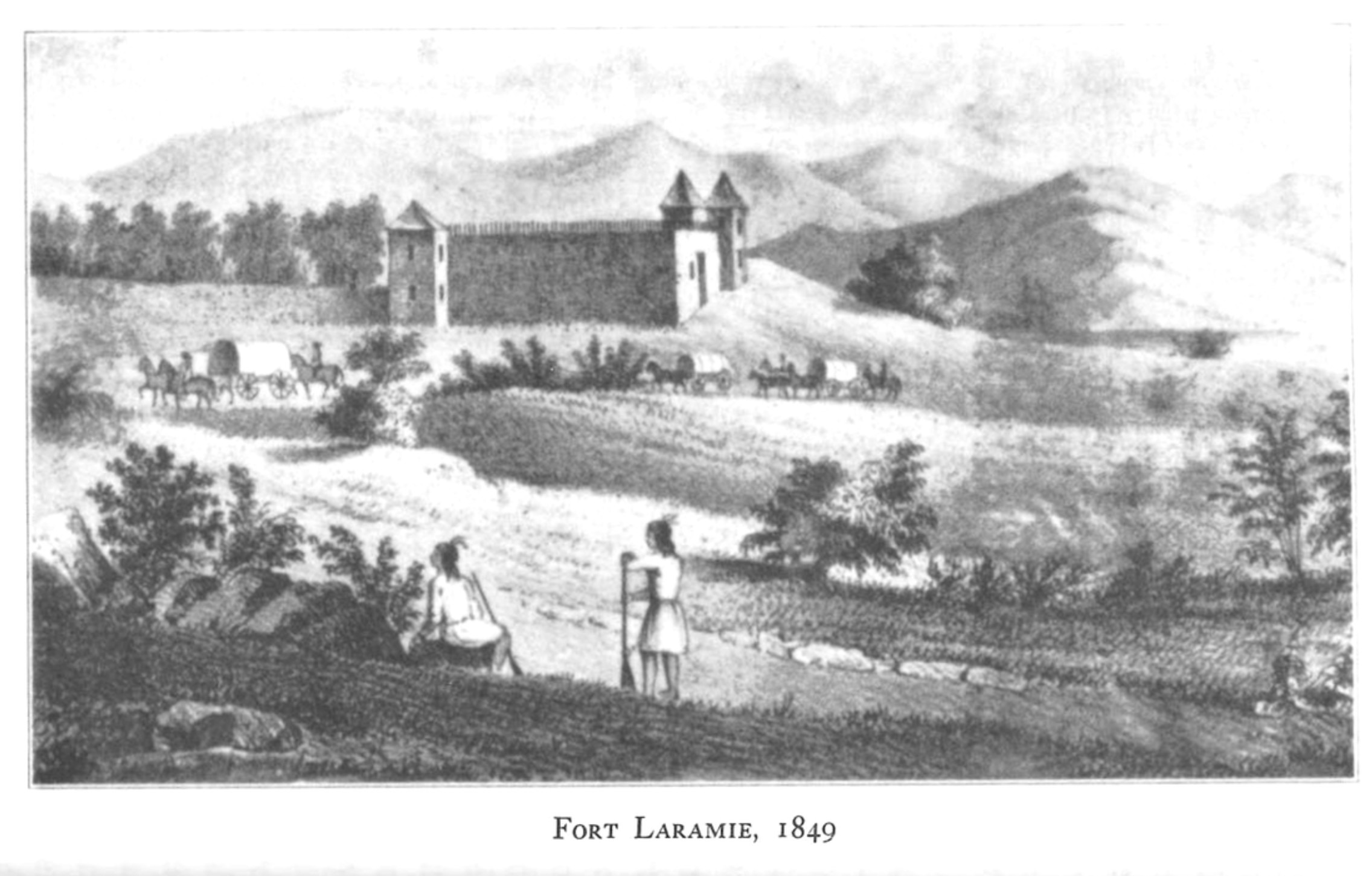
Friday, June 15. About four miles from camp we reached the commencement of the approach to Ash hollow. A large winding passage through the hills, which are here cut up in every direction by rains, ends in a precipitous descent of considerable difficulty. The sides of the bluffs exhibit strata of indurated clay, and the bottoms are filled with silicious sand and gravel. Gravel trails have been opened down this place and ox-teams pass without much risk, but mule-teams require to be eased down with a rope. The command descended without accident. The scenery of Ash hollow was a delightful change from the general monotony of the valley. Precipitous bluffs today arose on each side, the strata standing out in bold relief, while the stream that flows through it was shaded here and there by numerous clumps of the tree from which it takes its name. Emerging from this valley we reached the North fork, a stream much deeper and more narrow than the South fork and with clearer water. Similar ranges of precipitous clay bluffs extend on the left side. On the opposite [side] are ranges of low and rounded hills, said to be filled with pools of water. The hills on the left side soon receded from the river, leaving a marshy plain between it and the road. We marched today sixteen miles, being about seven miles and a half beyond the valley and making the width between the forks at the passage fifteen and one-half miles. On the road we found a note addressed to the commanding officer, recommending to his care a maniac, who had escaped from an emigrant train. Colonel Loring secured the man and had him taken care of, with the intention of conveying him on to [Fort] Laramie. His charity was further appealed to this evening on behalf of a woman, whose husband and two daughters had died on the route, and who was left with her team, a sick son-in-law and some younger children without assistance. Extra teamsters were furnished to convey her to the fort. Our camp tonight was in the plain between the road and the river. I noticed the appearance in the bluffs of conglomerate rocks formed of the same material as the strata before noticed. Some large masses had fallen down, and the enclosed pebbles were identical with the cement.
Saturday, June 16. The bluffs opposite the camp present a singularly castellated appearance. The road today [was] very sandy, and [we] found several ravines coming from the hills with beds of sand and gravel, one of them of considerable size, to which, in default of | another name, we gave that of Minnow brook. Beyond the point of hills [next] to this stream the bluffs sink again into low rolling ridges, similar to those on the opposite bank of the river. Some of those we passed today have been very picturesque, the tops assuming the forms of chimneys, towns, etc. The distance made was seventeen and three-quarters miles. [The] weather [was] unpleasantly warm.
Sunday, June 17. Marched twenty-one and one-half miles. Weather very warm, and [the] road in some places [was] heavy, though better than yesterday, Camped with right to the river on good grass. Two noted landmarks, the Courthouse and Chimney rock, are in sight of our camp.
Monday, June 18. The camp moved as usual. Two or three of us rode into the bluffs to visit the Court. house, or as it is often called, Solitary tower. After a far longer ride than we anticipated, we were astonished on reaching it at its immense size. The buttes which constitute this singular hill have been evidently a spur from the end of the chain of high bluffs of which Chimney rock, here distant fourteen miles, is an offshoot. Formed of the concrete already mentioned, they have been gradually absorbed by the heavy rains of this valley till they have taken their present shape. From the point of the road where we first saw them they presented the exact appearance of a square building surmounted by a dome. Farther on the shape varies and the tower stands out distinct from the remaining mass. On a near approach we found the former to be a huge circular mound rising perpendicularly from a sloping base. The latter, which is a few hundred yards farther west, is ragged and rises like a cone to a still greater height. The summit has been variously estimated at from six to seven hundred feet above the level of the Platte. The larger of the two only is practicable in ascent. We climbed up nearly to its top, but the wind which blew a hurricane deterred us from passing a point where the footing was insecure.
As it was, we had a fine view of the surrounding country and the valley of the Platte. There can hardly be said to be danger in the descent, except in wet weather, as the feet do not slip upon the dry clay. The bluffs of which these constitute a part stand some miles back from the river, with ridges of low hills and the bottom intervening. There lies between our last camp and the Courthouse a lateral valley, in the midst of which is the broad and sandy bed of a river known as Dry creek. Round the south side and under its walls winds a stream of excellent water, coming from the west and here turning north to the Platte. It has eaten its way deep into the hill, the side next the base of the tower being some fifty feet perpendicular. On every side deep ravines are also furrowed in the clay, from the rock down to the plain. We could see from here other hills in the course of being isolated from their ranges and cut down in like manner. The geological processes at work among those buttes are in fact of the highest interest. Owing to the yielding nature of the material, they go on with great rapidity as compared with other formations. The observer will find the cutting down of main and lateral valleys, the separation of continuous chains into peaks, the gradual destruction of the peaks by carrying down the material into the valleys, and the raising of the valleys into low bottoms going on within the reach of his eye with a distinctness he cannot misunderstand. I should have mentioned that under the clay bank overhanging the stream beneath the Courthouse, and on a level with the water’s edge, I noticed a layer of vegetable matter visible for a depth of two feet. [This was] similar to that which overlies brown coal and probably indicative of its existence.
Descending the Courthouse we found our horses quietly feeding in a ravine, and rode on towards camp.
I could not help reflecting upon the change which had come over this scene within a short year, its extraordinary causes and probable results. There were two of us, an artist from Boston and an ex-lawyer from New York, hunting the picturesque among the hills of the North fork of the Platte river with only one pistol between us, and that probably beyond discharging, miles distant from the great road, encountering only an occasional emigrant, and yet as free from danger as if we had been in Suffolk county or among the hills of Bergen. The country we were riding over was the war ground of the Sioux, where twelve months since men went only armed and in bodies sufficient to insure protection. The explanation was the line of white wagons which covered yonder road, the end who is to foretell?
Tired and hungry, for we had been out twelve hours with neither food nor drink except water, we charged into an emigrant camp and asked for some refreshment. Here too was a matter of wonder. In the midst of half a dozen wagons two women were cooking pancakes over a fire, a boy was churning butter, and men were splitting wood that they had brought in their wagons or fetching water from the river. They were emigrants from Connecticut via Ohio, and as I tumbled off my horse and emptied a can of buttermilk I laughed heartily at the luxuries they were enjoying, and which the army seldom sees. We found camp pitched on the river bank, twenty and one-half miles from the last, on good grass.
Tuesday, June 19. Mr. T[appan] and I again left the road to visit the famous Chimney rock, taking another long ride before we reached it, for the distance at which objects are seen upon these plains is immense. On arriving at the rock, formed of the same indurated clay as the bluffs, we ascended the cone to the commencement of the Chimney itself. The view from here was a fine one, disclosing many other points of similar but less developed forms. The Chimney has undergone much dilapidation within the memory of travelers, and a deep fissure from the top threatens no distant ruin. Around its base we found a stratum of much whiter material than the rest, probably containing a surplus of lime, and a seam was also visible near the top. These strata extended at about the same level through all the adjacent hills. On the sides of the cone we found the yucca just coming into bloom and everywhere the yellow cactus. We have now been some days in the country of the artemisia or bitter sage.
Leaving the rock we followed the camp, now a long distance in advance. About fifteen miles beyond the rock the road leaves the river and turns to the south of the high range known as Scott’s bluffs. We found the camps all together opposite to it, to the left of the road and in the wide plain which extends from these to a range of bluffs on the south side. Everywhere objects of interest now present themselves. The bluffs for the first time are covered with red cedar, heretofore found only in ravines, and the valley throughout its whole extent is covered with dry branches and trunks, evidently driftwood. Mr. Fremont’s theory is that these must have been washed down from the Black hills, but their distance is so great that I should have been disposed to question it, thinking it more probable that they either grew on the spot or came from the adjacent bluffs, were it not that they are everywhere intermingled with cones of the pine tree which nowhere occurs in this region. The soil of this region is everywhere thin, but the grass is good in the bottoms. A circumstance somewhat amusing but for its annoyance occurred today.
When the guide, accompanied by some officers, selected the camp ground, a fine stream of water was runnin down from the hill. As the very thing wanted, they fixed on a spot adjoining it, but when after pitching camp they returned to it, they were astonished to see it suddenly stop. The explanation soon suggested itself. 4 thunderstorm, which we had seen from a distance, had deluged the hills and the supply was copious for a time only. We went pretty much without water that night, The distance traveled today was about seventeen miles by leaving the river, and six and a half more to camp, A man died today of cholera, under circumstances which clearly indicated its origin in his case, as we had abundant evidence it had in others. He was seen drinking copiously of swale water during the march. Two hours after he was attacked with the disease and at night was buried. The water of the Platte valley, whether from the surface or from wells, seems invariably fatal, while that of the river, if drunk in moderation, has no bad consequences. The character of the salts which are seen efflorescing on the surface remains for analysis to discover.
Wednesday, June 20. Mr. T[appan] and myself again remained behind to sketch the bluffs. The valley enclosed between them seems about eight miles long and from five to six wide. It is surrounded on every side by precipitous hills [which] assume castellated forms, and is by far the most beautiful in point of scenery that we have met in the Platte country. After spending an hour or two among the hills we rode on, regretting that our time would not permit us to ascend them to enjoy the view of the Platte, of which we had already a glimpse. Near the head of the valley we encountered a brook of running water, up which we rode for two or three miles, the banks becoming higher and the ravine filled with
AY, JUNE 20. Mr. T[appan] and myself ned behind to sketch the bluffs. The valley ween them seems about eight miles long and six wide. It is surrounded on every side by hills [which] assume castellated forms, and > most beautiful in point of scenery that we the Platte country. After spending an hour ng the hills we rode on, regretting that our not permit us to ascend them to enjoy the Platte, of which we had already a glimpse. ad of the valley we encountered a brook of ter, up which we rode for two or three miles, iecoming higher and the ravine filled with ash trees and underbrush of roses, currents, and plums. On ascending toward the road we saw a little beyond us an Indian lodge, and riding towards it, to our astonishment, a log cabin. We amused ourselves with speculating whether some emigrant, tired of his journey, could here have established a “grocery” and on the probabilities of finding spruce beer and cakes under Scott’s bluffs. It turned out to be the “fort” of an Indian trader, who with his half-breed family had settled himself here, posted up a sign “Tinware, by A. Rubidue,” and occupied himself by doing blacksmith work for the emigrants in the interval of the trading seasons. As an appropriate memento I have posted up an enameled visiting card in the blacksmith shop. After sheltering ourselves from a passing thunderstorm we rode on. Emerging from the valley to the high ground beyond we caught the first view of Laramie’s peak, bearing nearly due west, and of other points in the range of the Black hills. The high bluffs on our left now bear away to the southward, and we come upon rolling prairie again. It deserves to be mentioned that the same strata of white clay and lime, referred to in speaking of Chimney rock and other points, ran continuously around the bluffs of the valley just passed, suggesting the idea that it has been excavated throughout its whole extent from a higher level in the same manner as the narrow ravines. We passed the ravines, one of which proved to be a bend of Horse creek, and found that the regiment had crossed the main stream and camped on the road between that and the river. The distance traveled was nineteen and one-half miles. The camp was named by Colonel Loring, Camp Taylor
Thursday, June 21. A few miles beyond the last camp we saw the sandstone formation on the right of the road noticed by Mr. Fremont, and farther on the same in the low bluffs which approach it to the left, The country today was very uninteresting, with sand-hills on both sides of the river. The road, however, [was] generally good. We camped nineteen and one. half miles beyond the last in a bottom near the river and to the right of the road. The grass on the main [road] was very much exhausted but good on an island opposite where we pastured the animals. Glenday and myself attempted to ford the main branch on foot, but found it too deep and rapid. Pebbles of jasper and agate are here abundant and some of them of fine quality, and the sand thrown up by the ants everywhere is granitic. Ash trees fringe the river at this point and [are] often of large size, but emigrants and Indians have committed sad waste among them. Weather oppressive.
Friday, June 22. Marched sixteen and one-half miles, reaching Fort Laramie. Finding the grass destroyed by the emigrants in its immediate vicinity [we] camped a mile or two above on the left bank of Laramie’s river without crossing. We found Major Sanderson’s command, consisting at present of company E only, already arrived and encamped on this side of the creek opposite the trading-fort. Major S[anderson], with [Lieutenant Daniel P.] Woodbury of the engineers, had proceeded some forty or fifty miles up the Platte to select the site of the new fort but we were most hospitably welcomed by Captains Duncan and McLane. The situation of this trading-post is well known from Fremont’s report. Hardly anything could be more forlorn or destitute of interest. The regiment, however, found excellent grass on the river in a pleasant spot fringed with trees where the facilities for bathing and washing our clothes were equally welcome. Laramie’s river is a cool, rapid, and tolerably clear stream, fordable easily in several places, and containing several varieties of fish. The hills in its immediate vicinity are barren and covered with quartz and agate pebbles and sand. The timber on its banks consists of ash and willow.
In the afternoon we had [an] amusing scene at the lower encampment. A corporal who had been sent out to find some missing horses brought in two, and with them an emigrant in whose possession he had found them. The company to which the man belonged had been pointed out to him as one of bad character, but no proof existed on which to found a conviction of horse stealing, nor was the arrest directed by any authority. Some of the younger officers and citizens traveling with the regiment determined, however, to make some fun out of the affair and organized a drumhead court-martial on their own account. A judge-advocate, the most noted was in the regiment, was appointed on behalf of the government and a citizen as counsel for the defense. The contest was carried on with due vehemence and personality, the prisoner of course convicted, and sentence of death passed upon him with awful solemnity by the president. Fifteen minutes were allowed him for preparation, at the end of which time he was taken with a lariat rope round his neck to a tree for execution. There a friendly officer interposed, attracted the attention of the guard, cast off the rope and told him to run as his last chance of life. The man, who was half dead with terror and had exhausted himself with tears and supplications, forthwith took to the water, dashed across [the river] amidst a volley of balls fired in every other direction but his, and ran for the hills with the speed of a greyhound. A more complete imposition was never practiced, and probably a more deserved punishment never inflicted, but the transaction was entirely without the knowledge of Colonel Loring and was censured extremely by him.
Saturday and Sunday, June 23 and 24. The command remained at their encampment to rest their animals, wash up, and prepare for the march through the Black hills on which we now enter. Orders had been given out to cut and dry a quantity of grass in anticipation of scarcity on the route, but Major Sanderson had returned with information that abundance exists for a distance of seventy-five miles above here on a route not followed by emigrants. We proceed tomorrow, therefore, at the usual hour. The only change in the disposition of the command is that Captain Rhett remains here and Captain [Mc]Lane proceeds with us.
We are now advanced one-third of the distance between Fort Leavenworth and the Pacific, and so far without any serious detention or other casualty than the loss of a few men by death and desertion. The carrying through in safety of so large a body at such a time, over so great a distance, is a work of the highest responsibility. We have as yet no reason to fear its successful accomplishment, and certainly none to doubt it, if a sense of that responsibility and an anxiety to sustain it on the part of those concerned can ensure it. As regards the emigrants, of whom information will be everywhere desirable, I regret to say that the forebodings entertained at an early period are fast becoming fulfilled. A great proportion indeed are persons of high character and ample means, but even these frequently suffer from the loss or giving out of their animals and are forced to abandon a part of their wagons. Other companies, not well assorted, have broken up from disagreement or broken down from weakness. Few, comparatively, have turned back indeed, but they are proceeding under circumstances which must be highly disastrous. The road is lined with broken wagons and abandoned provisions, and as destitution increases, so will robberies. The mortality from cholera has been considerable, but by no means as great as anticipated.
Monday, June 25. I hope to be able to write you again from Fort Plat[te].” The regiment has crossed the creek and is under way.
This letter goes by special express sent by Major Sanderson under charge of Captain Perry. A charge of two cents a letter is made to defray the expenses, and though open but a week, over three hundred dollars are already received.
G. G.
Notes
- The original lithograph, “Fort Laramie, 1849,” appears in Raymond W. Settle, ed., The March of the Mounted Riflemen (Glendale, California: The Arthur H. Clark Company, 1940), as the plate facing page 96; reproduced here from the scanned copy, page 94. ↑
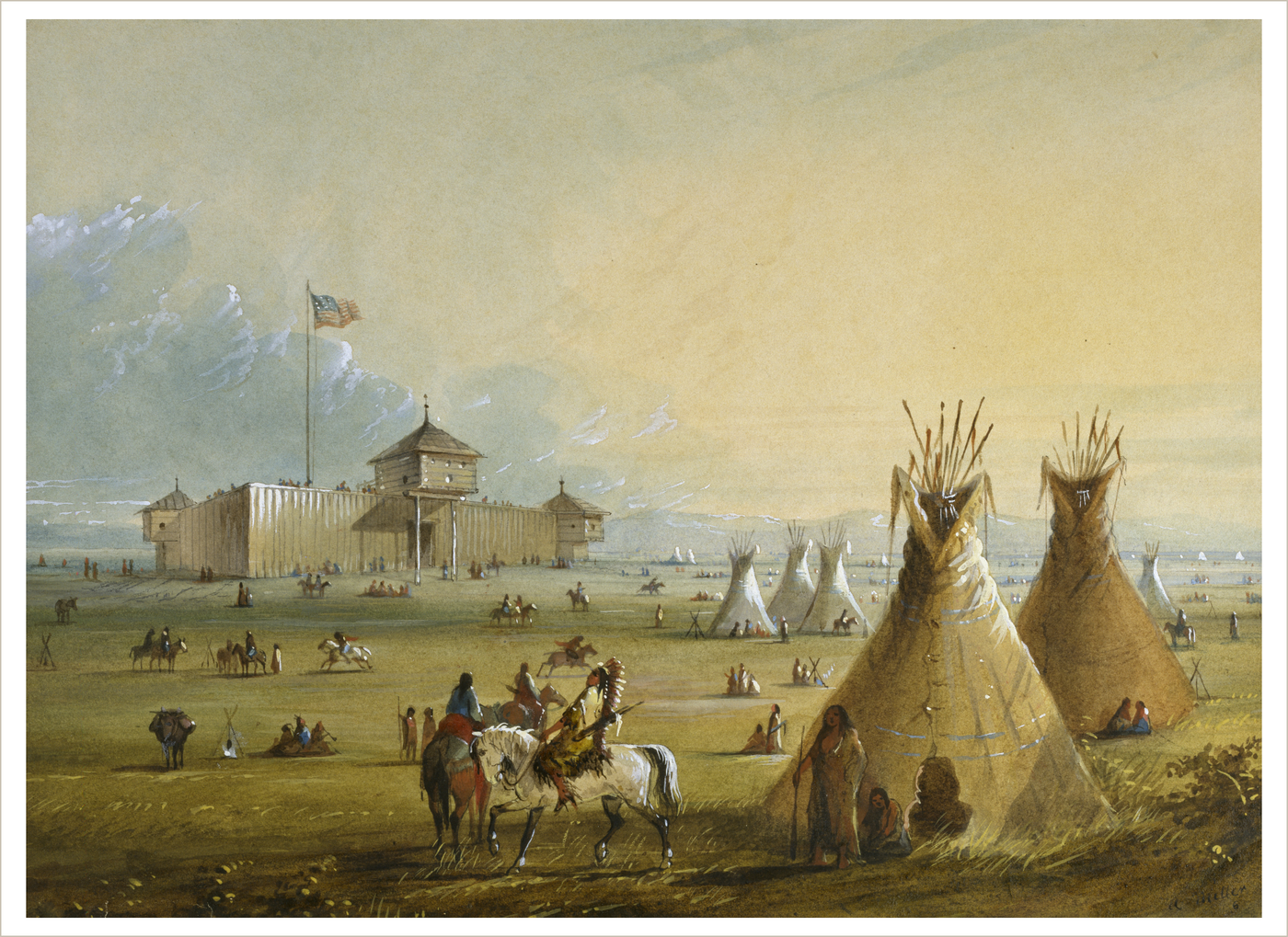
- “Fort Laramie,” watercolor by Alfred Jacob Miller (1810–1874), c. 1858–1860, after sketches from his 1837 journey; Walters Art Museum, Baltimore (accession 37.1940.49), public domain. It depicts the fur-trade fort (the log “Fort William”) that preceded the adobe Fort John of 1849. ↑