George Gibbs’s Diary of the Mounted Riflemen, 1849
Chapter 1
Into the Prairie: Fort Leavenworth to the Big Blue
May 13 to 22, 1849
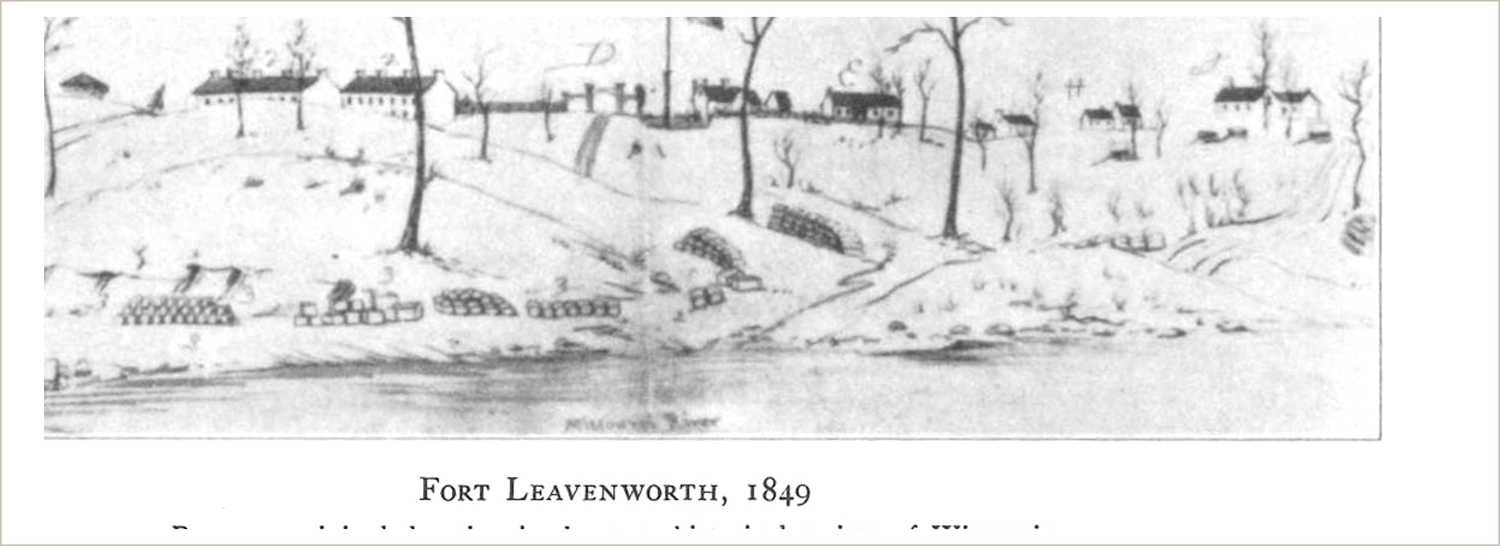
The surviving journal opens here in mid-passage, on the prairie west of Fort Leavenworth, near the camp Gibbs calls Camp Frederica. Editor’s footnotes have been set aside and obvious scan errors corrected; Gibbs’s own words are unchanged.
… sufficiently matured to afford healthy nutriment to our animals, [which are] accustomed to dry feed and grain, and an admixture of the old grass is sought for always in selecting a camp ground. Although upon Indian territory, the country being that assigned to the Kickapoos, etc., the diminution of these tribes and the disappearance of grain render the burning of the grass much less universal. A consequence is the increase of timber, which in a few years will doubtless clothe much of the land. Our guide, one long accustomed to western life and a man of much observation, states that within his recollection the timber had increased whenever the practice of burning was discontinued. Our camp was named after the daughter of an officer, Camp Frederica. The advance this day was about fifteen miles.
Sunday, May 13. Camp broke at seven a.m. Our march was about fifteen miles. The character of the country was the same as heretofore, and exceedingly picturesque. Our course during the day was generally northwest. About a mile out we had a last view of the Missouri river, some three miles to the right. Encamped some six miles from the river on excellent ground and with [an] abundance of fresh water. The road during the day was generally excellent, but with one very bad pass. During the ride a wolf was seen, some grey plover shot, and in camp a fine specimen of the swallow-tail hawk, falco furcatus, was seen. During the night we had a heavy thunderstorm with hail and high wind.
The supply train, owing to detention in passing the ravine, did not reach camp.
Monday, May 14. The camp did not break up until late, owing to the detention of the train. We passed several bad hollows or sloughs [which were] rendered soft by the rain of last night and advanced only four miles, The ground selected was a low and small village, with grass and good water, but a steep descent. The camping ground, I may here mention, is selected by the guide, who precedes the column with a small escort and fixes upon a suitable spot at about the distance intended for the day’s march. The first requisites are of course good grass and water, and finally wood for the camp fires. Of the latter very little is indeed necessary, a few sticks furnishing sufficient for a mess. Some of the officers’ messes are provided with portable sheet-iron stoves, but the fires are usually made in a small hole to protect them from the fresh wind of the prairie.
Tuesday, May 15. The camp broke up at seven [o’clock]. The road [was] still somewhat broken. At about six miles out we reached Wolf creek, a small stream running toward the Missouri [river]. The passage was here very bad, with a steep winding hill to ascend afterward. These passages, [crossed] with considerable labor and anxiety, furnish at the same time much excitement and even amusement. As each team approaches in turn, the wheels are locked, the mules led down the hill, and then, the chain being taken off, amidst a storm of blows, curses, and shouts, are run up the opposite side. With unbroken or unmatched teams, as ours are at present, this is a matter of no small difficulty, the wheel mules often refusing to draw or hold back as required, the forward ones kicking out of their traces or plunging from side to side, sometimes getting the wagon stalled in the mud [and] at others running in imminent danger of upsetting on the bank. Occasionally a pole or axle breaks and the whole train is stopped for the time. The forge comes up, extra poles are obtained and put in, and the shouting and whipping commence. To one unaccustomed to mules it is a matter of wonderment that they are not oftener ruined. The little wretches involve themselves in most inexplicable ways in their chains and harness, plunging, kicking, and falling on one another with a vicious perseverance that would kill a train of horses, and generally with as little injury to themselves as if they were of hammered iron. The duties of the wagonmasters of [the] division and their subordinates are at these places harassing enough and demand no little patience and presence of mind.
All those brooks which have given us so much trouble could have been avoided, had the trail been run a few miles farther west of the Missouri river.
About three miles from Wolf creek the [Fort] Leavenworth [road] strikes into the great trail from St. Joseph, now the most traveled of all the routes. The town of St. Joseph, one of the principal outfitting towns in western Missouri, has been created entirely by the business of the emigrants and is of so late an origin that its very name is not given on the maps. We have begun to encounter the emigrant trains in numbers, winding slowly along with their white-topped wagons and trains of oxen and mules. In passing over this district, than which few can be more beautiful, the eye wanders in search of the familiar farmhouse and the barn, built upon some little knoll by the brookside, that greets the eye in our eastern landscape. I often found myself almost cheated into the belief that the canvas covers of some emigrant train, seen in the distance, were the fixed residence of the white man. But no smoke except that of the campfire rises here. The Indian himself is unseen, and so peaceful is all around, that the weapon which every man carries seemed a useless plaything.
Our route was intersected or joined by a number of smaller trails, some of them the perhaps immemorial war paths of Indians. Others [were] distinguished by their wheel marks as the roads made by emigrants from distant points on the Missouri. I noticed today, and frequently afterward, circular spots or rings on the prairie where the old grass remained unburnt in the midst of an extent of fresh verdure. These the guide explained as places where horses had been picketed the previous year, or where a corral had been formed. We found a good camping ground about a mile southeast from the road, some twelve miles from the Missouri, and fourteen or fifteen from our starting point. The descent into it [was] bad, but [it] contained good water and [was] well protected. The evening was passed till a late hour round a campfire, and enlivened with merry chat and songs.
Wednesday, May 16. It being deemed advisable to rest the animals, the camp did not move today. I went on with Mr. Glendery [Glenday], the guide, and a party to seek a position for the next. We rode perhaps sixteen or eighteen miles. The trail, which is here very broad and beaten like a turnpike, was covered with emigrant parties, who continued passing at intervals during the day. These parties vary much in numbers and much in the appearance of the individuals and the apparent completeness of their outfit, some being in excellent order [and] others hardly removed from destitution. I noticed that but few. women or children accompanied them. They are chiefly made up from single towns or districts, less often of combined parties, and as yet they are not banded in large companies. Most of their wagons are drawn by oxen, from three to seven yoke to a team. It is hardly necessary to say that they are bound for California, and I learn that the most extravagant hopes animate most of them. Bitter disappointment is perhaps in store for all; distress and death for many most certainly. At points along the road we saw frequent cards and notes stuck on the top of sticks containing information to friends behind. The grass along the road is now almost eaten, and good camping grounds in its vicinity for so large a body of men as ours are scarce. The wood is also here less abundant, though patches of it show on either side in the bottoms. It should be noticed that the route is carried wherever practicable along the summit of the dividing ridges between the streams on account of a more level and drier track, [thus] avoiding the smaller ravines and swales. We are therefore often obliged to diverge for some distance. The turf on the prairie is several inches in thickness, very tenacious, singularly smooth in surface, and unless softened by recent rain affords a good road anywhere. This therefore seldom gives us much trouble. The country for some extent beyond this is well watered, and we rarely travel three or four miles without meeting places which would be suitable [camping places] in ordinary times.
We passed today a few sloughs, but the road generally was better, being drier. The sloughs are formed by the settling of the water in the swales or depressions leading into the ravines, which in turn empty into the streams. The turf once broken, the whole is converted, SSE EEE EE EELEESS, E, >, _, EE_ by passing in wet weather, into a tenacious and deep bed of mud, through which the wagons are drawn with difficulty, as they sometimes sink to the axles. Ours are very heavy at present and detentions frequently occur,
On the right of the road we had occasional glimpses during the day of the high and wooded banks of the Missouri, now at a considerable distance. We returned early in the afternoon, having selected the ground for next day’s encampment. At night we had more rain, and the howling of the prairie wolves made a doleful accompaniment to the storm.
Thursday, May 17. Broke up at seven [o’clock]. We found the road good except the crossings, and reached camp at an early hour without accident. The ground was a good one, situated to the left of the road, about sixteen miles from the last. In the evening some of us went to bathe in the brook, which was no small gratification after a week’s toil. One of the men caught a striped prairie squirrel, a female with young.
Friday, May 18. Camp moved at six [o’clock], the regular hour for moving being resumed. I again went forward with the guide to select a position for the night. We passed a number of emigrant trains, some of which had now become old acquaintances. Two or three meetings constitute such on the prairie, and hearty salutations were exchanged as we went on. There are odd characters and odd vehicles among them too. Every profession and every class in society are represented, and every mode of conveyance from the Conestoga wagon and its lumbering oxen, and the light draft mule-team, to the saddle horse. We even saw a doctor’s buggy with a bell-pull fastened to the hinder axle. The route today grows more monotonous, the divides longer, and the timbered streams more distant from the road and of less frequent occurrence. On either side we saw vestiges of campfires, but all [made by] whites, for the Indians are now mostly at their villages engaged in planting corn. A practiced eye readily distinguishes the fire made by an Indian from that of the emigrant or even the hunter. The white man lights his wood in the center of the sticks; the Indian always at the end, moving it up as it burns. The scarcity of wood in the prairie has taught him this lesson of economy. We passed today two bad sloughs on the opposite sides of a hill, and after five hours’ march selected a camp to the left of the road, some twenty miles from that of last night. It had been previously occupied and the grass was thin, but the situation [was] good and water plentiful. The trees in this bottom, as in most of those we have visited, were sour elm and scrub white oak. I strolled with my gun up the stream, but shot nothing. The birds particularly noticed today were the turkey buzzard, common crow, buffalo birds (the cow bunting of the east), doves, small woodpeckers, and a number of the sylviae, upon which I could not waste shot. The yellow-throated blackbird was also constantly seen in the flocks of the buffalo bird. Flowering plants were numerous, but none of them [were] of rare varieties.
To this camp was given the name of Camp Mary. We passed another merry evening at the tent of an officer, to whom a benevolent Irishman had given a bottle of ancient whiskey on condition that it should be drunk beyond the bounds of civilization, and heard the next morning’s reveille with our usual regret.
There was another thunderstorm during the night, fully justifying, in our opinion, the anathemas which our guide passed upon this district, [which is] said to be particularly subject to heavy rains.
Saturday, May 19. A slight fall of rain occurred early this morning. Our course today lay nearly due west over the tops of long ridges. A heavy shower with hail fell about ten, the sky clearing off at noon and exhibiting the exquisite valley of the Great Nemaha, The approach to this stream-on either side of the road is beautiful, the banks of the ravines being covered with wood. The river itself is small, notwithstanding its name, being at this time only some twenty feet wide and about a foot deep. The.general course is here north. west, but its bed is very winding. The banks are high, disclosing horizontal strata of fossiliferous limestone, some of the enclosed shells preserving the nacre. I noticed also a number of recent shells in the mud of the bottom, but found no live specimens to preserve for identification. The pioneers had here constructed a tolerable road and we passed safely. The passage itself was highly picturesque, and I spent a pleasant hour or two in watering the teams and reading the various inscriptions which the Pilgrims of the West had left upon the trees announcing their arrival at this point of their long journey. Ascending the opposite bank we found a pretty and level plain, from which again arose the spurs of another dividing ridge. Here stood the newly-made grave of an emigrant marked by a rude headboard, with his name and the date of his death affixed on a scrap of paper. His search for the gold of the Sacramento had been soon ended. How will it be with the rest? About five miles farther on, and some twenty from our last place, we found our camp, which was named Almira. Strolling around the hills, I picked up some fragments of the lily-like stems of a zoophyte, and noticed an abundance of quartz pebbles and large boulders, one of which was split as if by lightning. The evening we again passed round the campfire of an officer, and the scene that our party exhibited was one not to be forgotten. The night was blackness itself; a wind such as blows only on the prairie or on the sea roared around us, a blazing fire was built under an enormous mass of red quartz rock, [and] around it lay on their blankets some twenty men in the rude costume of the march, our old guide among them. On its top stood some half dozen others leading the chorus which thundered from beneath to the good old song of “Benny Havens, O!” As the firelight danced on their faces I could not but recall the pictures of Salvator and regret that the inspiration of such a pencil was wanting here.
Sunday, May 20. Again went in advance with our guide, leaving camp a little before six [o’clock]. About five miles out struck a branch of the Nemaha [river, where] there were two crossings that needed repair. It has been a matter of regret all along that the government did not send a body of pioneers a month previous to prepare the road between [Fort] Leavenworth and Fort Kearny by throwing bridges over the most difficult places, or marking out roads that might avoid them. The expense would have been trifling in comparison to the immense advantage both to the emigrants and ourselves. In most cases sufficient wood could be found for the purpose in the immediate neighborhood, and in others a few wagonloads of brush, easily procured within a mile or two or carried along from one place to another would have saved hours of delay and often the breakage of wagons. The crossings rarely need mending for more than twenty feet, and a number of the worst could have been turned by a circuitous march of a short distance. These we had of course no time to explore.
As it is, we have been of great service to the emigrants who follow us. I could not but pity some whom we occasionally met on the road, with their wagons broken and no means of repairing them. The regiment was unprovided with materials beyond their own immediate wants, and though our forges have been kindly employed in many cases for their relief, our march is necessarily too hurried to delay a moment. It is, however gratifying to observe that the emigrants are generally kind to one another, as well as that their conduct for the most part is exceedingly courteous and orderly, A few companies, we hear, have earned themselves bad names, but all that we have met have been as well behaved and well bred as [those] one would meet on a country road in the old states. Many are, in fact, led by men of high standing and composed of the most substantial class of the community. [It is a] pity that such should leave the comforts of civilized life to endure the sufferings that must await them before they reach the Utopia of the West.
This morning we again encountered heavy showers, The camp was selected to the right of the road, with good water, but wood scarce. This last item, the least important in our own calculations is, I observe, one of the most in that of the emigrants. “How far ‘is it to timber?” is a question often asked of us as we return from our morning scout.
Monday, May 21. We have now reached the dividing ridges of the waters running directly eastward to the Missouri and those running more southerly into the Kansas or Kaw, which empties into that river below our own starting point, our general course having been at first much to the north and west. Since crossing the Great Nemaha we have kept more westerly, following the ridge between that stream and the Little Nemaha, and we are now approaching the Big Blue. Leaving camp a little before six [o’clock] I overtook the guide, and at a quarter before nine reached a small branch or ravine running about westward. Here we found a very bad passage, but it was fortunately turned by the pioneers who followed. At ten [o’clock] we struck the valley of the Big Blue itself. Crossing the river the guide selected a camp about a mile beyond to the left and with the rear to the road. We then returned to witness the passage of the column. The river was at this time about twenty-five yards wide, and up to our saddle girths at the ford, with steep banks some twenty feet high. The bottom [was] hard and covered with pebbles of flint, quartz, and red jasper. The spurs approaching the valley are terraced with great regularity, strata of limestone and blue flint appearing on their edges. The highest of these terraces, it may be observed, are often more fertile than the second tables, from which the soil is generally washed. In the bed of the river were quite extensive bars of quartzose sand. Its banks were lined with sour elm, maples, cottonwood, and willows, with an undergrowth of seringa and other shrubs. The scene of the crossing afforded the usual amusement, the mules being most unwilling to take to the water, and often obliging the teamsters to rush through up to their middles. All however passed in safety. Our camp here was called Camp on the Big Blue. A short distance from it was a beautifully wooded bend of the river in which we bathed. In the evening we had another squall of rain. Our general course during the day had been to the south of west, and the viameter, now for the first time used, and which was attached to the forge, gave sixteen miles as the distance traveled.
Tuesday, May 22. [The] column moved this day only eight and a quarter miles by the viameter and mules needing rest. Grass excellent, the water [was] not so good, [but] enough however [was] found in pools. We now pass the graves of emigrants daily along the road, their inscriptions generally giving cholera or dysentery as the cause of their death, and on inquiring [we find that] almost every company has lost one or two members. [We] noticed cows frequently yoked in the teams with bulls and oxen. They are said to draw very well, but their milk must be unwholesome. The ox-teams keep very well up with the train, making fifteen miles on an average per day. In some respects they are preferable to mules, as they improve in condition so long as the grass holds good, are more easily tended, and less liable to escape. When, however, the grass is more exhausted I apprehend that they will suffer much. We are now on the war grounds, and although we have literally not seen an Indian since leaving Camp Sumner, greater precautions are deemed necessary, and for the first time we form a corral. This is made by enclosing a space within the wagons and tents, into which the animals are driven at night. The emigrants are nightly losing horses and mules, but whether from carelessness or theft it is difficult to tell. There is a report that buffalo have been seen today by one of the companies, but it is doubted. Our camp is called Camp Ann. During the night another shower fell.