NW Boundary Journal — Pages 41–46
Zoological Field Notebook · 1859–60
NW Boundary Journal — Pages 41–46
Miscellaneous zoological notes
Later zoological notes — swallows, coyotes, deer, and Coast Salish faunal names — before the notebook’s blank endpapers.
Page 41
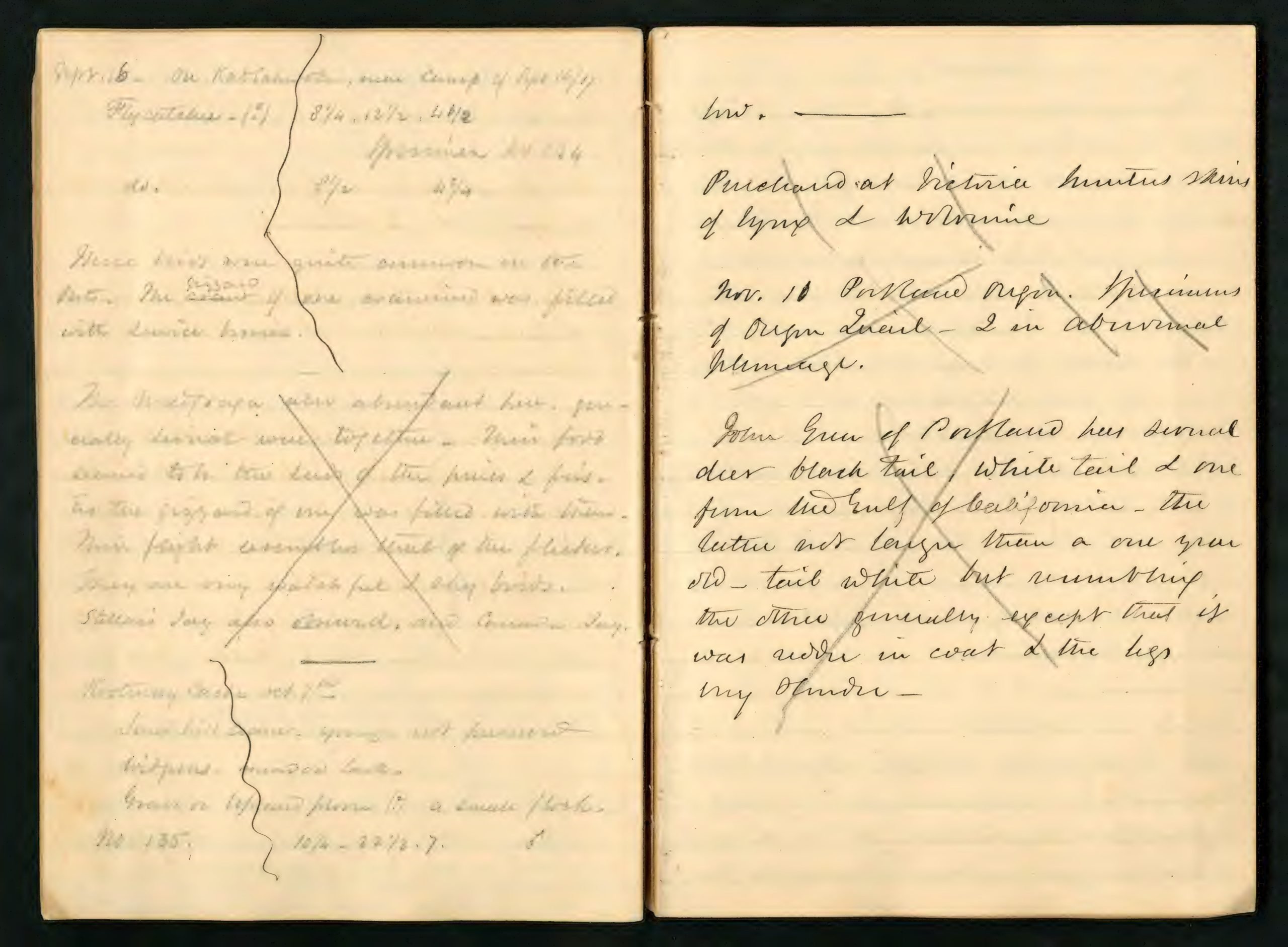
[Two-page spread. Several paragraphs on the left page and most of the right page are struck through with large diagonal X or slash marks (indicating the notes were copied out elsewhere).]
[Left page]
Flycatchers – [♀] 8/4, 12/2, 4 1/2
Specimen No 124
These birds were quite common on the [river?]. The [gizzard?] of one examined was filled with service berries.
The woodpeckers were abundant here, especially [larvæ?] were [together?] – Their food seemed to be the seeds of the pines & firs. The gizzard of one was filled with them. Their flight resembles that of the flickers. They are very [spiteful?] & chirp [briskly?]. Steller's Jay also occurred, and Common Jay.
Kootenay River Oct 7th Snow bird common. [spring?] not [pursued?] Widgeons [numerous?] ducks. Grouse or [Pheasant?] [?] a small flock.
[Right page]
Purchased at Victoria [hunters'?] skins of Lynx & Wolverine
of Oregon [Quail?] – 2 in Abnormal Plumage.
John Green of Portland has several deer black tail, white tail & one from the Gulf of California – the latter not larger than a one year old – tail white but resembling the others generally except that it was redder in coat & the legs very slender –
Page 42
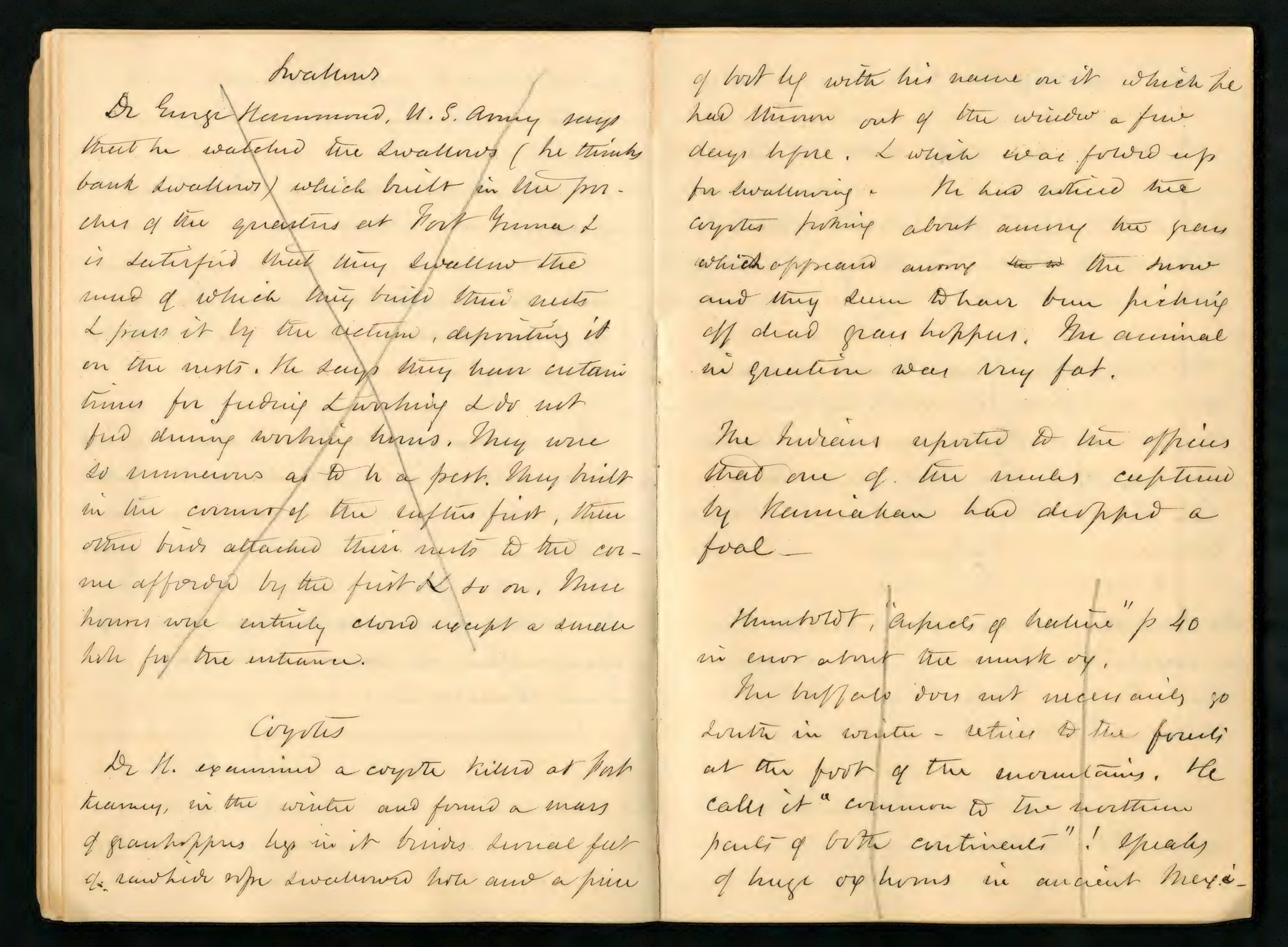
[Two-page spread. Faint diagonal slash marks cross parts of both pages.]
[Left page]
Swallows Dr George Hammond. U.S. Army says that he watched the swallows ( he thinks bank swallows) which built in the porches of the quarters at Fort Yuma & is satisfied that they swallow the mud of which they build their nests & pass it by the rectum, depositing it on the nests. He says they have certain times for feeding & working & do not feed during working hours. They were so numerous as to be a pest. They built in the corner of the rafters first, then other birds attached their nests to the cornice afforded by the first & so on. These [houses?] were entirely closed except a small hole for the entrance.
Coyotes Dr H. examined a coyote killed at Fort Kearney, in the winter and found a mass of grasshoppers legs in it besides some fat & rawhide [when?] swallowed here and a piece
[Right page]
of boot leg with his name on it which he had thrown out of the window a few days before. & which was folded up for swallowing. He had noticed the coyotes picking about among the grass which appeared among the snow and they seem to have been picking off dead grasshoppers. The animal in question was very fat.
The Indians reported to the officers that one of the mules captured by Kamiakan had dropped a foal —
Humboldt, "Aspects of Nature" p 40 in error about the musk ox. The buffalo does not necessarily go south in winter – retires to the forests at the foot of the mountains. He calls it " common to the northern parts of both continents"! Speaks of huge ox horns in ancient Mexi-
Page 43
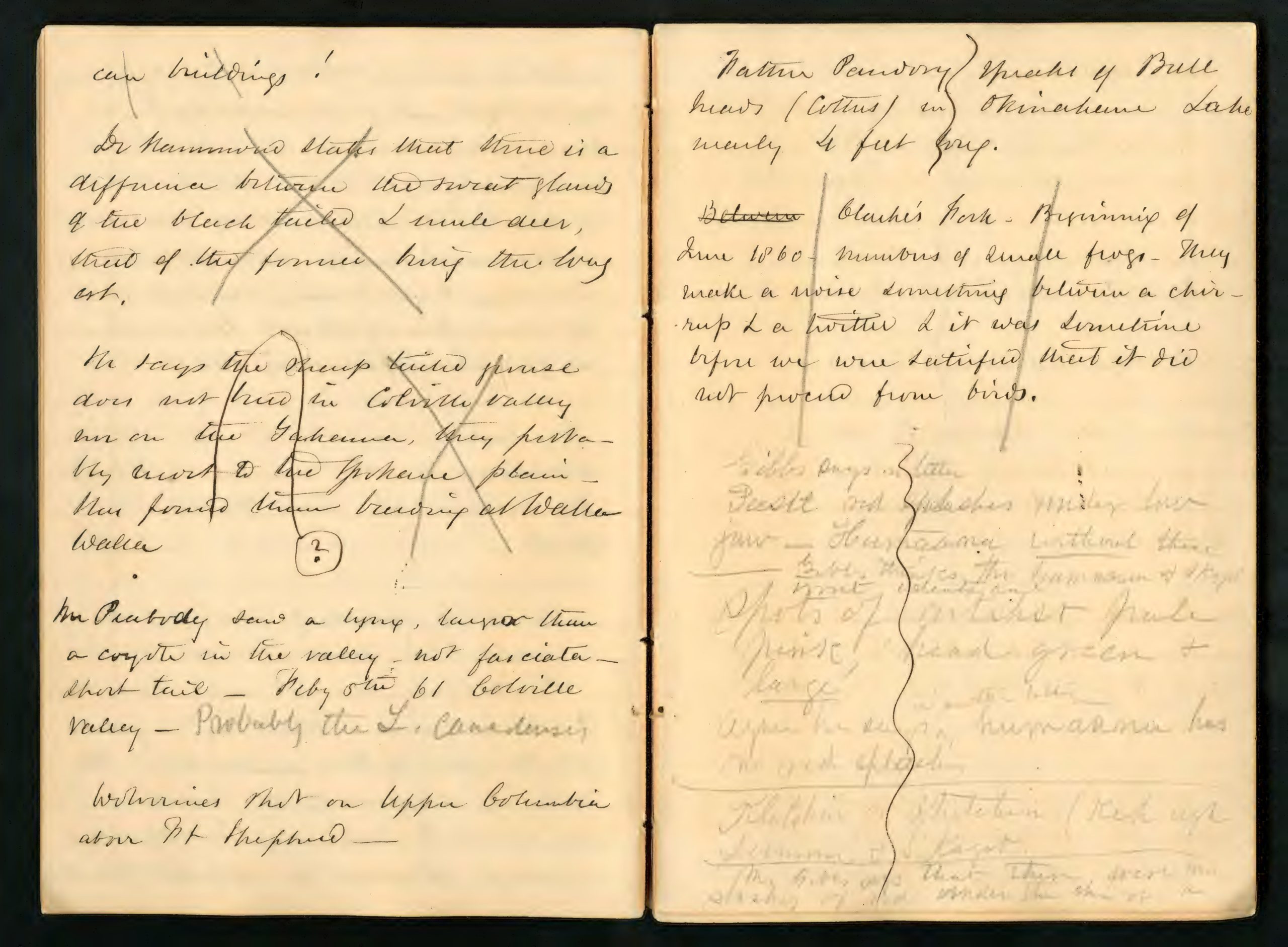
[Two-page spread. Ink text on the upper portions; the lower right is faint pencil and largely illegible. Two paragraphs on the left page are struck through with large diagonal X marks.]
[Left page]
can buildings !
Dr Hammond states that there is a difference between the sweat glands of the black tailed & mule deer, that of the former being the longest.
He says the [sharp?] tailed grouse does not breed in Colville valley nor on the Yakima, they probably [resort?] to the Spokane plain – then found them breeding at Walla Walla [?]
Mr Peabody saw a lynx, larger than a coyote in the valley – not fasciata – short tail — Feby 5th 61 Colville valley — Probably the L. Canadensis
Wolverines shot on Upper Columbia above Ft Shepherd —
[Right page]
Father Pandosy[?] speaks of Bull heads (Cottus) in Okinakane[?] Lake nearly 4 feet long.
[Between?] Clarke's Fork – Beginning of
make a noise something between a chirrup & a twitter & it was sometime before we were satisfied that it did not proceed from birds.
[Faint pencil, largely illegible:] Edible frogs [?] letter Prestl [?] [splashes?] under lower jaw — Hasmasona without them [Baird?] thinks the [Rana?] [?] & [?] Spots of [?] pale [green?], head green & large Upon the [?] [?] Hasmasona has [?] [?] [?] [Klikitat?] [?] [?] ( Kish up [Salmon?] [?] figs. [They?] [?] says that there were [?] [?] of [mud?] under the [?] [?]
Page 44
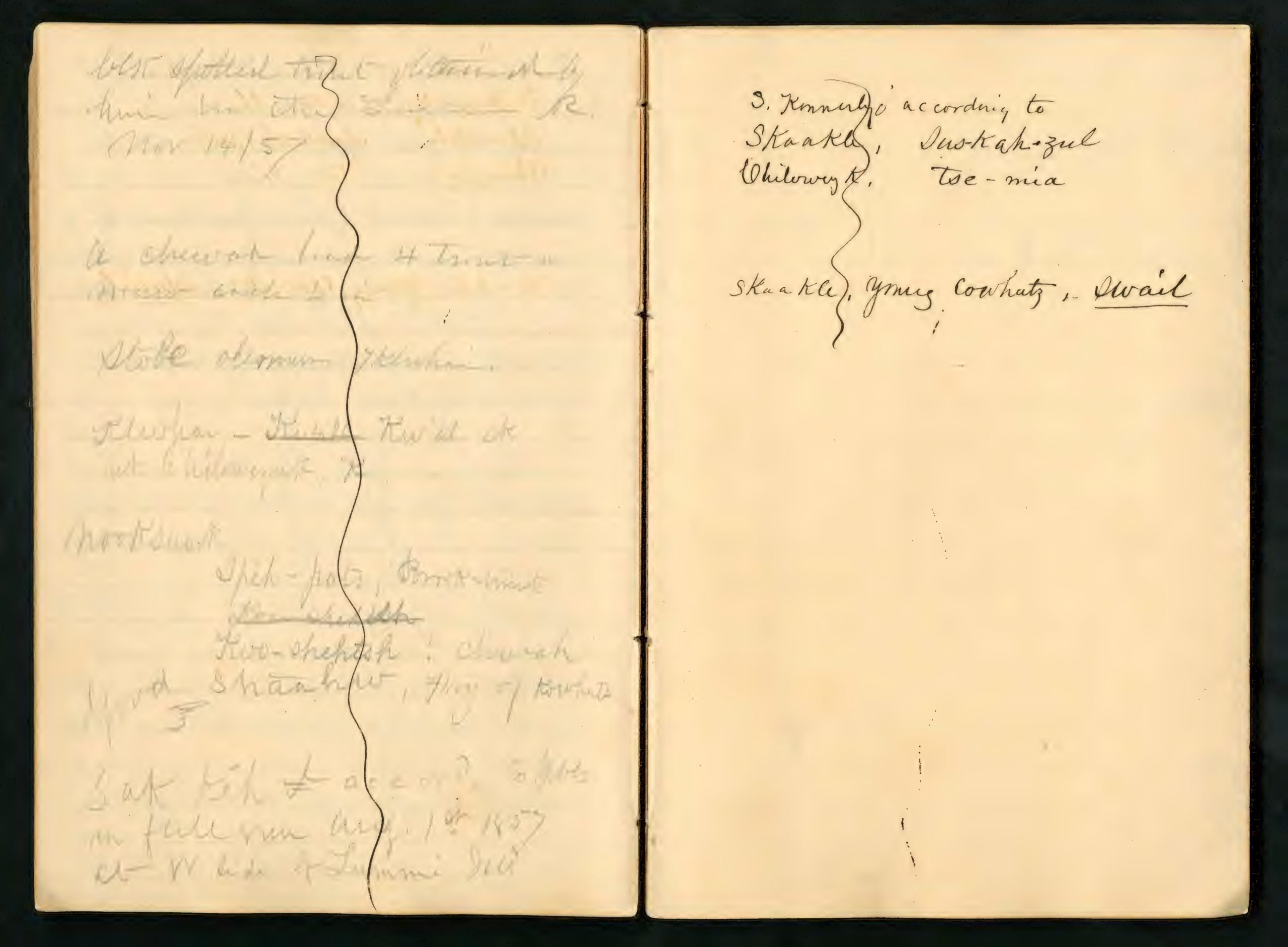
[Two-page spread, mostly faint pencil and difficult to read. The left page is a list of fish and Indian (Coast Salish) names, largely illegible. The right page is nearly blank apart from a few lines of Indian place/tribal names in the upper portion.]
[Left page — faint pencil]
[blk?] spotted trout [?] [?] [?] [?] R.
A [chinook?] [?] Trout [?] [?] with [?]
Stobe [?] [Klikitat?]
[Klikitat?] — [?] Kwil [?] at Chiloweyuk R.
Nooksack Speh – [pots?], [Brook trout?] [?] Kwo-shehtsh : chinook [?] Skaahw, [Hog?] of [trout?]
[Salmon?] [?] according to [?]
at W side of [Lummi?] [Isl?]
[Right page]
3. [Komnuljo?] according to Skaakle, Suskah-zul Chiloweyuk, tse-mia
Skaakle, [Ymug?] cowhatz, – Nwail
Page 45
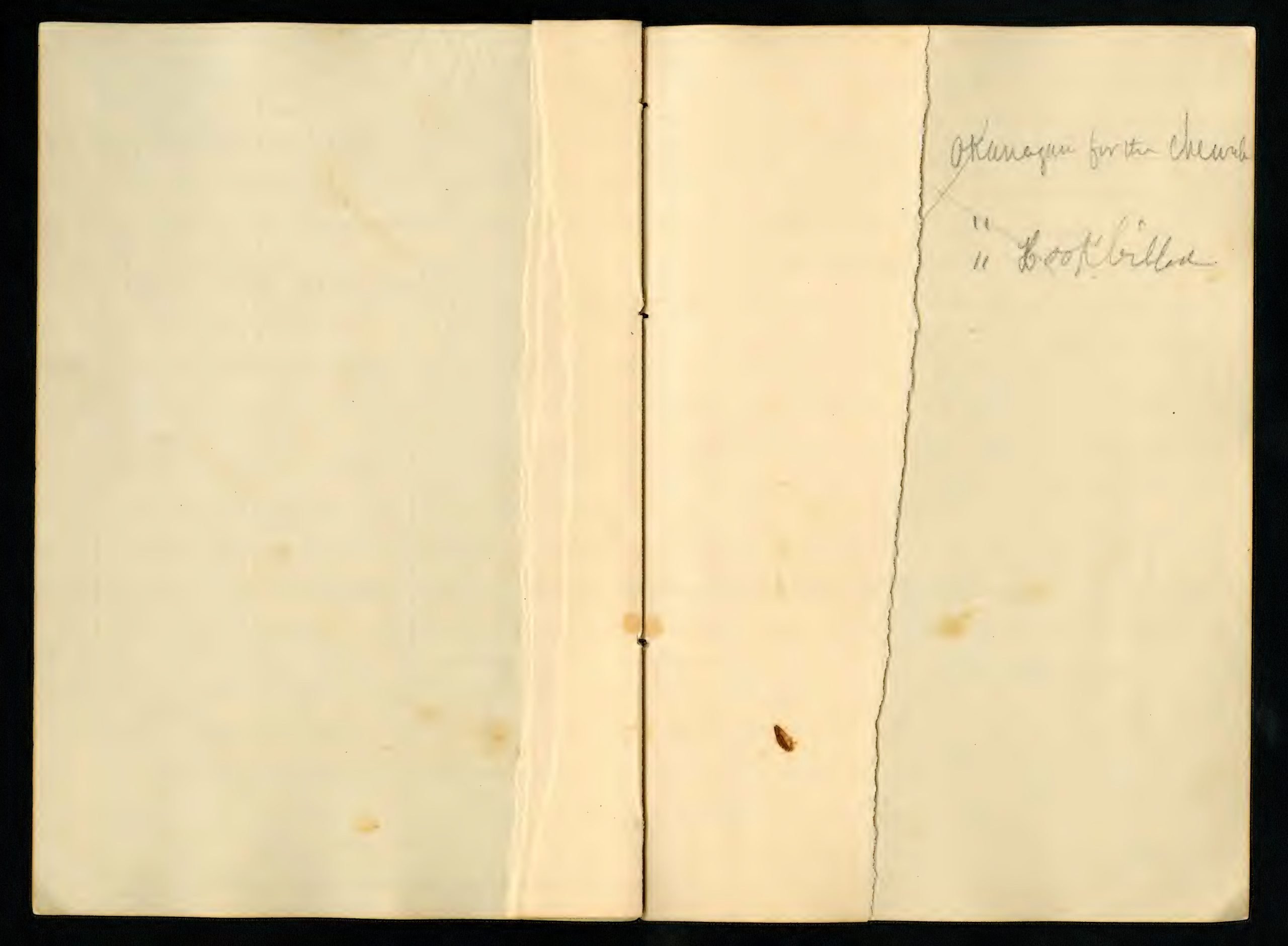
[Two-page spread, nearly blank. The left page is blank. The right page has a few lines of faint pencil in the upper right corner.]
[Right page — faint pencil, upper right]
Okanagan for the Chinook
" hook billed
Page 46
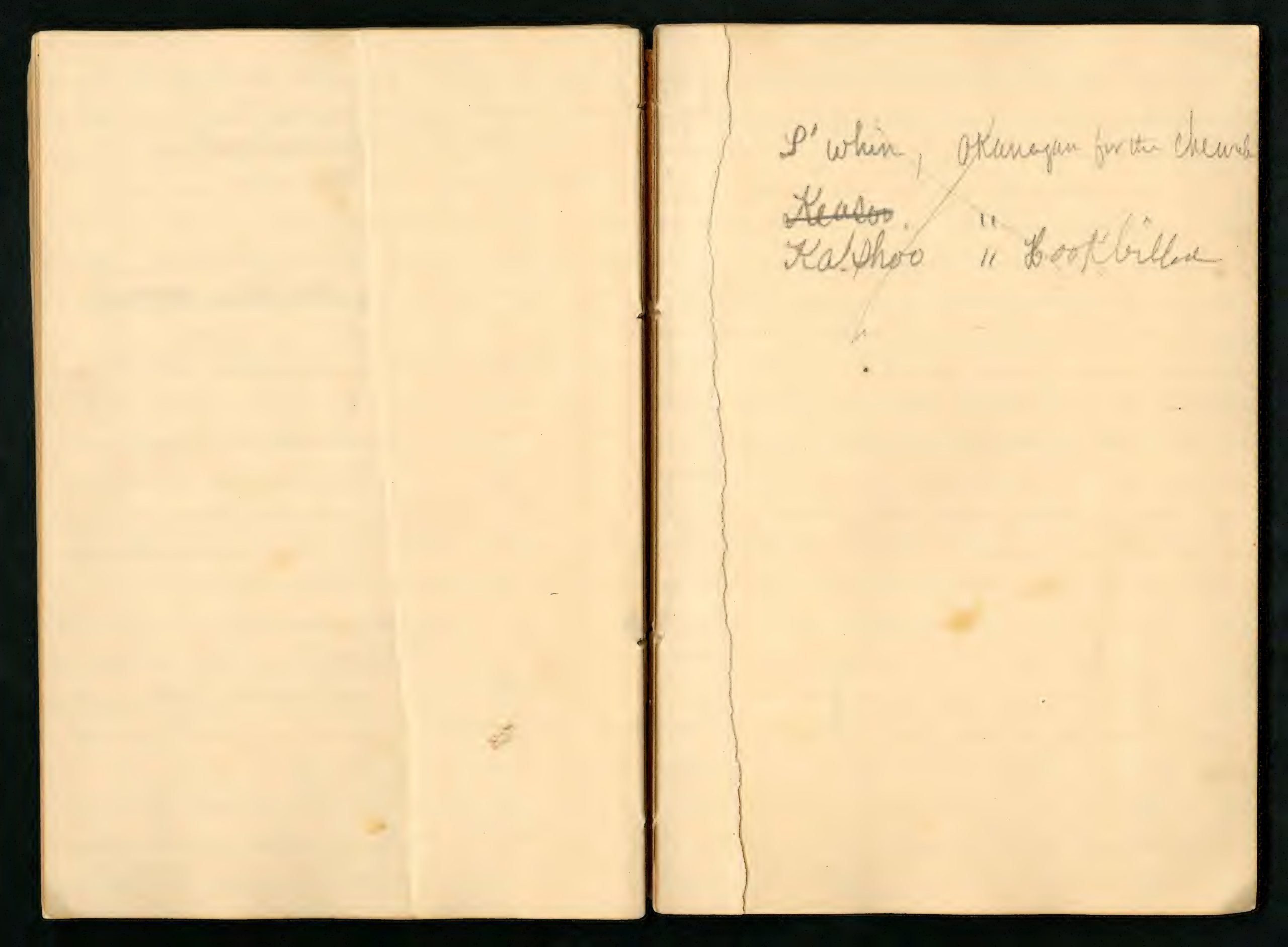
[Two-page spread, nearly blank. The left page is blank. The right page has a few lines of faint pencil in the upper portion; one word is struck through.]
[Right page — faint pencil]
S'whin, Okanagan for the Chinook [Keaoo?] Kalshoo " hook billed
Views: 8