Alphabetical Vocabulary of the Chinook Language (1863)
The George Gibbs Project · A Work Restored in Full
Alphabetical Vocabulary of the Chinook Language
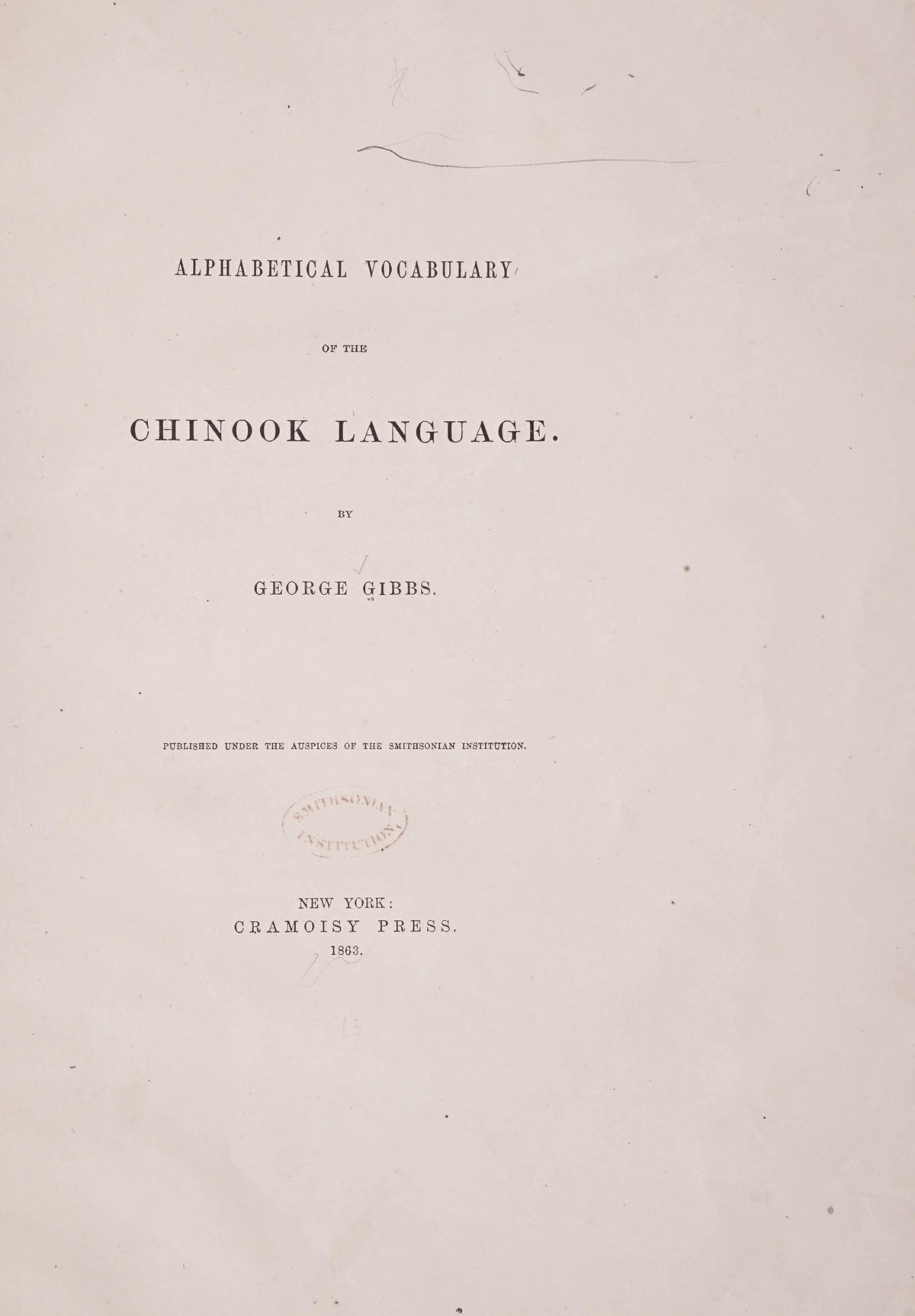
George Gibbs · Published under the auspices of the Smithsonian Institution · New York, Cramoisy Press, 1863
Preface
It should be premised that the following Vocabulary was collected at different times and from different Indians, and has never been revised with the assistance of one person. It undoubtedly contains words of two dialects, the Chinook proper and the Clatsop, and probably also of the Wakiakum. The words themselves, however, it is believed, are generally correct, and in some instances the dialect has been noted. The only apology for publishing it in its present form is, that the Indians speaking the Chinook language are so nearly extinct, that no other, better digested, is likely to be made, and that even thus it affords means for a much more extended comparison of this with other Indian languages than now exists.
The nation, or rather family, to which the generic name of Chinook has attached, formerly inhabited both banks of the Columbia River, from its mouth to the Grand Dalles, a distance of about a hundred and seventy miles, and was, as usual among the sedentary Indians of the west, broken up into numerous bands, each having its own village and chiefs, and possessing its special name; no common appellation being adopted by themselves, unless it might be the word signifying “people,” or “the people.”
Mr. Hale, in his Ethnography of the U. S. Exploring Expedition, has divided these into Upper and Lower Chinooks; the latter, as I suppose, intended only to include the Indians between Oak Point
and the mouth of the river. Very probably an intermediate or middle division would have more accurately described them, embracing that part of the territory between Oak Point and Fort Vancouver. The present vocabulary belongs to those nearest the mouth, of which there were five principal bands.
Mr. A. C. Anderson, formerly of the Hudson’s Bay Company, long resident on the Columbia River, assigns their boundaries as follows:—On the north side of the river, first the Chinooks proper (Tchi-nuk), whose territory extended from Cape Disappointment up the Columbia to the neighborhood of Gray’s Bay (not Gray’s Harbor, which is on the Pacific), and back to the northern vicinity of Shoalwater Bay, where they interlocked with the Chihalis of the coast; and above them the Wakiakums (Wa-kái-a-kum), who extended up towards Oak Point, having behind them the Willopahs (Kwal-hwi–ó-kwa), an isolated band of the Chepewyan family (Athabascans of Gallatin), who inhabited the country on the Willopah River, and the head of the Chihalis. On the south side of the Columbia the Clatsops (Klat-sop) extended along the coast about twenty miles from near Tillamook Head to Point Adams, and up the river to Tongue Point. Thence the Cathlamets (Kat-hla’met) reached to Puget’s Island, and were followed by the Cooniacs of Oak Point (Kahn-yak or Kukhn-yak, the Kreluits of Franchère and Skilloots of Lewis and Clarke). This last tribe, closely connected with the Klatskanai, another band of the Athabascan stock, who lived on the upper waters of the Nehalem, a stream running into the Pacific, on those of Young’s River, and one bearing their own name, which enters the Columbia at Oak Point. The above may properly be considered as constituting a single tribe, although under the jurisdiction of different chiefs, and though dialectic variations existed in their language. The language of the bands farther up the river departed more and more widely from the Chinook proper, so that the lower ones could not have understood the others without an interpreter.
Of the several vocabularies of this language heretofore published, the only reliable ones that I have seen are those of Mr. Hale in the Ethnography of the U. S. Exploring Expedition, giving 180 words of the Lower and 60 of the Upper Chinook (Watlala), the former accompanied by grammatical notices. Into all the others many words have crept from the Chihalis and Klikatat; the first a tribe of the Selish family, the second of the Sahaptin, who immediately join the Chinooks on the north, as well as some from the Nootka, which forms one of the components of what is called the Chinook “Jargon,” a mixed language in common use for trading purposes on the North West Coast, and often mistaken for the Chinook itself.
The vocabulary given by Dr. Scouler as “Chenook” is almost altogether Chihalis. His “Cathlascon,” though very incorrect, is Chinook; but he has wrongly assigned the location of the Cathlasco tribe. They were the Indians of the Dalles of the Columbia, and not of the region below the falls; and though they speak a dialect of the Chinook, the vocabulary is of some other band lower down the river. It is easy to see that comparisons founded on such data lead only to error.
In collecting the present vocabulary, I have been greatly assisted by Messrs. Robert Shortess and Solomon H. Smith, of Oregon, and Mr. A. C. Anderson, of Victoria, Vancouver Island, to all of whom I desire to express my acknowledgments.
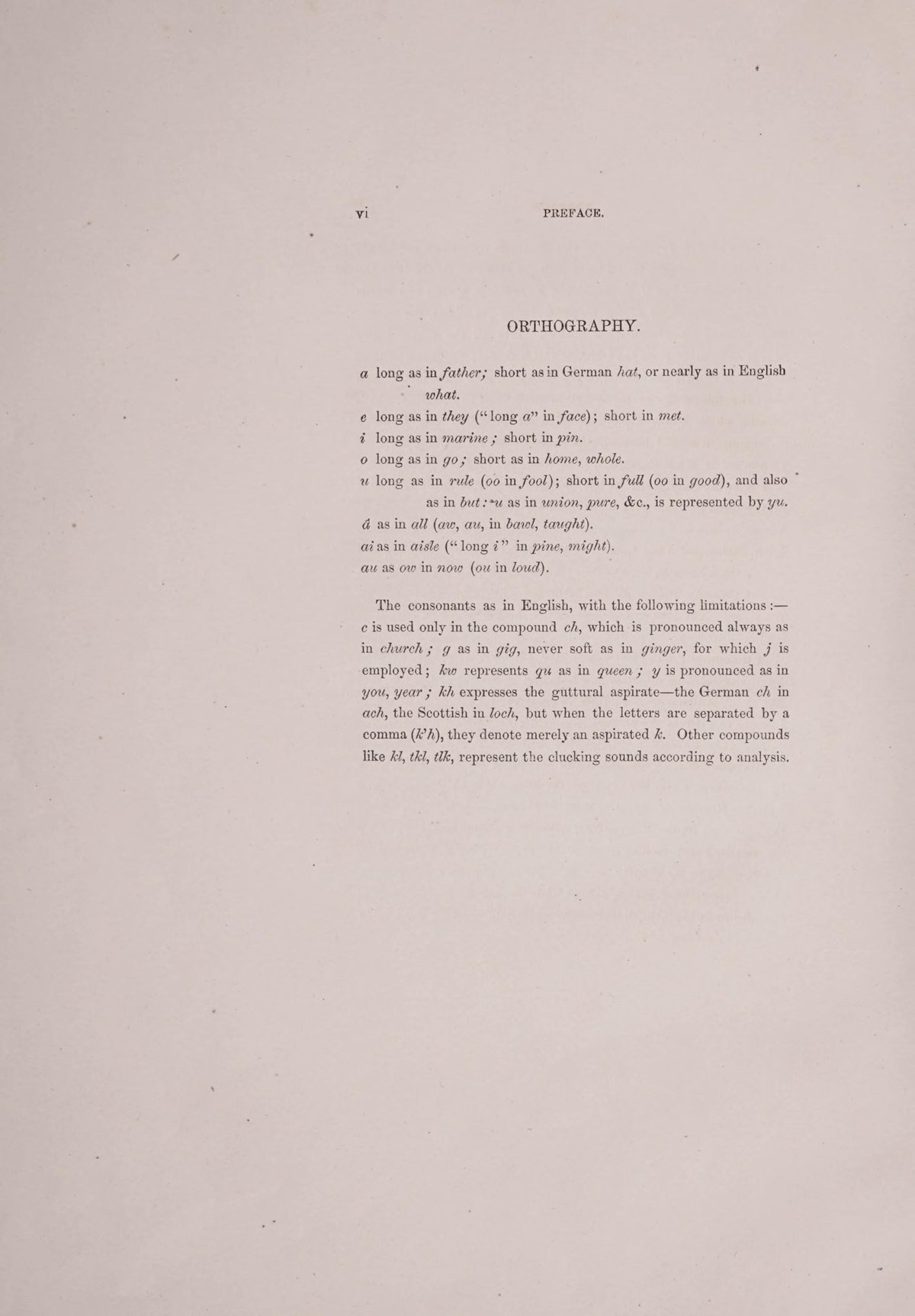
The very difficult pronunciation and excessively complicated form of the Chinook has effectually prevented its acquisition, even by missionaries and fur traders. It abounds with gutturals and “clucking” sounds, almost as difficult to analyse as to utter. As is the case with all the surrounding tribes, the consonants f, r, and v are wanting, perhaps also d and z. In pronouncing English words, f is changed to p; r to l; v to m. Th never occurs, either as in thin or thee; these letters, where they appear below, being pronounced as in the French thé. The system of spelling used is as follows:—
Orthography
ORTHOGRAPHY.
a long as in father; short as in German hat, or nearly as in English what.
e long as in they (“long a” in face); short in met.
i long as in marine ; short in pin.
o long as in go ; short as in home, whole.
u long as in rule (oo in fool); short in full (oo in good), and also as in but : u as in union, pure, &c., is represented by yu.
â as in all (aw, au, in bawl, taught).
ai as in aisle (“long i” in pine, might).
au as ow in now (ou in loud). The consonants as in English, with the following limitations :—
c is used only in the compound ch, which is pronounced always as
in church ; g as in gig, never soft as in ginger, for which j is
employed; kw represents qu as in queen ; y is pronounced as in
you, year ; kh expresses the guttural aspirate—the German ch in
ach, the Scottish in loch, but when the letters are separated by a
comma (k’h), they denote merely an aspirated k. Other compounds
like kl, tkl, tlk, represent the clucking sounds according to analysis.
Bibliography
BIBLIOGRAPHY.
The following are all the specimens of the Chinook language with which I am acquainted, with the exception of those of the Jargon, some of which have been given by the authors as Chinook proper, or as Clatsop, and are cited as such by Ludwig. These last I have included in the Bibliography of the Jargon appended to the Dictionary of that tongue, prepared for the Smithsonian Institution.
Archæologia Americana. Transactions of the American Antiquarian Society, 2 vols. 8vo. Worcester, 1820 ; Cambridge, 1836. Words from a MS. of Gabriel Franchère in the ” Synopsis of the Indian Tribes of North America,” by Albert Gallatin. Vol. II., p. 379. Ethnography and Philology of the U. S. Exploring Expedition. 4to. Philadelphia, 1840. By Horatio Hale. Vocabularies—Q, Watlala or Upper Chinooks—R, Tshinuk, Chinooks proper ; pp. 370–629. The work also contains a valuable notice of the grammar of this language. Transactions of the American Ethnological Society, 2 vols. 8vo. New York, Bartlett and Welford, 1845, 1848. Reprint of the above in article on “Hale’s North-Western Indians,” by Albert Gallatin in Vol. II., pp. 56, 89, 121. Seven Years’ Residence in the Great Deserts of North America, by Abbé M. Domenech, 2 vols. 8vo. London, 1860. Reprint of part of Hale’s Chinook Vocabulary, pp. 166–188. Journal of the Royal Geographical Society of London, vol. XI., 8vo. London, 1841.
” Observations on the Indigenous Tribes of the North-West Coast of America.” By John Scouler, M.D., &c. Vocabulary of the Cathlascon; pp. 243–246, 247. This, though not correct, as above mentioned, is some dialect of the Chinook, while his Chinook, so called, on the same pages, is Chihalis. Exploration du Territoire de l’Orégon, etc., par Duflot de Mofras. 2 vols. 8vo. Paris, 1844. The numerals from 1 to 10 are given in Vol. II., p. 201.
The Vocabulary
Local Nomenclature
A geographical appendix of Chinook place-names, along the coast and the Columbia.
George Gibbs, Alphabetical Vocabulary of the Chinook Language. Published under the auspices of the Smithsonian Institution. New York: Cramoisy Press, 1863. Transcribed in full from the digitized original at the Internet Archive (Library of Congress / Smithsonian deposit): archive.org/details/alphabeticalvoca00gibb. Transcription by AlfredGibbs.com, 2026; the Chinook orthography follows the 1863 printing, with uncertain characters marked (?).
The volume, leaf by leaf
The volume
38 leavesColor calibration target and ruler on the closed volumeLeaf 1
Color calibration target and ruler on the closed volume; visible call-number label reads: FT MEADE / PM 843 / .G5 / Copy 1
This leaf carries no text.
Blank flyleafLeaf 2
Blank flyleaf; library call-number stamp in upper left: FT / MEADE / PM 843 / .G5 / Copy 1
This leaf carries no text.
Blank flyleafLeaf 3
Blank flyleaf; Library of Congress barcode label: 0 003 230 459 A; pencil notation “/S.6”
This leaf carries no text.
Book cover, maroon cloth bindingLeaf 4
Book cover, maroon cloth binding; spine call-number label: FT / MEADE / PM 843 / .G5 / Copy 1
This leaf carries no text.
Marbled endpaper with pasted bookplate:Leaf 5
Marbled endpaper with pasted bookplate:
LIBRARY OF CONGRESS.
[SMITHSONIAN DEPOSIT.]
Chap. [PM 843 written in pencil]
Shelf. [.G5 written in pencil]
UNITED STATES OF AMERICA.
Marbled endpaperLeaf 6
Marbled endpaper; no text
This leaf carries no text.
Blank pageLeaf 7
blank page
This leaf carries no text.
Blank pageLeaf 8
blank page
This leaf carries no text.
Blank pageLeaf 9
blank page
This leaf carries no text.
ALPHABETICAL VOCABULARYLeaf 10
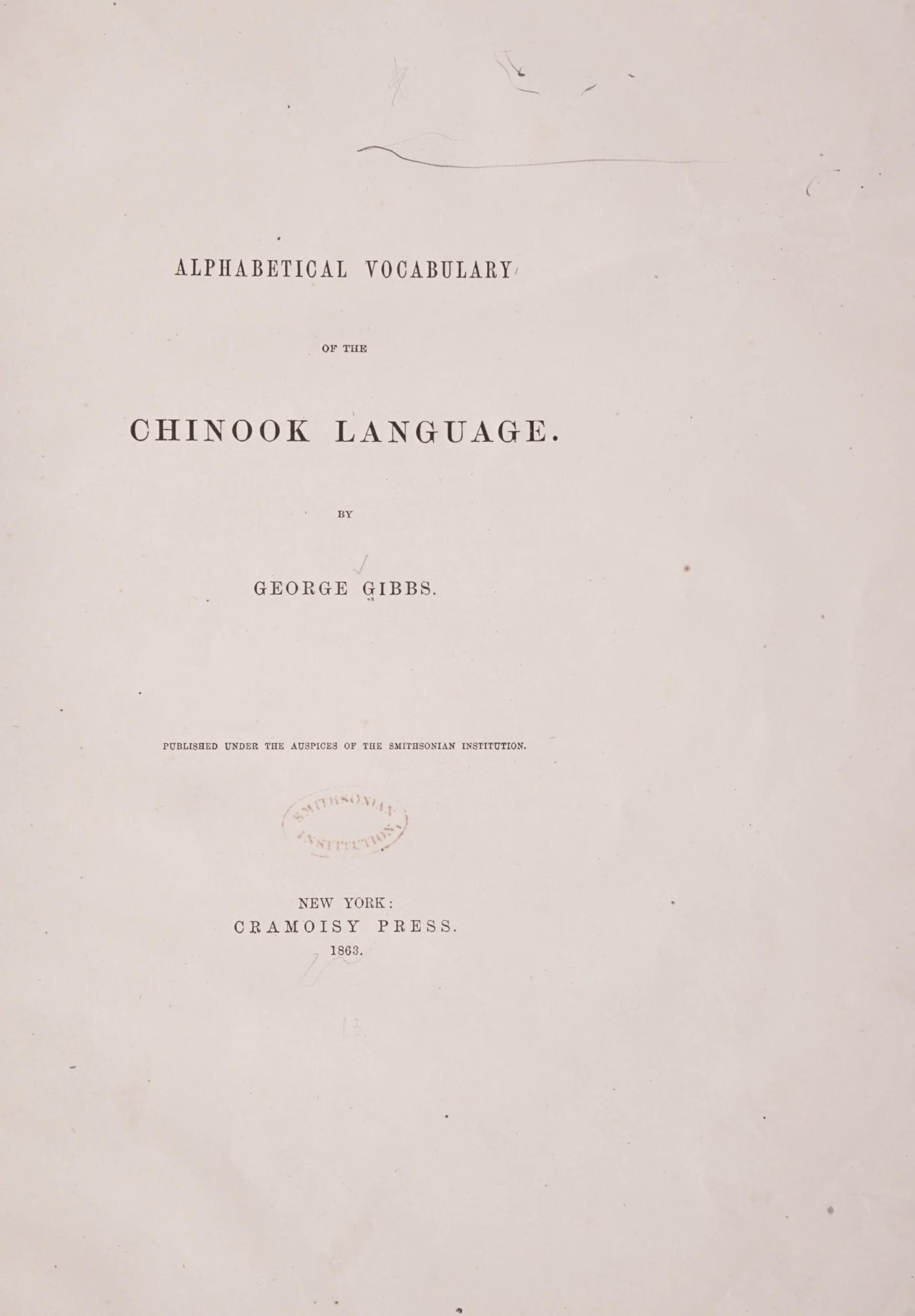
ALPHABETICAL VOCABULARY
OF THE
CHINOOK LANGUAGE.
BY
GEORGE GIBBS.
PUBLISHED UNDER THE AUSPICES OF THE SMITHSONIAN INSTITUTION.
[Smithsonian Institution oval stamp]
NEW YORK:
CRAMOISY PRESS.
1863.
Blank page — verso of title pageLeaf 11
blank page — verso of title page; pencil call number “PM843 .G5” in upper right corner
This leaf carries no text.
PREFACE.Leaf 12
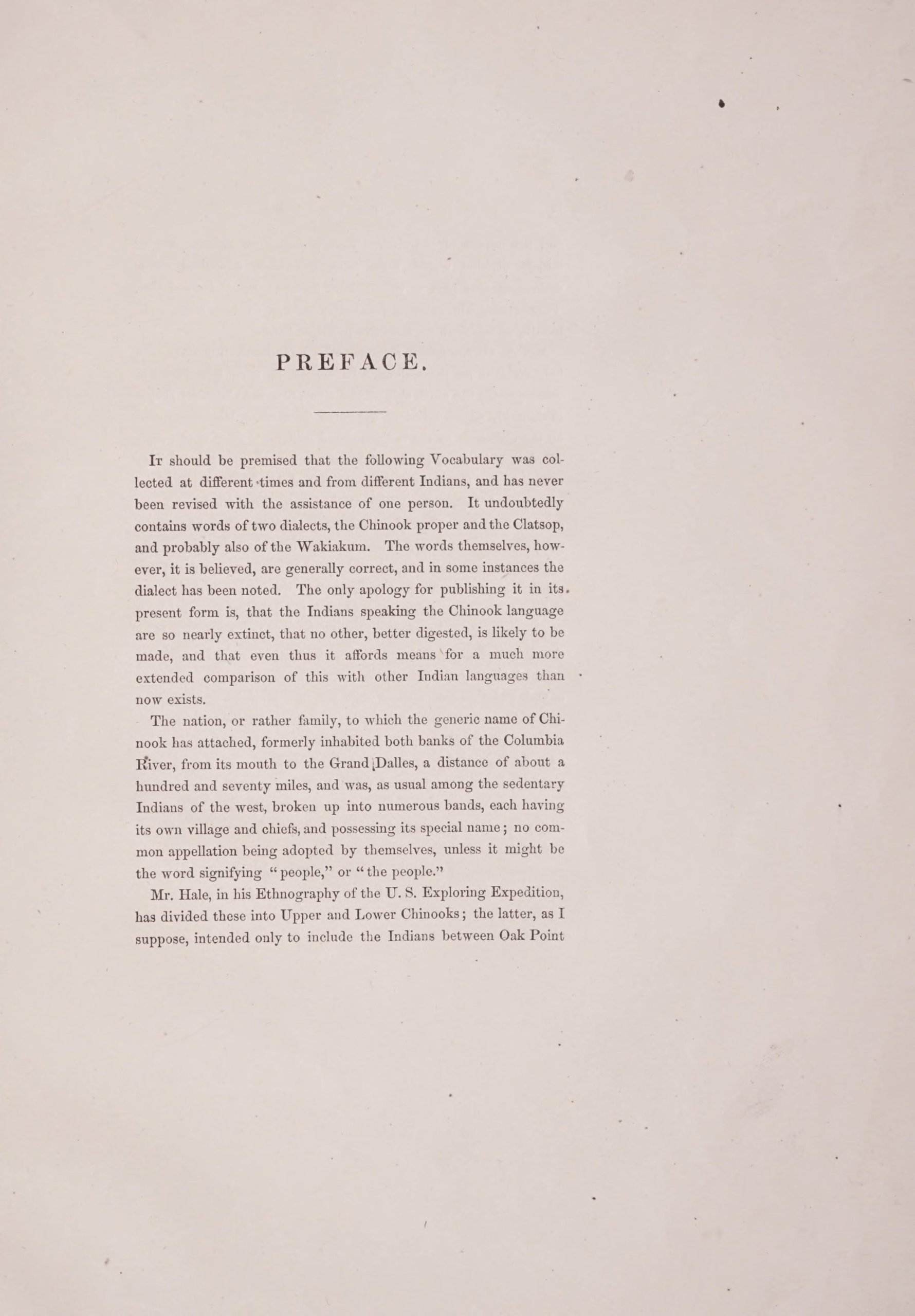
PREFACE.
It should be premised that the following Vocabulary was col-
lected at different times and from different Indians, and has never
been revised with the assistance of one person. It undoubtedly
contains words of two dialects, the Chinook proper and the Clatsop,
and probably also of the Wakiakum. The words themselves, how-
ever, it is believed, are generally correct, and in some instances the
dialect has been noted. The only apology for publishing it in its
present form is, that the Indians speaking the Chinook language
are so nearly extinct, that no other, better digested, is likely to be
made, and that even thus it affords means for a much more
extended comparison of this with other Indian languages than
now exists.
The nation, or rather family, to which the generic name of Chi-
nook has attached, formerly inhabited both banks of the Columbia
River, from its mouth to the Grand Dalles, a distance of about a
hundred and seventy miles, and was, as usual among the sedentary
Indians of the west, broken up into numerous bands, each having
its own village and chiefs, and possessing its special name; no com-
mon appellation being adopted by themselves, unless it might be
the word signifying “people,” or “the people.”
Mr. Hale, in his Ethnography of the U. S. Exploring Expedition,
has divided these into Upper and Lower Chinooks; the latter, as I
suppose, intended only to include the Indians between Oak Point
iv PREFACE.Leaf 13
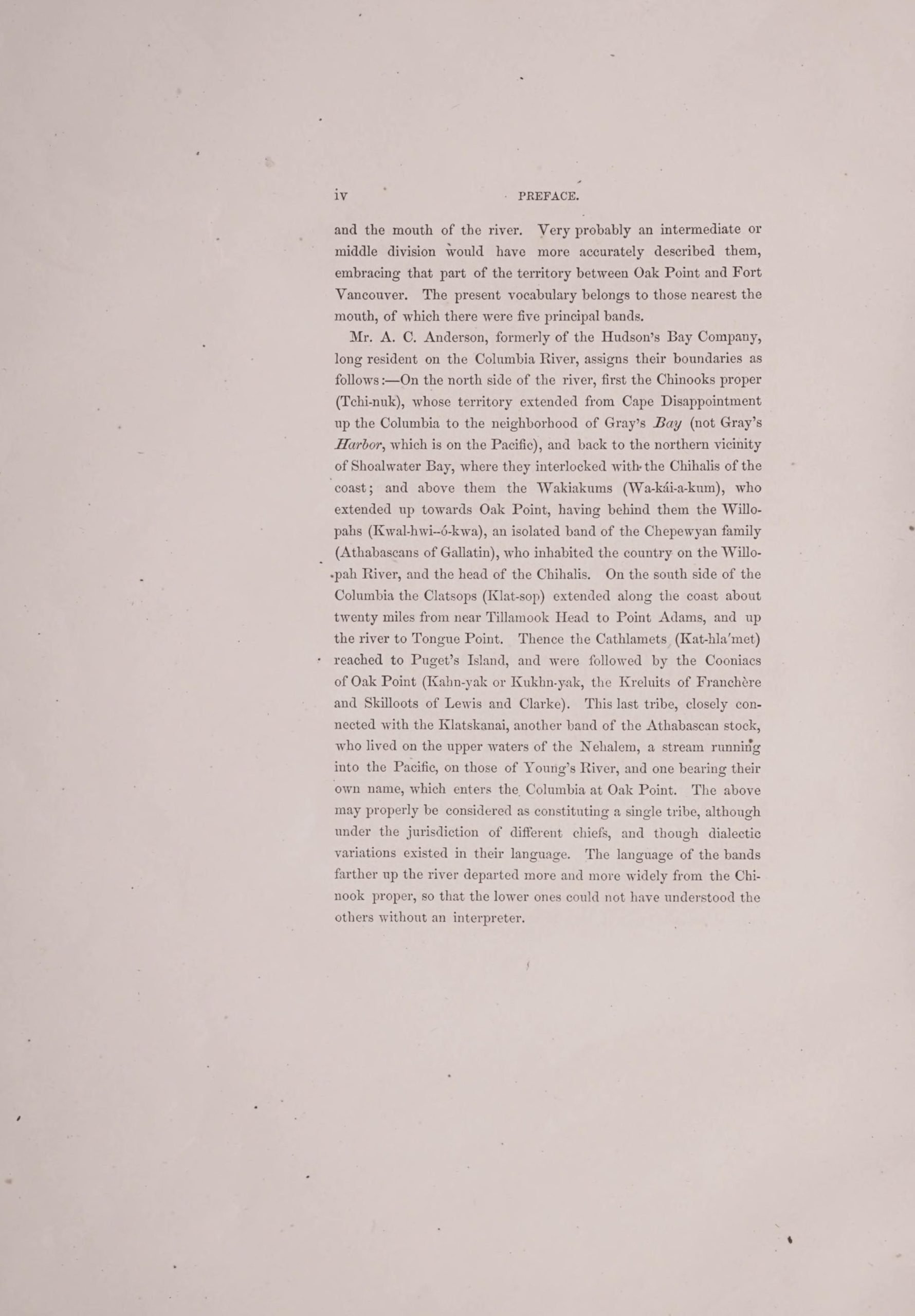
iv PREFACE.
and the mouth of the river. Very probably an intermediate or
middle division would have more accurately described them,
embracing that part of the territory between Oak Point and Fort
Vancouver. The present vocabulary belongs to those nearest the
mouth, of which there were five principal bands.
Mr. A. C. Anderson, formerly of the Hudson’s Bay Company,
long resident on the Columbia River, assigns their boundaries as
follows:—On the north side of the river, first the Chinooks proper
(Tchi-nuk), whose territory extended from Cape Disappointment
up the Columbia to the neighborhood of Gray’s Bay (not Gray’s
Harbor, which is on the Pacific), and back to the northern vicinity
of Shoalwater Bay, where they interlocked with the Chihalis of the
coast; and above them the Wakiakums (Wa-kái-a-kum), who
extended up towards Oak Point, having behind them the Willo-
pahs (Kwal-hwi–ó-kwa), an isolated band of the Chepewyan family
(Athabascans of Gallatin), who inhabited the country on the Willo-
pah River, and the head of the Chihalis. On the south side of the
Columbia the Clatsops (Klat-sop) extended along the coast about
twenty miles from near Tillamook Head to Point Adams, and up
the river to Tongue Point. Thence the Cathlamets (Kat-hla’met)
reached to Puget’s Island, and were followed by the Cooniacs
of Oak Point (Kahn-yak or Kukhn-yak, the Kreluits of Franchère
and Skilloots of Lewis and Clarke). This last tribe, closely con-
nected with the Klatskanai, another band of the Athabascan stock,
who lived on the upper waters of the Nehalem, a stream running
into the Pacific, on those of Young’s River, and one bearing their
own name, which enters the Columbia at Oak Point. The above
may properly be considered as constituting a single tribe, although
under the jurisdiction of different chiefs, and though dialectic
variations existed in their language. The language of the bands
farther up the river departed more and more widely from the Chi-
nook proper, so that the lower ones could not have understood the
others without an interpreter.
PREFACE. vLeaf 14
PREFACE. v
Of the several vocabularies of this language heretofore published,
the only reliable ones that I have seen are those of Mr. Hale in the
Ethnography of the U. S. Exploring Expedition, giving 180 words
of the Lower and 60 of the Upper Chinook (Watlala), the former
accompanied by grammatical notices. Into all the others many
words have crept from the Chihalis and Klikatat; the first a tribe of
the Selish family, the second of the Sahaptin, who immediately join
the Chinooks on the north, as well as some from the Nootka, which
forms one of the components of what is called the Chinook
“Jargon,” a mixed language in common use for trading purposes
on the North West Coast, and often mistaken for the Chinook itself.
The vocabulary given by Dr. Scouler as “Chenook” is almost
altogether Chihalis. His “Cathlascon,” though very incorrect, is
Chinook; but he has wrongly assigned the location of the Cathlasco
tribe. They were the Indians of the Dalles of the Columbia, and
not of the region below the falls; and though they speak a dialect
of the Chinook, the vocabulary is of some other band lower down
the river. It is easy to see that comparisons founded on such data
lead only to error.
In collecting the present vocabulary, I have been greatly assisted
by Messrs. Robert Shortess and Solomon H. Smith, of Oregon, and
Mr. A. C. Anderson, of Victoria, Vancouver Island, to all of whom
I desire to express my acknowledgments.
The very difficult pronunciation and excessively complicated
form of the Chinook has effectually prevented its acquisition, even
by missionaries and fur traders. It abounds with gutturals and
“clucking” sounds, almost as difficult to analyse as to utter. As is
the case with all the surrounding tribes, the consonants f, r, and v
are wanting, perhaps also d and z. In pronouncing English words,
f is changed to p; r to l; v to m. Th never occurs, either as in
thin or thee; these letters, where they appear below, being pro-
nounced as in the French thé. The system of spelling used is as
follows:—
vi PREFACE.Leaf 15
vi PREFACE.
ORTHOGRAPHY.
a long as in father; short as in German hat, or nearly as in English
what.
e long as in they (“long a” in face); short in met.
i long as in marine ; short in pin.
o long as in go ; short as in home, whole.
u long as in rule (oo in fool); short in full (oo in good), and also
as in but : u as in union, pure, &c., is represented by yu.
â as in all (aw, au, in bawl, taught).
ai as in aisle (“long i” in pine, might).
au as ow in now (ou in loud).
The consonants as in English, with the following limitations :—
c is used only in the compound ch, which is pronounced always as
in church ; g as in gig, never soft as in ginger, for which j is
employed; kw represents qu as in queen ; y is pronounced as in
you, year ; kh expresses the guttural aspirate—the German ch in
ach, the Scottish in loch, but when the letters are separated by a
comma (k’h), they denote merely an aspirated k. Other compounds
like kl, tkl, tlk, represent the clucking sounds according to analysis.
PREFACE. viiLeaf 16
PREFACE. vii
BIBLIOGRAPHY.
The following are all the specimens of the Chinook language
with which I am acquainted, with the exception of those of the
Jargon, some of which have been given by the authors as Chinook
proper, or as Clatsop, and are cited as such by Ludwig. These last
I have included in the Bibliography of the Jargon appended to the
Dictionary of that tongue, prepared for the Smithsonian Institution.
Archæologia Americana. Transactions of the American Antiqua-
rian Society, 2 vols. 8vo. Worcester, 1820 ; Cambridge, 1836.
Words from a MS. of Gabriel Franchère in the ” Synopsis of
the Indian Tribes of North America,” by Albert Gallatin.
Vol. II., p. 379.
Ethnography and Philology of the U. S. Exploring Expedition. 4to.
Philadelphia, 1840. By Horatio Hale.
Vocabularies—Q, Watlala or Upper Chinooks—R, Tshinuk,
Chinooks proper ; pp. 370–629. The work also contains
a valuable notice of the grammar of this language.
Transactions of the American Ethnological Society, 2 vols. 8vo.
New York, Bartlett and Welford, 1845, 1848.
Reprint of the above in article on “Hale’s North-Western
Indians,” by Albert Gallatin in Vol. II., pp. 56, 89, 121.
Seven Years’ Residence in the Great Deserts of North America, by
Abbé M. Domenech, 2 vols. 8vo. London, 1860.
Reprint of part of Hale’s Chinook Vocabulary, pp. 166–188.
Journal of the Royal Geographical Society of London, vol. XI., 8vo.
London, 1841.
viii PREFACE.Leaf 17
viii PREFACE.
” Observations on the Indigenous Tribes of the North-West
Coast of America.” By John Scouler, M.D., &c.
Vocabulary of the Cathlascon; pp. 243–246, 247. This, though
not correct, as above mentioned, is some dialect of the
Chinook, while his Chinook, so called, on the same pages,
is Chihalis.
Exploration du Territoire de l’Orégon, etc., par Duflot de Mofras.
2 vols. 8vo. Paris, 1844. The numerals from 1 to 10
are given in Vol. II., p. 201.
VOCABULARY.Leaf 18
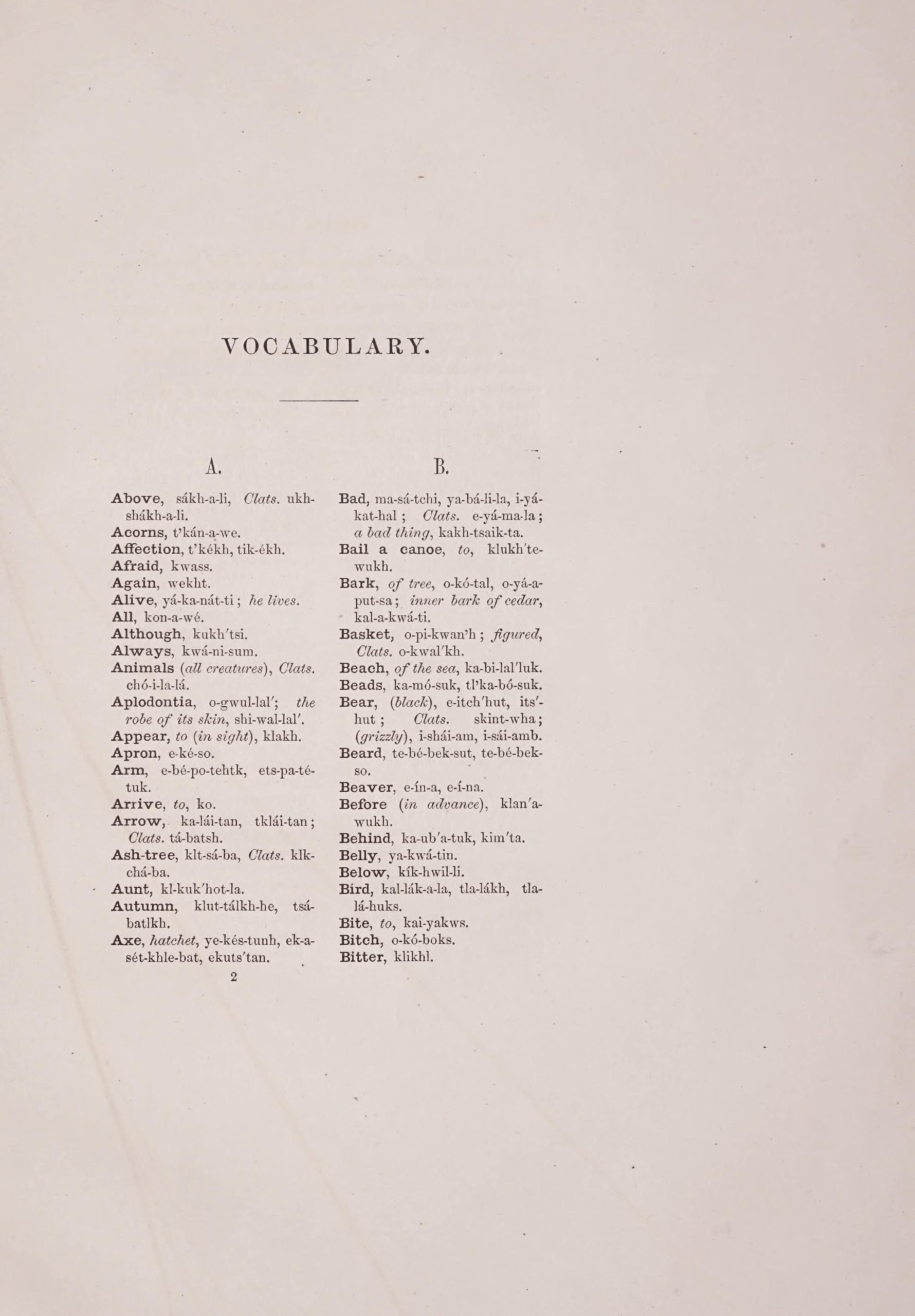
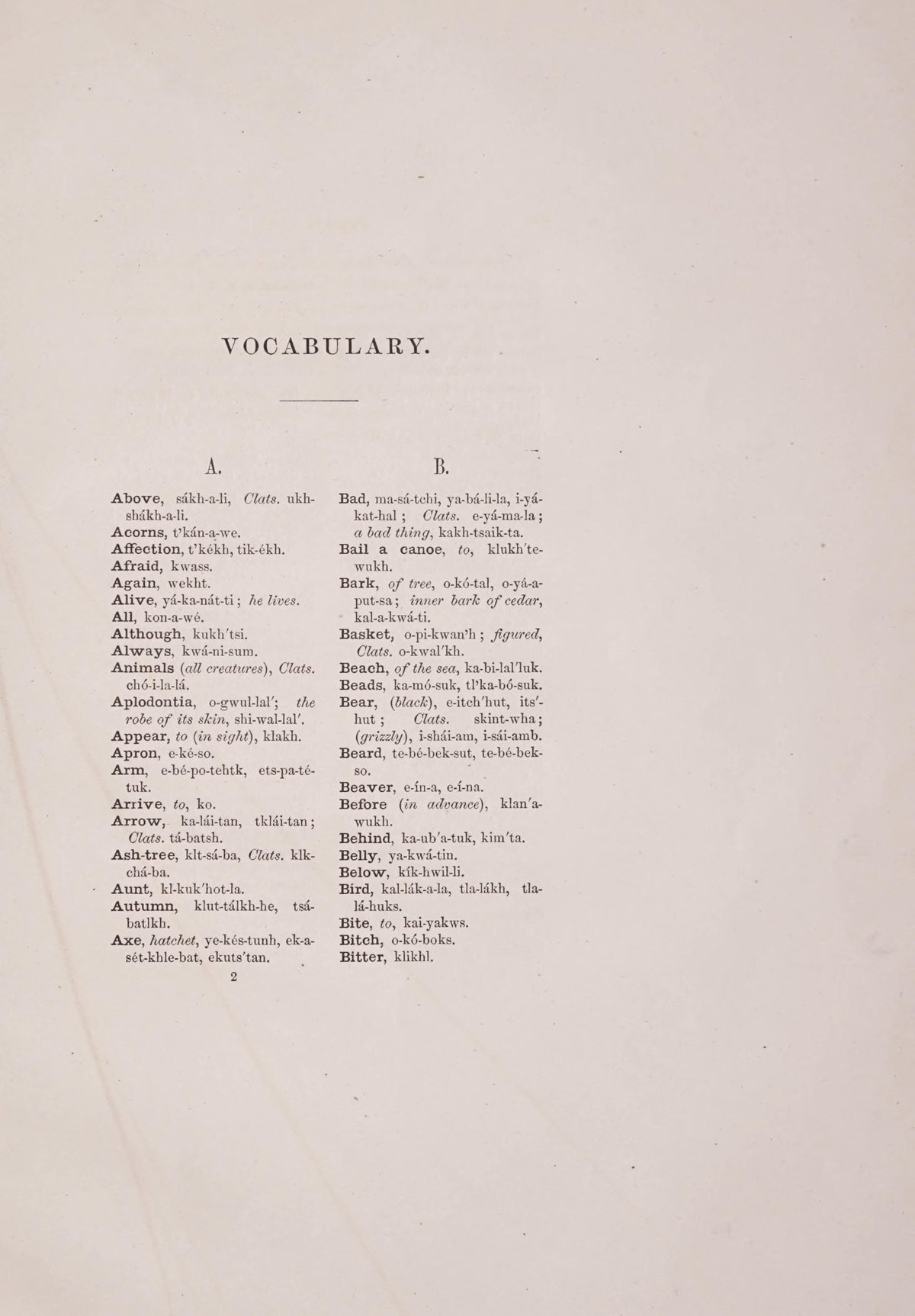
VOCABULARY.
A.
Above, sákh-a-li, Clats. ukh-
shákh-a-li.
Acorns, t’kán-a-we.
Affection, t’kékh, tik-ékh.
Afraid, kwass.
Again, wekht.
Alive, yá-ka-nát-ti ; he lives.
All, kon-a-wé.
Although, kukh’tsi.
Always, kwá-ni-sum.
Animals (all creatures), Clats.
chó-i-la-lá.
Aplodontia, o-gwul-lal’ ; the
robe of its skin, shi-wal-lal’.
Appear, to (in sight), klakh.
Apron, e-ké-so.
Arm, e-bé-po-tehtk, ets-pa-té-
tuk.
Arrive, to, ko.
Arrow, ka-lái-tan, tklái-tan ;
Clats. tá-batsh.
Ash-tree, klt-sá-ba, Clats. klk-
chá-ba.
Aunt, kl-kuk’hot-la.
Autumn, klut-tálkh-he, tsá-
batlkh.
Axe, hatchet, ye-kés-tunh, ek-a-
sét-khle-bat, ekuts’tan.
B.
Bad, ma-sá-tchi, ya-bá-li-la, i-yá-
kat-hal ; Clats. e-yá-ma-la ;
a bad thing, kakh-tsaik-ta.
Bail a canoe, to, klukh’te-
wukh.
Bark, of tree, o-kó-tal, o-yá-a-
put-sa ; inner bark of cedar,
kal-a-kwá-ti.
Basket, o-pi-kwan’h ; figured,
Clats. o-kwal’kh.
Beach, of the sea, ka-bi-lal’luk.
Beads, ka-mó-suk, tl’ka-bó-suk.
Bear, (black), e-itch’hut, its’-
hut ; Clats. skint-wha ;
(grizzly), i-shái-am, i-sái-amb.
Beard, te-bé-bek-sut, te-bé-bek-
so.
Beaver, e-ín-a, e-í-na.
Before (in advance), klan’a-
wukh.
Behind, ka-ub’a-tuk, kim’ta.
Belly, ya-kwá-tin.
Below, kík-hwil-li.
Bird, kal-lák-a-la, tla-lákh, tla-
lá-huks.
Bite, to, kai-yakws.
Bitch, o-kó-boks.
Bitter, klikhl.
2
Page 10: Bla–CloLeaf 19
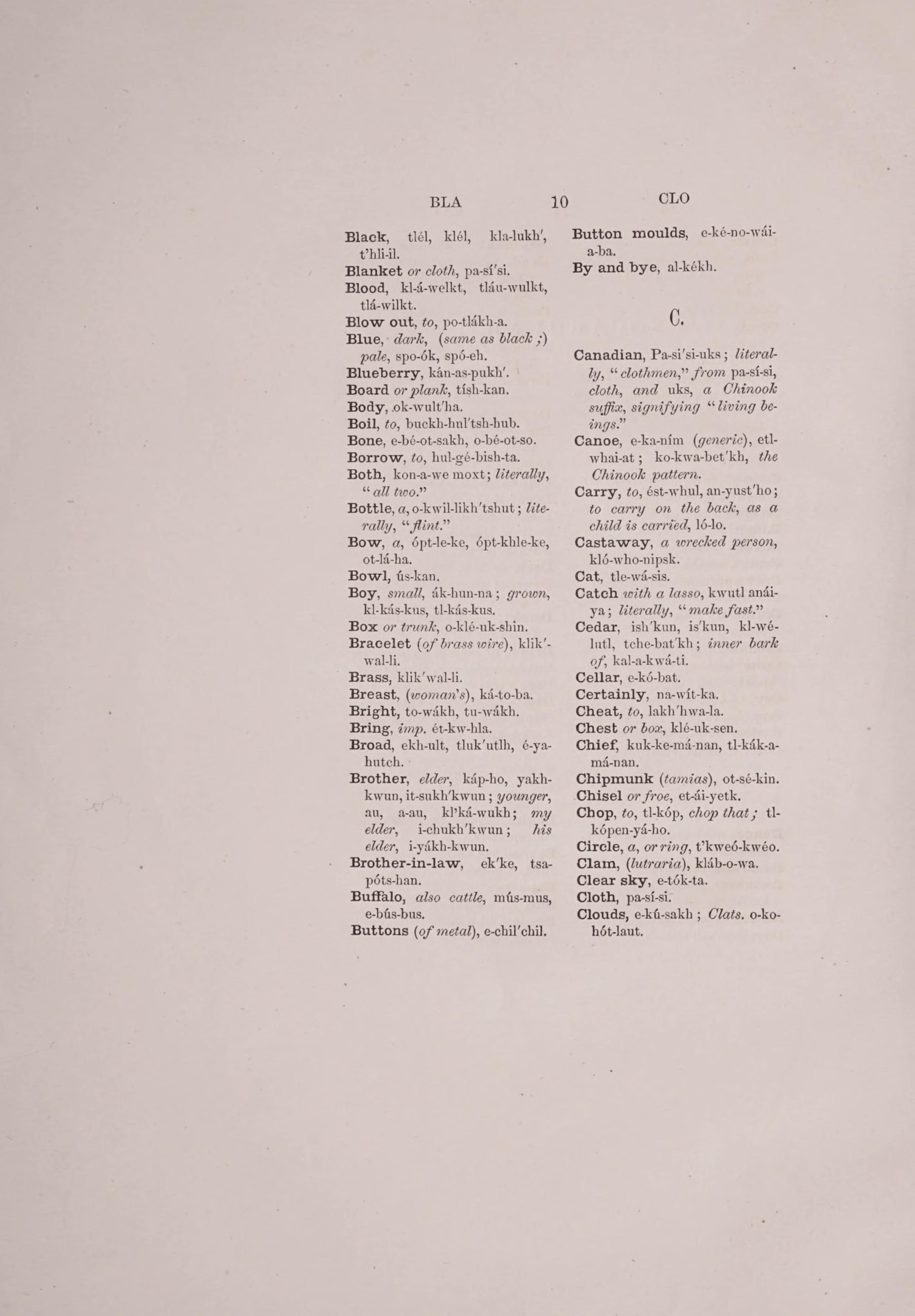
BLA 10 CLO
Black, tlél, klél, kla-lukh’,
t’hli-il.
Blanket or cloth, pa-sí’si.
Blood, kl-á-welkt, tláu-wulkt,
tlá-wilkt.
Blow out, to, po-tlákh-a.
Blue, dark, (same as black ;)
pale, spo-ók, spó-eh.
Blueberry, kán-as-pukh’.
Board or plank, tísh-kan.
Body, ok-wult’ha.
Boil, to, buckh-hul’tsh-hub.
Bone, e-bé-ot-sakh, o-bé-ot-so.
Borrow, to, hul-gé-bish-ta.
Both, kon-a-we moxt; literally,
” all two.”
Bottle, a, o-kwil-likh’tshut ; lite-
rally, ” flint.”
Bow, a, ópt-le-ke, ópt-khle-ke,
ot-lá-ha.
Bowl, ús-kan.
Boy, small, ák-hun-na ; grown,
kl-kás-kus, tl-kás-kus.
Box or trunk, o-klé-uk-shin.
Bracelet (of brass wire), klik’-
wal-li.
Brass, klik’wal-li.
Breast, (woman’s), ká-to-ba.
Bright, to-wákh, tu-wákh.
Bring, imp. ét-kw-hla.
Broad, ekh-ult, tluk’utlh, é-ya-
hutch.
Brother, elder, káp-ho, yakh-
kwun, it-sukh’kwun ; younger,
au, a-au, kl’ká-wukh ; my
elder, i-chukh’kwun ; his
elder, i-yákh-kwun.
Brother-in-law, ek’ke, tsa-
póts-han.
Buffalo, also cattle, mús-mus,
e-bús-bus.
Buttons (of metal), e-chil’chil.
Button moulds, e-ké-no-wái-
a-ba.
By and bye, al-kékh.
C.
Canadian, Pa-si’si-uks ; literal-
ly, ” clothmen,” from pa-sí-si,
cloth, and uks, a Chinook
suffix, signifying “living be-
ings.”
Canoe, e-ka-ním (generic), etl-
whai-at ; ko-kwa-bet’kh, the
Chinook pattern.
Carry, to, ést-whul, an-yust’ho ;
to carry on the back, as a
child is carried, ló-lo.
Castaway, a wrecked person,
kló-who-nipsk.
Cat, tle-wá-sis.
Catch with a lasso, kwutl anái-
ya ; literally, ” make fast.”
Cedar, ish’kun, is’kun, kl-wé-
lutl, tche-bat’kh ; inner bark
of, kal-a-kwá-ti.
Cellar, e-kó-bat.
Certainly, na-wít-ka.
Cheat, to, lakh’hwa-la.
Chest or box, klé-uk-sen.
Chief, kuk-ke-má-nan, tl-kák-a-
má-nan.
Chipmunk (tamias), ot-sé-kin.
Chisel or froe, et-ái-yetk.
Chop, to, tl-kóp, chop that ; tl-
kópen-yá-ho.
Circle, a, or ring, t’kweó-kwéo.
Clam, (lutraria), kláb-o-wa.
Clear sky, e-tók-ta.
Cloth, pa-sí-si.
Clouds, e-kú-sakh ; Clats. o-ko-
hót-laut.
Page 11: Coa–EatLeaf 20
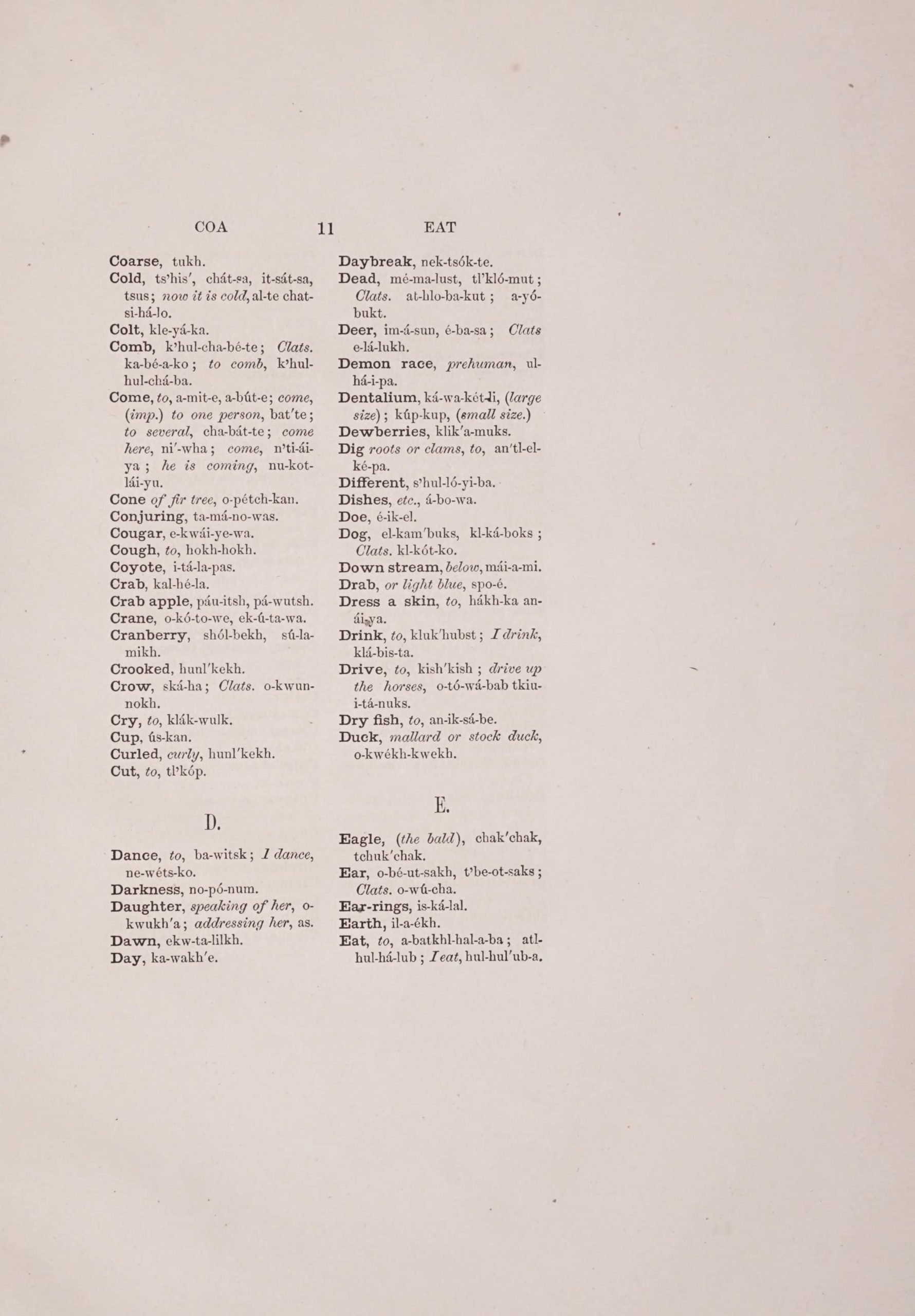
COA 11 EAT
Coarse, tukh.
Cold, ts’his’, chát-sa, it-sát-sa,
tsus ; now it is cold, al-te chat-
si-há-lo.
Colt, kle-yá-ka.
Comb, k’hul-cha-bé-te ; Clats.
ka-bé-a-ko ; to comb, k’hul-
hul-chá-ba.
Come, to, a-mit-e, a-bút-e; come,
(imp.) to one person, bat’te ;
to several, cha-bát-te ; come
here, ni’-wha ; come, n’ti-ái-
ya ; he is coming, nu-kot-
lái-yu.
Cone of fir tree, o-pétch-kan.
Conjuring, ta-má-no-was.
Cougar, e-kwái-ye-wa.
Cough, to, hokh-hokh.
Coyote, i-tá-la-pas.
Crab, kal-hé-la.
Crab apple, páu-itsh, pá-wutsh.
Crane, o-kó-to-we, ek-ú-ta-wa.
Cranberry, shól-bekh, sú-la-
mikh.
Crooked, hunl’kekh.
Crow, ská-ha ; Clats. o-kwun-
nokh.
Cry, to, klák-wulk.
Cup, ús-kan.
Curled, curly, hunl’kekh.
Cut, to, tl’kóp.
D.
Dance, to, ba-witsk ; I dance,
ne-wéts-ko.
Darkness, no-pó-num.
Daughter, speaking of her, o-
kwukh’a ; addressing her, as.
Dawn, ekw-ta-lilkh.
Day, ka-wakh’e.
Daybreak, nek-tsók-te.
Dead, mé-ma-lust, tl’kló-mut ;
Clats. at-hlo-ba-kut ; a-yó-
bukt.
Deer, im-á-sun, é-ba-sa ; Clats
e-lá-lukh.
Demon race, prehuman, ul-
há-i-pa.
Dentalium, ká-wa-két-li, (large
size) ; kúp-kup, (small size.)
Dewberries, klik’a-muks.
Dig roots or clams, to, an’tl-el-
ké-pa.
Different, s’hul-ló-yi-ba.
Dishes, etc., á-bo-wa.
Doe, é-ik-el.
Dog, el-kam’buks, kl-ká-boks ;
Clats. kl-kót-ko.
Down stream, below, mái-a-mi.
Drab, or light blue, spo-é.
Dress a skin, to, hákh-ka an-
ái-ya.
Drink, to, kluk’hubst ; I drink,
klá-bis-ta.
Drive, to, kish’kish ; drive up
the horses, o-tó-wá-bab tkiu-
i-tá-nuks.
Dry fish, to, an-ik-sá-be.
Duck, mallard or stock duck,
o-kwékh-kwekh.
E.
Eagle, (the bald), chak’chak,
tchuk’chak.
Ear, o-bé-ut-sakh, t’be-ot-saks ;
Clats. o-wú-cha.
Ear-rings, is-ká-lal.
Earth, il-a-ékh.
Eat, to, a-batkhl-hal-a-ba ; atl-
hul-há-lub ; I eat, hul-hul’ub-a.
Page 12: Ebb–GamLeaf 21
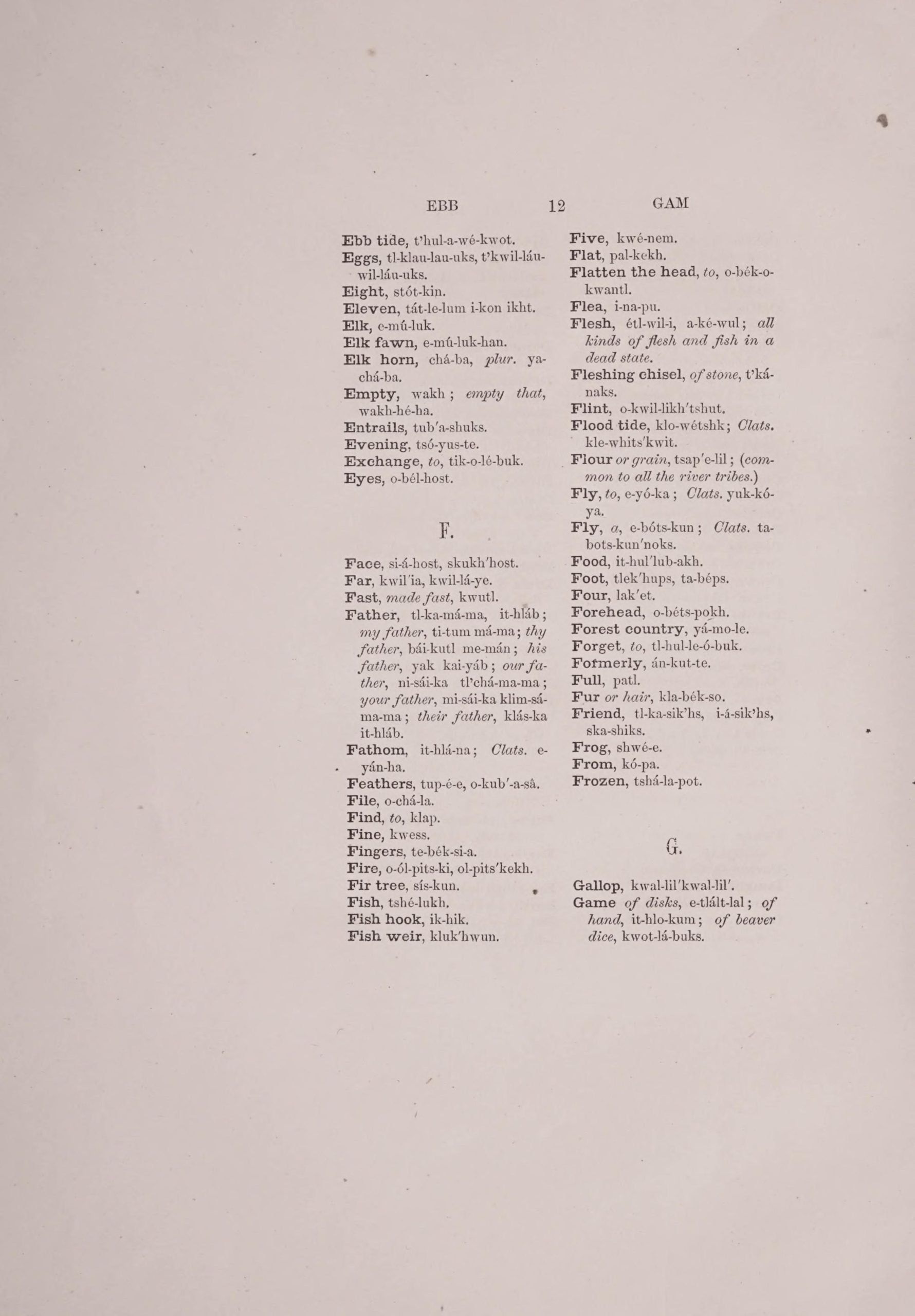
EBB 12 GAM
Ebb tide, t’hul-a-wé-kwot.
Eggs, tl-klau-lau-uks, t’kwil-láu-
wil-láu-uks.
Eight, stót-kin.
Eleven, tát-le-lum i-kon ikht.
Elk, e-mú-luk.
Elk fawn, e-mú-luk-han.
Elk horn, chá-ba, plur. ya-
chá-ba.
Empty, wakh ; empty that,
wakh-hé-ha.
Entrails, tub’a-shuks.
Evening, tsó-yus-te.
Exchange, to, tik-o-lé-buk.
Eyes, o-bél-host.
F.
Face, si-á-host, skukh’host.
Far, kwil’ia, kwil-lá-ye.
Fast, made fast, kwutl.
Father, tl-ka-má-ma, it-hláb ;
my father, ti-tum má-ma; thy
father, bái-kutl me-mán ; his
father, yak kai-yáb ; our fa-
ther, ni-sái-ka tl’chá-ma-ma ;
your father, mi-sái-ka klim-sá-
ma-ma ; their father, klás-ka
it-hláb.
Fathom, it-hlá-na ; Clats. e-
yán-ha.
Feathers, tup-é-e, o-kub’-a-sá.
File, o-chá-la.
Find, to, klap.
Fine, kwess.
Fingers, te-bék-si-a.
Fire, o-ól-pits-ki, ol-pits’kekh.
Fir tree, sís-kun.
Fish, tshé-lukh.
Fish hook, ik-hik.
Fish weir, kluk’hwun.
Five, kwé-nem.
Flat, pal-kekh.
Flatten the head, to, o-bék-o-
kwantl.
Flea, i-na-pu.
Flesh, étl-wil-i, a-ké-wul ; all
kinds of flesh and fish in a
dead state.
Fleshing chisel, of stone, t’ká-
naks.
Flint, o-kwil-likh’tshut.
Flood tide, klo-wétshk ; Clats.
kle-whits’kwit.
Flour or grain, tsap’e-lil ; (com-
mon to all the river tribes.)
Fly, to, e-yó-ka ; Clats. yuk-kó-
ya.
Fly, a, e-bóts-kun ; Clats. ta-
bots-kun’noks.
Food, it-hul’lub-akh.
Foot, tlek’hups, ta-béps.
Four, lak’et.
Forehead, o-béts-pokh.
Forest country, yá-mo-le.
Forget, to, tl-hul-le-ó-buk.
Formerly, án-kut-te.
Full, patl.
Fur or hair, kla-bék-so.
Friend, tl-ka-sik’hs, i-á-sik’hs,
ska-shiks.
Frog, shwé-e.
From, kó-pa.
Frozen, tshá-la-pot.
G.
Gallop, kwal-lil’kwal-lil’.
Game of disks, e-tlált-lal ; of
hand, it-hlo-kum ; of beaver
dice, kwot-lá-buks.
Page 13: Giv–HucLeaf 22
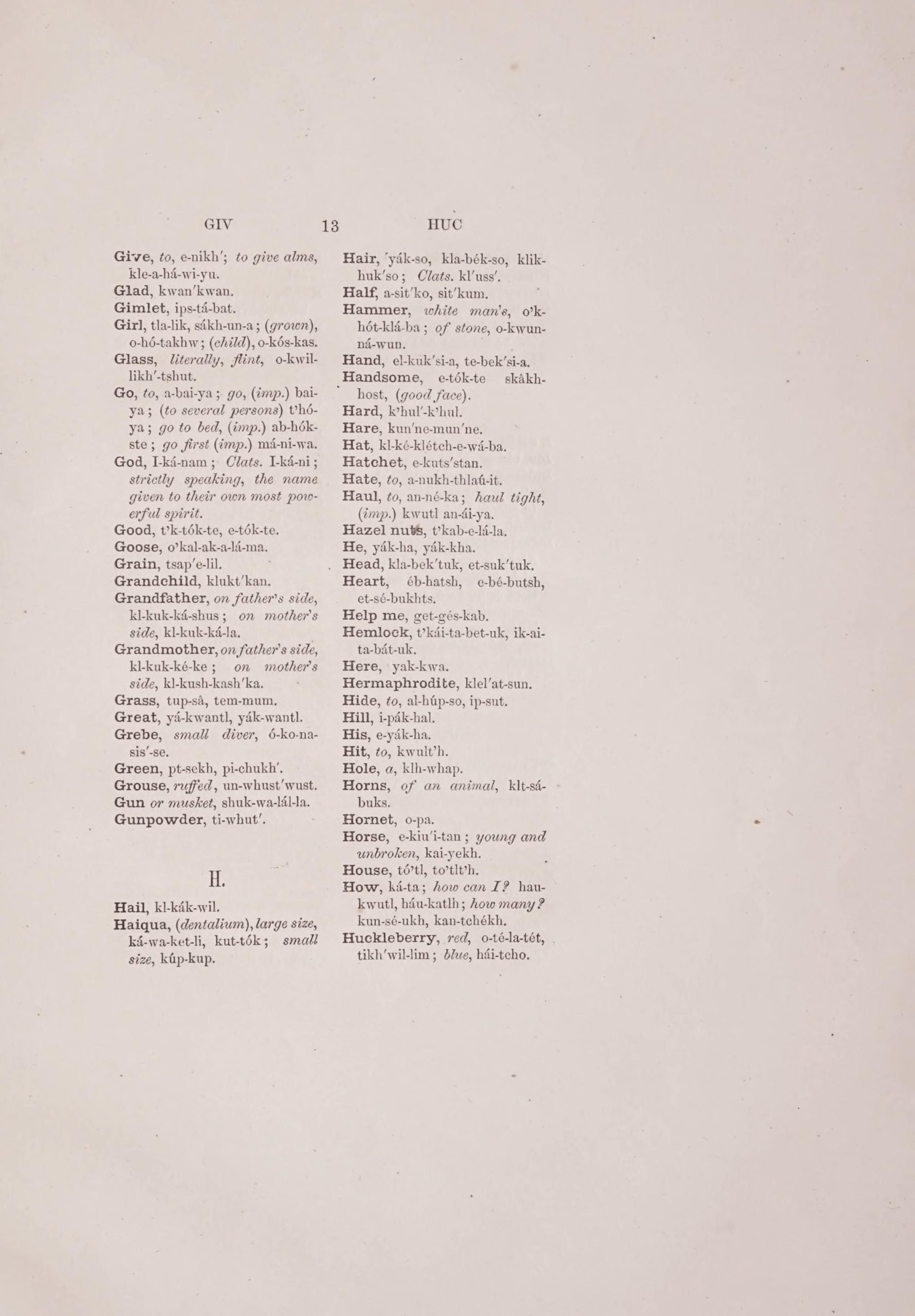
GIV 13 HUC
Give, to, e-nikh’; to give alms,
kle-a-há-wi-yu.
Glad, kwan’kwan.
Gimlet, ips-tá-bat.
Girl, tla-lik, sákh-un-a; (grown),
o-hó-takhw; (child), o-kós-kas.
Glass, literally, flint, o-kwil-
likh’-tshut.
Go, to, a-bai-ya; go, (imp.) bai-
ya; (to several persons) t’hó-
ya; go to bed, (imp.) ab-hók-
ste; go first (imp.) má-ni-wa.
God, I-ká-nam; Clats. I-ká-ni;
strictly speaking, the name
given to their own most pow-
erful spirit.
Good, t’k-tók-te, e-tók-te.
Goose, o’kal-ak-a-lá-ma.
Grain, tsap’e-lil.
Grandchild, klukt’kan.
Grandfather, on father’s side,
kl-kuk-ká-shus; on mother’s
side, kl-kuk-ká-la.
Grandmother, on father’s side,
kl-kuk-ké-ke; on mother’s
side, kl-kush-kash’ka.
Grass, tup-sâ, tem-mum.
Great, yá-kwantl, yák-wantl.
Grebe, small diver, ó-ko-na-
sis’-se.
Green, pt-sekh, pi-chukh’.
Grouse, ruffed, un-whust’wust.
Gun or musket, shuk-wa-lál-la.
Gunpowder, ti-whut’.
H.
Hail, kl-kák-wil.
Haiqua, (dentalium), large size,
ká-wa-ket-li, kut-tók; small
size, kúp-kup.
Hair, ‘yák-so, kla-bék-so, klik-
huk’so; Clats. kl’uss’.
Half, a-sit’ko, sit’kum.
Hammer, white man’s, o’k-
hót-klá-ba; of stone, o-kwun-
ná-wun.
Hand, el-kuk’si-a, te-bek’si-a.
Handsome, e-tók-te skâkh-
host, (good face).
Hard, k’hul’-k’hul.
Hare, kun’ne-mun’ne.
Hat, kl-ké-klétch-e-wá-ba.
Hatchet, e-kuts’stan.
Hate, to, a-nukh-thlaú-it.
Haul, to, an-né-ka; haul tight,
(imp.) kwutl an-ái-ya.
Hazel nuts, t’kab-e-lá-la.
He, yák-ha, yák-kha.
Head, kla-bek’tuk, et-suk’tuk.
Heart, éb-hatsh, e-bé-butsh,
et-sé-bukhts.
Help me, get-gés-kab.
Hemlock, t’kái-ta-bet-uk, ik-ai-
ta-bát-uk.
Here, yak-kwa.
Hermaphrodite, klel’at-sun.
Hide, to, al-húp-so, ip-sut.
Hill, i-pák-hal.
His, e-yák-ha.
Hit, to, kwult’h.
Hole, a, klh-whap.
Horns, of an animal, klt-sá-
buks.
Hornet, o-pa.
Horse, e-kiu’i-tan; young and
unbroken, kai-yekh.
House, tó’tl, to’tlt’h.
How, ká-ta; how can I? hau-
kwutl, háu-katlh; how many?
kun-sé-ukh, kan-tchékh.
Huckleberry, red, o-té-la-tét,
tikh’wil-lim; blue, hái-tcho.
Page 14: Hun–LynLeaf 23
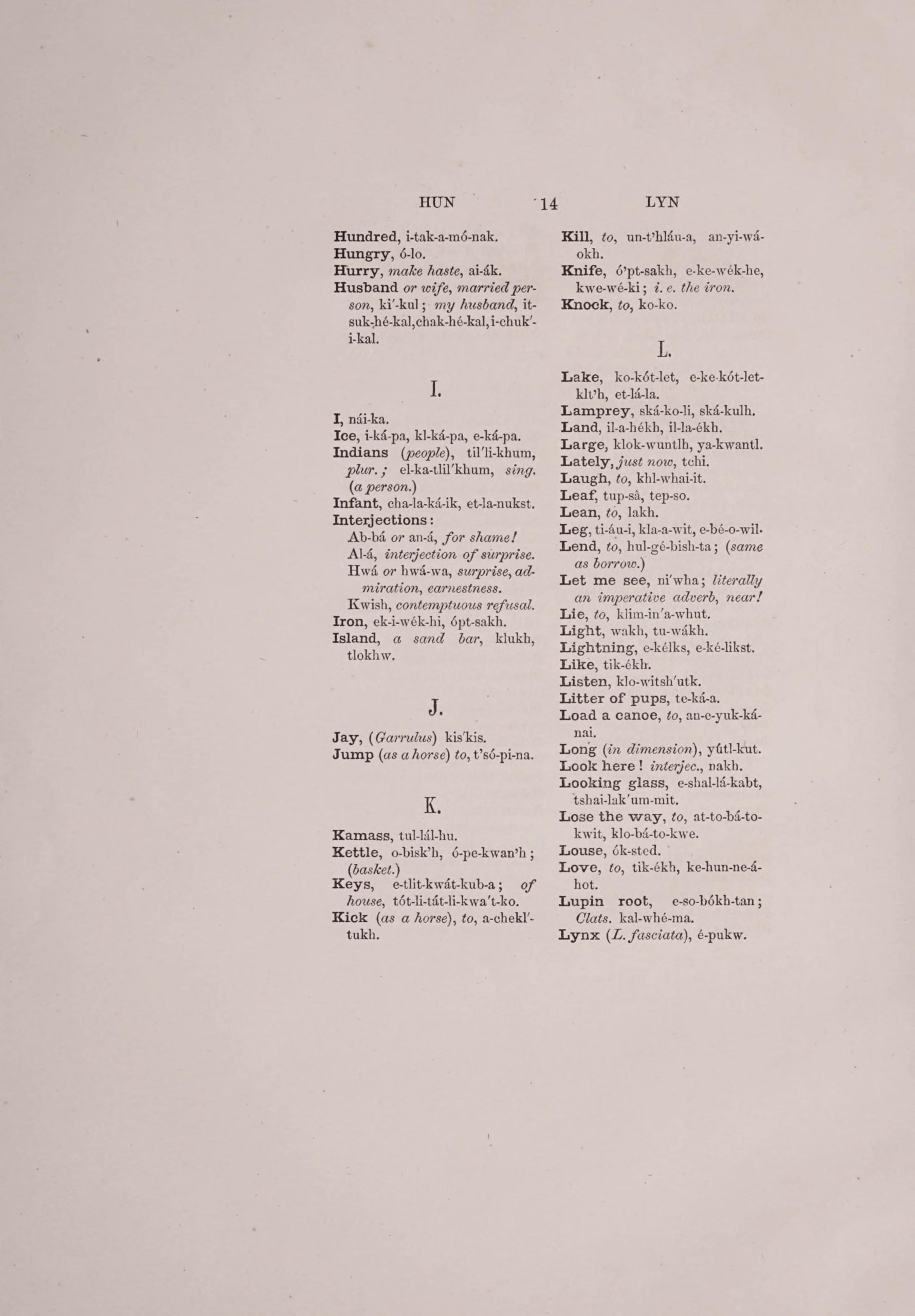
HUN 14 LYN
Hundred, i-tak-a-mó-nak.
Hungry, ó-lo.
Hurry, make haste, ai-ák.
Husband or wife, married per-
son, ki’-kul; my husband, it-
suk-hé-kal,chak-hé-kal,i-chuk’-
i-kal.
I.
I, nái-ka.
Ice, i-ká-pa, kl-ká-pa, e-ká-pa.
Indians (people), til’li-khum,
plur.; el-ka-tlil’khum, sing.
(a person.)
Infant, cha-la-ká-ik, et-la-nukst.
Interjections:
Ab-bá or an-á, for shame!
Al-á, interjection of surprise.
Hwá or hwá-wa, surprise, ad-
miration, earnestness.
Kwish, contemptuous refusal.
Iron, ek-i-wék-hi, ópt-sakh.
Island, a sand bar, klukh,
tlokhw.
J.
Jay, (Garrulus) kis’kis.
Jump (as a horse) to, t’só-pi-na.
K.
Kamass, tul-lál-hu.
Kettle, o-bisk’h, ó-pe-kwan’h;
(basket.)
Keys, e-tlit-kwát-kub-a; of
house, tót-li-tát-li-kwa’t-ko.
Kick (as a horse), to, a-chekl’-
tukh.
Kill, to, un-t’hláu-a, an-yi-wá-
okh.
Knife, ó’pt-sakh, e-ke-wék-he,
kwe-wé-ki; i. e. the iron.
Knock, to, ko-ko.
L.
Lake, ko-kót-let, e-ke-kót-let-
klt’h, et-lá-la.
Lamprey, ská-ko-li, ská-kulh.
Land, il-a-hékh, il-la-ékh.
Large, klok-wuntlh, ya-kwantl.
Lately, just now, tchi.
Laugh, to, khl-whai-it.
Leaf, tup-sâ, tep-so.
Lean, to, lakh.
Leg, ti-áu-i, kla-a-wit, e-bé-o-wil.
Lend, to, hul-gé-bish-ta; (same
as borrow.)
Let me see, ni’wha; literally
an imperative adverb, near!
Lie, to, klim-in’a-whut.
Light, wakh, tu-wákh.
Lightning, e-kélks, e-ké-likst.
Like, tik-ékh.
Listen, klo-witsh’utk.
Litter of pups, te-ká-a.
Load a canoe, to, an-e-yuk-ká-
nai.
Long (in dimension), yútl-kut.
Look here! interjec., nakh.
Looking glass, e-shal-lá-kabt,
‘tshai-lak’um-mit.
Lose the way, to, at-to-bá-to-
kwit, klo-bá-to-kwe.
Louse, ók-sted.
Love, to, tik-ékh, ke-hun-ne-á-
hot.
Lupin root, e-so-bókh-tan;
Clats. kal-whé-ma.
Lynx (L. fasciata), é-pukw.
Page 15: Mag–NumLeaf 24
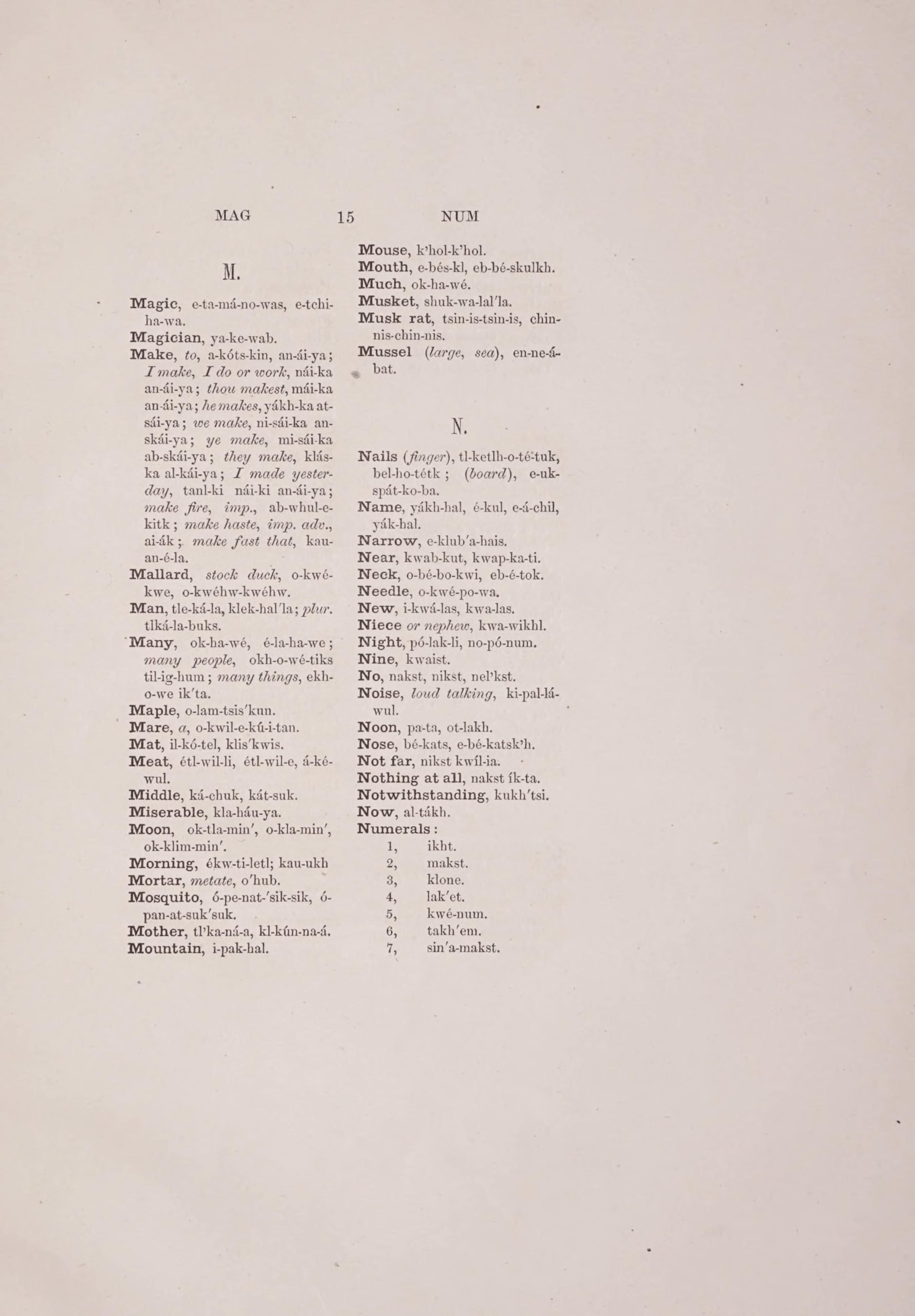
MAG 15 NUM
M.
Magic, e-ta-má-no-was, e-tchi-
ha-wa.
Magician, ya-ke-wab.
Make, to, a-kóts-kin, an-ái-ya;
I make, I do or work, nái-ka
an-ái-ya; thou makest, mái-ka
an-ái-ya; he makes, yákh-ka at-
sái-ya; we make, ni-sái-ka an-
skái-ya; ye make, mi-sái-ka
ab-skái-ya; they make, klás-
ka al-kái-ya; I made yester-
day, tanl-ki nái-ki an-ái-ya;
make fire, imp., ab-whul-e-
kitk; make haste, imp. adv.,
ai-ák; make fast that, kau-
an-é-la.
Mallard, stock duck, o-kwé-
kwe, o-kwéhw-kwéhw.
Man, tle-ká-la, klek-hal’la; plur.
tlká-la-buks.
Many, ok-ha-wé, é-la-ha-we;
many people, okh-o-wé-tiks
til-ig-hum; many things, ekh-
o-we ik’ta.
Maple, o-lam-tsis’kun.
Mare, a, o-kwil-e-kú-i-tan.
Mat, il-kó-tel, klis’kwis.
Meat, étl-wil-li, étl-wil-e, á-ké-
wul.
Middle, ká-chuk, kát-suk.
Miserable, kla-háu-ya.
Moon, ok-tla-min’, o-kla-min’,
ok-klim-min’.
Morning, ékw-ti-letl; kau-ukh
Mortar, metate, o’hub.
Mosquito, ó-pe-nat-‘sik-sik, ó-
pan-at-suk’suk.
Mother, tl’ka-ná-a, kl-kún-na-á.
Mountain, i-pak-hal.
Mouse, k’hol-k’hol.
Mouth, e-bés-kl, eb-bé-skulkh.
Much, ok-ha-wé.
Musket, shuk-wa-lal’la.
Musk rat, tsin-is-tsin-is, chin-
nis-chin-nis.
Mussel (large, sea), en-ne-á-
bat.
N.
Nails (finger), tl-ketlh-o-té-tuk,
bel-ho-tétk; (board), e-uk-
spát-ko-ba.
Name, yákh-hal, é-kul, e-á-chil,
yák-hal.
Narrow, e-klub’a-hais.
Near, kwab-kut, kwap-ka-ti.
Neck, o-bé-bo-kwi, eb-é-tok.
Needle, o-kwé-po-wa.
New, i-kwá-las, kwa-las.
Niece or nephew, kwa-wikhl.
Night, pó-lak-li, no-pó-num.
Nine, kwaist.
No, nakst, nikst, nel’kst.
Noise, loud talking, ki-pal-lá-
wul.
Noon, pa-ta, ot-lakh.
Nose, bé-kats, e-bé-katsk’h.
Not far, nikst kwíl-ia.
Nothing at all, nakst ík-ta.
Notwithstanding, kukh’tsi.
Now, al-tákh.
Numerals:
1, ikht.
2, makst.
3, klone.
4, lak’et.
5, kwé-num.
6, takh’em.
7, sin’a-makst.
Page 16: Oak–RalLeaf 25
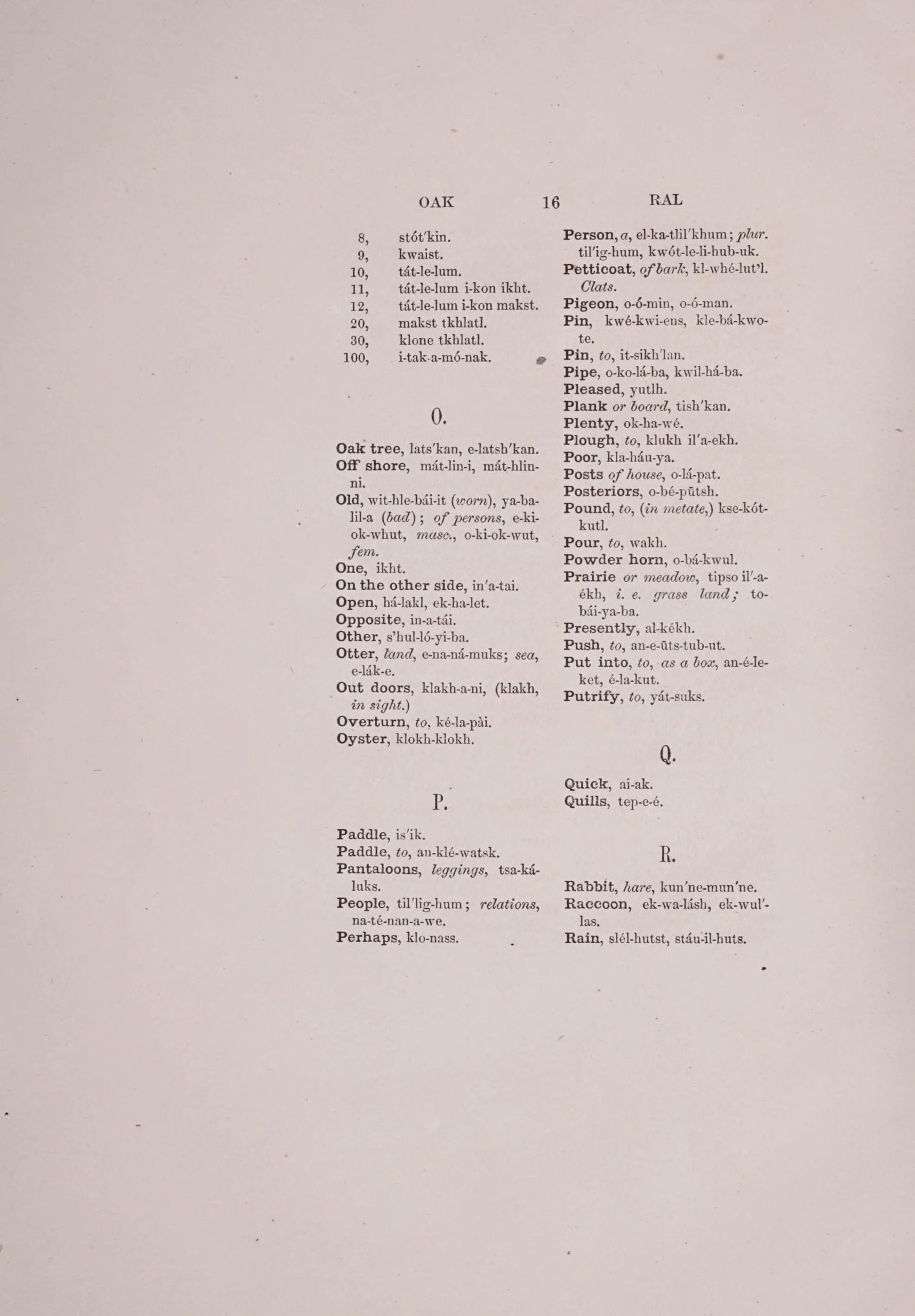
OAK 16 RAL
8, stót’kin.
9, kwaist.
10, tát-le-lum.
11, tát-le-lum i-kon ikht.
12, tát-le-lum i-kon makst.
20, makst tkhlatl.
30, klone tkhlatl.
100, i-tak-a-mó-nak.
O.
Oak tree, lats’kan, e-latsh’kan.
Off shore, mát-lin-i, mát-hlin-
ni.
Old, wit-hle-bái-it (worn), ya-ba-
lil-a (bad); of persons, e-ki-
ok-whut, masc., o-ki-ok-wut,
fem.
One, ikht.
On the other side, in’a-tai.
Open, há-lakl, ek-ha-let.
Opposite, in-a-tái.
Other, s’hul-ló-yi-ba.
Otter, land, e-na-ná-muks; sea,
e-lák-e.
Out doors, klakh-a-ni, (klakh,
in sight.)
Overturn, to, ké-la-pài.
Oyster, klokh-klokh.
P.
Paddle, is’ik.
Paddle, to, an-klé-watsk.
Pantaloons, leggings, tsa-ká-
luks.
People, til’lig-hum; relations,
na-té-nan-a-we.
Perhaps, klo-nass.
Person, a, el-ka-tlil’khum; plur.
til’ig-hum, kwót-le-li-hub-uk.
Petticoat, of bark, kl-whé-lut’l.
Clats.
Pigeon, o-ó-min, o-ó-man.
Pin, kwé-kwi-ens, kle-bá-kwo-
te.
Pin, to, it-sikh’lan.
Pipe, o-ko-lá-ba, kwil-há-ba.
Pleased, yutlh.
Plank or board, tish’kan.
Plenty, ok-ha-wé.
Plough, to, klukh il’a-ekh.
Poor, kla-háu-ya.
Posts of house, o-lá-pat.
Posteriors, o-bé-pútsh.
Pound, to, (in metate,) kse-kót-
kutl.
Pour, to, wakh.
Powder horn, o-bá-kwul.
Prairie or meadow, tipso il’-a-
ékh, i. e. grass land; to-
bái-ya-ba.
Presently, al-kékh.
Push, to, an-e-úts-tub-ut.
Put into, to, as a box, an-é-le-
ket, é-la-kut.
Putrify, to, yát-suks.
Q.
Quick, ai-ak.
Quills, tep-e-é.
R.
Rabbit, hare, kun’ne-mun’ne.
Raccoon, ek-wa-lásh, ek-wul’-
las.
Rain, slél-hutst, stáu-il-huts.
Page 17: Rai–ShuLeaf 26
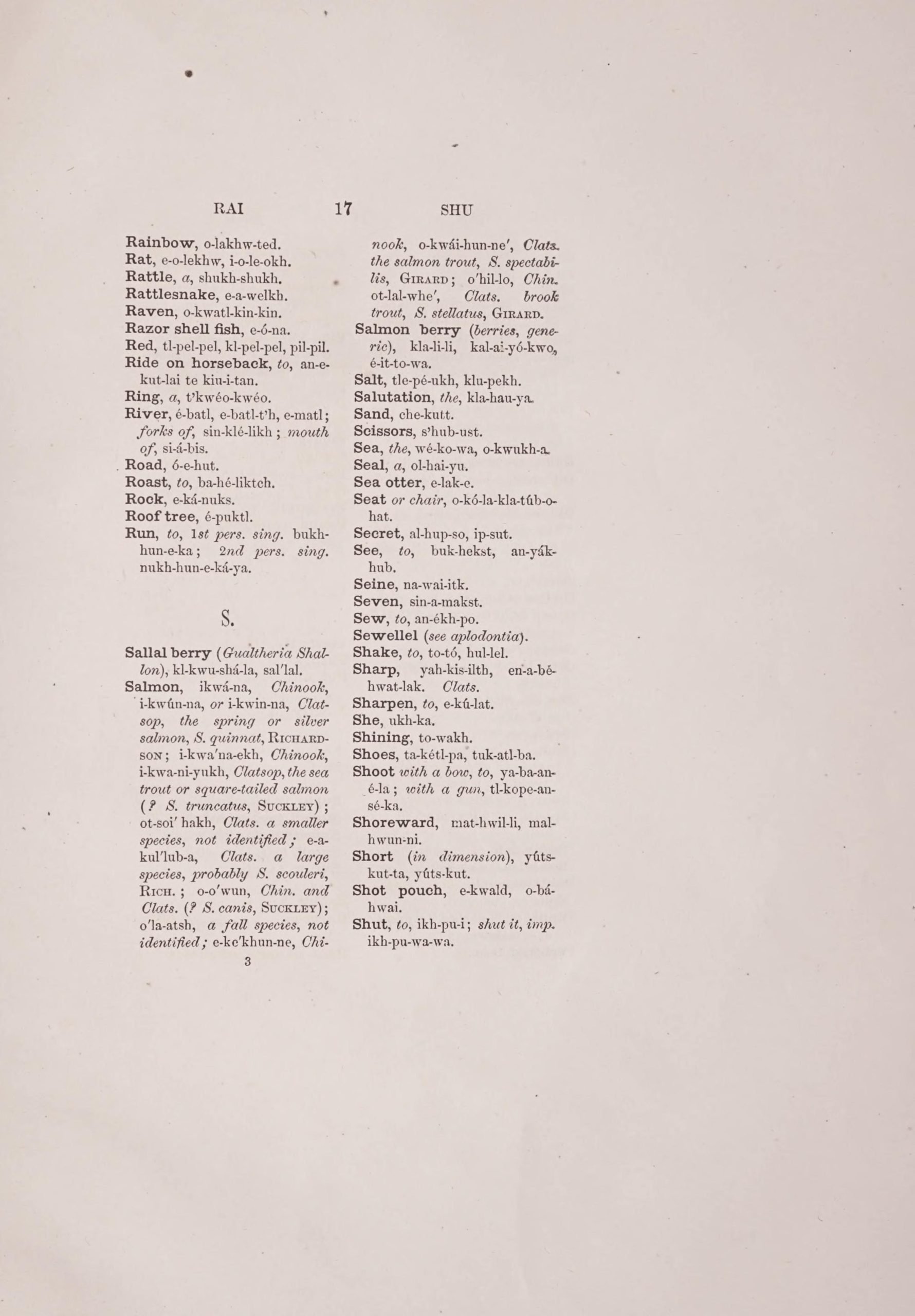
RAI 17 SHU
Rainbow, o-lakhw-ted.
Rat, e-o-lekhw, i-o-le-okh.
Rattle, a, shukh-shukh.
Rattlesnake, e-a-welkh.
Raven, o-kwatl-kin-kin.
Razor shell fish, e-ó-na.
Red, tl-pel-pel, kl-pel-pel, pil-pil.
Ride on horseback, to, an-e-
kut-lai te kiu-i-tan.
Ring, a, t’kwéo-kwéo.
River, é-batl, e-batl-t’h, e-matl;
forks of, sin-klé-likh; mouth
of, si-á-bis.
Road, ó-e-hut.
Roast, to, ba-hé-liktch.
Rock, e-ká-nuks.
Roof tree, é-puktl.
Run, to, 1st pers. sing. bukh-
hun-e-ka; 2nd pers. sing.
nukh-hun-e-ká-ya.
S.
Sallal berry (Gualtheria Shal-
lon), kl-kwu-shá-la, sal’lal.
Salmon, ikwá-na, Chinook,
i-kwún-na, or i-kwin-na, Clat-
sop, the spring or silver
salmon, S. quinnat, RICHARD-
SON; i-kwa’na-ekh, Chinook,
i-kwa-ni-yukh, Clatsop, the sea
trout or square-tailed salmon
(? S. truncatus, SUCKLEY);
ot-soi’ hakh, Clats. a smaller
species, not identified; e-a-
kul’lub-a, Clats. a large
species, probably S. scouleri,
RICH.; o-o’wun, Chin. and
Clats. (? S. canis, SUCKLEY);
o’la-atsh, a fall species, not
identified; e-ke’khun-ne, Chi-
3
nook, o-kwái-hun-ne’, Clats.
the salmon trout, S. spectabi-
lis, GIRARD; o’hil-lo, Chin.
ot-lal-whe’, Clats. brook
trout, S. stellatus, GIRARD.
Salmon berry (berries, gene-
ric), kla-li-li, kal-ai-yó-kwo,
é-it-to-wa.
Salt, tle-pé-ukh, klu-pekh.
Salutation, the, kla-hau-ya.
Sand, che-kutt.
Scissors, s’hub-ust.
Sea, the, wé-ko-wa, o-kwukh-a.
Seal, a, ol-hai-yu.
Sea otter, e-lak-e.
Seat or chair, o-kó-la-kla-túb-o-
hat.
Secret, al-hup-so, ip-sut.
See, to, buk-hekst, an-yák-
hub.
Seine, na-wai-itk.
Seven, sin-a-makst.
Sew, to, an-ékh-po.
Sewellel (see aplodontia).
Shake, to, to-tó, hul-lel.
Sharp, yah-kis-ilth, en-a-bé-
hwat-lak. Clats.
Sharpen, to, e-kú-lat.
She, ukh-ka.
Shining, to-wakh.
Shoes, ta-kétl-pa, tuk-atl-ba.
Shoot with a bow, to, ya-ba-an-
é-la; with a gun, tl-kope-an-
sé-ka.
Shoreward, mat-hwil-li, mal-
hwun-ni.
Short (in dimension), yúts-
kut-ta, yúts-kut.
Shot pouch, e-kwald, o-bá-
hwai.
Shut, to, ikh-pu-i; shut it, imp.
ikh-pu-wa-wa.
Page 18: Sic–SwiLeaf 27
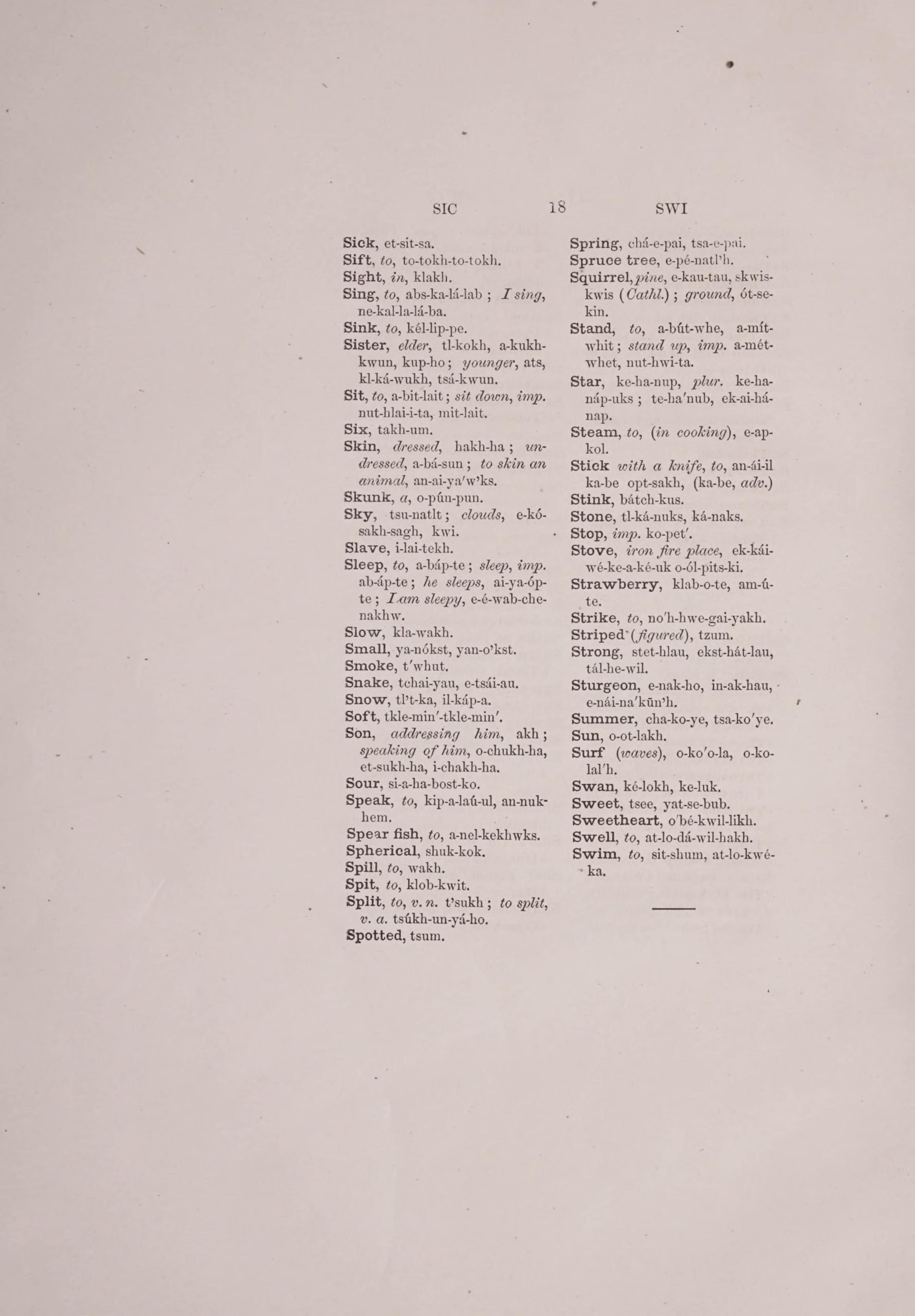
SIC 18 SWI
Sick, et-sit-sa.
Sift, to, to-tokh-to-tokh.
Sight, in, klakh.
Sing, to, abs-ka-lá-lab; I sing,
ne-kal-la-lá-ba.
Sink, to, kél-lip-pe.
Sister, elder, tl-kokh, a-kukh-
kwun, kup-ho; younger, ats,
kl-ká-wukh, tsá-kwun.
Sit, to, a-bit-lait; sit down, imp.
nut-hlai-i-ta, mit-lait.
Six, takh-um.
Skin, dressed, hakh-ha; un-
dressed, a-bá-sun; to skin an
animal, an-ai-ya’w’ks.
Skunk, a, o-pún-pun.
Sky, tsu-natlt; clouds, e-kó-
sakh-sagh, kwi.
Slave, i-lai-tekh.
Sleep, to, a-báp-te; sleep, imp.
ab-áp-te; he sleeps, ai-ya-óp-
te; I am sleepy, e-é-wab-che-
nakhw.
Slow, kla-wakh.
Small, ya-nókst, yan-o’kst.
Smoke, t’whut.
Snake, tchai-yau, e-tsái-au.
Snow, tl’t-ka, il-káp-a.
Soft, tkle-min’-tkle-min’.
Son, addressing him, akh;
speaking of him, o-chukh-ha,
et-sukh-ha, i-chakh-ha.
Sour, si-a-ha-bost-ko.
Speak, to, kip-a-laú-ul, an-nuk-
hem.
Spear fish, to, a-nel-kekhwks.
Spherical, shuk-kok.
Spill, to, wakh.
Spit, to, klob-kwit.
Split, to, v. n. t’sukh; to split,
v. a. tsúkh-un-yá-ho.
Spotted, tsum.
Spring, chá-e-pai, tsa-e-pai.
Spruce tree, e-pé-natl’h.
Squirrel, pine, e-kau-tau, skwis-
kwis (Cathl.); ground, ót-se-
kin.
Stand, to, a-bút-whe, a-mít-
whit; stand up, imp. a-mét-
whet, nut-hwi-ta.
Star, ke-ha-nup, plur. ke-ha-
náp-uks; te-ha’nub, ek-ai-há-
nap.
Steam, to, (in cooking), e-ap-
kol.
Stick with a knife, to, an-ái-il
ka-be opt-sakh, (ka-be, adv.)
Stink, bátch-kus.
Stone, tl-ká-nuks, ká-naks.
Stop, imp. ko-pet’.
Stove, iron fire place, ek-kái-
wé-ke-a-ké-uk o-ól-pits-ki.
Strawberry, klab-o-te, am-ú-
te.
Strike, to, no’h-hwe-gai-yakh.
Striped (figured), tzum.
Strong, stet-hlau, ekst-hát-lau,
tál-he-wil.
Sturgeon, e-nak-ho, in-ak-hau,
e-nái-na’kún’h.
Summer, cha-ko-ye, tsa-ko’ye.
Sun, o-ot-lakh.
Surf (waves), o-ko’o-la, o-ko-
lal’h.
Swan, ké-lokh, ke-luk.
Sweet, tsee, yat-se-bub.
Sweetheart, o’bé-kwil-likh.
Swell, to, at-lo-dá-wil-hakh.
Swim, to, sit-shum, at-lo-kwé-
ka.
Page 19: Tai–UpsLeaf 28
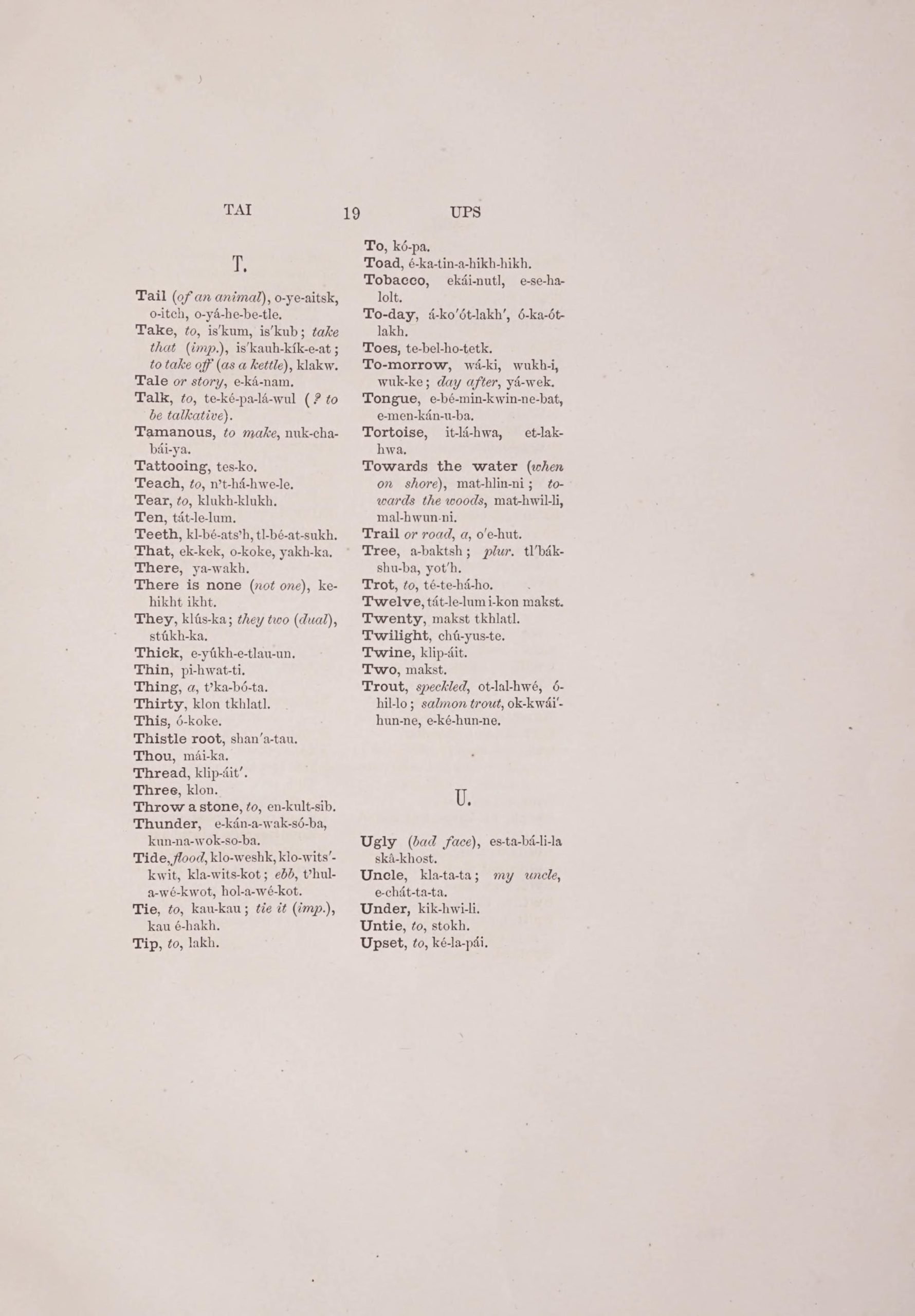
TAI 19 UPS
T.
Tail (of an animal), o-ye-aitsk,
o-itch, o-yá-he-be-tle.
Take, to, is’kum, is’kub; take
that (imp.), is’kauh-kík-e-at;
to take off (as a kettle), klakw.
Tale or story, e-ká-nam.
Talk, to, te-ké-pa-lá-wul (? to
be talkative).
Tamanous, to make, nuk-cha-
bái-ya.
Tattooing, tes-ko.
Teach, to, n’t-há-hwe-le.
Tear, to, klukh-klukh.
Ten, tát-le-lum.
Teeth, kl-bé-ats’h, tl-bé-at-sukh.
That, ek-kek, o-koke, yakh-ka.
There, ya-wakh.
There is none (not one), ke-
hikht ikht.
They, klús-ka; they two (dual),
stúkh-ka.
Thick, e-yúkh-e-tlau-un.
Thin, pi-hwat-ti.
Thing, a, t’ka-bó-ta.
Thirty, klon tkhlatl.
This, ó-koke.
Thistle root, shan’a-tau.
Thou, mái-ka.
Thread, klip-áit’.
Three, klon.
Throw a stone, to, en-kult-sib.
Thunder, e-kán-a-wak-só-ba,
kun-na-wok-so-ba.
Tide, flood, klo-weshk, klo-wits’-
kwit, kla-wits-kot; ebb, t’hul-
a-wé-kwot, hol-a-wé-kot.
Tie, to, kau-kau; tie it (imp.),
kau é-hakh.
Tip, to, lakh.
To, kó-pa.
Toad, é-ka-tin-a-hikh-hikh.
Tobacco, ekái-nutl, e-se-ha-
lolt.
To-day, á-ko’ót-lakh’, ó-ka-ót-
lakh.
Toes, te-bel-ho-tetk.
To-morrow, wá-ki, wukh-i,
wuk-ke; day after, yá-wek.
Tongue, e-bé-min-kwin-ne-bat,
e-men-kán-u-ba.
Tortoise, it-lá-hwa, et-lak-
hwa.
Towards the water (when
on shore), mat-hlin-ni; to-
wards the woods, mat-hwil-li,
mal-hwun-ni.
Trail or road, a, o’e-hut.
Tree, a-baktsh; plur. tl’bák-
shu-ba, yot’h.
Trot, to, té-te-há-ho.
Twelve, tát-le-lum i-kon makst.
Twenty, makst tkhlatl.
Twilight, chú-yus-te.
Twine, klip-áit.
Two, makst.
Trout, speckled, ot-lal-hwé, ó-
hil-lo; salmon trout, ok-kwái’-
hun-ne, e-ké-hun-ne.
U.
Ugly (bad face), es-ta-bá-li-la
skâ-khost.
Uncle, kla-ta-ta; my uncle,
e-chát-ta-ta.
Under, kik-hwi-li.
Untie, to, stokh.
Upset, to, ké-la-pái.
Page 20: Vei–YouLeaf 29
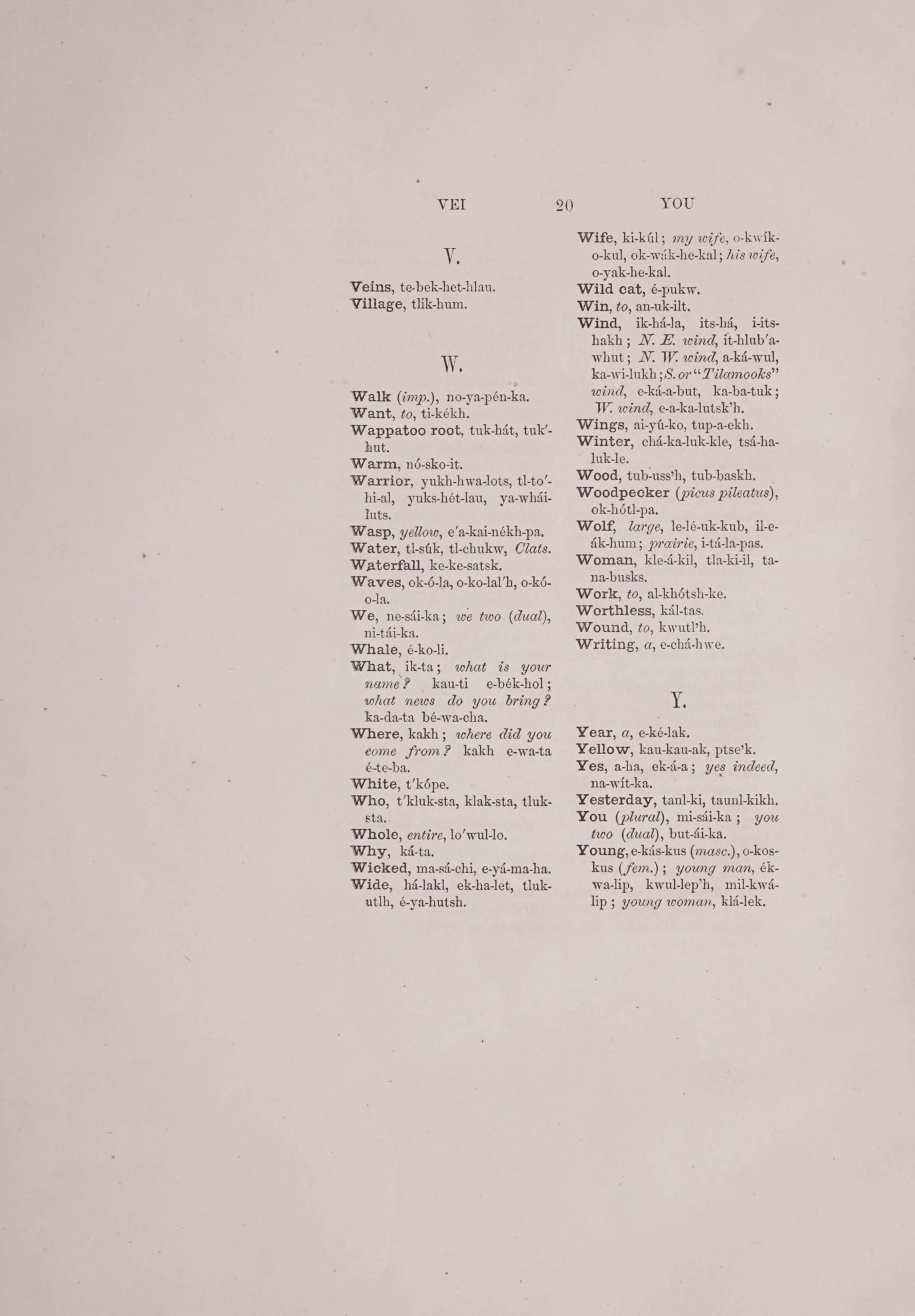
VEI 20 YOU
V.
Veins, te-bek-het-hlau.
Village, tlik-hum.
W.
Walk (imp.), no-ya-pén-ka.
Want, to, ti-kékh.
Wappatoo root, tuk-hát, tuk’-
hut.
Warm, nó-sko-it.
Warrior, yukh-hwa-lots, tl-to’-
hi-al, yuks-hét-lau, ya-whái-
luts.
Wasp, yellow, e’a-kai-nékh-pa.
Water, tl-súk, tl-chukw, Clats.
Waterfall, ke-ke-satsk.
Waves, ok-ó-la, o-ko-lal’h, o-kó-
o-la.
We, ne-sái-ka; we two (dual),
ni-tái-ka.
Whale, é-ko-li.
What, ik-ta; what is your
name? kau-ti e-bék-hol;
what news do you bring?
ka-da-ta bé-wa-cha.
Where, kakh; where did you
come from? kakh e-wa-ta
é-te-ba.
White, t’kópe.
Who, t’kluk-sta, klak-sta, tluk-
sta.
Whole, entire, lo’wul-lo.
Why, ká-ta.
Wicked, ma-sá-chi, e-yá-ma-ha.
Wide, há-lakl, ek-ha-lét, tluk-
utlh, é-ya-hutsh.
Wife, ki-kúl; my wife, o-kwík-
o-kul, ok-wák-he-kal; his wife,
o-yak-he-kal.
Wild cat, é-pukw.
Win, to, an-uk-ilt.
Wind, ik-há-la, its-há, i-its-
hakh; N. E. wind, it-hlub’a-
whut; N. W. wind, a-ká-wul,
ka-wi-lukh; S. or “Tilamooks”
wind, e-ká-a-but, ka-ba-tuk;
W. wind, e-a-ka-lutsk’h.
Wings, ai-yú-ko, tup-a-ekh.
Winter, chá-ka-luk-kle, tsá-ha-
luk-le.
Wood, tub-uss’h, tub-baskh.
Woodpecker (picus pileatus),
ok-hótl-pa.
Wolf, large, le-lé-uk-kub, il-e-
ák-hum; prairie, i-tá-la-pas.
Woman, kle-á-kil, tla-ki-il, ta-
na-busks.
Work, to, al-khótsh-ke.
Worthless, kál-tas.
Wound, to, kwutl’h.
Writing, a, e-chá-hwe.
Y.
Year, a, e-ké-lak.
Yellow, kau-kau-ak, ptse’k.
Yes, a-ha, ek-á-a; yes indeed,
na-wít-ka.
Yesterday, tanl-ki, taunl-kikh.
You (plural), mi-sái-ka; you
two (dual), but-ái-ka.
Young, e-kás-kus (masc.), o-kos-
kus (fem.); young man, ék-
wa-lip, kwul-lep’h, mil-kwá-
lip; young woman, klá-lek.
LOCAL NOMENCLATURE.Leaf 30
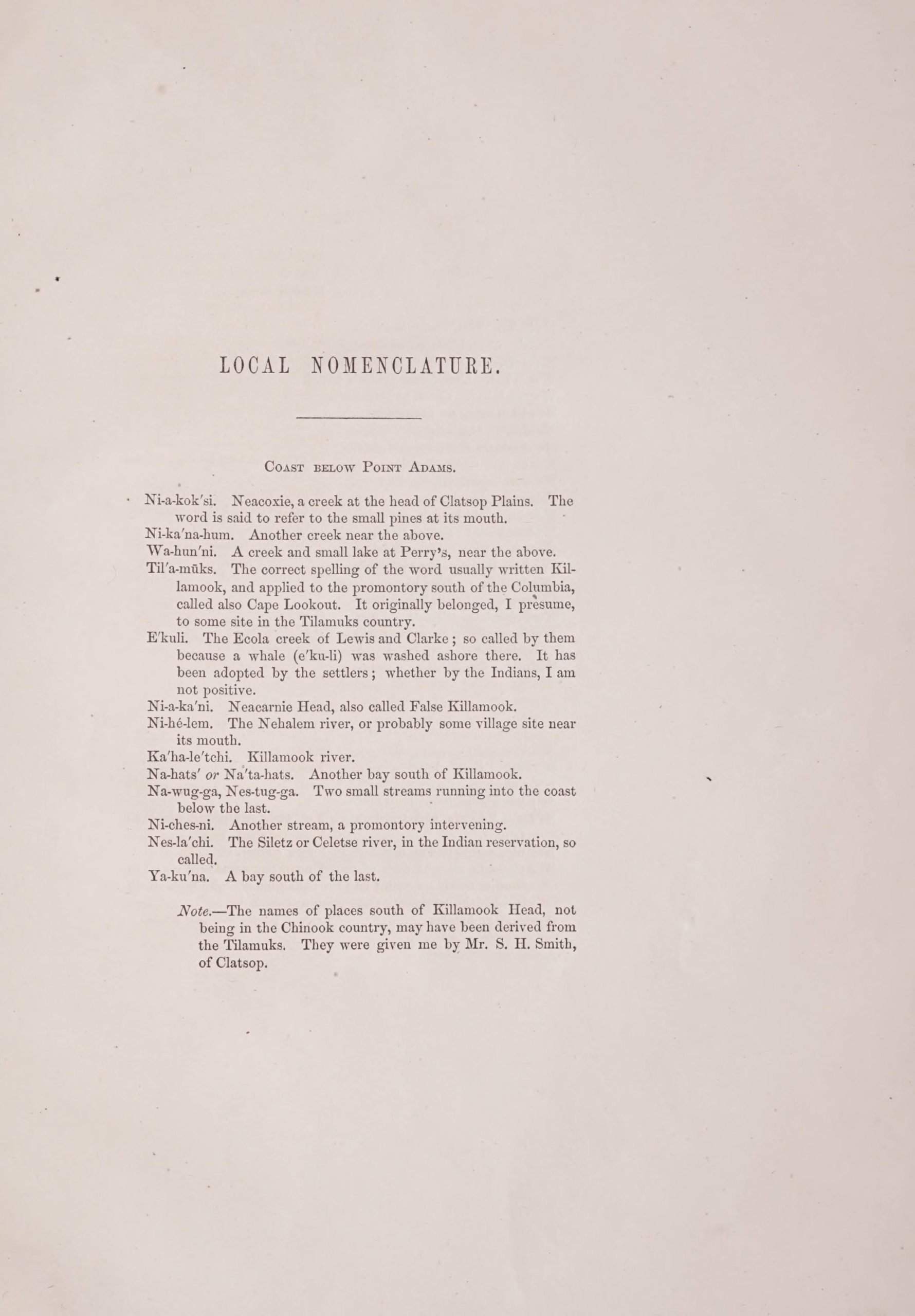
LOCAL NOMENCLATURE.
————————
Coast below Point Adams.
Ni-a-kok’si. Neacoxie, a creek at the head of Clatsop Plains. The
word is said to refer to the small pines at its mouth.
Ni-ka’na-hum. Another creek near the above.
Wa-hun’ni. A creek and small lake at Perry’s, near the above.
Til’a-mūks. The correct spelling of the word usually written Kil-
lamook, and applied to the promontory south of the Columbia,
called also Cape Lookout. It originally belonged, I presume,
to some site in the Tilamuks country.
E’kuli. The Ecola creek of Lewis and Clarke; so called by them
because a whale (e’ku-li) was washed ashore there. It has
been adopted by the settlers; whether by the Indians, I am
not positive.
Ni-a-ka’ni. Neacarnie Head, also called False Killamook.
Ni-hé-lem. The Nehalem river, or probably some village site near
its mouth.
Ka’ha-le’tchi. Killamook river.
Na-hats’ or Na’ta-hats. Another bay south of Killamook.
Na-wug-ga, Nes-tug-ga. Two small streams running into the coast
below the last.
Ni-ches-ni. Another stream, a promontory intervening.
Nes-la’chi. The Siletz or Celetse river, in the Indian reservation, so
called.
Ya-ku’na. A bay south of the last.
Note.—The names of places south of Killamook Head, not
being in the Chinook country, may have been derived from
the Tilamuks. They were given me by Mr. S. H. Smith,
of Clatsop.
22Leaf 31
22
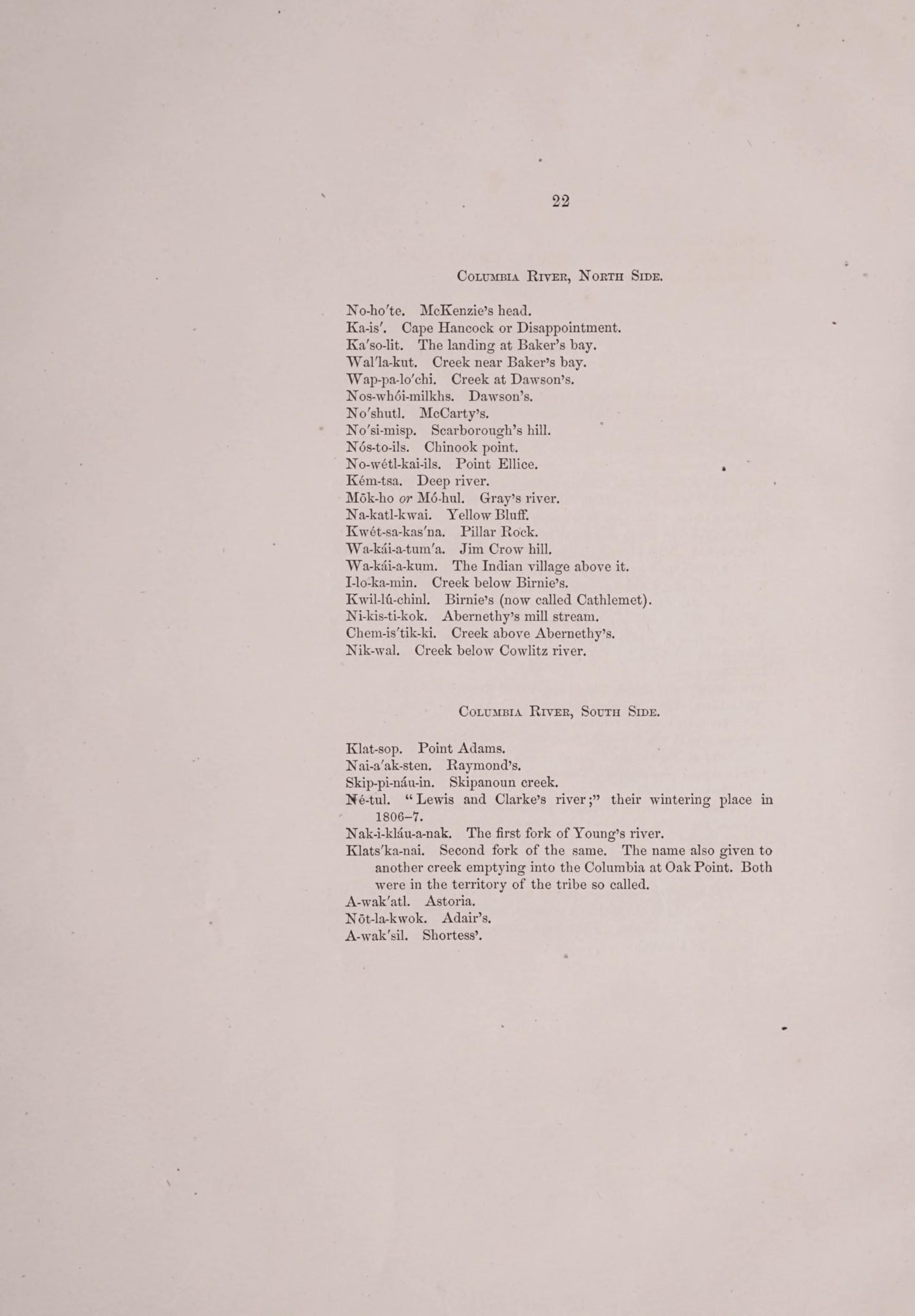
Columbia River, North Side.
No-ho’te. McKenzie’s head.
Ka-is’. Cape Hancock or Disappointment.
Ka’so-lit. The landing at Baker’s bay.
Wal’la-kut. Creek near Baker’s bay.
Wap-pa-lo’chi. Creek at Dawson’s.
Nos-whói-milkhs. Dawson’s.
No’shutl. McCarty’s.
No’si-misp. Scarborough’s hill.
Nós-to-ils. Chinook point.
No-wétl-kai-ils. Point Ellice.
Kém-tsa. Deep river.
Mōk-ho or Mó-hul. Gray’s river.
Na-katl-kwai. Yellow Bluff.
Kwét-sa-kas’na. Pillar Rock.
Wa-kái-a-tum’a. Jim Crow hill.
Wa-kái-a-kum. The Indian village above it.
I-lo-ka-min. Creek below Birnie’s.
Kwil-lú-chinl. Birnie’s (now called Cathlemet).
Ni-kis-ti-kok. Abernethy’s mill stream.
Chem-is’tik-ki. Creek above Abernethy’s.
Nik-wal. Creek below Cowlitz river.
Columbia River, South Side.
Klat-sop. Point Adams.
Nai-a’ak-sten. Raymond’s.
Skip-pi-náu-in. Skipanoun creek.
Né-tul. “Lewis and Clarke’s river;” their wintering place in
1806-7.
Nak-i-kláu-a-nak. The first fork of Young’s river.
Klats’ka-nai. Second fork of the same. The name also given to
another creek emptying into the Columbia at Oak Point. Both
were in the territory of the tribe so called.
A-wak’atl. Astoria.
Nōt-la-kwok. Adair’s.
A-wak’sil. Shortess’.
23Leaf 32
23
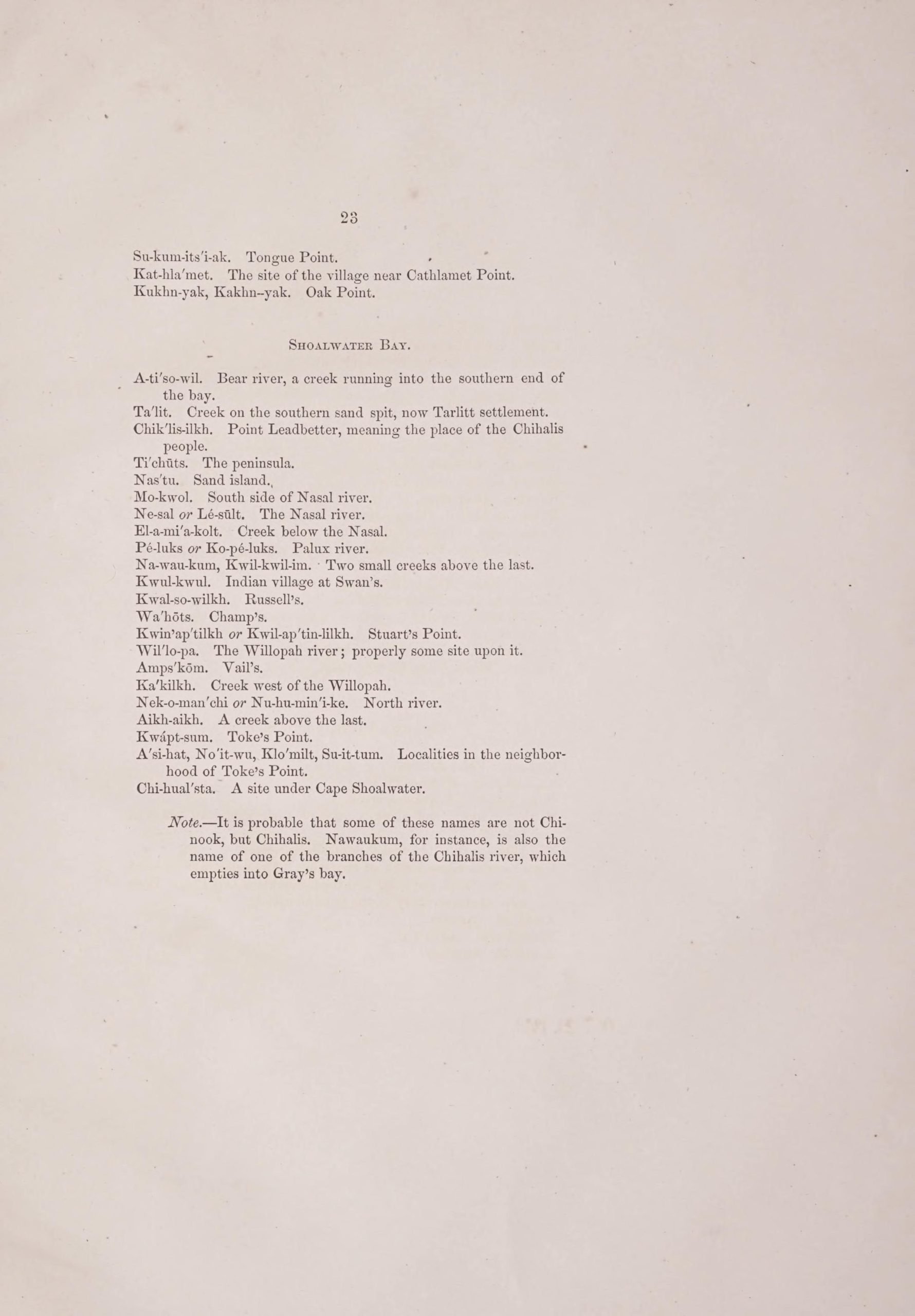
Su-kum-its’i-ak. Tongue Point.
Kat-hla’met. The site of the village near Cathlamet Point.
Kukhn-yak, Kakhn–yak. Oak Point.
Shoalwater Bay.
A-ti’so-wil. Bear river, a creek running into the southern end of
the bay.
Ta’lit. Creek on the southern sand spit, now Tarlitt settlement.
Chik’lis-ilkh. Point Leadbetter, meaning the place of the Chihalis
people.
Ti’chūts. The peninsula.
Nas’tu. Sand island.
Mo-kwol. South side of Nasal river.
Ne-sal or Lé-sūlt. The Nasal river.
El-a-mi’a-kolt. Creek below the Nasal.
Pé-luks or Ko-pé-luks. Palux river.
Na-wau-kum, Kwil-kwil-im. Two small creeks above the last.
Kwul-kwul. Indian village at Swan’s.
Kwal-so-wilkh. Russell’s.
Wa’hōts. Champ’s.
Kwin’ap’tilkh or Kwil-ap’tin-lilkh. Stuart’s Point.
Wil’lo-pa. The Willopah river; properly some site upon it.
Amps’kōm. Vail’s.
Ka’kilkh. Creek west of the Willopah.
Nek-o-man’chi or Nu-hu-min’i-ke. North river.
Aikh-aikh. A creek above the last.
Kwápt-sum. Toke’s Point.
A’si-hat, No’it-wu, Klo’milt, Su-it-tum. Localities in the neighbor-
hood of Toke’s Point.
Chi-hual’sta. A site under Cape Shoalwater.
Note.—It is probable that some of these names are not Chi-
nook, but Chihalis. Nawaukum, for instance, is also the
name of one of the branches of the Chihalis river, which
empties into Gray’s bay.
OCT. 20, 1863.Leaf 33
OCT. 20, 1863.
Blank pageLeaf 34
blank page

This leaf carries no text.
Blank pageLeaf 35
blank page
This leaf carries no text.
Blank pageLeaf 36
blank page
This leaf carries no text.
Blank page — marbled endpaper, no textLeaf 37
blank page — marbled endpaper, no text
This leaf carries no text.
Blank page — marbled endpaper, no textLeaf 38
blank page — marbled endpaper, no text
This leaf carries no text.
Source. Gibbs, G. (1863). Alphabetical vocabulary of the Chinook language. Cramoisy Press. Copy 1, Fort Meade collection (call number PM 843 .G5), Library of Congress. Digitised copy held in the archive of this site.
Views: 17