Following the Guidon, Chapter IX: Pets of the Camp
From Following the Guidon, by Elizabeth B. Custer (1890). Chapter IX. Back to Contents.
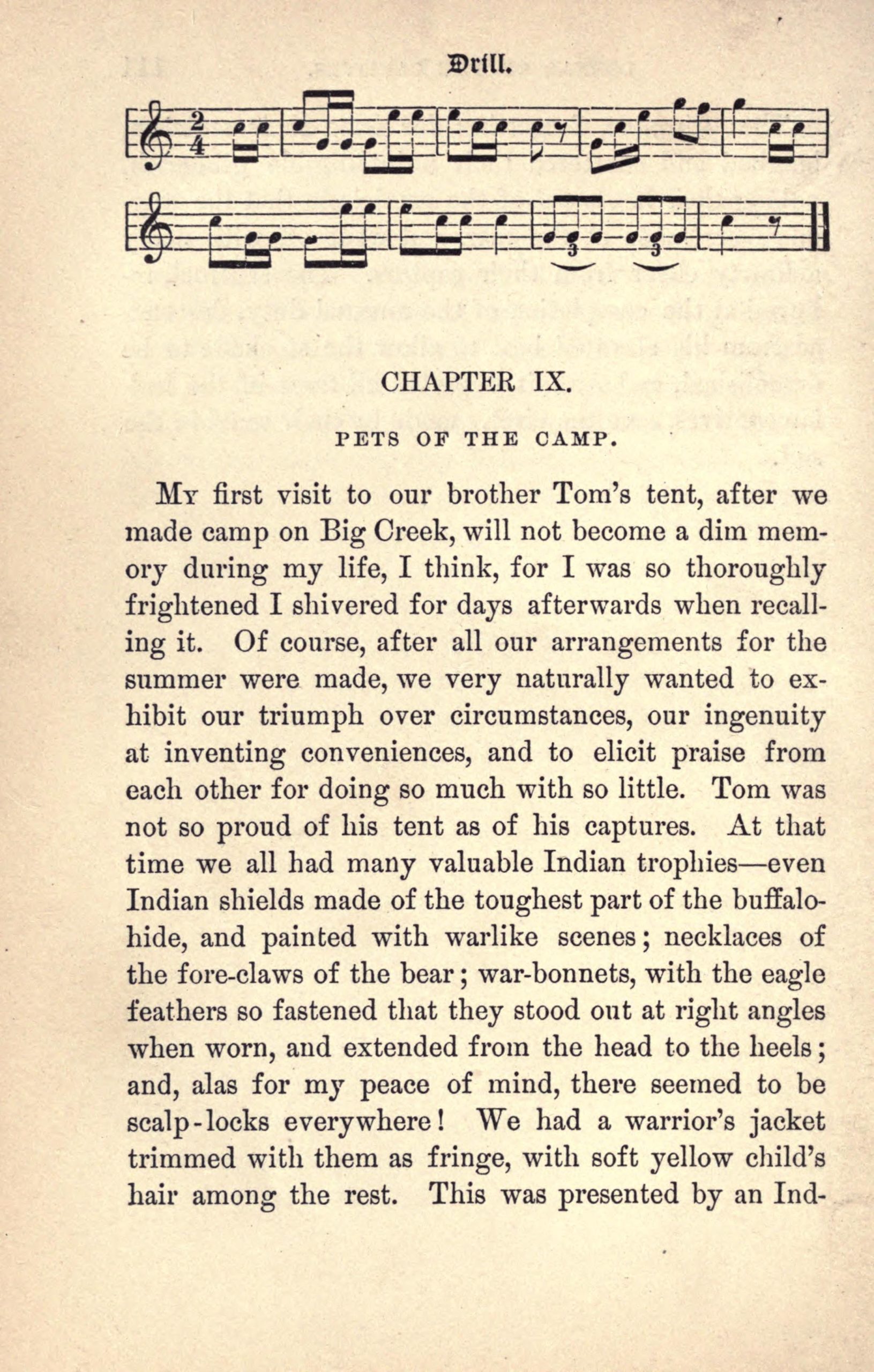
My first visit to our brother Tom’s tent, after we made camp on Big Creek, will not become a dim memory during my life, I think, for I was so thoroughly frightened I shivered for days afterwards when recalling it. Of course, after all our arrangements for the summer were made, we very naturally wanted to exhibit our triumph over circumstances, our ingenuity at inventing conveniences, and to elicit praise from each other for doing so much with so little. Tom was not so proud of his tent as of his captures. At that time we all had many valuable Indian trophies — even Indian shields made of the toughest part of the buffalohide, and painted with warlike scenes; necklaces of the fore-claws of the bear; war-bonnets, with the eagle feathers so fastened that they stood out at right angles when worn, and extended from the head to the heels; and, alas for my peace of mind, there seemed to be scalp -locks everywhere! We had a warrior’s jacket trimmed with them as fringe, with soft yellow cliild’s hair among the rest. This was presented by an Ind-
ian, wliile some of the officers were offered other trophies in trade.
There was a captured scalp -lock, stretched over a small hoop made of a willow withe to keep it from shrinking, and this was hung to the belt in an Indian dance, or to the tepee walls wdiile they were not in full dress. Our brother Tom always had an ample collection of these Indian mementos, and it made his tent or quarters in garrison very uncan-
ny, m my estimation. But if the war – bonnet, shield, or bear- claw necklace could be bought or traded for, or captured in an Indian fight, it was like possessing one’s self of the family diamonds a scalp-lock.
of an Indian, as these
three heirlooms were handed down as we white people bequeath jewels, plate, or pictures.
Colonel Tom’s next most valuable possession was a box of rattlesnakes. He was an expert in catching
tliem. Being very agile and extremely quick, he never failed to bag his game. When he discovered a snake with seven or more rattles he leaped from his horse, called his orderly to take off his coat and tie up the end of the sleeve and hold it for the prisoner. Then, with a well-aimed and violent stroke with the butt of the carbine he pinioned the reptile near the head, and holding it down with one hand, seized it by the back of the neck, lifted it from the ground, dropped it into the sleeve, tied it again, and swinging into the saddle, joined the column as unconcerned as if the seven rattles were not threatening vengeance behind him. On my first meeting with him after a campaign he usually said, ” Well, old lady, I have some beauties to show you this time, captured them on purpose for you,” and I knew that my hour had come. I never passed for a fearless woman, and I did not hesitate to beg off, telling him I ” appreciated the honor,” but would see the reptiles ” some other day,” and resorting to any subterfuge to escape this form of hospitality. But I might as well have argued with the snakes themselves for all the good I accomplished. He came after me, and we started; in vain I dawdled by the way to delay the moment that was simply horrible to me; his cheerful “Here we are!” seemed to sound so soon. The insecure cages were 23atclied-up hardtack boxes, and the snakes had to bo lifted out to exhibit them.
Tom’s bull-dog was always a terror to me, but in this new fright his ominous growls were forgotten. 1 only begged before the performance began to take up
my place on the bed — and oh, how I bemoaned the lowness of it! The agonizing thought was forced upon me that at that very moment a snake might be lurking under the low camp-cot, or, worse still, wriggling Tinder the blankets on which my trembling toes then rested. Then, with skirts gathered about me for a sudden flight, with protruding eyeballs, I shook and gasped as the box -lids were removed, and the great loathsome objects stretched up to show their length, a chance being given to each one to shake his rattles in rage.
Words of regret from Tom awoke no answering emotion in me when he found himself minus one snake. What was a source of regret to him was an occasion of horror to me; there was not a vestige of the snake remaining; it had not escaped; it was a victim of reptile cannibalism, for the larger of the two had eaten his smaller comrade, and not even a rattle was left!
After this entertainment was over, and I was going home, almost frisking with joy, over the plains that separated us from the soldiers’ and officers’ tents, I tried to argue with Tom that he sliould keep all of his snakes together instead of in separate boxes; and I contended that this was nothing more than a measure of justice to them, as they must miss the sort of companionship, a craving for which is said to exist throughout the animal kingdom; but he discovered my motive, and replied, ” If you think, old lady, that after all the trouble I have been to, to catch these snakes to
show you, I am going to make it easy for them to eat each other up, you are mightily mistaken.” Some English tourists were so interested in Tom’s daring mode of capture, and the snakes themselves were so novel a sight to them, that they persuaded him to send some specimens to the “Zoo” in London; and last summer I saw one of those who were our guests at that time (Dr. Town send), and he told me that the snakes were still there. Tom’s orderly might appear in this affair as an object of pity, but he was as much interested and as enthusiastic in the sport as his officer, and posed before the soldiers as a snake -catcher — a position not without lionor among many daring men, who were willing to meet any sound of war except the threatening rattle of such a foe.
When we were encamped on Big Creek, buffaloes were all about us; the Kansas Pacific Railroad had been completed only to Fort Hays, and the herds were still roaming in immense numbers along the line. They frequently crossed the track in front of a train, but they were so intent upon getting away that the sharpest, most continued shrieks of the whistle did not turn them from their course; the leaders in a move are very faithfully followed by the herd as a rule. The engineer was often obliged to whistle down the brakes to avoid accident.
I remember standing among a group of officers at one time, resting after a charge into a herd. We were on a divide, where the horizon was visible in every direction. One of the group said to me, ” Turn about,
Mrs. Custer, and notice that you are surrounded with buffaloes.” It was as if tho horizon was outlined with a dark rim. The officer continued, ” You are looking now upon a hundred thousand buffaloes.” I was rather incredulous of their stories when they were told to me, as I had been so often ^’ guyed.” I said: “Are you really in earnest? And can I tell this to the people in the East when I go home?” ” Honor bright,” he said; ” I do not exaggerate.”
I have been on a train when the black, moving mass of buffaloes before us looked as if it stretched on down to the horizon. Every one went armed in those days, and the car windows and platforms bristled with rifles and pistols, much as if it had been a fortification defended by small-arms instead of cannon.
It was the greatest wonder that more people were not killed, as the wild rush for the windows, and the reckless discharge of rifles and pistols, put every passenger’s life in jeopardy. N^o one interfered or made a protest with those travellers, however. They were the class of men who carry the chip balanced very lightly on the shoulder, and rather seek than avoid its jostling. I could not for the life of me avoid a shudder when a long line of guns leaning on the backs of the seats met my eye as I entered a car. When the sharp shriek of the whistle announced a herd of buffaloes the rifles were snatched, and in the struggle to twist round for a good aim out of the narrow window the barrel or muzzle of the fire-arm passed dangerously near the ear of any scared woman who had the te-
merity to travel in those tempestuous days. Men are pretty patient with women’s tremors if they try to keep them in control, and don’t carry their shrieks too far; but when the delay was long enough to empty the car I felt intensely relieved. Sometimes the whole train was abandoned for a time, engineer and all going out for sport. There was no railroad competition then, and only one train a day was run — therefore, there was no attempt to keep a correct schedule. We rarely used the raih’oad, even if it was near, when once out in camp. Our own mode of travel seemed preferable. In going on hunts the officers were not obliged to ride far before coming upon herds of grazing buffaloes, and sometimes the animals even came in sight of camp. Once, I remember, we were entertaining a distinguished Eastern journalist. He wanted to return with the record of a Nimrod, but he was too much exhausted from overwork to attempt riding, and he said, with regret, that he feared he would be obliged to go back without seeing a buffalo, and be unmercifully teased by his friends in the States into the bargain. Still he could not endure to lose for an hour the heaven of calm that his tired head enjoyed under the shade of our tarpaulin, where we begged him to lounge all day. Of course his enforced quiet was a boon to us. We plied him wuth questions as to Eastern progress, for, reading of new inventions put into use since we had come West, we could not quite understand from the newspaper accounts their practical application. I well remember how glad I was out there, wdien the first Elevated Road
was built in ‘New York, to have it carefully explained to me; for the papers, after all, take it for granted that every one lives in the heart of civilization. As our guest lounged under the shade one day we heard a shout near, the dogs rushed barking to the stream, the men ran at breakneck speed in the same direction, and one of our own people called back, ” Buffaloes!” Here was a chance, for, when this Mohammed could not go to the mountain, it bore down on him. The stream was then low, so that with help we could go over on logs and stepping-stones; and, standing on the other bank, we saw a splendid chase. The officers, always ready to do what they could to entertain strangers, had driven the herd as near our tent as possible, and the buffalo singled out to be killed was shot so near us that we all saw it.
The air of Kansas was so pure that we had no difficulty in keeping meat; but our trial was the rapacity of the dogs. They always seemed to be caverns, and at no hour could we eat without being surrounded by a collection of canines of all ages, which turned up their large appealing eyes to us, contesting in this pathetic manner every mouthful we took. In order to save the buffalo-meat from their tremendous leaps, as they were great thieves, it had to be strung far up in a tree, and let down by ropes when the meat for dinner was to be cut off. By violent ” shooing,” scolding, and throwing of sticks at the waiting dogs, Eliza cut what was needed, and swung the rest back to its safe height. We had then a pet wolf, or rather one that we would have
liked to pet; but the wolf is not an easy animal to tame. One of the soldiers, who was so devoted to General Custer that he would have lain down with a lion for his sake, kept the animal in his tent, and the chain allowed it to walk up and down, but, to my great relief, did not admit of a prowl of any considerable length.
The whole camp seemed like an animated ” zoo,” and each soldier or officer Avho owned a prized treasure boasted that his was superior to all others. There were besides wolves, prairie-dogs, raccoons, porcupines, wildcats, badgers, young antelopes, buffalo-calves, and any number of mongrel dogs. Our wolf Dixie, being near the creek, could send his lonely cries at night over the still prairie on the farther side; and these appealing howls were often answered by other wolves, which we frequently saw in the moonlight, skulking along the bank on the opposite side.
By this time Eliza had been provided with a few chickens, which were the pride of her life; and it would be hard to give the reader a conception of how strange their domestic cackle seemed in that wilderness. Eliza’s antipathy to the wolf was made a permanent memory, because her nmch-loved poultry suffered from his presence. Here is a report of one of her reminiscences touching the wolf and the other animals of the camp: ” You know. Miss Libbie, our wolf Dixie. Well, I had to gain the good-will of him before I got up to him, or he would bite me sure if I didn’t. He did bite me once, and I learned something from that. One
VN^i^
day I heered my cliickies a-sqiialling and a-cackling at a great rate, and all of ’em up a tree. I cast my eyes at Dixie’s house and Lo was gone! Miss Libbie, ho had broken his chain, climbed up on some logs and into that tree, and was a-laying out on a limb as nice as ever you see anything in your life, watching chickens, and trying to get his chance to leap and catch one. I took hold of his chain and yanked him down, and Dixie was ‘ mad with me for two.’ He used to chaw up the table-cloths and gnaw the sheets if we left ’em anywhere near him, and he was a terror, and I never could see why the ginnel would keep him. But, Miss Libbie, he wa’n’t a showin’ to that ‘coon we had for long-headed mischief. He’d drag everything he could to the tin wash-basin, and fumble everything in the water, and all I could do the ginnel would just lie there and laugh at him. One day he got the ginnel’s money out of his pocket-book, and rolled it into little wads. I ketched him, and I says, ‘ Ginnel, if you don’t kill him Iwill^^ but, lor’. Miss Libbie, one of them pets was as precious as if it had been a gold-mine. Do you mind that time the ‘coon nearly got killed, the time we just had an old colored man as waiter come to us? The ‘coon got loose and mounted up on the tent, and the old man hadn’t no -notion it was a pet, and he licked and cut around there, and was a-pounding the ‘coon, when the ginnel came out. Lord sakes. Miss Libbie! the old man cut and run the first word the ginnel said. He just hollered to him like as though he was going to leap through him, just to scare him, for fun, you know.
The old man just sprung to liis feet like lie was a young sparrow, and run back to him, for he liked him. Ginnel says, ‘ What are you doing V ‘ Killing a ‘coon, sail,’ says the old man, and then he found out that all ‘coons didn’t belong to the colored folks. ‘ Well,’ he says, ‘ if you haven’t got anything to do but kill my ‘coon, come in and wash my collars,’ and then the old man primped up his mouth and went at it. Miss Libbie, I watched his face, and as they cum to pieces he prepared to cut again, for he had never seed paper collars. Some one had given the ginnel a box, thinkin’ they would come handy on the march; but when they cum to pieces he just roared and shouted, and the old man found out, after all, that ’twasn’t his fault that the collars didn’t stay together.”
Our tents were usually a menagerie of pets: the soldiers, knowing General Custer’s love for them, brought him everything that they could capture. The wolf was the only one of the collection to which I objected. I was afraid of him, and, besides, he kept ns, with his nightly howls, surrounded by his fellow -vagrants of the plains. Our own tent opened on the little platform at the rear, and, giving as it did a draught through to the front, made us comfortable during the warmest night. The dogs, of course, ran in and out at will; no one ever thought of repressing them. The best we had was not considered good enough for them. We knew them to be faithful and affectionate, and we kept them about us almost constantly. We knew their step, even, and could distinguish ours from the others
in the camp. One niglit I was awakened by the peculiar tread of some animal, and woke General Custer. He said it was a large dun-colored dog from camp that was roaming coolly from the fly to the platform; but to make quite sure he rose to investigate, and came back to take his pistol. This alarmed me, but he soon returned and said there was nothing more to be seen of the intruder, and I went to sleep. J^ext morning I was told that our uninvited guest was a large wolf; but, thinking that if I knew it, it would effectually end sleep, General Custer had reserved the information till day.
Harrison, the soldier who so adored liis general that he gladly kept the wolf near him, was a little discouraged one morning, and we learned through Eliza, who was rewarding him with hot biscuit for perils passed, that, awaking in the moonlight, he had found a wolf’s head just inside of his tent, and he “reckoned if he kept Dixie much longer the hull tarnal lot of varmints would think they’d got to visit him.”
It was the only time I knew myself to be in such proximity to wolves; but the calls of the pet animal, added to the temptation offered by the odor of the fresh meat hanging in the tree, made it more than possible that these ugly brutes wandered around our tents night after night. Our dogs were often oS on a predatory excursion of their own, and thus left the way open for the strangers.
A camp is a very still place at night. Military rule is so rigid that a soldier is not permitted to leave his
tent after taps without special permission. Of course there is always a daring set of men who do go to the nearest town; but they learn to skulk in shadows, and creep off so silently that the sentinel on his beat, no matter how vigilant, can be easily evaded. In one of the tents within call — that is to say, a loud call — of ours, we had a dear friend who was very plucky. She could fire a revolver, and as the officers added, “hit something, too,” which was so significantly said that the dullest of us drew the conclusion that they thought it an impossibility for the rest of us ever to have an accurate aim. These tents, like ours, were near the stream, and domestic life went on there as happily as if the tent had been a palace. These friends were affectionately called the ” Smithies”; that is, the husband was called ” Fresh ” ‘Smith, to distinguish him from the sea captain in our regiment, who was ” Salt ” Smith, and the wife was Mrs. Smithy. Sometimes the head of the house answered if called ” Pilgrim,” which appellation, traced out, was found to have reference to the gray clothes he wore when he reported for duty, and also to be connected with some discordant notes he insisted upon singing, which, after much trouble, his jocular companions discovered to be an attempt at the hymn, ” I’m a pilgrim and I’m a stranger.” He was either musically unequal to the task, or he never was allowed to finish the “Do not detain me.” It was an altogether unnecessary request, for no one thought of detaining him if he attempted to sing.
When he reported for duty in camp, before Mrs.
Smith joined liiin, he was met by our brother Tom, who was cordial and hospitable, as was liis wont, urging the new-comer to go to his tent until his own was pitched, and help himself to anything that was needed. Tom, being on duty, could do no more than point out tlie way. Captain Smith was a brave soldier, as his disabled shoulder proved. After the war he had received an appointment in the regular anny as reward for his services, and this was his lirst appearance on the plains.
The captain did not feel wholly at ease as he approached Colonel Tom’s tent. A wolf was chained at the entrance, growling and walking his restless beat, as is the custom of that animal. He knew that it \vas regarded as a pet, but a wolf is a wolf, and do what you will, the familiar prowling gait of the jackal or panther is kept night and day, and the vicious eye roams from side to side in search of game upon which the beast can make his co\vardly spring. Thinking of ” Pilgrim’s Progress,” and the approach to the castle, the young stranger accomplished the entrance successfully, expecting momentarily that the wolf would set his teeth in his unprotected calves, only to be met with threatening grow^ls from under the bed. The red eyes of Brandy, the greatest fighting dog of the regiment, glared at him, and a whole -set of molars ^vas lavishly exhibited. While the stranger stood irresolute in the centre of the small tent, the snakes in the boxes set up a rattling that was not to be mistaken for anything else. When Tom came hurrying in from drill, some time
after, his guest was prepared for a roar of merriment at what he supposed was intended as a joke; but, on the contrary, Tom having been accustomed to strange room-mates, it had really not occurred to him that there is always a first time for every one, and so ” Smithy ” had passed alone through a part of his initiation.
Smithy was compelled to wait a short time for his own tent, and Tom entertained him with an exhibition of his snakes, and stories of the prowess of his dog. In one of the contests illustrating Brandy’s tenacity of grip our bull-dog — Turk — had figured. So savage had the dogs become that no ordinary means could separate them. At last an officer knelt down and bit one of Brandy’s toes with all his might, but he did not relax his grip in the least; then Colonel Tom seized a carbine, thrust it into the dog’s collar, twisted it till Brandy gurgled and choked, and was compelled to drop ” the under dog in the fight.” After that, if Tom was separated from us, he would write, ” Brandy sends his love to Turk, ‘ his dearest foe;’ ” and when he came back it became the study of every one to see that these implacable enemies should not meet. When Brandy’s record had been aired to Captain Smith, the history of the snakes was narrated, and the wolf also had special attention; but the pitching of his tent gave the new officer an opportunity to regain the equilibrium that had been so disturbed on his entrance into the new life.
The Smiths themselves soon gathered a little coUec-
tioii of pets about tliera, and even a stupid little prairiedog was partially tamed by their care. They had in time a buffalo-calf, which soon grew to be as much at home as if it had been a descendant of domesticated animals. Sometimes the soldier who cooked for them thought the calf altogether too familiar when he came galloping down to the cook-tent, knocking the campkettles about, butting at everything (the cook included) in the desire to exhibit a pair of growing horns.
The calf knew and was accustomed to officers and their uniforms, but one day one of them appeared in a spotless suit of white duck. It was warm, and the cool clothes were very aggravating to those who had none and were clad in woollen. The guest stroked the calf, petted and pla^^ed with the apparently innocent animal, not noticing that the bushy little head dropped lower and lower. The spectators knew this ominous sign, but said nothing, trying even to hide the gleam in their eyes. In a flash the owner of the hated white duck was picking himself up from a neighboring mud-puddle, while the apparently innocent calf went on grazing as if he had not so much as thought of experimenting with his embryo horns.
There were animals that w^ere not sought as pets, and naturally the ” prairie dandy ” was one. We were made aware that these animals w^ere around us, for the dogs, in their zeal for game, made no distinction. After a successful chase of the polecat by themselves, they came bounding back to us in a most triumphant manner, sure of a welcome, and prepared to get on the bed,
under it, in the camp-cliairs, on my lap, anywhere they could be sure was the best and easiest place. Their look was full of surprise and reproach when all their friends started hurriedly to their feet, seized sticks, cliairs, anything to hurl at them, shouting wildly, ” Get out! get out, you brutes!” while onlj^ that morning we had exhausted the vocabulary and coined words to tell them what darlings they were. Of course, followed by every available missile, they beat a retreat, but not for any great distance. Perfectly unconscious why they were not as acceptable at night as in the morning, they sat in a grieving semicircle some distance out in front of the tent, and reproved us by pitiful inquiring whines, by short interrogatory barks, by wagging tails and sinuous bodies, trying by their expressive motions to argue us out of our hard-heartedness.
There was another enemy that we did not cultivate livins: alonsc the stream. We had a little cellar that the soldiers liad dug in the side bank, making a roof of logs, and covering all with earth; a rude door was cobbled out of drift-wood planks — for if you wait long enough on a Kansas stream you can almost count on any houses, fences, or household utensils you need being washed down to you, if there are any settlements above, so violent are the freshets. This cellar, being the first we had ever had, was a great possession to us, and we proceeded to get supplies from the commissary in some quantities, instead of, as usual, sending daily for enough to last twenty-four hours. The cellar was pronounced a grand success until it began to empty with such ra-
pidity that we mildly asked Eliza if we had not better order the whole Commissary Department down at once. We even lost some supplies for w^hicli we had been extravagant enough to send to St. Louis.
Eliza says: ” I used to hear a crawling near my tent. There was an old fallen tree near, and the creeping and crawling and sneaking ‘peared to be right there. I thought it was a snake. I just kept missing my things out of the cellar right along. I was afraid to report it, ’cause I was afraid it was somebody stealing. Finally I told the ginnel my potatoes was agoing so fast I didn’t know what was the cause of it. You know, Miss Libbie, he was always a-teasing me, ’cause, he said, I fed so many; so he says: ‘ I know the cause of it. Just as like as not there’s an orphan asylum started again near my tent.’ Next morning I had everything ready to cook breakfast, and w^as running up the hill to wake you and the ginnel. As I was a-passing that old hollow tree I saw the biggest rat I ever did see, a-looking at me as sassy as ever you saw anything. Well, I didn’t think it was a rat. I ran on to the tent and said, ‘ Ginnel, get right up and see the biggest rat you ever did see.’ He says, ‘ Eat! where? who ever heard tell of rats in the timber V But he jumped up and dressed, and come down. Oh, my sakes, Miss Libbie! thar the rat lay, with his paws sticking out, ready to run out of the tree again. Well, he had carried out a load that night, but he had lugged out a loaf of bread, and got stuck on that, for he couldn’t tug it into his den. The officers all come up, and every one had a shoot at it, but
the rat ran in, and they had to split open the tree before they could get at him. Everything* got together to have a look at him after he was killed, for he was a foot and a half long. He had in that old tree two buckets of potatoes, two candles, and a box of matches (the ginnel said he was fixing to get supper), a package of chocolate, beans, and lots of other things, as he was laying by stores for winter.”
It was not pleasant to feel that we had such loathsome neighbors, but after I saw the rat I never felt sure that one like it would not dart through the tent, and every strange sound was attributed to them. But no such daring trespasser was found again on our doorstep almost — that is to say, what would have been a door-step if we had possessed a door.
* Eliza’s expression ” everything ” meant everything human in camp — officers, soldiers, quartermasters, quartermaster’s employes, and servants.
stable Call.
1^^
^-^^
:n-^-
1CW=^W=W
t^=LJ d v^-
Come off to the sta – ble All ye who are a – ble, And ^— #f— ^ = ^
:t=f=t^
_IIIjiz3=^
give your hors – es some oats and some com;
:i=_#_«_«_^
For
^z^-^-t=^.
if you don’t do it Your col
onel ■will know it,
And then you will rue it
you’re born.
Views: 8