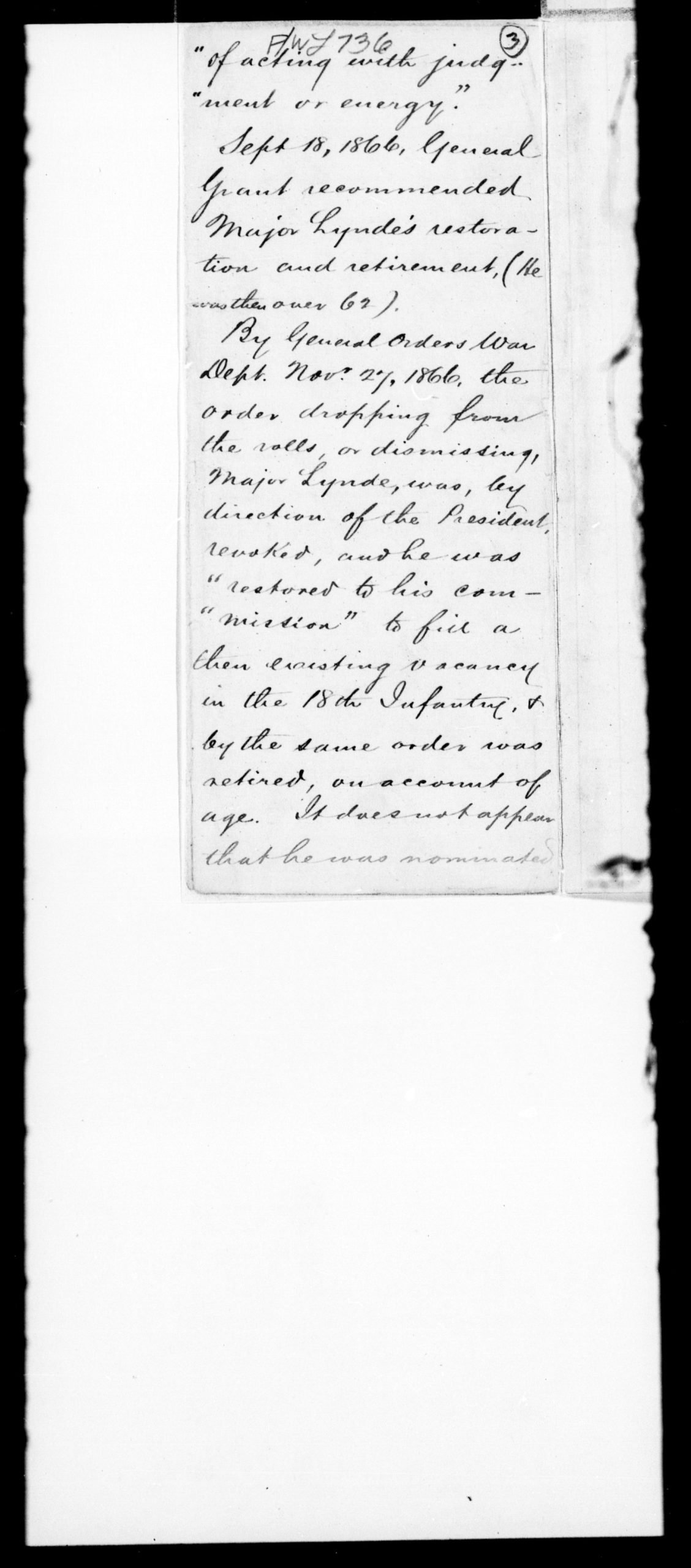
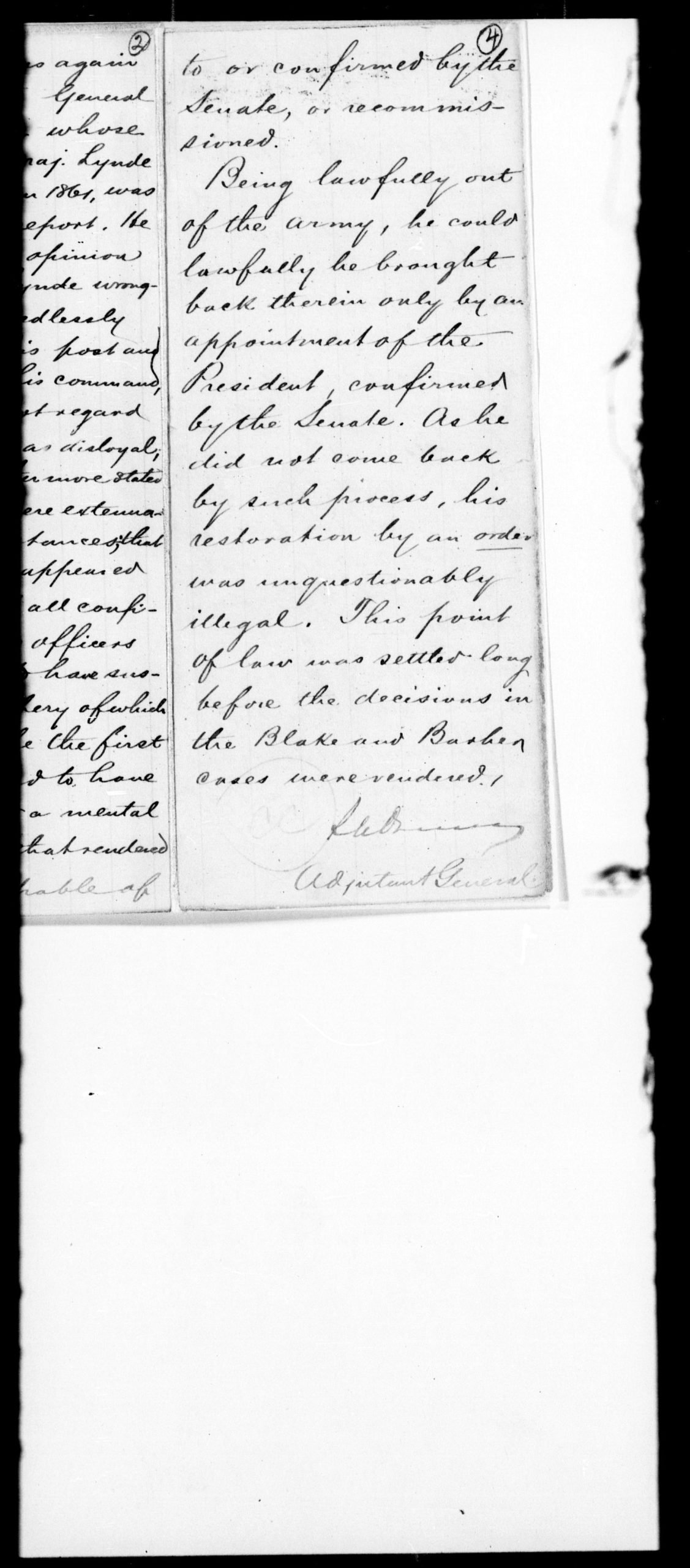
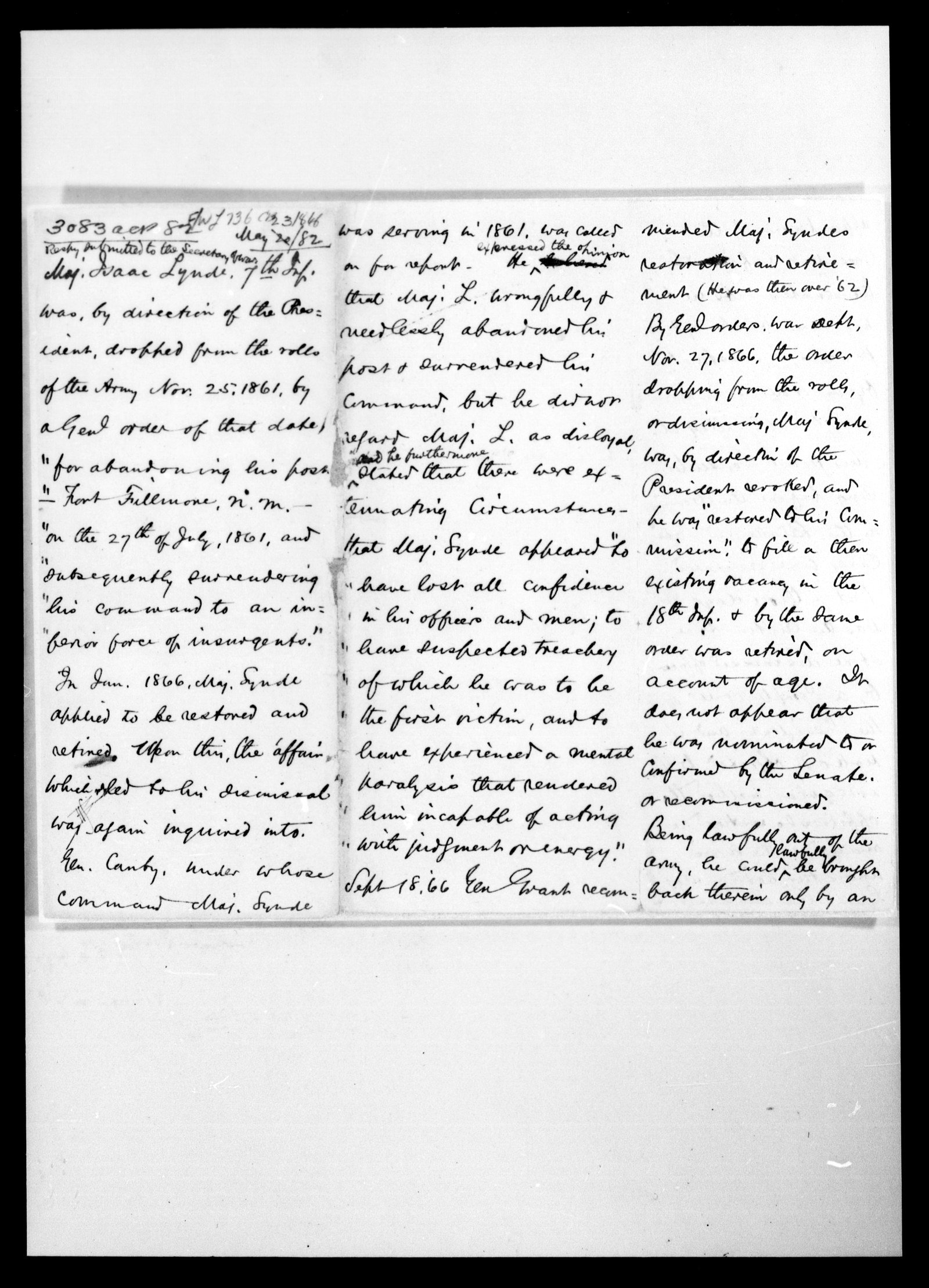
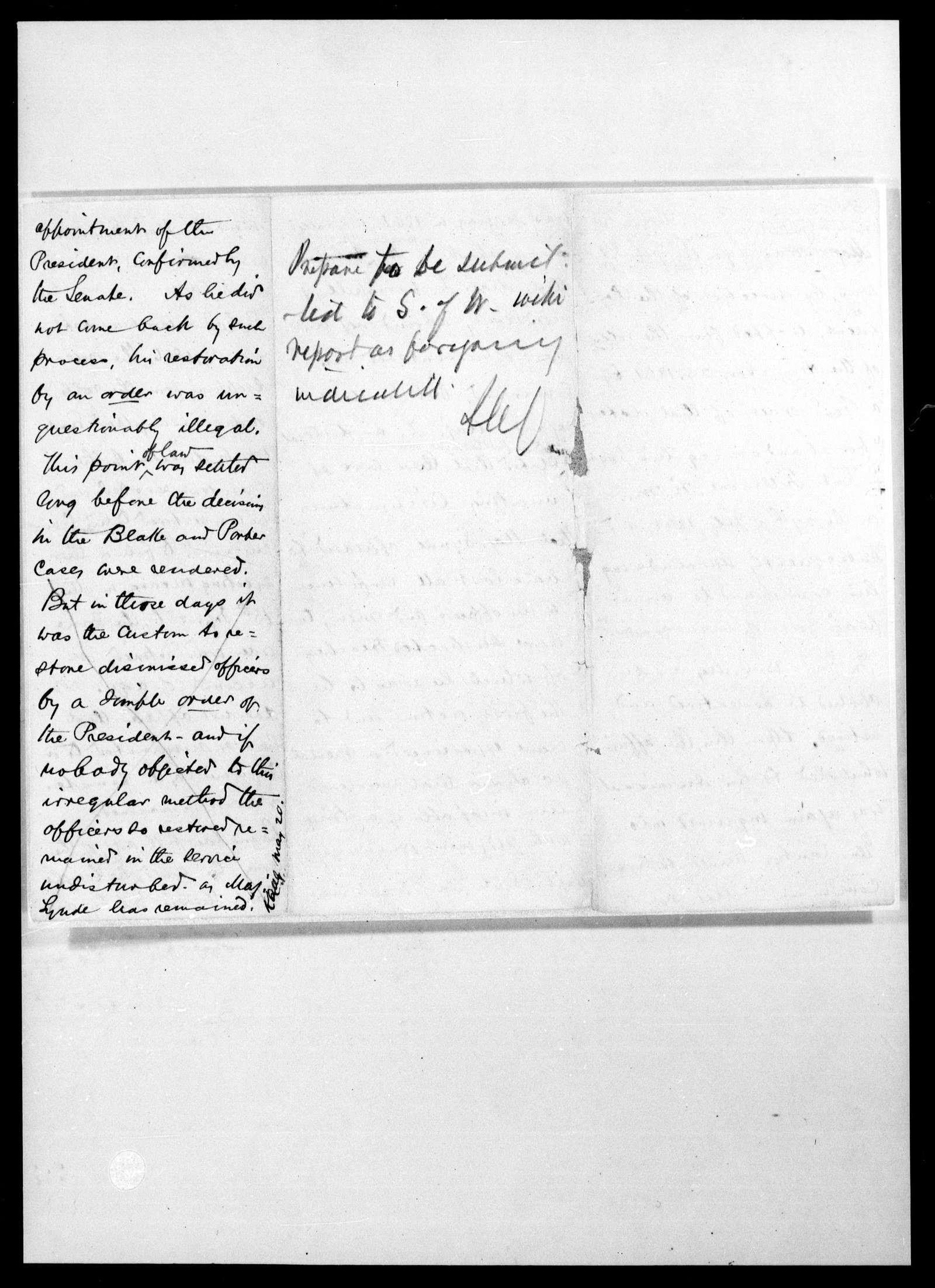
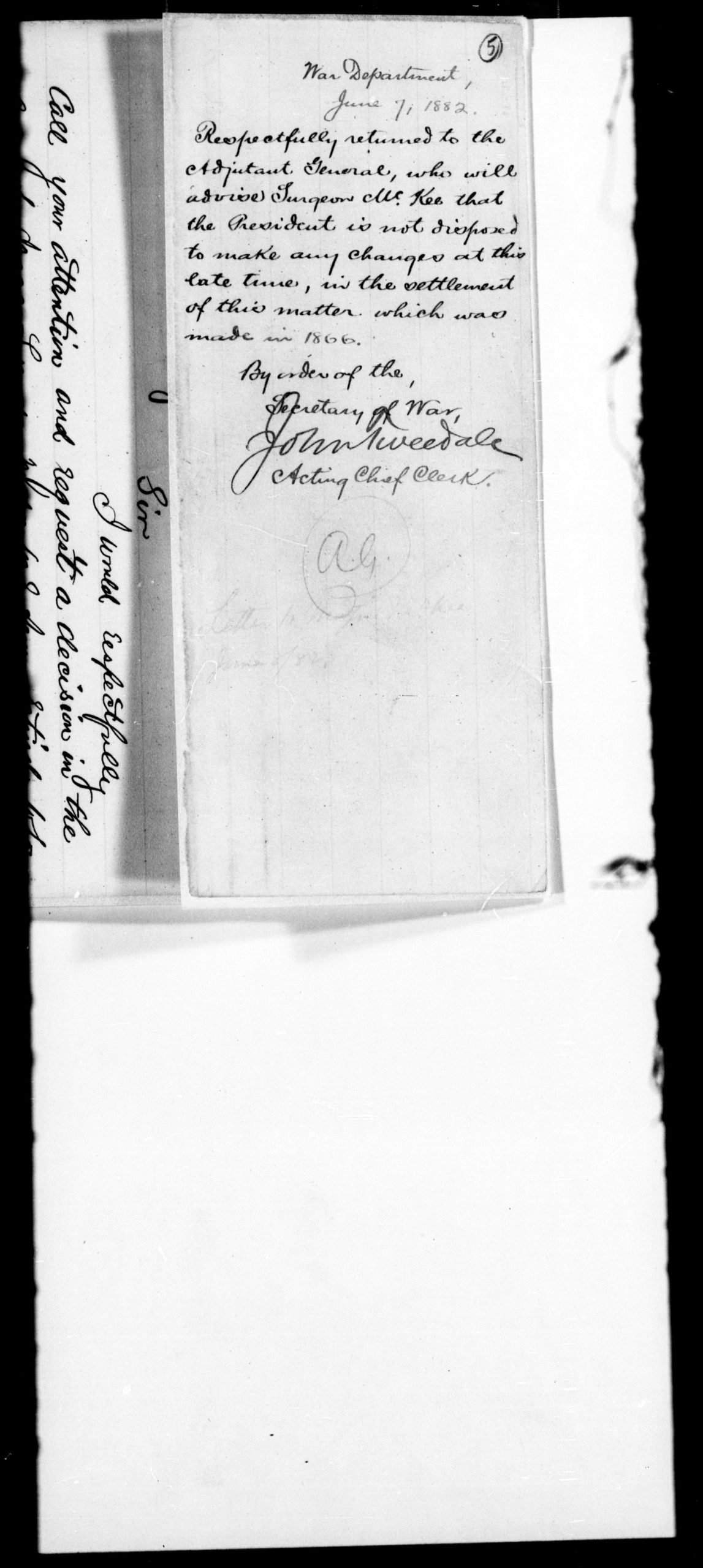
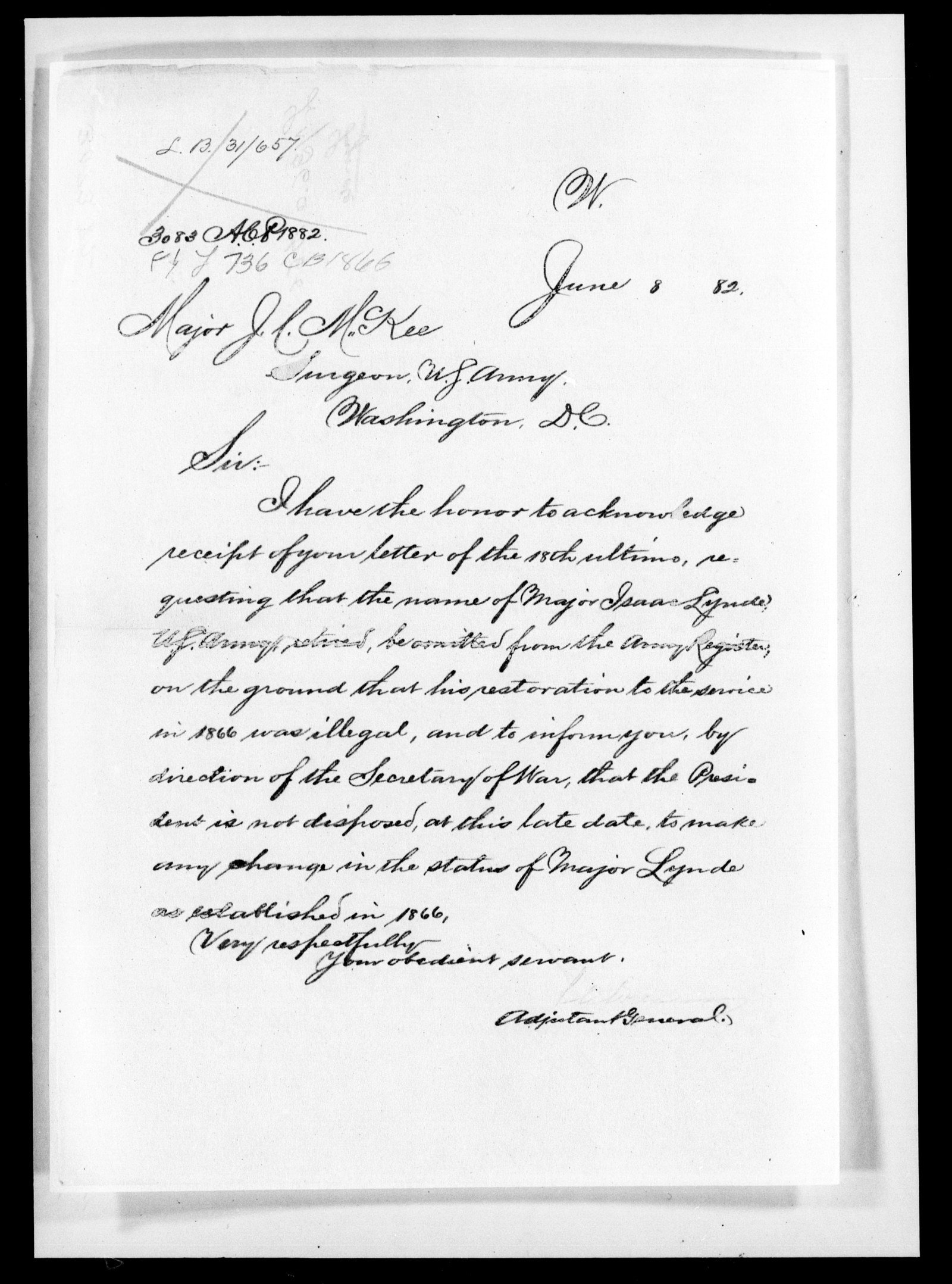
Sixteen years after Lynde’s restoration, Surgeon McKee found a new weapon in the Fitz John Porter and Chaplain Blake decisions and demanded that Lynde’s name be struck from the Army Register: President Johnson, he argued, could not lawfully restore a dismissed officer by simply revoking a predecessor’s order. What makes this round extraordinary is the Army’s answer to itself. Adjutant General R. C. Drum, reviewing the whole history for the Secretary of War, conceded the point: Lynde was never renominated to or confirmed by the Senate, and so “his restoration by an order was unquestionably illegal.” The office draft goes further, in a passage struck through before the endorsement went forward: it was then the custom to restore dismissed officers by simple order, “and if nobody objected to this irregular method the officers so restored remained in the service undisturbed, as Maj Lynde has remained.” The President declined to act: he was “not disposed to make any changes at this late time, in the settlement of this matter, which was made in 1866.” None of these manuscripts has been published before; McKee himself printed only the exchange’s surface in his pamphlet’s later edition.
Archival citation
Repository
National Archives and Records Administration (NARA), Washington, D.C.
Record Group
RG 94, Records of the Adjutant General’s Office, 1762–1984 (naId 423)
Series
Letters Received by the Commission Branch of the Adjutant General’s Office, 1863–1870 (National Archives Microfilm Publication M1064)
File Unit
“Lynde, Isaac — 1866” (file L736 CB 1866), naId 70339343
Item
McKee to the Adjutant General, May 18, 1882, with docket and enclosure note (3083 A.C.P. 1882); R. C. Drum endorsement, May 23, 1882; office draft; John Tweedale endorsement, June 7, 1882; Adjutant General to McKee, June 8, 1882 (images 0408–0417, 0440)
GET https://catalog.archives.gov/api/v2/records/search?naId=70339343
Digitized & transcribed
AlfredGibbs.com, July 10, 2026. Reproduced from the National Archives digital copies (public domain).
Suggested citation (Chicago): J. C. McKee to the Adjutant General, May 18, 1882, with endorsements and reply (3083 A.C.P. 1882), file “Lynde, Isaac, 1866” (L736 CB 1866), Letters Received by the Commission Branch of the Adjutant General’s Office, 1863–1870, M1064, Record Group 94, National Archives, Washington, D.C. Digitized copy and transcription at AlfredGibbs.com.
❦
The documents
McKee’s petition, May 18, 1882
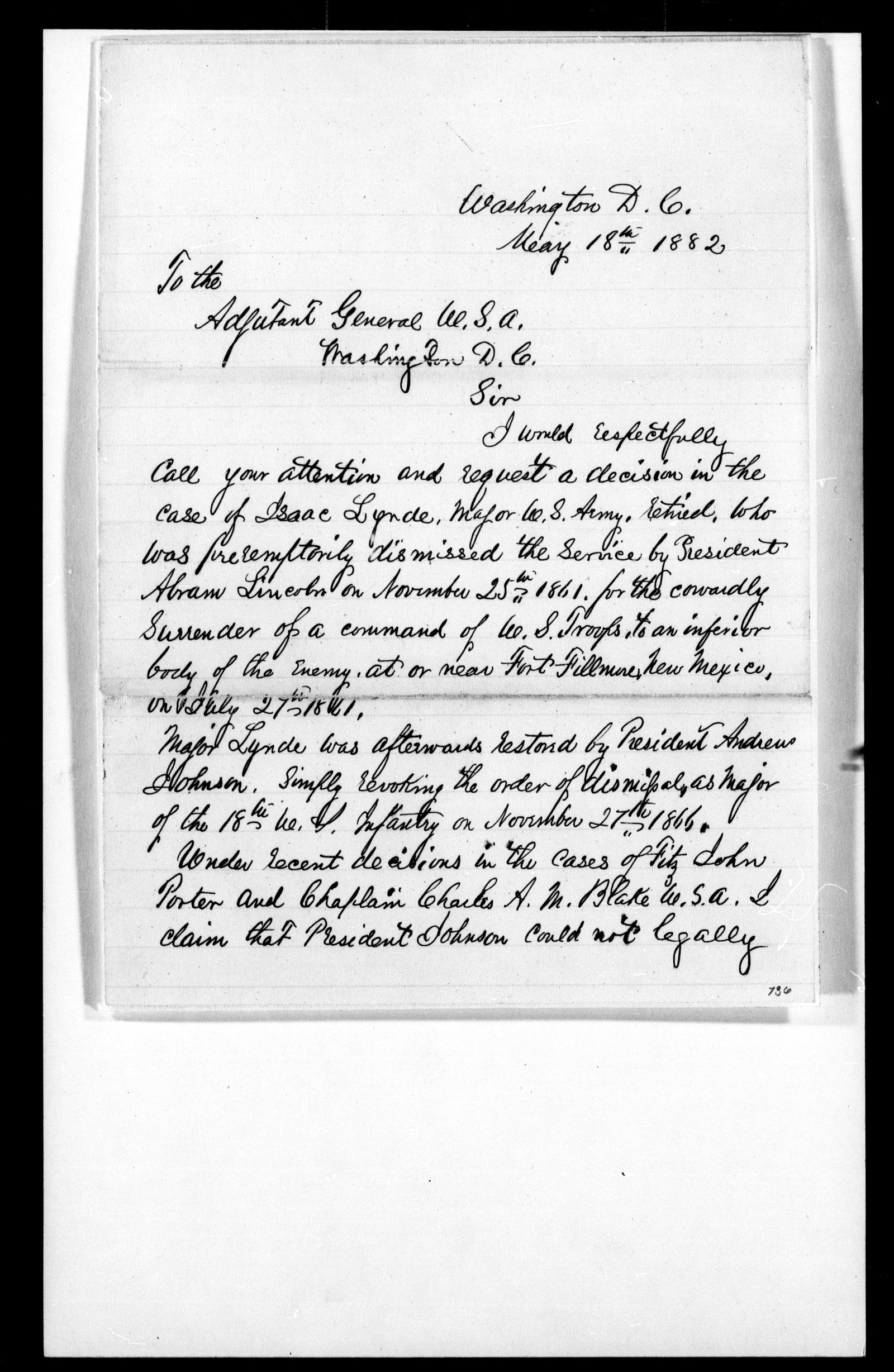
Page 1: ‘peremptorily dismissed the Service by President Abram Lincoln… for the cowardly surrender’; the Fitz John Porter and Blake precedents invoked. · view full size
Transcription
Washington D. C. May 18th, 1882
To the
Adjutant General U.S.A.
Washington D.C.
Sir
I would respectfully call your attention and request a decision in the case of Isaac Lynde, Major U.S. Army, Retired, who was peremptorily dismissed the Service by President Abram Lincoln on November 25th 1861, for the cowardly surrender of a command of U.S. Troops to an inferior body of the Enemy, at or near Fort Fillmore, New Mexico, on July 27th 1861.
Major Lynde was afterwards restored by President Andrew Johnson, simply revoking the order of dismissal, as Major of the 18th U.S. Infantry on November 27th 1866.
Under recent decisions in the cases of Fitz John Porter and Chaplain Charles A. M. Blake U.S.A. I claim that President Johnson could not legally
[page marked 736 at lower right; letter continues on next page]
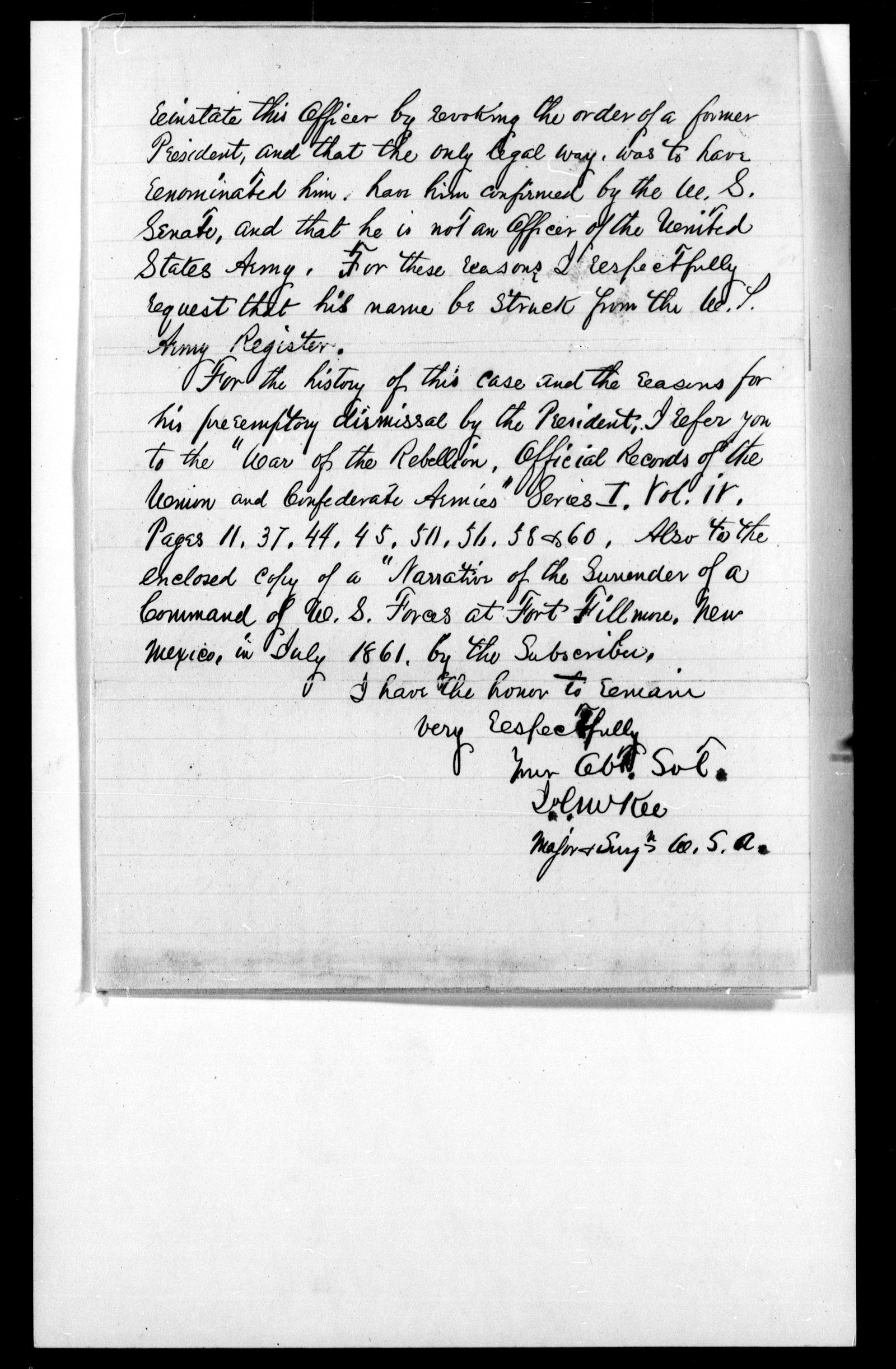
Page 2: ‘he is not an Officer of the United States Army’; McKee cites the Official Records, Series I, Vol. IV, and encloses his Narrative. Signed J. C. McKee. · view full size
Transcription
[continuation of McKee letter of May 18, 1882]
reinstate this Officer by revoking the order of a former President, and that the only legal way, was to have renominated him, have him confirmed by the U. S. Senate, and that he is not an Officer of the United States Army. For these reasons I respectfully request that his name be struck from the U.S. Army Register.
For the history of this case and the reasons for his peremptory dismissal by the President, I refer you to the “War of the Rebellion, Official Records of the Union and Confederate Armies” Series I. Vol. IV, Pages 11, 37, 44, 45, 511[?], 56, 58 & 60. Also to the enclosed copy of a “Narrative of the Surrender of a Command of U. S. Forces at Fort Fillmore, New Mexico, in July 1861, by the Subscriber.
I have the honor to remain
very Respectfully
Your Obt. Svt.
J C McKee
Major & Surgn U.S.A.
The docket and Adjutant General Drum’s review, May 23, 1882
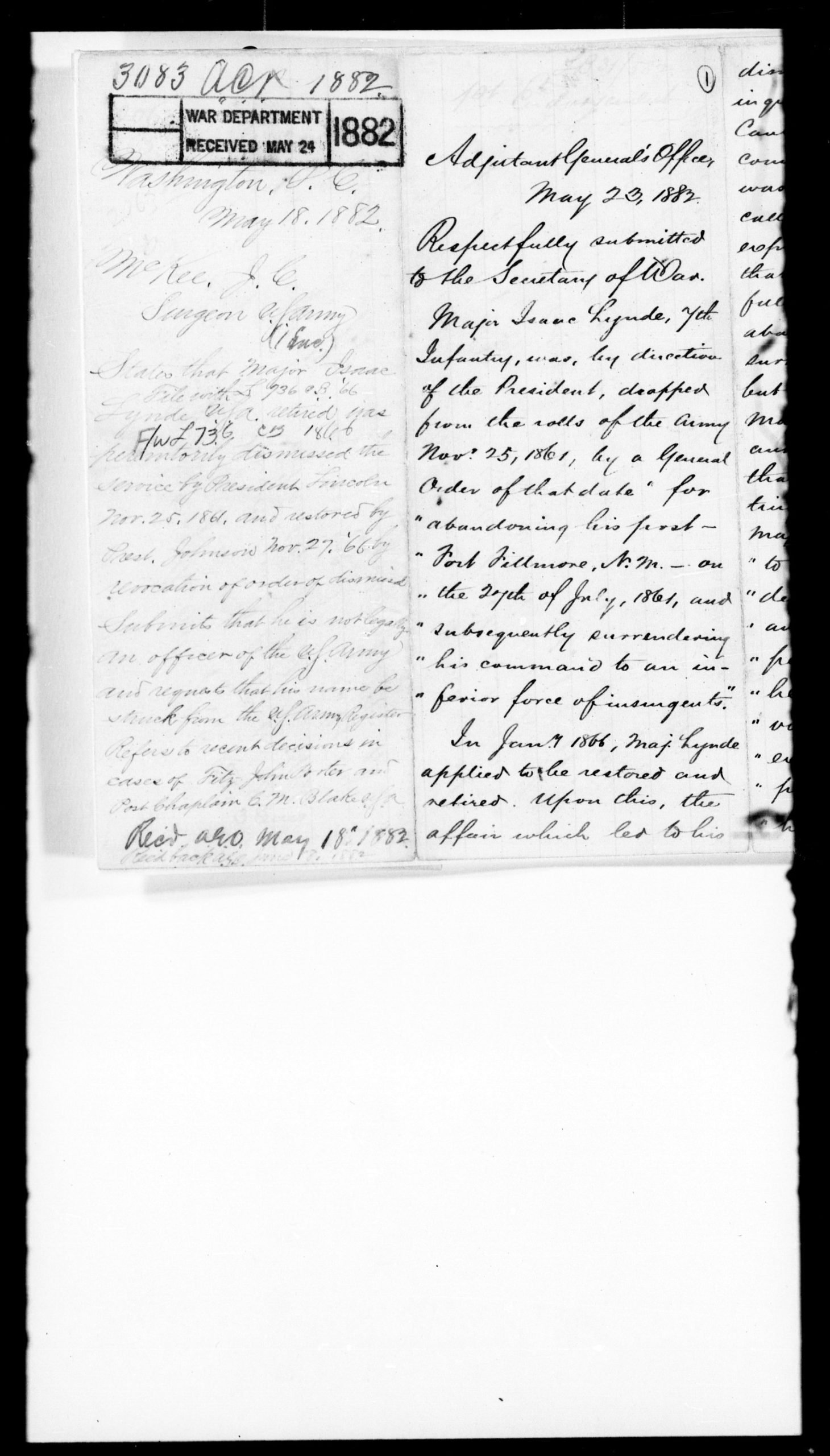
Drum’s endorsement retells the whole case for the Secretary of War: the 1861 dismissal, Canby’s findings, Grant’s recommendation, the 1866 order, and the legal concession. Portions of pages 2 and 3 sit at the edge of the National Archives scan frame; the parallel office draft below preserves the full text.
The docket (3083 ACP 1882) summarizing McKee’s request, and the opening of Drum’s endorsement. · view full size
Transcription
[wrapper/docket panel at left, with endorsement pages alongside]
3083 ACP 1882
[stamp:] WAR DEPARTMENT RECEIVED MAY 24 1882
Washington, D.C. May 18, 1882.
McKee, J. C.
Surgeon U.S. Army
(1 Enc.)
States that Major Isaac Lynde U.S.A. retired, was peremptorily dismissed the service by President Lincoln Nov. 25, 1861, and restored by Prest. Johnson Nov. 27, ’66 by revocation of order of dismissal. Submits that he is not legally an officer of the U.S. Army and requests that his name be struck from the U.S. Army Register. Refers to recent decisions in cases of Fitz John Porter and Post Chaplain C. M. Blake[?]
[interlined docket notes: File with L 736 C.B. ’66 / F/W L 736 CB 1866]
Rec’d A.G.O. May 18, 1882. [pencil:] Recd back AGO June 9[?], 1882
[second panel – first page of endorsement:]
Adjutant General’s Office, May 23, 1882.
Respectfully submitted to the Secretary of War.
Major Isaac Lynde, 7th Infantry, was, by direction of the President, dropped from the rolls of the Army Novr 25, 1861, by a General Order of that date, “for “abandoning his post – “Fort Fillmore, N.M. – on “the 27th of July, 1861, and “subsequently surrendering “his command to an in- “ferior force of insurgents.”
In Jany 1866, Maj. Lynde applied to be restored and retired. Upon this, the affair which led to his
[third column at right edge cut off in this image; text continues on following page]
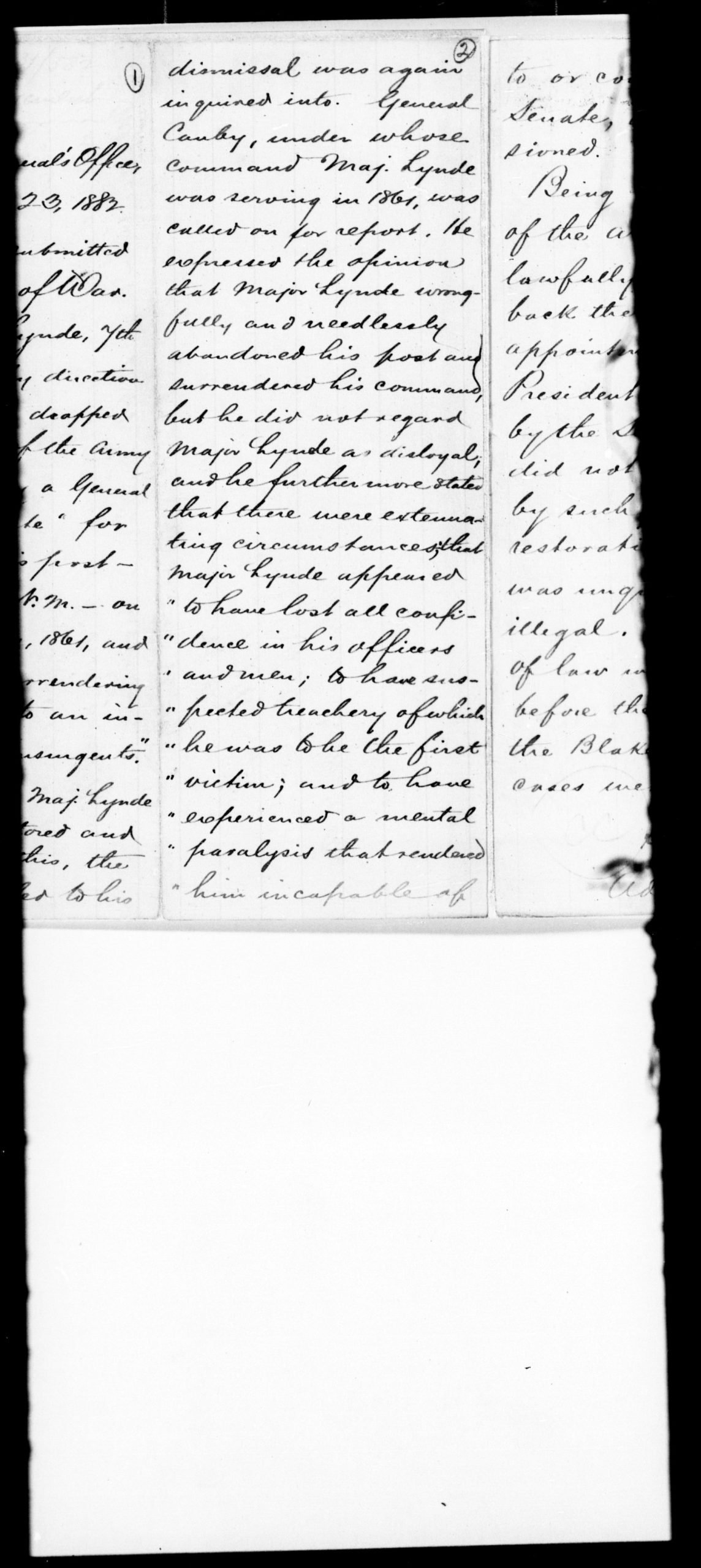
Drum’s review continued: Canby’s report quoted, including the ‘mental paralysis’ passage. · view full size
Transcription
[continuation of Adjutant General’s Office endorsement of May 23, 1882; page numbered 2; left column repeats edge of page 1, right column partially cut off at image edge]
[page 2:]
dismissal was again inquired into. General Canby, under whose command Maj. Lynde was serving in 1861, was called on for report. He expressed the opinion that Major Lynde wrongfully and needlessly abandoned his post and surrendered his command, but he did not regard Major Lynde as disloyal; and he furthermore stated that there were extenuating circumstances; that Major Lynde appeared “to have lost all confi- “dence in his officers “and men; to have sus- “pected treachery of which “he was to be the first “victim; and to have “experienced a mental “paralysis that rendered “him incapable of
[right column, partially cut off at right edge of image; visible fragments:]
to or co[…]
Senate, […]
sioned.
Being […] of the a[…] lawfully […] back tha[…] appointm[…] President […] by the S[…] did not […] by such […] restorati[…] was inqu[…] illegal. […] of law u[…] before th[…] the Blak[e…] cases we[…]
[…]
Ad[…]
Drum’s review continued: Grant’s recommendation; the 1866 restoration; ‘It does not appear that he was nominated…’ · view full size
Transcription
[continuation of AGO endorsement, page numbered 3; docket notation at top: F/W L 736]
“of acting with judg- “ment or energy.”
Sept 18, 1866, General Grant recommended Major Lynde’s restoration and retirement, (He was then over 62).
By General Orders War Dept. Novr 27, 1866, the order dropping from the rolls, or dismissing, Major Lynde, was, by direction of the President, revoked, and he was “restored to his com- “mission” to fill a then existing vacancy in the 18th Infantry, & by the same order was retired, on account of age. It does not appear that he was nominated
[text continues on next page]
The conclusion in Drum’s hand: ‘…his restoration by an order was unquestionably illegal.’ Signed R. C. Drum, Adjutant General. · view full size
Transcription
[continuation of AGO endorsement, page numbered 4; left edge shows part of page 2 already transcribed]
to or confirmed by the Senate, or recommissioned.
Being lawfully out of the Army, he could lawfully be brought back therein only by an appointment of the President, confirmed by the Senate. As he did not come back by such process, his restoration by an order was unquestionably illegal. This point of law was settled long before the decisions in the Blake and Barber[?] cases were rendered.
[signature:] R C Drum[?] Adjutant General
The office draft, with its struck-through afterthought
The draft endorsement, matching the fair copy through the legal conclusion. · view full size
Transcription
[draft of the AGO endorsement, three columns, with interlineations; docket at top: 3083 ACP 82 – F/W L 736 CB 3[?] 1866 – May 23/82]
Respy submitted to the Secretary of War.
Maj. Isaac Lynde, 7th Inf., was, by direction of the President, dropped from the rolls of the Army Nov. 25, 1861, by a Genl order of that date, “for abandoning his post “Fort Fillmore, N.M. – “on the 27th of July, 1861, and “subsequently surrendering “his command to an in= “ferior force of insurgents.”
In Jan. 1866, Maj. Lynde applied to be restored and retired. Upon this, the affair which led to his dismissal was again inquired into. Gen. Canby, under whose command Maj. Lynde was serving in 1861, was called on for report. He [struck: believed] [interlined: expressed the opinion] that Maj. L. wrongfully & needlessly abandoned his post & surrendered his command, but he did not regard Maj. L. as disloyal, [interlined: and he furthermore] stated that there were ex= tenuating circumstances – that Maj. Lynde appeared “to “have lost all confidence “in his officers and men; to “have suspected treachery “of which he was to be “the first victim, and to “have experienced a mental “paralysis that rendered “him incapable of acting “with judgment or energy.”
Sept 18, 66 Gen Grant recom= mended Maj. Lynde’s restoration and retire= ment (He was then over 62)
By Genl orders, War Dept, Nov. 27, 1866, the order dropping from the rolls, or dismissing, Maj. Lynde, was, by direction of the President revoked, and he was “restored to his Com= mission” to fill a then existing vacancy in the 18th Inf. & by the same order was retired, on account of age. It does not appear that he was nominated to or confirmed by the Senate, or recommissioned.
Being lawfully out of the Army, he could [interlined: lawfully] be brought back therein only by an
[draft continues on next page]
The passage the Army decided not to say: restoration by simple order ‘was the custom… as Maj Lynde has remained.’ Struck through diagonally. · view full size
Transcription
[continuation of the draft AGO endorsement; final passage partly struck through diagonally]
appointment of the President, confirmed by the Senate. As he did not come back by such process, his restoration by an order was un= questionably illegal. This point of law [interlined] was settled long before the decisions in the Blake and Porter cases were rendered.
[struck through diagonally:] But in those days it was the custom to re= store dismissed officers by a simple order of the President – and if nobody objected to this irregular method the officers so restored re= mained in the service undisturbed, as Maj Lynde has remained.
[marginal note, written vertically: KBG[?] May 20.]
[center panel notation:]
Prepare to be submit- ted to S. of W. with report as foregoing indicated[?]
[initials, illegible]
[right panel: blank, ink show-through from other side]
The President declines, June 7, and the reply to McKee, June 8
John Tweedale, Acting Chief Clerk, for the Secretary of War: the President ‘is not disposed to make any changes at this late time.’ The slip lies over the first page of McKee’s letter. · view full size
Transcription
[endorsement slip, page numbered 5, laid over another letter whose text runs vertically at left]
War Department, June 7, 1882.
Respectfully returned to the Adjutant General, who will advise Surgeon McKee that the President is not disposed to make any changes at this late time, in the settlement of this matter, which was made in 1866.
By order of the,
Secretary of War,
John Tweedale
Acting Chief Clerk.
[pencil stamp/notation: A.G.] [faint pencil: Letter to Maj[?] McKee / June [?] 1882]
[underlying letter, rotated 90 degrees, only partially visible:] Sir I would respectfully call your attention and request a decision in the [remainder hidden beneath endorsement slip; continues on another page]
The Adjutant General’s retained copy of the reply to McKee, June 8, 1882: no change ‘in the status of Major Lynde as established in 1866.’ · view full size
Transcription
[Handwritten letter, AGO retained copy – same letter as the mirrored press copy on the preceding image]
[pencil, struck through:] L.B. 31/657
[in ink:] 3083 ACP 1882.
[pencil:] F/w L 736 CB 1866
[pencil initials, illegible]
W. [Washington] June 8, [18]82.
Major J. C. McKee
Surgeon, U. S. Army,
Washington, D. C.
Sir:-
I have the honor to acknowledge receipt of your letter of the 18th ultimo, requesting that the name of Major Isaac Lynde, U. S. Army, retired, be omitted from the Army Register, on the ground that his restoration to the service in 1866 was illegal, and to inform you, by direction of the Secretary of War, that the President is not disposed, at this late date, to make any change in the status of Major Lynde as established in 1866.
Very respectfully,
Your obedient servant,
[signature faint/illegible]
Adjutant General.
McKee, J. C. (1882, May 18). [Letter to the Adjutant General requesting that the name of Major Isaac Lynde be struck from the U.S. Army Register]. File L736 CB 1866, Letters Received by the Commission Branch of the Adjutant General’s Office, 1863–1870 (Microfilm Publication M1064; Record Group 94; National Archives Identifier 70339343), National Archives, Washington, DC. https://catalog.archives.gov/id/70339343
Drum, R. C. (1882, May 23). [Endorsement to the Secretary of War reviewing the case of Major Isaac Lynde, with office draft]. File L736 CB 1866, Letters Received by the Commission Branch of the Adjutant General’s Office, 1863–1870 (Microfilm Publication M1064; Record Group 94; National Archives Identifier 70339343), National Archives, Washington, DC. https://catalog.archives.gov/id/70339343
Tweedale, J. (1882, June 7). [Endorsement for the Secretary of War declining to reopen the settlement of 1866]. File L736 CB 1866, Letters Received by the Commission Branch of the Adjutant General’s Office, 1863–1870 (Microfilm Publication M1064; Record Group 94; National Archives Identifier 70339343), National Archives, Washington, DC. https://catalog.archives.gov/id/70339343
Adjutant General’s Office. (1882, June 8). [Letter to Major J. C. McKee, retained copy]. File L736 CB 1866, Letters Received by the Commission Branch of the Adjutant General’s Office, 1863–1870 (Microfilm Publication M1064; Record Group 94; National Archives Identifier 70339343), National Archives, Washington, DC. https://catalog.archives.gov/id/70339343
McKee, J. C. (1881). Narrative of the surrender of a command of U.S. forces at Fort Fillmore, N.M., in July, A.D. 1861 (2nd ed.). New York.
Transcribed from the National Archives digital copies on July 10, 2026. The transcriptions follow the manuscripts; uncertain readings are marked with (?), and bracketed notes describe physical features of the documents. Corrections against better readings will be noted rather than made silently.