Dinwiddie Courthouse, Va., March 30 and 31, 1865
The Civil War · Appomattox Campaign · March 30–31, 1865
Dinwiddie Court House
The opening clash of the campaign that ended the war — a hard, outnumbered holding fight in which the First New York Dragoons were driven back, but bought the time that made Five Forks possible the next day.
The Battle of Dinwiddie Court House, fought on March 30 and 31, 1865, in Dinwiddie County, Virginia, opened the twelve-day Appomattox Campaign that ended the Civil War. It pitted Maj. Gen. Philip H. Sheridan’s Union cavalry against a combined Confederate force of infantry and cavalry under Maj. Gen. George E. Pickett. Contrary to a once-common misreading, March 31 ended as a Confederate tactical success: Pickett attacked and drove Sheridan’s troopers back into a tight perimeter around the courthouse. The Union breakthrough did not come here — it came the next day, a few miles to the northwest, at Five Forks. The First New York Dragoons, fighting dismounted in the advance, were among the regiments pushed back during the day’s heaviest fighting.
Background
By late March 1865 Lt. Gen. U.S. Grant was extending his lines southwest of Petersburg to turn Robert E. Lee’s right flank and threaten his last open supply line, the South Side Railroad. Sheridan’s Cavalry Corps was sent toward the road junction at Five Forks. To meet this threat Lee detached Pickett with an infantry division and supporting cavalry. On March 30 Sheridan’s troopers probed toward Five Forks over roads made nearly impassable by heavy rain; on March 31 Pickett seized the initiative and struck Sheridan’s advance south of Five Forks, near Chamberlain’s Bed (Chamberlain Run), driving for Dinwiddie Court House.
The First New York Dragoons — raised in 1862 as the 130th New York Infantry and converted to cavalry in 1863 — served in the Reserve Brigade, by then often designated the Second Brigade, of the First Cavalry Division. With Brig. Gen. Thomas C. Devin elevated to division command, the brigade was led by Col. Charles L. Fitzhugh, under Maj. Gen. Wesley Merritt and Sheridan’s Cavalry Corps. Their regimental historian, bugler James R. Bowen, recalled the march in: “In the early morning of March 29, we moved from near Petersburg, over almost bottomless roads, via Reams’ Station, halting for the night near Dinwiddie Courthouse, the enemy holding a strong infantry line in our front.”
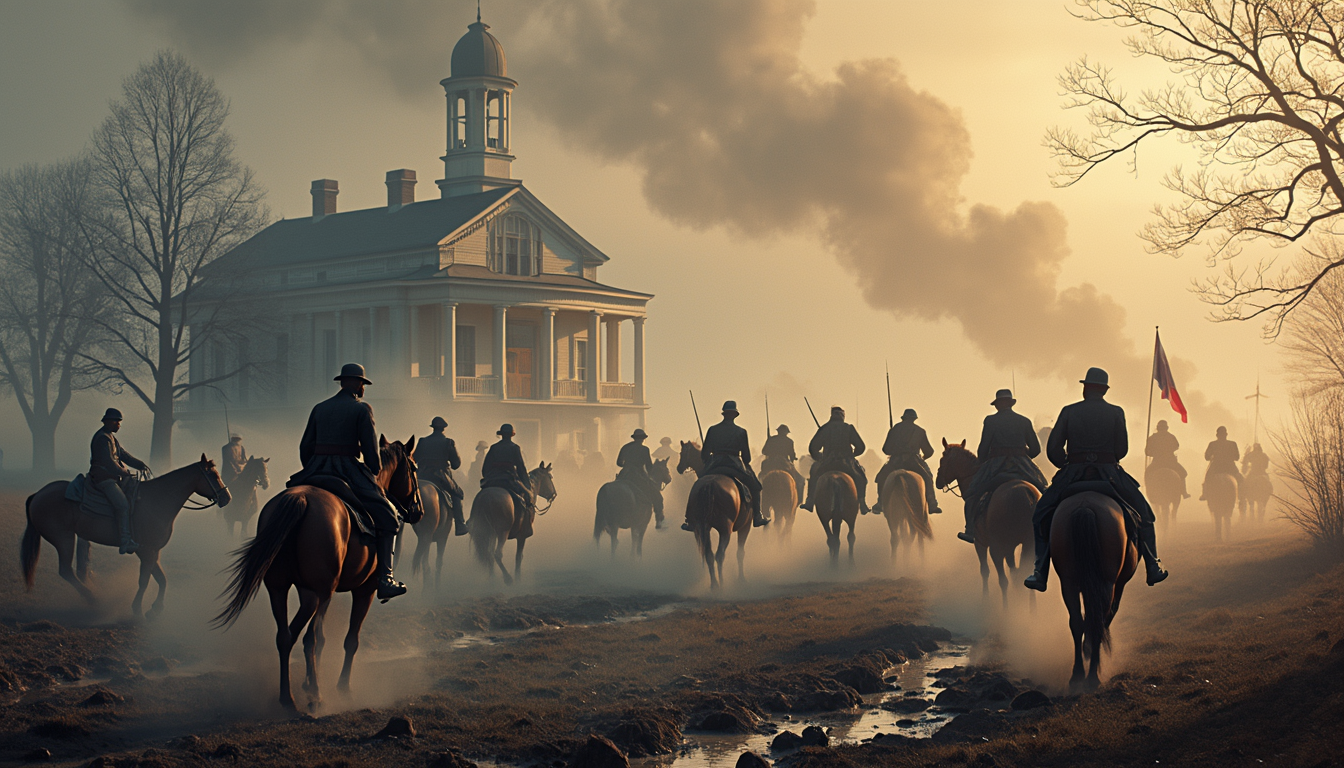
The Battle
On March 30 the contact was light. Bowen’s regimental history records: “On the 30th our regiment, having the advance, soon struck the enemy, with whom we had a short skirmish, but no decisive engagement.”
March 31 was different. Pickett pushed Fitzhugh Lee’s cavalry across the rain-swollen Chamberlain Run in mid-morning, and as Pickett’s infantry came up the Confederates forced the crossing and split Sheridan’s troopers, driving some east and some south toward Dinwiddie Court House. Heavily outnumbered, the Union cavalry gave ground stubbornly through the afternoon, contesting each position before falling back. By nightfall Sheridan had been pressed into a compact line just north of the courthouse — a Confederate tactical victory on the day, but one that left Pickett’s command dangerously advanced and isolated. Sheridan, far from beaten, telegraphed his intent to hold and counterattack. Aggregate losses were uneven: roughly 350 Union and about 760 Confederate killed, wounded, captured, and missing.
The First New York Dragoons
The Dragoons had the advance and fought dismounted. Bowen records that on the 31st “Devin’s entire division was advanced in the direction of Five Forks, to feel the enemy’s position, our brigade, under Colonel Fitzhugh, being dismounted,” and that they soon found the enemy “in strong force, consisting of Picket’s and Johnson’s divisions of infantry, with a strong force of cavalry, thus outnumbering us three to one.”
When the Confederate lines advanced “in solid columns” and the rebel cavalry charged for the brigade’s rear, Bowen writes, “Nothing but the most desperate fighting saved us,” the regiment’s seven-shot Spencer carbines proving “an important factor in such an unequal contest of numbers.” Bowen quotes Devin’s account of the crisis: “The Second Brigade was outflanked, while a heavy line emerged from the woods in front. In a few minutes the brigade would have been surrounded.”
The regiment’s stand bought time. In Bowen’s summary: “Though repulsed and driven back three or four miles, we accomplished the important result of holding the enemy and gaining time for the infantry to move up and participate next day in the Battle of Five Forks.”
“All was quiet just then in our front, when suddenly a rattling fusillade came from the rear, near our horses. Some one shouted, ‘They’ve got our horses!’ … The woods were alive with mounted Johnnies, and we were all mixed up in hand-to-hand encounters. … My only safety was to start on a race for life to a rail fence about one hundred yards distant. … As they gave me a parting salute, Custer dashed up to our relief, and the rebs got out quickly.”— Lieut. A. J. Aldrich, First New York Dragoons, recalling his “worst experience… at Dinwiddie, March 31, 1865,” in Bowen’s regimental history.
Casualties
Bowen records no roll of named regimental dead for March 31; he notes that although “men and horses were somewhat scattered, we reached the reserve with but little loss.” For the engagement as a whole, sourced estimates place Union losses at about 350 and Confederate losses at roughly 760 (American Battlefield Trust; National Park Service / CWSAC).
Aftermath
Dinwiddie Court House was a Confederate tactical victory that nonetheless carried no strategic gain. Pickett’s advance had left his force overextended; warned of his exposure, he withdrew during the night toward the entrenchments at Five Forks. Reinforced by Maj. Gen. Gouverneur K. Warren’s Fifth Corps, Sheridan pursued. The decisive blow — the rupture of the Confederate line, the severing of the South Side Railroad, and the chain of events that forced the evacuation of Petersburg and Richmond on April 2 — followed at Five Forks on April 1, not at Dinwiddie.

Sources & Further Reading
- Primary James R. Bowen, Regimental History of the First New York Dragoons (1900), ch. XXI, “Appomattox Campaign — The Final Battles,” pp. 282–287 — the regiment’s own historian and an eyewitness, drawing on the accounts of Capt. Leach, Lieut. Aldrich, and Gen. Devin. Full text: archive.org/details/regimentalhistor00bowe.
- Primary U.S. War Dept., The War of the Rebellion: Official Records of the Union and Confederate Armies, Series I, Vol. 46 (the reports of Sheridan, Merritt, Devin, and the cavalry for the Appomattox Campaign).
- American Battlefield Trust — Battle of Dinwiddie Court House: battlefields.org/learn/civil-war/battles/dinwiddie-court-house.
- National Park Service / CWSAC Battle Summary, Dinwiddie Court House (VA068): nps.gov/abpp/battles/va068.htm.
Five Forks — the next day · Trevilian Station · The Audiobook
Views: 93