Cedar Creek, Va., Oct. 17-19, 1864: A Comprehensive Dragoons Analysis
The Civil War · Shenandoah Valley · October 19, 1864
Cedar Creek
A surprise dawn attack nearly destroyed Sheridan’s army — and by nightfall the First New York Dragoons had ridden farther into the wreck of Early’s army than any other regiment, capturing “every wheel from Early.”
The Battle of Cedar Creek, fought October 19, 1864, near Middletown in the Shenandoah Valley of Virginia, stands as one of the most dramatic reversals of the American Civil War. Some fifty thousand men were engaged. At dawn Lt. Gen. Jubal A. Early’s Confederates burst out of the morning fog and routed two-thirds of the Union army before it could form; by nightfall Maj. Gen. Philip H. Sheridan — back from Winchester after his famous ride — had turned a catastrophe into a crushing victory that ended Early as a threat in the Valley. From the perspective of the First New York Dragoons, as recorded by their historian James R. Bowen, no single day better displayed the steadiness and dash of Sheridan’s cavalry.
Prelude: Early Catches the Army Napping
After the rebel cavalry’s rout at the “Woodstock Races,” Sheridan believed Early’s army too demoralized to take the offensive again, and had even begun sending the Sixth Corps and Merritt’s cavalry out of the Valley. But the plucky Confederate, reinforced, was planning a desperate stroke. From the signal station atop Three Top Mountain, Early’s chief engineer Jed Hotchkiss and Maj. Gen. John B. Gordon mapped the Union camps and a narrow path, twice crossing the north fork of the Shenandoah, by which the Federal left could be surprised. Fortunately the Sixth Corps and Merritt’s cavalry were recalled and held in the Valley during Sheridan’s visit to Washington.
On the night of October 18 Early’s whole army was in motion. Marching as noiselessly as possible, the rebels lined up within six hundred yards of the sleeping camps. At dawn, Bowen wrote, “there burst through the morning fog a deafening yell from ten thousand throats, followed by the blaze and crash of musketry.” Within fifteen minutes Crook’s Eighth Corps was “either killed, captured, or a flying mass of fugitives;” the Nineteenth Corps was broken in turn, and by eleven o’clock the army had fallen back nearly five miles to a stand near Middletown.
A Steadying Force: The Cavalry Stems the Rout
Merritt’s division was camped at the right and rear of the Sixth Corps. On hearing the firing the troopers saddled up and rode out “without breakfast for men or horses,” and were thrown across the rear of the army to head off the demoralized infantry streaming back — stragglers, squads, and even whole regiments. With great difficulty they checked the rout, at times having to use the flat of the saber on their own panic-stricken men. Bowen records that two skulkers carrying a wounded man were let through the line by Colonel Gibbs, only to drop the man and run; Gibbs had them brought back, gave each “a good whacking with his saber,” and started them back to their regiment on the double-quick. This stand, more than any other single thing, saved the army from utter demoralization.
Later in the forenoon Devin’s brigade did “valuable service” resisting the rebel advance on the Union left which, by Confederate account, kept the enemy from seizing the trains and working havoc in the rear. The brigade held its ground while Maj. Gen. Horatio Wright got his shattered corps back into shape.
Sheridan’s Ride and the Turning Point
Sheridan reached Winchester on the evening of the eighteenth, and on the morning of the nineteenth made his famous twenty-mile ride to the front — “the most dramatic incident” in the annals of the war, as Bowen called it. Contrary to legend, the army did not instantly wheel and charge: Sheridan arrived between ten and eleven, then spent four or five hours reforming his battalions, riding cheerily along the lines with promises that “we’re going back to our camps.” The Dragoons, holding a position on or near the Valley Pike, witnessed his arrival; after a few words with Torbert, Devin, Gibbs, and other officers he was “off like a flash,” leaping his black charger Rienzi over the barricades amid a thundering cheer.
About four o’clock the order to advance rang out. “That order,” Bowen wrote, “sounded the death knell of the Southern confederacy, as its execution resulted in the destruction of the last aggressive army of Virginia.” Sheridan threw his cavalry out on both flanks — Custer’s division to the right, Merritt’s to the left — while the infantry held the center.
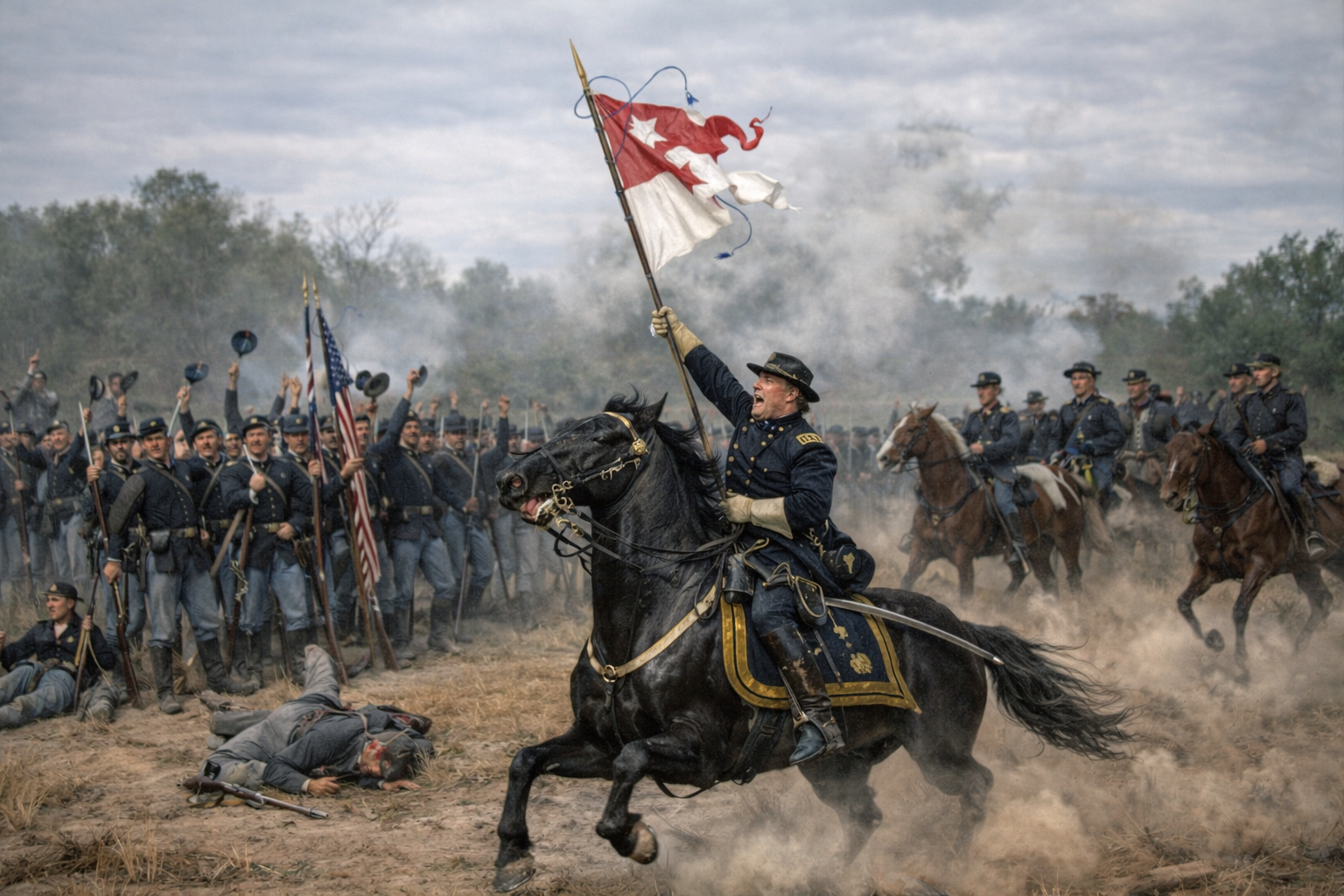
“More particular mention will be made regarding the part enacted by the First New York Dragoons, than which no one regiment contributed more to the success of the battle, especially in the final charge and the gathering up of prisoners and trophies.”— James R. Bowen, Regimental History of the First New York Dragoons (1900), ch. XVII, “Battle of Cedar Creek,” p. 250.
The Dragoons in the Final Charge
“The first duty of the Dragoons, according to Devin,” Bowen records, “was to charge the rebel infantry strongly posted in the streets and yards of Middletown.” As the infantry pressed the center, the troopers on either flank charged, in Torbert’s words, “with an impetuosity they could not withstand.” Early himself credited the Union horsemen with the disaster: “A terror of the enemy’s cavalry had seized them, and there was no holding them.”
It was here that the regiment earned its laurels. “A small body of the enemy’s cavalry,” ran Early’s report, “dashed across Cedar Creek, and got into the train and artillery running back on the pike … and thus succeeded in capturing the greater part of the artillery, ordnance, medical wagons, and ambulances.” Hotchkiss agreed: “Only a few Yankee cavalry did it all.” “This small force of Yankee cavalry,” Bowen declares, “was the First New York Dragoons, together with the Sixth and Ninth New York, all of Devin’s brigade. The Dragoons dashed farther in advance than any other regiment.”
Sweeping past Strasburg toward Fisher’s Hill in the gathering dark, the Dragoons blockaded the pike with the wreck of Early’s wagons, ambulances, caissons and guns. Capt. R. A. Britton, sent rearward by Gibbs, told Sheridan’s headquarters that the colonel “had captured every wheel from Early,” counting twenty-nine pieces of artillery and any number of wagons; Sheridan answered, “Captain, you have brought me the best news I ever received.” Of this far advance Devin’s official report is unequivocal: “I have no hesitation in asserting that no troops except my command went beyond Strasburg … and one man of the First New York Dragoons was killed.” In the day’s fighting Pvt. Prosper Swift was killed by a sharpshooter and Corporal Clough of Company C had his head carried off by a cannon ball, while Edson S. Barber of Company E recaptured a flag and was rewarded with a furlough.
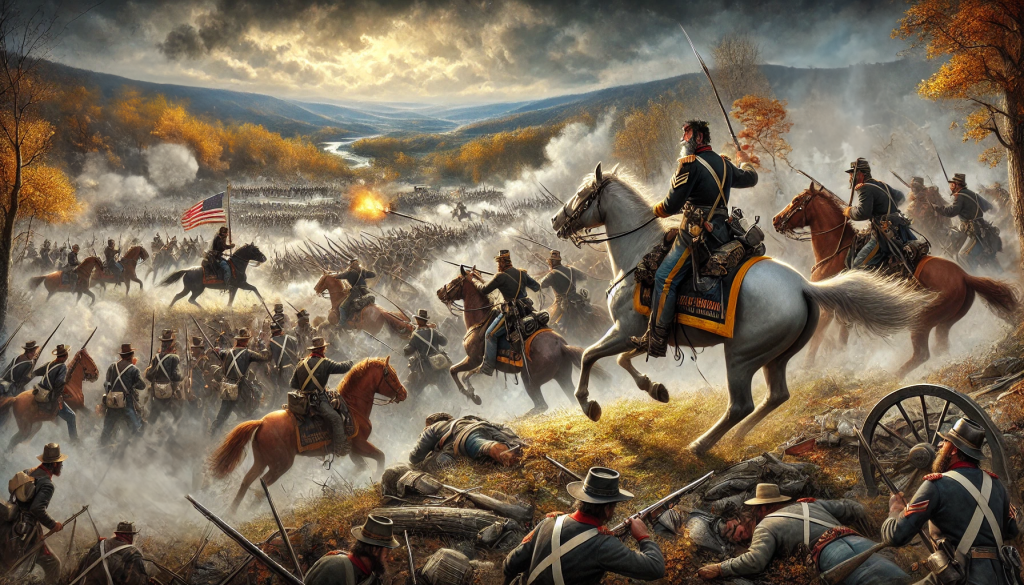
Aftermath and Legacy
Cedar Creek was the definitive end of Early’s Shenandoah campaign; thereafter, Bowen wrote, the regiment was “only occasionally troubled by him.” The captured property was hauled back through the night until about midnight, and when Custer’s division came up and afterward laid claim to all the trophies, the boast was “promptly contradicted by both Merritt and Devin in special official reports” — Merritt styling the attempt “wholesale robbery in this instance.” The victory steadied a war-weary North, helped carry Lincoln’s re-election, and confirmed the reputation of Sheridan’s cavalry. For the First New York Dragoons it remained, in their historian’s telling, the day on which no one regiment contributed more to the result.
Sources & Further Reading
- Primary James R. Bowen, Regimental History of the First New York Dragoons (originally the 130th N.Y. Vol. Infantry) (1900), ch. XVII, “Battle of Cedar Creek,” pp. 250–262 — the regiment’s own historian, an eyewitness, quoting comrades’ letters and the official reports. Full text: archive.org/details/regimentalhistor00bowe.
- Primary Brig. Gen. Thomas C. Devin, official report of operations at Cedar Creek, and Maj. Gen. A. T. A. Torbert’s cavalry report, in U.S. War Dept., The War of the Rebellion: Official Records of the Union and Confederate Armies, Series I, Vol. 43, Pt. 1 (the source of the Devin and Torbert quotations).
- Primary Lt. Gen. Jubal A. Early’s report and Jed Hotchkiss’s account, quoted by Bowen, crediting the Federal cavalry with the capture of the Confederate artillery and trains.
- American Battlefield Trust — Battle of Cedar Creek: battlefields.org/learn/civil-war/battles/cedar-creek.
- National Park Service / CWSAC Battle Summary, Cedar Creek (VA116): nps.gov/abpp/battles/va116.htm.
- Jeffry D. Wert, From Winchester to Cedar Creek: The Shenandoah Campaign of 1864 (Carlisle: South Mountain Press, 1987).
Third Winchester · The Shenandoah Valley Campaign · Trevilian Station · The Audiobook
Views: 107