A Good Drummer: The Boy of Fort Fillmore
A Fort Fillmore Story
A Good Drummer
A blind old laundress, a father dead at Camargo, and a nine-year-old boy enlisted at Fort Fillmore. Three generations of one family in a single regiment, recovered from a letter and a line in a register.
Illustration: a young army musician at a frontier post. No likeness of James Williamson is known to survive, and the image above is an artist’s evocation, not a photograph of him.
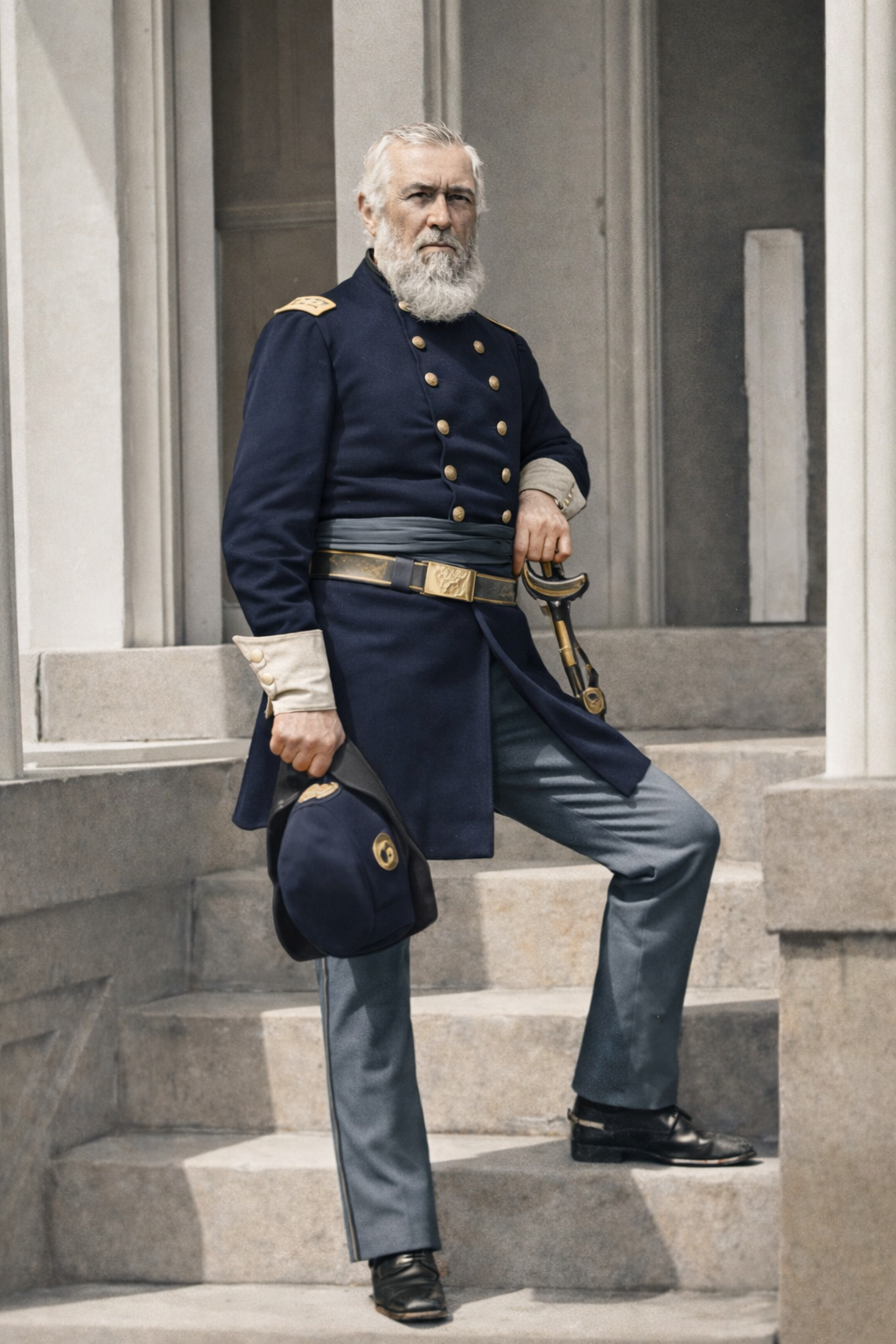
Sometime in the autumn of 1854, the commander of Fort Fillmore sat down to do an unusual thing: to argue that the Army should enlist a nine-year-old. Lt. Col. Dixon S. Miles knew the regulations allowed boys only at twelve. So he wrote an endorsement to the Adjutant General explaining why this one should be approved anyway, and in doing so he set down, almost by accident, the history of an entire military family.1
The boy was James Williamson. He was enlisted at the particular request of Bvt. Brig. Gen. John Garland, who commanded the Department of New Mexico,5 and Miles closed his plea with a soldier’s practical confidence: the boy, he wrote, “will make a good drummer.”1
Three generations in one regiment
What makes the letter remarkable is not the boy. It is the family standing behind him, all of it bound to a single regiment, the 3rd U.S. Infantry.1
The boy’s grandfather had been, in Miles’s words, “a meritorious soldier in the Regt. over thirty years ago.” He had died at Fort Jesup, Louisiana, an orderly sergeant, sometime in the 1820s.1
The boy’s father had been raised in the regiment and served in it as a musician. When the Mexican War came, he joined a Kentucky regiment of volunteers, and he was killed at Camargo, Tamaulipas, the disease-ridden staging depot on the Rio Grande where sickness took a larger share of Taylor’s volunteers than any battle did.14
And the boy’s grandmother, the widow of the orderly sergeant, was still with the regiment. She had been, Miles wrote, “a laundress of the Regt. at least thirty-five years,” and she was now “Old, blind, poor and helpless, dependent on a daughter married to a musician and this boy for her support.”1
Grandfather, father, son: a soldier, a musician, and a drummer, the whole arc of a regimental life compressed into one household at a frontier post.
That is the family the Army was being asked to take on by enlisting one small boy. Approving the enlistment was, in part, an act of care: a way to put a few dollars and a place into a household that had given the regiment three generations and had almost nothing left.
The boy in the register
For a long time the boy was only a phrase in an old letter. But the enlistment Miles asked for was approved, and it left its own record. In the National Archives registers of enlistments, on a page filled with grown laborers and farmers from Ireland and Germany, there is a single line that stops you cold.2
James Williamson, enlistment of 9 December 1854
- Born
- Cincinnati, Ohio, about 1845
- Age
- 9 years
- Enlisted
- Fort Fillmore, New Mexico, 9 December 1854
- Description
- Four feet tall; grey eyes, red hair, light complexion
- Regiment
- 3rd U.S. Infantry, Company K
- After
- Discharged 9 December 1859 on expiration of service, and re-enlisted in the company
National Archives M233, Registers of Enlistments, microfilm 350330, page 234.2
Read it slowly. He was four feet tall. He had red hair and grey eyes. And the regiment he was signed into, the 3rd Infantry, Company K, was the same regiment his grandfather had served, the same one his father had been raised in. The nine-year-old was not joining the Army. He was rejoining his family’s.
The register answers the question the letter could not: what became of him. He did not desert, and he did not die a child soldier. He served his full five-year term, and on the day it expired, 9 December 1859, his fourteenth winter, he re-enlisted. The drummer stayed.2
The world he drummed in
The Fort Fillmore of James Williamson’s boyhood was not only soldiers. The 1860 census of the post records the civilian households clustered at its edge, and they were an immigrant working community: Irish laborers and clerks, German tradesmen from Baden, Cologne, and Württemberg, and New Mexican and Mexican women who washed the garrison’s laundry and raised its children. Maria McKane and her Irish husband; the Lander brothers; the Snyders; Dolores Morales and her three children. His own grandmother had been one of these women for thirty-five years.3
This is the texture the surrender story leaves out. Before Fort Fillmore was a place where a flag came down, it was a place where a blind old woman’s grandson learned to keep time on a drum, and where the Army, for once, bent its own rule to keep a family together.
- Lt. Col. Dixon S. Miles, endorsement on the enlistment of the boy James Williamson, c. 1854, recommending approval at the request of Bvt. Brig. Gen. John Garland. National Archives; transcribed in the Fort Fillmore post history (Forgotten Fortress: Fort Millard Fillmore and Antebellum New Mexico). All of the quotations attributed to Miles here, the “good drummer,” the grandfather’s service, the father at Camargo, and the blind grandmother “a laundress of the Regt. at least thirty-five years,” are from this letter.
- Entry for James Williamson, 9 December 1854, Fort Fillmore. “Registers of Enlistments in the U.S. Army, 1798–1914,” National Archives Microcopy M233, roll/microfilm 350330, page 234; digitized by FamilySearch. The entry records his birthplace (Cincinnati, Ohio), age (9), physical description (four feet; grey eyes, red hair, light complexion), regiment and company (3rd U.S. Infantry, Co. K), and his discharge on 9 December 1859 by expiration of service with re-enlistment in the company.
- 1860 U.S. Federal Census, Doña Ana County, New Mexico Territory (enumerated “Fort Tillmore”), National Archives Microcopy M653, page 124. The McKane, Lander, Snyder, and Duper/Morales households named here.
- On Camargo, Tamaulipas: a forward depot on the Rio Grande in 1846 where camp disease killed a large fraction of the U.S. volunteer force, including many of the Kentucky volunteers who served in the Mexican War.
- Bvt. Brig. Gen. John Garland commanded the Department of New Mexico in the mid-1850s, the authority at whose request the boy’s enlistment was sought.
The Garrison of Fort Fillmore: A Roster · All About Fort Fillmore
Views: 26