Two Roads to McClellan: The Gibbs Brothers and the Class of 1846
The facts in this article are not new. Each of them has sat, for more than a century, in a book of its own: a cavalry regiment’s reunion history, an Oregon Trail diary, a Pacific Railroad survey report, the West Point register of the famous class of 1846. What only the most focused researchers have done is lay those books side by side and notice what they say together: that two brothers of the Gibbs family, by two completely different roads, both arrived at the side of George B. McClellan, and that one of those roads runs straight to the regiment this site is named for. This is that story, drawn entirely from the sources on the shelf.
Two Brothers from Sunswick
George Gibbs was born on July 17, 1815, and his younger brother Alfred on April 22, 1823, both on the family estate of Sunswick, near the village of Astoria on Long Island. They were sons of Colonel George Gibbs, the mineralogist, and grandsons, through their mother Laura Wolcott, of a Connecticut line that had given the republic a signer of the Declaration of Independence and a Secretary of the Treasury. It was a household of portraits and mineral cabinets, where the boys grew up among Gilbert Stuart canvases and their father’s collections.
From that one roof the brothers went out in opposite directions. George became a lawyer, a librarian, a naturalist, and ultimately one of the most important early ethnographers of the Pacific Northwest. Alfred became a soldier. The thing that would one day knit their two careers together was not a place or a profession. It was a man: a classmate Alfred met as a teenager at West Point, and an employer George would find years later and a continent away.
West Point, 1842 to 1846: Alfred and the Young Cadet McClellan
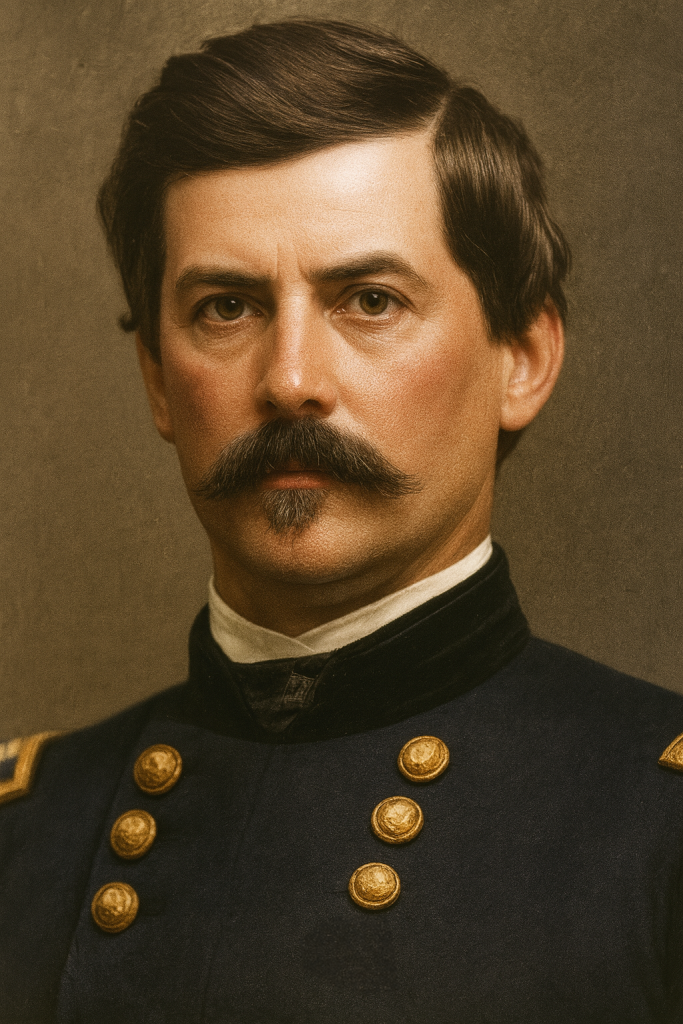
Alfred Gibbs entered the United States Military Academy and graduated in 1846, forty-second in a class of fifty-nine. That class has a name of its own in American military history, the Class of 1846, because of the men who walked off the Plain at West Point that summer. Among the fifty-nine were Thomas J. “Stonewall” Jackson, George E. Pickett, and, second in the entire class, a strikingly young cadet named George Brinton McClellan.
McClellan was barely more than a boy when he arrived. Born in December 1826, he entered the Academy in 1842 at the age of fifteen, admitted only after the normal minimum age was waived on his behalf, and was among the youngest arrivals of his year. Alfred Gibbs, born in 1823, was the older of the two by some three years. For four years these men shared the same small corps of cadets, the same drills, the same examinations. In a graduating class of fifty-nine, there were no strangers. When the regimental historians of the 1st New York Dragoons later called Gibbs and McClellan “classmates at West Point,” they were describing four years of shared life, not a coincidence of dates.
Both went straight from the Academy into the Mexican War. Gibbs was assigned to the Regiment of Mounted Riflemen, the very regiment whose name recurs throughout this site, and was wounded in the fighting, earning brevets for gallantry at Cerro Gordo and at the Garita de Belén. It is worth pausing on that fact: the man this website is named for began his army career in the Mounted Rifles, the same regiment that, in 1849, would carry his older brother George across the continent.
George Gibbs Finds McClellan in the Northwest
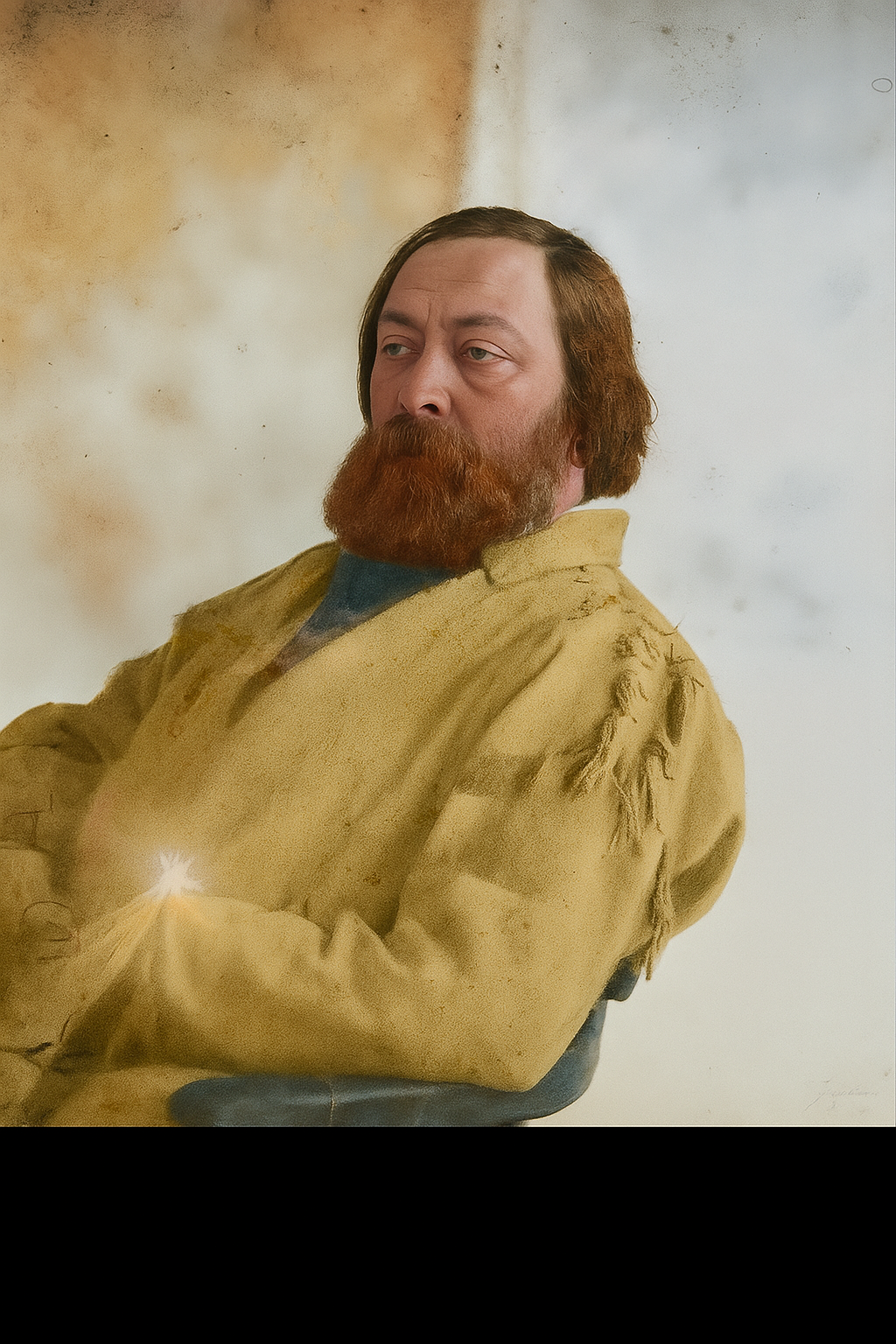
While Alfred soldiered, George took the other Gibbs road into the West. In 1849, a New York lawyer thrilled by the gold-rush excitement, he attached himself as a civilian to the Regiment of Mounted Riflemen and made the first complete military march over the length of the Oregon Trail, keeping the vivid diary that survives in The March of the Mounted Riflemen. He stayed in the Northwest, settling in Oregon and then Washington Territory, and turned his restless curiosity to the languages, customs, and geology of the region, becoming in time a leading ethnographer and linguist of the Pacific coast.
It was that expertise that brought him into McClellan’s orbit. In 1853 the army mounted the Pacific Railroad Surveys to find a route for a transcontinental line, and the survey of the northern passes through the Cascade Mountains in Washington Territory fell to a young captain of engineers, George B. McClellan. As the historian Stephen Dow Beckham has recounted, Gibbs “went directly to work for George McClellan for the survey,” who “employed Gibbs as geologist.” Gibbs filled his field notebooks with geology and natural history, and in 1855 produced for McClellan a report on the Indian tribes of the territory, by Beckham’s account the first overview of those peoples ever written. The lawyer and naturalist had become McClellan’s scientist and, in everything but title, his interpreter of the country and its native nations.
So by the eve of the Civil War, both Gibbs brothers had a personal tie to the same man: Alfred from the parade ground at West Point, George from a survey camp in the shadow of the Cascades. Neither tie had anything to do with the other. They simply ran, independently, to McClellan.
The Recommendation, 1862
When the war came, the threads pulled tight. McClellan rose with astonishing speed to command the Army of the Potomac and, for a time, all the armies of the United States. In the summer of 1862, the 130th New York Volunteer Infantry was raised from the farms of Allegany, Livingston, and Wyoming counties, and it needed a colonel. The choice fell on Alfred Gibbs, then a regular-army officer of twenty years’ standing. The regiment’s own historians recorded plainly how it happened:
Soon after our arrival at Suffolk, our new colonel, Alfred Gibbs, came to us and assumed command of his regiment. He had been appointed at the suggestion of General McClellan (his classmate at West Point), and brought with him the experience of twenty years’ service in the regular army.
Regimental History of the First New York Dragoons
This is not merely the affectionate memory of old veterans, either. The same account, that Gibbs was made colonel of the 130th New York “at the suggestion of General McClellan,” has passed into the standard biographies of Gibbs. The classmate of 1846 had become the general-in-chief, and when a New York regiment needed a professional soldier at its head, McClellan reached back across sixteen years to the small class he had drilled beside, and named Alfred Gibbs.
From the 130th New York to the First Dragoons
Gibbs brought West Point to the New York volunteers. “Colonel Gibbs had brought with him the rigid requirements of West Point,” the regiment remembered, “and we were taught that no excuse would be accepted for dirt, disorder, or disobedience.” He was a hard disciplinarian whose “kindness of heart soon drew the regiment to him in a strong bond of confidence and respect”; after his promotion to brigadier and brevet major general, he always called the men “my boys.”
In August 1863 the regiment did something almost unique in the Union army: it was converted entire from infantry to cavalry, exchanging “our Enfield rifles, together with all accouterments and clothing, for the carbine, saber, and revolver,” and was redesignated the 1st New York Dragoons. Under Gibbs it rode through the great cavalry campaigns of the war’s last years. He went on to command a brigade, and briefly a division, of cavalry, won his brigadier’s star for gallant and meritorious service, and at Five Forks on April 1, 1865, his command helped shatter the Confederate flank and open the road to Appomattox. He died, still a young man, on December 26, 1868.
The Connection That Was Hiding in Plain Sight
Set the records side by side and the shape is unmistakable. One family, the Gibbses of Sunswick, produced two brothers who each, on his own, formed a bond with George B. McClellan: Alfred as a classmate of the Class of 1846, George as the geologist and ethnologist of McClellan’s railroad survey. Both brothers were tied as well to the Regiment of Mounted Rifles. Alfred wore its uniform and bled for it in Mexico; George rode with it across the Oregon Trail. And in 1862 the older of those McClellan ties, the West Point classmate, became the reason a New York farm-boy regiment got the colonel who would lead it, reshape it into the 1st New York Dragoons, and follow it to Appomattox.
Only the most focused researchers have noticed the full shape of it, because no single document tells the whole story. It lives scattered across four separate books that have rarely been read together. Read together, they reveal a quiet truth at the foundation of this site: the regiment of Alfred Gibbs exists in its dragoon form because, sixteen years earlier, a fifteen-year-old boy and a young New Yorker stood in the same line of cadets, and one of them never forgot the other.
Sources: the Regimental History of the First New York Dragoons (the regiment’s own post-war history; the McClellan recommendation and Gibbs’s command are recorded there and repeated in standard biographies of Gibbs); Raymond W. Settle, ed., The March of the Mounted Riflemen (George Gibbs’s 1849 diary and the family background in the editor’s introduction); and Stephen Dow Beckham’s account of George Gibbs’s work as geologist and ethnologist on McClellan’s Pacific Railroad Survey. Dates and West Point class standings for Alfred Gibbs (b. April 22, 1823, Sunswick; 42nd of 59, 1846) and George B. McClellan (entered West Point 1842 at age fifteen; 2nd of 59, 1846) are confirmed against published biographical records.
Views: 23