Laura (Wolcott) Gibbs (Mother)

The Gibbs Family · Mother of the General
Laura Wolcott Gibbs
1794 – 1870
Daughter of Washington’s Treasury Secretary, widow at thirty nine, executrix, negotiator, abolitionist, and the woman who fought Washington for four years to put her son in West Point. “A piece of the original granite on which the nation was built.”

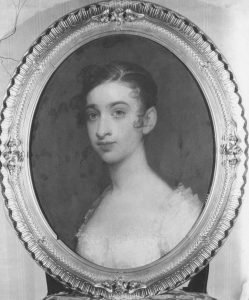
LAURA WOLCOTT GIBBS was a remarkable woman and one who extended a wide and beneficent influence during a long life. When Laura died in 1870, Dr. Henry W. Bellows, the great Unitarian clergyman these wrote of her:
“One of the last links binding the present with the early and heroic period of our national history has parted. The daughter of Oliver Wolcott, a member of the cabinet of Washington, will carry into her tomb a store of vivid recollections of the men and the times when our national life was young and earnest, anxious and devoted – after having given in her own person and life one of the best illustrations of the spirit and character of the fathers.
Her earliest years were too thoroughly steeped in the memories and traditions of the great struggle that made us a nation, to allow her character to escape the most shaping and permanent effects of it.
The ancestral home for three generations must have been the resort of all the chief friends of the country and the cause, and Oliver Wolcott’s daughter, the heiress of his vigorous intellect and decisive will, motherless from childhood, and taking her place in her early teens at the head of her father’s table, must from very infancy have been more accustomed to the discussion of public questions and the sight of public men than to the prattle or the playthings belonging to the nursery.
So fresh and active were these impressions that it was impossible to be in the company of Mrs. Gibbs for the shortest time without feeling that public questions, public interests, and duties were her natural or inherited concern. I always felt, in the presence of Mrs. Gibbs, as if I were talking with Oliver Wolcott himself and saw in her self-reliant, self-asserting and independent manner and speech, an unmistakable copy of a strong and thoroughly individual character, forged in the hottest fires of national struggle.
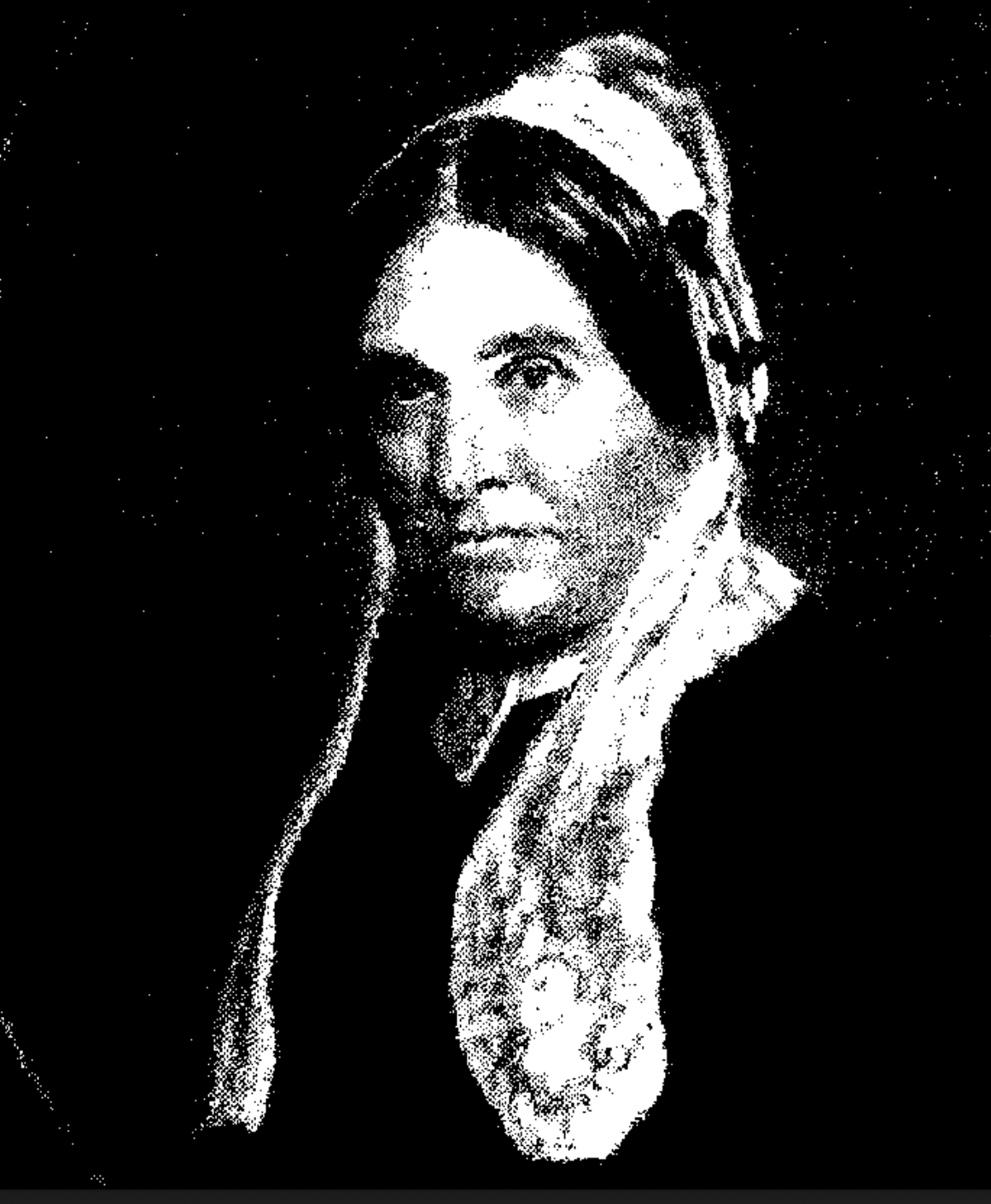
The intense individuality of her nature set her apart from others. You felt that she was a piece of the original granite on which the nation was built. It was very easy, from such a sample of the old stuff, to understand how the Revolution was accomplished.
Mrs. Gibbs brought down to our times in rare perfection these marks of our heroic age. She stood amid feeble, impressionable and plastic people, of which every society must be largely composed, like a rock that had been grooved and sculptured in some grander time. Nobody went to her for echoes of their own opinions or repetitions of the current notions of the day. But if you wanted to hear the truth plainly or even severely told,- if you wanted a strong independent judgment, – to feel the force of a vigorous nature, full of observation and reaction and common sense, brought to bear upon the matter in hand, where could you so certainly find it as in her presence?
Rectitude, veracity, simple, natural faith, and trust in great verities, with a noble skepticism for sentimental make-beliefs, self-reliance, with a fund of dry humor and sharp satire, marked her character. In the Civil War, she had the passionate patriotism of a young soldier. She lived in the news from day to day and stimulated all about her with ceaseless labors and services. It was not unusual for her to rebuke, even as she went along her outdoor visits to the butcher or the grocer, any expressions of an unpatriotic character that chanced to meet her ear. And thus she exercised, through her genuine earnestness of conviction, a positive political influence on the working class in her own neighborhood. They respected, after long acquaintance, her strength of judgment and reason, her uprightness and downright- ness, her simplicity of manners and courage of deportment and speech, and treated her like that almost extinct personage, the Lady of the Manor.
“It must not be inferred, from the emphasis laid upon the strong points in her character, that Mrs. Gibbs was deficient in tenderness and gentleness of heart. She had been a devoted and affectionate wife; she was a fond mother and warm friend. Those who knew her most intimately would probably insist that the largeness, depth, and self-sacrifice shown in her heart was her most striking grace and glory. To all, a certain magnanimity and grandeur of feeling must have been apparent. Constant and persistent in her friendships, painstaking and wise in her charities, she was an excellent woman, doing good as she had an opportunity, in an unostentatious and secret way. Few people, I heard one say who had the best opportunities of knowing, have made as good a use of a long life in the way of steady, quiet service to the poor and the sick and the unfortunate, or in the exercise ·of- sound and restraining counsel. It was not merely her strength of mind and her play of wit that drew so large a circle of friends about her, but her essential goodness of heart, reliableness of friendship, and the worth and weight of her sympathy.
“Widowed at an early period of her life, she brought up her family in such a way that her strong will neither hampered their independence nor weakened their union. It was delightful to see how rigorously she kept her house and home upon the footing on which her husband left it – a center for all her children, ever the resort of the best and most marked people, herself always the jealous head of the family; hospitable, able, and wise in her administration, and the object of a venerating and yet most companionable intercourse with her children. I rarely entered her doors without finding some interesting visitor there. She seemed to exercise to the last a powerful attraction for all superior spirits.
“I have thought it a duty to take this brief public view of the feelings aroused by the death of this strong woman, who represented so much of the past history of the country. I beg seriously to commend her example to the consideration of those who think the home and the family a small sphere for a woman to occupy. She proved how large, how decisive, and how excellent may be a woman’s sway who merely improves her domestic and social opportunities. She was one of the heirs of the great women who matched our Revolutionary sires, and who did their full part in achieving and consolidating our liberties, without once deserting the woman’s place, or imagining her sphere to be contracted. May her death add a fresh sense to the lesson her worthy and vigorous life inspired.”
It is necessary to make only a few additions to the admirable characterization of my grandmother made by Dr. Bellows. He has referred to her intense interest in the Civil War; tales of her special interest in the welfare of the sick and wounded might be cited from the recollections of members of the family. She was a strong abolitionist and used to hide negro slaves in her cellar at 261 Greene Street (renamed Winthrop Place). Even in New York City it was the custom to hunt down these refugees, and houses, where they were suspected of being concealed, were marked by a cross in chalk; Mrs. Gibbs, when she found such a mark would go down at night and remove it. Her love of beautiful objects and her own artistic gift should be enlarged upon. She drew with pencil and charcoal and also painted in watercolors extremely well. Partly from memory, partly from the study of other pictures, notably those of Trumbull, she executed in watercolor a portrait of Alexander Hamilton, which, having been engraved, remains one of the most generally admired portraits of Hamilton and widely used for the illustration of books. It represents him in early manhood, with an expression of much vigor and liveliness, in every way in his happiest moments. I do not know what became of the original, but the engraving from it is frequently met with and bears the name, «L. W. Gibbs, pinxit.”
The furniture and paintings of the house in Winthrop Place, where Mrs. Gibbs lived so long, made a collection as is rarely seen. Almost everything was an heirloom and recalled colonial times or the early days of the Republic. In the dining room was Cleven- ger’s bust of Oliver Wolcott, his portrait and that of his wife by Trumbull, and the portraits of Laura Wolcott by Stuart and of Elizabeth Wolcott Gracie by Trumbull. Also, there were four Gilbert Stuarts,- of George Gibbs (II.); his wife, Mary Channing; his partner Captain Anthony; and one of Colonel George Gibbs. In the drawing-room hung one of the two sets of Stuart portraits of the first five presidents of the United States. The drawing-room furniture was bought, at the time of Gibbs’s marriage, from Col. Humphrey, our first Minister to Spain, who disposed of much of his collection upon his return to America. This furniture, which is very beautiful, is Spanish Louis XVI; the set is now owned by Mrs. J. West Roosevelt. Among the many memorials of the Wolcott and Gibbs families, and of Washington and Hamilton, was Wolcott’s commission as Secretary of the Treasury, signed by Washington and Randolph, and a silver wine cooler given to him by Washington when he retired from the presidency. There was also a gold locket containing a lock of Washington’s hair. This was cut by Mrs. Washington and presented to Mrs. Wolcott, from whom it has descended to George Gibbs (V.). This interesting collection has been dispersed among the descendants of George and Laura Wolcott Gibbs.
George Gibbs (III.) and Laura Wolcott Gibbs had seven children, as follows:
- George (IV.), born July 17, 1815, died April 9, 1873; married Mary Kane Gibbs, his cousin, daughter of Gov. Wm. Channing Gibbs.
- Mary Gibbs. Mary died in infancy.
- Elizabeth Wolcott, born July 8, I 8I 9; died August 25, I 906, married Lucius Tuckerman, April 2, I 844.
- Oliver Wolcott, born February 2I, I 822; died December 9, I 908; married Josephine Mauran.
- Alfred, born April 22, 1823; died December 26, I 868; married Peggy Forshee Blair, of Richmond, Va.
- Laura Wolcott, born August I 2, I 82 7; died December 1, 1908; married Marie Theophile d’Oremieulx.
- Francis Sarason, born June 24, 1831; died December 27, 1882; married Eliza Gay Hosmer.
Read the full story, told through the family’s own 1833 letters: The Sale of Sunswick and the Move to New York. Her whole documented story is now told in one place: Laura’s War: The Widow Who Held the Gibbs Family Together, with every document, from the estate ledgers to the Silliman meteorite letters, reproduced and transcribed in full.
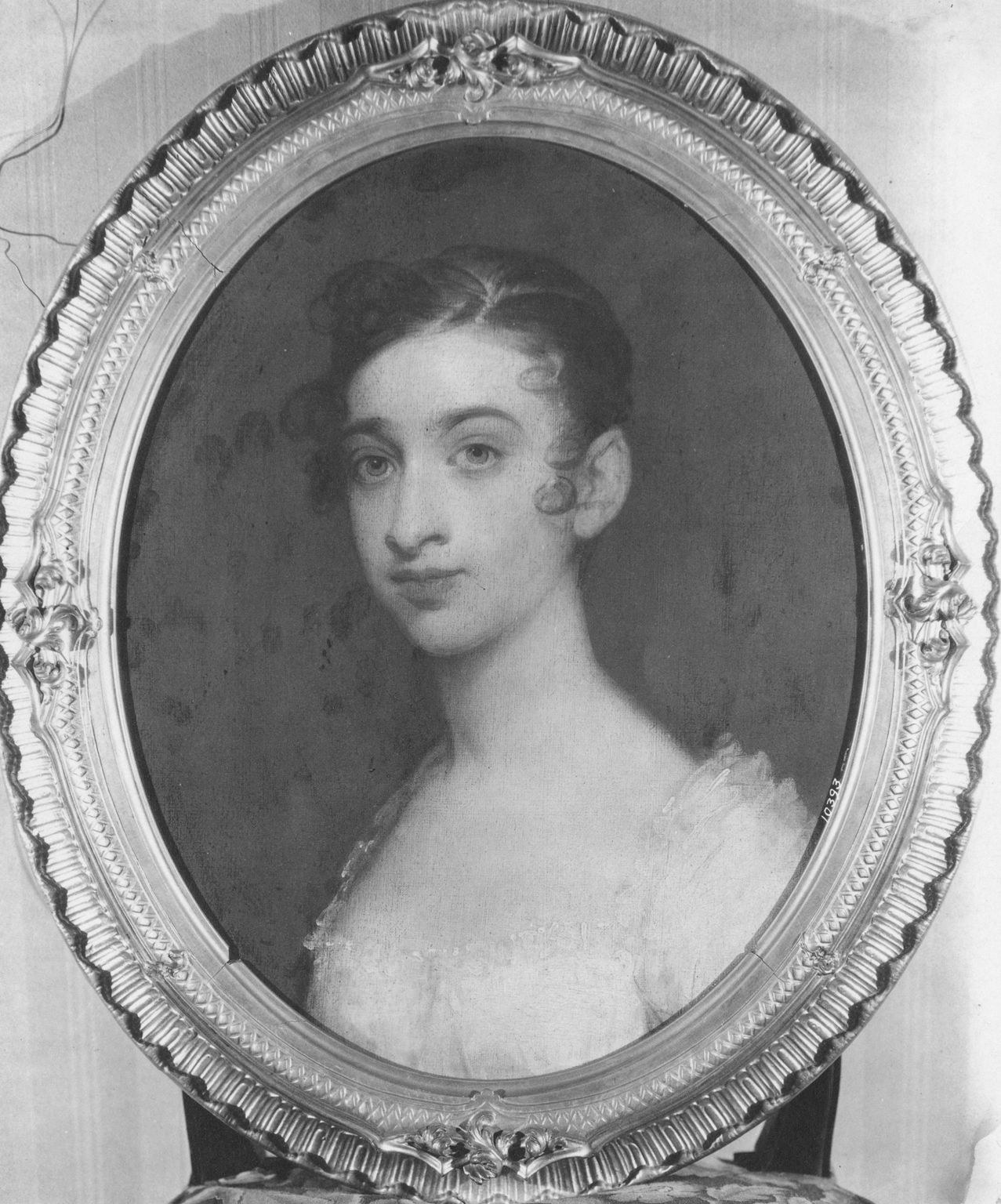
Why this image exists. It is mine. Unlike the modern dress renditions elsewhere on this site it does not move Laura into our century; it works from Gilbert Stuart’s painting of 1810 and uses CGI and colour to bring a flat black and white reproduction closer to a living face. The aim is the same, humanizing: to make a woman of two hundred years ago someone a modern researcher can meet. It is a rendering of a painting, not a photograph, and it should not be cited as a likeness taken from life. The photograph of Laura with her grandson Leon, further down this page, is the only camera image of her the site holds. — Garland H. Green Jr.
❦Her Photograph
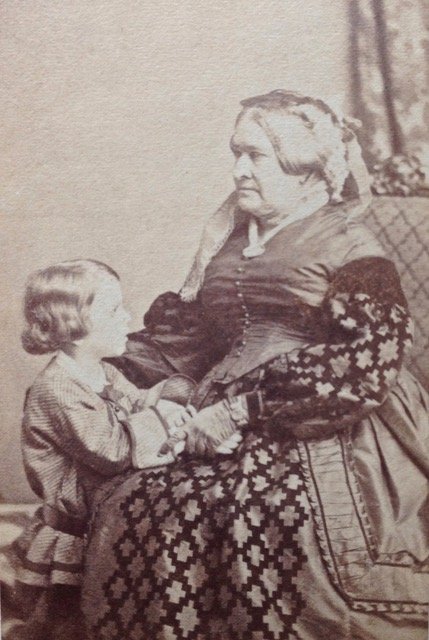
Note on this photograph. It is the first photograph of Laura herself to appear on this site. Every other likeness of her here descends from the Gilbert Stuart portrait of 1810, painted when she was about sixteen. The boy at her knee is her grandson Leon Francisque d’Oremieulx (1854-1899), son of her daughter and namesake Laura Wolcott Gibbs d’Oremieulx and of Professor Theophile Marie d’Oremieulx, and brother of Laura Henriette d’Oremieulx Roosevelt. The card carries no date. On the boy’s apparent age, four or five, the sitting belongs to about 1858 or 1859, when Laura was in her middle sixties and had been a widow some twenty-five years; the dark silk with its deep flounced skirt, the wide pagoda sleeves over white undersleeves, and the lace cap with lappets belong to that same decade. The identification is Deb Dodge’s, given with the photograph. The dating is this site’s reading of the picture and will be corrected if the Newport Historical Society’s record gives a date.
❦Short History of Laura’s Father (AUDIO)
Gibbs Archives · Reel 1The Reel 1 Papers
From the Gibbs Family Papers at the Wisconsin Historical Society, scanned frame by frame from the microfilm by the editor and published here so these letters can see the light of day. Twelve documents, 1809 to 1825, each shown whole with its complete verbatim transcription: Laura before her marriage, the letter that carries Alfred unborn, the letter that announces him, the Christmas wager on the boy, and the garden letters from Sunswick.
“Affectionate Laura” 
New York, December 24, 1809
The earliest letter in Laura’s own hand on this site, written within months of her marriage to George Gibbs. At her father’s request she introduces a young French traveller to her uncle, apologizes charmingly that she knows “nothing of the form of introductory letters,” and signs herself affectionate Laura. The postscript about her French drawing master, whom she likes “wonderfully,” is the young Laura Wolcott entire.
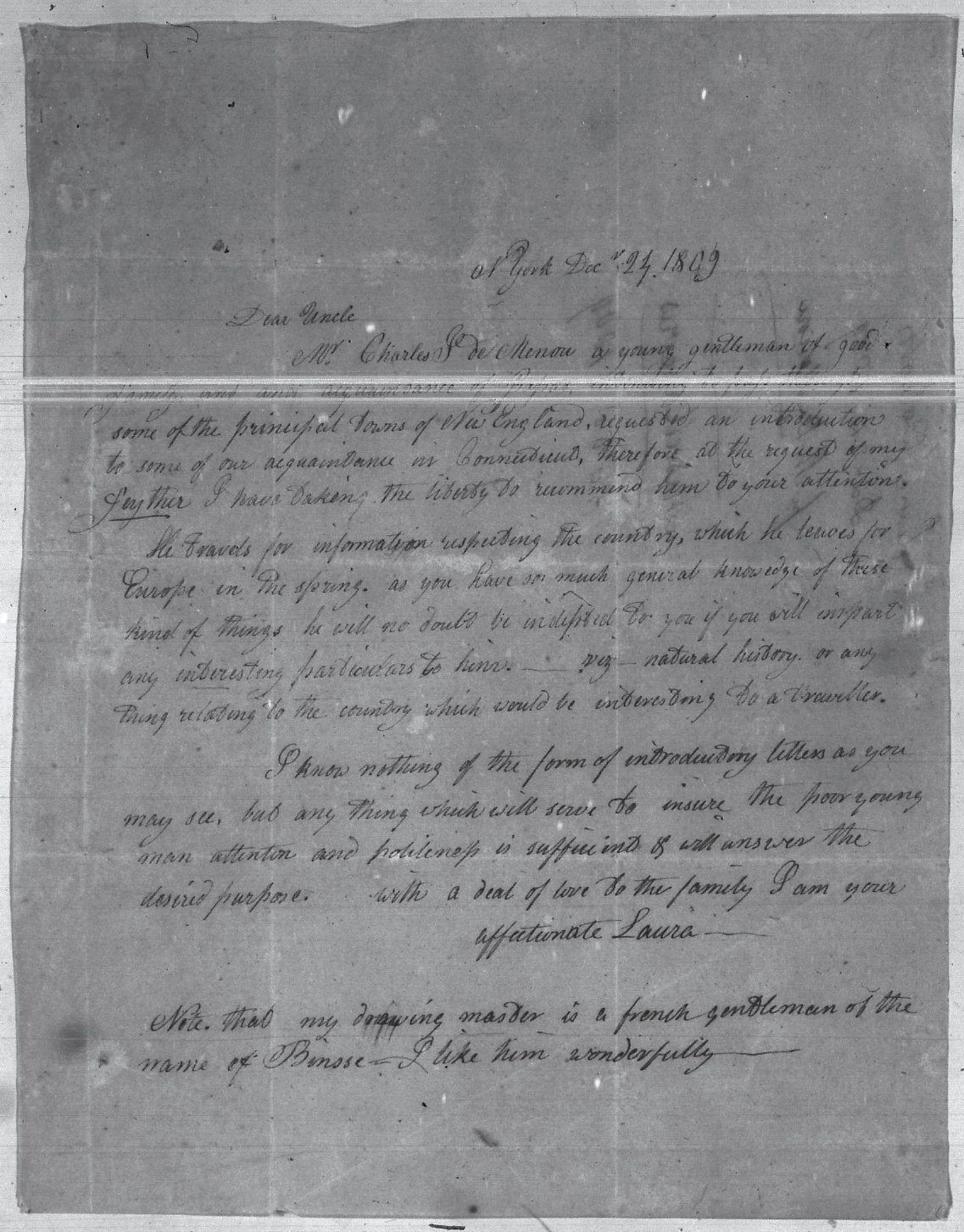
Dear Uncle
Mr. Charles J.[?] de Menou a young gentleman of good family[?] and with acquaintance of [illegible] [illegible] to pass[?] through[?] some of the prinicipal[?] towns of New England, requested an introduction to some of our acquaintance in Connecticut, therefore at the request of my Father[?] I have taken the liberty to recommend him to your attention.
He travels for information respecting the country, which he leaves for Europe in the spring. as you have so much general knowledge of these kind of things he will no doubt be indebted to you if you will impart any interesting particulars to him. — viz — natural history. or any thing relating to the country which would be interesting to a traveller.
I know nothing of the form of introductory letters as you may see, but any thing which will serve to insure the poor young man attention and politeness is sufficient & will answer the desired purpose. with a deal of love to the family I am your
affectionate Laura —
Note. that my drawing master is a french gentleman of the name of Binsse — I like him wonderfully —
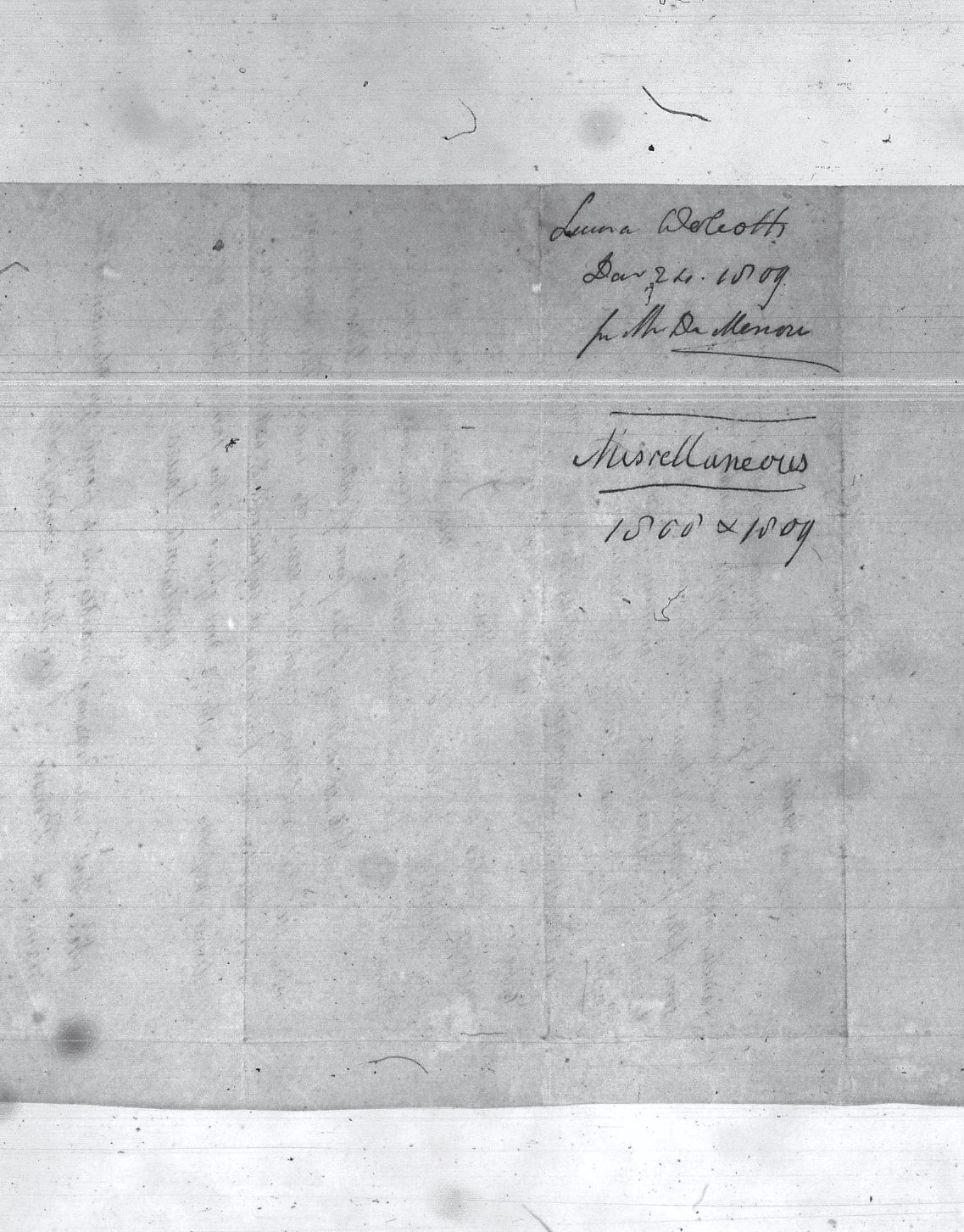
THE DOCKET
Laura Wolcott
Decr 24. 1809
for[?] Mr De Menou
Miscellaneous
1808 & 1809
Transcribed verbatim from the scans, keeping the original spelling, capitalization, and punctuation; the manuscript’s own dashes are kept, bracketed words are interlineations or uncertain readings, and [illegible] marks passages lost to the film. Condition: Scan 247: ink is faded and the microfilm image is low-contrast throughout. A horizontal fold/scan-defect band crosses the second line of the opening paragraph, leaving most of that line (after ‘family’ and ‘acquaintance of’) unreadable; readings on that line and a few adjacent words are marked uncertain. The middle initial in ‘Charles J.[?] de Menou’ is a flourished character and could be another letter. ‘Father’ is written with an unusual letterform (possibly ‘Feyther’). Scan 248: docket panel in a different hand, clear; the word before ‘Mr De Menou’ is abbreviated (likely ‘for’). Faint bleed-through of writing from the recto is visible but not independent text. The filing endorsement year reads ‘1808 & 1809’ though the first figure could be read as ‘1800’. The drawing master’s name, first read Benose[?], is BINSSE on re-examination of the strokes, confirmed independently: Ellen G. Miles (AAS Proceedings, 1998) documents the French emigre Louis Binsse as Laura Wolcott’s drawing master in 1809, citing this very letter.
Gibbs Family Papers, Wisconsin Historical Society, Reel 1, scans 247–248. Autograph letter of Laura Wolcott, New York, December 24, 1809, with its docket. Digitized from the microfilm by this site; transcribed in full above.
“I Owe Him Partly to You” 
Boston, April 11, 1811
Five months married, Laura writes the uncle who helped make the match, and the letter sparkles: her spirits “by no means oppressed by matrimony,” her humble and hearty thanks returned for her spouse, a proposal that her uncle join her and her husband on mineralogical excursions, and a new bride’s verdict that she “could not have made a better choice.” George, she notes, is at Newport and “will acquiesce, for he loves me as he ought to.”
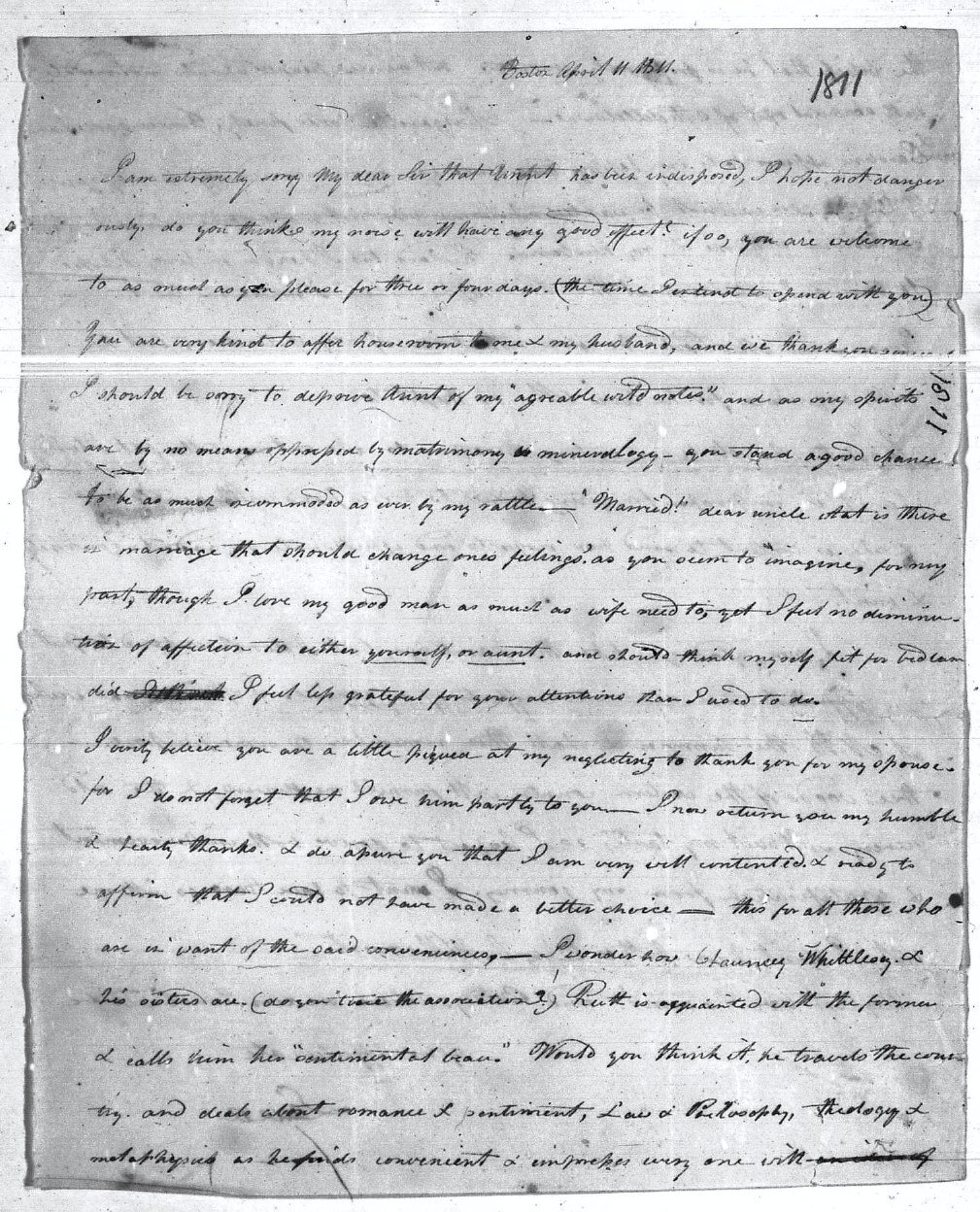
I am extremely sorry My dear Sir that Aunt has been indisposed, I hope not dangerously. do you think my noise will have any good effect? if so, you are welcome to as much as you please for three or four days. (the time I intend to spend with you) You are very kind to offer houseroom to me & my husband, and we thank you sincerely[?] — I should be sorry to deprive Aunt of my “agreable wild notes.” and as my spirits are by no means oppressed by matrimony [struck: illegible] mineralogy — you stand a good chance to be as much incommoded as ever by my rattle — “Married!” dear uncle what is there in marriage that should change ones feelings, as you seem to “imagine, for my part, though I love my good man as much as wife need to, yet I feel no diminution of affection to either yourself, or aunt. and should think myself fit for bedlam did [struck: illegible] I feel less grateful for your attentions than I used to do.
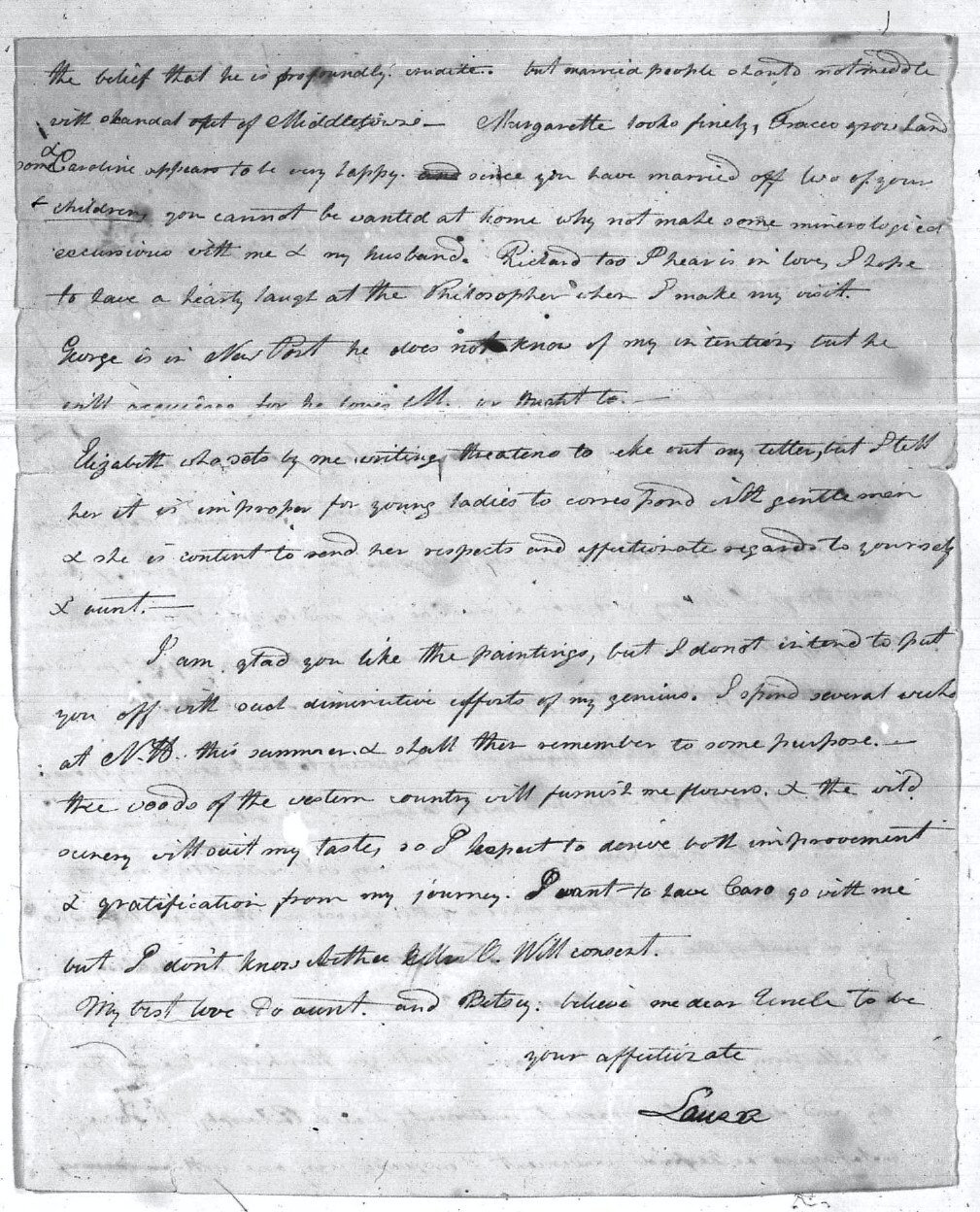
I verily believe you are a little piqued at my neglecting to thank you for my spouse, for I do not forget that I owe him partly to you — I now return you my humble & hearty thanks. & do assure you that I am very well contented, & ready to affirm that I could not have made a better choice — this for all those who are in want of the said conveniences. — I wonder how Chauncey Whittlesey & his sisters are. (do you trace[?] the association?) Ruth is acquainted with the former & calls him her “sentimental beau.” Would you think it, he travels the country, and deals about romance & sentiment, Law & Philosophy, Theology & metaphysics as he finds convenient & impresses every one with [struck: illegible] the belief that he is profoundly erudite.. but married people should not meddle with scandal [struck: illegible] of Middletown — Margarette looks finely, Frances[?] grows[?] handsome & Caroline appears to be very happy. [struck: and] since you have married off two of your children, you cannot be wanted at home why not make some mineralogical excursions with me & my husband. Richard too I hear is in love, I hope to have a hearty laugh at the Philosopher when I make my visit.
George is in New Port he does not know of my intention, but he will acquiesce for he loves me[?] as[?] he ought to. —
Elizabeth who sets by me writing threatens to eke out my letter, but I tell her it is improper for young ladies to correspond with gentlemen & she is content to send her respects and affectionate regards to yourself & aunt. —
I am glad you like the paintings, but I do not intend to put you off with such diminutive efforts of my genius. I spend several weeks at N.B. this summer, and shall there[?] remember[?] to some purpose. — the woods of the western country will furnish me flowers, & the wild scenery will suit my taste, so I expect to derive both improvement & gratification from my journey. I want to have Caro go with me but I don’t know whether Uncle O.[?] will consent.
My best love to aunt. and Betsey. believe me dear Uncle to be
your affectionate
Laura
Transcribed verbatim from the scans, keeping the original spelling, capitalization, and punctuation; the manuscript’s own dashes are kept, bracketed words are interlineations or uncertain readings, and [illegible] marks passages lost to the film. Condition: Two-page holograph, ink faded along horizontal fold creases on both leaves. Scan 265: an archivist’s pencil ‘1811’ appears twice in the right margin (not transcribed). End of the fourth manuscript line sits on a fold; ‘we thank you sincerely[?]’ is a conjectural completion of the faded tail. Two short strikeouts are inked over too heavily to recover: one between ‘matrimony’ and ‘mineralogy’, one after ‘bedlam did’. The word inside ‘(do you trace[?] the association?)’ is partially overwritten. Scan 266: a struck word follows ‘scandal’ before ‘of Middletown’. The clause ‘Frances[?] grows[?] handsome’ involves a cramped line-break (‘hand-‘ / marginal ‘some’) plus an interlined ‘&’ before ‘Caroline’; the two names read confidently as Margarette and Caroline, the third less so. The line ‘George is in New Port… he loves me[?] as[?] he ought to’ is the most badly faded passage of the letter. ‘N.B.’, ‘shall there[?] remember[?] to some purpose’, and ‘Uncle O.[?]’ are uncertain readings. Original spelling retained throughout (‘agreable’, ‘sets by me’, ‘New Port’); the stray opening quotation mark before ‘imagine’ is in the manuscript.
Gibbs Family Papers, Wisconsin Historical Society, Reel 1, scans 265–266. Autograph letter of Laura Wolcott Gibbs to her uncle, five months after her marriage. Digitized from the microfilm by this site; transcribed in full above.
“The Little Man in Grey” 
New York, February 13, 1813
Laura’s sister Eliza teases the new brother-in-law: does Laura still hate the drawing-room wallpaper, is Mrs. Perry as cross as ever, is the dog Saladin still fond of bread and butter, and does “the little man in grey” keep undisturbed possession of his four rooms? A bargain is struck: Laura’s household news in exchange for the reigning fashions. This is the Wolcott sisters’ voice, and the household Alfred was born into ten years later.
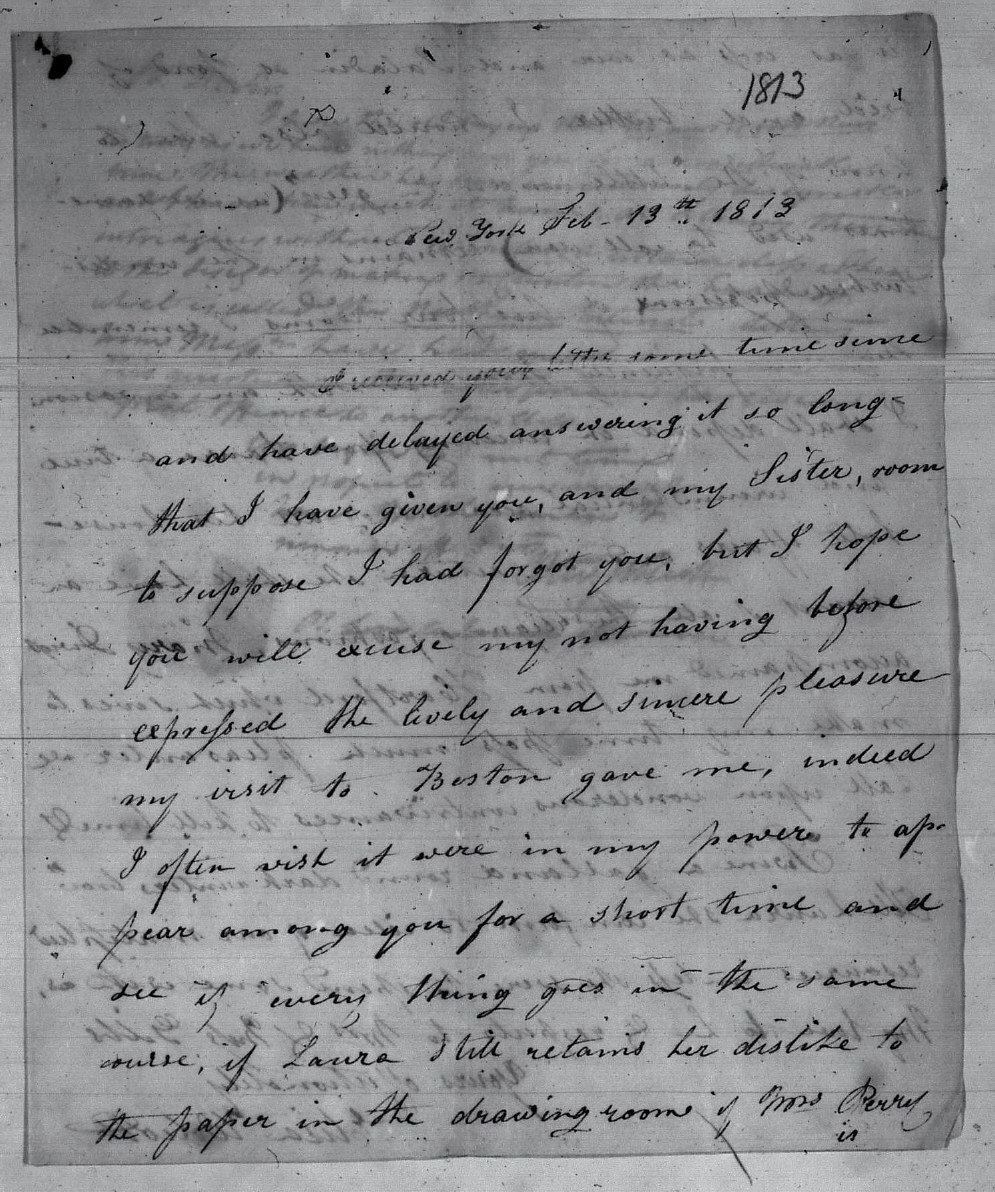
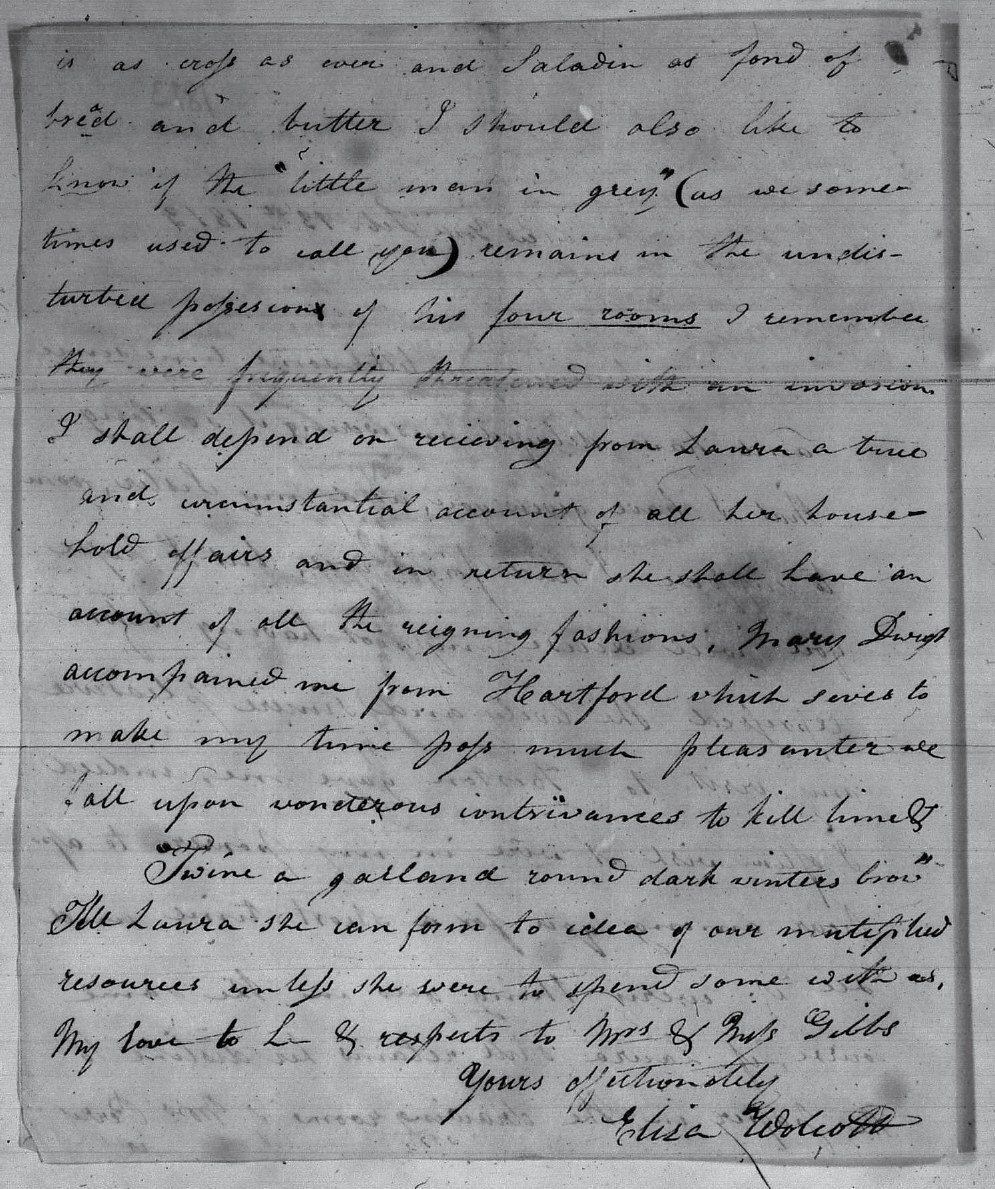
I received your letter[?] some time since and have delayed answering it so long — that I have given you, and my Sister, room to suppose I had forgot you, but I hope you will excuse my not having before expressed the lively and sincere pleasure my visit to Boston gave me, indeed I often wish it were in my power to appear among you for a short time and see if every thing goes in the same course, if Laura still retains her dislike to the paper in the drawing room if Mrs Perry is as cross as ever and Saladin as fond of bread and butter I should also like to know if the “little man in grey” (as we sometimes used to call you) remains in the undisturbed possesion of his four rooms I remember they were frequently threatened with an invasion[?] I shall depend on recieving from Laura a true and circumstantial account of all her household affairs and in return she shall have an account of all the reigning fashions, Mary Dwight accompanied me from Hartford which serves to make my time pass much pleasanter we fall upon wonderous[?] contrivances to kill time &
“Twine a galland round dark winters brow”
Tell Laura she can form no[?] idea of our multiplied resources unless she were to spend some with us. My love to L— & respects to Mrs & Miss Gibbs
Yours affectionately
Eliza Wolcott
Transcribed verbatim from the scans, keeping the original spelling, capitalization, and punctuation; the manuscript’s own dashes are kept, bracketed words are interlineations or uncertain readings, and [illegible] marks passages lost to the film. Condition: Scan 302 (page 1) carries heavy ink bleed-through from the verso, and a later archivist’s pencil ‘1813’ at top right. The opening line is interlined above the first ruled line and partly obscured; ‘letter’ is conjectural. The word ‘is’ at the foot of page 1 is a catchword repeated at the head of scan 303 (page 2) and is transcribed once. ‘four rooms’ is underlined in the manuscript. The line ‘they were frequently threatened with an invasion’ falls on a fold and is partly conjectural. ‘possesion’ and ‘recieving’ are the writer’s spellings; ‘galland’ (for garland) appears as written in the quoted verse. ‘wonderous’ and ‘no’ (in ‘form no idea’) are uncertain readings. Signature reads Eliza (possibly written ‘Elisa’) Wolcott.
Gibbs Family Papers, Wisconsin Historical Society, Reel 1, scans 302–303. Autograph letter of Eliza Wolcott to her brother-in-law Col. George Gibbs. Digitized from the microfilm by this site; transcribed in full above.
“These Genius’s Are Always Queer” 
Boston, August 13, 1816
Laura’s Boston literary correspondent was the wife of General David Humphreys, Washington’s aide and the first American minister to Spain, whose Spanish furniture later stood in the Gibbs drawing room. Between society news and marriages she reviews Leigh Hunt’s Story of Rimini, forgiving its poor lines for the melody of its sentiments but not its author’s conceit, wonders if Laura will see the great Mrs. Siddons before her final exit, and closes with “a kiss to the dear little Cherub”, the infant George Gibbs, the future ethnologist.
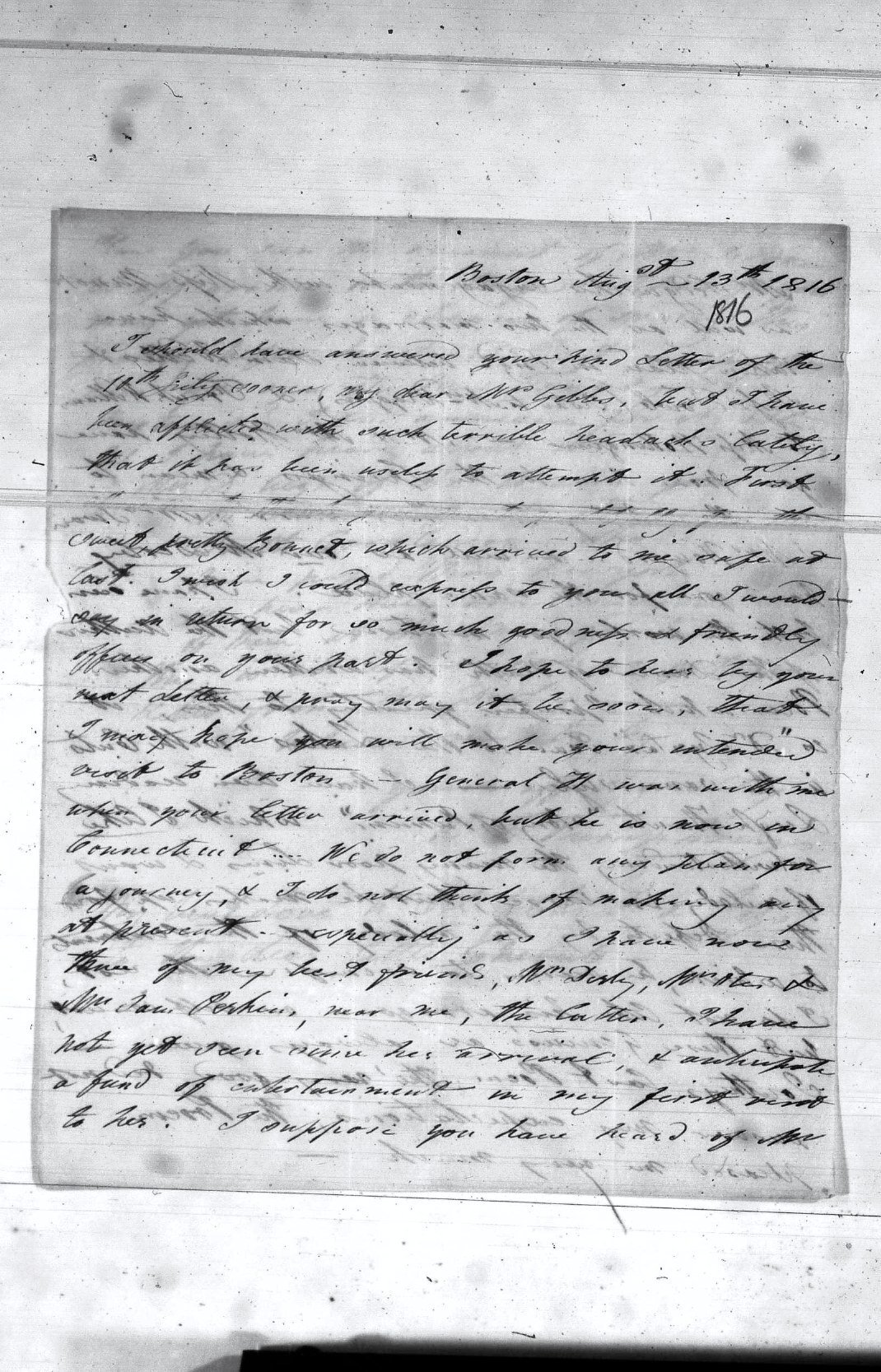
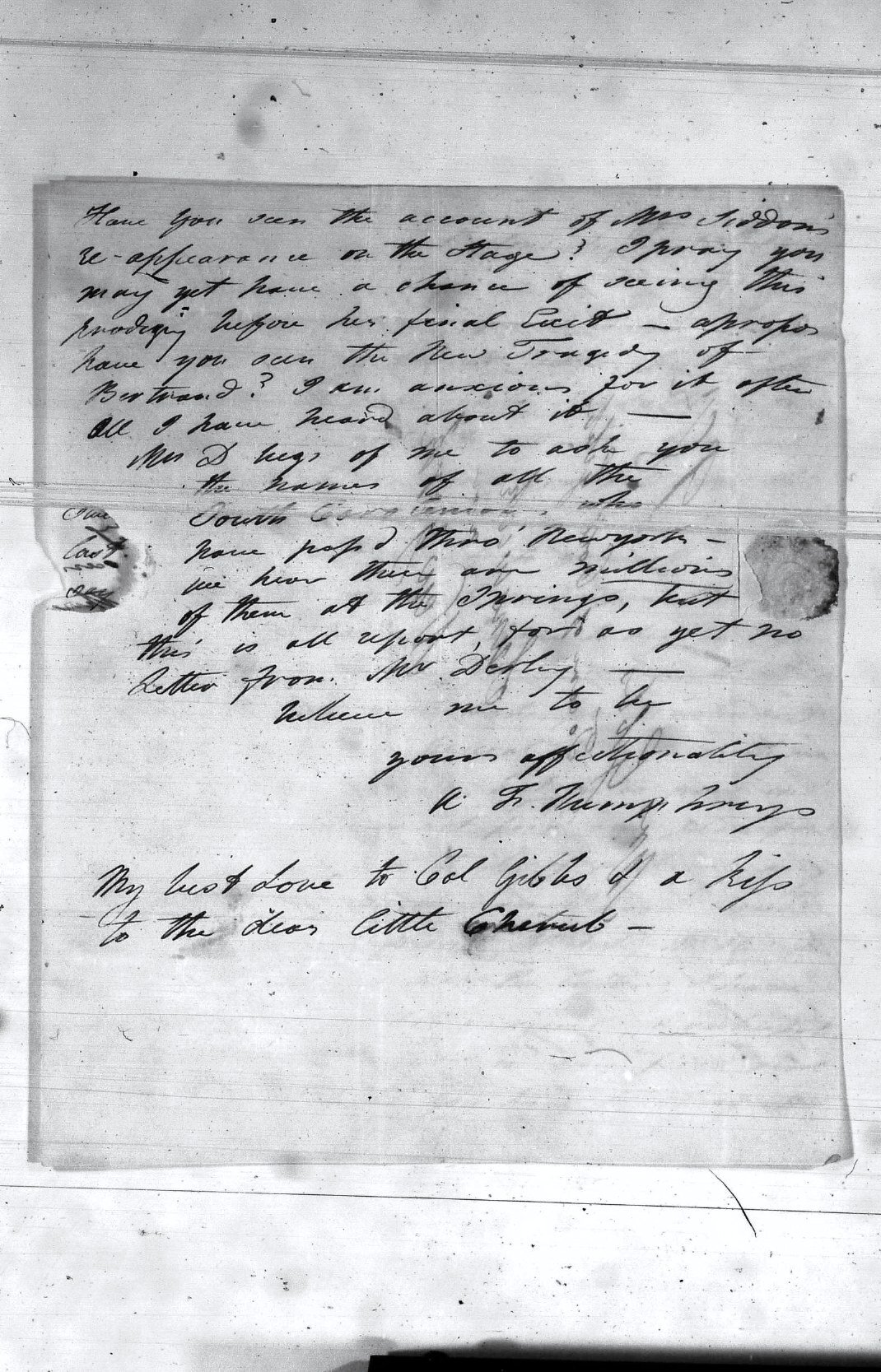
I should have answered your kind Letter of the 10th July sooner, my dear Mrs Gibbs, but I have been afflicted with such terrible headachs lately, that it has been useless to attempt it. First [one line badly faded — apparently thanking her for] the sweet pretty Bonnet, which arrived to me safe at last. I wish I could express to you all I would — say in return for so much goodness & friendly offers on your part. I hope to hear by your next Letter, & pray may it be soon, that I may hope you will make your intended visit to Boston — General H. was with me when your Letter arrived, but he is now in Connecticut — We do not form any plan for a journey, & I do not think of making any at present — especially, as I have now three of my best friends, Mrs Derby, Mrs Otis & Mrs Sam Perkins, near me, the Latter, I have not yet seen since her arrival, & anticipate a fund of entertainment in my first visit to her.
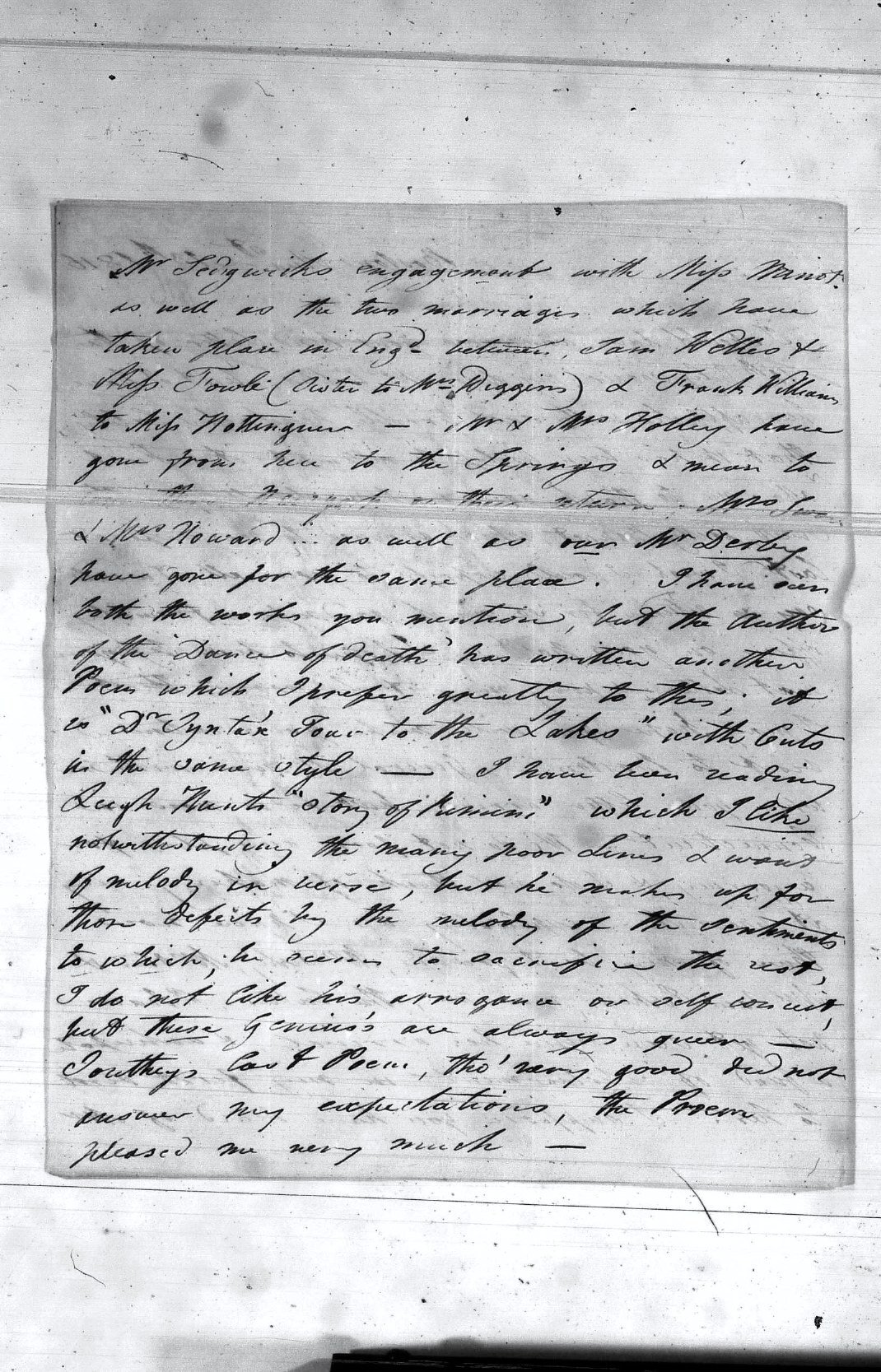
I suppose you have heard of Mr Sedgwicks engagement with Miss Minot, as well as the two marriages which have taken place in Engd between, Sam Welles & Miss Fowle (Sister to Mrs Duggins[?]) & Frank Williams to Miss Nottingham[?] — Mr & Mrs Holley have gone from here to the Springs & mean to [one line badly faded: visit[?] N[illegible] on their return[?] — Mrs S[illegible]] & Mrs Howard — as well as our Mr Derby have gone for the same place.
I have seen both the works you mention, but the Author of the ‘Dance of death’ has written another Poem which I prefer greatly to this; it is “Dr Syntax’s Tour to the Lakes” with Cuts in the same style — I have been reading Leigh Hunts “story of Rimini” which I like notwithstanding the many poor lines & want of melody in verse, but he makes up for those defects by the melody of the sentiments to which, he seems to sacrifice the rest, I do not like his arrogance or self conceit, but these Genius’s are always queer — Southeys last Poem, tho’ very good did not answer my expectations, the Proem pleased me very much —
Have you seen the account of Mrs Siddons re-appearance on the Stage? I pray you may yet have a chance of seeing this prodigy before her final Exit — apropos have you seen the New Tragedy of Bertrand[?]? I am anxious for it after all I have heard about it —
Mrs D begs of me to ask you the names of all the South Carolinians[?] who have passed thro’ Newyork — we hear they are millions of them at the Springs, but this is all report, for as yet no Letter from Mrs Derby —
Believe me to be
yours affectionatly
A. F. Humphreys
My best Love to Col Gibbs & a kiss to the dear little Cherub —
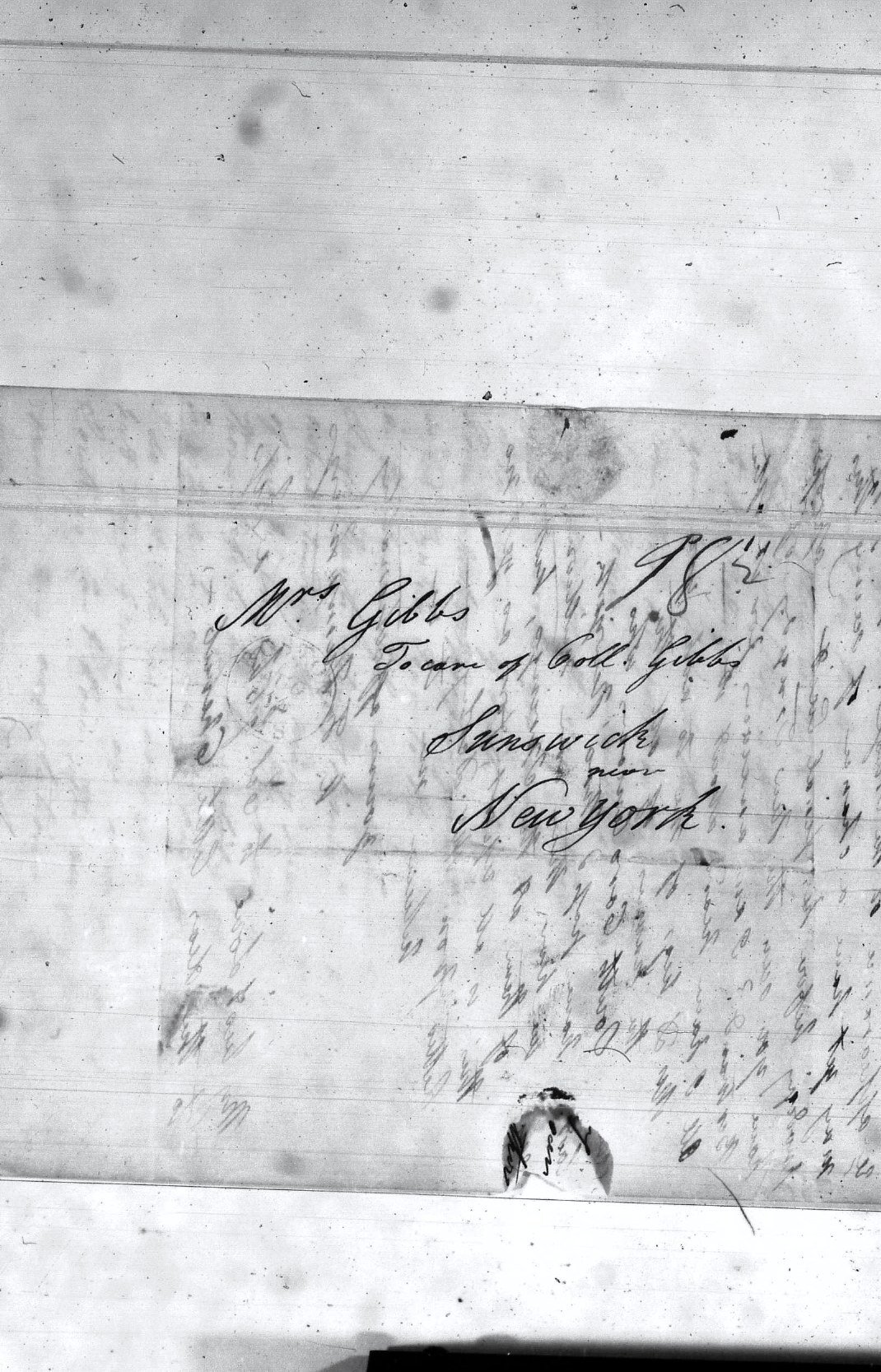
THE ADDRESS LEAF
Mrs Gibbs
To care of Coll. Gibbs
Sunswick
near
New York.
[postal rate, in ink, upper right:] 18 1/2
[faint circular postmark at left, Boston, only partly legible]
Transcribed verbatim from the scans, keeping the original spelling, capitalization, and punctuation; the manuscript’s own dashes are kept, bracketed words are interlineations or uncertain readings, and [illegible] marks passages lost to the film. Condition: Four microfilm scans: three manuscript pages (398-400) and the address leaf/wrapper (401), which carries heavy bleed-through from the letter text. The letter has no separate salutation line; ‘my dear Mrs Gibbs’ sits inline in the opening sentence. An archivist’s pencil ‘1816’ appears below the dateline on scan 398. Two lines are badly faded where a fold crosses the page: on p.1 the line after ‘First’ (context indicates thanks for the bonnet, ending ‘…the sweet pretty Bonnet’), and on p.2 the line after ‘& mean to’ (a destination, possibly Niagara or Newport, ‘on their return’, ending with a ‘Mrs S~’ name). ‘Duggins’ and ‘Nottingham’ are best readings of rubbed surnames; ‘Sam Welles & Miss Fowle’ matches the documented 1816 London marriage of Samuel Welles to Adeline Fowle. ‘General H.’ is the writer’s husband, Gen. David Humphreys. The new tragedy is written ‘Bertrand’ with what appears to be a terminal d, though the play meant is certainly Maturin’s ‘Bertram’ (Drury Lane, May 1816); the writer’s spelling is kept. On p.3 (scan 400) a seal tear at the left edge has destroyed a few marginal word-fragments (‘Our’, ‘Cast'[?]) not part of the running text; the line read as ‘South Carolinians[?]’ is overwritten and rubbed. The writer underlines ‘our’ (Mr Derby), ‘I like’, and ‘these’ (Genius’s); underlining is not reproduced in the paragraph text. Original spelling and punctuation retained throughout (‘headachs’, ‘affectionatly’, ‘Newyork’, ‘Genius’s’, ‘tho”); manuscript long dashes rendered as ~~; hyphenated line-break words silently rejoined. Postal rate 18 1/2 (cents) fits the 1816 single-sheet rate for 150-400 miles, Boston to New York.
Gibbs Family Papers, Wisconsin Historical Society, Reel 1, scans 398–401. Autograph letter of Ann Frances Humphreys to Laura Wolcott Gibbs, with its address leaf. Digitized from the microfilm by this site; transcribed in full above.
Awaiting Her “Change of Situation” 
Litchfield, July 1817
Eliza, now Mrs. Gracie, writes her sister while nursing their father through the aftermath of an illness, on the eve of escorting him to New Haven for the inauguration of Yale’s new president. The family waits daily for news of Laura’s confinement, and little George gets a promise from “Anty Liz” of something very pretty when she comes back.
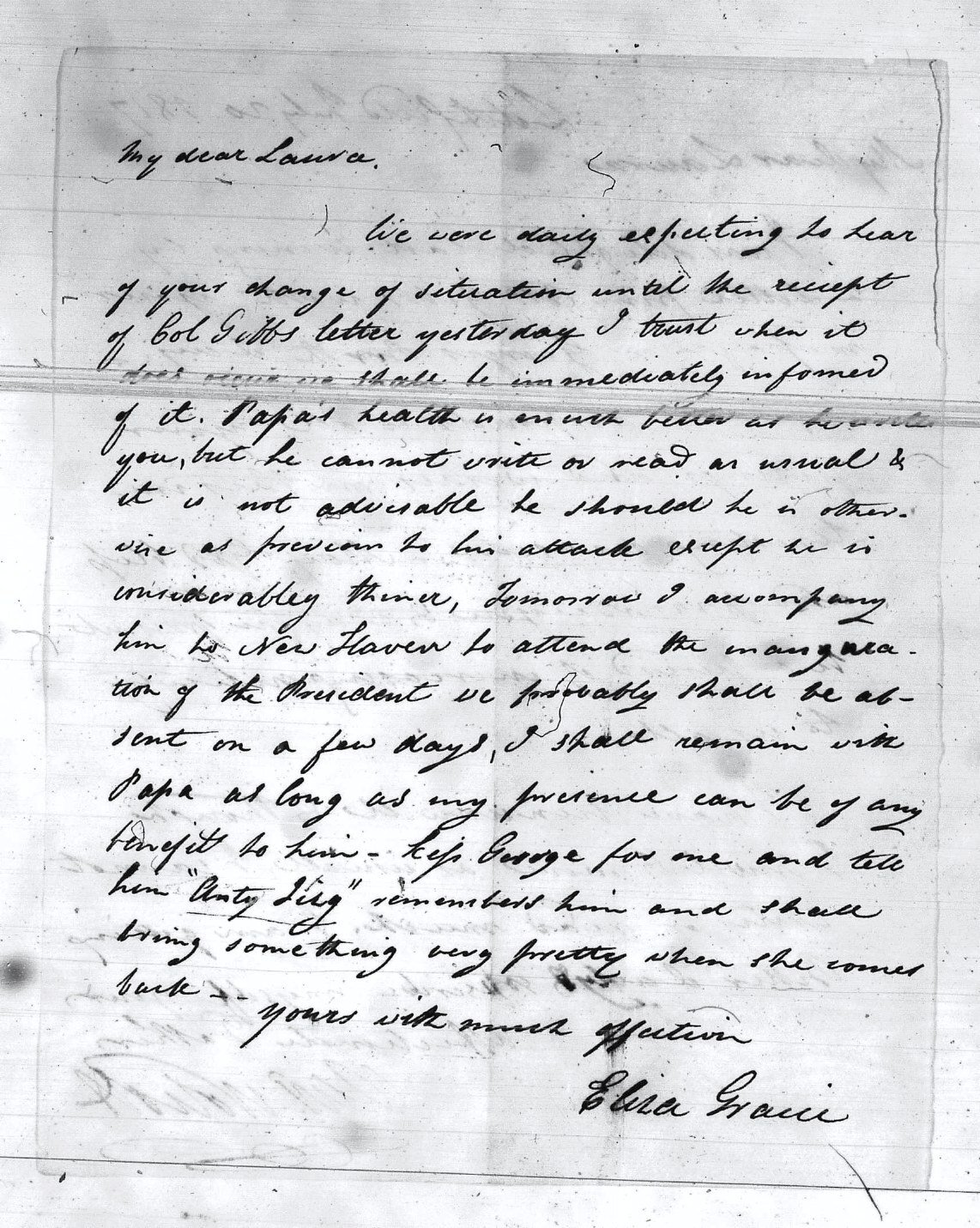
My dear Laura.
We were daily expecting to hear of your change of situation until the receipt of Col Gibbs letter yesterday I trust when it does occur[?] we shall be immediately informed of it. Papa’s health is much better as he writes[?] you, but he cannot write or read as usual & it is not advisable he should he is otherwise as previous to his attack except he is considerabley thiner, Tomorrow I accompany him to New Haven to attend the inauguration of the President we probably shall be absent on a few days, I shall remain with Papa as long as my presence can be of any benefit to him — kiss George for me[?] and tell him “Anty Liz[?]” remembers him and shall bring something very pretty when she comes back —
yours with much affection
Eliza Gracie
Transcribed verbatim from the scans, keeping the original spelling, capitalization, and punctuation; the manuscript’s own dashes are kept, bracketed words are interlineations or uncertain readings, and [illegible] marks passages lost to the film. Condition: Single-page letter, ink faded with heavy bleed-through from the verso. The dateline at the top right is almost entirely lost in bleed-through; ‘Litchfield’ and ‘1817’ are the most plausible readings and the day of the month is illegible (context: the Yale presidential inauguration of Jeremiah Day was 23 July 1817). A horizontal scanner/microfilm artifact stripe crosses the fourth line (‘does occur we shall be immediately informed’), making ‘does occur’ partly conjectural. The right edge of the line ‘much better as he writes you’ is rubbed; ‘writes’ is a best reading. ‘for me’ could also read ‘for one’; the nickname in quotation marks reads ‘Anty Liz’ or possibly ‘Aunty Lizy’. Original spelling retained throughout (e.g., ‘considerabley thiner’). Hyphenated line-break words (inaugura-tion, ab-sent) silently rejoined.
Gibbs Family Papers, Wisconsin Historical Society, Reel 1, scan 422. Autograph letter of Eliza (Wolcott) Gracie to Laura Wolcott Gibbs. The Yale inauguration referred to is Jeremiah Day’s, July 23, 1817. Digitized from the microfilm by this site; transcribed in full above.
“I Expect to Be Confined in May” 
Sunswick, Sunday evening, February 17, 1823
Alone at Sunswick three weeks with her husband away, Laura writes her father a Sunday-evening letter of family news, and in it, almost in passing, records the child she is carrying. The baby she expected in May came in April: Alfred, the general. This page is as close as the record comes to Alfred Gibbs before Alfred Gibbs.
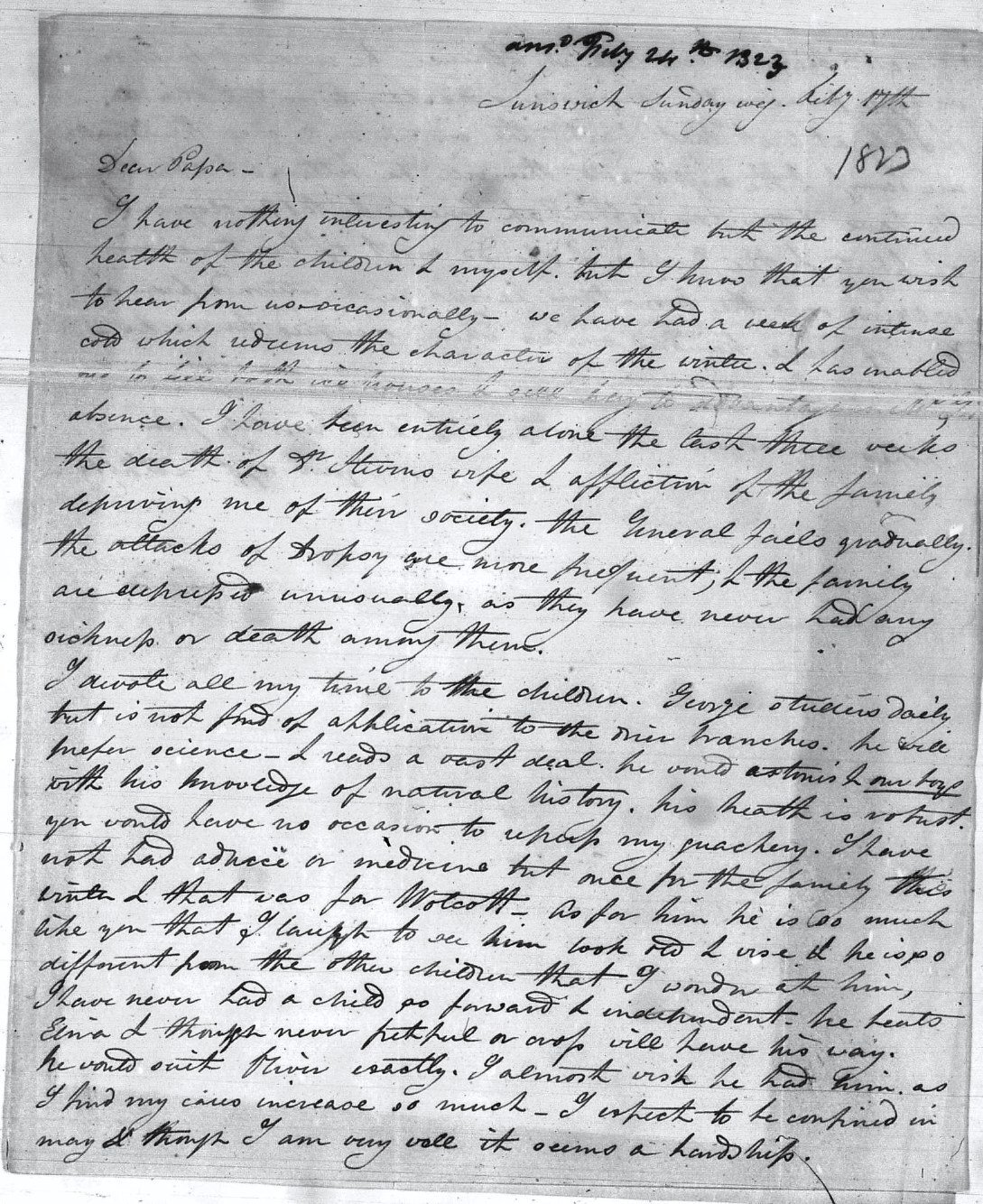
[Docket, another hand, top of page:]
ansd. Feby 24th 1823
[Annotation, right margin below dateline, another hand:]
1823
Dear Papa —
I have nothing interesting to communicate but the continued health of the children & myself. but I know that you wish to hear from us occasionally — we have had a week of intense cold which redeems the character of the winter. & has enabled us to fill both ice houses[?] & sell hay to advantage in Mr Gibbs’s[?] absence. I have been entirely alone the last three weeks the death of Dr Sterns wife & affliction of the family depriving me of their society. the General fails gradually. the attacks of dropsy are more frequent; & the family are depressed unusually, as they have never had any sickness or death among them.
I devote all my time to the children. Georgie studies daily but is not fond of application to the drier[?] branches. he will prefer science — & reads a vast deal. he would astonish our boys with his knowledge of natural history. his health is robust. you would have no occasion to upbraid[?] my quackery. I have not had advice or medicine but once for the family this winter & that was for Wolcott — As for him he is so much like you that I laugh to see him look old & wise & he is so different from the other children that I wonder at him, I have never had a child so forward & independent. he beats Elvira & though never fretful or cross will have his way. he would suit Oliver[?] exactly. I almost wish he had him. as I find my cares increase so much — I expect to be confined in may & though I am very well it seems a hardship.
THE LETTER BREAKS OFF HERE
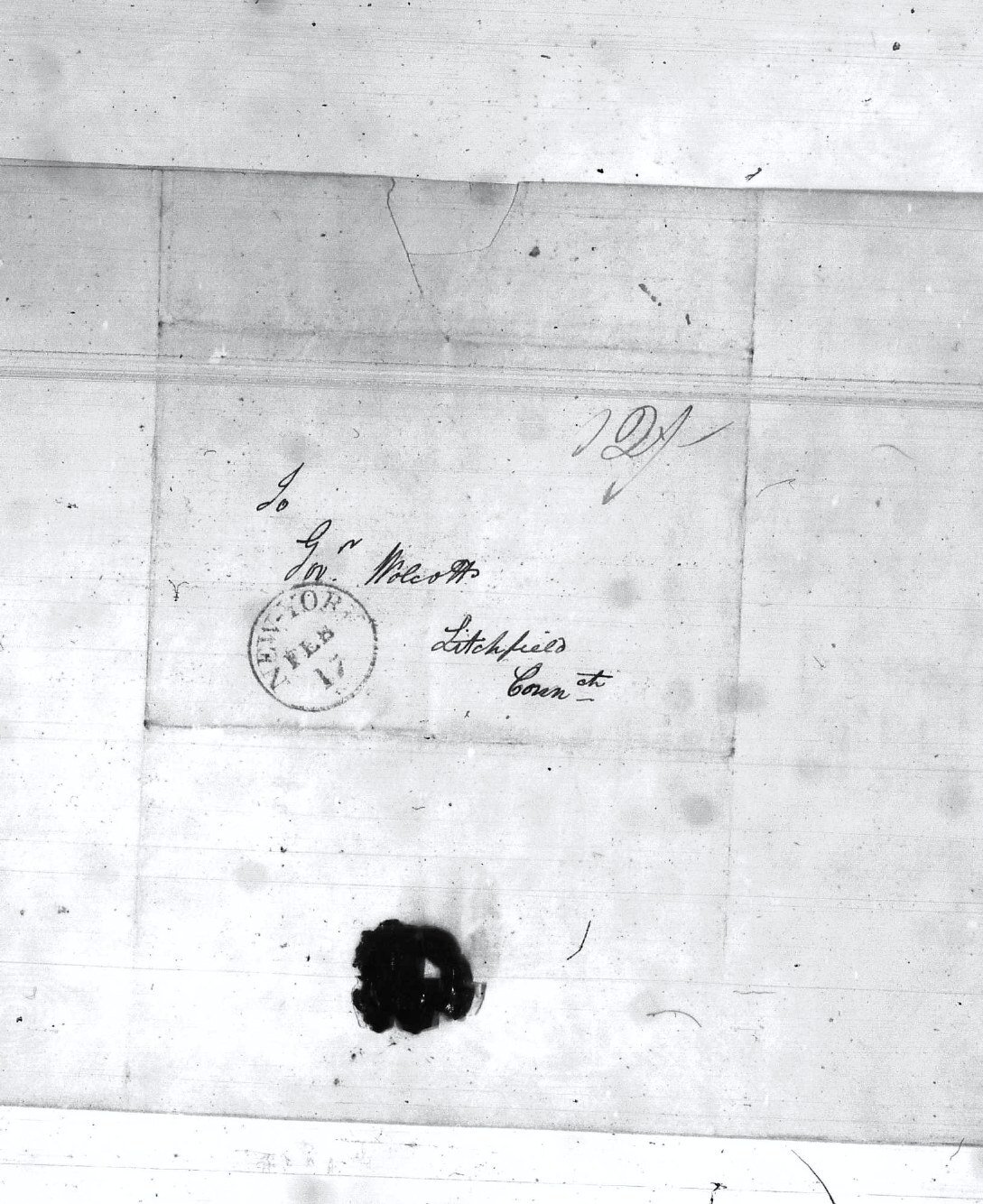
THE ADDRESS LEAF
To — Govr Wolcott — Litchfield — Connct —
[Stamped circular postmark:] NEW-YORK / FEB / 17
[Manuscript postal rate, upper right, a hurried scrawl:] 12[?]
[Black wax seal at the foot of the leaf.]
Transcribed verbatim from the scans, keeping the original spelling, capitalization, and punctuation; the manuscript’s own dashes are kept, bracketed words are interlineations or uncertain readings, and [illegible] marks passages lost to the film. Condition: Single-page PDF (scan 489); the letter breaks off mid-text at the foot of the page (‘…it seems a hardship.’) with no signature or address leaf, so the continuation must lie on an adjacent scan (likely 490). Ink faded overall with heavy show-through. One line near the top (‘us to fill both ice houses & sell hay to advantage in Mr Gibbs’s absence’) is badly faded/rubbed and partly conjectural, as marked. ‘our boys’ is underlined in the original. Docket ‘ansd. Feby 24th 1823’ and the year ‘1823’ are in a different hand/pencil. Scan 490 (address leaf, read by the editor): direction To Govr Wolcott, Litchfield, Connct; New-York Feb 17 circular postmark; a hurried rate scrawl at upper right read as 12; black wax seal. No letter text continues on this face, so the closing and signature of the letter are not preserved on the reel; the text ends mid-letter at the foot of scan 489.
Gibbs Family Papers, Wisconsin Historical Society, Reel 1, scans 489–490. Autograph letter of Laura Wolcott Gibbs to her father Oliver Wolcott Jr., Sunswick, February 17 [1823], docketed answered February 24, 1823, with its address leaf. The surviving text ends mid-letter; the closing is not preserved on the reel. Digitized from the microfilm by this site; transcribed in full above.
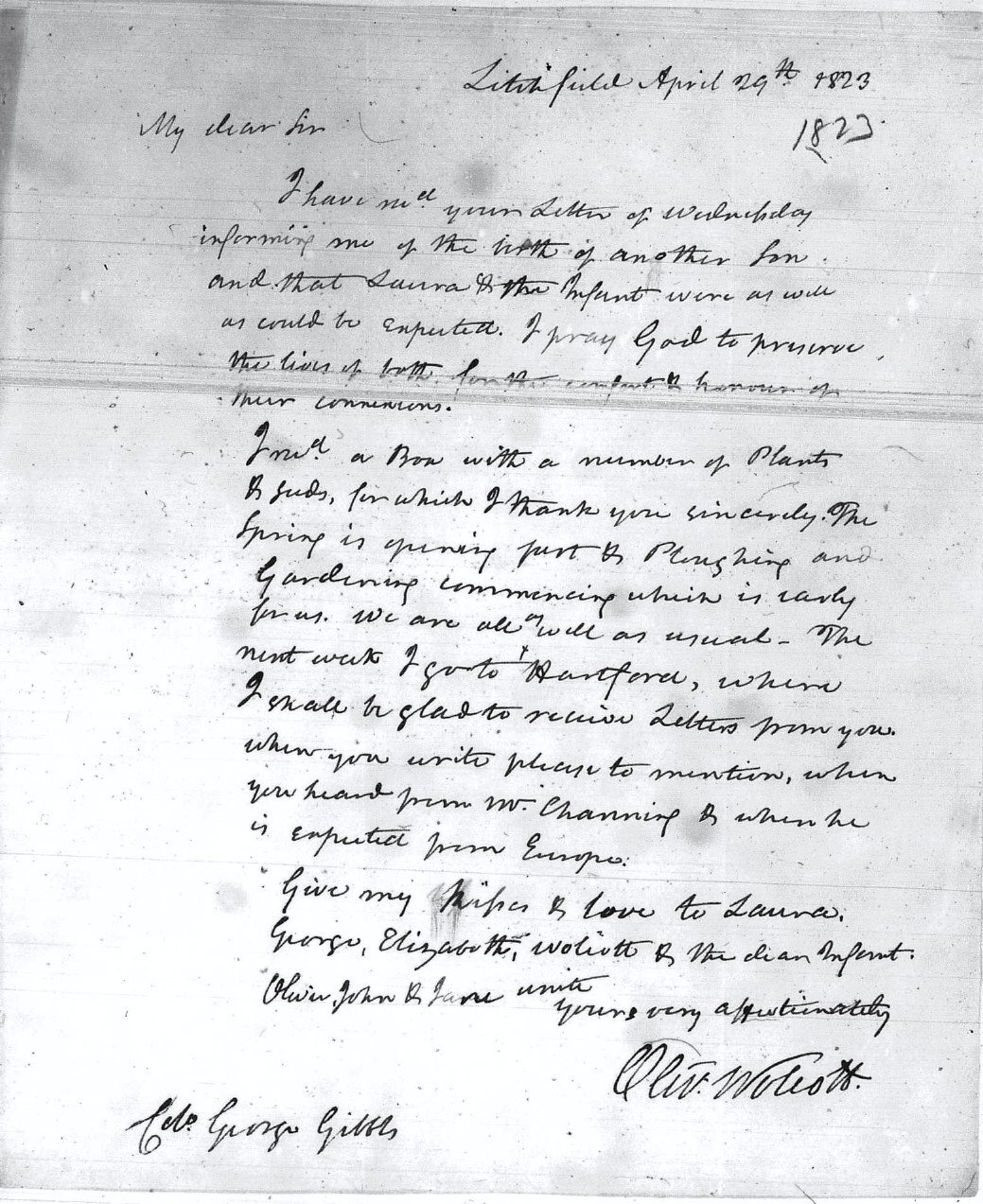
The Birth of Another Son 
Litchfield, April 29, 1823
The first document of Alfred Gibbs’s life. His grandfather Oliver Wolcott Jr., Washington’s and Adams’s Secretary of the Treasury and ten times governor of Connecticut, acknowledges the news from Sunswick: the birth of another son, Laura and the infant as well as could be expected, and a grandfather’s prayer for the lives of both. The week-old boy in this letter would die a brevet major general of the United States Army.
My dear Sir
I have recd. your Letter of Wednesday informing me of the birth of another Son. and that Laura & the Infant were as well as could be expected. I pray God to preserve the lives of both, for the comfort[?] & honour[?] of their connexions.
I recd. a Box with a number of Plants & Seeds, for which I thank you sincerely. The Spring is opening fast & Ploughing and Gardening commencing which is early for us. We are all as well as usual — The next week I go to Hartford, where I shall be glad to receive Letters from you. when you write please to mention, when you heard from Mr. Channing & when he is expected from Europe.
Give my Kisses & love to Laura. George, Elizabeth, Wolcott & the dear Infant. Oliver[?], John & Jane[?] unite
yours very affectionately Oliv. Wolcott
Colo. George Gibbs
Transcribed verbatim from the scans, keeping the original spelling, capitalization, and punctuation; the manuscript’s own dashes are kept, bracketed words are interlineations or uncertain readings, and [illegible] marks passages lost to the film. Condition: Single-page letter, microfilm photostat; generally legible cursive with fading and smudging along the fifth and sixth lines, where ‘for the comfort & honour of their connexions’ is blurred (readings marked uncertain). ‘as’ in ‘We are all as well as usual’ is an authorial superscript insertion. A later archivist’s pencil annotation ‘1823’ appears at upper right (not transcribed as text of the letter). ‘Colo. George Gibbs’ is the direction written at the foot of the page; no separate address panel or docket on this scan. The names ‘Oliver’ and ‘Jane’ in the compliments line are cramped and marked uncertain.
Gibbs Family Papers, Wisconsin Historical Society, Reel 1, scan 488. Autograph letter of Oliver Wolcott Jr. to Col. George Gibbs, Litchfield, April 29, 1823. Digitized from the microfilm by this site; transcribed in full above.
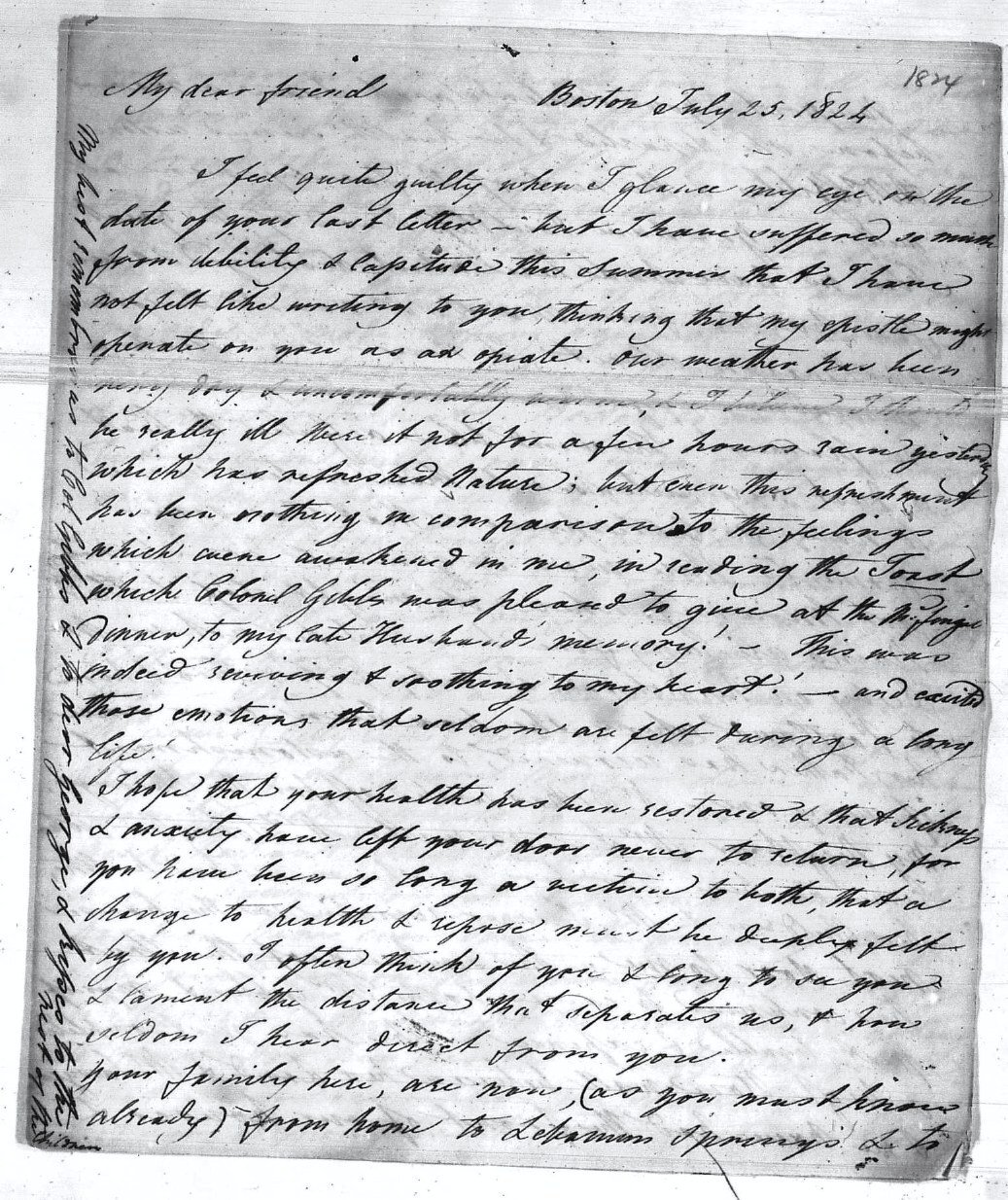
The Widow’s Letter: Boston Burning, Lafayette Coming 
Boston, July 25, 1824
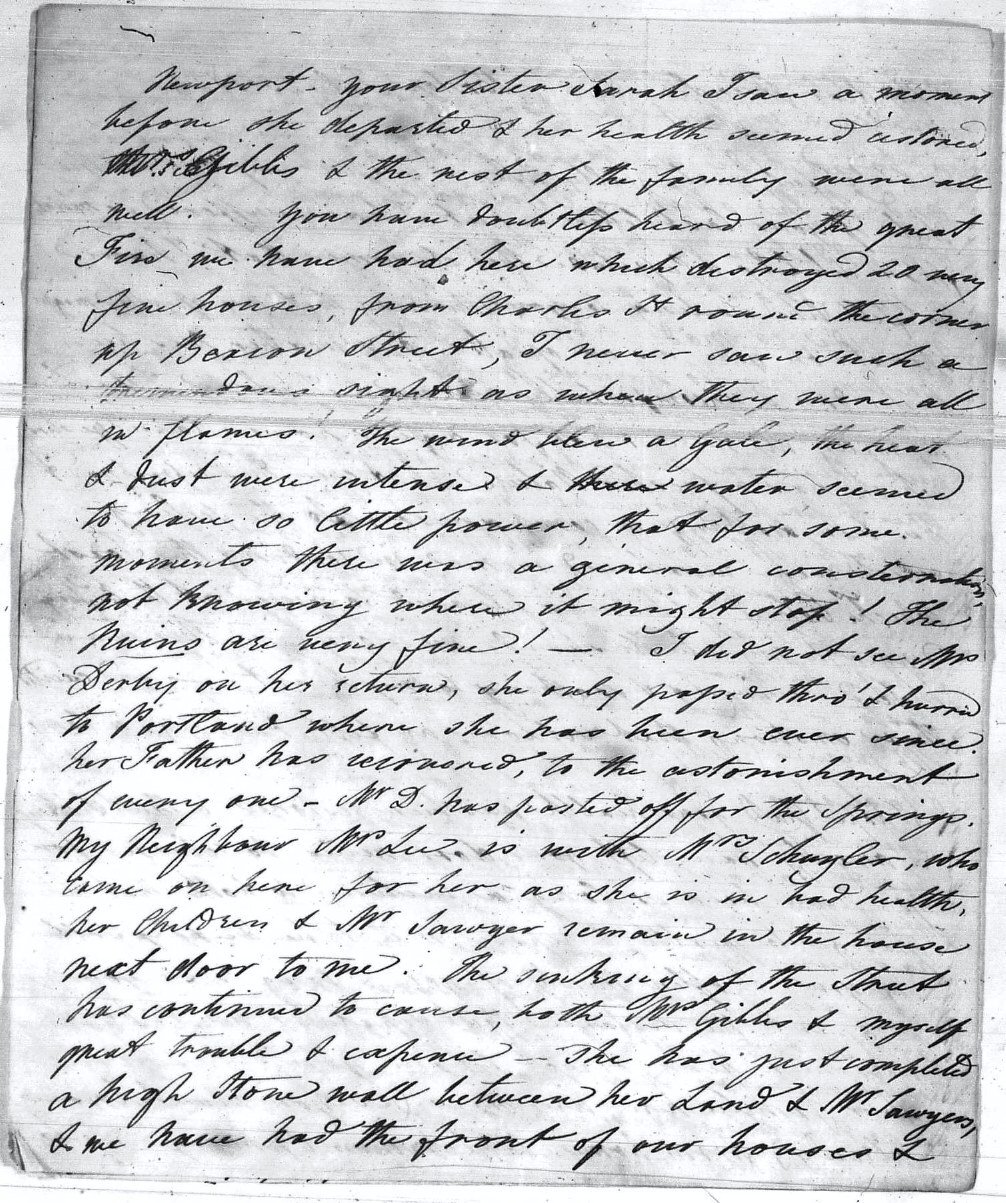
Four crowded pages from an unnamed Boston friend — a widow whose late husband Col. Gibbs once toasted at a public dinner, and a correspondent of “my friend Mrs Lewis (Nelly Custis),” Washington’s step-granddaughter. She gives Laura the whole town: the great Beacon Street fire that took twenty houses, the preparations for Lafayette’s arrival, the sinking street and the new stone wall, and asks after “the little room we called the red room” at Sunswick. Her signature dissolves into the cross-written margin; the film never gives up her name.
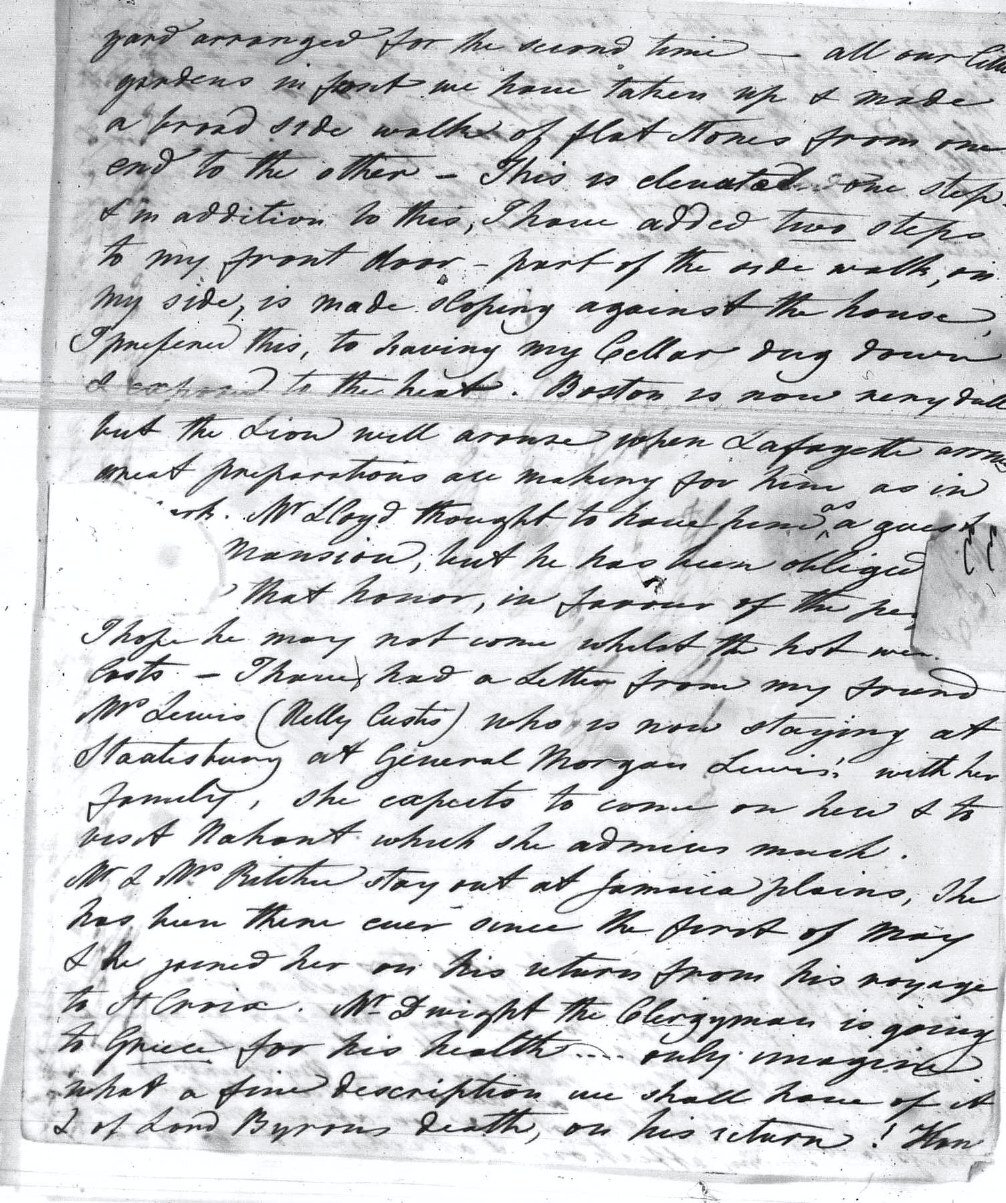
My dear friend
I feel quite guilty when I glance my eye on the date of your last letter — but I have suffered so much from debility & lassitude this Summer that I have not felt like writing to you, thinking that my epistle might operate on you as an opiate. Our weather has been very dry[?] & uncomfortably warm[?], & I believe[?] I should[?] be really ill were it not for a few hours rain yesterday[?] which has refreshed Nature; but even this refreshment has been nothing in comparison to the feelings which were awakened in me, in reading the Toast which Colonel Gibbs was pleased to give at the [illegible] dinner, to my late Husband’s memory! — This was indeed reviving & soothing to my heart! — and excited those emotions that seldom are felt during a long life!
I hope that your health has been restored & that Sickness & anxiety have left your doors never to return, for you have been so long a victim[?] to both, that a change to health & repose must be deeply felt by you. I often think of you & long to see you & lament the distance that separates us, & how seldom I hear direct from you.
Your family here, are now, (as you must know already) from home to Lebanon Springs & to Newport — your Sister Sarah I saw a moment before she departed & her health seemed restored, Mrs Gibbs & the rest of the family were all well.
You have doubtless heard of the great Fire we have had here which destroyed 20 very fine houses, from Charles St round the corner up Beacon Street, I never saw such a tremendous[?] sight as when they were all in flames. The wind blew a gale, the heat & dust were intense & [struck: these] water seemed to have so little power, that for some moments there was a general consternation, not knowing where it might stop! The Ruins are very fine! —
I did not see Mrs Derby on her return, she only passed thro’ & hurried to Portland where she has been ever since. her Father has recovered, to the astonishment of every one — Mr D. has posted off for the Springs. My Neighbour Mrs Lee is with Mrs Schuyler, who came on here for her as she is in bad health, her Children & Mr Sawyer remain in the house next door to me.
The sinking of the Street has continued to cause, both Mrs Gibbs & myself great trouble & expence — She has just completed a high Stone wall between her Land & Mr Sawyers, & we have had the front of our houses & yard arranged for the second time — all our little gardens in fact we have taken up & made a broad side walk of flat Stones from one end to the other — This is elevated one step, & in addition to this, I have added two steps to my front door — part of the side walk, on my side, is made sloping against the house, I preferred this, to having my Cellar dug down & exposed to the heat.
Boston is now very dull but the Lion will arouse when Lafayette arrives, great preparations are making for him as in [New Y?]ork. Mr Lloyd thought to have him, as a guest [illegible] mansion, but he has been obliged [illegible] that honor, in favour of the pe[ople?] [illegible] I hope he may not come whilst the hot wea[ther?] lasts —
I have had a Letter from my friend Mrs Lewis (Nelly Custis) who is now staying at Staatsburg[?] at General Morgan Lewis’ with her Family, she expects to come on here & to visit Nahant which she admires much.
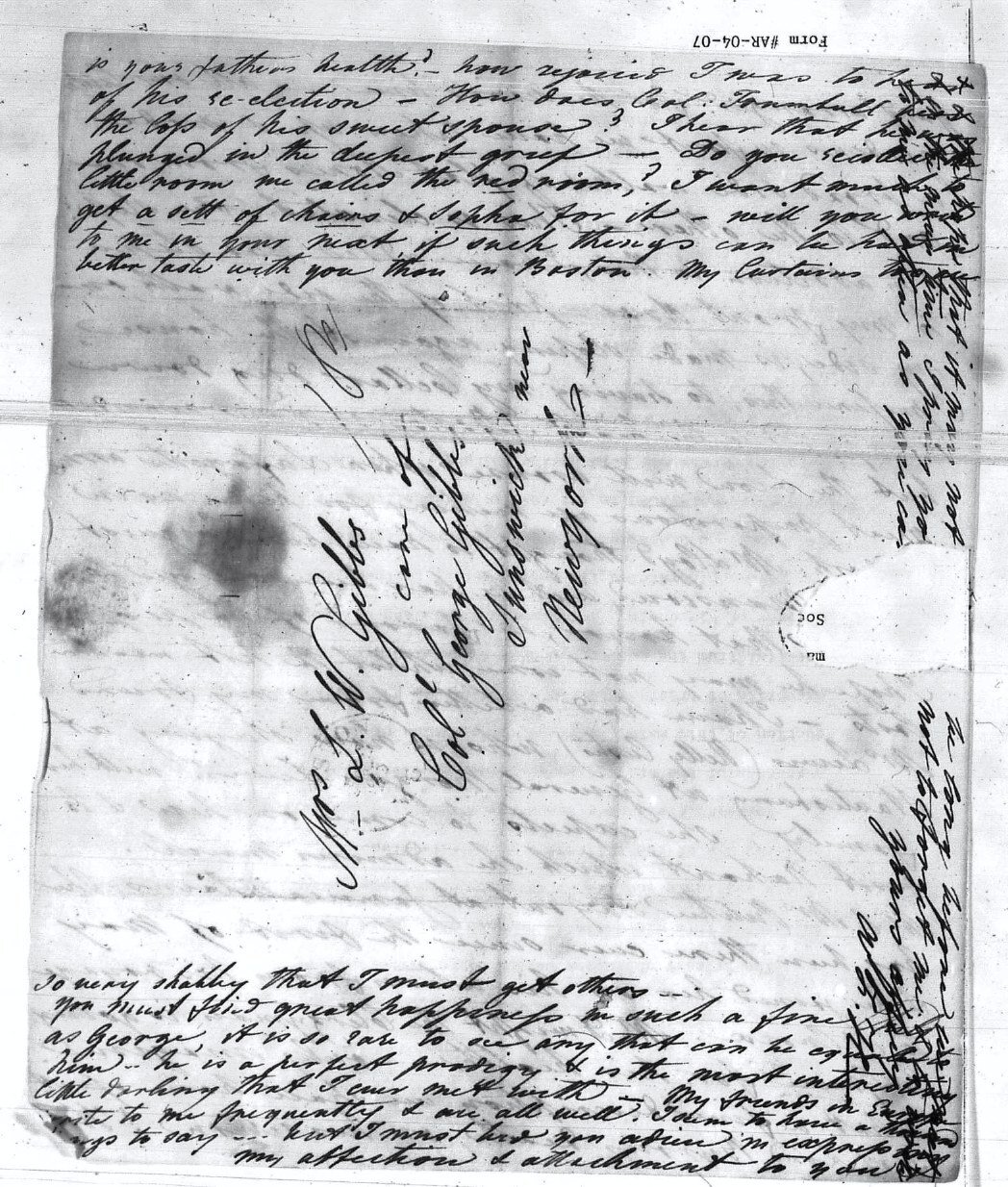
Mr & Mrs Ritchie stay out at Jamaica plains, She has been there ever since the first of May & he joined her on his return from his voyage to St Croix. Mr Dwight the Clergyman is going to Greece for his health … only imagine what a fine description we shall have of it & of Lord Byrons death, on his return! How is your fathers health? — how rejoiced I was to hear[?] of his re-election — How does, Col: Trumbull bear[?] the loss of his sweet spouse? I hear that he was[?] plunged in the deepest grief —
Do you reside[?] in[?] the little room we called the red room? I want much to get a sett of chairs & Sopha for it — will you write[?] to me in your next if such things can be had [illegible] better taste with you than in Boston. My Curtains [illegible] so very shabby that I must get others —
You must find great happiness in such a fine [illegible] as George, it is so rare to see any that can be eq[ualled?] [illegible] him — he is a perfect prodigy, & is the most interes[ting?] little darling that I ever met with — My friends in Eu[rope?] write to me frequently & are all well. I seem to have a thou[sand?] [thin?]gs to say — but I must bid you adieu in expressing my affection & attachment to you
[cross-written vertically in the left margin of page 1:] My best remembrances to Col Gibbs & to dear George, & respects[?] to the rest of the [illegible]
[written vertically in the right margin of the address leaf, continuation of the closing; largely illegible:] that it was[?] not [illegible] — [illegible] you [illegible] — [illegible] so you ca[n?] [illegible] — be[?] very [illegible] before[?] [illegible] not to forget me [illegible] yours [illegible]
[no signature or initials recoverable — the closing runs into the cross-written right margin of the address leaf and fades to illegibility; the writer is nowhere named]
[address panel, page 4:] Mrs. L. W. Gibbs — care of — Col. George Gibbs — Sunswick near — Newyork — [postal rate, upper corner:] 18 3/4
Transcribed verbatim from the scans, keeping the original spelling, capitalization, and punctuation; the manuscript’s own dashes are kept, bracketed words are interlineations or uncertain readings, and [illegible] marks passages lost to the film. Condition: Four microfilm scans (WHS Reel 1, frames 526-529) of a four-page letter, page 4 being the address leaf with two cross-written blocks above and below the address panel. A horizontal fold-fade band crosses pages 1-2 mid-sheet: on p1 it nearly erases the weather line (‘very dry & uncomfortably warm, & I believe I should’ is a reconstruction of faded strokes, marked [?]); on p2 it fades ‘tremendous sight’. Page 3 has a paper repair patch over the left line-ends of the Lafayette/Lloyd passage, so the words identifying whose mansion and what Lloyd relinquished are lost ([illegible]); a second patch tears the right edge. The name of the dinner at which Colonel Gibbs gave the toast to the writer’s late husband is written but not confidently legible on the microfilm and is left [illegible] rather than guessed. Page 4’s top and bottom blocks lose their right-hand line-ends to the fold/seal tear; the closing continues vertically in the right margin and dissolves into show-through – no signature, name, or initials are recoverable anywhere, so the widow remains unidentified. ‘Mrs Gibbs’ at the top of p2 is written over a false start. The writer underlined ‘Ruins’, ‘two’ (steps), ‘chairs’, and ‘Sopha’ in the original. ‘1824’ is docketed in another hand at top right of p1; the microfilm carries a printed ‘Form #AR-04-07′ stamp on frame 529. Original spelling retained throughout (expence, sett, Sopha, thro’, Newyork, Byrons, fathers).
Gibbs Family Papers, Wisconsin Historical Society, Reel 1, scans 526–529. Autograph letter of an unidentified Boston widow to Laura Wolcott Gibbs at Sunswick; no signature or initials are recoverable on the film, and the exhibit does not guess. Digitized from the microfilm by this site; transcribed in full above.
Abby of Brunswick 
Brunswick, Maine, September 12, 1824
A friendship letter from the far end of New England: Abby apologizes for her long silence, reflects on attachment and separation as her own marriage approaches and she weighs leaving an aged, dependent father, and closes with a postscript on a neighbor’s child lost to a prevailing distemper, hoping Laura’s children are spared. The ordinary tenderness and ordinary dread of a mother’s correspondence in 1824.
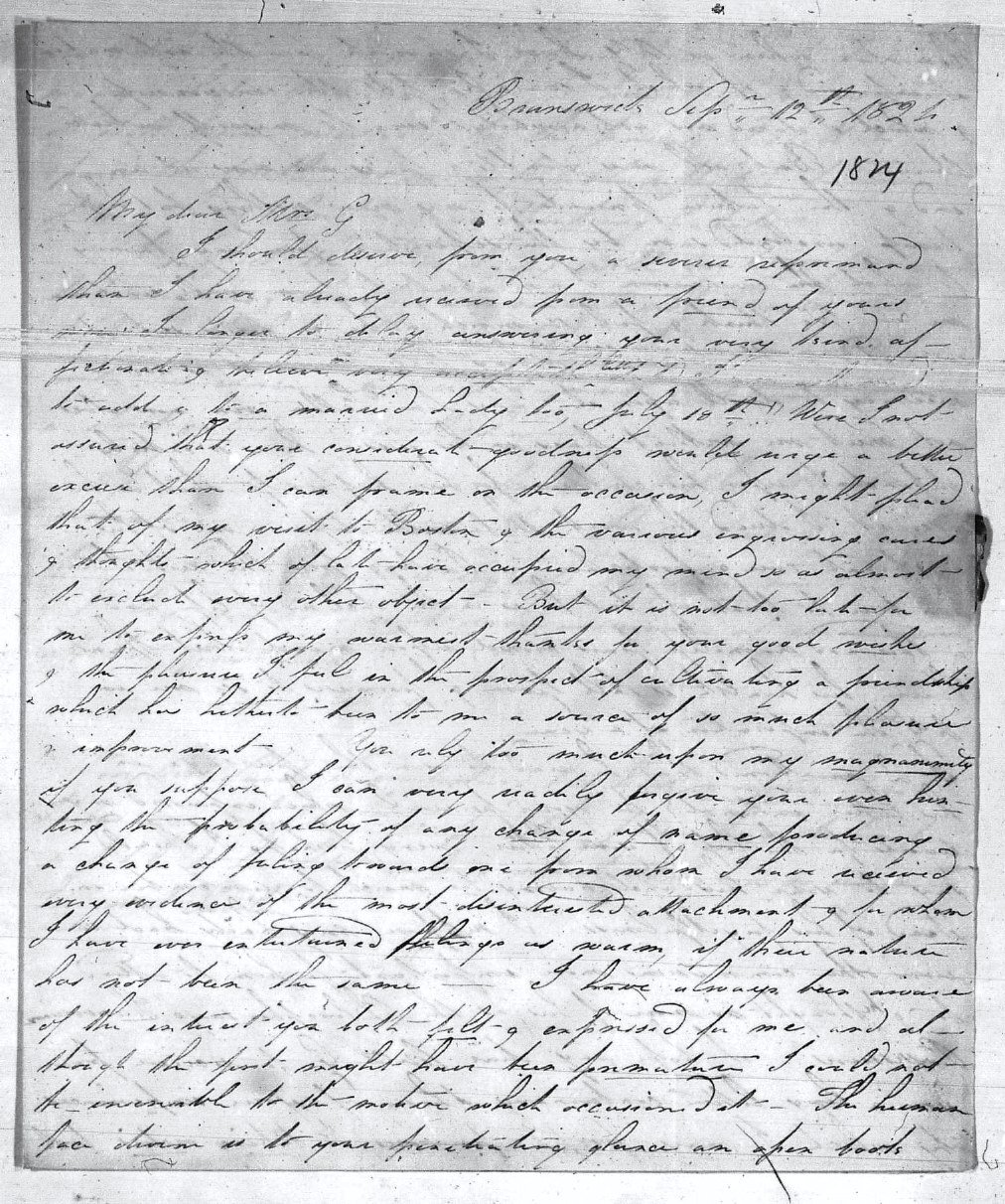
My dear Mrs G—
I should deserve, from you, a severer reprimand than I have already received from a friend of yours [illegible] longer to delay answering your very kind af—fectionate letter [illegible] to add, & to a married Lady too — July 18th!! Were I not assured that your considerate goodness would urge a better excuse than I can frame on the occasion, I might plead that of my visit to Boston & the various engrossing cares & thoughts which of late have occupied my mind so as almost to exclude every other object — But it is not too late for me to express my warmest thanks for your good wishes & the pleasure I feel in the prospect of cultivating a friendship which has hitherto been to me a source of so much pleasure & improvement — You rely too much upon my magnanimity if you suppose I can very readily forgive your even hinting the probability of any change of name producing a change of feeling towards one from whom I have received every evidence of the most disinterested attachment & for whom I have ever entertained feelings as warm, if their nature has not been the same — I have always been aware of the interest you both felt & expressed for me, and al—though the first might have been premature I could not be insensible to the motive which occasioned it — The human face divine is to your penetrating glance an open book
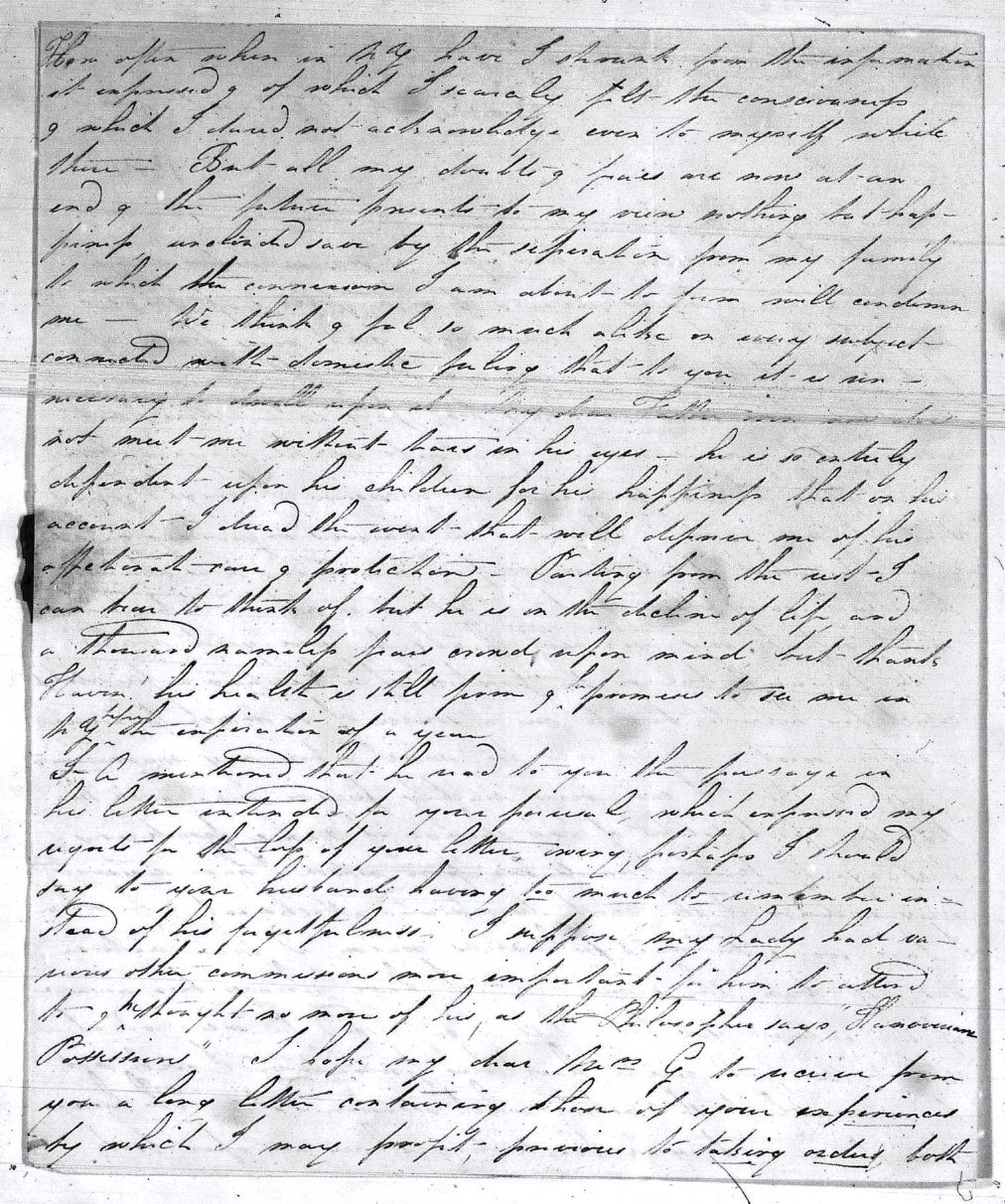
How often when in N—Y[?] have I shrunk from the information it expressed & of which I scarcely felt the consciousness & which I dared not acknowledge even to myself while there — But all my doubts & fears are now at an end & the future presents to my view nothing but hap—piness unclouded save by the seperation from my family to which the connexion I am about to form will condemn me — We think & feel so much alike on every subject connected with domestic feeling that to you it is un—necessary to dwell upon it — My dear Father even now[?] [illegible] not meet me without tears in his eyes — he is so entirely dependent upon his children for his happiness that on his account I dread the event that will deprive me of his affectionate care & protection — Parting from the rest I can bear to think of, but he is on the decline of life and a thousand nameless fears crowd upon mind, but thanks Heaven! his health is still firm & he promises to see me in N—Y[?] at[?] the expiration of a year
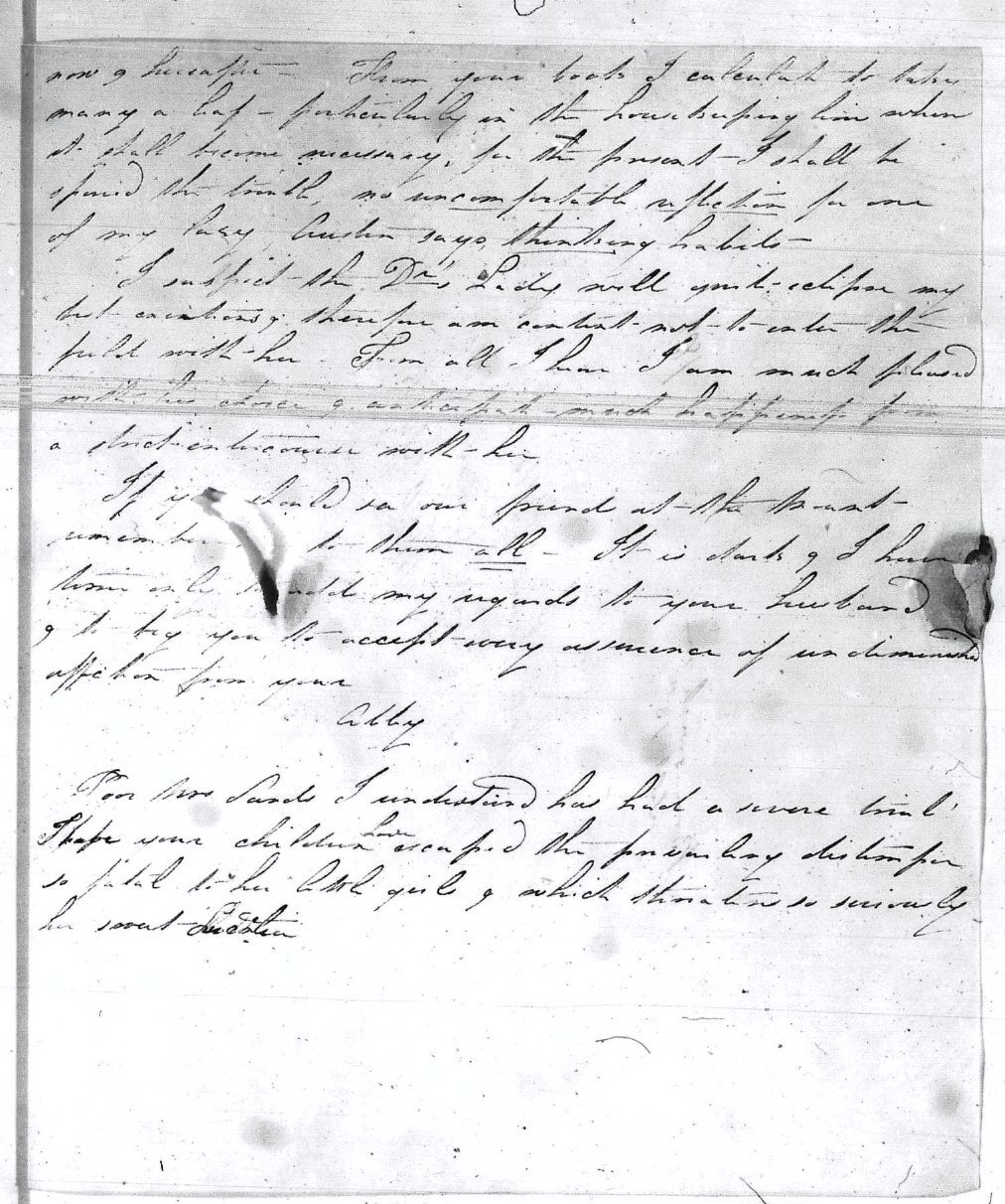
F— A— mentioned that he read to you the passage in his letter intended for your perusal, which expressed my regret for the loss of your letter, owing[?], perhaps I should say to your husband having too much to remember in—stead of his forgetfulness. I suppose my Lady had va—rious other commissions more important for him to attend to & thought no more of his[?], as the Philosopher says, “Hanoverian[?] Possession” I hope my dear Mrs G to receive from you a long letter containing those of your experiences by which I may profit, previous to taking orders, both now & hereafter — From your books I calculate to take many a leaf — particularly in the housekeeping line when it shall become necessary, for the present I shall be spared the trouble, no uncomfortable reflection for one of my lazy, brother says, thinking habits —
I suspect the Drs Lady will quite eclipse my best exertions & therefore am content not to enter the field with her. From all I hear I am much pleased with his choice[?] & anticipate much happiness[?] from a social intercourse with her.
If you should see our friends at the Point[?] remember me[?] to them all — It is dark & I have time only to add my regards to your husband & to beg you to accept every assurance of undiminished affection from your
Abby
Poor Mrs Sands I understand has had a severe trial, I hope your children have escaped the prevailing distemper so fatal to her little girl & which threatens so seriously her sweet Lucretia[?]
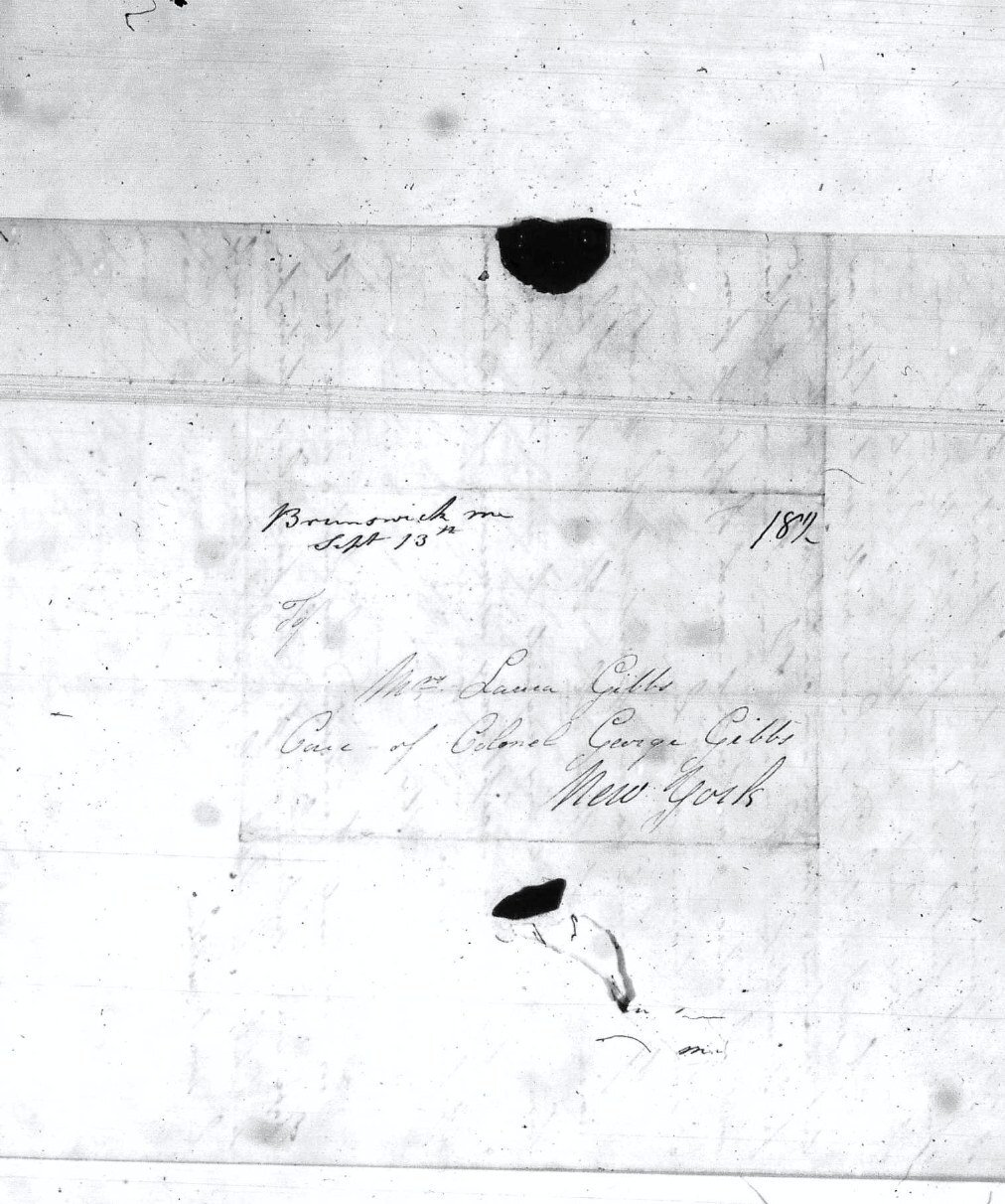
[Address wrapper, scan 535]
Brunswick me. Sept 13th — 18½[?] [postal rate] — To Mrs Laura Gibbs, Care of Colonel George Gibbs, New York
Transcribed verbatim from the scans, keeping the original spelling, capitalization, and punctuation; the manuscript’s own dashes are kept, bracketed words are interlineations or uncertain readings, and [illegible] marks passages lost to the film. Condition: Three-page letter (scans 532-534) plus address wrapper (535). A horizontal microfilm/fold artifact band crosses lines 3-4 of scan 532, obscuring the passage between ‘a friend of yours’ and ‘longer to delay’ and again after ‘affectionate letter’ (probably ‘were I’ and a short clause such as ‘my only apology I have’); both gaps marked [illegible]. The same kind of band crosses scan 533 at ‘My dear Father even now [illegible] not meet me’ (likely ‘does’ or ‘can’) and scan 534 at ‘with his choice & anticipate much happiness’, where ‘his choice’ and ‘happiness’ are best readings. ‘N~~Y’ (twice) is an abbreviated place, almost certainly New York, where the Gibbs household then lived. ‘F~~ A~~’ are initials as written, presumably the writer’s intended husband. ‘owing’ could also read ‘sorry’; the quoted phrase after ‘the Philosopher says’ is smudged and ‘Hanoverian Possession’ is conjectural. ‘orders’ (in ‘previous to taking orders’) is underlined in the manuscript, as are ‘friend’, ‘wishes’, ‘name’, ‘affection’ (532), ‘uncomfortable reflection’ (534), and ‘all’ (in ‘remember me to them all’). ‘Point’ in ‘our friends at the Point’ is a best reading. The final word of the postscript, a child’s name, is blotted; ‘Lucretia’ is conjectural. Later pencil ‘1824’ appears on scans 532 and 535 (archivist hand, not transcribed as text). Wrapper bears the Brunswick Me. Sept 13th postmark and what appears to be the 18 1/2-cent postal rate. Original spelling retained (e.g., ‘seperation’, ‘connexion’); hyphenated line-break words shown with ~~ joins per house convention.
Gibbs Family Papers, Wisconsin Historical Society, Reel 1, scans 532–535. Autograph letter, signed Abby, of Brunswick, Maine, to Laura Wolcott Gibbs, with its wrapper. Digitized from the microfilm by this site; transcribed in full above.
“I Will Bet Upon Alfred” 
Litchfield, December 25, 1824
A Christmas letter from the Litchfield household to “my dear Laura”: her boys away at school in Hartford, a neat edition of Pope’s Homer for a gift, colds and teething among the cousins. And then, of her twenty-month-old, the prophecy this website exists to vindicate: the writer will bet upon Alfred, that he makes his way in the world.
My dear Laura.
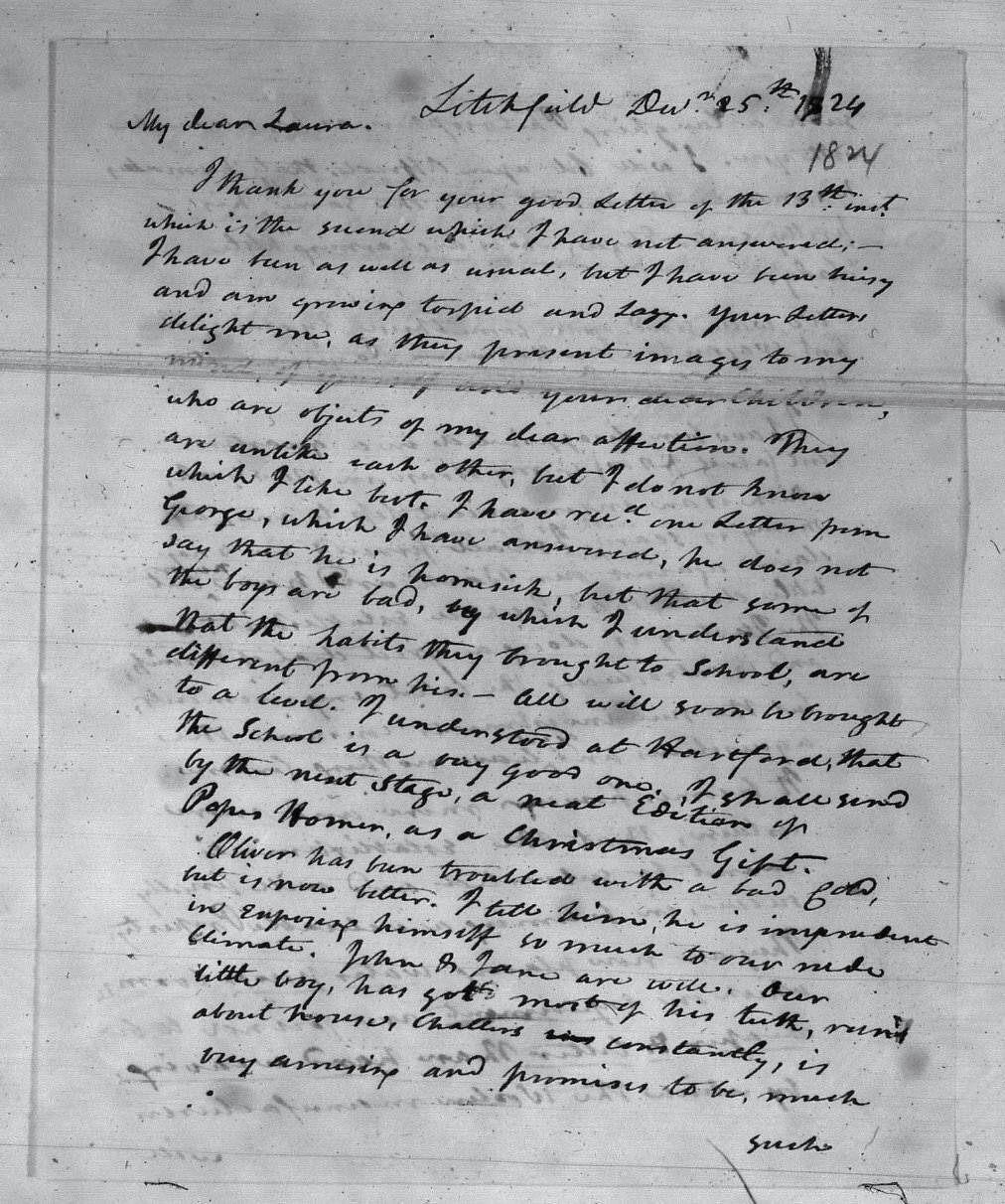
I thank you for your good Letter of the 13th. inst which is the second which I have not answered; — I have been as well as usual, but I have been busy and am growing torpid and lazy. Your Letters delight me, as they present images to my mind[?], of yourself[?] and your dear Children, who are objects of my dear affection. They are unlike each other, but I do not know which I like best. I have recd. one Letter from George, which I have answered, he does not say that he is homesick, but that some of the boys are bad, by which I understand that the habits they brought to School, are different from his. — all will soon be brought to a level. I understood at Hartford, that the School is a very good one. I shall send by the next Stage, a neat Edition of Popes Homer, as a Christmas Gift.
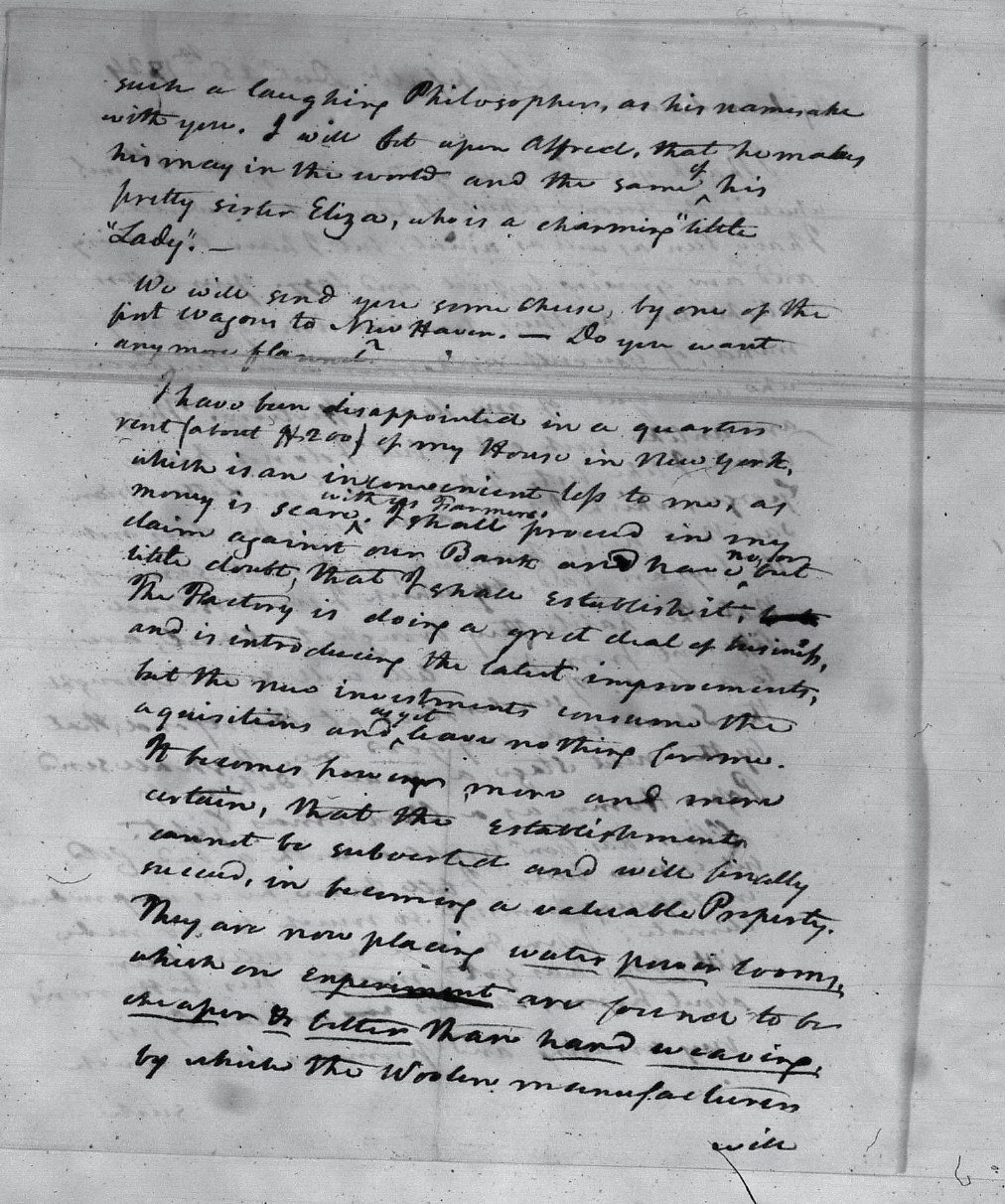
Oliver has been troubled with a bad cold, but is now better. I tell him, he is imprudent in exposing himself so much to our rude climate. John & Jane are well. Our little boy, has got most of his teeth, runs about house, Chatters [word struck through] constantly, is very amusing and promises to be, much such a laughing Philosopher, as his namesake with you. I will bet upon Alfred, that he makes his way in the world and the same of his pretty sister Eliza, who is a charming little “Lady”. —
We will send you some Cheese, by one of the first Wagons to New Haven. — Do you want any more flannel?
I have been disappointed in a quarters rent (about $200) of my House in New York, which is an inconvenient loss to me, as money is scarce with ye[?] Farmers. I shall proceed in my claim against our Bank and have no,[?] for[?] but little doubt, that I shall establish it. [word struck through]
The Factory is doing a great deal of business, and is introducing the latest improvements, but the new investments consume the aquisitions and, as yet, leave nothing for me. It becomes however, more and more certain, that the Establishments cannot be subverted and will finally succeed, in becoming a valuable Property. They are now placing water power looms, which on experiment are found to be cheaper & better than hand weaving, by which the Woolen manufactures will
THE LETTER BREAKS OFF HERE
THE ADDRESS LEAF
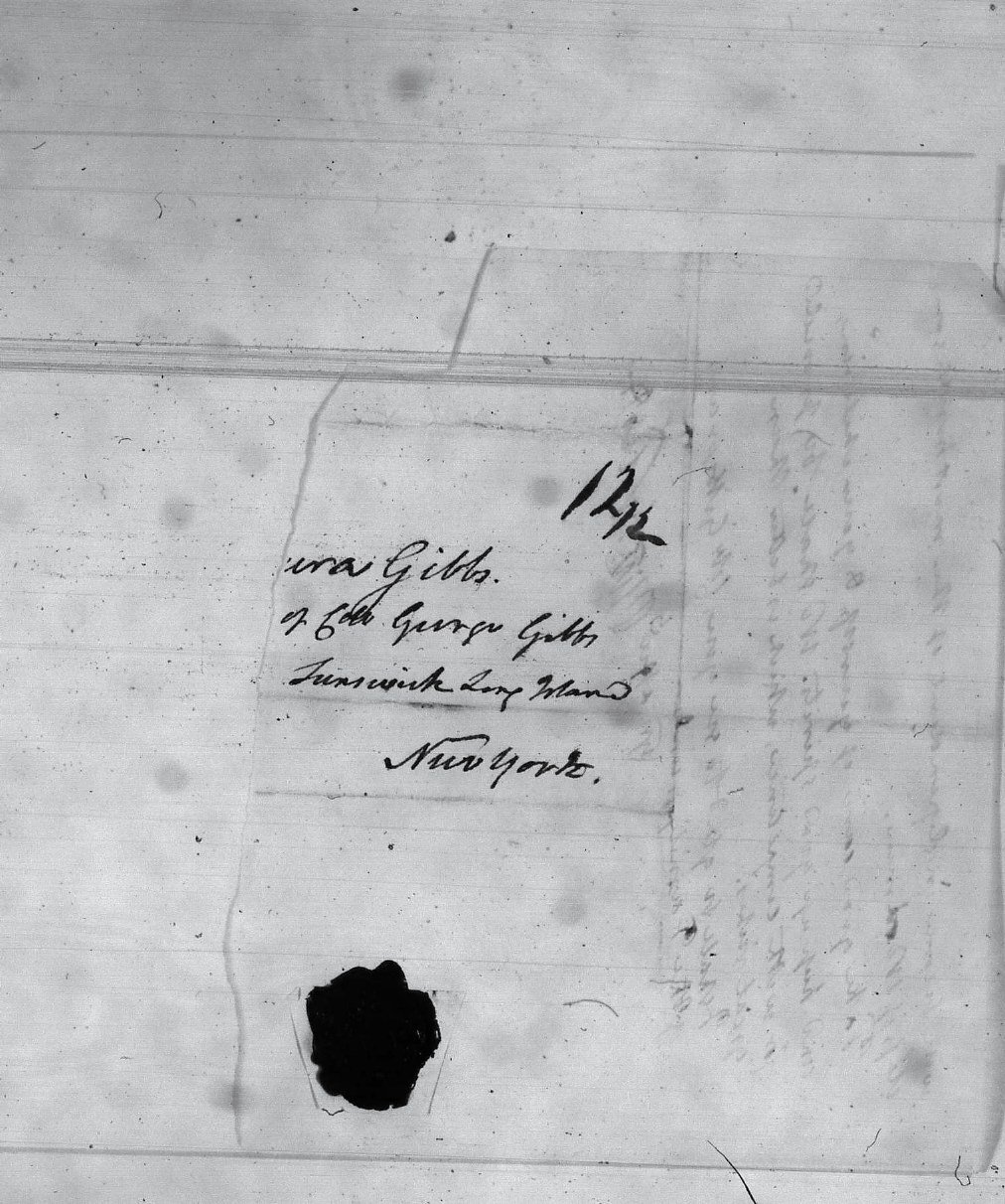
12½
[Mrs La]ura Gibbs.
[Care] of Coll[?] George Gibbs
Sunswick Long Island
New York.
Transcribed verbatim from the scans, keeping the original spelling, capitalization, and punctuation; the manuscript’s own dashes are kept, bracketed words are interlineations or uncertain readings, and [illegible] marks passages lost to the film. Condition: UNSIGNED on these leaves: the second page (scan 537) ends mid-sentence at the foot of the leaf with the catchword ‘will’ (‘…by which the Woolen manufactures will’), so the closing and signature were on a continuation leaf not among scans 536-538. The writer is of the Litchfield/Wolcott household (mentions of Oliver, John & Jane, and their teething little boy place the letter in the Wolcott circle at Litchfield). Hand is a fluent, legible early-19th-century cursive in iron-gall ink; both letter leaves carry a horizontal scanner/fold band that obscures one full line on page 1 (‘mind, of yourself’ partly conjectural). The catchword ‘such’ at the foot of page 1 is repeated at the head of page 2 and transcribed once. Several authorial interlineations are incorporated where carets indicate: ‘of’ (in ‘the same of his’), ‘little’ (in ‘charming little Lady’), ‘with ye Farmers.’, ‘no, for’ (above ‘but little doubt’ – reading of the insertion uncertain), and ‘as yet’. Two short words are struck through by the writer (after ‘Chatters’ on p.1 and after ‘establish it.’ on p.2) and are illegible under the cancellation. In the factory passage the writer underscored ‘water power looms’, ‘experiment’, ‘cheaper & better’ and ‘hand weaving’ for emphasis. The Alfred prophecy sentence reads exactly: ‘I will bet upon Alfred, that he makes his way in the world and the same of his pretty sister Eliza, who is a charming little “Lady”.’ – note it is ‘he makes his way’, not ‘will make his way’. Address leaf (scan 538): left edge of the address panel is cropped in the scan; bracketed [Mrs La] and [Care] are conjectural restorations of the trimmed text, and the rank abbreviation read as Coll is uncertain. ’12½’ at upper right is the postal rate in cents; a large black wax seal survives at the foot; faint show-through of the letter text is visible along the right side. A pencil ‘1824’ at the upper right of page 1 is a later archival annotation, not original.
Gibbs Family Papers, Wisconsin Historical Society, Reel 1, scans 536–538. Autograph letter of the Litchfield (Wolcott) household to Laura Wolcott Gibbs, December 25, 1824, with its address leaf. Digitized from the microfilm by this site; transcribed in full above.
The Garden Letters, I 
Sunswick, March 1825
Laura the gardener of Sunswick. Three months after burying her mother-in-law Mary Channing, she writes Mrs. Samuel W. Dana of Middletown, whom she calls Dear Aunt, with grape vines for the garden arbour, Isabella and Chasselas, sent up by steamboat, and an accounting of her scattered brood: George contented at school, Eliza with her aunts, and “two fine little boys” at home her only care. The younger of the two is Alfred.
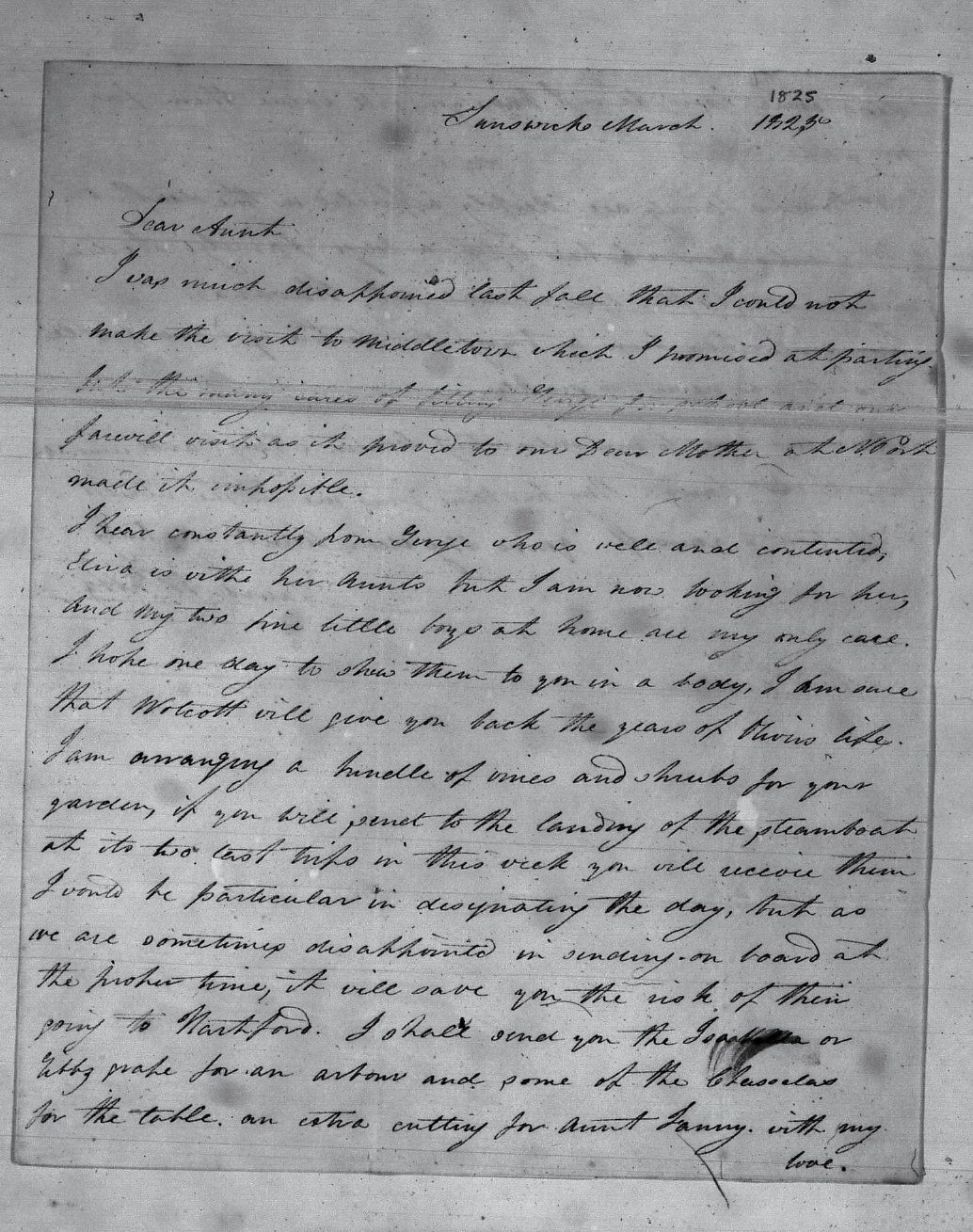
Dear Aunt
I was much disappointed last Fall that I could not make the visit to Middletown which I promised at parting but[?] the many cares of fitting[?] George for school[?] and our[?] farewell visit as it proved to our Dear Mother at N. York made it impossible.
I hear constantly from George who is well and contented; Eliza is with her Aunts but I am now looking for her, and my two fine little boys at home are my only care. I hope one day to shew them to you in a body, I am sure that Wolcott will give you back the years of Oliver’s[?] life.
I am arranging a bundle of vines and shrubs for your garden, if you will send to the landing of the steamboat at its two last trips in this week you will receive them I would be particular in designating the day, but as we are sometimes disappointed in sending on board at the proper time, it will save you the risk of their going to Hartford. I shall send you the Isabella or Bibby[?] grape for an arbour and some of the Chasselas for the table. an extra cutting for Aunt Fanny.
with my love.
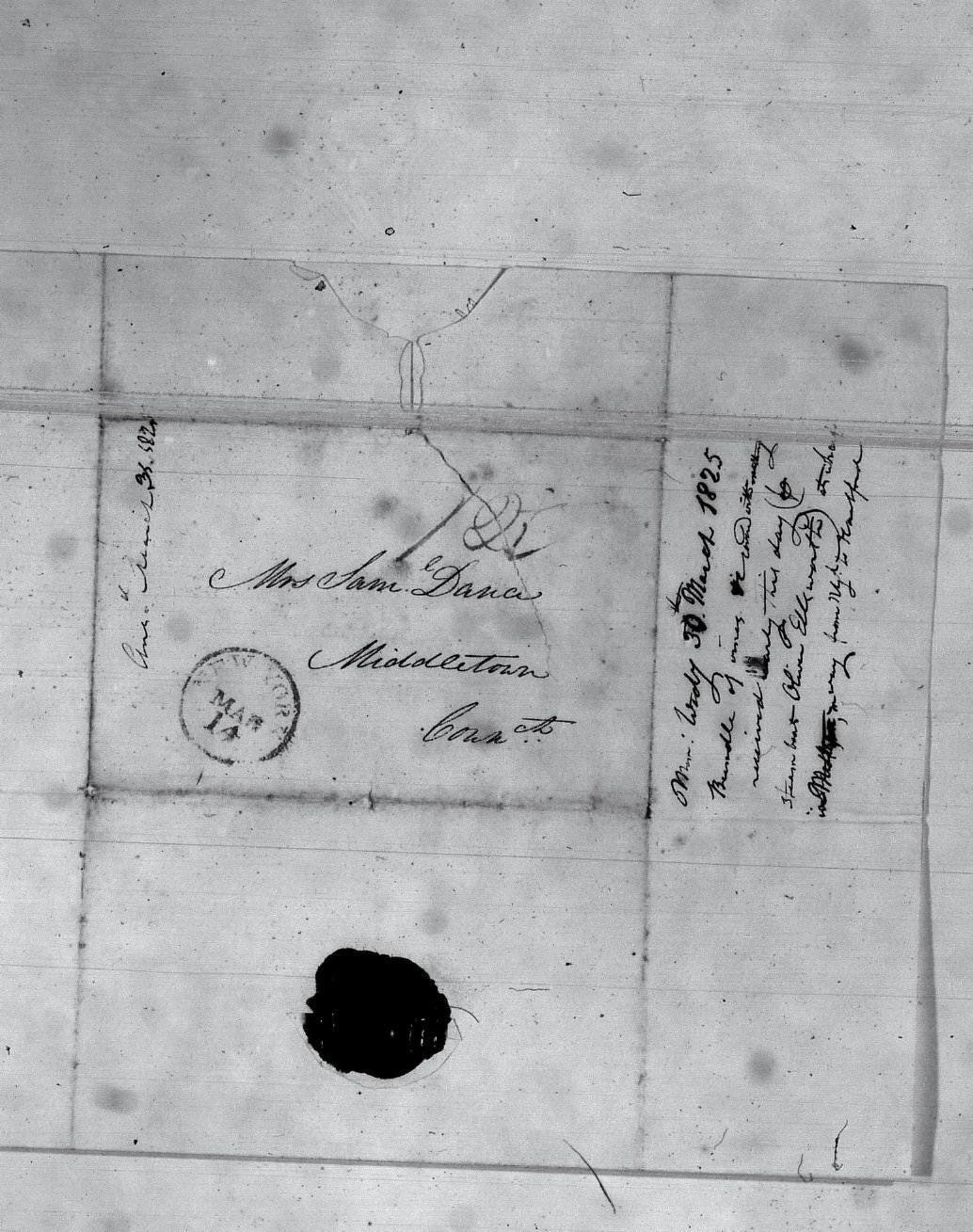
THE ADDRESS LEAF AND ENDORSEMENT
[Address panel:] Mrs Saml Dana[?] / Middletown / Connct
[Stamped circular postmark:] NEW-YORK MAR 14
[Manuscript postal rate, above the address:] 12½[?]
[Endorsement, written vertically along the right edge:] Mrs Wolcott[?] — 30th March 1825 — Bundle of vines &c [illegible] — received early this day (by Steamboat Oliver Ellsworth [illegible]) on its[?] way from N Yk[?] to Hartford
[Docket, written vertically along the left edge:] Ansd[?] June[?] 30. 182[illegible]
Transcribed verbatim from the scans, keeping the original spelling, capitalization, and punctuation; the manuscript’s own dashes are kept, bracketed words are interlineations or uncertain readings, and [illegible] marks passages lost to the film. Condition: Grayscale microfilm scan (WHS Reel 1). Scan 543 (letter, 1 p.): an archivist’s pencil ‘1825’ sits above the dateline flourish and is not transcribed as text. The third manuscript line is severely faded/abraded; the reading ‘but the many cares of fitting George for school and our’ is a confident partial reconstruction from visible fragments and is flagged word-by-word. No signature appears below the closing ‘with my love.’ — the leaf appears cropped at the foot, or Laura ended with the closing alone. The grape name before ‘grape for an arbour’ is uncertain (‘Bibby[?]’; initial letter has a descender and could also read ‘Libby’ or ‘Gibby’); ‘Isabella’ and ‘Chasselas’ are clear. Scan 544 (wrapper): large dark wax-seal remnant/hole at center-bottom. The addressee surname is flourished and can be read ‘Dance’ or ‘Dana’; ‘Dana[?]’ adopted since Senator Samuel W. Dana’s household was the prominent Middletown, Conn. family of that name in 1825 — verify before publishing. The recipient’s endorsement is rotated 90 degrees and partly faded; the name line (‘Mrs Wolcott[?]’, possibly ‘Mrs W. Gibbs’) and two short passages are unresolved and marked. The left-edge docket is faint; ‘Ansd June 30’ reading is tentative.
Gibbs Family Papers, Wisconsin Historical Society, Reel 1, scans 543–544. Autograph letter of Laura Wolcott Gibbs to Mrs. Samuel W. Dana of Middletown, Connecticut, Sunswick, March 1825, with its address leaf and the recipient’s endorsement. Digitized from the microfilm by this site; transcribed in full above.
The Garden Letters, II 
Sunswick, spring 1825
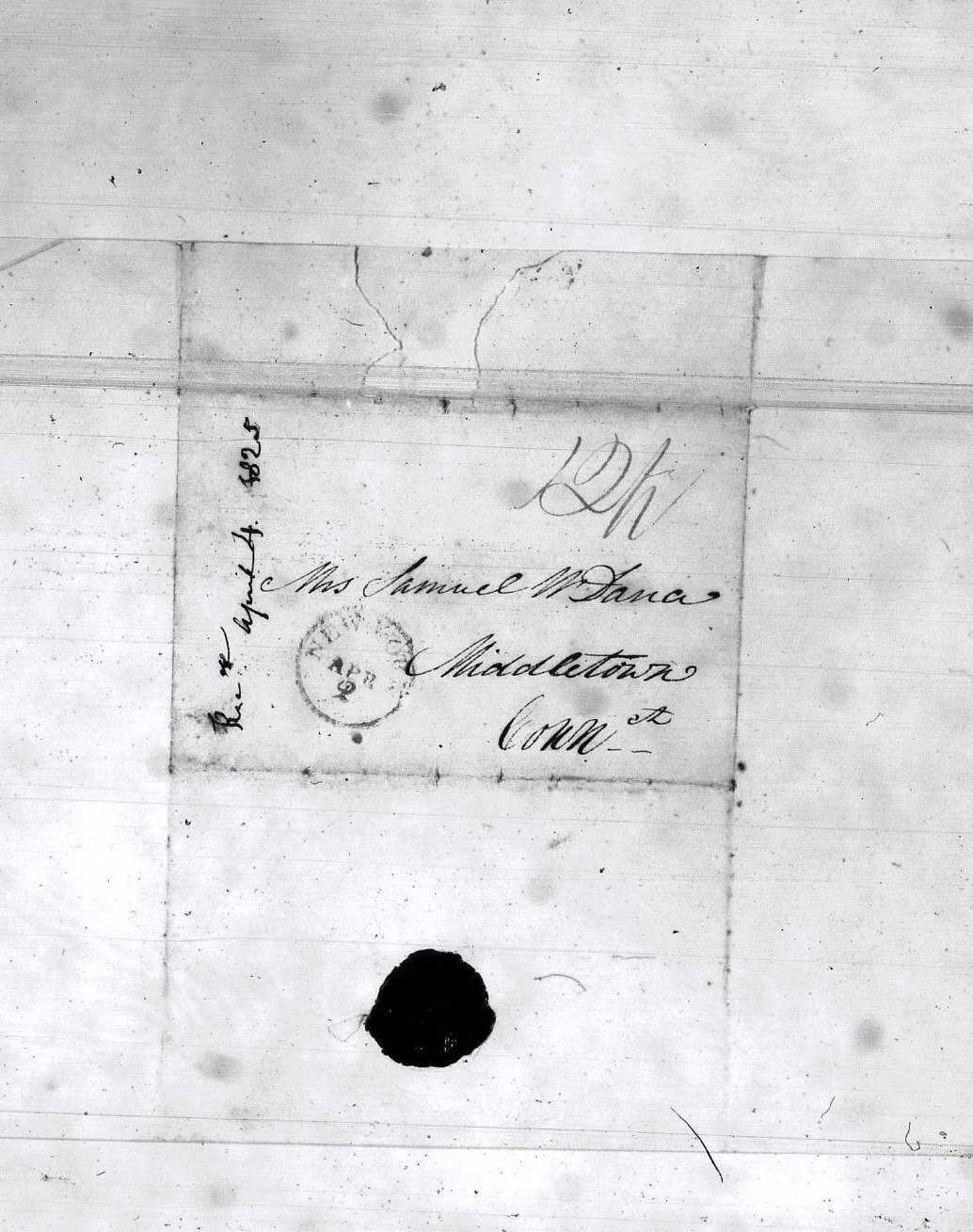
The second garden letter is a nursery dispatch: Eliza home from Boston with the measles, “all the children around me and all sick,” and still the cuttings get packed, Multiflora rose, jasmine, honeysuckles, double Althea, the Province and the medicinal rose, grapes, French strawberries, and white raspberry. The general’s mother, running a sick ward and a nursery with a trowel in her hand.
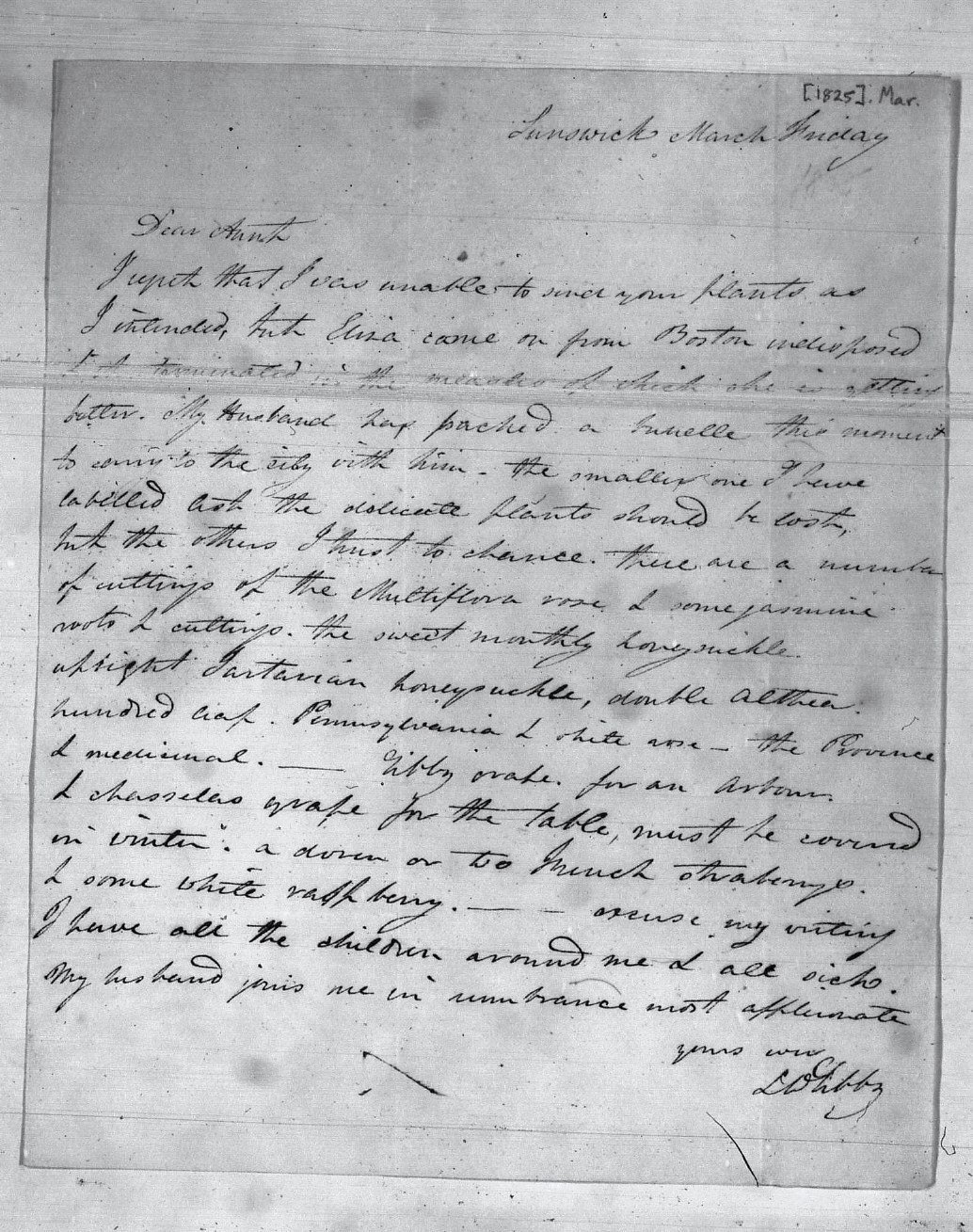
Dear Aunt
I regret that I was unable to send your plants as I intended, but Eliza came on from Boston indisposed & it terminated[?] in the measles of which she is getting[?] better. My Husband has packed a bundle this moment to carry to the city with him — the smaller one I have labelled lest the delicate plants should be lost, but the others I trust to chance. there are a number of cuttings of the Multiflora rose & some jasmine roots & cuttings. the sweet monthly honeysuckle upright Tartarian honeysuckle, double Althea. hundred leaf. Pennsylvania[?] & white rose — the Province & medicinal. — Libby grape. for an Arbour. & chasselas grape for the table, must be covered in winter. a dozen or two French strawberrys. & some white raspberry. — — excuse my writing I have all the children around me & all sick. My husband joins me in remembrance most affectionate
yours ever — L Gibbs
[Archivist’s pencil annotation, top right of first page: “[1825]. Mar.”; a faint “1825” written diagonally below it in another hand.]
THE ADDRESS LEAF
Mrs Samuel W Dance — Middletown — Conn —
[Manuscript postal rate, upper right: “12½”[?]]
[Circular postmark, stamped: “NEW-YORK / APR / 2”]
[Endorsement, written vertically along left edge: “Recd April 4. 1825”]
[Black wax seal, lower center of the leaf.]
Transcribed verbatim from the scans, keeping the original spelling, capitalization, and punctuation; the manuscript’s own dashes are kept, bracketed words are interlineations or uncertain readings, and [illegible] marks passages lost to the film. Condition: Scan 546: single page in a clear, rapid hand; generally legible. The third line of the body is badly faded and partly lost in a horizontal crease/scan artifact running across the sheet ~~ the reading “& it terminated in the measles of which she is getting” is conjectural at “terminated” and “getting” (marked [?]). “Pennsylvania” in the rose list is an uncertain reading of a cramped word. The signature is a compressed monogram-style “L Gibbs” (Laura Wolcott Gibbs); ampersands throughout are the writer’s “&”. Scan 547: address panel of the folded wrapper, image reproduced at a slight angle; New York circular postmark dated APR 2 (year not in stamp), manuscript rate mark read as 12½, receiver’s endorsement “Recd April 4. 1825” written sideways at left; heavy black wax seal intact below the panel. No year appears in the dateline; [1825] supplied from the endorsement and the archivist’s pencil note.
Gibbs Family Papers, Wisconsin Historical Society, Reel 1, scans 546–547. Autograph letter of Laura (L.) Gibbs to Mrs. Samuel W. Dana of Middletown, Connecticut, Sunswick, March [1825], with its address leaf. Digitized from the microfilm by this site; transcribed in full above.
A biography page of the Gibbs family series on AlfredGibbs.com. Text drawn from the family Record (The Gibbs Family of Rhode Island) and the sources linked above; images enhanced and colorized by Garland H. Green Jr., each linked to its original where one exists. This page was restyled July 10, 2026 with all original content preserved.
Update, August 12, 2026: A photograph of Laura herself has been added under “Her Photograph.” It is an undated carte de visite in the collections of the Newport Historical Society, Newport, Rhode Island, showing her with her grandson Leon d’Oremieulx, and it was contributed to this site by Deb Dodge, an Official Contributor to AlfredGibbs.com. A colorized and enhanced version is shown, linked to the unaltered original. Nothing already on the page was moved or removed; the Gilbert Stuart portrait of 1810 still heads it.
Views: 992