Appomattox Station, Va., April 8, 1865
The Civil War · Appomattox Campaign · April 8, 1865
Appomattox Station
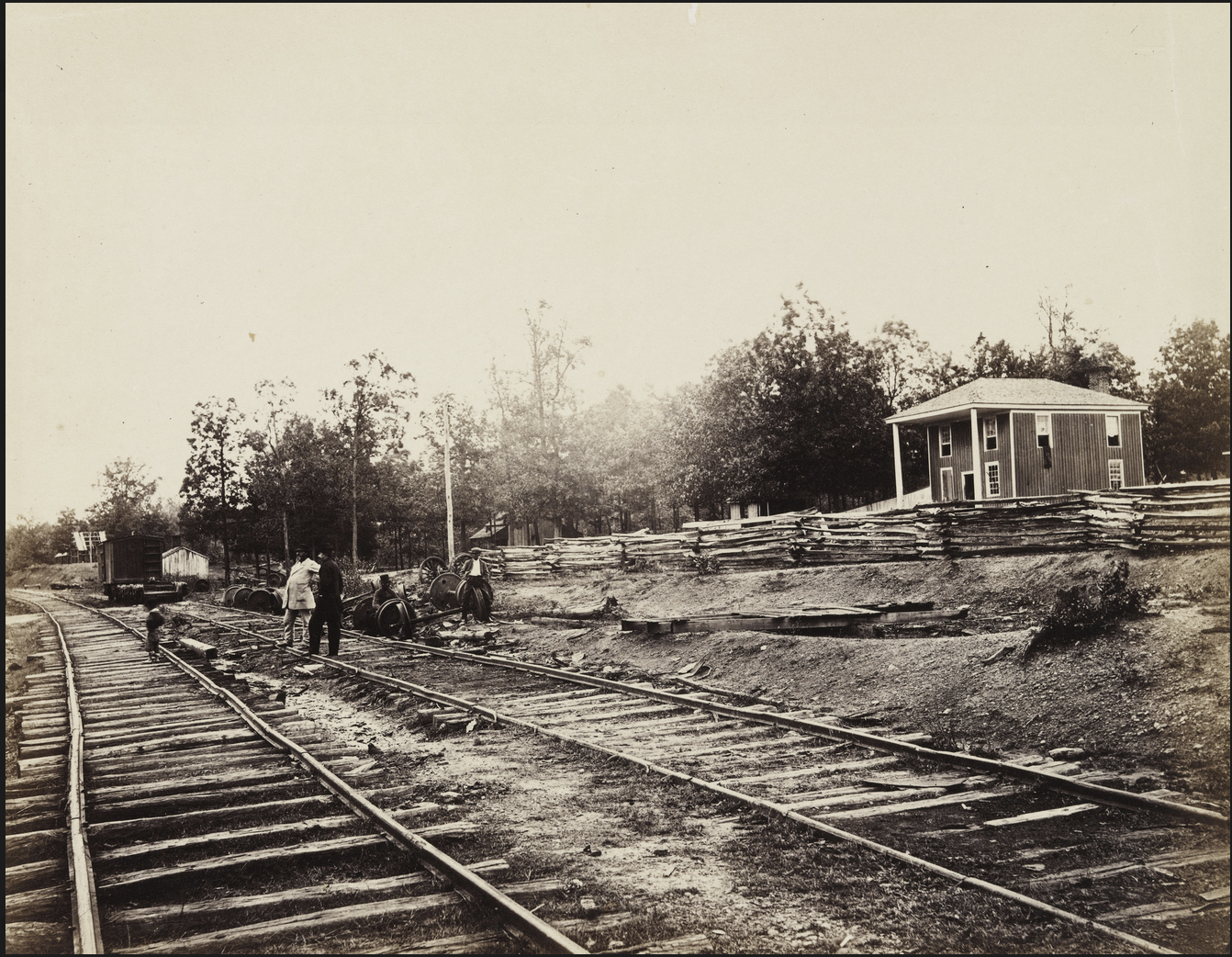
The last battle of the First New York Dragoons — the night before Lee’s surrender, when Sheridan’s cavalry seized the supply trains and threw itself across the Confederate line of retreat.
On the evening of April 8, 1865, Sheridan’s cavalry won the race for Appomattox Station and cut the last road open to Robert E. Lee’s army. Brig. Gen. George A. Custer’s division made the headlong charge that took the Confederate supply trains and artillery park; close behind came the First Cavalry Division under Bvt. Maj. Gen. Thomas C. Devin — “the old War Horse” — whose dismounted troopers, the First New York Dragoons among them, went in on Custer’s right to hold the ground and bring off the captures. That night Devin’s division was posted squarely across the road Lee meant to use, and the morning of April 9 found the Dragoons drawn up for a final mounted charge that the white flag of surrender alone called off.
The Race for the Station
After Sailor’s Creek on April 6 and the running fights that followed, it became plain that Lee was making for Lynchburg, not Danville, and that his one hope of food lay in the trains waiting at Appomattox Station. “Away went the cavalry for Appomattox Station,” Bowen wrote, “Custer’s division in the advance.” No engagement took place until afternoon, when scouts learned that four trains of cars loaded with rations for Lee’s army stood at the depot. Custer was off on the gallop, followed by Devin’s division and the Dragoons. Quick to take in the situation, Custer swung around, cut the track in the rear, and seized the station “just as the advance guard of Lee’s army arrived.”
Custer Charges — Devin Holds
The Confederates were in force and desperate to save the subsistence stores. Custer formed his division and, “before the astonished graybacks could realize what was up, swept into their lines, carrying everything before them.” The defense here was a crowded artillery park — some two dozen guns under Brig. Gen. R. Lindsay Walker, with little infantry to support them — and the fighting ran on into the evening under a bright moon. When the enemy rallied and, reinforced, threatened to hurl Custer back, it was Devin’s division that decided the issue. As Bowen put it, “our division dismounted, and went in on his right, enabling him to bring off his captures.”
It is a passage in which the regiment’s historian, never an admirer of Custer’s habit of claiming every laurel, set down what he believed to be the truth of the night’s work: “Custer’s charge was a magnificent one, but it was the old, reliable War Horse, Uncle Tommy Devin, who guarded the tree while the gayly attired cavalier gathered up the fruits of the victory.” The captures amounted to the supply trains, roughly twenty-five guns, and a great train of wagons; a single locomotive escaped toward Lynchburg.
The Retreat Cut Off
The fighting at the station mattered less for what it took than for what it closed. “That night,” Bowen recorded, “our division was posted across the road on which the enemy was attempting to move, effectually destroying his chance of making a night’s march in retreat as he intended to do.” A Confederate writer whom Bowen quotes felt the blow exactly: “Our bravest soldiers gave way in despair, when it became apparent that our line of retreat was cut off, and our greatly needed supplies taken from our mouths. The night of April 8 settled darkly over the bravest army that ever faced a foe.”
The Last Battle — April 9
At dawn on April 9 Lee saw that his only chance was to break the cavalry barring his front, and “came down upon them with overwhelming numbers.” The Dragoons’ orders were to hold the ground as stubbornly as possible, giving way no faster than they were forced to. “This,” Bowen wrote, “was the last battle in which the Dragoons faced the enemy during the Civil war.” The crisis passed when Maj. Gen. Ord’s infantry of the Army of the James, marching almost without rest from the previous dawn, came up behind the troopers — three lines of glistening bayonets suddenly appearing in Lee’s front, with the Fifth Corps covering the country toward Lynchburg.
Relieved by the infantry, the whole cavalry force wheeled into line for a mounted charge. The Confederate army lay at their mercy, the Union guns already opening, when a flag of truce came hurrying across the field. The charge was never made.
“Relieved by the infantry, the whole cavalry force was drawn up for a mounted charge. The rebel army was at our mercy. Our artillery had opened upon them, and in five minutes more the troopers would have swooped down upon them as we did at Winchester and Cedar Creek; but a white flag is seen hurrying forward in token of surrender.”— James R. Bowen, Regimental History of the First New York Dragoons (1900), ch. XXI, “Appomattox Campaign — The Final Battles.”
“Truth Is Stranger Than Fiction”
While the regiment still stood drawn up in line of battle, awaiting the turn of events, word ran down the ranks: “There comes General Grant!” He passed close to the Dragoons on his way to the McLean house, and the men marked his plain, rough, mud-bespattered garb. His conference with Lee was short, and soon the news that the Army of Northern Virginia had surrendered “spread like wildfire among the troops, when cheer upon cheer from thousands of throats rent the air.” To the soldiers’ surprise the gray army in the valley below cheered too, glad the long war was over.
Then came the scenes Bowen thought no one who had not seen them could believe: blue and gray sitting side by side, “munching hardtack and pork from the same haversack, and drinking from the same canteen,” talking over the battles in which they had lately stood as mortal enemies. Above both armies, Bowen wrote, the flag “looked out with starry eyes upon a Union restored, a nation saved, and the gallant First New York Dragoons had no little share in its accomplishment.”
Sources & Further Reading
- Primary James R. Bowen, Regimental History of the First New York Dragoons (originally the 130th N.Y. Vol. Infantry) (1900), ch. XXI, “Appomattox Campaign — The Final Battles,” pp. 282–297 — the regiment’s own historian, drawing on the recollections of “a score or more” of his comrades. Full text: archive.org/details/regimentalhistor00bowe.
- Primary U.S. War Dept., The War of the Rebellion: Official Records of the Union and Confederate Armies, Series I, Vol. 46 — the reports of Sheridan, Merritt, Devin, and Custer for the Appomattox campaign of March–April 1865.
- William Marvel, Lee’s Last Retreat: The Flight to Appomattox (Chapel Hill: University of North Carolina Press, 2002) — the standard modern study of the campaign and of the fighting at the station.
- American Battlefield Trust — Battle of Appomattox Station: battlefields.org/learn/civil-war/battles/appomattox-station; and Appomattox Court House: battlefields.org/learn/civil-war/battles/appomattox-court-house.
- National Park Service, Appomattox Court House National Historical Park: nps.gov/apco — the site of the station fight and the surrender.
Views: 1846