Liberty Mills, Va., Dec. 22, 1864
The Civil War · The Gordonsville Raid · December 22, 1864
Liberty Mills
A frozen night on a spur of the Blue Ridge, a lively charge into the enemy’s camps, and two captured guns — the only trophies of Torbert’s ill-starred Gordonsville Raid — won by the First New York Dragoons.
On December 22, 1864, the First New York Dragoons rode into the sharpest action of Torbert’s Gordonsville Raid — a bitter, ice-bound expedition that Bowen said was “scarcely mentioned in our general histories of the war,” yet “remembered with great distinctness by all who participated in it, on account of the long marches and the severity of the weather.” Reaching the summit of a spur of the Blue Ridge just before dark, the regiment charged a Confederate force drawn up on the plateau before them, drove it from its camps, and captured two pieces of artillery — the only trophies the whole raid had to show. By then their old colonel, Alfred Gibbs, was gone: promoted brigadier general two weeks before, he had left the regiment, which rode this raid under Major Scott.
Torbert’s Christmas Raid
The objects of the movement, Bowen noted, were set out in Sheridan’s official reports: General Torbert, with about eight thousand cavalry, was directed to strike the railroad at Charlottesville and follow it up to Lynchburg, destroying everything of use to the enemy. On December 19, 1864, the column — made up of the commands of Merritt and Powell — moved out from Winchester, passing the first day through Front Royal and Chester Gap. The Dragoons were commanded by Major Scott. It was one of the last mounted expeditions of the Valley winter, and it would be remembered less for what it accomplished than for what the men endured.

Over the Frozen Mountain
The weather, at first pleasant, changed within thirty-six hours — first to a drizzling rain, then to a “wretchedly disagreeable sleet,” soaking the men through on one of the most miserable nights of all their hard service. During the night the cold came on so fast that the wet clothing froze, the overcoats and pants becoming “almost as rigid as sheet iron.” Climbing a spur of the Blue Ridge, the column faced a wind so bitter, Bowen wrote, that “it forced its way to our bodies through thick clothing as though we were dressed in gauze.” The men could keep from freezing only by dismounting again and again and leading their horses at the quick walk of the marching column.

The Charge at Liberty Mills
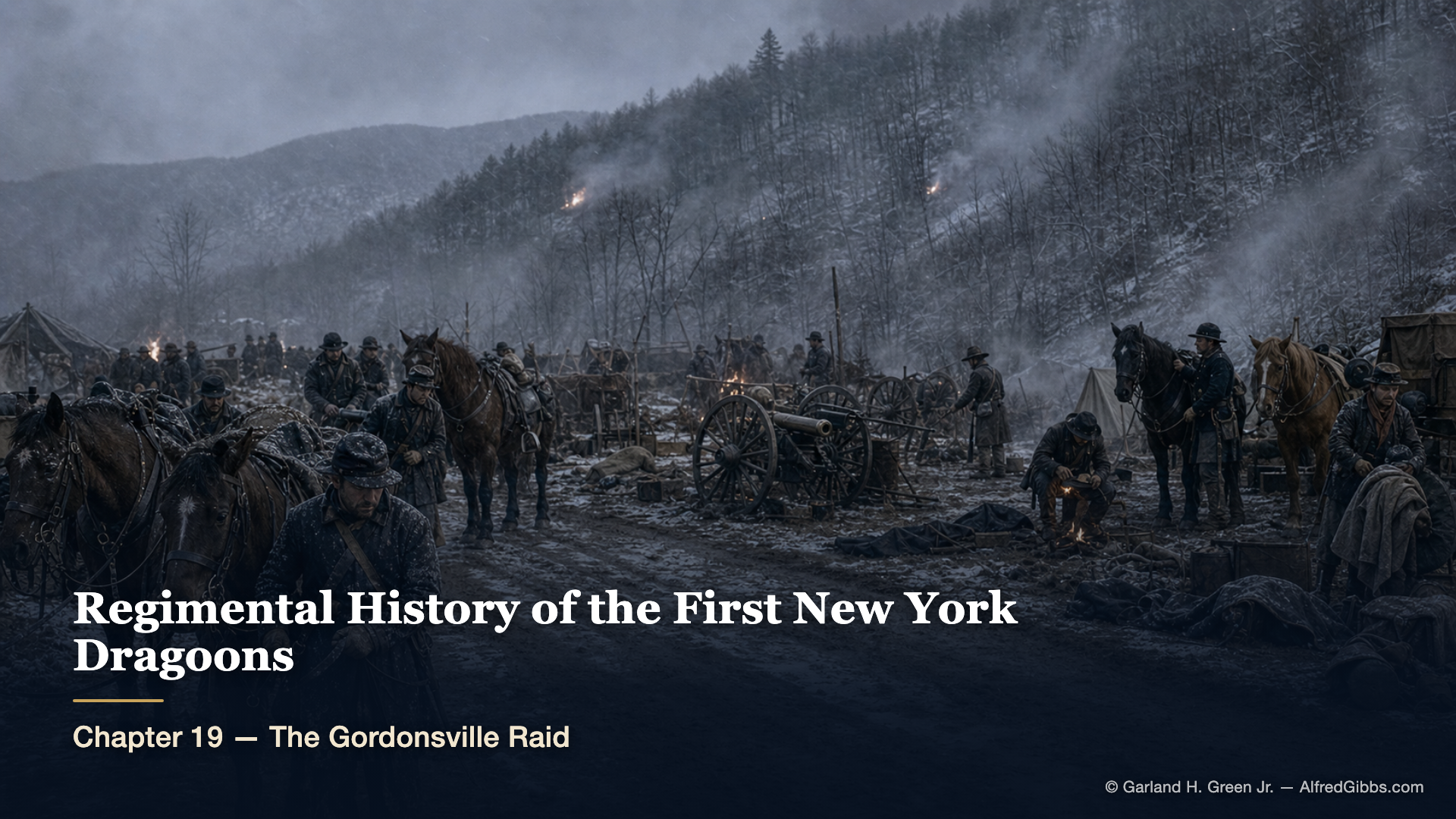
Reaching the summit just before dark, the Dragoons discovered a considerable force of the enemy occupying the plateau before them. A lively charge was made at once, led by one of the advance regiments, “hustling the Johnnies out of their comfortable camps at a rapid gait.” In this engagement, known as Liberty Mills, the regiment captured two pieces of artillery. Taking possession of the rebel camps — with fires burning and victuals cooking — the men felt themselves quite fortunate. It was a small triumph, and, as it turned out, the only real prize the whole raid would yield.
“On the very cold night at Liberty Mills we fought the enemy into a swamp, and next morning chopped out two rebel guns. Those we brought back, — the only things our army had to show for the raid.”— Surgeon Benjamin T. Kneeland, First New York Dragoons, in his “Recollections of an Army Surgeon,” a letter written to comrade J. R. Bowen and printed in the regimental history. On this raid, Kneeland recorded, “the regiment was commanded by Major Scott and the brigade by Colonel Kellogg.”
The Frozen Night
The comfort did not last. In the darkness the enemy could creep along the mountainside within easy range and make targets of the men about the fires, so every light had to be put out. The Dragoons huddled together for a little sleep, “soon froze out,” and were driven to run, beat their arms about their bodies, and try every device to keep from freezing; many of the men on picket that night were frost-bitten and permanently injured. Among the regiment’s wounded was Private Philidus C. Gratton of Company K, hit in action at Liberty Mills.
An interesting episode of that night was the shrewd capture of a rebel general’s pack train — men, horses, mules, and camp equipage — which, not suspecting the presence of Yankees, walked straight up to the Union picket and announced itself. Among the prisoners was a rebel surgeon, to whom Dr. Robert Rae of the Dragoons “paid special attention.” Rae had himself been left behind at Trevilian Station that June to tend the wounded, had been looted and made a prisoner by the enemy, and had only lately been exchanged and rejoined the regiment; if he said more to the captured surgeon than strictly necessary, he made sure the man was decently treated all the same.
Gordonsville and the Return
During the following day, December 23, several minor engagements occurred near Gordonsville, but nothing of special importance was accomplished beyond the capture of a few prisoners; the column then retired across the Rapidan and Robertson Rivers and turned homeward by way of Culpeper, Warrenton, and Ashby’s Gap, harried at times by guerrillas. Bowen judged the whole expedition a failure under an incompetent and tyrannical leader — “under a competent leader, [it] might have been a success; but under Torbert proved a failure.” Sheridan, he added, having lost confidence in Torbert, made Merritt his chief of cavalry for his last raid; and in his official report “the principal thing Sheridan gives Torbert credit for on this occasion is the capture of two pieces of artillery by the Dragoons.”
Sources & Further Reading
- Primary James R. Bowen, Regimental History of the First New York Dragoons (1900), ch. XIX, “The Gordonsville Raid,” pp. 269–273 — the regiment’s own historian and an eyewitness, source of the account of the charge, the captured guns, and the frozen night at Liberty Mills. Full text: archive.org/details/regimentalhistor00bowe.
- Primary Surgeon Benjamin T. Kneeland, “Recollections of an Army Surgeon” (ch. XXIII of Bowen’s history) — a letter to Bowen giving the surgeon’s firsthand account of the raid, the fight “into a swamp,” the two guns “chopped out” next morning, and the regiment’s command under Major Scott and Col. Kellogg.
- Primary U.S. War Dept., The War of the Rebellion: Official Records of the Union and Confederate Armies, Series I, Vol. 43, Pt. 1 — the reports of Maj. Gen. P. H. Sheridan and Bvt. Maj. Gen. A. T. A. Torbert on the December 1864 Gordonsville expedition.
- Primary Philip H. Sheridan, Personal Memoirs of P. H. Sheridan (New York, 1888) — Sheridan’s statement that, having lost confidence in Torbert, he made Merritt his chief of cavalry (cited by Bowen).
Trevilian Station · The Shenandoah Valley Campaign · The Audiobook
Views: 67