Read from the Book
Update, November 21, 2026: The Prologue now says Laura Wolcott Gibbs fought the War Department for three years, not four, to win her son's appointment to West Point, matching the book.
Read from the book
Read from the Book
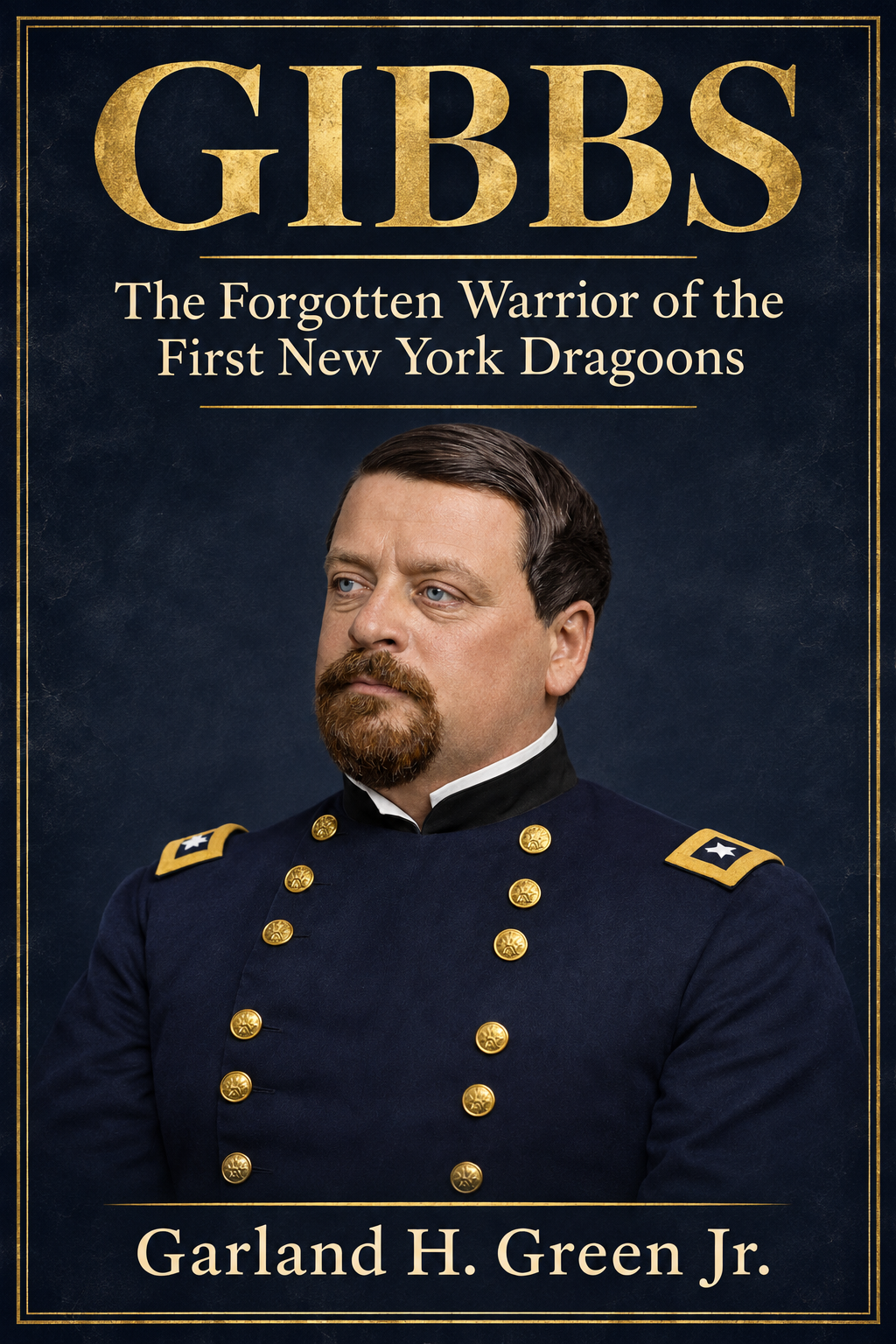
Two readings from GIBBS: The Forgotten Warrior of the First New York Dragoons, by Garland H. Green Jr.
The Prologue: Melted MajestyFrom Chapter 25: Swordless and Horseless
Prologue Melted Majesty
The book opens in 1776, forty-seven years before Alfred Gibbs was born, with a king’s statue and the family he would come from.
The road to Litchfield, Connecticut
Summer 1776
A reconstruction. The Notes at the back of the book show what is documented and what is imagined.
The rain had not let up since noon, and now it was dark.
The ox team came down off the high ground at a crawl, the wagon swaying behind them, its wheels throwing mud to the axles. Ahead, a lantern bobbed where the road crossed a stretch of bottomland on logs laid side by side. The logs were slick as soap. The oxen took them one plank at a time, heads low, steam rising off their backs.
The front wheels left the last log and dropped.
They went down to the hubs in the clay of the rise beyond and stuck there. The team leaned into the yokes, took a single step, and stopped dead. The wagon groaned. Something under the canvas shifted with a sound like a church bell dropped down a well, low and heavy, and settled again.
The teamster swore and called for help.
Three men came back through the rain. One of them held the lantern high while the other two set their shoulders to the tailboard, boots sinking in the muck, water running off their hat brims.
“Now!”
They pushed. The oxen pulled. The wheels turned a quarter turn, slid back, turned again. A foot at a time, the wagon came up out of the mud and onto the crown of the road, and the men stood bent over with their hands on their knees, breathing hard, in the hiss of the rain.
The canvas had come loose at one corner. The man with the lantern reached to tie it down and stopped.
The load was metal. Dull grey metal, hacked into pieces, heaped in the wagon bed like firewood. A curve of a horse’s flank. A length of leg. A fold of a cloak. A hoof, still shod. Where the rain had washed away the mud, the lantern caught something on the grey and threw back a flash of yellow.
Gold.
Gold leaf, thin as a moth’s wing, still clinging to the lead.
A lieutenant who watched it come down put the whole at four thousand pounds of lead. A few weeks before, all of it had been a king, riding a horse in the middle of New York.
There was no head in the wagon. Somebody in New York had other plans for that.
The man pulled the canvas tight and tied it down. Litchfield was still a long way off, and the people waiting there meant to turn every pound of the King of England into bullets.
New York
July 9, 1776
He had stood on the Bowling Green, at the foot of Broadway, for six years.
George the Third, King of Great Britain, cast in lead and covered in gold, dressed as a Roman emperor on horseback, larger than life on a white marble pedestal fifteen feet high, inside an oval of grass and an iron fence. The colony had ordered him from London to thank the King for repealing the Stamp Act. On the day he went up, the governor’s council and the merchants of the city drank his health under a salute of thirty-two guns.
Six years later the city was full of soldiers waiting for a British fleet, and the King was the most visible thing in New York that belonged to the King.
On the evening of July 9, 1776, the Declaration of Independence was read at the head of every brigade of the Continental Army in the city. That night soldiers and townspeople went down to the Green, and the King came off his horse.
Lieutenant Isaac Bangs wrote it in his journal the next morning, and he did not hide his pleasure:
Last night the Statue on the Bowling Green representing George Ghewelph alias George Rex was pulled down by the populace. In it were 4,000 pounds of Lead and a Man undertook to take off 10 oz. of gold from the Superficies, as both Man and Horse were covered with Gold leaf. The Lead we hear is to be run up into musket balls for the use of the Yankees.
General Washington was not amused. His orders that day granted that the men “who pulled down and mutilated the Statue in the Broadway last night were actuated by zeal in the public cause,” but the business had “so much the appearance of a riot and want of order in the army” that in future such things would be “left to be executed by the proper authority.”
He did not ask anyone to put the King back.
Three days later a New Yorker named Ebenezer Hazard sat down to write to General Horatio Gates, and found the line that would outlive every other word said about that night. The statue, he wrote, had been “pulled down to make musket balls of, so that his troops will probably have melted majesty fired at them.”
The head took a different road.
Someone cut it off the body. They sliced away the nose, clipped the laurel wreath, drove a musket ball partway through the skull, and carried it up the island to a tavern near Fort Washington, where they meant to stick it on a spike on top of a flagstaff.
They never got the chance. A British engineer named John Montresor heard about it. In September he sent a man through the American lines to steal the head and bury it. When the British took the city, Montresor dug it up and shipped it to Lord Townshend in London, “to convince them at home of the Infamous Disposition of the Ungrateful people of this distressed Country.”
The King’s head went home to England.
The rest of him went to Connecticut.
Litchfield, Connecticut
Summer 1776
Lead was scarce in the colonies, and dear, and an army without it could not fight. So the pieces went north, away from the British fleet, to a hill town in western Connecticut, “as a place of safety,” to the house of a man named Oliver Wolcott.
Wolcott had just come home from the Congress at Philadelphia, where he sat as a delegate, and his name would stand among the signers of the Declaration of Independence. His family would write a century later that “He carried with him from the city of New York the leaden statue of King George III., which was converted into bullets at Litchfield, under his direction.”
He did not stay to see it done. On the fifteenth of August the governor gave him fourteen regiments of Connecticut militia, more than five thousand men, and sent him to defend New York. The work at home fell to the people he left behind.
What they did, we know from one of them.
Frederick Wolcott was nine years old that summer. When he was an old man and a judge, he told his great-nephew that he remembered it all: “a shed was erected for the occasion in an apple-orchard adjoining the house, where his father chopped it up with a wood axe, and the girls had a frolic in running the bullets and making them up into cartridges.”
An apple orchard. A shed. A Signer of the Declaration of Independence swinging a wood axe at the King of England, and his daughters melting the pieces down.
And somebody kept count.
The sheet survives, in Oliver Wolcott’s own hand, endorsed “an account of the number of cartridges made.” Leaving out the running sub-accounts, its totals read:
Mrs. Marvin, 6,058 · Ruth Marvin, 11,592 · Laura, 8,378 · Mary Ann, 10,790 · Frederick, 936 · Mrs. Beach’s two accounts, 2,002 · Made by sundry persons, 2,182 · Gave Litchfield Militia, on alarm, 50 · Let the regiment of Col. Wigglesworth have 300 · Cartridges, No. 42,288 · Overcharged in Mrs. Beach’s account, 200 · 42,088
The Marvins and Mrs. Beach were neighbors. Laura and Mary Ann were Wolcott’s daughters. Frederick was the nine-year-old, and he made nine hundred and thirty-six. Even the arithmetic was honest: Mrs. Beach had been credited with two hundred too many, and they came off the total.
Forty-two thousand and eighty-eight cartridges.
The King of England went back to his soldiers one ball at a time.
New York
October 1844
The paper never went to a museum. It stayed in the family.
Wolcott’s son, Oliver Wolcott Jr., George Washington’s second Secretary of the Treasury, added a note beneath it, signed “O. W.,” so no one would ever mistake what it was: “The ladies of the village converted the lead into cartridges, of which the preceding is an account.”
The son’s daughter, Laura, married a Newport man named George Gibbs. Her eldest boy, another George, grew up with the family papers. In October 1844, a New York lawyer not yet thirty, he stood before the New-York Historical Society and told the members that the statue’s fate “has never been recorded, and having in my possession a paper giving authentic information on the subject, I have supposed that the royal effigy might be worth a brief obituary.”
He read them the tally. He read them his great-uncle Frederick’s memory of the orchard and the axe.
Fifty miles up the Hudson, that same autumn, George’s younger brother was in his third year as a cadet at the Military Academy at West Point. The family that had cast bullets for the Revolution had sent him there. His mother had fought the War Department for three years to do it.
Before he was done, a Mexican lance would go into him at Cerro Gordo. An Apache lance would open his belly and leave him fifteen hours on the ground. The Confederates would take him prisoner. His own general would put him under arrest, and he would go into the fire anyway, “swordless and horseless,” carrying the regiment’s colors. The Virginia sun would strike him senseless twice in eleven days, his surgeon would plead with him to leave the field, and he would not go. He would die in uniform at forty-five.
And the country his great-grandfather signed into being would forget him.
His name was Alfred Gibbs.
From Chapter 25 Swordless and Horseless
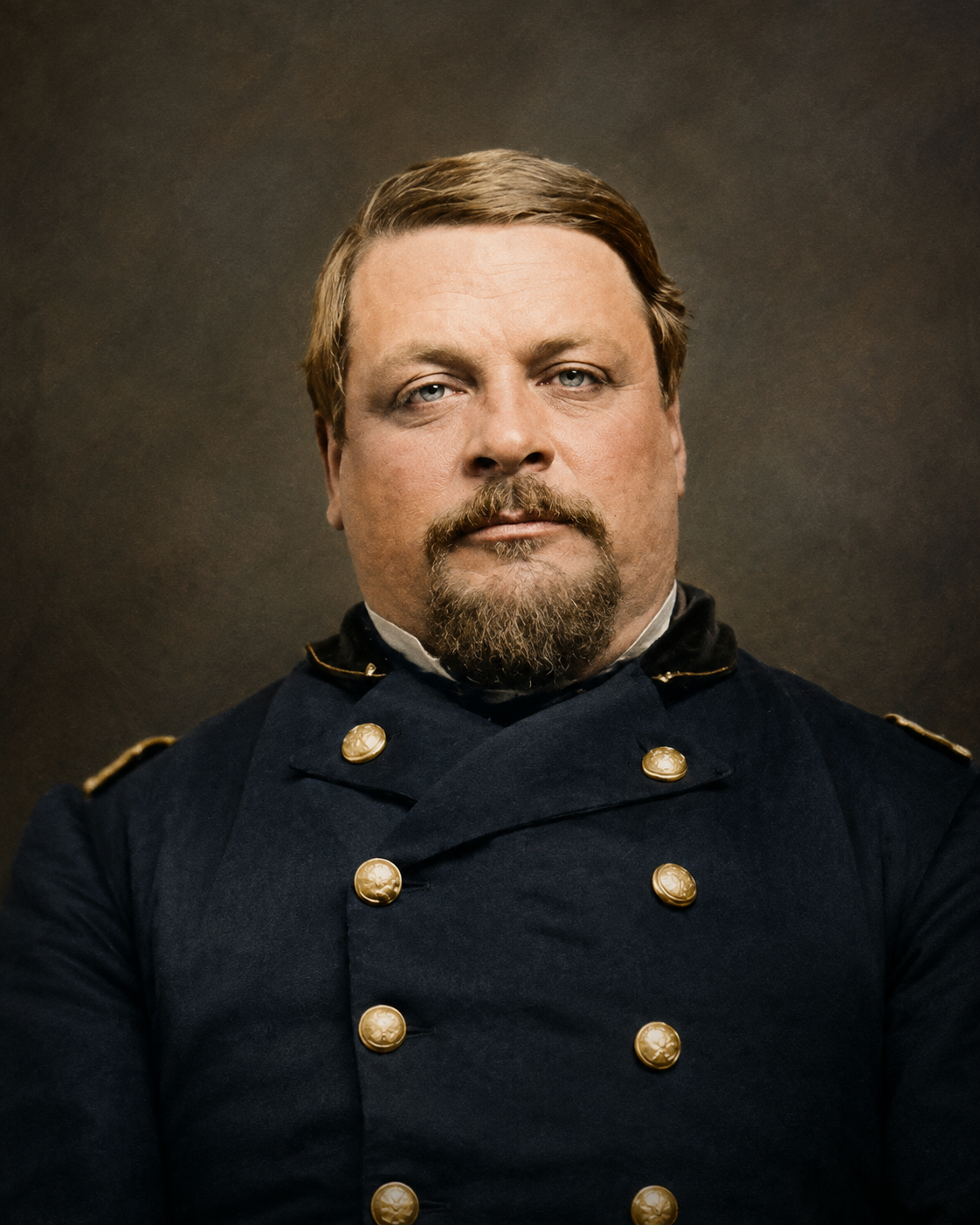
January 1863, near Suffolk, Virginia. The 130th New York, the regiment that would later be known as the First New York Dragoons, is ordered out at night toward the Blackwater River. Its colonel is Alfred Gibbs. What follows is the whole of that night and the morning after, as the book tells it.
Camp near Suffolk, Virginia
January 29, 1863
The orders came quietly, about eleven o’clock at night. “About eleven o’clock on the evening of Jan. 29, 1863, orders were quietly issued to the regiment to promptly prepare to march, with sixty rounds of ammunition and three days’ rations.”
The men had heard it before. All winter the reconnaissances had gone out toward the Blackwater River and come back with nothing to show but sore feet, and “the men murmured at going out so frequently upon wild-goose tramps.” James Bowen, who led the regiment’s drummers, noticed one thing different that night, and he never forgot it. “For the first time I was directed by Colonel Gibbs to take along the stretchers, with the assurance that we would probably have abundant use for them.”
The colonel knew something the men did not. That afternoon a scout of the 11th Pennsylvania Cavalry, Captain Ward, had come in to General John Peck at Suffolk with word that the Confederate general Roger Pryor had crossed the Blackwater and was camped at the Deserted House, a farm and store on the Franklin road nine miles out, “with some 2,000 infantry, 500 cavalry, and a number of pieces of artillery.” Peck put together a force to go and get him: Spear’s cavalry, two batteries and two mountain howitzers, six regiments of foot, “Colonel Gibbs commanding the infantry (amounting, by the morning reports of that day, to some 4,800 total).” Over the whole of it he put Brigadier General Michael Corcoran, the Irish brigadier who had come to Suffolk with his own brigade, Corcoran’s Irish Legion.
Gibbs had given up his brigade to General Terry only sixteen days before. Now, for one night, he had the infantry of the whole column.
In Company C a captain named Rowley Taylor was putting his affairs in order. He was forty, born in Busti, out in Chautauqua County, in 1822. He had come to Attica, in Wyoming County, at seventeen and made his living there as a merchant and banker, and he had married Harriet Baker in 1851. They had no children. When Wyoming County set its quotas for the new regiment in the summer of 1862, Attica owed twenty-four men, and Taylor was the man appointed to raise them. The quota was met that August, and the men became his Company C. One of his men, a soldier named Petibone, remembered what he did. “Captain Taylor had a presentiment before leaving Suffolk that he would be killed, and had packed his effects, leaving them in charge of Willis Parker to be sent to his wife if he should not return alive. He also asked the privilege of signing the pay roll, requesting his salary also sent to her.”
Levi Green fell in with Company E. His brother Marvin did not go.
The road to the Deserted House
January 30, 1863, before dawn
“It was past midnight when we moved out in the direction of the Blackwater upon what proved to be the last march for several of the regiment.”
Spear’s troopers rode in the extreme advance, then the 13th Indiana, veterans, then the 130th New York. Corcoran halted the column for ten minutes near the Nansemond County poorhouse and went on. Captain Taylor marched beside his company without a word. “In marching out to the Deserted Farm he was unusually quiet for him, scarcely speaking during the march.” When some of his men started joking he stopped them. “Boys, you had better keep quiet, as some of you will be in heaven or hell before morning.”
About eight miles out, at twenty minutes past three, the cavalry ran into Pryor’s pickets, and the shots “sent a thrill of animation through our ranks.” Pryor had been waiting for them. He had put a hundred sharpshooters in ambush on the road a mile beyond the swamp, and, by his own report, their first volley “emptied many a saddle.” Spear’s men charged anyway and drove the pickets in. The infantry waded a creek and turned off to the right into the edge of the woods. Beyond the trees lay an open field, a quarter to half a mile across, and on the far side of it the enemy’s campfires.
Spear ran his two mountain howitzers up to the edge of the clearing and opened on the fires. The men watched and enjoyed it. “We chuckled as we thought the Johnnies were catching it in good shape,” Bowen wrote, “but they were not of that kind, and soon taught us that war was a thing two could play at.” Pryor’s gunners had the range of the field. They answered with every gun they had, and the shells came “blazing and screaming through the air, tearing through the tree-tops or bursting in our midst, until it seemed as if pandemonium was let loose upon us.”
It was the 130th New York’s first time under heavy fire. “Not a man flinched during the terrible ordeal,” their historian wrote, and he was there to see.
The field at Kelly’s Store
January 30, 1863, 3:40 to 6 a.m.
The Union batteries came up at the gallop. Follett’s battery of the 4th U.S. Artillery opened at twenty minutes to four on the north side of the road, Davis’s 7th Massachusetts battery on the south, and for more than two hours, in the dark, the guns of both armies fired as fast as they could be served. Follett counted 1,140 rounds from his side alone.
The 130th lay in the open on the right of the line, “some ten paces in the rear of Davis’s battery,” which it was there to protect. The men were ordered to lie flat. “Shot and shell went plowing through the ranks of the infantry in rear of the artillery, with terrible effect,” the Wyoming County history said. “The bursting of one shell killed three and wounded four of Co. A.”
The battery in front of Company A lost so many gunners that its captain called for volunteers to help work the guns. A private named Johnny Keghan got up and said he would go. “He had not been with the battery ten minutes before he was killed.”
Lieutenant Flint saw a cannoneer whose leg had been torn to pieces by a shell keep working his piece. “A cannoneer held himself up by his gun, and rammed home a charge of powder and ball, after one of his legs had been torn to pieces by a shell.” He bled to death before the surgeon got to him. One of the caissons blew up, and the burning tow lit the field for the enemy’s gunners. “A badly wounded soldier hobbled out and extinguished the burning tow by stamping on it, so as not to reveal the location of the battery.”
“By the fitful light of bursting shells could be seen the ghastly features of the dead and dying, and the ground strewn with slain horses, while riderless ones galloped over the field, trampling underfoot friend and foe.”
Somewhere in it the colonel was on his feet. “During the hottest of the battle a shell tore up the ground just in front of the regiment. Noticing it, the Colonel stepped out and stood upon the spot.” Someone shouted at him. “Colonel, you had better get away from there.” Gibbs answered him with a joke. “Lightning seldom strikes twice in the same place.”
Down the line Captain Taylor lay with his company and said nothing for nearly two hours. Then the major, Rufus Scott, came walking along the line, smoking a cigar. Taylor was lying just at Petibone’s right, and Petibone heard it all.
“Taylor, how are your men?”
“Some are dead, but most of them are all right,” Taylor said. “Major, have a chew of tobacco with me.”
Scott said no, he was smoking, and went on up the line. Taylor decided he would have one himself. He raised up on his elbow and put his hand in his pocket. “Captain Taylor, of Co. C, had raised upon his elbow when a ball struck him squarely in the breast, hurling his mangled body some twenty feet to the rear.”
The arrest
January 30, 1863, at the outset
It had started in the first minutes, before Taylor was hit, before Keghan went to the guns.
Alfred Gibbs had been under fire before, and he knew what he was looking at. He carried the wound of a Mexican lance from Cerro Gordo and the scar of an Apache lance from Cooke’s Spring. He had been a prisoner of the Texans and had sat out a year on parole waiting to be exchanged. He was in that uniform because his family had refused to quit. His mother had left a sick bed to go to Washington and stand in the War Department until a colonel told her, “Madam you have your answer.” His brother George had written to two Secretaries of War. His uncle, a former governor of Rhode Island, had gone to a senator, and the senator had been asked to go to the President. Four congressmen and General Winfield Scott had put their names to it. It had taken four years. And here, in the dark at Kelly’s Store, he watched the infantry laid out in a line in the open field, behind the guns, where every shot the Confederates fired at the batteries came down on the men lying behind them.
The men could not fire back. They could only lie there and be hit. The county history, written by men who had lain there, put it plainly: “All who have had experience know that this is the most trying position for infantry it is the most senseless as well.”
Gibbs commanded all the infantry on that field. General Peck said so in his report. The disposition was Corcoran’s, and Corcoran outranked him.
Michael Corcoran had come to his stars by another road. Born in County Sligo in 1827, he had served three years in the Irish constabulary, come to New York in 1849, kept Hibernian Hall, and clerked in the post office. He rose in the 69th New York Militia from private to colonel, elected to the colonelcy in 1859, and an admirer wrote that he was counted among the best officers of his rank in the city’s militia. What made him famous was not a battle. In 1860, when New York turned out to honor the visiting Prince of Wales, Corcoran refused to parade his Irish regiment for the son of a queen “under whose rule Ireland was left a desert,” and he was court-martialed for it; the war dissolved the court. Then came Bull Run, where he was taken prisoner with the remnant of his regiment, a year in Confederate prisons, and a hero’s welcome home to New York. He raised a brigade of Irish regiments on his name and was made a brigadier general. He was a leader of his countrymen and a public figure before he was a soldier, and he had commanded in one battle, as colonel of a militia regiment, before this one. The man he outranked had been at West Point, in four battles in Mexico and on the frontier for seventeen years.
Gibbs went to him anyway.
No one wrote down the words they said to each other. What Gibbs asked for, the men who were there remembered. “Colonel Gibbs, a veteran of the Mexican war, ventured to expostulate with Corcoran at the outset against this disposition, and to suggest that the infantry should be posted on the flanks of the artillery, where they would escape the raking fire, and where they could repel an assault upon it, if made.”
He was asking for the lives of men who were not his own. Corcoran’s own Irish regiments were on that field, under the same guns.
“For his temerity in so doing he was put under arrest by Corcoran and his sword taken from him.”
Bowen, who had no use for Corcoran, called him “that pompous Irishman, Corcoran, who haughtily resented any suggestion from an officer whom he ranked,” and reminded his readers that Gibbs “was in command of the infantry, and in making the suggestions referred to did not exceed his right and privilege.”
So there it was. A colonel with seventeen years in the army, with two lance wounds and a captivity behind him, stood on a battlefield in the dark with no sword, a prisoner of his own army, while the shells came in on the men he had tried to move. Under the Articles of War he could not command, could not carry a weapon, could not leave his arrest until the man who had arrested him set him free. All he could do was wait for the general to be proven wrong.
He did not wait long. “But the wisdom of his suggestion was soon demonstrated. Corcoran’s own brigade, unused to fire, broke in confusion and disorder, and began a precipitate retreat. He was himself obliged to leave the field and join in the effort to rally them. In this he only partially succeeded.”
Corcoran’s report tells that part differently. At a quarter past five he ordered the infantry forward, and the order, “twice repeated, was not promptly executed,” for a cause he said he had given Peck by word of mouth. He rode to the regiment that would not move, the 167th Pennsylvania, a militia regiment new to fire, and “found the One hundred and sixty-seventh without a single field officer”: its colonel was mortally wounded and the other two were down with their horses killed under them. “They became a confused mass, mixed up with other regiments, and filled up the entire road, leaving it impassable, and creating confusion among other regiments in the rear.” He sent them to the rear to re-form, and put two of his own regiments across the road eight hundred paces back to stop anyone else from going that way. Of his own Irish regiments he wrote only praise.
Bowen had his own view of the Legion, and he gave it as an eyewitness. Carrying the stretchers back with the drum corps, he found the road choked with men “who, at the very first crash of shells, broke for the rear, blocking up the road so that in carrying off the dead and wounded the drum corps could scarcely get through with the stretchers. We found them everywhere, skulking behind logs and trees.” The regiment’s big drummer lost his temper with them. He “roughly yanked several of them from their hiding places, giving each in turn a lively application of the toe of his boot, and started them to the front on the double-quick.”
What happened between Gibbs and Corcoran at the guns was first written down in the county histories of 1879 and 1880, from the men of the regiment, and James Bowen copied it into his own history twenty years later. “Bear in mind,” he told his readers, “that this account of the battle was prepared soon after the close of the war, when all the facts were easily obtainable.” No other account of the arrest has been found, and Corcoran’s own report does not mention it.
Whose men ran first, the reports and the regiment do not agree. That a regiment broke, and that the road behind the guns filled with frightened men, the Union accounts all agree.
The charge
January 30, 1863, daybreak
Now the guns were nearly out of ammunition, and nobody in front was giving orders.
The three infantry regiments behind the guns had lain under that fire for two hours, “powerless to render any assistance, except to retake what may be lost.” And still they held. “Though suffering terrible punishment, the three infantry regiments remained at their post, firm as a wall. But what were they to do?”
Nobody could tell them. “On every hand, from artillery and infantry officers, was heard the inquiry” that no one could answer: “Where’s General Corcoran?” “No one knew.” The batteries, with no orders of their own, began to pull out. “Hastily the bodies of the dead were piled on to gun carriage, caisson and ammunition wagon, as they began to file down the road to the rear.” The light was coming up over the field. “Everybody looked the puzzled astonishment that they felt.” “What does this mean? What’s all this for?” “No one knew.”
“This is a shame!” somebody said. “This is a shame!” the line answered. “Let’s go on without orders! let’s charge them!” Then it was everywhere at once. “Let’s charge them! let’s charge them!” “went up as from one throat along the whole line. Everybody knew now just what to do.”
Their colonel was not supposed to be there.
Gibbs had been put under arrest, and the Articles of War said exactly what that meant. An officer charged with a crime “shall be arrested and confined in his barracks, quarters, or tent, and deprived of his sword by the commanding officer. And any officer who shall leave his confinement before he shall be set at liberty by his commanding officer, or by a superior officer, shall be cashiered.” The Army’s regulations added a line of their own: “An officer under arrest will not wear a sword.” Corcoran had not set him at liberty. Corcoran was not even on that part of the field.
Cashiered meant thrown out of the army in disgrace. For most of the colonels at Suffolk the army was the war’s interruption of a life at home. For Alfred Gibbs it was the life, and the only living he had ever had. An hour before, he had put it at risk to tell a general where to put his men. Now he put it at risk again.
He had no command, no sword and no horse. Why he was on foot, the record does not say. He went with them anyway, and in front of them, and he carried the one thing he could carry into that charge: the regiment’s flag.
“Who that was there can ever forget it? Who that witnessed it will not always remember the thrilling picture of brave Colonel Gibbs, under arrest as he was, swordless and horseless, seizing the colors and bearing them, like the hero that he was, in front of the regiment throughout the whole of that charge?”
That is how the men of the regiment told it to the historians of Allegany and Wyoming counties, sixteen years afterward. James Bowen, who was on that field with the stretchers, copied it into his own history twenty years after that, and added the one thing the men had held against their colonel before that morning. “For various reasons he had not heretofore been popular with all his men.” The county history said what changed. “There had been doubts, almost murmurings, but now and henceforth every man in the regiment was willing to die for him.” “From that hour his kingdom in the regiment was established.”
I have told this story to more people over the years than I can count, and it is still the one I come back to when someone asks me who Alfred Gibbs was. Read it again. He gave his commanding general advice that would have spared men under fire, Corcoran’s own men among them as well as the boys of the 130th, and for it he was arrested and disarmed on the field. He was soon proven right. Then, still under arrest, with no sword and no horse, he picked up the colors and carried them on foot at the head of a charge he had no right to be in, with his career in his hands. Deborah Dodge, who has studied him as long as anyone, put the man in one sentence: “He wanted to protect his men from unnecessary harm, but was fearless for himself.”
The men who crossed that field did not forget the flags. Twenty-eight years later, at a reunion of the Old Guard in Indianapolis, a poem was read for the day, “Battle of Deserted House,” and near its end the poet turned to the colors. “Well may each standard-bearer claim the proud inscription written here.”
The official reports tell the same minutes their own way. Corcoran wrote that he came back to the front with Spear at twenty minutes to six and “determined to charge the enemy with the bayonet,” put two guns in the road with the 13th Indiana on the right and the 130th New York on the left, and at six sent them all forward under Spear. In his account the charge was his. He did not mention Colonel Gibbs at all, then or anywhere in his report. Neither did Peck, after the line that put him in command of the infantry. Pryor, across the field, wrote that the Union infantry “issued from the woods across the field with the evident design of charging our batteries,” and that, met with case and canister, “they broke and ran in the utmost confusion.”
Three accounts, then, from three men with something to prove, and a fourth from the men who were in the charge. They agree on this much: at daybreak the Union infantry crossed that field, and soon after it, Pryor’s army was gone from the far side.
The pursuit
January 30, 1863
The enemy fell back into the woods, and the 130th went in after them as skirmishers, Lieutenant Colonel Thorp commanding. Levi Green remembered the rest of the morning as one long charge on a battery that would not be taken. “The rebs fell back into the woods and then the Infantry had to charge on the Battery we was drove back 3 times they shot grape into us.” Corcoran saw the same thing from the road: the Confederates “came forward with their peculiar yell to dislodge them, but were quickly driven back with much loss. They tried this three times with the same result.” “Lieutenant-Colonel Thorp exhibited much coolness and good judgment.”
The county history says the 130th was “shooting the gunners at their guns, when General Corcoran arrived on the field and recalled them.”
At a quarter past ten, with the men out of food and the guns out of shells, Corcoran halted the column for breakfast. “The men of the command had eaten nothing up to this time.” Fresh ammunition came up from Suffolk, and with it Colonel Foster of the 13th Indiana and the 112th New York. “At about 11 a. m. Colonel Foster reported to me, and I immediately placed him in command of the entire infantry.”
At three in the morning the infantry had been Gibbs’s. At eleven it was Foster’s. Corcoran does not say why, and Peck does not either. It may be the arrest, showing through the official record without being named. That is our reading, and no more than a reading.
The column went on at noon toward Carrsville. At Pecosin Creek the 13th Indiana caught Pryor’s rear guard, and Spear’s cavalry chased it two miles past Carrsville and found nothing. Bowen wrote that Pryor got away only by crossing the Blackwater and burning the bridge. Pryor wrote that he left the field “leisurely, marching 3 miles in so many hours.” Levi watched the Indiana men go in ahead of his regiment, “they went into them like men,” and remembered one more thing from the day: a soldier who had his haversack shot off his back by a shell and took it as a personal grievance. “He thot that he could eat all the bred he had himself he did not ask nothing of the Rebs.”
On the way back they stopped at the Deserted House for their dead. “When returning from the pursuit, we halted at the battlefield to gather up our dead, which, when placed on empty ammunition wagons, made three heaped-up loads.”
Corcoran rode over to a farmhouse the Confederates had used for a hospital, a Mrs. Mulholland’s. “Both floors of the building were covered with blood and pieces of bone and flesh.”
They were back in Suffolk after midnight, thirty-two miles out and back in twenty-four hours. “We got into camp at midnight,” Levi said. “I was about gon up.”
East Twenty-ninth Street, New York
January 30, 1863, eight o’clock in the evening
At about six that evening the column halted at the Deserted House to eat and to gather up its dead. Two hours later, while the regiment was on the road back to Suffolk and its colonel was walking it home under arrest, a dozen men climbed the steps of a house on East Twenty-ninth Street in New York. It was Alfred’s brother’s house.
The invitation had gone out over eight names, and two of them were Gibbses. “You are respectfully invited to attend a meeting called to take into consideration the plan embodied in the accompanying circular, at the house of Dr. Wolcott Gibbs, 59 East 29th Street, on Friday, the 30th instant, at 8 P.M.” Wolcott signed it, and so did George.
Wolcott was forty, the second son, a professor of chemistry at the Free Academy and the most respected chemist in the country. He was also the boy whose name had been on the West Point warrant of 1839. When he did well at Columbia, the family had asked that Alfred be given his place (Chapter 4), and Wolcott had gone into science instead of the army. Since 1861 he had been a commissioner of the Sanitary Commission, the body that had grown out of the women’s meeting at Cooper Union where his sister Laura sat on the first committee (Chapter 20).
The plan in the circular was his. “The rough draft was written by Dr. Gibbs,” Henry Bellows recorded. He had been turning it over since before the elections of the autumn; Frederick Law Olmsted’s first reply to him, written the day after New York elected a Democratic governor in November 1862, picked up the name Wolcott had given his idea, a “Loyalist’s Club.” By January it was a National Club, and the circular said what it was for: “to cultivate a profound national devotion, as distinguished from that of sectional feeling; to strengthen a love and respect for the Union.” There was to be one test for a member besides a clean name: “an uncompromising and unconditional loyalty to the Nation, and a complete subordination thereto of all other political ideas.”
Eleven men came that night. Bellows, who was there, listed them: Judge Murray Hoffman, Bellows himself, Dr. Cornelius Agnew, Wolcott Gibbs, George Templeton Strong, George Anthon, Dr. Weston, Horatio Allen, Dr. John Dalton, Professor Theodore Dwight and William Hoppin. George Gibbs had signed the call, but his name is not on the list of those present. Judge Hoffman took the chair. “On motion of Dr. Wolcott Gibbs, it was resolved, ‘That a committee of three be appointed by the Chair to prepare a scheme of organization for the proposed National Club.'” Wolcott was named to it. They adjourned to meet again in a week.
A week later, on the sixth of February 1863, at Strong’s house, Wolcott brought in the report, and the Union League Club of New York was organized. It would raise regiments, Black regiments among them, and press the Thirteenth Amendment on the legislature at Albany. It began in the parlor of the brother of a colonel who, that same night, was marching home from the Deserted House without his sword.
Neither brother could have known it. The first account of the battle reached the New York papers on the third of February. But Bellows, writing the club’s history sixteen years later, said why it had been Wolcott who started it, and the reason he gave was their mother. Wolcott, he wrote, had “a natural right among his co-workers to be earliest in the field with a plan which concerned the existence of the Union. His grandfather, Oliver Wolcott, had been among the most vigorous and earnest of the patriots who formed the Union and guided its earliest steps. His mother was known all her long life as a noble daughter of a revolutionary father, worthy of the name she bore, and inheriting and transmitting a profound interest in the honor and dignity of the country.”
Inheriting and transmitting. Her sons were transmitting it that night in two places at once: one on a dark road in Virginia, carrying the habits of West Point back to camp under arrest, the other in a lamplit room in New York, writing loyalty to the nation into the rules of a club.
The book is finished, and how to order it will be posted soon. You can reserve a copy now, with nothing to pay. You have read the Prologue and about half of one chapter of forty-three.
Reserve a copy The book and its research The documents behind Chapter 25
Both readings are printed as they stand in the book, with nothing left out of the scenes shown. The Prologue is a reconstruction, as its first line says: the book’s notes set out, line by line, what in it is documented and what is imagined. Every quotation comes from a document named in the book’s sources.
Views: 5