McClellan Report 1854, Chapter 2: The Vancouver country and the lava field
THE GIBBS PAPERS · REPORT TO CAPT. McCLELLAN, 1854 · CHAPTER 2 OF 10
Chapter 2. The Vancouver country and the lava field
George Gibbs to Capt. George B. McClellan, Olympia, May 1, 1854. Gibbs Family Papers, reel 2, scans 1532 to 1536. Every page shown with its complete transcription. Published July 14, 2026.
From the gravelly plains around Vancouver the report works up the Cathlapootl, through small prairies he reads as the beds of former lakes, past the Indian potato grounds, to the first rocks found in place and out onto the great lava field, its mounds swelled like gigantic bubbles with fissured tops.
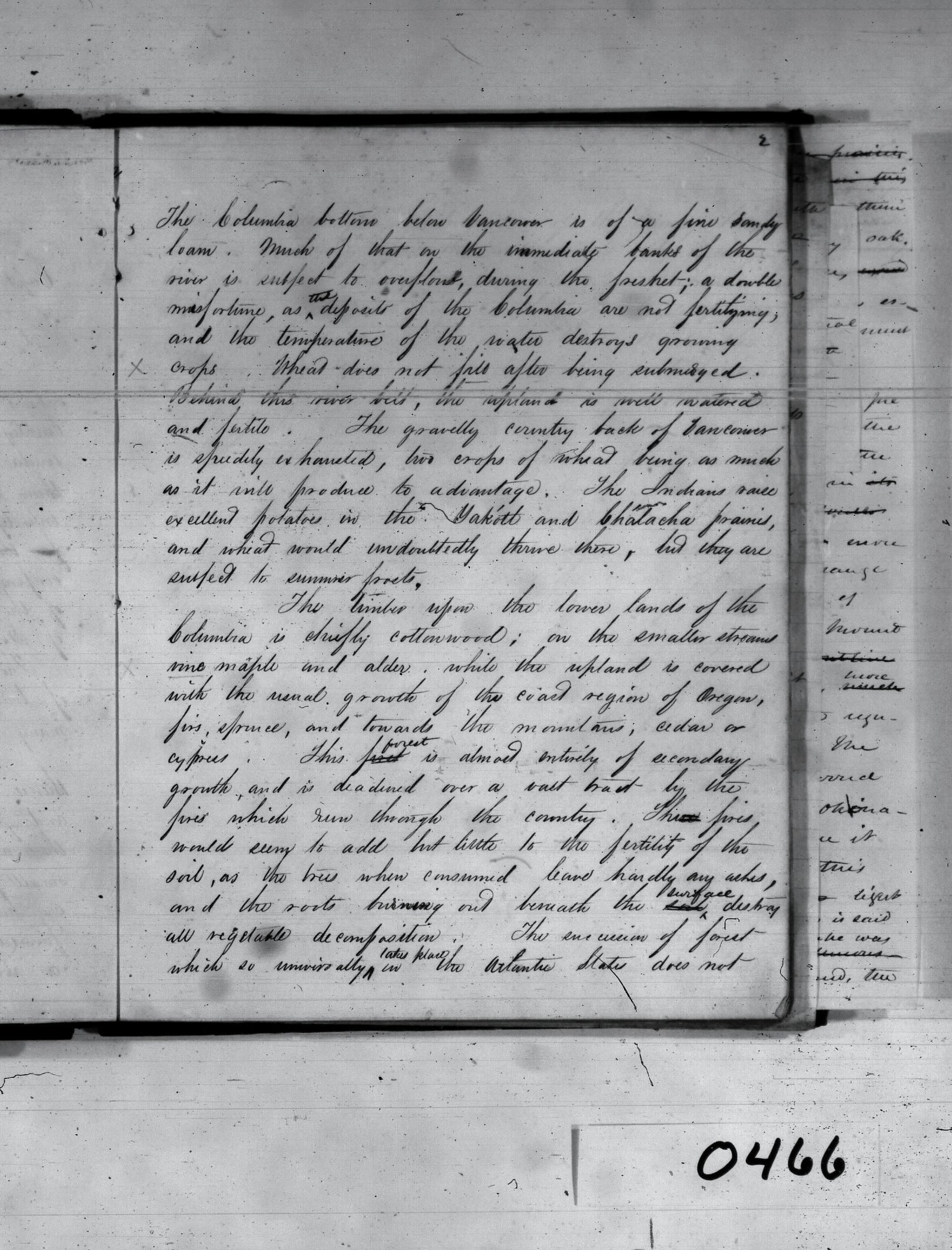
Complete transcription: manuscript page 2
The Columbia bottom below Vancouver is of a fine sandy loam. Much of that on the immediate banks of the river is subject to overflow, during the freshet; a double misfortune, as the deposits of the Columbia are not fertilizing; and the temperature of the water destroys growing crops. Wheat does not fill after being submerged. Behind this river belt, the upland is well watered and fertile. The gravelly country back of Vancouver is speedily exhausted, two crops of wheat being as much as it will produce to advantage. The Indians raise excellent potatoes in the Yakott and Chalacha prairies, and wheat would undoubtedly thrive there, but they are subject to summer frosts.
The timber upon the lower lands of the Columbia is chiefly cottonwood; on the smaller streams vine maple and alder, while the upland is covered with the usual growth of the coast region of Oregon, firs, spruce, and towards the mountains, cedar or cypress. This fir forest is almost entirely of secondary growth, and is deadened over a vast tract by the fires which run through the country. These fires would seem to add but little to the fertility of the soil, as the trees when consumed leave hardly any ashes, and the roots burning out beneath the sod? surface destroy all vegetable decomposition. The succession of forest which so universally takes place in the Atlantic States does not
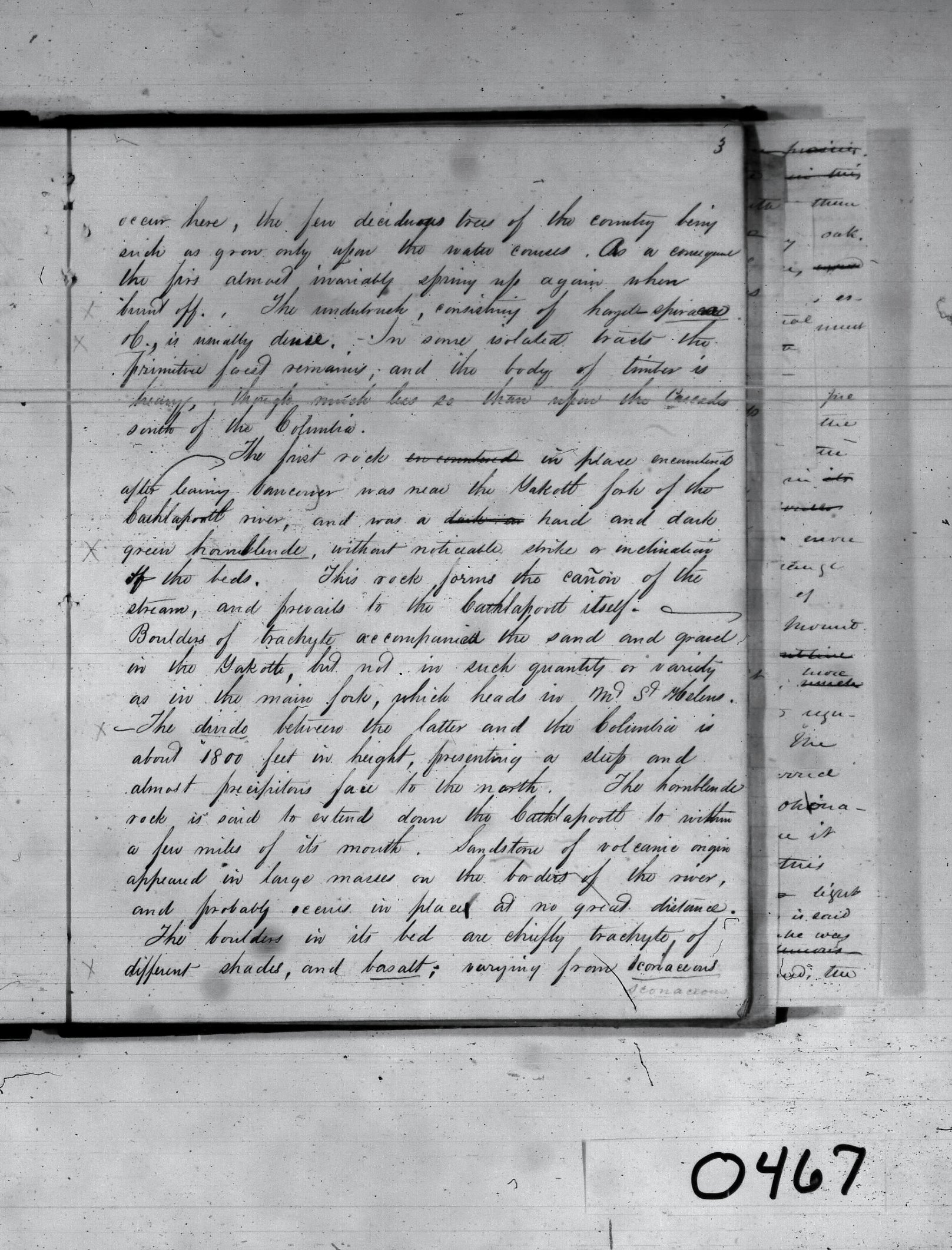
Complete transcription: manuscript page 3
occur here, the few deciduous trees of the country being such as grow only upon the water courses. As a consequence the firs almost invariably spring up again when burnt off. The underbrush, consisting of hazel spiraea &c., is usually dense. In some isolated tracts the primitive forest remains, and the body of timber is heavy, though much less so than upon the Cascades south of the Columbia.
The first rock encountered in place encountered after leaving Vancouver was near the Yakott fork of the Cathlapootl river, and was a dark or hard and dark green hornblende, without noticeable strike or inclination of the beds. This rock forms the cañon of the stream, and prevails to the Cathlapootl itself. Boulders of trachyte accompanied the sand and gravel in the Yakott, but not in such quantity or variety as in the main fork, which heads in Mt St Helens. The divide between the latter and the Columbia is about 1800 feet in height, presenting a steep and almost precipitous face to the north. The hornblende rock is said to extend down the Cathlapootl to within a few miles of its mouth. Sandstone of volcanic origin appeared in large masses on the borders of the river, and probably occurs in place at no great distance. The boulders in its bed are chiefly trachyte, of different shades, and basalt; varying from scoriaceous
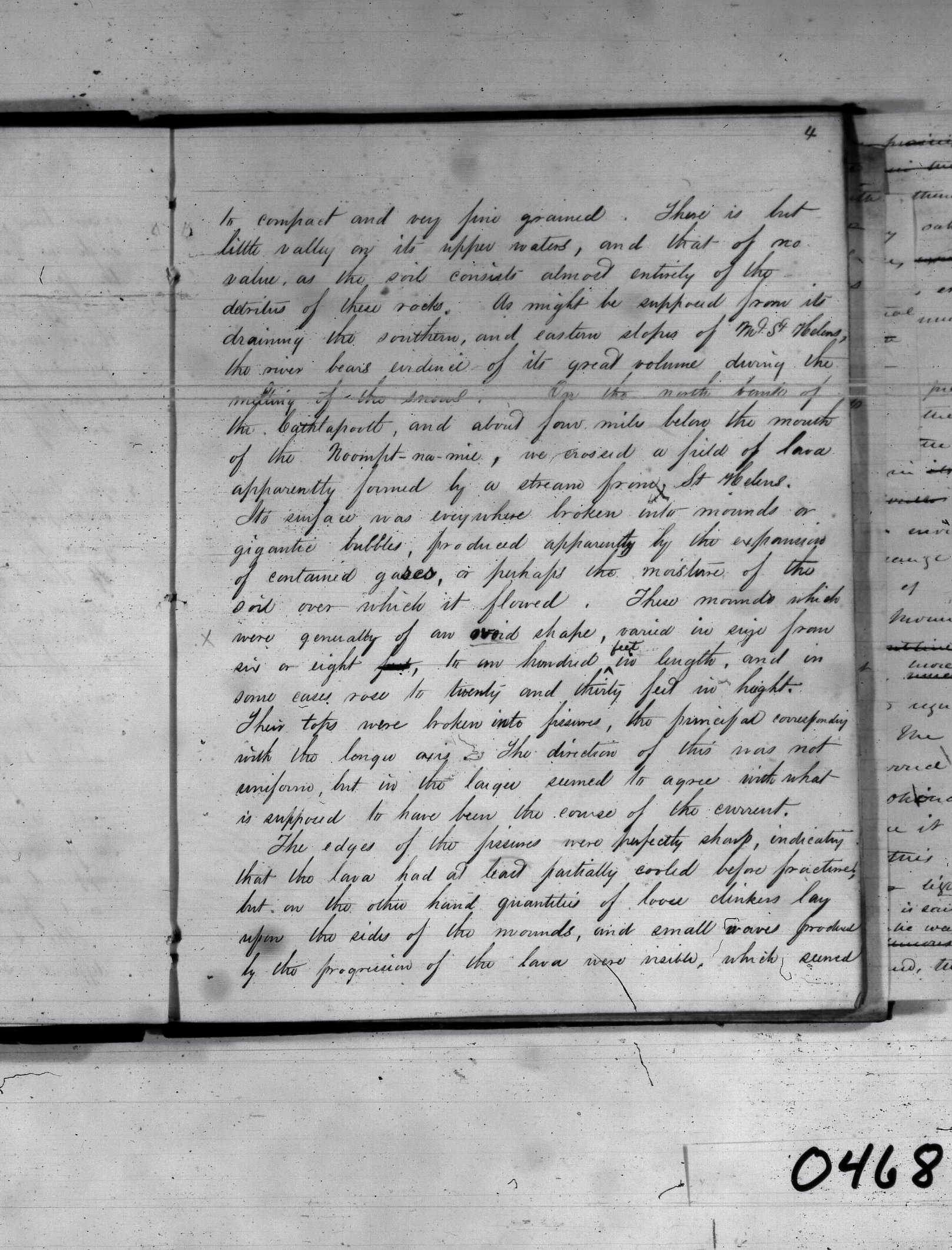
Complete transcription: manuscript page 4
to compact and very fine grained. There is but little valley on its upper waters, and that of no value, as the soil consists almost entirely of the detritus of these rocks. As might be supposed from its draining the southern, and eastern slopes of Mt St Helens, the river bears evidence of its great volume during the melting of the snows. On the north bank of the Cathlapootl, and about four miles below the mouth of the Noompt-na-mie, we crossed a field of lava apparently formed by a stream from St Helens. Its surface was everywhere broken into mounds or gigantic bubbles, produced apparently by the expansion of contained gases, or perhaps the moisture of the soil over which it flowed. These mounds which were generally of an ovoid shape, varied in size from six or eight feet, to an hundred feet in length, and in some cases rose to twenty and thirty feet in height. Their tops were broken into fissures, the principal corresponding with the longer axis. The direction of this was not uniform, but in the larger seemed to agree with what is supposed to have been the course of the current.
The edges of the fissures were perfectly sharp, indicating that the lava had at least partially cooled before fracture; but on the other hand quantities of loose clinkers lay upon the sides of the mounds, and small waves produced by the progression of the lava were visible, which seemed
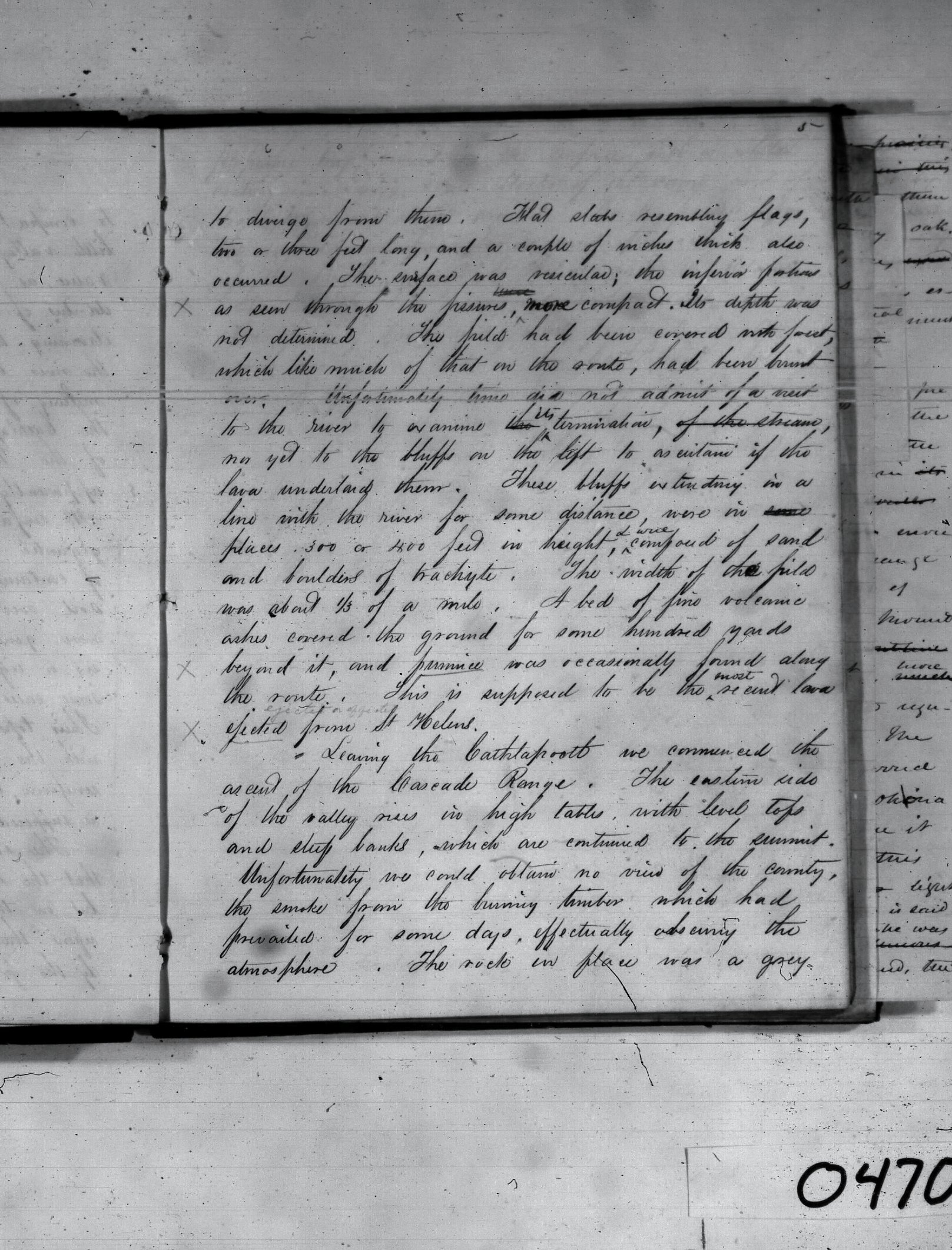
Complete transcription: manuscript page 5
to diverge from these. Flat slabs resembling flags, two or three feet long, and a couple of inches thick also occurred. The surface was vesicular; the interior portions as seen through the fissures, were more compact. Its depth was not determined. The field had been covered with forest, which like much of that on the route, had been burnt over. Unfortunately time did not admit of a visit to the river to examine the its termination, of the stream, nor yet to the bluffs on the left to ascertain if the lava underlaid them. These bluffs extending in a line with the river for some distance, were in some places 300 or 400 feet in height, & were composed of sand and boulders of trachyte. The width of the field was about 1/3 of a mile. A bed of fine volcanic ashes covered the ground for some hundred yards beyond it, and pumice was occasionally found along the route. This is supposed to be the most recent lava ejected from St Helens.
Leaving the Cathlapootl we commenced the ascent of the Cascade Range. The eastern side of the valley rises in high tables, with level tops and steep banks, which are continued to the summit. Unfortunately we could obtain no view of the country, the smoke from the burning timber which had prevailed for some days, effectually obscuring the atmosphere. The rock in place was a grey
Views: 9