The Bradish Will: Could a Married Woman Leave a Testament? (1816)
The Gibbs Archive · A Reel 1 Story
The Bradish Will
1816 · two opinions on a married woman’s testament
Helen Elizabeth Gibbs Bradish, sister of Col. George Gibbs, died in April 1816, months after her marriage, leaving a sealed will endorsed in her own hand: to be opened by her husband and sole executor only. The question her family then faced sounds simple and was not: in 1816, could a married woman leave a will at all? Two of the great lawyers of the age were asked, and their answers survive on the family’s microfilm reel, published here in full.
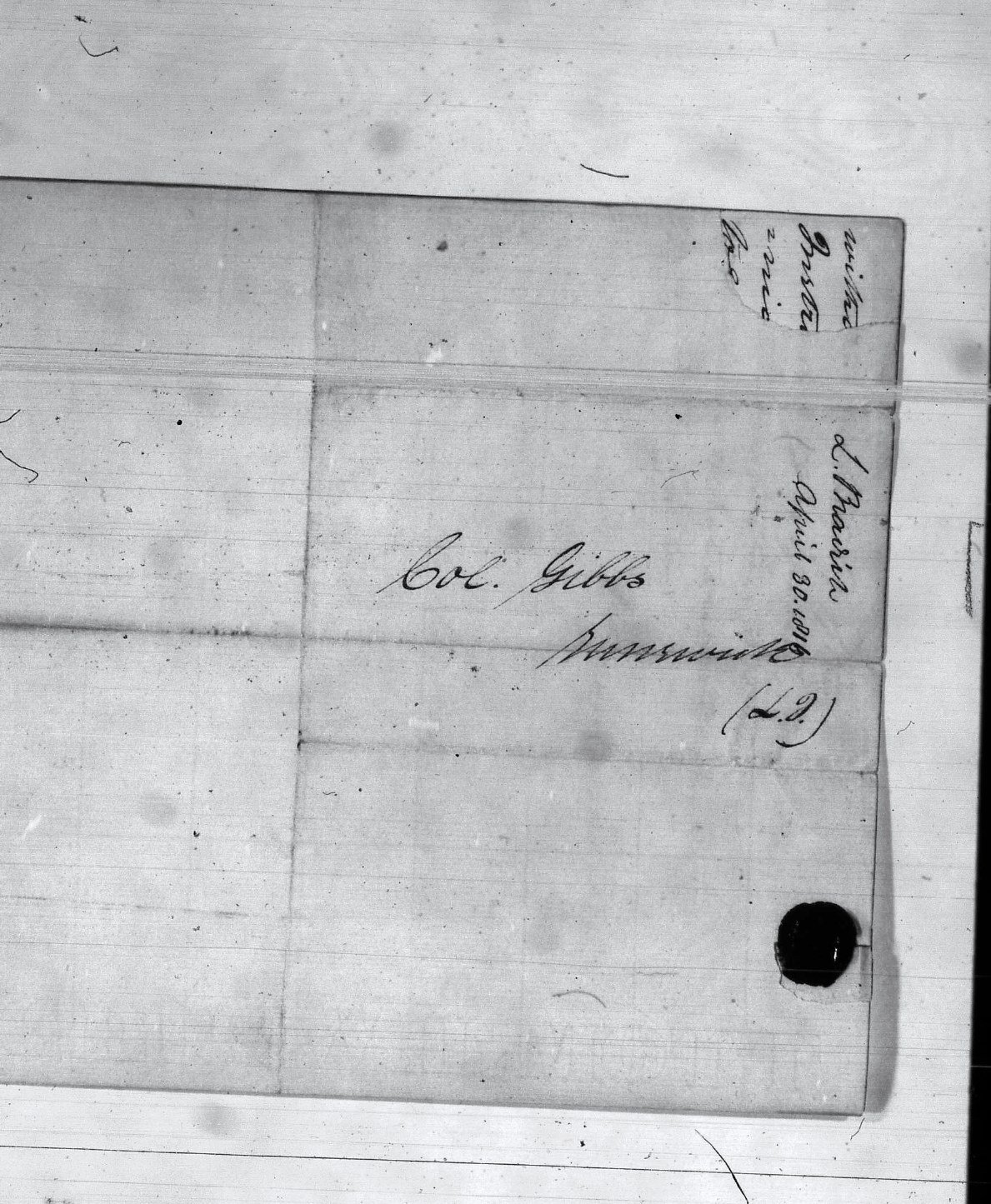
The story begins with the letter of April 30, 1816, in which the widowed Luther Bradish disclosed the sealed will to the family and awaited their wishes; that letter is exhibited on Col. George Gibbs’s page. Under the common law of coverture a married woman — a feme covert — generally could not devise real estate, and whether the statutes of the several states had changed that varied from Boston to Philadelphia. So the family did what careful families did: they bought the best legal minds available. Horace Binney of Philadelphia answered on July 10; James Gould, co-proprietor of the Litchfield Law School, answered on July 25. Their opinions, preserved among the family papers, are a window into what the law of 1816 made of a woman’s last wishes.
And they disagree. Binney, taking the Pennsylvania property, holds that Helen did not die intestate: equity will enforce the informal marriage agreement and “compel her heir at law to convey to her devisee,” and he sketches the practical conveyance to make it stick. Gould, taking New York, Rhode Island, and Massachusetts, finds the opposite on the decisive point: “there has been no settlement made, nor even an agreement to make one,” Mr. Bradish “never had himself the power” to authorize his wife’s devise, and the will is void in law and equity, though on Massachusetts he confesses himself “by no means free from doubt.” Each declined the other’s ground: Gould’s postscript begs off the Pennsylvania question that Binney answers. Two of the best lawyers in America, one dead woman’s wishes, and no agreement even on whether an agreement existed.
Mr. Binney’s Opinion 
Philadelphia, July 10, 1816
Horace Binney, the great Philadelphia counsel, takes the question first for the Pennsylvania property: what happens if Helen’s will fails and she is held to have died intestate, and what a Pennsylvania precedent from his own reports says about a married woman’s conveyance.
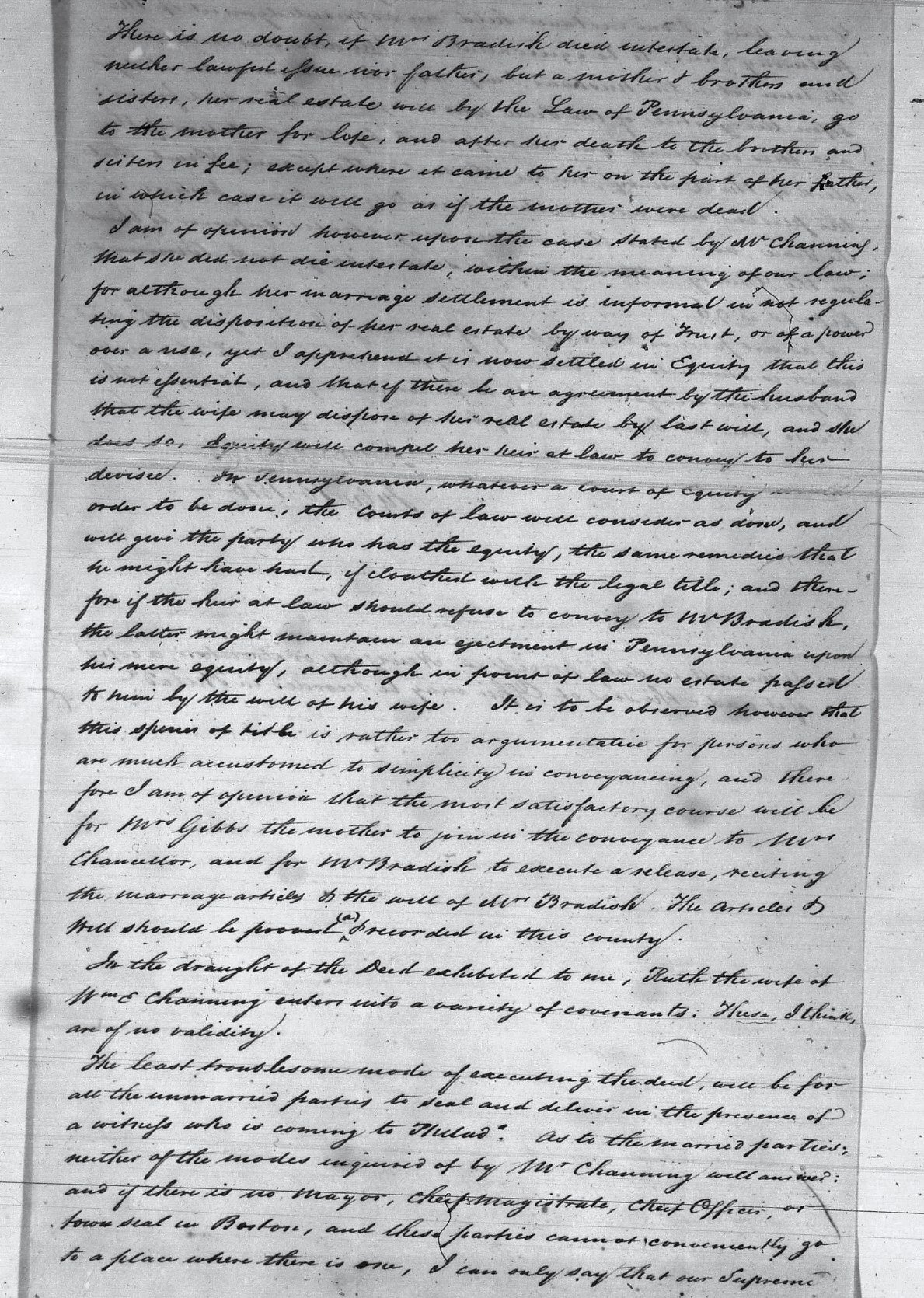
There is no doubt, if Mrs Bradish died intestate, leaving neither lawful issue nor father, but a mother & brothers and sisters, her real estate will by the Law of Pennsylvania, go to the mother for life, and after her death to the brothers and sisters in fee; except where it came to her on the part of her father, in which case it will go as if the mother were dead.
I am of opinion however upon the case stated by Mr Channing, that she did not die intestate, within the meaning of our law; for although her marriage settlement is informal in not regulating the disposition of her real estate by way of Trust, or of a power over a use, yet I apprehend it is now settled in Equity that this is not essential, and that if there be an agreement by the husband that the wife may dispose of her real estate by last will, and she does so, Equity will compel her heir at law to convey to her devisee. In Pennsylvania, whatever a Court of Equity would order to be done, the Courts of law will consider as done, and will give the party who has the equity, the same remedies that he might have had, if clothed with the legal title; and therefore if the heir at law should refuse to convey to Mr Bradish, the latter might maintain an ejectment in Pennsylvania upon his mere equity, although in point of law no estate passed to him by the will of his wife. It is to be observed however that this species of title is rather too argumentative for persons who are much accustomed to simplicity in conveyancing, and therefore I am of opinion that the most satisfactory course will be for Mrs Gibbs the mother to join in the conveyance to Mr[?] Chancellor, and for Mr Bradish to execute a release, reciting the marriage articles & the will of Mrs Bradish. The Articles & Will should be proved (a) & recorded in this county.
In the draught of the Deed exhibited to me, Ruth the wife of Wm E Channing enters into a variety of covenants: These, I think, are of no validity.
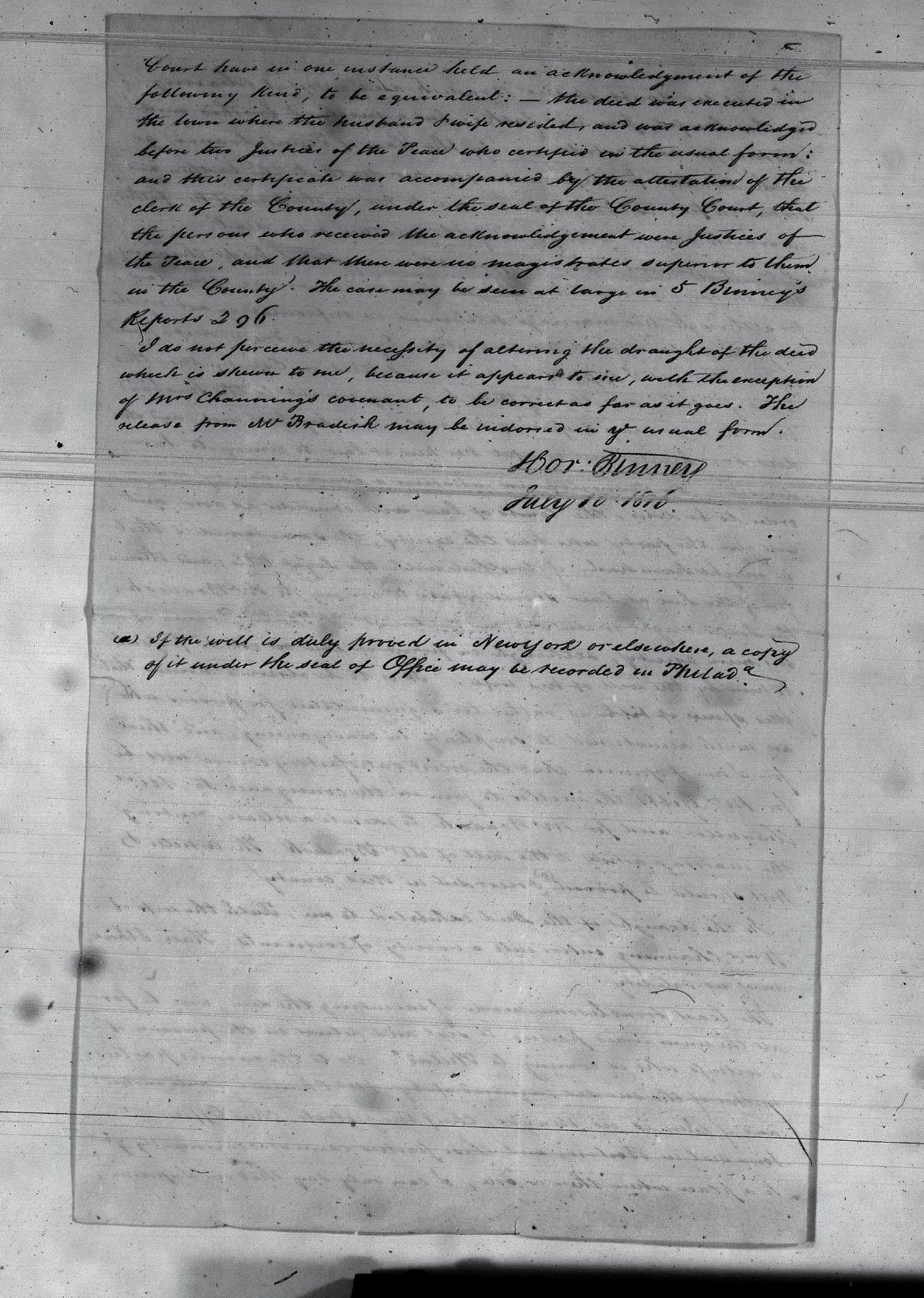
The least troublesome mode of executing the deed, will be for all the unmarried parties to seal and deliver in the presence of a witness who is coming to Philada. As to the married parties: neither of the modes inquired of by Mr Channing will answer: and if there is no Mayor, Chief Magistrate, Chief Officer, or town seal in Boston, and these parties cannot conveniently go to a place where there is one, I can only say that our Supreme Court have in one instance held an acknowledgment of the following kind, to be equivalent: — the deed was executed in the town where the husband & wife resided, and was acknowledged before two Justices of the Peace who certified in the usual form: and this certificate was accompanied by the attestation of the clerk of the County, under the seal of the County Court, that the persons who received the acknowledgment were Justices of the Peace, and that there were no magistrates superior to them in the County. The case may be seen at large in 5 Binney’s Reports 296.
I do not perceive the necessity of altering the draught of the deed which is shewn to me, because it appears to me, with the exception of Mrs Channing’s covenant, to be correct as far as it goes. The release from Mr Bradish may be indorsed in ye usual form.
Hor: Binney July 10 1816
[Note in Binney’s hand at the foot of scan 390, keyed to the mark (a) interlined on scan 389:] (a) If the will is duly proved in New York or elsewhere, a copy of it under the seal of Office may be recorded in Philada.
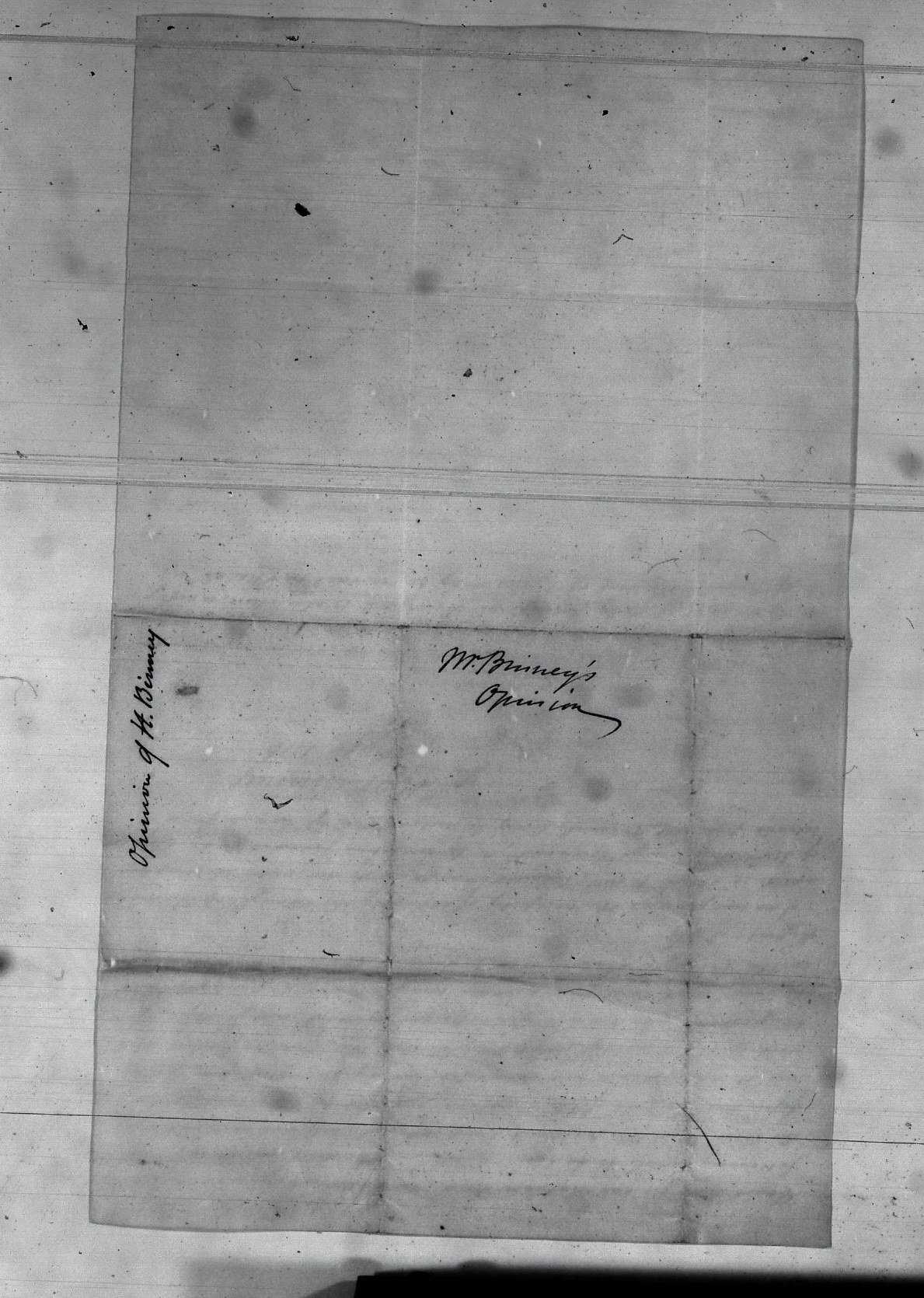
[Docket leaf, scan 391, center panel:] Mr Binney’s Opinion
[Docket leaf, scan 391, written vertically along the left edge:] Opinion of H. Binney
Transcribed verbatim from the scans, keeping the original spelling, capitalization, and punctuation; bracketed words are interlineations or uncertain readings, and [illegible] marks passages lost to the film. Condition: A fluent professional legal hand, fully legible with the aid of context; the opinion opens directly with no salutation, and the sentence beginning ‘The least troublesome mode’ breaks across the page turn 389/390 at ‘our Supreme / Court’ (rendered joined). One reading flagged: the honorific before ‘Chancellor’ (the grantee of the proposed conveyance, scan 389) is written with a terminal flourish and could read either ‘Mr’ or ‘Mrs’; rendered ‘Mr[?]’. The word ‘father’ at the end of the sixth line of scan 389 carries a horizontal stroke through it; since the sense of the intestacy rule requires the word (‘except where it came to her on the part of her father’), the stroke is read as a pen-drag or one of the microfilm scratch-lines that cross the full frame at several points on both text pages, not an authorial deletion ~~ no certain strikeouts appear in the document. The reference mark ‘(a)’ after ‘proved’ on scan 389 is a caret-interlined addition answered by Binney’s own footnote at the foot of scan 390. ‘Philada’ is written both times with a raised terminal a (rendered Philada.); ‘ye’ in the closing paragraph is the manuscript thorn-abbreviation for ‘the’; ‘shewn’ and ‘draught’ are the writer’s spellings, kept. The signature ‘Hor: Binney’ and the date line ‘July 10 1816’ below it are badly faded on the film but confident; the citation ‘5 Binney’s Reports 296’ is Binney citing the volume of Pennsylvania Supreme Court reports he himself compiled. Scan 390 shows heavy bleed-through of the scan-389 text (verso of the same leaf); the lower two-thirds of the page is blank. Scan 391 is the blank outer fold of the docket leaf bearing only the two endorsements transcribed above, in two different hands.
Gibbs Family Papers, Wisconsin Historical Society, Reel 1, scans 389–391. Legal opinion of Horace Binney on the estate of Helen Elizabeth (Gibbs) Bradish, with its docket. Digitized from the microfilm by this site; transcribed in full above.
Judge Gould’s Opinion 
Litchfield, July 25, 1816
Fifteen days later, James Gould of the Litchfield Law School delivers the fuller treatment: personal property follows the owner’s domicile; New York and Rhode Island lands are covered by express statute; but under the Massachusetts statute he inclines to hold that a married woman could not devise her real estate at all, and in equity the will cannot stand as an appointment, for “there has been no settlement made, nor even an agreement to make one.” The reel preserves pages 1 and 4 through 8; pages 2 and 3 were not filmed, and the gap is marked where it falls.
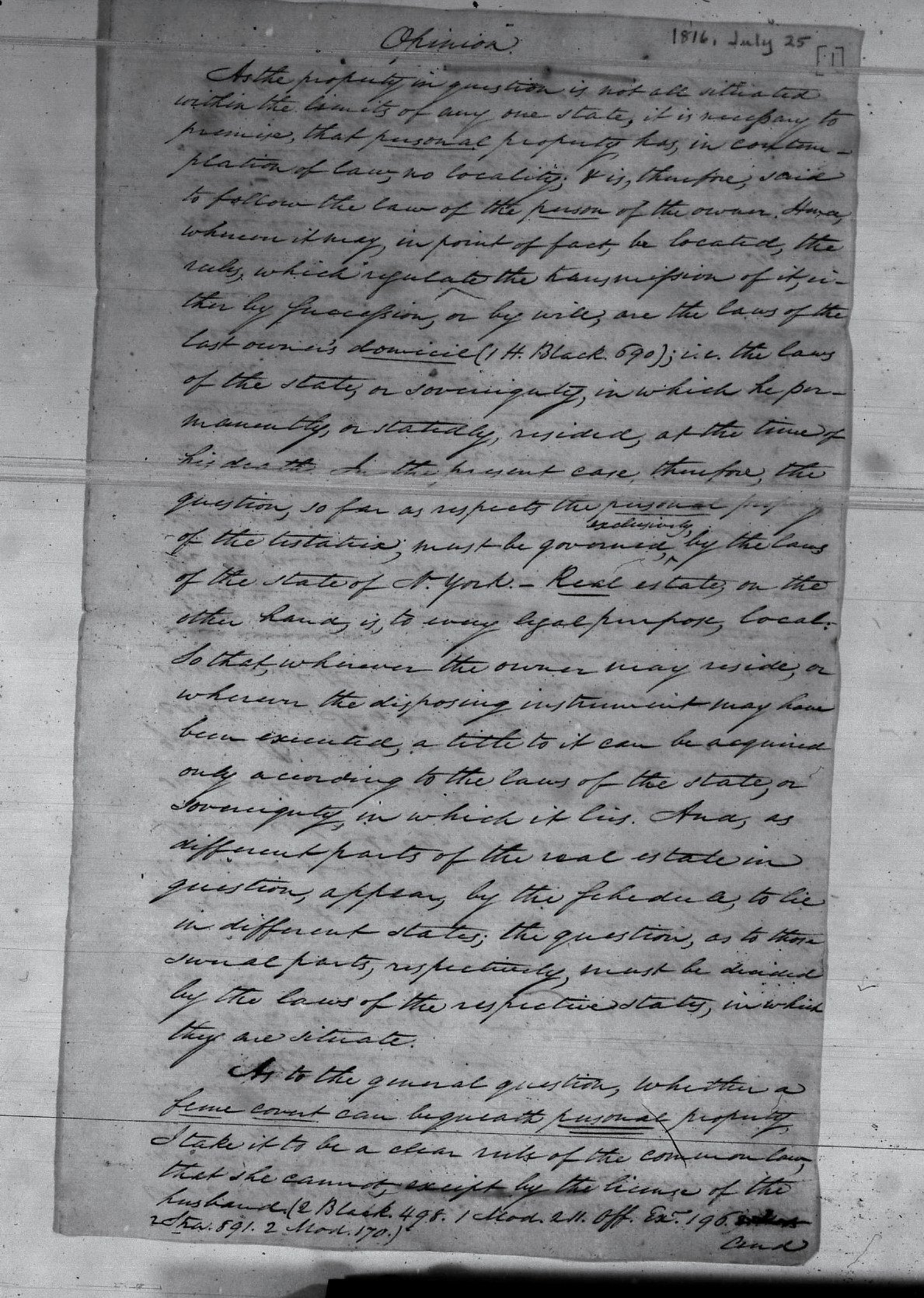
Opinion.
As the property in question is not all situated within the limits of any one state, it is necessary to premise, that personal property has, in contemplation of law, no locality; & is, therefore, said to follow the law of the person of the owner. Hence, wherever it may, in point of fact, be located, the rules, which regulate the transmission of it, either by succession, or by will, are the laws of the last owner’s domicil (1 H. Black. 690); i.e. the laws of the state, or sovereignty, in which he permanently, or statedly, resided, at the time of his death. In the present case, therefore, the question, so far as respects the personal property of the testatrix, must be governed exclusively by the laws of the state of N. York. — Real estate, on the other hand, is, to every legal purpose, local: So that, wherever the owner may reside, or wherever the disposing instrument may have been executed, a title to it can be acquired only according to the laws of the state, or sovereignty, in which it lies. And, as different parts of the real estate in question, appear, by the schedule, to lie in different states; the question, as to those several parts, respectively, must be decided by the laws of the respective states, in which they are situate.
As to the general question, whether a feme covert can bequeath personal property, I take it to be a clear rule of the common law, that she cannot, except by the license of the husband (2 Black. 498. 1 Mod. 211. Off. Ex. 196. [struck: illegible] 2 Stra.[?] 891. 2 Mod. 170.) [catchword: And]
[Pages 2 and 3 of the manuscript were not filmed; the reel resumes at page 4, mid-argument.]
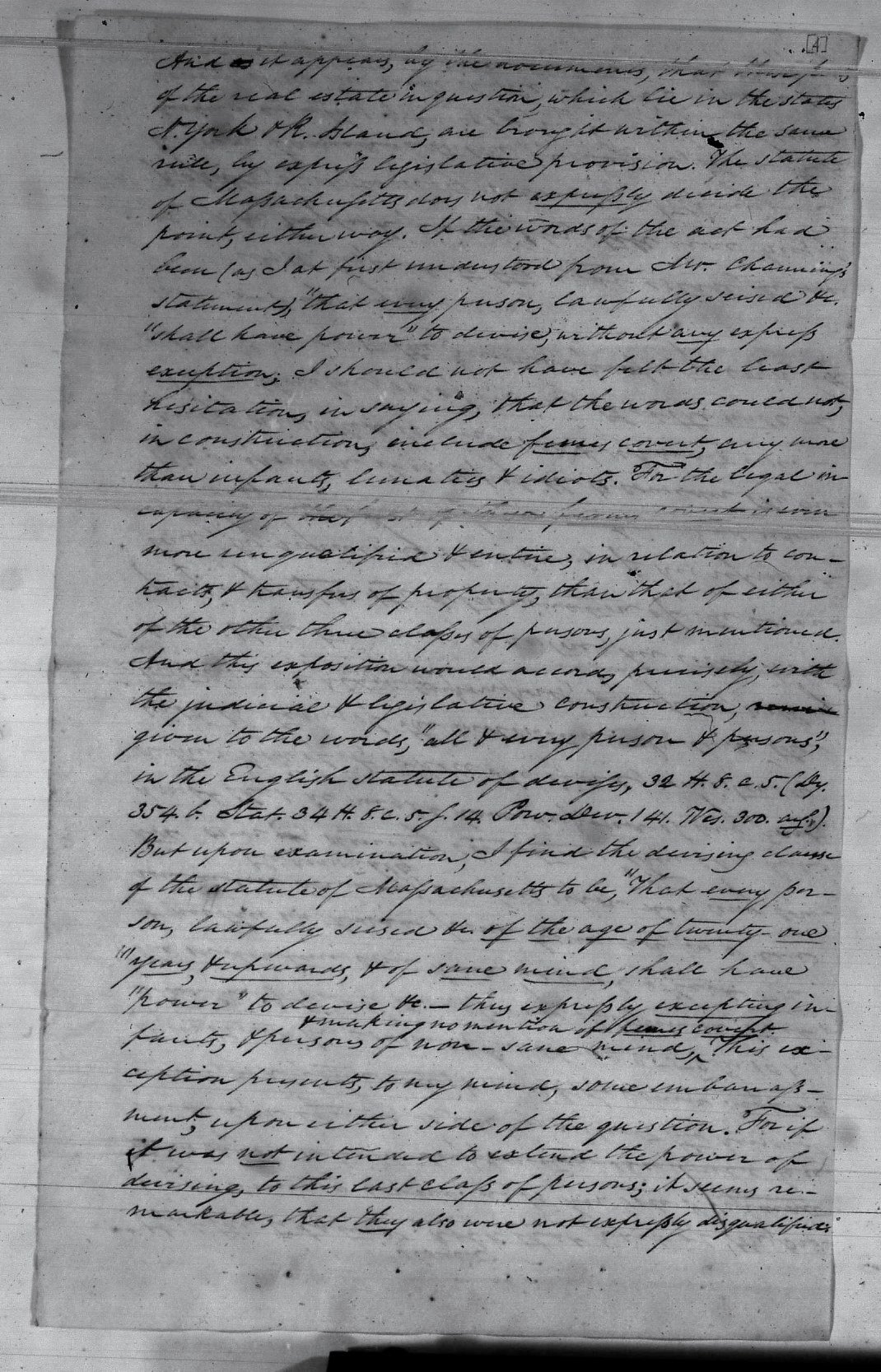
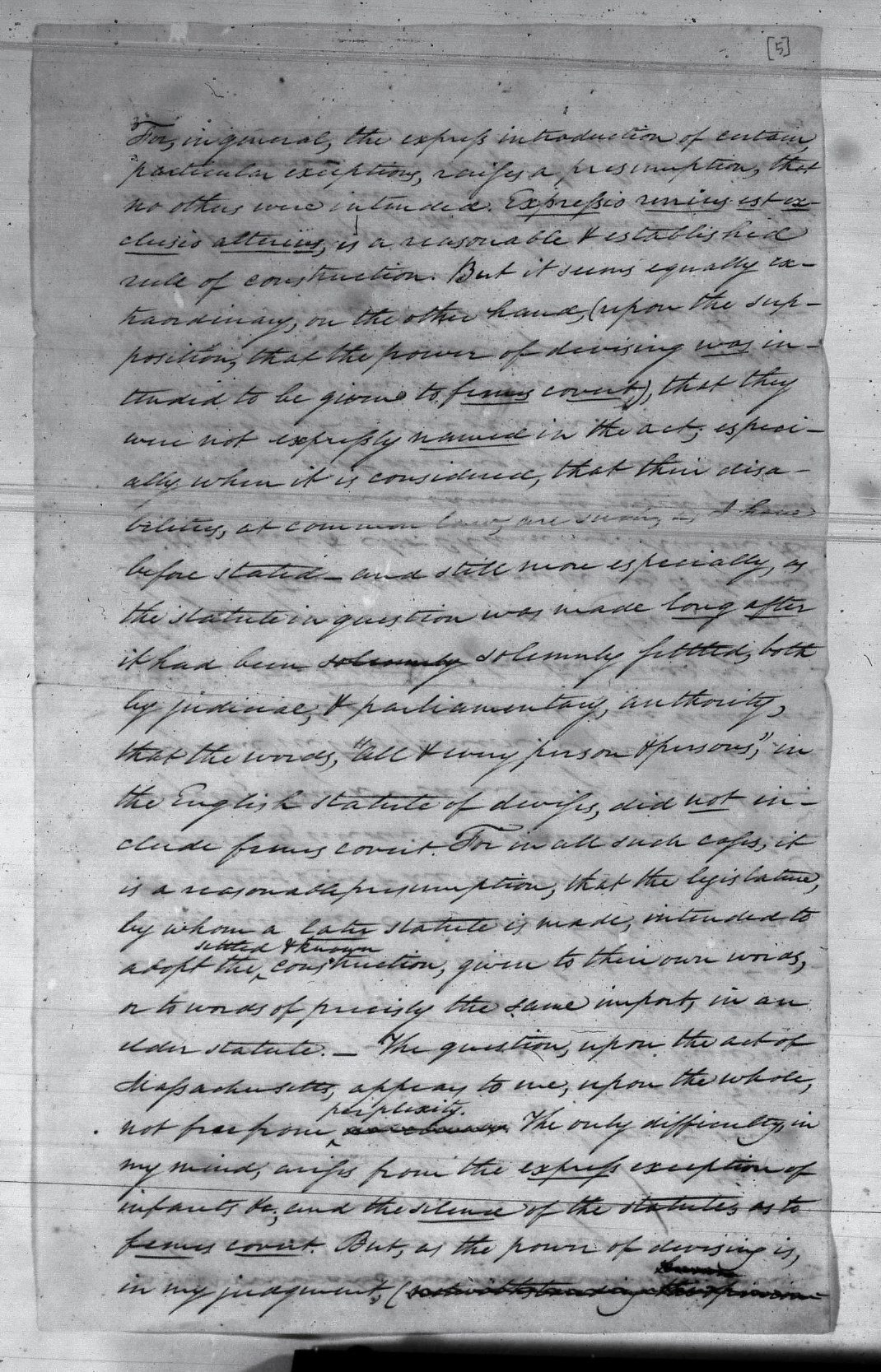
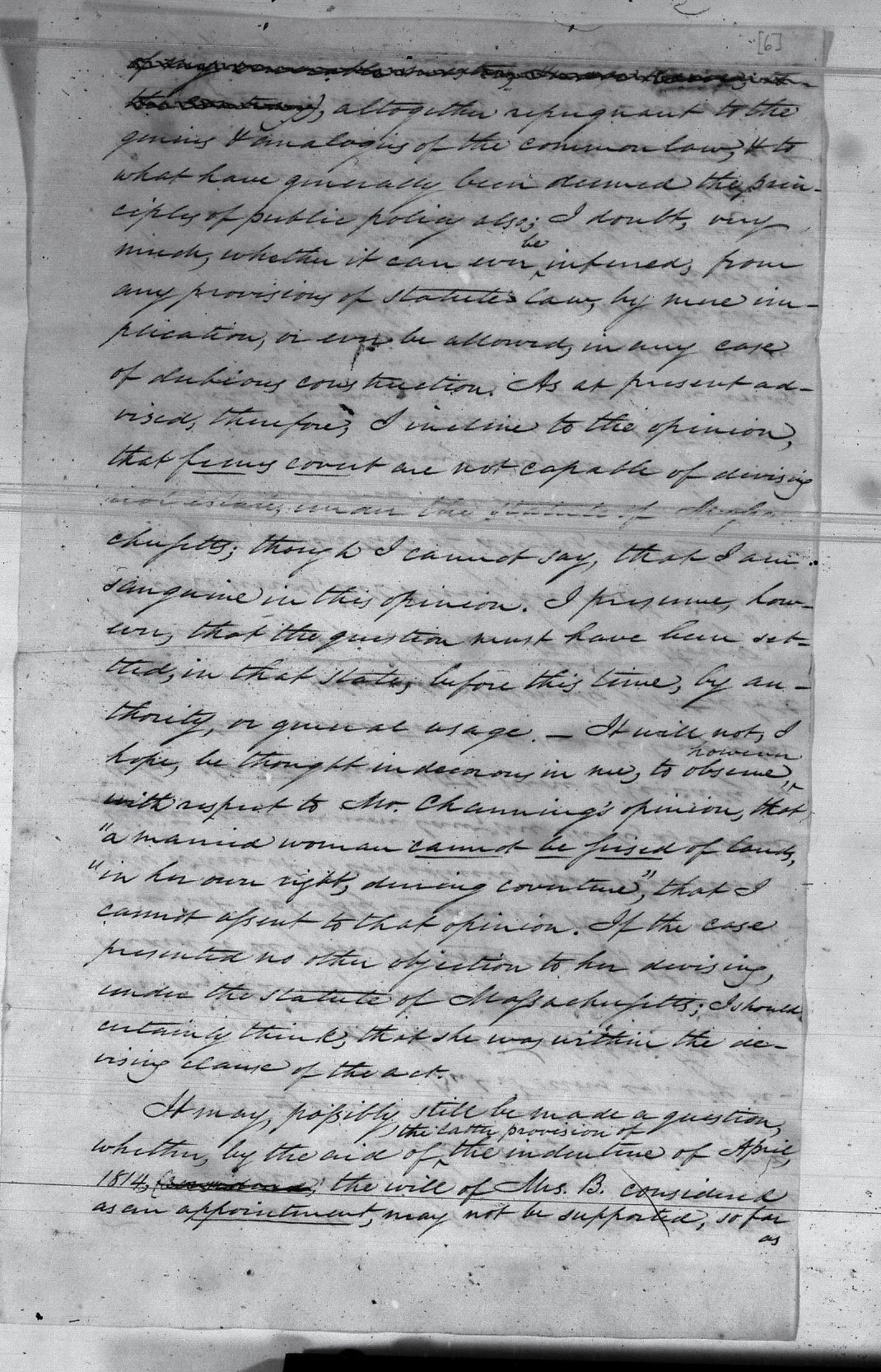
And it appears, by the documents, that those parts of the real estate in question, which lie in the states of N. York & Rh. Island, are brought within the same rule, by express legislative provision. The statute of Massachusetts does not expressly decide the point, either way. If the words of the act had been (as I at first understood from Mr. Channing’s statement), “that every person, lawfully seised &c. shall have power” to devise, without any express exception; I should not have felt the least hesitation, in saying, that the words could not, in construction, include femes covert, any more than infants, lunatics & idiots. For the legal incapacity of [struck: illegible] femes covert is even more unqualified & entire, in relation to contracts, & transfers of property, than that of either of the other three classes of persons, just mentioned. And this exposition would accord, precisely, with the judicial & legislative construction, [struck: illegible] given to the words, “all & every person & persons”, in the English statute of devises, 32 H. 8. c. 5. (Dy. 354. b. Stat. 34 H. 8. c. 5. s. 14. Pow. Dev. 141. Ves.[?] 300. arg.) But upon examination, I find the devising clause of the statute of Massachusetts to be, “That every person, lawfully seised &c. of the age of twenty-one years, & upwards, & of sane mind, shall have power” to devise &c. — thus expressly excepting infants, & persons of non-sane mind, & making no mention of femes covert. This exception presents, to my mind, some embarrassment, upon either side of the question. For if it was not intended to extend the power of devising, to this last class of persons; it seems remarkable, that they also were not expressly disqualified: For, in general, the express introduction of certain particular exceptions, raises a presumption, that no others were intended. Expressio unius est exclusio alterius, is a reasonable & established rule of construction. But it seems equally extraordinary, on the other hand, (upon the supposition, that the power of devising was intended to be given to femes covert), that they were not expressly named in the act; especially, when it is considered, that their disabilities, at common law, are [illegible], as I have before stated — and still more especially, as the statute in question was made long after it had been [struck: solemnly] solemnly settled, both by judicial, & parliamentary, authority, that the words, “all & every person & persons,” in the English statute of devises, did not include femes covert. For in all such cases, it is a reasonable presumption, that the legislature, by whom a later statute is made, intended to adopt the settled & known construction, given to their own words, or to words of precisely the same import, in an elder statute. — The question, upon the act of Massachusetts, appears to me, upon the whole, not free from [struck: illegible] perplexity. The only difficulty, in my mind, arises from the express exception of infants &c, and the silence of the statutes as to femes covert. But, as the power of devising is, in my judgment, [struck: parenthetical passage of some two lines, illegible, continuing at the head of page 6] altogether repugnant to the genius & analogies of the common law, & to what have generally been deemed the principles of public policy also; I doubt, very much, whether it can ever be inferred, from any provisions of statute law, by mere implication, or ever be allowed, in any case of dubious construction. As at present advised, therefore, I incline to the opinion, that femes covert are not capable of devising real estate, under the statute of Massachusetts; though I cannot say, that I am sanguine in this opinion. I presume, however, that the question must have been settled, in that state, before this time, by authority, or general usage. — It will not, I hope, be thought indecorous in me, to observe, however, with respect to Mr. Channing’s opinion, that “a married woman cannot be seised of lands, in her own right, during coverture”, that I cannot assent to that opinion. If the case presented no other objection to her devising, under the statute of Massachusetts; I should certainly think, that she was within the devising clause of the act.
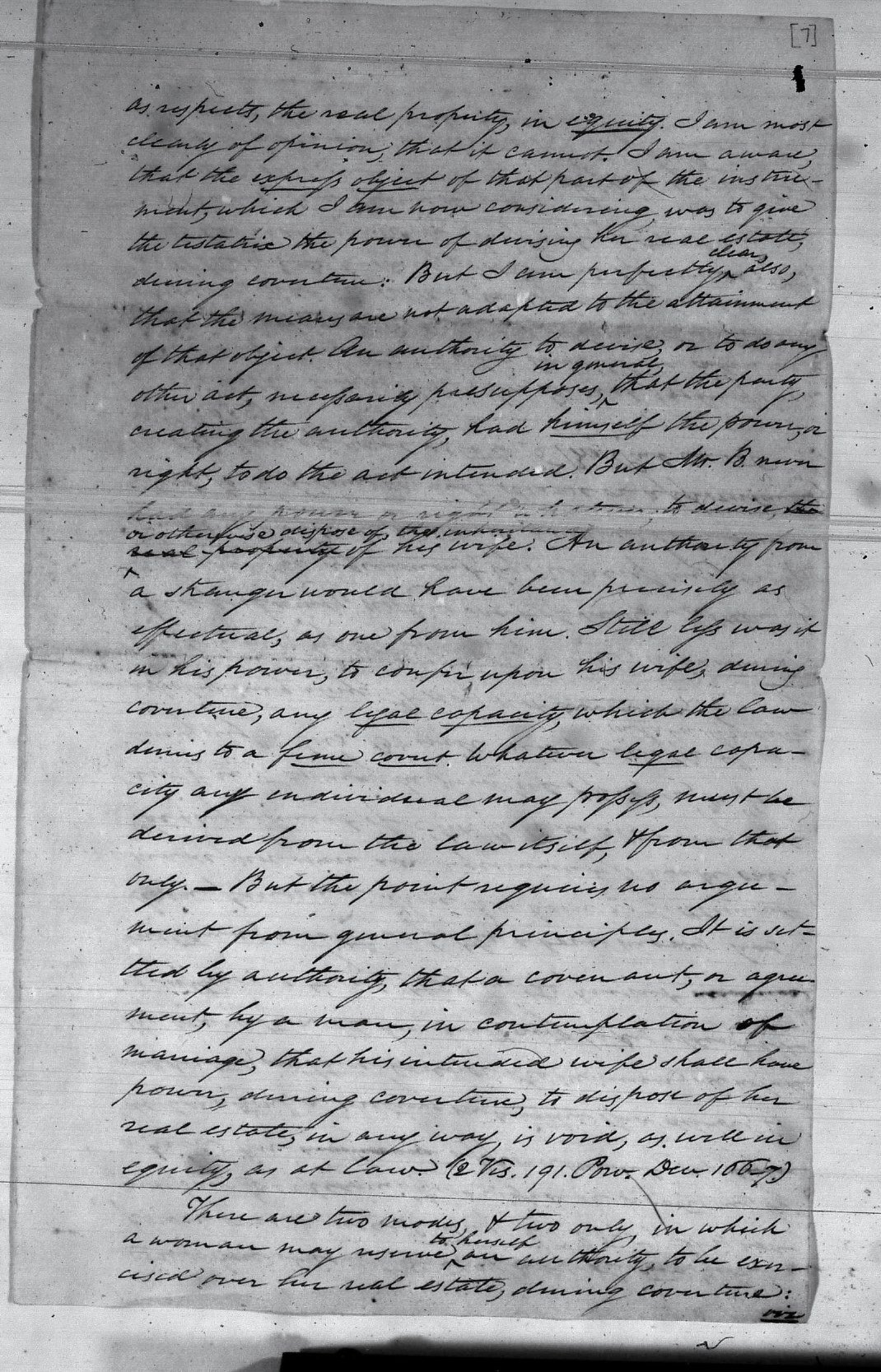
It may, possibly, still be made a question, whether, by the aid of the latter provision of the indenture of April, 1814, [struck: illegible]; the will of Mrs. B. considered as an appointment, may not be supported, so far as respects, the real property, in equity. I am most clearly of opinion; that it cannot. I am aware, that the express object of that part of the instrument, which I am now considering, was to give the testatrix the power of devising her real estate, during coverture: But I am perfectly clear, also, that the means are not adapted to the attainment of that object. An authority to devise, or to do any other act, necessarily presupposes, in general, that the party, creating the authority, had himself the power, or right, to do the act intended. But Mr. B. never had any power, or right, [illegible: line faded along a fold], to devise, or otherwise dispose of, the [illegible] [struck: real property] of his wife. An authority from a stranger would have been precisely as effectual, as one from him. Still less was it in his power, to confer, upon his wife, during coverture, any legal capacity, which the law denies to a feme covert. Whatever legal capacity any individual may possess, must be derived from the law itself, & from that only. — But the point requires no argument from general principles. It is settled by authority, that a covenant, or agreement, by a man, in contemplation of marriage, that his intended wife shall have power, during coverture, to dispose of her real estate, in any way, is void, as well in equity, as at law. (2 Ves. 191. Pow. Dev. 166. 7.)
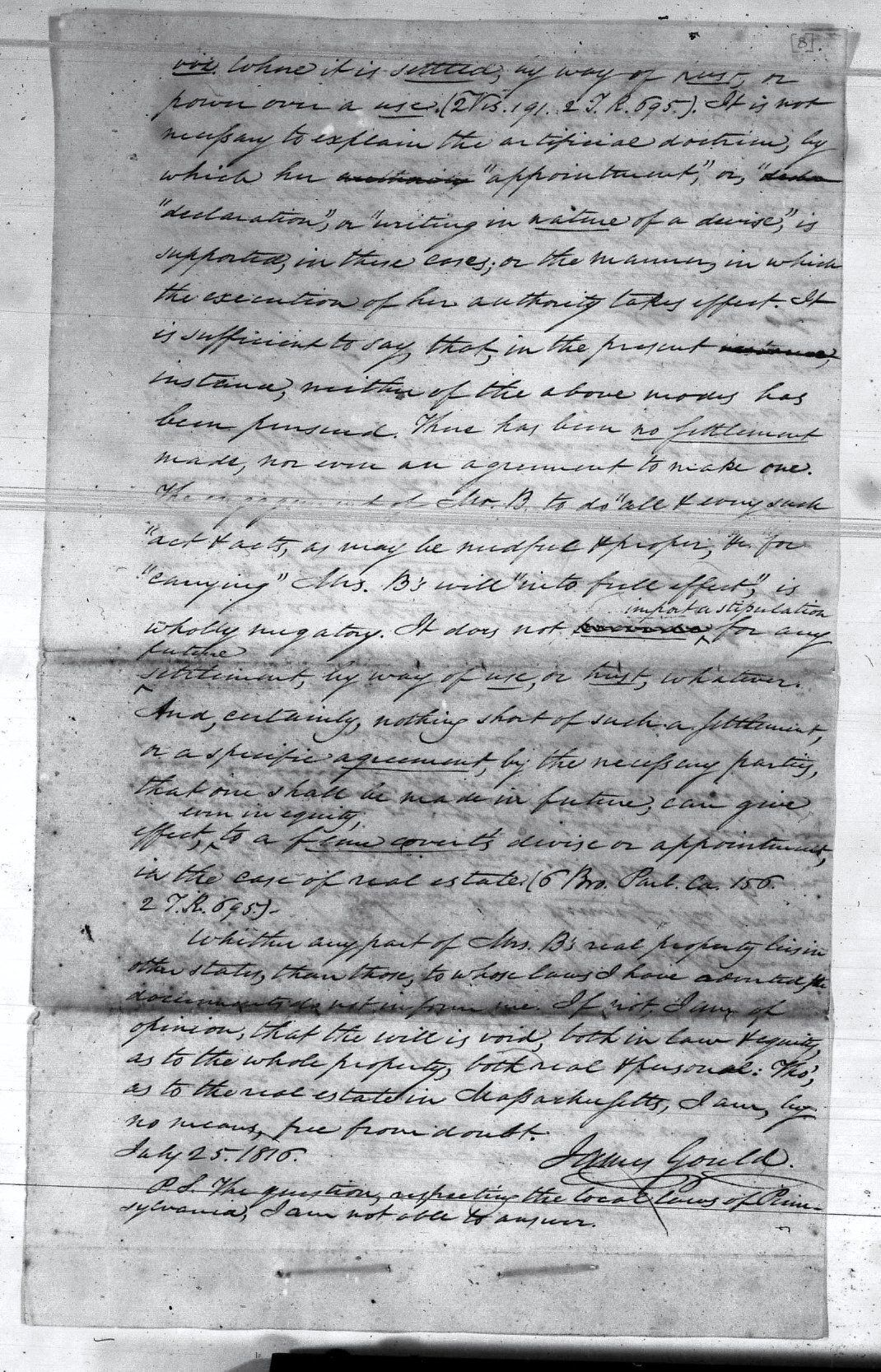
There are two modes, & two only, in which a woman may reserve to herself an authority, to be exercised over her real estate, during coverture: viz. Where it is settled, by way of trust, or power over a use (2 Ves. 191. 2 T. R. 695). It is not necessary to explain the artificial doctrine, by which her [struck: authority] “appointment”, or, [struck: decla] “declaration”, or “writing in nature of a devise,” is supported, in these cases; or the manner, in which the execution of her authority takes effect. It is sufficient to say, that, in the present [struck: instance] instance, neither of the above modes has been pursued. There has been no settlement made, nor even an agreement to make one. The engagement[?] of Mr. B. to do “all & every such act & acts, as may be needful & proper,” &c. for “carrying” Mrs. B’s will “into full effect”, is wholly nugatory. It does not [struck: illegible] import a stipulation for any future settlement, by way of use, or trust, whatever. And, certainly, nothing short of such a settlement, or a specific agreement, by the necessary parties, that one shall be made in future, can give effect, even in equity, to a feme covert’s devise or appointment, in the case of real estate. (6 Bro. Parl. Ca. 156. 2 T. R. 695.)
Whether any part of Mrs. B’s real property lies in other states, than those, to whose laws I have adverted, the documents do not inform me. If not, I am of opinion, that the will is void, both in law & equity, as to the whole property, both real & personal: Tho’, as to the real estate in Massachusetts, I am, by no means, free from doubt.
July 25. 1816. — James Gould.
P.S. The question, respecting the local laws of Pennsylvania, I am not able to answer.
Transcribed verbatim from the scans, keeping the original spelling, capitalization, and punctuation; bracketed words are interlineations or uncertain readings, and [illegible] marks passages lost to the film. Condition: Manuscript pages bear bracketed reel numbers [1], [4], [5], [6], [7], [8]; pages 2-3 were not filmed and the gap is marked with a subhead where it falls. A filing docket ‘1816, July 25’ appears at the upper right of page 1. Catchwords at page feet (‘And’ p.1, ‘as’ p.6, ‘viz’ p.7) are not duplicated into the following page’s text; the ‘And’ catchword on page 1 points into the missing page 2. Horizontal fold/ink-transfer bands cross every leaf and fade one line on each of pages 4, 5, 7 and 8; affected readings are flagged [illegible] or [?]. Page 6 opens with roughly two heavily struck lines (a discarded parenthetical begun at the foot of page 5), marked as a strikeout. Reporter abbreviations flagged with [?]: ‘2 Stra.[?] 891’ (p.1) and ‘Ves.[?] 300. arg.’ (p.4) are uncertain; ’32 H. 8. c. 5.’ is transcribed as written though the English statute of wills is 32 H. 8. c. 1. Line-initial continuation quotation marks in the manuscript’s quoted matter were not reproduced. Gould’s underscorings (personal, domicil, Real, feme covert, expressly, exception, Expressio unius est exclusio alterius, named, not, was, long after, no settlement, use, trust, appointment, etc.) are not marked in this transcription. Interlined insertions (‘exclusively’, ‘be’, ‘in general’, ‘settled & known’, ‘perplexity’, ‘& making no mention of femes covert’, ‘import a stipulation’, ‘future’, ‘even in equity’, ‘to herself’, ‘the latter provision of’, ‘however’) are incorporated silently at their marked positions.
Gibbs Family Papers, Wisconsin Historical Society, Reel 1, scans 392–397; pages 2 and 3 of the opinion were not filmed on the reel. Legal opinion of James Gould on the will of Helen Elizabeth (Gibbs) Bradish. Digitized from the microfilm by this site; the surviving pages transcribed in full above.
A document story of the Gibbs Archive on AlfredGibbs.com, published July 13, 2026. Every document is shown with its complete verbatim transcription. Related: Col. George Gibbs and the Reel 1 Papers (the Bradish death letter) · The Gibbs Family Papers.
Views: 10