Wolcott to Quincy: A Federalist Correspondence, 1801–1808
The Gibbs Archive · Reel 1 Document Series
Wolcott to Quincy: A Federalist Correspondence
Twelve letters, 1801–1808 · complete verbatim transcriptions
Alfred Gibbs’s grandfather kept up a running political correspondence with Josiah Quincy, the young Federalist congressman from Massachusetts, through the Jefferson years: Louisiana, the Burr election, Jefferson’s reelection, appropriations, the coming storm at sea, and the death of Fisher Ames. The letters survive in the family papers, some in Wolcott’s own hand and some in early typescripts, and are published here in full.
These letters came down through Wolcott’s daughter Laura Wolcott Gibbs, the General’s mother, and were microfilmed with the family papers now at the Wisconsin Historical Society. They are the private voice of a man who had run the Treasury under Washington and Adams, watching the opposition years from New York. Twelve are presented here, everything of the series so far found on the reel; two survive only as fragments, and the gaps are marked where the film left them. More will be added as transcription continues. For Wolcott’s family letters, see his archive hub and his biography.
“An Approaching Political Earthquake” 
Litchfield, October 8, 1801
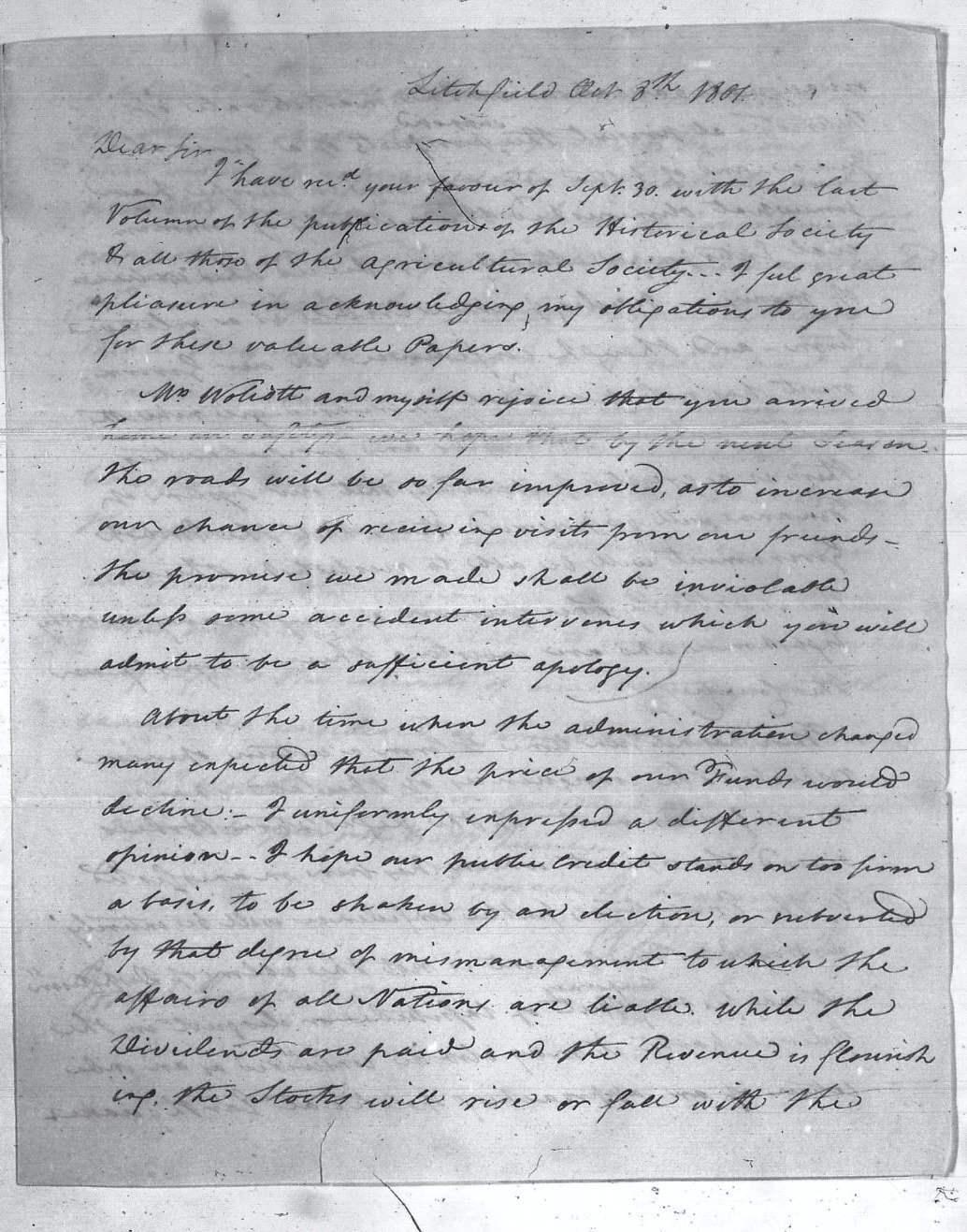
The earliest letter of the series, and the only one the reel preserves twice: in Wolcott’s own hand and in the early typescript a later generation made from it. Seven months into Jefferson’s presidency, Wolcott reads the political calm as “the temporary effect of lassitude” and possibly the sign of an approaching political earthquake. The autograph is transcribed in full; the typescript is collated against it below.
Dear Sir,
I have recd. your favour of Sept. 30. with the last Volumn of the publications of the Historical Society & all those of the agricultural Society — I feel great pleasure in acknowledging, my obligations to you for these valeable Papers.
Mrs Wolcott and myself rejoice that you arrived home in safety — we hope that by the next Season, the roads will be so far improved, as to increase our chance of receiving visits from our friends — The promise we made shall be inviolable unless some accident intervenes which you will admit to be a sufficient apology.
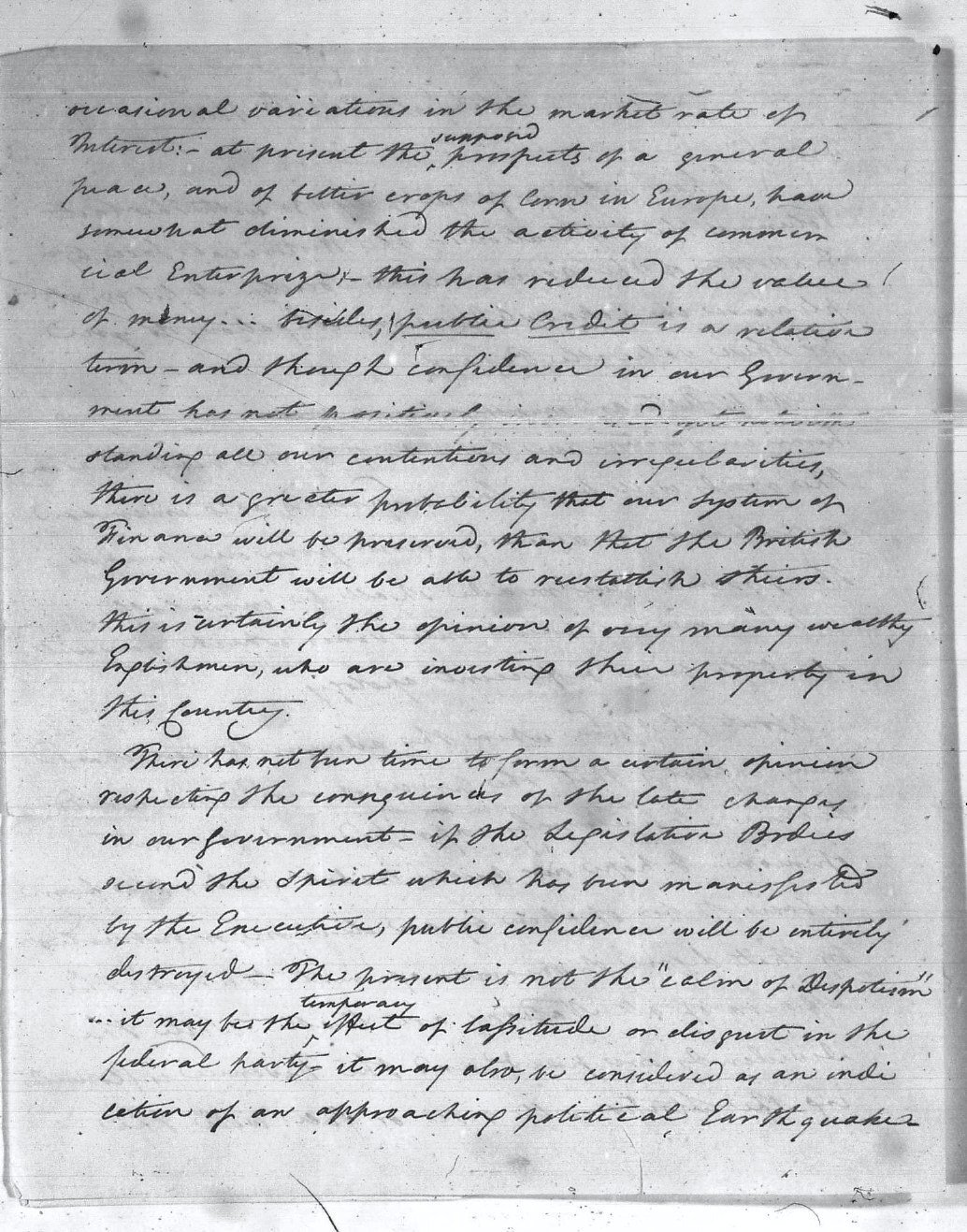
About the time when the administration changed many expected that the price of our Funds would decline: — I uniformly expressed a different opinion — I hope our public Credit stands on too firm a basis, to be shaken by an election, or subverted by that degree of mismanagement to which the affairs of all Nations are liable. While the Dividends are paid and the Revenue is flourishing, the Stocks will rise or fall with the occasional variations in the market rate of Interest: — at present the supposed prospects of a general peace, and of better crops of Corn in Europe, have somewhat diminished the activity of commercial Enterprize & this has reduced the value of money — besides, public Credit is a relative term — and though confidence in our Government has not positively increased[?], yet[?] notwithstanding all our contentions and irregularities, there is a greater probability that our system of Finance will be preserved, than that the British Government will be able to reestablish theirs. this is certainly the opinion of very many wealthy Englishmen, who are investing their property in this Country.
There has not been time to form a certain opinion respecting the consequences of the late changes in our Government — if the Legislative Bodies second the Spirit which has been manifested by the Executive, public confidence will be entirely destroyed — The present is not the “calm of Despotism” — it may be the temporary effect of lassitude or disgust in the federal party — it may also, be considered as an indication of an approaching political Earthquake
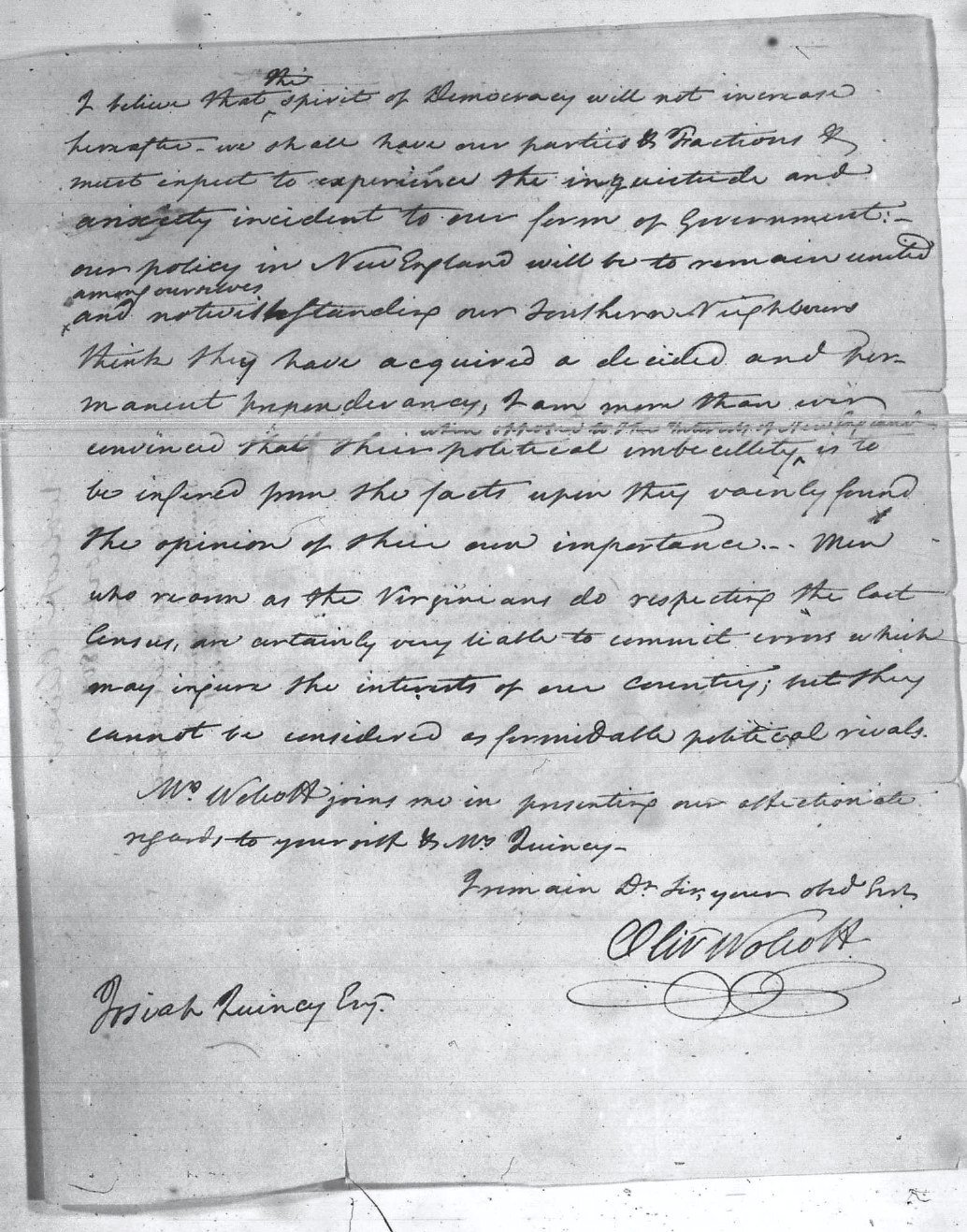
I believe that the spirit of Democracy will not increase hereafter — we shall have our parties & Factions & must expect to experience the inquietude and anxiety incident to our form of Government: — our policy in New England will be to remain united among ourselves and notwithstanding our Southern Neighbours think they have acquired a decided and permanent preponderancy, I am more than ever convinced that their political imbecility, when opposed to the interests of New England, is to be inferred from the facts upon they vainly found the opinion of their own importance — Men who reason as the Virginians do respecting the last census, are certainly very liable to commit errors which may injure the interests of our country; but they cannot be considered as formidable political rivals.
Mrs Wolcott joins me in presenting our affectionate regards to yourself & Mrs Quincy —
I remain Dr. Sir, your obdt. Servt. — Oliv Wolcott [signature with paraph flourish]
Josiah Quincy Esqr.
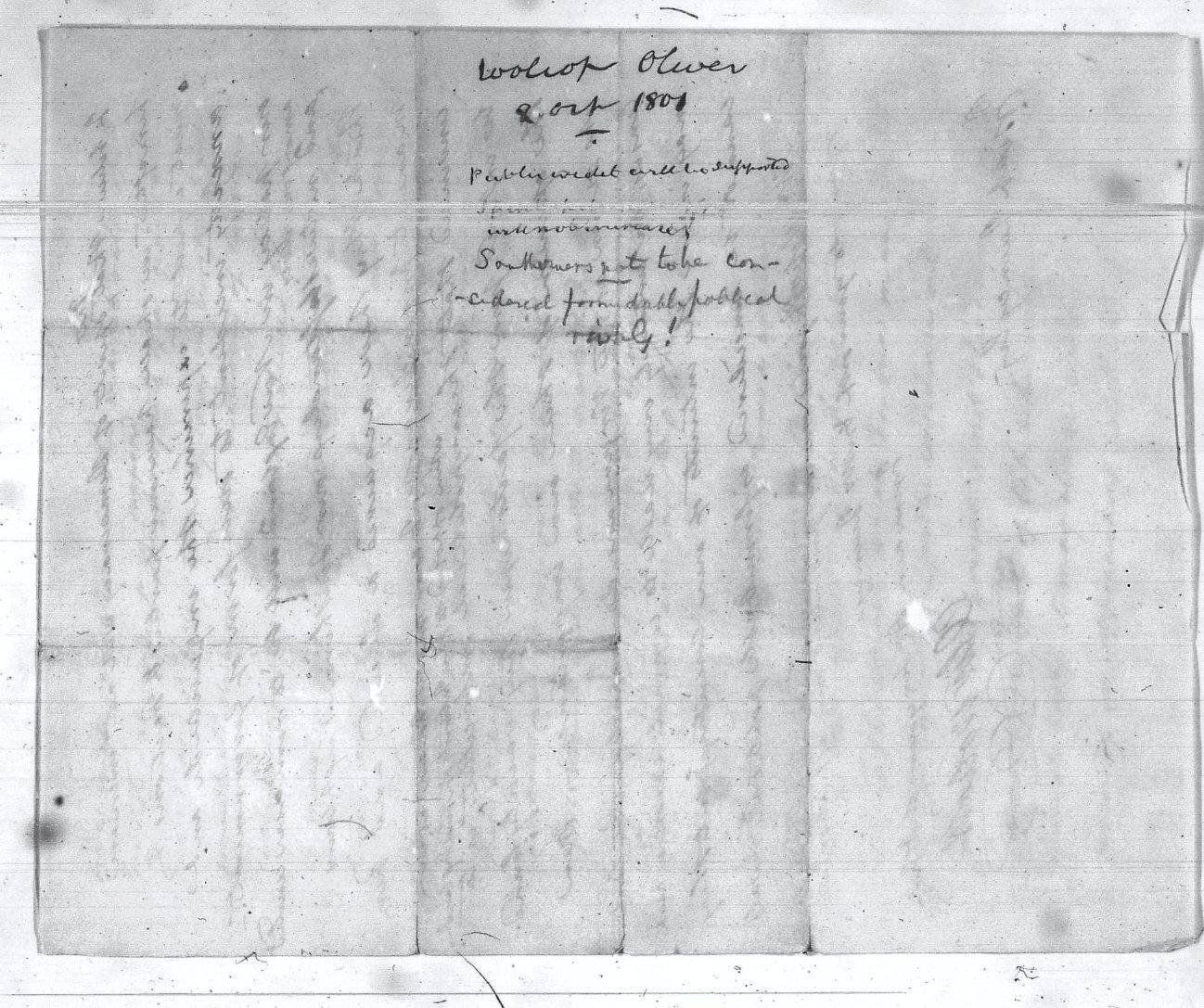
THE DOCKET LEAF (scan 138)
[endorsed on the folded address leaf, in a contemporary hand:] Wolcott Oliver / 8 Oct 1801
[summary notes below the endorsement:] Public credit will be supported / [one badly faded line, illegible — possibly a note on the spirit of Democracy] will not increase[?] / Southerners not to be con—sidered formidable political rivals!
THE TYPESCRIPT COPY (scans 133-134)
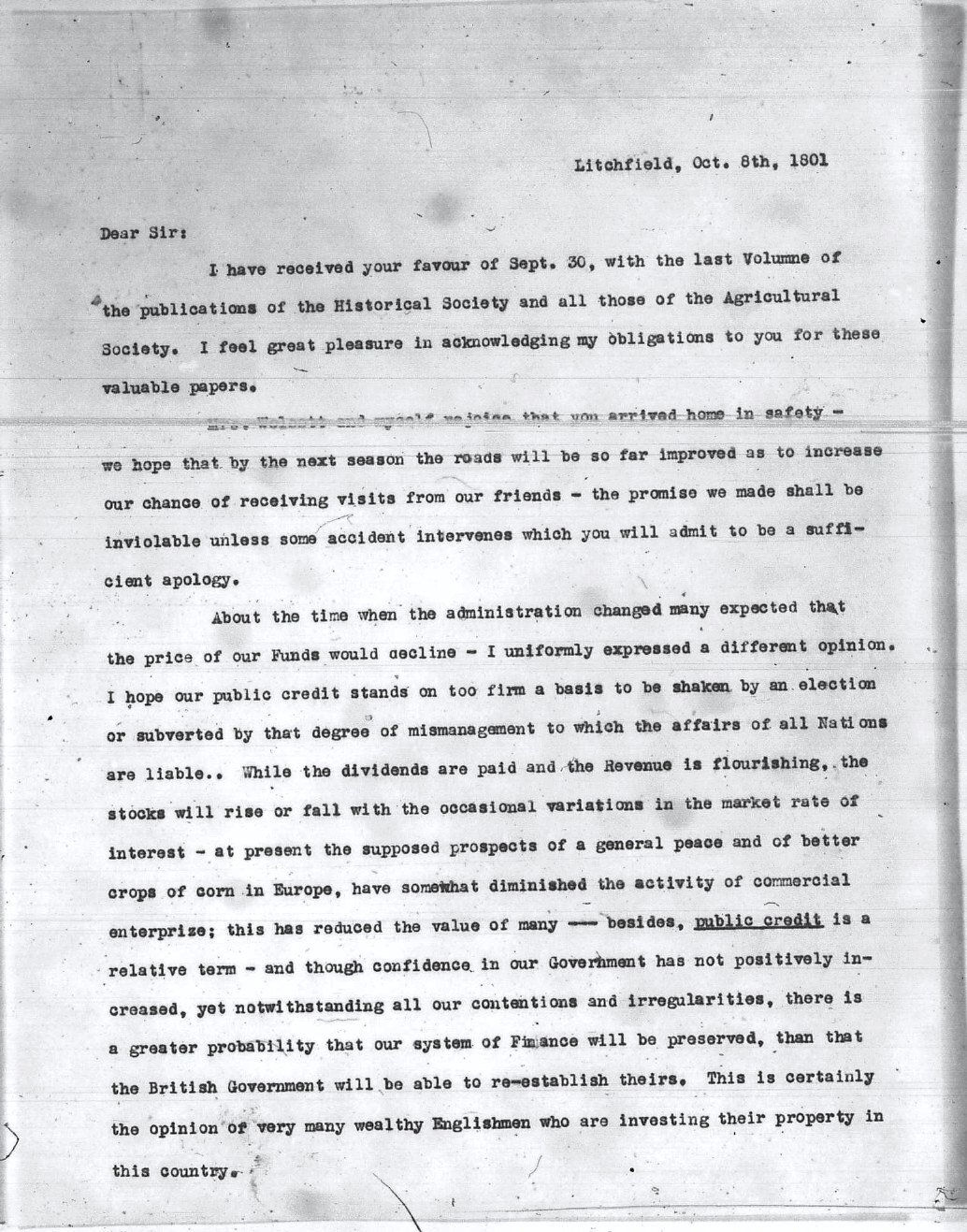
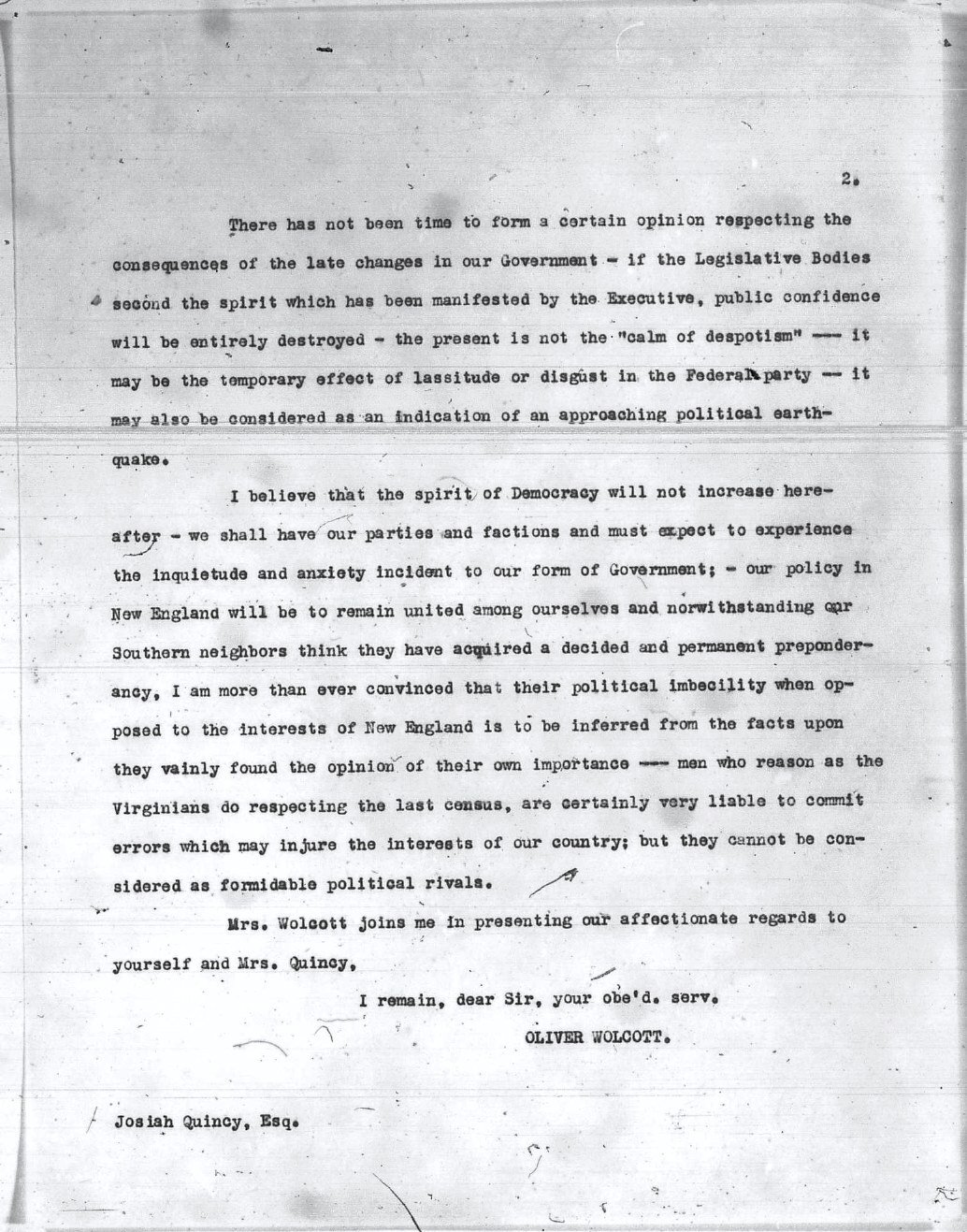
The reel also carries an early two-page typescript of this letter (headed “Litchfield, Oct. 8th, 1801”, signed in capitals “OLIVER WOLCOTT.”). It follows the autograph closely and silently incorporates all of Wolcott’s interlineations (“supposed,” “temporary,” “the” before “spirit,” “among ourselves,” and the inserted clause “when opposed to the interests of New England”). Wording differences worth recording:
— Typescript reads “this has reduced the value of many ———” where the autograph plainly reads “the value of money”: the typist misread the word and left a dash-filled gap.
— Typescript confirms the fold-damaged passage on autograph p. 2 as “has not positively increased, yet notwithstanding.”
— Typescript modernizes spellings and forms: “valuable papers” for “valeable Papers,” “Volumne” for “Volumn,” “Southern neighbors” for “Southern Neighbours,” “re-establish” for “reestablish,” “factions” for “Factions,” and a semicolon after “enterprize” where the autograph has an ampersand. It contains its own typo, “norwithstanding.”
— Typescript reproduces the autograph’s grammatical slip “the facts upon they vainly found the opinion of their own importance” (no “which”), confirming that reading.
— Closing regularized to “I remain, dear Sir, your obe’d. serv.” for the autograph’s “I remain Dr. Sir, your obdt. Servt.” No differences of substance: the typescript alters no statement of fact or opinion in the letter.
Transcribed verbatim from the scans, keeping the original spelling, capitalization, and punctuation; bracketed words are interlineations or uncertain readings, and [illegible] marks passages lost to the film. Condition: Three-page autograph letter in Oliver Wolcott Jr.’s clear but rapid hand, with his characteristic long dashes (rendered ~~). A horizontal fold crease damages one line on each of the first two pages: on p. 1 the line ‘home in safety ~~ we hope that by the next Season’ is faint but recoverable; on p. 2 the words after ‘has not positively’ are nearly lost in the crease and are supplied from the typescript as ‘increased, yet’ (marked [?]). Wolcott interlined five insertions with carets: ‘supposed’ above ‘prospects’ (p. 2), ‘temporary’ above ‘effect’ (p. 2), ‘the’ before ‘spirit of Democracy’ (p. 3), ‘among ourselves’ after ‘united’ (p. 3), and ‘when opposed to the interests of New England’ above the line after ‘imbecility’ (p. 3); all are printed in place. ‘public Credit’ is underscored in the autograph (p. 2) and underlined in the typescript. The phrase ‘the facts upon they vainly found’ lacks ‘which’ in both witnesses and is transcribed as written. The docket leaf (scan 138) shows heavy ink bleed-through from the letter text; its second summary line is too faded to read with confidence. Reel frame numbers appear in the lower right corners.
Gibbs Family Papers, Wisconsin Historical Society, Reel 1, scans 135–138 (autograph and docket) and 133–134 (typescript copy). Autograph letter of Oliver Wolcott Jr. to Josiah Quincy. Digitized from the microfilm by this site; transcribed in full above.
“A Pandora’s Box”: Louisiana 
Greenwich, near New York, September 12, 1803
Five months after the Louisiana treaty was signed, Washington’s and Adams’s Treasury Secretary sends Quincy the Federalist bill of particulars: naturalization by treaty, the burden falling on the monied States, unredeemable stock with interest payable in Europe, and the cream skimmed before the milk was sold. He asks Quincy to keep his name out of sight. The letter survives in the family papers as an early typescript, shown and transcribed exactly as typed.
My dear Sir:
I have received your favour of the 5th instant, and I must answer it briefly as I expect tomorrow to commence an excursion of a few weeks, to commence to visit my family. On the subject of your silence, permit me only to say that I never suspect my friends and have only to hope their indulgence for my omissions, which they may impute to any cause, except a want of sincerity and affection.
The Louisiana Treaty is a Pandoras Box which will be found “pregnant” with”sore evils and of long continuance” – The article most malignant is that which stipulates for the admission of the _allied countries into the Union on same principles as our existing new Territories._ We are bound to govern and protect the _French and Spaniards_, who are or may settle, and those at present settled must be considered as citizens _naturalized by Treaty_. I have not adopted the terms, but have no doubt that I have correctly stated the import of the stipulation.
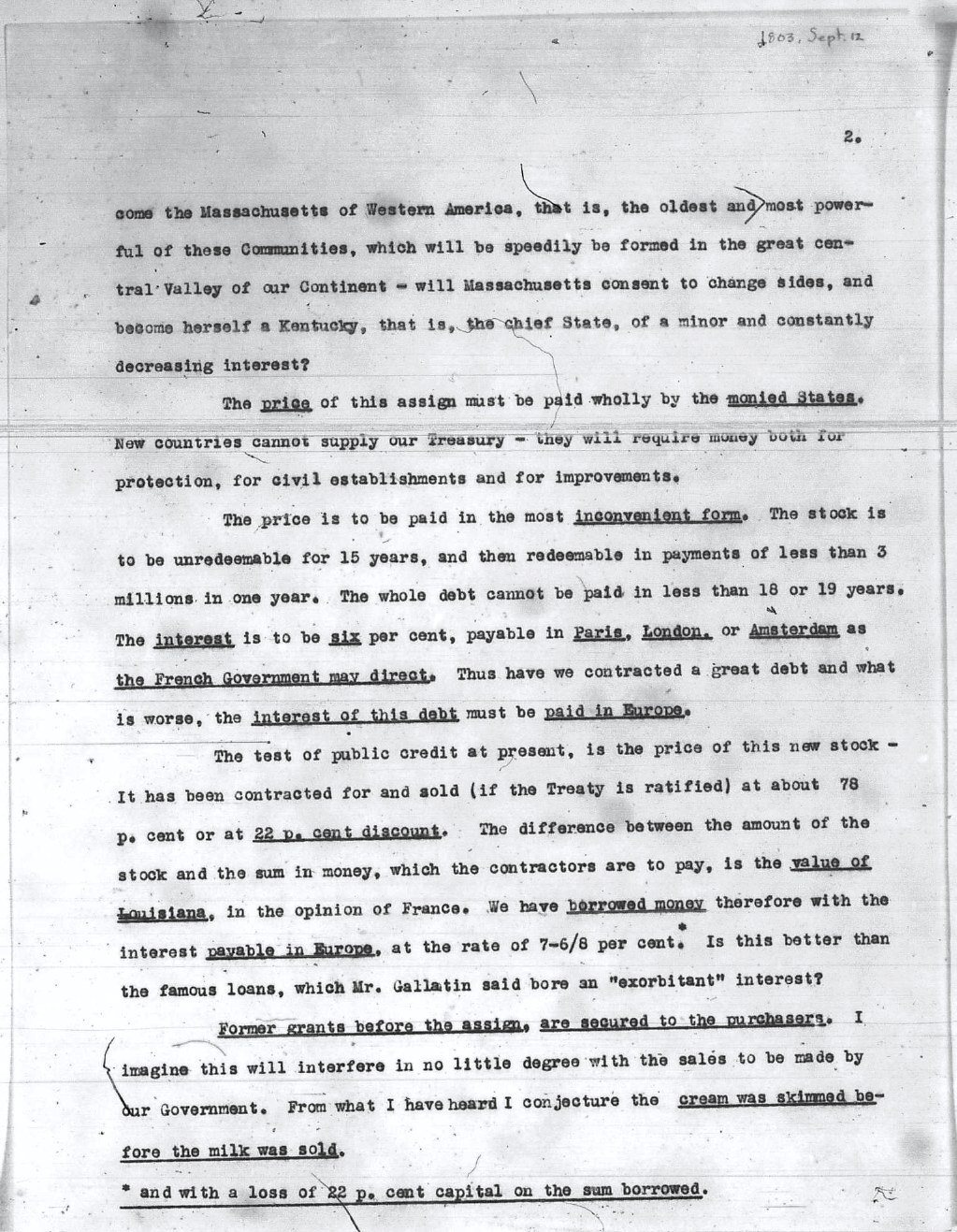
I have no doubt that this is a flagrant violation of a fundamental principle of our Constitution and if ratified it will prove its destruction. Is it possible to annex immense countries to our Country – to give votes and influence to strangers, and thus under the spacious appearance of extending the limits of the United States, to subject us all to a _foreign dominion?_ Such a power is unknown to any other, than a personal or despotic Government. But mischievous as this engagement is, it will be popular in the _Western States_, as it will open a vast field for _local ambition_. Kentucky will immediately become the Massachusetts of Western America, that is, the oldest and most powerful of these Communities, which will be speedily be formed in the great central Valley of our Continent – will Massachusetts consent to change sides, and become herself a Kentucky, that is, the chief State, of a minor and constantly decreasing interest?
The _price_ of this assign must be paid wholly by the _monied States_. New countries cannot supply our Treasury – they will require money both for protection, for civil establishments and for improvements.
The price is to be paid in the most _inconvenient form_. The stock is to be unredeemable for 15 years, and then redeemable in payments of less than 3 millions in one year. The whole debt cannot be paid in less than 18 or 19 years. The _interest_ is to be _six_ per cent, payable in _Paris, London,_ or _Amsterdam_ as _the French Government may direct_. Thus have we contracted a great debt and what is worse, the _interest of this debt_ must be _paid in Europe_.
The test of public credit at present, is the price of this new stock – It has been contracted for and sold (if the Treaty is ratified) at about 78 p. cent or at _22 p. cent discount_. The difference between the amount of the stock and the sum in money, which the contractors are to pay, is the _value of Louisiana_, in the opinion of France. We have _borrowed money_ therefore with the interest _payable in Europe_, at the rate of 7-6/8 per cent.* Is this better than the famous loans, which Mr. Gallatin said bore an “exorbitant” interest?
_Former grants before the assign, are secured to the purchasers_. I imagine this will interfere in no little degree with the sales to be made by our Government. From what I have heard I conjecture the _cream was skimmed before the milk was sold._
* _and with a loss of 22 p. cent capital on the sum borrowed._ [typed footnote at the foot of page 2, keyed to the asterisk after “7-6/8 per cent.”]
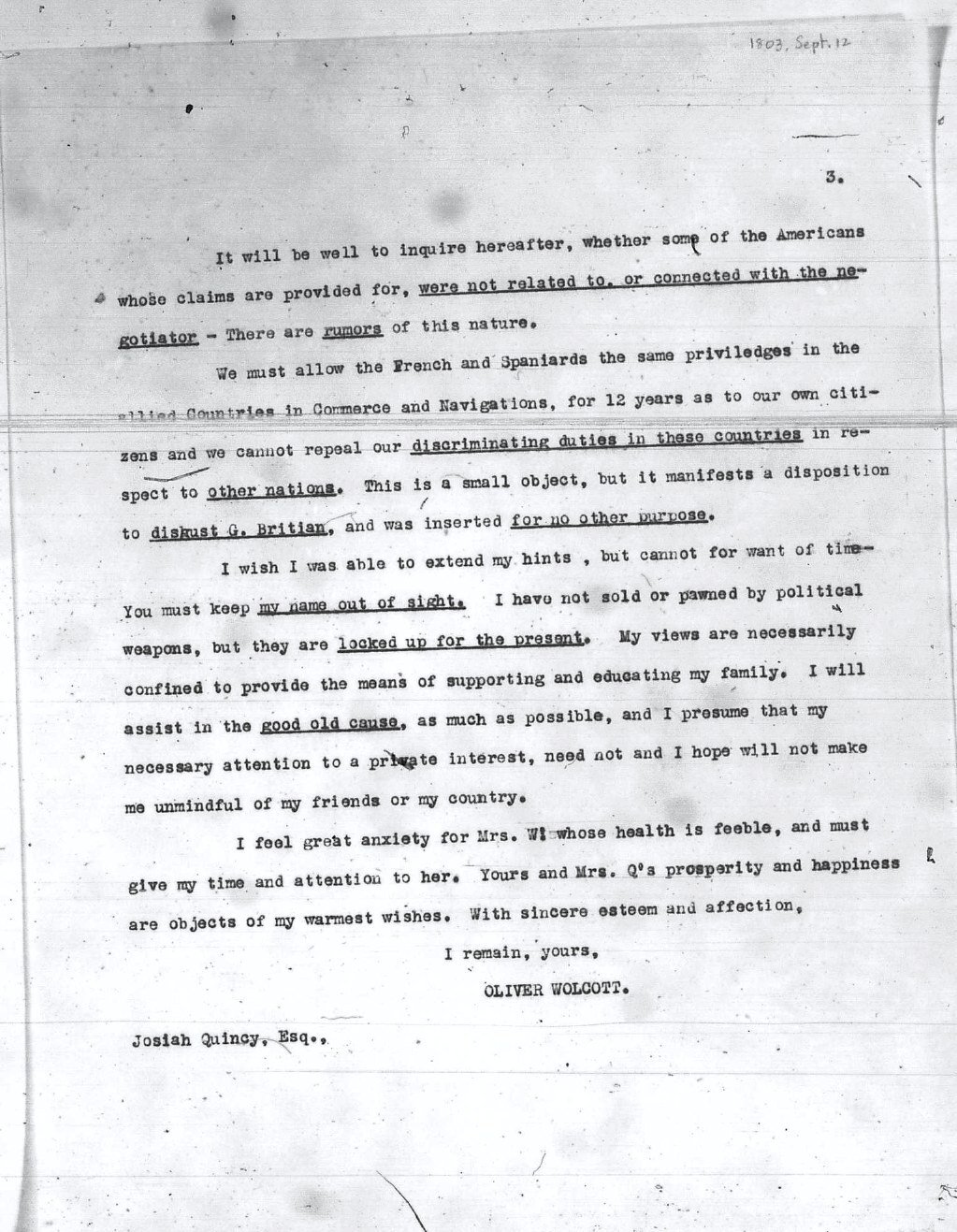
It will be well to inquire hereafter, whether some of the Americans whose claims are provided for, _were not related to, or connected with the negotiator_ – There are _rumors_ of this nature.
We must allow the French and Spaniards the same priviledges in the allied Countries in Commerce and Navigations, for 12 years as to our own citizens and we cannot repeal our _discriminating duties in these countries_ in respect to _other nations_. This is a small object, but it manifests a disposition to _diskust G. Britian_, and was inserted _for no other purpose_.
I wish I was able to extend my hints , but cannot for want of time- You must keep _my name out of sight._ I have not sold or pawned by political weapons, but they are _locked up for the present_. My views are necessarily confined to provide the means of supporting and educating my family. I will assist in the _good old cause_, as much as possible, and I presume that my necessary attention to a private interest, need not and I hope will not make me unmindful of my friends or my country.
I feel great anxiety for Mrs. W. whose health is feeble, and must give my time and attention to her. Yours and Mrs. Q’s prosperity and happiness are objects of my warmest wishes. With sincere esteem and affection,
I remain, yours, — OLIVER WOLCOTT.
Josiah Quincy, Esq.,
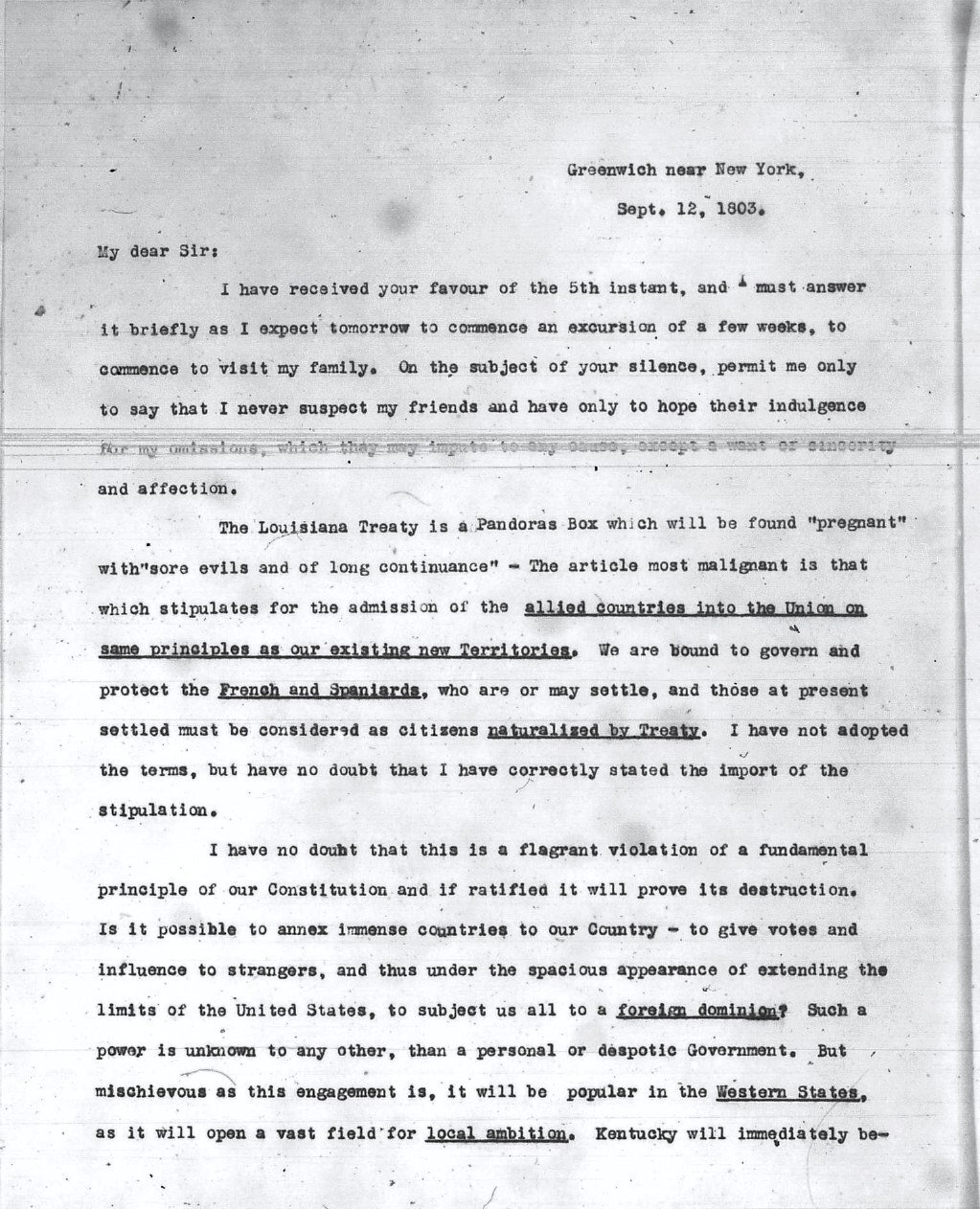
Transcribed verbatim from the scans, keeping the original spelling, capitalization, and punctuation; bracketed words are interlineations or uncertain readings, and [illegible] marks passages lost to the film. Condition: This is an early TYPESCRIPT transcript of the letter preserved in the family papers, not Wolcott’s autograph; the typing conventions of the copyist are reproduced verbatim, including typos (‘to commence… to commence’, ‘with”sore evils’ run together, ‘will be speedily be formed’, ‘spacious appearance’ [for specious], ‘priviledges’, ‘diskust G. Britian’, ‘sold or pawned by political weapons’ [by presumably for my], the spaced comma in ‘my hints ,’ and the raised inserted ‘I’ in ‘and I must answer’ on page 1). Typescript underlinings are rendered here between _underscores_. Pages 2 and 3 are numbered ‘2.’ and ‘3.’ at top right and carry a penciled archivist’s date ‘1803, Sept. 12’. Three lines cross faded/damaged streaks in the film: on page 1 the line ‘for my omissions, which they may impute to any cause, except a want of sincerity’ is badly faded but recoverable; on page 2 the line ‘New countries cannot supply our Treasury – they will require money both for’ is faint; on page 3 the line ‘allied Countries in Commerce and Navigations, for 12 years as to our own citi-‘ is faint but legible. The punctuation mark after ‘Mrs. W’ in the closing paragraph is smudged (period or colon). The typed footnote on page 2 (‘* and with a loss of 22 p. cent capital on the sum borrowed.’) is placed here after the paragraph that carries its asterisk.
Gibbs Family Papers, Wisconsin Historical Society, Reel 1, scans 170–172. Early typescript transcript of Oliver Wolcott Jr. to Josiah Quincy, September 12, 1803, preserved with the family papers. Digitized from the microfilm by this site; transcribed in full above.
Burr Most Probable to Win 
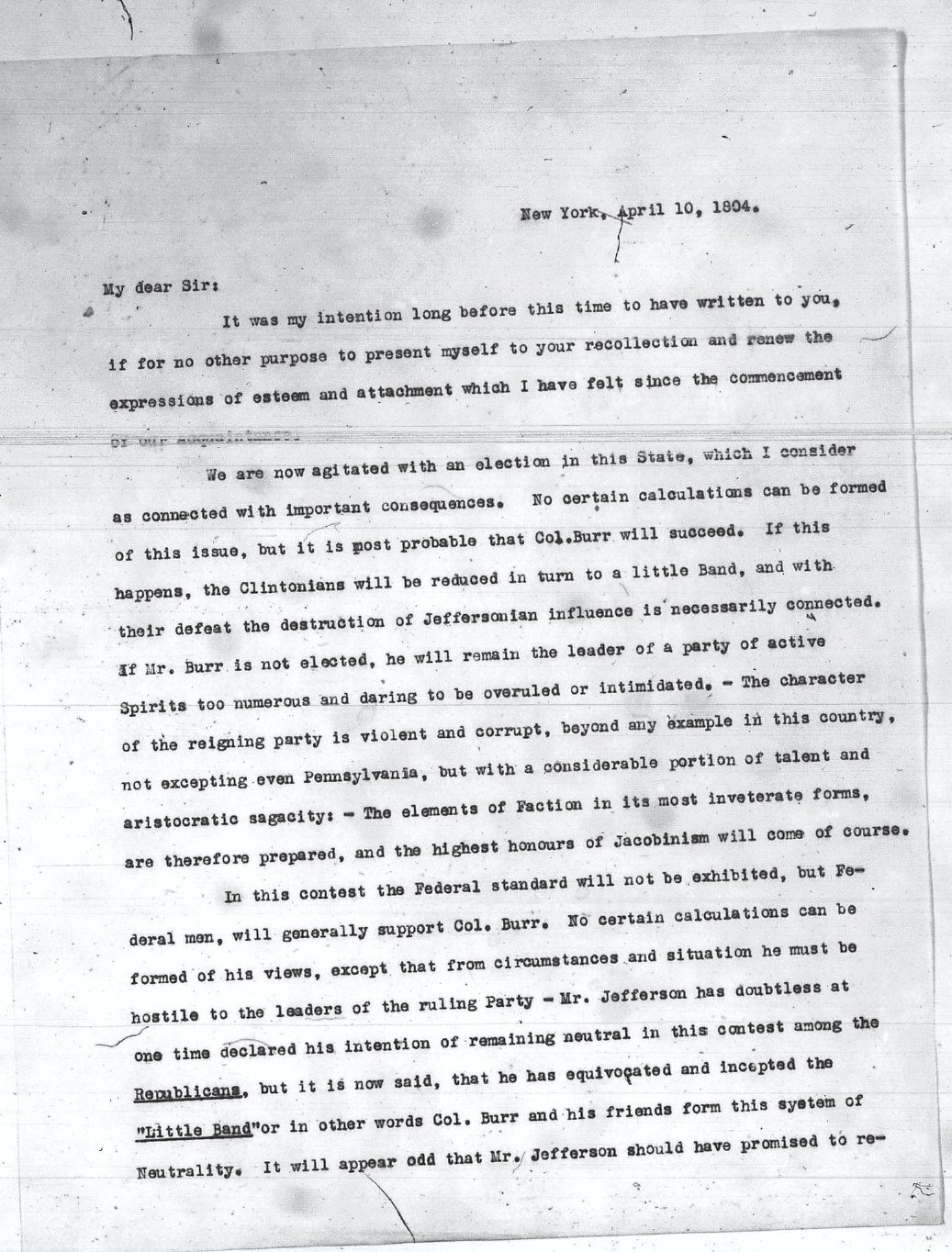
New York, April 10, 1804
Three months before the duel at Weehawken, Wolcott handicaps the New York governor’s race for Quincy: Colonel Burr the likely winner, the Clintonians and Jeffersonians maneuvering, the Federalists resolved to support Burr. He adds a personal grievance from his banking controversy, that his enemies would starve me and my family.
My dear Sir:
It was my intention long before this time to have written to you, if for no other purpose to present myself to your recollection and renew the expressions of esteem and attachment which I have felt since the commencement of our acquaintance[?].
We are now agitated with an election in this State, which I consider as connected with important consequences. No certain calculations can be formed of this issue, but it is most probable that Col. Burr will succeed. If this happens, the Clintonians will be reduced in turn to a little Band, and with their defeat the destruction of Jeffersonian influence is necessarily connected. If Mr. Burr is not elected, he will remain the leader of a party of active Spirits too numerous and daring to be overuled or intimidated. – The character of the reigning party is violent and corrupt, beyond any example in this country, not excepting even Pennsylvania, but with a considerable portion of talent and aristocratic sagacity: – The elements of Faction in its most inveterate forms, are therefore prepared, and the highest honours of Jacobinism will come of course.
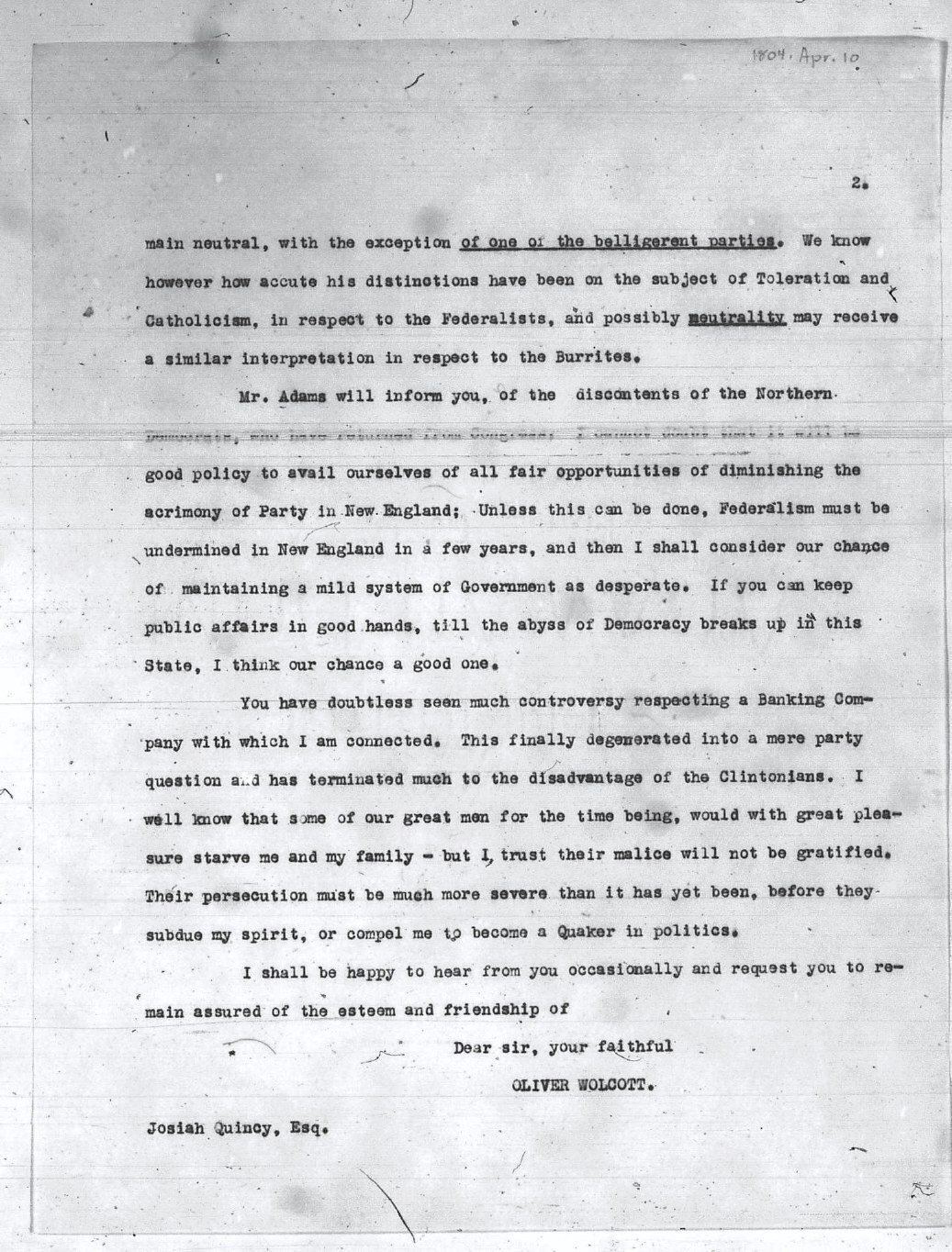
In this contest the Federal standard will not be exhibited, but Federal men, will generally support Col. Burr. No certain calculations can be formed of his views, except that from circumstances and situation he must be hostile to the leaders of the ruling Party – Mr. Jefferson has doubtless at one time declared his intention of remaining neutral in this contest among the Republicans, but it is now said, that he has equivocated and incepted[?] the “Little Band” or in other words Col. Burr and his friends form this system of Neutrality. It will appear odd that Mr. Jefferson should have promised to remain neutral, with the exception of one of the belligerent parties. We know however how accute his distinctions have been on the subject of Toleration and Catholicism, in respect to the Federalists, and possibly neutrality may receive a similar interpretation in respect to the Burrites.
Mr. Adams will inform you, of the discontents of the Northern Democrats[?], who have returned from Congress[?]; I cannot doubt[?] that it will be[?] good policy to avail ourselves of all fair opportunities of diminishing the acrimony of Party in New England; Unless this can be done, Federalism must be undermined in New England in a few years, and then I shall consider our chance of maintaining a mild system of Government as desperate. If you can keep public affairs in good hands, till the abyss of Democracy breaks up in this State, I think our chance a good one.
You have doubtless seen much controversy respecting a Banking Company with which I am connected. This finally degenerated into a mere party question and has terminated much to the disadvantage of the Clintonians. I well know that some of our great men for the time being, would with great pleasure starve me and my family – but I, trust their malice will not be gratified. Their persecution must be much more severe than it has yet been, before they subdue my spirit, or compel me to become a Quaker in politics.
I shall be happy to hear from you occasionally and request you to remain assured of the esteem and friendship of
Dear sir, your faithful
OLIVER WOLCOTT.
Josiah Quincy, Esq.
Transcribed verbatim from the scans, keeping the original spelling, capitalization, and punctuation; bracketed words are interlineations or uncertain readings, and [illegible] marks passages lost to the film. Condition: An early TYPESCRIPT transcript of the letter (typed copy, not the original manuscript), two pages; page 2 is numbered ‘2.’ and carries a manuscript archivist’s date ‘1804. Apr. 10’ at top right. The typing is clean and almost entirely legible. Two lines are badly faded (ribbon-faint, reading as if struck through): the last line of the opening paragraph on page 1 (read as ‘of our acquaintance’) and the second line of the Mr. Adams paragraph on page 2 (read as ‘Democrats, who have returned from Congress; I cannot doubt that it will be’); words from those lines are flagged [?]. Typist’s spellings preserved verbatim: ‘overuled’, ‘accute’, ‘incepted’ (possibly a mistyping of ‘excepted’), and the comma in ‘but I, trust’. In the typescript ‘Republicans’, ‘Little Band’, ‘neutrality’ (in the Toleration sentence), and ‘of one of the belligerent parties’ are underscored; the em-dashes of the original are typed as spaced hyphens, preserved as typed.
Gibbs Family Papers, Wisconsin Historical Society, Reel 1, scans 183–184. Early typescript transcript of Oliver Wolcott Jr. to Josiah Quincy, April 10, 1804. Digitized from the microfilm by this site; transcribed in full above.
“Vox Populi”: Jefferson Reelected 
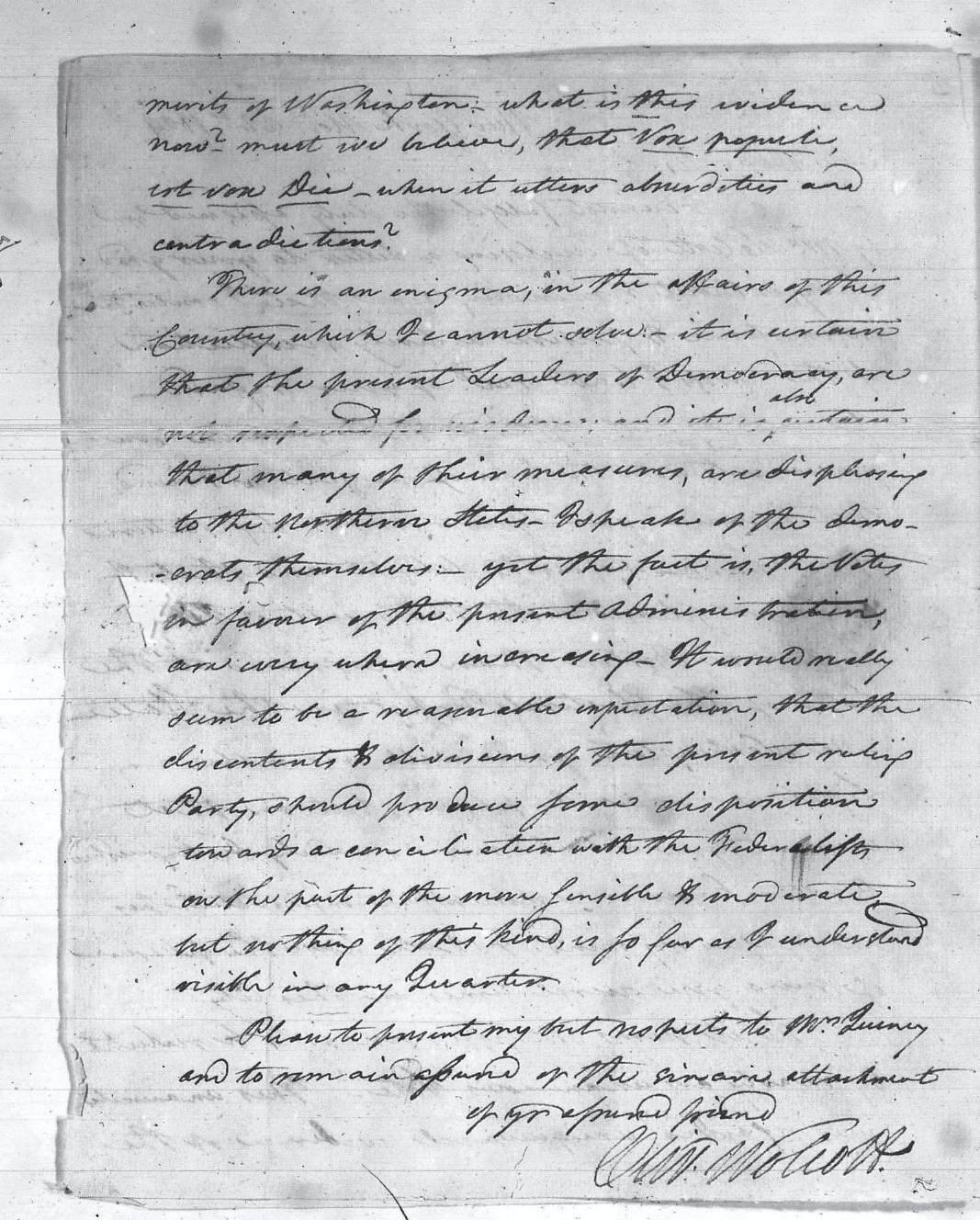
New York, November 22, 1804
In Wolcott’s own hand: Jefferson about to be reelected by a near-unanimous vote, the administration’s support everywhere increasing, no conciliation toward the Federalists in sight, and the state of the country pronounced an enigma. The wrapper carries Quincy’s own filing docket repeating the phrase.
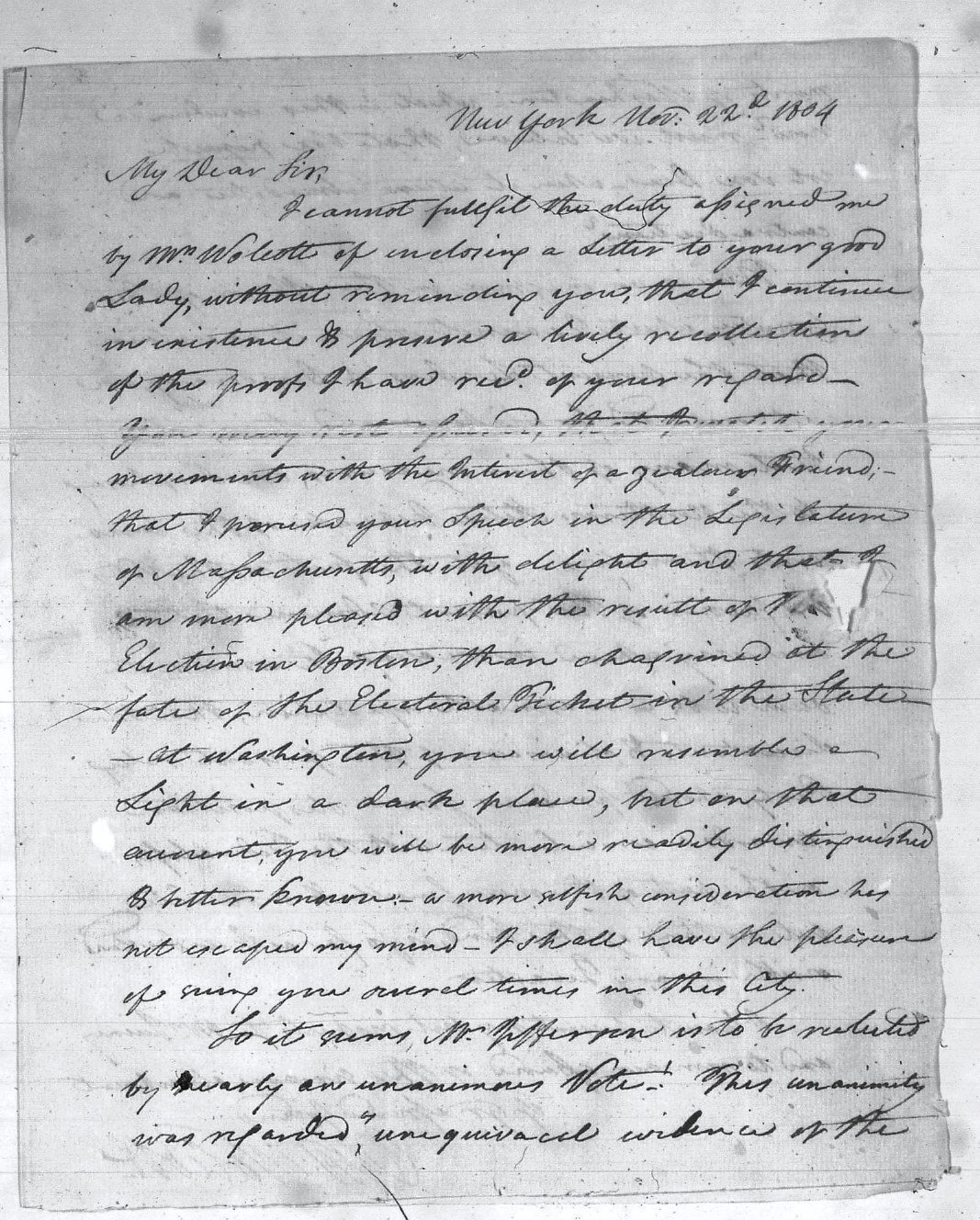
My Dear Sir,
I cannot fulfil the duty assigned me by Mrs. Wolcott of enclosing a Letter to your good Lady, without reminding you, that I continue in existence & preserve a lively recollection of the proofs I have recd. of your regard — You may rest assured[?], that at present[?], I [illegible] your movements with the Interest of a zealous Friend; — that I perused your Speech in the Legislature of Massachusetts, with delight and that I am more pleased with the result of the Election in Boston, than chagrined at the fate of the Electoral Ticket in the State — at Washington, you will resemble a Light in a dark place, but on that account, you will be more readily distinguished & better known: — a more selfish consideration has not escaped my mind — I shall have the pleasure of seeing you several times in this City.
So it seems, Mr. Jefferson is to be reelected by nearly an unanimous Vote — This unanimity was regarded “unequivocal evidence of the merits of Washington: — what is this evidence now? must we believe, that Vox populi, est vox Dei — when it utters absurdities and contradictions?
There is an enigma, in the affairs of this Country, which I cannot solve: — it is certain that the present Leaders of Democracy, are not respected[?] for wisdom[?]; and it is also certain[?], that many of their measures, are displeasing to the Northern States — I speak of the Democrats themselves: — yet the fact is, the Votes in favour of the present Administration, are every where increasing — It would really seem to be a reasonable expectation, that the discontents & divisions of the present ruling Party, should produce some disposition towards a conciliation with the Federalists, on the part of the more sensible & moderate, but nothing of this kind, is so far as I understand visible in any Quarter.
Please to present my best respects to Mrs. Quincy and to remain assured of the sincere attachment of yr esteemed[?] friend
Oliv: Wolcott.
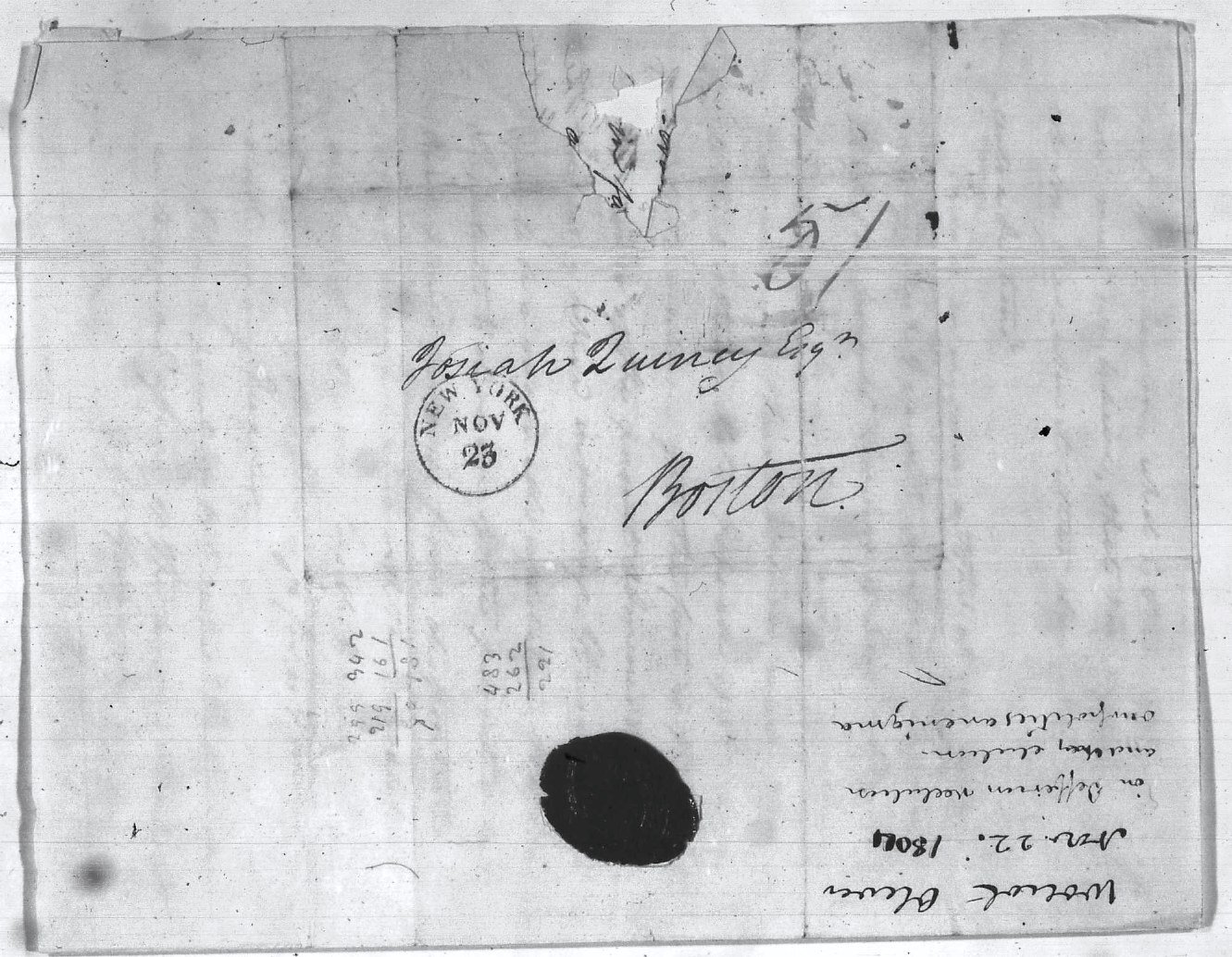
THE ADDRESS PANEL AND DOCKET
Josiah Quincy Esqr. / Boston [circular postmark: NEW YORK NOV 23] [manuscript postal rate mark, illegible: possibly 17]
[endorsed/docketed, written vertically at right of wrapper:] Wolcott Oliver / Nov. 22. 1804 / on Jefferson reelection / and the election[?] — / our politics an enigma
[also on wrapper: pencil arithmetic sums in a later hand, incl. 483/262/221 and a second column of figures; large ink or seal blot at center]
Transcribed verbatim from the scans, keeping the original spelling, capitalization, and punctuation; bracketed words are interlineations or uncertain readings, and [illegible] marks passages lost to the film. Condition: Autograph letter signed, Oliver Wolcott Jr. to Josiah Quincy, in Wolcott’s small clear hand; two pages plus integral address wrapper. One line on each page is badly faded/rubbed along a fold and largely lost: on page one the sentence after ‘your regard ~~’ reads only in traces (‘You may rest assured, that at present, I [illegible] your movements…’), and on page two the line ‘are not respected for wisdom; and it is also certain’ is mostly effaced, with ‘also’ interlined above the line. In the manuscript ‘this’ (‘what is this evidence now?’) and the Latin ‘Vox populi, est vox Dei’ are underscored. The opening quotation mark before ‘unequivocal evidence’ is never closed and Wolcott omits ‘as’ after ‘regarded’. ‘Democrats’ is hyphenated across a line break in the original (Demo-crats). Wrapper bears a circular NEW YORK NOV 23 postmark, a scrawled manuscript rate mark (unclear; NY-Boston single rate of 17 cents would be expected, more if the enclosure was rated), a heavy blot at center, later pencil arithmetic, and the vertical contemporary docket summarizing the letter (‘on Jefferson reelection … our politics an enigma’).
Gibbs Family Papers, Wisconsin Historical Society, Reel 1, scans 188–190. Autograph letter of Oliver Wolcott Jr. to Josiah Quincy, with its wrapper. Digitized from the microfilm by this site; transcribed in full above.
The Old Secretary on Appropriations 
New York, January 10, 1805
Nobody in America was better placed to write this letter. The man who ran the Treasury for both Washington and Adams tells the young congressman why the specific-appropriations doctrine is nonsense for the Army and Navy, counsels supporting rather than impeaching Secretary Smith, and urges that military appropriations be generous. Four pages, marked Private, in his own hand.
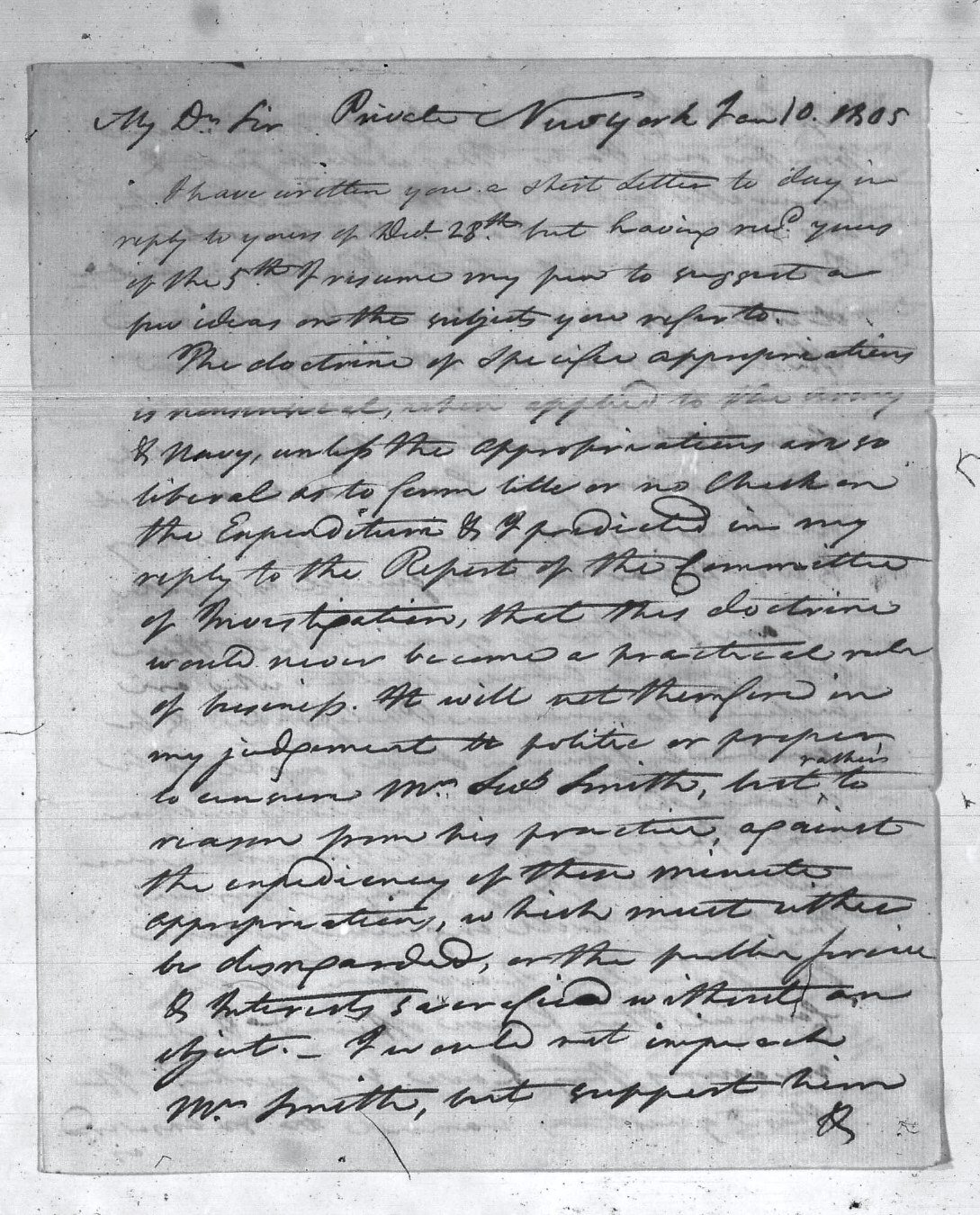
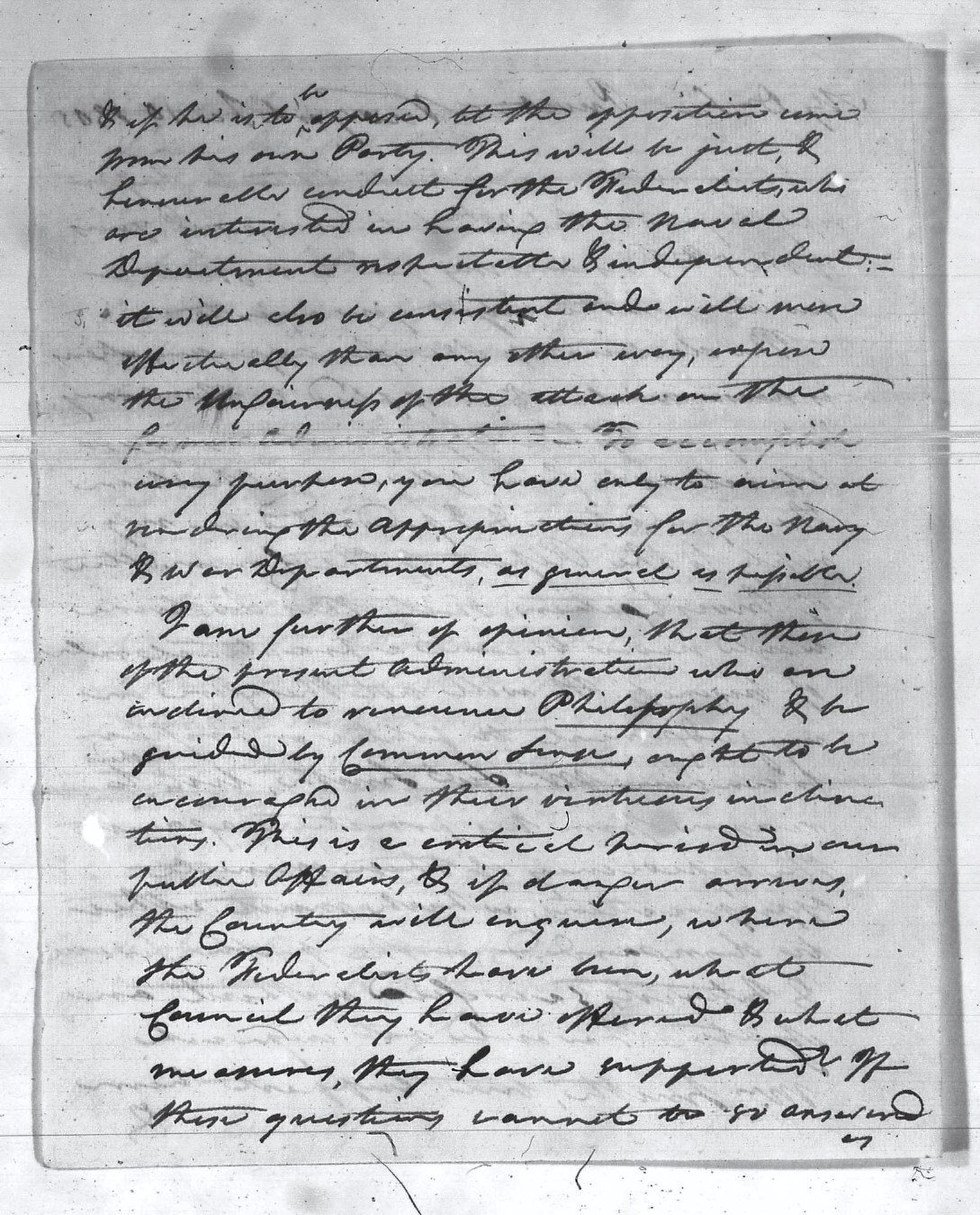
My Dr Sir
I have written you a short Letter to day in reply to yours of Dec. 28th. but having recd. yours of the 5th. I resume my pen to suggest a few ideas on the subjects you refer to.
The doctrine of Specific appropriations is nonsensical, when applied to the Army & Navy, unless the Appropriations are so liberal as to form little or no Check on the Expenditure & I predicted in my reply to the Reports of the Committee of Investigation, that this doctrine would never become a practical rule of business. It will not therefore in my judgement be politic or proper to censure Mr. Secy. Smith, but rather to reason from his practice, against the expediency of these minute appropriations, which must either be disregarded, or the public service & Interests sacrificed without an object. — I would not impeach Mr. Smith, but support him & if he is to be opposed, let the opposition come from his own Party. This will be just, & honourable conduct for the Federalists, who are interested in having the Naval Department respectable & independent: — it will also be consistent and will more effectually than any other way, expose the Unfairness of the attack on the former Administration. — To accomplish every purpose, you have only to aim at rendering the Appropriations for the Navy & War Departments, as general as possible.
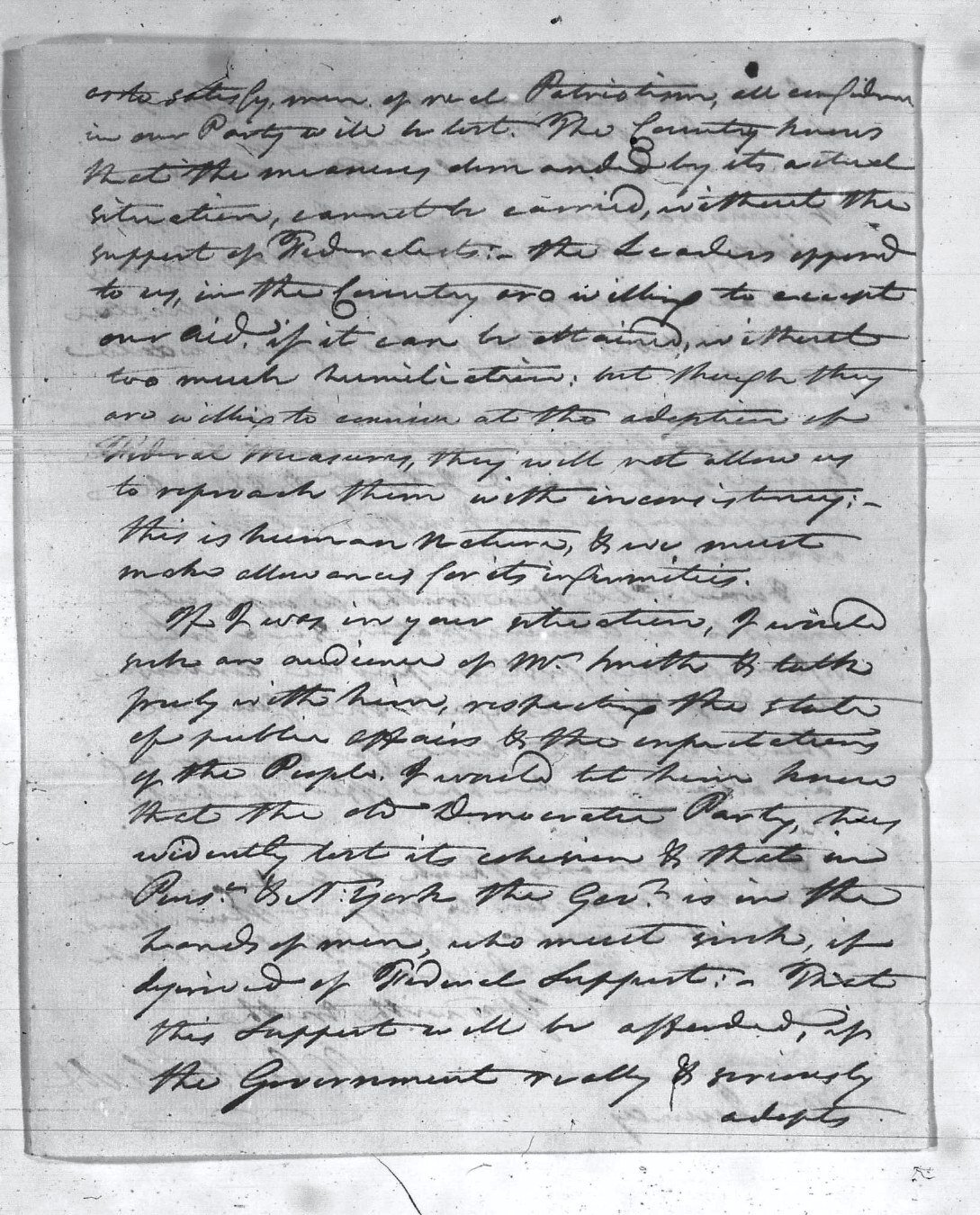
I am further of opinion, that those of the present Administration who are inclined to reverence Philosophy & be guided by Common Sense, ought to be encouraged in their virtuous inclinations. This is a critical period in our public Affairs, & if danger arrives, the Country will enquire, where the Federalists have been, what Council they have offered & what measures, they have supported? If these questions cannot be so answered as to satisfy, men of real Patriotism, all confidence in our Party will be lost. The Country knows that the measures demanded by its actual situation, cannot be carried, without the support of Federalists: — the Leaders opposed to us, in the Country are willing to accept our aid, if it can be obtained, without too much humiliation; but though they are willing to connive at the adoption of Federal Measures, they will not allow us to reproach them with inconsistency; — this is human Nature, & we must make allowances for its infirmities.
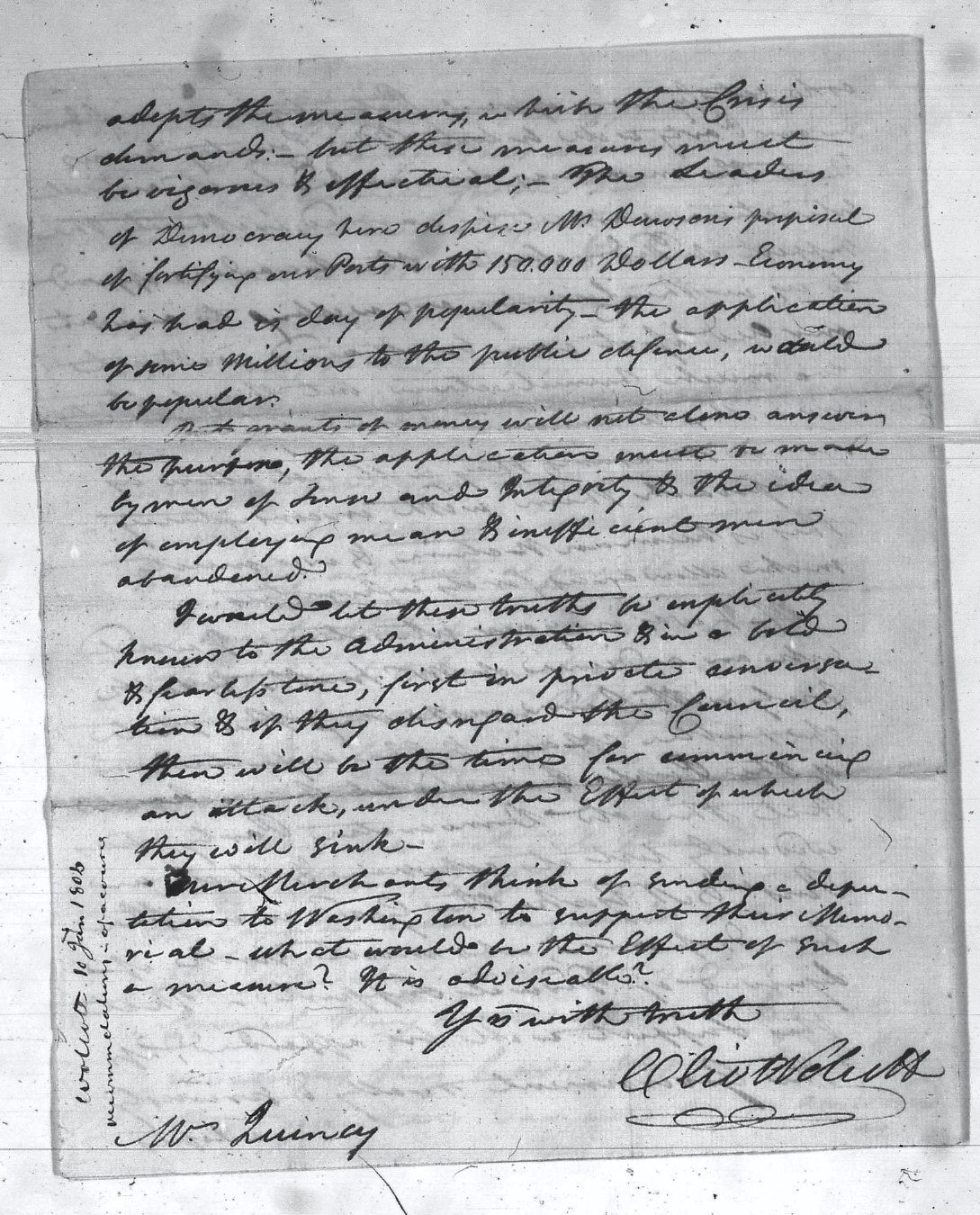
If I was in your situation, I would seek an audience of Mr. Smith & talk freely with him, respecting the state of public affairs & the expectations of the People. I would let him know that the old Democratic Party, has evidently lost its cohesion & that in Pensa. & N. York the Govt. is in the hands of men, who must sink, if deprived of Federal Support: — That this Support will be afforded, if the Government really & seriously adopts the measures, which the Crisis demands: — but these measures must be vigorous & effectual; — The Leaders of Democracy here despise Mr. Dawson’s proposal of fortifying our Ports with 150.000 Dollars — Economy has had its[?] day of popularity — the application of some Millions to the public defence, would be popular.
Grants[?] of money will not alone answer the purpose, the applications must be made by men of Sense and Integrity & the idea of employing mean & inefficient men abandoned.
I would let these truths be explicitly known to the Administration & in a bold & fearless tone, first in private conversation & if they disregard the Council, then will be the time for commencing an attack, under the Effect of which they will sink —
Our Merchants think of sending a deputation to Washington to support their Memorial — what would be the Effect of such a measure? Is it advisable?
Yrs with truth — Oliv Wolcott
Mr. Quincy
[Docket, written vertically along the left margin of the final leaf:] Wolcott — 10 Jan. 1805 — recommendation of a caution[?] [illegible]
Transcribed verbatim from the scans, keeping the original spelling, capitalization, and punctuation; bracketed words are interlineations or uncertain readings, and [illegible] marks passages lost to the film. Condition: Microfilm scan of a four-page autograph letter, Oliver Wolcott Jr. to Josiah Quincy. A dark fold shadow crosses each leaf and partially obscures one line per page (scan 197: ‘is nonsensical, when applied to the Army’; scan 198: ‘former Administration. ~~ To accomplish’ — both recovered from context and letterform traces). Wolcott underlined ‘as general as possible’, ‘Philosophy’, and ‘Common Sense’ in the manuscript; an apparent line through ‘they have supported’ (scan 198) reads as underscoring for emphasis, not a strikeout — no deliberate strikeouts detected. Two interlinear insertions incorporated silently into the text: ‘rather’ above the line after ‘but’ (scan 197) and ‘be’ above the line in ‘is to be opposed’ (scan 198). Catchwords at the foot of scans 197 (‘&’), 198 (‘as’), and 199 (‘adopts’) duplicate the first word of the following page and are transcribed once. ‘its[?] day of popularity’ appears written ‘is day’ in the manuscript; ‘Grants[?]’ at the opening of the money paragraph is partly obscured. The docket’s trailing words after ‘recommendation of a caution’ are too faint to read with confidence.
Gibbs Family Papers, Wisconsin Historical Society, Reel 1, scans 197–200. Autograph letter of Oliver Wolcott Jr. to Josiah Quincy, marked Private, with docket. Digitized from the microfilm by this site; transcribed in full above.
Advice on a Public Life 
New York, August 24, 1805
The mentor’s letter of the series: how a young man should prepare himself for public and political life, what documents to master, and how to procure the congressional papers through Mr. Hazard. It closes on the private grief running under the whole correspondence, Mrs. Wolcott’s failing health.
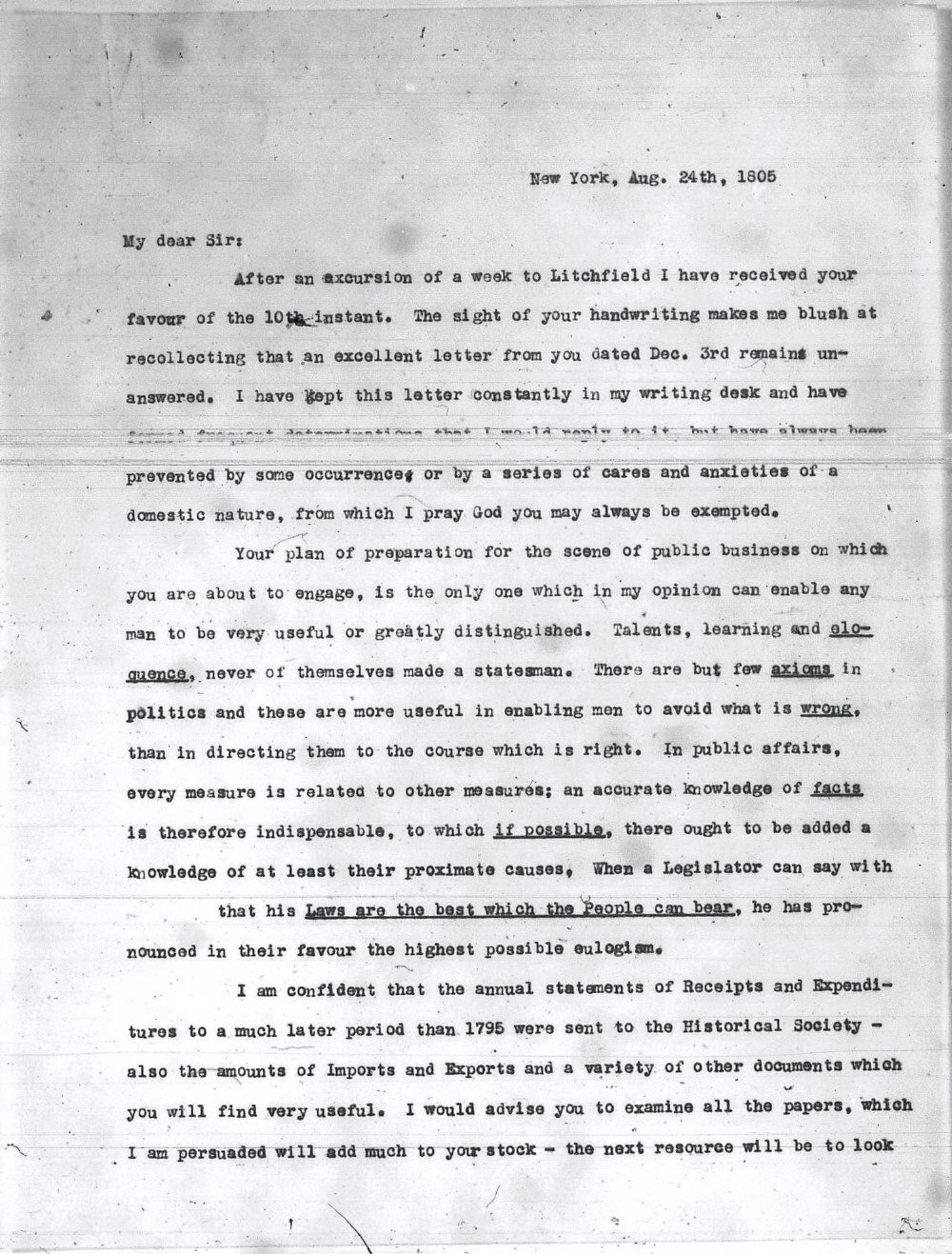
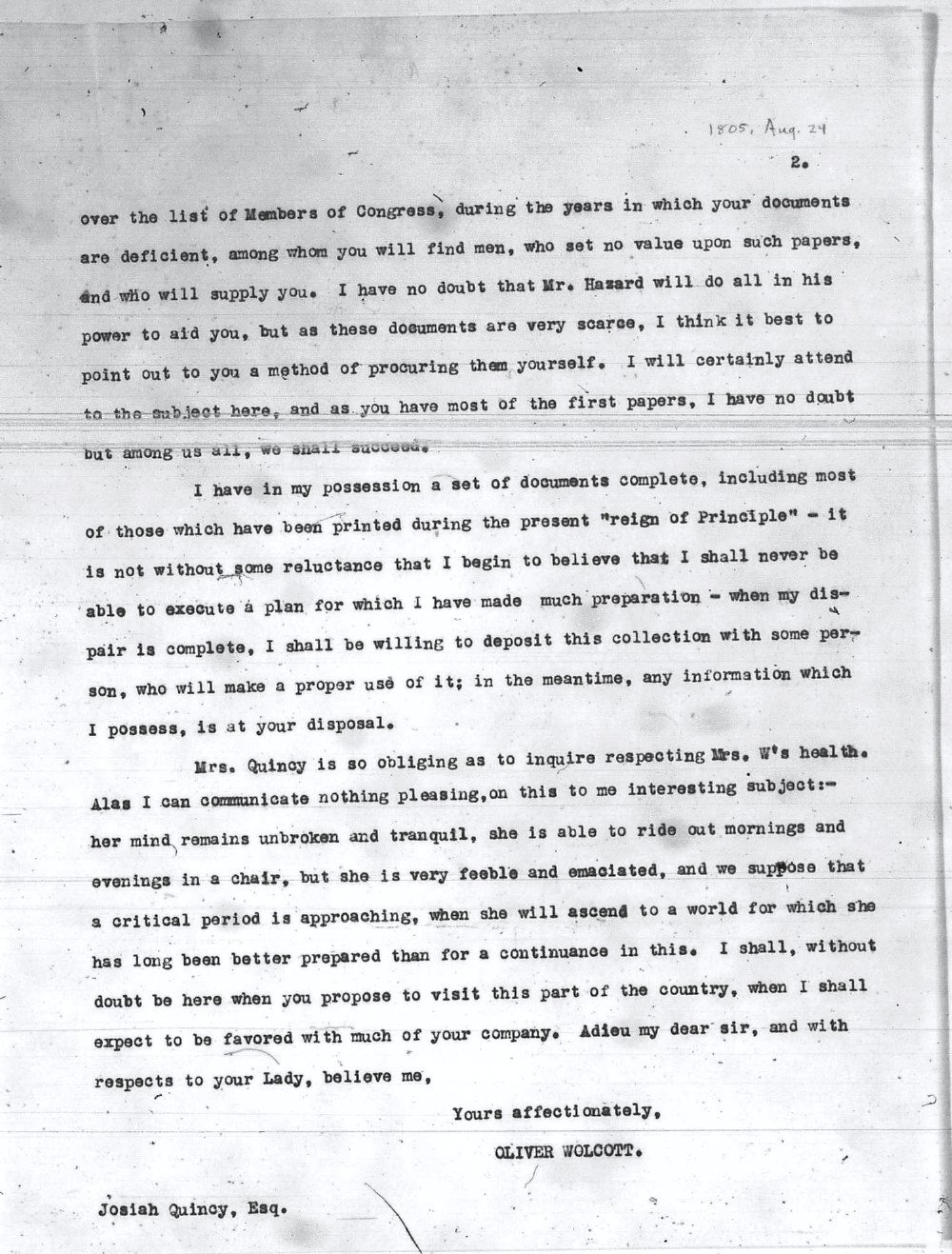
My dear Sir:
After an excursion of a week to Litchfield I have received your favour of the 10th instant. The sight of your handwriting makes me blush at recollecting that an excellent letter from you dated Dec. 3rd remains unanswered. I have kept this letter constantly in my writing desk and have formed[?] frequent[?] determinations[?] that I would reply to it, but have always been[?] prevented by some occurrence, or by a series of cares and anxieties of a domestic nature, from which I pray God you may always be exempted.
Your plan of preparation for the scene of public business on which you are about to engage, is the only one which in my opinion can enable any man to be very useful or greatly distinguished. Talents, learning and eloquence, never of themselves made a statesman. There are but few axioms in politics and these are more useful in enabling men to avoid what is wrong, than in directing them to the course which is right. In public affairs, every measure is related to other measures; an accurate knowledge of facts is therefore indispensable, to which if possible, there ought to be added a knowledge of at least their proximate causes, When a Legislator can say with that his Laws are the best which the People can bear, he has pronounced in their favour the highest possible eulogism.
I am confident that the annual statements of Receipts and Expenditures to a much later period than 1795 were sent to the Historical Society – also the amounts of Imports and Exports and a variety of other documents which you will find very useful. I would advise you to examine all the papers, which I am persuaded will add much to your stock – the next resource will be to look over the list of Members of Congress, during the years in which your documents are deficient, among whom you will find men, who set no value upon such papers, and who will supply you. I have no doubt that Mr. Hazard will do all in his power to aid you, but as these documents are very scarce, I think it best to point out to you a method of procuring them yourself. I will certainly attend to the subject here, and as you have most of the first papers, I have no doubt but among us all, we shall succeed.
I have in my possession a set of documents complete, including most of those which have been printed during the present “reign of Principle” – it is not without some reluctance that I begin to believe that I shall never be able to execute a plan for which I have made much preparation – when my dispair is complete, I shall be willing to deposit this collection with some person, who will make a proper use of it; in the meantime, any information which I possess, is at your disposal.
Mrs. Quincy is so obliging as to inquire respecting Mrs. W’s health. Alas I can communicate nothing pleasing, on this to me interesting subject:- her mind remains unbroken and tranquil, she is able to ride out mornings and evenings in a chair, but she is very feeble and emaciated, and we suppose that a critical period is approaching, when she will ascend to a world for which she has long been better prepared than for a continuance in this. I shall, without doubt be here when you propose to visit this part of the country, when I shall expect to be favored with much of your company. Adieu my dear sir, and with respects to your Lady, believe me,
Yours affectionately,
OLIVER WOLCOTT.
Josiah Quincy, Esq.
Transcribed verbatim from the scans, keeping the original spelling, capitalization, and punctuation; bracketed words are interlineations or uncertain readings, and [illegible] marks passages lost to the film. Condition: Early typescript transcript, two typed pages; page 2 headed “1805, Aug. 24” (pencil) and “2.”. Clean and fully legible except one line on page 1 obscured by a scan artifact (read as “formed frequent determinations that I would reply to it, but have always been”, marked [?]); a similar artifact on page 2 leaves “to the subject here… we shall succeed” faint but readable. Typist underlined: eloquence, axioms, wrong, facts, if possible, and “Laws are the best which the People can bear”. Typescript quirks preserved verbatim: comma after “proximate causes” before “When”; “can say with that his Laws” (typist apparently dropped a word, likely “truth”, at the line break); “dispair” for despair; “occurrence,” typed over a struck character. (typescript)
Gibbs Family Papers, Wisconsin Historical Society, Reel 1, scans 209–210. Early typescript transcript of Oliver Wolcott Jr. to Josiah Quincy. Digitized from the microfilm by this site; transcribed in full above.
Gunboats a Vanity 
New York, December 6, 1805
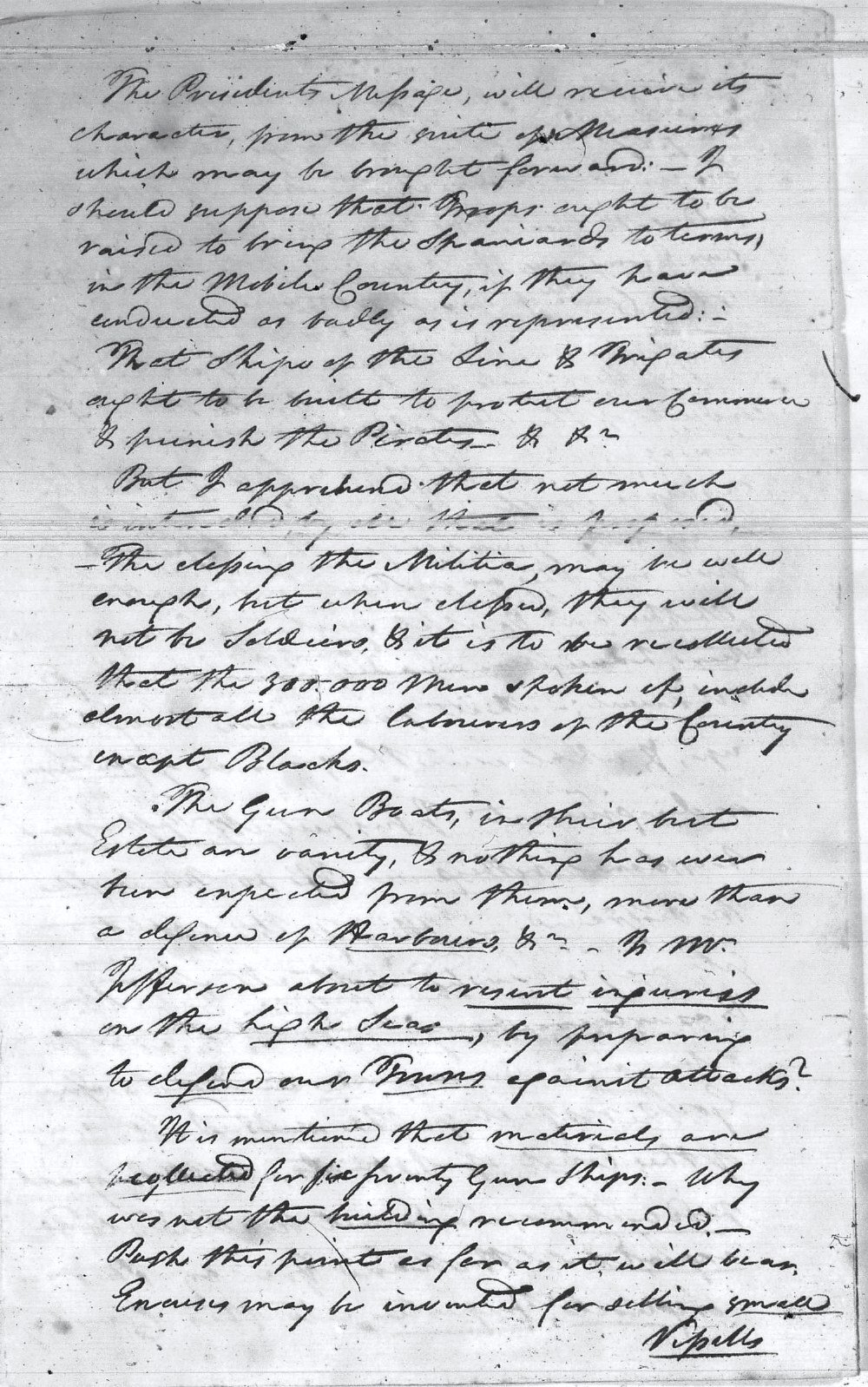
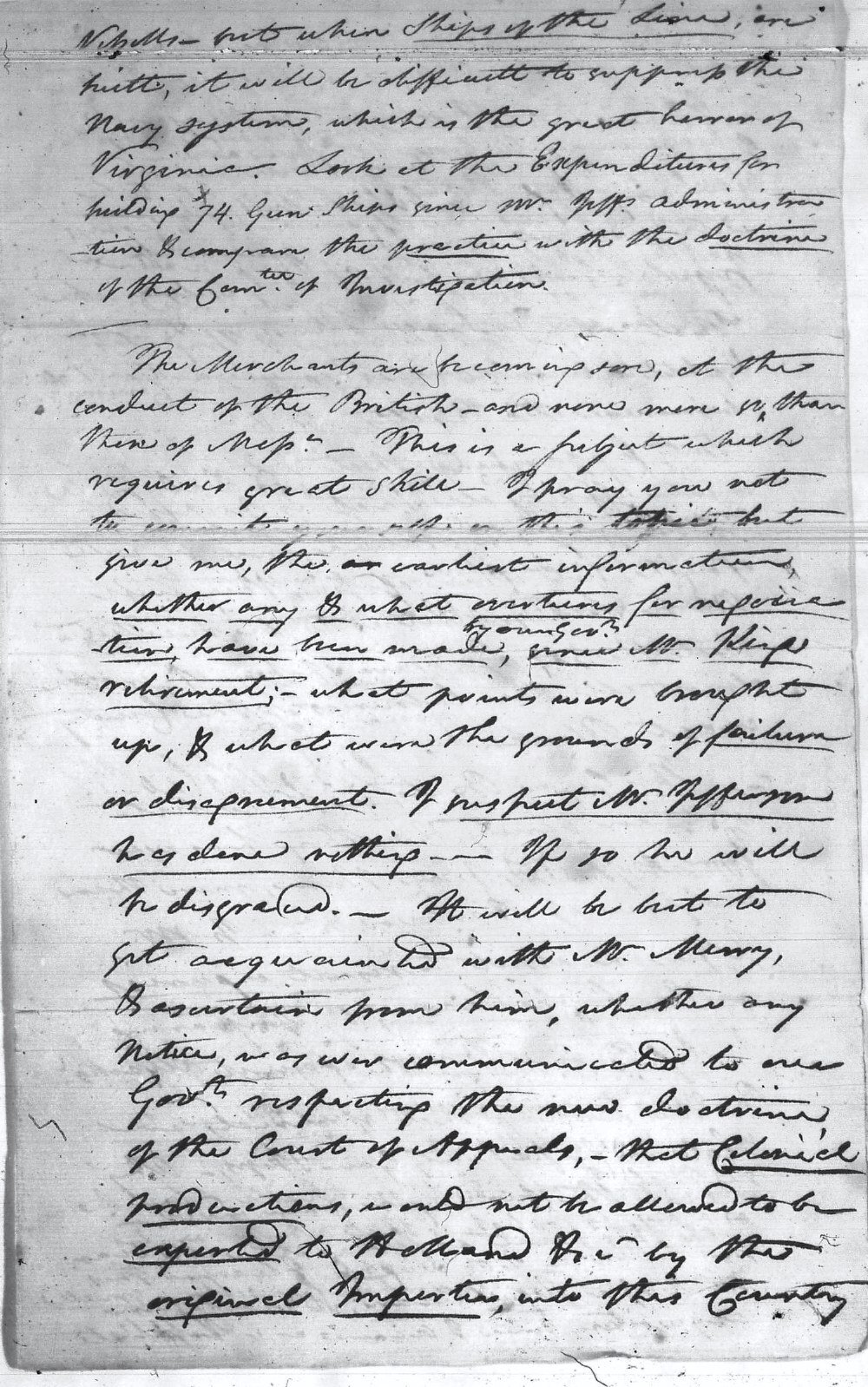
Four autograph pages on the gathering storm: the President’s message, troops for the Mobile country against the Spaniards, the gunboat program dismissed as vanity, ships of the line, and the merchants’ grievances against Britain. Wolcott suspects Jefferson has done nothing, and says so.
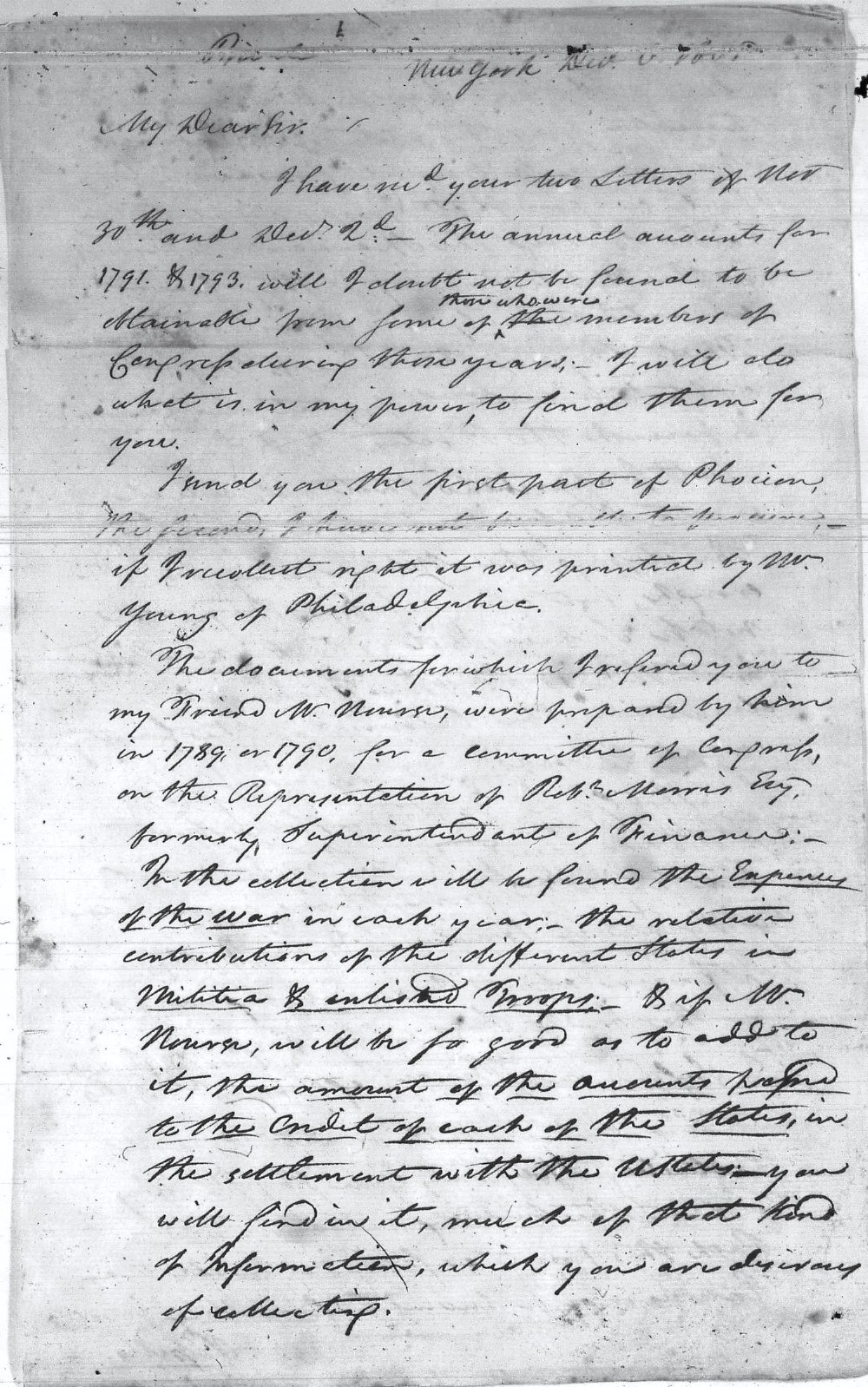
My Dear Sir.
I have recd. your two Letters of Nov 30th. and Decr. 2d. — The annual accounts for 1791. & 1793. will I doubt not be found to be obtainable from some of [struck: the] those who were members of Congress during those years: — I will do what is in my power, to find them for you.
I send you the first part of Phocion, the second, I have not been able[?] to procure[?], — if I recollect right it was printed by Mr. Young of Philadelphia.
The documents for which I refered you to my Friend Mr. Nourse, were prepared by him in 1789, or 1790, for a committee of Congress, on the Representation of Robt. Morris Esq, formerly Superintendant of Finance: — In the collection will be found the Expences of the War in each year, — the relative contributions of the different States in Militia & enlisted Troops: — & if Mr. Nourse, will be so good as to add to it, the amount of the accounts passed to the Credit of each of the States, in the settlement with the U.States: — you will find in it, much of that kind of Information, which you are desirous of collecting.
The Presidents Message, will receive its character, from the suite of Measures which may be brought forward: — I should suppose that Troops ought to be raised to bring the Spaniards to terms, in the Mobile Country, if they have conducted as badly as is represented: — That Ships of the Line & Frigates ought to be built to protect our Commerce & punish the Pirates — &c &ca.
But I apprehend that not much is intended[?], by what[?] is proposed[?], — The classing the Militia, may be well enough, but when classed, they will not be Soldiers, & it is to be recollected that the 300.000 Men spoken of, include almost all the labourers of the Country except Blacks.
The Gun Boats, in their best Estate are vanity, & nothing has ever been expected from them, more than a defence of Harbours, &ca. — Is Mr. Jefferson about to resent injuries on the high Seas, by preparing to defend our Towns against attacks?
It is mentioned that materials are collected for six seventy Gun Ships: — Why was not the building recommended. — Push this point as far as it will bear. Excuses may be invented for selling small Vessells — but when Ships of the Line, are built, it will be difficult to suppress the Navy system, which is the great horror of Virginia. — Look at the Expenditures for building 74. Gun Ships since Mr. Jeffs. administration & compare the practice with the doctrine of the Comtee. of Investigation.
The Merchants are becoming sore, at the conduct of the British — and none more so, than those of Massts. — This is a subject which requires great skill — I pray you not to commit yourself[?] on this topic[?]; but give me, the [struck: illegible] earliest information, whether any & what overtures for negociation, have been made by our Govt., since Mr. Kings retirement; — what points were brought up, & what were the grounds of failure or disagreement. I suspect Mr. Jefferson has done nothing. — If so he will be disgraced. — It will be well[?] to get acquainted with Mr. Merry, & ascertain from him, whether any Notice, was ever communicated to our Govt. respecting the new doctrine of the Court of Appeals, — that Colonial productions, would not be allowed to be exported to Holland &ca by the original Importers, into this Country and if such Notice has been given, at what time.
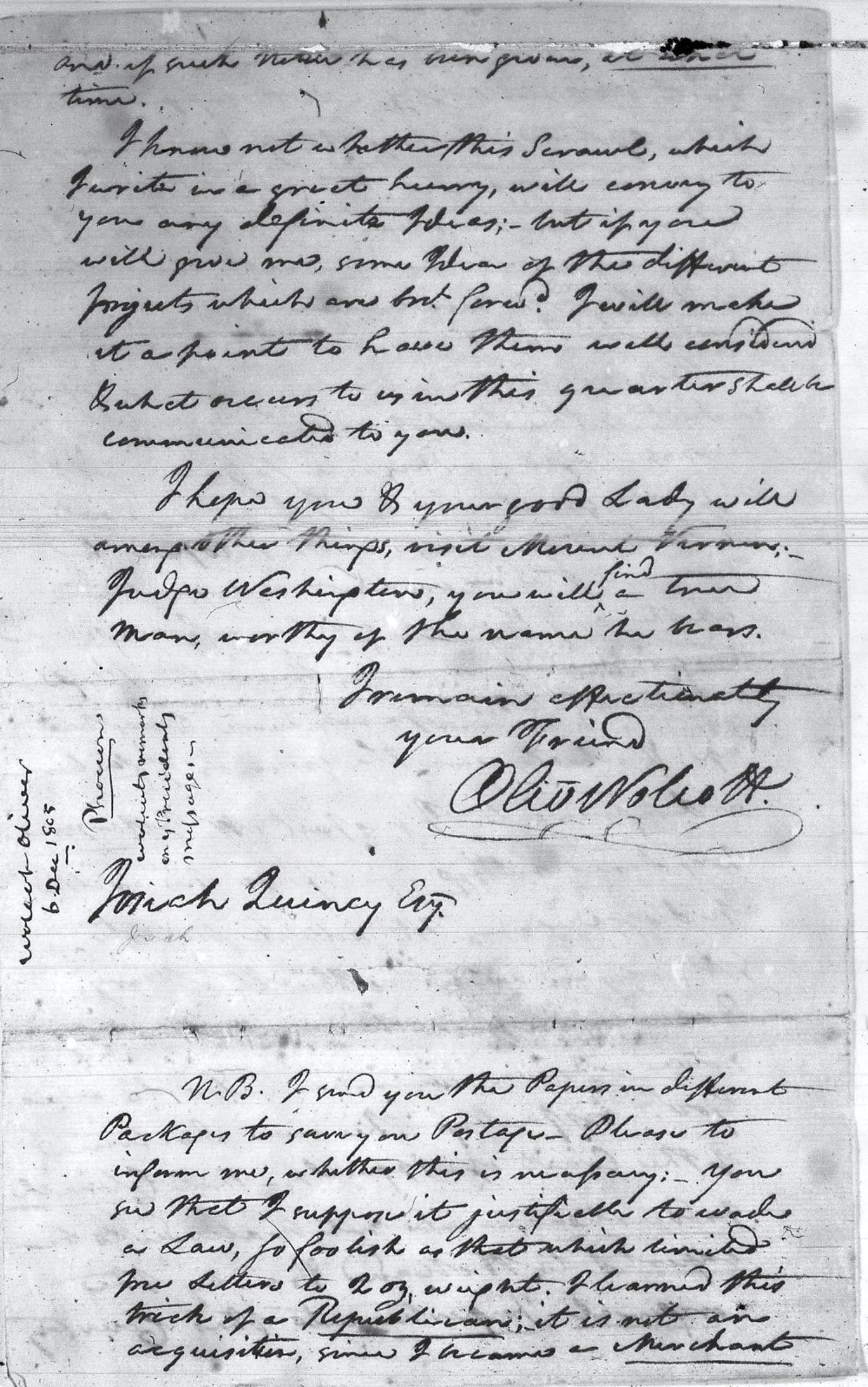
I know not whether this Scrawl, which I write in a great hurry, will convey to you any definite Ideas; — but if you will give me, some Idea of the different projects which are brot. forwd. I will make it a point to have them well considered & what occurs to us in this quarter shall be communicated to you.
I hope you & your good Lady will among other things, visit Mount Vernon; — Judge Washington, you will find a true Man, worthy of the name he bears.
I remain affectionately your Friend
Oliv Wolcott
Josiah Quincy Esq.
[Docket, written vertically:] Wolcott Oliver — 6 Dec 1805
[Docket, second column:] Phocion — and interesting remarks on the Presidents message.
N.B. I send you the Papers in different Packages to save you Postage — Please to inform me, whether this is necessary; — You see that I suppose it justifiable to evade a Law, so foolish as that which limited free Letters to 2 oz. weight. I learned this trick of a Republican; it is not an acquisition, since I became a Merchant.
Transcribed verbatim from the scans, keeping the original spelling, capitalization, and punctuation; bracketed words are interlineations or uncertain readings, and [illegible] marks passages lost to the film. Condition: Autograph letter signed, 4 pp., in Oliver Wolcott Jr.’s hand throughout. Three lines fall on horizontal fold creases where the ink has offset/faded and are transcribed conjecturally with [?]: scan 214 ‘the second, I have not been able to procure’; scan 215 ‘is intended, by what is proposed’; scan 216 ‘to commit yourself on this topic’. The year in the date line is faint but confirmed by the docket ‘6 Dec 1805’. A faint scrawl above the date line at top left of scan 214 may read ‘Private’ but is too faded to confirm. Wolcott’s manuscript underscoring (e.g. ‘Expences of the War’, ‘Militia & enlisted Troops’, ‘materials are collected’, ‘resent injuries on the high Seas’, ‘Ships of the Line’, ‘at what time’, ‘Republican’, ‘Merchant’) is not reproduced in this transcription. ‘those who were’ (scan 214), ‘by our Govt.’ and ‘find’ (scans 216-217) are interlinear insertions transcribed inline at their caret positions. The struck word before ‘earliest’ (scan 216) is a short false start, unreadable. Catchword ‘Vessells’ at the foot of scan 215 is repeated at the head of scan 216 and transcribed once. Signature ‘Oliv Wolcott’ is written with a long paraph flourish. The final N.B. line runs to the trimmed lower edge of scan 217 after ‘Merchant’; any terminal punctuation is lost.
Gibbs Family Papers, Wisconsin Historical Society, Reel 1, scans 214–217. Autograph letter of Oliver Wolcott Jr. to Josiah Quincy, with docket. Digitized from the microfilm by this site; transcribed in full above.
The Neutral Trade 
New York, December 10, 1805
Four days after the gunboats letter, the commercial sequel: the Treaty of 1794 and its twelfth article, the British doctrine of the “direct trade” and the continuity of a voyage, and the original-importer principle attacked as untenable. Wolcott’s premise is the large one: Britain and America between them hold the maritime commerce of the world, and the quarrel wants investigation and negotiation, not drift.
Dear Sir:
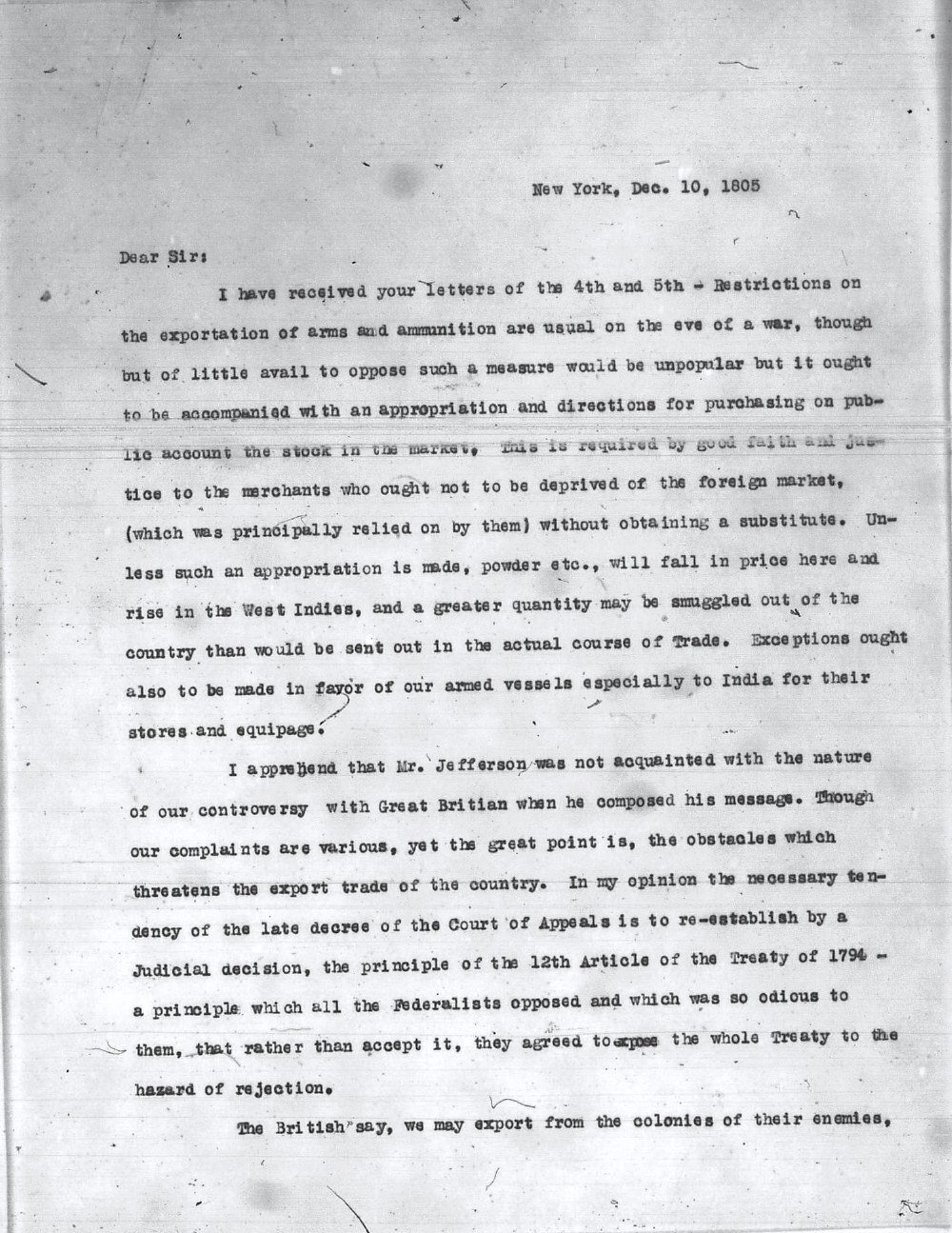
I have received your letters of the 4th and 5th – Restrictions on the exportation of arms and ammunition are usual on the eve of a war, though but of little avail to oppose such a measure would be unpopular but it ought to be accompanied with an appropriation and directions for purchasing on public account the stock in the market. This is required by good faith and justice to the merchants who ought not to be deprived of the foreign market, (which was principally relied on by them) without obtaining a substitute. Unless such an appropriation is made, powder etc., will fall in price here and rise in the West Indies, and a greater quantity may be smuggled out of the country than would be sent out in the actual course of Trade. Exceptions ought also to be made in favor of our armed vessels especially to India for their stores and equipage.
I apprehend that Mr. Jefferson was not acquainted with the nature of our controversy with Great Britian when he composed his message. Though our complaints are various, yet the great point is, the obstacles which threatens the export trade of the country. In my opinion the necessary tendency of the late decree of the Court of Appeals is to re-establish by a Judicial decision, the principle of the 12th Article of the Treaty of 1794 – a principle which all the Federalists opposed and which was so odious to them, that rather than accept it, they agreed to expose[?] the whole Treaty to the hazard of rejection.
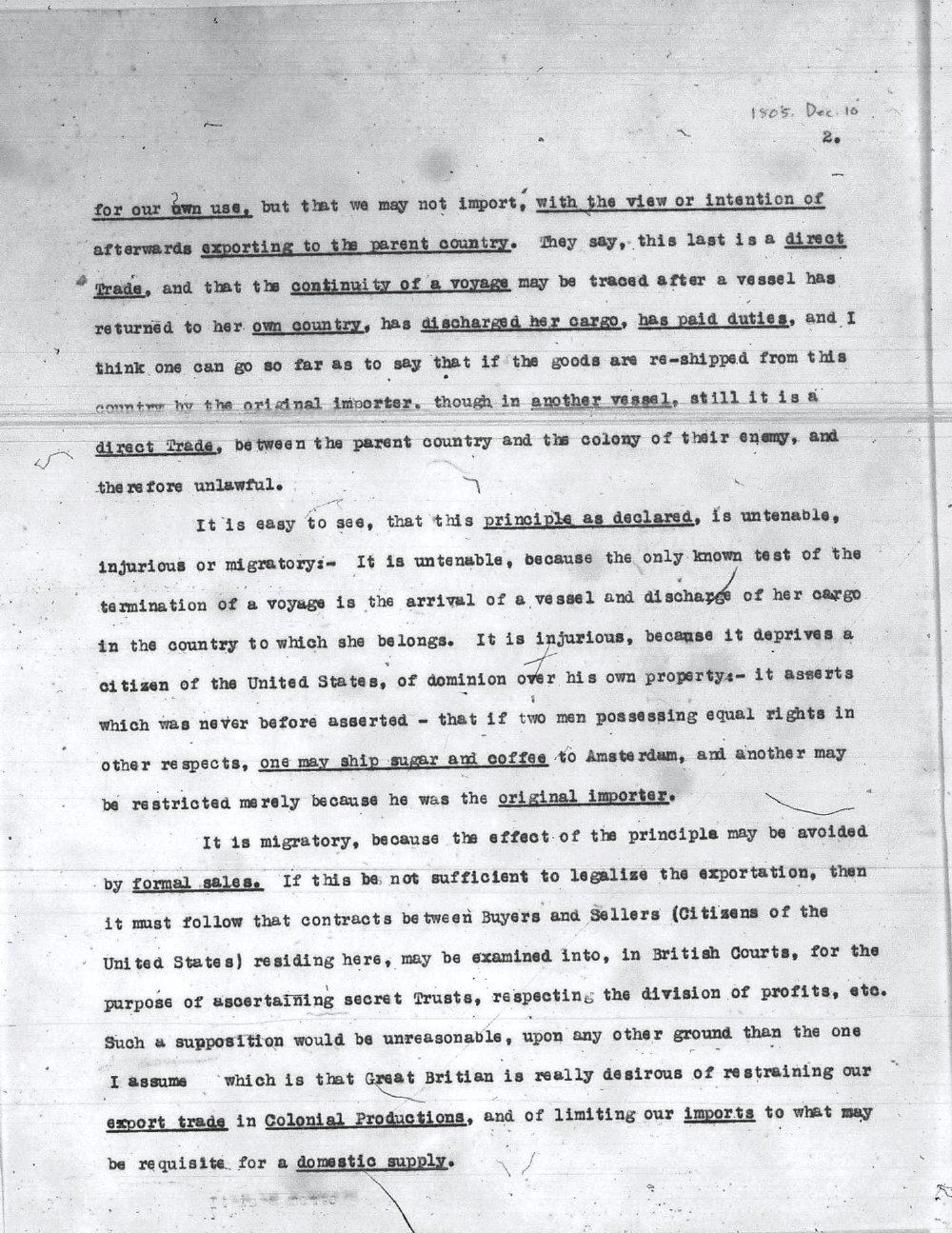
The British say, we may export from the colonies of their enemies, _for our own use_, but that we may not import, _with the view or intention of afterwards exporting to the parent country_. They say, this last is a _direct Trade_, and that the _continuity of a voyage_ may be traced after a vessel has returned to her _own country_, has _discharged her cargo_, _has paid duties_, and I think one can go so far as to say that if the goods are re-shipped from this country by the original importer, though in _another vessel_, still it is a _direct Trade_, between the parent country and the colony of their enemy, and therefore unlawful.
It is easy to see, that this _principle as declared_, is untenable, injurious or migratory:- It is untenable, because the only known test of the termination of a voyage is the arrival of a vessel and discharge of her cargo in the country to which she belongs. It is injurious, because it deprives a citizen of the United States, of dominion over his own property:- it asserts which was never before asserted – that if two men possessing equal rights in other respects, _one may ship sugar and coffee_ to Amsterdam, and another may be restricted merely because he was the _original importer_.
It is migratory, because the effect of the principle may be avoided by _formal sales_. If this be not sufficient to legalize the exportation, then it must follow that contracts between Buyers and Sellers (Citizens of the United States) residing here, may be examined into, in British Courts, for the purpose of ascertaining secret Trusts, respecting the division of profits, etc. Such a supposition would be unreasonable, upon any other ground than the one I assume which is that Great Britian is really desirous of restraining our _export trade_ in _Colonial Productions_, and of limiting our _imports_ to what may be requisite for a _domestic supply_.
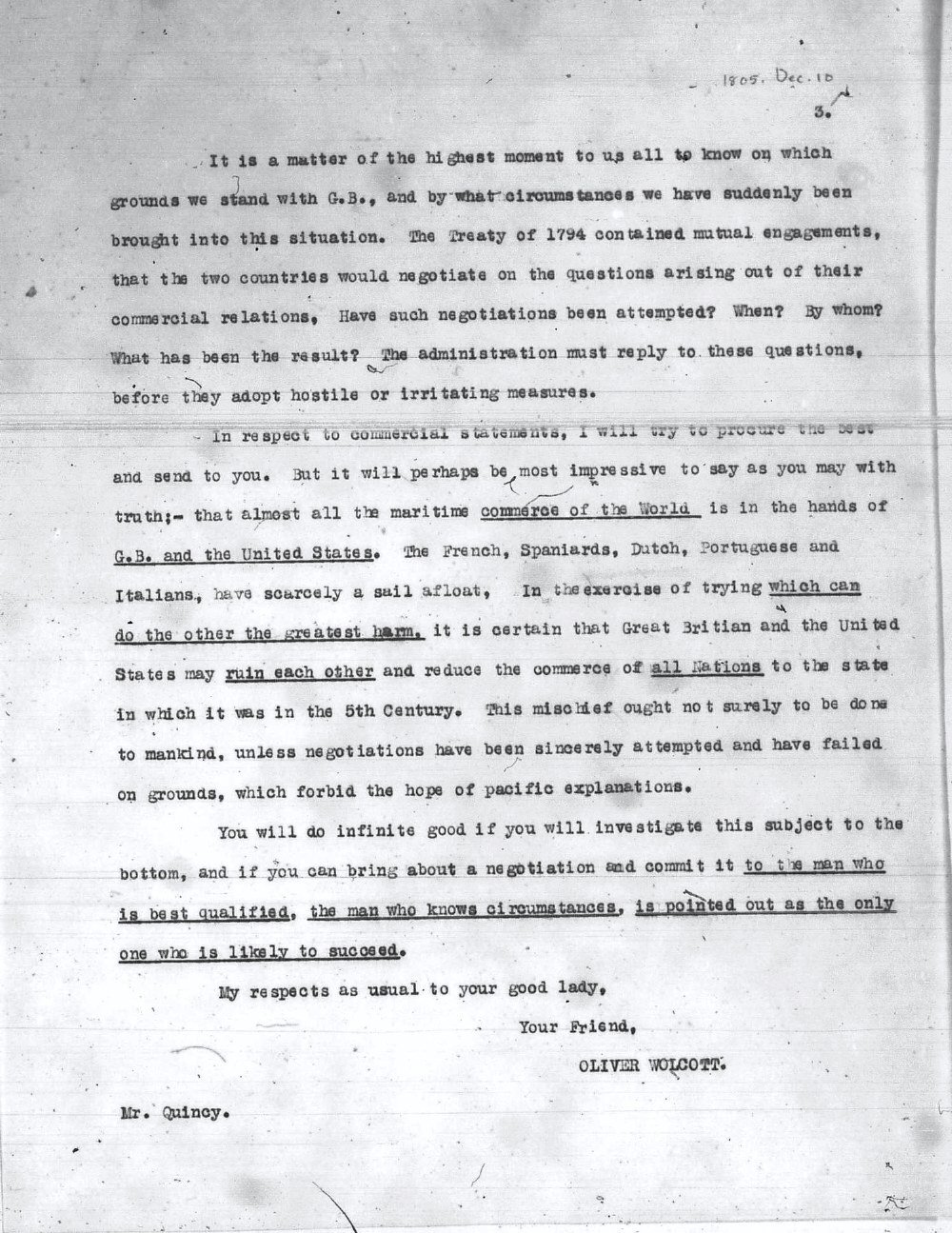
It is a matter of the highest moment to us all to know on which grounds we stand with G.B., and by what circumstances we have suddenly been brought into this situation. The Treaty of 1794 contained mutual engagements, that the two countries would negotiate on the questions arising out of their commercial relations, Have such negotiations been attempted? When? By whom? What has been the result? The administration must reply to these questions, before they adopt hostile or irritating measures.
In respect to commercial statements, I will try to procure the best and send to you. But it will perhaps be most impressive to say as you may with truth:- that almost all the maritime _commerce of the World_ is in the hands of _G.B. and the United States_. The French, Spaniards, Dutch, Portuguese and Italians, have scarcely a sail afloat, In the exercise of trying _which can do the other the greatest harm,_ it is certain that Great Britian and the United States may _ruin each other_ and reduce the commerce of _all Nations_ to the state in which it was in the 5th Century. This mischief ought not surely to be done to mankind, unless negotiations have been sincerely attempted and have failed on grounds, which forbid the hope of pacific explanations.
You will do infinite good if you will investigate this subject to the bottom, and if you can bring about a negotiation and commit it _to the man who is best qualified, the man who knows circumstances, is pointed out as the only one who is likely to succeed._
My respects as usual to your good lady,
Your Friend, — OLIVER WOLCOTT.
Mr. Quincy.
Transcribed verbatim from the scans, keeping the original spelling, capitalization, and punctuation; bracketed words are interlineations or uncertain readings, and [illegible] marks passages lost to the film. Condition: An early typescript transcript (typed copy), three pages, dated ‘New York, Dec. 10, 1805’ with ‘Dear Sir:’ salutation and the typed signature ‘OLIVER WOLCOTT.’ over the attention line ‘Mr. Quincy.’ Pages 2 and 3 carry a penciled archivist’s header ‘1805. Dec. 10’ with typed page numbers ‘2.’ and ‘3.’ Phrases underscored by the typist are rendered here between _underscores_; the extents follow the typescript. The typist’s spellings and punctuation are preserved verbatim, including ‘Britian’ (three times), the run-on ‘though but of little avail to oppose such a measure would be unpopular’, ‘it asserts which was never before asserted’, and the comma in ‘commercial relations, Have such negotiations been attempted?’ One word on page 1 is overtyped/smudged: ‘they agreed to expose[?] the whole Treaty’ (context supports ‘expose’). Three lines sit in horizontal fade bands across the frames but remain readable: p.1 ‘…lic account the stock in the market. This is required by good faith and jus-‘, p.2 ‘…country by the original importer, though in another vessel, still it is a’, p.3 ‘In respect to commercial statements, I will try to procure the best’. On page 2 the typist left an extra typed gap in ‘the one I assume which is that Great Britian…’ (collapsed to a single space here). Faint frame numbers appear in the lower right corners.
Gibbs Family Papers, Wisconsin Historical Society, Reel 1, scans 219–221. Early typescript transcript of Oliver Wolcott Jr. to Josiah Quincy. Digitized from the microfilm by this site; transcribed in full above.
On Impressment 
New York, February 7, 1806
The grievance that would finally make the war: the impressment of American seamen by the British. Wolcott proposes a settlement modeled on the old Consular Convention with France, and weighs the Southern states against the colony trade.
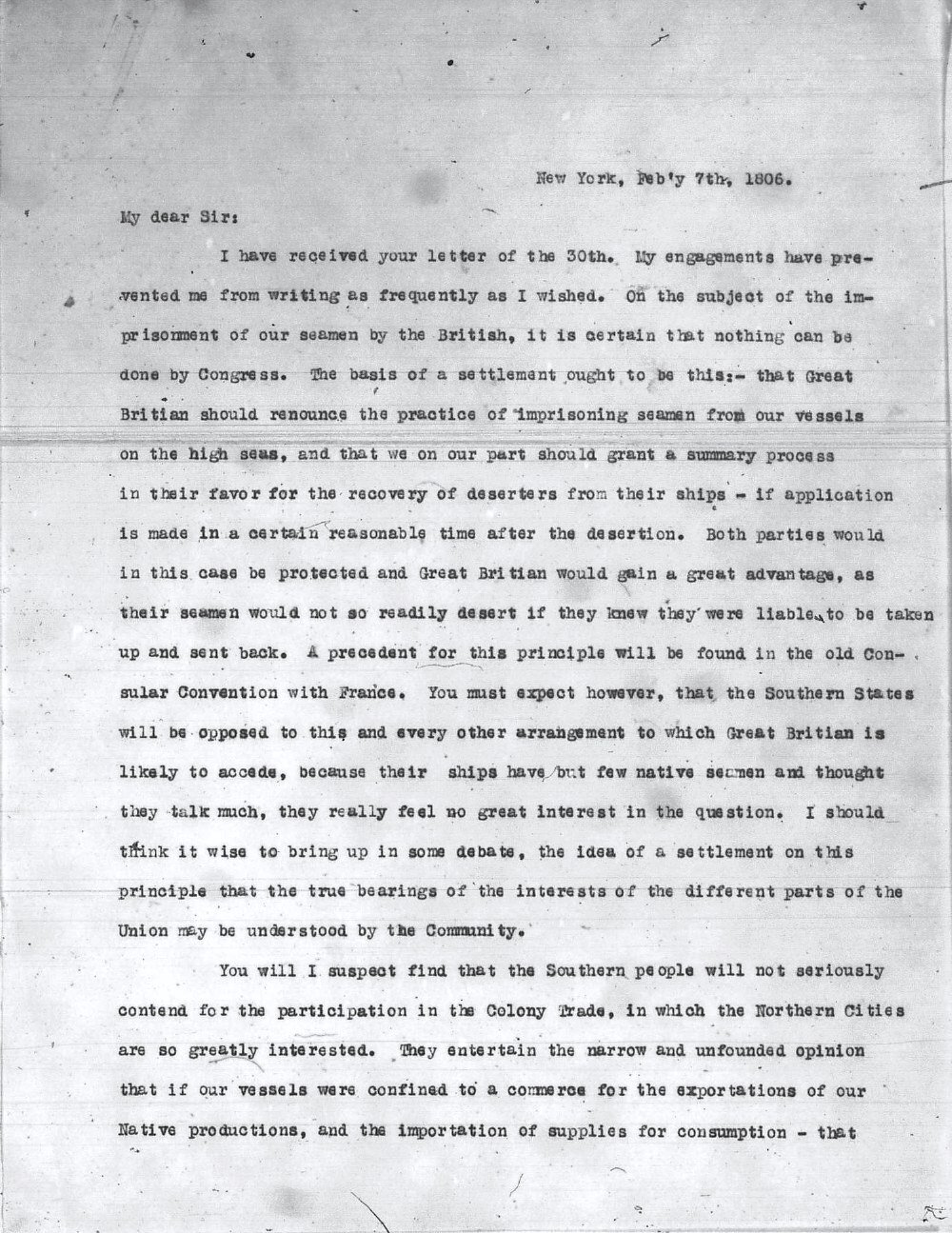
My dear Sir:
I have received your letter of the 30th. My engagements have prevented me from writing as frequently as I wished. On the subject of the imprisonment of our seamen by the British, it is certain that nothing can be done by Congress. The basis of a settlement ought to be this:- that Great Britian should renounce the practice of imprisoning seamen from our vessels on the high seas, and that we on our part should grant a summary process in their favor for the recovery of deserters from their ships – if application is made in a certain reasonable time after the desertion. Both parties would in this case be protected and Great Britian would gain a great advantage, as their seamen would not so readily desert if they knew they were liable to be taken up and sent back. A precedent for this principle will be found in the old Consular Convention with France. You must expect however, that the Southern States will be opposed to this and every other arrangement to which Great Britian is likely to accede, because their ships have but few native seamen and thought they talk much, they really feel no great interest in the question. I should think it wise to bring up in some debate, the idea of a settlement on this principle that the true bearings of the interests of the different parts of the Union may be understood by the Community.
You will I suspect find that the Southern people will not seriously contend for the participation in the Colony Trade, in which the Northern Cities are so greatly interested. They entertain the narrow and unfounded opinion that if our vessels were confined to a commerce for the exportations of our Native productions, and the importation of supplies for consumption – that
[The transcript breaks off here, mid-sentence. No further page of this letter was filmed on the reel.]
Transcribed verbatim from the scans, keeping the original spelling, capitalization, and punctuation; bracketed words are interlineations or uncertain readings, and [illegible] marks passages lost to the film. Condition: Early typewritten transcript, single page, fully legible. Transcribed exactly as typed, preserving the typist’s spellings and slips: ‘Britian’ for Britain (three times), ‘thought they talk much’ (evidently for ‘though’), and the ‘:-‘ punctuation. The page ends mid-sentence at ‘the importation of supplies for consumption – that’; the continuation was not filmed. (typescript)
Gibbs Family Papers, Wisconsin Historical Society, Reel 1, scan 222. Early typescript transcript of Oliver Wolcott Jr. to Josiah Quincy. Digitized from the microfilm by this site; transcribed in full above.
“Millions for Defense” 
New York, March 17, 1806
The old Federalist battle cry redeployed: oppose the Grigg and Virginia systems, build the fortifications, station the Navy in the North, and do not be cheated over neutral rights as the country was over the Mediterranean Fund and Louisiana.
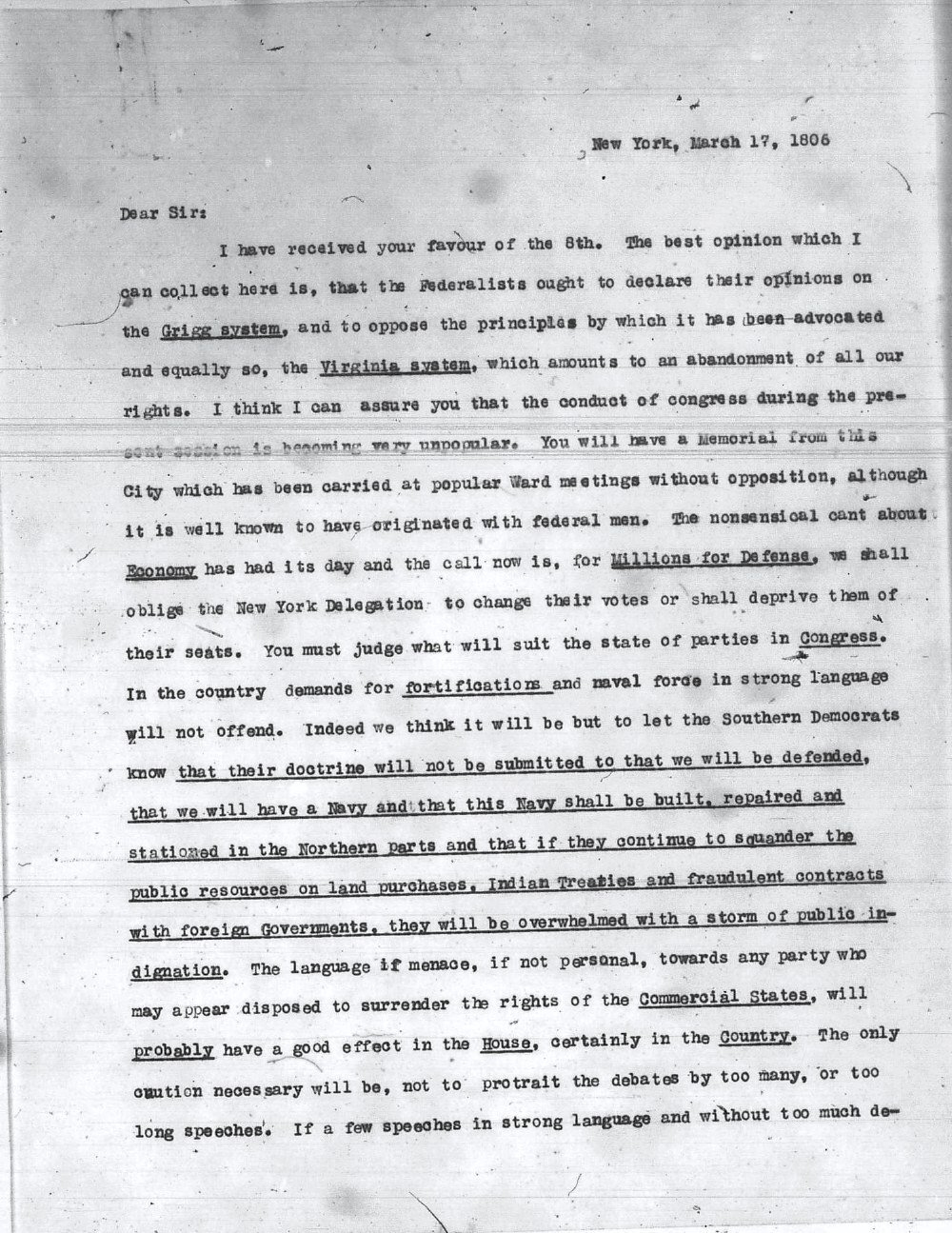
Dear Sir:
I have received your favour of the 8th. The best opinion which I can collect here is, that the Federalists ought to declare their opinions on the Grigg system, and to oppose the principles by which it has been advocated and equally so, the Virginia system, which amounts to an abandonment of all our rights. I think I can assure you that the conduct of congress during the present session is becoming very unpopular. You will have a Memorial from this City which has been carried at popular Ward meetings without opposition, although it is well known to have originated with federal men. The nonsensical cant about Economy has had its day and the call now is, for Millions for Defense, we shall oblige the New York Delegation to change their votes or shall deprive them of their seats. You must judge what will suit the state of parties in Congress. In the country demands for fortifications and naval force in strong language will not offend. Indeed we think it will be but[?] to let the Southern Democrats know that their doctrine will not be submitted to that we will be defended, that we will have a Navy and that this Navy shall be built, repaired and stationed in the Northern parts and that if they continue to squander the public resources on land purchases, Indian Treaties and fraudulent contracts with foreign Governments, they will be overwhelmed with a storm of public indignation. The language if menace, if not personal, towards any party who may appear disposed to surrender the rights of the Commercial States, will probably have a good effect in the House, certainly in the Country. The only caution necessary will be, not to protrait the debates by too many, or too long speeches. If a few speeches in strong language and without too much detail, are made, the public will take the correct side of the question.
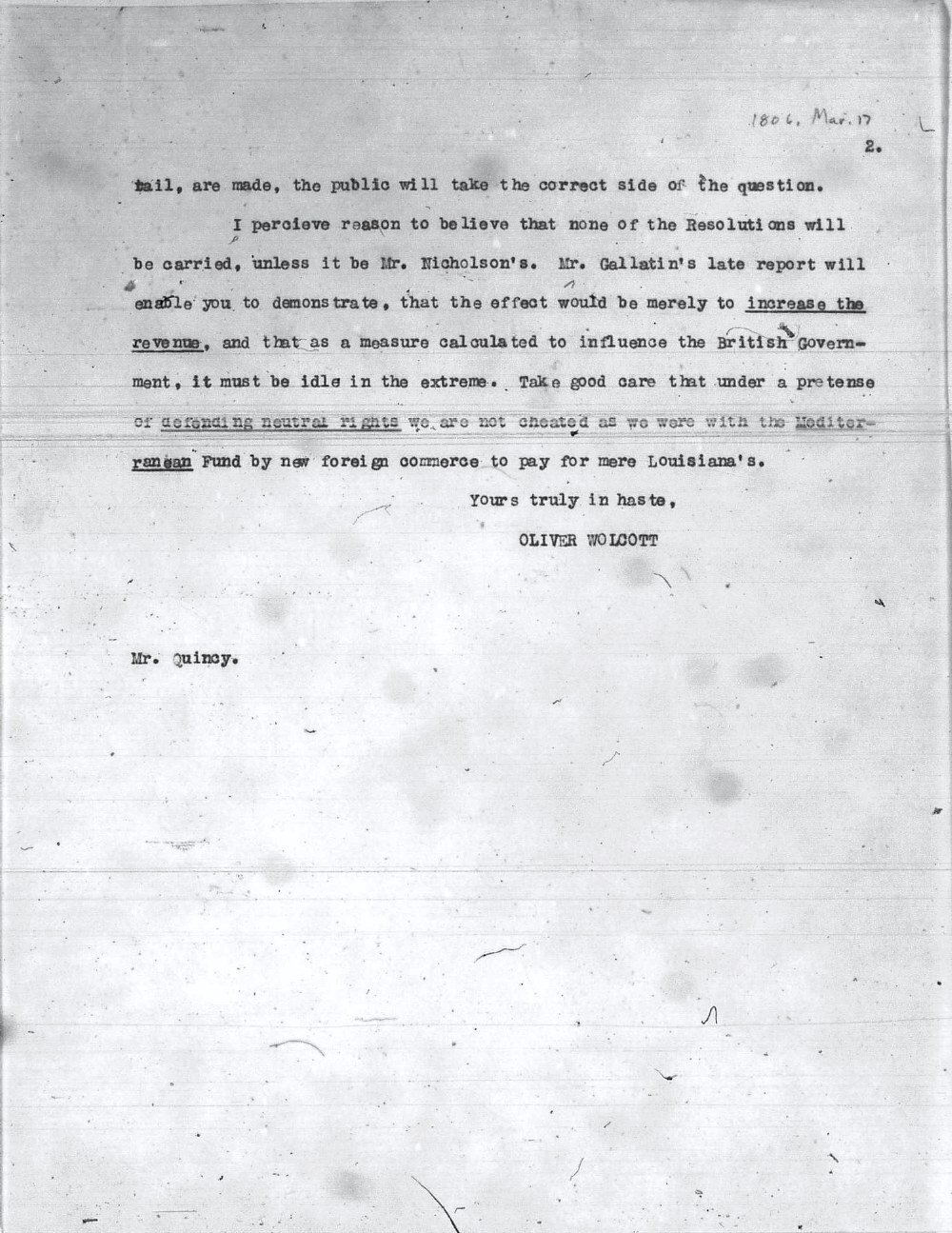
I percieve reason to believe that none of the Resolutions will be carried, unless it be Mr. Nicholson’s. Mr. Gallatin’s late report will enable you to demonstrate, that the effect would be merely to increase the revenue, and that as a measure calculated to influence the British Government, it must be idle in the extreme. Take good care that under a pretense of defending neutral rights we are not cheated as we were with the Mediterranean Fund by new foreign commerce to pay for mere Louisiana’s.
Yours truly in haste,
OLIVER WOLCOTT
Mr. Quincy.
Transcribed verbatim from the scans, keeping the original spelling, capitalization, and punctuation; bracketed words are interlineations or uncertain readings, and [illegible] marks passages lost to the film. Condition: Early typescript transcript, two pages, generally sharp and fully legible. One line on p.1 (“sent session is becoming very unpopular.”) and one line on p.2 (“of defending neutral rights we are not cheated as we were with the Mediter-“) are faded by a horizontal microfilm band but readable. “but” in “it will be but to let” is slightly uncertain (possibly “well”). Typescript’s own spellings preserved verbatim: “protrait” (protract), “percieve”, “The language if menace” (likely “of menace”), “Defense”, “pretense”, “Louisiana’s”. Underlining in the typescript: Grigg system, Virginia system, Economy, Millions for Defense, Congress, fortifications, “that their doctrine will not be submitted to that we will be defended, that we will have a Navy and that this Navy shall be built, repaired and stationed in the Northern parts and that if they continue to squander the public resources on land purchases, Indian Treaties and fraudulent contracts with foreign Governments, they will be overwhelmed with a storm of public indignation”, Commercial States, probably, House, Country, “increase the revenue”, “defending neutral rights”, Mediterranean. Pencil docket top right of p.2: “1806, Mar. 17” and page number “2.” (typescript)
Gibbs Family Papers, Wisconsin Historical Society, Reel 1, scans 223–224. Early typescript transcript of Oliver Wolcott Jr. to Josiah Quincy. Digitized from the microfilm by this site; transcribed in full above.
The Fishing Bounty (a Fragment) 
New York, December 12, 1806
The reel preserves only the second page of this letter; the first was not filmed, and the text begins mid-argument, exactly as the film gives it. What survives is Wolcott on the fishing bounty as a nursery of seamen and the folly of diminishing the public resources.
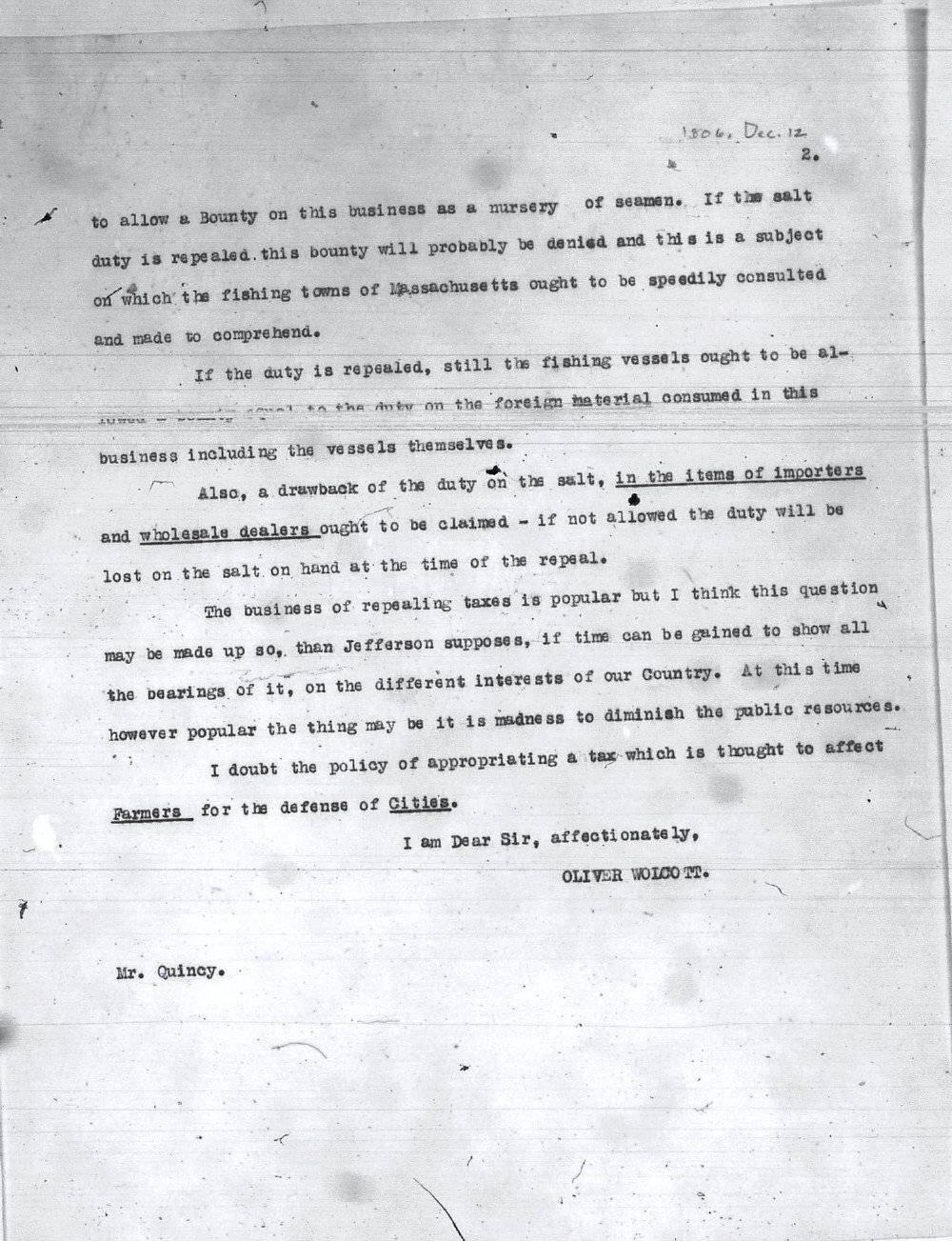
THE FIRST PAGE OF THIS LETTER WAS NOT FILMED. The surviving transcript begins mid-sentence at the top of its second page.
to allow a Bounty on this business as a nursery of seamen. If the salt duty is repealed this bounty will probably be denied and this is a subject on which the fishing towns of Massachusetts ought to be speedily consulted and made to comprehend.
If the duty is repealed, still the fishing vessels ought to be allowed a bounty[?] equal[?] to the duty on the foreign material consumed in this business including the vessels themselves.
Also, a drawback of the duty on the salt, in the items of importers and wholesale dealers ought to be claimed – if not allowed the duty will be lost on the salt on hand at the time of the repeal.
The business of repealing taxes is popular but I think this question may be made up so, than Jefferson supposes, if time can be gained to show all the bearings of it, on the different interests of our Country. At this time however popular the thing may be it is madness to diminish the public resources.
I doubt the policy of appropriating a tax which is thought to affect Farmers for the defense of Cities.
I am Dear Sir, affectionately,
OLIVER WOLCOTT.
Mr. Quincy.
Transcribed verbatim from the scans, keeping the original spelling, capitalization, and punctuation; bracketed words are interlineations or uncertain readings, and [illegible] marks passages lost to the film. Condition: Early typescript transcript, not the original manuscript; this is scan 226 only, carrying the typed page number ‘2.’ and a handwritten date annotation ‘1806, Dec. 12’ at top right — page 1 was not filmed on the reel, so the text opens mid-sentence (‘to allow a Bounty…’). One line is badly faded/damaged across the page: it completes ‘the fishing vessels ought to be al-‘ and reads approximately ‘lowed a bounty equal to the duty on the foreign material consumed in this’; only fragments (‘…al to the duty on the foreign material consumed in this’) are clearly legible, so ‘bounty[?] equal[?]’ are marked as uncertain readings. The phrases ‘in the items of importers and wholesale dealers’, the word ‘Farmers’, and ‘Cities’ are underlined in the typescript. The quirky construction ‘may be made up so, than Jefferson supposes’ is as typed (transcriber’s rendering; the typist likely dropped a word such as ‘otherwise’).
Gibbs Family Papers, Wisconsin Historical Society, Reel 1, scan 226; the first page of the letter was not filmed. Early typescript transcript of Oliver Wolcott Jr. to Josiah Quincy. Digitized from the microfilm by this site; the surviving text transcribed in full above.
On the Death of Fisher Ames 
New York, July 23, 1808
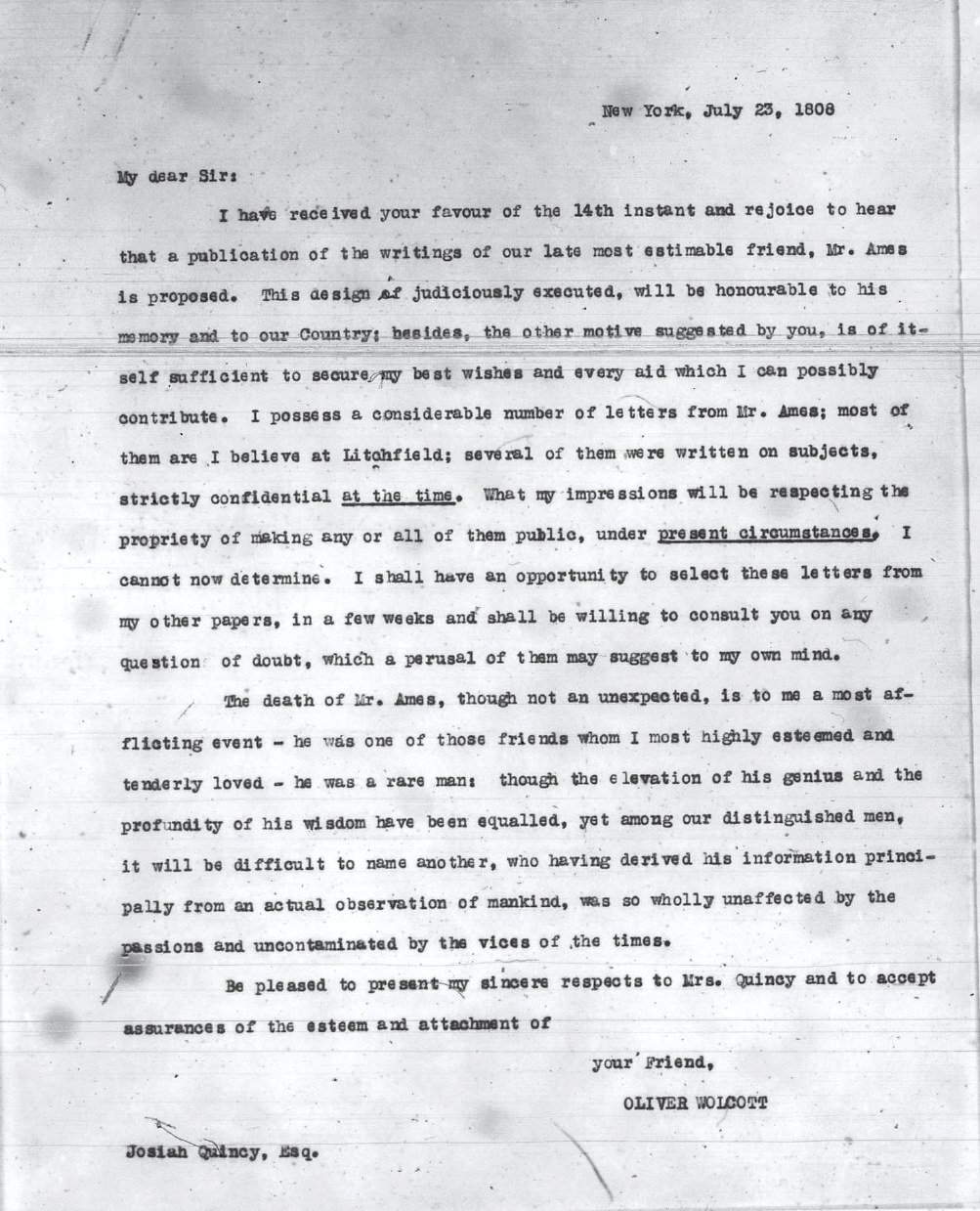
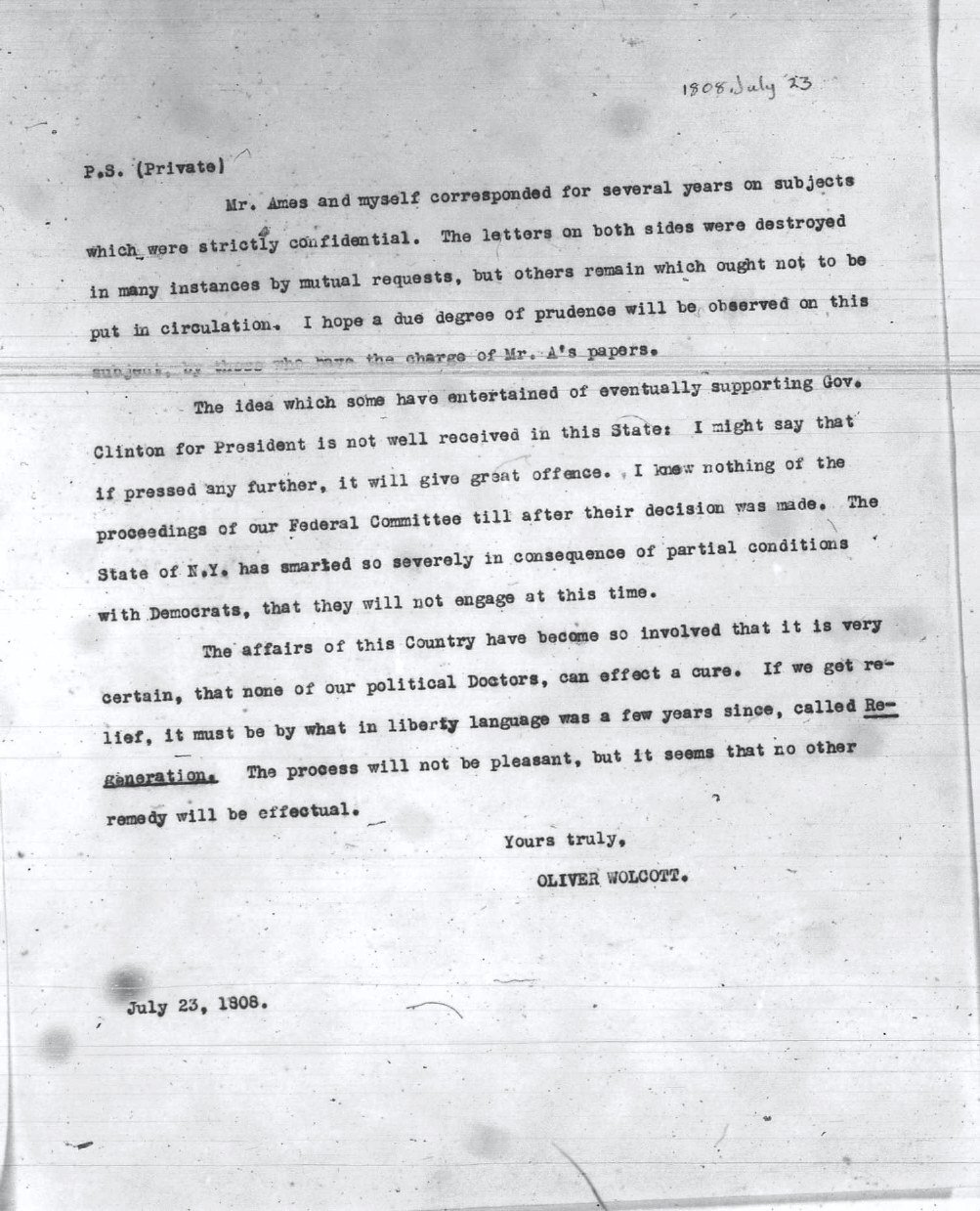
Fisher Ames died on the Fourth of July, 1808. Three weeks later Wolcott welcomes Quincy’s plan to publish Ames’s writings, offers his own Ames letters at Litchfield, and eulogizes his friend. The private postscript turns to prudence with the papers and the politics of New York.
My dear Sir:
I have received your favour of the 14th instant and rejoice to hear that a publication of the writings of our late most estimable friend, Mr. Ames is proposed. This design if[?] judiciously executed, will be honourable to his memory and to our Country; besides, the other motive suggested by you, is of itself sufficient to secure my best wishes and every aid which I can possibly contribute. I possess a considerable number of letters from Mr. Ames; most of them are I believe at Litchfield; several of them were written on subjects, strictly confidential at the time. What my impressions will be respecting the propriety of making any or all of them public, under present circumstances, I cannot now determine. I shall have an opportunity to select these letters from my other papers, in a few weeks and shall be willing to consult you on any question of doubt, which a perusal of them may suggest to my own mind.
The death of Mr. Ames, though not an unexpected, is to me a most afflicting event – he was one of those friends whom I most highly esteemed and tenderly loved – he was a rare man: though the elevation of his genius and the profundity of his wisdom have been equalled, yet among our distinguished men, it will be difficult to name another, who having derived his information principally from an actual observation of mankind, was so wholly unaffected by the passions and uncontaminated by the vices of the times.
Be pleased to present my sincere respects to Mrs. Quincy and to accept assurances of the esteem and attachment of
your Friend,
OLIVER WOLCOTT
Josiah Quincy, Esq.
P.S. (Private)
Mr. Ames and myself corresponded for several years on subjects which were strictly confidential. The letters on both sides were destroyed in many instances by mutual requests, but others remain which ought not to be put in circulation. I hope a due degree of prudence will be observed on this subject[?], by those[?] who have[?] the charge of Mr. A’s papers.
The idea which some have entertained of eventually supporting Gov. Clinton for President is not well received in this State: I might say that if pressed any further, it will give great offence. I knew nothing of the proceedings of our Federal Committee till after their decision was made. The State of N.Y. has smarted so severely in consequence of partial conditions[?] with Democrats, that they will not engage at this time.
The affairs of this Country have become so involved that it is very certain, that none of our political Doctors, can effect a cure. If we get relief, it must be by what in liberty language was a few years since, called Regeneration. The process will not be pleasant, but it seems that no other remedy will be effectual.
Yours truly,
OLIVER WOLCOTT.
July 23, 1808.
Transcribed verbatim from the scans, keeping the original spelling, capitalization, and punctuation; bracketed words are interlineations or uncertain readings, and [illegible] marks passages lost to the film. Condition: Early typescript transcript, clearly legible throughout (typescript). Scan 239 = letter; scan 238 = private P.S. leaf, docketed in ink at top right ‘1808. July 23’. Letter: the word rendered ‘if[?]’ in ‘This design if judiciously executed’ is overtyped/struck on the typescript and could read ‘of’. P.S. leaf: the line ‘subject, by those who have the charge of Mr. A’s papers’ falls on a fold/fade in the scan and is partly obscured, hence the bracketed queries; ‘conditions[?]’ in ‘partial conditions with Democrats’ is as typed but may be a typist’s error for ‘coalitions’. ‘Regeneration’ is underscored in the typescript, as are ‘at the time’ and ‘present circumstances’ in the letter. ‘though not an unexpected’ and ‘in liberty language’ are as typed.
Gibbs Family Papers, Wisconsin Historical Society, Reel 1, scans 239 and 238. Early typescript transcript of Oliver Wolcott Jr. to Josiah Quincy, with its private postscript. Digitized from the microfilm by this site; transcribed in full above.
A document series of the Gibbs Archive on AlfredGibbs.com, published July 13, 2026. Every document is shown with its complete verbatim transcription per the site’s standing rule. Related: The Oliver Wolcott Jr. Archive · The Gibbs Family Papers · The House on Winthrop Place.
Views: 35