Gibbs and the Dragoons in Sheridan’s Valley Victories, September-October 1864
The Gibbs Papers · The Official Records
Gibbs and the Dragoons in Sheridan’s Valley Victories
September to October 1864: Third Winchester, Tom’s Brook, and the ride that saved a battle.
In September 1864 Colonel Alfred Gibbs and his First New York Dragoons left the Regulars behind. On the 8th the Cavalry Reserve Brigade, which Gibbs had led through August, was reorganized, and the Dragoons were transferred to Brigadier-General Thomas C. Devin’s Second Brigade, “the old war-horse,” as Bowen called him. Gibbs went with his regiment. [Correction, November 4, 2026: for ten days he did more than go with it. “September 9, the First New York Dragoons were transferred to the brigade and Colonel Gibbs assumed command. The brigade remained at Smithfield holding the line of the Opequon until September 19, at which time Brevet Brigadier-General Devin returned and assumed command.” (Devin, report of the Second Brigade, First Cavalry Division, September 1 to October 21, dated October 23, 1864, Official Records, Series I, Vol. XLIII, Part 1). Gibbs commanded Devin’s Second Brigade from September 9 to 19, 1864, while Devin was away wounded.] Through the three battles that broke Jubal Early’s army and cleared the Shenandoah (Third Winchester, Fisher’s Hill, and Tom’s Brook), the Dragoons fought under Devin’s eye, and the brigade commander’s own official report records what they did.
Third Winchester, September 19, 1864
At the Opequon, Devin’s charge broke through the enemy’s retiring infantry, was thrown back, and was steadied by the Dragoons, at the cost of one of the regiment’s best officers.
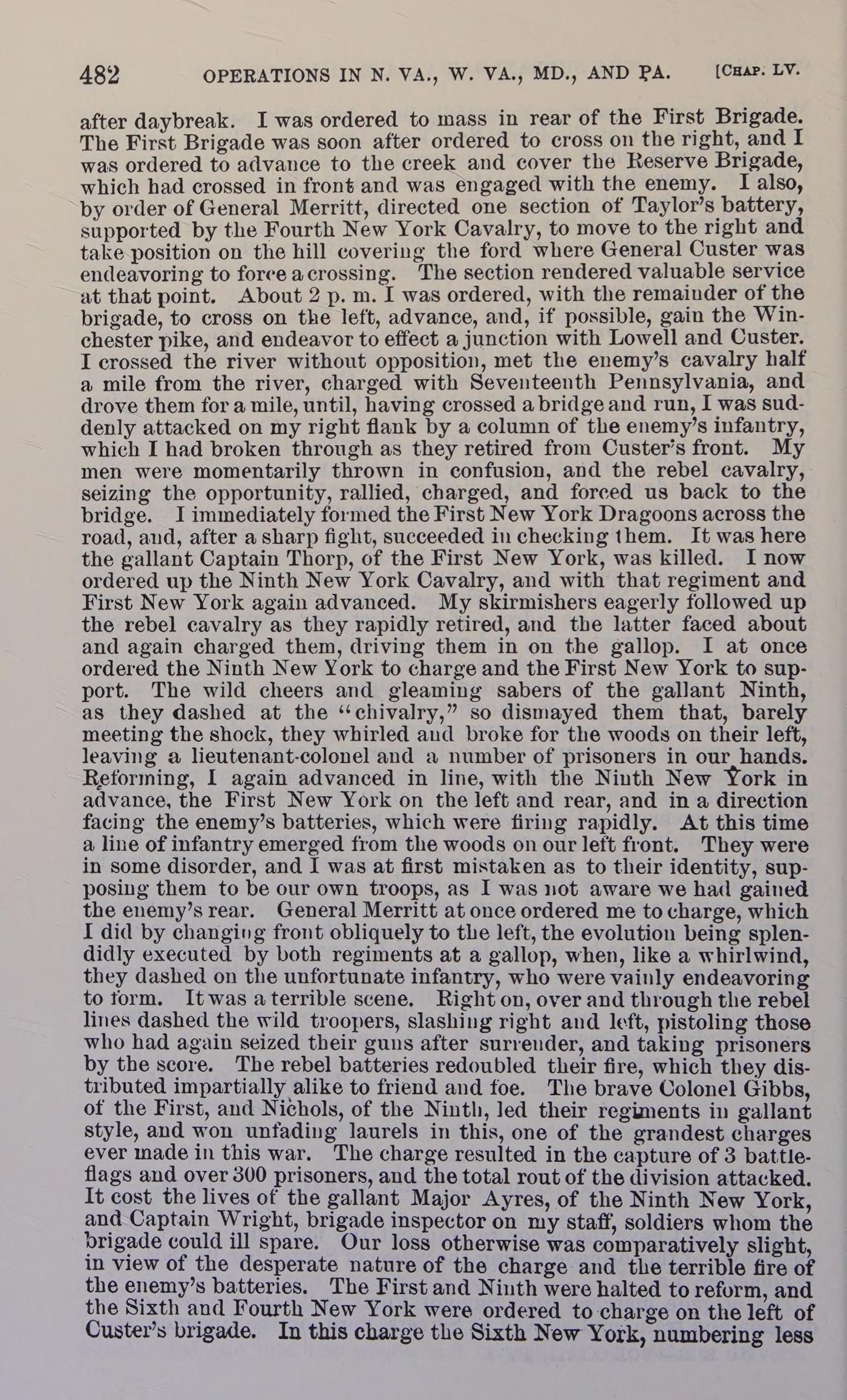
“… I was suddenly attacked on my right flank by a column of the enemy’s infantry… My men were momentarily thrown in confusion, and the rebel cavalry, seizing the opportunity, rallied, charged, and forced us back to the bridge. I immediately formed the First New York Dragoons across the road, and, after a sharp fight, succeeded in checking them. It was here the gallant Captain Thorp, of the First New York, was killed. … General Merritt at once ordered me to charge… the evolution being splendidly executed by both regiments at a gallop, when, like a whirlwind, they dashed on the unfortunate infantry… It was a terrible scene. Right on, over and through the rebel lines dashed the wild troopers, slashing right and left, … and taking prisoners by the score.”Bvt. Brig. Gen. Thomas C. Devin, report of the Second Brigade [No. 144], in OR, Ser. I, Vol. XLIII, Pt. 1.
“The brave Colonel Gibbs, of the First, and Nichols, of the Ninth, led their regiments in gallant style, and won unfading laurels in this, one of the grandest charges ever made in this war. The charge resulted in the capture of 3 battle-flags and over 300 prisoners, and the total rout of the division attacked.”Devin, report [No. 144], OR, Ser. I, Vol. XLIII, Pt. 1, p. 482.
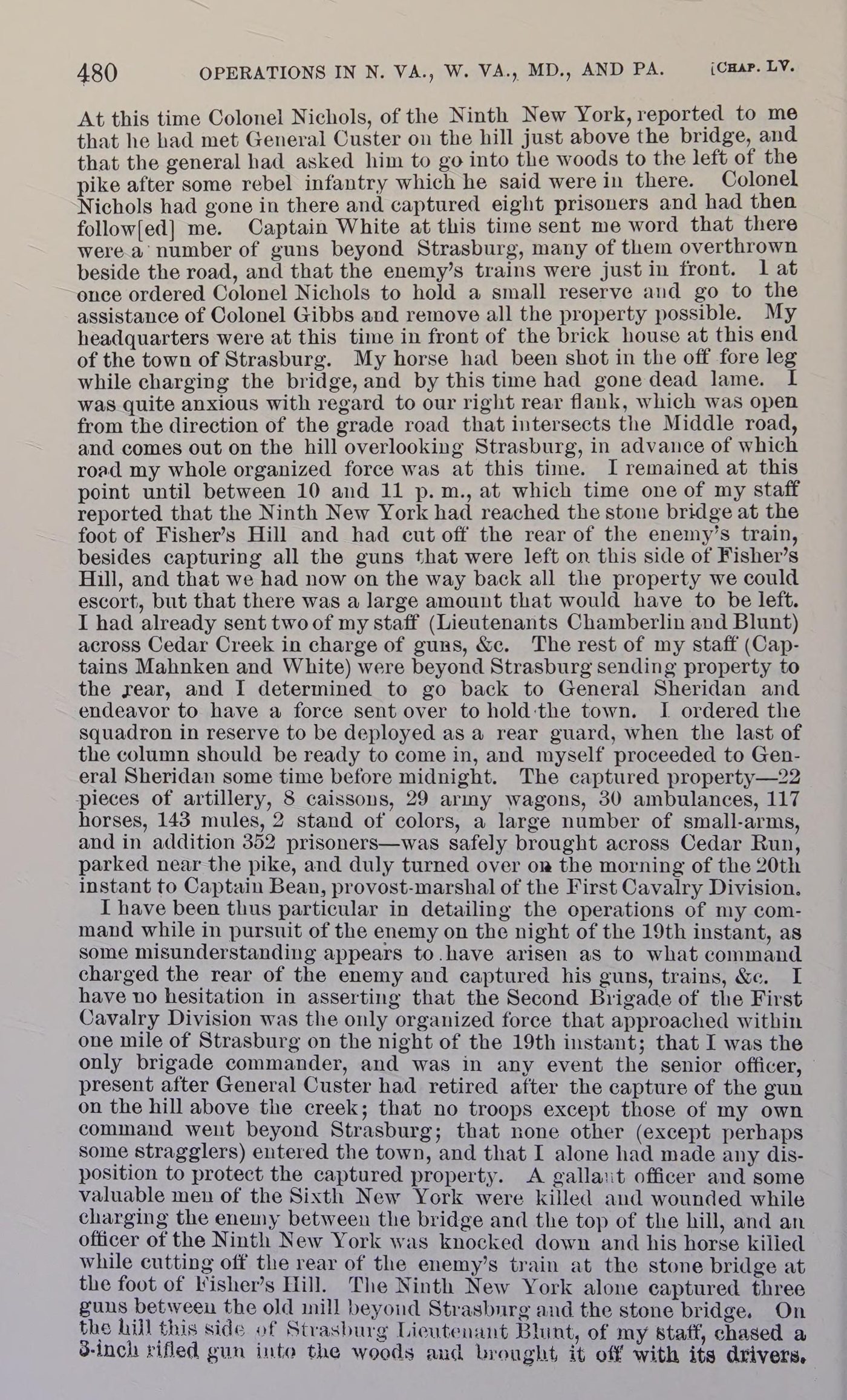
The document itself: Devin’s report in the Official Records, Vol. XLIII, Pt. 1 (p. 480, Tom’s Brook; p. 482, Third Winchester, where Devin names Gibbs). Click to enlarge.
Relieving the Reserve Brigade
Later in the campaign, when the Regulars Gibbs had once led (now Colonel Lowell’s Reserve Brigade) were driven back, it was Gibbs’s Dragoons who steadied the line.
“That brigade was forced back to my left and rear and the enemy appeared in force in the woods on my left and front. I at once dismounted two squadrons of [the] First New York Dragoons and soon dislodged them, at the same time relieving the pressure on Colonel Lowell’s front.”Devin, report [No. 144], OR, Ser. I, Vol. XLIII, Pt. 1.
Tom’s Brook, October 9, 1864
At the rout the troopers called the “Woodstock Races,” the Dragoons were among the regiments that ran down the fleeing Confederate horse and hauled in their guns.
“I at once ordered all of the First New York Dragoons to the front, except one squadron; I proceeded toward Strasburg and successively met men of the Sixth New York and First New York Dragoons with guns, caissons, &c.”Devin, report [No. 144], OR, Ser. I, Vol. XLIII, Pt. 1.
And at Cedar Creek
Three weeks later, on October 19, the Dragoons were on the field for the campaign’s climactic battle, and their own historian, an eyewitness, places Gibbs there among the senior officers as Sheridan galloped up from Winchester to rally his broken army:
“After a few moments’ conversation with Torbert, Devin, Gibbs, and other officers, he [Sheridan] was off like a flash… With a thundering shout the men cheered and cheered again.”J. R. Bowen, Regimental History of the First New York Dragoons (1900), ch. XVII.
A note on the sources, and on command
These are the words of the brigade commander, General Devin, in his official report, and of the Dragoons’ own historian, not a modern paraphrase. Because Devin’s report covers his entire brigade, the passages bearing on the Dragoons are quoted here with citation rather than reproduced whole. One point of accuracy: in these September and October battles Gibbs led his regiment, the First New York Dragoons, within Devin’s Second Brigade. He did not command the Reserve Brigade at Third Winchester, Fisher’s Hill, Tom’s Brook, or Cedar Creek: that brigade was Colonel Lowell’s (mortally wounded at Cedar Creek). Gibbs resumed brigade command that December. [Correction, November 4, 2026: see the note above. He also commanded Devin’s Second Brigade from September 9 to 19, 1864.]
References
Devin, T. C. (1864). Reports of Bvt. Brig. Gen. Thomas C. Devin, commanding Second Brigade [No. 144]. In The War of the Rebellion: A Compilation of the Official Records of the Union and Confederate Armies (Series I, Vol. XLIII, Part 1). U.S. Government Printing Office.
Bowen, J. R. (1900). Regimental History of the First New York Dragoons, ch. XVII.
Gibbs’s war record, in his own words: » The Shenandoah Valley, August 1864 · » The Appomattox Campaign, 1865
Views: 7