Gibbs in the Shenandoah Valley, August 1864
The Gibbs Papers · The Official Records
Gibbs in the Shenandoah Valley, August 1864
His first weeks in brigade command: a running cavalry fight, and a war against guerrillas behind the lines.
On August 10, 1864, Colonel Alfred Gibbs took command of the Cavalry Reserve Brigade (the Regulars, with his own First New York Dragoons) at the opening of Sheridan’s Shenandoah Valley campaign. The three weeks that followed were his in full: the running fight at Newtown, rear-guard actions from Charlestown to Shepherdstown, and a saber charge at Leetown that “completely routed” a brigade of Maryland cavalry. They were also a lesson in the Valley’s other war: his entire brigade train burned by guerrillas, and his commissary murdered on the road. This is Gibbs’s own report of those weeks, word for word.
The Document Itself
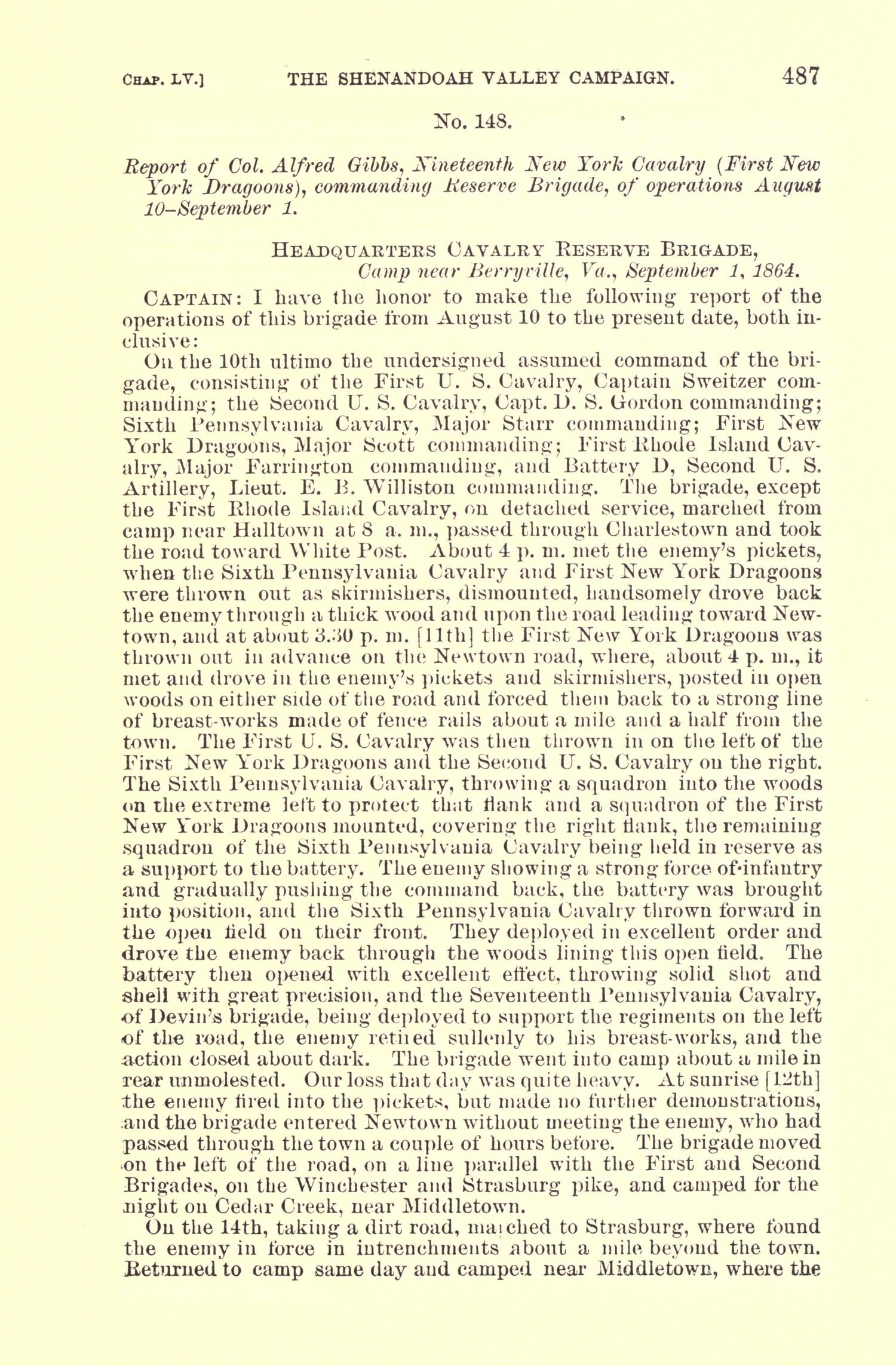
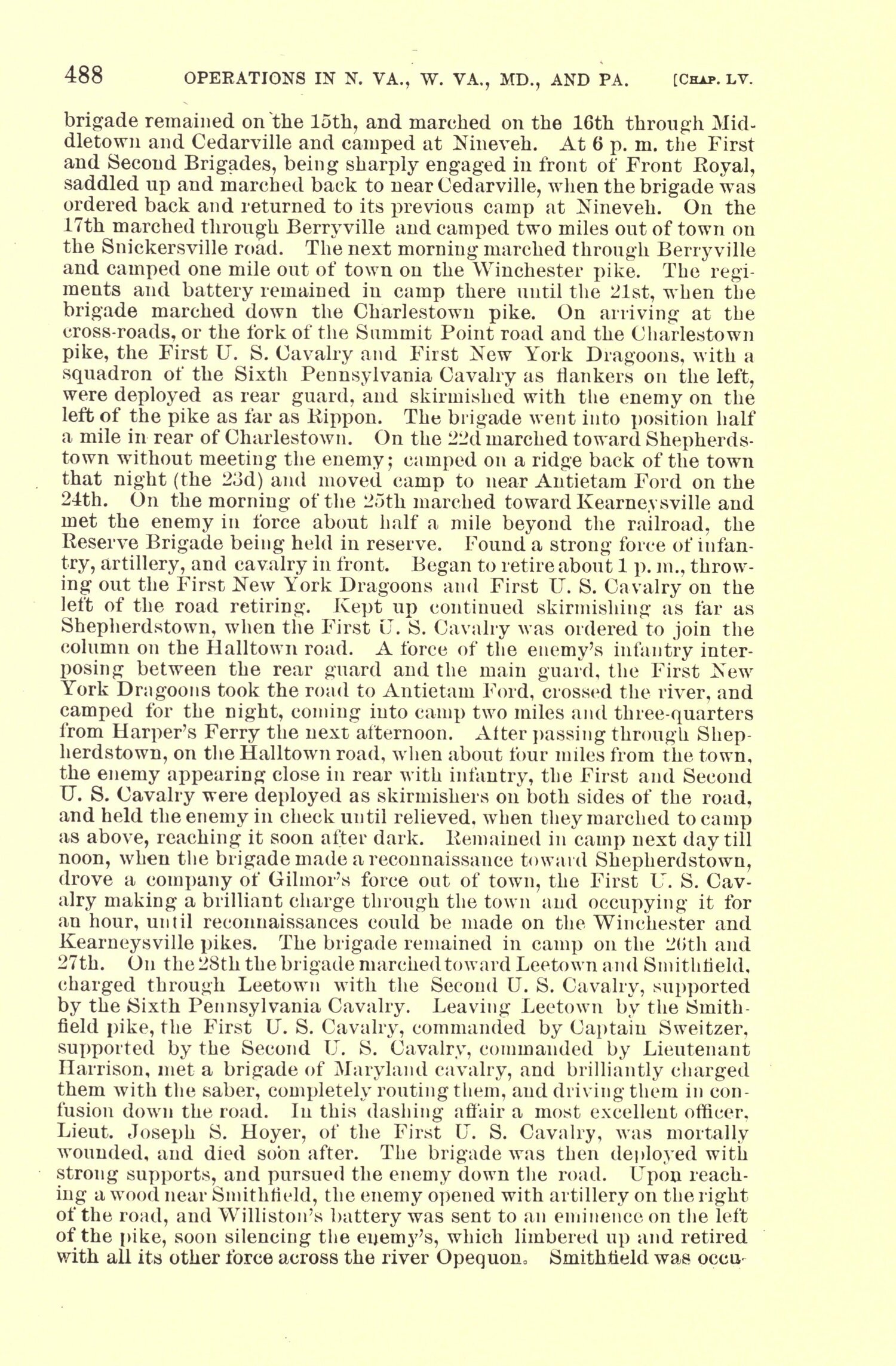
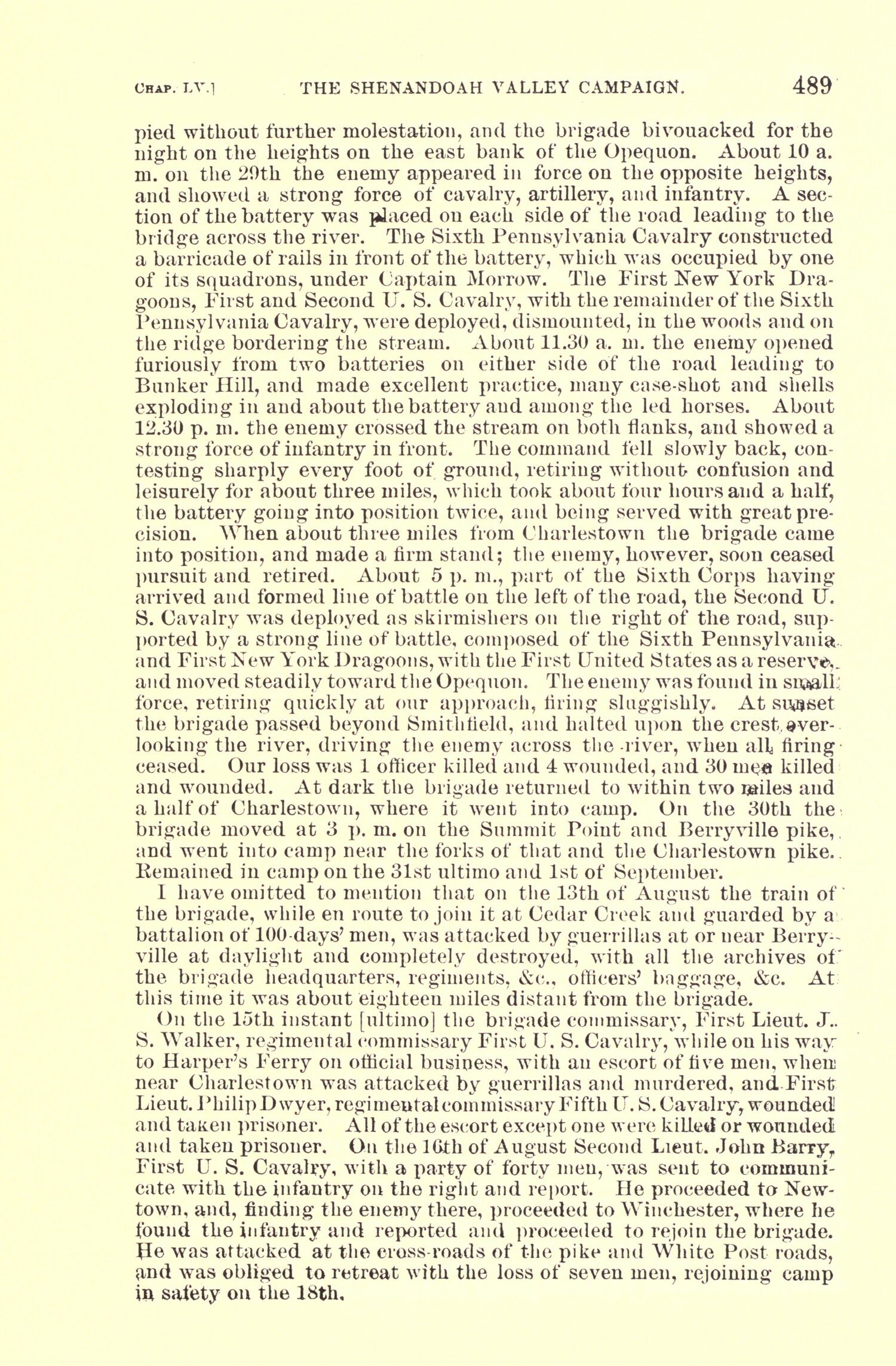
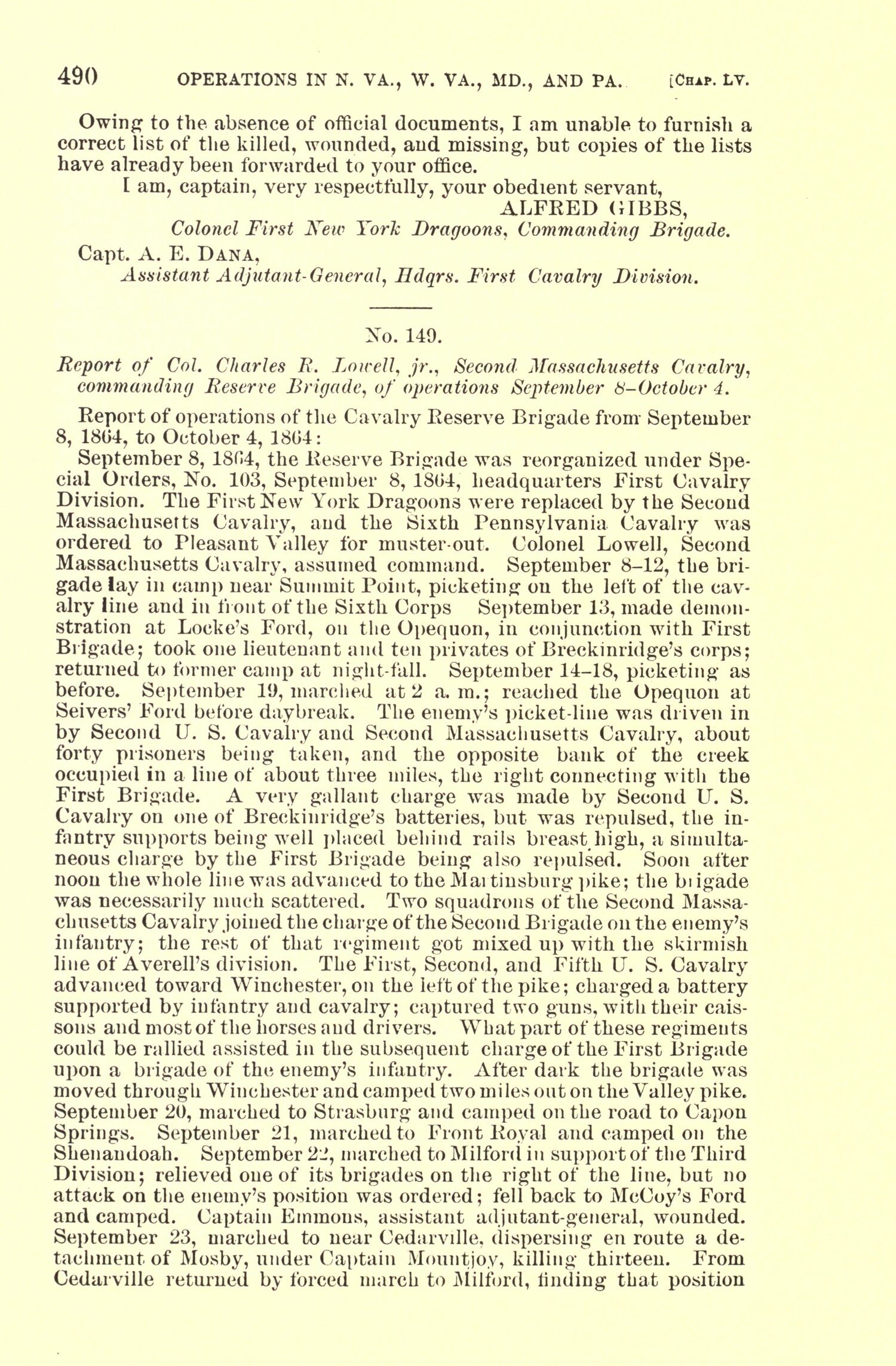
Report No. 148, The War of the Rebellion: Official Records of the Union and Confederate Armies, Series I, Vol. XLIII, Part 1, pp. 487-490 (Government Printing Office). Click any page to enlarge; the full-resolution scans are hosted here on this site.
In His Own Hand
Colonel Gibbs’s Report of the August Operations
Filed from “Camp near Berryville” on September 1, 1864, and printed in the Official Records: the daily grind of a cavalry brigade in the Valley: the fight and heavy loss at Newtown, the death of Lieutenant Hoyer in the Leetown charge, the four-and-a-half-hour fighting withdrawal at the Opequon, and the guerrilla raids that cost him his train and his commissary.
“Brilliantly charged them with the saber, completely routing them.”
Report of Col. Alfred Gibbs, Cavalry Reserve Brigade, operations August 10 to September 1, 1864
Verbatim transcription
No. 148. Report of Col. Alfred Gibbs, Nineteenth New York Cavalry (First New York Dragoons), commanding Reserve Brigade, of operations August 10–September 1.
Headquarters Cavalry Reserve Brigade, Camp near Berryville, Va., September 1, 1864.
Captain: I have the honor to make the following report of the operations of this brigade from August 10 to the present date, both inclusive:
On the 10th ultimo the undersigned assumed command of the brigade, consisting of the First U. S. Cavalry, Captain Sweitzer commanding; the Second U. S. Cavalry, Capt. D. S. Gordon commanding; Sixth Pennsylvania Cavalry, Major Starr commanding; First New York Dragoons, Major Scott commanding; First Rhode Island Cavalry, Major Farrington commanding, and Battery D, Second U. S. Artillery, Lieut. E. B. Williston commanding. The brigade, except the First Rhode Island Cavalry, on detached service, marched from camp near Halltown at 8 a. m., passed through Charlestown and took the road toward White Post. About 4 p.m. met the enemy’s pickets, when the Sixth Pennsylvania Cavalry and First New York Dragoons were thrown out as skirmishers, dismounted, handsomely drove back the enemy through a thick wood and upon the road leading toward Newtown, and at about 3.30 p. m. [11th] the First New York Dragoons was thrown out in advance on the Newtown road, where, about 4 p. m., it met and drove in the enemy’s pickets and skirmishers, posted in open woods on either side of the road and forced them back to a strong line of breast-works made of fence rails about a mile and a half from the town. The First U. S. Cavalry was then thrown in on the left of the First New York Dragoons and the Second U. S. Cavalry on the right. The Sixth Pennsylvania Cavalry, throwing a squadron into the woods on the extreme left to protect that flank and a squadron of the First New York Dragoons mounted, covering the right flank, the remaining squadron of the Sixth Pennsylvania Cavalry being held in reserve as a support to the battery. The enemy showing a strong force of infantry and gradually pushing the command back, the battery was brought into position, and the Sixth Pennsylvania Cavalry thrown forward in the open field on their front. They deployed in excellent order and drove the enemy back through the woods lining this open field. The battery then opened with excellent effect, throwing solid shot and shell with great precision, and the Seventeenth Pennsylvania Cavalry, of Devin’s brigade, being deployed to support the regiments on the left of the road, the enemy retired sullenly to his breast-works, and the action closed about dark. The brigade went into camp about a mile in rear unmolested. Our loss that day was quite heavy. At sunrise [12th] the enemy fired into the pickets, but made no further demonstrations, and the brigade entered Newtown without meeting the enemy, who had passed through the town a couple of hours before. The brigade moved on the left of the road, on a line parallel with the First and Second Brigades, on the Winchester and Strasburg pike, and camped for the night on Cedar Creek, near Middletown.
On the 14th, taking a dirt road, marched to Strasburg, where found the enemy in force in intrenchments about a mile beyond the town. Returned to camp same day and camped near Middletown, where the brigade remained on the 15th, and marched on the 16th through Middletown and Cedarville and camped at Nineveh. At 6 p.m. the First and Second Brigades, being sharply engaged in front of Front Royal, saddled up and marched back to near Cedarville, when the brigade was ordered back and returned to its previous camp at Nineveh. On the 17th marched through Berryville and camped two miles out of town on the Snickersville road. The next morning marched through Berryville and camped one mile out of town on the Winchester pike. The regiments and battery remained in camp there until the 21st, when the brigade marched down the Charlestown pike. On arriving at the cross-roads, or the fork of the Summit Point road and the Charlestown pike, the First U. S. Cavalry and First New York Dragoons, with a squadron of the Sixth Pennsylvania Cavalry as flankers on the left, were deployed as rear guard, and skirmished with the enemy on the left of the pike as far as Rippon. The brigade went into position half a mile in rear of Charlestown. On the 22d marched toward Shepherdstown without meeting the enemy; camped on a ridge back of the town that night (the 23d) and moved camp to near Antietam Ford on the 24th.
On the morning of the 25th marched toward Kearneysville and met the enemy in force about half a mile beyond the railroad, the Reserve Brigade being held in reserve. Found a strong force of infantry, artillery, and cavalry in front. Began to retire about 1 p. m., throwing out the First New York Dragoons and First U. S. Cavalry on the left of the road retiring. Kept up continued skirmishing as far as Shepherdstown, when the First U. S. Cavalry was ordered to join the column on the Halltown road. A force of the enemy’s infantry interposing between the rear guard and the main guard, the First New York Dragoons took the road to Antietam Ford, crossed the river, and camped for the night, coming into camp two miles and three-quarters from Harper’s Ferry the next afternoon. After passing through Shepherdstown, on the Halltown road, when about four miles from the town, the enemy appearing close in rear with infantry, the First and Second U. S. Cavalry were deployed as skirmishers on both sides of the road, and held the enemy in check until relieved, when they marched to camp as above, reaching it soon after dark. Remained in camp next day till noon, when the brigade made a reconnaissance toward Shepherdstown, drove a company of Gilmor’s force out of town, the First U. S. Cavalry making a brilliant charge through the town and occupying it for an hour, until reconnaissances could be made on the Winchester and Kearneysville pikes. The brigade remained in camp on the 26th and 27th.
On the 28th the brigade marched toward Leetown and Smithfield, charged through Leetown with the Second U. S. Cavalry, supported by the Sixth Pennsylvania Cavalry. Leaving Leetown by the Smithfield pike, the First U. S. Cavalry, commanded by Captain Sweitzer, supported by the Second U. S. Cavalry, commanded by Lieutenant Harrison, met a brigade of Maryland cavalry, and brilliantly charged them with the saber, completely routing them, and driving them in confusion down the road. In this dashing affair a most excellent officer, Lieut. Joseph S. Hoyer, of the First U. S. Cavalry, was mortally wounded, and died soon after. The brigade was then deployed with strong supports, and pursued the enemy down the road. Upon reaching a wood near Smithfield, the enemy opened with artillery on the right of the road, and Williston’s battery was sent to an eminence on the left of the pike, soon silencing the enemy’s, which limbered up and retired with all its other force across the river Opequon. Smithfield was occupied without further molestation, and the brigade bivouacked for the night on the heights on the east bank of the Opequon.
About 10 a. m. on the 29th the enemy appeared in force on the opposite heights, and showed a strong force of cavalry, artillery, and infantry. A section of the battery was placed on each side of the road leading to the bridge across the river. The Sixth Pennsylvania Cavalry constructed a barricade of rails in front of the battery, which was occupied by one of its squadrons, under Captain Morrow. The First New York Dragoons, First and Second U. S. Cavalry, with the remainder of the Sixth Pennsylvania Cavalry, were deployed, dismounted, in the woods and on the ridge bordering the stream. About 11.30 a. m. the enemy opened furiously from two batteries on either side of the road leading to Bunker Hill, and made excellent practice, many case-shot and shells exploding in and about the battery and among the led horses. About 12.30 p. m. the enemy crossed the stream on both flanks, and showed a strong force of infantry in front. The command fell slowly back, contesting sharply every foot of ground, retiring without confusion and leisurely for about three miles, which took about four hours and a half, the battery going into position twice, and being served with great precision. When about three miles from Charlestown the brigade came into position, and made a firm stand; the enemy, however, soon ceased pursuit and retired. About 5 p.m., part of the Sixth Corps having arrived and formed line of battle on the left of the road, the Second U. S. Cavalry was deployed as skirmishers on the right of the road, supported by a strong line of battle, composed of the Sixth Pennsylvania and First New York Dragoons, with the First United States as a reserve, and moved steadily toward the Opequon. The enemy was found in small force, retiring quickly at our approach, firing sluggishly. At sunset the brigade passed beyond Smithfield, and halted upon the crest overlooking the river, driving the enemy across the river, when all firing ceased. Our loss was 1 officer killed and 4 wounded, and 30 men killed and wounded. At dark the brigade returned to within two miles and a half of Charlestown, where it went into camp. On the 30th the brigade moved at 3 p.m. on the Summit Point and Berryville pike, and went into camp near the forks of that and the Charlestown pike. Remained in camp on the 31st ultimo and 1st of September.
I have omitted to mention that on the 13th of August the train of the brigade, while en route to join it at Cedar Creek and guarded by a battalion of 100-days’ men, was attacked by guerrillas at or near Berryville at daylight and completely destroyed, with all the archives of the brigade headquarters, regiments, &c., officers’ baggage, &c. At this time it was about eighteen miles distant from the brigade. On the 15th instant [ultimo] the brigade commissary, First Lieut. J. S. Walker, regimental commissary First U. S. Cavalry, while on his way to Harper’s Ferry on official business, with an escort of five men, when near Charlestown was attacked by guerrillas and murdered, and First Lieut. Philip Dwyer, regimental commissary Fifth U. S. Cavalry, wounded and taken prisoner. All of the escort except one were killed or wounded and taken prisoner. On the 16th of August Second Lieut. John Barry, First U. S. Cavalry, with a party of forty men, was sent to communicate with the infantry on the right and report. He proceeded to Newtown, and, finding the enemy there, proceeded to Winchester, where he found the infantry and reported and proceeded to rejoin the brigade. He was attacked at the cross-roads of the pike and White Post roads, and was obliged to retreat with the loss of seven men, rejoining camp in safety on the 18th.
Owing to the absence of official documents, I am unable to furnish a correct list of the killed, wounded, and missing, but copies of the lists have already been forwarded to your office.
I am, Captain, very respectfully, your obedient servant,
Alfred Gibbs, Colonel First New York Dragoons, Commanding Brigade.
To Capt. A. E. Dana, Assistant Adjutant-General, Hdqrs. First Cavalry Division.
Gibbs, A. (1864). Report of Col. Alfred Gibbs, Nineteenth New York Cavalry (First New York Dragoons), commanding Reserve Brigade [No. 148]. In The War of the Rebellion: A Compilation of the Official Records of the Union and Confederate Armies (Series I, Vol. XLIII, Part 1). U.S. Government Printing Office.
A correction to the record
Gibbs is often said to have “commanded the Reserve Brigade at Cedar Creek.” The record refines this. On September 8-9, 1864 the Reserve Brigade was reorganized (Special Orders No. 103): the First New York Dragoons were transferred to Devin’s Second Brigade, and Colonel Charles R. Lowell took the Reserve Brigade, leading it at Third Winchester, Fisher’s Hill, Tom’s Brook, and Cedar Creek, where he was mortally wounded on October 19 (Crowninshield then succeeded him). Gibbs went with his regiment: through those same battles, including Cedar Creek, he fought at the head of the 1st New York Dragoons in Devin’s brigade, present on the field (the regiment’s historian places him in conversation with Sheridan during Sheridan’s Ride), but not again in brigade command until December 13, 1864. [Correction, November 4, 2026: General Devin’s own report records a brigade command in between. “September 9, the First New York Dragoons were transferred to the brigade and Colonel Gibbs assumed command. The brigade remained at Smithfield holding the line of the Opequon until September 19, at which time Brevet Brigadier-General Devin returned and assumed command.” (Devin, report of the Second Brigade, First Cavalry Division, September 1 to October 21, dated October 23, 1864, Official Records, Series I, Vol. XLIII, Part 1). Gibbs therefore commanded Devin’s Second Brigade from September 9 to 19, 1864, while Devin was away wounded, and handed it back on the morning of Third Winchester. This sentence said he held no brigade command again until December. The December date is right for the Reserve Brigade.] His brigadier’s star, dated October 1864, rested on that Valley service and on the year-long advocacy campaign (see The Making of a General), not on a Reserve-Brigade command he no longer held. The report above is his last as the Reserve Brigade’s commander.
The Proof in Print
The Army’s Own Order of Battle
The reorganization described above is not inference. The Official Records print the order of battle of Sheridan’s army at the battle of Winchester (the Opequon), September 19, 1864, and there it stands in a single page of type: Colonel Charles R. Lowell at the head of the Reserve Brigade, and Gibbs at the head of the 19th New York (1st Dragoons) in Devin’s Second Brigade of Merritt’s First Division. The page is reproduced and transcribed in full below.
“19th New York (1st Dragoons), Col. Alfred Gibbs.”
The cavalry of Sheridan’s army as organized at the battle of Winchester (the Opequon), September 19, 1864
The document itself: the organization table as printed in the Official Records, Vol. XLIII, Pt. 1, p. 111 (click to enlarge)
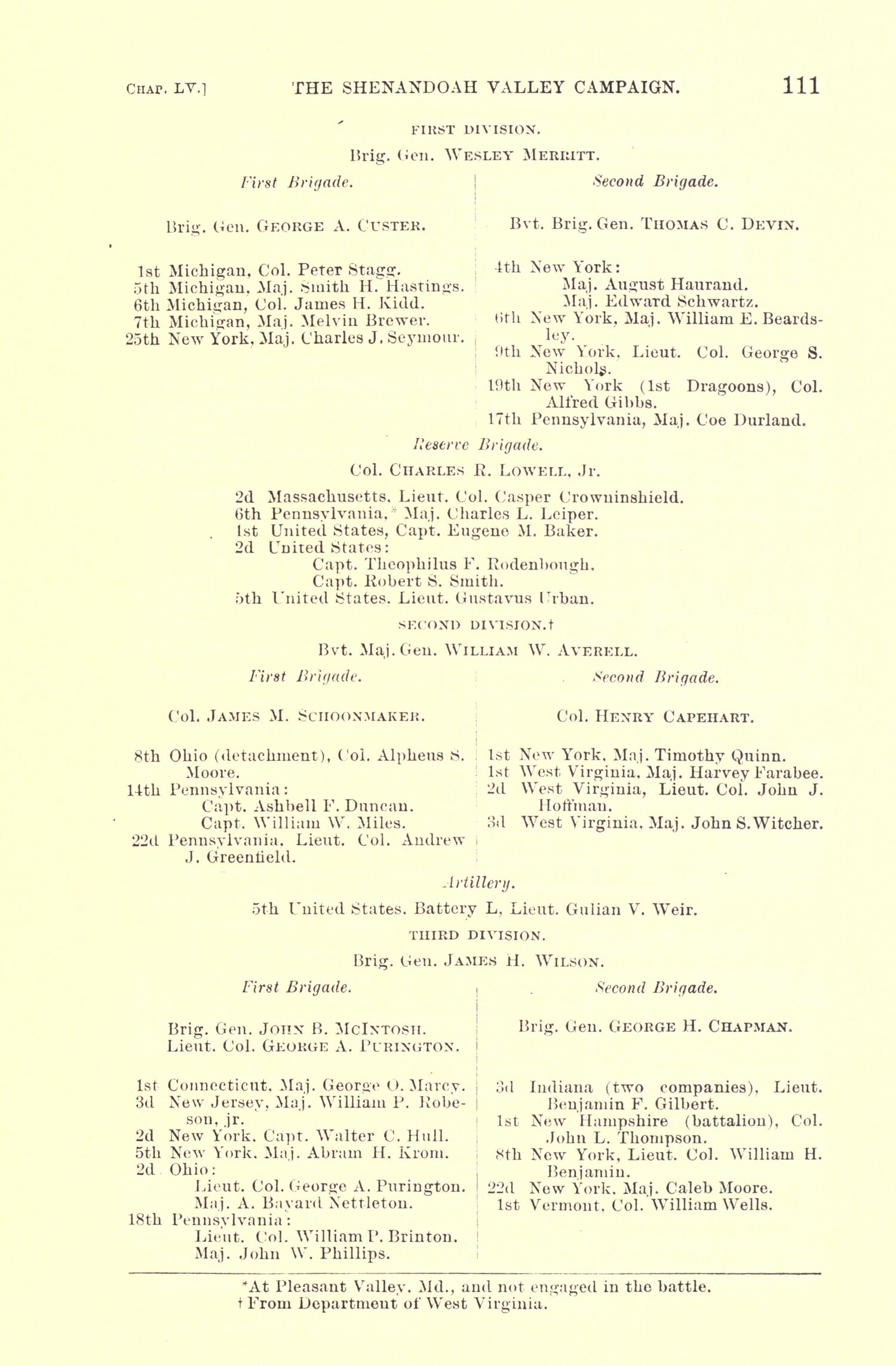
Verbatim transcription
From “Organization of the Union forces, commanded by Maj. Gen. Philip H. Sheridan, U. S. Army, at the battle of Winchester (or the Opequon), Va., September 19” [No. 3], at page 111: the cavalry entire. The volume prints the brigades in facing columns; they are set here in sequence.
FIRST DIVISION.
Brig. Gen. WESLEY MERRITT.
First Brigade.
Brig. Gen. GEORGE A. CUSTER.
1st Michigan, Col. Peter Stagg.
5th Michigan, Maj. Smith H. Hastings.
6th Michigan, Col. James H. Kidd.
7th Michigan, Maj. Melvin Brewer.
25th New York, Maj. Charles J. Seymour.
Second Brigade.
Bvt. Brig. Gen. THOMAS C. DEVIN.
4th New York:
Maj. August Haurand.
Maj. Edward Schwartz.
6th New York, Maj. William E. Beardsley.
9th New York, Lieut. Col. George S. Nichols.
19th New York (1st Dragoons), Col. Alfred Gibbs.
17th Pennsylvania, Maj. Coe Durland.
Reserve Brigade.
Col. CHARLES R. LOWELL, Jr.
2d Massachusetts, Lieut. Col. Casper Crowninshield.
6th Pennsylvania,* Maj. Charles L. Leiper.
1st United States, Capt. Eugene M. Baker.
2d United States:
Capt. Theophilus F. Rodenbough.
Capt. Robert S. Smith.
5th United States, Lieut. Gustavus Urban.
SECOND DIVISION.†
Bvt. Maj. Gen. WILLIAM W. AVERELL.
First Brigade.
Col. JAMES M. SCHOONMAKER.
8th Ohio (detachment), Col. Alpheus S. Moore.
14th Pennsylvania:
Capt. Ashbell F. Duncan.
Capt. William W. Miles.
22d Pennsylvania, Lieut. Col. Andrew J. Greenfield.
Second Brigade.
Col. HENRY CAPEHART.
1st New York, Maj. Timothy Quinn.
1st West Virginia, Maj. Harvey Farabee.
2d West Virginia, Lieut. Col. John J. Hoffman.
3d West Virginia, Maj. John S. Witcher.
Artillery.
5th United States, Battery L, Lieut. Gulian V. Weir.
THIRD DIVISION.
Brig. Gen. JAMES H. WILSON.
First Brigade.
Brig. Gen. JOHN B. McINTOSH.
Lieut. Col. GEORGE A. PURINGTON.
1st Connecticut, Maj. George O. Marcy.
3d New Jersey, Maj. William P. Robeson, jr.
2d New York, Capt. Walter C. Hull.
5th New York, Maj. Abram H. Krom.
2d Ohio:
Lieut. Col. George A. Purington.
Maj. A. Bayard Nettleton.
18th Pennsylvania:
Lieut. Col. William P. Brinton.
Maj. John W. Phillips.
Second Brigade.
Brig. Gen. GEORGE H. CHAPMAN.
3d Indiana (two companies), Lieut. Benjamin F. Gilbert.
1st New Hampshire (battalion), Col. John L. Thompson.
8th New York, Lieut. Col. William H. Benjamin.
22d New York, Maj. Caleb Moore.
1st Vermont, Col. William Wells.
* At Pleasant Valley, Md., and not engaged in the battle.
† From Department of West Virginia.
Organization of the Union forces, commanded by Maj. Gen. Philip H. Sheridan, U. S. Army, at the battle of Winchester (or the Opequon), Va., September 19 [No. 3]. In The War of the Rebellion: A Compilation of the Official Records of the Union and Confederate Armies (Series I, Vol. XLIII, Part 1, pp. 107-113; the cavalry at p. 111). U.S. Government Printing Office. The scan is hosted on this site.
References
Gibbs, A. (1864). Report [No. 148]. In The War of the Rebellion… Official Records (Series I, Vol. XLIII, Part 1). U.S. Government Printing Office. Transcription verified against the printed volume; obvious scanning errors silently corrected to the printed text.
Lowell, C. R., & Crowninshield, C. (1864). Reports of the Reserve Brigade [Nos. 149-150], September 8-October 31. In Official Records (Series I, Vol. XLIII, Part 1). [Establishes that Lowell, then Crowninshield, and not Gibbs, commanded the brigade at Cedar Creek.]
» Gibbs in the Appomattox Campaign, 1865 · » Sheridan’s Valley Victories, Sep-Oct 1864
Views: 17