Mary Channing (1747-1824)

A Biography Hub of the Gibbs Archive · Grandmother of the General
Mary Channing
1747 – 1824 · Newport and Boston
A Channing of Newport who married a Gibbs and knitted the two great families into one. Mother of ten, grandmother of a general, and aunt by marriage to the most famous preacher in America, she is remembered on her monument for a character her grandchildren could not forget.
Her husband, George Gibbs II →Her son, Col. George Gibbs →The Channing familyAll the family
IThe Life
What the family record holds on Mary Channing.
Eldest of the Channings
Mary Channing was born in 1747, the eldest of the eight children of John Channing the Second and his wife Mary Chaloner. Her mother, remembered as a commanding and beautiful woman, was the widow of Dr. James Robinson before her Channing marriage. The Channings were a Newport family of English root: Mary’s grandfather, John Channing the First, was born in Dorsetshire in 1683, settled first in Boston, and removed to Newport in 1719.
Her family became, through her, bound twice over to the Gibbses. Her brother Walter Channing went into partnership with her husband as Gibbs and Channing. Her brother William Channing married Lucy Ellery, and their son, the Reverend William Ellery Channing, the great Unitarian divine, married Mary’s own daughter Ruth Gibbs, his first cousin. Through Mary Channing the Gibbs line reaches into the Channing, Ellery, Eustis, and Wister families.
Mistress of the Gibbs house
In 1768 she married George Gibbs the Second of Newport and became mistress of one of the great merchant houses of New England. She bore him ten children, of whom two sons and five daughters survived their father. The eldest surviving son was Colonel George Gibbs, the mineralogist and father of General Alfred Gibbs; so it is through Mary Channing that the Newport merchants join the line of the soldier.
The family history dates her marriage October 9, 1768, in its genealogical record, while the Trinity Church register it prints reads November 19, 1768. Both are the book’s own; the discrepancy is shown here, not resolved by guess.
Widow, and the removal to Boston
George Gibbs the Second died in 1803. As his widow, Mary Channing Gibbs continued to add to the family lands at Newport, and in time she and her brother Walter Channing removed to Boston, where she died on December 26, 1824, in her seventy-eighth year. Gilbert Stuart had painted her, and for generations her portrait hung beside her husband’s; in the Newport drawing room of her grandson Wolcott Gibbs the venerable Grandmother Gibbs looked out beside the merchant of old Newport fame.
Remembered in stone
She and her husband are commemorated by the marble monument at St. Mary’s, South Portsmouth. Its inscription, written by her nephew and son-in-law Dr. William Ellery Channing, is less an epitaph than a portrait.
“The graces of her character, the refinement of her mind, the dignity of her manners, her serene and benignant countenance, her tones and deeds of love, no time can erase from the memory of her grateful children.”Monument at St. Mary’s, inscription by Dr. William Ellery Channing · Chapter XI
The family book documents Mary Channing’s descent, her marriage, her children, and her memorial, but it preserves very little of her as an individual: no letters, no anecdote in her own voice. That silence is one of the things the Reel 1 correspondence may begin to fill, for she was a widow through nearly the whole span the reel covers.
IIIn the Family Record
The chapters of the 1933 Gibbs family history that document this life.
Chapter IV: The Channing FamilyThe Channing descent from which Mary Channing came into the Gibbs line.Chapter XI: Early Family DataWills, Trinity Church registers, funeral sermons, obituaries, and the Newport tomb inscriptions.Chapter X: Condensed Genealogical RecordThe spine of vital dates: births, marriages, deaths, and children of every generation.Hierarchical List of Alfred’s FamilyThe full generational tree from James Gibbs of Bristol down to the General.❦IIIThe Reel 1 Correspondence
The first documents recovered from the Gibbs Archives Reel 1, each shown as the original scan with its complete transcription.
A Letter from William Ellery Channing
Portsmouth, August 1814
Mary Channing appears in her family’s letters not as an estate to be divided but as a woman being cared for. In August 1814 the Reverend William Ellery Channing, soon to be the most celebrated preacher in America, wrote to his brother-in-law George Gibbs. Channing had just married Mary’s daughter Ruth, his own first cousin. He reports that the family had brought Mary to Portsmouth, where their society had made her less sensible to a loss she had suffered, and that she appeared to be gaining strength and spirits.
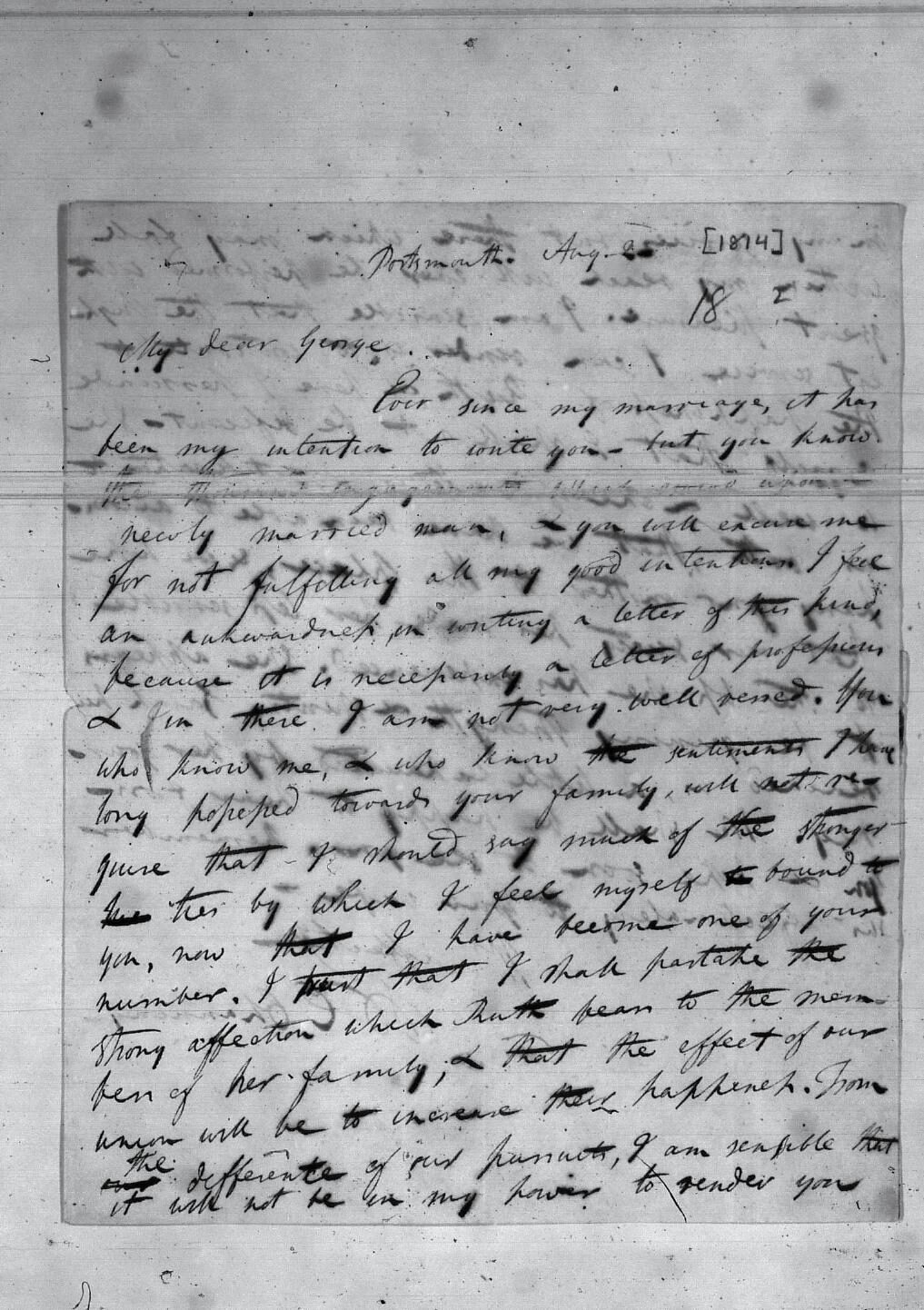
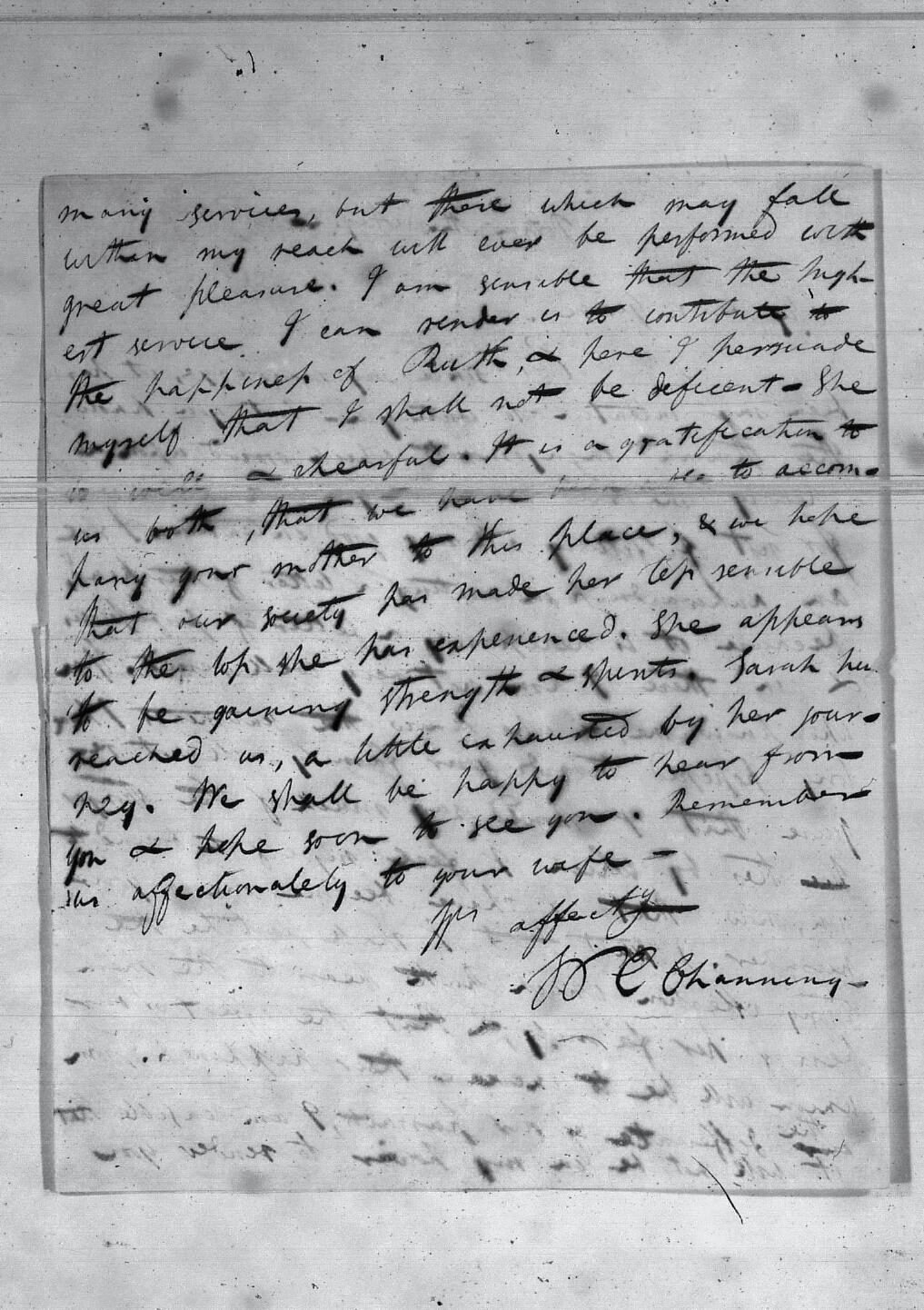
Portsmouth, August [1814]
My dear George,
Ever since my marriage, it has been my intention to write you — but you know the [engagements which crowd upon a] newly married man, & you will excuse me for not fulfilling all my good intentions. I feel an awkwardness in writing a letter of this kind, because it is necessarily a letter of professions, & in these I am not very well versed. You who know me, & who know the sentiments I have long possessed towards your family, will not require that [I should] say much of the stronger ties by which I feel myself bound to you, now that I have become one of your number. I trust that I shall partake the strong affection which Ruth bears to the members of her family; & that the effect of our union will be to increase their happiness. From the difference of our pursuits, I am sensible that it will not be in my power to render you many services, but those which may fall within my reach will ever be performed with great pleasure.
I am sensible that the highest service I can render is to contribute to the happiness of Ruth, & here I persuade myself that I shall not be deficient. She is [calm?] & chearful. It is a gratification to us both, that we have [been able] to accompany your mother to this place, & we hope that our society has made her less sensible to the loss she has experienced. She appears to be gaining strength & spirits. Sarah has reached us, a little exhausted by her journey. We shall be happy to hear from you & hope soon to see you. Remember us affectionately to your wife —
yr affecty
W. E. Channing
Transcribed verbatim, keeping the original spelling (‘chearful’) and ampersands. The scan is faint in places; words in square brackets are uncertain readings given with best effort. The writer is the Rev. William Ellery Channing (1780-1842); ‘your mother’ is Mary Channing Gibbs, ‘Ruth’ is her daughter Ruth Gibbs, whom Channing had just married, and ‘Sarah’ is her daughter Sarah Gibbs. The letter does not say what loss Mary had suffered, and this transcription does not guess.
Gibbs Family Papers, Wisconsin Historical Society, Reel 1, scans 342-343. Autograph letter of the Rev. William Ellery Channing to George Gibbs, Portsmouth, Rhode Island, August 1814.
Where she appears in the record
Reel 1 has now been catalogued in full. It holds few letters in Mary Channing’s own hand; she appears most often, as in the letter above, in what her children and their friends wrote about her, and in the long settlement of her estate through the 1820s. More of the letters that name her will be added here as they are prepared.
IVStill Hunting
Still Hunting: Open Threads
- Reel 1: letters in Mary Channing Gibbs’s hand, or addressed to her as widow, 1803-1824.
- Her removal to Boston with Walter Channing: the date, the household, the Boston address.
- The Chaloner and Robinson connections through her mother, Mary Chaloner.
- Gilbert Stuart’s portrait of her: present location and provenance of the original.
“Your Excellent Sister”: The Condolence 
Newport, January 18, 1825
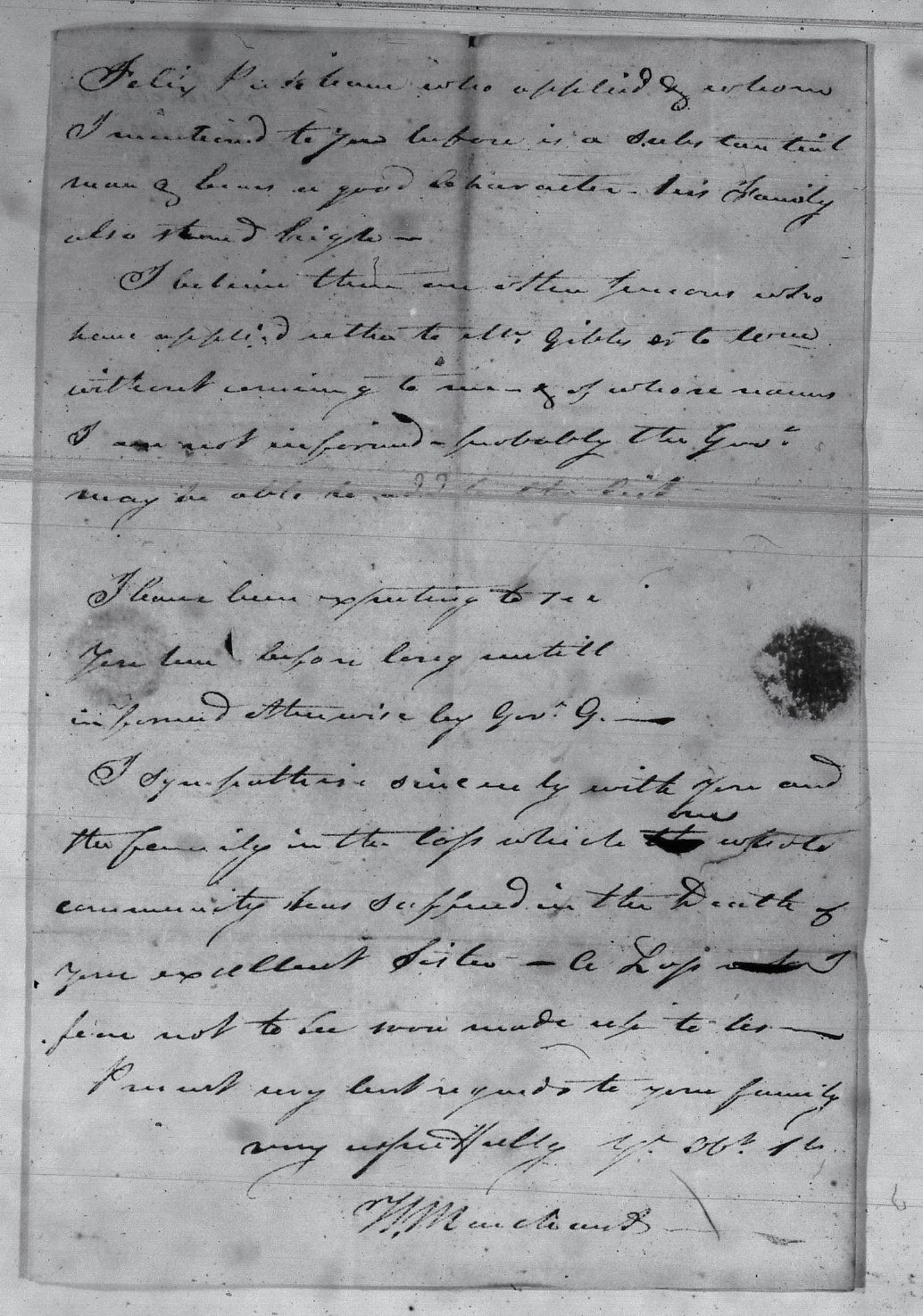
Three weeks after Mary Channing’s death, the business of her Newport farm had to go on: a tenant must be found, and Marchant reports the candidates to her brother Walter Channing, weighing Peckhams and Clarks like any January letter of affairs. Then the pen slows, and the era’s reticence gives way for one sentence: the death of “your excellent Sister” is a loss to the whole community “not to be soon made up to us.” Marchant first wrote ‘the whole community’ and changed it to ‘our’ — the revision is visible on the page. It is the only contemporaneous tribute to her yet found in the reel.
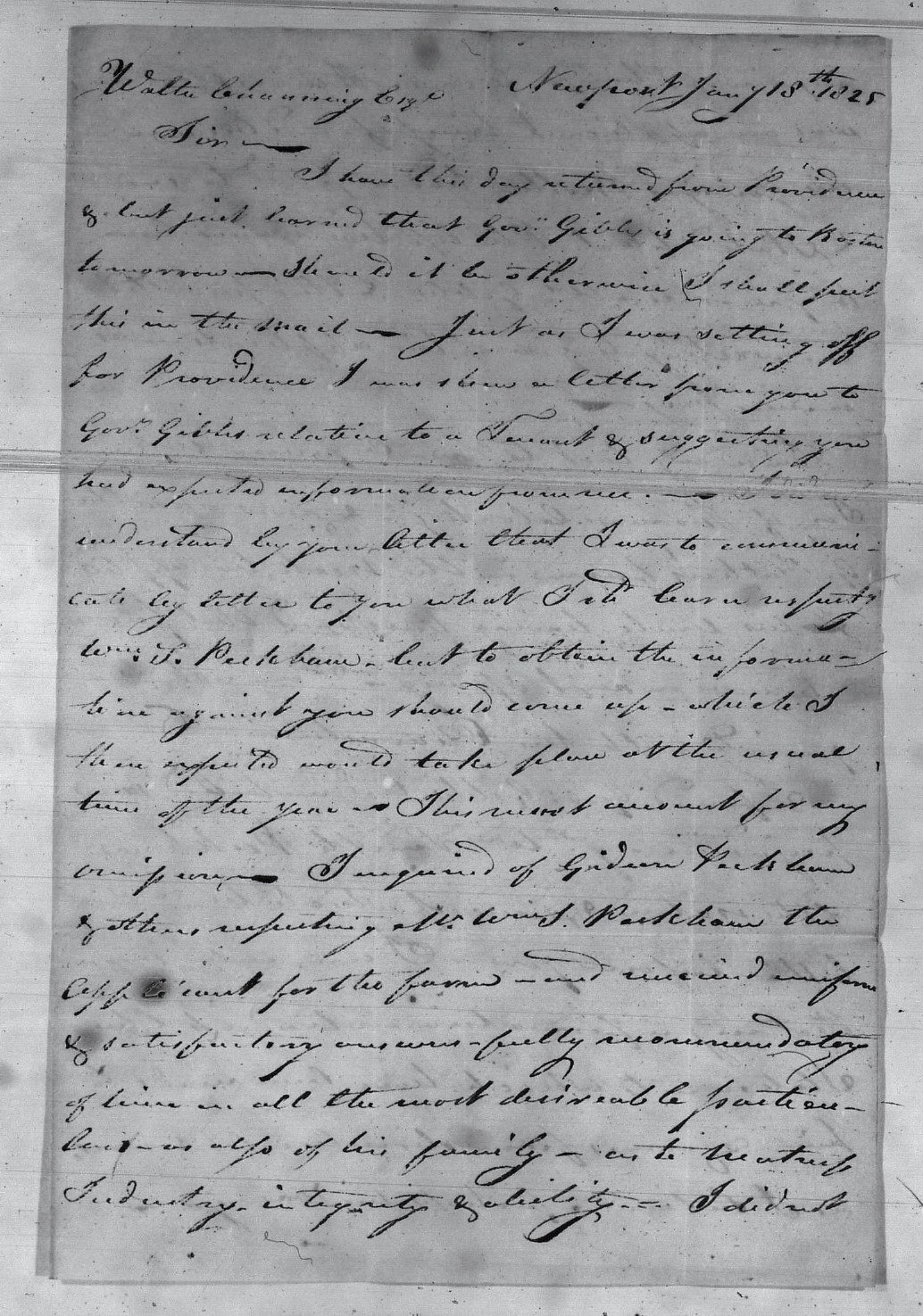
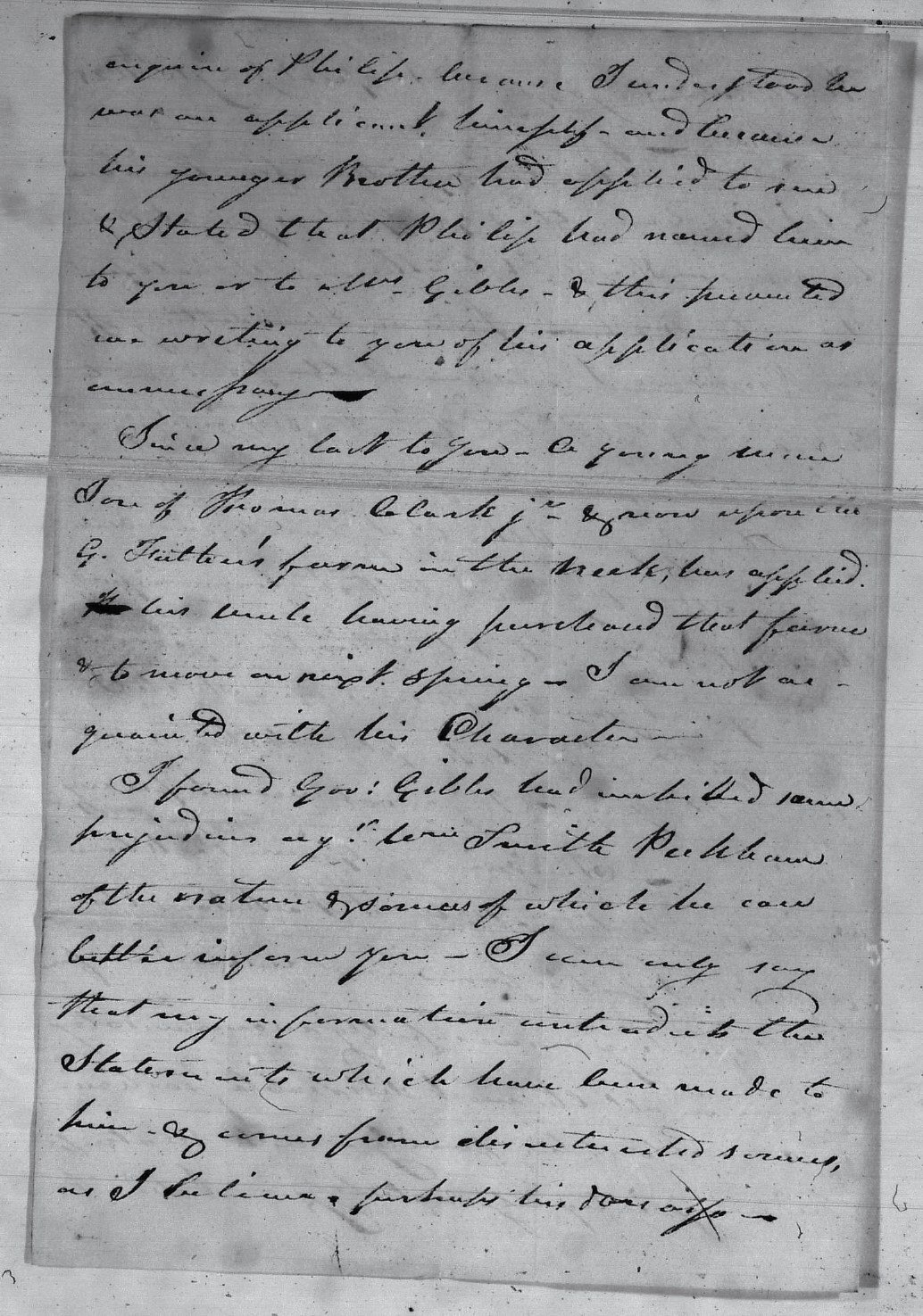
Walter Channing Esqr
Sir —
I have this day returned from Providence & but just learned that Govr Gibbs is going to Boston tomorrow — Should it be otherwise I shall put this in the mail — Just as I was setting off for Providence I was shewn a letter from you to Govr Gibbs relative to a Tenant & suggesting you had expected information from me. — I did not[?] understand by your letter that I was to communicate by letter to you what I cd learn respecting Wm S. Peckham — but to obtain the information against you should come up — which I then expected would take place at the usual time of the year — This must account for my omission — I enquired of Gideon Peckham & others respecting Mr Wm S. Peckham the applic’t[?] for the farm — and received uniform & satisfactory answers — fully recommendatory of him in all the most desireable particulars — as also of his family — as to neatness Industry, integrity & ability. — I did not enquire of Philip, because I understood he was an applicant, himself — and because his younger Brother had applied to me, & stated that Philip had named him to you or to Mrs[?] Gibbs — & this prevented my writing to you of his application as unnecessary —
Since my last to you — a young man Son of Thomas Clark jr & now upon his G. Father’s farm in the Neck, has applied. his uncle having purchased that farm & to move on next spring — I am not acquainted with his Character —
I found Gov: Gibbs had imbibed some prejudices agst Wm Smith Peckham of the nature & sources of which he can better inform you — I can only say that my information contradicts the statements which have been made to him — & comes from disinterested sources, as I believe — perhaps his does also —
Felix Peckham who applied & whom I mentioned to you before is a substantial man & bears a good character — his Family also stand high —
I believe there are other persons who have applied either to Mrs[?] Gibbs or to him[?] without coming to me — & of whose names I am not informed — probably the Govr may be able to add to[?] the list
I have been expecting to see you here before long untill informed otherwise by Govr G. —
I sympathise sincerely with you and the family in the loss which our whole community has suffered in the Death of your excellent Sister — a Loss I fear[?] not to be soon made up to us —
Present my best regards to your family
very respectfully yr Obt St[?]
W Marchant —
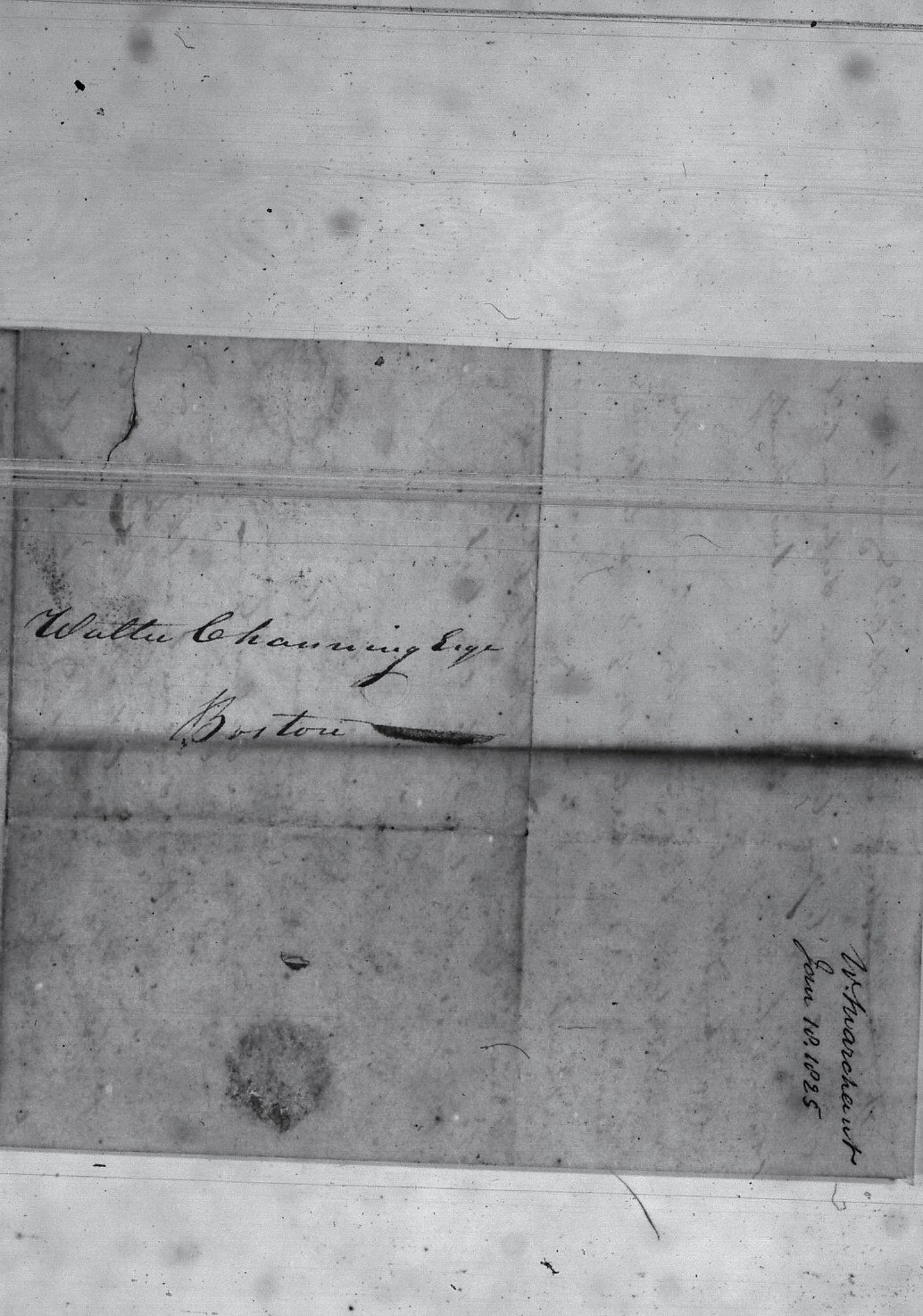
[Wrapper, scan 542 — address leaf]
Walter Channing Esqe
Boston —
[Docket, written vertically:] W. Marchant Jan 18. 1825
Transcribed verbatim from the scans, keeping the original spelling, capitalization, and punctuation; the manuscript’s own dashes are kept, bracketed words are uncertain readings, and [illegible] marks passages lost to the film. Condition: Faded iron-gall ink on water-stained paper with heavy show-through from the reverse; hand is a fluent Federal-era cursive. Scan 539: the phrase read as ‘I did not’ at the end of the ninth line is badly faded (the ‘not’ is a faint superscript); ‘applic’t’ (applicant) for the farm is abbreviated and partly obscured by a blot. Scan 540: a false-start stroke is struck through before ‘his uncle’; the final words ‘his does also’ end with a struck-out flourish. Scan 541: in the condolence paragraph the word ‘our’ is interlined above a cancelled ‘the’ before ‘whole community’; a short word after ‘a Loss’ is struck through and illegible; the line ‘may be able to add to the list’ trails off very faint at ‘add to’; the complimentary close abbreviations (‘yr Obt St’) are conjectural. Scan 542 is the wrapper: address ‘Walter Channing Esqe / Boston’ at center, docket ‘W. Marchant / Jan 18. 1825’ written vertically at right edge; mirror-image show-through of the letter text visible across the leaf. Manuscript dashes rendered as ~~ per house convention.
Gibbs Family Papers, Wisconsin Historical Society, Reel 1, scans 539–542. Autograph letter of W. Marchant of Newport to Walter Channing of Boston, with its wrapper. Digitized from the microfilm by this site; transcribed in full above.
A Biography Hub of the Gibbs Archive, AlfredGibbs.com. Biography drawn from The Gibbs Family of Rhode Island and Some Related Families (George Gibbs, 1933), reproduced on this site chapter by chapter and cited above. Any document displayed on this site appears with its complete verbatim transcription at the linked exhibit. Corrections are made openly, never silently, and this hub will grow as the Reel 1 papers are catalogued.
Views: 31