George Gibbs the Second (1735-1803)

A Biography Hub of the Gibbs Archive · Grandfather of the General
George Gibbs the Second
1735 – 1803 · Newport, Rhode Island
The richest merchant in New England, and a self-made one. Sixty-two vessels flew his flag; a Loyalist in a rebel town, he weathered the British occupation of Newport and came out of it to found the fortune that carried his son to Yale and his grandson to West Point.
The great-grandfather →His wife, Mary Channing →His son, Col. George Gibbs →All the family
IThe Life
What the family record holds on George Gibbs the Second.
The self-made merchant
George Gibbs the Second was born on May 19, 1735, the eldest surviving son of George Gibbs the First and Ruth Hart. Unlike his father, he was not passed over by fortune; he made his own. The family history, drawing on the reminiscence of Miss Powel of Newport, records that he began with almost nothing and ended at the top of New England commerce.
“He was deeply beloved and widely respected, the founder of a great fortune which he originated from a small ship’s-bakery; a gentleman of good colonial blood, but in respect to fortune self-made.”Miss Powel’s reminiscence · Chapter VII
“Sixty-two vessels sailed the seas in his fleets, and he died the richest merchant in New England, the senior partner in the firm of Gibbs and Channing.”Miss Powel’s reminiscence · Chapter VII
He held the three-quarter share in Gibbs and Channing, the firm he formed with his brother-in-law Walter Channing by articles dated April 16, 1792. An earlier partner had been Captain Joseph Anthony, a Philadelphia merchant and an uncle of the painter Gilbert Stuart. His trade reached, in the words of his funeral sermon, his own country, Europe, and the Indies.
Two marriages
His first wife was Susannah Scott, daughter of Joseph Scott. Their only child, a son named George, was born on June 2, 1767, and lived just eleven weeks. Susannah herself died that same June, in her twenty-second year, and George raised a stone to her in the Trinity churchyard. In 1768 he married again, to Mary Channing, sister of his future partner. She would bear him ten children and outlive him by twenty-one years.
The 1933 family history gives the marriage of George Gibbs the Second and Mary Channing as October 9, 1768, in its Condensed Genealogical Record, but the Trinity Church register it also prints reads “1768. Nov. 19. George Gibbs to Mary Channing.” Both dates are the book’s own. We show the discrepancy rather than choose silently.
Of the ten children of that marriage, his widow, two sons, and five daughters survived him. They carried the name far: Colonel George Gibbs, the mineralogist and father of General Alfred Gibbs; Ruth, who married the Reverend William Ellery Channing, her own first cousin; William Channing Gibbs, three times Governor of Rhode Island; and Elizabeth, who married Luther Bradish, afterward Lieutenant-Governor of New York.
A Loyalist in a rebel town
When the Revolution came, George Gibbs the Second stood with the Crown. The British seized Newport on December 8, 1776, and quartered some eight thousand troops there for three years, and the town’s population fell from twelve thousand to four. Ezra Stiles, in his diary, listed Gibbs among the principal and active Tories who left the town, and noted that he did no business during the occupation. When the British evacuated in October 1779 he returned to Newport and rebuilt his trade, fitting out vessels once more, among them the ship Mount Hope, 570 tons and ten guns, Newport-built. Later, in the French depredations on neutral American shipping, his ship Russell was taken by a French privateer on August 8, 1799.Proof: The Gibbs Family of Rhode Island, Chapter XI gives the British ‘quartering an army of 8,000 men… they remained three’ years, ‘the population dwindled from 12,000 to 4,000,’ Ezra Stiles’s naming of Gibbs among the ‘Principal and Active Tories,’ and the ship Mount Hope; the ship Russell ‘captured by a French privateer on August 8, 1799’ is in Chapter II, part 3.
Trinity Church, Mill Street, and Oakland
He was a staunch Church of England man and a vestryman of Trinity Church in Newport, where the family pew has been kept ever since. His colonial house on Mill Street, built before 1770 by John Tillinghast, became during the war the headquarters of General Nathanael Greene, who was visited there by Kosciuszko, Baron Steuben, and Lafayette. His lands ran to the whole of Easton’s Point and some hundred acres within Newport, and in 1796 he bought the farm at South Portsmouth the family called Oakland. About 1798 Gilbert Stuart painted his portrait, and Stuart’s portrait of his wife beside it; both hung in the family for generations.Proof: The Gibbs Family of Rhode Island, Chapter II, part 3 gives the Church of England ‘vestry man of old Trinity Church’ and the family pew ‘occupied continuously by the family,’ the ‘colonial house in Mill Street… built prior to 1770 by John Tillinghast’ and later General Greene’s headquarters, Easton’s Point, and ‘Oakland… purchased in 1796… from John Faxon;’ the Stuart portraits are in part 5.
The richest merchant in New England
George Gibbs the Second died on October 11, 1803, after a long illness. His funeral was preached at Trinity Church by the Reverend Theodore Dehon, afterward Bishop of South Carolina, and he was buried in the Trinity churchyard. Miss Powel remembered the church hung in black at his death, and the ritual of his rent days, when his tenants counted out their gold onto a silver salver and he tied it up in a little leather bag.Proof: The Gibbs Family of Rhode Island, Chapter XI for the death and the Rev. Dehon’s funeral at Trinity; and Miss Powel’s reminiscence, Chapter VII, for Dehon ‘afterward Bishop of South Carolina,’ the ‘black hangings in Trinity Church when Mr. Gibbs died in 1803,’ and the rent money ‘handed to Mr. Gibbs on a silver salver’ which he tied in ‘a little leather bag.’
“That he was the main pillar in the mercantile line at Newport, no one, it is presumed, will deny.”Newport Mercury obituary, October 15, 1803 · Chapter XI
“By enterprise, integrity, candor, and punctuality, he rendered himself known and respectable throughout his own country, in Europe, and in the Indies.”Funeral sermon of the Rev. Theodore Dehon · Chapter XI
His tomb in the Trinity churchyard carries the merchant’s own creed: Persevering in industry, judicious in enterprise, faithful in engagement, he acquired universal confidence and respect as a merchant. He and Mary Channing are commemorated together by a marble monument at St. Mary’s, South Portsmouth, designed by Washington Allston and inscribed by Dr. William Ellery Channing.
The Trinity tomb gives his age as 68 years; the Newport Mercury of October 15, 1803 places him in his 69th year. Both figures come from the family book, and both are shown here.
IIIn the Family Record
The chapters of the 1933 Gibbs family history that document this life.
Chapter VII: Further Account of the Gibbs FamilyThe narrative chapter, including Miss Powel’s reminiscence of the great Newport fortune.Chapter XI: Early Family DataWills, Trinity Church registers, funeral sermons, obituaries, and the Newport tomb inscriptions.Chapter X: Condensed Genealogical RecordThe spine of vital dates: births, marriages, deaths, and children of every generation.Hierarchical List of Alfred’s FamilyThe full generational tree from James Gibbs of Bristol down to the General.❦IIIThe Reel 1 Correspondence
The first documents recovered from the Gibbs Archives Reel 1, each shown as the original scan with its complete transcription.
A Father’s Letter of Advice
Newport, 1796
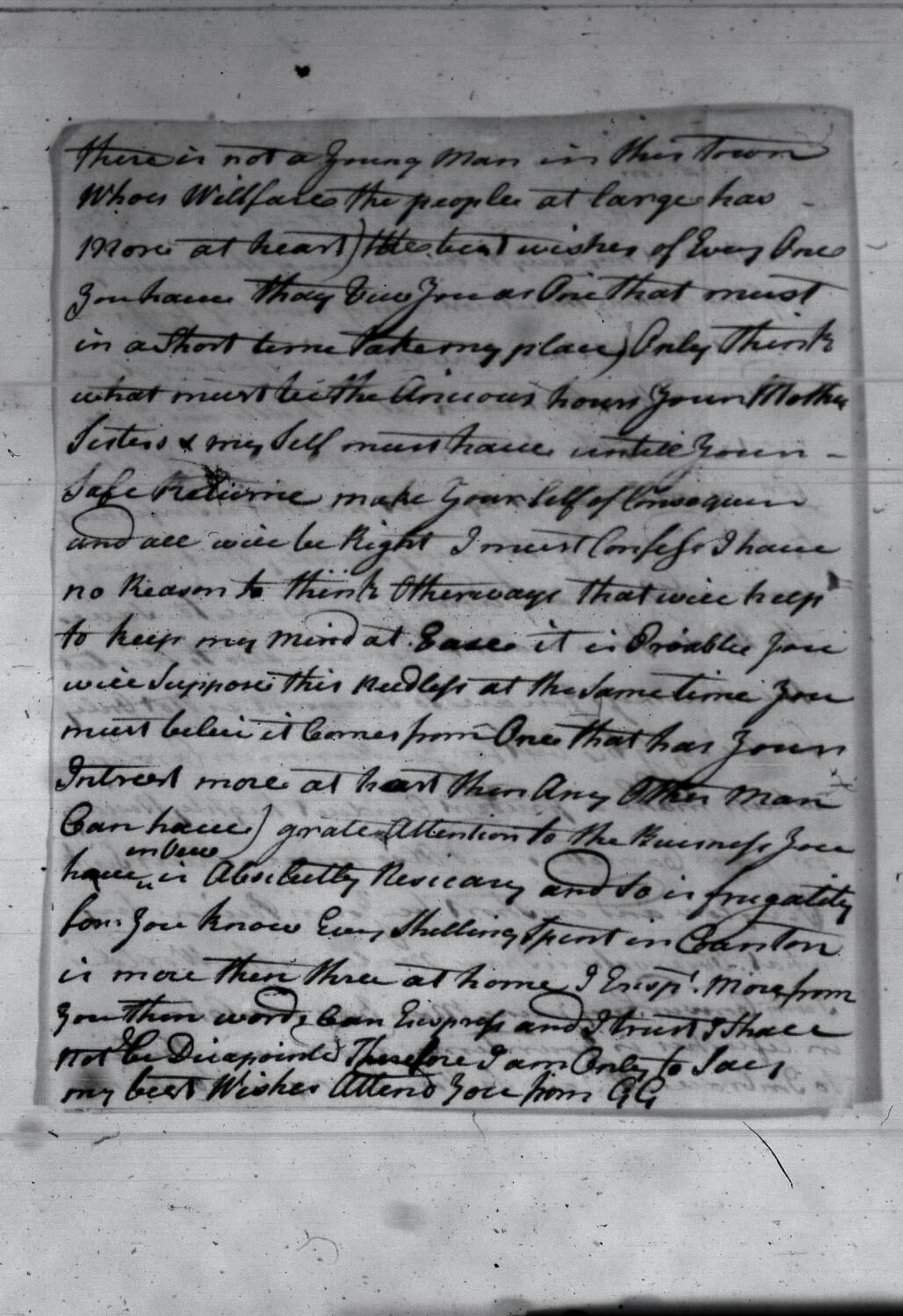
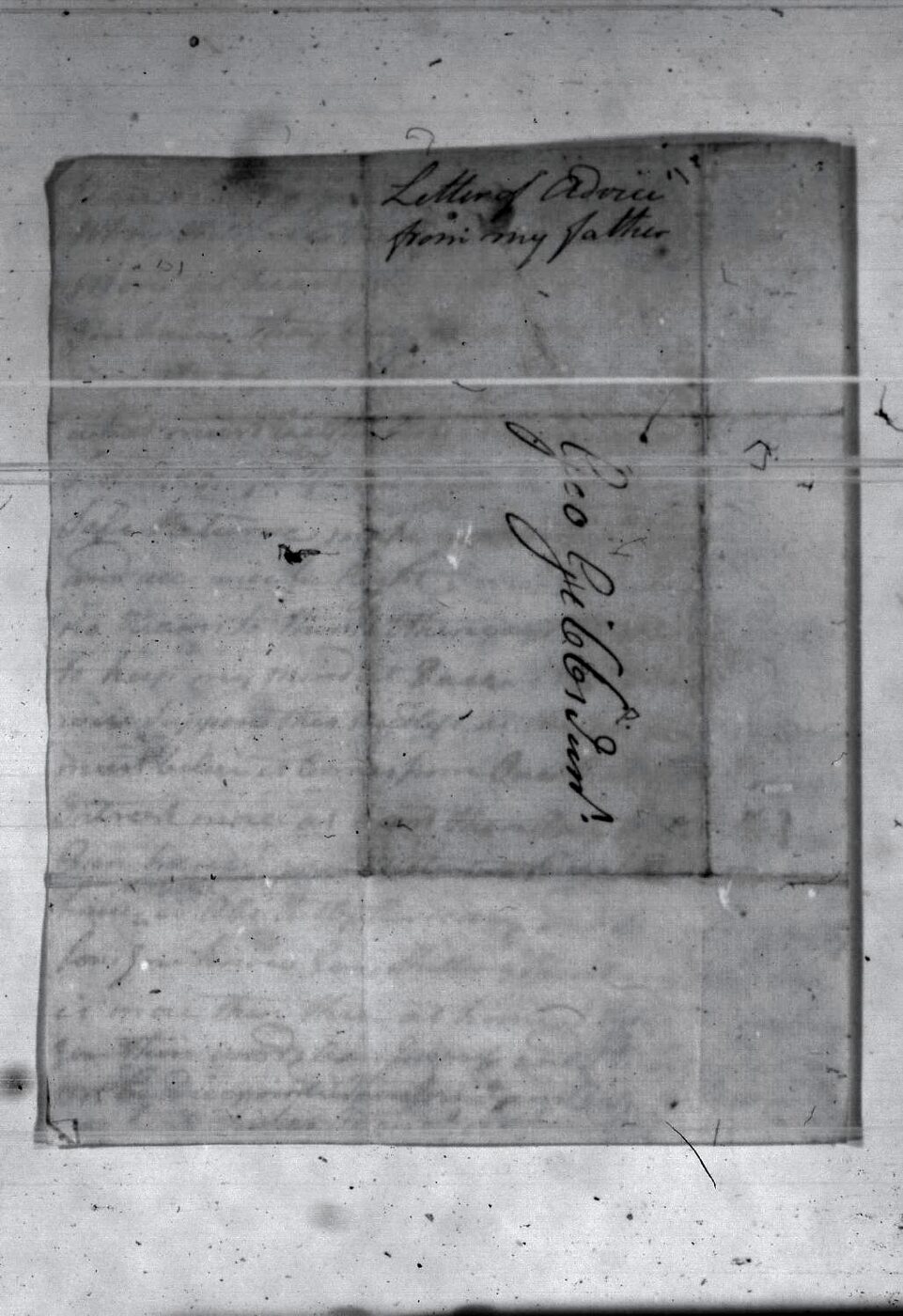
Seven years before the deathbed letter, George Gibbs the Second was already writing to this same son as a father. In 1796 he sent young George, barely twenty, to Canton on a trading voyage, and put into a letter of advice the very counsel he would repeat from his deathbed: attention to business, strict frugality, and a father’s fear for a son at sea. When this exhibit was first published only the second leaf was thought to survive; the cataloguing of the reel’s remaining frames in July 2026 recovered the first page, and the letter now reads whole, one sentence running unbroken across the two leaves. The son kept it all his life and endorsed the back, ‘Letter of Advice from my father.’
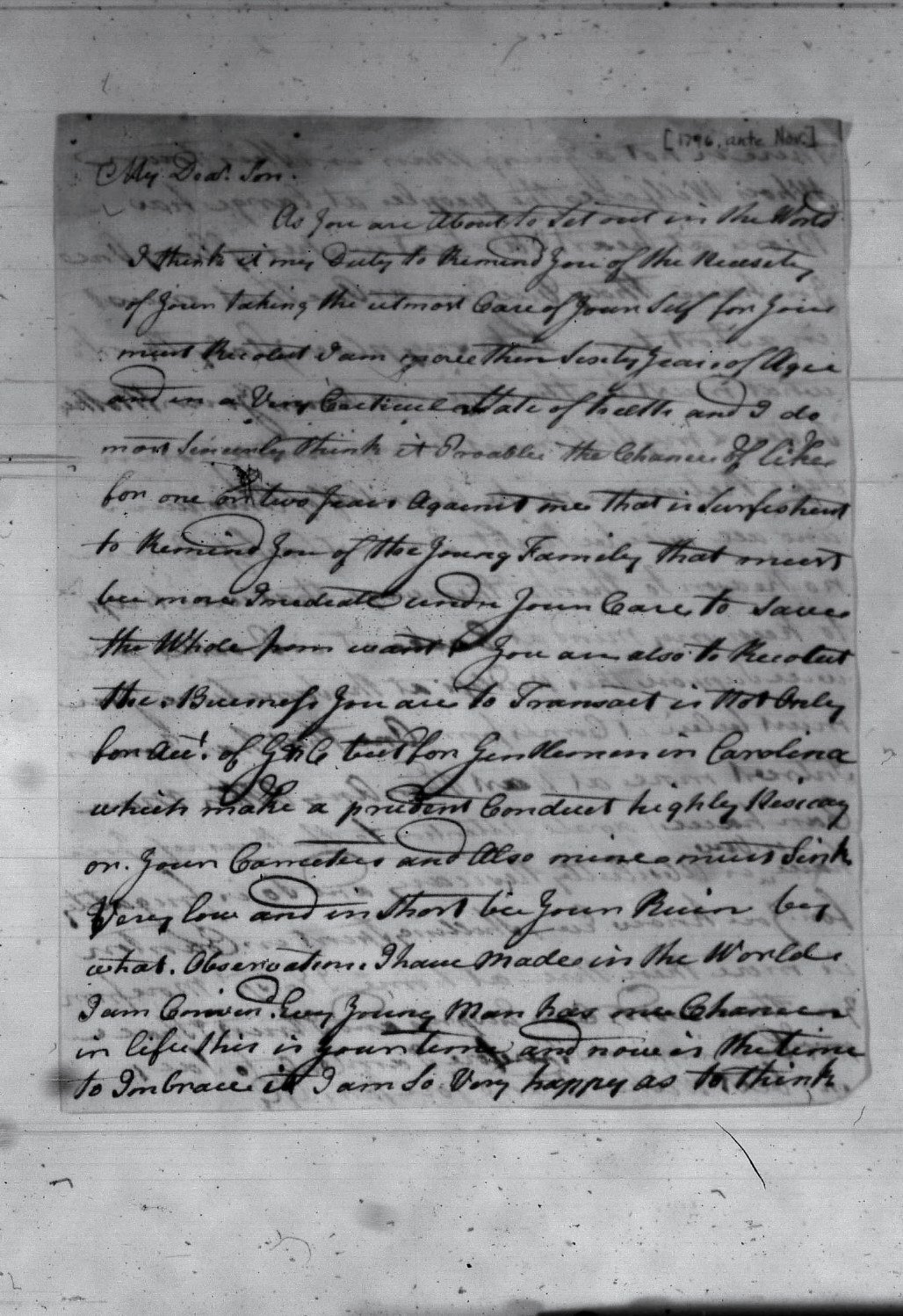
My Dear Son.
As you are about to Set out in the World I think it my Duty to Remind you of the Necesety[?] of your taking the utmost Care of your Self for you must Recolect I am more then Sixty Years of Age and in a Very Cretical State of health and I do most Sincerly think it Proable the Chances of Life for one or two years Against me that is[?] Surfeshent to Remind you of the young Family that must bee more Imediate under your Care to Save the Whole from want — you are also to Recolect the Buisness you are to Transact is Not Only for Acc’t of G&C but for Gentlemen in Carolina which make a prudent Conduct highly Nessecary[?] or your Carrecter and Also mine — must Sink Very low and in Short bee your Ruin — by what Observation I have Made in the World I am Convinced Evry young Man has one Chance in life this is your turn and now is the time to Imbrace it I am So Very happy as to think
[The sentence continues without a break onto the second leaf.]
there is not a Young Man in this Town Whose Wellfare the people at large has More at heart) the best wishes of Every One you have, thay view you as One that must in a Short time take my place) Only think what must be the Anxious hours your Mother Sisters & my Self must have untill your Safe Return, make your Self of Consequence and all will be Right, I must Confess I have no Reason to think Otherways, that will help to keep my mind at Ease, it is Probable you will Suppose this Needless, at the Same time you must belive it Comes from One that has your Intrest more at heart then Any other Man Can have) grate Attention to the Business you have [in vew] is Absolutely Necesary and So is frugality, for you know Every Shilling Spent in Canton is more then three at home, I Exsp’t. More from you then words Can Express and I trust I Shall Not be Disapointed, Therefore I am Only to Say, my best Wishes Attend you —
from GG
Transcribed verbatim, keeping George Gibbs the Second’s own phonetic spelling (‘Necesety,’ ‘Recolect,’ ‘Cretical,’ ‘Surfeshent,’ ‘Carrecter,’ ‘Wellfare,’ ‘thay,’ ‘belive,’ ‘grate,’ ‘vew,’ ‘Exsp’t’ for expect). Bracketed words are interlineations or uncertain readings. Update, July 13, 2026: when first published this exhibit held only the second leaf, page one being thought lost; the indexing of the reel’s previously uncatalogued frames identified scan 10 as the missing first page, and it is restored above – the letter’s final sentence runs unbroken from one leaf to the other. On the back of the second leaf the son wrote in his own hand, ‘Letter of Advice from my father.’ He was about twenty, sailing for Canton, and he kept his father’s letter for the rest of his life.
Gibbs Family Papers, Wisconsin Historical Society, Reel 1, scans 10–11, with the son’s docket on scan 13. Autograph letter of George Gibbs the Second of Newport to his son George, 1796, sent under a cover addressed ‘To George Gibbs Jun’r.’ Undated by the writer; the archivist’s pencil supplies [1796, ante Nov.], consistent with the son’s arrival at Canton by the end of October 1796.
The Deathbed Letter
Newport, October 5, 1803
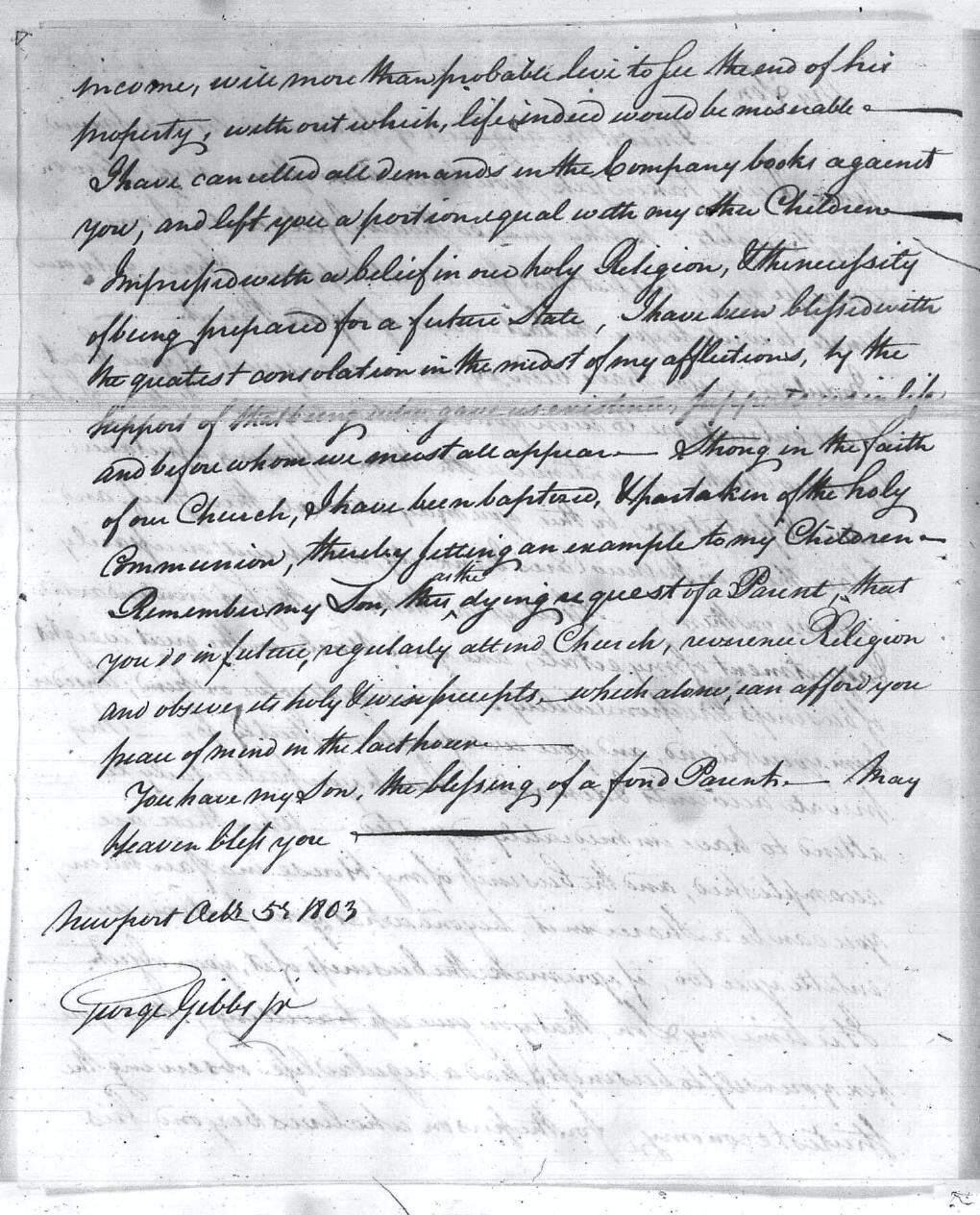
Six days before he died, too weak to hold a pen, George Gibbs the Second had his brother take down the last advice of a fond Parent to his eldest son, George Gibbs junior – the future Colonel George Gibbs, mineralogist, and father of General Alfred Gibbs. It is the plainest self-portrait the old merchant left: a hard creed, a father’s tenderness, and the famous instruction, ‘give up travelling… fix yourself to business,’ sent to the young traveller who would go on to build the Gibbs mineral cabinet. This is the general’s grandfather writing to the general’s father.
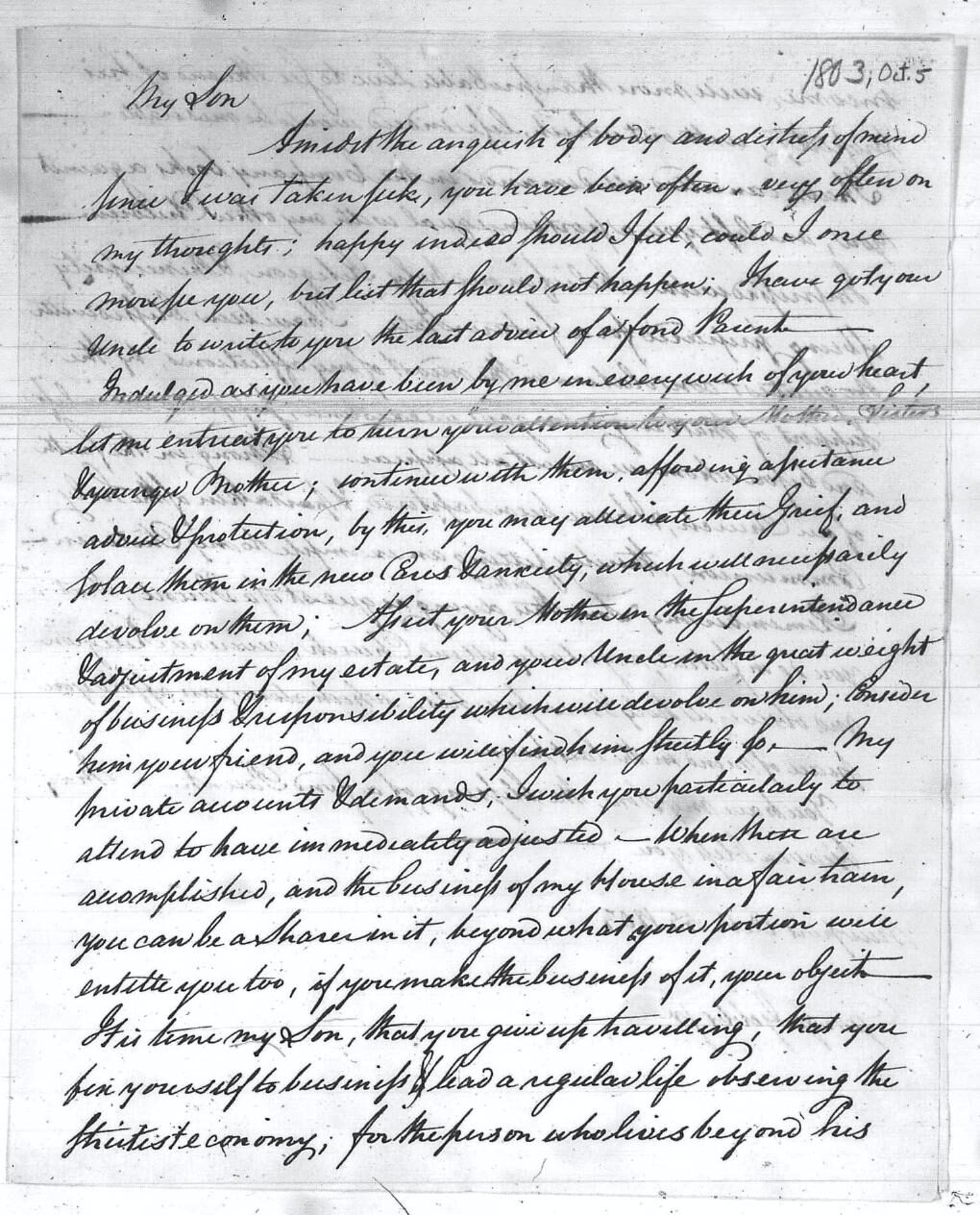
My Son
Amidst the anguish of body and distress of mind since I was taken sick, you have been often, very often on my thoughts; happy indeed should I feel, could I once more see you, but lest that should not happen, I have got your Uncle to write to you the last advice of a fond Parent —
Indulged as you have been by me in every wish of your heart, let me entreat you to turn your attention to your Mother, Sisters & younger Brother; continue with them, affording assistance advice & protection, by this, you may alleviate their Grief, and solace them in the new Cares & anxiety, which will necessarily devolve on them; Assist your Mother in the Superintendance & adjustment of my estate, and your Uncle in the great weight of business & responsibility which will devolve on him; Consider him your friend, and you will find him strictly so. — My private accounts & demands, I wish you particularly to attend to have immediately adjusted — When these are accomplished, and the business of my House in a fair train, you can be a Sharer in it, beyond what your portion will entitle you too, if you make the business of it, your object —
It is time my Son, that you give up travelling, that you fix yourself to business & lead a regular life observing the strictest economy; for the person who lives beyond his income, will more than probable live to see the end of his property, without which, life indeed would be miserable —
I have cancelled all demands in the Company books against you, and left you a portion equal with my other Children —
Impressed with a belief in our holy Religion, & the necessity of being prepared for a future State, I have been blessed with the greatest consolation in the midst of my afflictions, by the support of that being who gave us existence [supporter of our being through this transitory life], and before whom we must all appear — Strong in the faith of our Church, I have been baptized, & partaken of the holy Communion, thereby setting an example to my Children —
Remember my Son, this [as the] dying request of a Parent, that you do in future, regularly attend Church, reverence Religion and observe its holy & wise precepts, which alone, can afford you peace of mind in the last hour —
You have my Son, the blessing of a fond Parent — May Heaven bless you —
Newport Octb’r 5th 1803
George Gibbs jr
Transcribed verbatim, keeping the original spelling, capitalization, and ampersands. Words in square brackets are faint phrases the writer interlined above the line, read with best effort. The letter names no recipient beyond ‘My Son,’ but its own details fix him: a son who had been travelling, who had debts on the firm’s books, and who had a single younger brother, charged now to help his mother settle the estate. That is the eldest son, George Gibbs junior (1776-1833), who became Colonel George Gibbs the mineralogist, husband of Laura Wolcott and father of General Alfred Gibbs. Two George Gibbses were styled ‘junior’ at once: the dying father signed ‘George Gibbs jr,’ junior to his own late father George Gibbs the First, while this son signed ‘George Gibbs Junr’ in his turn.
Gibbs Family Papers, Wisconsin Historical Society, Reel 1, scans 179-180. Autograph letter, dictated to his brother, Newport, Rhode Island, October 5, 1803. George Gibbs the Second died six days later, on October 11, 1803, and was buried from Trinity Church, Newport.
The Last Will and Testament
Newport, October 2 & 4, 1803
On October 2, 1803, three days before he dictated the deathbed letter above, George Gibbs the Second set his hand and seal to his will. It divided a great merchant fortune, kept the firm of Gibbs and Channing running under his partner and brother-in-law Walter Channing, provided for his wife Mary and their seven children, and pensioned his two widowed sisters. Two days later a codicil added his eldest son, the future mineralogist, as an executor.
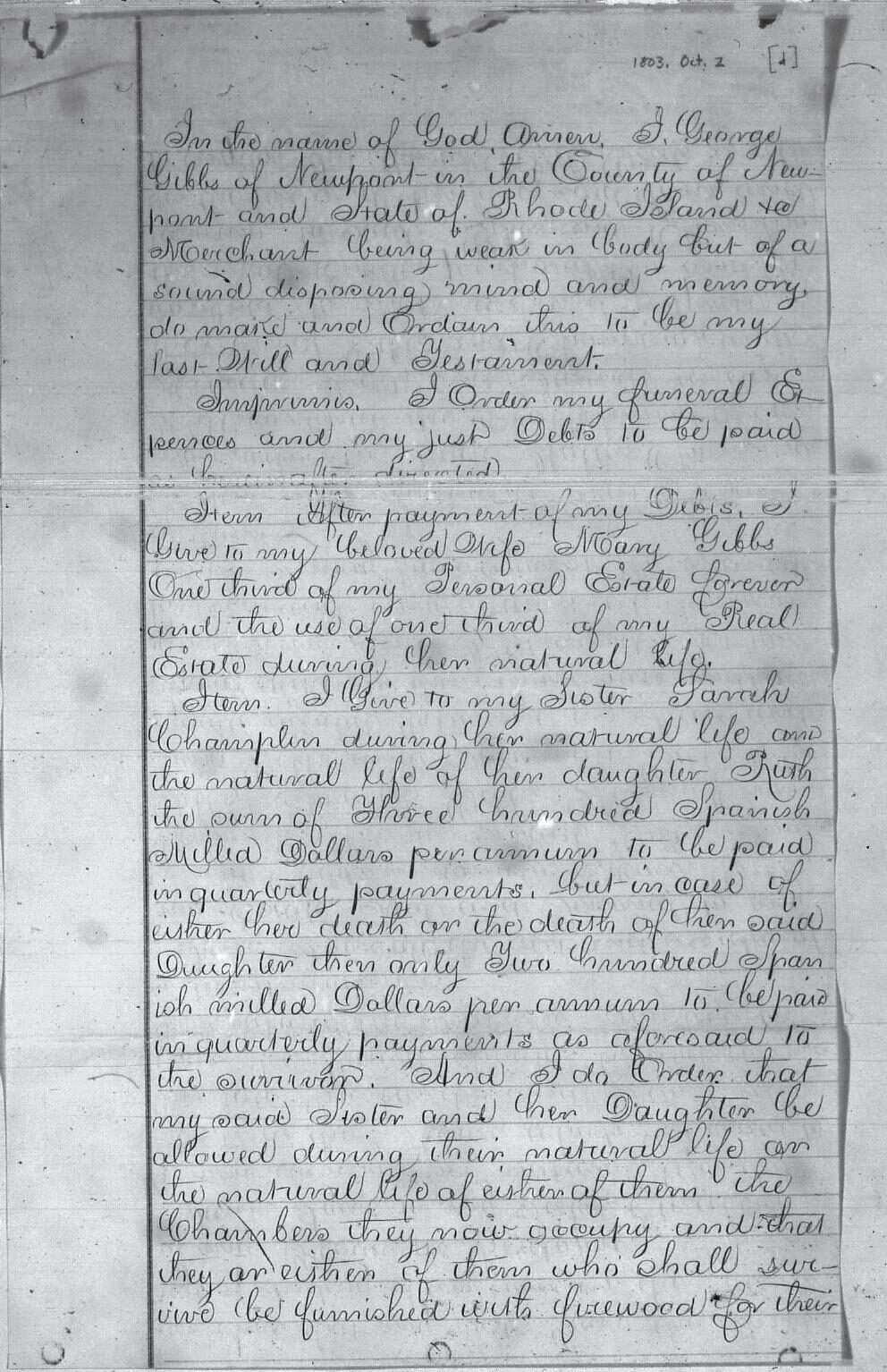
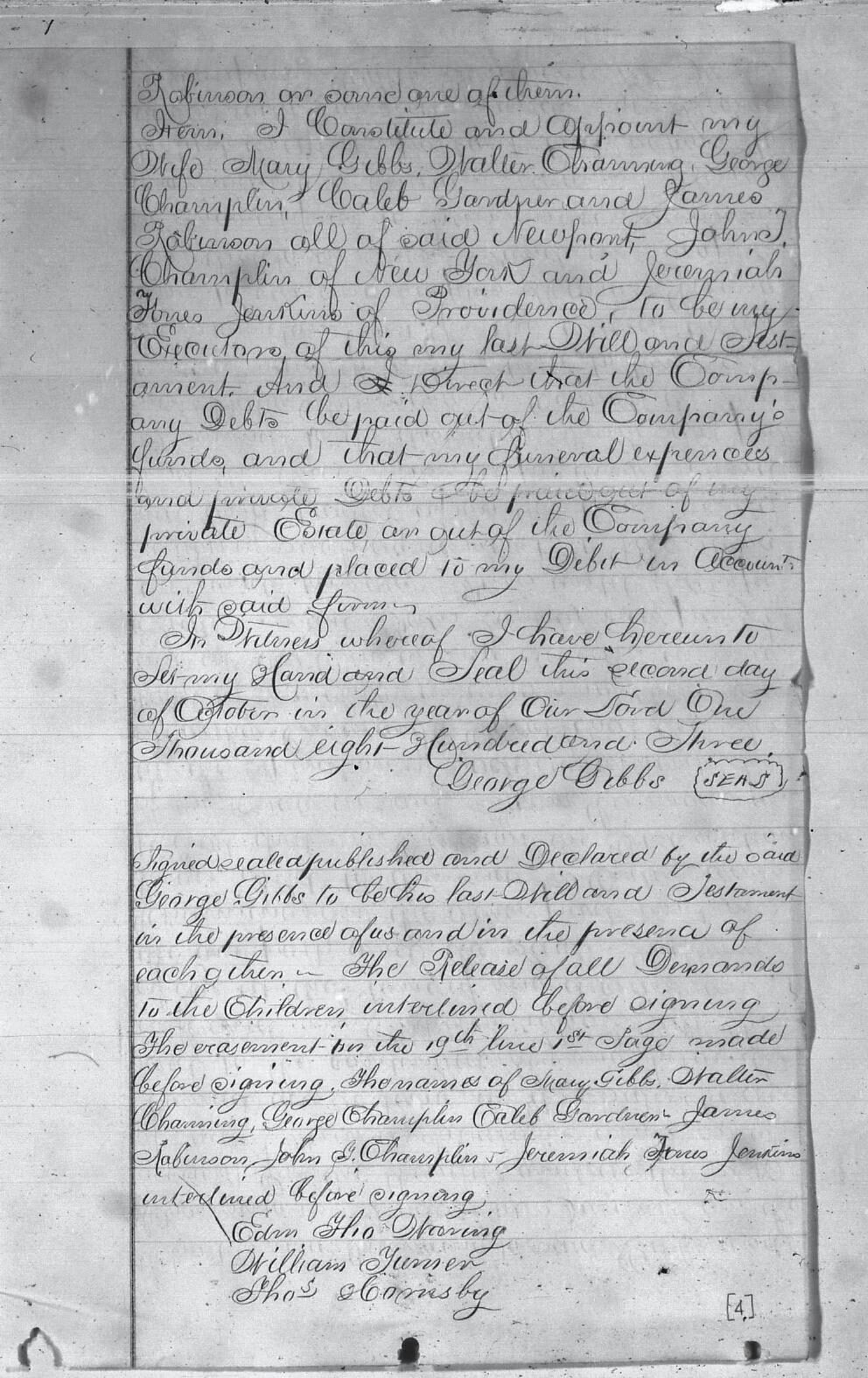
In the name of God Amen. I George Gibbs of Newport in the County of Newport and State of Rhode Island &c Merchant being weak in body but of a sound disposing mind and memory, do make and Ordain this to be my last Will and Testament.
Imprimis. I Order my funeral Expences and my just Debts to be paid [as hereinafter directed].
Item. After payment of my Debts, I Give to my beloved Wife Mary Gibbs One third of my Personal Estate forever and the use of one third of my Real Estate during her natural Life.
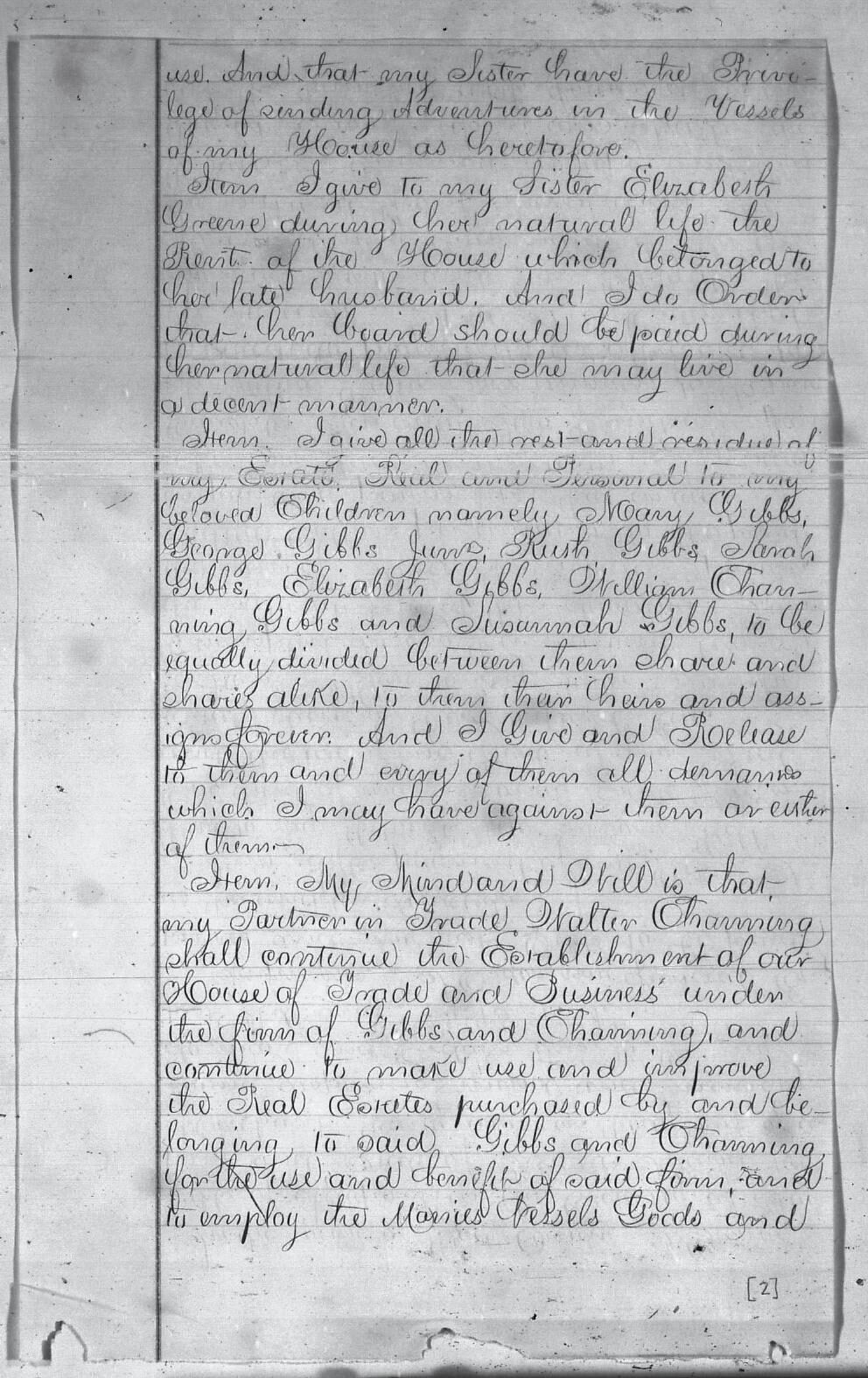
Item. I Give to my Sister Sarah Champlin during her natural life and the natural life of her daughter Ruth the sum of Three hundred Spanish Milled Dollars per annum to be paid in quarterly payments. but in case of either her death or the death of her said Daughter then only Two hundred Spanish milled Dollars per annum to be paid in quarterly payments as aforesaid to the survivor. And I do Order that my said Sister and her Daughter be allowed during their natural life or the natural life of either of them the Chambers they now occupy and that they or either of them who shall survive be furnished with firewood for their use. And that my Sister have the Privilege of sending Adventures in the Vessels of my House as heretofore.
Item. I give to my Sister Elizabeth Greene during her natural life the Rent of the House which belonged to her late husband. And I do Order that her Board should be paid during her natural life that she may live in a decent manner.
Item. I give all the rest and residue of my Estate Real and Personal to my beloved Children namely Mary Gibbs, George Gibbs Junr, Ruth Gibbs, Sarah Gibbs, Elizabeth Gibbs, William Channing Gibbs and Susannah Gibbs, to be equally divided between them share and share alike, to them their heirs and assigns forever. And I Give and Release to them and every of them all demands which I may have against them or either of them.
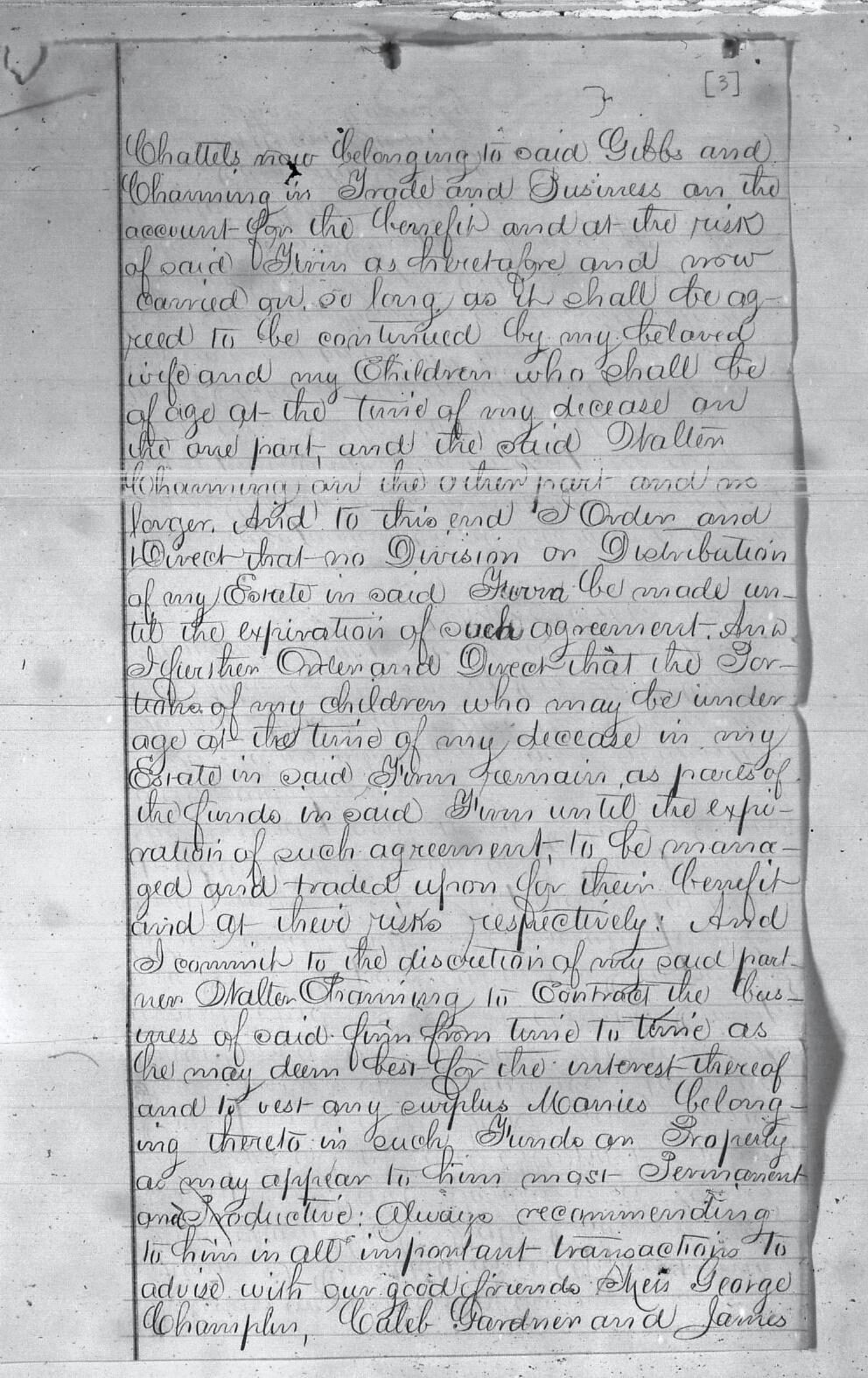
Item. My Mind and Will is that my Partner in Trade Walter Channing shall continue the Establishment of our House of Trade and Business under the firm of Gibbs and Channing, and continue to make use and improve the Real Estates purchased by and belonging to said Gibbs and Channing for the use and benefit of said firm, and to employ the Monies Vessels Goods and Chattels now belonging to said Gibbs and Channing in Trade and Business on the account for the benefit and at the risk of said firm as heretofore and now carried on, so long as it shall be agreed to be continued by my beloved wife and my Children who shall be of age at the time of my decease on the one part, and the said Walter Channing on the other part and no longer. And to this end I Order and Direct that no Division or Distribution of my Estate in said firm be made until the expiration of such agreement. And I further Order and Direct that the Portions of my Children who may be under age at the time of my decease in my Estate in said firm remain as parts of the funds in said firm until the expiration of such agreement, to be managed and traded upon for their benefit and at their risks respectively. And I commit to the discretion of my said partner Walter Channing to Contract the business of said firm from time to time as he may deem best for the interest thereof and to vest any surplus Monies belonging thereto in such funds or Property as may appear to him most Permanent and Productive: Always recommending to him in all important transactions to advise with our good friends Mess George Champlin, Caleb Gardner and James Robinson or some one of them.
Item. I Constitute and Appoint my Wife Mary Gibbs, Walter Channing, George Champlin, Caleb Gardner and James Robinson all of said Newport, John G. Champlin of New York and Jeremiah Innes Jenkins of Providence, to be my Executors of this my last Will and Testament. And I direct that the Company Debts be paid out of the Company’s funds, and that my Funeral expences and private Debts be paid out of my private Estate, or out of the Company funds and placed to my Debit in Account with said firm.
In Witness whereof I have hereunto set my Hand and Seal this Second day of October in the year of Our Lord One Thousand eight Hundred and Three.
George Gibbs [Seal]
Signed sealed published and Declared by the said George Gibbs to be his last Will and Testament in the presence of us and in the presence of each other. The Release of all Demands to the Children, interlined before signing. The erasement in the 19th line 1st page made before signing. The names of Mary Gibbs, Walter Channing, George Champlin Caleb Gardner, James Robinson, John G. Champlin & Jeremiah Innes Jenkins interlined before signing.
Edm’d Thos Waring
William Turner
Thos Hornsby
The Codicil · October 4, 1803
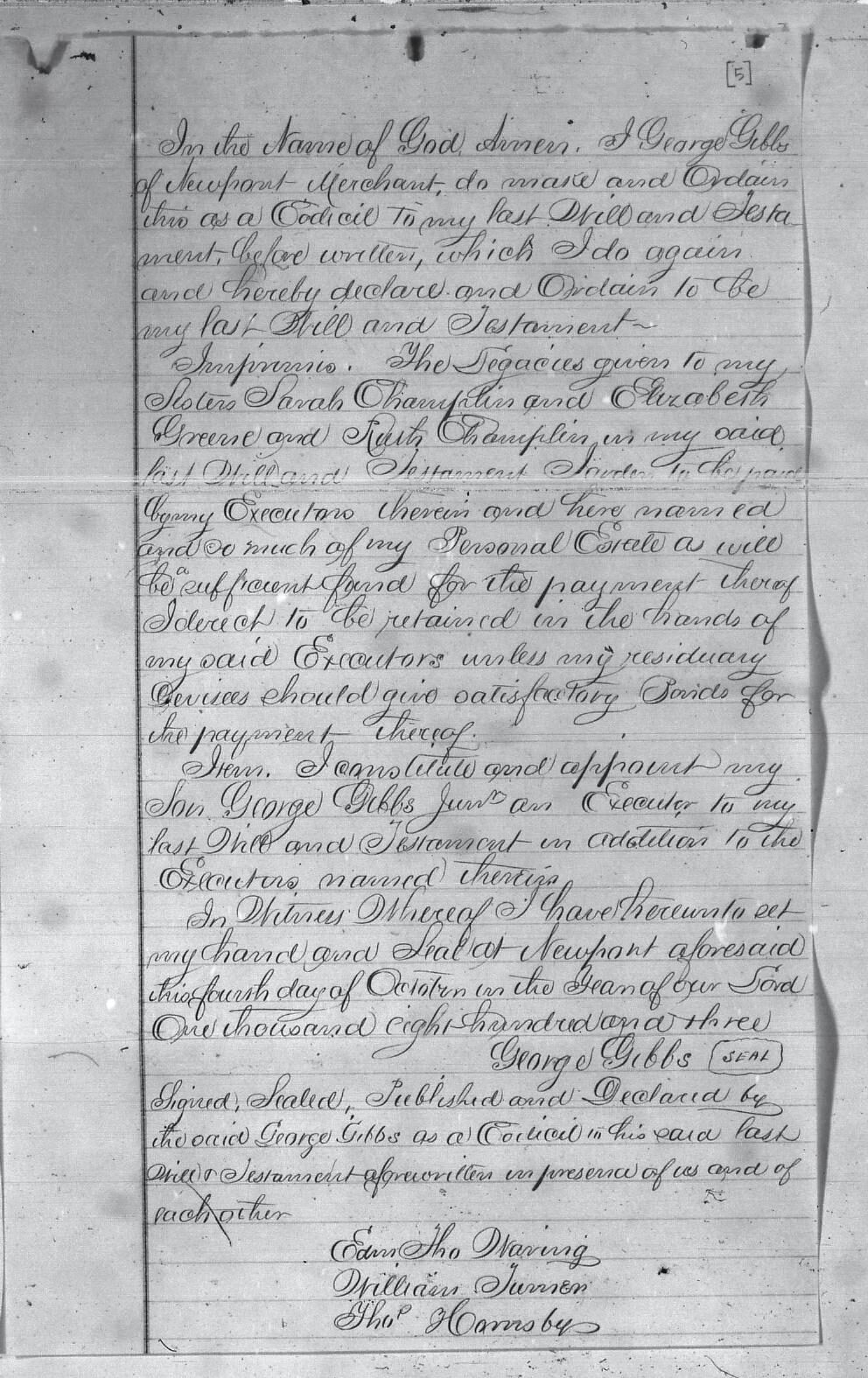
In the Name of God Amen. I George Gibbs of Newport Merchant, do make and Ordain this as a Codicil to my last Will and Testament, before written, which I do again and hereby declare and Ordain to be my last Will and Testament.
Imprimis. The Legacies given to my Sisters Sarah Champlin and Elizabeth Greene and Ruth Champlin in my said last Will and Testament I order to be paid by my Executors therein and here named and so much of my Personal Estate as will be a sufficient fund for the payment thereof I direct to be retained in the hands of my said Executors unless my residuary Devisees should give satisfactory Bonds for the payment thereof.
Item. I constitute and appoint my Son George Gibbs Junr an Executor to my last Will and Testament in addition to the Executors named therein.
In Witness Whereof I have hereunto set my hand and Seal at Newport aforesaid this fourth day of October in the Year of our Lord One thousand eight hundred and three
George Gibbs [Seal]
Signed, Sealed, Published and Declared by the said George Gibbs as a Codicil to his said last Will & Testament aforewritten in presence of us and of each other
Edm’d Thos Waring
William Turner
Thos Hornsby
Transcribed verbatim from the four-page will and its codicil, keeping the original spelling, capitalization, and ampersands. Words in square brackets are either interlined above the line or faint readings given with best effort; the attestation itself records that the release clause and the executors’ names were interlined before signing. The third witness surname, read Thos Hornsby, is not certain.
Gibbs Family Papers, Wisconsin Historical Society, Reel 1, scans 173-177. Autograph last will of October 2, 1803, with a codicil of October 4, 1803, of George Gibbs the Second of Newport, merchant; witnessed by Edmund Thomas Waring, William Turner, and Thomas Hornsby.
The will, the codicil, and the estate
Reel 1 has now been catalogued in full. Beyond the deathbed letter above, it holds George Gibbs the Second’s own four-page last will and its codicil of October 1803 (scans 173-177), the invoices of the firm of Gibbs and Channing, and the long settlement of his estate through the 1820s. Each will be added here with its complete transcription as it is prepared.
IVStill Hunting
Still Hunting: Open Threads
- Reel 1: letters and firm papers of Gibbs and Channing, 1796-1803, and the estate settlement after.
- The Loyalist record: Ezra Stiles’s diary entries in full, and any British-occupation papers.
- The ship Russell and the French Claims: the spoliation-claim file, if it survives.
- Gilbert Stuart’s portrait: present location and provenance of the original.
- The Mill Street house and Oakland farm: deeds, and the Nathanael Greene headquarters record.
A Biography Hub of the Gibbs Archive, AlfredGibbs.com. Biography drawn from The Gibbs Family of Rhode Island and Some Related Families (George Gibbs, 1933), reproduced on this site chapter by chapter and cited above. Any document displayed on this site appears with its complete verbatim transcription at the linked exhibit. Corrections are made openly, never silently, and this hub will grow as the Reel 1 papers are catalogued.
Views: 61