The Other Gibbs Byline: Frank in the Spirit of the Times
The Gibbs Family in Print · Found July 2026
The Other Gibbs Byline: Frank in the Spirit of the Times
Two years before Alfred’s front-page “Fishing in Texas,” his youngest brother was writing the same paper from China – “Regatta at Canton” signed “G.,” and a Macao report that made the front page.
On September 3, 1852, Alfred’s sister Laura wrote to Frank in China, in a letter exhibited on this site: “Alfred writes that he received news from you in the Spirit of the Times, I am very glad that you do so, as it will improve your style very much.” This page is what Alfred read in Texas: “REGATTA AT CANTON, CHINA,” datelined April 20, 1852 and printed that July 17 over the signature “G.” – a young clerk of the foreign factories taking “for the nonce, the office of reporter” in “this confined and business place,” and giving the Spirit’s readers three days of racing on the Macao Passage with a sportswriter’s relish. Eight months later the paper’s editors introduced “a correspondent of this paper – a young countryman, now in China” and put his report of the Macao Regatta on the front page: the China-trade yachts of Forbes, Dent, and Livingston racing a gale, the Atalanta flying “as did her classic prototype,” and a sign-off pun worthy of his brother – the report of a day that ended “at the house of the victor” is signed “VICTOR.” Francis Sarason Gibbs was twenty-three. Two brothers, one sporting weekly, and both of them made the front page.
Who wrote this · the attribution
Francis Sarason Gibbs of New York, aged about 23, clerk of the China trade – the General’s youngest brother, signing “G.”
1. The family says so. His sister Laura to Frank, Sept. 3, 1852 (exhibited here): “Alfred writes that he received news from you in the Spirit of the Times, I am very glad that you do so, as it will improve your style very much.”
2. The right man in the right port. The family letters on this site track Frank to Canton exactly when this report was written (April 1852), and its July 17 printing reached Alfred in Texas exactly in time for the sister’s remark.
3. The signature. “G.” – and the editors’ later description of their correspondent: “a young countryman, now in China.”
The Letter
Spirit of the Times, July 17, 1852 – complete article
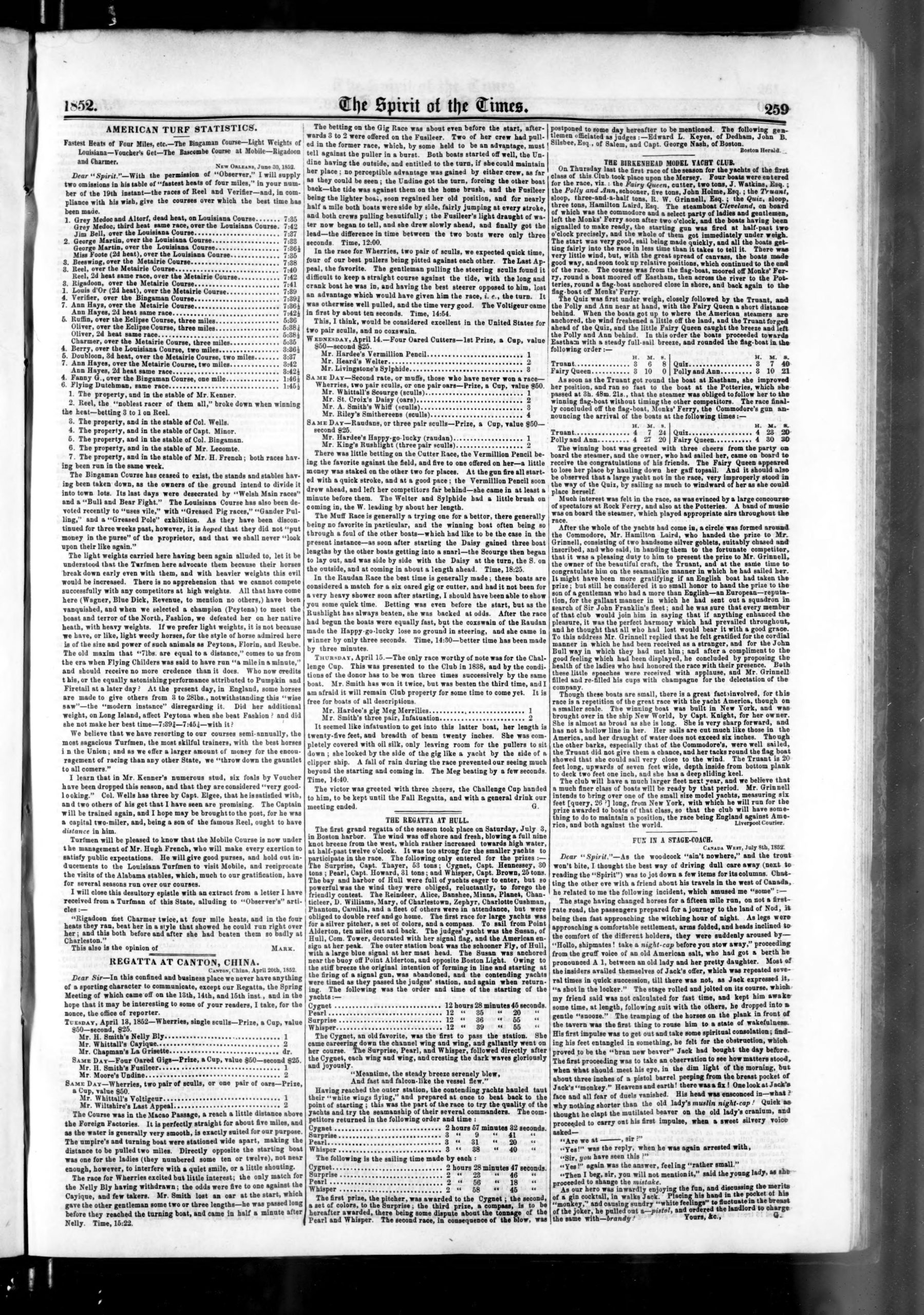
REGATTA AT CANTON, CHINA.
Canton, China, April 20th, 1852.
Dear Sir-In this confined and business place we never have anything of a sporting character to communicate, except our Regatta, the Spring Meeting of which came off on the 13th, 14th, and 15th inst., and in the hope that it may be interesting to some of your readers, I take, for the nonce, the office of reporter.
Tuesday, April 13, 1852-Wherries, single sculls-Prize, a Cup, value $50-second, $25.
Mr. H. Smith’s Nelly Bly …. 1
Mr. Whittall’s Cayique …. 2
Mr. Chapman’s La Grisette …. dr. [?]
Same Day-Four Oared Gigs-Prize, a Cup, value $50-second $25.
Mr. H. Smith’s Fusileer …. 1
Mr. Moore’s Undine …. 2
Same Day-Wherries, two pair of sculls, or one pair of oars-Prize, a Cup, value $50.
Mr. Whittall’s Voltigeur …. 1
Mr. Wiltshire’s Last Appeal …. 2
The Course was in the Macao Passage, reach a little distance above the Foreign Factories. It is perfectly straight for about five miles, and as the water is generally very smooth, is exactly suited for our purpose. The umpire’s and turning boat were stationed wide apart, making the distance to be pulled two miles. Directly opposite the starting boat was one for the ladies (they numbered some ten or twelve), not near enough, however, to interfere with a quiet smile, or a little shouting.
The race for Wherries excited but little interest; the only match for the Nelly Bly having withdrawn; the odds were five to one against the Cayique, and few takers. Mr. Smith lost an oar at the start, which gave the other gentleman some two or three lengths-he was passed long before they reached the turning boat, and came in half a minute after Nelly. Time, 15:22.
The betting on the Gig Race was about even before the start, afterwards 3 to 2 were offered on the Fusileer. Two of her crew had pulled in the former race, which, by some held to be an advantage, must tell against the puller in a burst. Both boats started off well, the Undine having the outside, and entitled to the turn, if she could maintain her place; no perceptible advantage was gained by either crew, as far as they could be seen; the Undine got the turn, forcing the other boat back-the tide was against them on the home brush, and the Fusileer being the lighter boat, soon regained her old position, and for nearly half a mile both boats were side by side, fairly jumping at every stroke, and both crews pulling beautifully; the Fusileer’s light draught of water now began to tell, and she drew slowly ahead, and finally got the lead-the difference in time between the two boats were only three seconds. Time, 12:00.
In the race for Wherries, two pair of sculls, we expected quick time, four of our best pullers being pitted against each other. The Last Appeal, the favorite. The gentleman pulling the steering sculls found it difficult to keep a straight course against the tide, with the long and crank boat he was in, and having the best steerer opposed to him, lost an advantage which would have given him the race, i. e., the turn. It was otherwise well pulled, and the time very good. The Voltigeur came in first by about ten seconds. Time, 14:54.
This, I think, would be considered excellent in the United States for two pair sculls, and no coxswain.
Wednesday, April 14.-Four Oared Cutters-1st Prize, a Cup, value $50-second $25.
Mr. Hardee’s Vermillion Pencil …. 1
Mr. Haase’s [?] Welter …. 2
Mr. Livingstone’s Sylphide …. 3
Same Day-Second rate, or muffs, those who have never won a race-Wherries, two pair sculls, or one pair oars-Prize, a Cup, value $50.
Mr. Whittall’s Scourge (sculls) …. 1
Mr. St. Croix’s Daisy (oars) …. 2
Mr. A. Smith’s Whiff (sculls) …. 3
Mr. Riley’s Smithereens (sculls) …. 4
Same Day-[Raudans-heading illegible]
Mr. Hardee’s Happy-go-lucky (raudan) …. 1
Mr. King’s Rushlight (three pair sculls [?]) …. 2
There was little betting on the Cutter Race, the Vermillion Pencil being the favorite against the field, and five to one offered on her-a little money was staked on the other two for places. At the gun fire all started with a quick stroke, and at a good pace; the Vermillion Pencil soon drew ahead, and left her competitors far behind-she came in at least a minute before them. The Welter and Sylphide had a little brush on coming in, the W. leading by about her length.
The Muff Race is generally a trying one for a bettor, there generally being no favorite in particular, and the winning boat often being so through a foul of the other boats-which had like to be the case in the present instance-as soon after starting the Daisy gained three boat lengths by the other boats getting into a snarl-the Scourge then began to lay out, and was side by side with the Daisy at the turn, the S. on the outside, and at coming in about a length ahead. Time, 18:25.
In the Raudan Race the best time is generally made; these boats are considered a match for a six oared gig or cutter, and had it not been for a very heavy shower soon after starting, I should have been able to show you some quick time. Betting was even before the start, but as the Rushlight has always beaten, she was backed at odds. After the race had begun the boats were equally fast, but the coxswain of the Raudan made the Happy-go-lucky lose no ground in steering, and she came in winner by only three seconds. Time, 14:30-better time has been made by three minutes.
Thursday, April 15.-The only race worthy of note was for the Challenge Cup. This was presented to the Club in 1838, and by the conditions of the donor has to be won three times successively by the same boat. Mr. Smith has won it twice, but was beaten the third time, and I am afraid it will remain Club property for some time to come yet. It is free for boats of all descriptions.
Mr. Hardee’s gig Meg Merrilies …. 1
Mr. Smith’s three pair, Infatuation …. 2
It seemed like infatuation to get into this latter boat, her length is twenty-five feet, and breadth of beam twenty inches. She was completely covered with oil silk, only leaving room for the pullers to sit down; she looked by the side of the gig like a yacht by the side of a clipper ship. A fall of rain during the race prevented our seeing much beyond the starting and coming in. The Meg beating by a few seconds. Time, 14:40.
The victor was greeted with three cheers, the Challenge Cup handed to him, to be kept until the Fall Regatta, and with a general drink our meeting ended.
G.
Spirit of the Times, March 12, 1853, front page – complete article
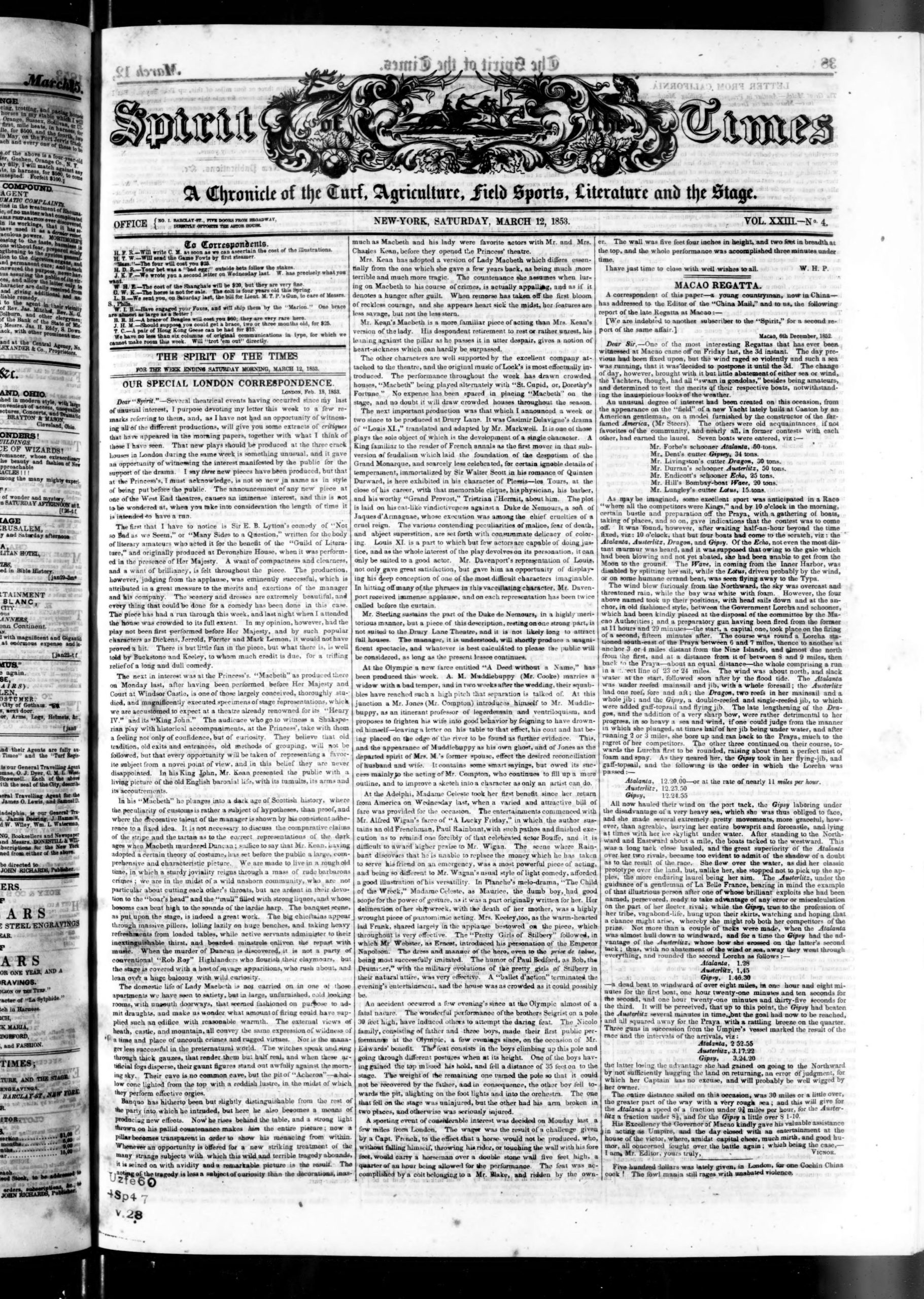
MACAO REGATTA.
A correspondent of this paper-a young countryman, now in China-has addressed to the Editor of the “China Mail,” and to us, the following report of the late Regatta at Macao:- [We are indebted to another subscriber to the “Spirit,” for a second report of the same affair.]
Macao, 6th December, 1852.
Dear Sir,-One of the most interesting Regattas that has ever been witnessed at Macao came off on Friday last, the 3d instant. The day previous had been fixed upon, but the wind raged so violently and such a sea was running, that it was decided to postpone [?] it until the 3d. The change of day, however, brought with it but little abatement of either sea or wind, the Yachters, though, had all “swam in gondolas,” besides being amateurs, and determined to test the merits of their respective boats, notwithstanding the inauspicious looks of the weather.
An unusual degree of interest had been created on this occasion, from the appearance on the “field” of a new Yacht lately built at Canton by an American gentleman, on a model furnished by the constructor of the far-famed America, (Mr. Steers). The others were old acquaintances, if not favorites of the community, and nearly all, in former contests with each other, had earned the laurel. Seven boats were entered, viz:-
Mr. Forbe’s schooner Atalanta, 50 tons.
Mr. Dent’s cutter Gepsey, 34 tons.
Mr. Livingston’s cutter Dragon, 30 tons.
Mr. Durran’s schooner Austerlitz, 50 tons.
Mr. Endicott’s schooner Echo, 25 tons.
Mr. Hill’s Bombay-boat Wave, 20 tons.
Mr. Lungley’s cutter Lotus, 15 tons.
As may be imagined, some excellent sport was anticipated in a Race “where all the competitors were Kings,” and by 10 o’clock in the morning, a certain bustle and preparation [?] off the Praya, with a gathering of boats, taking of places, and so on, gave indications that the contest was to come off. It was found, however, after waiting half-an-hour beyond the time fixed, viz: 10 o’clock, that but four boats had come to the scratch, viz: the Atalanta, Austerlitz, Dragon, and Gipsy. Of the Echo, not even the most distant murmur was heard, and it was supposed that owing to the gale which had been blowing and not yet abated, she had been unable to get from the Moon [?] to the ground. The Wave, in coming from the Inner Harbor, was disabled by splitting her sail, while the Lotus, driven probably by the wind, or on some humane errand bent, was seen flying away to the Typa.
The wind blew furiously from the Northward, the sky was overcast and threatened rain, while the bay was white with foam. However, the four above named took up their positions, with head sails down and at the anchor, in old fashioned style, between the Government Lorcha and schooner, which had been kindly placed at the disposal of the committee by the Macao Authorities; and a preparatory gun having been fired from the former at 11 hours and 29 minutes-the start, a capital one, took place on the firing of a second, fifteen minutes after. The course was round a Lorcha stationed south-east of the Praya between 6 and 7 miles, thence to another at anchor 3 or 4 miles distant from the Nine Islands, and almost due north from the first, and at a distance from it of between 8 and 9 miles, then back to the Praya-about an equal distance-the whole comprising a run in a direct line of 23 or 24 miles. The wind was about north, and slack water at the start, followed soon after by the flood tide. The Atalanta was under reefed mainsail and jib, with a whole foresail; the Austerlitz had one reef, fore and aft; the Dragon, two reefs in her mainsail and a whole jib; and the Gipsy, a double-reefed mainsail [?] and single-reefed jib, to which were added gaff-topsail and flying jib. The late lengthening of the Dragon, and the addition of a very sharp bow, were rather detrimental to her progress, in so heavy a sea and wind, if one could judge from the manner in which she plunged, at times half of her jib being under water, and after running 2 or 3 miles, she bore up and ran back to the Praya, much to the regret of her competitors. The other three continued on their course, towards the Lorcha first to be rounded, raising about them a perfect mist of foam and spray. As they neared her, the Gipsy took in her flying-jib, and [illegible], and the following is the order in which the Lorcha was passed:-
Atalanta, 12.20.00-or at the rate of nearly 11 miles per hour.
Austerlitz, 12.23.50
Gipsy, 12.24.55
All now hauled their wind on the port tack, the Gipsy laboring under the disadvantage of a very heavy sea, which she was thus obliged to face, and she made several extremely pretty movements, more graceful, however, than agreeable, burying her entire bowsprit and forecastle, and lying at times with her lee skylight under water. After standing to the Northward and Eastward about a mile, the boats tacked to the westward. This was a long tack close hauled, and the great superiority of the Atalanta over her two rivals, became too evident to admit of the shadow of a doubt as to the result of the race. She flew over the water, as did her classic prototype over the land, but, unlike her, she stopped not to pick up the apples, the more enduring laurel being her aim. The Austerlitz, under the guidance of a gentleman of La Belle France, bearing in mind the example of that illustrious person after one of whose brilliant exploits she had been named, persevered, ready to take advantage of any error or miscalculation on the part of her fleeter rival; while the Gipsy, true to the profession of her tribe, vagabond-like, hung upon their skirts, watching and hoping that a chance might arise, whereby she might rob both her competitors of the prize. Not more than a couple of tacks were made, when the Atalanta was almost hull down to windward, and for a time the Gipsy had the advantage of the Austerlitz, whose bow she crossed on the latter’s second tack; thus, with no abatement of the wind or sea, away they went through everything, and rounded the second Lorcha as follows:-
Atalanta, 1.28
Austerlitz, 1.45
Gipsy, 1.46.30
-a dead beat to windward of over eight miles, in one hour and eight minutes for the first boat, one hour twenty-one minutes and ten seconds for the second, and one hour twenty-one minutes and thirty-five seconds for the third. It will be perceived, that up to this point, the Gipsy had beaten the Austerlitz several minutes in time, but the goal had now to be reached, and all squared away for the Praya with a rattling breeze on the quarter. Three guns in succession from the Umpire’s vessel marked the result of the race and the intervals of the arrivals, viz:
Atalanta, 2.52.55
Austerlitz, 3.17.22
Gipsy, 3.24.20
the latter losing the advantage she had gained on going to the Northward by not sufficiently hugging the land on returning, an error of judgment, for which her Captain has no excuse, and will probably be well wigged by her owner.
The entire distance sailed on this occasion, was 30 miles or a little over, the greater part of the way with a very rough sea; and this will give for the Atalanta a speed of a fraction under 9 1/2 miles per hour, for the Austerlitz a fraction under 8 1/2, and for the Gipsy a little over 8 1-10.
His Excellency the Governor of Macao kindly gave his valuable assistance in acting as Umpire, and the day closed with an entertainment at the house of the victor, where, amidst capital cheer, much mirth, and good humor, all concerned fought over the battle again; which being the case,-
I am, Mr. Editor, yours truly,
VICTOR.
1. THE FAMILY EVIDENCE. Laura’s letter of Sept. 3, 1852 (Gibbs Family Papers, exhibited) congratulates Frank on his pieces in the Spirit and shows Alfred reading them in Texas – dating Frank’s first appearances to the spring-summer 1852 printings. Frank was at Canton exactly then: his own May 1851 San Francisco letter and Alfred’s August 1852 letter (both exhibited) track him to the China house and its Shanghai move.
2. THE SIGNATURE. “G.” – and a reporter who knows the boats but owns none, writes like a man raised on the New York Yacht Club gossip his sister’s letters carried, and apologizes that a counting-house town offers nothing sporting but its regatta.
3. THE MACAO REPORT is attributed: the editors describe their established correspondent – “a young countryman, now in China” – and the December 1852 dateline fits Frank’s coast movements. The signature “Victor” is a joke in the family manner. A second reader’s report of the same regatta reached the paper independently.
4. ON THE INITIALS “W. H. P.” standing near this item in the Spirit’s tight columns: they are the signature of the paper’s regular traveling correspondent (the same initials close its London letters), whose piece adjoins the regatta report on the page; the Macao report itself is the “young countryman’s,” signed “Victor.”
5. Frank’s China years ended when the house failed; he returned to New York and, as Alfred’s 1854 letters note, tried banking. The hunt continues for further “G.” letters, 1852-1853, and in the Hong Kong China Mail, to which the Macao report was also addressed.
Archival citation
Gibbs Family Papers, 1763-1918. U.S. Mss Y; Micro 1117; Photo Lots 3696-3697. Wisconsin Historical Society, Division of Library, Archives, and Museum Collections, Madison, Wis. Digitized research copy (Green collection), Reel 2. Scans Internet Archive: sim_spirit-of-the-times_1852-07-17_22_22 and sim_spirit-of-the-times_1853-03-12_23_4; microfilm frames full page images preserved in this archive. Every page of the letter is shown above; duplicate microfilm exposures are noted in the reel index.
Suggested citation (Chicago): [Gibbs, Francis S.] “G.” “Regatta at Canton, China.” Spirit of the Times (New York), July 17, 1852; and [attributed] “Macao Regatta.” Spirit of the Times, March 12, 1853, 1. Attribution established by Laura Gibbs to Francis S. Gibbs, September 3, 1852, Gibbs Family Papers, Wisconsin Historical Society. Accessed via AlfredGibbs.com.
Related in the Record
References
[Gibbs, F. S.] “G.” (1852, July 17). Regatta at Canton, China. Spirit of the Times (New York), 22(22). https://archive.org/details/sim_spirit-of-the-times_1852-07-17_22_22
[Gibbs, F. S., attrib.] (1853, March 12). Macao regatta. Spirit of the Times (New York), 23(4), 1. https://archive.org/details/sim_spirit-of-the-times_1853-03-12_23_4
Gibbs, L. (1852, September 3). [Letter to Francis S. Gibbs]. Gibbs Family Papers, 1763-1918 (U.S. Mss Y, Micro 1117, reel 2) [Manuscript]. Wisconsin Historical Society, Madison, WI.
Accuracy review: transcription checked against the full-resolution scans, July 11, 2026. Original spelling and punctuation are preserved; editorial matter appears in square brackets and uncertain readings are marked [?] rather than guessed. Corrections are made openly; this page will be updated, never silently, if better readings are established.
Views: 6