NW Boundary Journal — Pages 21–30
Zoological Field Notebook · 1859–60
NW Boundary Journal — Pages 21–30
October 1859–April 1860 · Colville Depot
Note: pages 28–30 are in faded ink and low-confidence; readings are uncertain.
Winter specimen entries at the Colville Depot — ermine, lynx, hares, finches, and fish.
Page 21
[Two-page spread. Left page:]
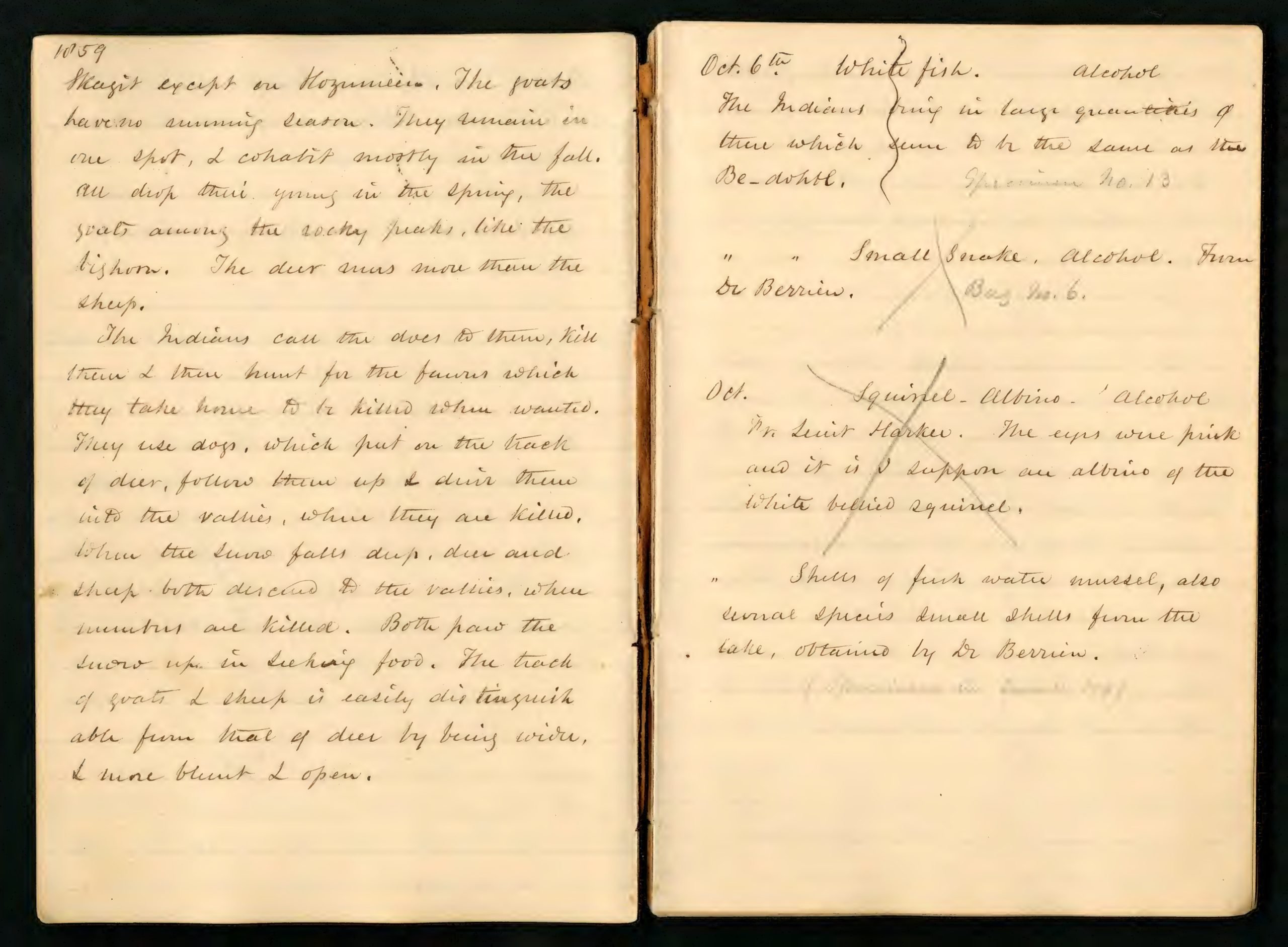
Skagit except on Hozumeen. The goats have no running season. They remain in one spot, & cohabit mostly in the fall. All drop their young in the spring, the goats among the rocky peaks, like the bighorn. The deer runs more than the sheep. The Indians call the does to them, kill them & then hunt for the fawns which they take home to be killed when wanted. They use dogs, which put on the track of deer, follow them up & drive them into the vallies, where they are killed. When the snow falls deep, deer and sheep both descend to the vallies, when numbers are killed. Both paw the snow up in seeking food. The track of goats & sheep is easily distinguish able from that of deer by being wider, & more blunt & open.
[Right page:]
The Indians bring in large quantities of these which seem to be the same as the Be-dohtl. Specimen No. 13
Dr Berrien. Bag No. 6.
Fr Lieut Harker. The eyes were prick[?] and it is I suppose an albino of the White bellied squirrel.
several species small Shells from the Lake, obtained by Dr Berrien. [illegible struck-through line]
Page 22
[Two-page spread. Left page:]
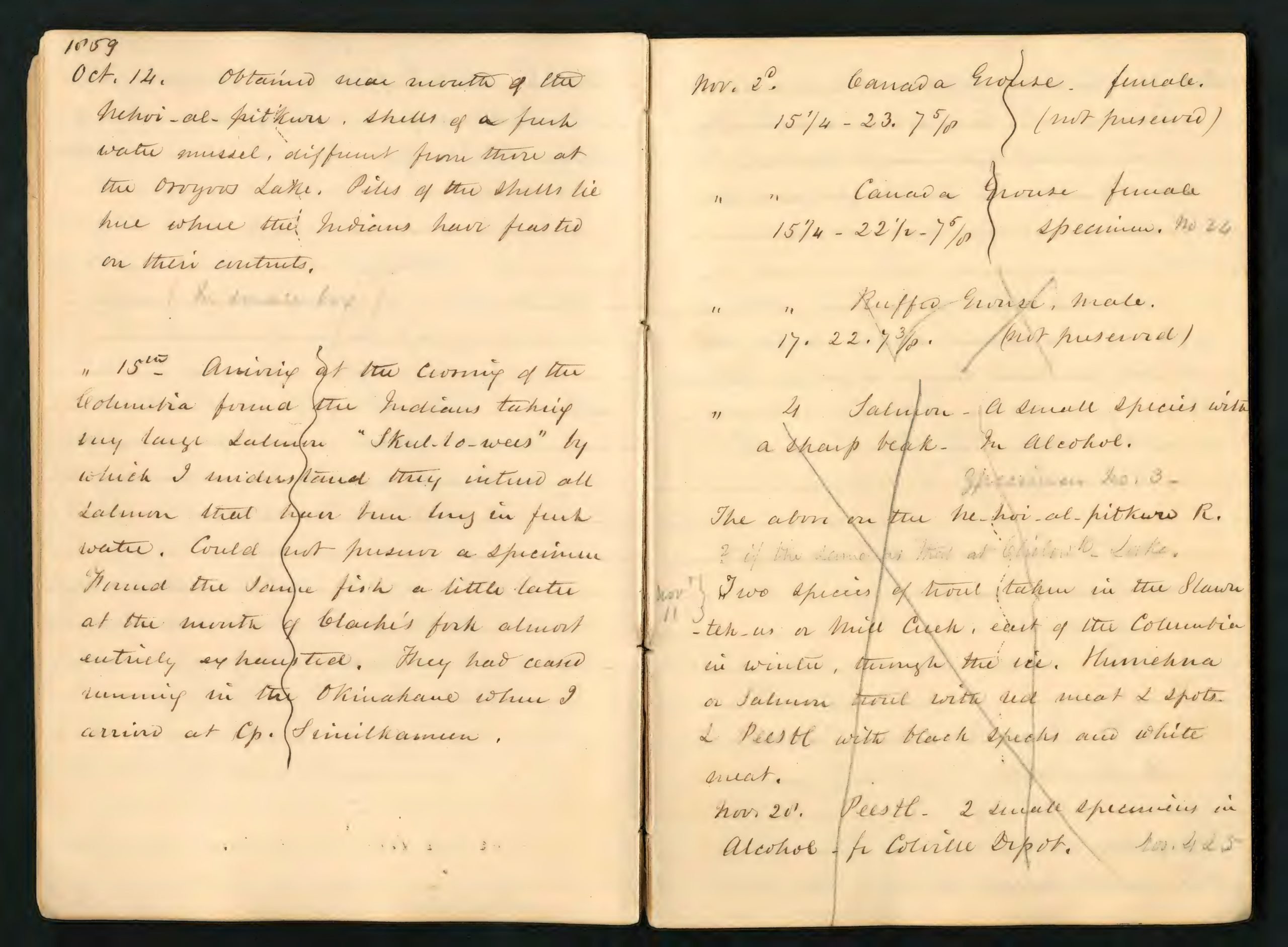
Oct. 14. Obtained near mouth of the
Nehoi-al-pitkwu. shells of a fresh water mussel, different from those at the Osoyoos Lake. Piles of the shells lie here where the Indians have feasted on their contents. [ illegible bracketed note ]
Columbia found the Indians taking very large Salmon "Skul-to-wees" by which I understand they intend all Salmon that have been long in fresh water. Could not preserve a specimen Found the same fish a little later at the mouth of Clarke's fork almost entirely exhausted. They had ceased running in the Okinakane when I arrived at Cp. Similkameen.
[Right page:]
15 1/4 – 23. 7 5/8 (not preserved)
15 1/4 – 22 1/2 – 7 5/8 Specimen. No 24
17. 22. 7 3/8. (not preserved)
a sharp beak – In Alcohol. Specimen No. 3 – The above on the Ne-hoi-al-pitkwu R. ? if the same as that at Chilou[?] R. Lake. Two species of trout taken in the Slawn -teh-us or Mill Creek, east of the Columbia in winter, through the ice. Khunichna or Salmon trout with red meat & spots. & Peestl with black specks and white meat.
Alcohol – fr Colville Depot. Nos. 4 & 5
Page 23
[Two-page spread. Left page:]
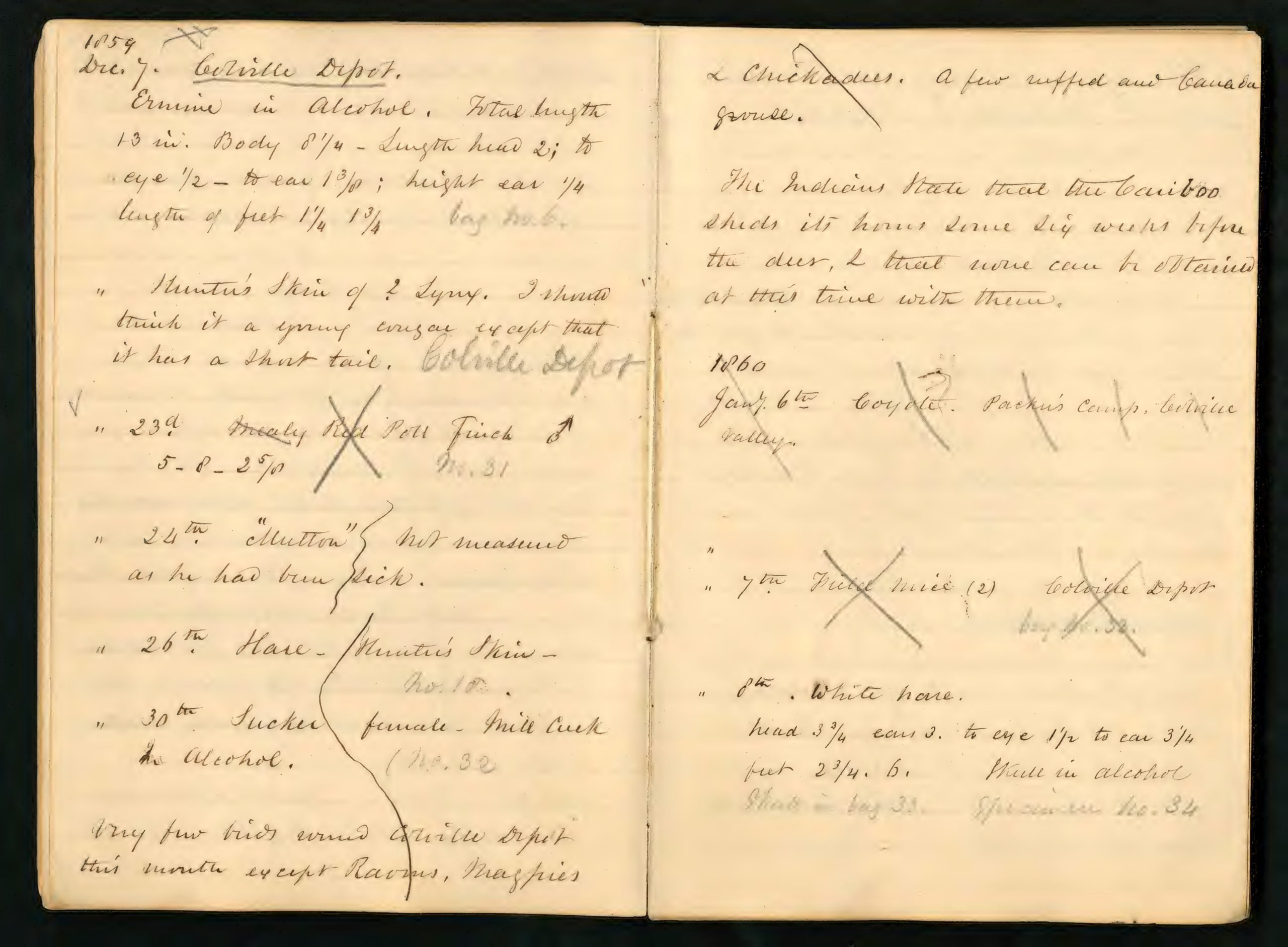
Dec. 7. Colville Depot.
Ermine in Alcohol. Total length
eye 1/2 – to ear 1 3/8 ; height ear 1/4
length of feet 1 1/4 1 3/4 bag No. [?]
think it a young cougar except that it has a short tail. Colville Depot
5 – 8 – 2 5/8 No. 31
as he had been sick.
No. 18[?] .
" 30th Sucker female – Mill Creek
In Alcohol. ( No. 32
Very few birds around Colville Depot this month except Ravens, Magpies
[Right page:]
& Chickadees. A few ruffed and Canada grouse.
The Indians state that the Cariboo sheds its horns some six weeks before the deer, & that none can be obtained at this time with them.
Jany. 6th Coyote. Packru's[?] camp, Colville valley.
bag No. 32[?]
head 3 3/4 ears 3. to eye 1/2 to ear 3/4
feet 2 3/4. 6. Skull in alcohol
Skull in bag 33. Specimen No. 34
Page 24
[Two-page spread. Left page:]
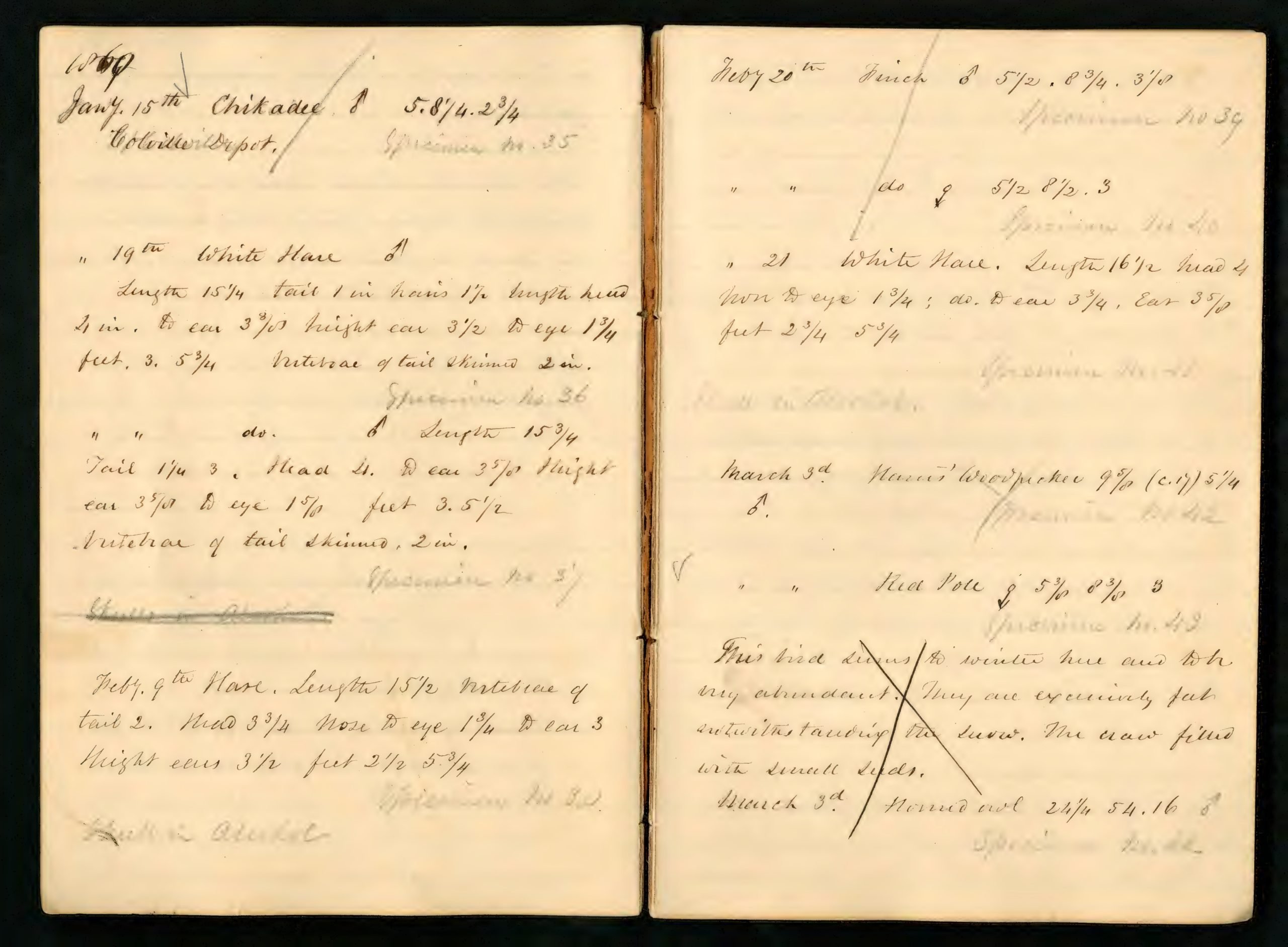
Jany. 15th Chikadee [male] 5. 8 3/4. 2 3/4
Colville Depot. Specimen No. 35
Length 15 1/4 tail 1 in ears 1 1/2 Length head
4 in. to ear 3 3/8 height ear 3 1/2 to eye 1 3/4
feet. 3. 5 3/4 Vertebrae of tail skinned 2 in.
Specimen No 36
Tail 1 1/4 3 . Head 4. to ear 3 5/8 height
ear 3 5/8 to eye 1 5/8 feet 3. 5 1/2
Vertebrae of tail skinned. 2 in. Specimen No 37 Skull in Alcohol [struck through]
tail 2. Head 3 3/4 Nose to eye 1 3/4 to ear 3
height ears 3 1/2 feet 2 1/2 5 3/4
Specimen No 38 Skull in Alcohol
[Right page:]
Specimen No 39
Specimen No 40
Nose to eye 1 3/4 ; do. to ear 3 3/4. Ear 3 5/8
feet 2 3/4 5 3/4
Specimen No 41 Skull in Alcohol.
[male]. Specimen No 42
Specimen No 43
This bird seems to winter here and to be very abundant. They are exceedingly fat notwithstanding the snow. The craw filled with small seeds.
Specimen No 44
Page 25
[Two-page spread. Left page:]
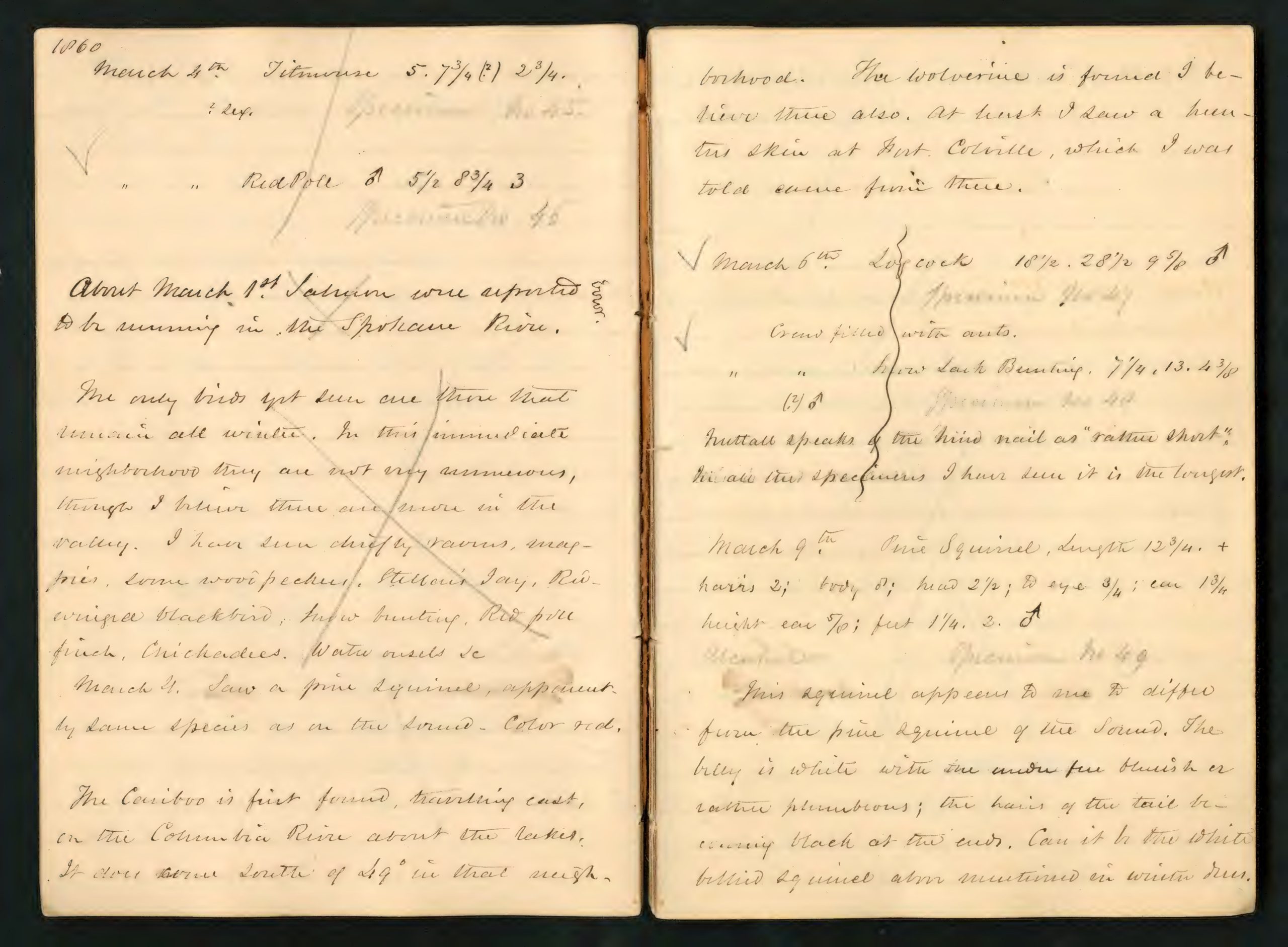
March 4th Titmouse 5. 7 3/4 (?) 2 3/4.
? sex. Specimen No. 45
Specimen No 46
About March 1st Salmon were reported to be running in the Spokane River.
The only birds yet seen are those that remain all winter. In this immediate neighborhood they are not very numerous, though I believe there are more in the valley. I have seen chiefly ravens, magpies, some woodpeckers, Stellar's Jay, Redwinged blackbird, snow bunting, Red poll finch, Chickadees. Water ousels &c March 4. Saw a pine squirrel, apparently same species as on the Sound – Color red.
The Cariboo is first found, travelling east, on the Columbia River about the lakes. It does come south of 49° in that neigh-
[Right page:]
borhood. The wolverine is found I believe there also. At least I saw a hunter's skin at Fort Colville, which I was told came from there.
Specimen No 47 Craw filled with ants.
(?) [male] Specimen No 48
Nuttall speaks of the hind nail as "rather short". In all the specimens I have seen it is the longest.
hairs 2; body 8; head 2 1/2; to eye 3/4 ; ear 1 3/4
height ear 5/8; feet 1 1/4. 2. [male]
Alcohol Specimen No 49 This squirrel appears to me to differ from the pine squirrel of the Sound. The belly is white with the under fur bluish or rather plumbeous; the hairs of the tail becoming black at the ends. Can it be the White bellied squirrel above mentioned in winter dress.
Page 26
[Two-page spread. Left page:]
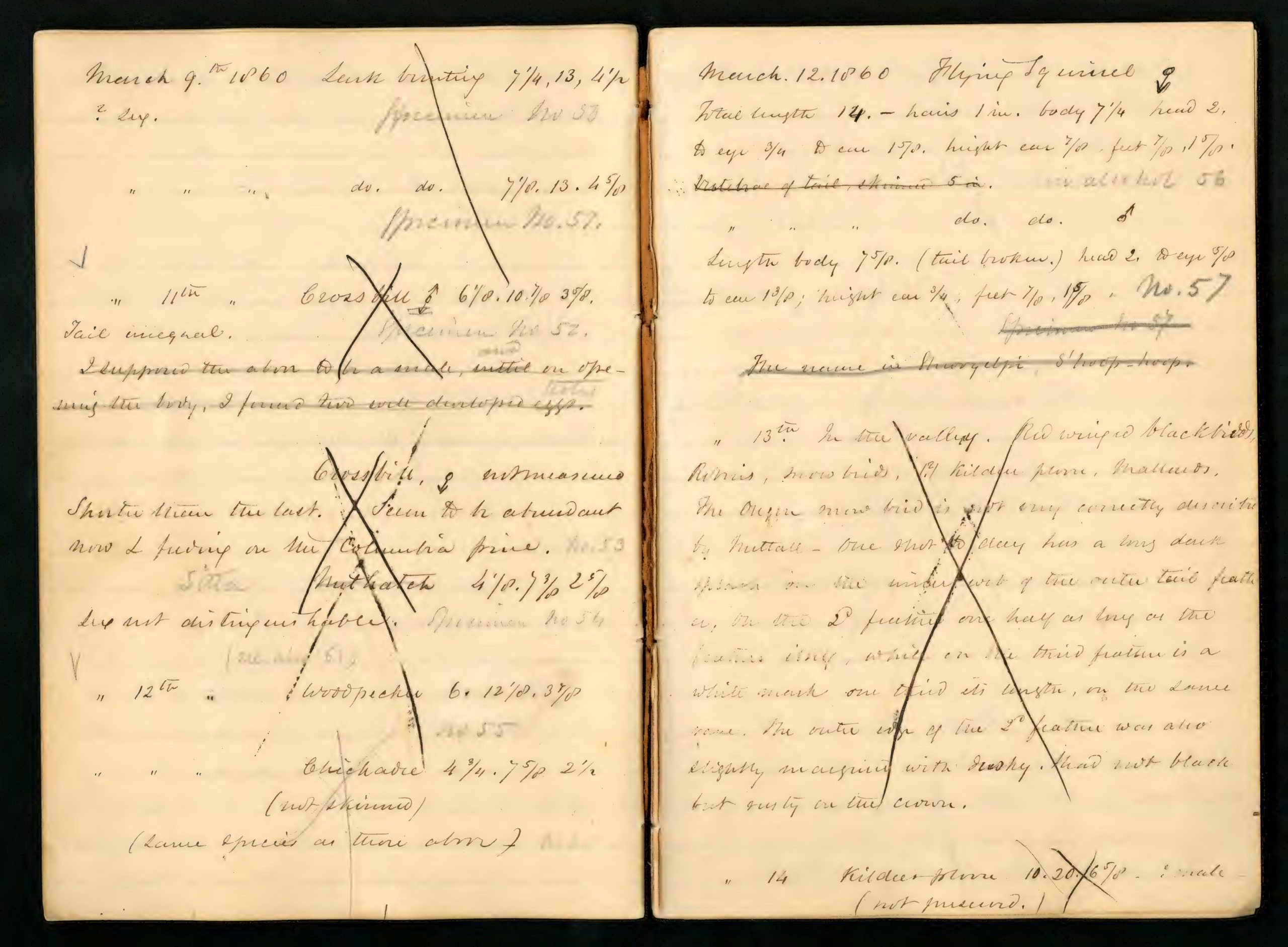
? sex. Specimen No 50
Specimen No. 51.
Tail unequal. Specimen No 52. I supposed the above to be a male, until on opening the body, I found two well developed eggs[?]. [testes?]
Cross bill, [female] not measured Shorter than the last. Seem to be abundant now & feeding on the Columbia pine. No. 53
are not distinguishable. Specimen No 54
" 12th " Woodpecker 6. 12 5/8. 3 5/8
No. 55
" " " Chickadee 4 3/4. 7 5/8 2 1/2
(not skinned) (same species as those above )
[Right page:]
March. 12. 1860 Flying Squirrel [female]
to eye 3/4 to ear 1 5/8. height ear 7/8. feet 7/8. 1 5/8.
Vertebrae of tail. skinned 5 in. [struck] In alcohol 56
Length body 7 5/8. (tail broken.) head 2. to eye 7/8
to ear 1 3/8; height ear 3/4; feet 7/8. 1 5/8 . No. 57
Specimen No 57 [struck] The name is Skwargelpi.[?] hoop-hoop. [struck]
Robins, snow bird, (?) Kildeer plover. Mallards. The Oregon snow bird is not very correctly described by Nuttall – the one shot to-day has a long dark space on the inner web of the outer tail feather, on the 2d feather one half as long as the feather itself, while on the third feather is a white mark one third its length, on the same vane. The outer edge of the 2d feather was also slightly margined with dusky. Head not black but rusty on the crown.
(not preserved. )
Page 27
[Two-page spread. Left page:]
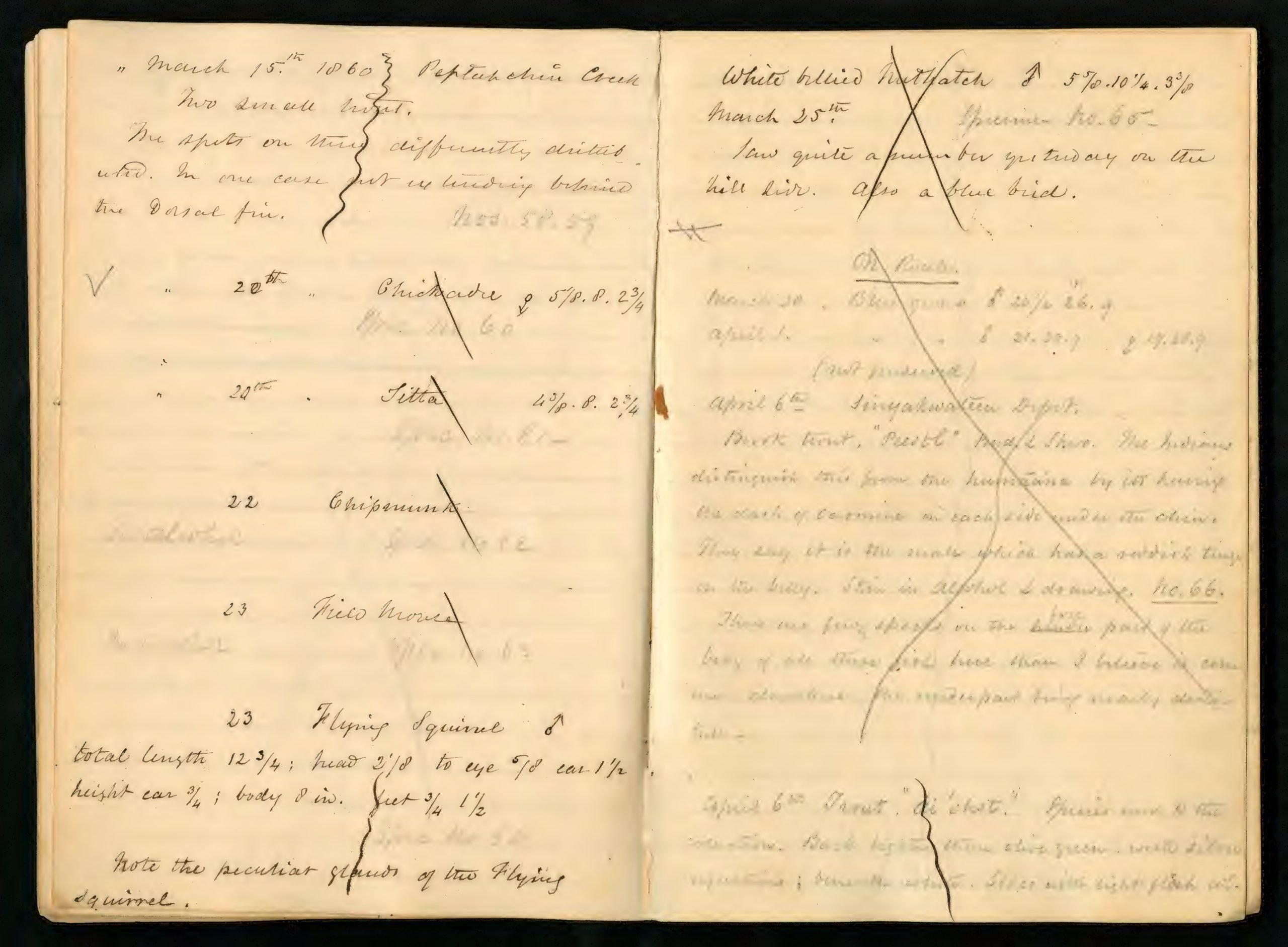
Two small trout. The spots on these differently distributed. In one case not extending behind
No. 60
Spec. No. 61 –
22 Chipmunk
23 Field Mouse
23 Flying Squirrel [male]
height ear 3/4 ; body 8 in. feet 3/4 1 1/2
Spec. No 64
Note the peculiar glands of the Flying Squirrel.
[Right page:]
March 25th Specimen No. 65 –
Saw quite a number yesterday on the hill side. Also a blue bird.
[struck-through heading, illegible]
April 1. " [male] 21. 20. [female] [female] 19. 20. [female]
(not preserved ) April 6th Sinyakwateen Depot. Brook trout, "Peestl" [illegible] there. The Indians distinguish this from the hunichna by its having the dash of Carmine on each side under the chin. They say it is the male which had a reddish tinge on the belly. Skin in alcohol & drawing. No. 66. There are fewer specks on the lower[?] part of the body of these fish here than I believe is common elsewhere. The under part being nearly destitute –
Page 28
⚠ Low confidence — faint pencil
[Two-page spread. Ink very faint throughout; many readings uncertain.]
[Left page:]
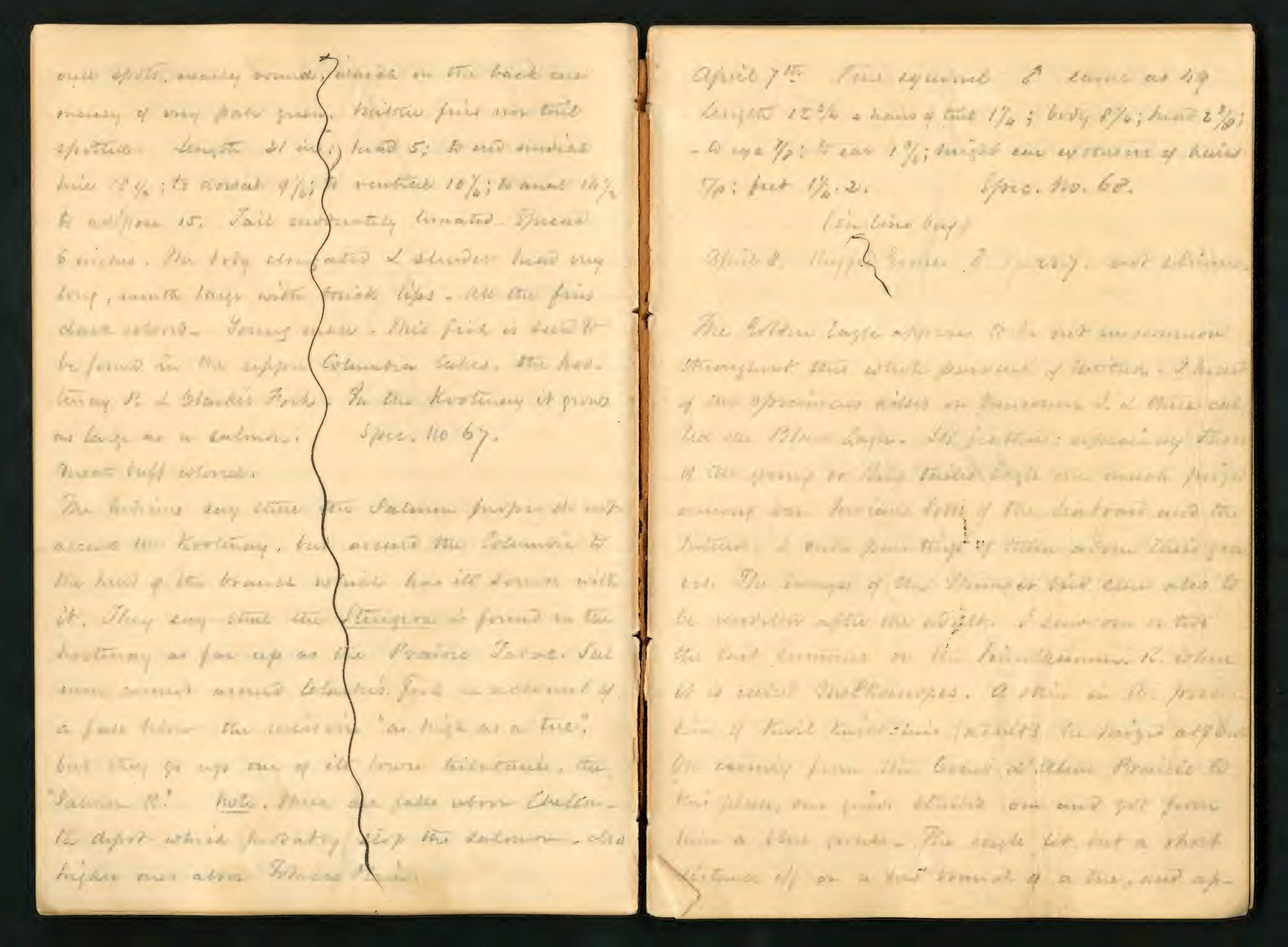
outer spots, nearly round, which on the back are many of very pale green, without their own outline[?]
[illegible] 12 1/2; to dorsal 9 1/2; to ventral 10 1/2; to anal 14 1/2
to adipose 15. Tail evidently lunated. Spread 6 inches. The body elongated & slender head very long, mouth large with thick lips – all the fins dark colored – Young of same – This fish is said to be found in the upper Columbia lakes, the Kootenay R. & Clarke's Fork. In the Kootenay it grows as large as a salmon. Spec. No 67. [illegible] buff colored. The Indians say that the Salmon proper do not ascend the Kootenay, but ascend the Columbia to the head of the branch which has its source with it. They say that the Sturgeon is found in the Kootenay as far up as the Prairie Lake. [illegible] runs cannot ascend Columbia fork on account of a fall below the crossing "as high as a tree", but they go up one of its lower tributaries, the
te depot which probably stop the salmon, others higher even above Palouse River[?]
[Right page:]
April 7th Pine squirrel [male] same as 49
– to eye 7/8; to ear 1 3/8; height ear exclusive of hairs
7/8; feet 1 1/2. 2. Spec. No. 68.
(in one bag) April 8. Nuttall's[?] [illegible] [male] [illegible] 23. 7. not skinned.
The Golden eagle appears to be not uncommon throughout the whole [illegible] of territory. I heard[?] of two specimens killed in Vancouver &c & others call the sea Blue Eagle. Its [illegible]; especially those of the young or three tailed[?] eagle are much prized among the Indians. Both of the sea coast and the interior[?]. I saw painting[?] of them above their graves. The images of the Thunder bird[?] came also to be considered after the [illegible]. I saw one in the [illegible] the last summer on the [illegible] R. where it is called Tholtcauspee[?]. A skin in the possession of Kwill Kwill-chius[?] [illegible] the [illegible] of a [illegible] On coming from the coast at Alum Prairie[?] to this place, our guide shouted out and got from him a blue grouse – The eagle lit but a short distance off on a low branch of a tree, and ap-
Page 29
⚠ Low confidence — faint pencil
[Two-page spread. Ink very faint throughout; many readings uncertain.]
[Left page:]
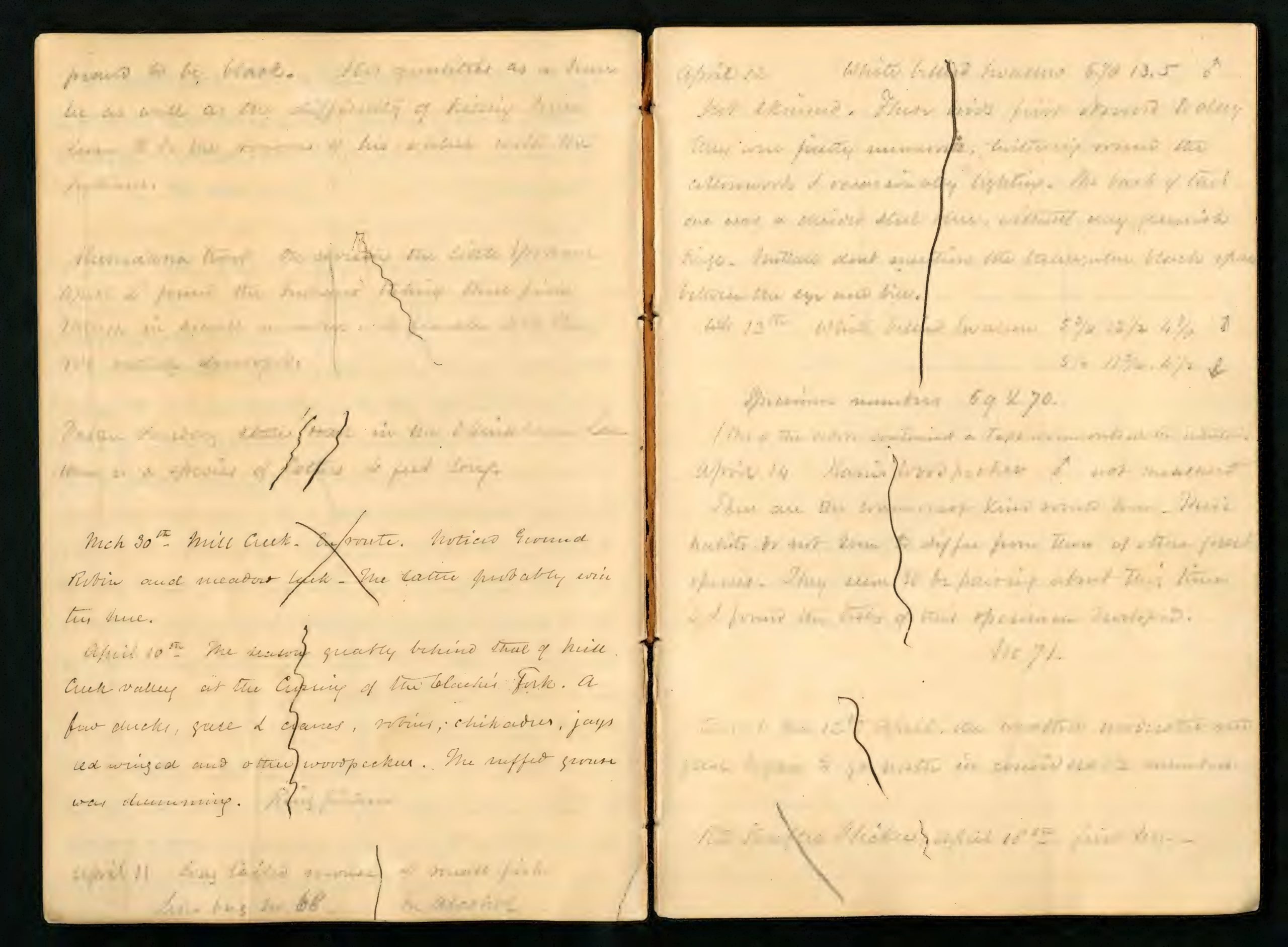
proved to be black. [illegible] gambled[?] as a hunter as well as the difficulty of hitting him [illegible] to be the [illegible] of his [illegible] with the Indians[?].
Hunichna trout. On approaching the little Spokane River I found the Indians taking these fish [illegible] in [illegible] numbers. [illegible] [illegible] Sinyakwateen[?]
[illegible faint line]
Mch 30th Mill Creek. En route. Notices Ground Robin and meadow lark – The cattle probably were[?] this line[?]. April 10th The season greatly behind that of Mill Creek valley at the Crossing of the Clarke's Fork. A few ducks, geese & cranes, robins, chikadees, jays red winged and other woodpeckers. The ruffed grouse was drumming. [illegible, struck through]
April 11 Very little snow[?] [illegible] of small fish[?] [illegible] bag No 68[?] In Alcohol
[Right page:]
Not skinned. These were first observed to-day. They were pretty numerous, twittering round the outerworks & occasionally lighting. The back of this one was a [illegible] steel blue, without any purplish tinge. Nuttall does not mention the transverse black space between the eye and bill.
5 1/2. 12 3/4. 4 1/2 [female]
Specimen numbers 69 & 70. [ this & the other contained a tapeworm[?] intestine, illegible ] April 14 Harris' woodpecker [male] not measured These are the common[?] kind [illegible] here. Their habits do not seem to differ from those of other forest[?] species. They seem to be pairing about this time & I found the testes of this specimen developed.
[illegible faint lines] About the 12th April[?], the weather [illegible] [illegible] began to go north in considerable [illegible]
Red Shafted Flicker[?] April 16th first seen –
Page 30
⚠ Low confidence — faint pencil
[Two-page spread. Ink faint throughout; several readings uncertain.]
[Left page:]
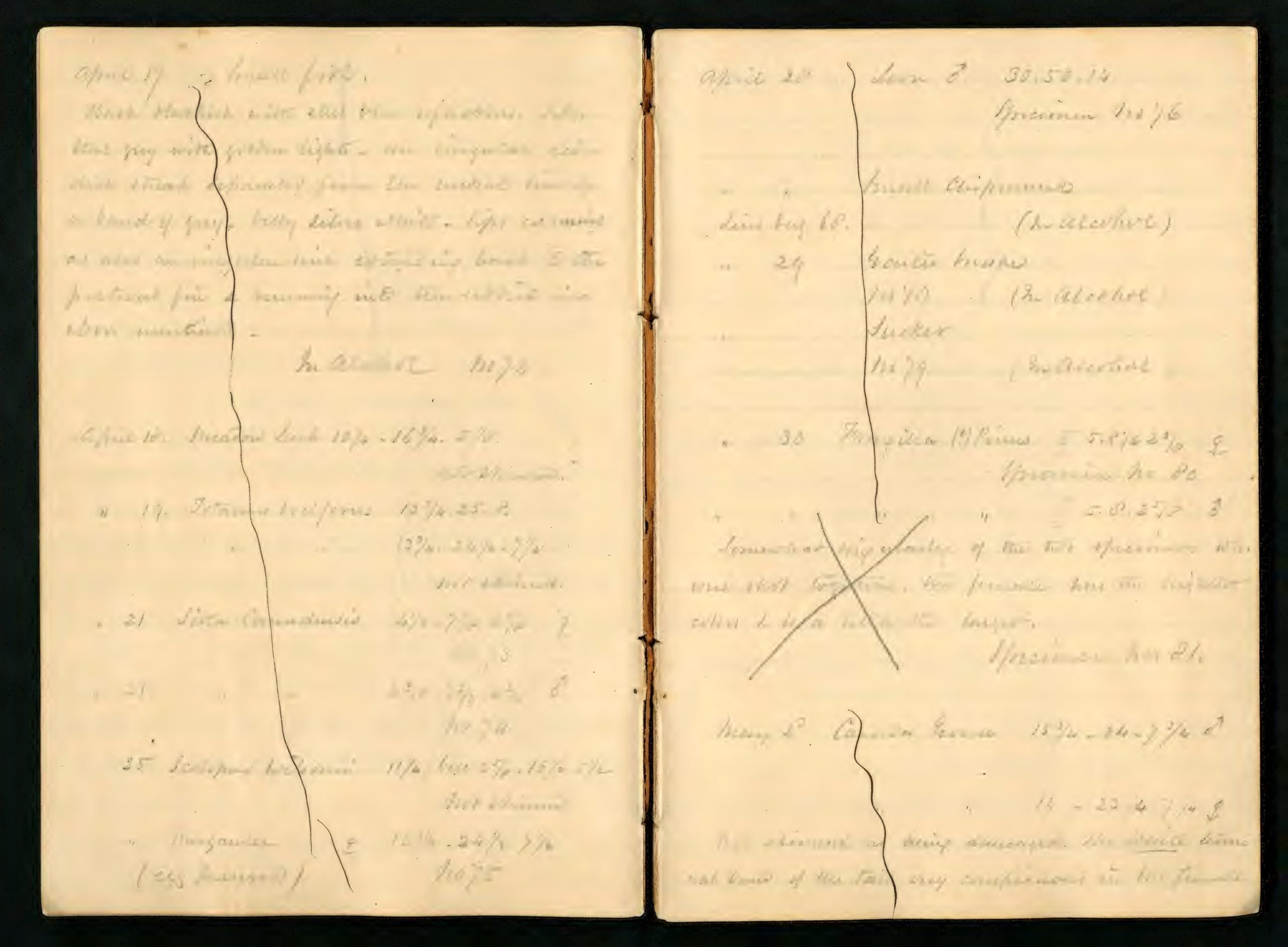
April 17 2 small fish[?]. Brook Nuthatch with steel blue reflections. Silver grey with golden tips[?]. On comparison, ap[illegible, struck] from the [illegible] [illegible] a band of grey belly rather whitish. Legs carmine or [illegible] on [illegible] with [illegible] up back & the [illegible] fur & [illegible] into the reddish also above mentioned – In Alcohol No 74[?]
not skinned.
" " 13 3/4 24 1/4 8 1/2
not skinned.
No 73
" 21 " " 4 3/4 7 1/2 2 3/4 [male]
No 74
" 25 Scolopax Wilsonii 11 1/4 bill 2 5/8. 16 1/4 5 1/2
Not skinned.
( egg preserved ) No 75
[Right page:]
Specimen No 76
Skin bag 60. (In Alcohol )
" 29 Garter snake
No 78 (In Alcohol )
" Sucker
No 79 ( In Alcohol )
" 30 Fringilla (?) Purpu-[?] [male] 5. 8 1/4 2 3/8 [female]
Specimen No 80
Somewhat singular[?] of the two specimens which were shot together, the female has the brightest[?] colors & is a little the larger. Specimen No 81
16 – 23 1/2 7 1/4 [female]
Not skinned. In being skinned the white terminal bars of the tail very conspicuous in the [illegible]
Views: 14