NW Boundary Journal — Pages 11–20
Zoological Field Notebook · 1859–60
NW Boundary Journal — Pages 11–20
August–October 1859 · Skagit River specimens
The field log opens with August–October 1859 specimen entries and natural-history notes from the Skagit River country — hoary marmots, grouse, mountain goat, and trout.
Page 11
[Left page: blank. Right page: blank leaf, with the edge of an adjacent tabbed/indexed page showing at the outer margin; only stray fragments of words are visible, illegible.]
Page 12
[Left page: blank. Right page: specimen list followed by journal entry.]
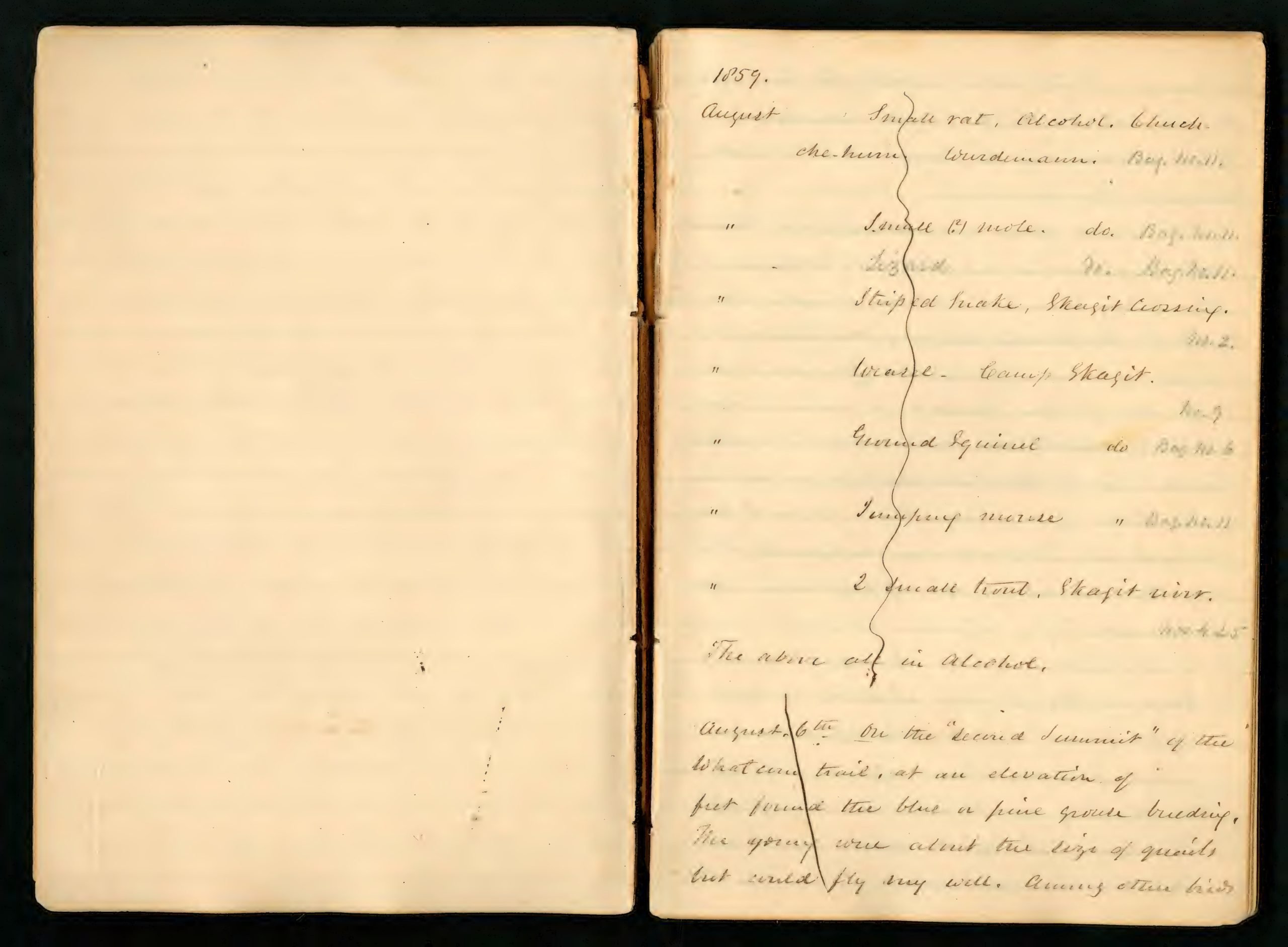
August Small rat, Alcohol. Chuckche-hum. Wurdemann. Bag. No. 11.
Lizard do. Bag. No. 11.
" Striped Snake, Skagit Crossing.
No. 2.
No. 9.
" Jumping mouse " Bag No. 11
" 2 Small trout, Skagit river.
No. 4 & 5.
The above all in Alcohol.
August 6th On the "Second Summit" of the Whatcom trail, at an elevation of [blank] feet found the blue or pine grouse breeding. The young were about the size of quails but could fly very well. Among other birds
Page 13
[Two-page spread. Left page:]
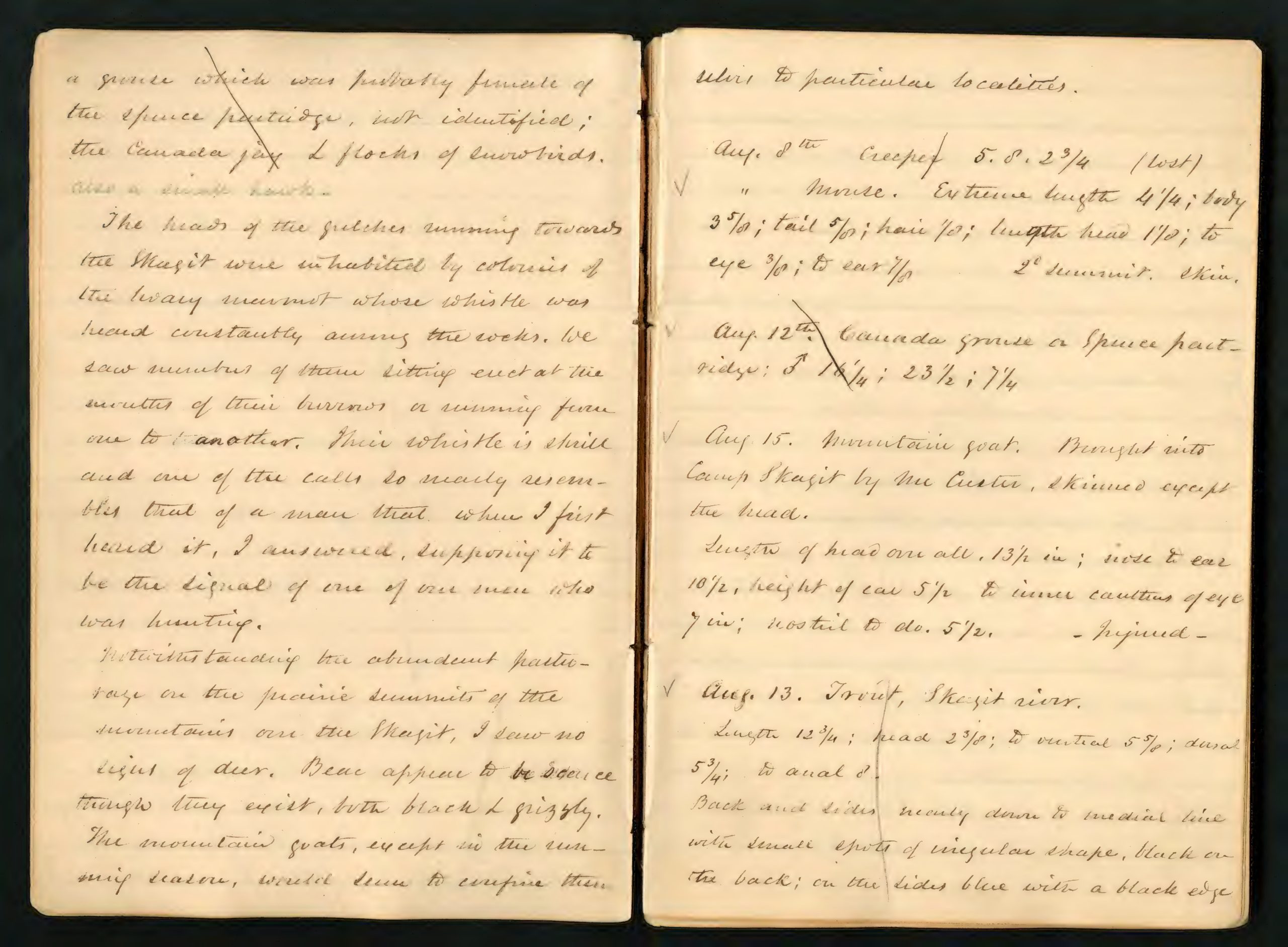
a grouse which was probably female of the spruce partridge, not identified; the Canada jay & flocks of snowbirds.
[Also a small hawk.] [struck through]
The heads of the gulches running towards the Skagit were inhabited by colonies of the hoary marmot whose whistle was heard constantly among the rocks. We saw numbers of them sitting erect at the mouths of their burrows or running from one to another. Their whistle is shrill and one of the calls so nearly resembles that of a man that when I first heard it, I answered, supposing it to be the signal of one of our men who was hunting. Notwithstanding the abundant pasturage on the prairie summits of the mountains on the Skagit, I saw no signs of deer. Bear appear to be scarce though they exist, both black & grizzly. The mountain goats, except in the running season, would seem to confine them
[Right page:]
selves to particular localities.
" Mouse. Extreme length 4 1/4; body
3 5/8; tail 5/8; hair 1/8; length head 1/8; to
eye 3/8; to ear 7/8 2d summit. Skin.
ridge; ♂ 16 1/4; 23 1/2; 7 1/4
Camp Skagit by Mr Custer. Skinned except the head.
10 1/2, height of ear 5 1/2 to inner canthus of eye
7 in; nostril to do. 5 1/2. – Injured –
Length 12 3/4; head 2 3/8; to ventral 5 7/8; dorsal
5 3/4; to anal 8.
Back and sides nearly down to medial line with small spots of irregular shape, black on the back; on the sides blue with a black edge
Page 14
[Two-page spread. Left page:]
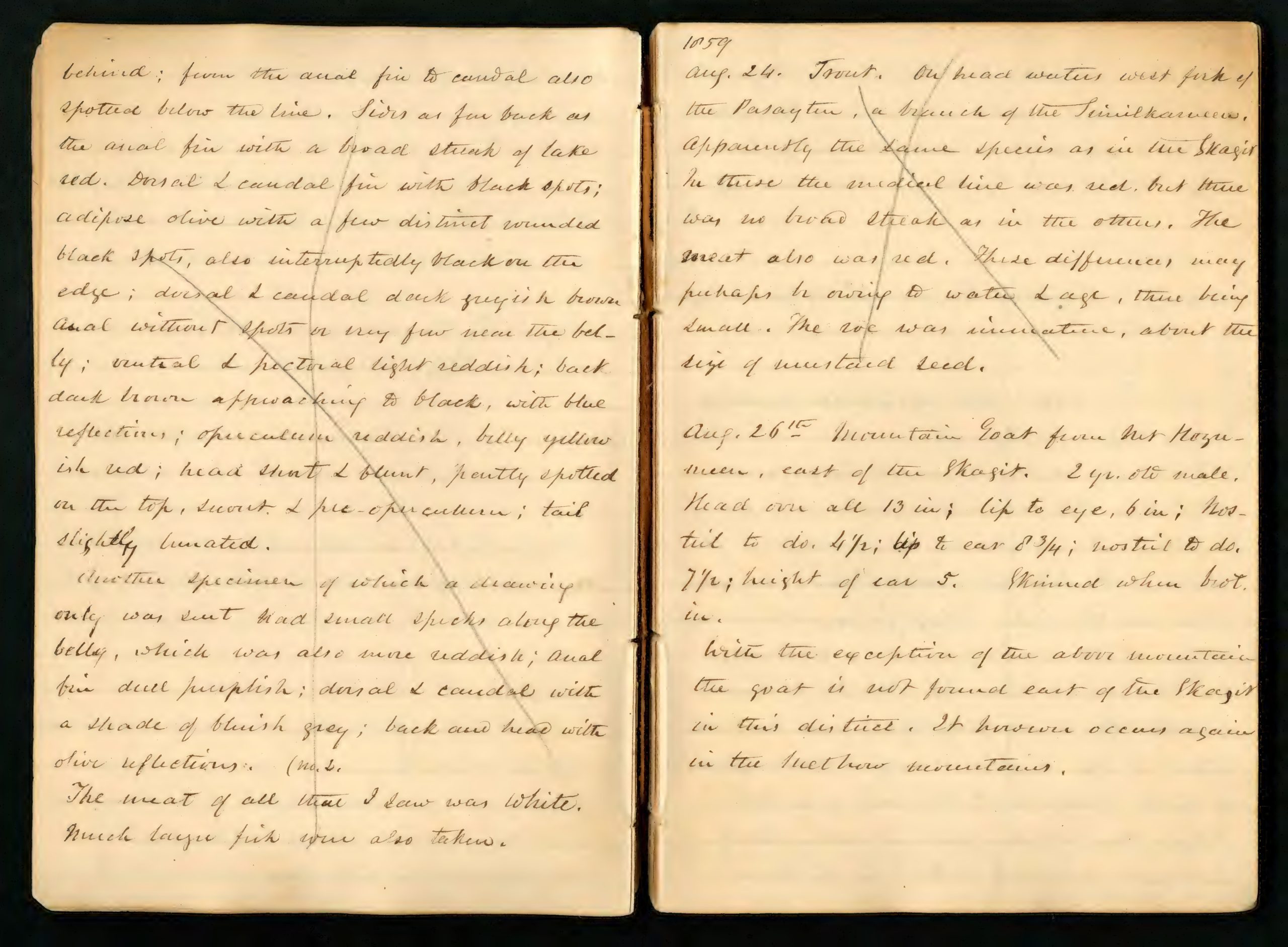
behind; from the anal fin to caudal also spotted below the line. Sides as far back as the anal fin with a broad streak of lake red. Dorsal & caudal fin with black spots; adipose olive with a few distinct rounded black spots, also interruptedly black on the edge; dorsal & caudal dark greyish brown Anal without spots or very few near the belly; ventral & pectoral light reddish; back dark brown approaching to black, with blue reflections; operculum reddish, belly yellowish red; head short & blunt, partly spotted on the top, snout & pre-operculum; tail slightly lunated. Another specimen of which a drawing only was sent had small specks along the belly, which was also more reddish; Anal fin dull purplish; dorsal & caudal with a shade of bluish grey; back and head with olive reflections. (No. 2. The meat of all that I saw was white. Much larger fish were also taken.
[Right page:]
Aug. 24. Trout. On head waters west fork of
the Pasayten, a branch of the Similkameen. Apparently the same species as in the Skagit In these the medial line was red, but there was no broad streak as in the others. The meat also was red. These differences may perhaps be owing to water & age, these being small. The roe was immature, about the size of mustard seed.
meen, east of the Skagit. 2 yr. old male.
tril to do. 4 1/2; lip to ear 8 3/4; nostril to do.
7 1/2; height of ear 5. Skinned when brot.
in. With the exception of the above mountain the goat is not found east of the Skagit in this district. It however occurs again in the Methow mountains.
Page 15
[Two-page spread. Left page:]
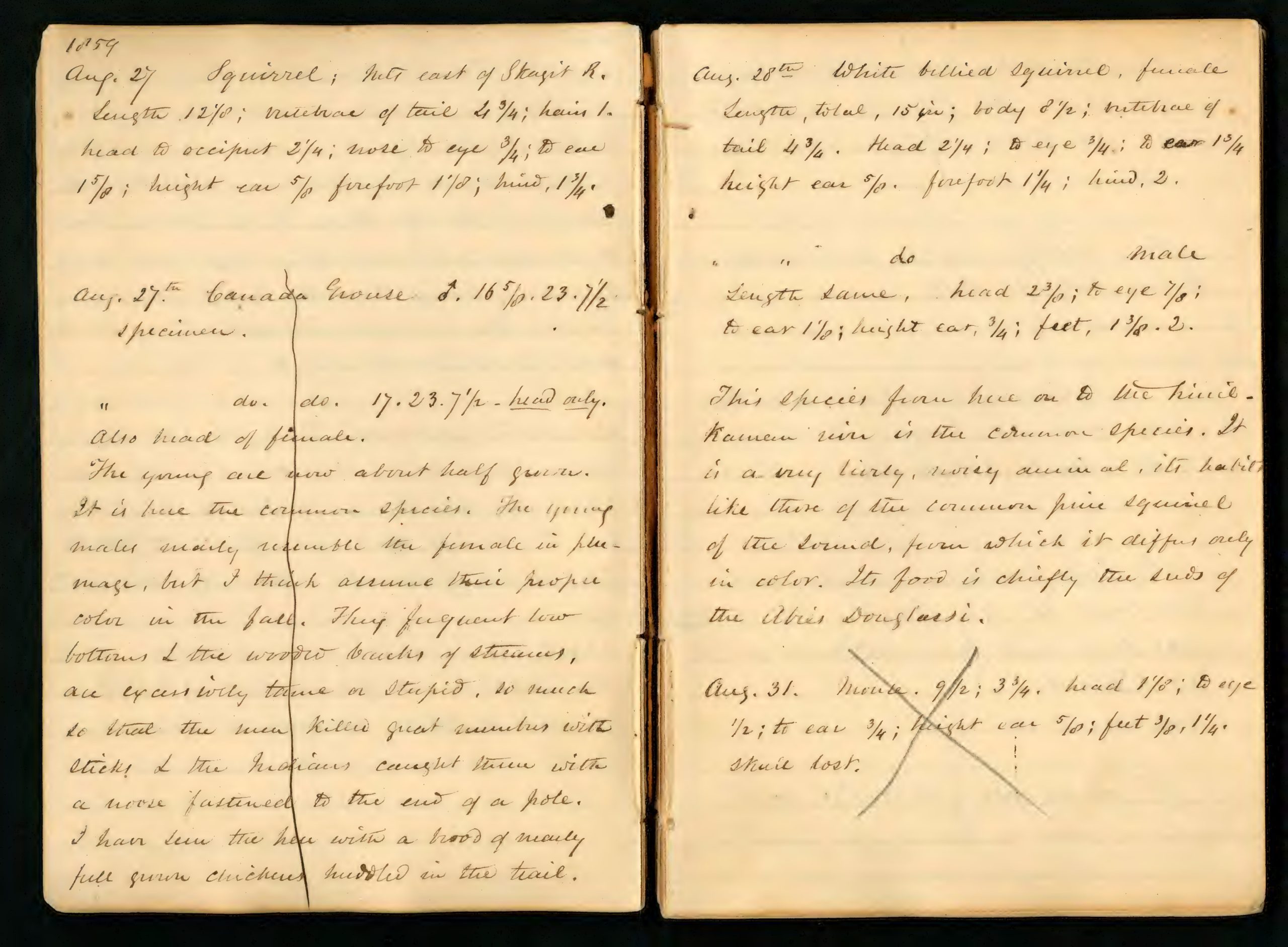
Aug. 27 Squirrel; Mts east of Skagit R.
Length 12/8; vertebrae of tail 4 3/4; hairs 1.
head to occiput 2 1/4; nose to eye 3/4; to ear
1 5/8; height ear 5/8 forefoot 1 1/8; hind, 1 3/4.
specimen.
Also head of female. The young are now about half grown. It is here the common species. The young males mainly resemble the female in plumage, but I think assume their proper color in the fall. They frequent low bottoms & the wooded banks of streams, are excessively tame or stupid. So much so that the men killed great numbers with sticks & the Indians caught them with a noose fastened to the end of a pole. I have seen the hen with a brood of nearly full grown chickens huddled in the trail.
[Right page:]
Length, total, 15 in; body 8 1/2; vertebrae of
tail 4 3/4. Head 2 1/4; to eye 3/4; to ear 1 3/4
height ear 5/8. forefoot 1 1/4; hind, 2.
Length same, head 2 3/8; to eye 7/8;
to ear 1 1/8; height ear, 3/4; feet, 1 3/8. 2.
This species from here on to the Similkameen river is the common species. It is a very lively, noisy animal, its habits like those of the common pine squirrel of the Sound, from which it differs only in color. Its food is chiefly the seeds of the Abies Douglassi.
1/2; to ear 3/4; height ear 5/8; feet 3/8, 1 1/4.
Skull lost.
Page 16
[Two-page spread. Left page:]
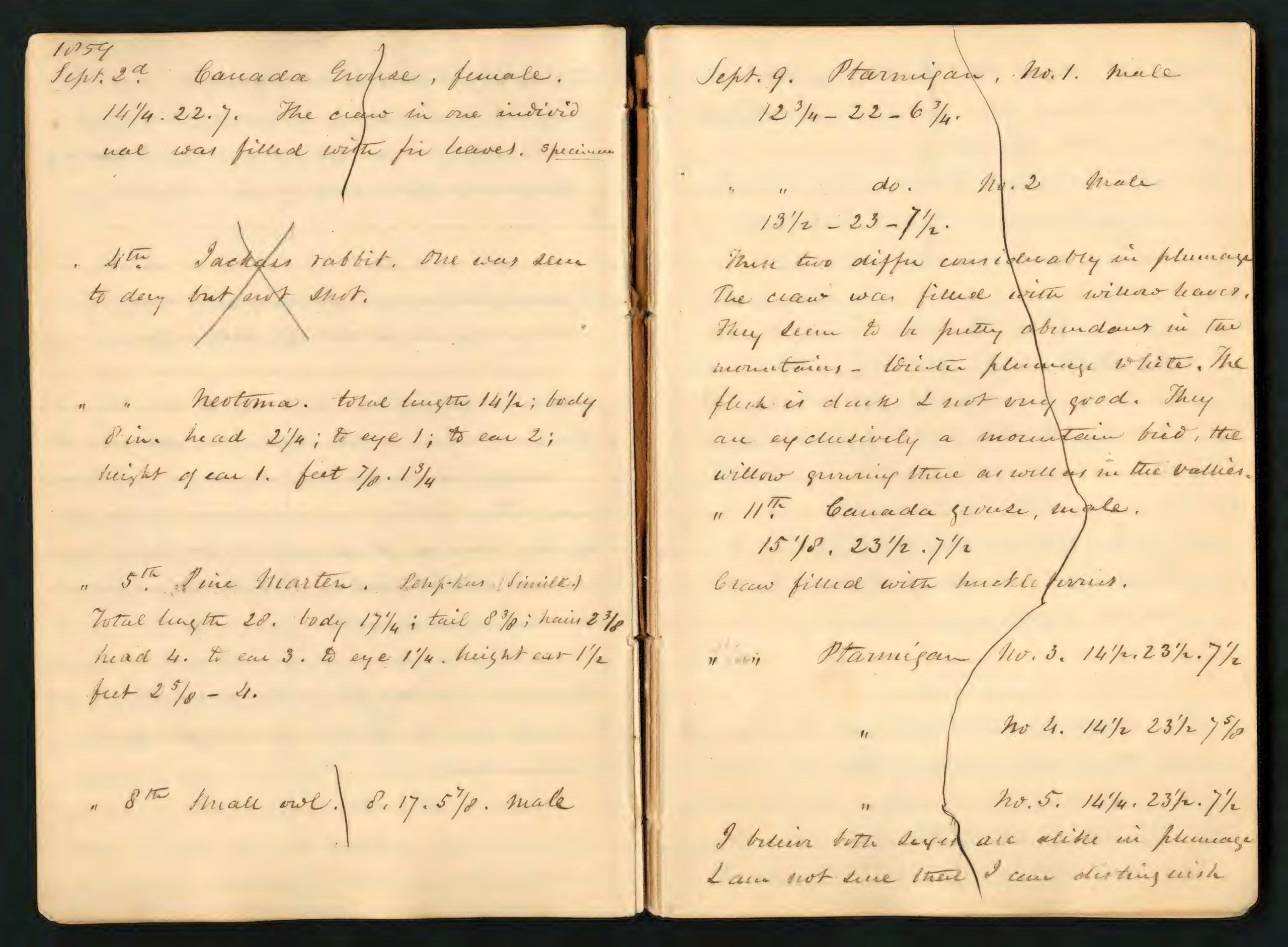
Sept. 2d Canada Grouse, female.
14 1/4. 22. 7. The craw in one individ
ual was filled with fir leaves. Specimen
to day but not shot.
8 in. head 2 1/4; to eye 1; to ear 2;
height of ear 1. feet 7/8. 1 3/4
Total length 28. body 17 1/4; tail 8 3/8; hairs 2 3/8
head 4. to ear 3. to eye 1 1/4. height ear 1 1/2
feet 2 5/8 – 4.
[Right page:]
12 3/4 – 22 – 6 3/4.
13 1/2 – 23 – 7 1/2.
These two differ considerably in plumage The craw was filled with willow leaves. They seem to be pretty abundant in the mountains – Winter plumage white. The flesh is dark & not very good. They are exclusively a mountain bird, the willow growing there as well as in the vallies.
15 1/8. 23 1/2. 7 1/2
Craw filled with huckleberries.
I believe both sexes are alike in plumage I am not sure that I can distinguish
Page 17
[Two-page spread. Left page:]
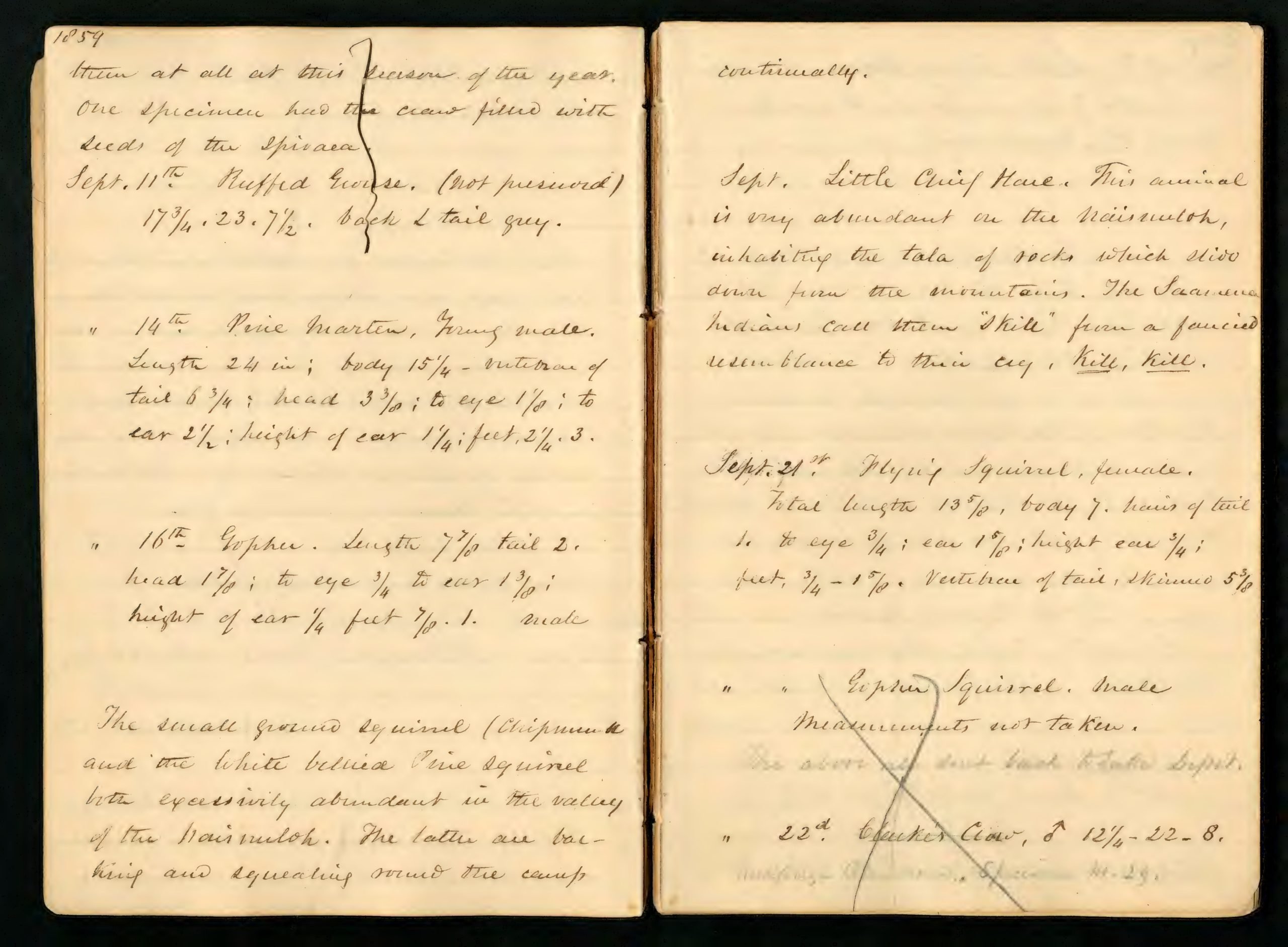
them at all at this season of the year. One specimen had the craw filled with seeds of the Spiraea.
17 3/4. 23. 7 1/2. back & tail grey.
Length 24 in; body 15 1/4 – vertebrae of
tail 8 3/4; head 3 3/8; to eye 1 1/8; to
ear 2 1/2; height of ear 1 1/4; feet, 2 1/4. 3.
head 1 7/8; to eye 3/4 to ear 1 3/8;
height of ear 1/4 feet 7/8. 1. male
The small ground squirrel (Chipmunk and the White bellied Pine squirrel both excessively abundant in the valley of the Naismuloh. The latter are barking and squealing round the camp
[Right page:]
continually.
is very abundant on the Naismuloh, inhabiting the tala of rocks which slide down from the mountains. The Saanema[?] Indians call them "Skill" from a fancied resemblance to their cry, Kill, Kill.
Total length 13 5/8, body 7. hairs of tail
1. to eye 3/4; ear 1 5/8; height ear 3/4;
feet, 3/4 – 1 5/8. Vertebrae of tail, skinned 5 3/8
Measurements not taken. [The above … sent back to Lake Depot.] [struck through]
[Nucifraga … , Specimen No. 24.]
Page 18
[Two-page spread. Left page:]
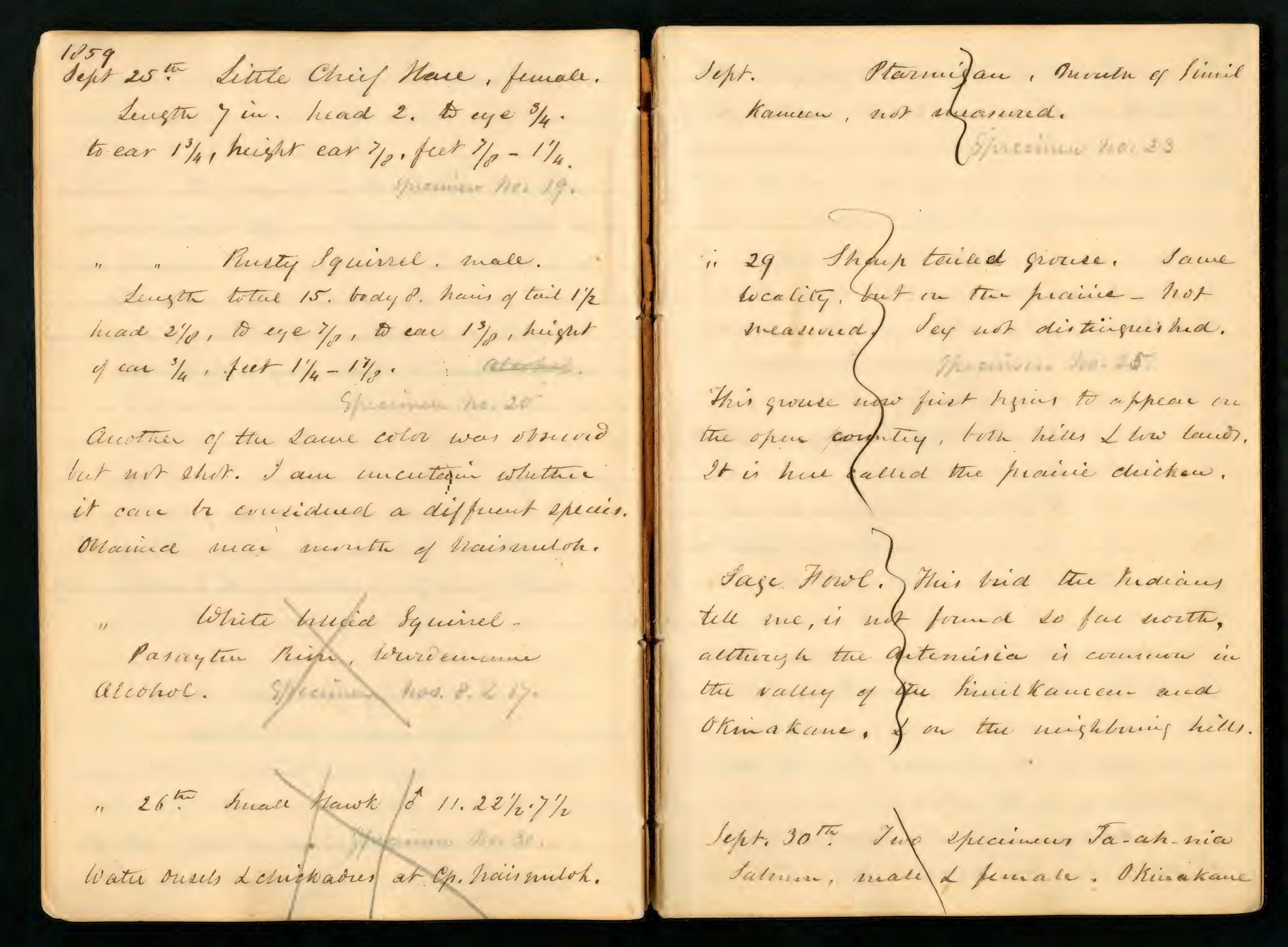
Sept 25th Little Chief Hare, female.
Length 7 in. head 2. to eye 3/4.
to ear 1 3/4, height ear 7/8, feet 7/8 – 1 1/4.
Specimen No. 19.
Length total 15. body 8. hairs of tail 1 1/2
head 2 1/8, to eye 7/8, to ear 1 3/8, height
of ear 3/4, feet 1 1/4 – 1 7/8. [Alcohol.]
Specimen No. 20 Another of the same color was observed but not shot. I am uncertain whether it can be considered a different species. Obtained near mouth of Naismuloh.
Pasayten River, Wurdemann Alcohol. Specimen Nos. 8. & 17.
[Specimen No. 30.] Water ousels & chickadees at Cp. Naismuloh.
[Right page:]
Kameen, not measured. Specimen No. 23
locality, but on the prairie – Not measured. Sex not distinguished. Specimen No. 25 This grouse now first begins to appear on the open country, both hills & low lands. It is here called the prairie chicken.
Sage Fowl. This bird the Indians tell me, is not found so far north, although the Artemisia is common in the valley of the Similkameen and Okinakane, & on the neighboring hills.
Salmon, male & female. Okinakane
Page 19
[Two-page spread. Left page:]
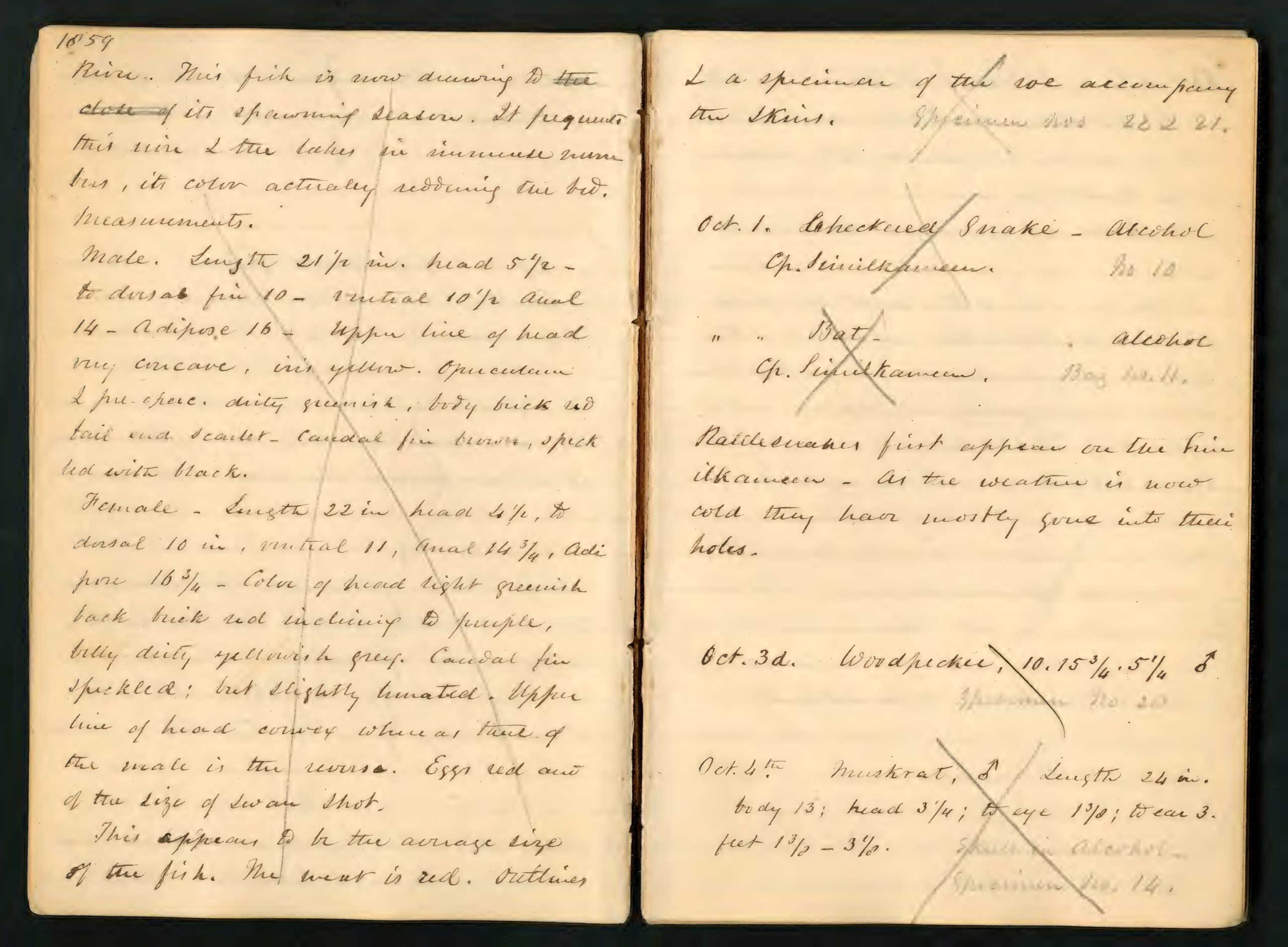
River. This fish is now drawing to the close of its spawning season. It frequents this river & the lakes in immense numbers, its color actually reddening the bed. Measurements.
to dorsal fin 10 – ventral 10 1/2 Anal
14 – Adipose 16 – Upper line of head very concave, iris yellow. Operculum & pre-operc. dirty greenish, body brick red tail and scarlet – Caudal fin brown, speckled with black.
dorsal 10 in, ventral 11, Anal 14 3/4, Adi-
pose 16 3/4 – Color of head light greenish
back brick red inclining to purple, belly dirty yellowish grey. Caudal fin speckled; but slightly lunated. Upper line of head convex whereas that of the male is the reverse. Eggs red and of the size of swan shot. This appears to be the average size of the fish. The meat is red. Outlines
[Right page:]
& a specimen of the roe accompany
Cp. Similkameen. No 10
Cp. Similkameen. Bag No. 11.
Rattlesnakes first appear on the Similkameen – As the weather is now cold they have mostly gone into their holes.
Specimen No 20
body 13; head 3 1/4; to eye 1 3/8; to ear 3.
feet 1 3/8 – 3 1/8. Skinned in Alcohol –
Specimen No. 14.
Page 20
[Two-page spread. Left page:]
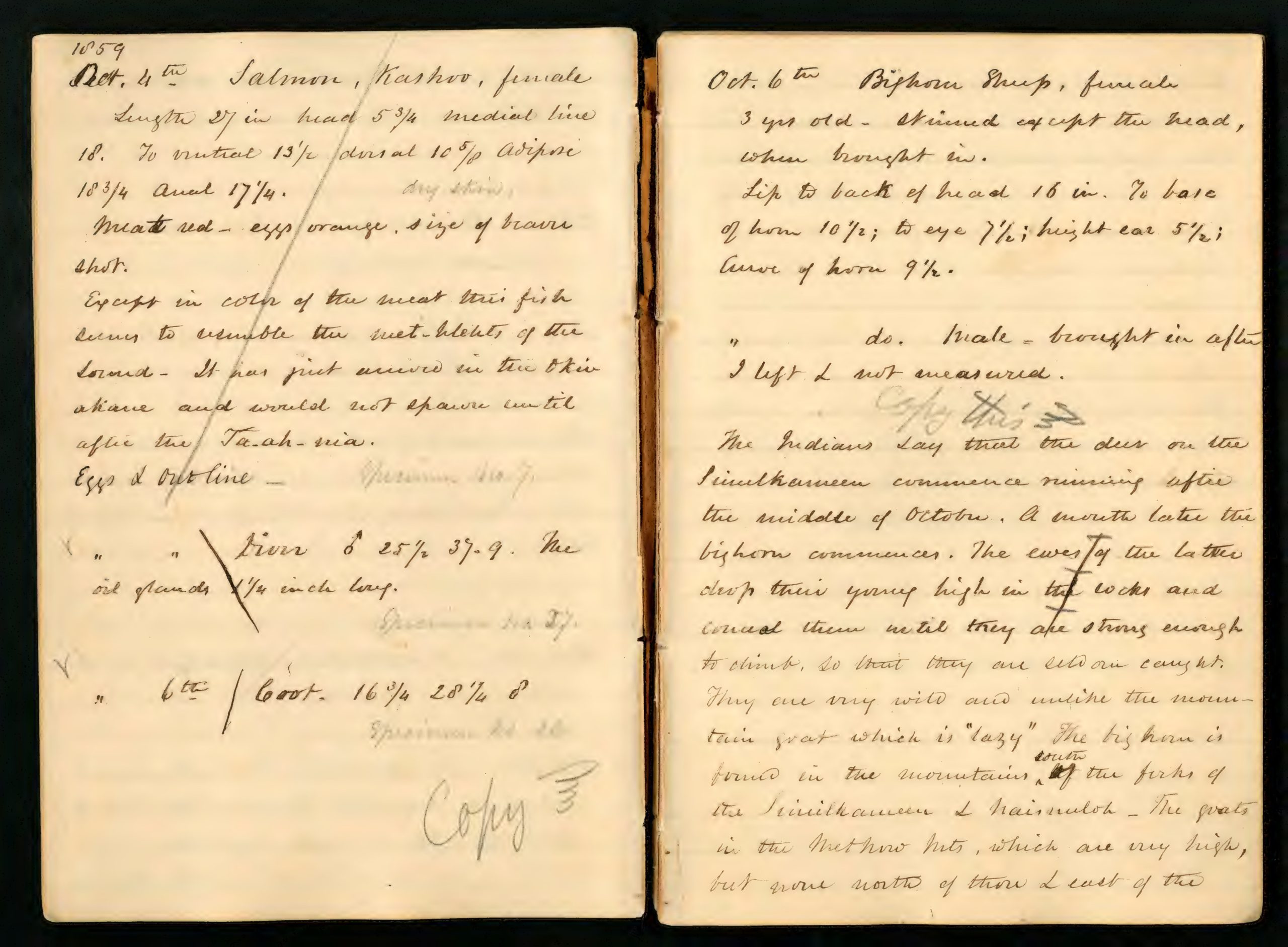
Oct. 4th Salmon, Kashoo, female
Length 27 in head 5 3/4 medial line
18. To ventral 13 1/2 dorsal 10 5/8 Adipose
18 3/4 Anal 17 1/4. dry skins.
Meat red – eggs orange. size of beaver shot. Except in color of the meat this fish seems to resemble the met-hleltz[?] of the Sound – It has just arrived in the Okinakane and would not spawn until after the Ta-ah-nia. Eggs & Outline – Specimen No 7
oil glands 1 1/4 inch long.
Specimen No 17.
Specimen No 26
Copy
[Right page:]
3 yrs old – Skinned except the head, when brought in. Lip to back of head 16 in. To base
Curve of horn 9 1/2.
I left & not measured. Copy this The Indians say that the deer on the Similkameen commence running after the middle of October. A month later the bighorn commences. The ewes of the latter drop their young high in the rocks and conceal them until they are strong enough to climb, so that they are seldom caught. They are very wild and unlike the mountain goat which is "lazy" The bighorn is found in the mountains south of the forks of the Similkameen & Naismuloh – The goats in the Methow Mts, which are very high, but more north of these & east of the
Views: 5