The Gibbs Family Papers
The Gibbs Papers · Exhibit
The Gibbs Family Papers
The oldest documents in the archive — a founding-era statesman’s letters about the infant grandson who would grow up to command the First New York Dragoons.
Before the General
A Family in Letters
Long before Alfred Gibbs wore a uniform, he was a plump, sedate baby at his grandfather’s house in Litchfield, Connecticut. The handful of family papers preserved in the archive are its oldest treasures — older than his commission, older than the Republic of Texas, nearly as old as the man himself. They open in 1824, the year of his birth, in the hand of a man who had helped build the country Alfred would one day fight to preserve.
Laura Wolcott Gibbs — the general’s mother — was the daughter of Oliver Wolcott Jr.: George Washington’s second Secretary of the Treasury, and in 1824 the sitting Governor of Connecticut. She had married Colonel George Gibbs III and raised her children at Sunswick, the family estate at Astoria on Long Island. The two letters below travelled from her father’s home in Litchfield to Sunswick in the autumn and winter of 1824 — and they talk, above all, about her children.
Featured Documents
The Wolcott Letters, 1824
In September 1824 the writer apologizes for a week’s absence: he had been “to visit Genl. La Fayette at Hartford, at the request of that City,” and to attend commencement at New Haven “as one of the Corporation.” Only one member of the family fits that sentence. Governor Oliver Wolcott Jr. formally received Lafayette on the Marquis’s triumphal 1824 tour, and Connecticut’s governor sat ex officio on the Yale Corporation. The little boys underfoot in Litchfield were Laura’s sons — Wolcott, the grandfather’s namesake, and baby Alfred, born that April.
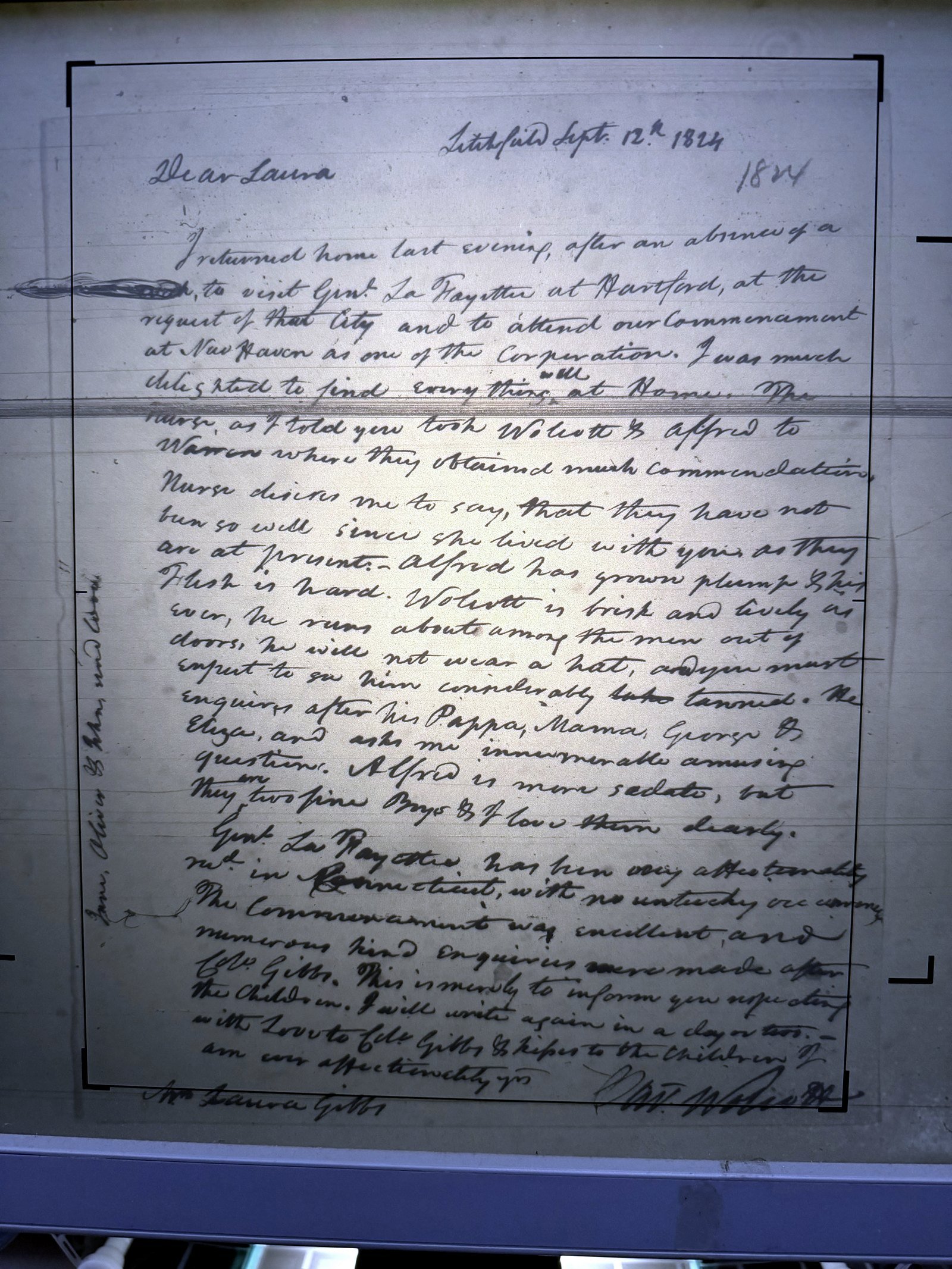
“I returned home last evening, after an absence of a week, to visit Genl. La Fayette at Hartford, at the request of that City, and to attend our commencement at New Haven as one of the Corporation… Alfred has grown plump & hearty; Wolcott is brisk and lively as ever… Eliza asks me innumerable amusing questions. Alfred is more sedate, but they are fine Boys & I love them dearly.” Litchfield, September 12, 1824 · Document #1647
“Genl La Fayette has been very affectionately met in Connecticut… This is merely to inform you respecting the children. I will write again in a day or two.” Same letter, closing lines
On Christmas Day he wrote again — thanking Laura for her letters, fretting over a grandson away at school (“I shall send Papa’s Homer, as a Christmas Gift”), reporting on woolen-mill investments and scarce money, and then, in the letter’s most remarkable line, sizing up the youngest grandchildren like a man who knew how to judge a prospect.
“Your letters delight me, as they present images to my mind of your dear children, who are objects of my dear affection. They are unlike each other, but I do not know which I like best.” Litchfield, December 25, 1824 · Document #1647 (page 1)
“…such a laughing Philosopher, as his namesake with you. I will bet upon Alfred, that he makes his way in the world — and the same his pretty sister Eliza, who is a charming little ‘Lady.’” Same letter, page 2 · Document #1647
“Take good care of yourself & your children, and keep up good spirits. We shall be provided for with competence, which is better than great riches… yrs affly” Same letter, closing · Document #1647
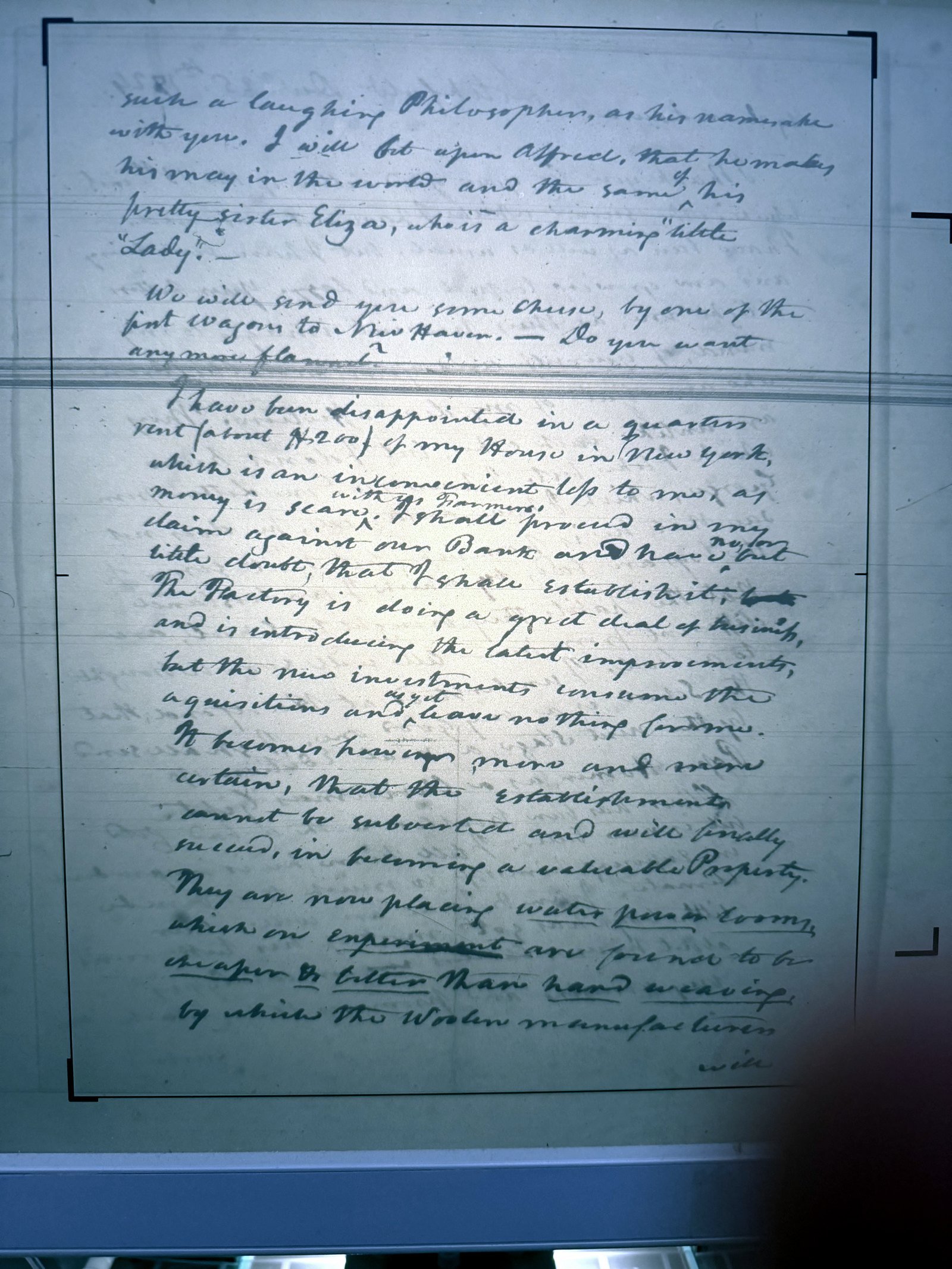
Transcription of the original manuscript. View & zoom the scan in the archive →
Transcription of the original manuscript. View & zoom the scan in the archive →
A note on the attribution
The signature on the final page is damaged by a fold and the scan’s light band, and the archive’s OCR could not name the writer. We attribute both letters to Oliver Wolcott Jr. (1760–1833) on the convergence of the evidence:
- Both letters are written from Litchfield, the Wolcott family seat, to “My dear Laura” about “your dear children.”
- The writer received Gen. Lafayette at Hartford and attended Yale commencement “as one of the Corporation” — the office of the Governor of Connecticut, which Wolcott held in 1824.
- He calls one grandchild “his namesake with you” — Oliver Wolcott Gibbs, Laura’s son, named for him.
- The visible strokes of the signature are consistent with “Oliv Wolcott.”
If the attribution holds, these pages connect the First New York Dragoons’ commander, by a single sheet of paper, to Washington’s cabinet.
The Cover That Names the Estate
Directed to Sunswick
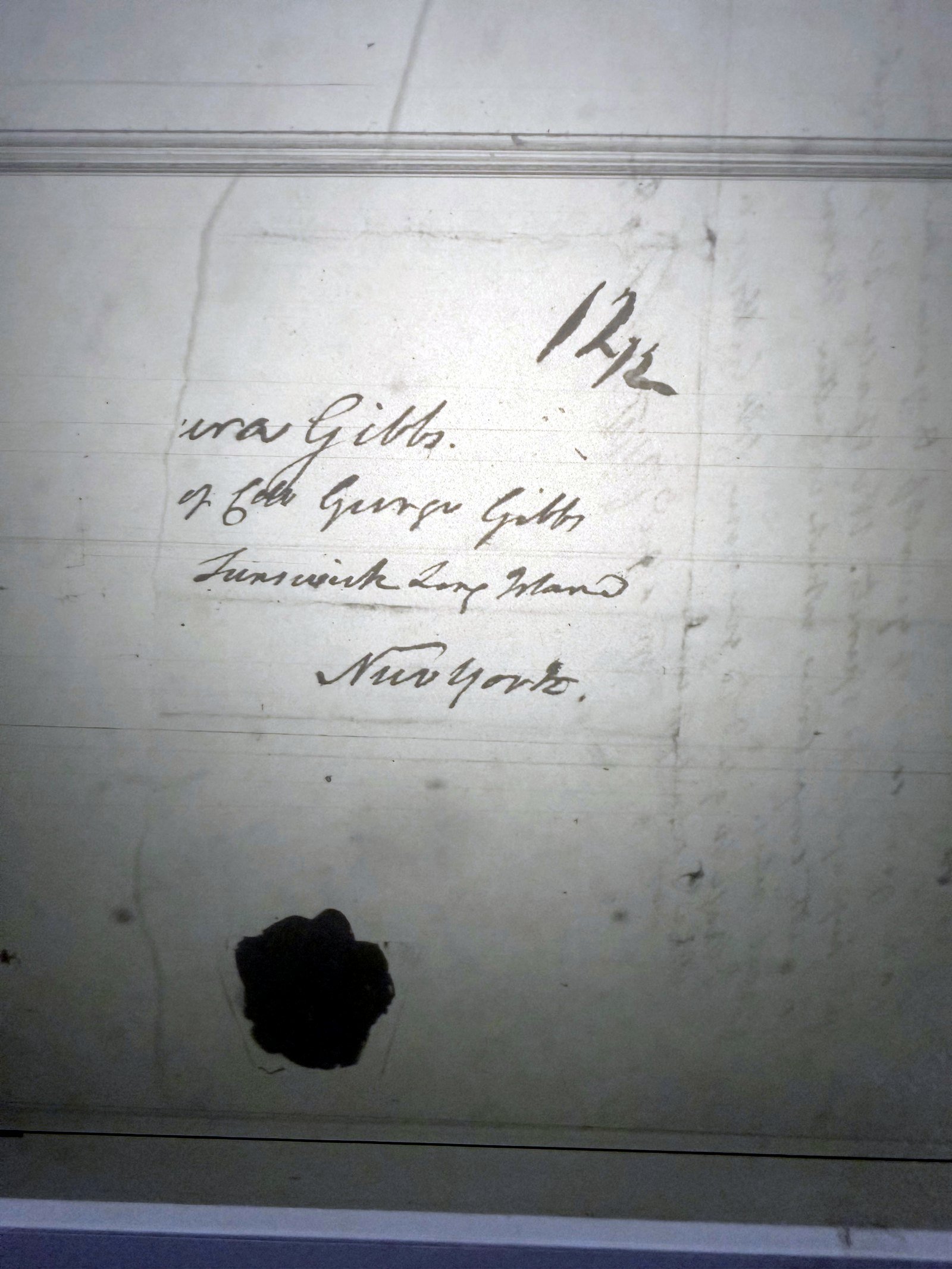
Transcription of the original manuscript. View & zoom the scan in the archive →
Folded letters needed no envelope: the outer leaf carried the address, the wax seal, and the postage reckoning. This one is directed to “Mrs. Laura Gibbs, care of Colo George Gibbs, Sunswick, Long Island, New York” — the family estate at Astoria whose story is told on our Sunswick page.
The “12½” in the corner is the postal rate in cents: under the postal law then in force, 12½¢ carried a single-sheet letter 80 to 150 miles — almost exactly the road from Litchfield to Long Island. The general’s archive preserves not just the words, but the journey.
The Boy, Grown
Dartmouth, 1841 — The Road Not Taken
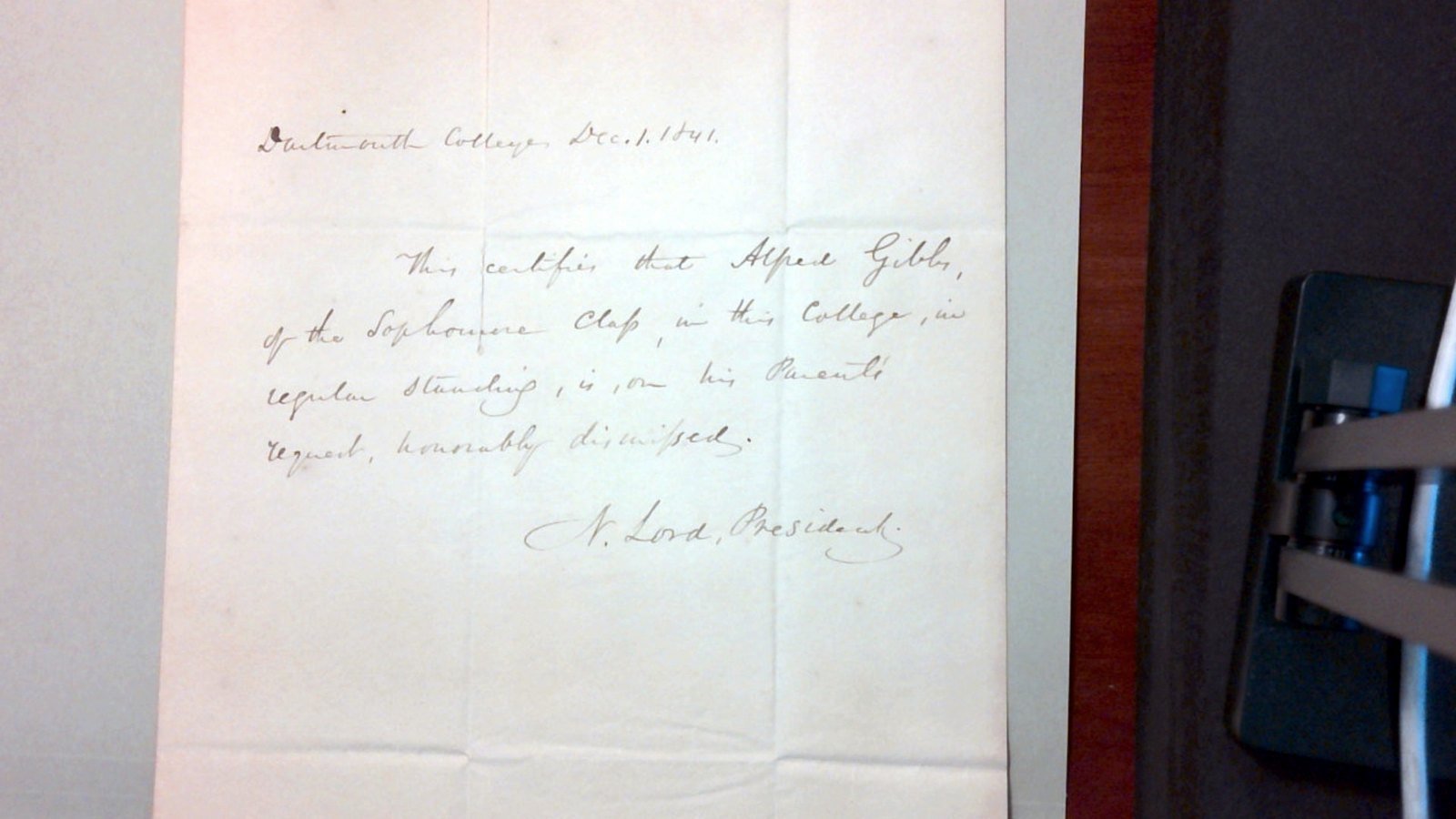
Seventeen years later, the baby his grandfather bet on was a Dartmouth sophomore — briefly. On December 1, 1841, President Nathan Lord signed this certificate discharging him “on his Parents’ request, honorably.” The family had other plans: within a year Alfred was studying at White Plains, and in 1842 he entered West Point. Had this small paper never been signed, there might have been no Mexican War brevets, no Fort Fillmore, no First New York Dragoons.
“Dartmouth College, Dec. 1, 1841. This certifies that Alfred Gibbs, of the Sophomore Class, in this College, in regular standing, is, on his Parents’ request, honorably dismissed. — N. Lord, President.” Complete text · Document #1645
The Wider Family
A Brother in Canton, a Sister’s Household
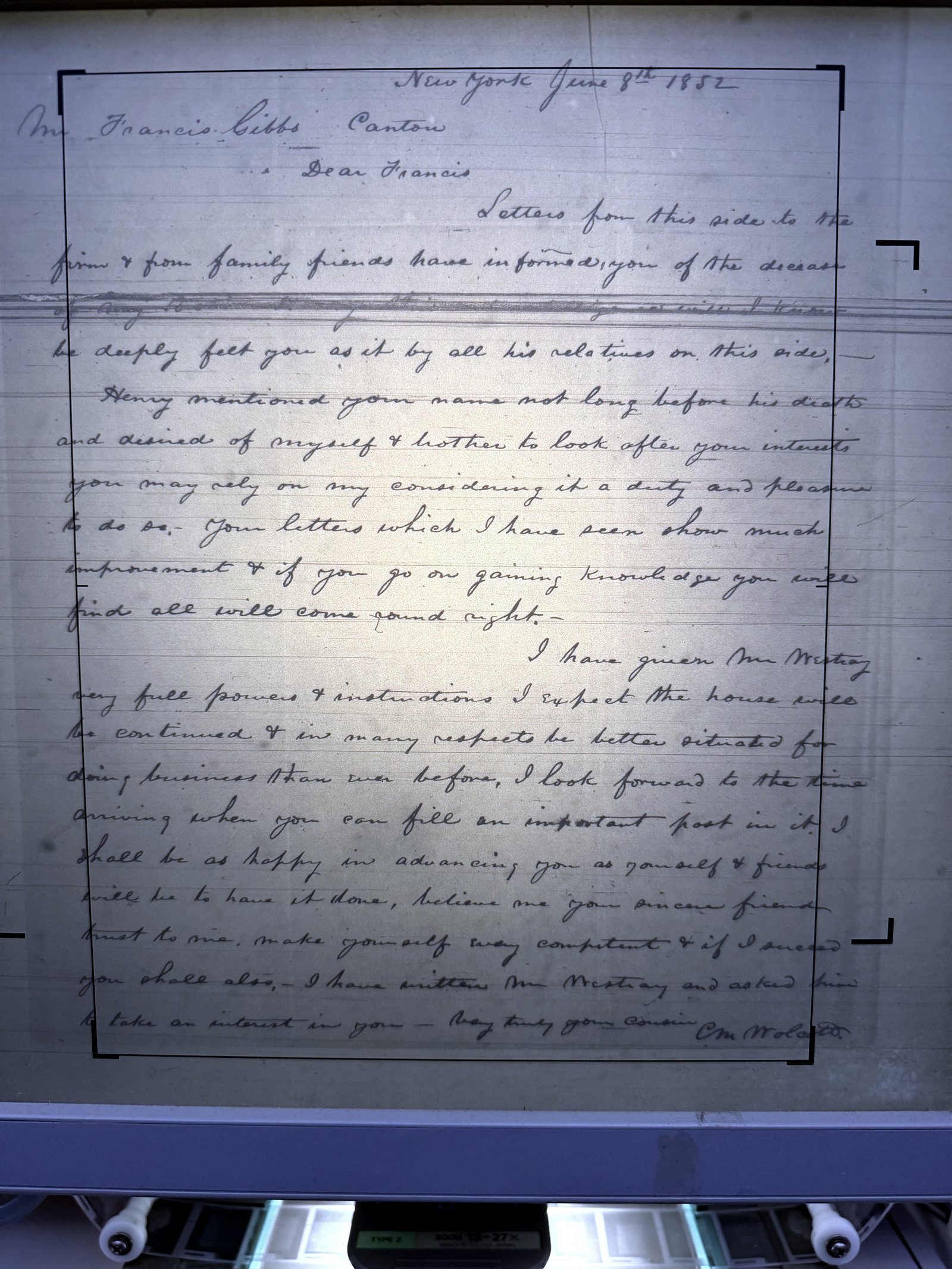
Transcription of the original manuscript. View & zoom the scan in the archive →
The family papers reach around the globe. In June 1852 a New York merchant wrote to Francis Gibbs — the general’s brother, then at Canton, China in the trading house — consoling him on a death in the circle and promising patronage: “make yourself very competent & if I succeed you shall also.” While one brother chased the China trade and another, Wolcott, became one of America’s great chemists, Alfred was a lieutenant of Mounted Riflemen on the New Mexico frontier.
Two smaller papers round out the collection: a bibliographic note pointing to a congressional document (33rd Congress — likely the world of brother George Gibbs, the ethnologist), and an 1858 letter in Alfred’s own hand from 281 Greene Street, New York, settling New Mexico accounts and mentioning “Mr. Tuckerman” — the husband of his sister Elizabeth.
Docs #1647 · #1642–#1645
The Wolcott Letters
Two autograph letters, Litchfield, 1824, attributed to Oliver Wolcott Jr. — Lafayette, Yale, and the grandchildren, with the Sunswick address leaf.
Doc #891
Dartmouth Certificate, 1841
Sophomore Alfred Gibbs honorably dismissed “on his Parents’ request” — the paper that cleared the road to West Point.
Docs #1646 · #1641
The Wider Family
The Canton letter to brother Francis (1852), a congressional-document note, and Alfred’s 1858 Greene Street letter naming Mr. Tuckerman.
Explore the Archive
These nine documents are the threshold of a collection of 866 — commissary papers signed by Longstreet, a note in Sheridan’s hand, the orders and invoices of a life in the saddle.
The Gibbs Papers Enter the Reading RoomViews: 25