The Garrison of Fort Fillmore: A Roster from the Gibbs Papers
The Garrison of Fort Fillmore: A Roster from the Gibbs Papers
Fort Fillmore is remembered for the day it was surrendered. But the post lived for eleven years, garrisoned by men whose names have mostly slipped out of the record. This page begins to put some of them back. It is a working roster of the people named at Fort Fillmore, New Mexico, reconstructed from a body of original documents that survive in private hands: the commissary and subsistence papers of Bvt. Captain Alfred Gibbs, who served there in 1856 and 1857 as the post’s Acting Assistant Commissary of Subsistence. Roughly seventy of these papers mention the fort, and they have been scanned and read one by one.
Because they are an officer’s administrative records, they name the officer corps and post staff in full and the rank and file only in glimpses, on a single pay roll and in a handful of sworn statements. What follows is therefore a partial roster, not a complete muster. Every name here is offered to the public record; where the 1850s handwriting leaves a reading in doubt, it is marked so. This is the garrison of the Gibbs years, 1856 to 1857, the same Mounted Rifles and infantry companies that would be caught up in the 1861 catastrophe told elsewhere in this series.
Officers and post staff, 1856–1857
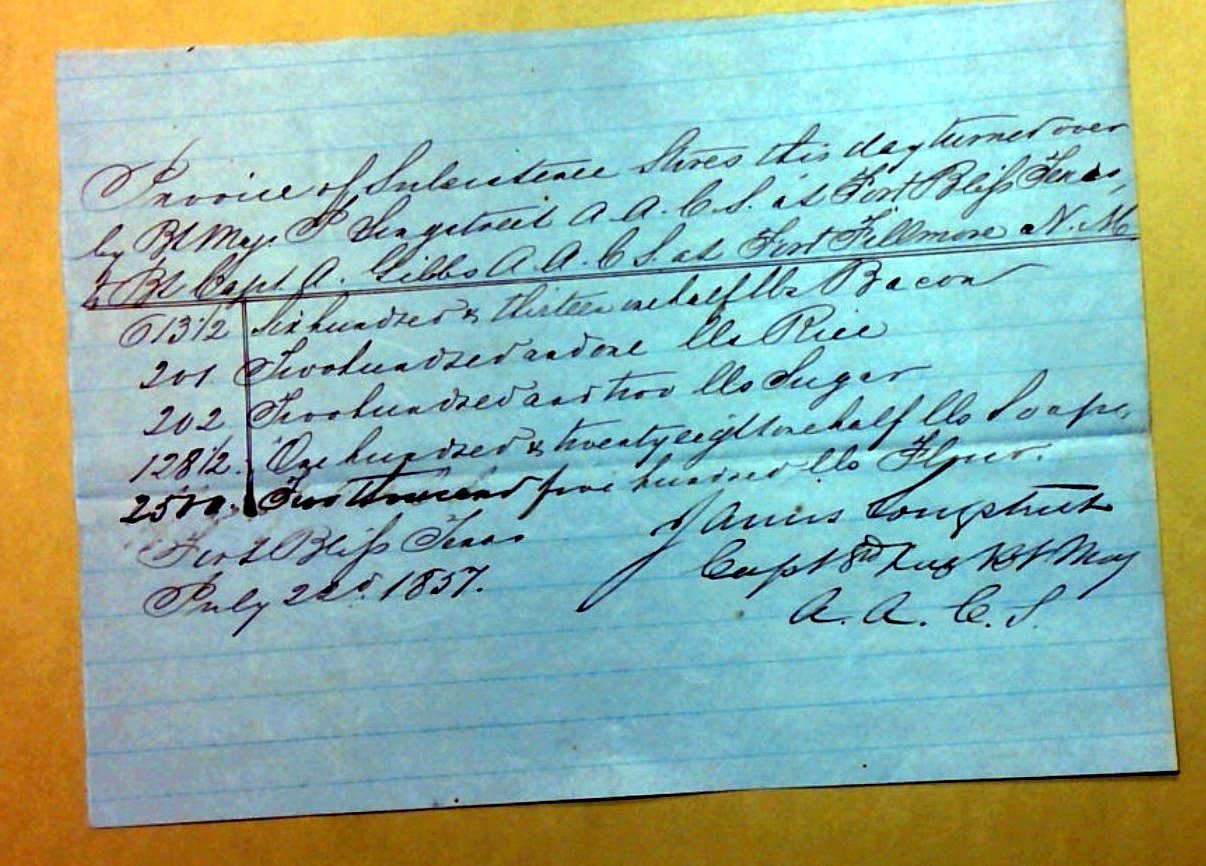
- Bvt. Capt. Alfred Gibbs, 1st Lieutenant, Regiment of Mounted Rifles; Acting Assistant Commissary of Subsistence and post property officer. The keeper of these papers and the figure at the center of this archive.
- Capt. (Bvt. Maj.) James Longstreet, Acting Assistant Commissary of Subsistence at neighboring Fort Bliss, Texas, who forwarded provisions to Fort Fillmore. Later a Confederate lieutenant general.
- Maj. Gouverneur Morris, 3rd U.S. Infantry; commanding the post in 1857 (orders issued “by order of Major Morris”).
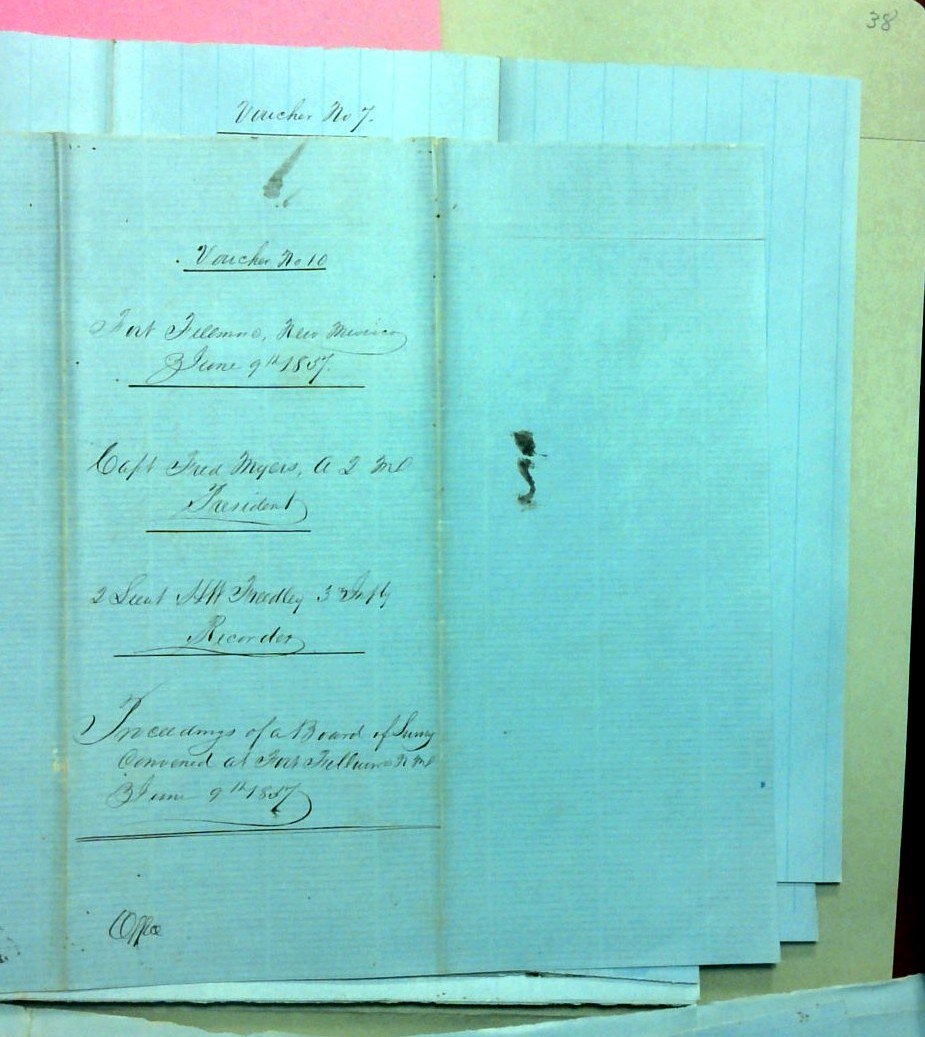
- Capt. Fred Myers, Assistant Quartermaster; President of the post Board of Survey.
- Lt. William D. Whipple, 3rd Infantry; Acting Assistant Adjutant General and Post Adjutant.
- 2nd Lt. S. M. Bradley, 3rd Infantry; Recorder of the Board of Survey.
- Maj. John B. Grayson, Commissary of Subsistence at the department level, a correspondent on Fort Fillmore supply.
- 1st Lt. Schroeder, named in post correspondence.
- Lawrence Murphy, J. B. Baker, A. B. Thompson, and J. H. M. Thompson, correspondents and associates writing to or from the post in 1857.
Enlisted men and soldiers
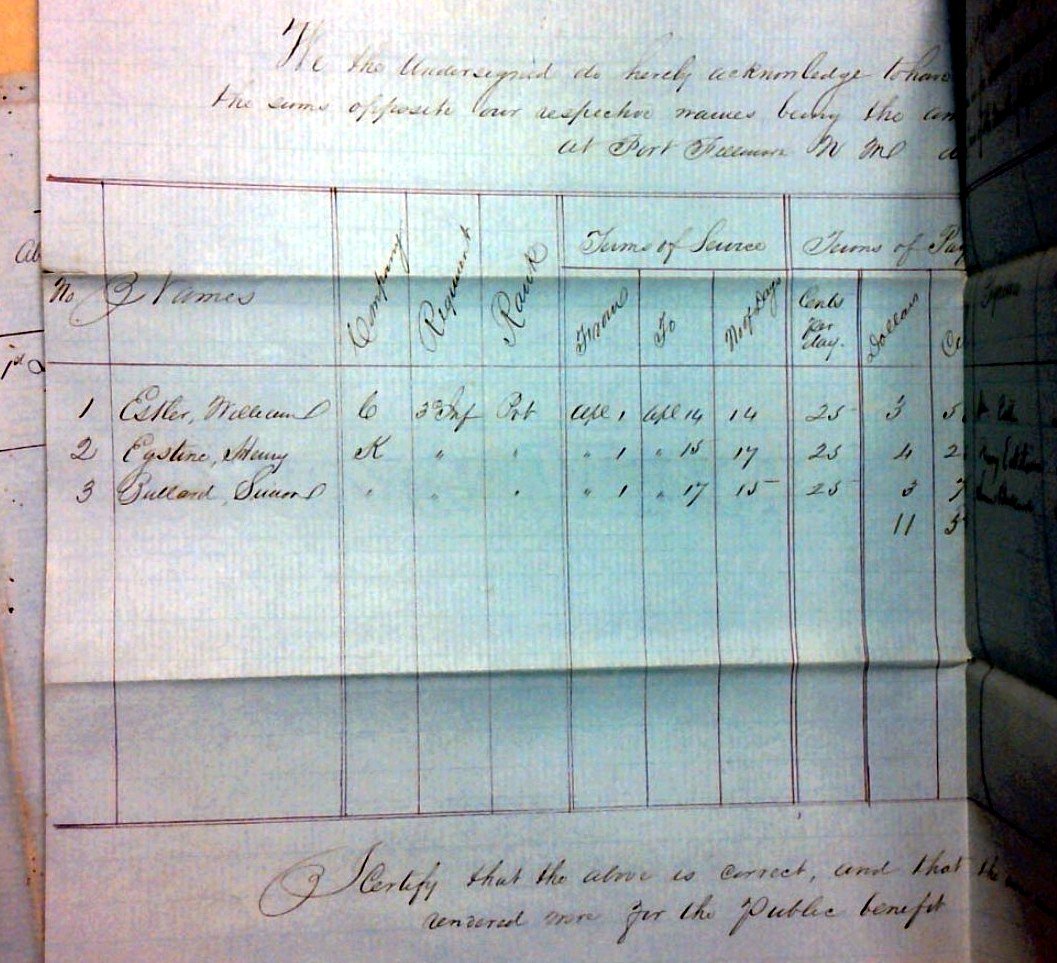
These names come from the one surviving pay roll and from sworn statements made before the post notary. The handwriting is faded and several readings are uncertain; they are given here so they can be searched for and corrected, and they should be checked against the National Archives muster rolls before being relied on.
- James Percy, Company G, Regiment of Mounted Rifles. Gave a sworn deposition at the post in April 1857.
- Gottlob Roff, Company C, 1st U.S. Infantry. Named in three separate depositions; the best attested enlisted man in the set.
- John Stretton (reading uncertain), a soldier deponent, 1857.
- Private William Estler (surname uncertain), Company C, 3rd Infantry; on the April 1857 extra-duty pay roll.
- Private Henry Eystine (surname uncertain), Company K, 3rd Infantry; same pay roll.
- Private Stuart Bullard (name uncertain), Company K, 3rd Infantry; same pay roll.
Beyond the Gibbs papers: a drummer in the enlistment registers
The Gibbs papers are not the only record of who stood at this post. The National Archives enlistment registers (Microcopy M233) add at least one more soldier to Company K of the 3rd Infantry, the same company that appears on the 1857 pay roll above, and he is the most affecting name in the whole set: a nine-year-old drummer.
- Drummer James Williamson, Company K, 3rd U.S. Infantry. Born in Cincinnati, Ohio, about 1845; enlisted at Fort Fillmore on December 9, 1854, at the age of nine, four feet tall, with grey eyes and red hair, on the particular request of Bvt. Brig. Gen. John Garland. He was the third generation of his family to serve in the 3rd Infantry. He completed his five-year term and re-enlisted in the company in 1859. Source: National Archives M233, Registers of Enlistments in the U.S. Army, microfilm 350330, page 234. This name comes from the enlistment register rather than the Gibbs pay roll, but Williamson was a soldier of the same Company K and was in the garrison through the Gibbs years. His story is told in A Good Drummer: The Boy of Fort Fillmore.
Post functionaries and civilians
- The post Notary Public, who administered the soldiers’ depositions at Fort Fillmore in 1857. The signature reads as G. W. Sequard, or possibly W. M. Senty; the reading is not certain.
- Amy Pitts and May (or Aug.) Pitts, witnesses on the 1857 pay roll, likely post civilians or laundresses.
Units at the post in these papers
- Regiment of Mounted Rifles, Company G (Gibbs’s company).
- 3rd U.S. Infantry, Companies C and K.
- 1st U.S. Infantry, Company C.
How this roster was made, and how to add to it
The documents behind this page were photographed and run through machine transcription, then the name-bearing pages, the pay roll, the depositions, and the Board of Survey records, were read individually against the original scans. The full set can be browsed in the Fort Fillmore section of the Gibbs document archive. The roster is not closed. More names wait in commissary abstracts that list the officers messing at the post, in the broader body of Gibbs’s New Mexico papers, and above all in the National Archives muster rolls for these companies. If one of these names belongs to your family, or if you can correct a reading, we would be glad to hear from you.
Related on this site
- Enlisted Men of Fort Fillmore: A Working Database, the rank and file documented at the post.
- Hands of the Garrison: Fort Fillmore Officers’ Signatures, the actual autographs of the men named here.
- The Lost Diary of Private Sylvester W. Matson, an enlisted man’s account of the same post.
- All About Fort Fillmore, New Mexico.
- Captain Alfred Gibbs and the San Augustine Springs Surrender.
Views: 47