Following the Guidon, Chapter XX: A Flood on Big Creek
From Following the Guidon, by Elizabeth B. Custer (1890). Chapter XX. Back to Contents.
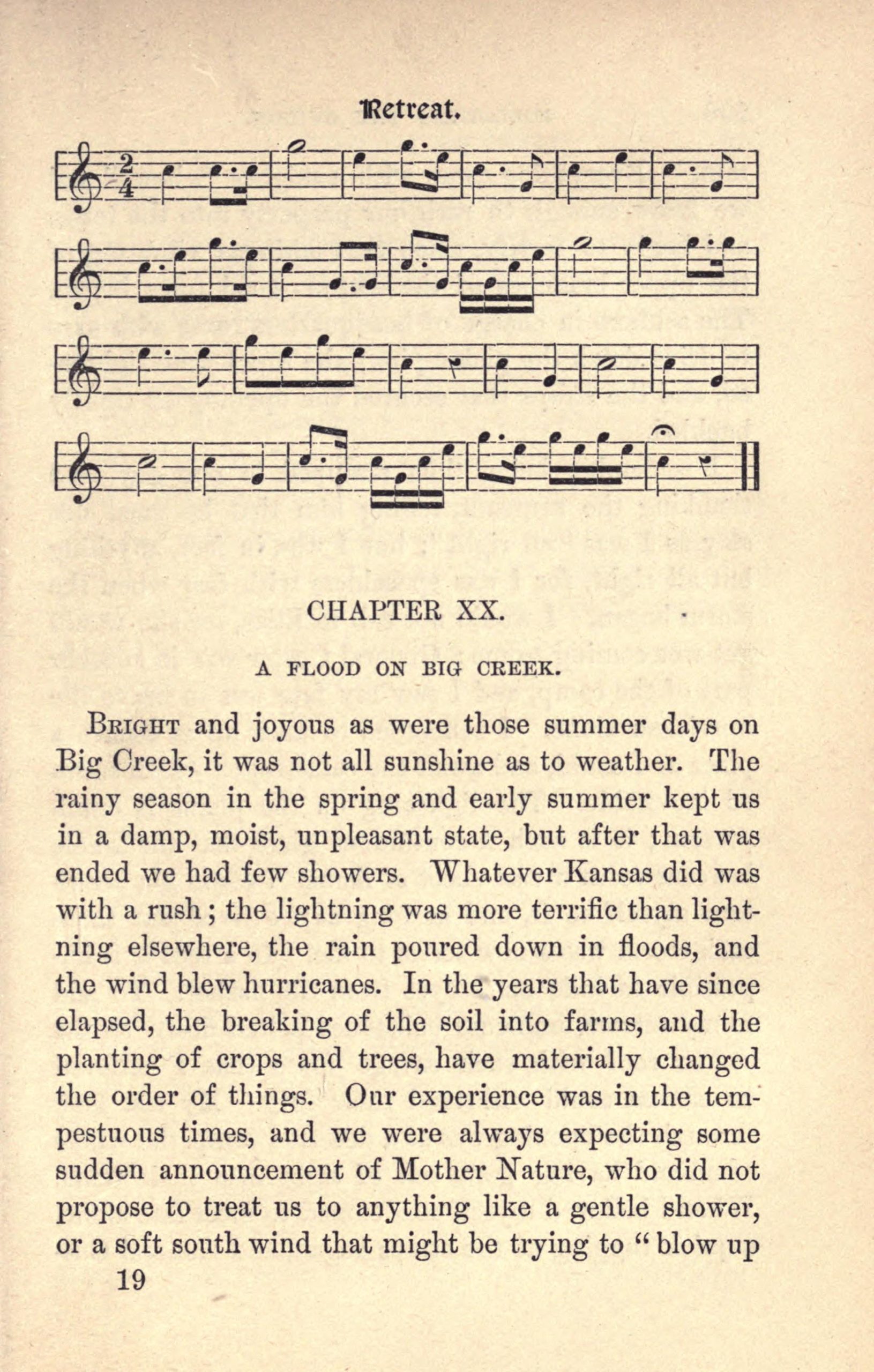
Bright and joyous as were tliose summer days on Big Creek, it was not all sunshine as to weather. The rainy season in the spring and early summer kept us in a damp, moist, unpleasant state, but after that was ended we had few showers. Whatever Kansas did was with a rush; the lightning was more terrific than lightning elsewhere, the rain poured down in floods, and the wind blew hurricanes. In the years that have since elapsed, the breaking of the soil into farms, and the planting of crops and trees, have materially changed the order of things. Our experience was in the tempestuous times, and we were always expecting some sudden announcement of Mother Kature, who did not propose to treat us to anything like a gentle shower, or a soft south wind that might be trying to ” blow up
rain.” Everything came with a mighty “whew!” and we knew enough to rush our j)roperty into the tents, and begin to fortify, when that ominous vibrating of the upper branches of the cotton -wood trees began. The soldiers in charge of headquarters came witli axes to drive down the picket-pins; the ropes were tightened, and the straps that secured tlie opening all tightly buckled.
I remember being thus strapped in one day, and thanking the sergeant, telHng him that he need not stay as I was “all right”; but I was, in fact, anything but all right, for I was speechless with fear wlien the storm began. I would not call to Eliza, for she would get wet coming to me; General Custer w^as in another part of the camp, and I saw my fate was to brave the hurricane alone. I concluded to take up as secure a place as I could, and await the catastro^^he wdiich seemed inevitable. The lightning on the plains is omnipresent; it is such a continuous glare that the whole heavens seem a vast sheet of flame. I could not accustom myself to it, and as long as we lived out there each storm was a new terror to me. In a tent it is impossible to hide one’s eyes from the flashes. To add to my terrors, immense hailstones pelted down on the cotton roof with such savage force that I believed no canvas could withstand their fury. My last look through the opening was at a deserted camp, the whole command, having gone out of sight into their tents. When I believed myself condemned to meet fate alone, a quick tugging at the straps began, and General Cus-
ter leaped into the aperture, drenched with the storm. I came out from under the bed, where I had laken up what I tliought a safe position, and began, woman-like, to question why he had ventured into such danger. He had remembered my terror of lightning, and had made a rush over the unprotected parade-ground, with the hailstones pounding down on him like a shower of lead. Such hail no one out there had ever seen before. The Smithies measured many of the hailstones that day, and the average was from an inch to an inch and a half through. Captain Smith made a dash for home from the grazing-ground, his horse running at a fearful pace, with a little dog yelping with pain from the pelting he got following at his heels. Lumps which were tender to the touch for days afterwards were raised on the captain’s head.
The pitiful part of it was the unprotected condition of the horses; they had to endure all the violence of the elements, with no shelter. It was strange how wonderfully sleek, fat, and well they kept if there w^ere no hard marches to wear them down. The prolonged storms of the rainy season did not appear to reduce them. They seemed to think their home, the picket rope, gave them every luxury. We were often amused to see the whole number out grazing voluntarily start home when a few drops of rain fell. They either ran up to the picket rope, or made those teetering and awkward leaps that a hobbled animal makes; and when the rope was reached they seemed to feel themselves as secure as if within the driest of stables.
There was one especial storm that I have cause to remember, for it came near being as serious as the one described in Tenting on the Plains the summer before, when lives were lost. One lovely day, with an azure sky and soft velvety wind that seemed to blow from the Arcady of the poets, I sat under the fly of our tent, reading, or living that dolce far niente existence which camp-life induces, when tlie air suddenly chilled, and I felt sure the change was some sort of a weather precursor. It was one of the vagaries of the Kansas climate that delighted in sudden alternations from summer to winter. After I had put on a wrap I sat down to await the next change. It was not long before the sky dulled, and an ominous roar came rumbling over the plains — ” a voice of the noise of rain.” Then I ran off to find Henry, and tell him that I feared a freshet. He confirmed my fears by telhng me the water had “been on the rise right smart of time already.” I left him^ to go to the headquarters sergeant, and ask him quietly to prepare for what I believed would be a terrible storm, and come to me if it began to rain. He was so accustomed to these frightened confidences of mine when terror overtook me that he was willing to come even if he himself thought it was only a ” woman’s notion.” If in the military recommendation that General Custer wrote out for him I had been permitted to add a line, it would not have been official; it would only have been my testimony to his capability of making a good husband, he was such a patient man with a woman’s fears.
When I came back to the fly General Custer looked up from his absorption in his book, and asked me where I had been. I temporized, for I did not like to admit that I was already scared before a drop of rain had fallen. He persisted, and finding out my agitation, assured me that I was foolish, that we were a good distance from the creek, that I need not be disturbed yet. I argued that our camp being on such a loop of land, the stream might cut a channel across the narrow part, and leave us on an island exactly as the little knot of men were cut off the summer before. Time enough to prepare for that, he replied; and not realizing the genuineness of my trepidation, he strolled off across the parade-ground to practise shots on the billiard -table that the sutler had put in the hall the soldiers built for their amusement. With the remembrance of what Big Creek could do in the way of a rise — for measurements the summer before proved that it went up an inch a minute — I prepared for what might come, and threw our few camp garments into the trunk, heaped the chairs, etc., on the table, tied down the windowflap at the rear, and sat down to watch the clouds. It seemed but a few moments before the sky darkened, and the shriek and whistle of the keen wind came over the prairie, and twisted the leaves and branches of our few protecting trees, cracking the dry twigs and breaking the exposed branches. Meanwhile the stream was beginning to tear along, carrying with it underbrush, logs, and saplings attached to great clumps of earth still held together by the net-work of roots. The sergeant
and his men were soon all activity, and Henry ran hither and tliither, intent on the horses’ safety.
With the roar of the storm coming over the trackless waste beyond ns at sixty miles an hour came big drops of rain and great clouds of dust. How I wished that we had a ” dugout ” in the side of tlie bank! Finally a wall of rain advanced towards us, cutting as clear a swath as it came as if it had marked out the path in advance. Whether it was due to water-spouts or to cloud-bursts we did not know; but there was some mighty power behind all that sudden change from sunshine to storm. No ordinary progress of nature’s laws produced the startling transformation.
Not long since Eliza, the dear, faithful friend of those days, came to pay me a visit from her Oliio home, and in talking over the happy past she recalled the storm; the description was so characteristic that I shall give it: ” The first notion that I had of the creek risin’ was a crash, and things come tumblin’ and knockin’ against my tent. It had a wood floor, and it began to ride up and down, and out floated the things, and I dragged my trunk and all the cookin’ utensils I could get hold of up on the hill-side. Then my tent cut loose from the moorin’s. Big trees and roots and parts of cabins and a wash-stand and a bed-tick from a settler’s place up near the fort came a-tearin’ down by. It was all in a minute. My shoes and stockin’s was off, and I was a-wadin’ around catchin’ hold of my cookin’ things and holdin’ in a long pole to gather in the half -drowned chickens. I was a heap more con-
cerried about mj kitchen things than I was about my clothes. Those wind-storms come so sudden! They w^ould just tear up everything, and while we was a-strivin’ to save the beddin’ and tins from the water the wind w^as twistin’ the tent and whirlin’ all sorts of things around our head. Well, the ginnel he come a-fiyin’ home then, and I says to him, ‘ There is goin’ to be a big storm;’ and he says ‘ Yes,’ and sent right off for the men to drive the picket-pins in and tighten the ropes. My tent was so nice; but dear me! I heard the tins and the iron tilings a-rattlin’, and the ginnel said, *You needn’t be afraid; there’s no danger of your tent a-goin’.’ It was down under the hill a bit, and I tell you it did go, though. Tin pans, buckets, fryin’-pans, all tumbled and pitched about in a heap, and the tent was lifted on high and blown away off on the parade-ground for good. Such a gatherin’! — such a gatherin’ as I had of the things; and then the ginnel w^ould stand and holler to me while I was a-pickin’ them up and say, ‘How long before dinner?’ when 1 hadn’t one thing to get dinner with, nor even a sliver of dry wood. I jest raised my head wdiile I was a-clutchin’ for the things knee-deep in water, and said, * Ginnel, don’t you say dinner to me!’ “
Meanwhile Henry was not idle; his horses were his anxiety. He told me when I saw him last that the night succeeding the storm which I have described, after the tempest had subsided a little and we had gathered our scattered belongings together and set Eliza up in another tent on dry land, he was awakened
by a great rumbling in the brush and trees. His tent was only fifty feet from the water: ” I sprang from my bed, which was on four-foot stakes, right out into three feet of water. The night was very dark, and I raised the alarm; the general was as quick as a flash out of his tent and had the whole regiment standing ready for duty to remove camp in case the water broke over the banks. When I got to my horses they were almost ready to strike a swim, as the water only had to rise six inches more to break all over the camp. All the plunder was loaded on the wagons, and it had to stay loaded for over twelve hours before the water began to fall, and after it did fall the bridge at the fort fell, and there was no way to get supplies.” Henry, after all this excitement, was completely disgusted with the Kansas climate. When I talked with him as he stayed by the water taking measurements on a stick to watch the rising of the stream, he acknowledged that he was tired of roughing it. ” You see. Miss Libbie,” he said, “Manda — that’s the yellow girl that used to take care of Mrs. Card’s baby — and me is going to be married, and she couldn’t no more stand what you does than anything, so I must go; and I think as you have relatives in Topeka, like as not you and the general would be a-coming there and I should see you, so I am thinking of living there. Why, Miss Libbie, the times I’ve been washed out here this summer I can’t count, but if you and the general can manage to pitch my tent on a boat I can stay.”
Our tent had three feet of water in it during the
next day, and I sat a long time in the travelling wagon, in the midst of a collection of household possessions that almost buried me. The horses were harnessed, ready to be put to the wagon at the first intimation that the water had risen above the danger line. The hens, becoming almost human from intimate association and sharing hardships, were roosting on the tongue, or pecked at the grass under the wagon, while the dogs leaped in and out over me, and over the traps, all day. It was an unending day, for we could do nothing but wait and watch, but fortunately the rain had ceased. In the afternoon, fearing another cloud-burst, tents were sent out of camp to the divide that sloped gradually from the stream, and we slept there. Eliza had found a little wood, and putting it under her blankets at night to keep it dry, was able to make our breakfast for us.
The Smithies meanwhile were in equal dilemma, for their tent was also near the stream, though not so close to it as ours. They rose in the morning and found the water was rising very fast, but thought they might get breakfast before it rose higher. The stream had then reached to within a foot of the tent. When they came out from breakfast they were obliged to jump across a stream that had flowed over the grass during breakfast. Then they began to pack their traps. A detail from the company went down to the diningtent, and lifted the table, just as it stood, with all the dishes onto the higher ground. The water increased so rapidly that the tent was in danger of being swept
away, and Tiittle, their man, swam out to loosen the ropes. After this the luggage was bundled into the wagon, and the Smithies went to higher ground.
When the water subsided we Avere all anxious to get back to our tents and begin home life again. Everything in our place was soaked. My trunk had stood almost entirely under water during the storm, and the bedding w^as musty and moist. A bright sun helped us, and soon all we had was flying in the Kansas breeze. The whole camp became a perfect sea of floating pennants, while horse – blankets waved from the picket line like a brown cloud. The same wind that had blown itself into a hurricane now turned about and atoned for its rage by drying our clothes. In my eagerness to possess our home again I went back to the damp tent too soon, and soon fell ill with a fever, which continued long enough to prove that the oldest veteran, who may be proof against the active drenching of a storm, is likely to succumb if careless enough to sleep in a thoroughly soaked bed.
tattoo.
_J^4-,’-^’ — #.
^=*-3:
:p=t::
3=S3^:
-0 • i-€ 0 0
:t=^
~I-H ^—^-r
-# # 0-\-\ \- F— ^-
iiitjtzzl=:i-zt:p=f=t=f=^:
g^S3=33^^^
* — #-v-#-
W^zjrrf-w-
=^SEE^i
^_^-l-*_^_
^i.^_
:t=P±*^:
:ti^
-# — #-^-* — # — i — I 1 — ^1 —
==1=4
# #-,-#
E^ES
iSilzzi—iiJ:
:t:-f=:
-^-^
‘^f^^m^^^^mf^’^^
■f9-T~ >^~-f9
H —
^iigi^i^ll
Views: 6