Following the Guidon, Chapter XIV: First Women to Hunt Buffaloes
From Following the Guidon, by Elizabeth B. Custer (1890). Chapter XIV. Back to Contents.
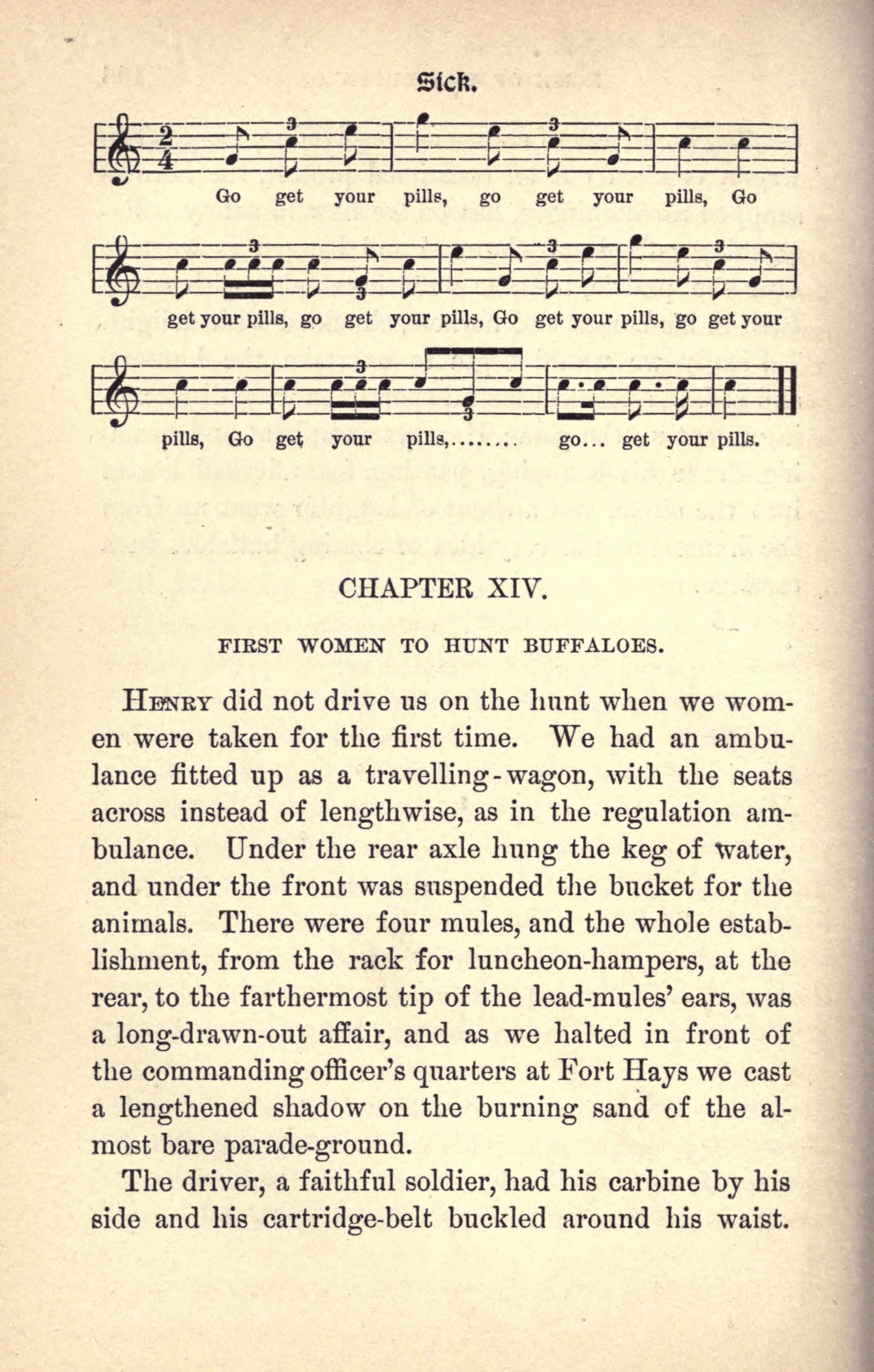
Henry did not drive us on the hunt when we women were taken for the first time. We had an ambulance fitted up as a travelling -wagon, with the seats across instead of lengthwise, as in the regulation ambulance. Under the rear axle hung the keg of water, and under the front was suspended the bucket for the animals. There were four mules, and the whole establishment, from the rack for luncheon-hampers, at the rear, to the farthermost tip of the lead-mules’ ears, was a long-drawn-out affair, and as we halted in front of the commanding ofiicer’s quarters at Fort Hays we cast a lengthened shadow on the burning sand of the almost bare parade-ground.
The driver, a faithful soldier, had his carbine by his side and his cartridge-belt buckled around his waist.
These ominous preparations for a pleasure-party made me shudder a little, while the detachment of cavalry waiting outside the post, with jingling spurs, rattling arms, and impatient, stamping horses, suggested further precaution, and added still more to my fears. The escort was unusually large, as the unfortunate shooting of the Indian chiefs in the corral was too recent an event not to make the officers realize the necessity for caution. It was impossible to communicate with the liostiles and explain this catastrophe, and no one knew at what moment a band of warriors, intent on revenge, would start out from a ravine and attack any one venturing outside the post.
I was not the only one of the four women who were so honored as to be taken along who trembled at these warlike preparations, for Mrs. Miles, then a bride, and having her first experience of the plains, watched her husband anxiously as he rode about giving final directions, and would gladly have urged him to drive with us, thus striving to secure his safety, had she hoped to dislodge a born cavalryman from his seat in the saddle that he so loved, and that he filled so well. General Miles had been a cavalry officer during the war, and though at that time an infantry colonel, he took to this mounted pleasuring as naturally as if leading a charge. When the officers declared that all was ready the bugle sounded, the impatient horses started, and the little cavalcade was, after many delays, set in motion. There was an ambulance at the rear, and that was another rather gloomy accompani-
ment of a laughing, singing, rollicking hunting party. It was considered necessary, however; for, though the accidents were never serious, there was rarely a hunt in which some one was not hurt.
Our progress to the part of the plains where the buffaloes grazed was slow, as all the officers tried to save their horses until the actual cliase began. The only variety for some miles was the sudden darting off of the dogs in pursuit of the jack-rabbits that lifted their fawn-like heads above the tufts of grass where they had been nibbling, and then shot over the plain in terrified haste. AVe were so much in sympathy with the little creatures that we did not share the sportsman’s disappointment when they succeeded in getting so great a start of the dogs that they were soon too dim a speck on the prairie to be discernible. The officers occasionally came riding back from the advance to chat with us; but through all the day the doctor, who had constituted himself our escort, never left us. He rode a cumbersome gray, and he himself, having started out in his military career with over six feet of person one way, was busy with good dinners getting himself into condition to measure that much the other, and the circumference he had acquired made him anything bat a light weight or a typical cavalryman.
All the novelty of the occasion, the soft air of the plains, deliciously pure and exhilarating, the rare sensation when we looked about us and saw the entire horizon with ” the sky fitting close down all around,” as our officers expressed it, did not banish from my
mind the dread of the Indian. Every tuft of grass, or sage-bush, or dump of cactus, silhouetted against the sky seemed to sway slowly as if a human being were hiding behind the low barricade. As one rides or drives with cavalry the least diversion seems to tremble along through the column and reach you in a dozen mute ways. The sudden rattle of steel or accoutrements as the rider turns slightly in the saddle, the short, low ejaculation of the troopers, the horses’ ears starting from a listless droop into alert erectness, the click of the hoof evidencing a change in gait — all these simple signals reached me, and before a word was spoken my heart pounded a wild tattoo on my ribs, and to solve the mystery my eyes quickly scanned the great circle bounding the sky. Perhaps a herd of antelopes stood transfixed by curiosity as we were discovered approaching; possibly a deer, taking fright for himself and the pretty doe and fawn, sprang off with marvellous bounds to lead the way to securer haunts. The ever-vigilant eyes of a terrified woman soon have a whole collection of small signs that telegraph to her quick sensibilities the possibility of danger. If in description of the trifles that produce this tremor of almost impercejDtible excitement through a cavalry column Longfellow had framed a line such as he wrote for the ship — ” She feels a thrill of life along her keel” — it would have saved much prose which cannot even clumsily portray the momentary precursor of disturbance that pervades a body of horsemen. When the disturbing object presents itself, then the voices are outspoken, and after
the mystery is solved the column resumes its even gait of four miles an hour.
After several of tliese slight interruptions, which gave me, nevertheless, a start of agitation, finally there came something that even the troopers watched with suspense. Human beings, whether white or red men, were seen far away to our left. The command was instantly halted, and the officers consulted together. We were too far at the rear to hear a word of the discussion. All eyes were turned to the left. Our leadmules’ ears began to express excitement as their eyes descried the distant figures. The driver, trying not to let us see him, quietly freed his carbine from the reins and litter that had been tossed on the front seat. The doctor instinctively put his hand to his belt and tugged at his pistol, which, uncomfortable at being jostled about his broad proportions, had settled itself in the small of his back. The officers rode back to us in a few moments, and St. Peter recorded another of those fibs of which he has such a list laid up against officers who tell women ” there is not the slightest danger.” I had then been married several years, and this assertion, that I had heard so often, had no effect in calming me.
General Miles and General Custer determined to ride on and investigate, and an Irish officer, a reckless rider, begged to accompany them. Both officers had fieldglasses, but the distance was too great to discover anything definite. The Irishman’s horse was like himself, and plunged on in advance at headlong speed; Gener-
al Miles and General Caster were mounted on animals that combined other traits even more desirable in buffalo-hunting— tenacity of will and strength. As the horseman in advance dashed on precipitately, the figures we were watching so closely began to ride in a circle. Still, though this, all over the plains, was the established signal for a parley, we knew that Indians had sometimes used it as a ruse to decoy the white man into their power. When the daring captain was near enough to speak to them, we saw him turn and ride back; and as we gazed through our opera-glasses, which we found aided us even then, it was with intense relief that we saw the circle-riding given up, and the captain’s own pace become more moderate. The horsemen proved to be herders looking for their mules, and seeing our little cavalcade, they were as much frightened as we were, and only too glad to be relieved of their terrors.
Finally, after the beautiful cool morning merged into the warmth of noon, and the quivering heat over the scorching ground made us feel thirsty, and sigh for a murmuring stream, it was decided that our pursuit of game could go on more actively if the inner man were fortified. We might look in vain for a tree, or for a brook, or even a pool: there was no shade except a very narrow strip beside the wagon, for the sun was still almost above us. The water in the kegs was not improved by the constant swinging that had been kept up with the motion of the wagon; the ” cold ” tea and coffee were lukewarm, but what did we care? I wish
that I could see such sparkling eyes, such devouring appetites, such enthusiastic diners at Delmonico’s, as were gathered about the luncheon-baskets on that glorious summer day. Every one had contributed something, and the jumble was amusing; but when we had finished there was scarcely enough left to give the driver a taste of each of the viands to add to his hardtack, pork, and the tepid water in his canteen. Tlie dogs sat around the outside of the circle, disputing, as usual, with their hungry eyes every mouthful we took, and jumping for the bones that were tossed them. Then the two generals poured from the keg containing the only water we might see during the entire day, a little for each hound, and in return got an affectionate lick from the rough but loving tongues, and a gambol of grateful delight as they sprang off for the march.
Coming to a stream, we found the column suddenly halted, and our heads were instantly out of the side of the wagon to see what could be the matter. The doctor soon came hurrying back to say that the j^assage was disputed by a small but well-armed foe, and added that ” as soon as that essence-peddler saw fit to move on, the major-general commanding would issue his order to march.” It was rather laughable to have a whole command held at bay by one small animal.
Not long after we had started again there was a shout from the head of tlie column, and on came to us the word ” Buffaloes!” It conveyed to me another tremor of agitation. I am ashamed to confess that I was even afraid of buffaloes. I had not then seen them, for.
tliongh in previous cliaj^ters reference may have been made to them, the aUnsions were to the events of the summer. These great black blotches against the faultless sky were my introduction to the American buffalo. They loomed up like elephants to my scared vision. I thought at that time that they combined the ferocity of the tiger with the strength of the lion. I had no idea how peaceful they reall}^ were if let alone. The soldiers who had gone in advance, and who had informed us by riding in a circle (a preconcerted signal) that buffaloes were ahead, now joined the column, and a halt was called to prepare for the chase. The doctor and a few men were to remain as our escort, while we followed slowly.
There was no particular care as to the dress of the hunters, and officers and enlisted men took every latitude in the matter of costume. The legs of a cavalryman are usually well cared for; his corduroy or buckskin breeches are an excellent fit, and his troop-boots, coming to the knee, set off a shapely thigh. A flannel shirt, with the loose collar confined by a soft tie, was especially becoming to those bronzed men. The soldiers were nondescript in their dress. There was a prevailing tint of army blue throughout; but there were picturesque patches, and the gaudy shirts bought from the army sutler seemed an appropriate costume for their fine muscular forms. Every sort of close cap and hat appeared, for nothing broad in the brim could withstand the furious speed with which they rode against the wind. It was impossible for women to make toi-
lets on such an occasion. We simply looked up the strongest garments we had, for the rough riding, the constant clambering in and out of the carriage, the absence of any protection to our clothes when we halted and sat on the ground for luncheon or to rest, made havoc with anything good.
Our opera-glasses looked just a little “frilly” in such a place, but they were really useful. It struck us as rather odd, when taking them from their velvet cases on the barren desert of a plain, to contrast our surroundings with the last place where they were used. The brilliantly lighted opera-house, the air scented with hot-house flowers, the rich costumes of the women, the faultlessly dressed men, the studied conventionality of the calmly listening audience, hearing ravishing music unmoved — all these recollections presented a scene about as different from that on the plains as can be imagined. Here we were, after all that glimpse of luxurious life, rolling over the arid desert, breathing with joy the intoxicating air, and going into ecstasies over everything, even over the one flower the hot summer had spared — the soapwort with its scentless blossom, its dagger-like leaves, and its prosaic root, which was really used as a substitute for soap.
As soon as the men dismounted every soldier began to examine his girth, bit, bridle, stirrups, and fire-arms, to buckle his carbine-belt, and fasten on his hat. The little company of troopers was told off into detachments, and directed to approach the herd to leeward, so that the quick nostrils of the buffalo picket might
not sniff danger. There were only murmuring voices — no loud talking was allowed — and the merriment which rarely leaves the happy-go-lucky trooper was momentarily suppressed. Some took off their caps, and tied them, with their blouses, to the saddle; other superfluous articles were strapped down so as not to make a sound. Then, with a low signal, they all gave rein to their already excited horses, and dashed up from the little divide in which these preparations had gone on, and were off like a flash. The buffaloes, finally startled by the noise of the hoofs of the advancing steeds, awakened from their lazy, stupid browsing, started their cumbrous gait, and made over the country far more rapidly than any one would imagine possible in view of their enormous size. Soon our men were among the herd, singling out the especial buffalo they wished to kill; and with our glasses we saw tliem for some time, but at last a divide hid pursuers and pursued.
After a time Colonel Tom was discovered riding towards us. He brought the news that his brother had wounded a buffalo, and waited for us before he put in the death-shot. We were guided to the spot, and found a huge beast pawing the ground, his short tail waving defiance and rage, his bloodshot eyes glittering from beneath the thick mat of bushy hair on his forehead, his horns ripping up the sod. As the officers darted up to him he plunged forward to gore their horses, and failing, dug his hoofs in the soil and tore up the earth, throwing the dust about him in his fury.
It was a repetition of the Spanish bnll-fight with the matadore for a few brief moments; but the telling shot was soon sent, and the great animal’s tongue hung out helplessly, his nostrils bled as he rolled over, shook his huge frame, and struggled no more. We left the carriage in order to view him on all sides; and while we used up adjectives in the most reckless manner trying to find language fitting to describe our surprise at the size of the monster, we suddenly heard a scream, and found that General Custer had cauglit up the young lady of the party and set her down on the huge carcass of the dead game. She cried out in terror, but was firmly held there, and told to take the knife and cut a tuft from the buffalo’s head as a trophy. Iler hands trembled so much that Colonel Tom had to do the work, and then his brother laughingly handed the tuft to the temporarily enthroned queen of the hunt, telling her, with a droll twinkle of the eye, to take it to her sister with his compliments, and say that it was snatched from the head of a certain woman whom we knew that she desjDised. The brush was given to another one of us, and lochs of hair secured for others; then we returned to the carriage while the buffalo was being cut up. It required much dexterity to take out the tongue. I know that our officers did some awkward hacking before they learned from a scout that it is skill and experience that are necessary. The rumpsteaks were easily removed, and then the soldiers cut where they chose, and strung the meat to their saddles. It was a great privilege to the enlisted man to
get this salutaiy change from his ration- of salt pork to fresh meat.
We were placed again in the carriage, the liorsemen monnted, and the hunt was resumed. Finally we came to the edge of a cliff, and our carriage halted to find a safe descent. The officers and soldiers descended carefnlly, while the buffaloes seemed to go down head-first, but gathered themselves quickly, and started off so rapidly that they gained considerably on the riders, who had to take more time in getting again to the comparatively level ground. From our rather elevated position we had a fine view of the chase, and began to enjoy it all as we found what daring and splendid horsemanshij) was exhibited without accident. The manner in which the soldiers and officers rode was alone worth our trouble in coming as spectators. On our ordinary daily rides, or on the hunts after jackrabbits or wolves, or even antelopes, there was not
* The Ration (Par. 1367, Army Regulations). — A ration is the established daily allowance of food for one person. As now fixed, its components are as follows:
Twelve ounces of pork or bacon or canned beef (fresh or corned), or one pound and four ounces of fresh beef, or twenty-two ounces of salt beef; eighteen ounces of soft bread or flour, or sixteen ounces of hard bread, or one pound and four ounces of cornmeal; and to have, ever}^ one hundred rations, fifteen pounds of pease or beans, or ten pounds of rice or hominy; ten pounds of green coffee, or eight of roasted (or roasted and ground) coffee, or two pounds of tea; fifteen pounds of sugar, four quarts of vinegar; four pounds of soap, four pounds of salt; four ounces of pepper; one pound and eight ounces of adamantine or star candles; and to troops in the field, when necessary, four pounds of yeast-powder to one hundred rations of flour.
much opportunity for us to see the remarkable intelligence of some of the best horses, or have an exhibition of the superb equestrian ship of a wild charge into a herd of buffaloes. Horse and rider were keyed up to such a pitch that not a word, and hardly a touch of the bridle, much less of a spur, was necessary. Without any guiding, the intelligent beast swung one moment into a graceful semicircle as he avoided the buffalo-wallow, hardly slackening his speed, or sprang with a pov/erful leap over a bunch of cactus, or made his tortuous way through the prairie-dog village, planting his hoofs with such unerring precision, it seemed incredible in view of the s^eed kept up. Then, when the one animal singled out as game was reached, the speed of the steed slackened, and a series of tactics w^orthy of a trained circus-horse began. The sudden rearing, and the quick backing in retreat to avoid the threatening horns, the dash forward beside the beast, the leaping to one side on all fours when the buffalo made a charge, were movements repeated with wonderful agility.
All amateurs fired at a buffalo’s head, but the largest bullets made no impression on the thick skull. The animal shook his huge head as if dislodging a fly when a shot struck him in the face, or perhaps he paid no attention at all to the leaden hail as the bullets glanced off him as from an iron-clad.
With all the quick veering from side to side, the rapid wheeling to get out of the way, the rider, with body swaying at every movement of the horse, met
each new change of gait, each fresh impulse of the vigilant animal, as if man and beast were one. In all these evolutions, so quickly and skilfully effected, the rider was able to load the poor liunted beast with lead in aiming for the telling spot, giving scarcely a thought to his horse. It goes without saying that our officers were good shots; but it was no easy affair to get a bullet just outside the edge of the great mass of tangled woolly hair that was packed so densely around the luige head. I remember one buffalo into which forty shots had been fired, and yet, with liis hide thus perforated with bullets, he fought with desperation, even with his tongue hanging out, the unerring signal of fast-coming death.
One of the sights of the day, and one to remember for many a long day afterwards, was a contest with a buffalo which General Miles and General Custer had singled out of the herd and driven to bay. The exasperated animal made a furious fight, his great eyeballs red and glittering with rage, his huge head thrust downward as he hurled himself first at one officer who rode at him on one side, and then suddenly wheeling, he made desperate lunges towards the other when the hunter’s temerity brought him too near. These lithe young men, without an ounce of superfluous flesh, with their bright eyes dancing with excitement, their fair hair flying, their throats bared and throbbing with the hot blood that rushed through their veins, their muscles steeled to the absorbing work before them, made such pictures of vigorous manhood that are not
soon effaced from the camera of the mind. They thrust their feet out of the stirrups, and held themselves in place by their powerful and pliable legs; and as neither weighed over one hundred and sixty pounds, they knew how to sit their horses lightly, and so favor the nervous, active animals under them.
It was something to occupy every energy, and keep even young and agile men vigilant, when the colossal animal suddenly wakened out of the usual dull lethargy of his humdrum life into the ferocity of rage. Had not the horses been so attuned to their riders, and so one with them in the excitement of the chase, one of the wildly tossing horns of the beast would liave been thrust into the side from which such persistent aim was taken. The hunters trusted to their faithful steeds, and believed that they would take care of themselves as well as of their riders. The bridle was scarcely touched, and as the horses whirled first to one side and then to the other, the swaying supple forms of the athletic riders followed instinctively every motion of their steeds. Sometimes one of the horses sprang back almost upon his haunches in his struggle to retreat from the threatening head of the foe. Tlien, had not the skilful horseman, poised so lightly in the saddle as he was, been quick to dig his muscular legs into the horse’s sides, and had not the bridle been loosely held so that there was not the least pull on the animal’s mouth, there would surely have been a heap of tumbled-up and prostrate humanity floundering in the soil, and sending up a cloud equal to that which the hoofs of the great fierce monster threw
into the air at every lunge of liis enormous body. E”o one can conceive what marvellous activity was exhibited by these great creatures weighing eight hundred pounds, and cumbered as they were with a thick matted coat of hair about the head and shoulders, which alone seemed enough to retard their celerity.
As this battle was being waged by these two determined men with an equally resolute foe, they firing the pistols held constantly cocked and aimed at the foreshoulder of the buffalo, there was still a fourth assailant in the fray. A large and courageous dog had separated himself from the pack and followed the hunters. He began a series of attacks on the buffalo’s hind-legs, his instinct pointing out, if not the vulnerable point, still one that was likely to ])vovq a telling one on the animal’s nerves and temper.
At last the frantic beast, coming just short of goring the horses that darted before him, condescended to bend his huge head lower, and while the dog leaped to secure another hold on the flying legs, the ponderous creature wheeled, and was for once too quick for the poor canine. He tossed him thirty feet in the air, and when the daring dog descended to the upturned turf it seemed as if his last yelp of pain was sounding.
But whatever crunching of bones went on in his terrible tumble, those of his legs were still intact, for he rose to his feet, dragged his tail between his legs, and started with a limp and a howl for home, possibly twenty miles away over a country without landmarks.
Still the buffalo fought on, his short, tufted tail, that U
usually hangs so limj:), raised in air and waving defiance. The blood at last trickled from his nostrils, one front-leg went under, and with a mighty crash down came the conquered foe, floundering and wallowing in the loosened soil, yielding reluctantly to the bullet that had pierced his side.
As we women watched this panorama spread at our feet we were filled with alarm, and trembling with anxiety one moment, triumphant and delighted with the horsemanship the next. Several buffaloes in different parts of the field were down, and we began to hope that the set of instruments one of the younger surgeons had carelessly exposed, and which had given us shudders when we started, would lie in their case undisturbed. This hope was suddenly dissipated when we saw one of the riders plunge over his horse’s head, and lie motionless on the ground. There were three women who could not breathe except in gasps for a few moments, and the unmarried woman, in deep sympatliy, strained her eyes to see if the wounded man could not be identified. Our gallant escort, the doctor, pitying the suspense of those who feared the prostrate man was the one of all the world to them, rode forward and soon brought us news. A sergeant’s horse, getting his foot into a prairie-dog hole, had thrown him. The ofiicers and soldiers gathered about the j^rostrate man, who almost instantly sprang to his feet, and declared liimself ” all right ” with only his arm sprained, he thought. The young surgeon was only too proud to produce the instrument-case, so odious to us in the
morning; but it was no sj^rain. Tlie arm of tlie fine fellow was broken, and the surgeon had work to do.
However, with all his courage, the officers feared the man would faint, and there was wild riding about to see if among the hunters there was any whiskey. The young follower of Esculapius, familiarly called ” Little Pills,” had all the apparatus to cut up his patients, but nothing to resuscitate them afterwards. Finally, after a fruitless search among the officers, the orderly rode on to our carriage to give the doctor’s compliments, and ask if the ladies had any whiskey. There was just a momentary smile awakened, but a real round laugh came from three throats when one of us asked to look under the carriage seat, where the wraps and extra necessaries were kept, and from a bag a little flask was quietly brought forth. By this time some officers had joined us, and deep and long was the peal of laughter that they gave, for the woman who produced the whiskey was the one of the four who never tasted it, nor even had so much as a gill in her house. In a twinkling this little joke spread among the hunters, with the following questions: ” Who produced the ‘ needful V ” ” Why, who do you suppose? — Mrs. So-andSo!” At sound of the name another shout, and such ejaculations as, ” Well, I should just as soon have expected old Gough himself to have handed out a flask from his pocket!” and it was in vain that the woman protested that she had “feared accidents.” When merry people want to get a joke out of anything it is difficult to turn the tide into another channel.
Tlie sergeant, tliaiiks to his pluck and to his splendid physical condition, was able to ride back to garrison, and as no one had much heart for further hunting, we all turned our faces in the direction in which the compass told us our home lay. There was not a distinguishing mark in the landscape to guide us. The utter monotony of the plains prevents any one from attempting to be a path-finder; and sometimes a boastful one among us, proud of his bump of locality, attempted to find his way, but travelled in a circle invariably as the lost traveller has always done. Soon the stars came out to light and guide us onward, and at ten o’clock we entered the camp, chaffing, singing, and chattering in spite of fatigue.
$itc Blarm.
JiJI^Bifeg^^^Sip^
Fire I fire!
fire I fire I
Fire I.
fire! fire! fire I
m ^^^%
^^^^^^
fire! Go get your buckets, get your buckets, Get your buck-ets,
V —:: — ^— ^ — ‘- — “^L^ ^ —r_tZ-:
soldiers; Get your buckets, get your buckets, Get your buckets, all.
Views: 7