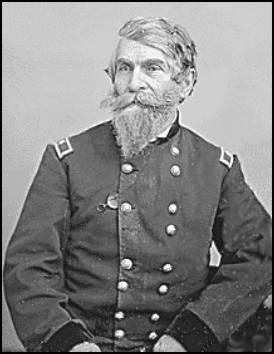
George Sears Greene (May 6, 1801 – January 28, 1899)
Correction (added July 2026): which Greene line?
George Sears Greene descended from the Warwick Greenes, not from the Quidnessett line followed elsewhere on this site. His own family genealogy, The Greenes of Rhode Island, with Historical Records of English Ancestry, 1534-1902 (1903), reproduced here in full, is built entirely around “The Greenes of Warwick, R. I.” In it the general records his own descent plainly: “My father’s father, Caleb Greene, was a ship-owner, and in his youth a ship-master, residing in the village of Apponaug in the town of Warwick.” The name Quidnessett does not appear anywhere in that book. The Warwick Greenes (the family of John Greene “the Surgeon,” and also of Gen. Nathanael Greene) and the Quidnessett Greenes are treated by the sources as two separate Rhode Island families; whether the two share a common English root is exactly the question that remains unproven. The thread drawn below from Quidnessett to General Greene should therefore be read as a hoped-for family connection, not a documented descent.
From Quidnessett to Gettysburg:
A Greene Family Thread Through the Making of America
History does not move forward by accident. It moves because men and women decide that certain principles are worth protecting, sometimes with words, sometimes with work, and sometimes with their lives.
In the Greene family, that thread can be traced back to the shores of Narragansett Bay.
At the beginning of the American story stands John Greene of Quidnessett. Arriving in 1635, he settled in the wilderness of Rhode Island, associated with Richard Smith at the trading post along the Pequot Path, and established what became the Quidnessett branch of the Greene family. This was not merely a migration story. It was a commitment to a new experiment in civil society, one shaped by religious liberty, land ownership, local governance, and independence of thought.
Rhode Island in the seventeenth century was not an easy place. It was a frontier of ideas as much as geography. The colony was built on principles of liberty of conscience and resistance to centralized religious control. To plant a family there was to plant it in soil that valued autonomy and conviction.
From John Greene of Quidnessett, the family spread outward, into Newport, into Monmouth County, New Jersey, and eventually into New York. Through the line of his son Henry, the Newport and Monmouth branches developed into a lineage that would one day produce a Union general.
That general was George Sears Greene.
Born on May 6, 1801, George Sears Greene was a civil engineer by profession, a graduate of West Point, and ultimately a Major General in the Union Army during the American Civil War. His life represents a second great test of American ideals, not the founding, but the preservation.
At Gettysburg in July 1863, Greene commanded the defense of Culp’s Hill. While much of the battle has been remembered through other names, Greene’s engineering foresight and insistence on building fortifications saved the Union right flank. His position held when Confederate assaults pressed heavily against it. If that hill had fallen, the battle, and perhaps the war, could have taken a different course.
The connection between John Greene of Quidnessett and George Sears Greene is not symbolic. It is genealogical.
John Greene (c.1606–1699)
↓
Henry Greene²
↓
The Newport / Monmouth Branch
↓
New Jersey and New York generations
↓
George Sears Greene (1801–1899)
From a seventeenth-century Rhode Island settler to a nineteenth-century Union general, the line is direct.
But the story does not stop there.
The Greene family did not serve America in only one war or one generation.
In the Civil War, another descendant carried the name forward: Levi Davis Green. Levi Davis Green served in the 130th New York Volunteer Infantry, later redesignated as the 1st New York Dragoons. These were mounted troops who endured some of the hardest campaigning in the Army of the Potomac’s cavalry corps. They were not distant observers of history, they were in it.
The Dragoons rode through the Overland Campaign, through the Shenandoah Valley, and through the grinding attrition that ultimately broke the Confederacy. Levi Davis Green represents another branch of the same extended family tree, not high command, but enlisted service. Not the drawing board and fortification plan, but the saddle, the saber, and the Spencer repeating rifle.
Two different roles. Same war. Same commitment.
And the thread continued.
Marvin Wheeler Green, also of the 1st New York Dragoons, carried the Greene/Green name forward in that same crucible. These men stood in the long line that began at Quidnessett, a line defined not by title or wealth, but by participation.
It is tempting to romanticize ancestry. It is better to understand it.
The Greene family story is not about prestige. It is about continuity.
In the seventeenth century, the family helped establish a colony rooted in liberty of conscience.
In the nineteenth century, they defended a Union built on constitutional government.
Across generations, they served, as settlers, as soldiers, as engineers, as farmers, as citizens.
There is a pattern here.
The Greene line emerging from Rhode Island consistently placed itself at points where American ideals were contested:
- Religious liberty in colonial Rhode Island
- Independence and republican government in the Revolutionary era
- National unity and constitutional preservation in the Civil War
From John Greene’s frontier settlement to George Sears Greene’s fortified hill at Gettysburg, and through the mounted service of Levi Davis Green and Marvin Wheeler Green, the family appears again and again where the question was the same:
Will this experiment endure?
That endurance was never guaranteed.
It required men who believed in something larger than themselves, and who were willing to act accordingly.
The Greene family’s repeated appearance in pivotal moments is not accidental. It reflects a tradition of civic responsibility embedded early in Rhode Island soil. The colony that prized liberty of conscience produced generations who believed liberty must also be defended.
The story is not one of isolated heroics. It is a multigenerational narrative of stewardship.
From Quidnessett to Gettysburg.
From trading post to fortified hill.
From settler’s oath to soldier’s commission.
The Greene family did not simply witness the development of the United States of America. They participated in its protection, across centuries.
And that is a lineage worth remembering.
Views: 19