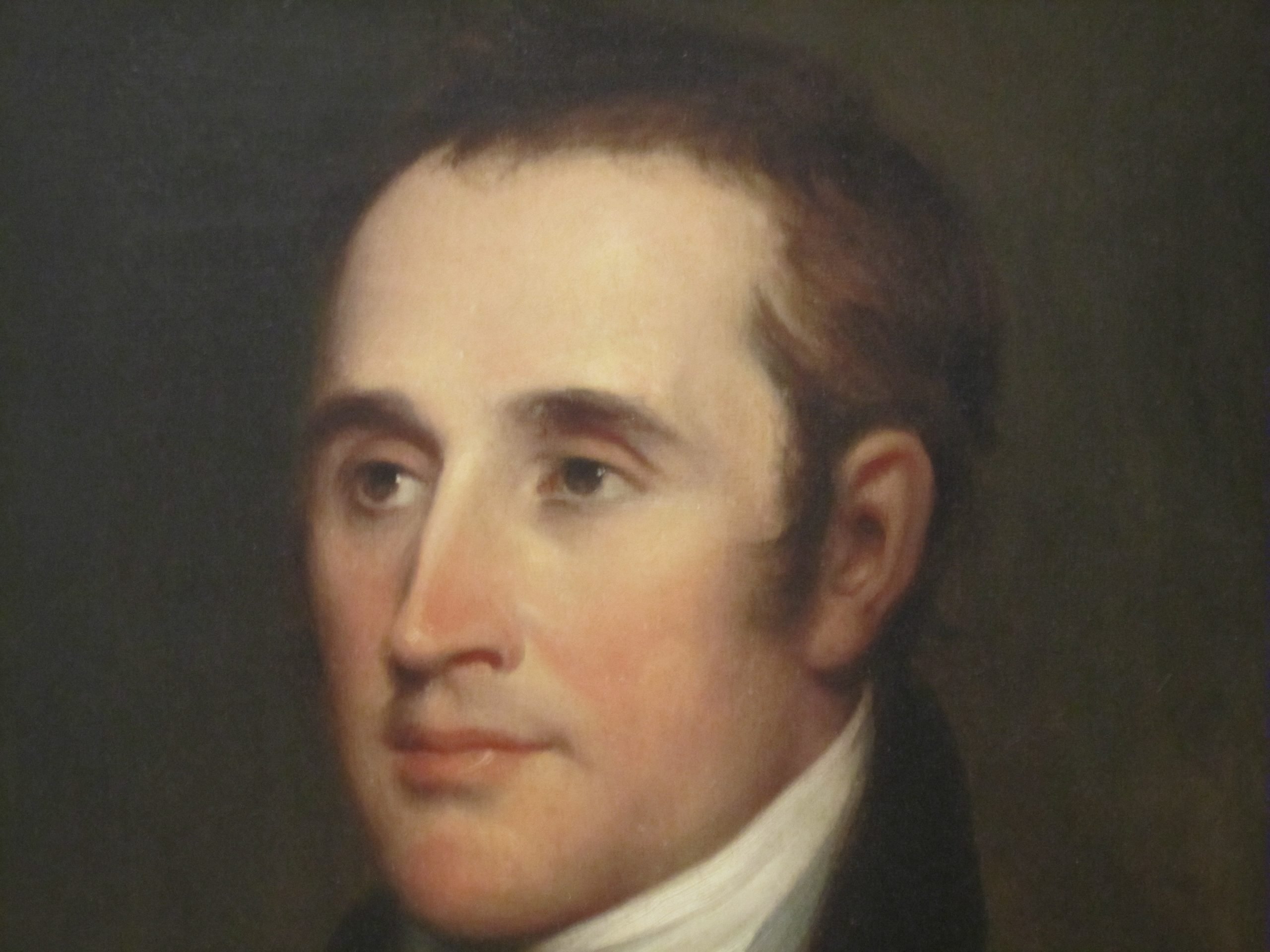
George Gibbs III (Father)

The Gibbs Family · Father of the General
Colonel George Gibbs III
1776 – 1833
Merchant’s son, mineralogist, master of Sunswick. He built the greatest mineral collection in America, gave Yale its Gibbs Cabinet, and left the mineral gibbsite carrying his name. His death in August 1833 set every later chapter of this archive in motion.
GEORGE GIBBS (III.). Eldest son and fourth child of George (II.) and Mary Channing, was born in Newport, R. I., in 1776. He was educated at Yale College and married Laura Wolcott (born 1794), daughter of Oliver Wolcott, Jr., of Litchfield, Conn., and Elizabeth Stoughton. Laura was but fifteen years of age at the time of her marriage. Extended reference to this remarkable woman will be found beginning on page 21. For an account of the Wolcott connection through my grandmother, see “The Wolcott Family.”

EARLY LIFE
George Gibbs in his early life was sent to China as a supercargo in one of the ships of Gibbs and Channing, as his father intended that his son should succeed him in his business. However, a life of cultivated leisure attracted the young man strongly and upon returning from China he went to Europe, where he spent some years in study. While in France he had the opportunity of meeting many important and interesting people of the Directoire, among whom may be mentioned Mme. Recamier. He returned with a very fine collection of minerals, derived from the purchase of two noted European cabinets. The whole comprised over 10,000 specimens, making it, at the time the largest collection in America. With additions he made later it now amounts to 20,000 specimens. Col. Gibbs, as he was known, deposited his collection at Yale College. Through his friend, Professor Benjamin Silliman, that Institution purchased it, in 182 5, for $20,000. He continued throughout his Ii£etime to add to the collection and to engage in geological work to develop new mineral localities. Colonel Gibbs was the first to geologize systematically in the White Mountains. In 1816 Dr. Bigelow and his party found and followed the path cut through the thickets by Gibbs some years earlier.

MARRIAGE TO LAURA WOLCOTT
On his marriage to Laura Wolcott in 1810, he purchased from the Delafield family a large estate, comprising about 40 acres, and a fine Colonial house, named “Sunswick,” on Long Island near what was then called Hallett’s Cove, and is now known as Astoria. The place was about opposite the northern end of Blackwell’s Island (Welfare Island now). It is difficult today to picture this locality as a desirable residence district, but 125 years ago it was in fact a beautiful shore and a favorite spot for the fine country places of New York families, easily reached by ferry or by sailing boats from the Battery, where the City was then clustered.1. Here Colonel Gibbs devoted himself with great ardor and success to horticulture, and especially to the introduction and testing of new varieties of fruit. Meantime he kept up his scientific studies, accumulated a noble library, and exercised abounding hospitality. For many years he offered prizes at Yale for superior attainment in mineralogy and for services rendered to science by useful discoveries and observation, and first suggested to Professor Silliman the publication of the well-known “American Journal of Science.” Two of his sons as will be seen, inherited his scientific tastes.
VARIOUS ACTIVITIES AND INTERESTS
Col. Gibbs’s various activities and interests should be further mentioned.
He was elected Vice-President of the New York Lyceum of Natural History in 1822 and contributed many articles to the American Mineralogical Journal and to the American Journal of Science. He received the degree of M.A. from Brown University in 1800, and from Yale in 1808.
He was appointed Aide-de-Camp by the Governor of Rhode Island in 1804. His Societies were:
- Member of the Royal Institution (England), 1807.
- American Philosophical Society, Philadelphia, l 81o.
- American Antiquarian Society, 1813.American Academy of
- Arts and Sciences, 1813. American Academy of Fine Arts,
- 1816. Mineralogical Society of Dresden, Germany, 1816.
- Newport Marine Society, 1819.
- Agricultural Society of Florence, Italy, 1821. Imperial
- Agricultural Society of Vienna, 1824. New York
- Horticultural Society, 1824. Linnean Society of Paris, 1826.
- Massachusetts Horticultural Society, 1830.
His great interest in art induced a strong friendship with Gilbert Stuart; the acquaintance was made while Stuart was painting the portrait of Gibbs’s father. When George Gibbs (III.) died in I 833, his widow, for the sake of improving educational facilities for her children sold “Sunswick” and moved to New York City.
1798.1
Gibbs Archives · Reel 1The Reel 1 Papers
From the Gibbs Family Papers at the Wisconsin Historical Society, scanned frame by frame from the microfilm by the editor and published here so these letters can see the light of day. Twenty-six documents, 1796 to 1834, each shown whole with its complete verbatim transcription: the boy in Canton, the science and the speculations, the painter in Paris, the offer and the sale of the cabinet that made Yale a home of American mineralogy, and Silliman’s tributes to the widow after his death.
The Instructions 
January 2, 1796
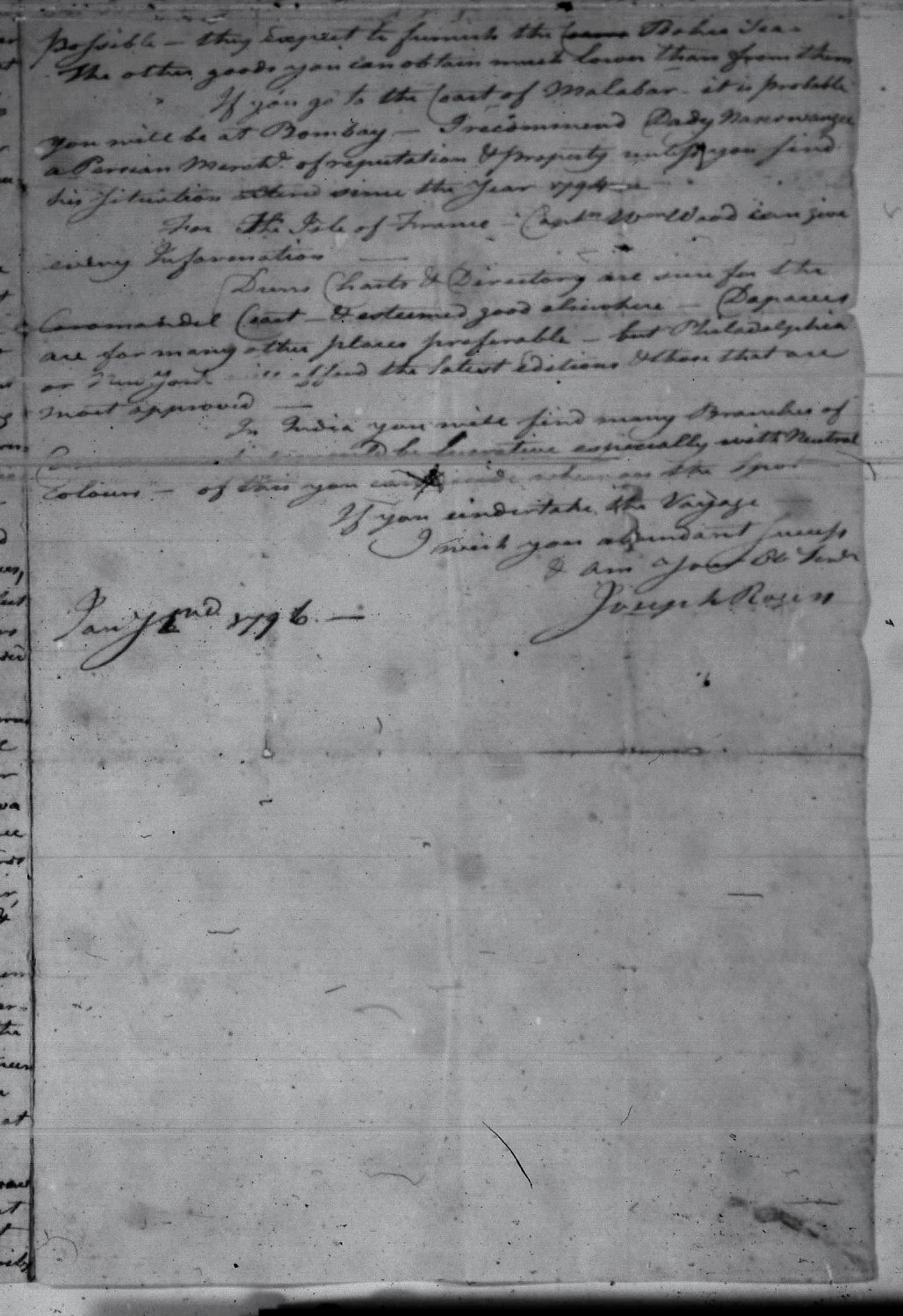
Before the voyage, the briefing. Joseph Rogers, a veteran of the India trade, sets down for the twenty-year-old everything a first venture east needed to know: the sailing directions, where to anchor and whom to trust, the named merchants of the eastern ports, and what the Chinese will expect to furnish. The son’s Canton letter below shows the playbook in use ten months later. The docket is endorsed simply: Jos. Rogers, Instructions.
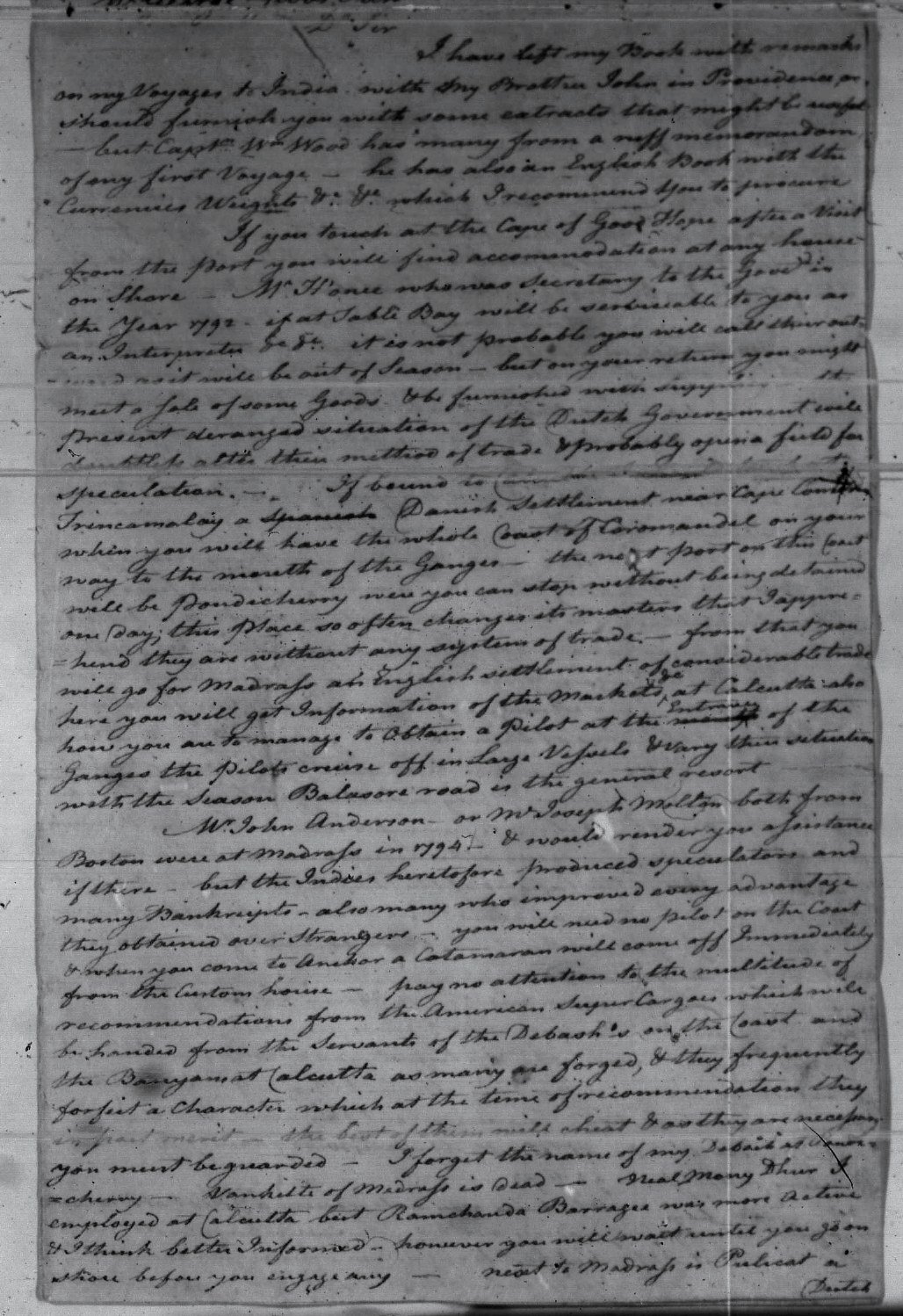
Dr Sir
I have left my Book with remarks on my Voyages to India with My Brother John in Providence, he should furnish you with some extracts that might be useful — but Captn. Wm. Wood has many from a rough memorandum of my first Voyage — he has also an English Book with the Currencies Weights &c. &c. which I recommend You to procure
If you touch at the Cape of Good Hope after a Visit from the Port you will find accommodation at any house on Shore — Mr. H’once[?] who was Secretary to the Govd. in the Year 1792~ if at Table Bay will be serviceable to you as an Interpreter &c &c. it is not probable you will call there out[war]d[?] as it will be out of Season — but on your return you might meet a Sale of some Goods & be furnished with Supplies[?] — the Present deranged situation of the Dutch Government will Doubtless alter their method of trade & probably open a field for speculation. —
If bound to Ca[illegible] [illegible] Trincamalay a [struck: Spanish] Danish Settlement near Cape [illegible] when you will have the whole Coast of Coromandel on your way to the mouth of the Ganges — the next port on this Coast will be Pondicherry were you can stop without being detained one Day; this Place so often changes its masters that I apprehend they are without any system of trade. — from that you will go for Madrass an English settlement of considerable trade here you will get Information of the Markets &ca. at Calcutta also how you are to manage to Obtain a Pilot at the [struck: mouth[?]] Entrance of the Ganges the Pilots cruise off in Large Vessels & vary their situation with the Season Balasore road is the general resort
Mr. John Anderson — or Mr. Joseph Melton[?] both from Boston were at Madrass in 1794~ & would render you assistance if there — but the Indies heretofore produced speculators and many Bankrupts ~ also many who improved every advantage they obtained over Strangers — you will need no Pilot on the Coast & when you come to Anchor a Catamaran will come off Immediately from the Custom house — pay no attention to the multitude of recommendations from the American Supercargoes which will be handed from the Servants of the Debash’s on the Coast and the Banyans at Calcutta as many are forged, & they frequently forfeit a Character which at the time of recommendation they in part merit — the best of them will cheat & as they are necessary you must be guarded — I forget the name of my Debash at Pondicherry — Vankelte[?] of Madrass is dead — Neal Many Dhur[?] I employed at Calcutta but Ramchanda Barrages[?] was more active & I think better Informed — however you will wait until you go on shore before you engage any — next to Madrass is Pulicat a Dutch
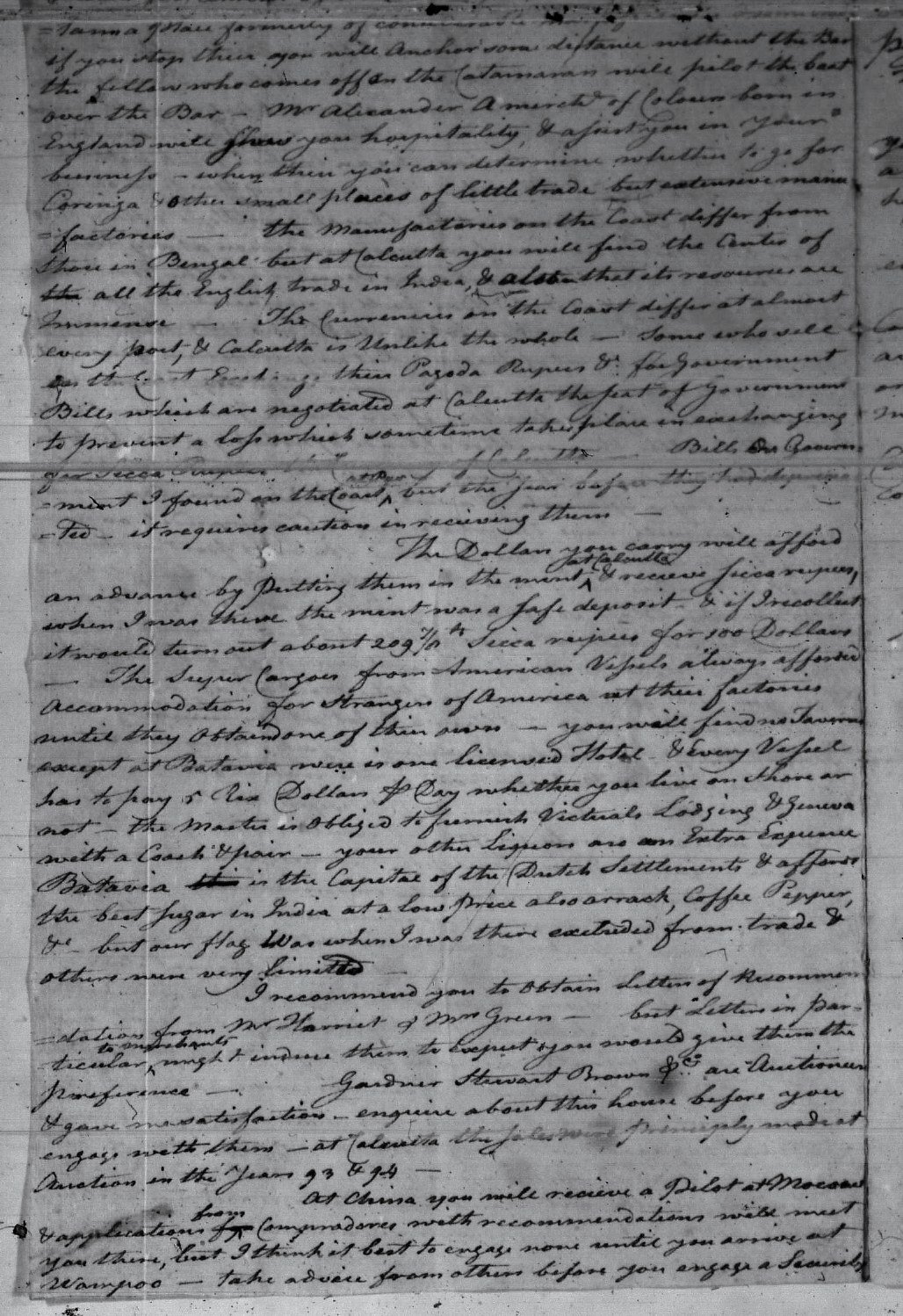
[settle]ment[?] a Place formerly of considerable[?] [illegible] if you stop there you will Anchor some distance without the Bar the fellow who comes off on the Catamaran will pilot the boat over the Bar — Mr. Alexander A Merchd. of Colours[?] born in England will shew you hospitality, & assist you in your business ~ when there you can determine whether to go for Coringa & other small places of little trade but extensive manufactories — the Manufactories on the Coast differ from those in Bengal but at Calcutta you will find the Center of [struck: the] all the English trade in India, & also that its resources are Immense — The Currencies on the Coast differ at almost every port, & Calcutta is Unlike the whole — Some who sell on the Coast Exchange their Pagoda Rupees &c. for Government Bills which are negotiated at Calcutta the Seat of Government to prevent a loss which sometime takes place in exchanging for Sicca Rupees — Bills On Government I found on the Coast [illegible] but the year before[?] they had depreciated — it requires caution in receiving them —
The Dollars you carry will afford an advance by putting them in the mint at Calcutta & receive Sicca rupees, when I was there the mint was a safe deposit — & if I recollect it would turn out about 209 7/10th Sicca rupees for 100 Dollars — The Super Cargoes from American Vessels always afforded Accommodation for Strangers of America at their factories until they Obtain one of their own — you will find no Taverns except at Batavia were is one licensed Hotel ~ & Every Vessel has to pay 5 Rix Dollars pr Day whether you live on Shore or not ~ the Master is Obliged to furnish Victuals Lodging & Geneva with a Coach & pair — your other Liquors are an Extra Expense Batavia [struck: it] is the Capital of the Dutch Settlements & affords the best Sugar in India at a low price also arrack, Coffee Pepper, &c but our flag Was when I was there excluded from trade & others were very limited —
I recommend you to Obtain Letters of Recommendation from Mr. Harriet[?] & Mrs. Green — but Letters in particular to merchants might[?] induce them to expect you would give them the preference — Gardner Stewart Brown & Co. are Auctioneers & gave me satisfaction — enquire about this house before you engage with them ~ at Calcutta the Sales were[?] principally made at Auction in the Years 93 & 94 —
At China you will receive a Pilot at Macao & applications from Compradores with recommendations will meet you there, but I think it best to engage none until you arrive at Wampoo — take advice from others before you engage a Security
possible — they expect to furnish the [struck: illegible] Bohea Tea. The other goods you can obtain much lower than from them.
If you go to the Coast of Malabar ~ it is probable you will be at Bombay — I recommend Dady Nasserwangee a Persian Merchd. of reputation & property unless you find his Situation altered since the Year 1794 —
For the Isle of France ~ Captn. Wm. Wood can give every Information
Dunns Charts & Directory are sure for the Coromandel Coast — & esteemed good elsewhere — D’Apres[?] are for many other places preferable — but Philadelphia or New York will afford the latest Editions & those that are most approved —
In India you will find many Branches of [illegible] [illegible] be lucrative especially with Neutral Colours — of this you can decide[?] when on the Spot
If you undertake the Voyage I wish you abundant success & am Yours Obt. Servt.
Joseph Rogers
Jany 2nd 1796. —
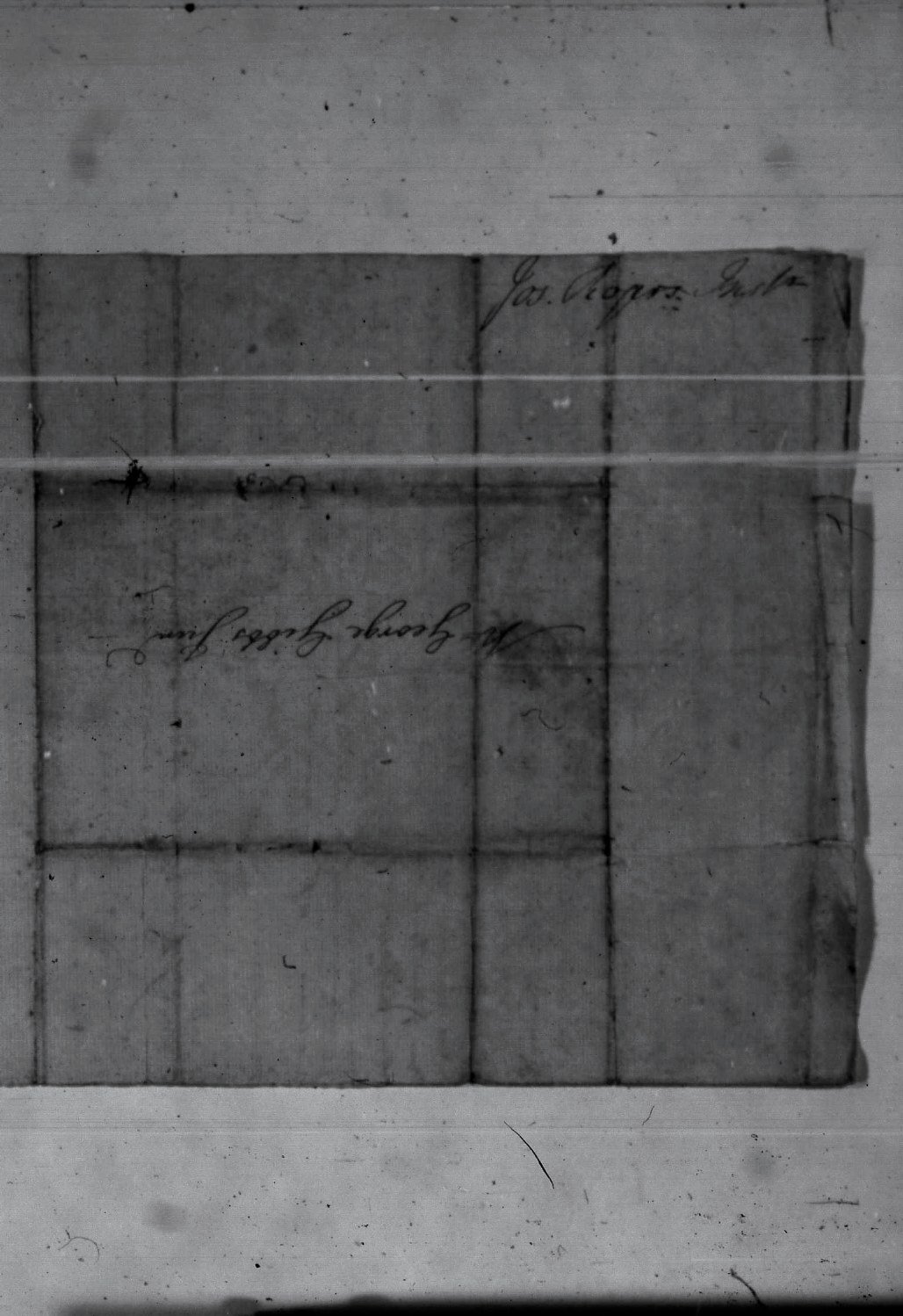
[docket, in a later hand:] Jos. Rogers Instrs.
[address panel:] Mr. George Gibbs Junr. —
Transcribed verbatim from the scans, keeping the original spelling, capitalization, and punctuation; the manuscript’s own dashes are kept, bracketed words are interlineations or uncertain readings, and [illegible] marks passages lost to the film. Condition: Microfilm (WHS Reel 1) of a folded 3-page holograph letter plus address leaf; contrast is poor throughout. Scan 6 (p.1): the very top line is cropped by the frame (almost certainly the inside address ‘Mr George Gibbs Junr’ above the salutation); two mid-page lines (‘If bound to Ca…’ and the phrase after ‘recommendation they in part merit’) are badly faded, readings marked. ‘Entrance of the Ganges’ is interlined above a struck word (probably ‘mouth’). The Calcutta banyan names ‘Neal Many Dhur’ (likely Neelmoney Dhur) and ‘Ramchanda Barrages’ (surname uncertain, possibly a Banerjee) and the Madras debash ‘Vankelte’ are phonetic renderings, marked [?]. Scan 7a (p.2): the first line is cropped at the top edge, so the word completing ‘Pulicat a Dutch [settle]ment’ is partly conjectural; ‘at Calcutta’ and ‘to merchants’ are interlineations, transcribed in place; one faded passage after ‘Bills On Government I found on the Coast’ left as [illegible]. The page ends ‘engage a Security’ and scan 7b opens ‘possible’, so a few words (probably ‘& make the terms as low as’ or similar) are lost at the leaf turn / crop. Scan 7b (p.3): one wholly faded line in the final paragraph (‘many Branches of [illegible] [illegible] be lucrative’) resists reading; ‘Dady Nasserwangee’ is the writer’s spelling of the Bombay Parsi merchant Dady Nasserwanjee; ‘D’Apres’ (the French chart-maker d’Apres de Mannevillette) is a probable but not certain reading. Scan 9: address leaf, blank but for docket and address, both faint (address is mirrored/show-through faint in the scan). Manuscript long dashes rendered ~~; original spelling (Madrass, Trincamalay, Wampoo, ‘were’ for where, etc.) preserved.
Gibbs Family Papers, Wisconsin Historical Society, Reel 1, scans 6, 7a, 7b, and 9. Autograph letter of instructions of Joseph Rogers to George Gibbs Jr. before his first eastern voyage, with its address leaf. Digitized from the microfilm by this site; transcribed in full above.
From Canton, Aged Twenty 
Canton, November 11, 1796
The earliest document of his life on this site, and nearly the first frame of the reel: the young George Gibbs reports to his father from China after a passage of almost seven months. Macao and Whampoa, the choosing of a Security Merchant, the extortions of the Mandarins set down in sums, the cooks pronounced as good as any in the world, and the merchants’ reputation for roguery traced, with striking fairness, to poverty and oppression. The mineralogist, the Yale benefactor, and the master of Sunswick begins here, buying silks in Canton for the family firm.
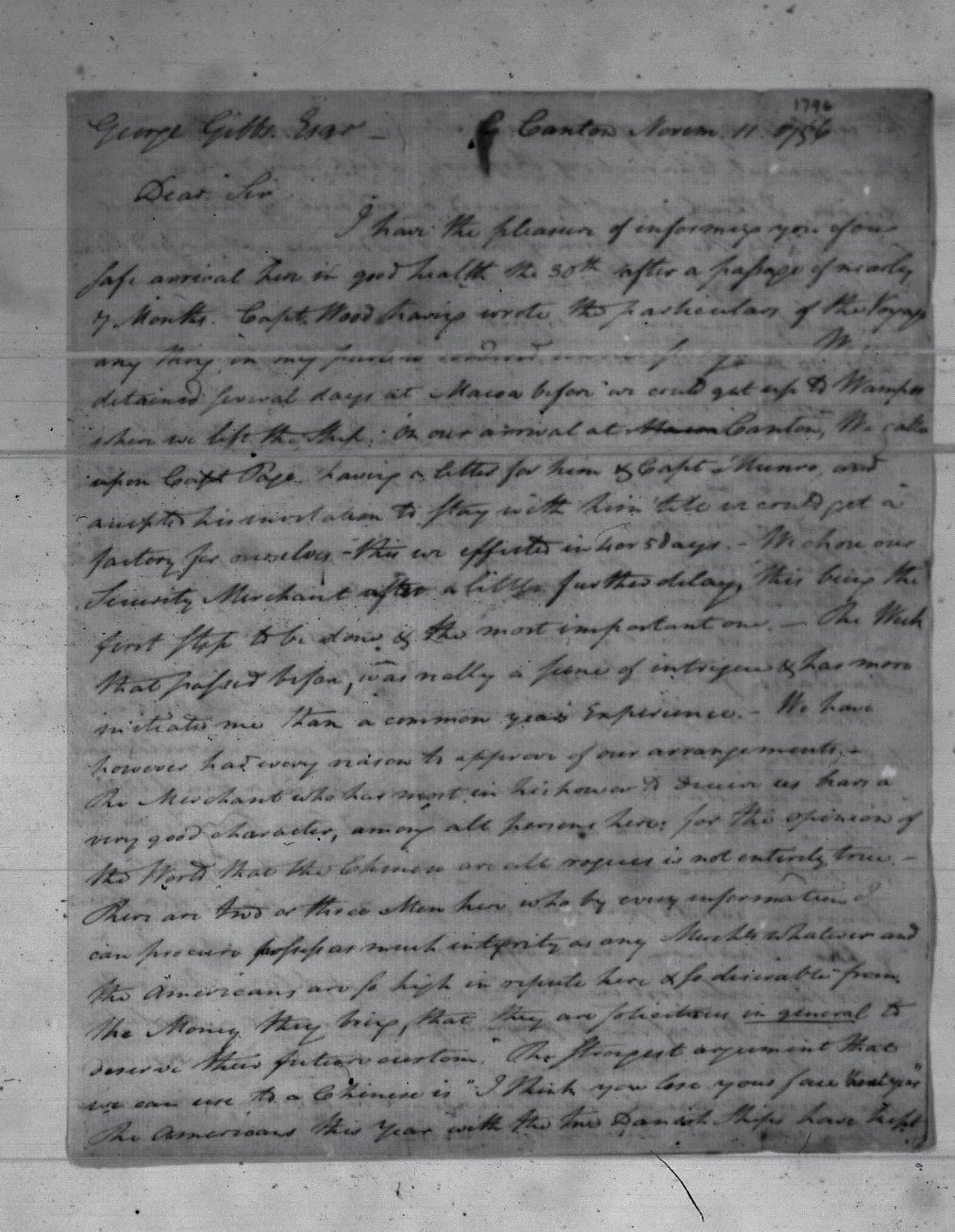
George Gibbs Esqr —
Dear Sir
I have the pleasure of informing you of our safe arrival here in good health the 30th after a passage of nearly 7 Months. Capt. Wood having wrote the particulars of the Voyage any thing on my part is [remainder of line badly faded — illegible] We were detained several days at Macoa before we could get up to Wampoa where[?] we left the Ship; on our arrival at [struck: Macoa] Canton, we called upon Capt Page, having a letter[?] for him & Capt Munro, and accepted his invitation to stay with him till we could get a factory for ourselves — this we effected in 4 or 5 days. — We chose our Security Merchant after a little further delay, this being the first step to be done & the most important one. — The Week that passed before, was really a scene of intrigue & has more initiated me than a common years Experience. — We have however had every reason to approve of our arrangements. — The Merchant who has most in his power to deceive us has a very good character, among all persons here; for the opinion of the World that the Chinese are all rogues is not entirely true — There are two or three Men here who by every information I can procure possess as much integrity as any Mercht whatever and the Americans are so high in repute here & so desirable from the Money they bring, that they are solicitous in general to deserve their future custom. The strongest argument that we can use to a Chinese is “I think you lose your face truly[?]” The Americans this Year with the two Danish Ships have kept
[TEXT BREAKS OFF — THE INTERVENING PAGE WAS NOT AMONG THESE SCANS]
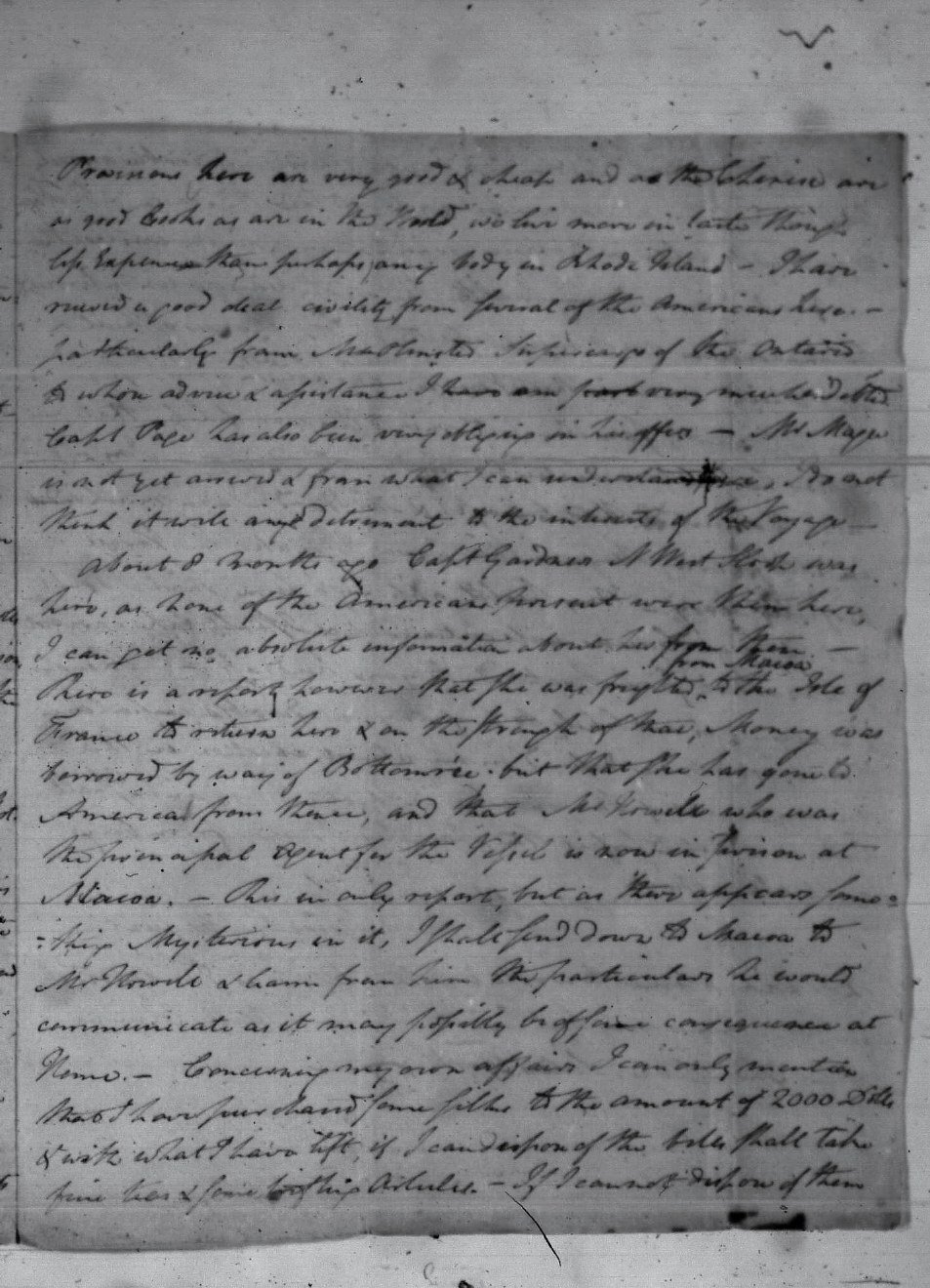
Provisions here are very good & cheap and as the Chinese are as good Cooks as are in the World, we live more in taste though less expense than perhaps any body in Rhode Island — I have received a good deal civility from several of the Americans here — particularly from Mr Olmsted[?] Supercargo of the Ontario to whose advice & assistance I have [struck: am] been[?] very much indebted. Capt Page has also been very obliging in his offers — Mr Magee is not yet arrived & from what I can understand [one or two words struck through], I do not think it will [be?] any detriment to the interests of the Voyage —
About 8 Months ago Capt Gardners N West Ship was here, as none of the Americans present were then here, I can get no absolute information about her from them — There is a report however that she was freighted [“from Macoa” interlineated above the line here] to the Isle of France to return here & on the strength of that, Money was borrowed by way of Bottomree but that she has gone to America from thence, and that Mr Howell who was the principal Agent for the Vessel is now in prison at Macoa. — This is[?] only report, but as there appears something Mysterious in it, I shall send down to Macoa to Mr Howell & learn from him the particulars he would communicate as it may possibly be of some consequence at Home. — Concerning my own affairs I can only mention that I have purchased some silks to the amount of 2000 Dolls & with what I have left, if I can dispose of the bills shall take fine teas & some trifling Articles. — If I cannot dispose of them
[TEXT BREAKS OFF — RESUMES MID-SENTENCE ON THE NEXT FILMED PAGE]
the whole Company of Chinese Merchants from failing — Their general Character of Roguery, which indeed they truly deserve, I think must be caused a good deal by their abject poverty & by the oppression of their Mandarines — oppressed themselves, they oppress others in their turn. — A new Governor has lately come here, it is said [several words illegible — line badly faded] 200,000 [struck: Dolls] Tale which is 270,000 Dolls to the [Imperial?] Court [several words illegible — line badly faded] his Birthday was announced when he demanded 10,000 Tale as a present of the Chinese Merchants, his Wifes, Sons, daughters, & Grandmothers, soon followed in succession in the course of a Month or two, with the like demands. — As to ourselves we are obliged to give 300 Dolls in the first place to a Man to supply the Ship with provision[s] and he must cheat us out of 350 more before he can pay the Mandarin for his License — An American Ship about a Month ago & soon after her arrival sent her Sail boat up to Canton, unluckily she was ballasted with Swivels & Pistols[?]. This Circumstance was eagerly seized[?] on, and a fine of 10,000 Dolls would have been exacted if she had been secured[?]. As this was not the case the Mandarin offered to pass it over if the American would put his business into the hands of a friend of [struck: the] Mandarin, whose Affairs were rather embarassed; what this will cost in the end, I cannot tell. — These will give some Idea of the oppressions of a Government a Revolution is now preparing to overturn — The object of this is to remove the present race of Tartar kings — The Exactions & restraints [remainder of final line badly faded — illegible]
Transcribed verbatim from the scans, keeping the original spelling, capitalization, and punctuation; the manuscript’s own dashes are kept, bracketed words are interlineations or uncertain readings, and [illegible] marks passages lost to the film. Condition: Three microfilmed pages of a longer letter, written in the young George Gibbs’s rapid, heavily dashed hand on paper that has faded badly in horizontal bands (frame 3 on the reel is a duplicate exposure of frame 2 and was skipped). The letter is UNSIGNED as filmed: no signature leaf and no address panel appear among these scans, and the text twice breaks off mid-sentence (after ‘have kept’ on scan 2, and after ‘If I cannot dispose of them’ on scan 4), so at least one intervening page per gap was not filmed here; scan 5 opens mid-sentence (‘the whole Company of Chinese Merchants from failing’). The year in the dateline reads 1796 and an archivist has penciled ‘1796’ at the top right of scan 2. Badly faded passages rendered [illegible]: the second half of the line following ‘any thing on my part is’ (scan 2); two bands on scan 5 around the new Governor’s reported payment and the lead-in to ‘his Birthday was announced’; and the final line of scan 5 after ‘The Exactions & restraints’. ‘Tale’ (twice on scan 5, once written over a struck ‘Dolls’) is the tael, the Chinese silver unit ~~ the 200,000 Tale = 270,000 Dolls conversion confirms the reading. The closing word of the quoted pidgin argument to a Chinese merchant is uncertain (read as ‘truly’). In the manuscript ‘in general’ (scan 2) and ‘no’ in ‘no absolute information’ (scan 4) are underlined. Interlineation: ‘from Macoa’ inserted above the line after ‘freighted’ (scan 4). Strikeouts preserved as [struck: word]: ‘Macoa’ before ‘Canton’ (scan 2), ‘Dolls’ before ‘Tale’ and ‘the’ before ‘Mandarin’ (scan 5), ‘am’ before ‘been’ (scan 4), plus an unrecovered one-to-two-word strike after ‘from what I can understand’ (scan 4). Historical anchors legible in the text: Capt. Wood (the ship), Capt. Page and Capt. Munro at Canton, Mr. Olmsted supercargo of the Ontario, Mr. Magee not yet arrived, Capt. Gardner’s Northwest ship and Mr. Howell reportedly imprisoned at Macao, and the purchase of silks to the amount of 2000 Dolls.
Gibbs Family Papers, Wisconsin Historical Society, Reel 1, scans 2, 4–5 (scan 3 is a duplicate exposure). Autograph letter of George Gibbs to his father George Gibbs of Newport, unsigned as filmed. Digitized from the microfilm by this site; transcribed in full above.
“So Severe a Dispensation of Providence” 
Baltimore, September 6, 1797
A consignment letter with a mystery in the middle of it. George Sears of Baltimore reports on the silks from the Canton cargo, and then, between the invoice prices and the market quotations, offers his condolence on “the unfortunate accident in your family.” No name, no detail. Some sudden calamity struck the Gibbs household of Newport in the late summer of 1797, and this sentence is so far the only trace of it in the record. The question stands open.
Mr. George Gibbs Junr
Dear sir
Your esteemed fav of 13th Ulto with Sundries by the Aurora Capt. Reid came safely to hand, as also your letter p post with the Certificate for Exportation — I have it not in my power[?] at present[?] to say[?] [illegible] [illegible] — in a short time I shall be better informed — The Silks I am told (by those who have seen them) are too high charged — it is said they have been sold 15 p Ct. lower. — If they do not bring your Invoice prices I shall consult Hy[?] Ladd relating them. —
I have never experienced more painful emotions than on hearing of the unfortunate accident in your family — I pray God to bless you with fortitude & resignation under so severe a dispensation of Providence. Please present my affectionate Regards to the family and believe me Dear sir, with much Esteem.
Your obedt friend George Sears
Beef 16 Dollars Pork 24 a 25 Dollars
Transcribed verbatim from the scans, keeping the original spelling, capitalization, and punctuation; the manuscript’s own dashes are kept, bracketed words are interlineations or uncertain readings, and [illegible] marks passages lost to the film. Condition: Single-page letter, dark microfilm scan but largely legible. One badly faded line (body line 5, between ‘I have it not in my’ and ‘a short time I shall be better informed’) is mostly unrecoverable; conjectural readings marked with [?] and two words marked [illegible]. ‘p’ in ‘p post’ and ’15 p Ct.’ renders the per-symbol. The name before Ladd is cramped; ‘Hy[?]’ (Henry?) is conjectural. No strikeouts. The closing price memorandum (‘Beef 16 Dollars / Pork 24 a 25 Dollars’) is in the same hand at lower left, below the signature. The condolence passage is fully legible as transcribed.
Gibbs Family Papers, Wisconsin Historical Society, Reel 1, scan 18. Autograph letter of George Sears of Baltimore to George Gibbs Jr. Digitized from the microfilm by this site; transcribed in full above.
A Credit in London 
London, February 8, 1798
The trade network answering back: George Barclay & Co. of London advise the twenty-one-year-old that a remittance has arrived and £354.9.1 is passed to his credit, and tender their services. The Canton silks were becoming London balances; the young merchant’s ledger now reached across two oceans.
Mr George Gibbs Junr
Sir
The purport of this, is to advise you that we Received a Remittance on your Account from Messs Cordes[?] Benidztorf[?] & Coldes[?] of Hamburgh[?] in their own Draft on Pernentz[?] Bodecher[?] of this City, Amdt: £354.9.1 — which is Duly Honored & passed in Conformity to your Credit Subject to your Disposal —
We are happy on this Occasion to Tender you our Services in this City, being very Sincerely —
Sir ~ Your most obt Servt[?] ~ George Barclay & Co
[DOCKET, IN A SECOND HAND, ON THE VERSO — SCAN 33]
George Barclay & Co ~ Feby. 8. 98
Transcribed verbatim from the scans, keeping the original spelling, capitalization, and punctuation; the manuscript’s own dashes are kept, bracketed words are interlineations or uncertain readings, and [illegible] marks passages lost to the film. Condition: A single leaf in a professional counting-house hand, filmed as a faint, low-contrast exposure throughout; every reading of the merchant-firm names should be treated as provisional. The remitting Hamburg house is read as ‘Cordes Benidztorf & Coldes’ ~~ the second name could also be read ‘Benidetos’ and the third ‘Colders’; their London drawee is read ‘Pernentz Bodecher’ (possibly ‘Berentz Bodecker’). ‘Hamburgh’ is inferred from context and the visible letterforms but is not certain. The sum is clear: Amdt: £354.9.1 (354 pounds, 9 shillings, 1 penny). ‘Messs’ is the clerk’s abbreviation for Messieurs, written with raised terminal letters, as are ‘Mr’, ‘Junr’, ‘Feby’, ‘Amdt’, ‘obt’ and ‘Servt’. The valediction runs continuously from the last body line (‘…our Services in this City, being very Sincerely ~~ Sir ~ Your most obt Servt’) into the signature ‘George Barclay & Co’, which is finished with a large calligraphic paraph (flourish) below; the terminal abbreviation read ‘Servt’ may be plural ‘Servts’. Scan 33 is the verso of the same folded leaf: blank except for the contemporary filing docket ‘George Barclay & Co / Feby. 8. 98’ at the head, with heavy mirror-image bleed-through of the recto text visible across the page. No strikeouts or interlineations appear in the letter.
Gibbs Family Papers, Wisconsin Historical Society, Reel 1, scans 32–33. Autograph letter of George Barclay & Co. of London to George Gibbs Jr., with its docket. Digitized from the microfilm by this site; transcribed in full above.
“War with France Likely” 
Alexandria, March 9, 1798
A friend in Alexandria writes as the Quasi-War gathers: war with France likely, society and trade dull, and three bank shares bought at a hundred and eighty dollars each because better terms could not be had. The leaf ends mid-sentence; the signature page was not filmed, and the exhibit says so.
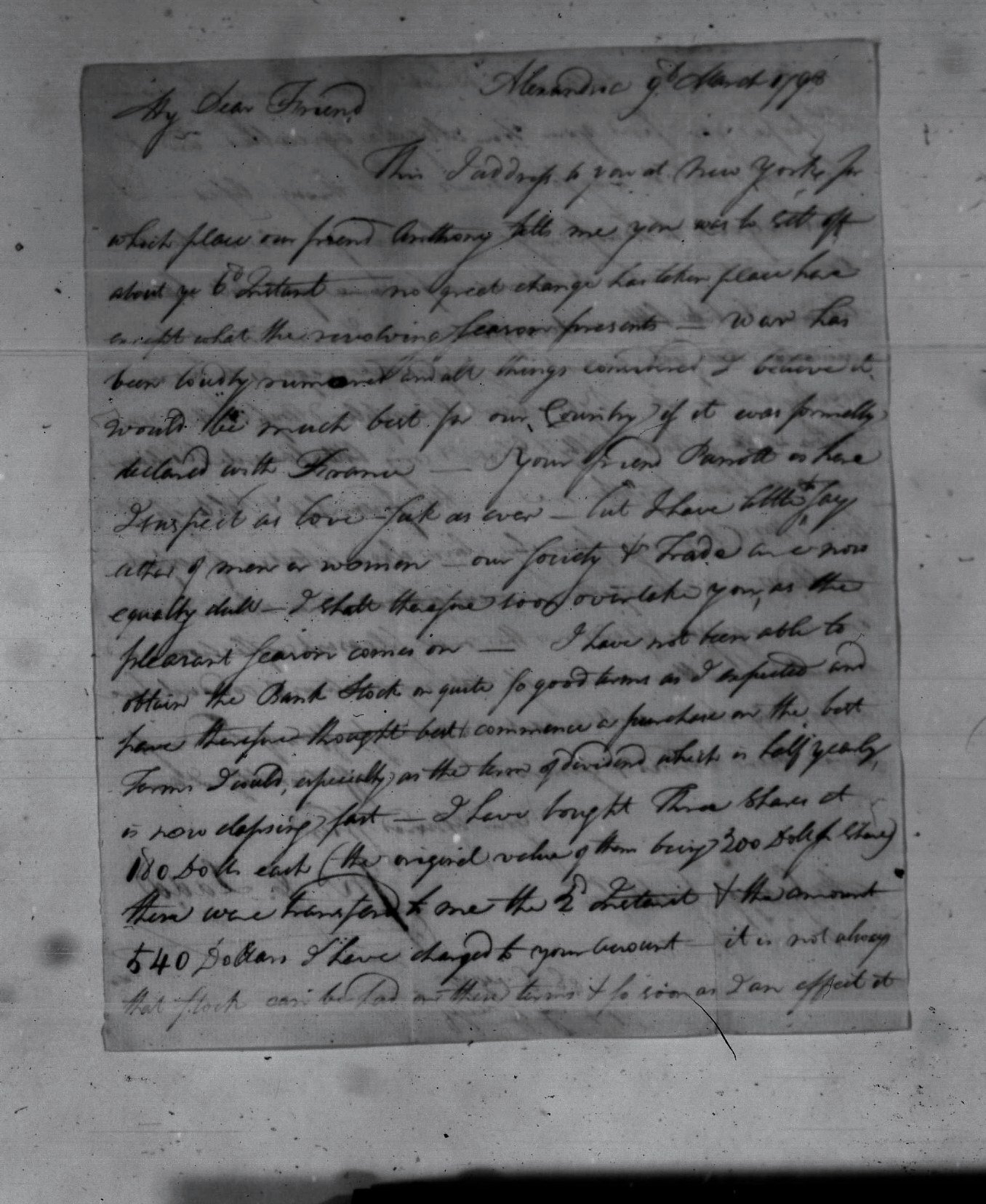
My Dear Friend
This I address to you at New York, for which place our friend Anthony tells me you was to sett off about ye 6th Instant — no great change has taken place here except what the revolving Seasons presents — War has been loudly rumoured and all things considered I believe it would be much best for our Country if it was formally declared with France — Your friend Parrott[?] is here I suspect as love-sick as ever — but I have little to say either of men or women — our Society & Trade are now equally dull — I shall therefore soon overtake you, as the pleasant Season comes on — I have not been able to obtain the Bank Stock on quite so good terms as I expected and have therefore thought best commence a purchase on the best Terms I could, especially as the term of dividend which is half yearly, is now elapsing fast — I have bought Three Shares at 180 Dolls each (the original value of them being 200 Dolls p[er] Share) these were transferd to me the 2d Instant & the amount 540 Dollars I have charged to your Account — it is not always that Stock can be had on these terms & so soon as I can effect it
[LEAF ENDS MID-SENTENCE — THE REMAINDER OF THE LETTER AND THE SIGNATURE ARE NOT ON THIS PAGE]
Transcribed verbatim from the scans, keeping the original spelling, capitalization, and punctuation; the manuscript’s own dashes are kept, bracketed words are interlineations or uncertain readings, and [illegible] marks passages lost to the film. Condition: A single filmed leaf (scan 34) of a longer letter, written from Alexandria on 9 March 1798 to a correspondent about to arrive in New York ~~ from the banking commission and the circle of friends, evidently to the young George Gibbs Jr. The exposure is dark and faint but nearly every word is recoverable. The text runs to the bottom edge of the leaf and breaks off mid-sentence after ‘so soon as I can effect it’; no closing, signature, or address panel appears on this scan, so the writer is UNIDENTIFIED as filmed. Uncertain readings: the love-sick friend’s surname is read as ‘Parrott’ (could be ‘Barrott’); the last line, ‘that Stock can be had on these terms & so soon as I can effect it’, is the most faded on the page but reads confidently under magnification. Original spellings kept: ‘sett off’, ‘you was’, ‘ye 6th Instant’, ‘the revolving Seasons presents’ (singular verb as written), ‘transferd’. The manuscript uses the per-sign abbreviation before ‘Share’, expanded here as ‘p[er] Share’. The writer’s long dashes between sentences are rendered ~~. No strikeouts or interlineations on this leaf. Historical anchors: war with France ‘loudly rumoured’ three weeks before the XYZ dispatches were made public (the Quasi-War began that summer); the friend Anthony who reported the recipient’s departure for New York about the 6th Instant; and the purchase of three bank shares at 180 Dolls each (par 200 Dolls), transferred the 2d Instant, the 540 Dollars charged to the recipient’s account.
Gibbs Family Papers, Wisconsin Historical Society, Reel 1, scan 34; the letter’s closing leaf was not filmed. Autograph letter to George Gibbs Jr. Digitized from the microfilm by this site; the surviving text transcribed in full above.
The Ladies and the Tea 
Charleston, May 26, 1798
Why the Canton tea would not sell in Charleston, in one immortal line of commercial sociology: one of the ladies had prejudiced the others against its color and flavor. Miller & Robertson enclose the account of sales, and hope to move the tea yet, particularly if war takes place.
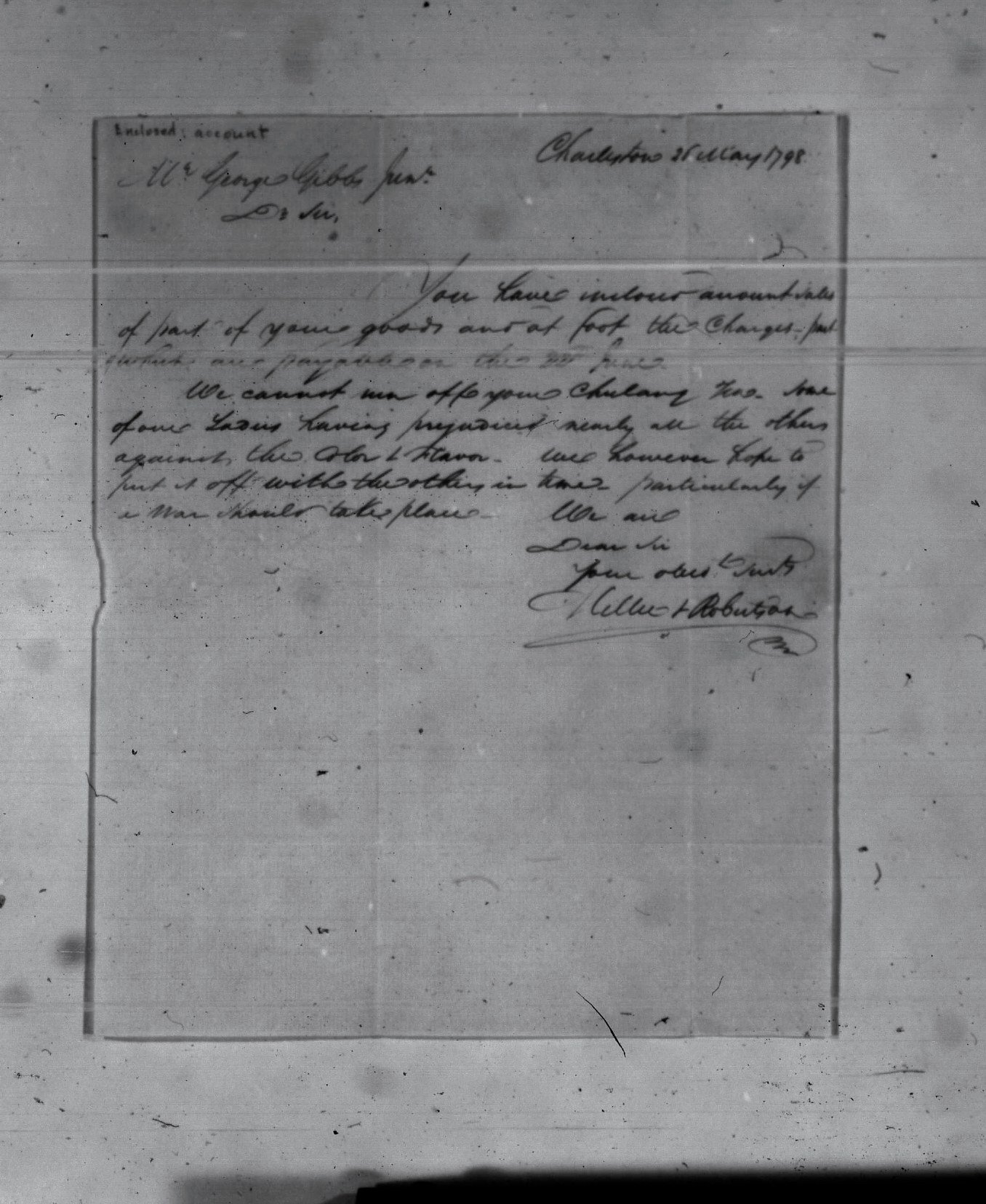
[Scan 49 — cover letter. Archivist pencil, top left: “Enclosed: account”]
Mr George Gibbs Junr
Dr Sir,
You have inclosed amount sales of part of your goods and at foot the Charges — part which[?] are payable on the 25th[?] June[?]
We cannot move[?] off your Chulang Tea — One of our Ladies having prejudiced nearly all the others against the Color & Flavor — We however hope to put it off with the others in time — particularly if a War should take place — We are
Dear Sir
Your obedt Servts
Miller & Robertson
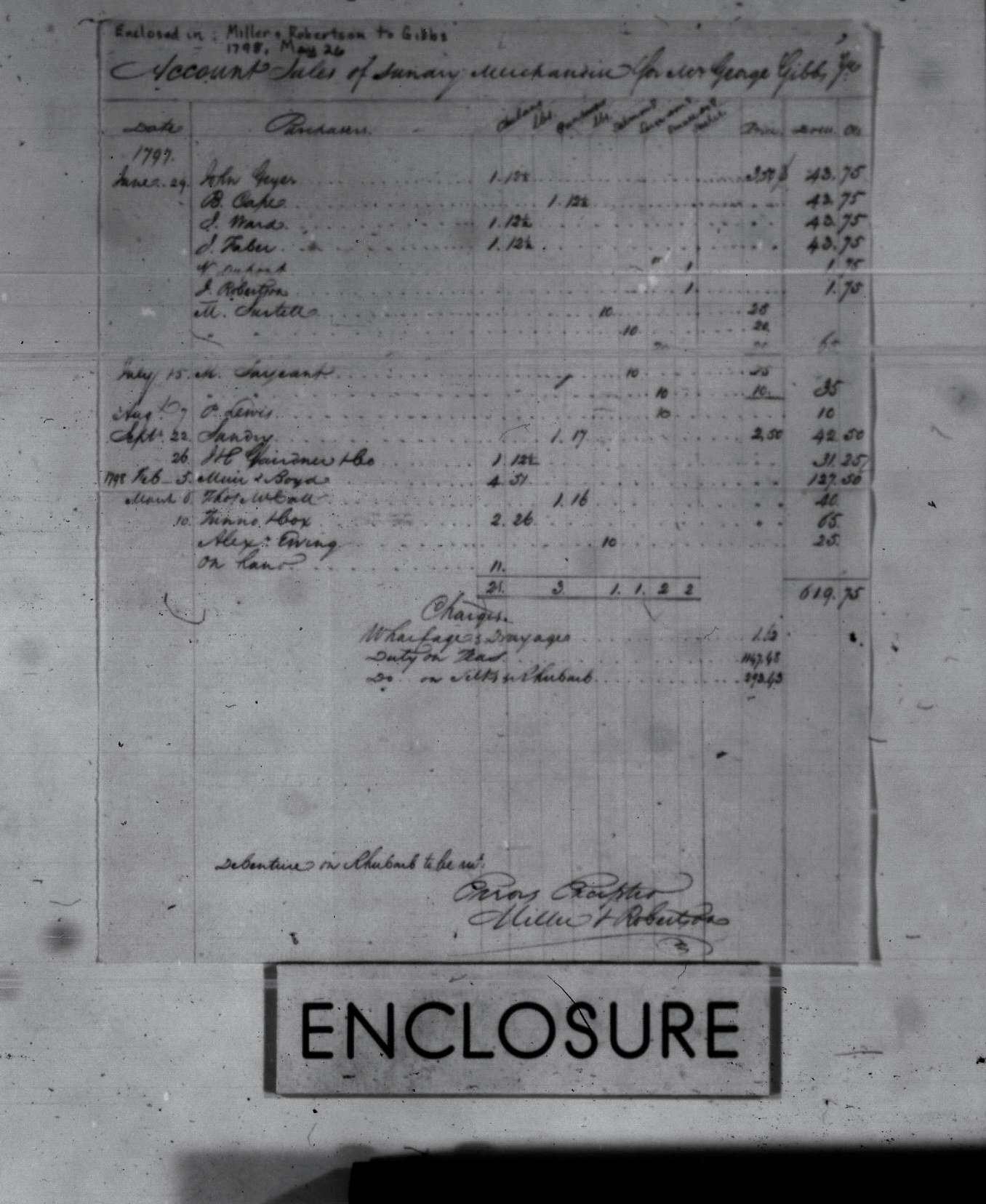
[Scan 50 — enclosure. Archivist pencil, top left: “Enclosed in: Miller & Robertson to Gibbs 1798, May 26”]
Account Sales of Sundry Merchandize[?] for Mr George Gibbs Jr
[Ruled table. Columns: Date | Purchasers | six narrow commodity-quantity columns whose slanted headings are largely illegible (the first apparently the Chulang[?] tea, another Gunpowder[?] tea, others possibly Silks and Rhubarb per the Charges below) | Price | Doll. Cts]
1797
June 24 — John Geyer — 1.15[?] — [price] 35[?] — 43.75
B. Cape — 1.12 1/2 — 43.75
S. Ward — 1.12 1/2 — 43.75
J. Faber — 1.12 1/2 — 43.75
W. Dupont[?] — 1.75
J. Robertson — 1 — 1.75
M. Sartell[?] — 10 [at] 25[?] — 10 [at] 20[?] — [third entry illegible] — 60[?]
July 15 — M. Sargeant[?] — 10 [at] 25[?] — 10 [at] 10 — 35
Aug 7 — P. Lewis — 10 — 10
Sept 22 — Sundry — 1.17 — 2.50 — 42.50
26 — H. Gairdner[?] & Co — 1.12 1/2 — 31.25
1798 Feb 5 — Muir & Boyd — 4.51 — 127.50
March 6 — Thos W. Ball[?] — 1.16 — 40
10 — Kinno & Box[?] — 2.26 — 65
Alexr Ewing — 10 — 25
On hand — 11.
[column totals] 21 — 3 — 1. 1. 2 — 2 — [amount total] 619.75
Charges.
Wharfage & Drayage — 1.62[?]
Duty on Teas — 147.43[?]
Do on Silks & Rhubarb — 293.43[?]
Debenture on Rhubarb to be recd
Errors Excepted
Miller & Robertson
[Archival stamp: ENCLOSURE]
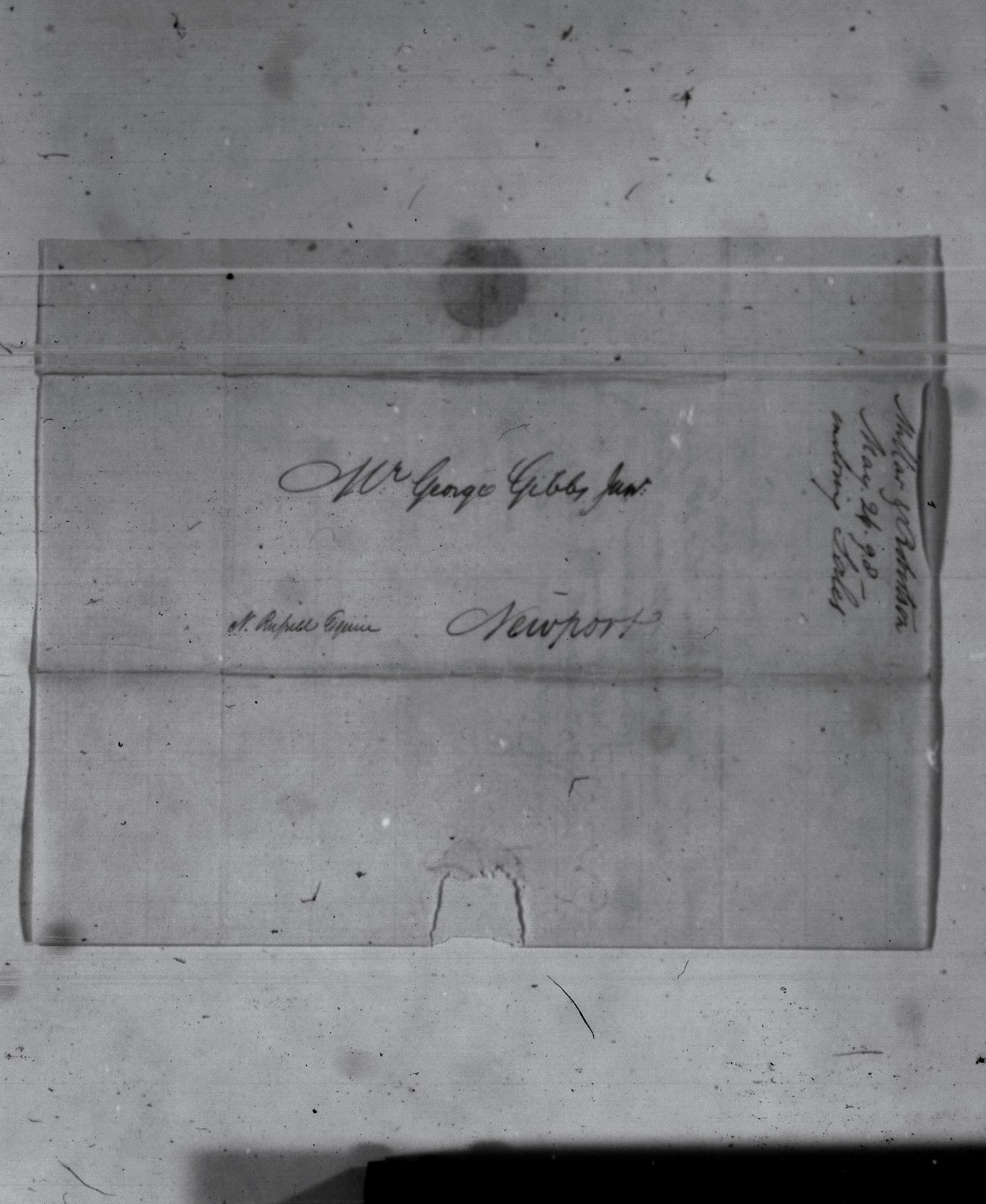
[Scan 51 — address wrapper]
Mr George Gibbs Junr
Newport
[lower left, carrier annotation] N. Russell[?] Esquire
[docket, written vertically at right] Miller & Robertson — May 26[?] 98 — enclosing Sales
Transcribed verbatim from the scans, keeping the original spelling, capitalization, and punctuation; the manuscript’s own dashes are kept, bracketed words are interlineations or uncertain readings, and [illegible] marks passages lost to the film. Condition: FILE-NUMBER CORRECTION: the prose cover letter with the tea passage is scan 49.pdf, not 50.pdf; 50.pdf is the enclosed Account Sales sheet and 51.pdf the wrapper. All three transcribed here as one document set. The cover letter (49) is faded but mostly legible; its third line (“part which are payable on the 25th June”) is severely faded and the day/month there are best guesses. The key tea passage is clear except the verb in “We cannot move[?] off,” written as a compressed abbreviation. The firm writes “Chulang Tea” (with terminal g), and “One of our Ladies having prejudiced nearly all the others against the Color & Flavor” ~~ note “nearly all the others,” not simply “the others.” The Account Sales (50) has tiny slanted column headings that are largely illegible at scan resolution; quantities and dollar amounts transcribed where readable, several purchaser names uncertain (Sartell, Sargeant, Gairdner, Ball, Kinno & Box). Duty figures partly obscured by fading. Wrapper (51): the lower-left carrier line reads “N. Russell Esquire” (long-s “Rufsell”), NOT “care of Mr Rufus Greene” as the catalogue brief expected ~~ the catalogue entry should be corrected. Docket day digit is ambiguous (26 or 24); the letter’s date line and the pencil docket on scan 50 both support May 26.
Gibbs Family Papers, Wisconsin Historical Society, Reel 1, scans 49–51 (an earlier pass swapped the letter and its enclosure; corrected against the files July 13, 2026; 52 is a duplicate of the wrapper). Autograph letter of Miller & Robertson of Charleston to George Gibbs Jr., with its Account Sales enclosure and wrapper. Digitized from the microfilm by this site; transcribed in full above.
“My Little Favourite William” 
[November 5], 1798
The surviving leaf of a friend’s letter, and a family portrait in one sentence: John G. Ladd sends his regards to the worthy parents, to the sisters Mary, Ruth, Sally and Eliza, to little William, and pays tribute to “the friendship & politeness of Mr & Mrs Channings family.” The whole Newport household of the 1790s, greeted by name. The first leaf, with the dateline, was not filmed; the date rests on the docket.
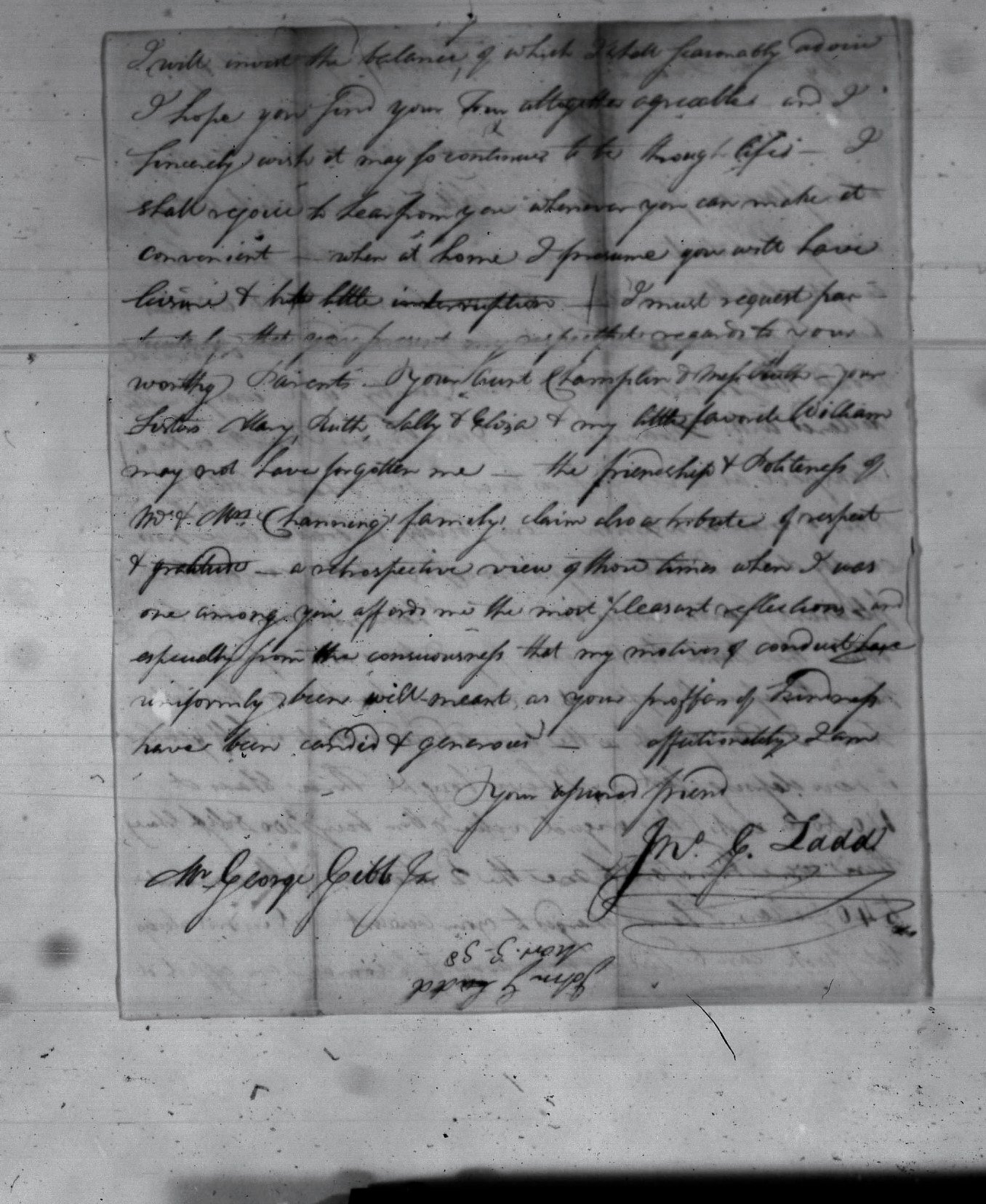
[THE LEAF OPENS MID-SENTENCE — THE FIRST LEAF OF THE LETTER, WITH ITS DATELINE AND SALUTATION, WAS NOT FILMED]
I will invest the balance, of which I shall seasonably[?] advise you[?] — I hope you find your tour altogether agreeable and I sincerely wish it may so continue to be through life — I shall rejoice to hear from you whenever you can make it convenient — when at home I presume you will have leisure & but little interruption — I must request particularly[?] that you present my respectful[?] regards to your worthy Parents — your Aunt Champlin[?] & Miss [illegible] — your Sisters Mary, Ruth, Sally & Eliza & my little favourite William may not have forgotten me — the friendship & politeness of Mr & Mrs Channings family, claim also a tribute of respect & gratitude — a retrospective view of those times when I was one among you affords me the most pleasant reflections — and especially from the consciousness that my motives of conduct have uniformly been well meant as your proffers of kindness have been candid & generous — — affectionately I am
Your assured friend
Jno. G. Ladd
Mr. George Gibbs Jr
[DOCKET, WRITTEN PERPENDICULAR TO THE TEXT NEAR THE FOOT OF THE LEAF]
John G. Ladd — Nov. 5[?]. 98
Transcribed verbatim from the scans, keeping the original spelling, capitalization, and punctuation; the manuscript’s own dashes are kept, bracketed words are interlineations or uncertain readings, and [illegible] marks passages lost to the film. Condition: The surviving second (closing) leaf of a friendly letter from John G. Ladd to the young George Gibbs Jr., filmed as a single faint microfilm frame with bleed-through from the verso. The leaf opens mid-sentence (‘I will invest the balance…’), so the first leaf ~~ with the dateline, place, and salutation ~~ was not filmed; the letter’s date rests on the docket, read as Nov. 5, 1798 (the docket is written perpendicular to the main text near the foot of the leaf, is partly obscured by the large flourish under Ladd’s signature, and the day-figure is uncertain). The hand uses the long s throughout (‘assured’ appears as ‘afsured’). One or two lines fall in a badly faded horizontal band: ‘particularly’ and ‘respectful’ in ‘request particularly that you present my respectful regards’ are partly conjectural, as are ‘seasonably advise you’ at the end of the opening line. In the string of greetings after ‘worthy Parents’ the reading ‘your Aunt Champlin’ is probable but not certain, and the name following ‘& Miss’ is illegible. ‘so’ in ‘it may so continue’ appears inserted above the line with a small caret. The signature ‘Jno. G. Ladd’ is followed by an elaborate looping paraph. The inline address ‘Mr. George Gibbs Jr’ stands at the lower left of the leaf, level with the signature. Family anchors legible in the text: sisters Mary, Ruth, Sally & Eliza; ‘my little favourite William’ (the youngest Gibbs brother); and the tribute to ‘Mr & Mrs Channings family’ ~~ the Newport household of the writer’s and recipient’s Channing kin.
Gibbs Family Papers, Wisconsin Historical Society, Reel 1, scan 45; the first leaf of the letter was not filmed. Autograph letter of John G. Ladd to George Gibbs Jr., docketed November 5, 1798. Digitized from the microfilm by this site; the surviving text transcribed in full above.
The Meteorite Letter 
New York, February 21, 1808
On the eve of sailing for France, Gibbs asks Silliman for a few pieces of a famous stone, almost certainly the meteorite that had fallen at Weston, Connecticut, ten weeks earlier and that Silliman had just made the first scientifically investigated fall in the New World. He authorizes two hundred dollars for the largest fragment, because his reception in France “will much depend on my mineralogical friends.”
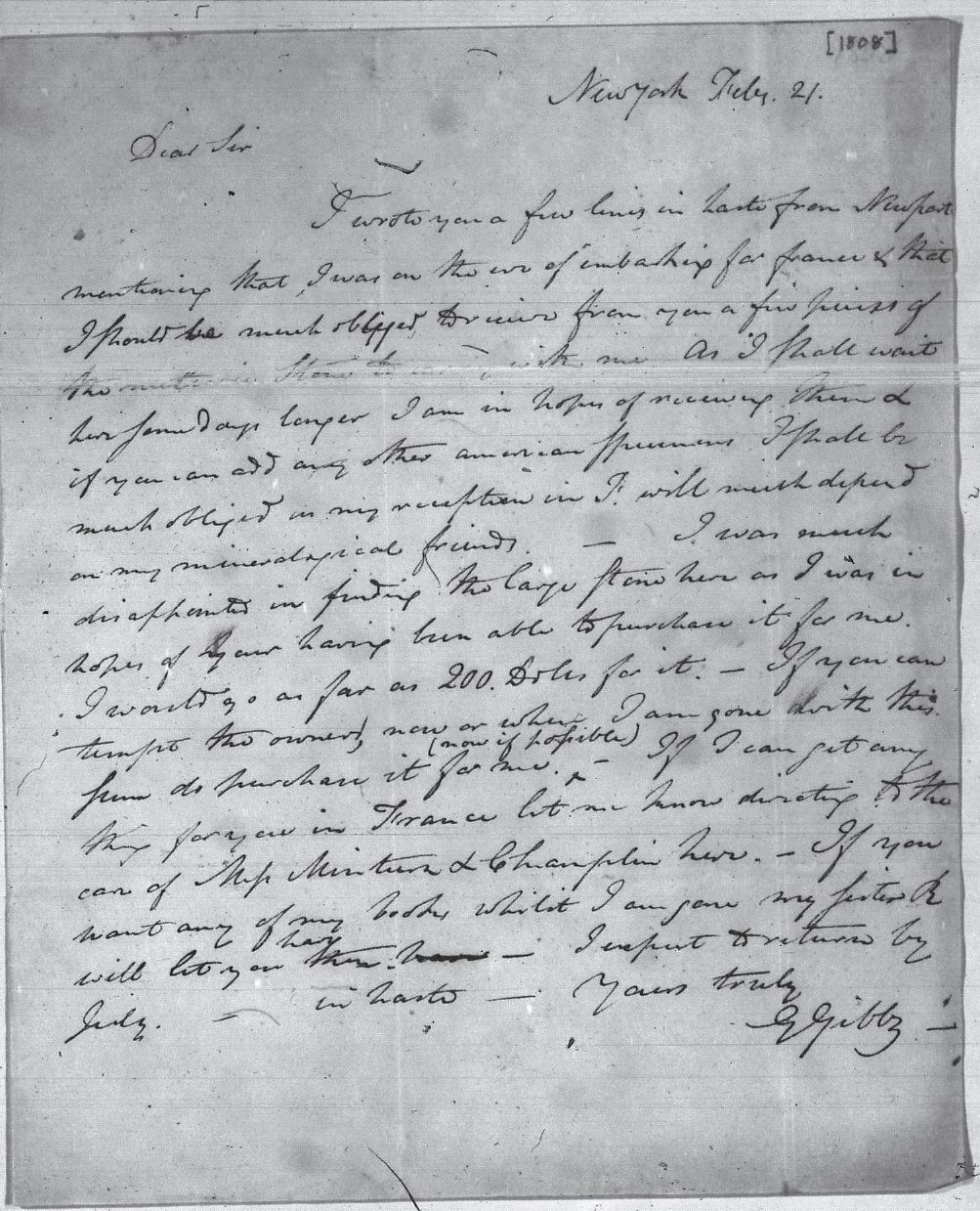
Dear Sir
I wrote you a few lines in haste from Newport mentioning that, I was on the eve of embarking for france & that I should be much obliged, to receive from you a few pieces of the meteoric[?] Stone to [illegible] with me. As I shall wait here some days longer I am in hopes of receiving them & if you can add any other american Specimens I shall be much obliged as[?] my reception in F. will much depend on my mineralogical friends. — I was much disappointed in finding the large stone here as I was in hopes of your having been able to purchase it for me. I would go as far as 200. Dolls for it. — If you can tempt the owner, now or when, [“(now if possible)” interlineated between the lines here, keyed by an x after “for me.”] I am gone with this sum do purchase it for me. x — If I can get any thing for you in France let me know directing to the care of Mess[?] Minturn & Champlin here. — If you want any of my books whilst I am gone my sister R will let you them [one word struck through, possibly “have”] — I expect to return by July. —
in haste — Yours truly G Gibbs —
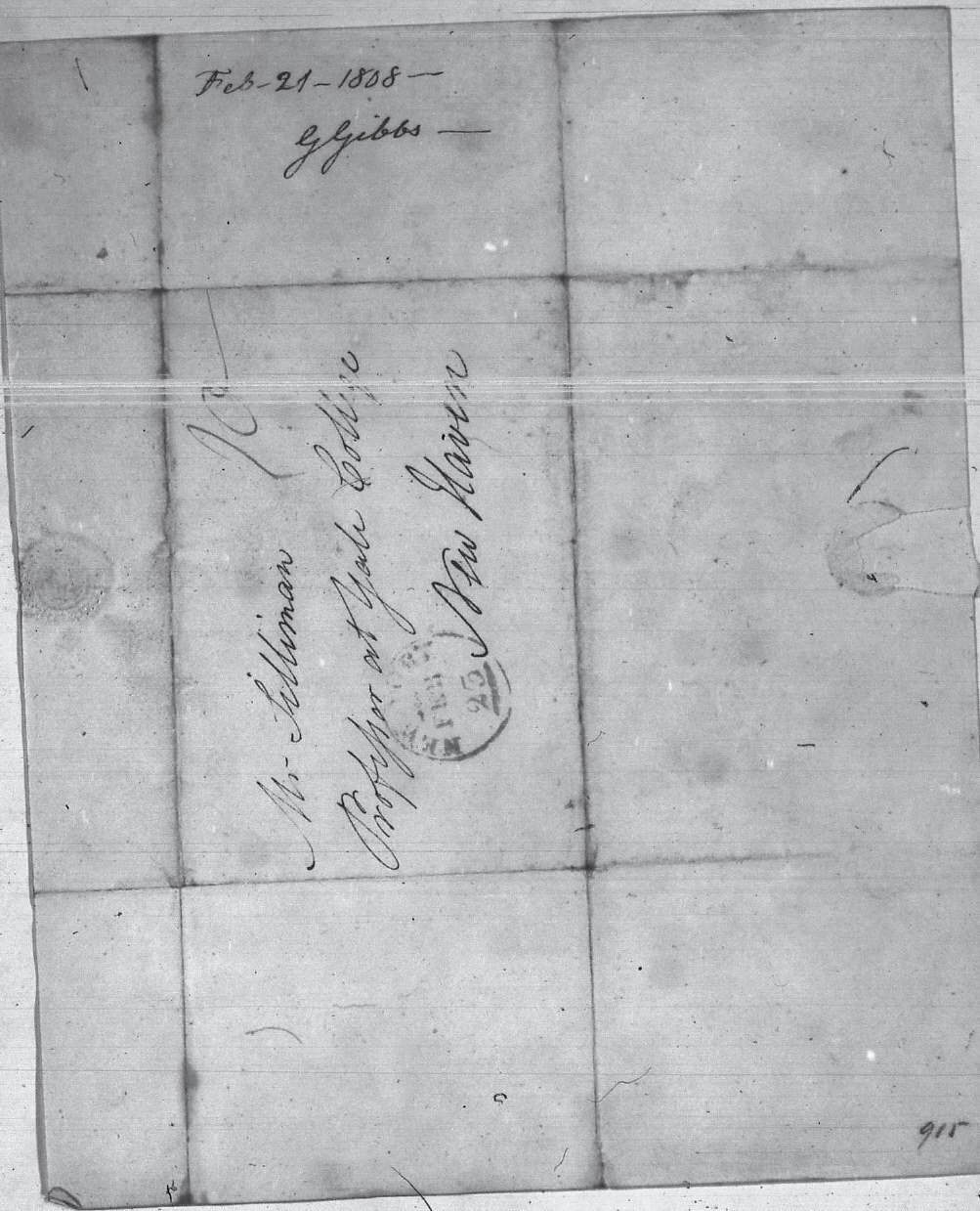
THE ADDRESS PANEL AND DOCKET
Mr Silliman / Professor at Yale College / New Haven [circular postmark: NEW-YORK[?] FEB 25] [manuscript postal rate mark: 10[?]]
[endorsed, top of wrapper:] Feb 21 1808 — / G Gibbs —
Transcribed verbatim from the scans, keeping the original spelling, capitalization, and punctuation; the manuscript’s own dashes are kept, bracketed words are interlineations or uncertain readings, and [illegible] marks passages lost to the film. Condition: A hurried single-page letter (Gibbs signs off ‘in haste’) in a rapid, heavily dashed hand; the year 1808 is supplied in an archivist’s penciled bracket at the top of the letter page and confirmed by the docket. One line is badly faded/rubbed: after ‘a few pieces of the’ the word read as ‘meteoric’ and the verb between ‘Stone to’ and ‘with me’ are largely lost (this is Silliman’s Weston meteorite of Dec 1807, but only ‘Stone’ is secure). The interlineated ‘(now if possible)’ is squeezed between lines and keyed by a small x after ‘purchase it for me.’ One struck-through word follows ‘will let you them’. Wrapper carries a New York circular postmark dated FEB 25, a faint manuscript rate mark (probably 10), and the WHS reel frame number 915 in the lower right corner.
Gibbs Family Papers, Wisconsin Historical Society, Reel 1, scans 229–230. Autograph letter of George Gibbs to Benjamin Silliman, New York, February 21, 1808, with its address wrapper. Digitized from the microfilm by this site; transcribed in full above.
“Faites des Minéralogistes en Amérique” 
Fajac, near Toulouse, May 14, 1808
The French geologist Jean-François d’Aubuisson answers Gibbs in the year of his French tour with the most prophetic advice in the reel: if political circumstances deny him a name in the military world he will make one in the scientific world. Follow no system, observe everything, and “make Mineralogists in America” – your knowledge, your intelligence, and your fine cabinet furnish the means. The complete French text is followed by an English translation.
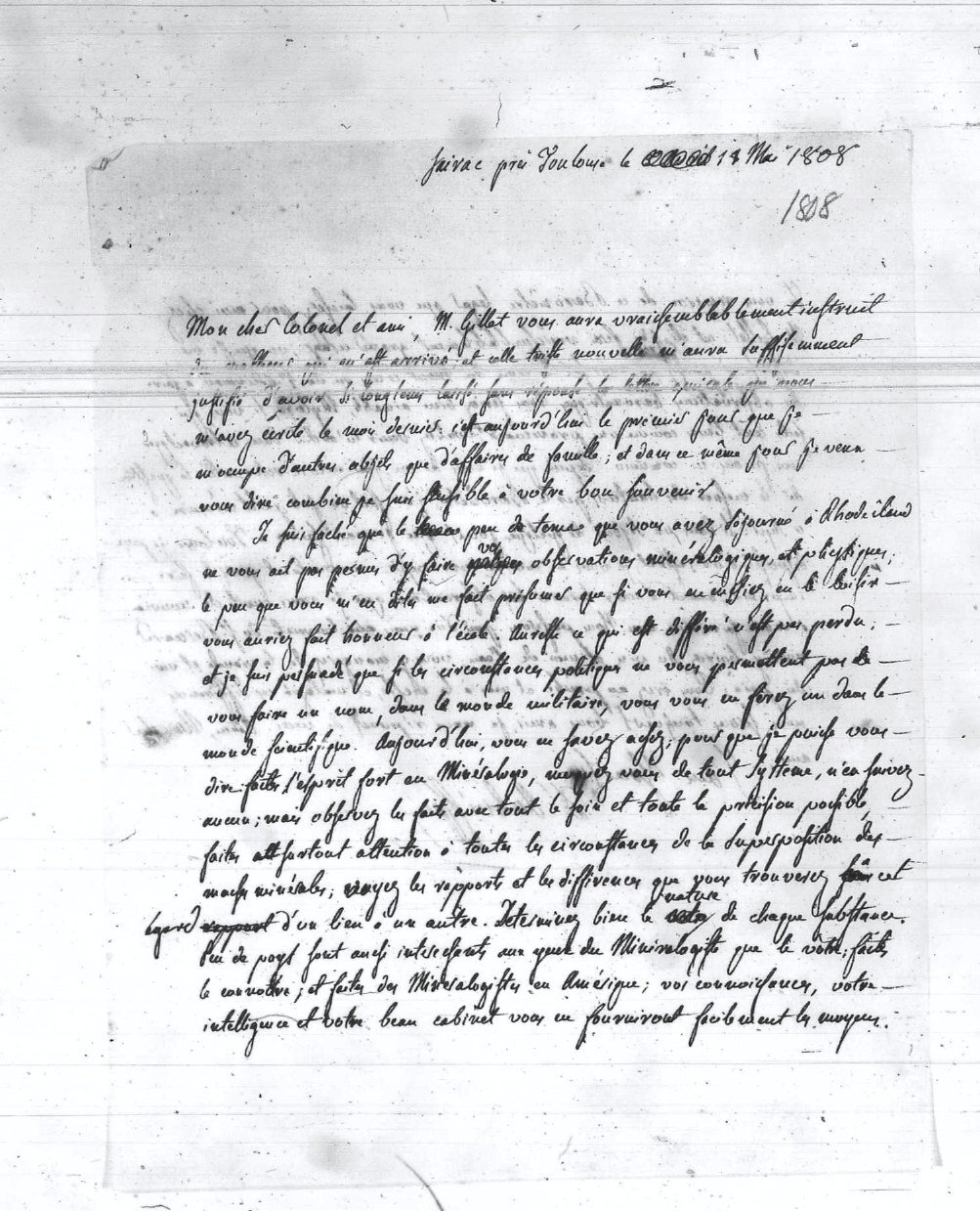
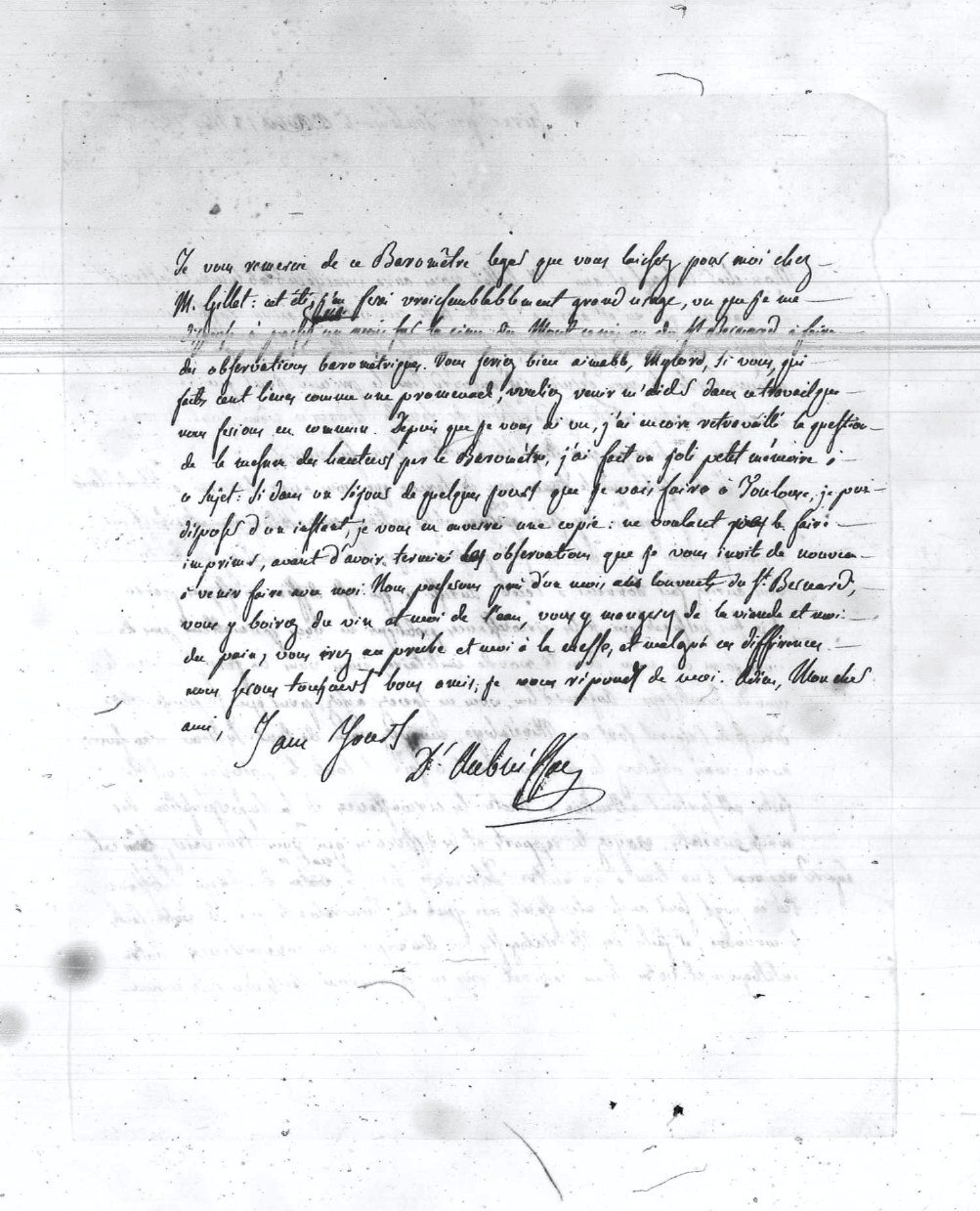
Mon cher Colonel et ami,
M. Gillet vous aura vraisemblablement instruit du malheur qui m’est arrivé; et cette triste nouvelle m’aura suffisamment justifié d’avoir si longtems laissé sans réponse la lettre amicale que vous m’avez écrite le mois dernier. c’est aujourd’hui le premier jour que je m’occupe d’autres objets que d’affaires de famille; et dans ce même jour je veux vous dire combien je suis sensible à votre bon souvenir.
Je suis faché que le peu de tems que vous avez séjourné à Rhode island ne vous ait pas permis d’y faire vos observations minéralogiques, et physiques; le peu que vous m’en dites me fait présumer que si vous en eussiez eu le loisir vous auriez fait honneur à l’école. Au reste ce qui est différé n’est pas perdu; et je suis persuadé que si les circonstances politiques ne vous permettent pas de vous faire un nom, dans le monde militaire, vous vous en ferez un dans le monde scientifique. Aujourd’hui, vous en savez assez; pour que je puisse vous dire: faites l’esprit fort en Minéralogie, moquez vous de tout Systême, n’en suivez aucun; mais observez les faits avec tout le soin et toute la précision possible, faites surtout attention à toutes les circonstances de la superposition des masses minérales; voyez les rapports et les différences que vous trouverez à cet égard d’un lieu à un autre. Déterminez bien la nature de chaque substance. Peu de pays sont aussi intéressants aux yeux du Minéralogiste que le vôtre; faites le connoître; et faites des Minéralogistes en Amérique; vos connoissances, votre intelligence et votre beau cabinet vous en fourniront facilement les moyens.
Je vous remercie de ce Baromètre léger que vous laissez[?] pour moi chez M. Gillet: cet été, j’en ferai vraisemblablement grand usage, vu que je me dispose[?] à passer un mois [illegible] au pied[?] des Monts[?] [illegible] à faire des observations barométriques. Vous seriez bien aimable, Mylord, si vous, qui faites cent lieues comme une promenade, vouliez venir m’aider dans ce travail que nous ferions en commun. Depuis que je vous ai vu, j’ai encore retravaillé la question de la mesure des hauteurs par le Baromètre; j’ai fait un joli petit mémoire à ce sujet: si dans un séjour de quelques jours que je vais faire à Toulouse, je puis disposer d’un instant, je vous en adresse une copie: ne voulant pas la faire imprimer, avant d’avoir terminé les observations que je vous invite de nouveau à venir faire avec moi. Nous passerons près d’un mois au couvent du St. Bernard, vous y boirez du vin et moi de l’eau, vous y mangerez de la viande et moi du pain, vous irez au prêche et moi à la messe, et malgré ces différences nous serons toujours bons amis; je vous réponds de moi. Adieu, Mon cher ami,
I am Yours
D’Aubuisson
ENGLISH TRANSLATION (EDITORIAL)
My dear Colonel and friend,
M. Gillet will in all likelihood have informed you of the misfortune that has befallen me; and that sad news will have sufficiently excused my having so long left unanswered the friendly letter you wrote me last month. Today is the first day that I have occupied myself with any objects other than family affairs; and on this same day I want to tell you how touched I am by your kind remembrance.
I am sorry that the short time you spent in Rhode Island did not permit you to make your mineralogical and physical observations there; the little you tell me of it leads me to presume that, had you had the leisure, you would have done honor to the school. For the rest, what is deferred is not lost; and I am persuaded that if political circumstances do not permit you to make a name for yourself in the military world, you will make one in the scientific world. Today you know enough for me to be able to tell you: be a freethinker in Mineralogy, laugh at every System, follow none; but observe the facts with all the care and all the precision possible; above all pay attention to every circumstance of the superposition of the mineral masses; note the correspondences and the differences that you will find in this regard from one place to another. Determine well the nature of each substance. Few countries are as interesting in the eyes of the Mineralogist as yours; make it known, and make Mineralogists in America; your knowledge, your intelligence, and your fine cabinet will easily furnish you the means.
I thank you for that light Barometer which you left[?] for me with M. Gillet: this summer I shall in all likelihood make great use of it, seeing that I am preparing[?] to spend a month [illegible] at the foot[?] of the Mounts[?] [illegible] making barometric observations. You would be very kind, Mylord, if you, who cover a hundred leagues as if on a stroll, would be willing to come help me in this work, which we would do in common. Since I saw you, I have worked over again the question of the measurement of heights by the Barometer; I have written a nice little memoir on the subject: if, during a stay of a few days that I am going to make at Toulouse, I can spare a moment, I will send you a copy of it, not wishing to have it printed before having finished the observations which I invite you once again to come and make with me. We shall spend nearly a month at the convent of St. Bernard; there you will drink wine and I water, there you will eat meat and I bread, you will go to the sermon and I to Mass, and in spite of these differences we shall always be good friends; I answer for myself. Farewell, my dear friend,
I am Yours
D’Aubuisson
Transcribed verbatim from the scans, keeping the original spelling, capitalization, and punctuation; the manuscript’s own dashes are kept, bracketed words are interlineations or uncertain readings, and [illegible] marks passages lost to the film. Condition: Two leaves on faint microfilm with heavy show-through from the facing pages. Scan 231 (first leaf): a word struck out before the day in the dateline is illegible; the day reads 14 (13 possible); an archivist’s ‘1808’ is added at upper right in a later hand. Lines 2-3 are the most faded on this leaf but recoverable. The author made several currente calamo corrections (words struck and replaced, e.g. before ‘surtout attention’, before ‘voyez les rapports’, and ‘nature’ written over a cancelled word); the transcription gives his corrected final text. Scan 232 (second leaf, with signature): line 3, naming where the summer barometric campaign was to take place, is badly faded and partly struck over and is the one substantially lost passage; ‘au pied des Monts’ is a doubtful reading. The closing ‘I am Yours’ is in English in the original, above the signature and paraph. Throughout both leaves d’Aubuisson finishes short lines with long right-margin filler dashes; these fall mid-sentence (the prose runs continuously across them) and are line-justification strokes, not textual dashes, so they are not reproduced in the text.
Gibbs Family Papers, Wisconsin Historical Society, Reel 1, scans 231–232. Autograph letter of Jean-François d’Aubuisson de Voisins to Col. George Gibbs, May 14, 1808, in French. Digitized from the microfilm by this site; transcribed in full above, with an editorial English translation.
The Coal Speculation 
Northampton, May 12, 1810
The man of science was also a man of enterprise. Written in great haste as he left the Connecticut Valley, this letter lays out Gibbs’s speculation in coal rights near Northampton and South Hadley, and his fury at the rival Nichols, a man whose Rhode Island coal Gibbs says he had himself saved from bankruptcy, who slipped down to the canal under a respectable name and bought up rights from under his agent.
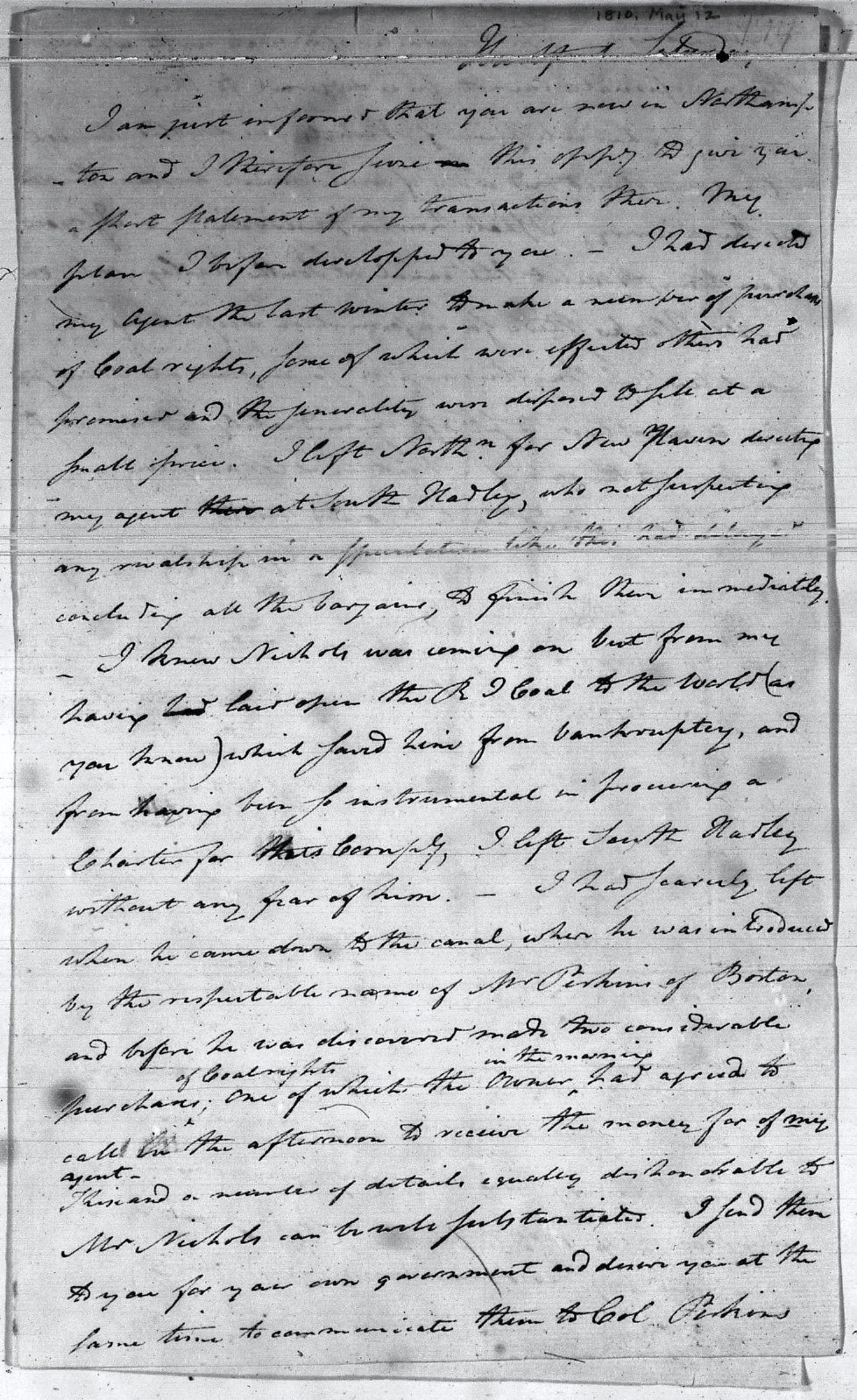
I am just informed that you are now in Northampton and I therefore seize [crossed out: word illegible] this oppy to give you a short statement of my transactions there. My plan I before developped to you. — I had directed my Agent the last winter to make a number of purchases of Coal rights, some of which were effected others had promised and the generality were disposed to sell at a small price. I left Northn for New Haven directing my agent [crossed out: then[?]] at South Hadley, who not suspecting any rivalship in a speculation like this had delay’d[?] concluding all the bargains, to finish them immediatly.
I knew Nichols was coming on but from my having [crossed out: had] laid open the R I Coal to the World (as you know) which saved him from bankruptcy, and from having been so instrumental in procuring a Charter for [crossed out: that] this[?] Compy, I left South Hadley without any fear of him. — I had scarcely left when he came down to the canal, where he was introduced by the respectable name of Mr Perkins of Boston, and before he was discovered made two considerable purchases of Coal rights; one of which the Owner in the morning had agreed to call in the afternoon to receive the money for of my agent — This and a number of details equally dishonorable to Mr Nichols can be well substantiated. I send them to you for your own government and desire you at the same time to communicate them to Col Perkins
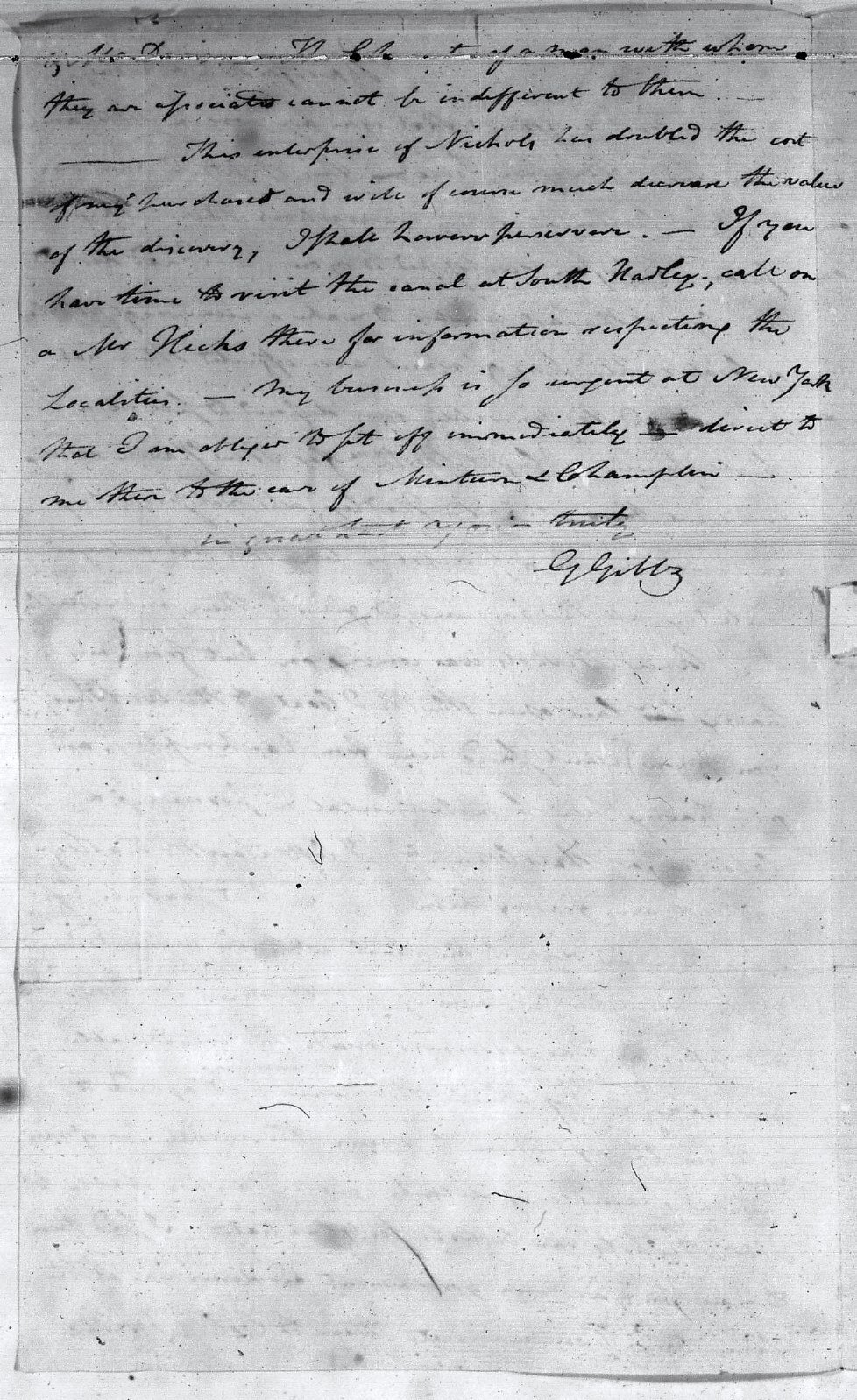
[top line of second page partly trimmed: two or three words illegible] the conduct of a man with whom they are associated cannot be indifferent to them. —
— This enterprise of Nichols has doubled the cost of my purchases and will of course much decrease the value of the discovery, I shall however persevere. — If you have time to visit the canal at South Hadley, call on a Mr Hicks there for information respecting the Localities. — My business is so urgent at New York that I am obliged to set off immediately — direct to me there to the care of Minturn & Champlin —
in great hast[?] yours — truly G Gibbs
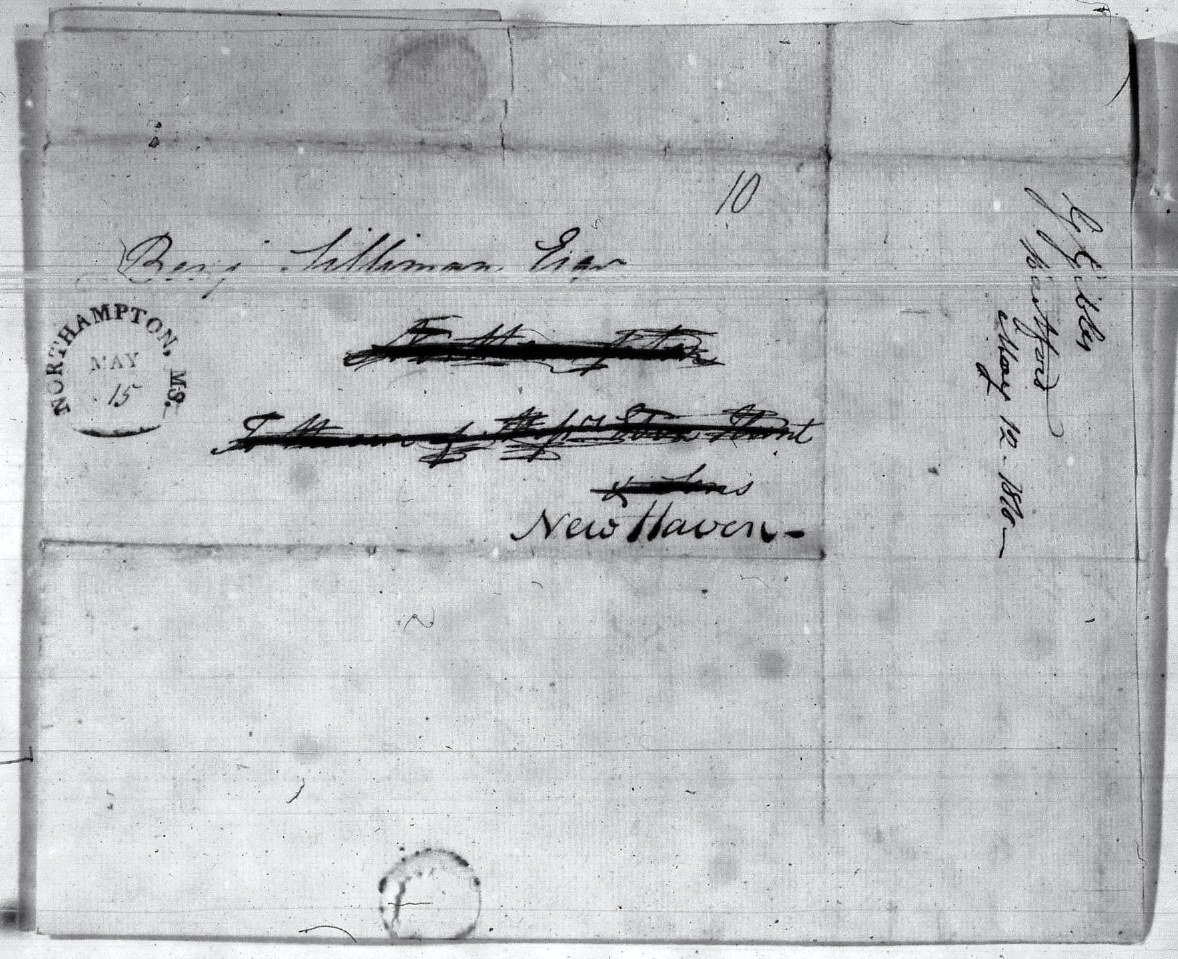
THE ADDRESS PANEL AND DOCKET
Benj Silliman Esqr
[two lines crossed out and illegible — apparently an earlier or forwarding direction, the second line ending Hunt[?]]
New Haven —
[postal rate, in ink:] 10
[circular postmark:] NORTHAMPTON, MS. MAY 15
[endorsement, written vertically at right edge:] G Gibbs Hartford[?] May 12. 1810 —
Transcribed verbatim from the scans, keeping the original spelling, capitalization, and punctuation; the manuscript’s own dashes are kept, bracketed words are interlineations or uncertain readings, and [illegible] marks passages lost to the film. Condition: Microfilm of a two-page autograph letter plus its address wrapper. The head of page 1 is trimmed at the fold, taking the ink dateline (a later pencil hand supplies ‘1810. May 12’); the first line of page 2 is likewise clipped, costing the words that completed the Col Perkins sentence. Gibbs wrote in haste: several words are struck through (rendered [crossed out: …]) and two phrases are interlined above the line (‘of Coal rights’ after ‘purchases’ and ‘in the morning’ before ‘had agreed’, both incorporated into the running text; ‘like this had delay’d’ is an interlined repair whose last word is uncertain). The closing line is badly faded. On the wrapper, two lines of the address were heavily struck out by a contemporary hand and are unrecoverable; the docket word between ‘G Gibbs’ and the date is read uncertainly as ‘Hartford’. Long manuscript dashes are rendered ~~ per house convention.
Gibbs Family Papers, Wisconsin Historical Society, Reel 1, scans 251–253. Autograph letter of George Gibbs to Benjamin Silliman, May 12, 1810, with its address wrapper. Digitized from the microfilm by this site; transcribed in full above.
The Yale Offer 
Boston, March 12, 1811
The founding document of the Gibbs Cabinet. Gibbs offers to open one of his European mineral collections at Yale and specifies the room it will need, about twenty feet by thirty, with shelves and glass doors. Everything that followed, the fifteen-year deposit, the resolution of thanks, the twenty-thousand-dollar purchase, and the name GIBBS CABINET over the door, begins with this page.
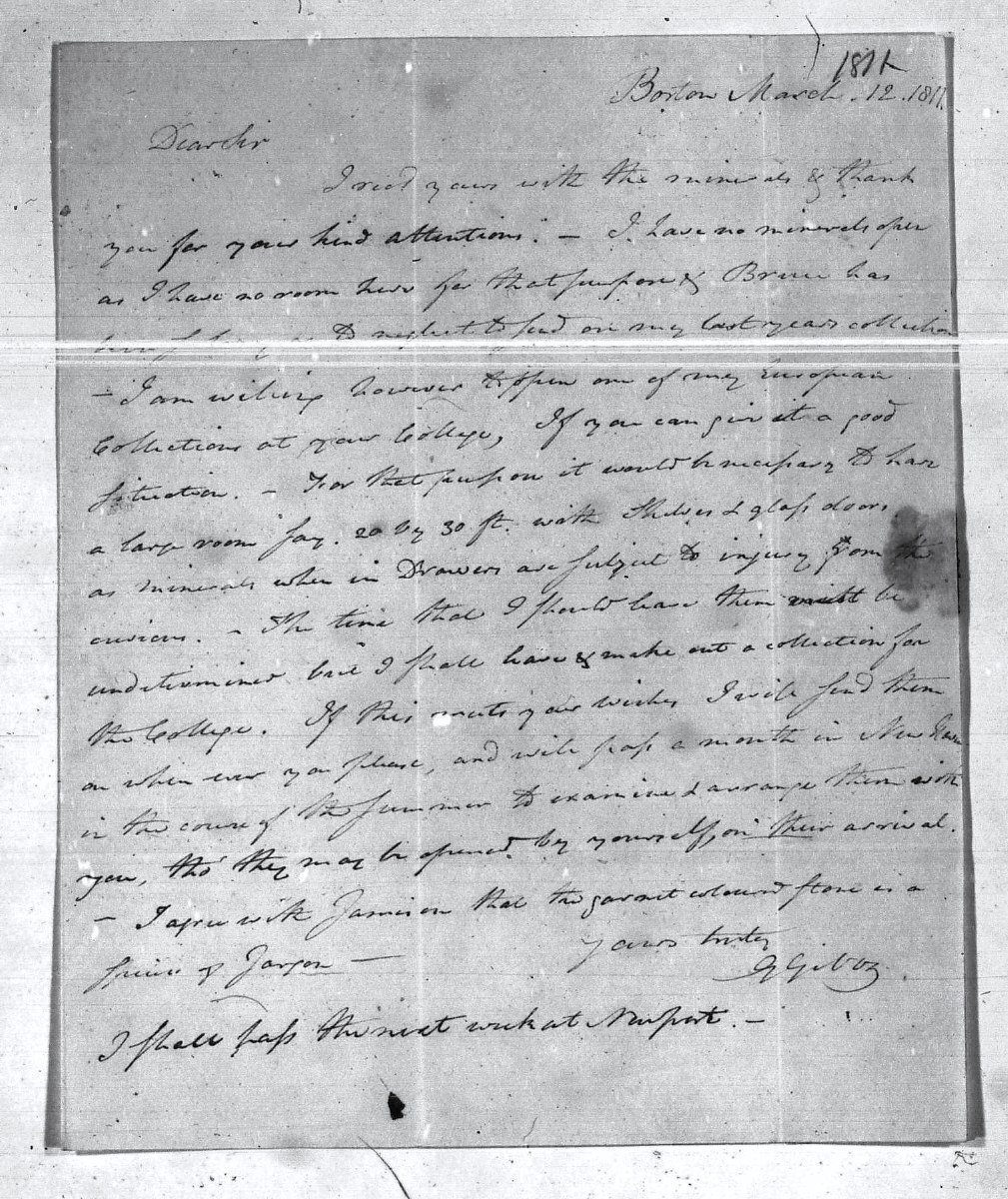
Dear Sir
I recd yours with the minerals & thank you for your kind attentions. — I have no minerals open as I have no room here for that purpose & Bruce has [three or four words obscured by a horizontal fold across the sheet] to neglect to send on my last years collection — I am willing however to open one of my European Collections at your College, If you can give it a good Situation. — For that purpose it would be necessary to have a large room say 20 by 30 ft. with Shelves & glass doors, as minerals when in Drawers are subject to injury from the curious. — The time that I should leave them might be undetermined but I shall have &[?] make out a collection for the College. If this meets your wishes I will send them on when ever you please, and will pass a month in New Haven in the course of the Summer to examine & arrange them with you, tho they may be opened by yourself on their arrival. — I agree with Jamison that the garnet coloured stone is a species of Jargon —
yours truly G Gibbs
I shall pass the next week at Newport. —
THE ADDRESS PANEL AND DOCKET
Benj. Silliman Esqr
[notation in a second hand, above the town line:] Missent to N.Y
New Haven
[postal rate, in ink, struck large across the panel between dashes:] 10
[large flourished figure in ink below the address, apparently a postal clerk’s mark: 2[?]]
[circular postmark, at left:] NEW-YORK 17 MAR
[faint second circular strike at upper left edge, mostly illegible: MAR visible]
[docket, written vertically at right edge:] Boston Mar. 12. 1811 G Gibbs —
Transcribed verbatim from the scans, keeping the original spelling, capitalization, and punctuation; the manuscript’s own dashes are kept, bracketed words are interlineations or uncertain readings, and [illegible] marks passages lost to the film. Condition: Microfilm of a one-page autograph letter (scan 262) and its address wrapper (scan 263); scan 264, a duplicate exposure of the wrapper, is omitted. On the letter a heavy horizontal fold-line crosses the fourth line of text, obliterating three or four words of the clause about Dr. Bruce; the surviving tail reads ‘to neglect to send on my last years collection’. In the sentence ‘I shall have &[?] make out a collection for the College’ the mark read as an ampersand is cramped against ‘make’ and could be intended otherwise. Gibbs underlined ‘their’ in ‘opened by yourself on their arrival’; the underline is his. Original spelling and lack of apostrophes (‘last years’, ‘tho’, ‘when ever’, ‘Jamison’, ‘Jargon’ for jargoon/zircon) are retained. On the wrapper the 10-cent rate is written large between long dashes across the address; the big flourished figure beneath ‘New Haven’ is read uncertainly as a clerk’s ‘2’. The New-York circular postmark of 17 March corroborates the ‘Missent to N.Y’ notation; a second, fainter strike at the left edge is illegible beyond ‘MAR’. Long manuscript dashes are rendered ~~ per house convention.
Gibbs Family Papers, Wisconsin Historical Society, Reel 1, scans 262–263. Autograph letter of George Gibbs to Benjamin Silliman. Digitized from the microfilm by this site; transcribed in full above.
The French Plan 
New York, May 1811
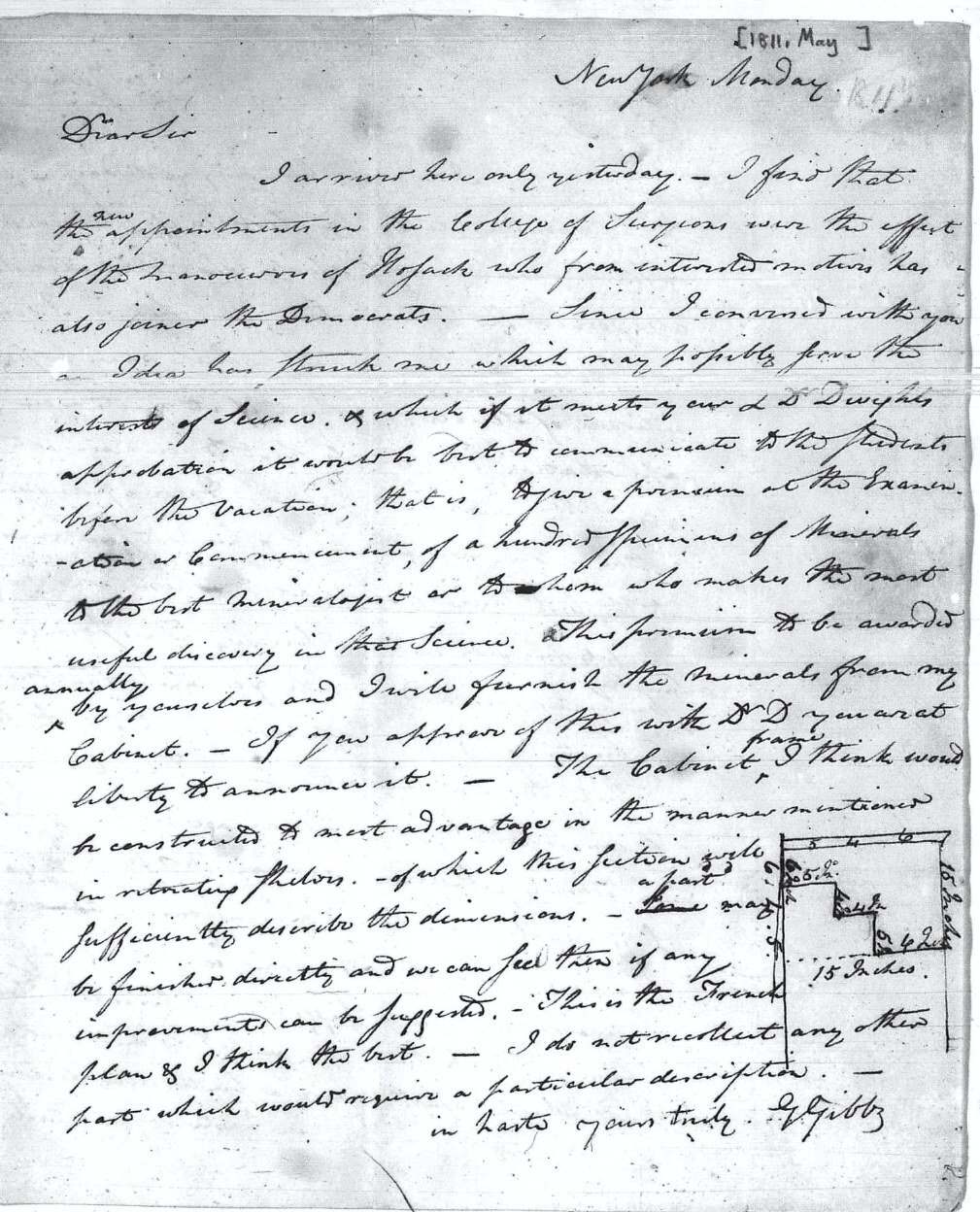
Two months after the offer, the practical sequel: how to fit up the room. Gibbs proposes an annual premium of a hundred mineral specimens for the students and sketches the stepped shelving of the French cabinets for Silliman to copy, with a sideswipe at the manoeuvres of Dr. Hosack along the way.
Dear Sir —
I arrived here only yesterday. — I find that the new [“new” interlined] appointments in the College of Surgeons were the effect of the manoeuvres of Hosack who from interested motives has also joined the Democrats. — Since I conversed with you an Idea has struck me which may possibly serve the interests of Science, & which if it meets your & Dr Dwights approbation it would be best to communicate to the Students before the Vacation; that is, to give a premium at the Examination or Commencement, of a hundred Specimens of Minerals to the best Mineralogist or to him who makes the most useful discovery in that Science. This premium to be awarded annually [“annually” interlined] by yourselves and I will furnish the minerals from my Cabinet. — If you approve of this with Dr D you are at liberty to announce it. —
The Cabinet frame [“frame” interlined] I think would be constructed to most advantage in the manner mentioned in retreating shelves. — of which this Section will sufficiently describe the dimensions. — [Here, in the right margin beside these lines, Gibbs pens a cross-section of the stepped shelving: a right-angled profile of three receding steps rising against a vertical back marked “18 Inches” (rotated) and standing on a base marked “15 Inches.”; the step treads are figured across the top 5, 4[?], and 6 inches, and the steps themselves are annotated “5 Do”, “4 Do”, and “4 In[?]”, with further small figures along the left riser edge [illegible].] a part [interlined above a cancelled “Same”] may be finished directly and we can see[?] then if any improvements can be suggested. — This is the French plan & I think the best. — I do not recollect any other part which would require a particular description. —
in haste yours truly. G Gibbs
[Address wrapper, scan 268]
B. Silliman. Esqr. — at Yale College — New Haven
[Docketed vertically at left edge of the wrapper, in the recipient’s hand:] G Gibbs — New York — May — 1811
Transcribed verbatim from the scans, keeping the original spelling, capitalization, and punctuation; the manuscript’s own dashes are kept, bracketed words are interlineations or uncertain readings, and [illegible] marks passages lost to the film. Condition: Letter written in Gibbs’s rapid hand with several interlineations (new, annually, frame, a part-over-cancelled-Same); undated beyond “New York Monday”, with “[1811, May]” supplied in pencil by an archivist at the head and confirmed by the wrapper docket. The marginal cross-section sketch is clear in outline but its smaller figures are cramped: the middle tread figure and the lowest step annotation are read with reservation (4[?], 4 In[?]) and the small figures on the left riser edge are illegible. “see then” in the finishing sentence could alternatively be read “feel then”. NOTE ON SCAN NUMBERS: the letter is scan 267 and its wrapper is scan 268; scan 269 (checked) is an unrelated docket panel reading “Deed ~~ Joshua Gilpin Esqr[?] ~~ Mary Gibbs” with filing note “1.67[?] fd 17th Jany 1811” and does not belong to this document.
Gibbs Family Papers, Wisconsin Historical Society, Reel 1, scans 267–268 (an earlier pass of the catalogue misnumbered this letter as scan 269; corrected against the files July 13, 2026). Autograph letter of George Gibbs to Benjamin Silliman, with its wrapper. Digitized from the microfilm by this site; transcribed in full above.
“My Dear Nephew”: A Marriage in the Family 
Newport, October 9, 1811
The Rev. Henry Channing conducts family diplomacy over an impending marriage in the Gibbs family, and begs George to come and take his place in the family circle for it. Written the year after George’s own marriage to Laura, it is the Newport kin at their most characteristic: affection administered with a clergyman’s care.
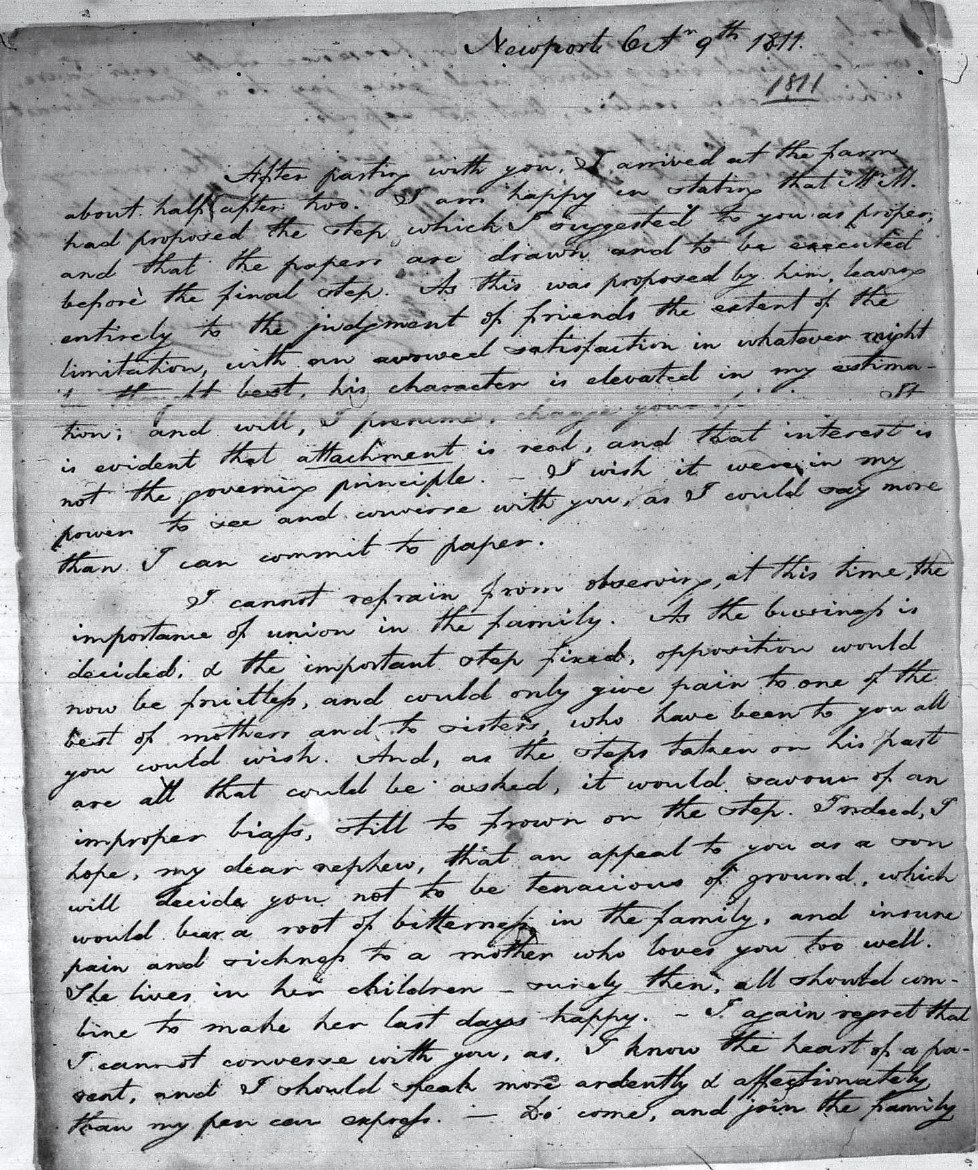
After parting with you, I arrived at the farm about half after two. I am happy in stating that Mr M.[?] had proposed the step, which I suggested to you as proper, and that the papers are drawn, and to be executed before the final step. As this was proposed by him, leaving entirely to the judgment of friends the extent of the limitation, with an avowed satisfaction in whatever might be thought best, his character is elevated in my estima—tion; and will, I presume, [struck: change your f[illegible]]. It is evident that attachment is real, and that interest is not the governing principle. — I wish it were in my power to see and converse with you, as I could say more than I can commit to paper.
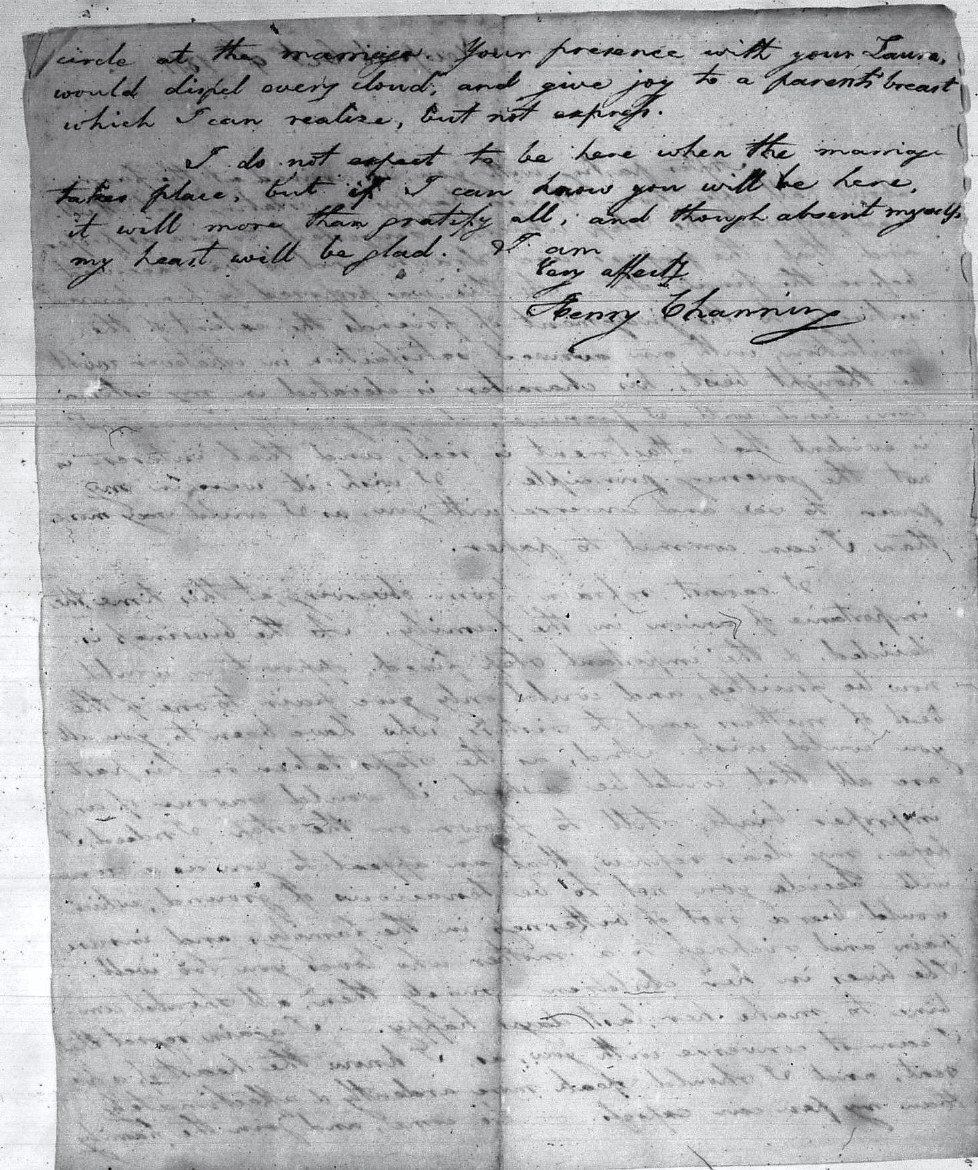
I cannot refrain from observing, at this time, the importance of union in the family. As the business is decided, & the important step fixed, opposition would now be fruitless, and could only give pain to one of the best of mothers and to sisters, who have been to you all you could wish. And, as the steps taken on his part are all that could be asked, it would savour of an improper biass, still to frown on the step. Indeed, I hope, my dear nephew, that an appeal to you as a son will decide you not to be tenacious of ground, which would bear a root of bitterness in the family, and insure pain and sickness[?] to a mother who loves you too well. She lives in her children — surely then, all should com—bine to make her last days happy. — I again regret that I cannot converse with you, as, I know the heart of a pa—rent, and I should speak more ardently & affectionately than my pen can express. — Do come, and join the family circle at the marriage. Your presence with your Laura, would dispel every cloud, and give joy to a parent’s breast which I can realize, but not express.
I do not expect to be here when the marriage takes place, but if I can know you will be here, it will more than gratify all, and though absent myself, my heart will be glad. I am
very affectly
Henry Channing
Transcribed verbatim from the scans, keeping the original spelling, capitalization, and punctuation; the manuscript’s own dashes are kept, bracketed words are interlineations or uncertain readings, and [illegible] marks passages lost to the film. Condition: Two-page letter. NOTE ON SCAN NUMBERS: the letter is scans 276 (page 1) and 277 (page 2), not 275-276 as first catalogued; 275.pdf is an unrelated document, a Philadelphia indenture of 17 June 1811 conveying a Chesnut Street lot from Joshua Gilpin and wife Mary to Mary Gibbs. Page 1 (276) is clean and largely legible with heavy show-through from the verso; page 2 (277) carries only nine lines plus the closing, the rest being show-through of page 1. ‘Mr M.’ (second line of page 1) is the best reading of an abbreviated name for the prospective husband; the abbreviation is cramped and could be read otherwise, so marked [?]. The letter never names the parties to the marriage: the man is ‘Mr M.[?]’ / ‘he’ / ‘his’, the bride is never named, and the injured parties of any opposition would be ‘one of the best of mothers and to sisters’ — i.e., a marriage within Col. Gibbs’s immediate family circle, but the text itself does not say whose. ‘attachment’ (page 1) is underlined in the manuscript. A struck passage follows ‘and will, I presume,’ at a fold/artifact band crossing the page; it appears to begin ‘change your f…’ and is otherwise unrecoverable, marked [struck: change your f[illegible]]. ‘sickness’ in ‘insure pain and sickness to a mother’ is a best reading (could be read ‘richness’, which makes no sense in context). ‘your Laura’ (page 2) is George’s wife Laura. Closing reads ‘very affectly’ with ‘ly’ superscripted. A later pencil ‘1811’ below the date line is an archivist’s annotation, not transcribed. Original spelling retained (e.g., ‘biass’, ‘savour’); hyphenated line-break words joined with ~~ and manuscript dashes rendered ~~ per house convention.
Gibbs Family Papers, Wisconsin Historical Society, Reel 1, scans 276–277 (an earlier pass misnumbered these; corrected against the files July 13, 2026 — scan 275 is an unrelated Philadelphia indenture). Autograph letter of the Rev. Henry Channing to his nephew Col. George Gibbs. The couple is never named in the letter; the exhibit does not guess. Digitized from the microfilm by this site; transcribed in full above.
Quincy’s Prophecy 
Washington, December 7, 1811
Gibbs had proposed exempting books and philosophical apparatus from the non-intercourse laws; his friend Josiah Quincy, the Federalist congressman, answers from Washington in full satirical cry, and closes with a prediction about the coming war with Britain that history would overturn within six months. The exact words are in the transcription; the war was declared the following June.
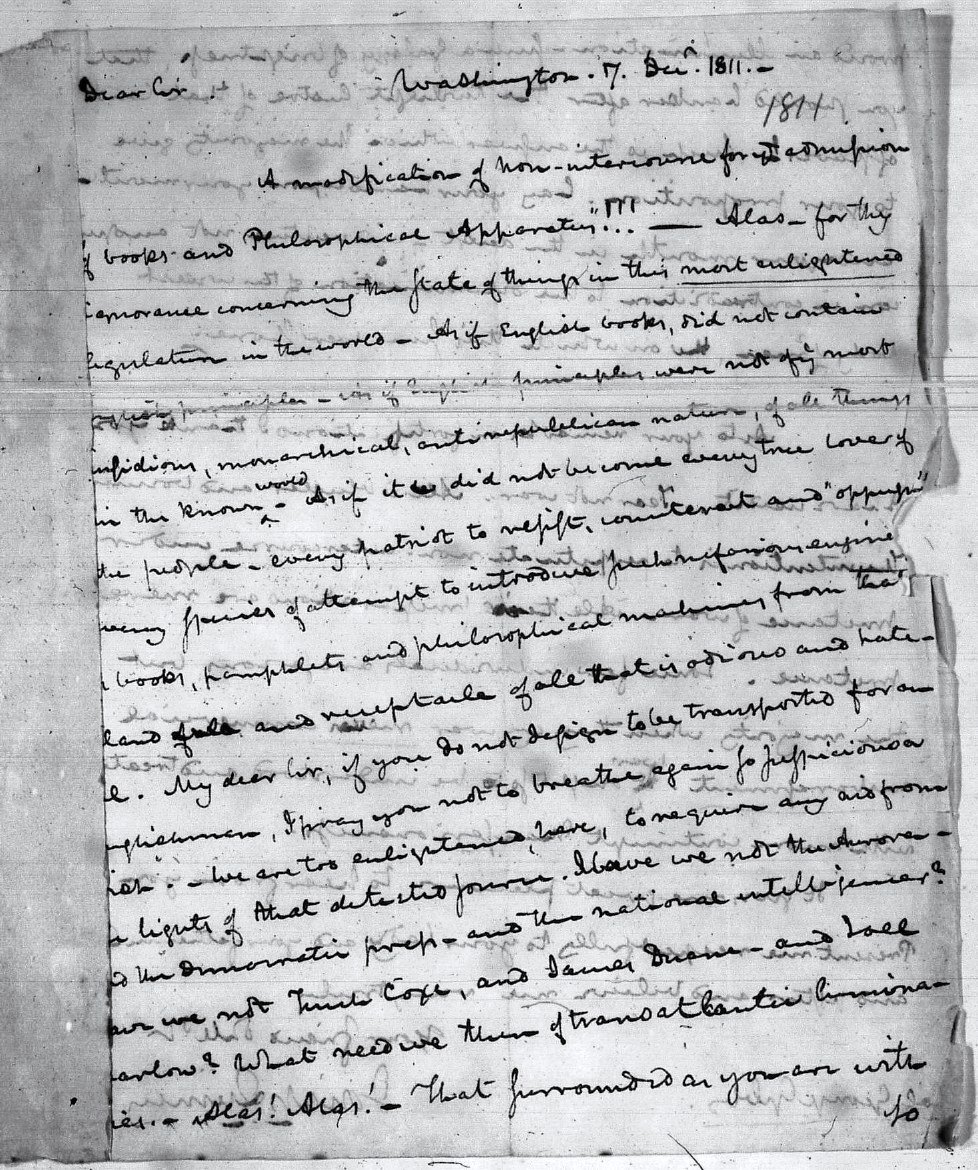
Dear Sir,
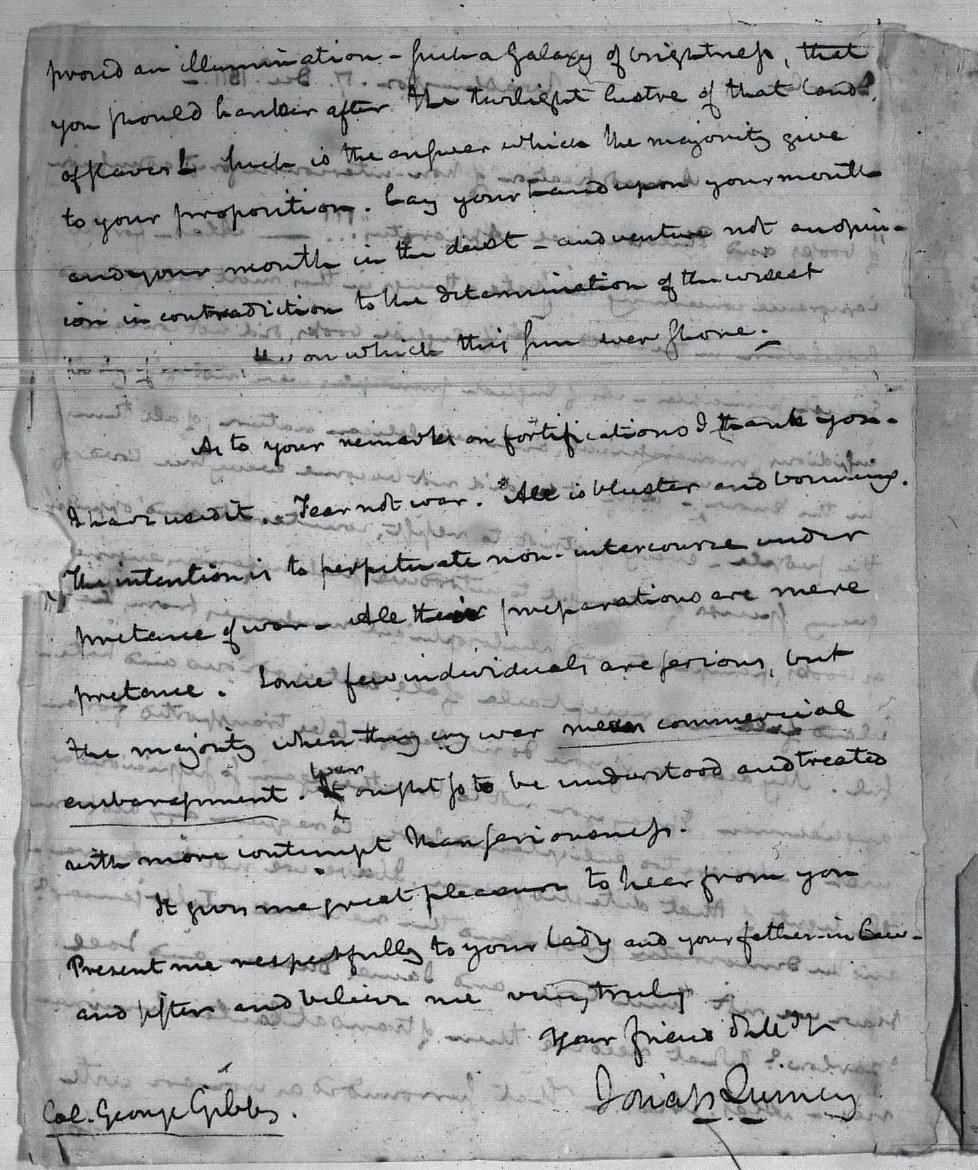
“A modification of non-intercourse for the admission of books and Philosophical Apparatus”!!! — Alas — for thy ignorance concerning the state of things in this most enlightened legislation[?] in the world — As if English books, did not contain English principles — as if English principles were not of the most insidious, monarchical, antirepublican nature, of all things in the known world — As if it did not become every true lover of the people — every patriot to resist, counteract and “oppose” every species of attempt to introduce such nefarious engines as books, pamphlets and philosophical machines from that land and receptacle of all that is odious and hateful. My dear Sir, if you do not design to be transported for an Englishman, I pray you not to breathe again so suspicious a wish. — we are too enlightened here, to require any aid from the lights of that detested fountain[?]. Have we not the Aurora — and the Democratic press — and the national intelligencer? Have we not Tench Coxe, and James Duane — and Joel Barlow? What need we then of transatlantic luminaries. — Alas! Alas! — That surrounded as you are with so proud[?] an illumination — such a Galaxy of brightness, that you should hanker after the twilight lustre of that land of slaves! Such is the answer which the majority give to your proposition. Lay your hand upon your mouth and your mouth in the dust — and venture not an opinion in contradiction to the determination of the wisest nation[?], on which this sun ever shone.
As to your remarks on fortifications I thank you. I have used it. Fear not war. All is bluster and vapouring[?]. The intention is to perpetuate non-intercourse under pretence of war — all their preparations are mere pretence. Some few individuals are serious, but the majority when they cry war mean commercial embarrassment. They ought so to be understood and treated with more contempt than seriousness.
It gives me great pleasure to hear from you. Present me respectfully to your Lady and your father-in-law — and sisters and believe me very truly
Your friend & Serv’t
Josiah Quincy
Col. George Gibbs.
Transcribed verbatim from the scans, keeping the original spelling, capitalization, and punctuation; the manuscript’s own dashes are kept, bracketed words are interlineations or uncertain readings, and [illegible] marks passages lost to the film. Condition: Scan 278 (page 1): left margin trimmed/torn, clipping the first one or two letters of most lines; readings restored from context (e.g. ‘of books’, ‘ignorance’, ‘English’, ‘the people’, ‘as books’, ‘hateful’, ‘Englishman’, ‘wish’, ‘Barlow’, ‘-ies’). ‘legislation[?]’ first letters lost to the tear; ‘nation’ or ‘Legislature’ also possible. Heavy ink bleed-through from the verso throughout both scans. Docket ‘1811’ in another hand at top right of scan 278. Authorial revisions: ‘world’ interlined with caret after ‘in the known’; a word struck through after ‘As if it’; a word struck through and illegible between ‘that land’ and ‘and receptacle’ (deletions omitted from text); on scan 279 ‘They’ interlined above a struck ‘It’ before ‘ought so to be understood’. Underscored in the manuscript: ‘most enlightened’ (p1), ‘mean commercial embarrassment’ (p2), ‘Col. George Gibbs.’ (p2). ‘fountain[?]’, ‘proud[?]’, and ‘vapouring[?]’ are uncertain readings obscured by bleed-through. Catchword at foot of scan 278 (‘so’) repeated at head of scan 279. Manuscript long dashes rendered as ~~ per convention.
Gibbs Family Papers, Wisconsin Historical Society, Reel 1, scans 278–279. Autograph letter of Josiah Quincy to Col. George Gibbs. Digitized from the microfilm by this site; transcribed in full above.
Founding the Geological Society 
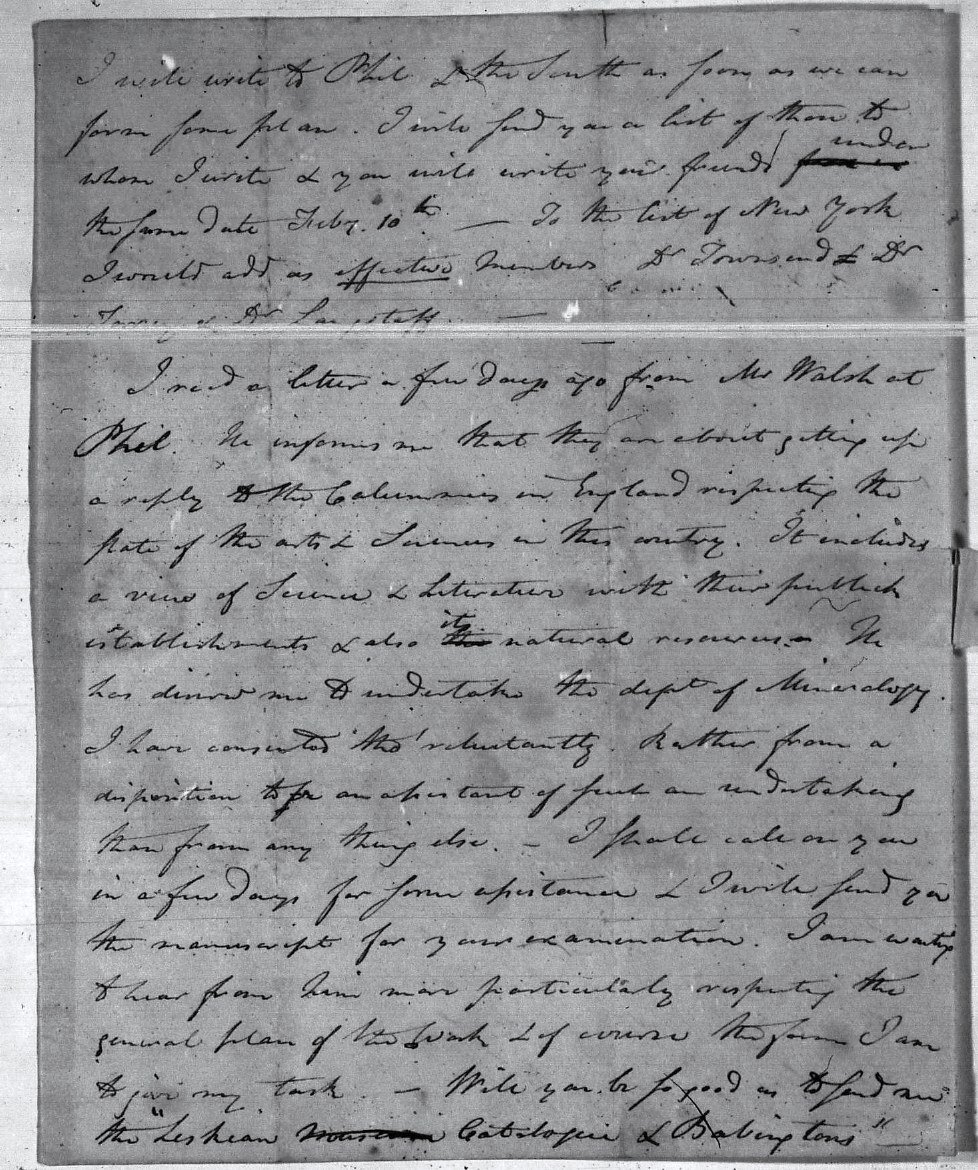
New York, March 11, 1812
The centerpiece of the reel’s scientific correspondence. Gibbs reports that Davis, Channing, Webster, Hunt, and Cleaveland have all answered him, that the name Geological Society is agreed, and then sets down a five-point founding programme, with the first meeting to be held at New Haven the day before Commencement and the rules to be drawn by “S & G,” Silliman and Gibbs. In the same letter he reluctantly agrees to write the Mineralogy department of Walsh’s answer to English calumnies on American arts and sciences. The American Geological Society would be organized at New Haven seven years later with Gibbs among its founders; here is its blueprint.
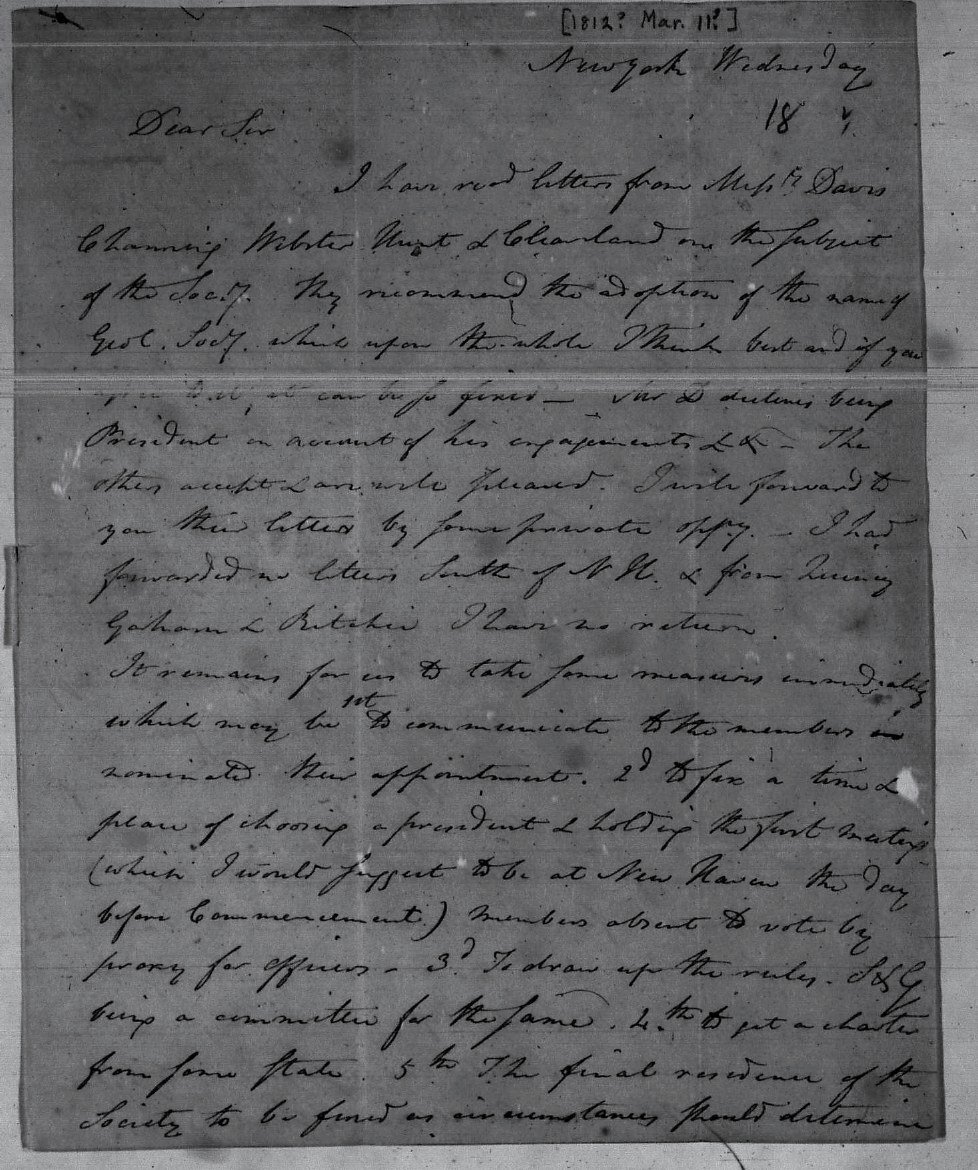
Dear Sir
I have recd letters from Messrs Davis Channing Webster Hunt & Cleaveland on the subject of the Socty. They recommend the adoption of the name of Geol. Socty. which upon the whole I think best and if you [illegible], it can be so fixed — Mr D declines being President on account of his engagements &c — The others accept & are well pleased. I will forward to you their letters by some private oppy. — I had forwarded no letters South of N.H. & from Quincy Gorham & Ritchie I have no return.
It remains for us to take some measures immediately which may be 1st To communicate to the members nominated their appointments. 2d To fix a time & place of choosing a president & holding the first meeting (which I would suggest to be at New Haven the day before Commencement.) Members absent to vote by proxy for officers — 3d To draw up the rules. S & G being a committee for the same. 4th to get a charter from some state. 5th The final residence of the Society to be fixed as circumstances should determine
I will write to Phil & the South as soon as we can form some plan. I will send you a list of those to whom I write & you will write your friends under the same date Feby.[?] 10th. — To the list of New York I would add as effective Members Dr Townsend & Dr [illegible] & Dr Langstaff. —
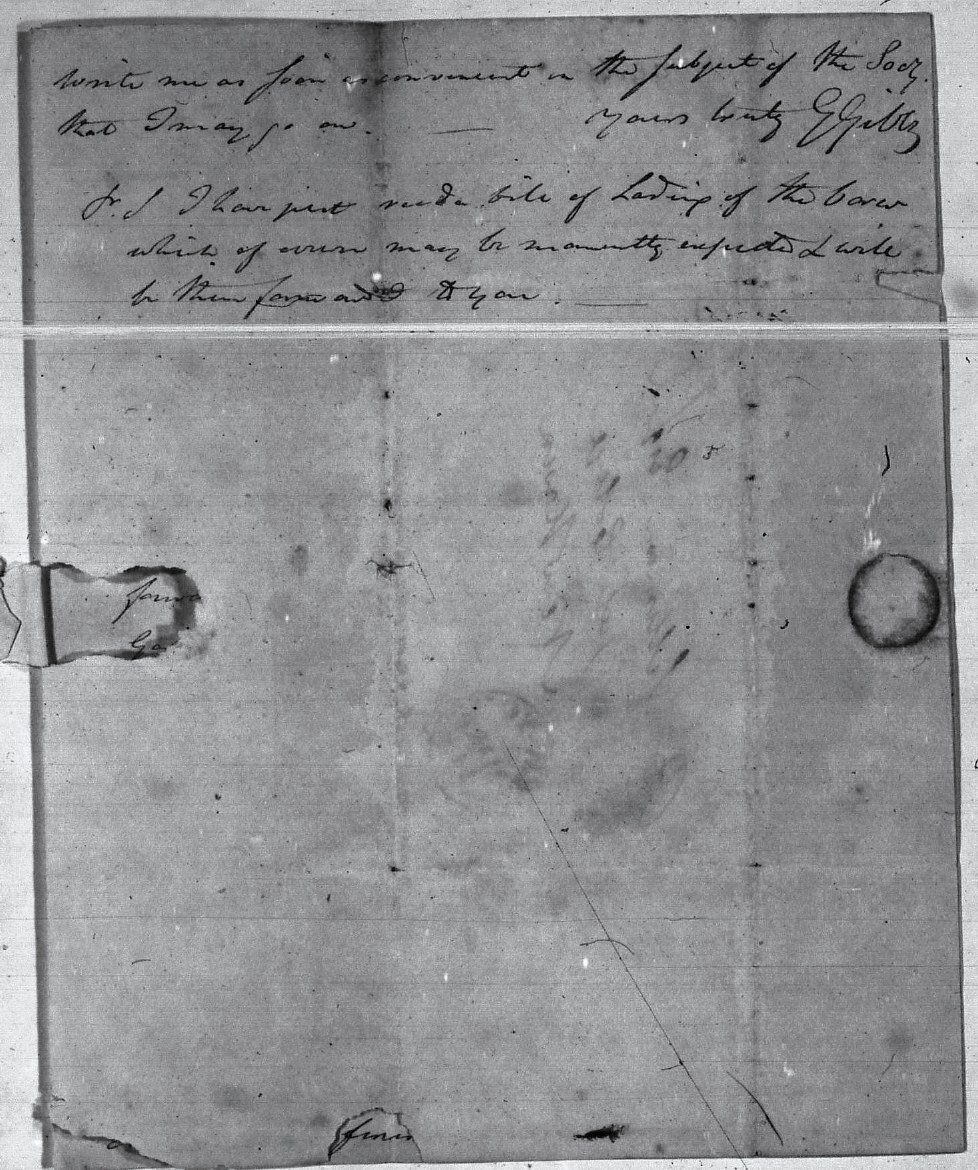
I recd a letter a few days ago from Mr Walsh at Phil. He informs me that they are about getting up a reply to the Calumnies in England respecting the state of the arts & Sciences in this country. It includes a view of Science & Literature with their publick establishments & also its natural resources. — He has desired me to undertake the dept of Mineralogy. I have consented tho’ reluctantly. Rather from a disposition to be an assistant of such an undertaking than from any thing else. — I shall call on you in a few days for some assistance & I will send you the manuscript for your examination. I am waiting to hear from him more particularly respecting the general plan of the Work & of course the form I am to give my task. — Will you be so good as to send me the “Leskean Catalogue & Babingtons” write me as soon as convenient on the subject of the Socty. that I may go on. —
Yours truly G Gibbs
P.S. I have just recd a bile of Lading of the boxes which of course may be momently expected & will be then forwarded to you. —
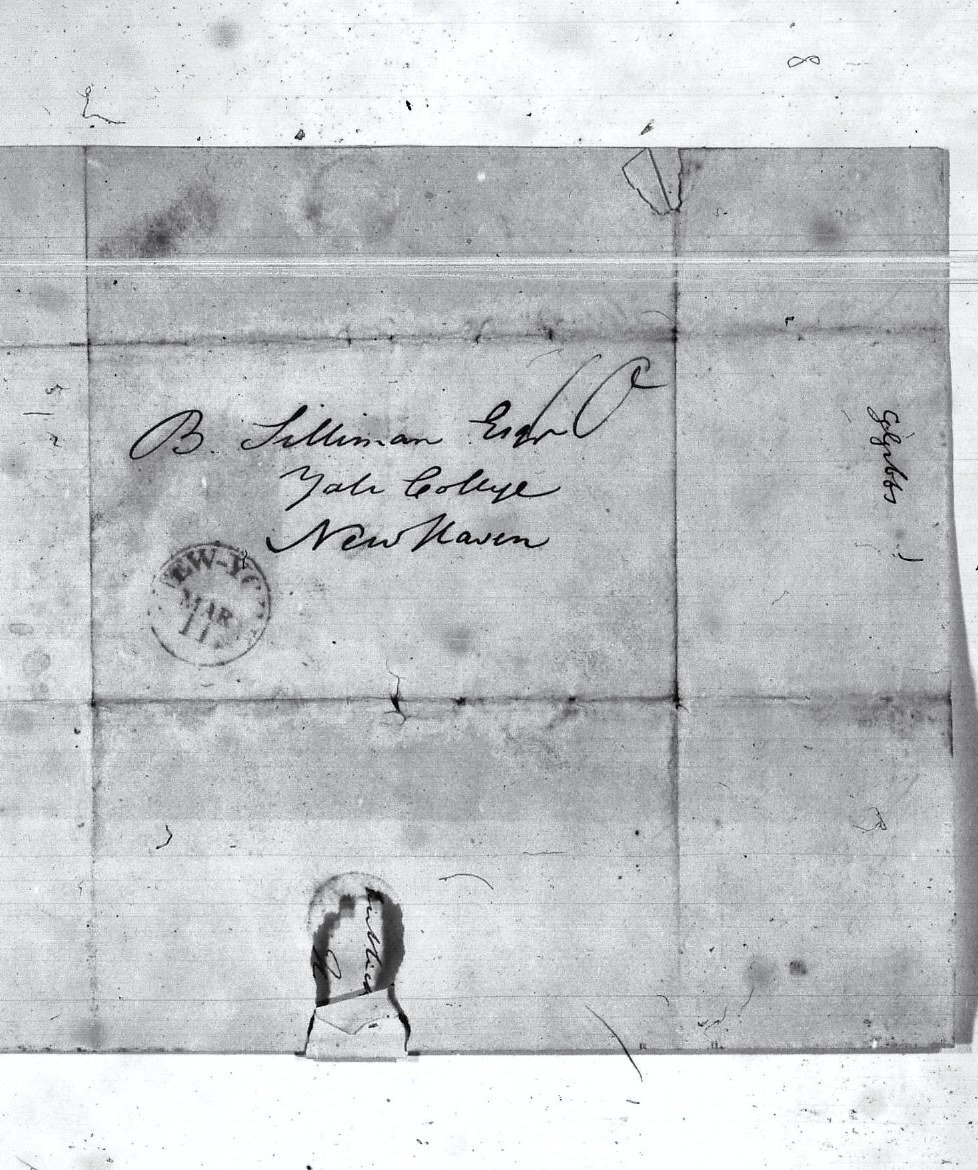
THE ADDRESS PANEL AND DOCKET
B. Silliman Esqr / Yale College / New Haven
[Circular postmark:] NEW-YO[RK] / MAR / 11
[Manuscript rate mark, upper right of address:] 10
[Endorsed vertically at right edge, in another hand:] G. Gibbs
[Verso of the third leaf (scan 287, below the postscript): blank except a torn wafer-seal remnant at left with fragmentary offset letters, [illegible]; faint ink bleed-through of figures from the facing page; a faint scrawl at bottom, [illegible]]
Transcribed verbatim from the scans, keeping the original spelling, capitalization, and punctuation; the manuscript’s own dashes are kept, bracketed words are interlineations or uncertain readings, and [illegible] marks passages lost to the film. Condition: Hasty, heavily abbreviated Gibbs hand on foxed paper; microfilm scan with a horizontal white splice band across each leaf. The bracketed heading “[1812? Mar. 11?]” is a later archivist’s pencil annotation; Gibbs himself wrote only “NewYork Wednesday 18” with the year left unfinished, the date supplied by the NEW-YORK MAR 11 postmark. The splice band obliterates a few words on page 1 after “and if you” (rendered [illegible]). Authorial deletions: on page 2 a word (apparently “from”) struck out and “under” interlined before “the same date”; “this” struck and “its” interlined before “natural resources”; a word (apparently “Museum”) struck out between “Leskean” and “Catalogue”; “1st” is interlined above the line in the numbered programme. The month in “Feby.[?] 10th” and the name of the second New York doctor (between Dr Townsend and Dr Langstaff) are uncertain. “bile of Lading” in the postscript is Gibbs’s spelling as written (for bill of lading). “S & G” = Silliman and Gibbs.
Gibbs Family Papers, Wisconsin Historical Society, Reel 1, scans 285–288. Autograph letter of George Gibbs to Benjamin Silliman, New York, dated by postmark March 11 [1812], with its address cover. Digitized from the microfilm by this site; transcribed in full above.
Vanderlyn Writes from Paris 
Paris, February 7, 1813
Seven pages from the painter John Vanderlyn to his patron. Gibbs’s own portrait is stranded at Cherbourg by the War of 1812; the artist, out of money and out of patience with Paris, resolves to bring the pictures home himself. Along the way: the Sleeping Ariadne hung too high in the exhibition, American scruples about buying a picture of a naked woman, the Antiope after Correggio offered to Gibbs on generous terms, the fear that Mr Peale has exhibited his Marius in Philadelphia, and a plea that Gibbs forget, for this time yet, the money owed him.
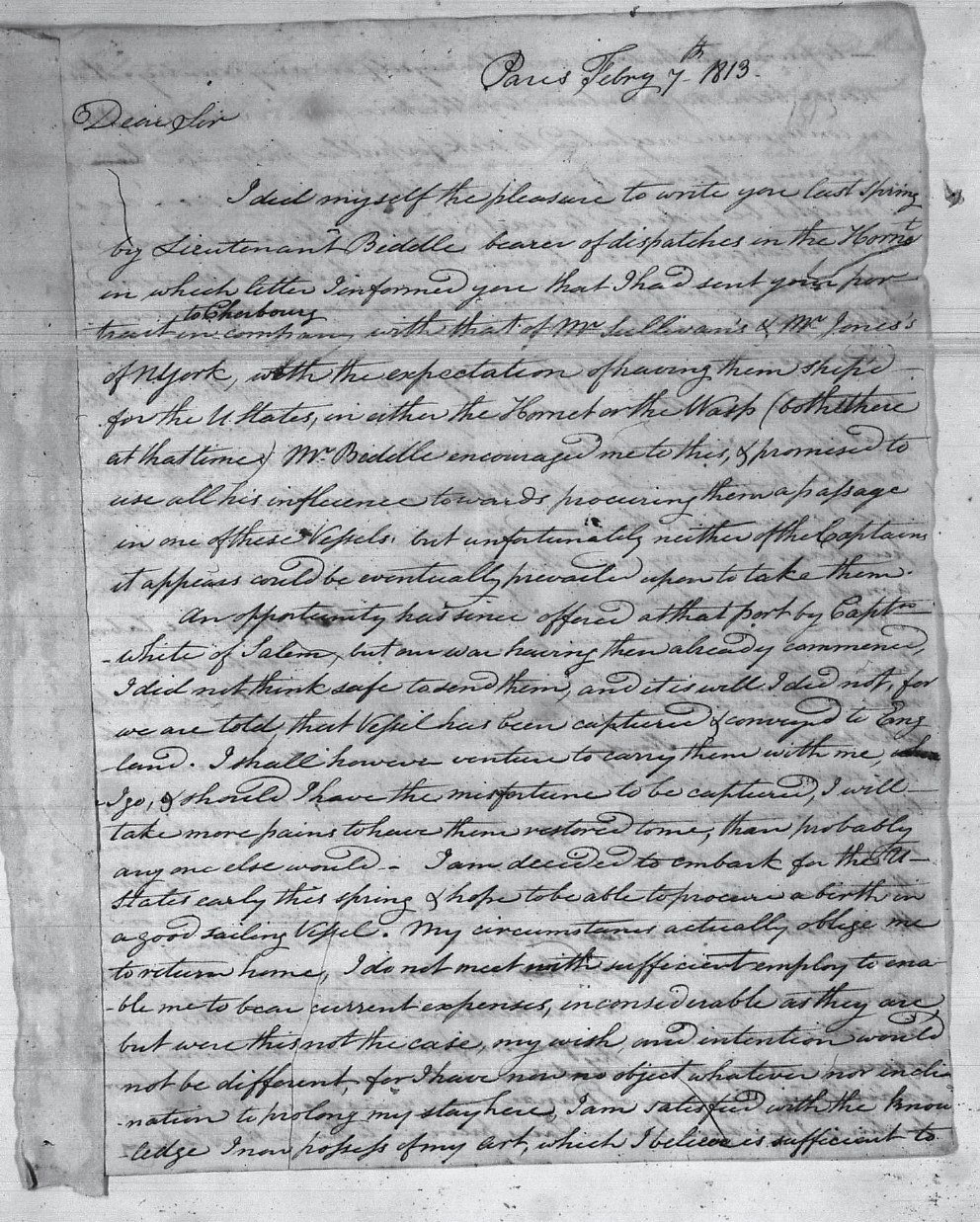
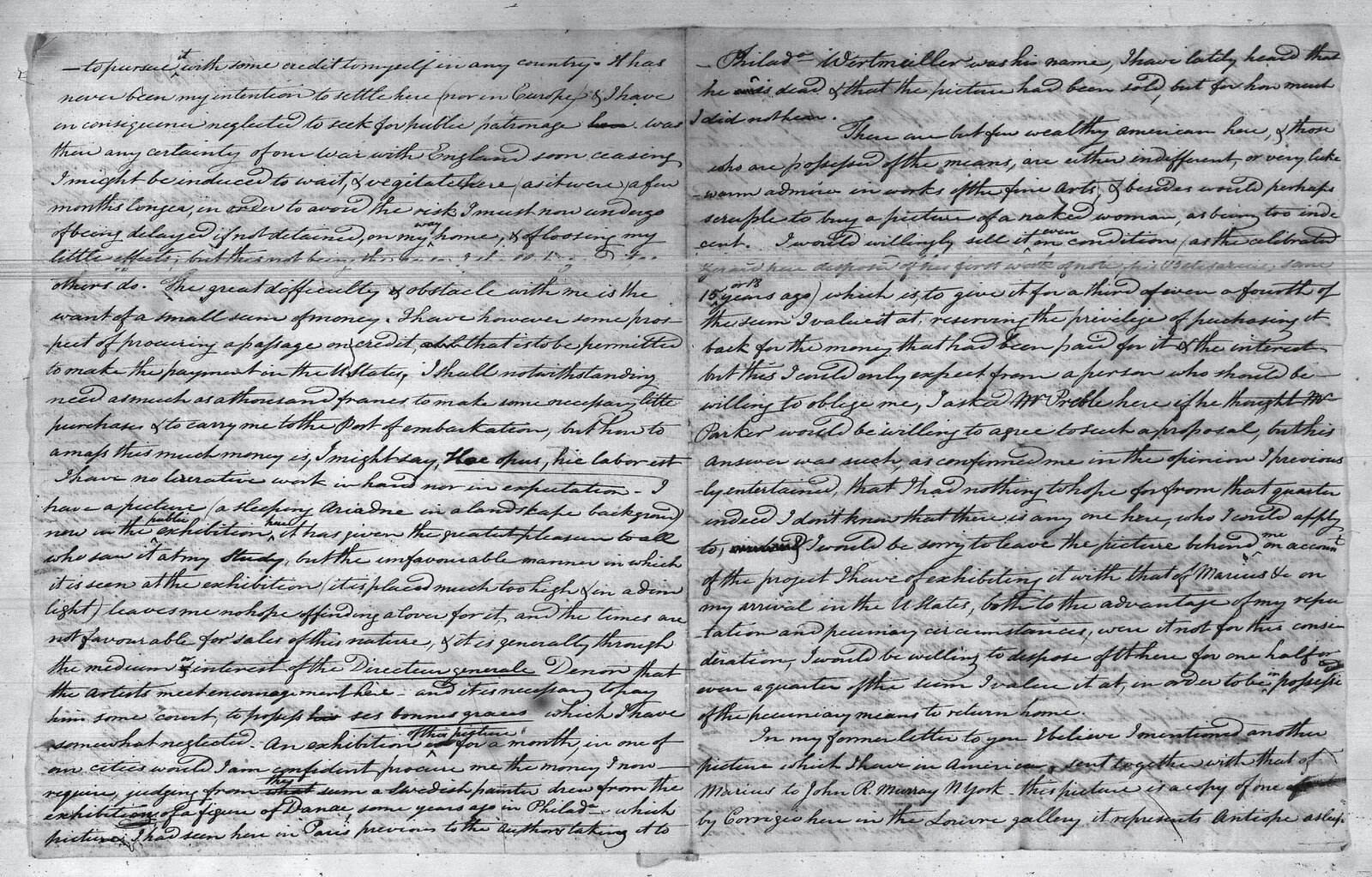
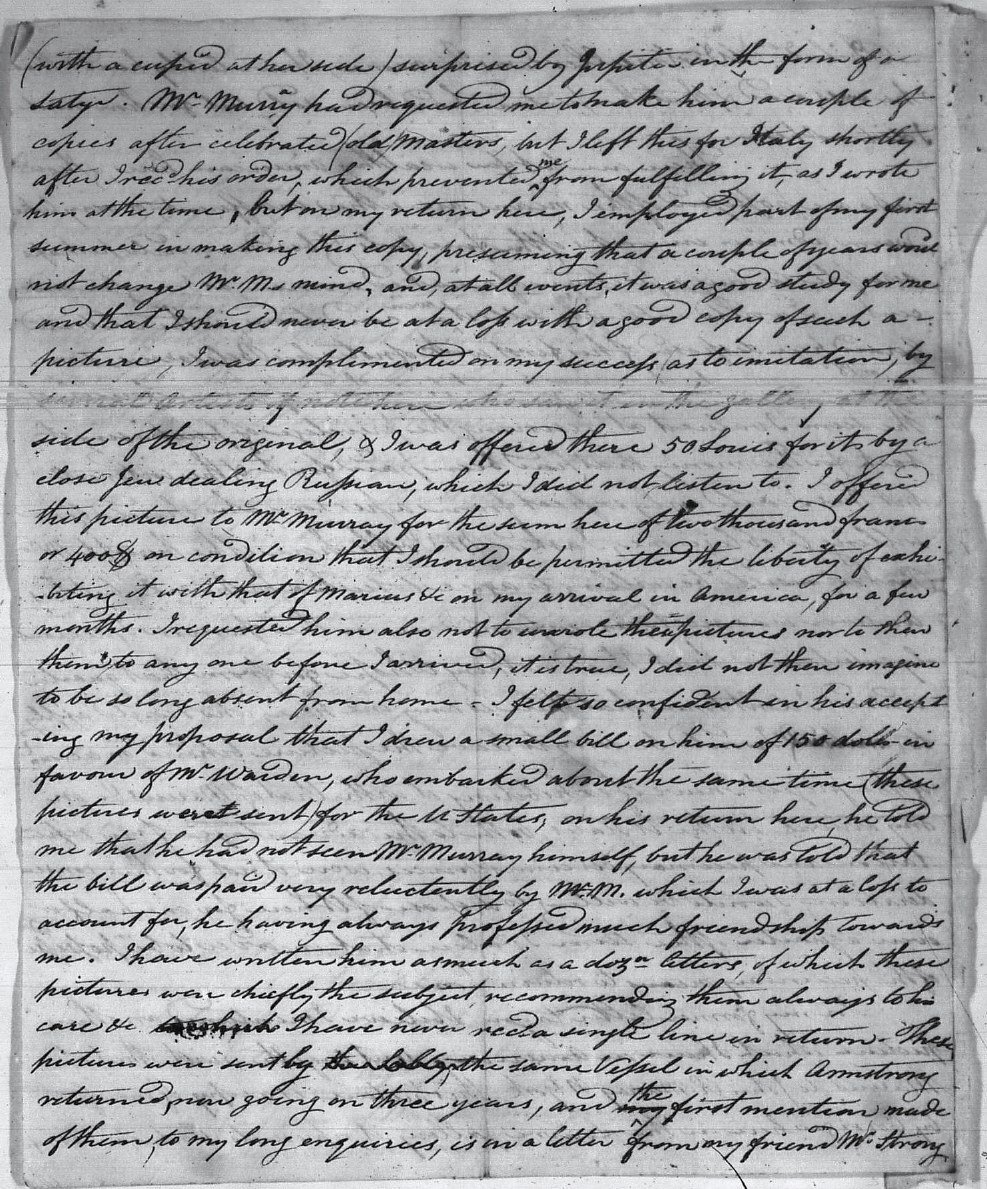
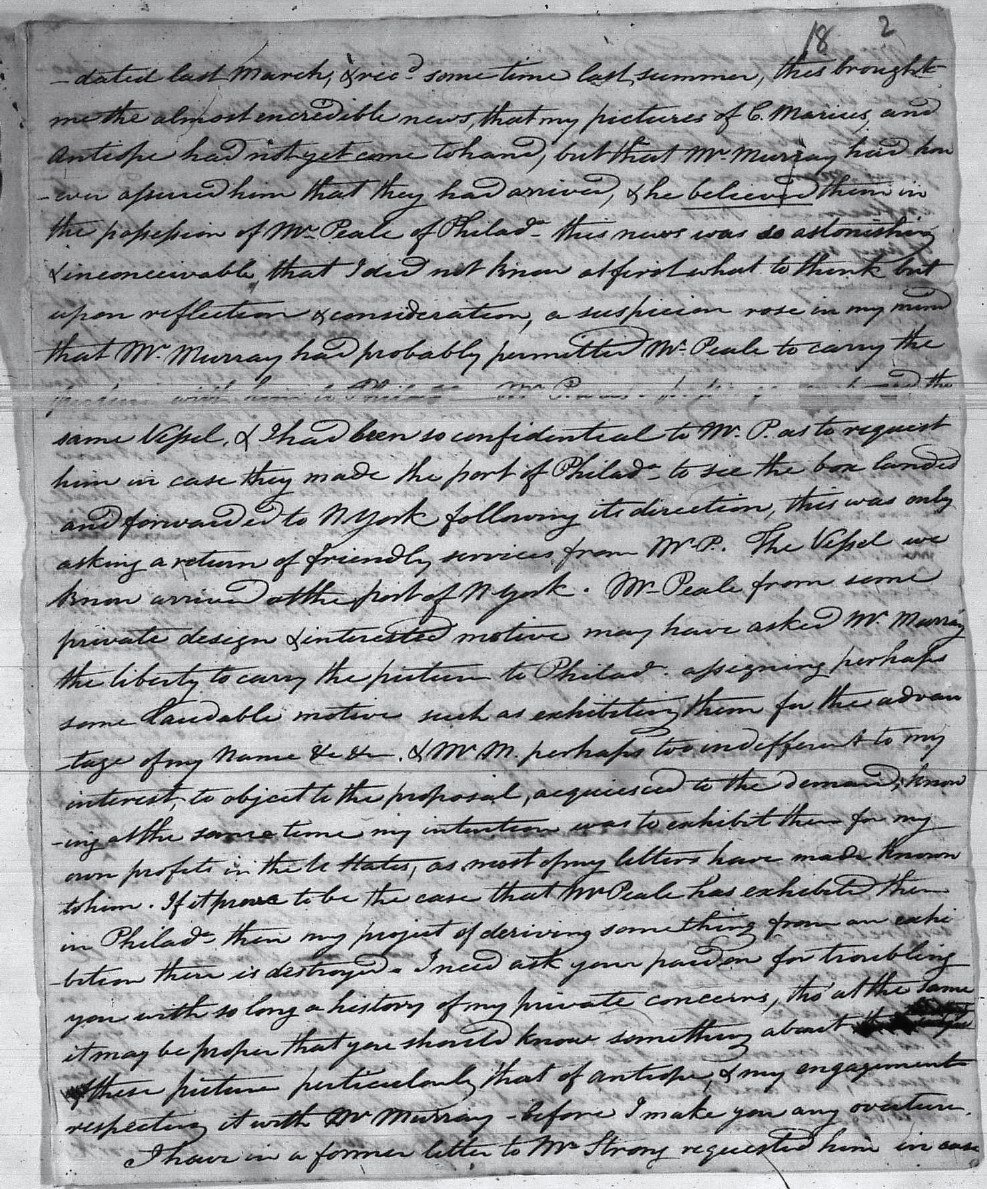
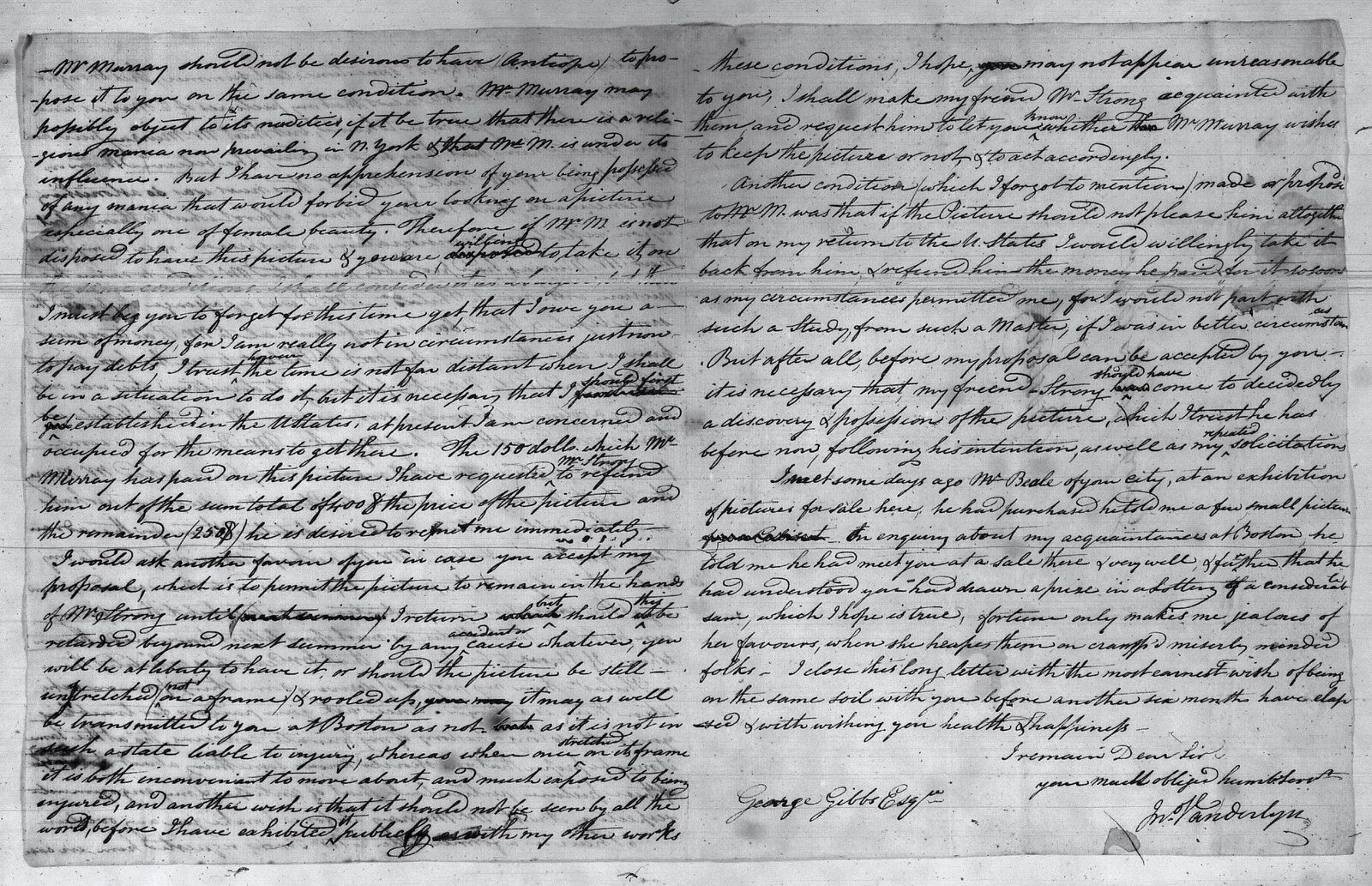
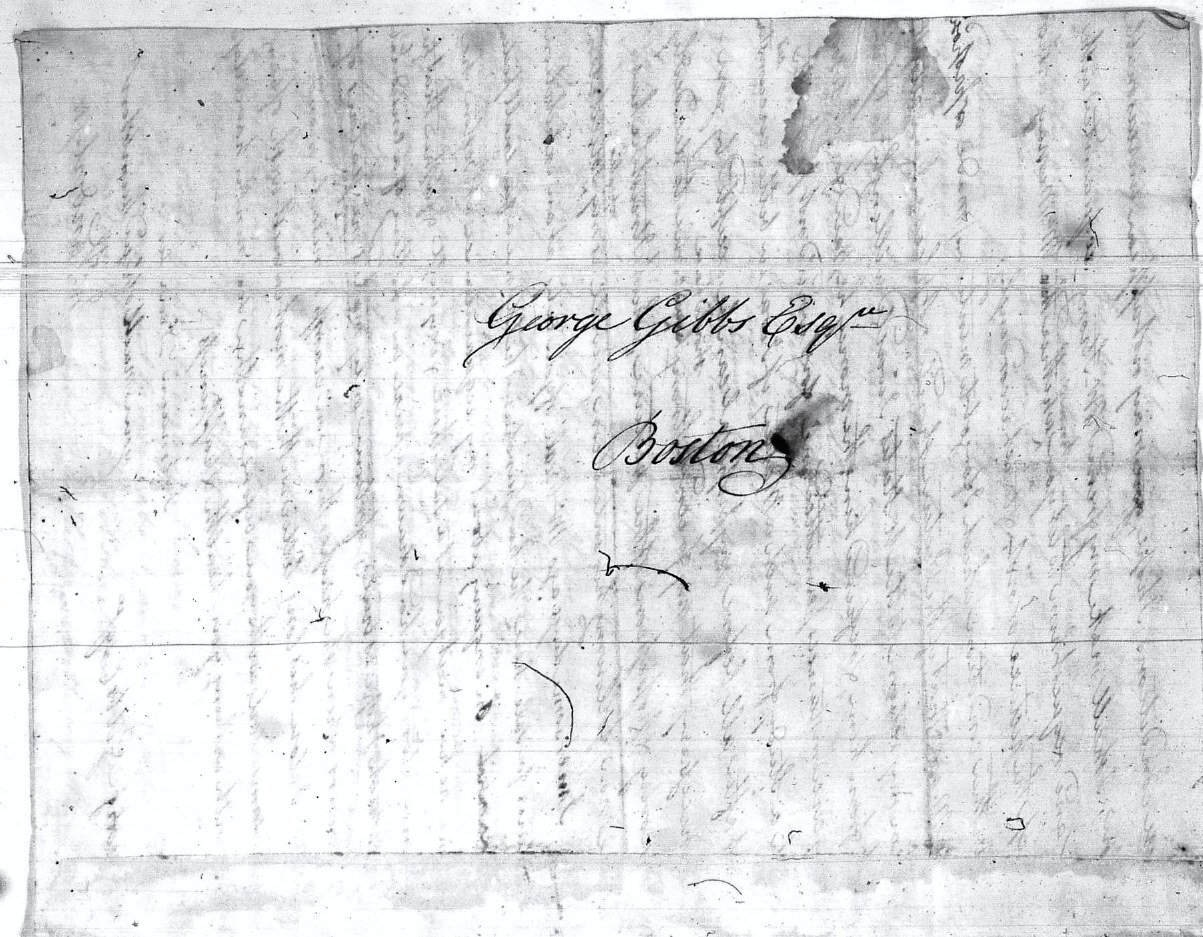
Dear Sir
I did myself the pleasure to write you last Spring by Lieutenant Biddle bearer of dispatches in the Hornet in which letter I informed you that I had sent your portrait to Cherbourg in company with that of Mr Sullivan’s & Mr Jones’s of N.York, with the expectation of having them ship’d for the U.States, in either the Hornet or the Wasp (both there at that time) Mr Biddle encouraged me to this, & promised to use all his influence towards procuring them a passage in one of these Vessels. but unfortunately neither of the Captains it appears could be eventually prevailed upon to take them.
An opportunity has since offered at that port by Captn White of Salem, but our war having then already commenced, I did not think safe to send them, and it is well I did not, for we are told, that Vessel has been captured & convey’d to England. I shall however venture to carry them with me, when I go, & should I have the misfortune to be captured, I will take more pains to have them restored to me, than probably any one else would — I am decided to embark for the U.States early this spring & hope to be able to procure a birth in a good sailing Vessel. My circumstances actually oblige me to return home, I do not meet with sufficient employ to enable me to bear current expenses, inconsiderable as they are but were this not the case, my wish and intention would not be different, for I have now no object whatever nor inclination to prolong my stay here, I am satisfied with the knowledge I now possess of my art, which I believe is sufficient to pursue it, with some credit to myself in any country. It has never been my intention to settle here (nor in Europe) & I have in consequence neglected to seek for public patronage here. Was there any certainty of our war with England soon ceasing I might be induced to wait, & vegetate here (as it were) a few months longer, in order to avoid the risk I must now undergo of being delayed, if not detained, on my way home, & of loosing my little effects. but this not being the case [illegible] &c &c. others do. The great difficulty & obstacle with me is the want of a small sum of money. I have however some prospect of procuring a passage on credit, but that is to be, permitted to make the payment in the U.States, I shall notwithstanding need as much as a thousand francs to make some necessary little purchases & to carry me to the Port of embarkation, but how to amass this much money is, I might say, Hoc opus, hic labor est I have no lucrative work in hand nor in expectation — I have a picture (a sleeping Ariadne in a landskape background[?]) now in the public exhibition, it has given the greatest pleasure to all who saw it at my study, but the unfavourable manner in which it is seen at the exhibition (it is placed much too high & in a dim light) leaves me no hope of finding a lover for it, and the times are not favourable for sales of this nature, & it is generally through the medium & interest of the Directeur generale Denon that the artists meet encouragement here — and it is necessary to pay him some court, to possess ses bonnes graces which I have somewhat neglected. An exhibition of this picture for a month, in one of our cities would I am confident procure me the money I now require, judging from the sum a Swedish painter drew from the exhibition of a figure of Danae some years ago in Philada — which picture I had seen here in Paris previous to the author taking it to Philada — Wertmuller was his name, I have lately heard that he is dead & that the picture had been sold, but for how much I did not hear.
There are but few wealthy americans here, & those who are possessed of the means, are either indifferent, or very lukewarm admirers in works of the fine Arts, & besides would perhaps scruple to buy a picture of a naked woman, as being too indecent. I would willingly sell it even on condition, (as the celebrated [illegible] here dispos’d of his goods[?] with [illegible], some 15 or 18 years ago) which is, to give it for a third of even a fourth of the sum I value it at, reserving the privelege of purchasing it back for the money that had been paid for it & the interest. but this I could only expect from a person who should be willing to oblige me, I asked Mr Preble here if he thought Mr Parker would be willing to agree to such a proposal, but his answer was such, as confirmed me in the opinion I previously entertained, that I had nothing to hope for from that quarter indeed I don’t know that there is any one here, who I could apply to, I would be sorry to leave the picture behind me on account of the project I have of exhibiting it with that of Marius &c on my arrival in the U.States, both to the advantage of my reputation and pecuniary circumstances, were it not for this consideration, I would be willing to dispose of it here for one half or even a quarter of the sum I value it at, in order to be in possession of the pecuniary means to return home.
In my former letter to you I believe I mentioned another picture which I have in America, sent together with that of Marius to John R. Murray N.York — this picture is a copy of one by Corregio here in the Louvre gallery it represents Antiope asleep (with a cupid at her side) surprised by Jupiter in the form of a satyr. Mr Murray had requested me to make him a couple of copies after celebrated (old) Masters, but I left this for Italy shortly after I recd his order, which prevented me from fulfilling it, as I wrote him at the time, but on my return here, I employed part of my first summer in making this copy, presuming that a couple of years would not change Mr M’s mind, and, at all events, it was a good study for me and that I should never be at a loss with a good copy of such a picture, I was complimented on my success (as to imitation) by several artists of note here who saw it in the gallery[?], at the side of the original, & I was offered there 50 Louis for it, by a close Jew dealing Russian, which I did not listen to. I offered this picture to Mr Murray for the sum here of two thousand francs or 400$ on condition that I should be permitted the liberty of exhibiting it with that of Marius &c on my arrival in America, for a few months. I requested him also not to unrole these pictures nor to shew them to any one before I arrived, it is true, I did not then imagine to be so long absent from home. I felt so confident in his accepting my proposal that I drew a small bill on him of 150 dolls in favour of Mr Warden, who embarked about the same time (these pictures were sent) for the U.States, on his return here he told me that he had not seen Mr Murray himself, but he was told that the bill was paid very reluctantly by Mr M. which I was at a loss to account for, he having always professed much friendship towards me. I have written him as much as a dozn letters, of which these pictures were chiefly the subject, recommending them always to his care &c I have never recd a single line in return — These pictures were sent by the same Vessel in which Armstrong returned, now going on three years, and the first mention made of them, to my long enquiries, is in a letter from my friend Mr Strong dated last March, & recd some time last summer, this brought me the almost encredible news, that my pictures of C. Marius, and Antiope had not yet come to hand, but that Mr Murray had however assured him that they had arrived, & he believed them in the possession of Mr Peale of Philada — this news was so astonishing & inconceivable, that I did not know at first what to think but upon reflection & consideration, a suspicion rose in my mind that Mr Murray had probably permitted Mr Peale to carry the pictures[?] with him to Philada[?] [illegible] the same Vessel, & I had been so confidential to Mr P. as to request him in case they made the port of Philada to see the box landed and forwarded to N.York following its direction, this was only asking a return of friendly services from Mr P. The Vessel we know arrived at the port of N.York. Mr Peale from some private design & interested motive may have asked Mr Murray the liberty to carry the pictures to Philada assigning perhaps some laudable motive such as exhibiting them for the advantage of my name &c &c — & Mr M. perhaps too indifferent to my interest, to object to the proposal, acquiesced to the demand, knowing at the same time my intention was to exhibit them for my own profits in the U.States, as most of my letters have made known to him. If it prove to be the case that Mr Peale has exhibited them in Philada then my project of deriving something from an exhibition there is destroyed. I need ask your pardon for troubling you with so long a history of my private concerns, tho’ at the same it may be proper that you should know something about these pictures particularly, that of Antiope, & my engagements respecting it with Mr Murray — before I make you any overture.
I have in a former letter to Mr Strong requested him in case (Mr Murray should not be desirous to have Antiope) to propose it to you on the same condition. Mr Murray may possibly object to its nudities, if it be true that there is a religious mania now prevailing in N.York & that Mr M. is under its influence. But I have no apprehension of your being possessed of any mania that would forbid your lookings on a picture especially one of female beauty. Therefore, if Mr M. is not disposed to have this picture & you are willing to take it, on the same conditions[?], I shall consider it as [illegible]
I must beg you to forget for this time yet, that I owe you a sum of money, for I am really not in circumstances just now to pay debts, I trust however the time is not far distant when I shall be in a situation to do it, but it is necessary that I should first be established in the U.States, at present I am concerned and occupied for the means to get there. The 150 dolls. which Mr Murray has paid on this picture I have requested Mr Strong to refund him out of the sum total of 400$ the price of the picture and the remainder (250$) he is desired to remit me immediatly.
I would ask another favour of you in case you accept my proposal, which is to permit the picture to remain in the hands of Mr Strong until I return but should they be retarded beyond next summer by any accident or cause whatever, you will be at liberty to have it, or should the picture be still unstretched (not on a frame) & rooled up, it may as well be transmitted to you at Boston as not. as it is not in such a state liable to injury, whereas when once stretched on its frame it is both inconvenient to move about, and much exposed to being injured, and another wish is that it should not be seen by all the world, before I have exhibited it publicly with my other works these conditions, I hope, may not appear unreasonable to you, I shall make my friend Mr Strong acquainted with them and request him to let you know whether Mr Murray wishes to keep the picture or not, & to act accordingly.
Another condition (which I forgot to mention) made or propos’d to Mr M. was that if the Picture should not please him altogether that on my return to the U.States I would willingly take it back from him, & refunded him the money he had paid for it as soon as my circumstances permitted me, for I would not part with such a Study from such a Master, if I was in better circumstances. But after all, before my proposal can be accepted by you — it is necessary that my friend Strong should have come to decidedly a discovery & possession of the pictures, which I trust he has before now, following his intention, as well as my repeated solicitations.
I meet some days ago Mr Beale of your city, at an exhibition of pictures for sale here, he had purchased he told me a few small pictures. On enquiring about my acquaintances at Boston he told me he had meet you at a sale there & very well[?], & further that he had understood you had drawn a prize in a lottery of a considerable sum, which I hope is true, fortune only makes me jealous of her favours, when she heapes them on cramp’d miserly minded folks — I close this long letter with the most earnest wish of being on the same soil with you before another six months have elapsed & with wishing you health & happiness —
I remain Dear Sir,
your much obliged humble servt
Jn Vanderlyn
George Gibbs Esqre
THE ADDRESS LEAF
George Gibbs Esqre
Boston
Transcribed verbatim from the scans, keeping the original spelling, capitalization, and punctuation; the manuscript’s own dashes are kept, bracketed words are interlineations or uncertain readings, and [illegible] marks passages lost to the film. Condition: A seven-page letter plus address leaf, scanned in six frames: 296 is page 1, 297 and 300 each capture a two-page opening (pages 2-3 and 6-7), 298 is page 4, 299 is page 5, 301 the address leaf. Browned paper with heavy show-through of the verso text throughout. A horizontal band of fading or fold damage crosses the middle of scans 297, 298, 299, and 300, each costing most of one line: on 297 the parenthetical naming the celebrated seller whose buy-back terms Vanderlyn proposes to imitate; on 298 the faded line (‘several artists of note here who saw it in the gallery’) is largely recoverable; on 299 the line naming how Peale carried the pictures in the same vessel; on 300 the struck-and-faded clause after ‘willing to take it, on’. One further interlined clause on page 2 after ‘this not being the case’ is illegible. The manuscript carries many authorial interlineations and cancellations (e.g. ‘to Cherbourg’, ‘public’, ‘of this picture’, ‘ses bonnes graces’ replacing ‘his’, ‘Mr Strong’, ‘should have’); the transcription follows Vanderlyn’s final corrected reading. Pencil archival marks ’18’ and ‘2’ appear at the head of scan 299. The address leaf bears only the direction ‘George Gibbs Esqre / Boston’ with strong show-through of the letter text; the repeated ‘George Gibbs Esqre’ at the foot of page 7 is Vanderlyn’s own recipient docket.
Gibbs Family Papers, Wisconsin Historical Society, Reel 1, scans 296–301. Autograph letter of John Vanderlyn to George Gibbs, Paris, February 7, 1813, seven pages with address leaf. Digitized from the microfilm by this site; transcribed in full above.
A Word for Captain Hull 
Boston, September 28, 1813
A short note with a soldier’s instinct in it, from the father of a future general: Gibbs points out to Silliman that among all the public congratulations Captain Isaac Hull has received for his victories, none has come from his native state, “the place whence they would be the most welcome,” and asks his friend to see to it. He adds that the Geological Society’s Transactions have arrived and will travel with him in November.
Dear Sir
It has been noticed to me that among the publick congratulations & acknowledgements that Capt Hull has received, there has been none from the place whence[?] they would be the most welcome, — his native state. —
My partiality for your state leads me to mention this to you as a friend. —
I have recd. the “Geological Society’s transactions” which will bring on with me in Nov —
Yours truly
Geo Gibbs
[Pencil annotation in a later hand, upper right corner of the letter:] 1813
THE ADDRESS PANEL AND DOCKET
B. Silliman Esqr
Yale College
New Haven
[Manuscript postal rate, upper center:] 17
[Stamped circular postmark, left of address, mostly illegible:] BOSTON[?] SEP [illegible]
[Docket, in Silliman’s hand, written vertically at right:] Boston Septr. 28 Col. G — ans. Octob. 6[?] —
Transcribed verbatim from the scans, keeping the original spelling, capitalization, and punctuation; the manuscript’s own dashes are kept, bracketed words are interlineations or uncertain readings, and [illegible] marks passages lost to the film. Condition: Letter (scan 310) is a short single-page note in George Gibbs’s hasty hand on toned paper with foxing and a vertical fold stain through the text block; fully legible apart from minor uncertainty on ‘whence’. The word ‘publick’ is interlined above ‘congratulations’ with a long dash following. Gibbs closes several sentences with long manuscript dashes (rendered ~~). Signature is the characteristic compressed ‘Geo Gibbs’ flourish. Address leaf (scan 311) shows fold panels, wax-seal tears at top edge, a bold manuscript rate ’17’, and a faint Boston circular datestamp overlapping the address; Silliman’s vertical docket at right is legible except the day numeral of the reply date, which reads as 6 (possibly 2).
Gibbs Family Papers, Wisconsin Historical Society, Reel 1, scans 310–311. Autograph letter of George Gibbs to Benjamin Silliman, Boston, September 28, 1813, with its address leaf. Digitized from the microfilm by this site; transcribed in full above.
Amid the Removal 
Boston, February 15, 1814
One hurried leaf, written a month after Gibbs bought the Delafield farm at Hallett’s Cove that the family would name Sunswick. Much engaged in preparations for his removal, he defers the Geological Society until they meet, and closes with the line that carries the family in it: “Mrs G is well” – Laura Wolcott Gibbs, the general’s mother, packing up the Boston household for the move to the farm where Alfred would be born.
[Docketed in pencil, a later hand, top right of leaf:] 1814
Dear Sir
I recd yours of ye 20th relating to the Coal which I was very glad to hear. — I shall be on in about three[?] weeks before any thing can be done. Being much engaged in preparations for my removal I will [word struck out] leave till we meet the subject of a Geological Socy. — Mrs G is well and joins with me in best regards to Mrs S[?] & yourself
Yours truly G Gibbs
[Directed at foot of leaf:] B Silliman Esqr
Transcribed verbatim from the scans, keeping the original spelling, capitalization, and punctuation; the manuscript’s own dashes are kept, bracketed words are interlineations or uncertain readings, and [illegible] marks passages lost to the film. Condition: Single small leaf, torn/irregular left and top edges, photostat-grey microfilm copy; hasty hand with heavy abbreviation. Two authorial strikethroughs: one word struck before ‘weeks’ (apparently rewritten as ‘three’) and one word struck (probably ‘defer’) before ‘leave’ in the Geological Society sentence. Final digit of the year in the dateline is malformed and could be misread as an 8, but the docket and content confirm 1814. ‘Socy’ abbreviation and ‘Mrs S’ initial are slightly uncertain.
Gibbs Family Papers, Wisconsin Historical Society, Reel 1, scan 340. Autograph note of George Gibbs to Benjamin Silliman, Boston, February 15, 1814. Digitized from the microfilm by this site; transcribed in full above. The Sunswick purchase papers of January 1814 are at scans 322–338 of the same reel.
After the Great Gale 
Boston, September 26, 1815
Three days after the Great September Gale of 1815, the worst hurricane to strike New England in living memory, W. Channing writes from Boston: the roads blocked by fallen trees, no stage news out of Newport, the Stone Bridge washed down, and the town’s vessels, wharves, and stores injured. Family business waits at the end, as it always did.
My dear Sir,
I recd a few days ago your letter of the 5th & 18th — It was my intention to have been in New York last week but it not being quite convenient, and expecting a storm about the equinox while on the way, led me to defer it — Since which the disastrous[?] storm of the 23d has led me to wait a day or two, as it is said the roads were much obstructed by trees which have fallen, and in hopes I might get information from Newport, which I apprehend has suffered much — The Stage last evg brot no letters nor passengers I could hear of, it is said the Stone Bridge is washed down, and that much injury to the Vessels, Wharves & Stores in Newport. — If not delayed by advices from Newport, which may lead me to go by that way — I hope to be in New York by [struck: the] last of the week —
I am sorry to learn, by your letter of the 22d recd this morning that no arrangement has been made by Mr Patten[?] for [struck: Govt Stock] the investment authorized in U. S. Stocks, and that the advance of them, renders it no longer adviseable to invest in them — I wish you & Mr Patten[?] to advise yourselves what can be done & may be best to do when I come on —
I saw your Mother & Sarah this morning & Ruth yesterday who are in usual health —
Yours W Channing
G Gibbs Esqr —
Transcribed verbatim from the scans, keeping the original spelling, capitalization, and punctuation; the manuscript’s own dashes are kept, bracketed words are interlineations or uncertain readings, and [illegible] marks passages lost to the film. Condition: Single-page letter, hand generally clear. A full-width horizontal crease/film line crosses the sixth manuscript line exactly through the phrase describing the hurricane; the words beneath it read ‘disastrous storm of the 23d’ from ascenders and context, with ‘disastrous’ the least certain word (flagged [?]). The line spans the entire frame including margins, so it is a fold/scan artifact, not an authorial strikeout. Two genuine authorial strikeouts: ‘the’ cancelled before ‘last of the week’, and a false start (reads ‘Govt Stock’, the second word firmly overstruck) cancelled before ‘the investment authorized in U. S. Stocks’. The correspondent’s name (twice) reads ‘Patten’ or possibly ‘Pallen’; the crossbar suggests double-t, flagged [?] both times. Abbreviations kept as written: ‘recd’, ‘Septr’, ‘evg’, ‘brot’, ‘Esqr’; period spelling ‘adviseable’ retained. Signature is ‘W Channing’ with a long flourish; ‘Yours’ sits on the line above it. The address line ‘G Gibbs Esqr’ is at lower left in the writer’s hand. The letter dates the storm to the 23d, i.e. the Great September Gale of 22-23 September 1815.
Gibbs Family Papers, Wisconsin Historical Society, Reel 1, scan 373. Autograph letter of W. Channing to George Gibbs Esqr. Digitized from the microfilm by this site; transcribed in full above.
“Our Dear, Departed Elizabeth” 
New York, April 30, 1816
Grief conducted with the formality of the age. Luther Bradish, widowed within the year of his marriage, writes his brother-in-law at Sunswick about the sealed will his wife, Gibbs’s sister Helen Elizabeth, executed before her last journey to Newport: “to be opened by Her Husband and Sole Executor Luther Bradish only.” Before breaking the seal he lays the matter before the family and awaits their wishes. Bradish would live to be lieutenant governor of New York; this page is the young man in the worst spring of his life.
My Dear Sir,
I feel it my Duty to address You upon a Subject which I approach with infinite Pain and reluctance. But from its nature, and not knowing who may be interested therein, I feel that I have no right to indulge my own Feelings by a further postponement of this Communication. I fear I have already, perhaps, deferred it too long: But if so, I trust Your own Heart will suggest for me a Sufficient Reason and apology.
Our Dear, departed Elizabeth, previous to Her leaving here for New Port in August last, wrote and executed Her Will. It was sealed up and directed on the back by Herself as follows,
“The last Will and Testament of Helen Elizabeth Gibbs Bradish — In case of Her Death, to be opened by Her Husband and Sole Executor Luther Bradish only.”
I know not the Provisions of this Instrument, nor whether She ever communicated them or the fact of its Existence to Yourself or any of the Family. I feel it My painful Duty, therefore, without further Loss of time, and before The Instrument is opened, to make this Communication to You and The Family — And to enquire what are, and await, Your Wishes upon its Subject.
Very Affectionately And truly Yours L. Bradish
Col. Gibbs
[Wrapper, scan 387, address panel:] Col. Gibbs Sunswick (L.I.)
[Wrapper, scan 387, docket:] L. Bradish April 30. 1816
Transcribed verbatim from the scans, keeping the original spelling, capitalization, and punctuation; the manuscript’s own dashes are kept, bracketed words are interlineations or uncertain readings, and [illegible] marks passages lost to the film. Condition: Hand is clear and fully legible throughout; no illegible words and no authorial strikeouts (the horizontal streaks crossing several lines on scans 385-386 are microfilm scratches spanning the full frame, not ink). Scan 385 carries a penciled archival date ‘1816, Apr. 30’ at top right. In the will endorsement (subhead), the manuscript repeats an opening quotation mark at the start of each of its four lines, per period convention; the transcription gives the passage with single opening and closing quotes. The word ‘Communication’ in the final paragraph is broken across the page turn 385/386 with a double-hyphen line break (‘Commu= nication’); rendered joined. Signature ‘L. Bradish’ is written with a long flourish partly obscured by a fold/film line but is confident. Date line appears below the signature; month abbreviation written ‘Apl’ with raised terminal letter, rendered ‘Apl.’ Wrapper (387) shows the black wax seal intact at right and, along the torn upper edge, a strip of the letter’s second-page text (fragments ‘witho- / Instru- / =nica- / upo-‘) where the wrapper is the same folded sheet.
Gibbs Family Papers, Wisconsin Historical Society, Reel 1, scans 385–387 (388 is a duplicate of the wrapper). Autograph letter of Luther Bradish to Col. George Gibbs on the death of Helen Elizabeth (Gibbs) Bradish, with its wrapper. Digitized from the microfilm by this site; transcribed in full above.
From Sunswick 
Sunswick, May 19, 1817
The dateline is the point: Sunswick, the farm on Hallett’s Cove that gave the family its seat and this website half its map. From the new estate Gibbs presses his circular for public mineral collections at Philadelphia, Boston, and New Haven, declines flatly to be made a lecturer, mourns the death of his friend Dr. Dwight of Yale, and reports two new minerals from France and Sweden that he recognizes among his own unnamed American specimens.
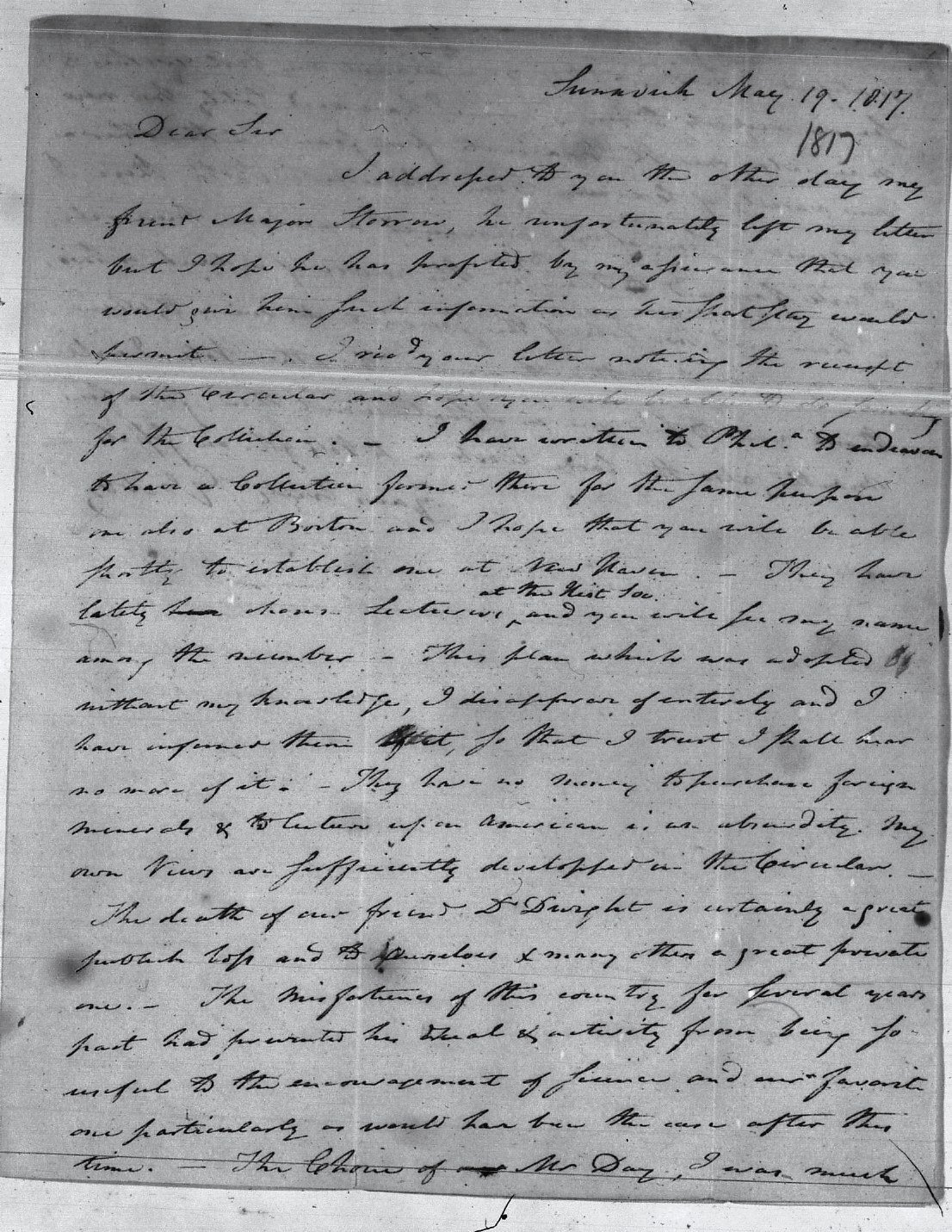
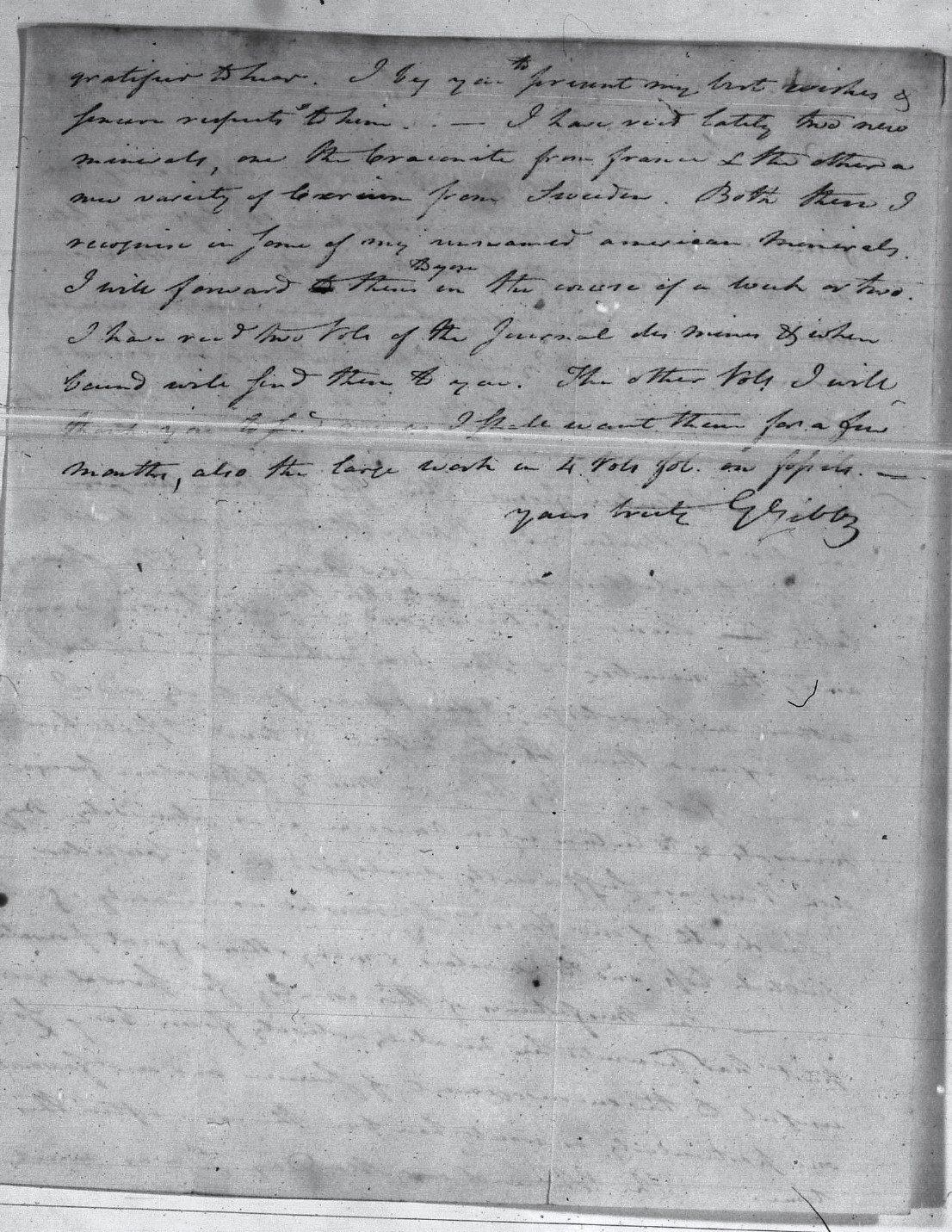
Dear Sir
I addressed to you the other day my friend Major Storrow, he unfortunately left my letter but I hope he has profited by my assurance that you would give him such information as his short stay would permit. — I recd your letter noticing the receipt of the Circular and hope you will [illegible] to [illegible] for the Collection. — I have written to Phila. to endeavour to have a Collection formed there for the same purpose one also at Boston and I hope that you will be able shortly to establish one at New Haven. — They have lately chosen Lecturers at the Hist Soc. and you will see my name among the number — This plan which was adopted without my knowledge, I disapprove of entirely and I have informed them of it, so that I trust I shall hear no more of it. — They have no money to purchase foreign minerals & to lecture upon American is an absurdity. My own views are sufficiently developped in the Circular. —
The death of our friend Dr Dwight is certainly a great publick loss and to ourselves & many others a great private one. — The misfortunes of this country for several years past had prevented his zeal & activity from being so useful to the encouragement of Science and our favorite one particularly as would have been the case after this time. — The Choice of Mr Day, I was much gratified to hear. I beg you to present my best wishes & sincere respects to him. —
I have recd lately two new minerals, one the Craconite[?] from France & the other a new variety of Cerium from Sweden. Both these I recognise in some of my unnamed american minerals. I will forward them to you in the course of a week or two. I have recd two Vols of the Journal des Mines & when bound will send[?] them to you. The other Vols I will thank you to [illegible] [illegible] I shall want them for a few months, also the large work in 4 Vols fol. on fossils. —
Yours truly G Gibbs
THE ADDRESS PANEL AND DOCKET
Benj. Silliman Esqr / Yale College / New Haven
[stamped circular postmark:] NEW-YORK / MAY / 19 ~ [manuscript postal rate:] 10
[docket, in Silliman’s hand, written vertically at right:] Sunswick May / 18 1817 — / G.G. ans 23 —
Transcribed verbatim from the scans, keeping the original spelling, capitalization, and punctuation; the manuscript’s own dashes are kept, bracketed words are interlineations or uncertain readings, and [illegible] marks passages lost to the film. Condition: Microfilm scan of a two-leaf letter, medium-toned with heavy foxing; leaf 2 (scan 416) shows strong show-through of the page-1 text on its blank lower half. Two passages run along horizontal fold lines and are effectively lost: on p.1, several words between ‘hope you will’ and ‘for the Collection’; on p.2, two to three words after ‘The other Vols I will thank you to’. The dateline day reads as 19 but Silliman’s docket says May 18 (the New York postmark is May 19); both readings are preserved verbatim where they occur. ‘at the Hist Soc.’ (p.1) and ‘to you’ (p.2, after ‘I will forward them’) are interlined insertions incorporated at their marked positions; a struck-out false start before ‘chosen’ (p.1) is omitted. ‘1817’ at upper right of p.1 is a later pencil annotation. ‘Craconite’ is a doubtful reading of the French mineral’s name (possibly Craitonite/Crichtonite); ‘developped’, ‘publick’, lowercase ‘american’, and all abbreviations are sic.
Gibbs Family Papers, Wisconsin Historical Society, Reel 1, scans 415–417. Autograph letter of George Gibbs to Benjamin Silliman, Sunswick, May 19, 1817 (docketed May 18), with its address wrapper. Digitized from the microfilm by this site; transcribed in full above.
The Bradish Letters 
1817 to 1818
Three letters from Luther Bradish, the widowed brother-in-law rebuilding his life in the law: circuit business in Otsego and Chenango, the cause in Chancery, and one page of political comedy — the rumored “Intrigues of our Triumvirate” and plots to usurp “the Honors of the Palace, or White House” dismissed as “mere Phantoms for the Amusement of Political Brawlers and Idle Dreamers.” Bradish would end his career as lieutenant governor of New York.
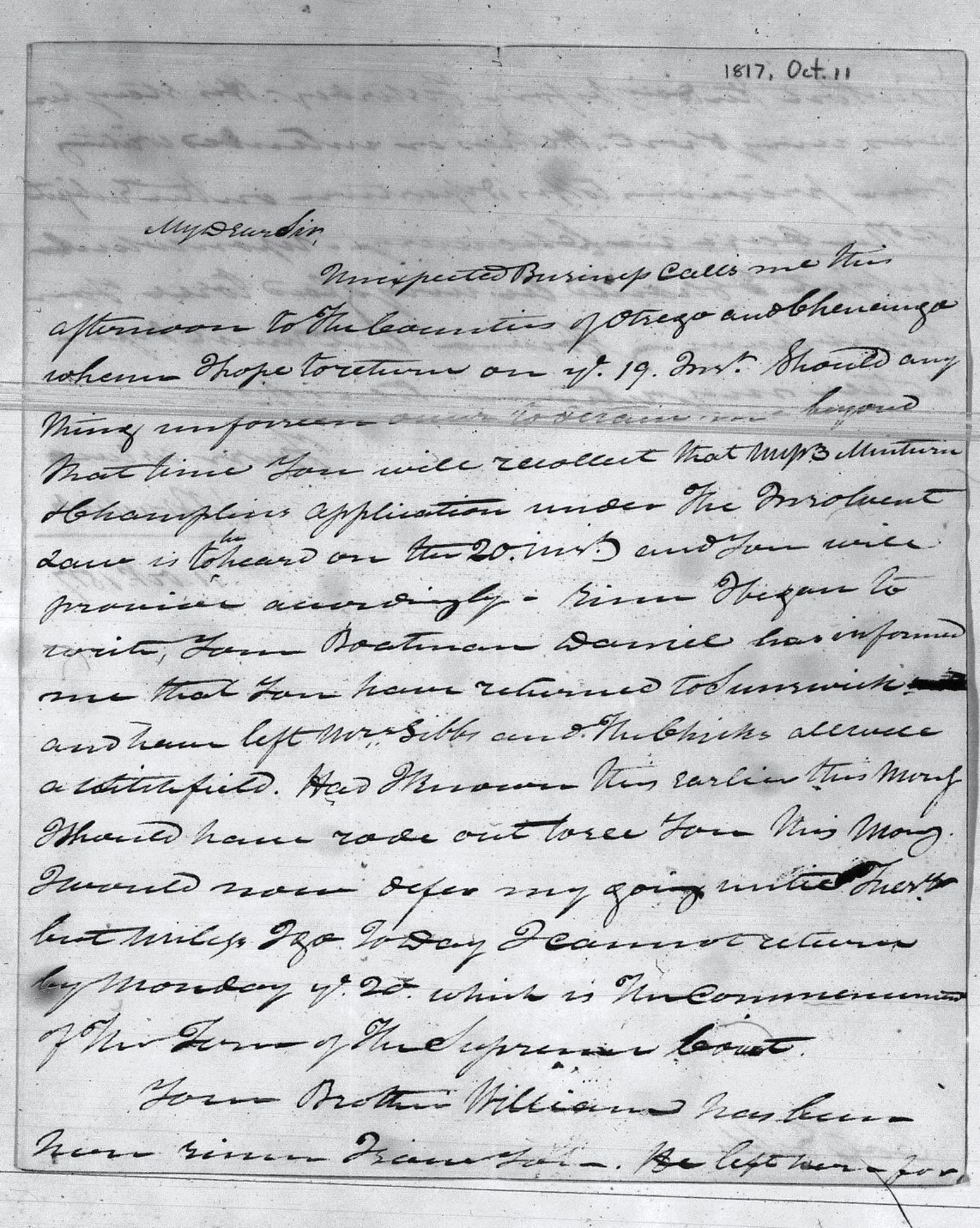
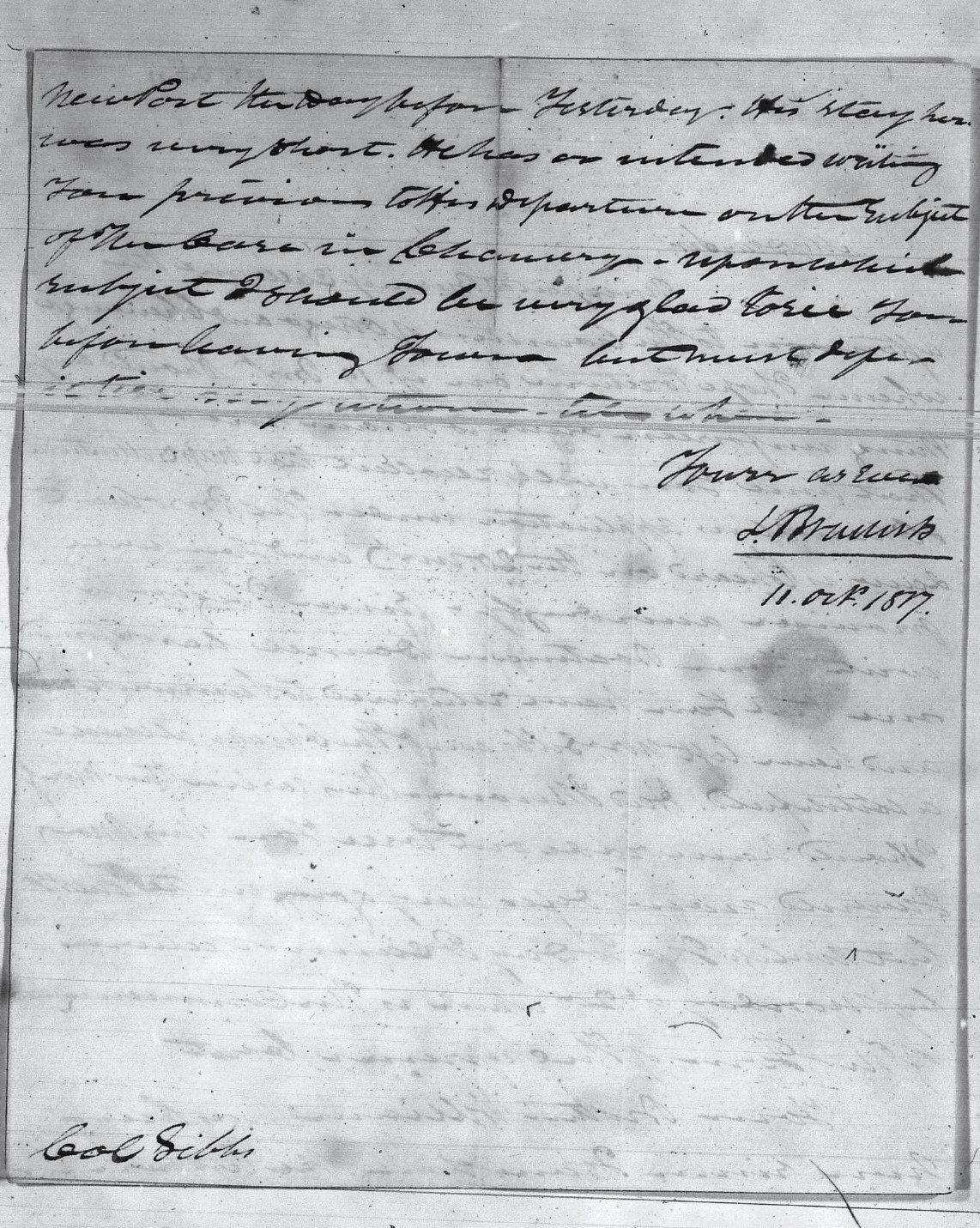
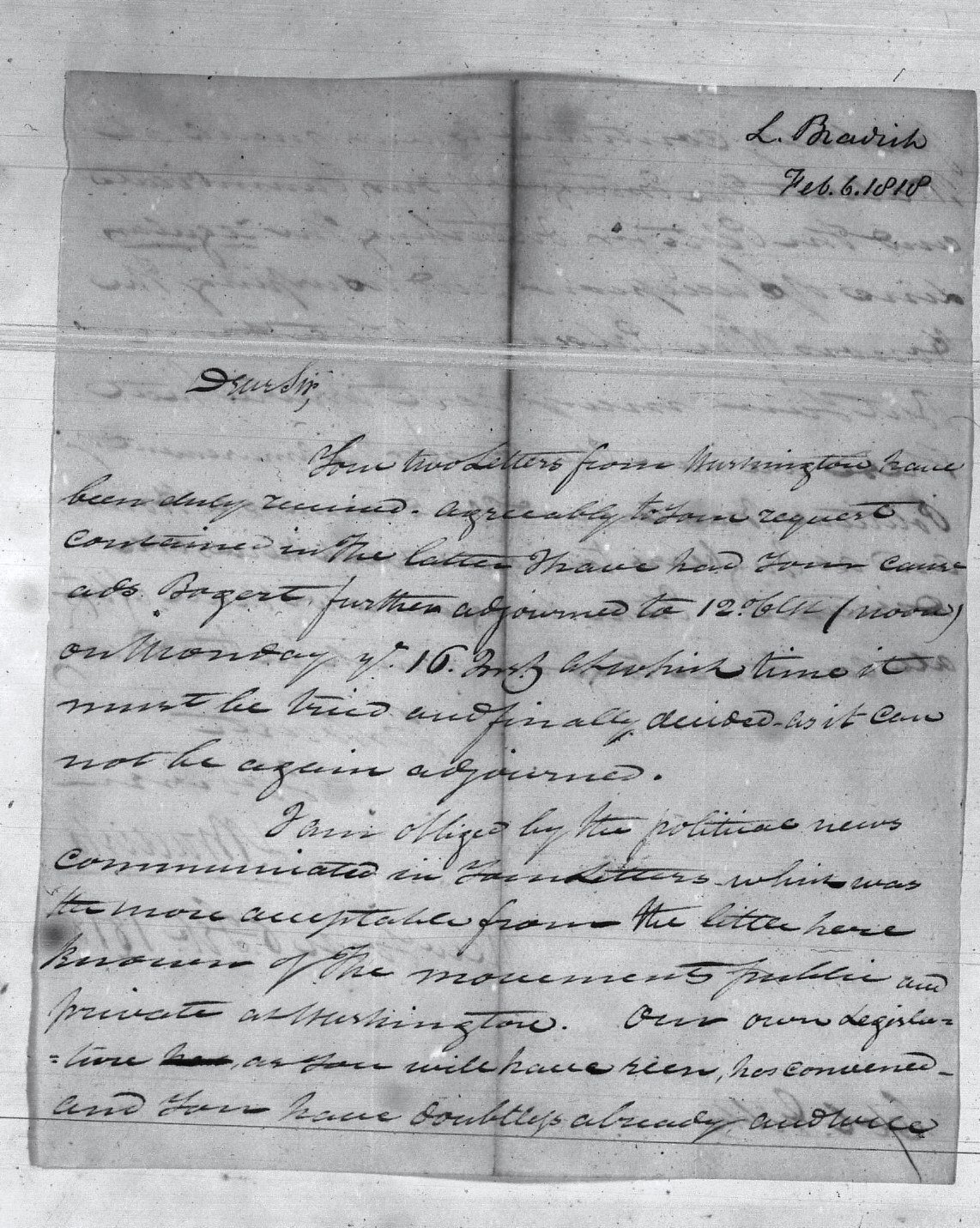
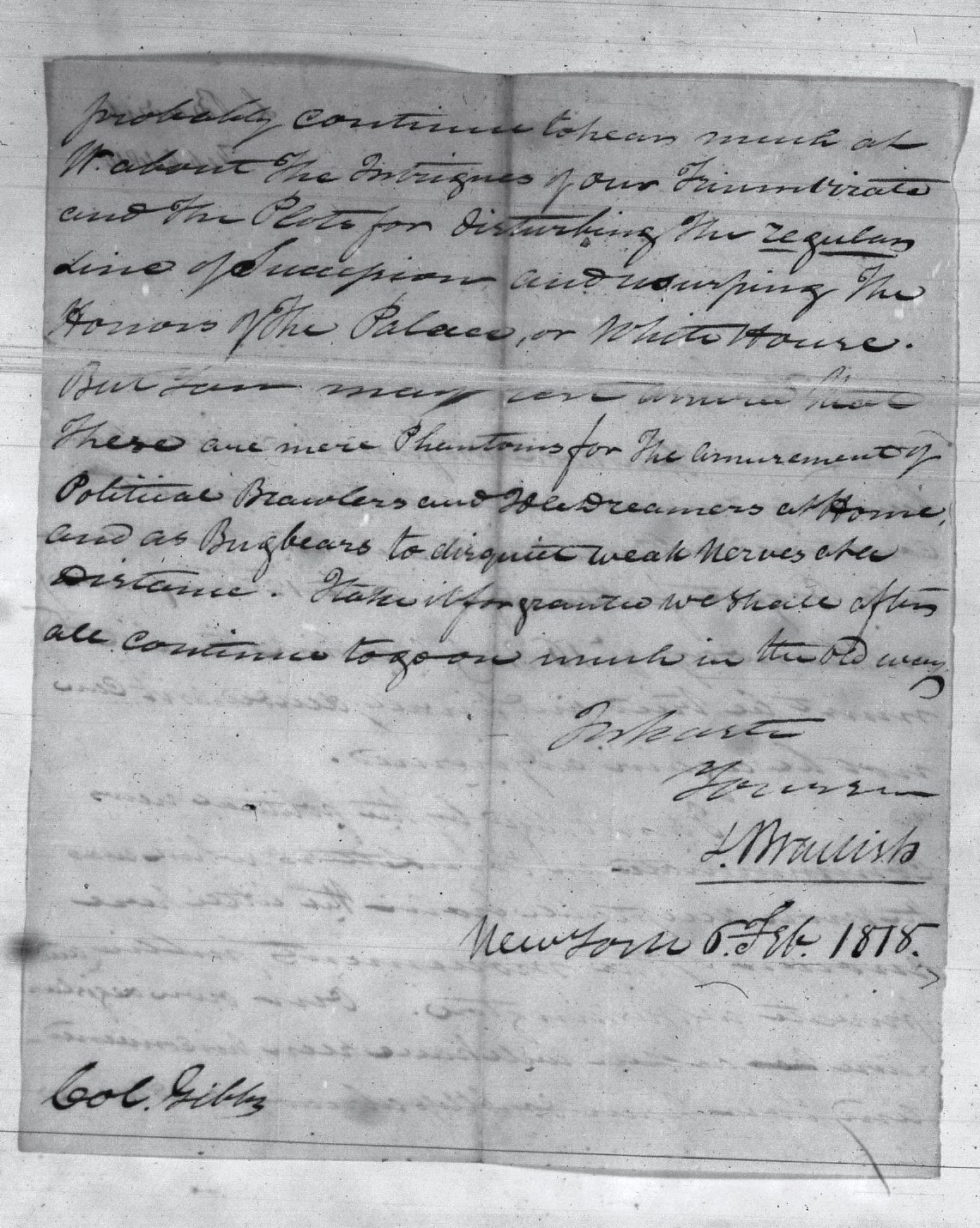
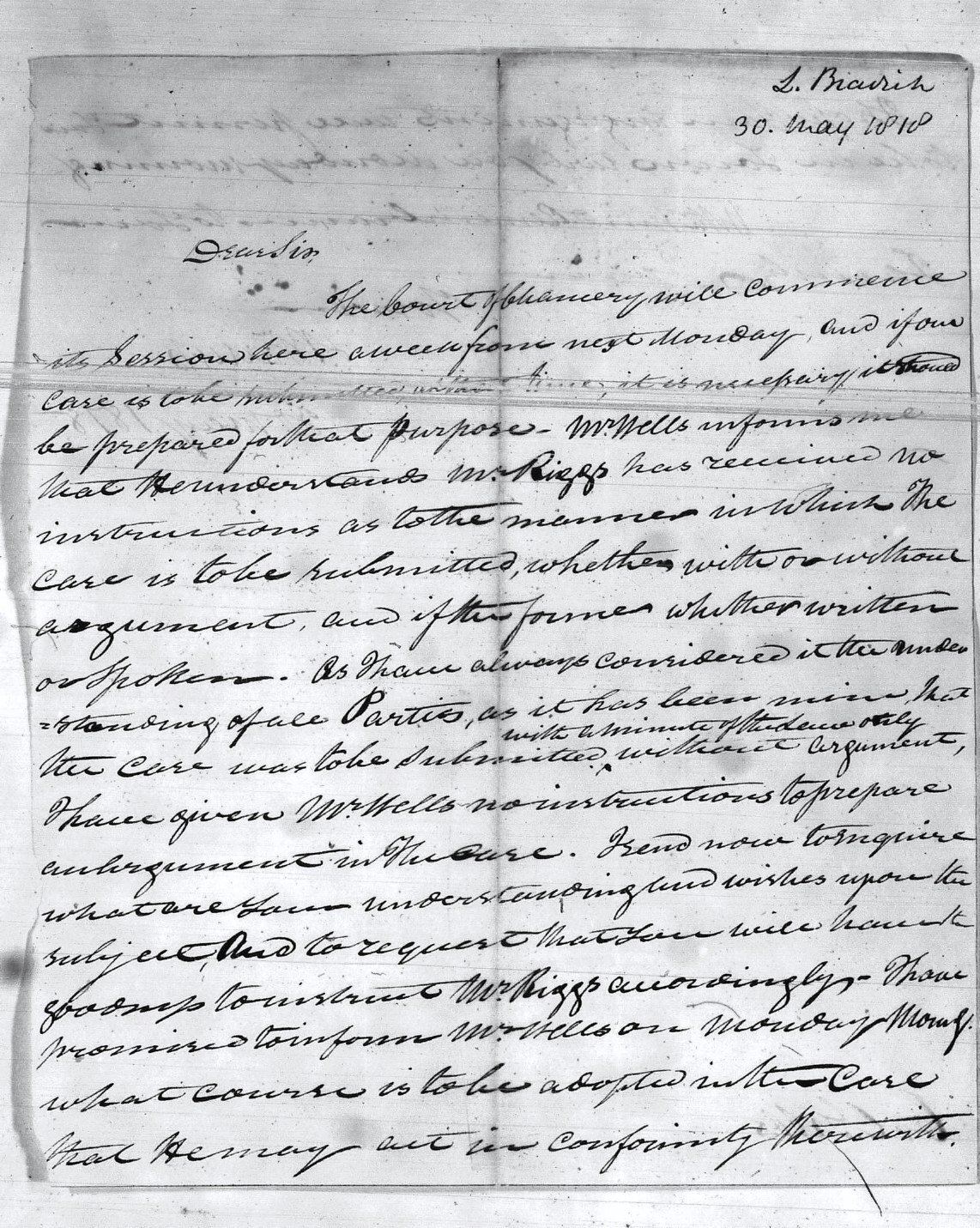
LETTER OF OCTOBER 11, 1817
My Dear Sir,
Unexpected Business calls me this afternoon to the Counties of Otsego and Chenango whence I hope to return on ye 19. Inst. Should any thing unforeseen occur to detain me beyond that time You will recollect that Messrs. Minturn & Champlin’s application under the Insolvent Law is to be heard on the 20. inst. and You will provide accordingly — Since I began to write, Your Boatman Daniel has informed me that You have returned to Sunswick and have left Mrs Gibbs and the Chicks all well at Litchfield. Had I known this earlier this morng I should have rode out to see You this morng. I would now defer my going untill Tuesday[?] but unless I go today I cannot return by Monday ye 20th which is the Commencement of the Term of the Supreme Court.
Your Brother William has been here since I saw You[?] — He left here for New Port the Day before Yesterday — His stay here was very short. He has or intended writing You previous to His departure on the subject of the Cause in Chancery — upon which subject I should be very glad to see You before leaving Town — but must defer [struck: this untill my return[?] — till when[?]]
Yours as Ever L. Bradish
11. Octr. 1817.
Col Gibbs
[Wrapper, scan 426, address panel:] Col. Gibbs Sunswick (L.I.)
[Wrapper, scan 426, rate mark below address:] 7[?]
[Wrapper, scan 426, docket, written vertically at right edge:] L. Bradish Oct 11. 1817
LETTER OF FEBRUARY 6, 1818
[Docket, scan 428, top right:] L. Bradish Feb. 6. 1818
Dear Sir,
Your two Letters from Washington have been duly received — Agreeably to Your request contained in the latter I have had Your cause ads. Bogert further adjourned to 12 oClk (noon) on Monday ye 16. Inst. at which time it must be tried and finally decided — as it can not be again adjourned.
I am obliged by the political news communicated in Your Letters, which was the more acceptable from the little here known of the movements public and private at Washington. Our own Legislature [struck: has], as You will have seen, has convened — and You have doubtless already and will probably continue to hear much at W. about the Intrigues of our Triumvirate and the Plots for disturbing the regular Line of Succession and usurping the Honors of the Palace, or White House. But You may rest assured that these are mere Phantoms for the Amusement of Political Brawlers and Idle Dreamers at Home, and as Bugbears to disquiet weak Nerves at a Distance. I take it for granted we shall after all continue to go on much in the old way.
In haste Yours as Ever[?] L. Bradish
New York 6. Feb. 1818.
Col. Gibbs
LETTER OF MAY 30, 1818
[Docket, scan 430, top right:] L. Bradish 30. May 1818
Dear Sir,
The Court of Chancery will commence its Session here a week from next Monday, and if our Case is to be submitted at that time[?], it is necessary it should be prepared for that purpose — Mr. Wells informs me that He understands Mr. Riggs has received no instructions as to the manner in which the Case is to be submitted, whether with or without argument, and if the former whether written or spoken — As I have always considered it the understanding of all Parties, as it has been mine, that the Case was to be submitted with a Minute of the same[?] only, without argument, I have given Mr. Wells no instructions to prepare an argument in the Case. I send now to inquire what are Your understanding and wishes upon the subject, And to request that You will have the goodness to instruct Mr. Riggs accordingly — I have promised to inform Mr. Wells on Monday Morng what course is to be adopted in the Case that He may act in conformity therewith
[Text of scan 430 ends here at the foot of the page; the closing and signature fall on a continuation page not among these scans.]
Transcribed verbatim from the scans, keeping the original spelling, capitalization, and punctuation; the manuscript’s own dashes are kept, bracketed words are interlineations or uncertain readings, and [illegible] marks passages lost to the film. Condition: Three letters, all in Luther Bradish’s hand, all docketed to Col. George Gibbs. OCT 11 1817 (scans 424-425 + wrapper 426): scan 424 carries a penciled archival date ‘1817, Oct. 11’ at top right; a horizontal microfilm scratch crosses the full frame at the fourth line (‘thing unforeseen occur to detain me beyond’) and is not ink. ‘be’ in ‘is to be heard’ is interlined above the line. ‘Litchfield’ (where Mrs Gibbs and ‘the Chicks’ were left) is confident from context (the Wolcott family seat) though the initial letters are cramped. ‘Tuesday’ in ‘defer my going untill Tuesday’ is abbreviated with a raised terminal and marked [?]. Opening of the second paragraph, ‘since I saw You,’ is faint at the fold and marked [?]. On scan 425 the last line before the closing is struck through in the author’s hand and only partly recoverable; it appears to read ‘this untill my return ~~ till when’ and is so rendered inside [struck: …] with queries. Wrapper 426 bears remains of a black wax seal, a manuscript rate figure that reads ‘7’ [?], and the docket written vertically along the right edge. FEB 6 1818 (scans 428-429): heavy show-through from the facing page on both scans but the text hand is clear. ‘ads.’ (ad sectam) in ‘Your cause ads. Bogert’ is as written. After ‘Our own Legislature’ the word ‘has’ is struck out, then repeated later in the clause (‘as You will have seen, has convened’). In the Triumvirate passage the word ‘regular’ (‘the regular Line of Succession’) is underscored in the manuscript; ‘rest assured’ sits on a faint fold line but is confident. The dashed closing scrawl between ‘In haste’ and the signature is compressed and rendered ‘Yours as Ever[?]’. Dateline ‘New York 6. Feb. 1818.’ follows the signature. MAY 30 1818 (scan 430): a full-frame film scratch crosses the third line; beneath it the phrase after ‘if our Case is to be submitted’ is partly obscured with an interlined insertion, rendered ‘at that time[?]’ (possibly ‘without loss of time’). The insertion ‘with a Minute of the same[?] only’ is interlined above ‘submitted, without argument’; the queried word could also read ‘Law’ or ‘Case’. ‘understanding’ at the paragraph’s first occurrence is broken across lines with a double-hyphen (‘under= standing’), rendered joined. The page ends mid-letter at ‘in conformity therewith’; no closing or signature appears on this scan. Superscript-style abbreviations (ye, Inst., Octr, morng, Morng, oClk, 20th) are kept as written on the line.
Gibbs Family Papers, Wisconsin Historical Society, Reel 1, scans 424–426 and 428–430 (427 is a duplicate; the May 1818 letter’s closing page was not filmed). Three autograph letters of Luther Bradish to Col. George Gibbs. Digitized from the microfilm by this site; transcribed in full above.
Bancroft Explains His School 
Northampton, July 7, 1824
George Bancroft — not yet the historian of the United States, then a young schoolmaster — answers the Colonel’s inquiry, relayed through Rev. Dr. Channing, about placing his sons at Round Hill. It is a complete statement of the school’s philosophy in Bancroft’s own hand: no uniform course of study, “our constant aim to make the most of each individual mind,” Greek and German only for the apt, languages as the best discipline. The Gibbs boys went; their Round Hill letters are exhibited on the ethnologist’s page.
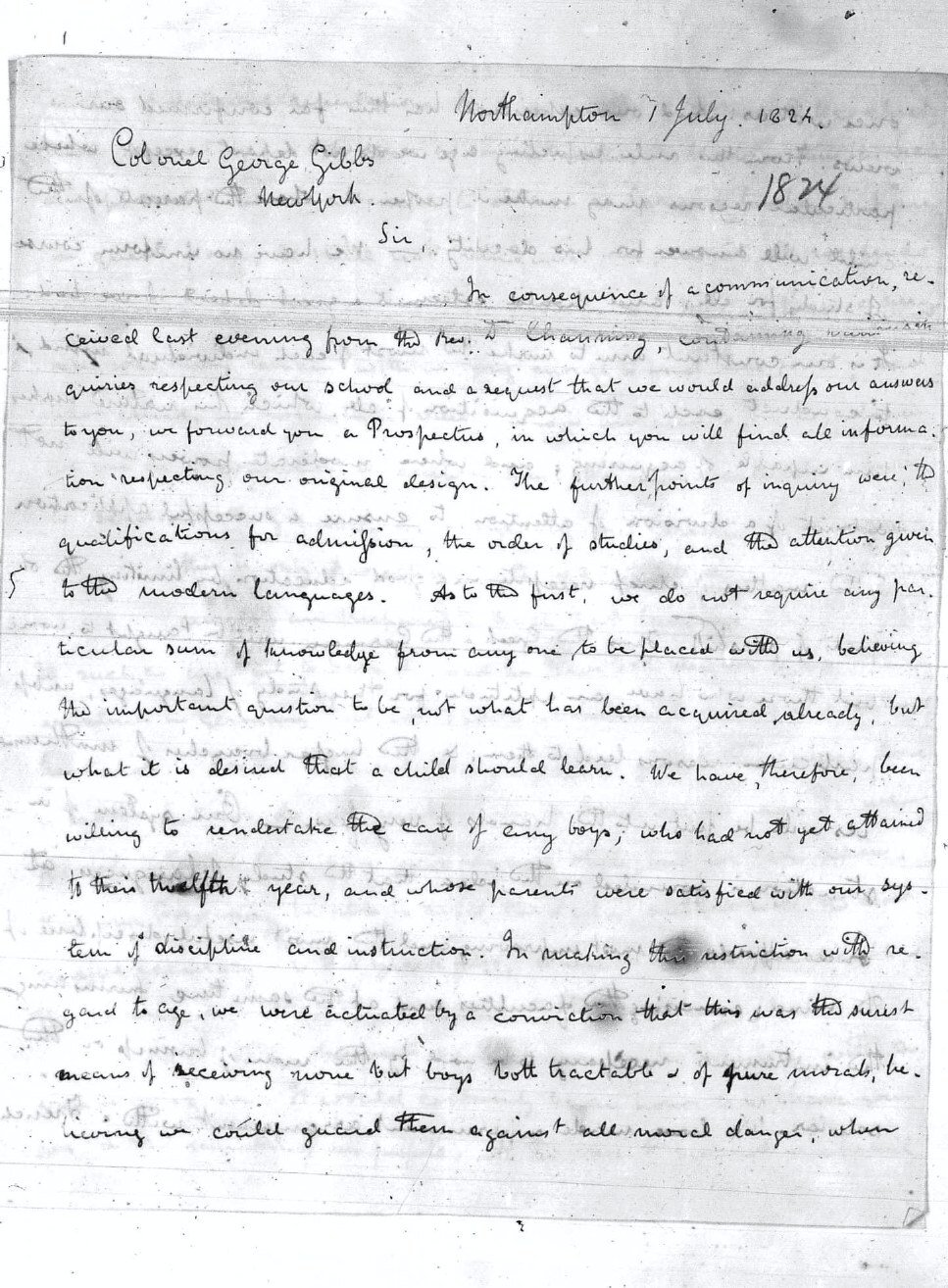
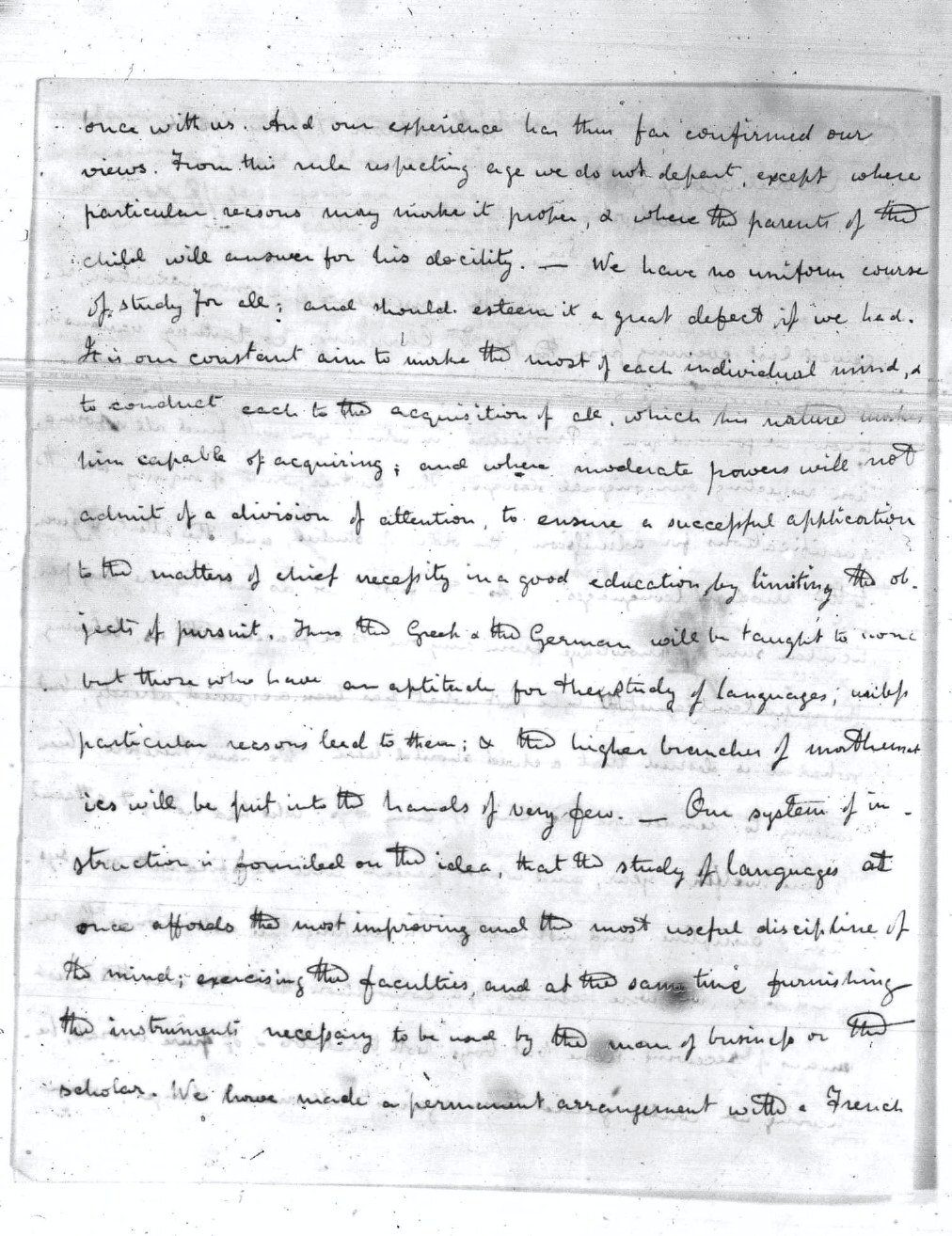
Colonel George Gibbs NewYork.
Sir,
In consequence of a communication, received last evening from the Rev. Dr Channing, containing inquiries[?] respecting our school and a request that we would address our answers to you, we forward you a Prospectus, in which you will find all information respecting our original design. The further points of inquiry were; the qualifications for admission, the order of studies, and the attention given to the modern languages. As to the first, we do not require any particular sum of knowledge from any one to be placed with us, believing the important question to be, not what has been acquired already, but what it is desired that a child should learn. We have, therefore, been willing to undertake the care of any boys, who had not yet attained to their twelfth year, and whose parents were satisfied with our system of discipline and instruction. In making this restriction with regard to age, we were actuated by a conviction that this was the surest means of receiving none but boys both tractable & of pure morals, believing we could guard them against all moral danger, when once with us. And our experience has thus far confirmed our views. From this rule respecting age we do not depart, except where particular reasons may make it proper, & where the parents of the child will answer for his docility. —
We have no uniform course of study for all; and should esteem it a great defect if we had. It is our constant aim to make the most of each individual mind, & to conduct each to the acquisition of all, which his nature makes him capable of acquiring; and where moderate powers will not admit of a division of attention, to ensure a successful application to the matters of chief necessity in a good education, by limiting the objects of pursuit. Thus the Greek & the German will be taught to none but those who have an aptitude for the study of languages; unless particular reasons lead to them; & the higher branches of mathematics will be put into the hands of very few. —
Our system of instruction is founded on the idea, that the study of languages at once affords the most improving and the most useful discipline of the mind; exercising the faculties and at the same time furnishing the instruments necessary to be used by the man of business or the scholar. We have made a permanent arrangement with a French teacher of deserved reputation. He is a native of France & has already had several years experience as an instructer. We have thus far been disappointed in all attempts to obtain a Spanish teacher, but are in quest of one, & shall not relinquish our pursuit till we find one. It comes within our design to teach the Italian to all or nearly all, who may[?] remain with us long enough to find time for it, and have already an instructer in view, who is prepared to join us, whenever we are in a condition to employ him. We hope eventually to be able to send out to Germany for a regularly-bred German scholar; but as this is only projected, both Mr Cogswell & myself are prepared to teach that language to such as are fit to learn it, and we have both been for so ma[ny years?] residents in Germany, that we should undertake to instruct in it without hesitation. For the ancient languages we give to them much time & labor; but we do not make Latin & Greek verses, nor do we profess to teach to write a pure Latin style; but we take pains, that our boys may be able to read the Latin authors with the most careful accuracy; & the Greek also, where it seems practicable, & the parents do not express a desire to the contrary.
Dr C. observes to us, that you make inquiries with a view to your son. It would certainly be an honor to us, to have your son in the number of our pupils. At the present moment our family contains as many as we can accommodate. In October we purpose to receive a small additional number of boys; should you desire at that time to place your son under our care, we have to request, that you would give us early information of it, in order that we may certainly have room for him.
Permit me to request you would accept, the assurances of regard on the part of Mr Cogswell & myself —
Yrs respectfully
George Bancroft —
[Address leaf, written crosswise:] Colonel George Gibbs / NewYork. [postal marking:] July [large docket, scan 502:] 1824
Transcribed verbatim from the scans, keeping the original spelling, capitalization, and punctuation; the manuscript’s own dashes are kept, bracketed words are interlineations or uncertain readings, and [illegible] marks passages lost to the film. Condition: Four manuscript pages, not three: scan 505 proved to be a duplicate exposure of the same page as 504, and the letter’s final page (conclusion, closing, signature, and address leaf) is scan 506, which was read and included so the document is complete rather than ending mid-sentence at ‘our family’. SIGNATURE: signed by George Bancroft ALONE (‘Yrs respectfully / George Bancroft’), but explicitly on behalf of both principals (‘the assurances of regard on the part of Mr Cogswell & myself’); Cogswell is referred to in the third person throughout (‘both Mr Cogswell & myself are prepared to teach that language’), so the whole letter is in Bancroft’s hand and voice. The reply answers queries relayed through Rev. Dr Channing (Wm. Ellery Channing, the Gibbses’ Boston connection), addressed to Col. Gibbs in New York. Legibility: heavy show-through of the facing page and foxing on all scans; a horizontal fold/scan-line crosses 502 (line 2 of the body, ‘containing in-quiries’ is broken across the line with a small interlined insertion, reading confident from context but flagged inquiries[?]) and crosses 504 mid-page, obscuring one line (‘all, who may[?] remain with us long enough’), the may[?] reading aided by duplicate scan 505. Right-edge loss on 504: ‘for so ma[ny years?] residents in Germany’. On 506 ‘may’ is interlined above the line in ‘that we may certainly have room for him’. A large archival docket ‘1824’ is written diagonally at the head of 502, and a pencil ‘5’ sits in the left margin of 502; both are filing marks, not letter text. Original spellings kept throughout: ‘instructer’ (twice), ‘NewYork’. The long dashes the writer uses as paragraph breaks are rendered ~~ and the text split into paragraphs at those points and at the two physical indents (the ‘Dr C. observes’ and ‘Permit me’ paragraphs).
Gibbs Family Papers, Wisconsin Historical Society, Reel 1, scans 502–504 and 506 (505 is a duplicate of 504; the final page, first thought missing, was identified at scan 506 on July 13, 2026). Autograph letter of George Bancroft, for himself and Joseph Cogswell, to Col. George Gibbs. Digitized from the microfilm by this site; transcribed in full above.
The Sale of the Cabinet 
May 1825 to February 1826
Three documents close the story of the great mineral cabinet. Yale’s corporation resolves its formal thanks and names Gibbs “one of the Founders of mineralogical & geological science in the United States.” The next day his father-in-law Oliver Wolcott Jr., the old Treasury Secretary, reports that ten thousand dollars was subscribed at New Haven in a few days, praises grandson George as “a fine manly boy,” and grieves at newspaper talk of the family removing to France and a final separation from Laura and the dear children. Eight months on, Gibbs himself arranges the payments through the New Haven bank and asks after the Hungarian Catalogue so he can study, one last time, the collection he is letting go.
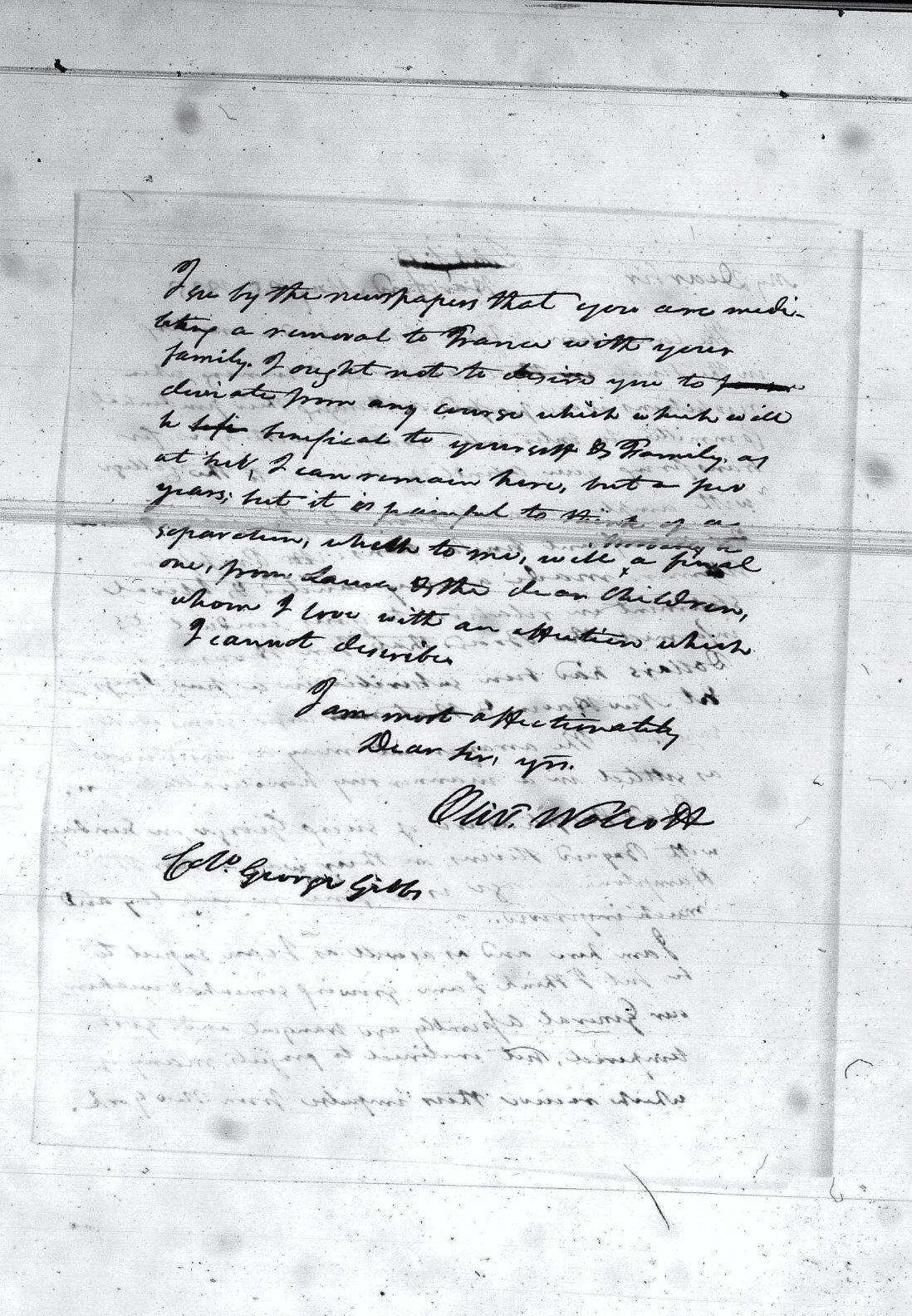
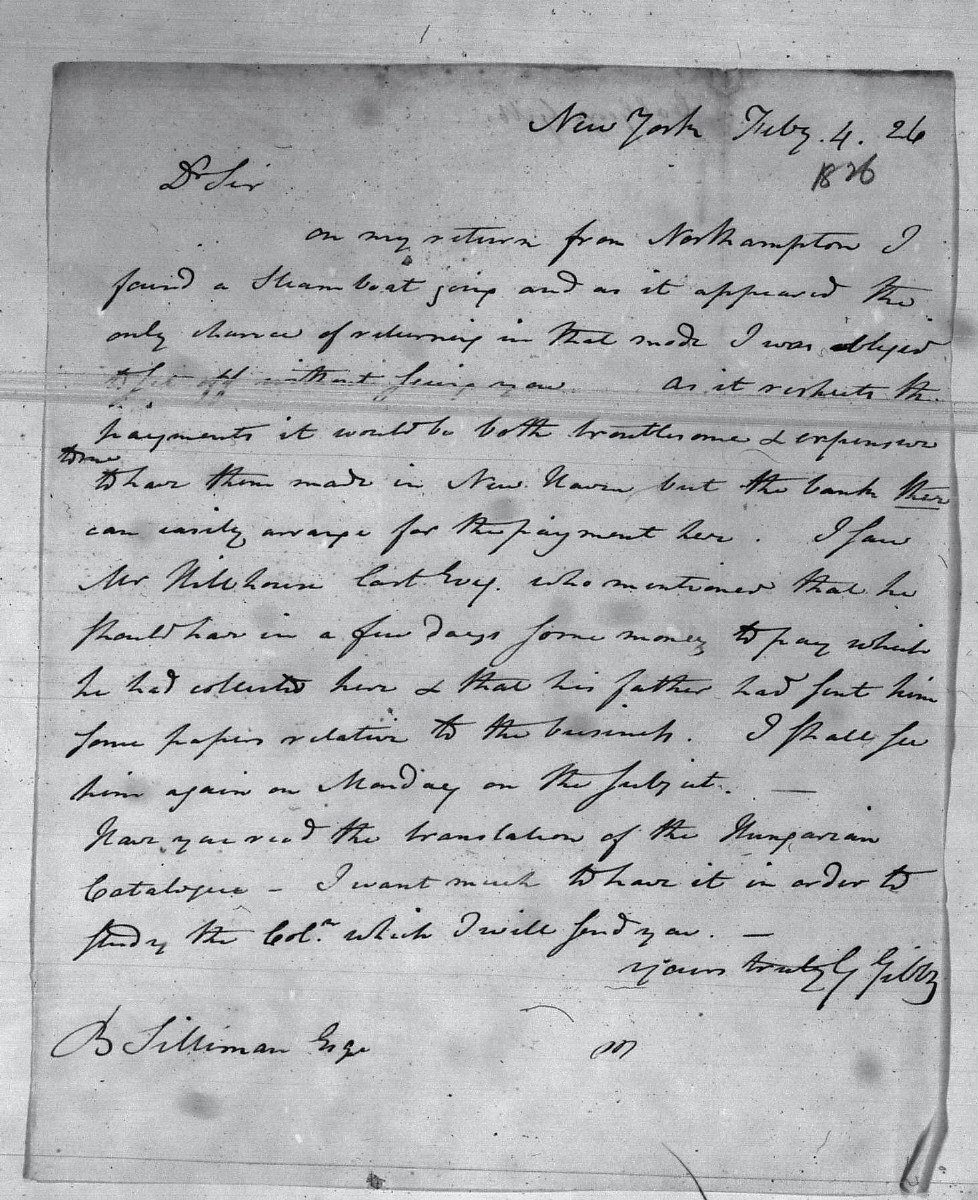
THE YALE RESOLUTION
[docketed in pencil at top: 1825. May 24]
At a special Meeting of the President & Fellows of “Yale College in New Haven” at Hartford on this 24 day of May 1825.
Voted that this Board do entertain a high sense of the public spirit and liberality of Col George Gibbs manifested in the Loan to Yale College & the public, during a period of fifteen years of his splendid & highly useful Cabinet of minerals and Models & of a valuable collection of books relating to natural science — that the introduction of this Cabinet has, in an important degree, given rise to a new Science in this Country, thus preparing the way for the more complete discovery of its mineral treasures, and for the developement[?] of new sources of national and individual wealth — that it has contributed much to advance the reputation, usefulness and prosperity of Yale College, and to diffuse among our Youth important practical knowledge, and a taste for accurate observation & original research; that Col Gibbs is therefore justly regarded as one of the Founders of mineralogical & geological science in the United States, and as a distinguished Patron of the Arts; and that he is therefore entitled to the thanks of this Board & of his Country — and that the President be requested to present to Col Gibbs the thanks of this Corporation for his many Acts of liberality to this Institution.
The foregoing is a true Copy of the records of the President & Fellows of Yale College certified by
Elizur Goodrich Secretary P & F. Yale College
OLIVER WOLCOTT TO GIBBS
[struck through: Litchfield[?]] Hartford May 25. 1825 [pencil, another hand: 1825]
My Dear Sir
The Corporation of Yale College, had a meeting in the Senate [struck through: in the] Chamber last evening, when resolutions were passed, authorizing their prudential Committee to enter into a contract with you, for transferring your cabinet of Minerals to the College with ample acknowledgements for your [word struck through] magnificent benefactions. [struck through: Mr] Professor Silliman made a very candid & liberal statement, in relation to your conduct & informed the Board that Ten thousand Dollars had been subscribed in a few days at New Haven & that larger sums were expected. The arrangement may be considered as settled in a manner very honourable to you.
I had the pleasure of seeing George, on Sunday with Bayard Stevens, on their way to North Hampton. George is a fine manly boy and much improved.
I am here and as well as I can expect to be, but I think I am growing somewhat weaker. our General Assembly are tranquil and good tempered, but inclined to projects, many of which receive their impulse from New York.
I see by the newspapers that you are meditating a removal to France with your family. I ought not to desire you to [word struck through] deviate from any course which which will be [struck through: safe[?]] beneficial to yourself & Family, as at best, I can remain here, but a few years; but it is painful to think of a separation, which to me, will probably[?] be a final one, from Laura & the dear Children, whom I love with an affection which I cannot describe.
I am most affectionately Dear Sir, yrs.
Olivr. Wolcott
Colo. George Gibbs
THE DOCKET
Letter [struck through: to] & Copy to
Colo. George Gibbs
[illegible faded line, apparently a date, 1825[?]]
Sale of Minerals
GIBBS TO SILLIMAN ON THE PAYMENTS
New York Feby. 4. 26 [pencil, another hand: 1826]
Dr Sir
on my return from Northampton I found a Steamboat going and as it appeared the only chance of returning in that mode I was obliged [word struck through] to set off without seeing you. As it respects the payments it would be both troublesome & expensive to have them made in New Haven but the bank there can easily arrange for the payment here. I saw Mr. Hillhouse last Evg. who mentioned that he should have in a few days some money to pay which he had collected here & that his father had sent him some papers relative to the business. I shall see him again on Monday on the subject. —
Have you recd the translation of the Hungarian Catalogue — I want much to have it in order to study the Colln[?]. which I will send you. —
yours truly G Gibbs
B Silliman Esqe
Transcribed verbatim from the scans, keeping the original spelling, capitalization, and punctuation; the manuscript’s own dashes are kept, bracketed words are interlineations or uncertain readings, and [illegible] marks passages lost to the film. Condition: Scan 559 (resolution copy) is legible throughout but crossed by microfilm fold-lines; one passage mid-page is partly obscured by a fold and bleed-through, read as ‘developement[?] of new sources of’. The certification is in Elizur Goodrich’s hand. Scans 560-561 are Wolcott’s retained letter (the docket on 562 reads ‘Letter & Copy’), written aslant with several authorial strikethroughs: the place-line word struck before ‘Hartford’ appears to be ‘Litchfield’; ‘in the’ struck after ‘Senate’; a word (apparently ‘generous’) struck before ‘magnificent benefactions’; ‘Mr’ struck before ‘Professor Silliman’. On 561 ‘which which’ is doubled in the manuscript and is preserved; ‘probably’ is an interlined insertion marked with a caret and is partly obscured; a wholly struck-out illegible word stands at the head of the leaf. Scan 562 is the address/docket wrapper: four short docket lines at upper left, the third (a date line) too faded to read; the rest of the leaf shows only mirror bleed-through of the letter text. Scan 581 (Gibbs to Silliman) is bold and legible; a false start is struck at ‘I was obliged [word struck through] to set off’; a stray struck word begins the line before ‘to have them made’; ‘there’ is underlined in the manuscript (‘the bank there’); the abbreviation before ‘which I will send you’ reads ‘Colln[?]’ (Collection); an ink flourish or offset mark sits at bottom center. Pencil archivist dates (‘1825. May 24’, ‘1825’, ‘1826’) appear on 559, 560 and 581.
Gibbs Family Papers, Wisconsin Historical Society, Reel 1, scans 559–562 and 581. Certified copy of the Yale Corporation resolution of May 24, 1825; autograph letter of Oliver Wolcott Jr. to Col. George Gibbs, Hartford, May 25, 1825, with its docket; and autograph letter of George Gibbs to Benjamin Silliman, New York, February 4, 1826. Digitized from the microfilm by this site; transcribed in full above.
After His Death: The Gibbs Cabinet Inscription 
New Haven, November 2, 1834
Fifteen months after the Colonel’s death, Silliman writes the widow at Sunswick. The famous meteoric iron is held up by the Lyceum’s president, Major Delafield; and Silliman describes the Trumbull Gallery’s inscription in massy silver letters as the model for what he proposes to raise at Yale: the name GIBBS CABINET over the door of the collection, a monument to the man he remembers with gratitude.
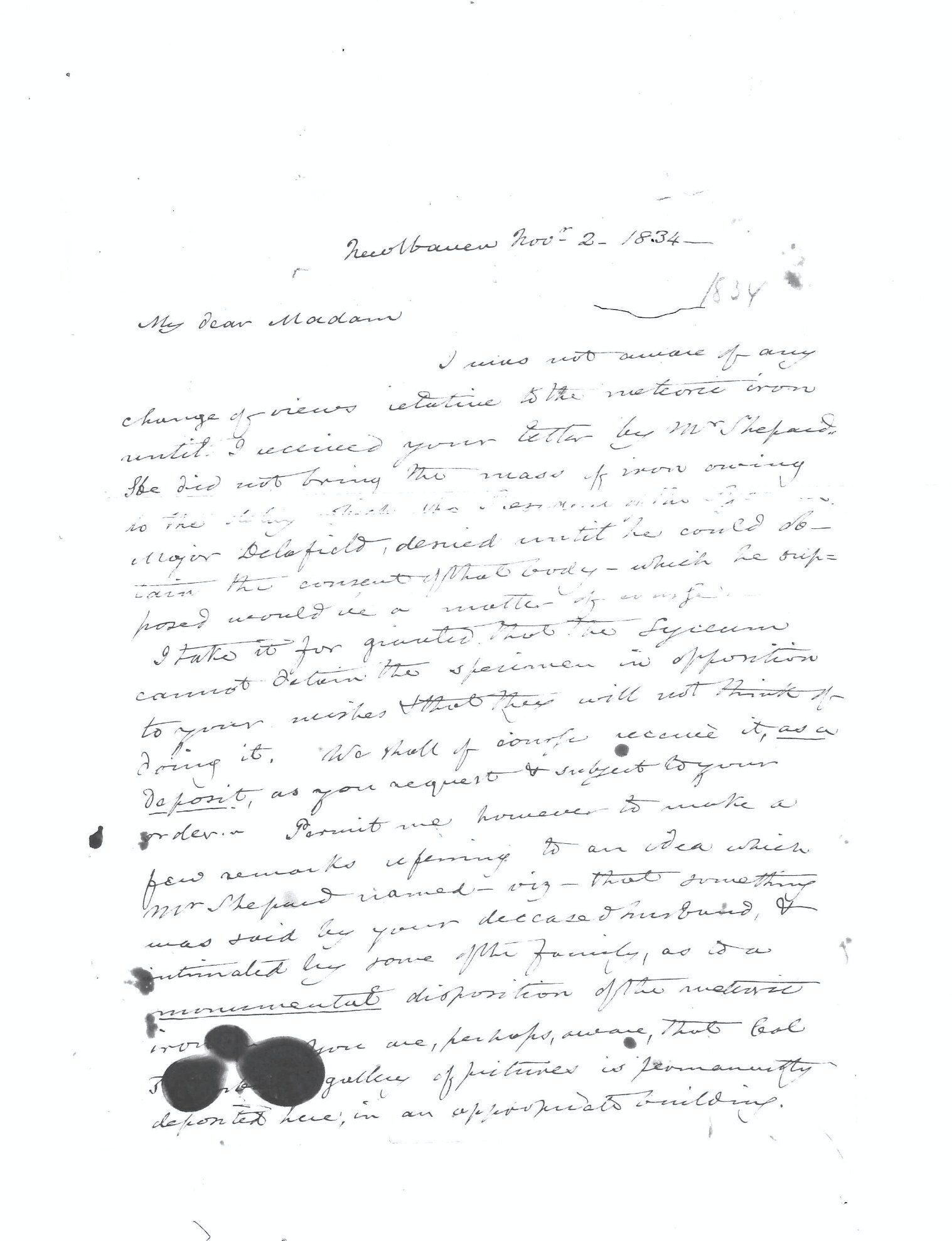
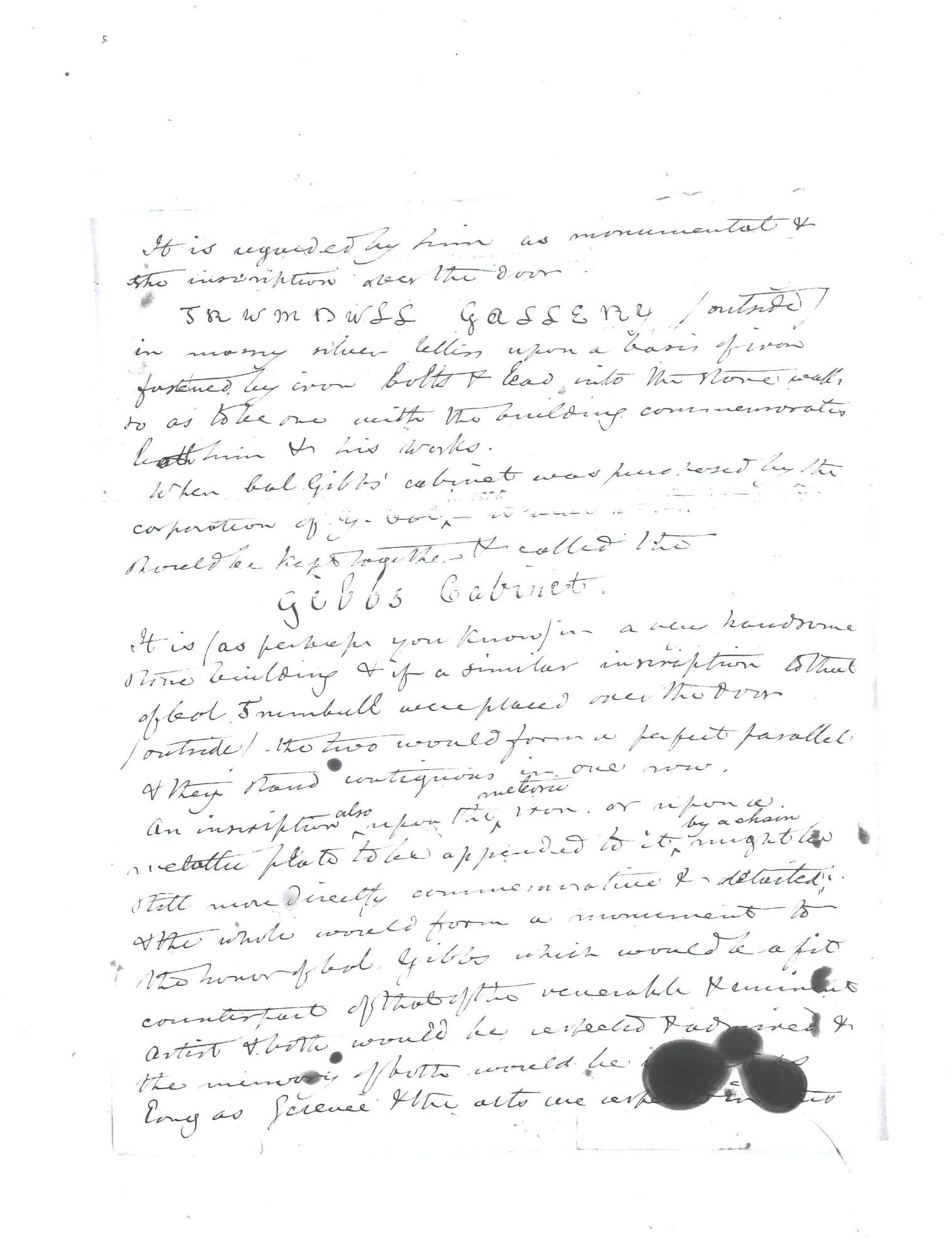
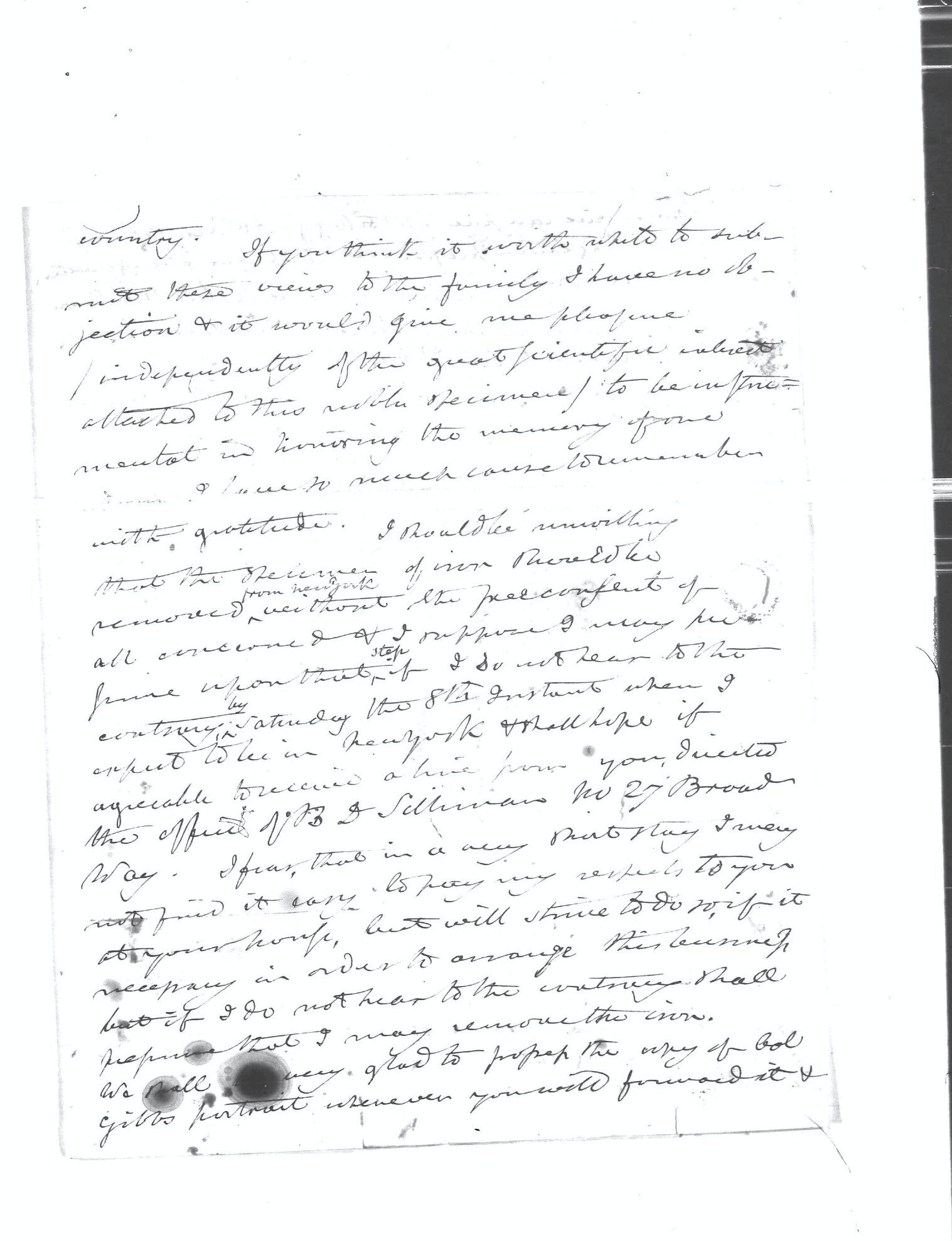
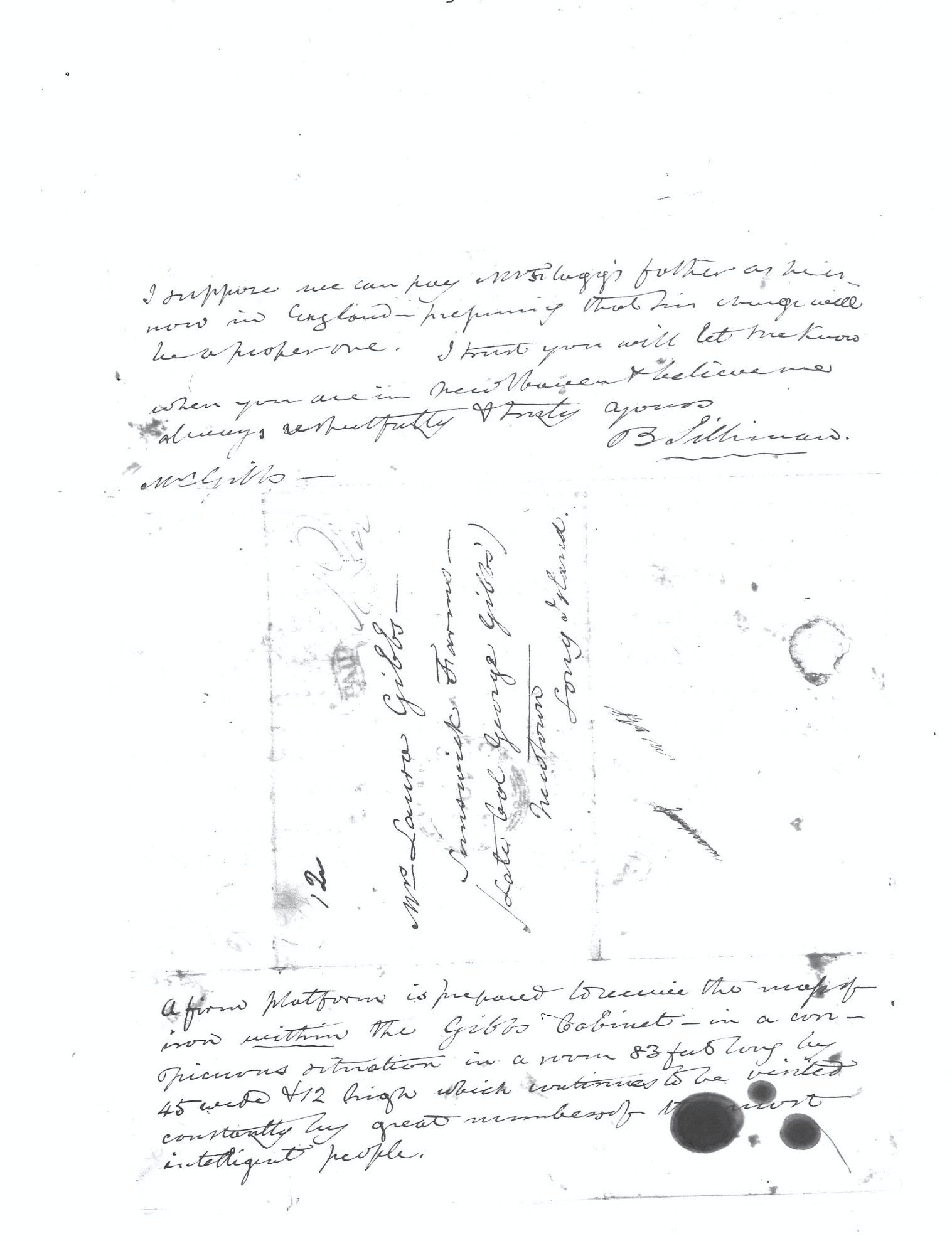
New Haven Novr. 2 — 1834 — [pencil, another hand: 1834]
My dear Madam
I was not aware of any change of views relative to the meteoric iron until I received your letter by Mr Shepard. He did not bring the mass of iron owing to the [faint line: delivery[?]] which the President of the Lyceum[?] — Major Delafield, denied until he could obtain the consent of that body — which he supposed would be a matter of course[?]. —
I take it for granted that the Lyceum cannot detain the specimen in opposition to your wishes & [struck through: that] they will not think of doing it. We shall of course receive it, as a deposit, as you request & subject to your order. — Permit me however to make a few remarks referring to an idea which Mr Shepard named — viz — that something was said by your deceased husband, & intimated by some of the family, as to a monumental disposition of the meteoric iron. [words obscured by ink blots] You are, perhaps, aware, that Col Trumbull’s[?] gallery of pictures is permanently deposited here, in an appropriate building.
It is regarded by him as monumental & [struck through: the] the inscription over the door
TRUMBULL GALLERY (outside)
in massy silver letters upon a basis of iron fastened by iron bolts & lead into the stone walls so as to be one with the building commemorates [struck through: with[?]] both him & his works.
When Col Gibbs’ cabinet was purchased by the corporation of Y. Col. — it was [faint: agreed[?] that it[?]] would be kept together & called the
GIBBS CABINET.
It is (as perhaps you know) in a very handsome stone building & if a similar inscription to that of Col Trumbull were placed over the door (outside) the two would form a perfect parallel & they stand contiguous in one row.
An inscription also upon the meteoric iron, or upon a metallic plate to be appended to it by a chain, might be still more directly commemorative & detailed, & the whole would form a monument to the honor of Col. Gibbs which would be a fit counterpart of that of the venerable & eminent artist & both would be respected & admired & the memories of both would be [obscured by ink blots] long as Science & the arts are resp[ected in this[?]] country.
If you think it worth while to submit these views to the family I have no objection & it would give me pleasure (independently of the great scientific interest attached to this noble specimen) to be instrumental in honoring the memory of one whom[?] I have so much cause to remember with gratitude.
I should be unwilling that the specimen of iron should be removed from New York, without the free consent of all concerned & I suppose I may presume upon that step, if I do not hear to the contrary, by Saturday the 8th Instant when I expect to be in New York & shall hope if agreeable to receive a line from you, directed to the office of B. D. Silliman No 27 Broad Way.
I fear, that in a very short stay I may not find it easy to pay my respects to you at your house, but will strive to do so, if it necessary in order to arrange this business but if I do not hear to the contrary shall presume that I may remove the iron.
We shall [be] very glad to possess the copy of Col Gibbs’ portrait whenever you will forward it & I suppose we can pay Mr Selagi’s[?] father as he is now in England — presuming that his charge will be a proper one.
I trust you will let me know when you are in New Haven & believe me
always respectfully & truly yours
B Silliman.
Mrs Gibbs —
THE ADDRESS PANEL (scan 912, wrapper)
Mrs Laura Gibbs —
Sunswick Farms —
(Late Col George Gibbs’)
Newtown
Long Island.
[postal rate, another hand: 12; faint circular postmark, illegible]
POSTSCRIPT (below the address panel)
A firm platform is prepared to receive the mass of iron within the Gibbs Cabinet — in a conspicuous situation in a room 83 feet long by 45 wide & 12 high which continues to be visited constantly by great numbers of the[?] most intelligent people.
Transcribed verbatim from the scans, keeping the original spelling, capitalization, and punctuation; the manuscript’s own dashes are kept, bracketed words are interlineations or uncertain readings, and [illegible] marks passages lost to the film. Condition: Scan 909 (p. 1): one whole line is badly faded ~~ read as ‘owing to the delivery[?] which the President of the Lyceum[?]’ before ‘Major Delafield, denied’; the sentence-end after ‘matter of’ is faint (‘course’ conjectural). Heavy ink blots at the foot obscure a few words after ‘meteoric iron’ and the name in ‘Col Trumbull’s gallery’ (restored from context ~~ the Trumbull Gallery is named on p. 2). In the manuscript ‘monumental’ and the ‘posit’ of ‘deposit’ are underlined; ‘that’ is struck before ‘they will not think of doing it’; words broken at line-ends with ‘=’ (ob=tain, sup=posed) are joined silently. Scan 910 (p. 2): the inscription ‘TRUMBULL GALLERY’ and ‘GIBBS CABINET’ are written large in imitation of the lettering; a word is struck before ‘the inscription’ and another (apparently ‘with’) before ‘both him & his works’; the clause after ‘corporation of Y. Col.’ is faded ~~ ‘agreed that it’ conjectural; ‘also’, ‘meteoric’ and ‘by a chain’ are caret interlineations, incorporated silently; ink blots at the foot obscure the words between ‘would be’ and ‘long as Science’ and the endings of ‘respected in this’. Scan 911 (p. 3): opens with the catchline ‘country.’ completing the blotted sentence; ‘from New York’, ‘step’ and ‘by’ are interlineations, incorporated silently; ‘whom’ before ‘I have so much cause’ is faded; ‘if it necessary’ lacks a verb in the manuscript and is kept verbatim; a blot covers the word after ‘We shall’ (evidently ‘be’). Scan 912 (p. 4): the surname in ‘Mr Selagi’s[?] father’ is doubtful ~~ the hand admits other readings; the address panel is written crosswise on the wrapper leaf, which also bears a rate marking ’12’ and an illegible circular postmark; blots at the lower right partly obscure ‘of the most intelligent people’ in the postscript. Scan 913 is a duplicate exposure of 912 and was not separately transcribed.
Gibbs Family Papers, Wisconsin Historical Society, Reel 1, scans 909–912 (913 is a duplicate exposure). Autograph letter of Benjamin Silliman to Laura Wolcott Gibbs. Digitized from the microfilm by this site; transcribed in full above.
“More Like a Man Receiving Than Conferring a Favor” 
New Haven, November 14, 1834
The finest tribute to the Colonel in the reel, from the man best placed to give it. Silliman tells the widow what he learned only by accident: that through the fifteen years the cabinet was deposited at Yale, Gibbs bore himself as if the college were doing him the kindness, and quietly insured the collection at his own expense the whole time, holding the matter confidential. The meteoric iron, the drills and saws, and every commemorative plan wait on her wishes.
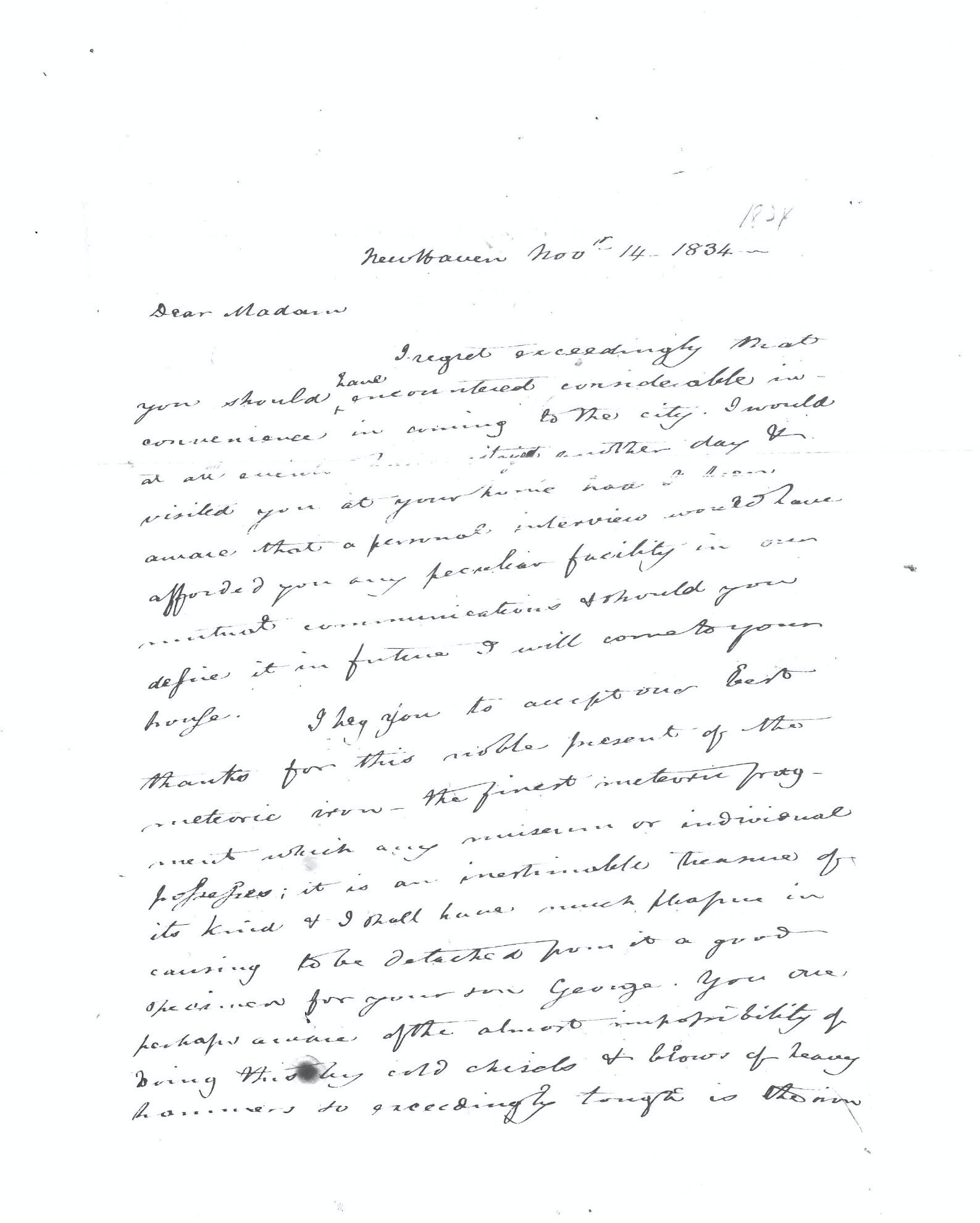
Dear Madam
I regret exceedingly that you should have encountered considerable inconvenience in coming to the city. I would at all events [two or three words illegible] another day & visited you at your home had I been aware that a personal interview would have afforded you any peculiar facility in our mutual communications & should you desire it in future I will come to your house.
I beg you to accept our best thanks for this noble present of the meteoric iron — the finest meteoric fragment which any museum or individual possesses; it is an inestimable treasure of its kind & I shall have much pleasure in causing to be detached from it a good specimen for your son George. You are perhaps aware of the almost impossibility of doing this by cold chisels & blows of heavy hammers so exceedingly tough is the iron of meteors but I trust we can succeed by drills & saws. —
Every thing commemorative shall be deferred until I know your wishes & feelings. I am well aware of those traits of Col Gibbs’ character to which you allude & know your impression to be entirely well founded. —
It has been my pleasure for many years to honor Col Gibbs’ character as a zealous munificent & efficient promoter & patron of science & especially of mineralogy & geology. All our classes have heard from me the history of its progress in this country & especially of the great cabinet which has been the starting point for the nation. —
During the 15 years that the cabinet was in deposit — (as I have many times said) Col Gibbs acted more like a man receiving than conferring a favor; so unassuming & modest was his deportment & it was only[?] by accident that I learned (not from himself) that he insured the cabinet while it was his own: I felt the trust to be peculiarly confidential & therefore demanding entire fidelity in me — for he assured me — more than once — that if I should leave the college he should remove the cabinet. I never [permitted?] [illegible] a fragment to be taken from it nor am I aware that any specimen[?] was ever stolen.
Excepting a few duplicates (& there are many in some departments) which have been exchanged since the cabinet was ours, every thing remains as it was when Col Gibbs last saw it. —
I trust you will let me hear from you again when you have matured your views as to an inscription &c. I can assure you that every thing will be done here that you & Col Gibbs’ sister may think proper — & with my respects to Miss Gibbs I remain — dear Madam your friend & servant
B Silliman.
Mrs Gibbs
[Address wrapper — scan 917]
Mrs Laura W Gibbs / Sunswick / Post Office at / Hallet’s Cove / Long Island —
Transcribed verbatim from the scans, keeping the original spelling, capitalization, and punctuation; the manuscript’s own dashes are kept, bracketed words are interlineations or uncertain readings, and [illegible] marks passages lost to the film. Condition: Scan 914 (page 1): a later pencil annotation ‘1834’ appears at the upper right. One line falls on a horizontal fold and is badly faded ~~ after ‘I would at all events’ two or three words are unrecoverable before ‘another day &’; the sense (that Silliman would have chosen another day and visited her at home) is carried by the following lines. ‘have’ in ‘you should have encountered’ is interlined above a caret in Silliman’s hand. Scan 915 (page 2): an ink blot partly covers the word read as ‘only’ in ‘it was only by accident’ ~~ marked only[?]. Scan 916 (page 3): in ‘I never [permitted?] [illegible] a fragment to be taken from it’, one word is a conjectural reading and a short faded word or two follows on the fold line; ‘specimen’ before ‘was ever stolen’ is faded at the fold and could read ‘specimens’ ~~ marked specimen[?]. Bottom-left docket ‘Mrs Gibbs’ is Silliman’s own foot-of-letter direction. Scan 917 (wrapper): address panel fully legible; faint mirrored bleed-through of letter text at top is not independent writing; remnant of a black wax seal below the address. Scan 918 is a lighter duplicate exposure of this wrapper and was not separately transcribed. Manuscript long dashes are rendered as ~~ throughout; original spelling and ampersands retained; hyphenated line-break words silently rejoined.
Gibbs Family Papers, Wisconsin Historical Society, Reel 1, scans 914–917 (918 is a lighter duplicate of the wrapper). Autograph letter of Benjamin Silliman to Laura Wolcott Gibbs. Digitized from the microfilm by this site; transcribed in full above.
A biography page of the Gibbs family series on AlfredGibbs.com. Text drawn from the family Record (The Gibbs Family of Rhode Island) and the sources linked above; images enhanced and colorized by Garland H. Green Jr., each linked to its original where one exists. This page was restyled July 10, 2026 with all original content preserved.
Views: 376