John Greene and Richard Smith: Their Roles in the Narragansett Land Disputes
This page was rewritten on 22 September 2026 from the printed primary records, each shown below as a page image with its transcription and a citation. The earlier version, written from secondary accounts under a Researcher’s Note, said that John Greene “played an active role in resolving” the land disputes, that he mediated between settlers and the Narragansett, that he advocated for settlers’ rights, and that he signed a petition to the Crown in 1676. None of those statements has a record behind it, and they are withdrawn. The records show something plainer and more interesting: two neighbours at Wickford, a trader and the man who lived in his house, caught between two colonies that both claimed the ground under them, and choosing, and changing, sides to keep their land. The section “What this page said before” lists each withdrawn statement.
Why the Narragansett country was fought over
Two colonies, one country. The Narragansett country, the mainland west of the bay from Wickford south, was claimed by Rhode Island and by Connecticut at the same time. Rhode Island held it under its royal charter, its “gratyous letters pattent,” and treated the Boston men who bought land there as “intruders” (Bartlett, 1857, pp. 29–30). The men at Wickford, when they chose Connecticut in 1663, said they did so “according to his Majesties grente,” meaning Connecticut’s charter of 1662 (Arnold, 1894, pp. 24–25). For twenty years both colonies sent courts, constables, and warrants into the same few miles of shoreline.
The Atherton purchase. In June and July 1659 Major Humphrey Atherton of Dorchester, John Winthrop the younger, Governor of Connecticut, and a group of Boston partners took deeds of gift from the sachem Coginaquond for two great tracts, the north tract at Quidnessett and Boston Neck to the south (Arnold, 1894, pp. 1–5; Potter, 1835, p. 58). Richard Smith senior and Richard Smith junior, “of Cocumcrosuck, Traders,” are named grantees in the north-tract deed, and the deed excepts the land Smith already held “by deede before this grante” (Arnold, 1894, pp. 1–2). Rhode Island had a law, dated 2 November 1658, that “noe person within the precincts of this collony shall buy or purchass any land of the Indians without licence of this Generall Court” (Bartlett, 1856, p. 418). Potter, who edited the Narragansett records in 1835, put it plainly: the purchases “were made in contravention of an express law of the colony; and the government therefore did not consider them valid, but treated him and his company as intruders.” Roger Williams had warned Atherton of this when he first came into the country and refused the land Atherton offered him to interpret (Potter, 1835, p. 59).
Why it mattered to a farmer. Anyone who held land at Quidnessett under the Atherton title had a deed that was good if Connecticut governed and worthless if Rhode Island did. That is the whole of John Greene’s and Richard Smith’s part in the dispute. They were not arbiters of it. They were people whose homes depended on how it came out (Huling, 1883, pp. 138–139).
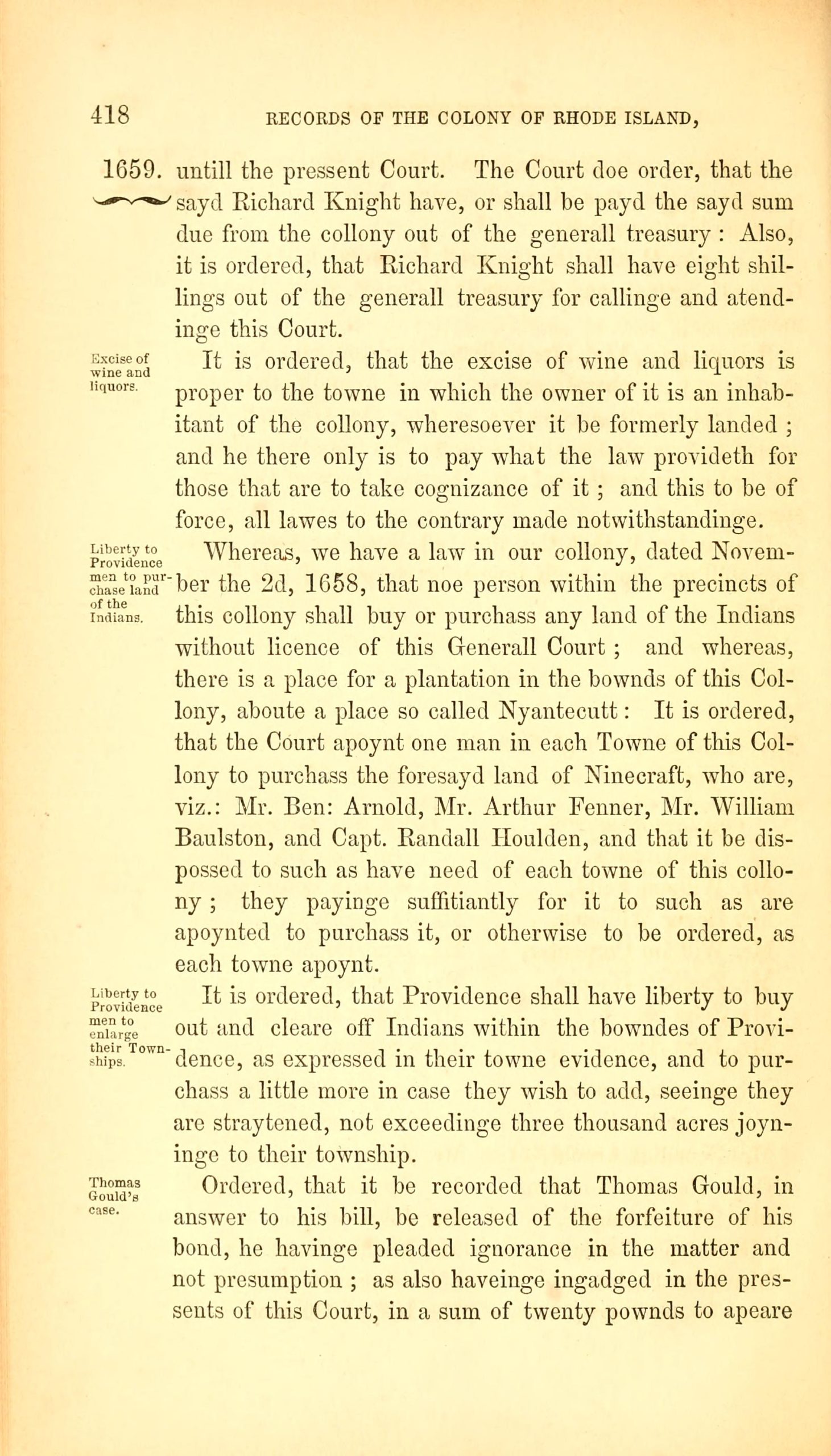
Bartlett, 1856, p. 418 (General Court, May 1659). “Whereas, we have a law in our collony, dated November the 2d, 1658, that noe person within the precincts of this collony shall buy or purchass any land of the Indians without licence of this Generall Court; and whereas, there is a place for a plantation in the bownds of this Collony, aboute a place so called Nyantecutt: It is ordered, that the Court apoynt one man in each Towne of this Collony to purchass the foresayd land of Ninecraft, who are, viz.: Mr. Ben: Arnold, Mr. Arthur Fenner, Mr. William Baulston, and Capt. Randall Houlden, and that it be dispossed to such as have need of each towne of this collony; they payinge suffitiantly for it to such as are apoynted to purchass it, or otherwise to be ordered, as each towne apoynt.” Margin: “Liberty to Providence men to purchase land of the Indians.” Huling and Potter date the colony’s order against Indian purchases to November 1651; the law as recited here by the Court itself is dated 2 November 1658.
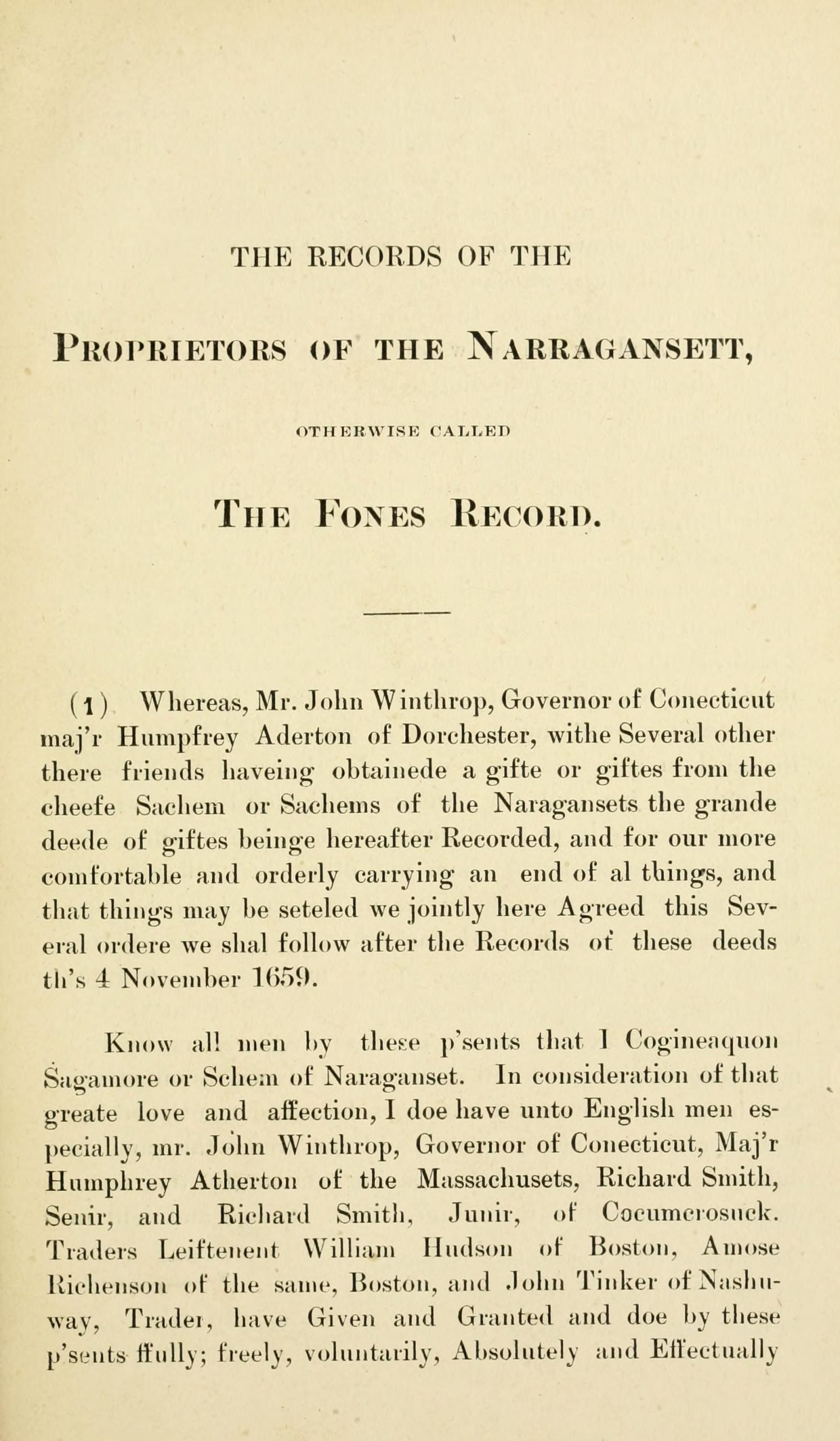
Arnold, 1894, pp. 1–2. “(1) Whereas, Mr. John Winthrop, Governor of Conecticut maj’r Humpfrey Aderton of Dorchester, withe Several other there friends haveing obtainede a gifte or giftes from the cheefe Sachem or Sachems of the Naragansets the grande deede of giftes beinge hereafter Recorded, and for our more comfortable and orderly carrying an end of al things, and that things may be seteled we jointly here Agreed this Several ordere we shal follow after the Records of these deeds th’s 4 November 1659.”
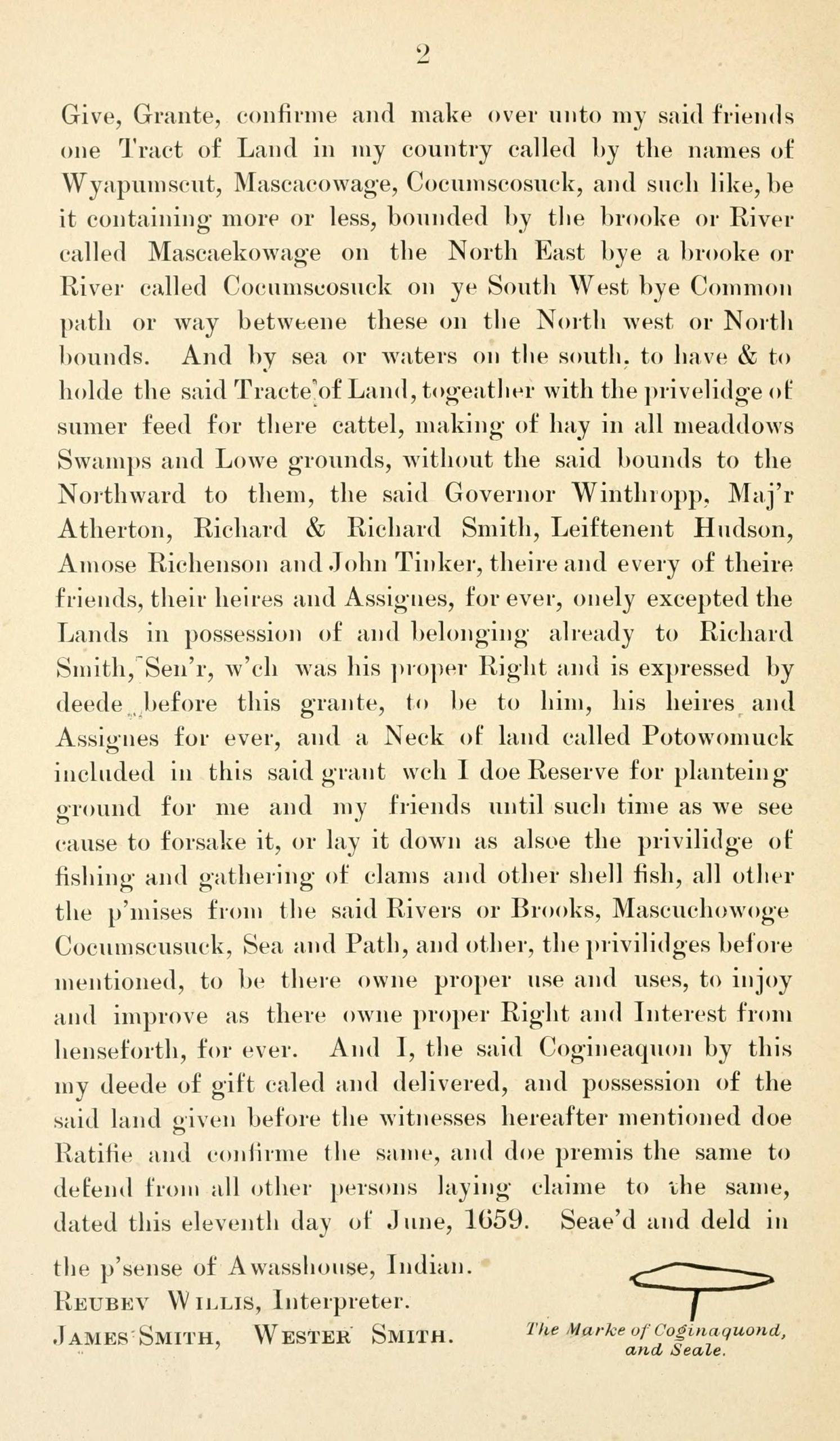
“Know all men by these p’sents that I Cogineaquon Sagamore or Schem of Naraganset. In consideration of that greate love and affection, I doe have unto English men especially, mr. John Winthrop, Governor of Conecticut, Maj’r Humphrey Atherton of the Massachusets, Richard Smith, Senir, and Richard Smith, Junir, of Cocumcrosuck. Traders Leiftenent William Hudson of Boston, Amose Richenson of the same, Boston, and John Tinker of Nashuway, Trader, have Given and Granted and doe by these p’sents ffully; freely, voluntarily, Absolutely and Effectually Give, Grante, confirme and make over unto my said friends one Tract of Land in my country called by the names of Wyapumscut, Mascacowage, Cocumscosuck, and such like, be it containing more or less, bounded by the brooke or River called Mascaekowage on the North East bye a brooke or River called Cocumscosuck on ye South West bye Common path or way betweene these on the North west or North bounds. And by sea or waters on the south, to have & to holde the said Tracte of Land, togeather with the privelidge of sumer feed for there cattel, making of hay in all meaddows Swamps and Lowe grounds, without the said bounds to the Northward to them, the said Governor Winthropp, Maj’r Atherton, Richard & Richard Smith, Leiftenent Hudson, Amose Richenson and John Tinker, theire and every of theire friends, their heires and Assignes, for ever, onely excepted the Lands in possession of and belonging already to Richard Smith, Sen’r, w’ch was his proper Right and is expressed by deede before this grante, to be to him, his heires and Assignes for ever, and a Neck of land called Potowomuck included in this said grant wch I doe Reserve for planteing ground for me and my friends until such time as we see cause to forsake it, or lay it down as alsoe the privilidge of fishing and gathering of clams and other shell fish, all other the p’mises from the said Rivers or Brooks, Mascuchowoge Cocumscusuck, Sea and Path, and other, the privilidges before mentioned, to be there owne proper use and uses, to injoy and improve as there owne proper Right and Interest from henseforth, for ever. And I, the said Cogineaquon by this my deede of gift caled and delivered, and possession of the said land given before the witnesses hereafter mentioned doe Ratifie and confirme the same, and doe premis the same to defend from all other persons laying claime to the same, dated this eleventh day of June, 1659. Seae’d and deld in the p’sense of Awasshouse, Indian. Reubev Willis, Interpreter. James Smith, Wester Smith. The Marke of Coginaquond, and Seale.” Margin of the Fones Record: “A coppie of the deed of gift for the north end tract of land. Exam No. 1.”
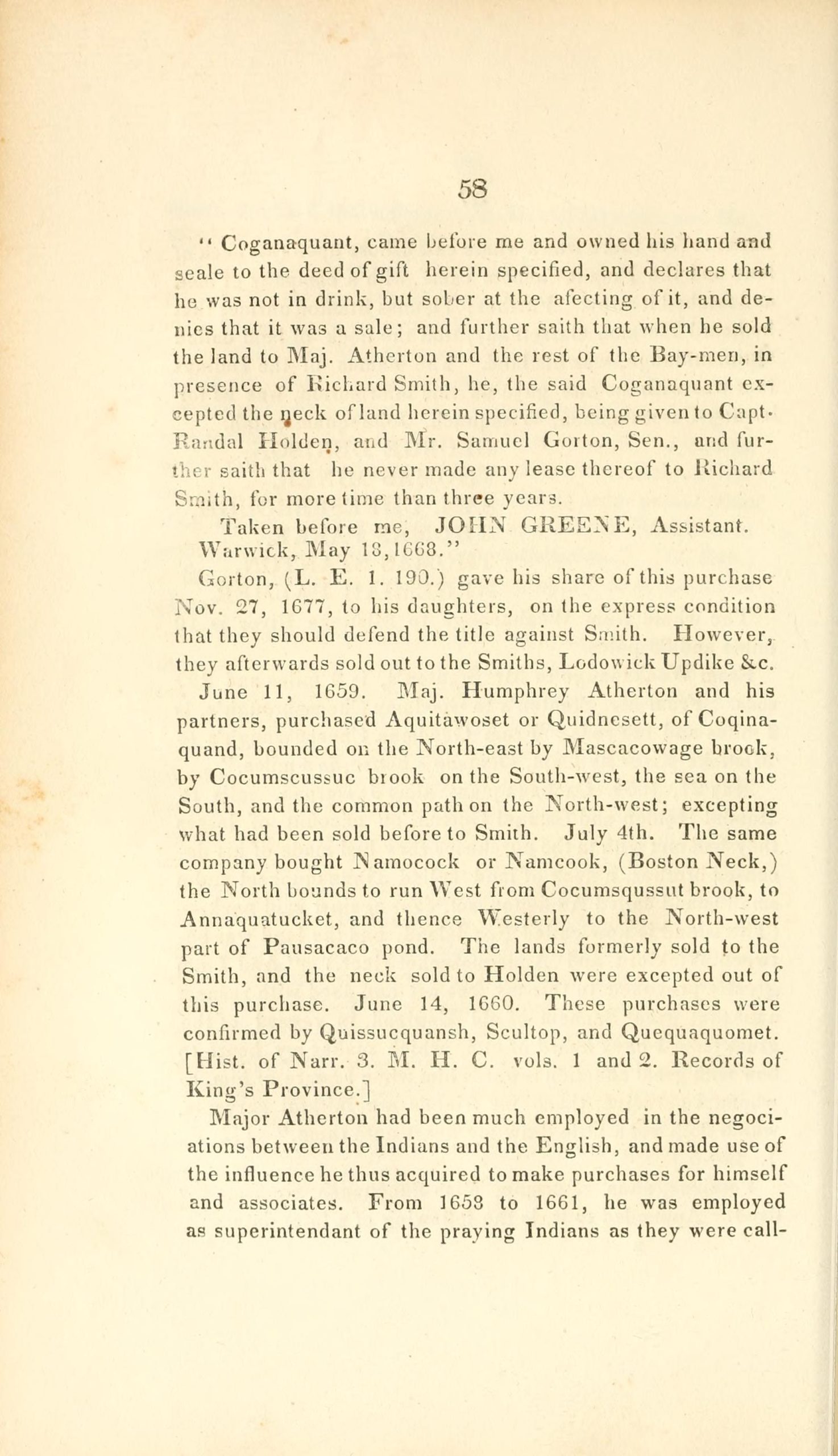
Potter, 1835, p. 58. “‘Coganaquant, came before me and owned his hand and seale to the deed of gift herein specified, and declares that he was not in drink, but sober at the afecting of it, and denies that it was a sale; and further saith that when he sold the land to Maj. Atherton and the rest of the Bay-men, in presence of Richard Smith, he, the said Coganaquant excepted the neck of land herein specified, being given to Capt. Randal Holden, and Mr. Samuel Gorton, Sen., and further saith that he never made any lease thereof to Richard Smith, for more time than three years. Taken before me, JOHN GREENE, Assistant. Warwick, May 18, 1668.’ Gorton, (L. E. 1. 190.) gave his share of this purchase Nov. 27, 1677, to his daughters, on the express condition that they should defend the title against Smith. However, they afterwards sold out to the Smiths, Lodowick Updike &c. June 11, 1659. Maj. Humphrey Atherton and his partners, purchased Aquitawoset or Quidnesett, of Coqinaquand, bounded on the North-east by Mascacowage brook, by Cocumscussuc brook on the South-west, the sea on the South, and the common path on the North-west; excepting what had been sold before to Smith. July 4th. The same company bought Namocock or Namcook, (Boston Neck,) the North bounds to run West from Cocumsqussut brook, to Annaquatucket, and thence Westerly to the North-west part of Pausacaco pond. The lands formerly sold to the Smith, and the neck sold to Holden were excepted out of this purchase. June 14, 1660. These purchases were confirmed by Quissucquansh, Scultop, and Quequaquomet. [Hist. of Narr. 3. M. H. C. vols. 1 and 2. Records of King’s Province.] Major Atherton had been much employed in the negociations between the Indians and the English, and made use of the influence he thus acquired to make purchases for himself and associates. From 1658 to 1661, he was employed as superintendant of the praying Indians as they were call-”
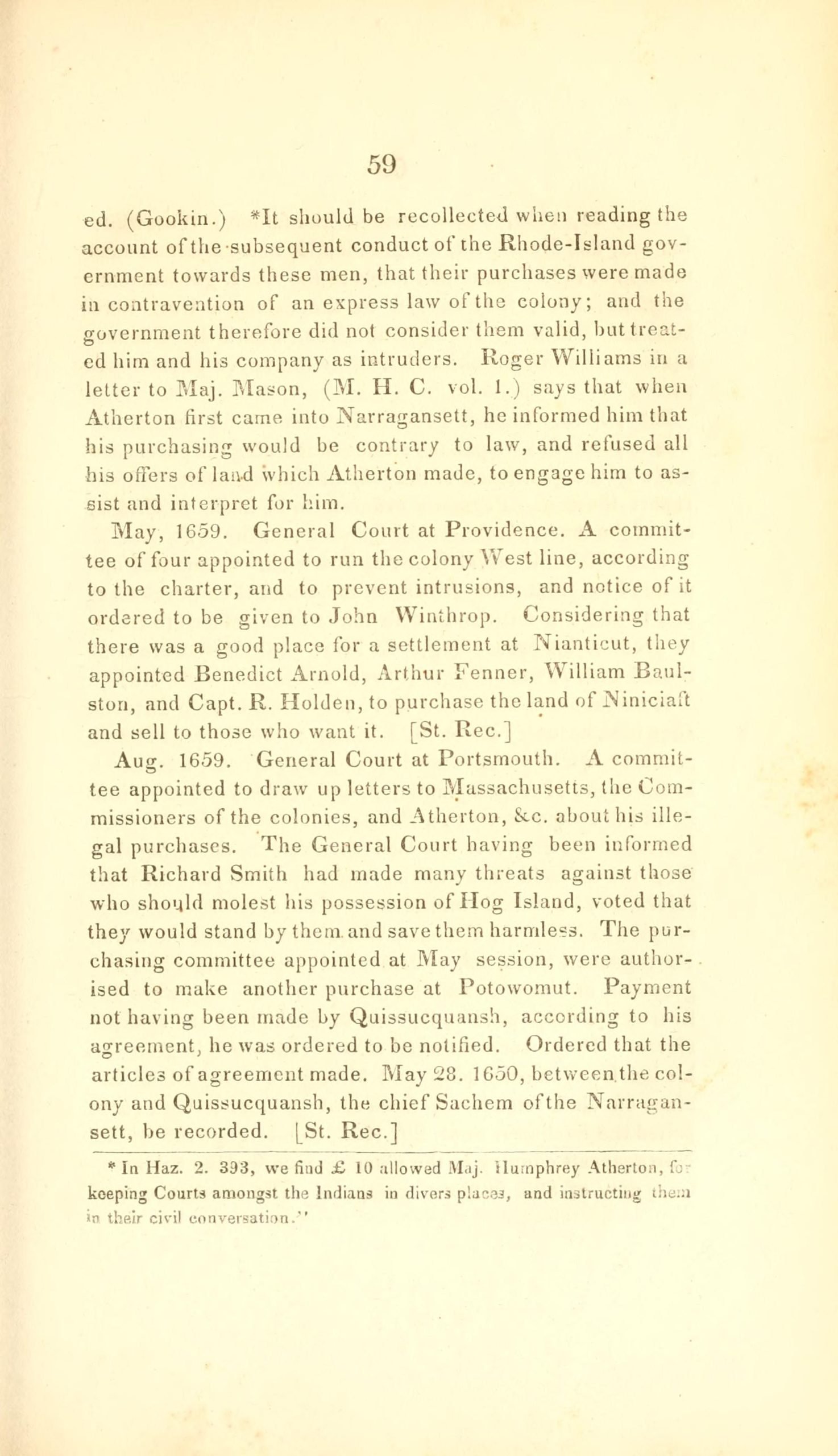
Potter, 1835, p. 59. “ed. (Gookin.) *It should be recollected when reading the account of the subsequent conduct of the Rhode-Island government towards these men, that their purchases were made in contravention of an express law of the colony; and the government therefore did not consider them valid, but treated him and his company as intruders. Roger Williams in a letter to Maj. Mason, (M. H. C. vol. 1.) says that when Atherton first came into Narragansett, he informed him that his purchasing would be contrary to law, and refused all his offers of land which Atherton made, to engage him to assist and interpret for him. May, 1659. General Court at Providence. A committee of four appointed to run the colony West line, according to the charter, and to prevent intrusions, and notice of it ordered to be given to John Winthrop. Considering that there was a good place for a settlement at Nianticut, they appointed Benedict Arnold, Arthur Fenner, William Baulston, and Capt. R. Holden, to purchase the land of Niniciaft and sell to those who want it. [St. Rec.] Aug. 1659. General Court at Portsmouth. A committee appointed to draw up letters to Massachusetts, the Commissioners of the colonies, and Atherton, &c. about his illegal purchases. The General Court having been informed that Richard Smith had made many threats against those who should molest his possession of Hog Island, voted that they would stand by them and save them harmless. The purchasing committee appointed at May session, were authorised to make another purchase at Potowomut. Payment not having been made by Quissucquansh, according to his agreement, he was ordered to be notified. Ordered that the articles of agreement made, May 28, 1650, between the colony and Quissucquansh, the chief Sachem of the Narragansett, be recorded. [St. Rec.]” Footnote: “* In Haz. 2. 393, we find £10 allowed Maj. Humphrey Atherton, for keeping Courts amongst the Indians in divers places, and instructing them in their civil conversation.”
Richard Smith’s house at Cocumscussoc
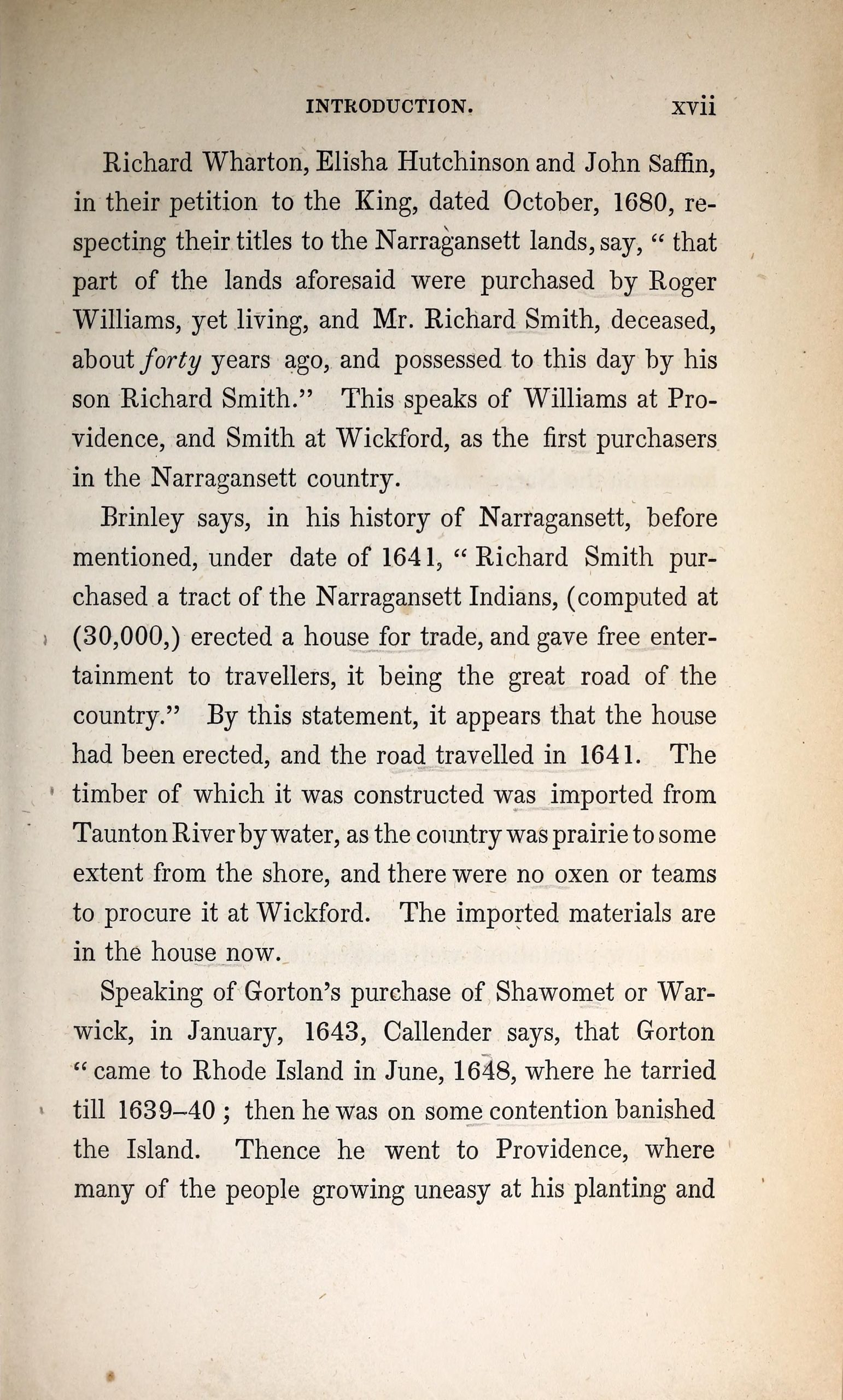
The trader who came first. Richard Smith left Taunton in Plymouth colony “for his conscience sake” and, as Roger Williams testified in 1679, “put up in the thickest of the barbarians the first English house among them,” about 1639. He kept possession there for forty years, “coming and going himself, children and servants,” and died in his own house (Updike, 1847, pp. xv–xvi). Brinley’s account puts the house and the trade at 1641, its timber brought by water from the Taunton River (Updike, 1847, p. xvii). This is the house John Greene was living in when the Narragansett record first notices him (Huling, 1883, pp. 137–138).
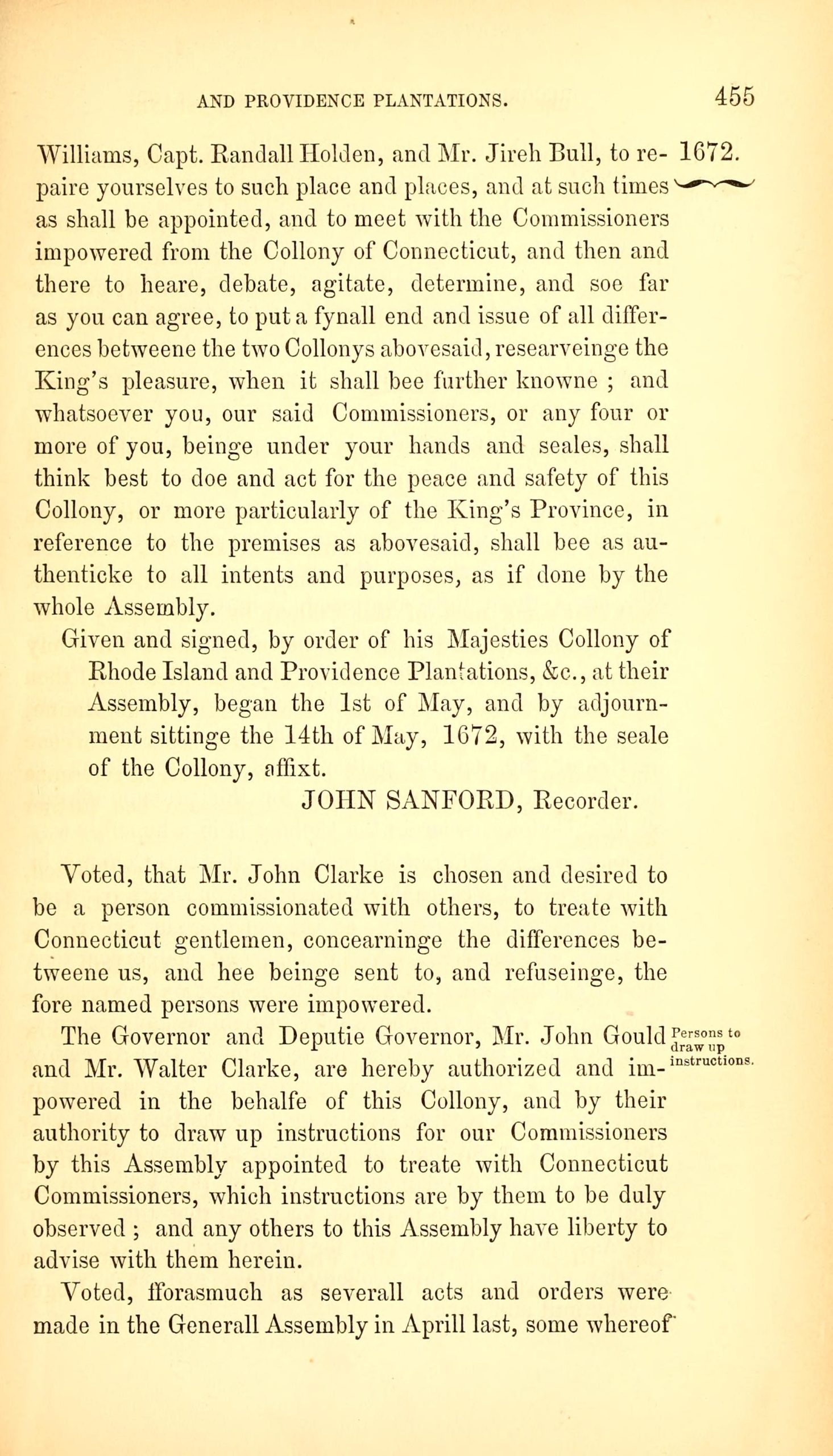
Where Smith stood. Smith had land of his own before 1659 by an earlier deed, and in 1659 he and his son became partners in the Atherton purchase (Arnold, 1894, pp. 1–2). So his title, like Greene’s, was an Atherton title, and Connecticut, the colony of his partner Governor Winthrop, was the government that would confirm it. He signed the subscription for Connecticut in 1663 and both Wickford petitions to Connecticut in 1668 (Arnold, 1894, p. 25; Gardiner, 1883, pp. 112–113). Rhode Island, which called him “an antiant inhabitant of this Collony,” tried courtesy on him first, in the letter of 4 May 1664; his answer was to send the letter to Boston and ask Connecticut to intervene (Bartlett, 1857, pp. 45–48). Richard Smith senior died in 1666. His son, the younger Richard, sat as a Rhode Island Assistant by 1672 and was one of the colony’s own commissioners appointed “to treate with Connecticut” that May (Bartlett, 1857, pp. 454–455). In July 1679 the Assembly, having received the King’s letter confirming its jurisdiction, ordered that “Richard Smith, having contrary to law, petitioned the King,” be apprehended (Potter, 1835, p. 102). The Smiths, in other words, were on whichever side their land needed them to be on, and the record shows them on both.
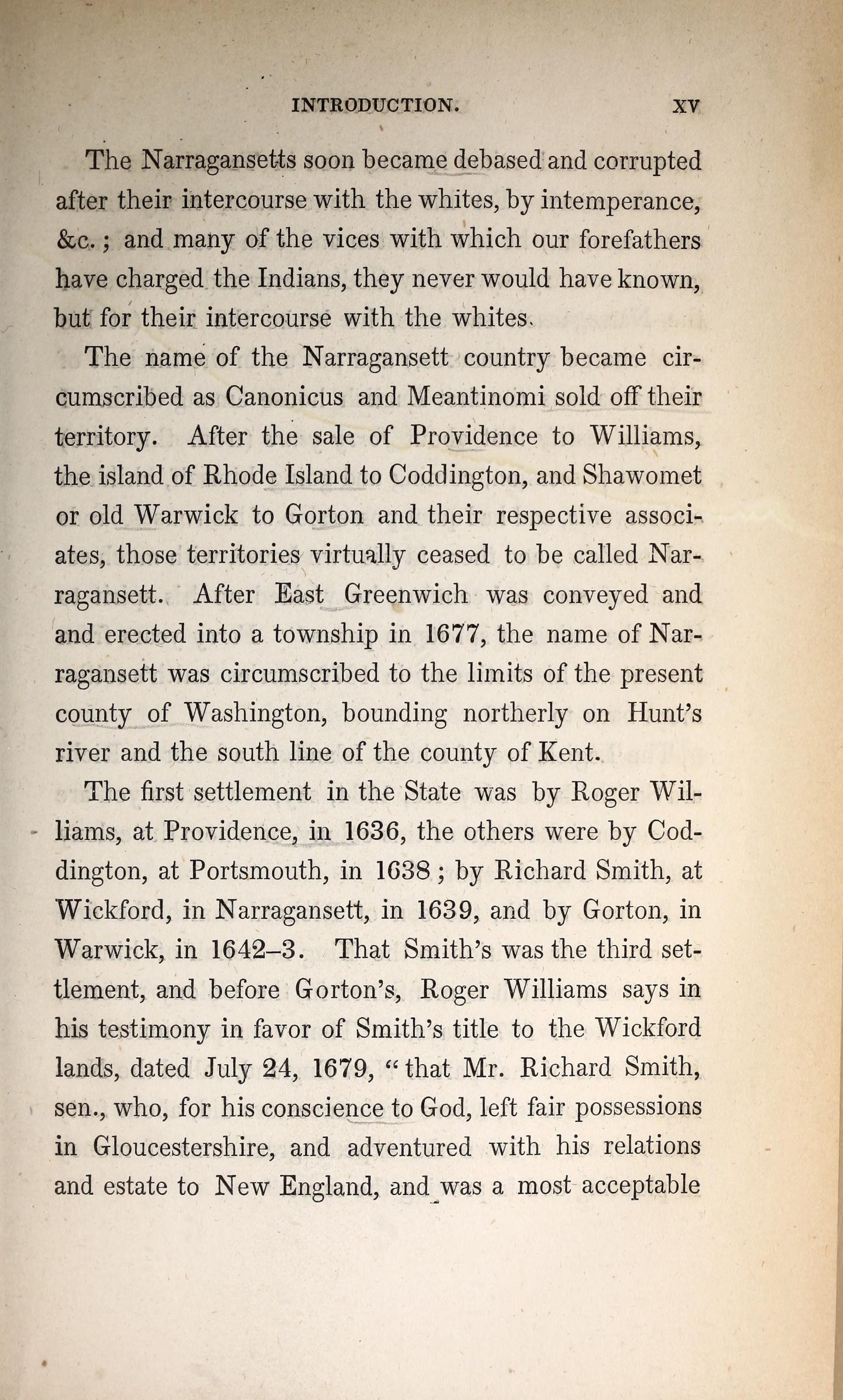
Updike, 1847, p. xv. “The first settlement in the State was by Roger Williams, at Providence, in 1636, the others were by Coddington, at Portsmouth, in 1638; by Richard Smith, at Wickford, in Narragansett, in 1639, and by Gorton, in Warwick, in 1642–3. That Smith’s was the third settlement, and before Gorton’s, Roger Williams says in his testimony in favor of Smith’s title to the Wickford lands, dated July 24, 1679, ‘that Mr. Richard Smith, sen., who, for his conscience to God, left fair possessions in Gloucestershire, and adventured with his relations and estate to New England, and was a most acceptable”
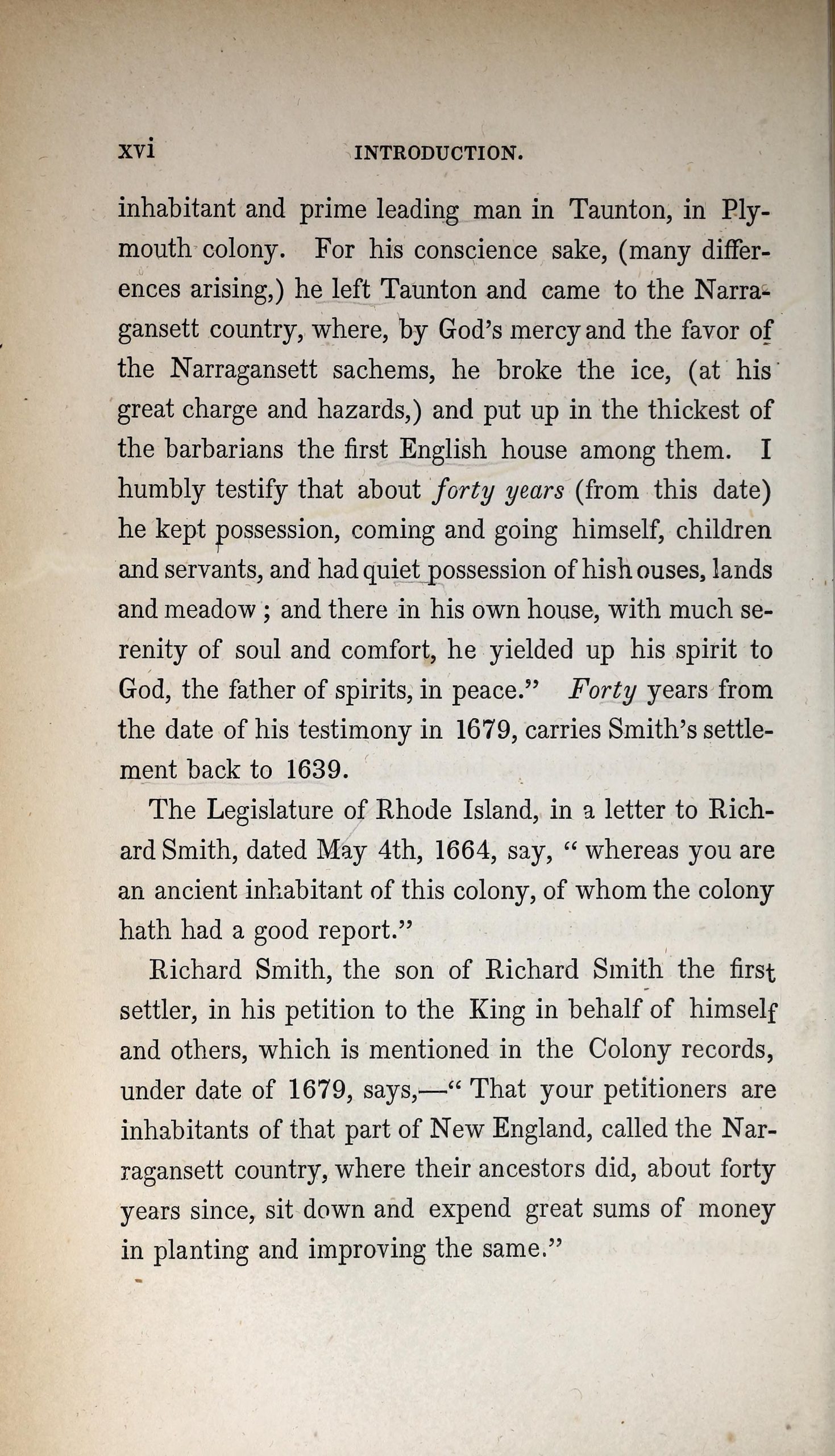
Updike, 1847, p. xvi. “inhabitant and prime leading man in Taunton, in Plymouth colony. For his conscience sake, (many differences arising,) he left Taunton and came to the Narragansett country, where, by God’s mercy and the favor of the Narragansett sachems, he broke the ice, (at his great charge and hazards,) and put up in the thickest of the barbarians the first English house among them. I humbly testify that about forty years (from this date) he kept possession, coming and going himself, children and servants, and had quiet possession of his houses, lands and meadow; and there in his own house, with much serenity of soul and comfort, he yielded up his spirit to God, the father of spirits, in peace.’ Forty years from the date of his testimony in 1679, carries Smith’s settlement back to 1639. The Legislature of Rhode Island, in a letter to Richard Smith, dated May 4th, 1664, say, ‘whereas you are an ancient inhabitant of this colony, of whom the colony hath had a good report.’ Richard Smith, the son of Richard Smith the first settler, in his petition to the King in behalf of himself and others, which is mentioned in the Colony records, under date of 1679, says, ‘That your petitioners are inhabitants of that part of New England, called the Narragansett country, where their ancestors did, about forty years since, sit down and expend great sums of money in planting and improving the same.’”
Updike, 1847, p. xvii. “Richard Wharton, Elisha Hutchinson and John Saffin, in their petition to the King, dated October, 1680, respecting their titles to the Narragansett lands, say, ‘that part of the lands aforesaid were purchased by Roger Williams, yet living, and Mr. Richard Smith, deceased, about forty years ago, and possessed to this day by his son Richard Smith.’ This speaks of Williams at Providence, and Smith at Wickford, as the first purchasers in the Narragansett country. Brinley says, in his history of Narragansett, before mentioned, under date of 1641, ‘Richard Smith purchased a tract of the Narragansett Indians, (computed at 30,000,) erected a house for trade, and gave free entertainment to travellers, it being the great road of the country.’ By this statement, it appears that the house had been erected, and the road travelled in 1641. The timber of which it was constructed was imported from Taunton River by water, as the country was prairie to some extent from the shore, and there were no oxen or teams to procure it at Wickford. The imported materials are in the house now.” The page continues with Callender on Gorton’s purchase of Shawomet.
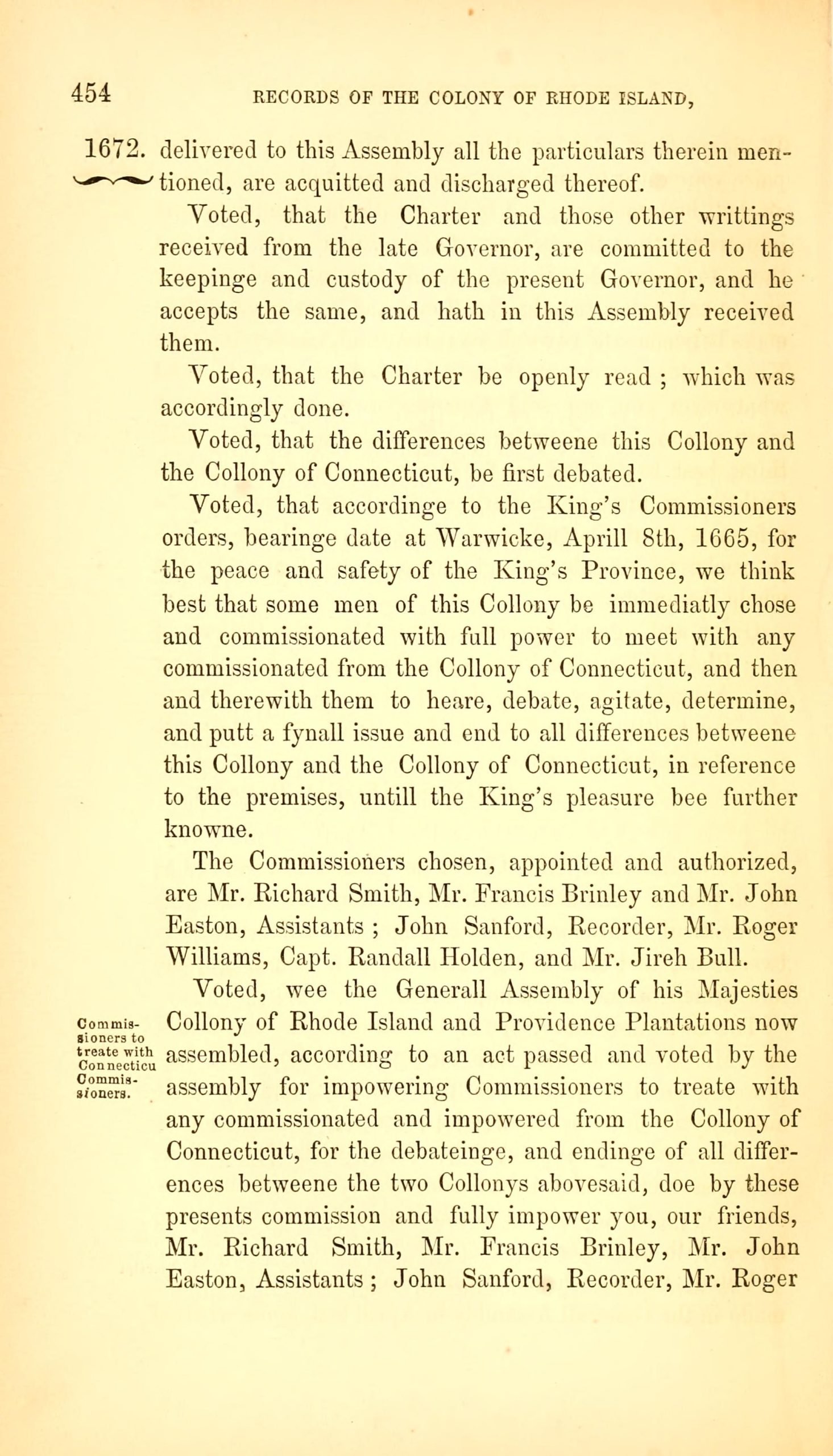
Bartlett, 1857, p. 454. “Voted, that the differences betweene this Collony and the Collony of Connecticut, be first debated. Voted, that accordinge to the King’s Commissioners orders, bearinge date at Warwicke, Aprill 8th, 1665, for the peace and safety of the King’s Province, we think best that some men of this Collony be immediatly chose and commissionated with full power to meet with any commissionated from the Collony of Connecticut, and then and therewith them to heare, debate, agitate, determine, and putt a fynall issue and end to all differences betweene this Collony and the Collony of Connecticut, in reference to the premises, untill the King’s pleasure bee further knowne. The Commissioners chosen, appointed and authorized, are Mr. Richard Smith, Mr. Francis Brinley and Mr. John Easton, Assistants; John Sanford, Recorder, Mr. Roger Williams, Capt. Randall Holden, and Mr. Jireh Bull. Voted, wee the Generall Assembly of his Majesties Collony of Rhode Island and Providence Plantations now assembled, according to an act passed and voted by the assembly for impowering Commissioners to treate with any commissionated and impowered from the Collony of Connecticut, for the debateinge, and endinge of all differences betweene the two Collonys abovesaid, doe by these presents commission and fully impower you, our friends, Mr. Richard Smith, Mr. Francis Brinley, Mr. John Easton, Assistants; John Sanford, Recorder, Mr. Roger”
Bartlett, 1857, p. 455. “Williams, Capt. Randall Holden, and Mr. Jireh Bull, to repaire yourselves to such place and places, and at such times as shall be appointed, and to meet with the Commissioners impowered from the Collony of Connecticut, and then and there to heare, debate, agitate, determine, and soe far as you can agree, to put a fynall end and issue of all differences betweene the two Collonys abovesaid, researveinge the King’s pleasure, when it shall bee further knowne; and whatsoever you, our said Commissioners, or any four or more of you, beinge under your hands and seales, shall think best to doe and act for the peace and safety of this Collony, or more particularly of the King’s Province, in reference to the premises as abovesaid, shall bee as authenticke to all intents and purposes, as if done by the whole Assembly. Given and signed, by order of his Majesties Collony of Rhode Island and Providence Plantations, &c., at their Assembly, began the 1st of May, and by adjournment sittinge the 14th of May, 1672, with the seale of the Collony, affixt. JOHN SANFORD, Recorder. Voted, that Mr. John Clarke is chosen and desired to be a person commissionated with others, to treate with Connecticut gentlemen, concearninge the differences betweene us, and hee beinge sent to, and refuseinge, the fore named persons were impowered.” The page continues with the appointment of the Governor, Deputy Governor, Mr. John Gould and Mr. Walter Clarke to draw up the commissioners’ instructions.
How John Greene came into it
A man in Smith’s house, then a man with land. John Greene was living with Richard Smith at the trading post about 1639, by his own affidavit of 1679; nothing is known of him before that (Huling, 1883, pp. 137–138). By 1663 he was “an occupant, and probably an owner,” of a tract at Quidnessett neck held under the Atherton title, which is why, in Huling’s words, “if Rhode Island should prevail, Greene would have no valid title to his recently acquired homestead; while the success of Connecticut would confirm him in his possessions” (Huling, 1883, pp. 138–139). On 3 July 1663 he signed, with Smith and the Atherton partners, the subscription to be under Connecticut (Arnold, 1894, pp. 24–25).
What followed. Rhode Island answered in March 1664 with an act against the “intruders,” in May with a warrant, and about 11 May with a party that took Greene from his house to Newport, where he petitioned for pardon and was kept as a freeman. That episode is told in full, with every record shown and transcribed, in the section “The arrest of 1664” on the page John Greene of Quidnessett. Two of its documents are repeated here so the story reads through.
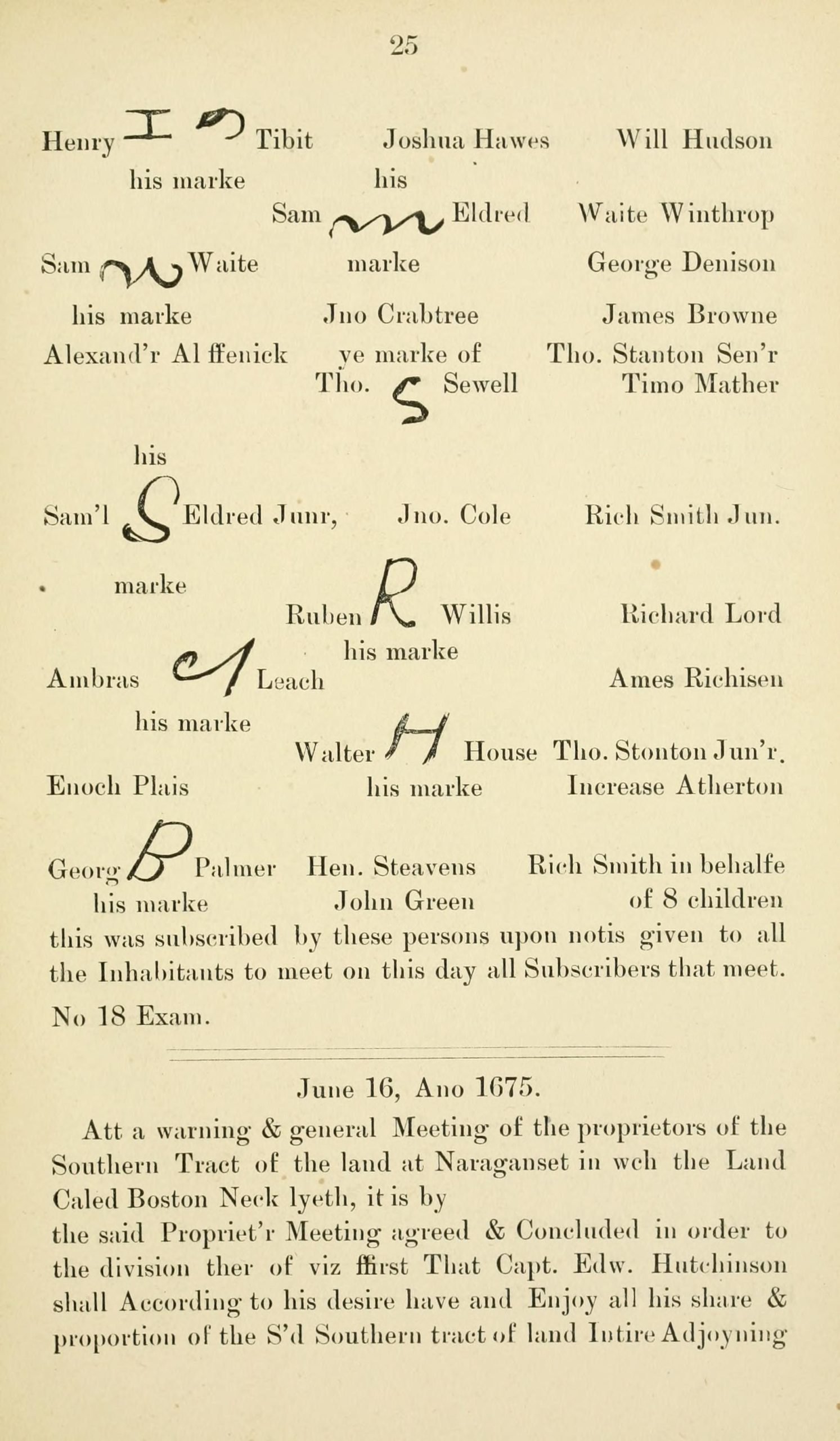
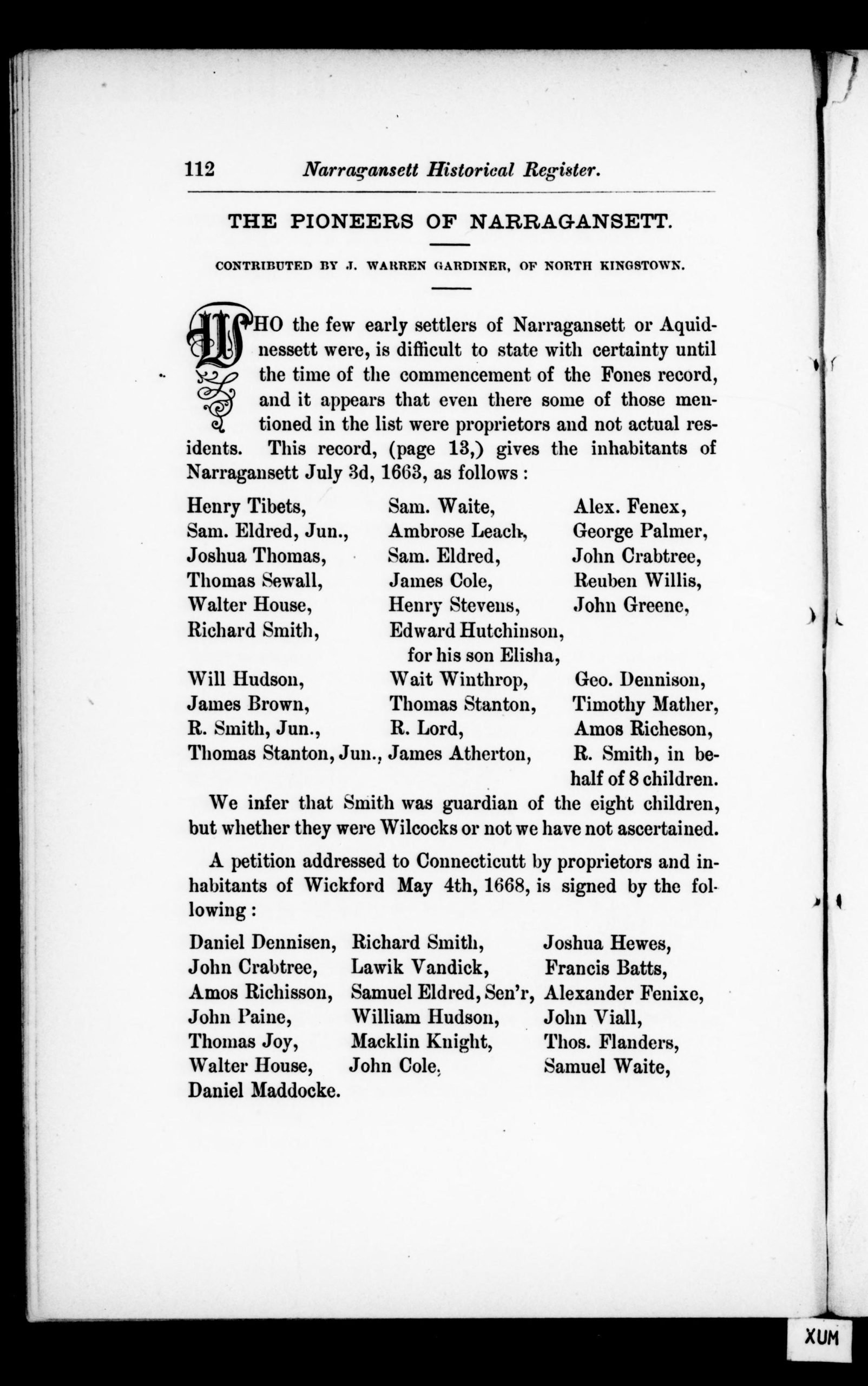
Arnold, 1894, pp. 24–25. “Naraganset 3, July 1663. We whose names are under written being the Inhabitants & the proprietors of the lands lying in the Naraganset have & doe desire (according to his Majesties grente) to be under the Govern’tt of Conecticot Collony & Request there protection according to a letter sent in June last. mr. Bradstreet & others have desired the same in ye Letter formerly Mentioned. Richard Smith, Edw. Hutchinson and for his son Elisha … Hen. Steavens, John Green, Rich Smith in behalfe of 8 children. this was subscribed by these persons upon notis given to all the Inhabitants to meet on this day all Subscribers that meet. No 18 Exam.”
Gardiner, 1883, p. 112. “THE PIONEERS OF NARRAGANSETT. Contributed by J. Warren Gardiner, of North Kingstown. Who the few early settlers of Narragansett or Aquidnessett were, is difficult to state with certainty until the time of the commencement of the Fones record, and it appears that even there some of those mentioned in the list were proprietors and not actual residents. This record, (page 13,) gives the inhabitants of Narragansett July 3d, 1663, as follows: Henry Tibets, Sam. Waite, Alex. Fenex, Sam. Eldred, Jun., Ambrose Leach, George Palmer, Joshua Thomas, Sam. Eldred, John Crabtree, Thomas Sewall, James Cole, Reuben Willis, Walter House, Henry Stevens, John Greene, Richard Smith, Edward Hutchinson, for his son Elisha, Will Hudson, Wait Winthrop, Geo. Dennison, James Brown, Thomas Stanton, Timothy Mather, R. Smith, Jun., R. Lord, Amos Richeson, Thomas Stanton, Jun., James Atherton, R. Smith, in behalf of 8 children. We infer that Smith was guardian of the eight children, but whether they were Wilcocks or not we have not ascertained. A petition addressed to Connecticutt by proprietors and inhabitants of Wickford May 4th, 1668, is signed by the following: Daniel Dennisen, Richard Smith, Joshua Hewes, John Crabtree, Lawik Vandick, Francis Batts, Amos Richisson, Samuel Eldred, Sen’r, Alexander Fenixe, John Paine, William Hudson, John Viall, Thomas Joy, Macklin Knight, Thos. Flanders, Walter House, John Cole, Samuel Waite, Daniel Maddocke.” Gardiner, working from the same page, read “R. Smith, in behalf of 8 children” as Smith’s entry, which settles the machine misreading “John Green of 8 children.”
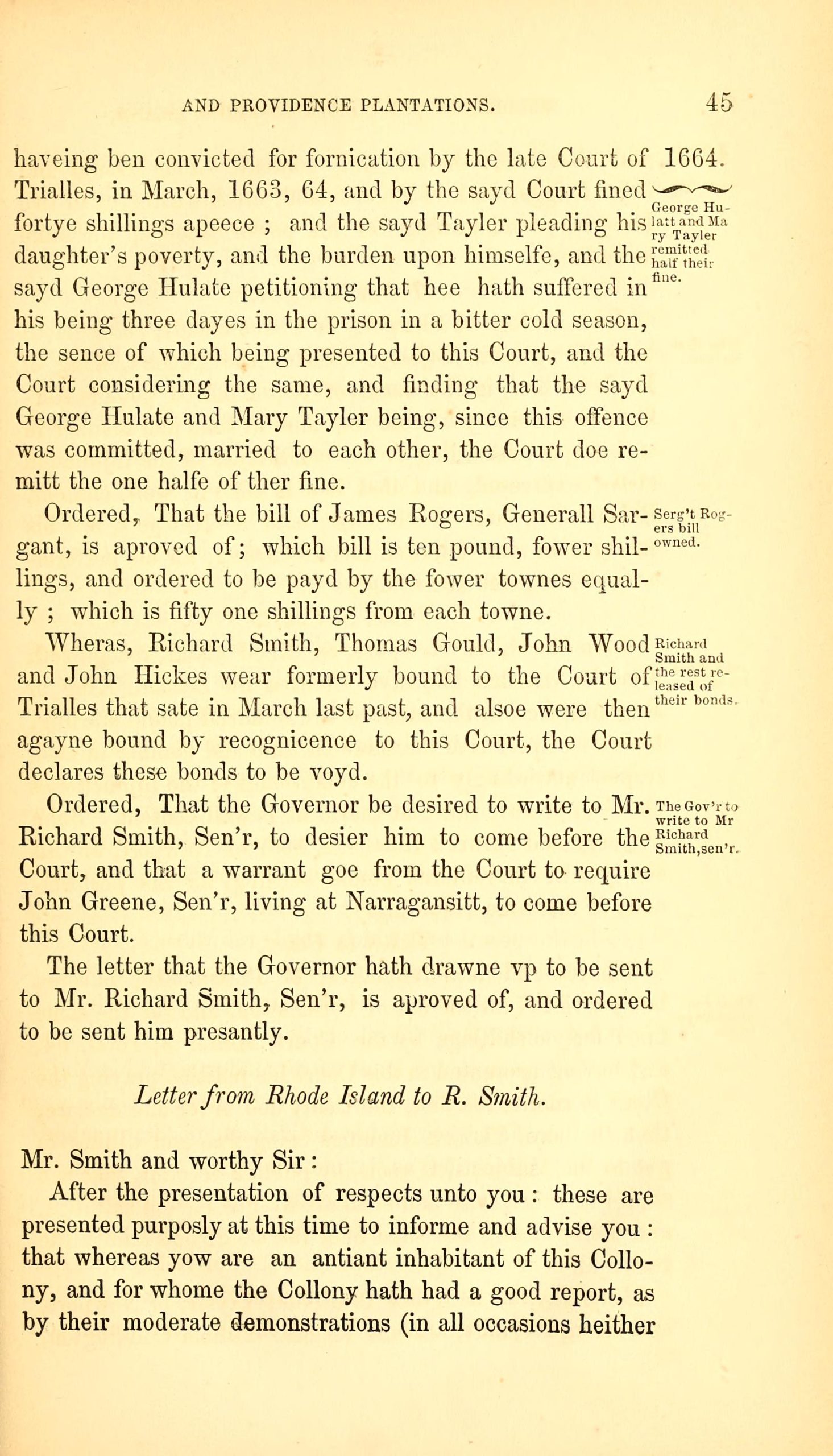
Bartlett, 1857, p. 45. “Ordered, That the Governor be desired to write to Mr. Richard Smith, Sen’r, to desier him to come before the Court, and that a warrant goe from the Court to require John Greene, Sen’r, living at Narragansitt, to come before this Court.”
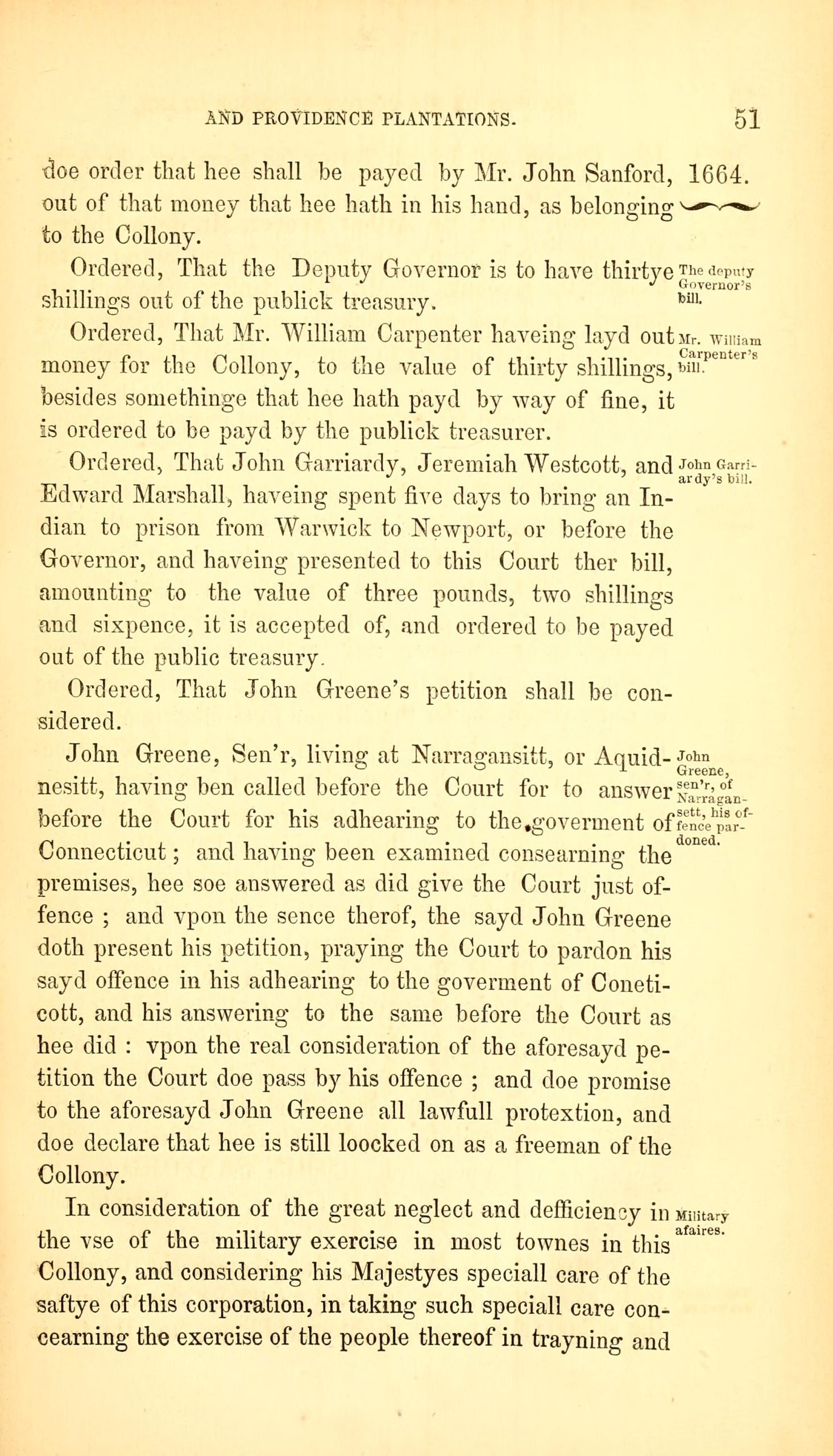
Bartlett, 1857, p. 51. “John Greene, Sen’r, living at Narragansitt, or Aquidnesitt, having ben called before the Court for to answer before the Court for his adhearing to the goverment of Connecticut; and having been examined consearning the premises, hee soe answered as did give the Court just offence; and vpon the sence therof, the sayd John Greene doth present his petition, praying the Court to pardon his sayd offence in his adhearing to the goverment of Coneticott, and his answering to the same before the Court as hee did: vpon the real consideration of the aforesayd petition the Court doe pass by his offence; and doe promise to the aforesayd John Greene all lawfull protextion, and doe declare that hee is still loocked on as a freeman of the Collony.” The act of March 1664, the letter to Smith, Smith’s letter of 14 May, and Huling’s commentary are shown and transcribed on the John Greene of Quidnessett page.
The King’s Province, 1665
The Crown steps in. In the spring of 1665 four royal commissioners, Robert Carr, George Cartwright, and Samuel Maverick, with Richard Nicolls, came through New England to settle the colonies’ quarrels. At Warwick on 4 April they declared that no colony had any right to lands beyond “those bounds which the King by his charter hath given it,” and voided the Massachusetts grants in the Narragansett country. On 8 April they named the Narragansett country “the King’s Province,” to be governed, until the King’s pleasure was known, by Rhode Island’s own magistrates, whom they appointed justices of the peace for it (Bartlett, 1857, pp. 93–94). Among the justices named is “John Greene, gentlemen”: that is the Warwick John Greene, an Assistant of the colony, not the Quidnessett farmer (Bartlett, 1857, p. 94). In August, having first ordered all the inhabitants of the Province to leave by the end of September, the commissioners relented and ordered that “all now in possession (or who heretofore have been), may remaine in quiett possession, of whatever formerly they had” (Bartlett, 1857, p. 94). That last order is what let Greene, Smith, and their neighbours stay on their farms while the two colonies went on arguing over them for another sixty years.
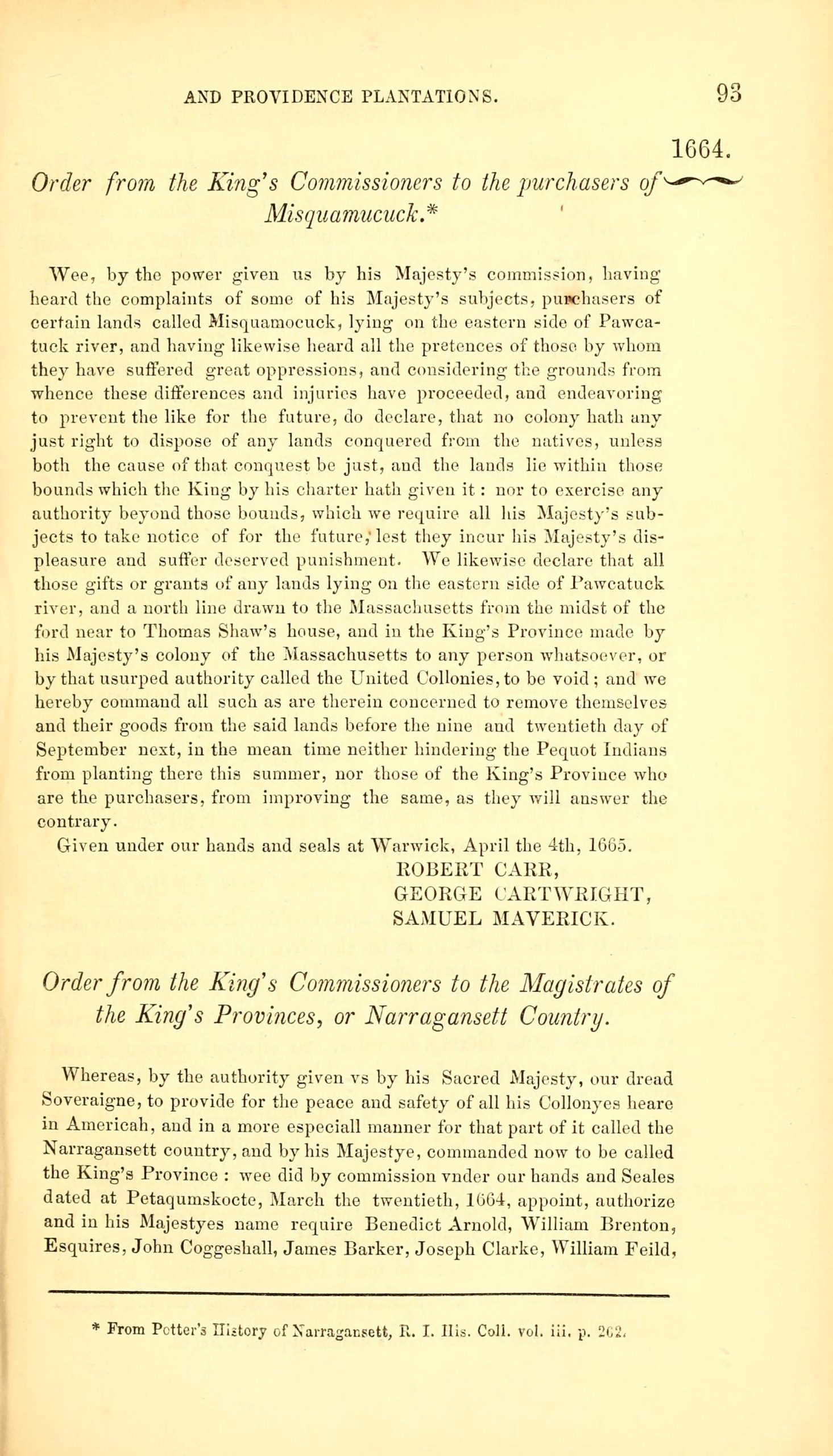
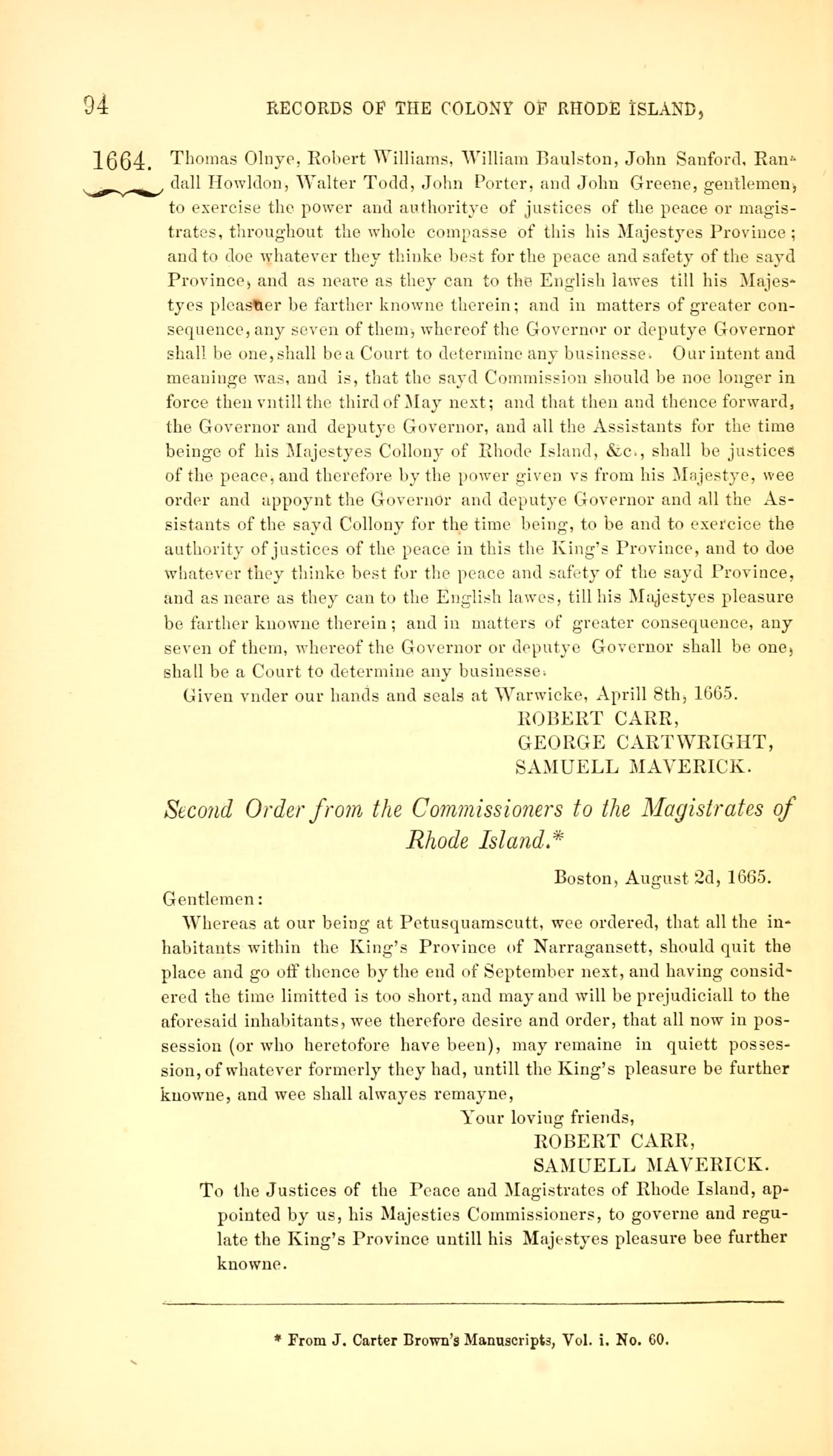
Bartlett, 1857, p. 93. Order from the King’s Commissioners to the purchasers of Misquamucuck. “Wee, by the power given us by his Majesty’s commission, having heard the complaints of some of his Majesty’s subjects, purchasers of certain lands called Misquamocuck, lying on the eastern side of Pawcatuck river, and having likewise heard all the pretences of those by whom they have suffered great oppressions, and considering the grounds from whence these differences and injuries have proceeded, and endeavoring to prevent the like for the future, do declare, that no colony hath any just right to dispose of any lands conquered from the natives, unless both the cause of that conquest be just, and the lands lie within those bounds which the King by his charter hath given it: nor to exercise any authority beyond those bounds, which we require all his Majesty’s subjects to take notice of for the future, lest they incur his Majesty’s displeasure and suffer deserved punishment. We likewise declare that all those gifts or grants of any lands lying on the eastern side of Pawcatuck river, and a north line drawn to the Massachusetts from the midst of the ford near to Thomas Shaw’s house, and in the King’s Province made by his Majesty’s colony of the Massachusetts to any person whatsoever, or by that usurped authority called the United Collonies, to be void; and we hereby command all such as are therein concerned to remove themselves and their goods from the said lands before the nine and twentieth day of September next, in the mean time neither hindering the Pequot Indians from planting there this summer, nor those of the King’s Province who are the purchasers, from improving the same, as they will answer the contrary. Given under our hands and seals at Warwick, April the 4th, 1665. ROBERT CARR, GEORGE CARTWRIGHT, SAMUEL MAVERICK.” Footnote: “From Potter’s History of Narragansett, R. I. His. Coll. vol. iii. p. 262.”
Order from the King’s Commissioners to the Magistrates of the King’s Provinces, or Narragansett Country. “Whereas, by the authority given vs by his Sacred Majesty, our dread Soveraigne, to provide for the peace and safety of all his Collonyes heare in Americah, and in a more especiall manner for that part of it called the Narragansett country, and by his Majestye, commanded now to be called the King’s Province: wee did by commission vnder our hands and Seales dated at Petaqumskocte, March the twentieth, 1664, appoint, authorize and in his Majestyes name require Benedict Arnold, William Brenton, Esquires, John Coggeshall, James Barker, Joseph Clarke, William Feild,” [p. 94] “Thomas Olnye, Robert Williams, William Baulston, John Sanford, Randall Howldon, Walter Todd, John Porter, and John Greene, gentlemen, to exercise the power and authoritye of justices of the peace or magistrates, throughout the whole compasse of this his Majestyes Province; and to doe whatever they thinke best for the peace and safety of the sayd Province, and as neare as they can to the English lawes till his Majestyes pleasuer be farther knowne therein; and in matters of greater consequence, any seven of them, whereof the Governor or deputye Governor shall be one, shall be a Court to determine any businesse. Our intent and meaninge was, and is, that the sayd Commission should be noe longer in force then vntill the third of May next; and that then and thence forward, the Governor and deputye Governor, and all the Assistants for the time beinge of his Majestyes Collony of Rhode Island, &c., shall be justices of the peace, and therefore by the power given vs from his Majestye, wee order and appoynt the Governor and deputye Governor and all the Assistants of the sayd Collony for the time being, to be and to exercice the authority of justices of the peace in this the King’s Province, and to doe whatever they thinke best for the peace and safety of the sayd Province, and as neare as they can to the English lawes, till his Majestyes pleasure be farther knowne therein; and in matters of greater consequence, any seven of them, whereof the Governor or deputye Governor shall be one, shall be a Court to determine any businesse. Given vnder our hands and seals at Warwicke, Aprill 8th, 1665. ROBERT CARR, GEORGE CARTWRIGHT, SAMUELL MAVERICK.”
Second Order from the Commissioners to the Magistrates of Rhode Island. “Boston, August 2d, 1665. Gentlemen: Whereas at our being at Petusquamscutt, wee ordered, that all the inhabitants within the King’s Province of Narragansett, should quit the place and go off thence by the end of September next, and having considered the time limitted is too short, and may and will be prejudiciall to the aforesaid inhabitants, wee therefore desire and order, that all now in possession (or who heretofore have been), may remaine in quiett possession, of whatever formerly they had, untill the King’s pleasure be further knowne, and wee shall alwayes remayne, Your loving friends, ROBERT CARR, SAMUELL MAVERICK. To the Justices of the Peace and Magistrates of Rhode Island, appointed by us, his Majesties Commissioners, to governe and regulate the King’s Province untill his Majestyes pleasure bee further knowne.” Footnote: “From J. Carter Brown’s Manuscripts, Vol. i. No. 60.”
The Wickford petitions of 1668
Smith signs; Greene does not. The Wickford men petitioned Connecticut again on 4 May 1668 and in October 1668. Richard Smith signed both. John Greene, pardoned four years earlier on his promise of allegiance, signed neither, so far as the lists Gardiner printed in 1883 show; a Robert Greene signed in October (Gardiner, 1883, pp. 112–113). Gardiner’s caution applies to every list on this page: the signers were “only those who sought to further the claim of Connecticut,” and some were proprietors who never lived there (Gardiner, 1883, p. 113).
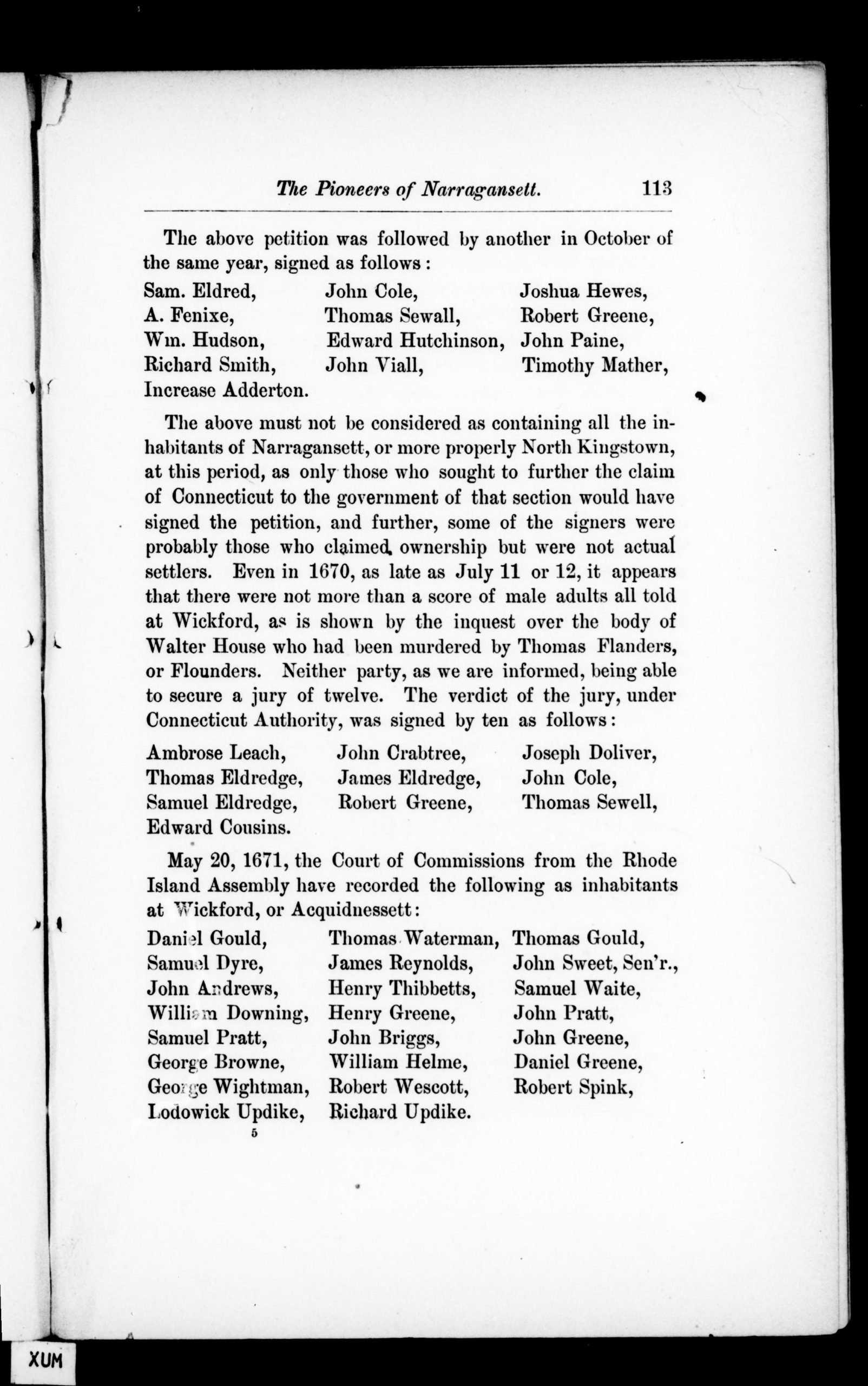
Gardiner, 1883, p. 113. “The above petition was followed by another in October of the same year, signed as follows: Sam. Eldred, John Cole, Joshua Hewes, A. Fenixe, Thomas Sewall, Robert Greene, Wm. Hudson, Edward Hutchinson, John Paine, Richard Smith, John Viall, Timothy Mather, Increase Adderton. The above must not be considered as containing all the inhabitants of Narragansett, or more properly North Kingstown, at this period, as only those who sought to further the claim of Connecticut to the government of that section would have signed the petition, and further, some of the signers were probably those who claimed ownership but were not actual settlers. Even in 1670, as late as July 11 or 12, it appears that there were not more than a score of male adults all told at Wickford, as is shown by the inquest over the body of Walter House who had been murdered by Thomas Flanders, or Flounders. Neither party, as we are informed, being able to secure a jury of twelve. The verdict of the jury, under Connecticut Authority, was signed by ten as follows: Ambrose Leach, John Crabtree, Joseph Doliver, Thomas Eldredge, James Eldredge, John Cole, Samuel Eldredge, Robert Greene, Thomas Sewell, Edward Cousins. May 20, 1671, the Court of Commissions from the Rhode Island Assembly have recorded the following as inhabitants at Wickford, or Acquidnessett: Daniel Gould, Thomas Waterman, Thomas Gould, Samuel Dyre, James Reynolds, John Sweet, Sen’r., John Andrews, Henry Thibbetts, Samuel Waite, William Downing, Henry Greene, John Pratt, Samuel Pratt, John Briggs, John Greene, George Browne, William Helme, Daniel Greene, George Wightman, Robert Wescott, Robert Spink, Lodowick Updike, Richard Updike.”
The court at Acquidnesset, May 1671
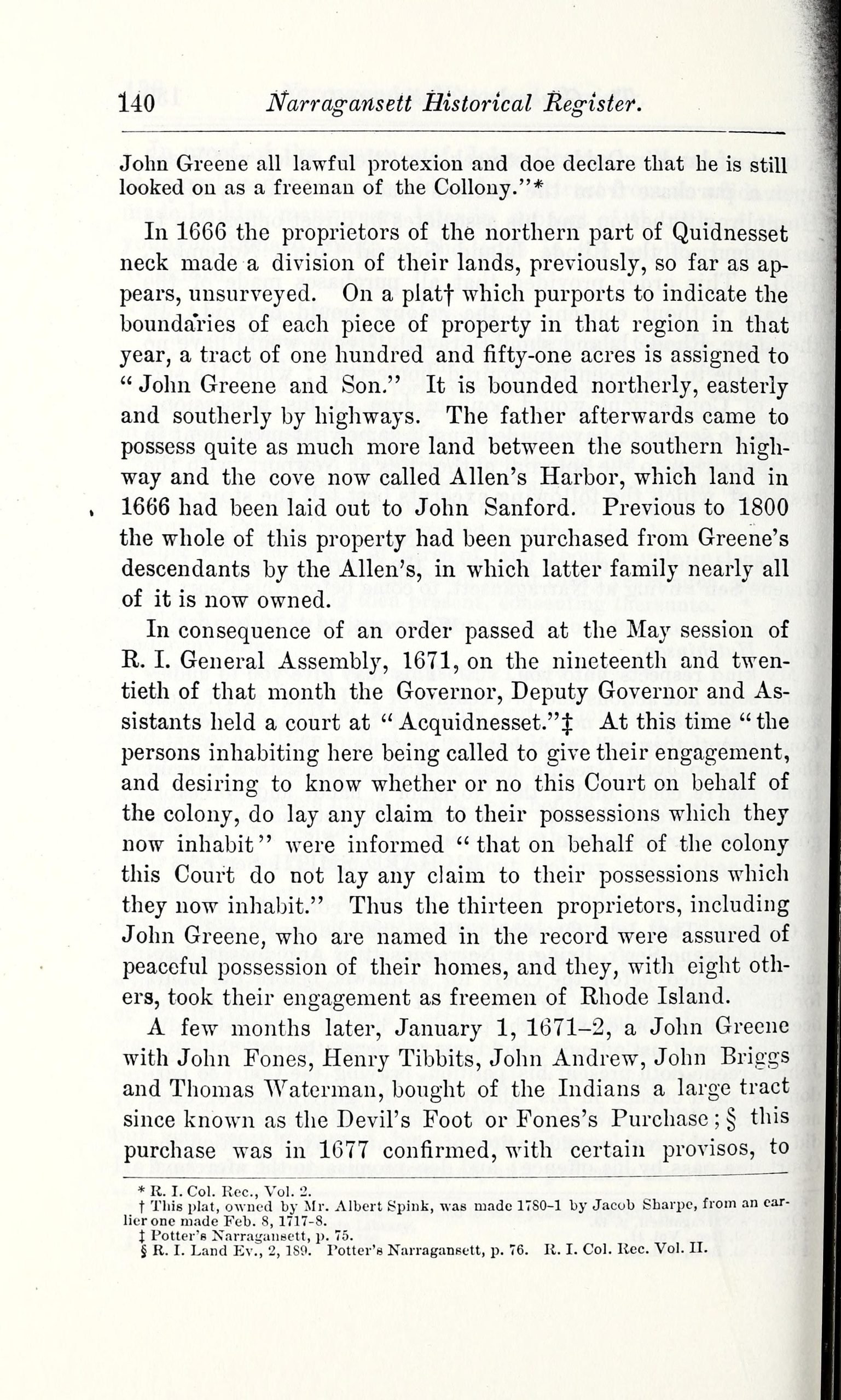
Rhode Island makes its peace. Under an order of the May 1671 Assembly, the Governor, Deputy Governor, and Assistants rode into the Narragansett country and held court, first at Pettaquamscutt and then, on 19 and 20 May, at Thomas Gould’s house at Acquidnesset. The inhabitants asked the one question that mattered to them: did the colony lay any claim to the possessions they lived on? The Court answered, unanimously, “that on behalf of the colony, this Court do not lay any claim to their possessions which they now inhabit.” Thirteen men asked it, John Greene among them; twenty-one, including John, Henry, and Daniel Greene, then took the engagement as freemen of Rhode Island (Potter, 1835, pp. 75–76; Huling, 1883, p. 140). This is the day the dispute stopped being a threat to the Greene farm. Seven months later, on 1 January 1671/2, John Greene and five partners bought the Devil’s Foot tract from the sachem Awashowat, a purchase the Assembly confirmed in 1677 (Potter, 1835, p. 76; Arnold, 1894, pp. 166–168).
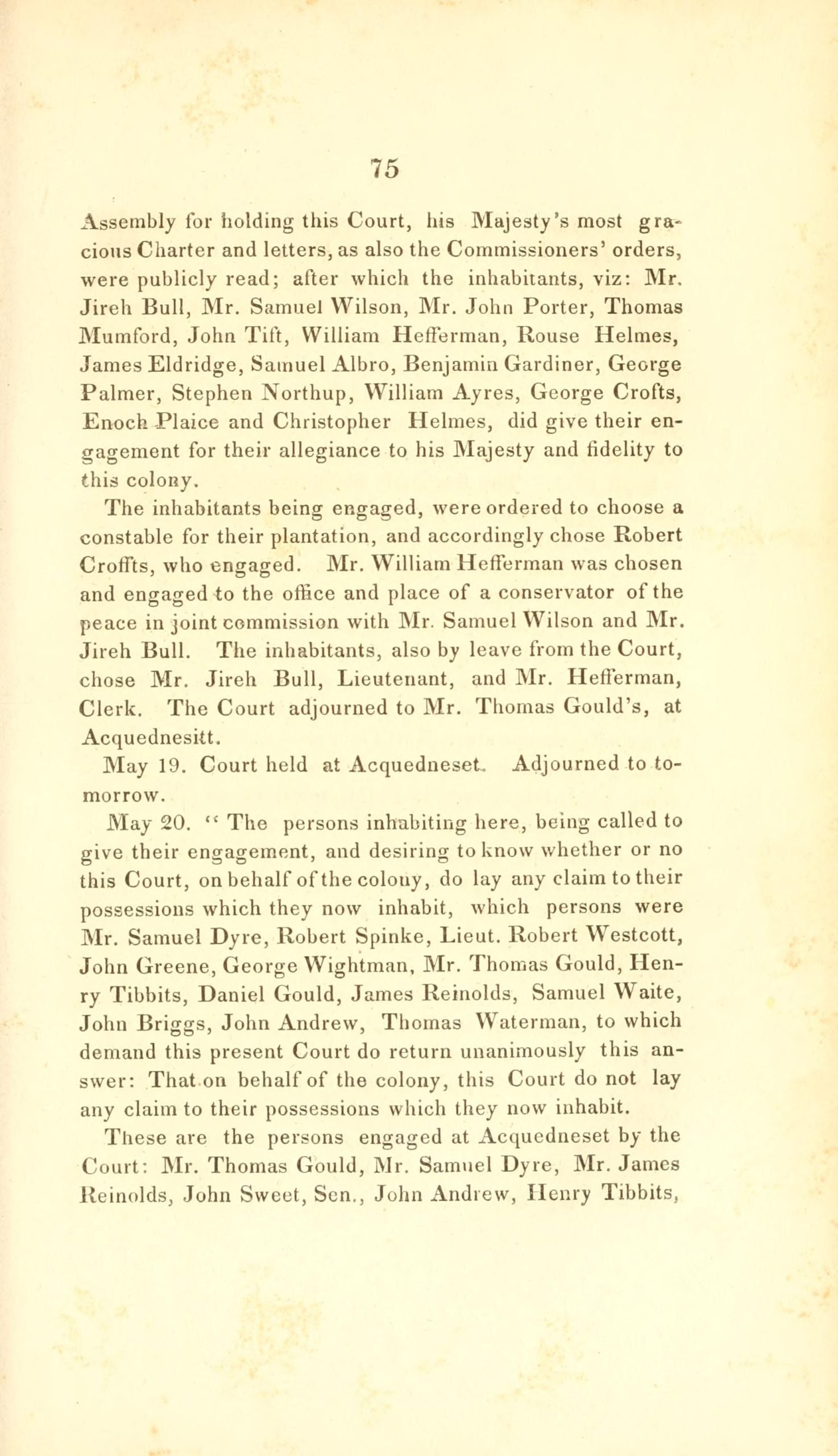
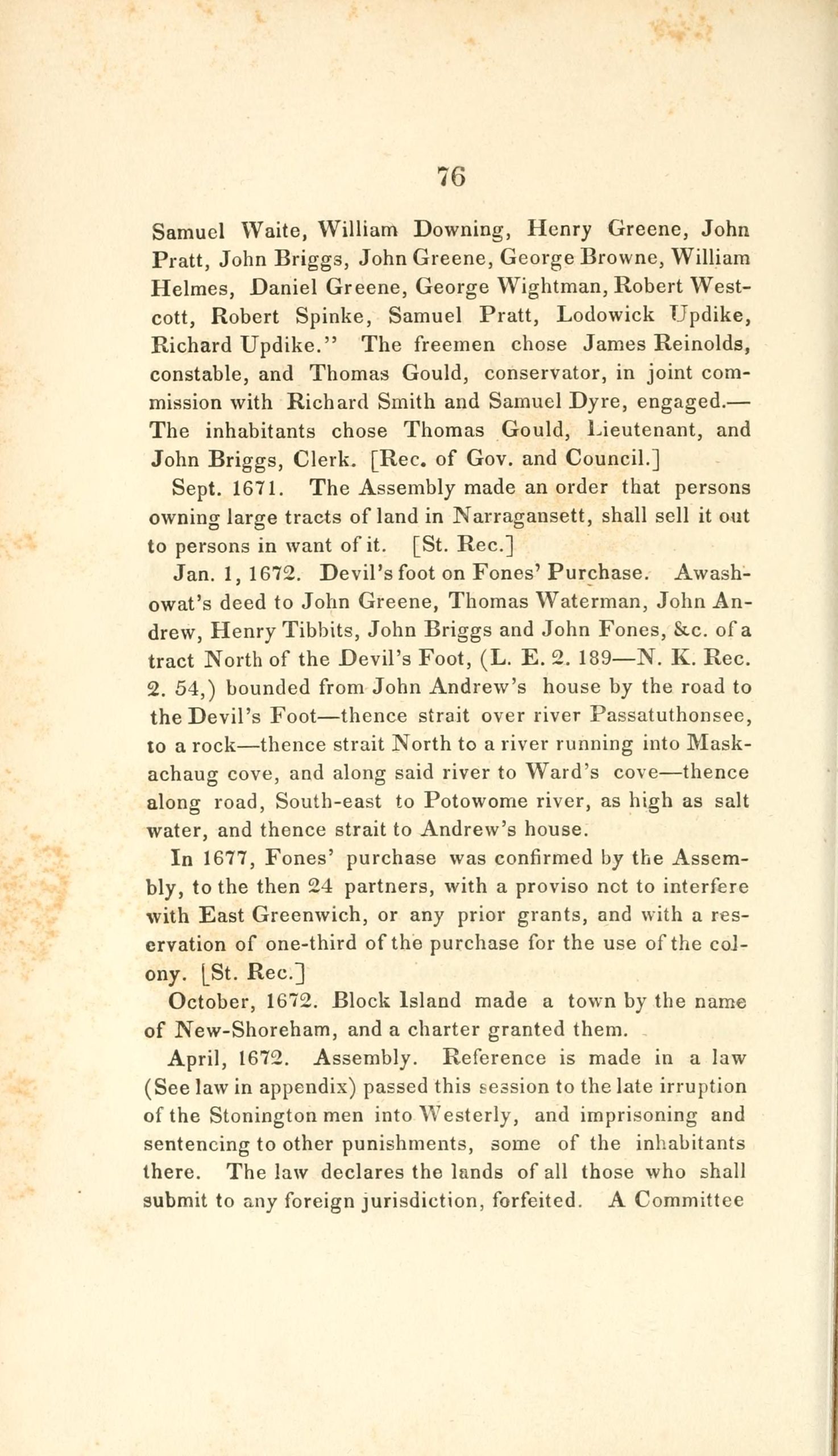
Potter, 1835, p. 75. “Assembly for holding this Court, his Majesty’s most gracious Charter and letters, as also the Commissioners’ orders, were publicly read; after which the inhabitants, viz: Mr. Jireh Bull, Mr. Samuel Wilson, Mr. John Porter, Thomas Mumford, John Tift, William Hefferman, Rouse Helmes, James Eldridge, Samuel Albro, Benjamin Gardiner, George Palmer, Stephen Northup, William Ayres, George Crofts, Enoch Plaice and Christopher Helmes, did give their engagement for their allegiance to his Majesty and fidelity to this colony. The inhabitants being engaged, were ordered to choose a constable for their plantation, and accordingly chose Robert Croffts, who engaged. Mr. William Hefferman was chosen and engaged to the office and place of a conservator of the peace in joint commission with Mr. Samuel Wilson and Mr. Jireh Bull. The inhabitants, also by leave from the Court, chose Mr. Jireh Bull, Lieutenant, and Mr. Hefferman, Clerk. The Court adjourned to Mr. Thomas Gould’s, at Acquednesitt. May 19. Court held at Acquedneset. Adjourned to to-morrow. May 20. ‘The persons inhabiting here, being called to give their engagement, and desiring to know whether or no this Court, on behalf of the colony, do lay any claim to their possessions which they now inhabit, which persons were Mr. Samuel Dyre, Robert Spinke, Lieut. Robert Westcott, John Greene, George Wightman, Mr. Thomas Gould, Henry Tibbits, Daniel Gould, James Reinolds, Samuel Waite, John Briggs, John Andrew, Thomas Waterman, to which demand this present Court do return unanimously this answer: That on behalf of the colony, this Court do not lay any claim to their possessions which they now inhabit. These are the persons engaged at Acquedneset by the Court: Mr. Thomas Gould, Mr. Samuel Dyre, Mr. James Reinolds, John Sweet, Sen., John Andrew, Henry Tibbits,”
Potter, 1835, p. 76. “Samuel Waite, William Downing, Henry Greene, John Pratt, John Briggs, John Greene, George Browne, William Helmes, Daniel Greene, George Wightman, Robert Westcott, Robert Spinke, Samuel Pratt, Lodowick Updike, Richard Updike.’ The freemen chose James Reinolds, constable, and Thomas Gould, conservator, in joint commission with Richard Smith and Samuel Dyre, engaged. The inhabitants chose Thomas Gould, Lieutenant, and John Briggs, Clerk. [Rec. of Gov. and Council.] Sept. 1671. The Assembly made an order that persons owning large tracts of land in Narragansett, shall sell it out to persons in want of it. [St. Rec.] Jan. 1, 1672. Devil’s foot on Fones’ Purchase. Awashowat’s deed to John Greene, Thomas Waterman, John Andrew, Henry Tibbits, John Briggs and John Fones, &c. of a tract North of the Devil’s Foot, (L. E. 2. 189. N. K. Rec. 2. 54,) bounded from John Andrew’s house by the road to the Devil’s Foot, thence strait over river Passatuthonsee, to a rock, thence strait North to a river running into Maskachaug cove, and along said river to Ward’s cove, thence along road, South-east to Potowome river, as high as salt water, and thence strait to Andrew’s house. In 1677, Fones’ purchase was confirmed by the Assembly, to the then 24 partners, with a proviso not to interfere with East Greenwich, or any prior grants, and with a reservation of one-third of the purchase for the use of the colony. [St. Rec.]” The page continues with Block Island made a town, October 1672, and the law of April 1672 on Westerly.
Huling, 1883, p. 140. “In consequence of an order passed at the May session of R. I. General Assembly, 1671, on the nineteenth and twentieth of that month the Governor, Deputy Governor and Assistants held a court at ‘Acquidnesset.’ At this time ‘the persons inhabiting here being called to give their engagement, and desiring to know whether or no this Court on behalf of the colony, do lay any claim to their possessions which they now inhabit’ were informed ‘that on behalf of the colony this Court do not lay any claim to their possessions which they now inhabit.’ Thus the thirteen proprietors, including John Greene, who are named in the record were assured of peaceful possession of their homes, and they, with eight others, took their engagement as freemen of Rhode Island.” The page also carries the 1666 plat of “John Greene and Son” and the Devil’s Foot purchase, transcribed on the John Greene of Quidnessett page.
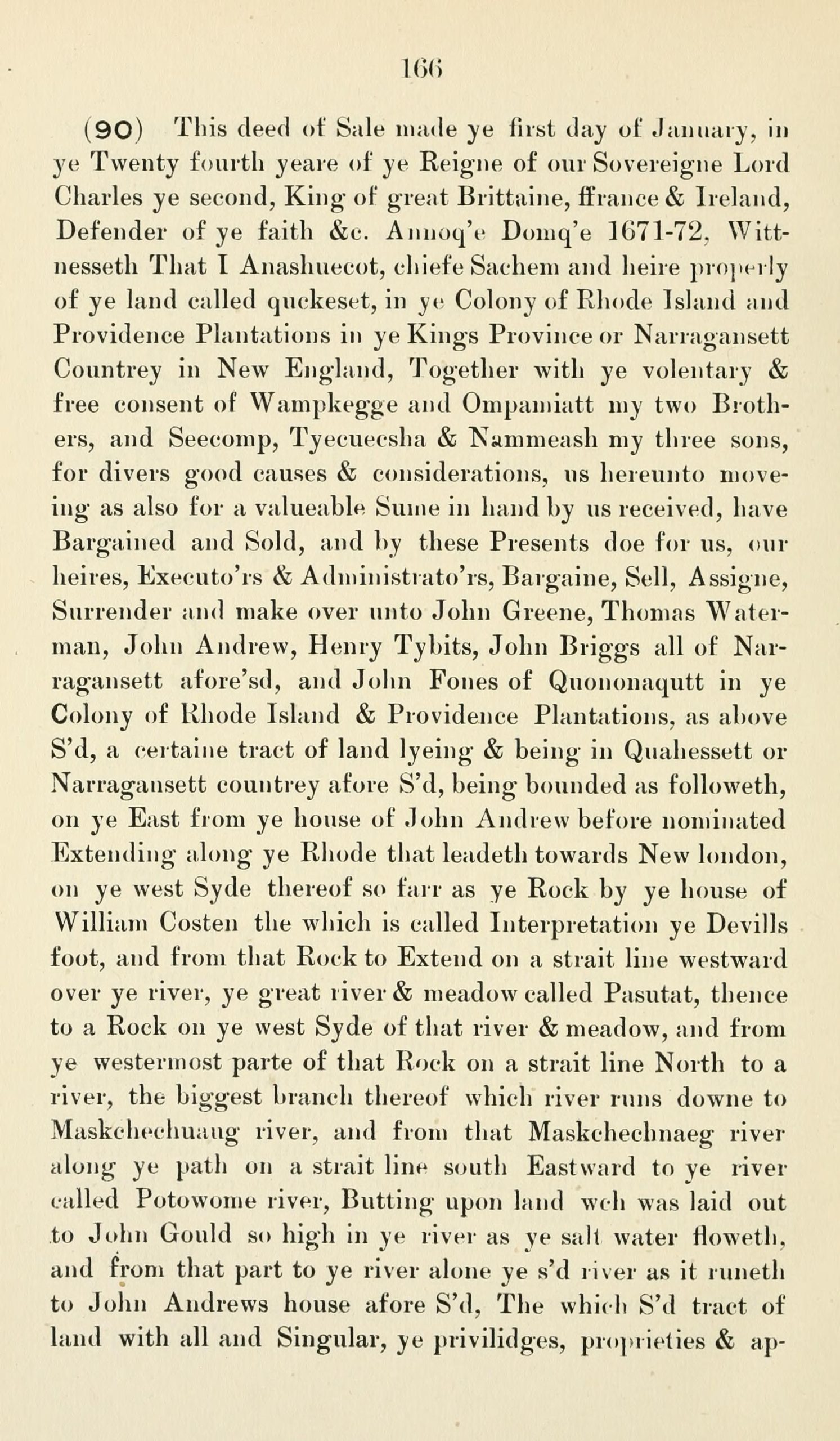
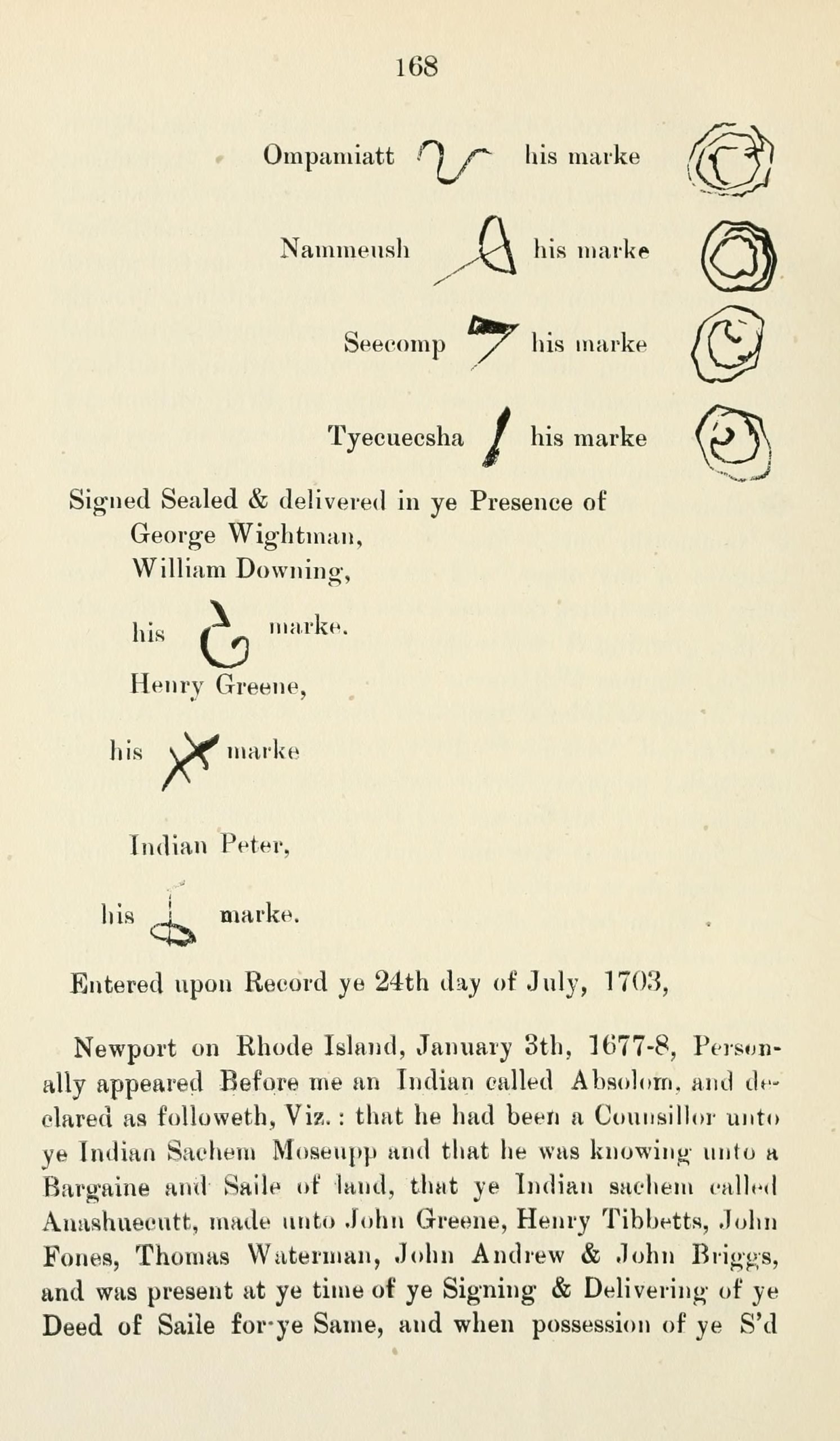
Arnold, 1894, pp. 166–168. The deed of Anashuecot, chief sachem, with his two brothers and three sons, to John Greene, Thomas Waterman, John Andrew, Henry Tibbits, John Briggs, and John Fones, witnessed by George Wightman, William Downing, Henry Greene (his mark), and Indian Peter, and entered upon record 24 July 1703. The full text is transcribed on the page Joan, wife of John Greene of Quidnessett: the Narragansett record.
After the war: the affidavit and the petition of 1679
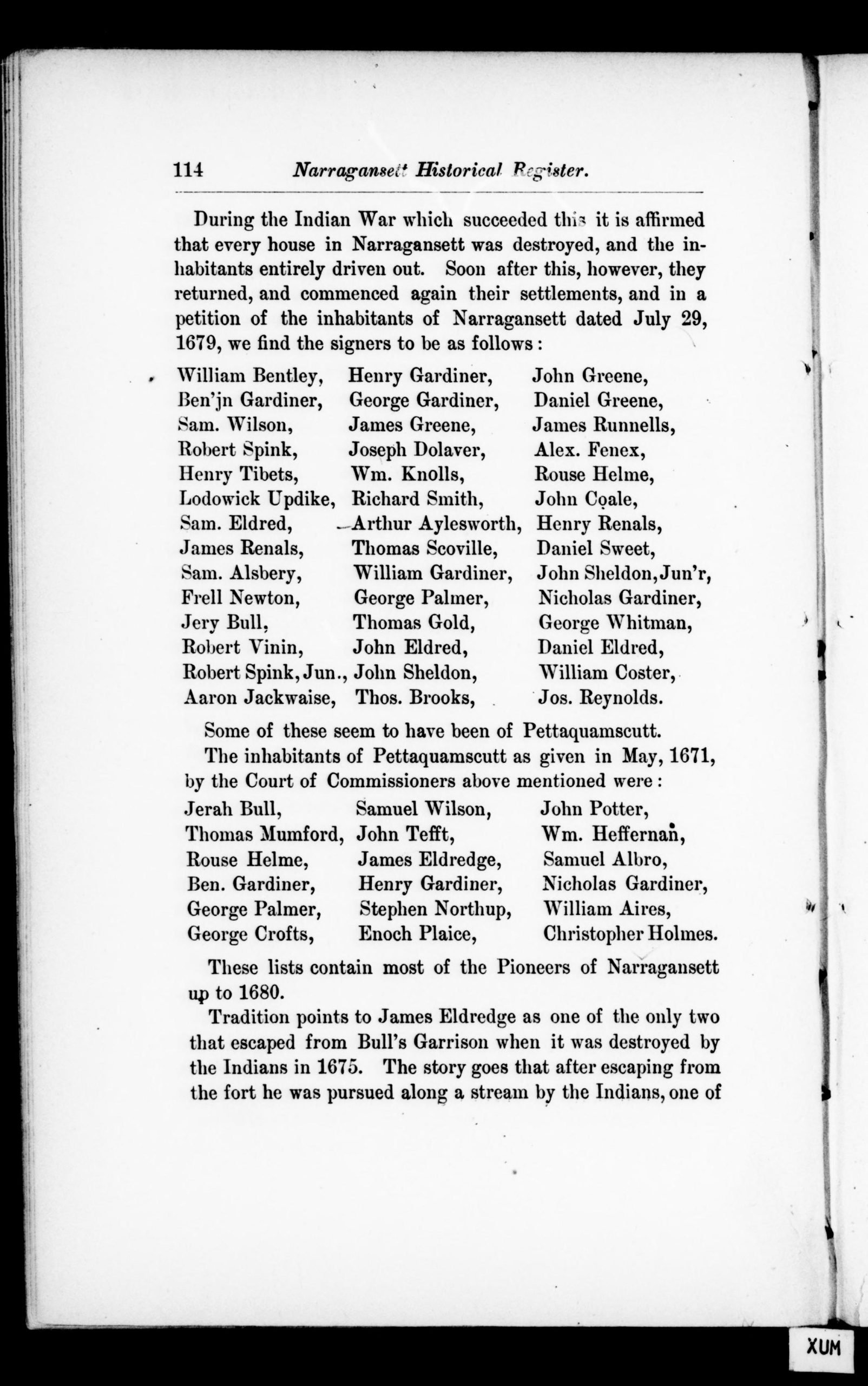
Burned out, and back. King Philip’s War reached the Narragansett country in December 1675. Gardiner records the tradition that “every house in Narragansett was destroyed, and the inhabitants entirely driven out,” and that they soon returned (Gardiner, 1883, p. 114). Two records of 1679 show the Greenes back on the land and still bound up with the Smiths. On 21 July John Greene, “sworn a Conservator of the Peace,” swore the affidavit that Richard Smith the younger used to defend his title, that “forty years and more ago, Mr. Richard Smith that I then lived with did first begin and make a settlement in the Narragansett” (Huling, 1883, p. 138). On 29 July the inhabitants of Narragansett petitioned, and the signers include John Greene, Daniel Greene, James Greene, and Richard Smith (Gardiner, 1883, p. 114). That petition is the only “petition to the Crown” with a Greene of Quidnessett on it that has been found; the earlier version of this page dated it 1676.
The younger Smith on the other side again. The same summer the Assembly, holding the King’s letter of 12 February 1678/9 confirming Rhode Island’s jurisdiction, ordered that Richard Smith, “having contrary to law, petitioned the King,” be apprehended (Potter, 1835, p. 102). Fifteen years after his father had been the colony’s “loveing neighbour” and seven after he had been its commissioner, the younger Smith was again the man Rhode Island sent for.
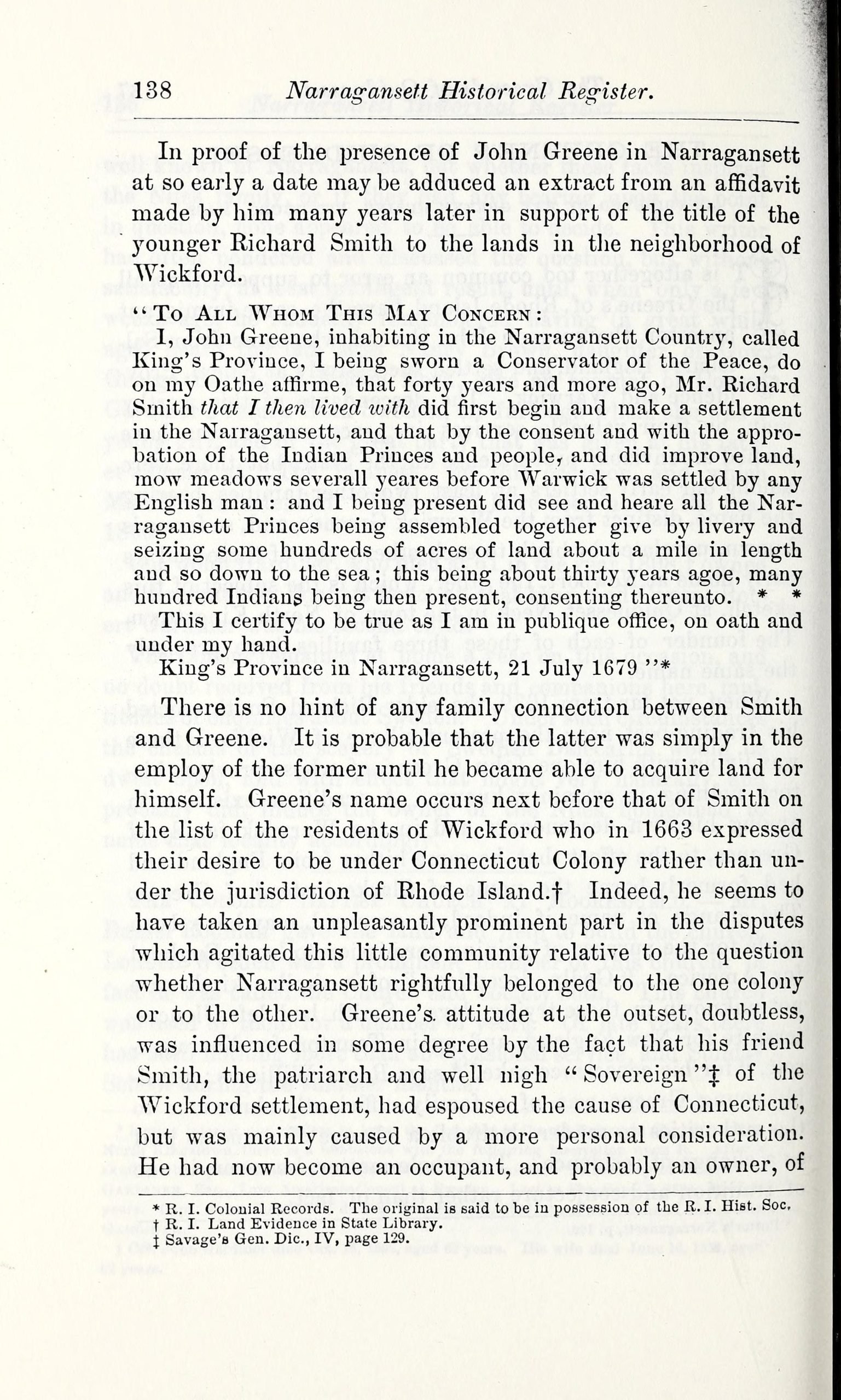
Huling, 1883, p. 138. “In proof of the presence of John Greene in Narragansett at so early a date may be adduced an extract from an affidavit made by him many years later in support of the title of the younger Richard Smith to the lands in the neighborhood of Wickford. ‘To All Whom This May Concern: I, John Greene, inhabiting in the Narragansett Country, called King’s Province, I being sworn a Conservator of the Peace, do on my Oathe affirme, that forty years and more ago, Mr. Richard Smith that I then lived with did first begin and make a settlement in the Narragansett, and that by the consent and with the approbation of the Indian Princes and people, and did improve land, mow meadows severall yeares before Warwick was settled by any English man: and I being present did see and heare all the Narragansett Princes being assembled together give by livery and seizing some hundreds of acres of land about a mile in length and so down to the sea; this being about thirty years agoe, many hundred Indians being then present, consenting thereunto. * * This I certify to be true as I am in publique office, on oath and under my hand. King’s Province in Narragansett, 21 July 1679.’* There is no hint of any family connection between Smith and Greene. It is probable that the latter was simply in the employ of the former until he became able to acquire land for himself.” The rest of the page, on the 1663 list and Greene’s motive, is transcribed on the John Greene of Quidnessett page. Footnote: “* R. I. Colonial Records. The original is said to be in possession of the R. I. Hist. Soc.”
Gardiner, 1883, p. 114. “During the Indian War which succeeded this it is affirmed that every house in Narragansett was destroyed, and the inhabitants entirely driven out. Soon after this, however, they returned, and commenced again their settlements, and in a petition of the inhabitants of Narragansett dated July 29, 1679, we find the signers to be as follows: William Bentley, Henry Gardiner, John Greene, Ben’jn Gardiner, George Gardiner, Daniel Greene, Sam. Wilson, James Greene, James Runnells, Robert Spink, Joseph Dolaver, Alex. Fenex, Henry Tibets, Wm. Knolls, Rouse Helme, Lodowick Updike, Richard Smith, John Coale, Sam. Eldred, Arthur Aylesworth, Henry Renals, James Renals, Thomas Scoville, Daniel Sweet, Sam. Alsbery, William Gardiner, John Sheldon, Jun’r, Frell Newton, George Palmer, Nicholas Gardiner, Jery Bull, Thomas Gold, George Whitman, Robert Vinin, John Eldred, Daniel Eldred, Robert Spink, Jun., John Sheldon, William Coster, Aaron Jackwaise, Thos. Brooks, Jos. Reynolds. Some of these seem to have been of Pettaquamscutt. The inhabitants of Pettaquamscutt as given in May, 1671, by the Court of Commissioners above mentioned were: Jerah Bull, Samuel Wilson, John Potter, Thomas Mumford, John Tefft, Wm. Heffernan, Rouse Helme, James Eldredge, Samuel Albro, Ben. Gardiner, Henry Gardiner, Nicholas Gardiner, George Palmer, Stephen Northup, William Aires, George Crofts, Enoch Plaice, Christopher Holmes. These lists contain most of the Pioneers of Narragansett up to 1680.” The page continues with the tradition of James Eldredge’s escape from Bull’s garrison in 1675.
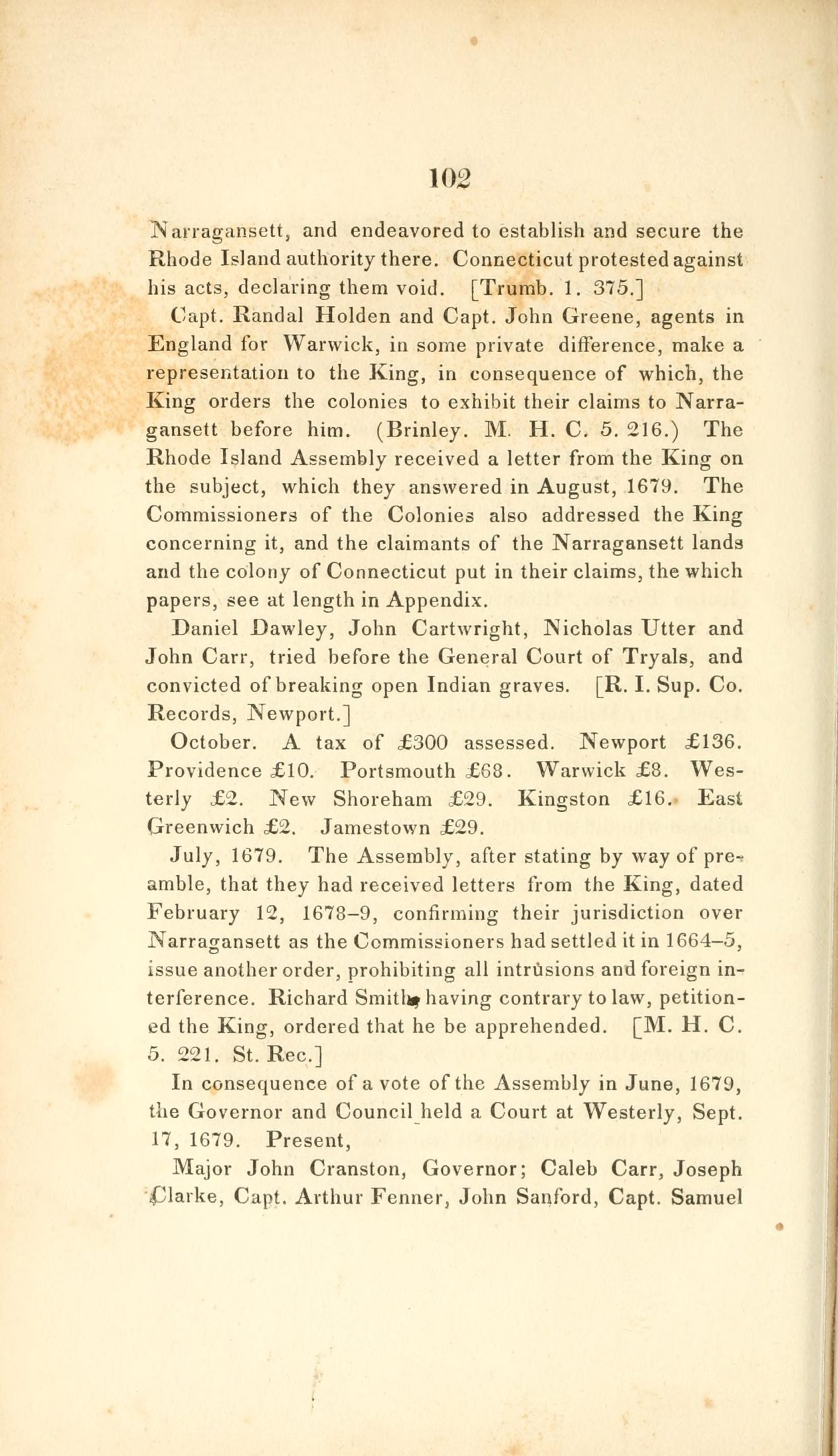
Potter, 1835, p. 102. “Narragansett, and endeavored to establish and secure the Rhode Island authority there. Connecticut protested against his acts, declaring them void. [Trumb. 1. 375.] Capt. Randal Holden and Capt. John Greene, agents in England for Warwick, in some private difference, make a representation to the King, in consequence of which, the King orders the colonies to exhibit their claims to Narragansett before him. (Brinley. M. H. C. 5. 216.) The Rhode Island Assembly received a letter from the King on the subject, which they answered in August, 1679. The Commissioners of the Colonies also addressed the King concerning it, and the claimants of the Narragansett lands and the colony of Connecticut put in their claims, the which papers, see at length in Appendix. Daniel Dawley, John Cartwright, Nicholas Utter and John Carr, tried before the General Court of Tryals, and convicted of breaking open Indian graves. [R. I. Sup. Co. Records, Newport.] October. A tax of £300 assessed. Newport £136. Providence £10. Portsmouth £68. Warwick £8. Westerly £2. New Shoreham £29. Kingston £16. East Greenwich £2. Jamestown £29. July, 1679. The Assembly, after stating by way of preamble, that they had received letters from the King, dated February 12, 1678–9, confirming their jurisdiction over Narragansett as the Commissioners had settled it in 1664–5, issue another order, prohibiting all intrusions and foreign interference. Richard Smith, having contrary to law, petitioned the King, ordered that he be apprehended. [M. H. C. 5. 221. St. Rec.] In consequence of a vote of the Assembly in June, 1679, the Governor and Council held a Court at Westerly, Sept. 17, 1679. Present, Major John Cranston, Governor; Caleb Carr, Joseph Clarke, Capt. Arthur Fenner, John Sanford, Capt. Samuel”
Two John Greenes, and the one who negotiated
The confusion, and how to end it. Family accounts, including the earlier version of this page, have credited John Greene of Quidnessett with negotiating the land disputes. The negotiator in the records is a different man: Major John Greene of Warwick, son of John Greene the surgeon, an Assistant of the colony from the 1660s and Deputy Governor from 1690. It was he who was appointed with Joseph Torrey in May 1664 to treat with Massachusetts, at the same session that pardoned the Quidnessett Greene (Bartlett, 1857, p. 49); he who was named a justice of the King’s Province in April 1665 (Bartlett, 1857, p. 94); he who took Coginaquond’s statement at Warwick in May 1668 as an Assistant (Potter, 1835, p. 58); and he who went to England with Randall Holden as agent for Warwick in the 1670s and put the Narragansett question before the King, as Potter records and as the royal commissioners of 1683 complained: “what was Some yeares Since Suggested to yo’r Maj’tie and Councill by Randall Houldeen and John Greene” (Potter, 1835, p. 102; Arnold, 1894, p. 65). John Greene of Quidnessett appears in the same dispute only as a subscriber, a prisoner, a petitioner for pardon, a freeman engaged, a purchaser, a deponent, and a signer of the petition of 1679. Huling warned in 1883 that confusing the two was “altogether too common an error,” and the warning stands (Huling, 1883, p. 137).
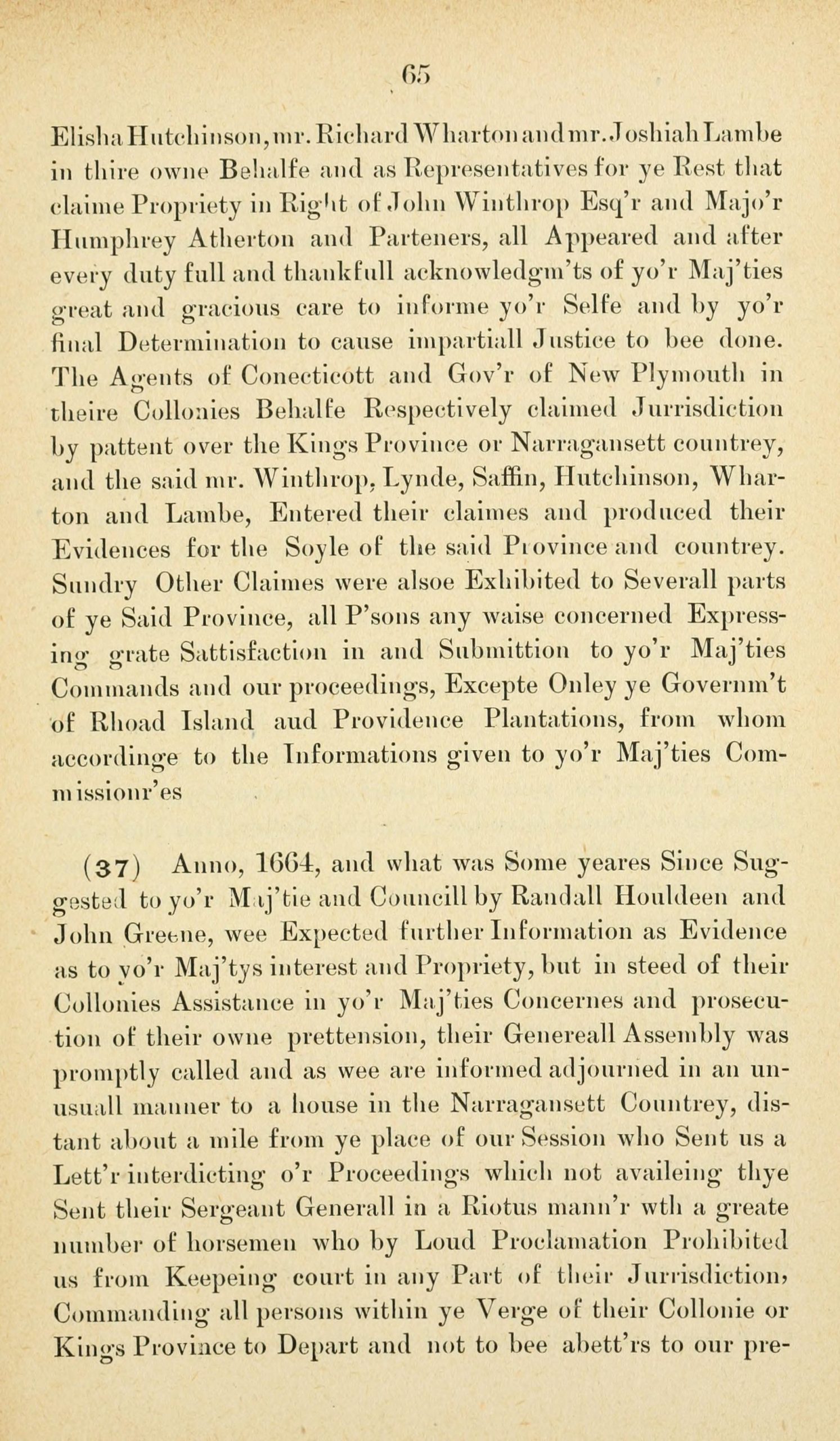
Arnold, 1894, p. 65. “Elisha Hutchinson, mr. Richard Wharton and mr. Joshiah Lambe in thire owne Behalfe and as Representatives for ye Rest that claime Propriety in Right of John Winthrop Esq’r and Majo’r Humphrey Atherton and Parteners, all Appeared and after every duty full and thankfull acknowledgm’ts of yo’r Maj’ties great and gracious care to informe yo’r Selfe and by yo’r final Determination to cause impartiall Justice to bee done. The Agents of Conecticott and Gov’r of New Plymouth in theire Collonies Behalfe Respectively claimed Jurrisdiction by pattent over the Kings Province or Narragansett countrey, and the said mr. Winthrop, Lynde, Saffin, Hutchinson, Wharton and Lambe, Entered their claimes and produced their Evidences for the Soyle of the said Province and countrey. Sundry Other Claimes were alsoe Exhibited to Severall parts of ye Said Province, all P’sons any waise concerned Expressing grate Sattisfaction in and Submittion to yo’r Maj’ties Commands and our proceedings, Excepte Onley ye Governm’t of Rhoad Island and Providence Plantations, from whom accordinge to the Informations given to yo’r Maj’ties Commissionr’es (37) Anno, 1664, and what was Some yeares Since Suggested to yo’r Maj’tie and Councill by Randall Houldeen and John Greene, wee Expected further Information as Evidence as to yo’r Maj’tys interest and Propriety, but in steed of their Collonies Assistance in yo’r Maj’ties Concernes and prosecution of their owne prettension, their Genereall Assembly was promptly called and as wee are informed adjourned in an unusuall manner to a house in the Narragansett Countrey, distant about a mile from ye place of our Session who Sent us a Lett’r interdicting o’r Proceedings which not availeing thye Sent their Sergeant Generall in a Riotus mann’r wth a greate number of horsemen who by Loud Proclamation Prohibited us from Keepeing court in any Part of their Jurrisdiction, Commanding all persons within ye Verge of their Collonie or Kings Province to Depart and not to bee abett’rs to our pre-” [continued on page 66].
What it meant for the family
The land the sons got. The whole point of John Greene’s twenty years of signing, submitting, engaging, and buying was the farm. On 24 March 1681/2 he deeded it to his sons: sixty acres to James and one hundred and twenty to Daniel, each to pay thirty shillings a year “as long as the father or mother should live.” The James deed is the one record that names his wife, “Joane Greene, his wife” (Rhode Island Historical Society, 1921, pp. 173–174; Huling, 1883, pp. 141–142). The land was Atherton land in 1659, Connecticut land in 1663, Rhode Island land from 1671, and Greene land until the family sold the last of it to the Allens in 1797 (Huling, 1883, p. 142). Her record is on the page Joan, wife of John Greene of Quidnessett: the Narragansett record.
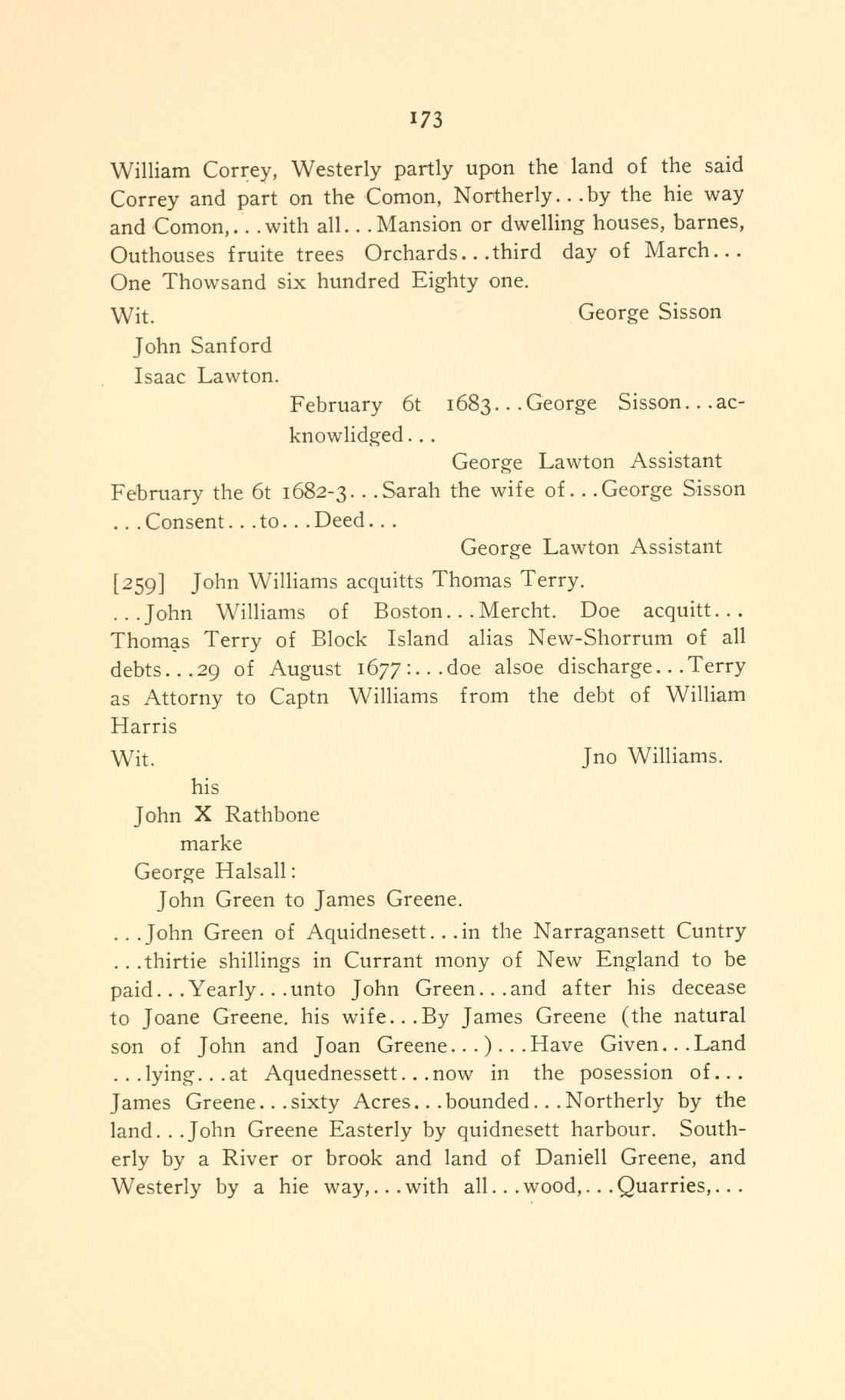
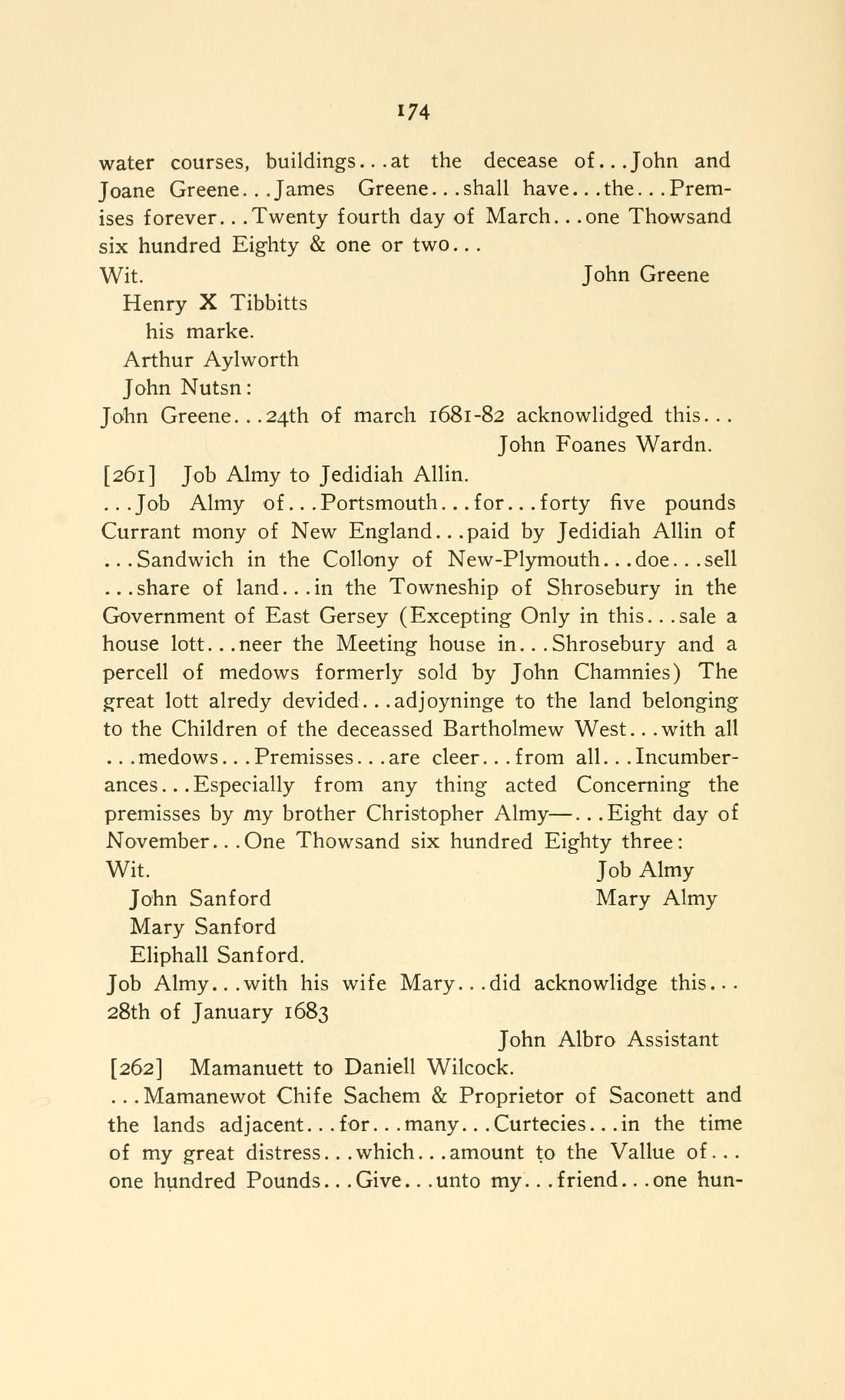
Rhode Island Historical Society, 1921, pp. 173–174, entry [260]. Transcribed in full on the page Joan, wife of John Greene of Quidnessett: the Narragansett record.
What this page said before, and what the records say
| Said before 22 September 2026 | What the records show |
|---|---|
| John Greene “played an active role in resolving” the land disputes between Massachusetts, Rhode Island, and Connecticut. | He was a party to the dispute, never an arbiter or agent. The negotiating John Greene is Major John of Warwick (Bartlett, 1857, pp. 49, 94; Potter, 1835, p. 102; Arnold, 1894, p. 65). |
| He mediated disputes between settlers and the Narragansett tribe. | No record found. His only recorded dealing with the Narragansett is as a purchaser in 1671/2 (Arnold, 1894, pp. 166–168). |
| He advocated for settlers’ rights. | No record found. He signed the subscription of 1663 and the petition of 1679 as one inhabitant among many (Arnold, 1894, p. 25; Gardiner, 1883, p. 114). |
| In 1676 he co-signed a petition to the English Crown. | The petition of the inhabitants of Narragansett is dated 29 July 1679 (Gardiner, 1883, p. 114). No 1676 petition with his name has been found. |
| Greene’s advocacy “often aligned with Rhode Island’s interests,” while Smith preferred Connecticut. | Both men chose Connecticut in 1663. Greene submitted to Rhode Island in 1664 and engaged in 1671; the younger Smith served Rhode Island as Assistant and commissioner in 1672 and was ordered apprehended by it in 1679 (Bartlett, 1857, pp. 51, 454; Potter, 1835, pp. 76, 102). |
| The King’s Province was “under direct English control until it was incorporated into Rhode Island in 1726.” | The commissioners of 1665 placed the King’s Province under Rhode Island’s own magistrates as justices of the peace (Bartlett, 1857, p. 94). The later history of the boundary is outside this page. |
Further reading on the Boston partnership: Atherton Trading Company (Wikipedia; a secondary summary, not a source for this page).
References
Arnold, J. N. (Ed.). (1894). The records of the proprietors of the Narragansett, otherwise called the Fones record. Providence, RI: Narragansett Historical Publishing Co. https://archive.org/details/recordsofproprie00arno
Bartlett, J. R. (Ed.). (1856). Records of the Colony of Rhode Island and Providence Plantations in New England (Vol. 1, 1636–1663). Providence, RI: A. C. Greene. https://archive.org/details/recordsofcolonyo01rhod
Bartlett, J. R. (Ed.). (1857). Records of the Colony of Rhode Island and Providence Plantations in New England (Vol. 2, 1664–1677). Providence, RI: A. C. Greene. https://archive.org/details/recordsofcolonyo02rhod
Gardiner, J. W. (1883). The pioneers of Narragansett. The Narragansett Historical Register, 2(2), 112–115. https://archive.org/details/sim_narragansett-historical-register-plantations_1883-10_2_2
Huling, R. G. (1883). The Greene’s of Quidnesset. The Narragansett Historical Register, 2(2), 137–142. https://archive.org/details/narragansetthistv1v2rhod
Potter, E. R. (1835). The early history of Narragansett (Collections of the Rhode Island Historical Society, Vol. 3). Providence, RI: Marshall, Brown. https://archive.org/details/earlyhistoryofna00pott
Rhode Island Historical Society. (1921). Rhode Island land evidences, vol. I, 1648–1696, abstracts. Providence, RI: Author. https://archive.org/details/rhodeislandlande00wort
Updike, W. (1847). A history of the Episcopal Church in Narragansett, Rhode Island. New York, NY: H. M. Onderdonk. https://archive.org/details/historyofepiscop00updi_0
Every page image above was read and checked against its transcription on 22 September 2026. Nothing has been supplied where a source is silent; where a page continues beyond the entry used, the transcription says so.
Views: 92