Major Jacob W. Knapp of the First New York Dragoons
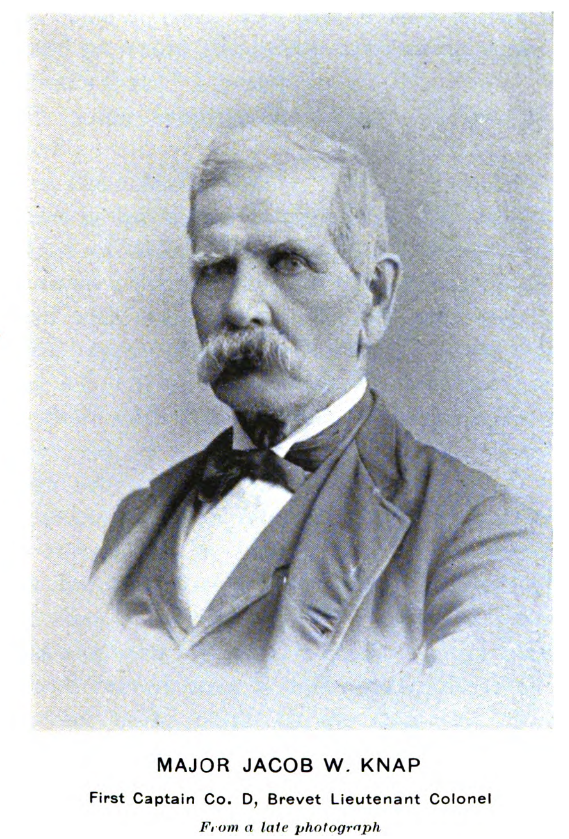
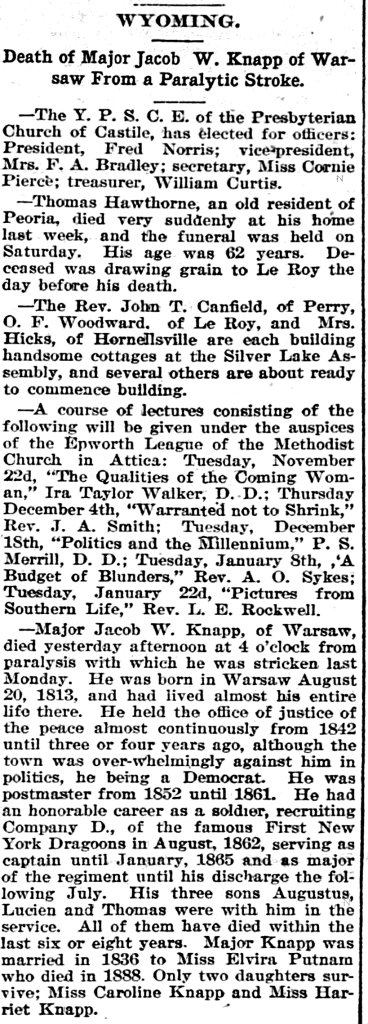
Primary Sources & Records
Original documents located in federal and state archives that name this soldier. Each is shown with its full transcription and citation.
From the 1895 Biographical Review
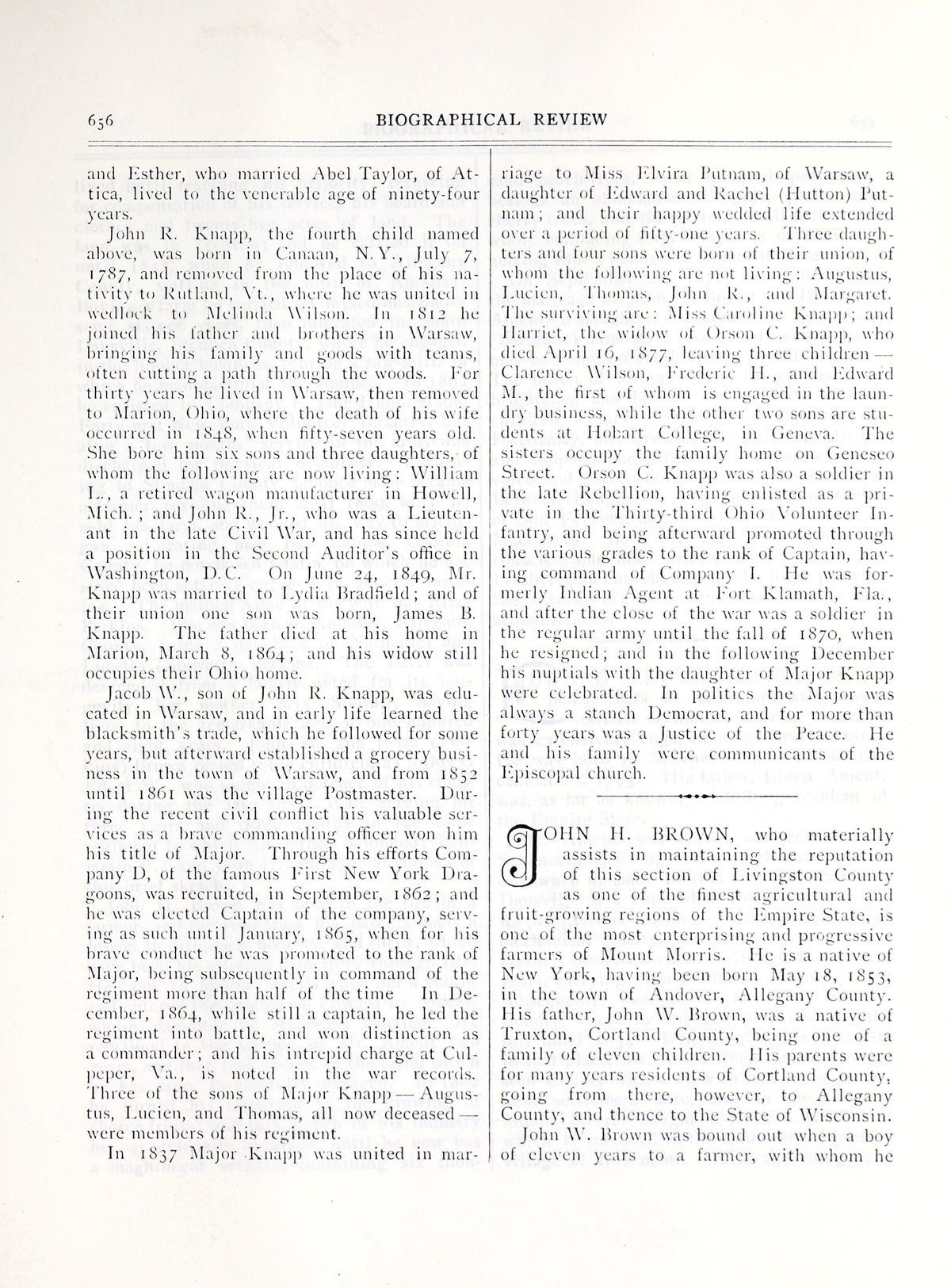
656 BIOGRAPHICAL REVIEW
and Esther, who married Abel Taylor, of Attica, lived to the venerable age of ninety-four years.
John R. Knapp, the fourth child named above, was born in Canaan, N.Y., July 7, 1787, and removed from the place of his nativity to Rutland, Vt., where he was united in wedlock to Melinda Wilson. In 1812 he joined his father and brothers in Warsaw, bringing his family and goods with teams, often cutting a path through the woods. For thirty years he lived in Warsaw, then removed to Marion, Ohio, where the death of his wife occurred in 1848, when fifty-seven years old. She bore him six sons and three daughters, of whom the following are now living: William L., a retired wagon manufacturer in Howell, Mich.; and John R., Jr., who was a Lieutenant in the late Civil War, and has since held a position in the Second Auditor’s office in Washington, D.C. On June 24, 1849, Mr. Knapp was married to Lydia Bradfield; and of their union one son was born, James B. Knapp. The father died at his home in Marion, March 8, 1864; and his widow still occupies their Ohio home.
Jacob W., son of John R. Knapp, was educated in Warsaw, and in early life learned the blacksmith’s trade, which he followed for some years, but afterward established a grocery business in the town of Warsaw, and from 1852 until 1861 was the village Postmaster. During the recent civil conflict his valuable services as a brave commanding officer won him his title of Major. Through his efforts Company D, of the famous First New York Dragoons, was recruited, in September, 1862; and he was elected Captain of the company, serving as such until January, 1865, when for his brave conduct he was promoted to the rank of Major, being subsequently in command of the regiment more than half of the time. In December, 1864, while still a captain, he led the regiment into battle, and won distinction as a commander; and his intrepid charge at Culpeper, Va., is noted in the war records. Three of the sons of Major Knapp (Augustus, Lucien, and Thomas, all now deceased) were members of his regiment.
In 1837 Major Knapp was united in marriage to Miss Elvira Putnam, of Warsaw, a daughter of Edward and Rachel (Hutton) Putnam; and their happy wedded life extended over a period of fifty-one years. Three daughters and four sons were born of their union, of whom the following are not living: Augustus, Lucien, Thomas, John R., and Margaret. The surviving are: Miss Caroline Knapp; and Harriet, the widow of Orson C. Knapp, who died April 16, 1877, leaving three children: Clarence Wilson, Frederic H., and Edward M., the first of whom is engaged in the laundry business, while the other two sons are students at Hobart College, in Geneva. The sisters occupy the family home on Geneseo Street. Orson C. Knapp was also a soldier in the late Rebellion, having enlisted as a private in the Thirty-third Ohio Volunteer Infantry, and being afterward promoted through the various grades to the rank of Captain, having command of Company I. He was formerly Indian Agent at Fort Klamath, Fla., and after the close of the war was a soldier in the regular army until the fall of 1870, when he resigned; and in the following December his nuptials with the daughter of Major Knapp were celebrated. In politics the Major was always a stanch Democrat, and for more than forty years was a Justice of the Peace. He and his family were communicants of the Episcopal church.
JOHN H. BROWN, who materially assists in maintaining the reputation of this section of Livingston County as one of the finest agricultural and fruit-growing regions of the Empire State, is one of the most enterprising and progressive farmers of Mount Morris. He is a native of New York, having been born May 18, 1853, in the town of Andover, Allegany County. His father, John W. Brown, was a native of Truxton, Cortland County, being one of a family of eleven children. His parents were for many years residents of Cortland County, going from there, however, to Allegany County, and thence to the State of Wisconsin.
John W. Brown was bound out when a boy of eleven years to a farmer, with whom he
Source. Biographical Review Publishing Company. (1895). Biographical review: This volume contains biographical sketches of the leading citizens of Livingston and Wyoming counties, New York (p. 656). Biographical Review Publishing Company. Internet Archive identifier biographicalrevi00unse_1. https://archive.org/details/biographicalrevi00unse_1
The book prints Company D, not Company I as in the roster facts; the candidate search had silently bracketed “[I]”. One of the two is in error and the discrepancy should be checked against Bowen or the NY Adjutant General roster before the company letter is asserted on the page. The bio begins mid-sentence because the sketch opens at the foot of page 655.
County History Account (1880)
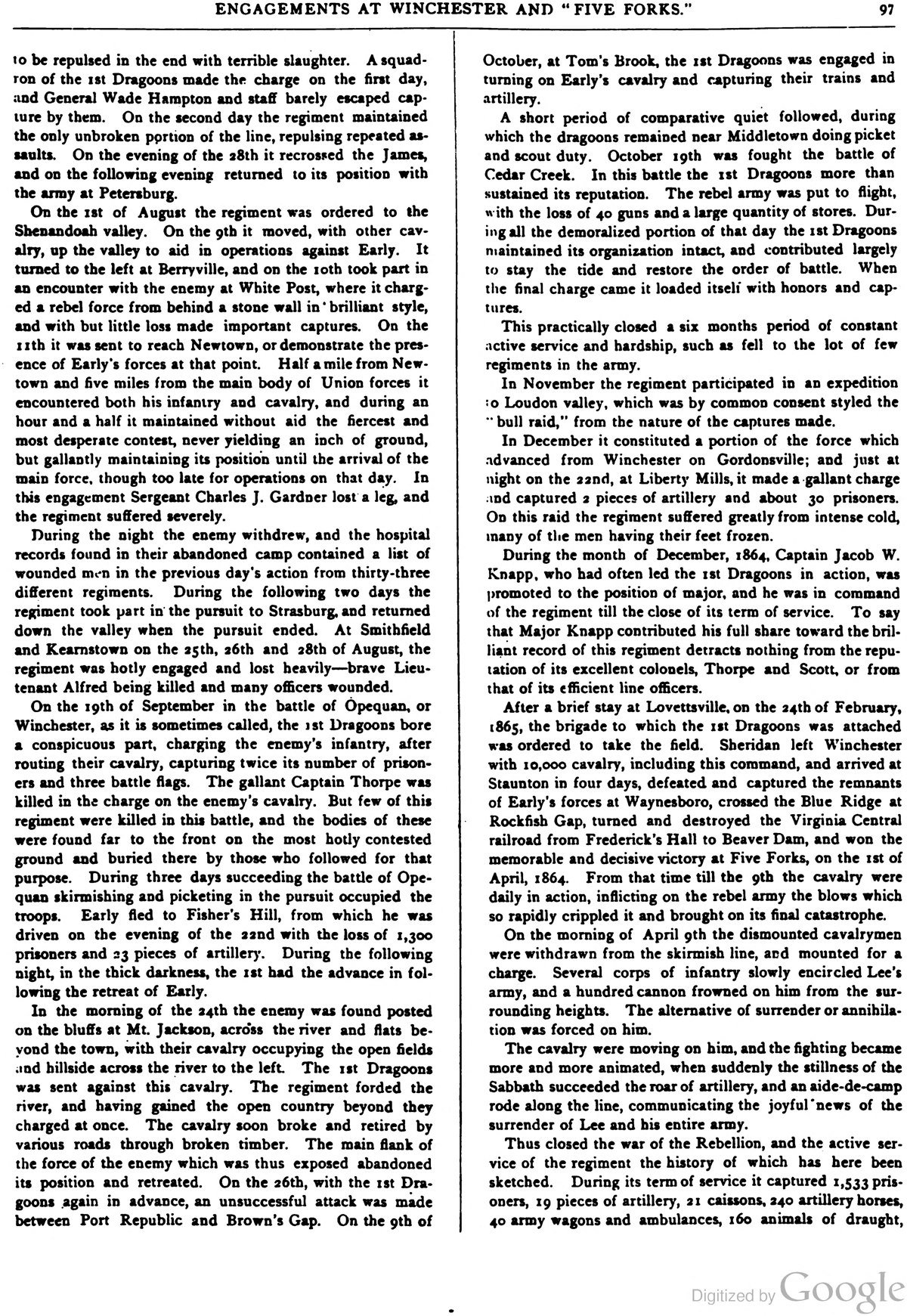
ENGAGEMENTS AT WINCHESTER AND “FIVE FORKS.” 97
to be repulsed in the end with terrible slaughter. A squadron of the 1st Dragoons made the charge on the first day, and General Wade Hampton and staff barely escaped capture by them. On the second day the regiment maintained the only unbroken portion of the line, repulsing repeated assaults. On the evening of the 28th it recrossed the James, and on the following evening returned to its position with the army at Petersburg.
On the 1st of August the regiment was ordered to the Shenandoah valley. On the 9th it moved, with other cavalry, up the valley to aid in operations against Early. It turned to the left at Berryville, and on the 10th took part in an encounter with the enemy at White Post, where it charged a rebel force from behind a stone wall in brilliant style, and with but little loss made important captures. On the 11th it was sent to reach Newtown, or demonstrate the presence of Early’s forces at that point. Half a mile from Newtown and five miles from the main body of Union forces it encountered both his infantry and cavalry, and during an hour and a half it maintained without aid the fiercest and most desperate contest, never yielding an inch of ground, but gallantly maintaining its position until the arrival of the main force, though too late for operations on that day. In this engagement Sergeant Charles J. Gardner lost a leg, and the regiment suffered severely.
During the night the enemy withdrew, and the hospital records found in their abandoned camp contained a list of wounded men in the previous day’s action from thirty-three different regiments. During the following two days the regiment took part in the pursuit to Strasburg, and returned down the valley when the pursuit ended. At Smithfield and Kearnstown on the 25th, 26th and 28th of August, the regiment was hotly engaged and lost heavily; brave Lieutenant Alfred being killed and many officers wounded.
On the 19th of September in the battle of Opequan, or Winchester, as it is sometimes called, the 1st Dragoons bore a conspicuous part, charging the enemy’s infantry, after routing their cavalry, capturing twice its number of prisoners and three battle flags. The gallant Captain Thorpe was killed in the charge on the enemy’s cavalry. But few of this regiment were killed in this battle, and the bodies of these were found far to the front on the most hotly contested ground and buried there by those who followed for that purpose. During three days succeeding the battle of Opequan skirmishing and picketing in the pursuit occupied the troops. Early fled to Fisher’s Hill, from which he was driven on the evening of the 22nd with the loss of 1,300 prisoners and 23 pieces of artillery. During the following night, in the thick darkness, the 1st had the advance in following the retreat of Early.
In the morning of the 24th the enemy was found posted on the bluffs at Mt. Jackson, across the river and flats beyond the town, with their cavalry occupying the open fields and hillside across the river to the left. The 1st Dragoons was sent against this cavalry. The regiment forded the river, and having gained the open country beyond they charged at once. The cavalry soon broke and retired by various roads through broken timber. The main flank of the force of the enemy which was thus exposed abandoned its position and retreated. On the 26th, with the 1st Dragoons again in advance, an unsuccessful attack was made between Port Republic and Brown’s Gap. On the 9th of October, at Tom’s Brook, the 1st Dragoons was engaged in turning on Early’s cavalry and capturing their trains and artillery.
A short period of comparative quiet followed, during which the dragoons remained near Middletown doing picket and scout duty. October 19th was fought the battle of Cedar Creek. In this battle the 1st Dragoons more than sustained its reputation. The rebel army was put to flight, with the loss of 40 guns and a large quantity of stores. During all the demoralized portion of that day the 1st Dragoons maintained its organization intact, and contributed largely to stay the tide and restore the order of battle. When the final charge came it loaded itself with honors and captures.
This practically closed a six months period of constant active service and hardship, such as fell to the lot of few regiments in the army.
In November the regiment participated in an expedition to Loudon valley, which was by common consent styled the “bull raid,” from the nature of the captures made.
In December it constituted a portion of the force which advanced from Winchester on Gordonsville; and just at night on the 22nd, at Liberty Mills, it made a gallant charge and captured 2 pieces of artillery and about 30 prisoners. On this raid the regiment suffered greatly from intense cold, many of the men having their feet frozen.
During the month of December, 1864, Captain Jacob W. Knapp, who had often led the 1st Dragoons in action, was promoted to the position of major, and he was in command of the regiment till the close of its term of service. To say that Major Knapp contributed his full share toward the brilliant record of this regiment detracts nothing from the reputation of its excellent colonels, Thorpe and Scott, or from that of its efficient line officers.
After a brief stay at Lovettsville, on the 24th of February, 1865, the brigade to which the 1st Dragoons was attached was ordered to take the field. Sheridan left Winchester with 10,000 cavalry, including this command, and arrived at Staunton in four days, defeated and captured the remnants of Early’s forces at Waynesboro, crossed the Blue Ridge at Rockfish Gap, turned and destroyed the Virginia Central railroad from Frederick’s Hall to Beaver Dam, and won the memorable and decisive victory at Five Forks, on the 1st of April, 1864. From that time till the 9th the cavalry were daily in action, inflicting on the rebel army the blows which so rapidly crippled it and brought on its final catastrophe.
On the morning of April 9th the dismounted cavalrymen were withdrawn from the skirmish line, and mounted for a charge. Several corps of infantry slowly encircled Lee’s army, and a hundred cannon frowned on him from the surrounding heights. The alternative of surrender or annihilation was forced on him.
The cavalry were moving on him, and the fighting became more and more animated, when suddenly the stillness of the Sabbath succeeded the roar of artillery, and an aide-de-camp rode along the line, communicating the joyful news of the surrender of Lee and his entire army.
Thus closed the war of the Rebellion, and the active service of the regiment the history of which has here been sketched. During its term of service it captured 1,533 prisoners, 19 pieces of artillery, 21 caissons, 240 artillery horses, 40 army wagons and ambulances, 160 animals of draught,
Source. Beers, F. W. (1880). History of Wyoming County, N.Y., with illustrations, biographical sketches and portraits of some pioneers and prominent residents (p. 97). F. W. Beers & Co. Internet Archive identifier HistoryOfWyomingCountyN.y.WithIllustrationsBiographicalSketchesAnd. https://archive.org/details/HistoryOfWyomingCountyN.y.WithIllustrationsBiographicalSketchesAnd
The page’s closing paragraphs misprint the date of Five Forks as “April, 1864” (it was 1865); transcription is verbatim. The candidate’s cited index entry (p. 288) is a different Knapp reference; the load-bearing passage is here on p. 97.
Pension Index Card
Jacob W Knapp’s card in the General Index to Pension Files. It records his service, the pension claims made on it, and, where the clerk noted it, his death. The card is an index: the claim files it points to are held separately at the National Archives.
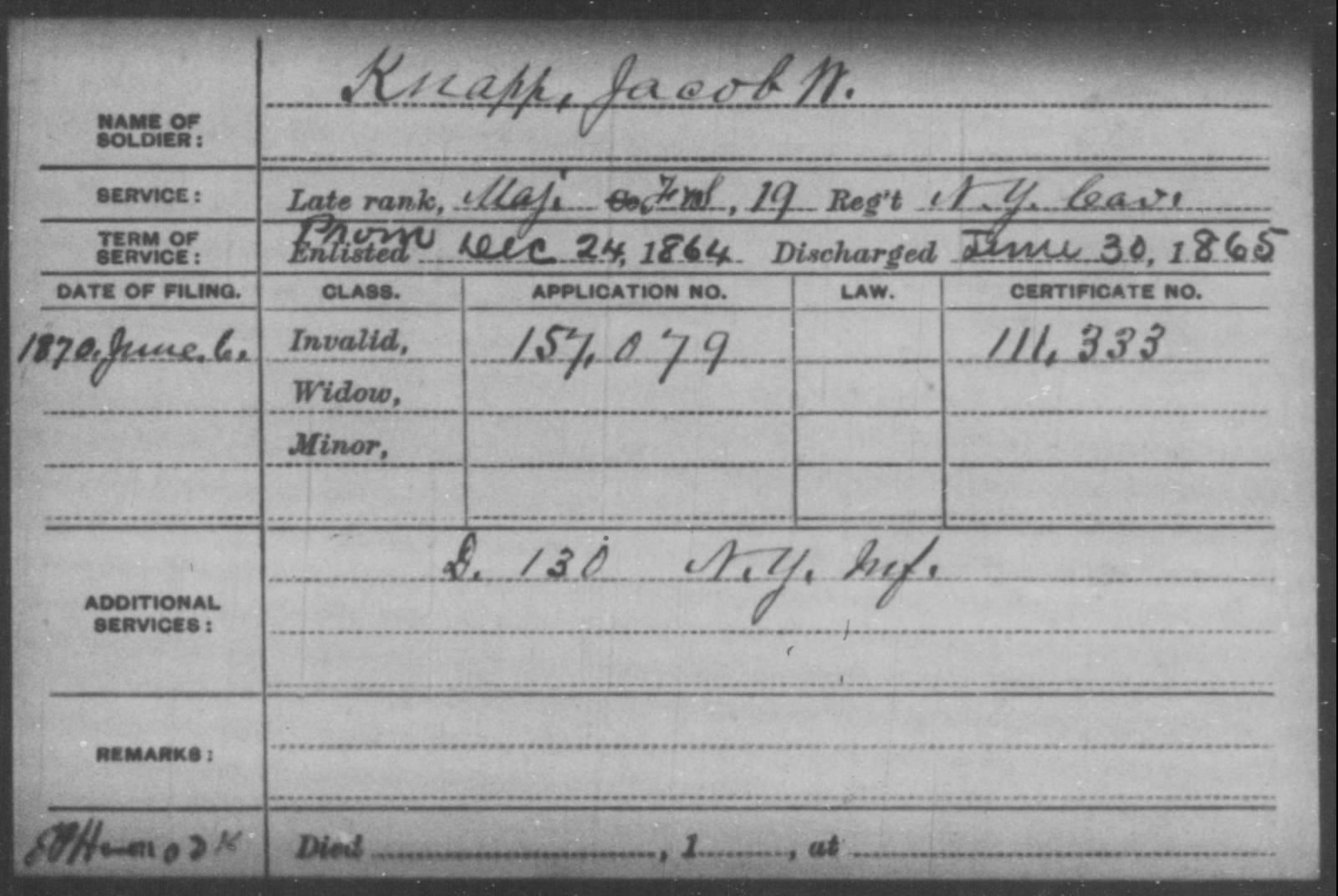
| Late rank | Maj. |
|---|---|
| Company | F&S |
| Regiment | 19th N.Y. Cavalry |
| Enlisted | 24 December 1864 (annotated “Prom”, promoted) |
| Discharged | 30 June 1865 |
| Invalid claim | application 157079, certificate 111333, filed 6 June 1870 |
| Widow claim | none |
| Additional service | D, 130th N.Y. Infantry |
| Died | [blank; no DEAD stamp] |
NAME OF SOLDIER: Knapp, Jacob W.
SERVICE: Late rank, Maj., Co. F&S, 19 Reg't N. Y. Cav.
TERM OF SERVICE: [annotation: Prom] Enlisted Dec 24, 1864  Discharged June 30, 1865
DATE OF FILING   CLASS     APPLICATION NO.   LAW   CERTIFICATE NO.
1870 June 6      Invalid   157079                  111333
                 Widow     [blank]
                 Minor     [blank]
ADDITIONAL SERVICES: D. 130 N. Y. Inf.
REMARKS: [clerk's initials]
Died [blank], at [blank]
Source. Pension Index Card, Knapp, Jacob W, Co. F&S, 19th N.Y. Cavalry. General Index to Pension Files, 1861-1934 (NARA microfilm publication T288), Record Group 15, roll [not read]. Digital image, Fold3 (https://www.fold3.com/image/4990281), accessed 15 September 2026. Transcribed from the original by sight.
Compiled Military Service Record
The index to the compiled service records confirms Jacob W Knapp in the 19th Cavalry (the regiment’s Fold3 designation; it is the First New York Dragoons), Company D (with “F.S.” written beneath), entering service as Capt. and leaving it as Major.
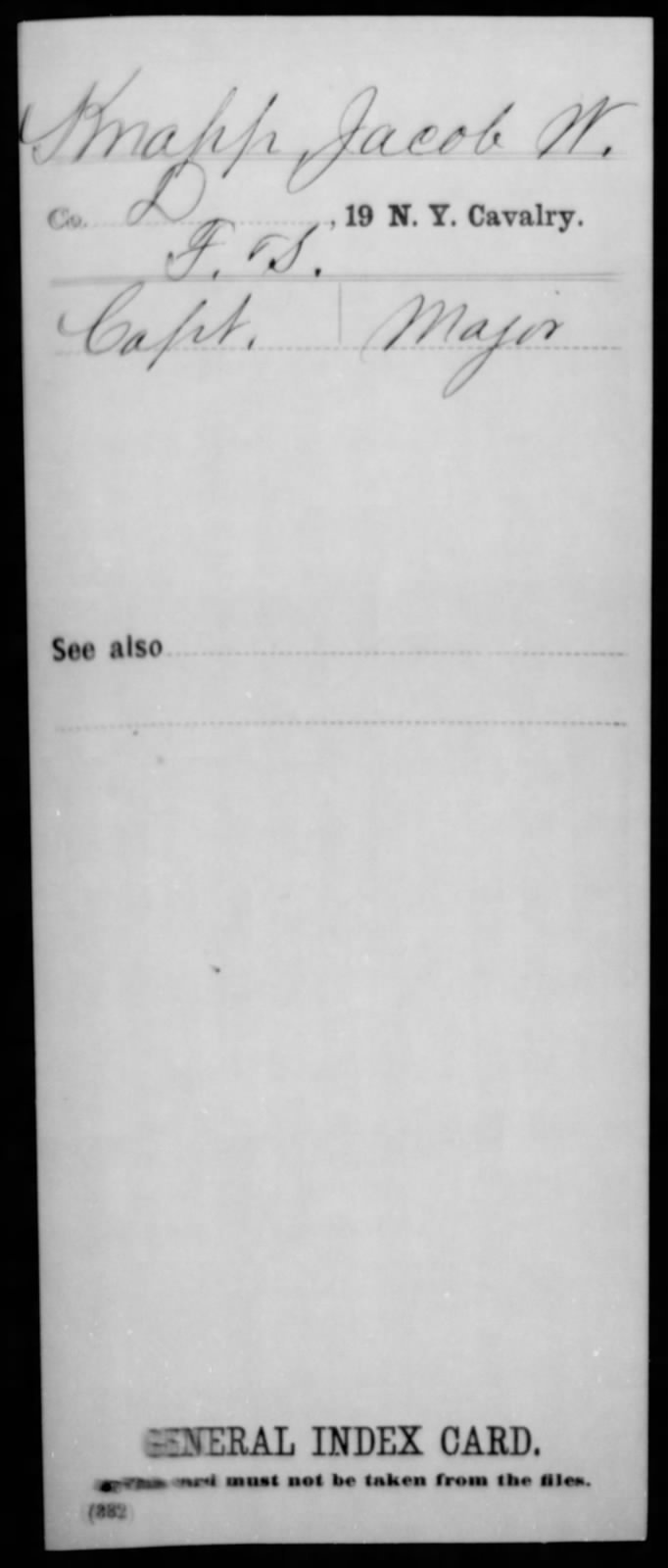
| Military unit | 19th Cavalry |
|---|---|
| Company | D (with “F.S.” written beneath) |
| Enlistment rank | Capt. |
| Discharge rank | Major |
| See also | [blank] |
Knapp, Jacob W.
Co. D [F.S. written beneath], 19 N. Y. Cavalry.
Capt.        Major
See also [blank]
Source. Compiled Military Service Record, Knapp, Jacob W, Co. D (with “F.S.” written beneath), 19th Cavalry. Indexes to the Carded Records of Soldiers Who Served in Volunteer Organizations During the Civil War (NARA microfilm publication M551), Record Group 94, roll [not read]. Digital image, Fold3 (https://www.fold3.com/image/288563638), accessed 15 September 2026. Transcribed from the original by sight.
In the County Histories
The county histories compiled within twenty years of the war named the men who went, and often recorded what became of them. His name appears on the pages reproduced below.
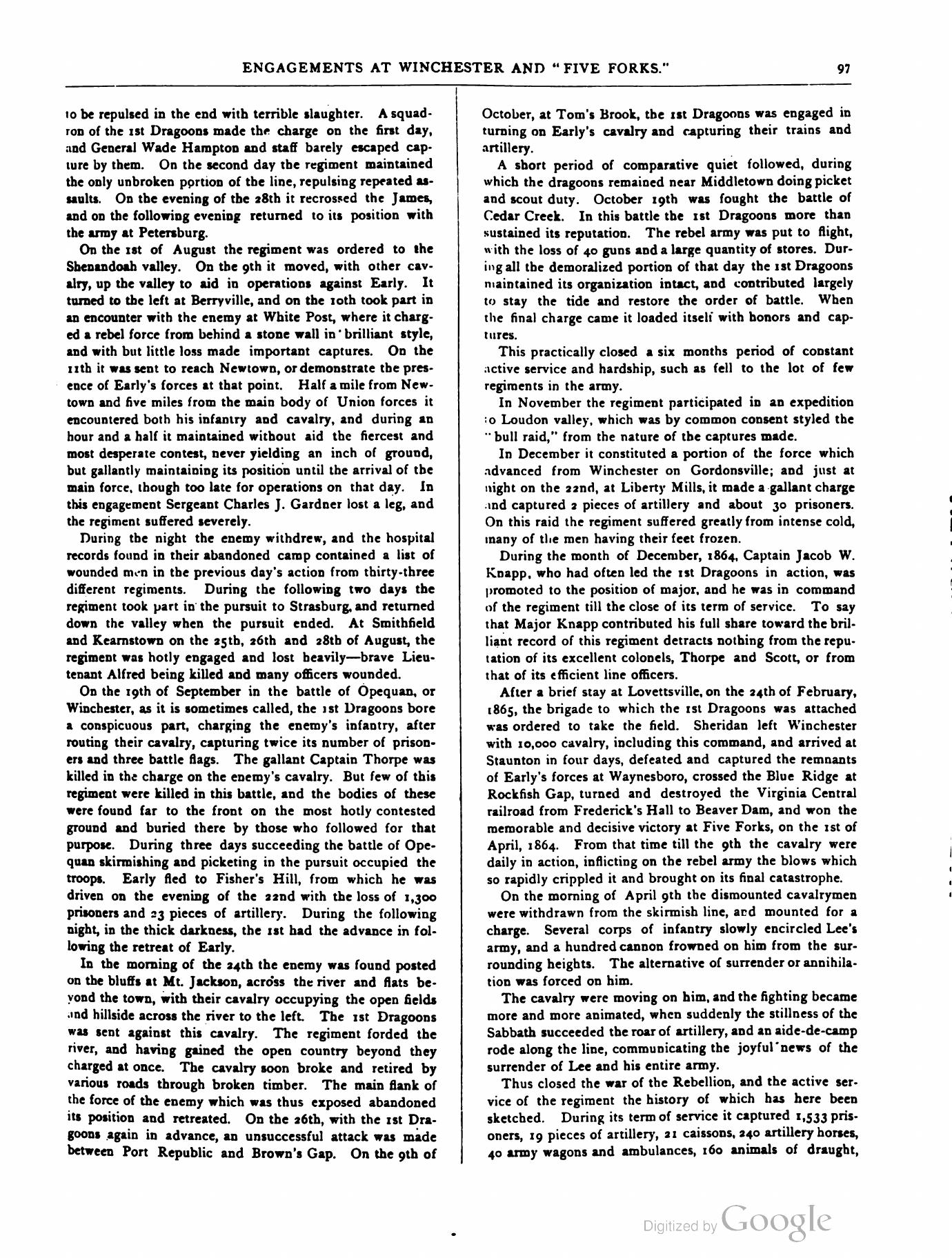
“Jacob W. Knapp , who had often led the ist Dragoons in action, was promoted to the position of major, and he was in command of the regiment till the close of its term of service. To say that Major Kna”
Source. F. W. Beers & Co. (1880). History of Wyoming County, N.Y. (p. 97). New York, NY: F. W. Beers & Co.. Public domain; digitised copy held in the archive of this site.
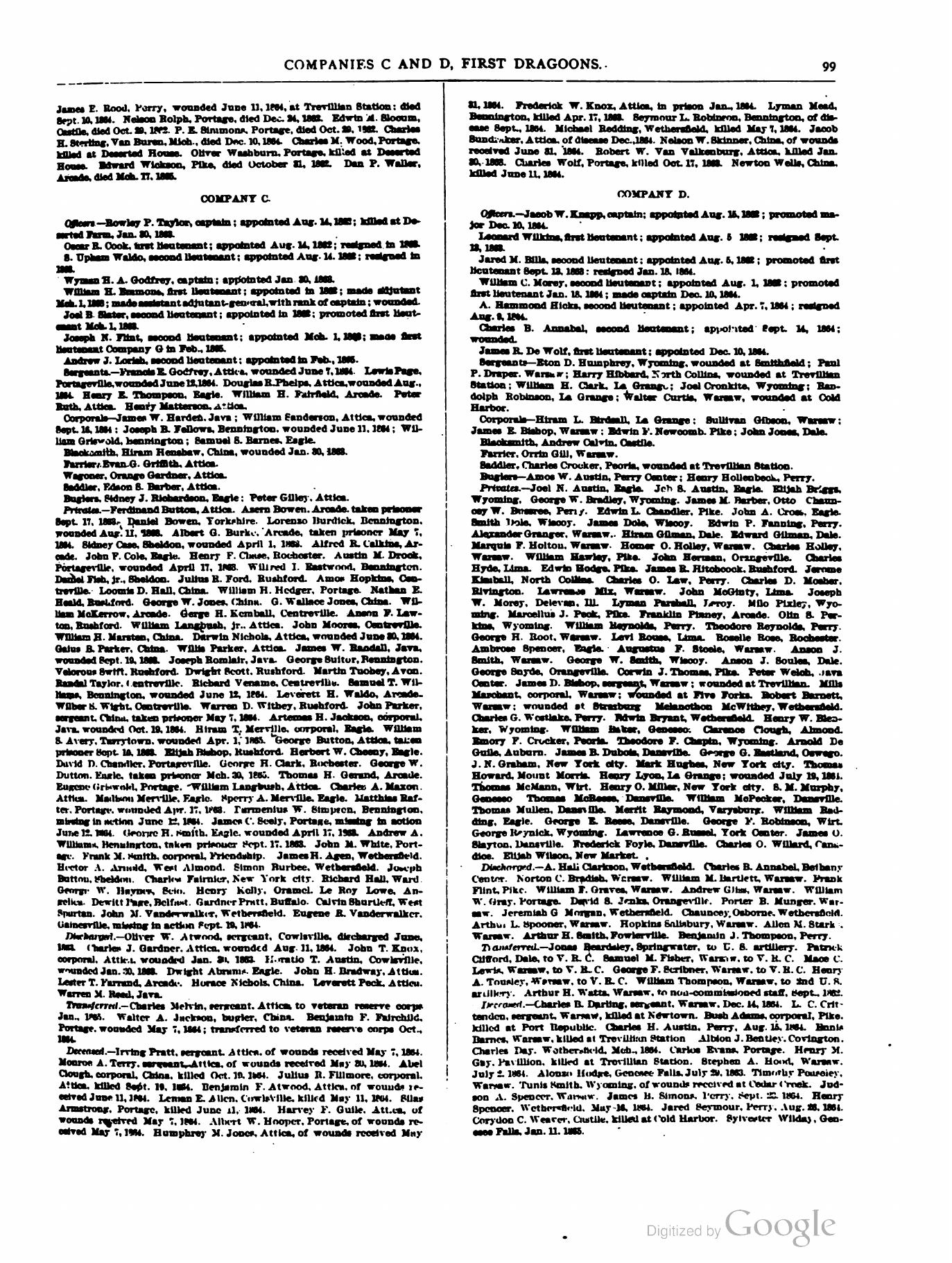
“Jacob W. Knapp, captain”
Source. F. W. Beers & Co. (1880). History of Wyoming County, N.Y. (p. 99). New York, NY: F. W. Beers & Co.. Public domain; digitised copy held in the archive of this site.
From the Regimental Register
The regiment’s own record of Jacob W. Knapp, as printed in Bowen’s history of the First New York Dragoons.
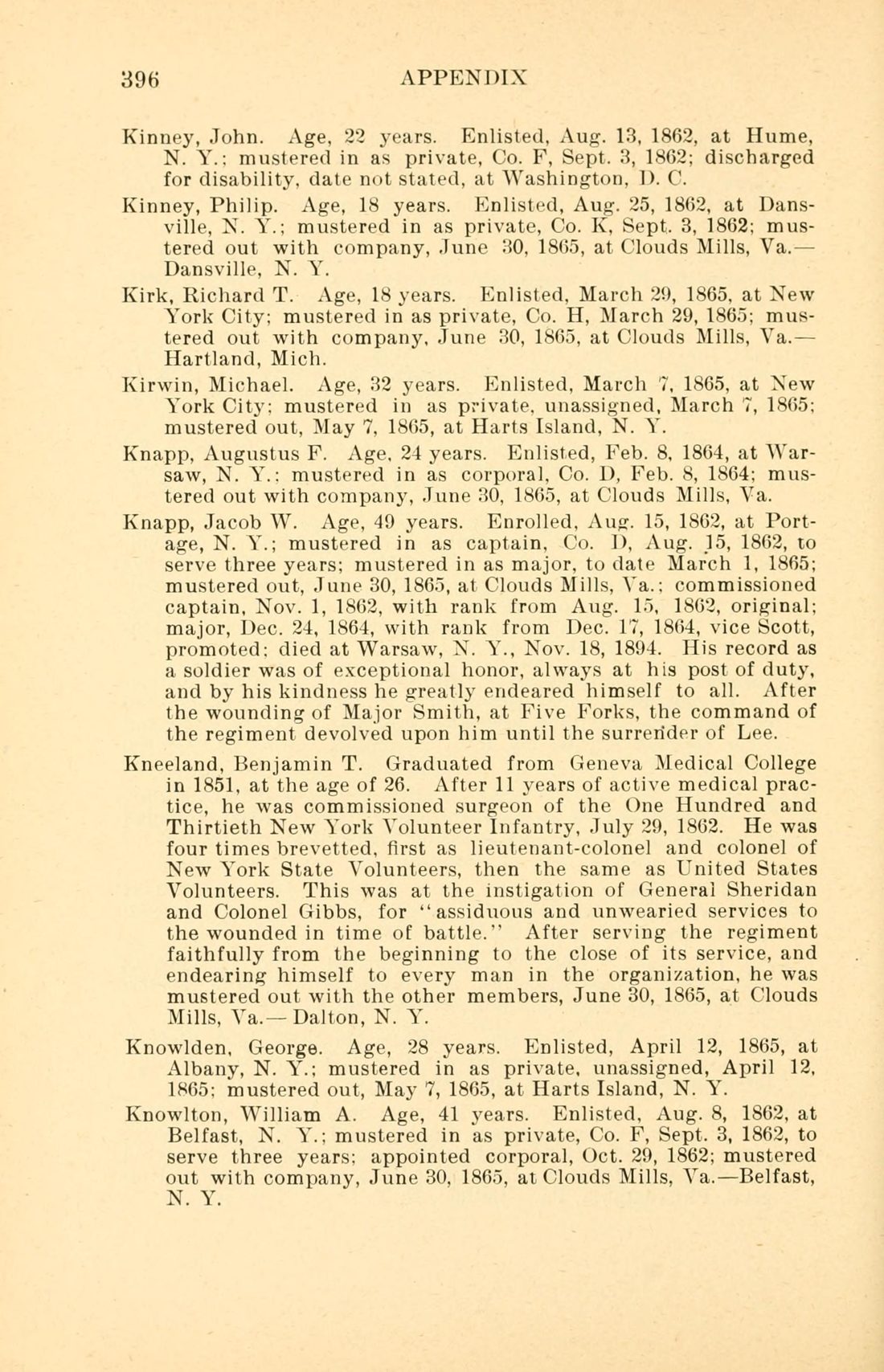
His entry as printed on page 396 of the regimental history. Click to enlarge.
“Knapp, Jacob W. Age, 49 years. Enrolled, Aug. 15, 1862, at Portage, N. Y.; mustered in as captain, Co. D, Aug. 15, 1862, to serve three years; mustered in as major, to date March 1, 1865; mustered out, June 30, 1865, at Clouds Mills, Va.; commissioned captain, Nov. 1, 1862, with rank from Aug. 15, 1862, original; major, Dec. 24, 1864, with rank from Dec. 17, 1864, vice Scott, promoted; died at Warsaw, N. Y., Nov. 18, 1894. His record as a soldier was of exceptional honor, always at his post of duty, and by his kindness he greatly endeared himself to all. After the wounding of Major Smith, at Five Forks, the command of the regiment devolved upon him until the surrender of Lee.”
Source. Bowen, J. R. (1900). Regimental history of the First New York Dragoons (originally the 130th N. Y. Vol. Infantry) during three years of active service in the great Civil War (p. 396). Author. archive.org/details/regimentalhistor00bowe
Views: 64