Oliver Wolcott Jr.
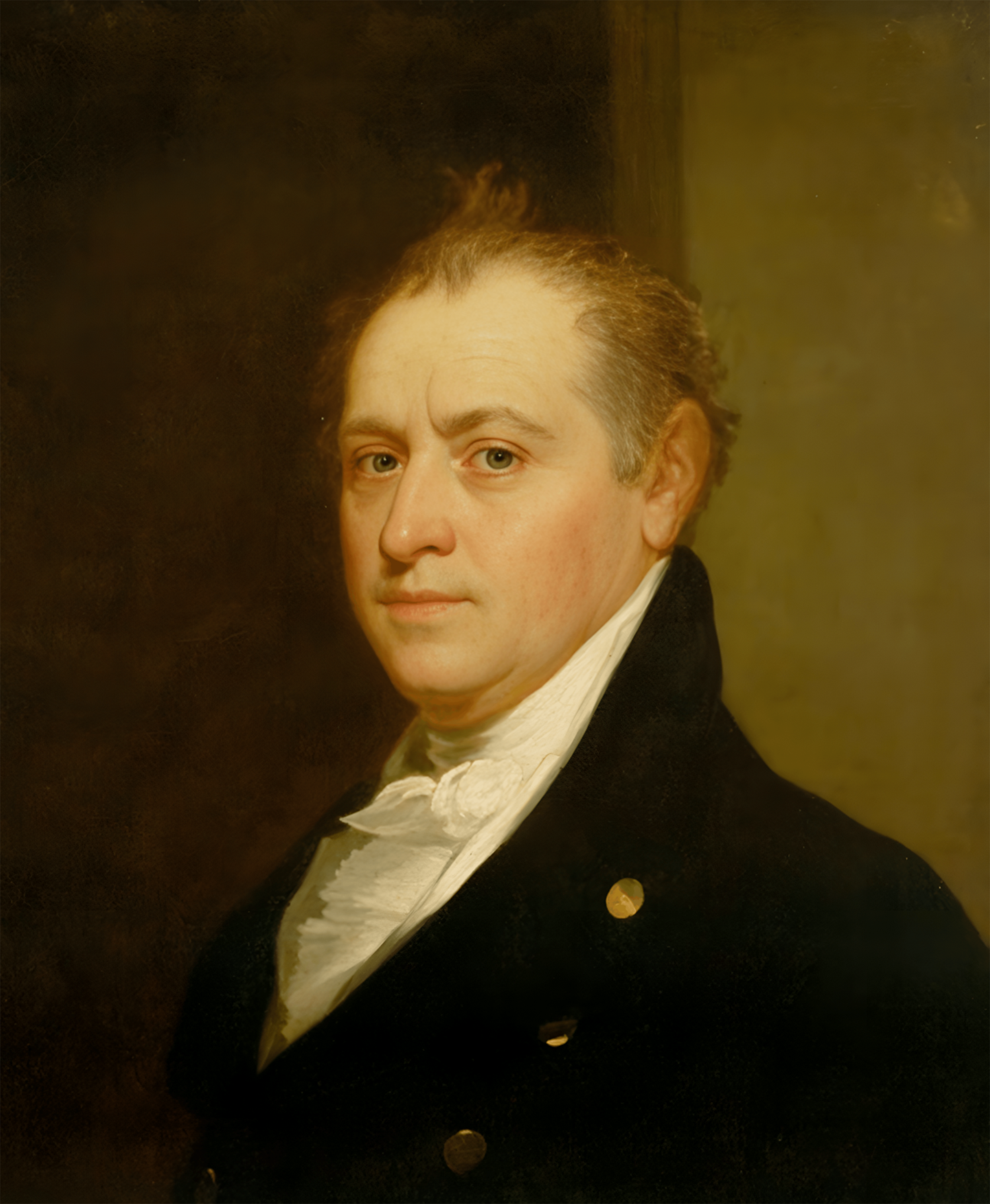
The Gibbs Family · Grandfather of the General
Oliver Wolcott Jr.
1760 – 1833
Washington’s and Adams’s Secretary of the Treasury, Governor of Connecticut, son of a Signer, and the grandfather whose letters carry the first written traces of baby Alfred Gibbs.
Oliver Wolcott Jr. (January 11, 1760 – June 1, 1833) was an influential figure in American politics and law. He served as the second Secretary of the Treasury for the United States, a judge on the United States Circuit Court for the Second Circuit, and eventually became the 24th Governor of Connecticut. His career began in his home state of Connecticut, where he was involved in various governmental roles before moving into federal service. Over the years, Wolcott’s political affiliations evolved, reflecting shifts in the broader political landscape.
Born in Litchfield, Connecticut Colony, Wolcott was part of a prominent family with deep roots in the colony’s elite society. He served in the Continental Army during the American Revolutionary War and later graduated from Yale University in 1778. After reading law in 1781, he entered public service in Connecticut, where he played a significant role in managing the state’s military finances during the Revolution.
Wolcott’s career in federal government began as the first Auditor in the Treasury Department under Alexander Hamilton, the first Secretary of the Treasury. His work in this role, which involved auditing government accounts and managing financial records, set the stage for his subsequent appointment as Secretary of the Treasury by President George Washington in 1795. During his tenure, Wolcott was instrumental in implementing financial policies and managing the federal government’s growing bureaucracy.
As Secretary of the Treasury, Wolcott maintained close ties with Hamilton, who continued to exert influence over federal financial policies even after stepping down. However, the political dynamics changed with the election of John Adams as President in 1797, leading to tensions between Federalists like Wolcott and the rising Democratic-Republicans led by Thomas Jefferson.
One notable episode during Wolcott’s tenure involved the escape of Oney Judge, an enslaved woman who fled from the household of President George Washington. Wolcott played a role in Washington’s efforts to recapture Judge, though these efforts ultimately failed, reflecting the complex and often contradictory nature of the era’s attitudes toward slavery.
In 1801, President John Adams appointed Wolcott as a judge on the newly established United States Circuit Court for the Second Circuit. However, his judicial career was short-lived, as the court was abolished in 1802.
After leaving federal service, Wolcott returned to Connecticut, where he continued his public service as the state’s governor from 1817 to 1827. During his governorship, he was known for his moderate and pragmatic approach to governance, focusing on the needs of the state rather than partisan politics. He played a key role in drafting Connecticut’s 1818 constitution, which introduced several important reforms, including expanded voting rights, religious freedom, and improvements in manufacturing laws.
Wolcott passed away in New York City in 1833, leaving behind a legacy as one of the last surviving members of George Washington’s cabinet. The town of Wolcott, Connecticut, was named in honor of him and his father, reflecting the family’s enduring impact on the state’s history.

A biography page of the Gibbs family series on AlfredGibbs.com. Text drawn from the family Record (The Gibbs Family of Rhode Island) and the sources linked above; images enhanced and colorized by Garland H. Green Jr., each linked to its original where one exists. This page was restyled July 10, 2026 with all original content preserved.
Views: 67