John Greene of Quidnessett (d. 1692–1695)
The Greene Family: Two Pioneering Johns
Over the years, there have been questions within my immediate and extended families regarding whether John Greene the Surgeon was the “John Greene” who immigrated to the British Colony that would later become the United States of America and the descendant of Levi, Marvin and John Sterns Green.
The data I have shared on this page is about John Greene of Quidnessett (1606-1695), who immigrated to Quidnessett, Rhode Island, in 1635. Below is information on John Greene the Surgeon and his relation to “our John” and their family lineage.
What is known, and what is family tradition
What the records establish. John Greene of Quidnessett appears in Rhode Island records from about 1637. He lived near Richard Smith’s trading post in what became North Kingstown, married a woman named Joan, raised a large family, was made a freeman of the colony, and died between 1692 and 1695. That much rests on documents. (Corrected 23 September 2026: this sentence formerly said he married “the widow Joan Beggarly around 1642” and died in 1695; Mrs. Beggarly was the surgeon’s wife, and Austin (1887) places his death between 13 May 1692 and 8 March 1694/5.)
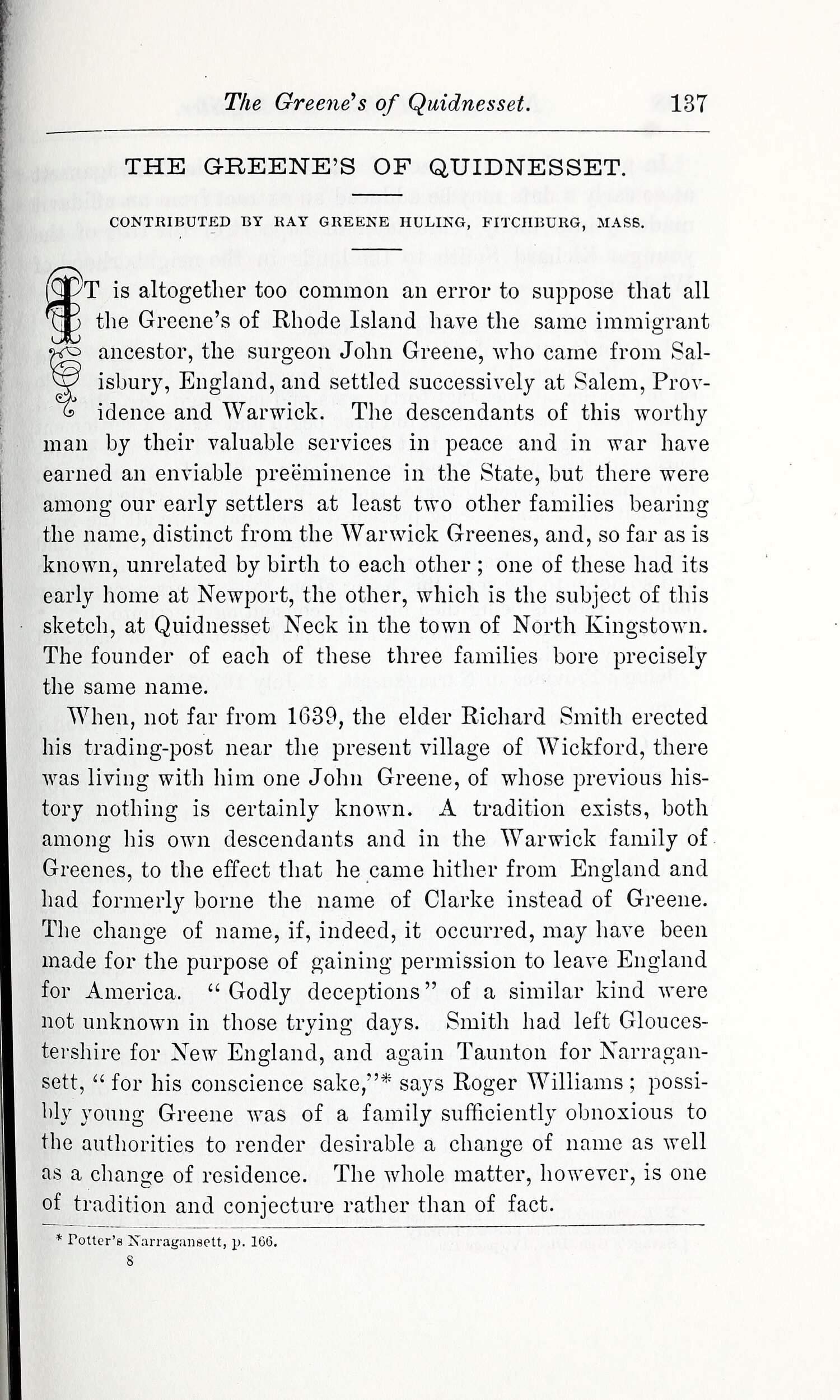
What is not known is where he came from. His English origin and parentage have never been proven, and the two foundational studies of this family both say so. Ray Greene Huling’s original account (Narragansett Historical Register, 1884) says of him that “nothing is certainly known” of his previous history, gives only a tradition that he came from England, and even records a separate tradition that he first bore the name Clarke, not Greene. George Sears Greene’s The Greenes of Rhode Island (1903) places the Quidnesset Greenes in a section of their own with the caution that “a careful research is still necessary to prove the exact connection,” and FamilySearch still leaves his parents unassigned.
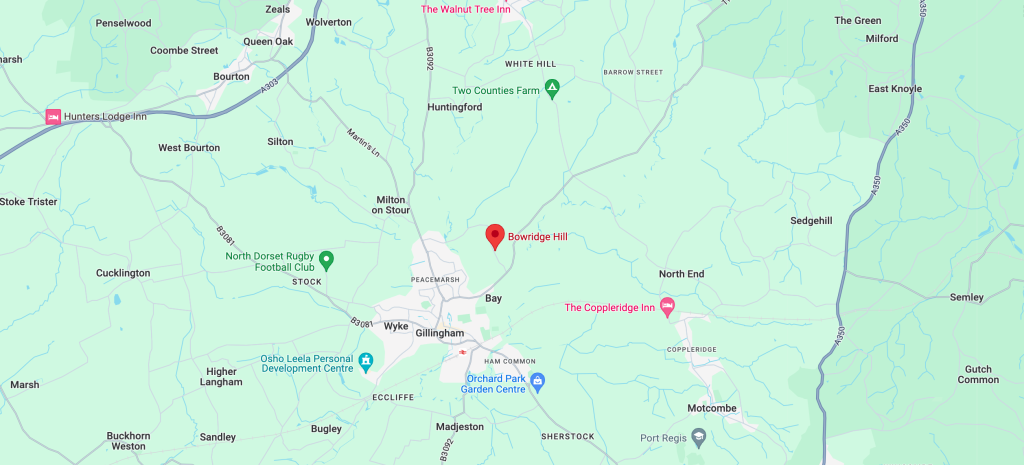
So read what follows in that light. The Bowridge Hill and Gillingham pedigree set out below, which carries the line back through a John Greene of 1529 to a Robert Greene who bought the Bowridge Hill estate in Dorset, is inherited family tradition worth preserving, not established fact. That material comes from the genealogy of the Warwick Greenes, the line of John Greene the surgeon; whether our Quidnessett founder truly joins it in England is the very point no record has settled. The fuller sourcing note, with the 1884 page shown, appears further down this page.
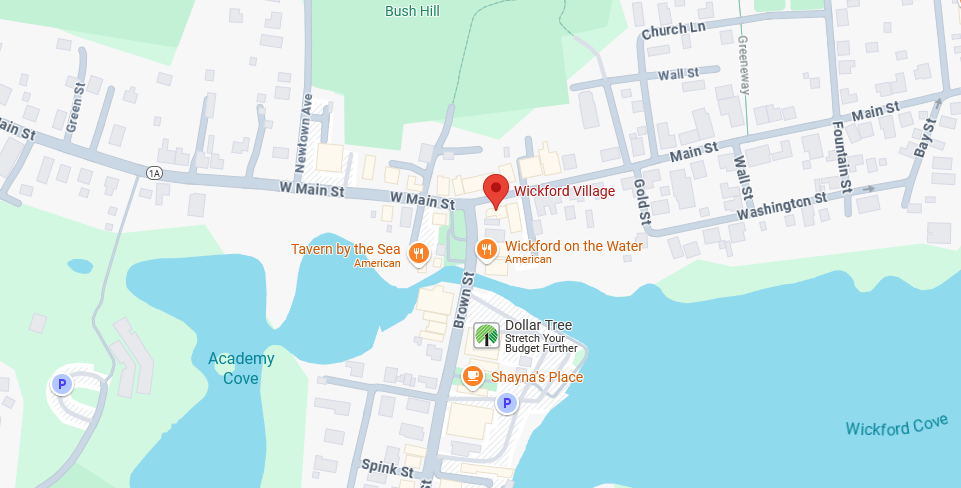
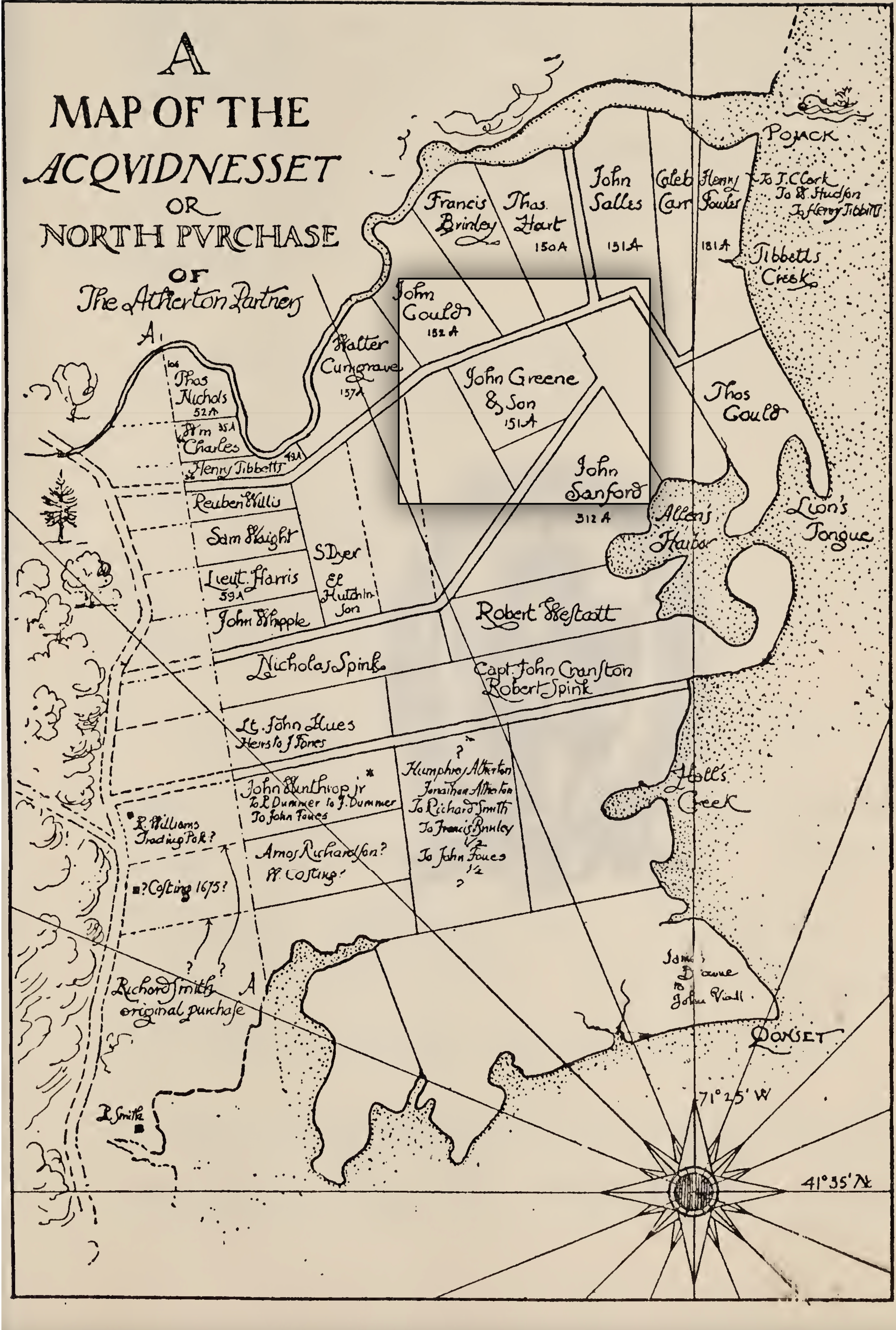
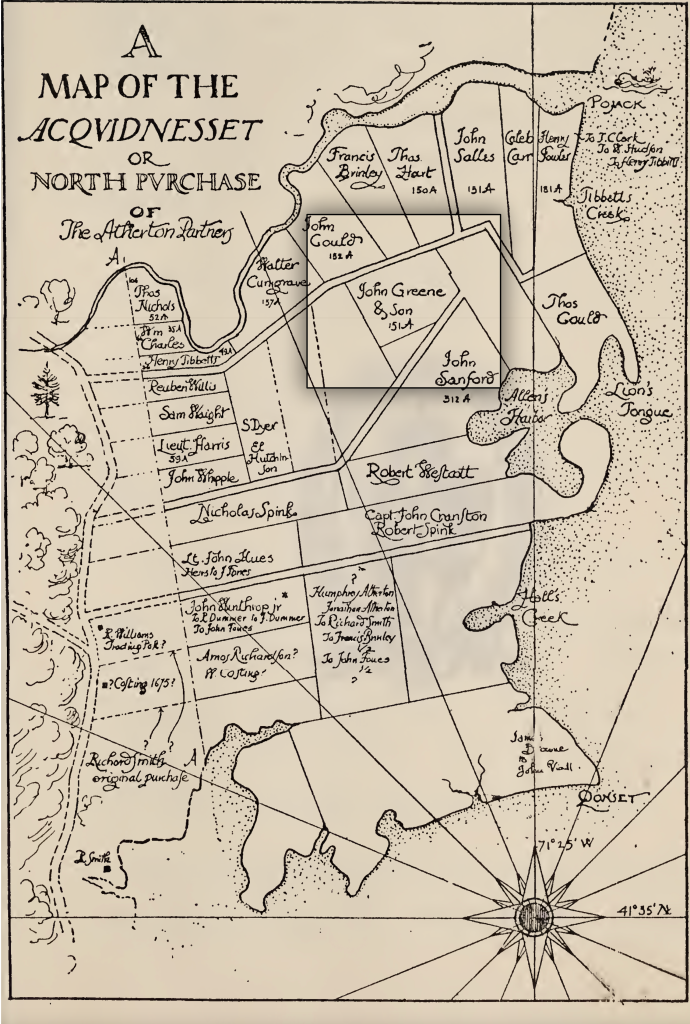
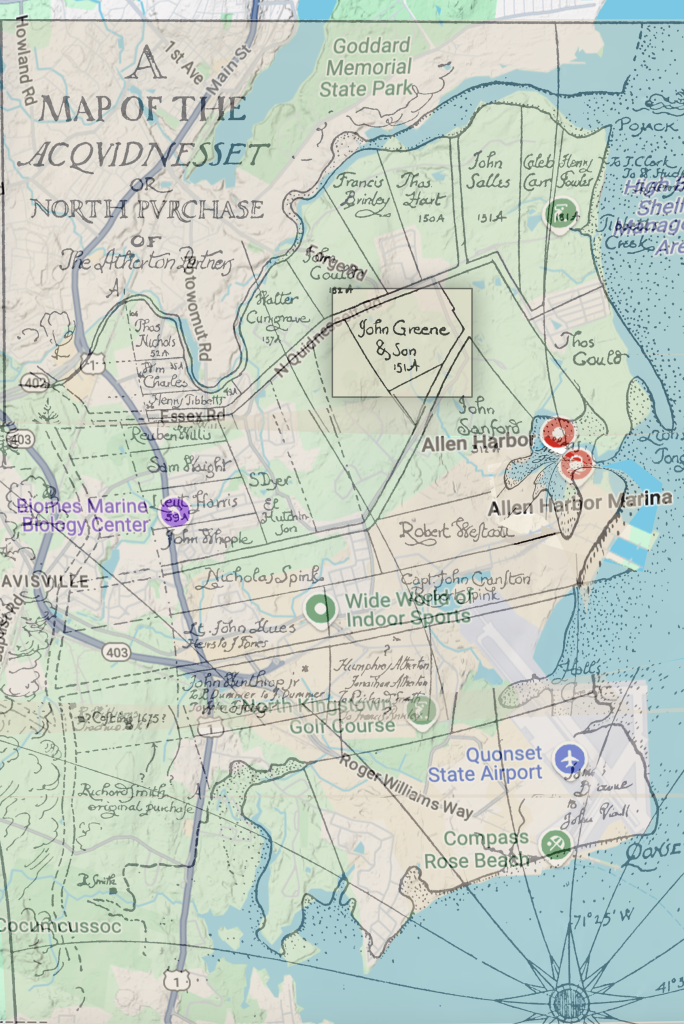
RESEARCHER’S NOTE: John Greene, born 1606 in England, immigrated to New England in 1635. By approximately 1639, he settled in the Quidnessett area of North Kingstown, Rhode Island. Historical records indicate that he lived in the vicinity of Richard Smith’s trading post near present-day Wickford Village. This area is situated along the western shore of Narragansett Bay. While exact property boundaries from that era are not well-documented, it’s likely that John Greene’s homestead was located near this early settlement. [Please take a deeper dive by reading “John Greene and Richard Smith: Their Roles in the Narragansett Land Disputes” linked here]
Distinguishing the Many Johns and James
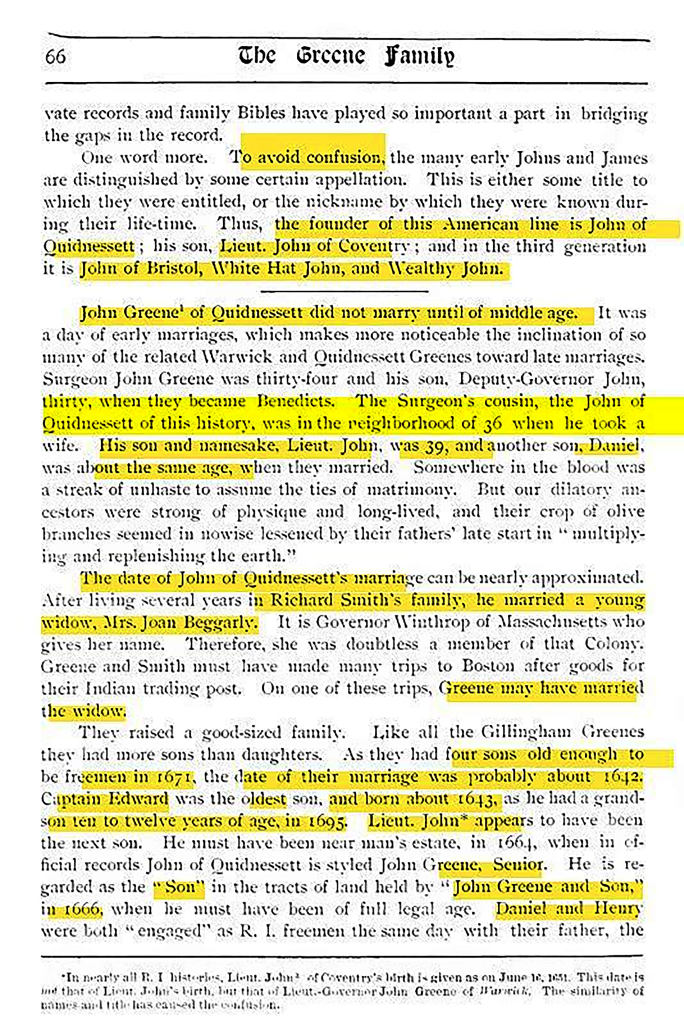
To avoid confusion, the many early Johns and James in the Greene family are distinguished by specific titles or nicknames. The founder of this American line is known as John of Quidnessett. His son is Lieut. John of Coventry, and in the third generation, we have John of Bristol, White Hat John, and Wealthy John.
John Greene of Quidnessett did not marry until middle age. Unlike the norm of early marriages, the related Warwick and Quidnessett Greenes were inclined toward late marriages. Surgeon John Greene was thirty-four and his son, Deputy-Governor John, thirty, when they married. John of Quidnessett was around 36 when he took a wife. His son and namesake, Lieut. John, was 39, and another son, Daniel, was about the same age when they married. Despite their late start, they were strong and long-lived, and their families flourished.
John of Quidnessett married a woman named Joan after living several years in Richard Smith’s family. [Read More About John and Joan HERE] They had a large family, with more sons than daughters. Their marriage date is estimated to be around 1642. Captain Edward, the oldest son, was born around 1643. Lieut. John was likely near adulthood in 1664, and Daniel and Henry were both engaged as R.I. freemen the same day with their father. (Corrected 23 September 2026: this paragraph formerly named her “Mrs. Joan Beggarly, a young widow.” Providence town records show that Mrs. Beggarly, Alice Daniell, was the second wife of John Greene the surgeon, not of John of Quidnessett (Early Records of the Town of Providence, XVII, 9; I, 105). Joan is named in his deeds of March 1681/2; her maiden name is not known. See Joan, wife of John Greene of Quidnessett: the Narragansett record.)
RESEARCHER’S NOTE: In the 1660s, being “engaged as R.I. freemen” in Rhode Island referred to individuals granted the legal status of freemen within the colony. Freemen were entitled to participate in political and civic life, including voting in elections, holding public office, and attending town meetings or legislative assemblies. This status typically required property ownership and an oath of allegiance to the colony, pledging to uphold its laws and contribute to its welfare. Unlike other colonies, Rhode Island’s emphasis on religious tolerance, as outlined in its 1663 Royal Charter, meant that church membership was less critical for achieving freeman status. Freemen enjoyed various legal and economic benefits, such as owning property, engaging in trade, and having full protection under the law. They were also expected to fulfill certain obligations, including serving in the militia, paying taxes, and participating in public works or justice administration. In Rhode Island’s democratic and religiously tolerant framework, freemen played a crucial role in shaping the colony’s governance, embodying the progressive ideals of its time.
The Oath of Allegiance (1606 version, adapted for colonial emigrants and mariners):
“I, [name], do truly and sincerely acknowledge, profess, testify, and declare in my conscience before God and the world, that our Sovereign Lord King [name of reigning monarch] is lawful and rightful King of this realm and of all other His Majesty’s dominions and countries; and that the Pope, neither of himself nor by any authority of the Church or See of Rome, or by any other means with any other, hath any power or authority to depose the King or to dispose of any of His Majesty’s kingdoms or dominions, or to authorize any foreign prince to invade or annoy him or his countries, or to discharge any of his subjects of their allegiance and obedience to His Majesty, or to give license or leave to any of them to bear arms, raise tumult, or to offer any violence or hurt to His Majesty’s royal person, state, or government, or to any of His Majesty’s subjects within His Majesty’s dominions.”
The Oath of Supremacy:
This oath accompanied the Oath of Allegiance and focused specifically on adherence to the Church of England:
“I, [name], do declare that the King’s Majesty is the only Supreme Governor of this Realm, and of all other His Highness’s Dominions and Countries, as well in all Spiritual or Ecclesiastical things or causes, as Temporal; and that no foreign prince, person, prelate, state, or potentate hath or ought to have any jurisdiction, power, superiority, preeminence, or authority ecclesiastical or spiritual within this realm.”
These oaths were required for anyone emigrating or embarking on voyages under English rule to ensure their loyalty to both the Crown and the Protestant faith.
Greene Family Lineage
The Greenes were a prominent family in England and America. Richard Greene left a son Richard and a daughter. Richard and his wife Mary had five sons and four daughters. The fourth son was Surgeon John Greene.
John, son of Robert, died in 1560. He had three sons: Robert of Langham, Jeremy of Gillingham, and Henry, who lived some distance from the old home. Henry “died suddenly” on August 22, 1578. Henry’s son Robert had a son John, born in 1606, who came to the New World in 1635 and is known as John Greene of Quidnessett.
Biography: John Greene (1529-1560)
John Greene (1529-1560) was the great-grandfather of John Greene of Quidnessett, Rhode Island. His name appears in Parish Registers, and he is mentioned in his brother Peter’s will. John Greene had three sons: Robert of Langham, Jeremy of Gillingham, and Henry Greene.
Family Lineage
Robert Greene, a gentleman, purchased the estate of Bowridge Hill in the Parish of Gillingham, Dorsetshire. He appears in the Subsidy Rolls of 1543, 1545, 1547, and 1558. He had two daughters (Alice and Anne) and three sons:
- Peter – who succeeded to the estate, died in May 1583.
- Richard – who succeeded Peter, made his will in 1606, and died in 1608. He was the grandfather of John Greene of Warwick, Rhode Island.
- John Greene – the great-grandfather of John Greene of Quidnessett.
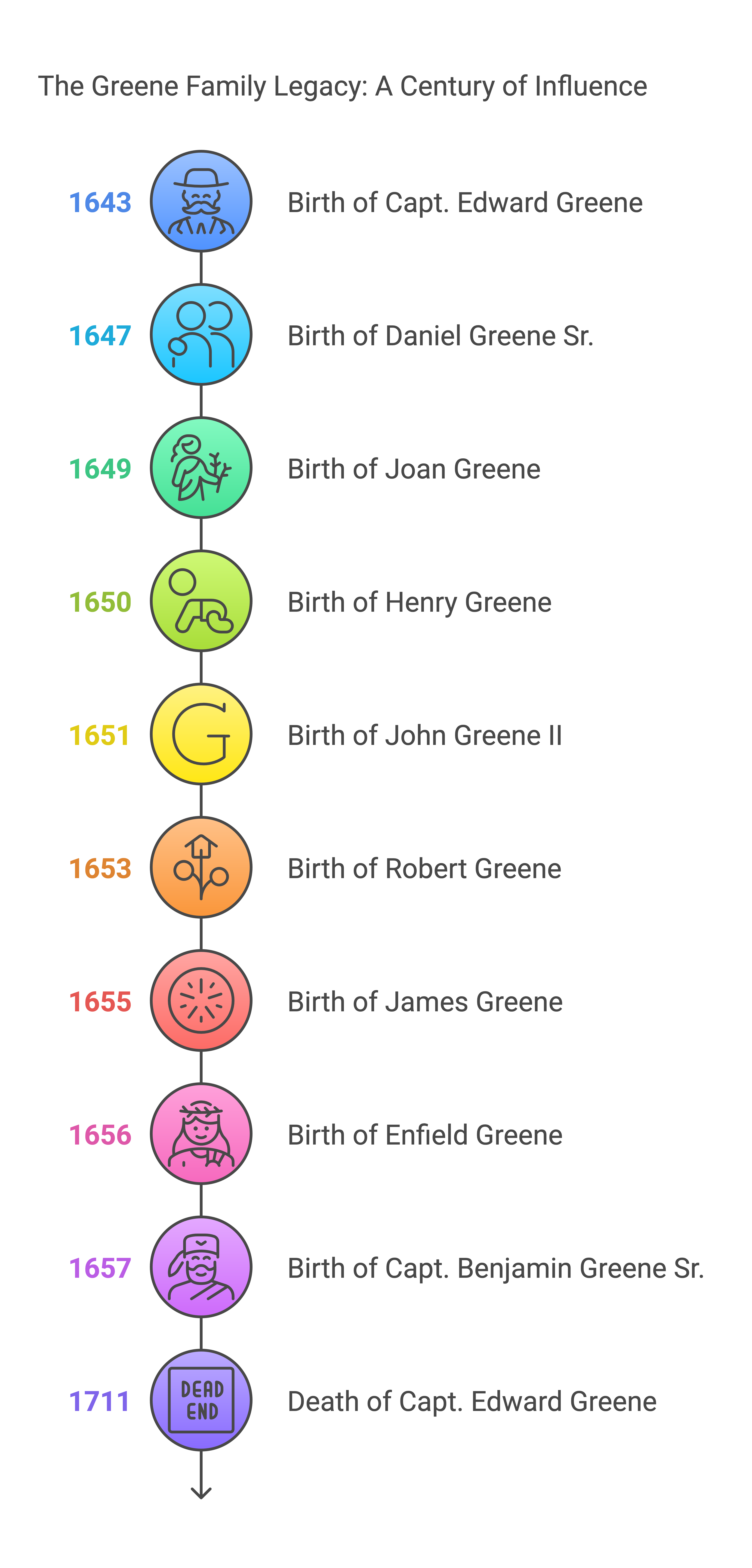
Children of John Greene of Quidnessett (8)
1.Capt. Edward Greene Male, 1643–1711
2.Daniel Greene Sr. Male, 1647–1729
3.Henry Greene Male, 1650–1694
4.John Greene II Male, 1651–1729
Also referred to as Lieutenant John Greene. Married at age 39.
5.Robert Greene Male, 1653–Deceased
6.James Greene Male, 1655–1728
7.Enfield Greene Female, 1656–1698
8.Capt. Benjamin Greene Sr. Male, 1657–1719
Correction, 22 September 2026: a daughter “Joan Greene, 1649–1715” was removed from this list. No record of her was found in Austin, Huling, the Rhode Island Land Evidences, or any other source searched; the standing of the entry is set out on the page Alice Daniell, called Mrs. Beggarly, in the section on the Quidnessett children.
Conanicut, 1657 to 1662: the Jamestown records
Added 25 September 2026. The pages below were photographed in the Jamestown town records by Rosemary Enright for the Jamestown Historical Society and sent on 24 September 2026, in answer to our request for John Greene’s sale of his Conanicut land. Each deed is transcribed in full as far as the photograph shows it; words lost at the edge of the page are in [square brackets].
What these records show. Before he settled for good at Quidnessett, John Greene lived at Newport. In 1657 he was one of the Newport and Portsmouth men who bought Conanicut (now Jamestown) and Dutch Island from the Narragansett sachems, each partner taking one fortieth share (Bates, 1918, pp. 73–74). He signed the purchasers’ agreement in his own hand. Five years later, as “John Greene of Newport,” he sold the whole share: one half to John Sanford of Portsmouth and the other half to Caleb Carr of Newport. The Carr half was bounded on the north by Joseph Clarke. In 1685, when Clarke sold his own land, the deed described Carr’s land as “formerly in possession of John Greene, sr., of Narragansett, now deceased.” That link is how Louise Prosser Bates proved that John Greene of Newport and John Greene of Quidnessett were one man (Bates, 1918, p. 74).
His wife is not named. We asked for these deeds because a seller’s wife often signed away her rights, and John’s wife Joan is named in only one surviving record. She does not appear in either sale, and the Historical Society reports that it “could find no record of the name of John Green’s wife” in the town records (R. Enright, personal communication, September 24, 2026). The search for her is recorded on Joan, wife of John Greene of Quidnessett.
1. The Conanicut purchase agreement, 1657: John Greene’s own signature. The agreement was “Ratifyed by us whose Names are herto Subscribed the 12 day of […] 1657.” The text of the agreement itself is not in the scans we were sent; the three sheets below are its signatures. John Greene signed first on the second sheet, in his own hand, as one word. The third sheet carries a separate signature, “John Greene Jur of Warwick,” the son of John Greene the surgeon; he is a different man.
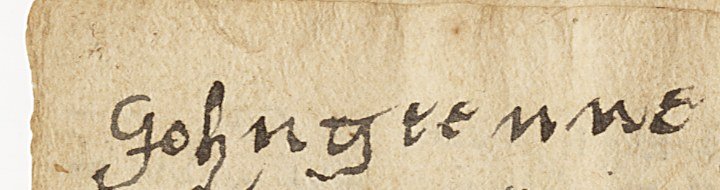
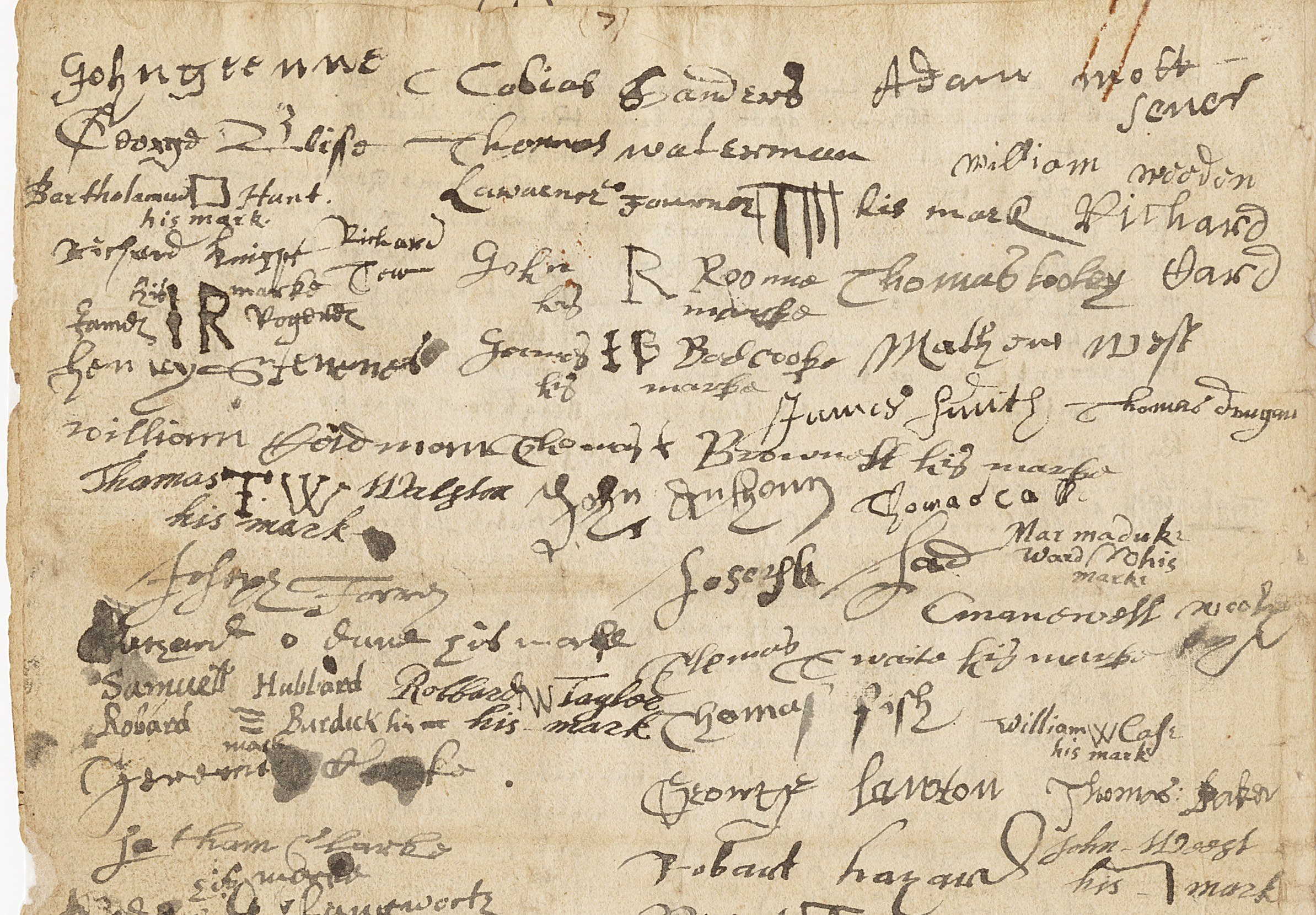
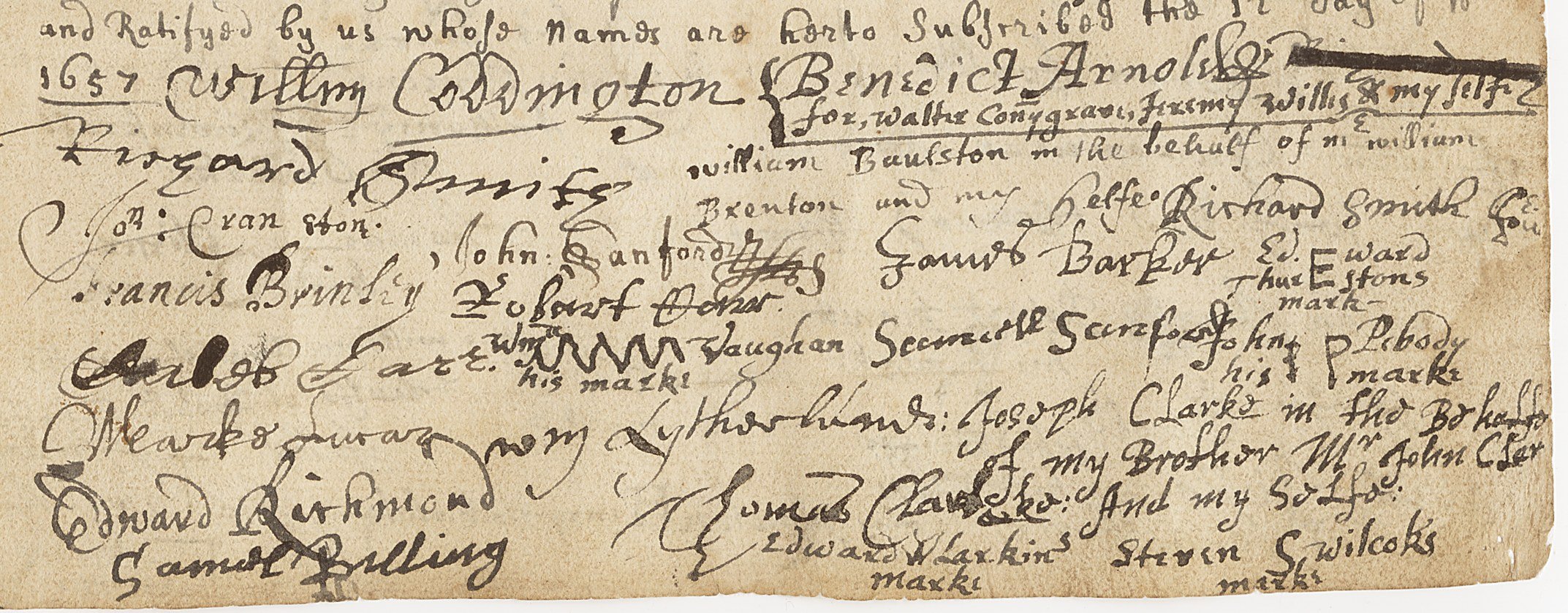
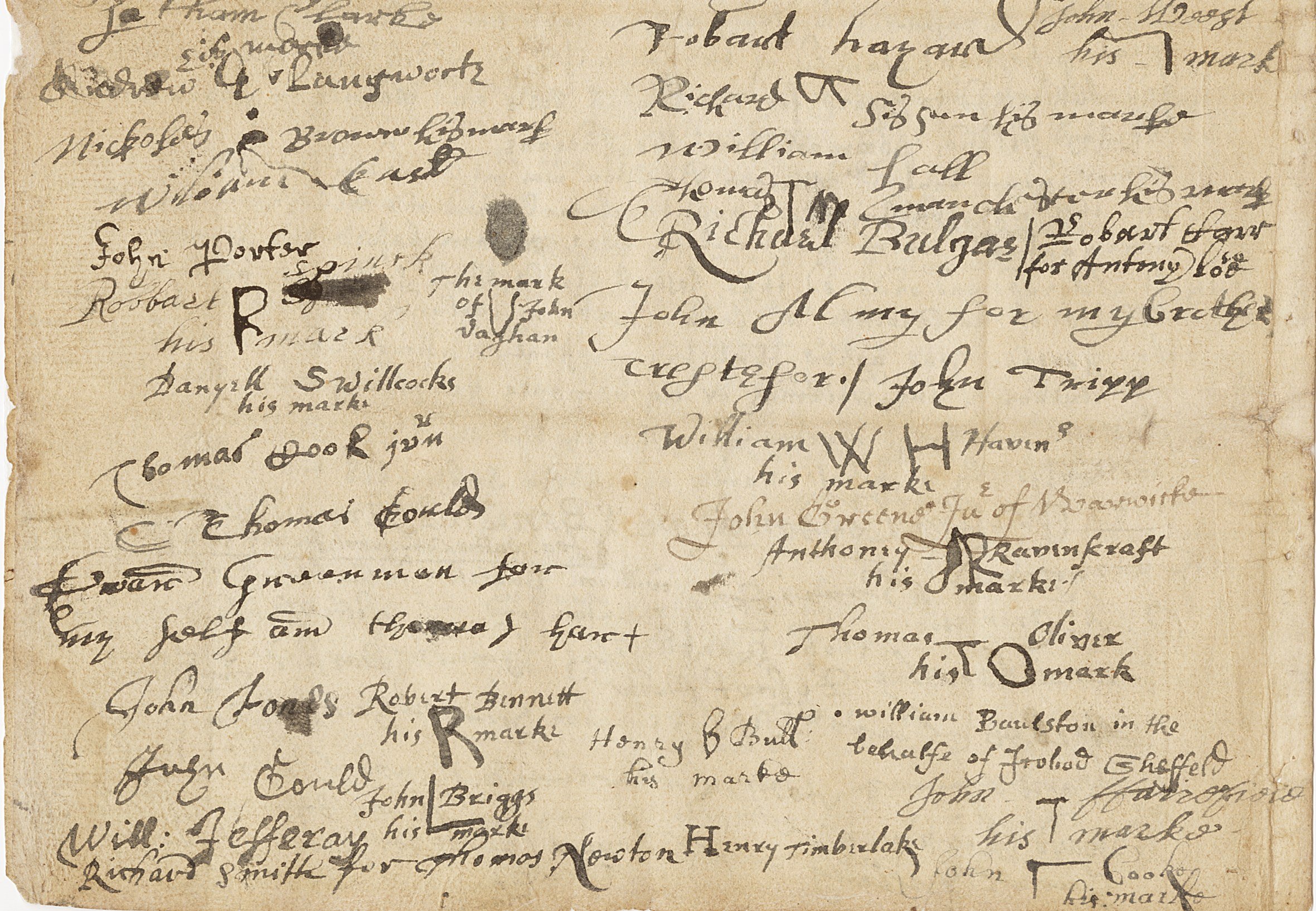
Source: Conanicut purchase agreement, signatures, ratified 12 [month illegible] 1657. Original manuscript, Jamestown Historical Society, Jamestown, Rhode Island; scanned 2008, sent by R. Enright, September 24, 2026.
The signatures, transcribed. Read name by name from the three scans on 25 September 2026 and written as they stand on the sheets, in the signers’ own spelling. A mark is shown in [square brackets]; [?] marks a doubtful reading; a vertical bar separates one signature from the next. Sheets 2 and 3 are the top and bottom of the same page and overlap; names in the overlap (Robert Hazard, John West, Latham Clarke) are given once. The order follows the sheets from top left, as closely as the crowded page allows.
Sheet 1: and Ratifyed by us whose Names are herto Subscribed the 12 day of […] 1657 | Willm Coddington | Benedict Arnold [a word struck through] for, walter Conygrave, Jeremy willis & my selfe | Richard Smith | william Baulston in the behalfe of mr william Brenton and my selfe | Richard Smith Ju[nr] | Joh: Cranston | John: Sanford [a word struck through] | James Barker | Edward [E] Thurstons marke | Francis Brinley | Robart Carr | Caleb Carr | Wm [mark] Vaughan his marke | Samuell Sanford | John [P] Pebody his marke | Marke Lucar[?] | Wm Lytherland | Joseph Clarke in the Behalfe of my Brother Mr John Clar[ke] And my Selfe | Edward Richmond | Samuell Billing | Thomas Clarke | Edward [mark] Larkins marke | Steven [S] wilcoks marke
Sheet 2: Johngreenne | Tobias Sanders | Adam mott Senior | George Blisse | Thomas waterman | william weedin | Bartholmew [□] Hunt his mark | Lawrence Turnor[?] [IIII] his mark | Richard Card | Richard knight | Richard Tew | John [R] Roome his marke | Thomas Tooley | James [IR] Rogers his marke | Henry Steuens | James [IB] Badcocke his marke | Mathew West | James Smith | Thomas Dungan[?] | william Codmon[?] | Thomas [+] Brownell his marke | Thomas [TW] Walston his mark | John Anthony | Thomas Ca[st?] | Jos[?] Torry | Joseph Lad | Marmaduke Ward [mark] his marke | Emanowell Wool[?] | Richard [o] Dune his marke | Thomas [T] waite his marke | Samuell Hubbard | Robbard [W] Taylor his mark | Robard [≡] Burdick his marke | Jeremiah Clarke | Thomas Fish | William [W] Case his mark | George Lawton | Thomas Baker | Robart hazard | John [T] Weest his mark | Latham Clarke
Sheet 3: his marke Andrew [A] Langworth | Nicholas [mark] Brown his marke | William Earle | Richard [mark] Sisson his marke | william hall | Thomas [TM] Manchester his marke | Richard Bulgar | Robart Carr for Antony Lo[w] | John Porter | Robbart [R] Spinck his marke | the mark of [V] John Vaghan | Danyell [S] Willcocks his marke | John Almy for my brother Crestefer | John Tripp | Thomas Cook junr | William [WH] Havens his marke | Thomas Gould | John Greene Jur of Warwicke | Anthony [AR] Rawinskraft his marke | Edward Greenman for my self and thomas hart | Thomas [TO] Oliver his mark | John Fones | Robert [R] Bennitt his marke | Henry [B] Bull his marke | william Baulston in the behalfe of Ichabod Sheffeld | John Gould | John [L] Briggs his marke | John [T] ffairfeild his marke | Will: Jefferay | Richard Smith for Thomas Newton | Henry timberlake | John [T] Cooke his marke
2. The sale of one half to John Sanford of Portsmouth, 24 January 1661. The date is written “one thousand six hundred sixty one.” Under the calendar then in use the year began on 25 March, and the clerk’s own recording notes on these pages are double-dated (“1661 (62)”), so in modern reckoning this is probably January 1662. It is a clerk’s copy in the town book; the name “John Greene” under it is in the clerk’s hand, with a drawn seal.
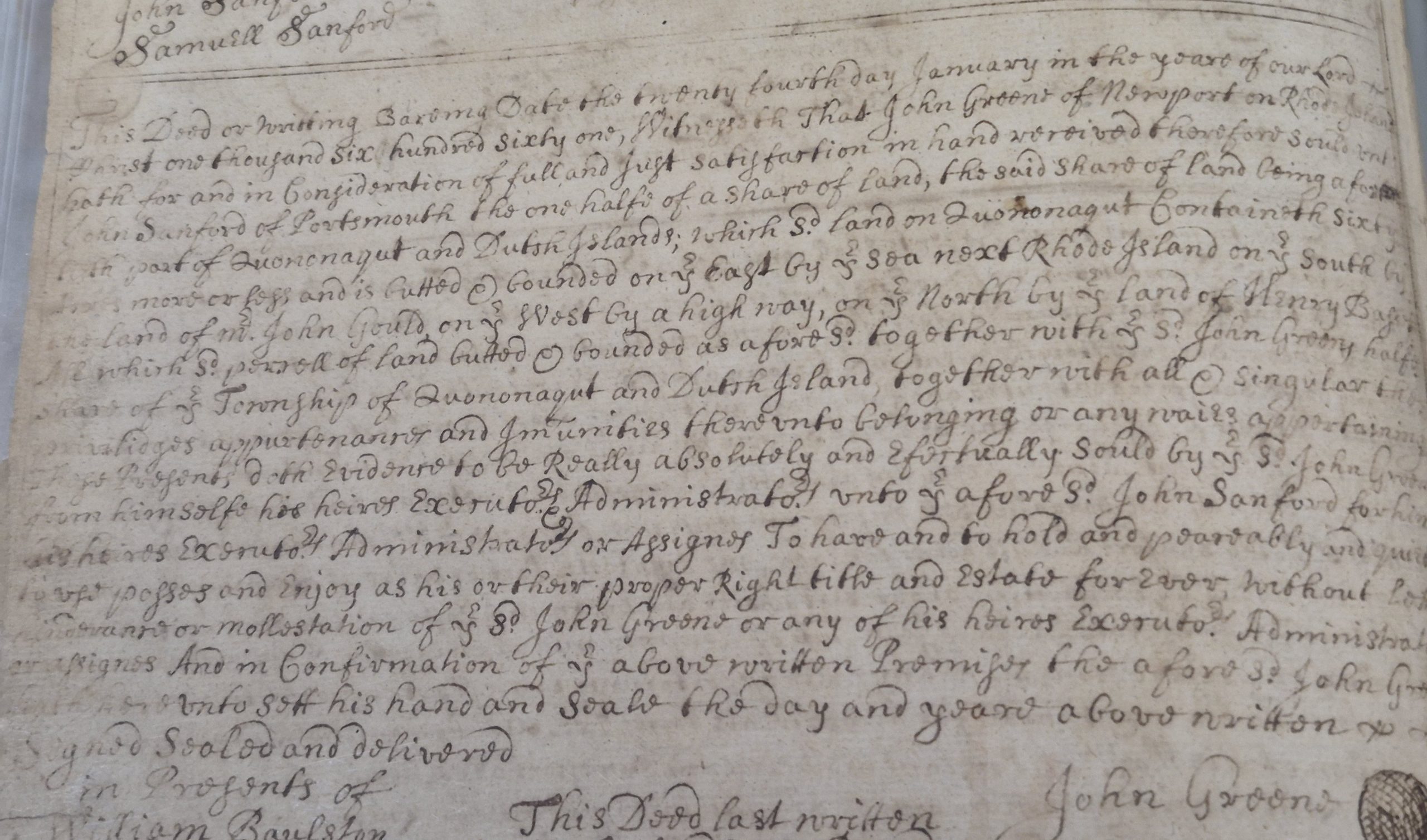
This Deed or writing Bearing Date the twenty fourth day January in the yeare of our Lord [Je]sus Christ one thousand six hundred sixty one, Witnesseth That John Greene of Newport on Rhode Island hath for and in Consideration of full and just satisfaction in hand received therefore sould unt[o] John Sanford of Portsmouth the one halfe of a share of land, the said share of land being a fort[ie]th part of Quononaqut and Dutch Islands; which sd land on Quononaqut Containeth Sixty [acres] more or less and is butted & bounded on ye East by ye sea next Rhode Island on ye South by [the] land of Mr John Gould, on ye West by a high way, on ye North by ye land of Henry Ba[ssett]. All which sd parcell of land butted & bounded as aforesd together with ye sd John Greene’s half share of ye Township of Quononaqut and Dutch Island, together with all & Singular the [pri]viledges appurtenances and Immunities thereunto belonging or any waies appertaining [the]se Presents doth Evidence to be Really absolutely and Effectually sould by ye sd John Gre[ene] from himselfe his heires Executors & Administrators unto ye aforesd John Sanford for him[selfe and h]is heires Executors Administrators or Assignes To have and to hold and peaceably and quie[tly] to use possess and Enjoy as his or their proper Right title and Estate for Ever, without Lett [hi]nderance or mollestation of ye sd John Greene or any of his heires Executors Administrat[ors or] Assignes And in Confirmation of ye above written Premises the aforesd John Gre[ene hath here]unto sett his hand and Seale the day and yeare above written.
Signed Sealed and delivered in Presents of William Baulston […]. John Greene [seal]
This Deed last written [was entered upon record …; the rest of the note is below the edge of the photograph].
Source: John Greene of Newport to John Sanford of Portsmouth, deed, 24 January 1661 [1661/2]. Jamestown, Rhode Island, Town Records, Book 1, p. 22, Jamestown Town Clerk’s office. Photograph by R. Enright for the Jamestown Historical Society, September 24, 2026.
3. The sale of the other half to Caleb Carr of Newport. This is the deed Bates used: the land is bounded north by Joseph Clarke, and it is the other half of the same share, bounded south by Henry Bassett just as the Sanford half is bounded north by him. The entry begins at the foot of page 31, below an unrelated deed of 13 July 1661 from Jeremiah Willis to Caleb Carr, and runs over the page.
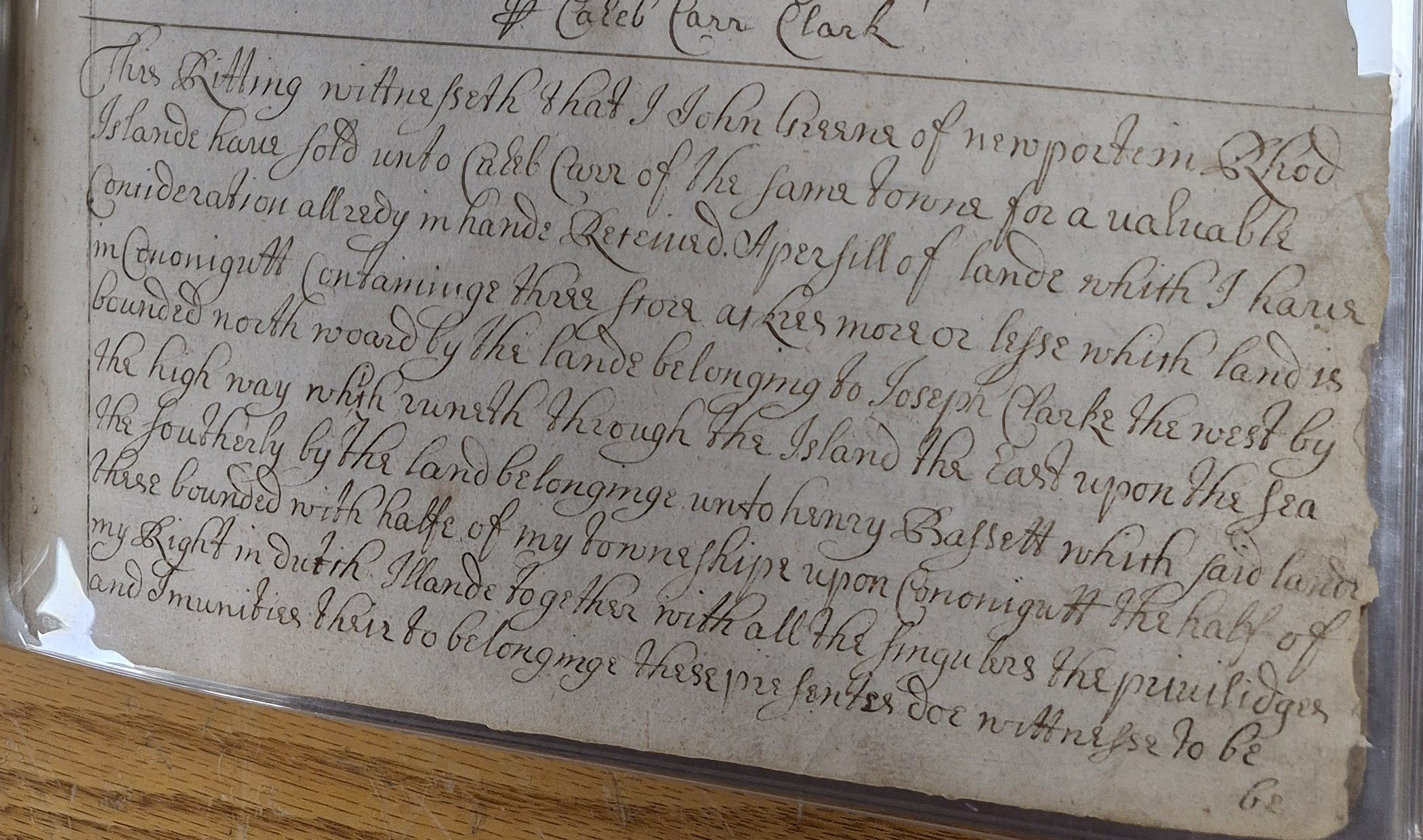
This Ritting witnesseth that I John Greene of newporte in Rhod Islande have sold unto Caleb Carr of the same towne for a valuable Consideration allredy in hande Receiued A persill of lande which I have in Cononigutt Containinge three score akers more or lesse which land is bounded north woard by the lande belonging to Joseph Clarke the west by the high way which runeth through the Island the East upon the sea the Southerly by the land belonginge unto henry Bassett which said lande [is] there bounded with halfe of my towneshipe upon Cononigutt the half of my Right in dutch Illande together with all the singulers the priuilidges and Imunities their to belonginge these presentes doe wittnesse to be
[The deed continues on page 32, which was not photographed. Its date, signature and witnesses are therefore not shown here.]
Source: John Greene of Newport to Caleb Carr of Newport, deed, undated in the portion photographed [c. 1661/2]. Jamestown, Rhode Island, Town Records, Book 1, pp. 31–32, Jamestown Town Clerk’s office. Photograph of p. 31 by R. Enright for the Jamestown Historical Society, September 24, 2026.
Two other pages in the same set are not this John Greene. Book 1, page 24, is a deed of 10 November 1665 in which “John Greene Inhabitant of the T[owne] of Warwick” sells to Peleg Sanford “all my Right title & Interest to the lands in Quononaqut & Dutch Island, as I am a Purchaser.” That is the Warwick John Greene, who signed the agreement separately; our John had already sold his whole share. Book 1, page 112, is a deed of 30 April 1700 from Peter Greene of Cowesett in Warwick to Caleb Carr, for land “given to mee by my father James Greene,” of the Warwick family of John Greene the surgeon. Both are kept with the research papers and are not shown here.
References for this section.
Bates, L. P. (1918). John Greene of Newport and Narragansett. Rhode Island Historical Society Collections, 11(3), 69–78. https://archive.org/details/rhodeislandhisto11prov
Jamestown, Rhode Island. (1657). Conanicut purchase agreement, signatures [Manuscript, scanned 2008]. Jamestown Historical Society, Jamestown, RI.
Jamestown, Rhode Island. (1661–1662). John Greene of Newport to John Sanford of Portsmouth, deed, 24 January 1661 [1661/2]. Town records (Book 1, p. 22). Photograph by R. Enright for the Jamestown Historical Society, September 24, 2026.
Jamestown, Rhode Island. (c. 1661–1662). John Greene of Newport to Caleb Carr of Newport, deed. Town records (Book 1, pp. 31–32). Photograph by R. Enright for the Jamestown Historical Society, September 24, 2026.
The arrest of 1664
Added 22 September 2026. Every statement below is drawn from the pages shown in the two document rows, each transcribed in full where it concerns John Greene; citations in the text point to the reference list at the end of this section.
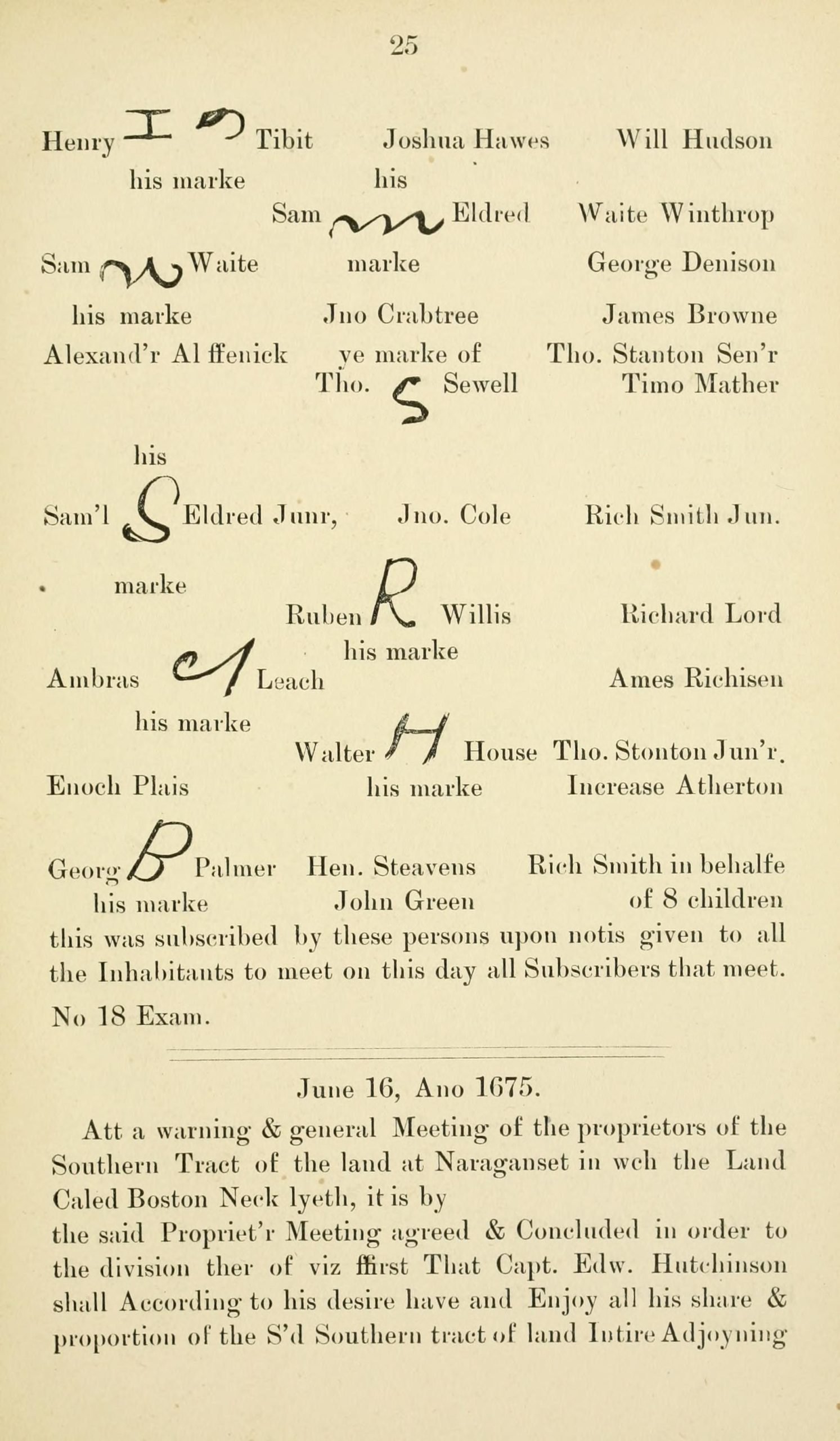
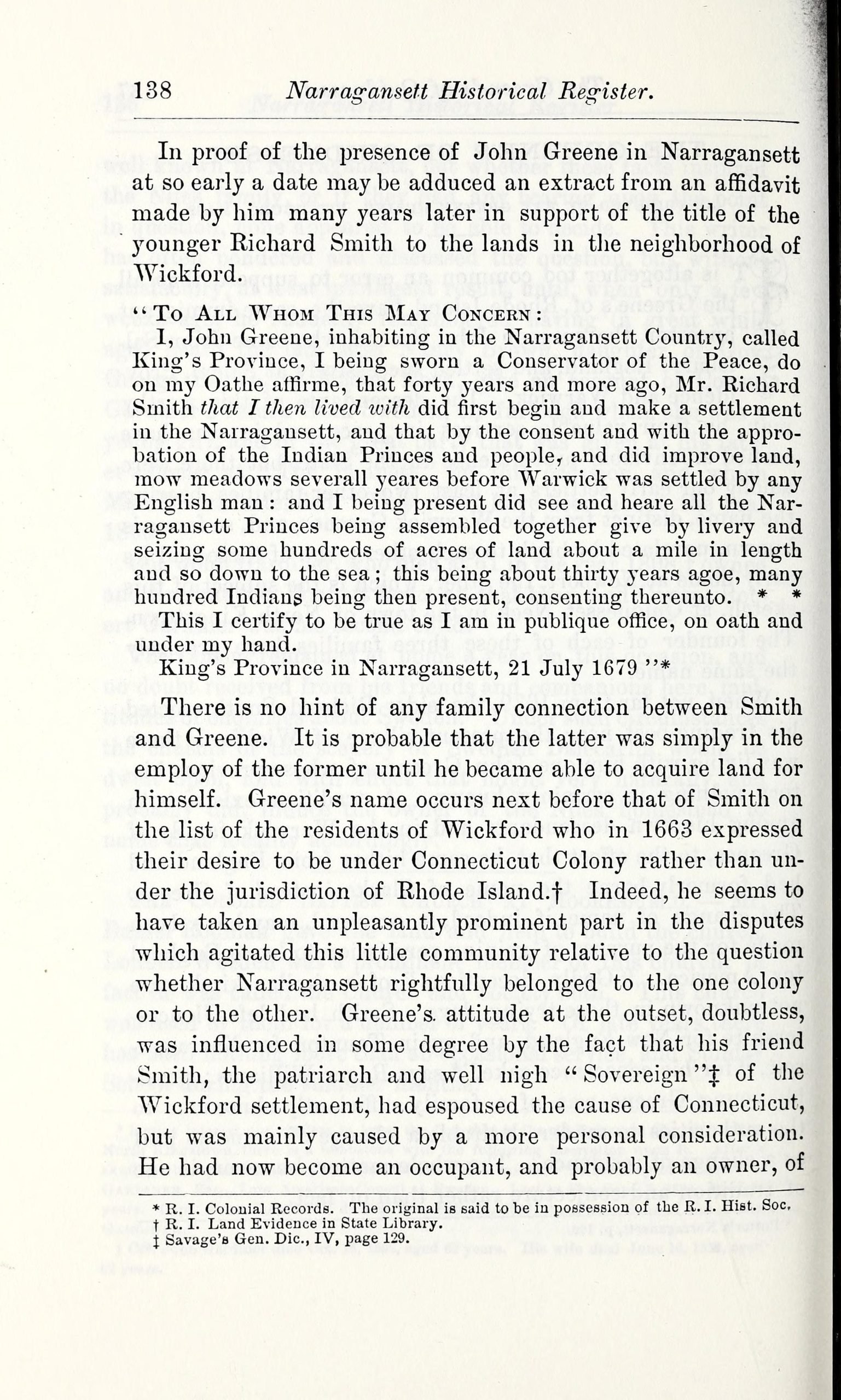
Why it happened. The Narragansett territory was caught in a tug-of-war between two rival colonies. Rhode Island held the country under its royal charter, its “gratyous letters pattent,” and called the Boston men settling there “intruders” (Bartlett, 1857, pp. 29–30). The Wickford men, for their part, subscribed “according to his Majesties grente” to be under Connecticut (Arnold, 1894, pp. 24–25). Backing Connecticut were the Atherton partners, Boston investors such as Edward Hutchinson, William Hudson, and Amos Richardson, who had bought the land from the Narragansett sachems in 1659 (Bartlett, 1857, p. 30; Huling, 1883, p. 139). Rhode Island rejected those purchases under its order of November 1651 that all purchases from the Indians without the colony’s consent were void (Huling, 1883, p. 139). As Huling points out, John Greene’s homestead at Quidnessett sat on land held under the Atherton title. If Rhode Island won the dispute, Greene’s title was worthless; if Connecticut won, he kept his property. So on July 3, 1663, Greene joined the other Wickford men in subscribing to be under Connecticut, taking what Huling calls “an unpleasantly prominent part” in the conflict (Arnold, 1894, pp. 24–25; Huling, 1883, pp. 138–139).
Rhode Island’s response. At its session of March 1664 the Rhode Island General Assembly fought back. It ordered that the “intruders” at Narragansett, naming Hutchinson, Hudson, and Richardson and “any other with them, joyning and to them adhearing,” be summoned to the May Assembly, and it declared that warrants from the Governor or Deputy Governor “shall be suficient” to summon or to apprehend (Bartlett, 1857, pp. 29–30). The Court of Trials that March had already bound over four Narragansett men, Richard Smith Jr., Thomas Gould, John Wood, and John Hickes (Bartlett, 1857, p. 45).
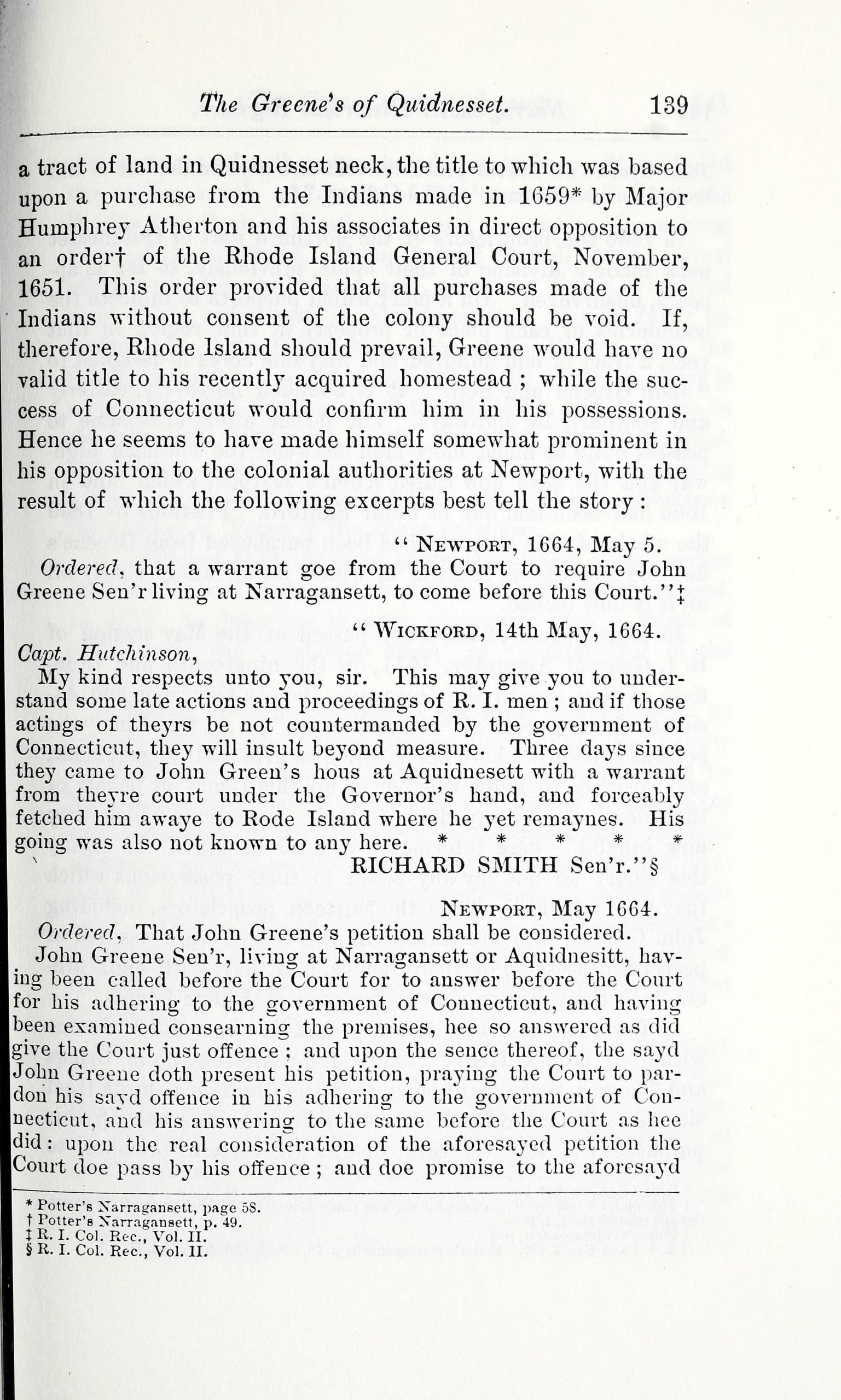
The warrant. On May 4, 1664, at Newport, the Assembly took two very different approaches in the same breath. It sent a polite letter to Richard Smith Sr., the patriarch of Wickford, inviting him to come over with the messenger Robert Carr and explain himself. John Greene got no letter. The order simply reads: “a warrant goe from the Court to require John Greene, Sen’r, living at Narragansitt, to come before this Court” (Bartlett, 1857, pp. 45–47).
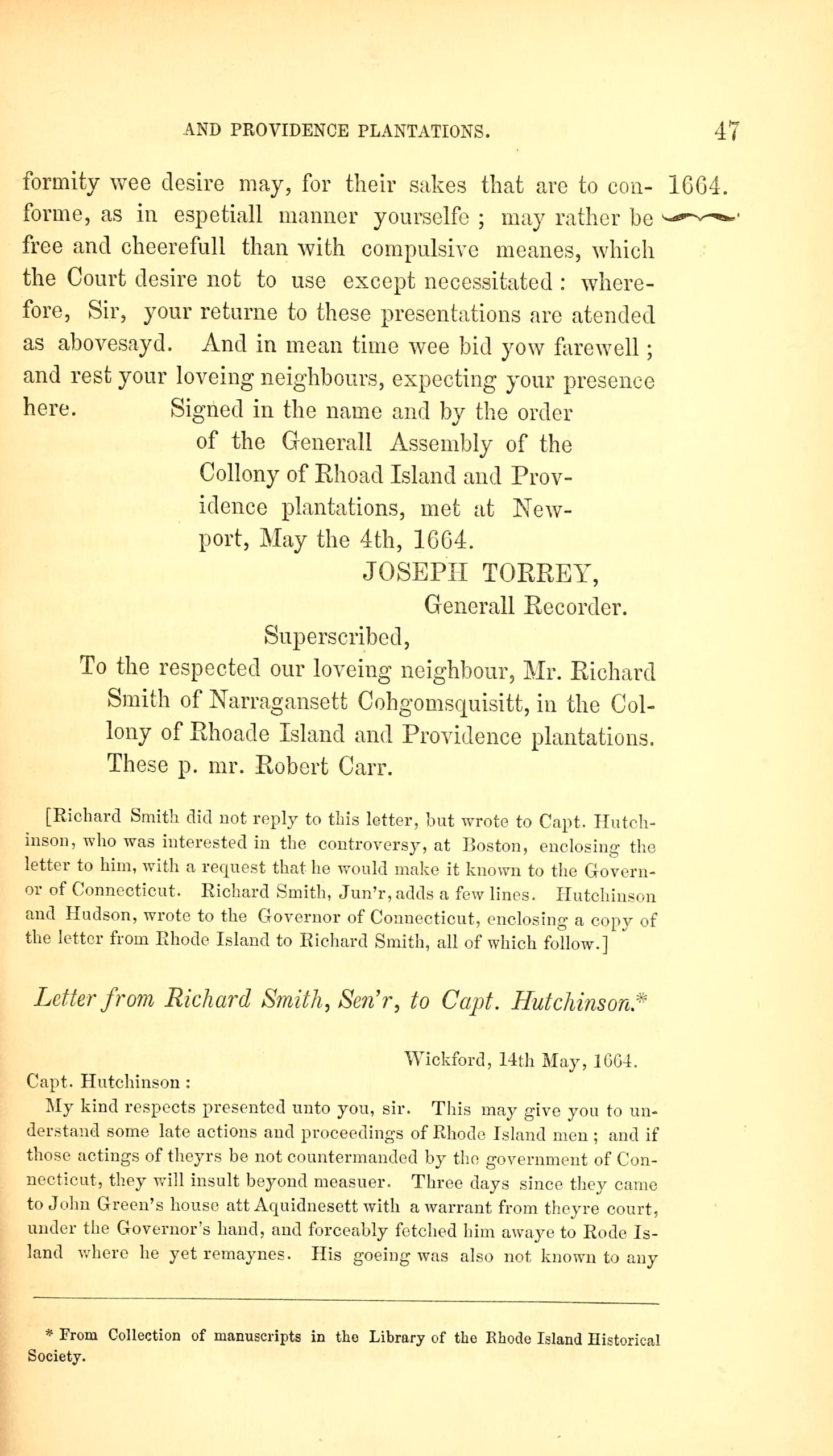
The seizure. Richard Smith described what happened next in a letter to Captain Hutchinson on May 14 (Bartlett, 1857, pp. 47–48):
Three days since they came to John Green’s house att Aquidnesett with a warrant from theyre court, under the Governor’s hand, and forceably fetched him awaye to Rode Island where he yet remaynes. His goeing was also not known to any here.
Around May 11, the warrant party, acting under the hand of Governor Benedict Arnold, took Greene from his own house and carried him across the bay to Newport before his neighbors knew he was gone. Smith urged Hutchinson to alert Connecticut, warning that Rhode Island meant “by force and violence” to fetch others. On May 20 Hutchinson and Hudson forwarded the whole file to Governor John Winthrop of Connecticut, asking how they should respond (Bartlett, 1857, pp. 47–49).
Before the Court. According to the Assembly’s own minutes, when Greene was examined about “his adhearing to the goverment of Connecticut,” his answers “did give the Court just offence.” Greene then submitted a petition asking pardon for his loyalty to Connecticut and for the way he had answered the Court. The Court agreed to drop the matter, promising him “all lawfull protextion” and declaring that “hee is still loocked on as a freeman of the Collony” (Bartlett, 1857, p. 51). No fine and no bond are recorded, unlike Thomas Gould, who was bound to appear again eighteen months later (Bartlett, 1857, p. 48). How long Greene was held at Newport is not recorded; Smith’s letter shows he was still there three days after he was taken (Bartlett, 1857, p. 47).
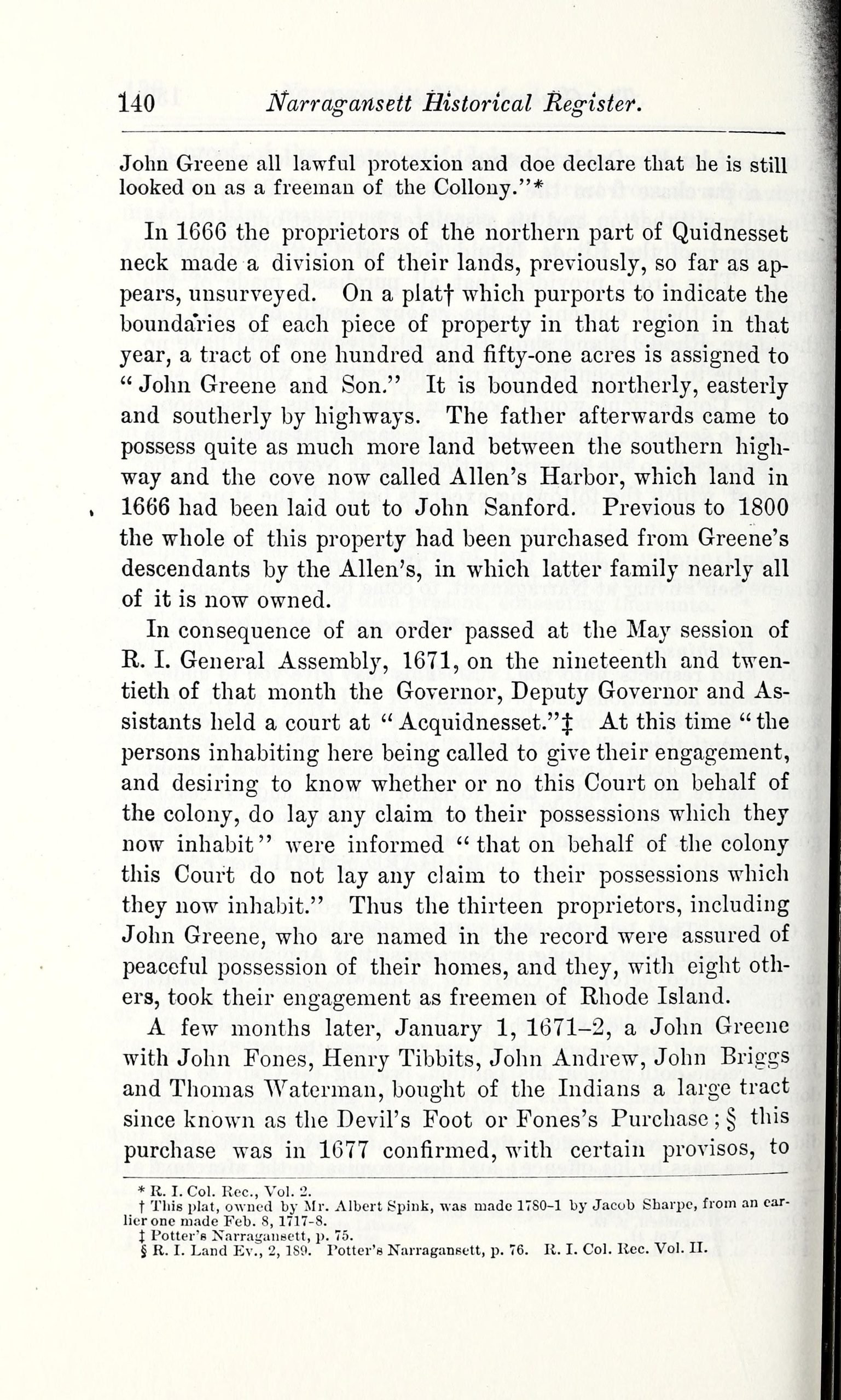
The record calls the place “John Green’s house.” No wife, child, or other member of the household is named (Bartlett, 1857, p. 47). Seven years later, at the court held at Acquidnesset on 19 and 20 May 1671, the thirteen proprietors named in the record, John Greene among them, were assured that the colony laid no claim to their possessions, and they took their engagement as freemen of Rhode Island (Huling, 1883, p. 140).
The wider quarrel, from the Atherton purchase of 1659 to the King’s Province and the court of 1671, with Richard Smith’s part in it, is told on the page John Greene and Richard Smith: Their Roles in the Narragansett Land Disputes.
The record of the arrest.
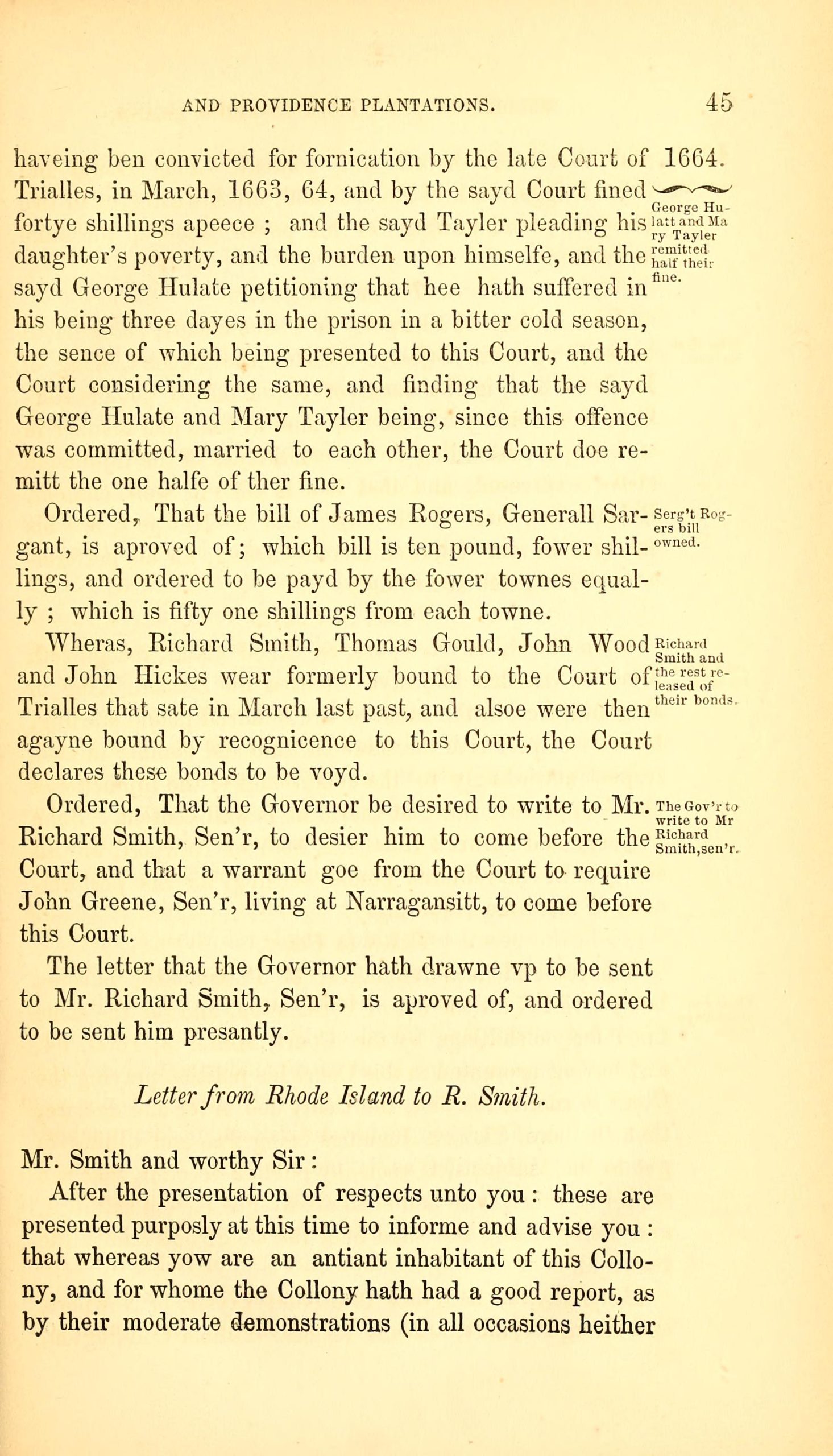
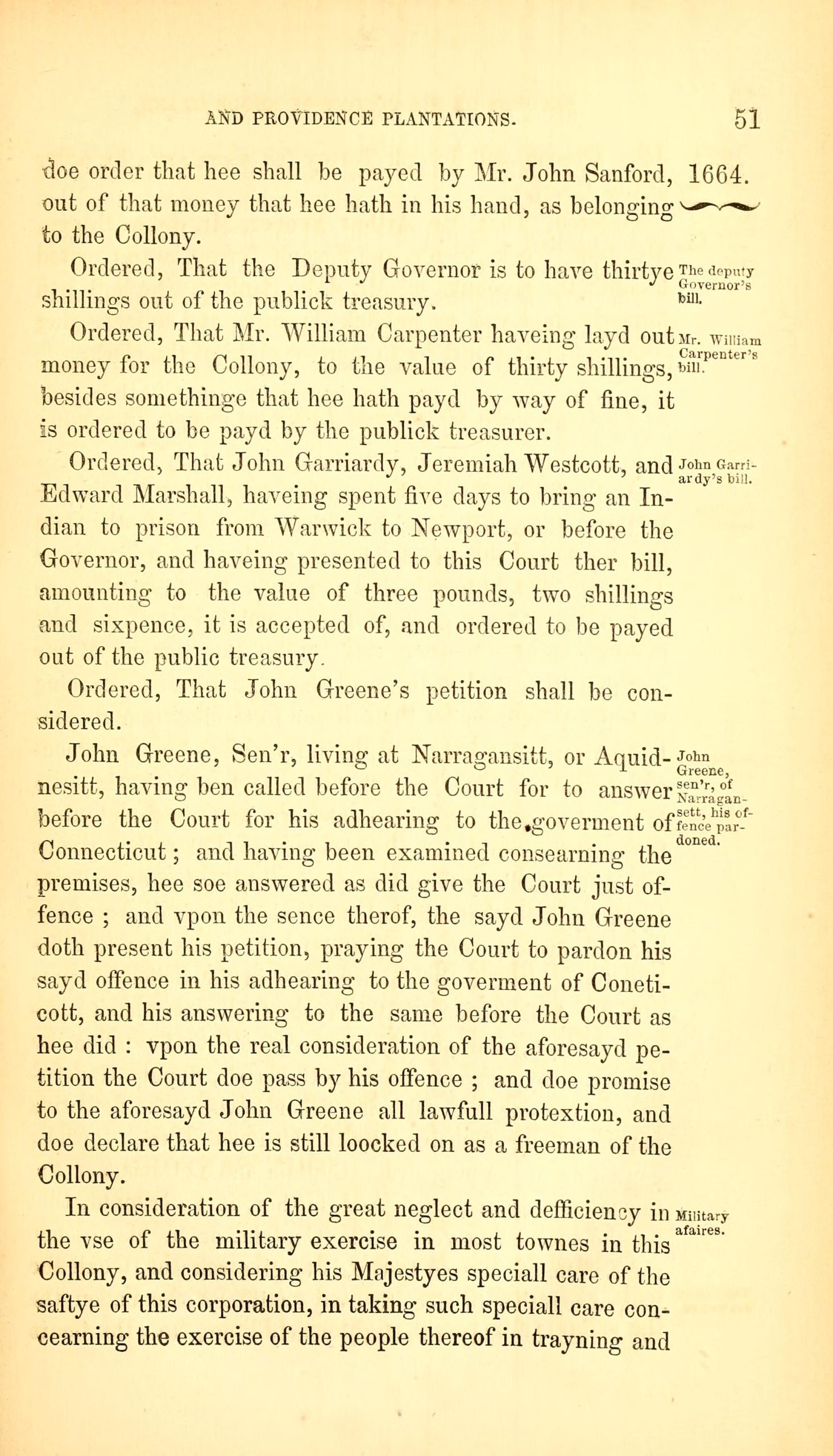
Bartlett, 1857, p. 45 (4 May 1664). “Wheras, Richard Smith, Thomas Gould, John Wood and John Hickes wear formerly bound to the Court of Trialles that sate in March last past, and alsoe were then agayne bound by recognicence to this Court, the Court declares these bonds to be voyd. Ordered, That the Governor be desired to write to Mr. Richard Smith, Sen’r, to desier him to come before the Court, and that a warrant goe from the Court to require John Greene, Sen’r, living at Narragansitt, to come before this Court. The letter that the Governor hath drawne vp to be sent to Mr. Richard Smith, Sen’r, is aproved of, and ordered to be sent him presantly.”
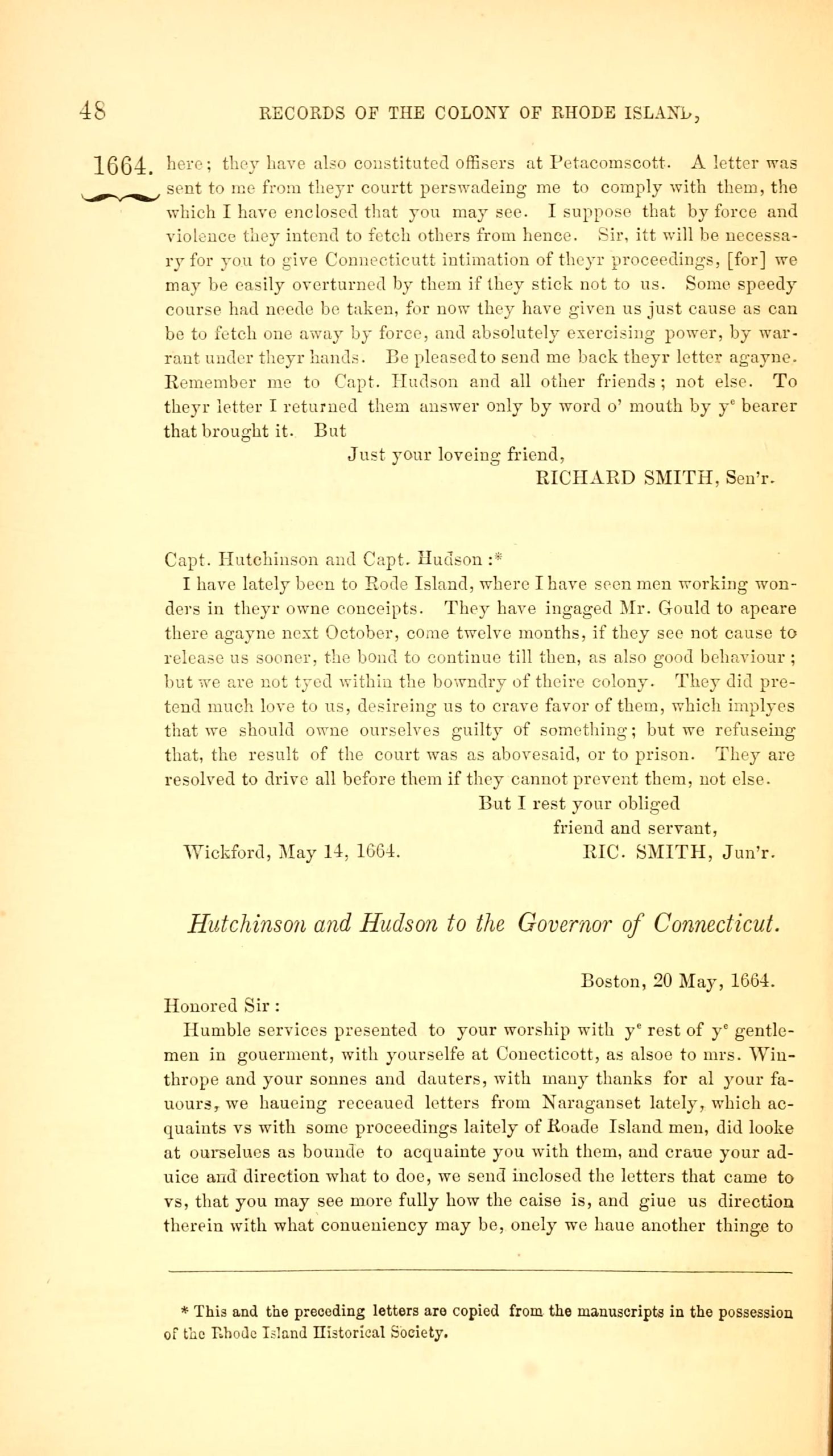
Bartlett, 1857, pp. 47–48, Letter from Richard Smith, Sen’r, to Capt. Hutchinson. “Wickford, 14th May, 1664. Capt. Hutchinson: My kind respects presented unto you, sir. This may give you to understand some late actions and proceedings of Rhode Island men; and if those actings of theyrs be not countermanded by the government of Connecticut, they will insult beyond measuer. Three days since they came to John Green’s house att Aquidnesett with a warrant from theyre court, under the Governor’s hand, and forceably fetched him awaye to Rode Island where he yet remaynes. His goeing was also not known to any here; they have also constituted offisers at Petacomscott. A letter was sent to me from theyr courtt perswadeing me to comply with them, the which I have enclosed that you may see. I suppose that by force and violence they intend to fetch others from hence. Sir, itt will be necessary for you to give Connecticutt intimation of theyr proceedings, [for] we may be easily overturned by them if they stick not to us. Some speedy course had neede be taken, for now they have given us just cause as can be to fetch one away by force, and absolutely exercising power, by warrant under theyr hands. Be pleased to send me back theyr letter agayne. Remember me to Capt. Hudson and all other friends; not else. To theyr letter I returned them answer only by word o’ mouth by ye bearer that brought it. But Just your loveing friend, RICHARD SMITH, Sen’r.” The editor’s footnote: “From Collection of manuscripts in the Library of the Rhode Island Historical Society.”
Bartlett, 1857, p. 48, Richard Smith, Jun’r, added. “Capt. Hutchinson and Capt. Hudson: I have lately been to Rode Island, where I have seen men working wonders in theyr owne conceipts. They have ingaged Mr. Gould to apeare there agayne next October, come twelve months, if they see not cause to release us sooner, the bond to continue till then, as also good behaviour; but we are not tyed within the bowndry of theire colony. They did pretend much love to us, desireing us to crave favor of them, which implyes that we should owne ourselves guilty of something; but we refuseing that, the result of the court was as abovesaid, or to prison. They are resolved to drive all before them if they cannot prevent them, not else. But I rest your obliged friend and servant, Wickford, May 14, 1664. RIC. SMITH, Jun’r.” The letter of Hutchinson and Hudson to the Governor of Connecticut, Boston, 20 May 1664, begins at the foot of the same page: “Honored Sir: Humble services presented to your worship with ye rest of ye gentlemen in gouerment, with yourselfe at Conecticott, as alsoe to mrs. Winthrope and your sonnes and dauters, with many thanks for al your fauours, we haueing receaued letters from Naraganset lately, which acquaints vs with some proceedings laitely of Roade Island men, did looke at ourselues as bounde to acquainte you with them, and craue your aduice and direction what to doe, we send inclosed the letters that came to vs, that you may see more fully how the caise is, and giue us direction therein with what conueniency may be, onely we haue another thinge to” [continued on page 49].
Bartlett, 1857, p. 51 (May 1664). “Ordered, That John Greene’s petition shall be considered. John Greene, Sen’r, living at Narragansitt, or Aquidnesitt, having ben called before the Court for to answer before the Court for his adhearing to the goverment of Connecticut; and having been examined consearning the premises, hee soe answered as did give the Court just offence; and vpon the sence therof, the sayd John Greene doth present his petition, praying the Court to pardon his sayd offence in his adhearing to the goverment of Coneticott, and his answering to the same before the Court as hee did: vpon the real consideration of the aforesayd petition the Court doe pass by his offence; and doe promise to the aforesayd John Greene all lawfull protextion, and doe declare that hee is still loocked on as a freeman of the Collony.” Margin: “John Greene, sen’r, of Narragansett, his offence pardoned.”
The background records.
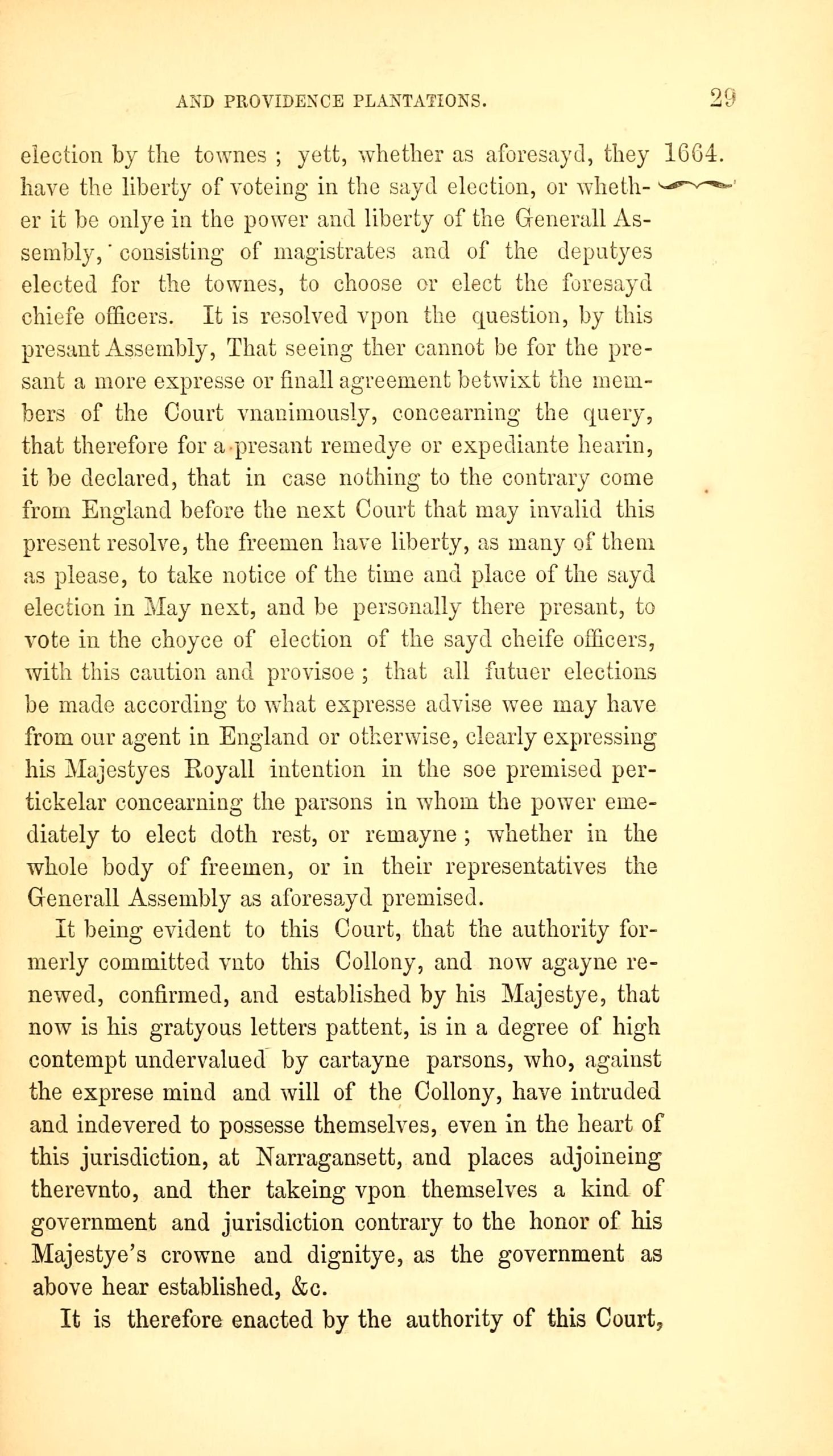
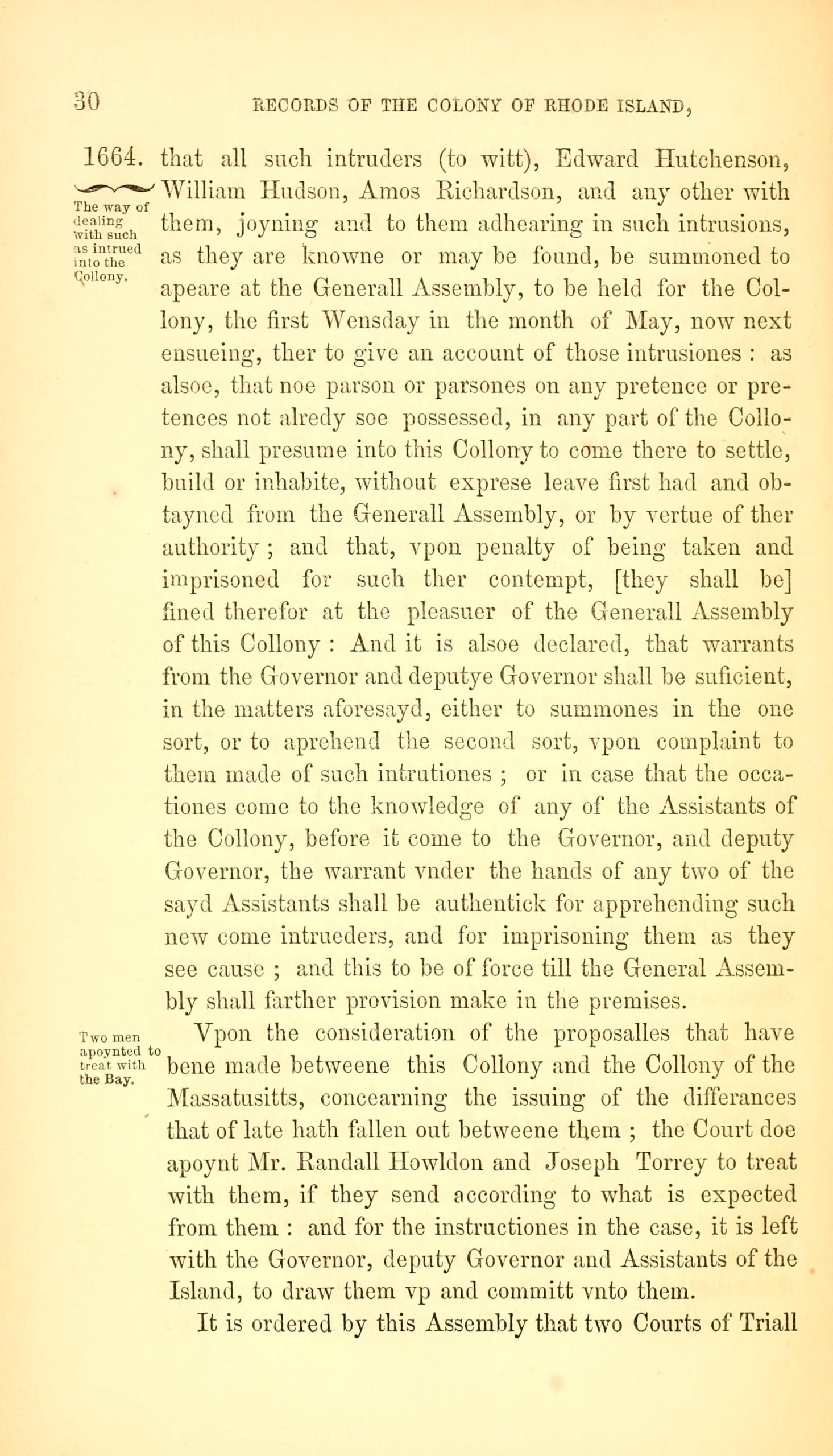
Bartlett, 1857, pp. 29–30 (Assembly of March 1664). “It being evident to this Court, that the authority formerly committed vnto this Collony, and now agayne renewed, confirmed, and established by his Majestye, that now is his gratyous letters pattent, is in a degree of high contempt undervalued by cartayne parsons, who, against the exprese mind and will of the Collony, have intruded and indevered to possesse themselves, even in the heart of this jurisdiction, at Narragansett, and places adjoineing therevnto, and ther takeing vpon themselves a kind of government and jurisdiction contrary to the honor of his Majestye’s crowne and dignitye, as the government as above hear established, &c. It is therefore enacted by the authority of this Court, that all such intruders (to witt), Edward Hutchenson, William Hudson, Amos Richardson, and any other with them, joyning and to them adhearing in such intrusions, as they are knowne or may be found, be summoned to apeare at the Generall Assembly, to be held for the Collony, the first Wensday in the month of May, now next ensueing, ther to give an account of those intrusiones: as alsoe, that noe parson or parsones on any pretence or pretences not alredy soe possessed, in any part of the Collony, shall presume into this Collony to come there to settle, build or inhabite, without exprese leave first had and obtayned from the Generall Assembly, or by vertue of ther authority; and that, vpon penalty of being taken and imprisoned for such ther contempt, [they shall be] fined therefor at the pleasuer of the Generall Assembly of this Collony: And it is alsoe declared, that warrants from the Governor and deputye Governor shall be suficient, in the matters aforesayd, either to summones in the one sort, or to aprehend the second sort, vpon complaint to them made of such intrutiones; or in case that the occationes come to the knowledge of any of the Assistants of the Collony, before it come to the Governor, and deputy Governor, the warrant vnder the hands of any two of the sayd Assistants shall be authentick for apprehending such new come intrueders, and for imprisoning them as they see cause; and this to be of force till the General Assembly shall farther provision make in the premises.” Margin: “The way of dealing with such as intrued into the Collony.”
Arnold, 1894, pp. 24–25 (3 July 1663). “Naraganset 3, July 1663. We whose names are under written being the Inhabitants & the proprietors of the lands lying in the Naraganset have & doe desire (according to his Majesties grente) to be under the Govern’tt of Conecticot Collony & Request there protection according to a letter sent in June last. mr. Bradstreet & others have desired the same in ye Letter formerly Mentioned. Richard Smith, Edw. Hutchinson and for his son Elisha … Hen. Steavens, John Green, Rich Smith in behalfe of 8 children. this was subscribed by these persons upon notis given to all the Inhabitants to meet on this day all Subscribers that meet. No 18 Exam.” The entry “Rich Smith in behalfe of 8 children” stands in the right-hand column beside “John Green”; the eight children are Smith’s. A “marke” is printed only against the men who could not write their names; “John Green” has none, so he signed his own name, whereas the witness “Henry Greene” to the deed of 1671/2 made his mark.
Huling, 1883, pp. 138–139. “Greene’s name occurs next before that of Smith on the list of the residents of Wickford who in 1663 expressed their desire to be under Connecticut Colony rather than under the jurisdiction of Rhode Island.† Indeed, he seems to have taken an unpleasantly prominent part in the disputes which agitated this little community relative to the question whether Narragansett rightfully belonged to the one colony or to the other. Greene’s attitude at the outset, doubtless, was influenced in some degree by the fact that his friend Smith, the patriarch and well nigh “Sovereign”‡ of the Wickford settlement, had espoused the cause of Connecticut, but was mainly caused by a more personal consideration. He had now become an occupant, and probably an owner, of a tract of land in Quidnesset neck, the title to which was based upon a purchase from the Indians made in 1659* by Major Humphrey Atherton and his associates in direct opposition to an order† of the Rhode Island General Court, November, 1651. This order provided that all purchases made of the Indians without consent of the colony should be void. If, therefore, Rhode Island should prevail, Greene would have no valid title to his recently acquired homestead; while the success of Connecticut would confirm him in his possessions. Hence he seems to have made himself somewhat prominent in his opposition to the colonial authorities at Newport, with the result of which the following excerpts best tell the story:” Huling’s footnotes: p. 138, “† R. I. Land Evidence in State Library. ‡ Savage’s Gen. Dic., IV, page 129.”; p. 139, “* Potter’s Narragansett, page 58. † Potter’s Narragansett, p. 49.” The excerpts that follow on his page 139 are the warrant of 5 May, Smith’s letter, and the pardon, as printed above from Bartlett.
Huling, 1883, p. 140. “In consequence of an order passed at the May session of R. I. General Assembly, 1671, on the nineteenth and twentieth of that month the Governor, Deputy Governor and Assistants held a court at “Acquidnesset.”‡ At this time “the persons inhabiting here being called to give their engagement, and desiring to know whether or no this Court on behalf of the colony, do lay any claim to their possessions which they now inhabit” were informed “that on behalf of the colony this Court do not lay any claim to their possessions which they now inhabit.” Thus the thirteen proprietors, including John Greene, who are named in the record were assured of peaceful possession of their homes, and they, with eight others, took their engagement as freemen of Rhode Island.” Huling’s footnote: “‡ Potter’s Narragansett, p. 75.”
References for this section.
Arnold, J. N. (Ed.). (1894). The records of the proprietors of the Narragansett, otherwise called the Fones record. Providence, RI: Narragansett Historical Publishing Co. https://archive.org/details/recordsofproprie00arno
Bartlett, J. R. (Ed.). (1857). Records of the Colony of Rhode Island and Providence Plantations in New England (Vol. 2, 1664–1677). Providence, RI: A. C. Greene. https://archive.org/details/recordsofcolonyo02rhod
Huling, R. G. (1883). The Greene’s of Quidnesset. The Narragansett Historical Register, 2(2), 137–142. https://archive.org/details/narragansetthistv1v2rhod
Relationship to John Greene the Surgeon
John Greene the Surgeon (1597-1658) was a prominent early settler in Rhode Island. He is often confused with John Greene of Quidnessett, but they are from different branches of the Greene family. John Greene the Surgeon is a cousin of John Greene of Quidnessett. They both descend from the original Greene family of Bowridge Hill:
- Robert Greene, Gentleman, had three sons: Peter Greene, Richard Greene, and John Greene (1529-1560).
- John Greene (1529-1560) was the great-grandfather of John Greene of Quidnessett.
- Richard Greene was the father of John Greene the Surgeon.
- Therefore, John Greene the Surgeon and John Greene of Quidnessett are first cousins twice removed.
Correction (July 2026): An earlier version of this page read “first cousins once removed.” Counting the generations set out above, John Greene the Surgeon is a grandson of Robert Greene (through his son Richard), while John Greene of Quidnessett is Robert’s great-great-grandson (through his son John Greene, 1529-1560). Two generations down against four makes the two men first cousins twice removed, the Surgeon being a first cousin of John of Quidnessett’s grandfather.
Legacy and Historical Significance
The Greene family established themselves in the New World, notably in Rhode Island, through John Greene of Quidnessett, who emigrated in 1635. The lineage traces back to England with substantial connections and contributions to early American history. Their late marriages did not hinder their lineage’s continuation, with strong and long-lived descendants.

Detailed History and Relationships of the Greene Family
Founding Ancestors
- John Greene (1529-1560)
- Birth: About 1529 in Bowridge Hall, Gillingham, Dorset, England
- Death: 1560 in Gillingham, Dorset, England
- Spouse: Anne (Arthington) Greene
- Children:
- Robert Greene
- Jeremy Greene
- Michael Greene
- Henry Greene
- Edward Greene
John Greene (1529-1560) was the great-grandfather of John Greene of Quidnessett, Rhode Island. His name appears in Parish Registers, and he is mentioned in his brother Peter’s will.
Immediate Descendants of John Greene (1529-1560)
Robert Greene (Son of John Greene 1529-1560)
- Residence: Langham
Jeremy Greene (Son of John Greene 1529-1560)
- Residence: Gillingham
Henry Greene (Son of John Greene 1529-1560)
- Residence: Some distance from the old home
- Death: August 22, 1578
- Children:
- Thomas of Wyke
- Robert Greene
Key Descendants Leading to John Greene of Quidnessett
Robert Greene (Son of Henry Greene)
- Child:
- John Greene (Born in 1606)
- Child:
John Greene (1606-1695) – John Greene of Quidnessett
- Birth: 1606
- Immigration: Came to the New World in 1635
- Marriage: Married Joan, about 1642 (named in his deeds of 1682; maiden name unknown)
- Children:
- Captain Edward Greene (Born about 1643)
- Lieut. John Greene
- Daniel Greene
- Henry Greene
John Greene of Quidnessett did not marry until middle age, around 36, and had his children later in life. He lived several years with Richard Smith’s family and later married Joan, whose maiden name is not known. (Corrected 23 September 2026: formerly “Joan Beggarly, a young widow.”)
Notable Descendants of John Greene of Quidnessett
Captain Edward Greene (Son of John Greene of Quidnessett)
- Birth: About 1643
Lieut. John Greene (Son of John Greene of Quidnessett)
- Marriage Age: 39 years
Daniel Greene (Son of John Greene of Quidnessett)
- Marriage Age: About 39 years
Henry Greene (Son of John Greene of Quidnessett)
Early Greene Family in England
- Robert Greene (Ancestor, Gentlemen)
- Estate: Purchased Bowridge Hill in Gillingham, Dorsetshire
- Sons:
- Peter Greene
- Richard Greene
- John Greene (1529-1560)
Peter Greene
- Inheritance: Heir to Bowridge Hall
- Death: May 1583
Richard Greene
- Inheritance: Succeeded Peter Greene
- Death: 1608
- Will: Made in 1606
- Relation: Grandfather of John Greene of Warwick, Rhode Island
Legacy and Historical Significance
The Greene family established themselves in the New World, notably in Rhode Island, through John Greene of Quidnessett who emigrated in 1635. The lineage traces back to England with substantial connections and contributions to early American history. Their late marriages did not hinder their lineage’s continuation, with strong and long-lived descendants.
Sources
- Bickley, Francis B., British Museum, hired by Gen. F.V. Greene in 1902.
- Greene, George Sears, The Greenes of Rhode Island: with historical records of English ancestry, 1534-1902, New York: The Knickerbocker Press, 1903. Accessed via Hathitrust.org on May 18, 2021.
Views: 688