The Frenchman commissioned only to teach — and the captaincy he refused to keep his word
Brother-in-law of Gen. Alfred Gibbs · Assistant Professor of French, U.S. Military Academy, c. 1840–1856
He is remembered on this site as the husband of Alfred Gibbs’s sister, Laura Wolcott Gibbs — a courtly “Captain” of family tradition, a teacher of French, the man who once wrote to Victor Hugo. The federal record tells a stranger and finer story. Théophile d’Oremieulx was never a captain. He was offered the rank in 1850 and turned it down — because he had given his word, when the Army first commissioned him, that he would ask for nothing but the desk where he taught cadets to speak French.
New to the record. The documents below come from a single National Archives file — File D-257 of 1855, in the Letters Received by the Adjutant General (M567, Record Group 94). Its twenty-three pages were located and transcribed for this page in 2026 and, so far as we can find, have never before been published. They resolve the old family title “Captain,” and they carry the autograph decision of a Secretary of War who would soon lead the Confederacy.
Théophile d’Oremieulx
Born Paris, 1815/16; son of a banished French general
Recruited to West Point to teach French, 1838–40
First Lieutenant, U.S. Army — declined a captaincy, 1850
Married Laura Wolcott Gibbs, 1853
Left the Academy c. 1856; died 1881
Alfred Gibbs
Born New York, 1823; West Point class of 1846
Cadet at the Academy while d’Oremieulx taught there
Brevetted for gallantry, Mexican War; wounded
Gained a brother-in-law when d’Oremieulx married Laura
Union cavalry general; died 1868
The file assembles, in one place, every document the War Department could find on d’Oremieulx’s unusual commission: the letters that created it, the 1850 captaincy he refused, and the 1855 crisis in which his whole life at West Point briefly hung on a Secretary of War’s pen. Read them in three acts. Click any page to read the full transcription beside the scan.
Act I
The Recruitment, 1838–1840
★ How a Frenchman Came to Wear the Uniform
Gouverneur Kemble to Secretary of War Jefferson Davis · Cold Spring, N.Y., 18 July 1855
The man who recruited him tells the story. As a Congressman in 1838–39, Kemble was asked by Secretary of War Poinsett to find a qualified Frenchman to mend West Point’s French instruction. After “diligent search” he recommended d’Oremieulx — “the son of an old French general officer, who had been banished from France by the Bourbons” — on a verbal, honor-bound agreement to abide by a lieutenant’s rank.
Why the Army Made Him an Officer
Maj. Richard Delafield to Gen. Joseph G. Totten, Chief Engineer · Paris, 19 May 1855
The former Superintendent of West Point explains from Europe that the only lawful way to secure a qualified French teacher was to give him an Army commission — a step taken under Secretary Poinsett around 1840, with the understanding that d’Oremieulx would never perform other military duty.
Act II
The Captaincy He Refused, 1850
★ The Regiment’s Objection
Bvt. Lt. Col. J. Morris, 1st Infantry, to the Adjutant General · Fort Duncan, Texas, 2 December 1850
When Major Scott’s death put d’Oremieulx first in line for a captaincy, the officers of his paper regiment protested: he had “been more than ten years in the service” yet “not yet done a day’s duty with the Regiment.”
His Refusal, in His Own Hand
1st Lt. Théophile d’Oremieulx to the Adjutant General · West Point, 11 December 1850
Four sentences that settle the “Captain” question forever: “Having heard unofficially of the death of Maj. Scott, I would respectfully beg leave to decline the promotion consequent upon it.”
The Army Lets the Promotion Pass
Adjutant General R. Jones to Secretary of War C. M. Conrad, with Conrad’s approval · Washington, 20 December 1850
His name is withdrawn from the promotion list before the Senate and the captaincy passes to the next senior officer, Lt. James N. Caldwell — the paperwork that carried out his wish.
A Professor Pleads to Keep Him
Prof. Hyacinth R. Agnel to Superintendent Capt. H. Brewerton · West Point, 25 November 1850
The head of the French Department argues that d’Oremieulx’s place “could not without much difficulty be supplied, if indeed it could be so at all,” and that his commission ought to be treated “as one of exception.”
Act III
The Crisis and the Reprieve, 1855
‘To Fulfil My Part of the Contract’
1st Lt. d’Oremieulx to Secretary of War Jefferson Davis · Washington, 20 July 1855
Summoned to explain himself, he tells Davis he declined the captaincy because promotion “would have defeated the object of my appointment; besides its having been clearly understood that I would lay no claim to such promotion.”
One Minute to Change a Life
1st Lt. d’Oremieulx to Secretary of War Jefferson Davis · New York, 24 July 1855
With his post at West Point suddenly in doubt, he appeals for a decision: it “may happen to be such as to change in one minute, at this comparatively late period of my life, the whole of my plans and prospects,” forcing him into “duties for which ‘I was desired not to qualify myself.’”
★ The Secretary of War Decides
Engineer Department summary, endorsed by Secretary of War Jefferson Davis · War Department, 31 July 1855
Jefferson Davis settles it in his own hand: “On account of the peculiarity of the case, Lt d’Oremieux will not be relieved from duty at the Academy until further orders.” The reprieve that let him finish his years at West Point.
Afterward: The Letter to Victor Hugo
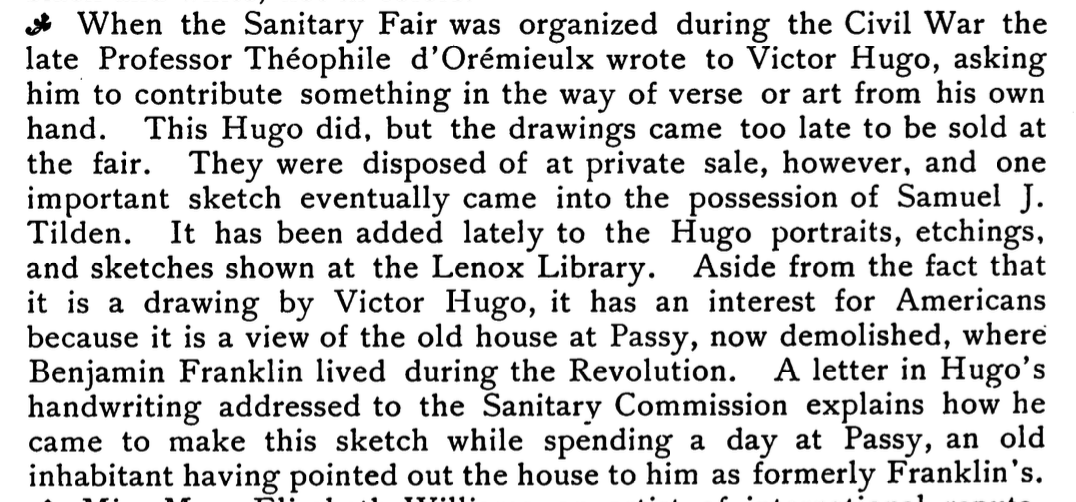
Two decades later, during the Civil War, d’Oremieulx turned his French connections to the Union cause. This passage — found by Garland H. Green Jr. in an October 1902 issue of Brush and Pencil — records it.
“Gleanings from American Art Centers,” Brush and Pencil, October 1902. · Full article (PDF)
“When the Sanitary Fair was organized during the Civil War the late Professor Théophile d’Orémieulx wrote to Victor Hugo, asking him to contribute something in the way of verse or art from his own hand. This Hugo did, but the drawings came too late to be sold at the fair. They were disposed of at private sale, however, and one important sketch eventually came into the possession of Samuel J. Tilden. It has been added lately to the Hugo portraits, etchings, and sketches shown at the Lenox Library. Aside from the fact that it is a drawing by Victor Hugo, it has an interest for Americans because it is a view of the old house at Passy, now demolished, where Benjamin Franklin lived during the Revolution. A letter in Hugo’s handwriting addressed to the Sanitary Commission explains how he came to make this sketch while spending a day at Passy, an old inhabitant having pointed out the house to him as formerly Franklin’s.”
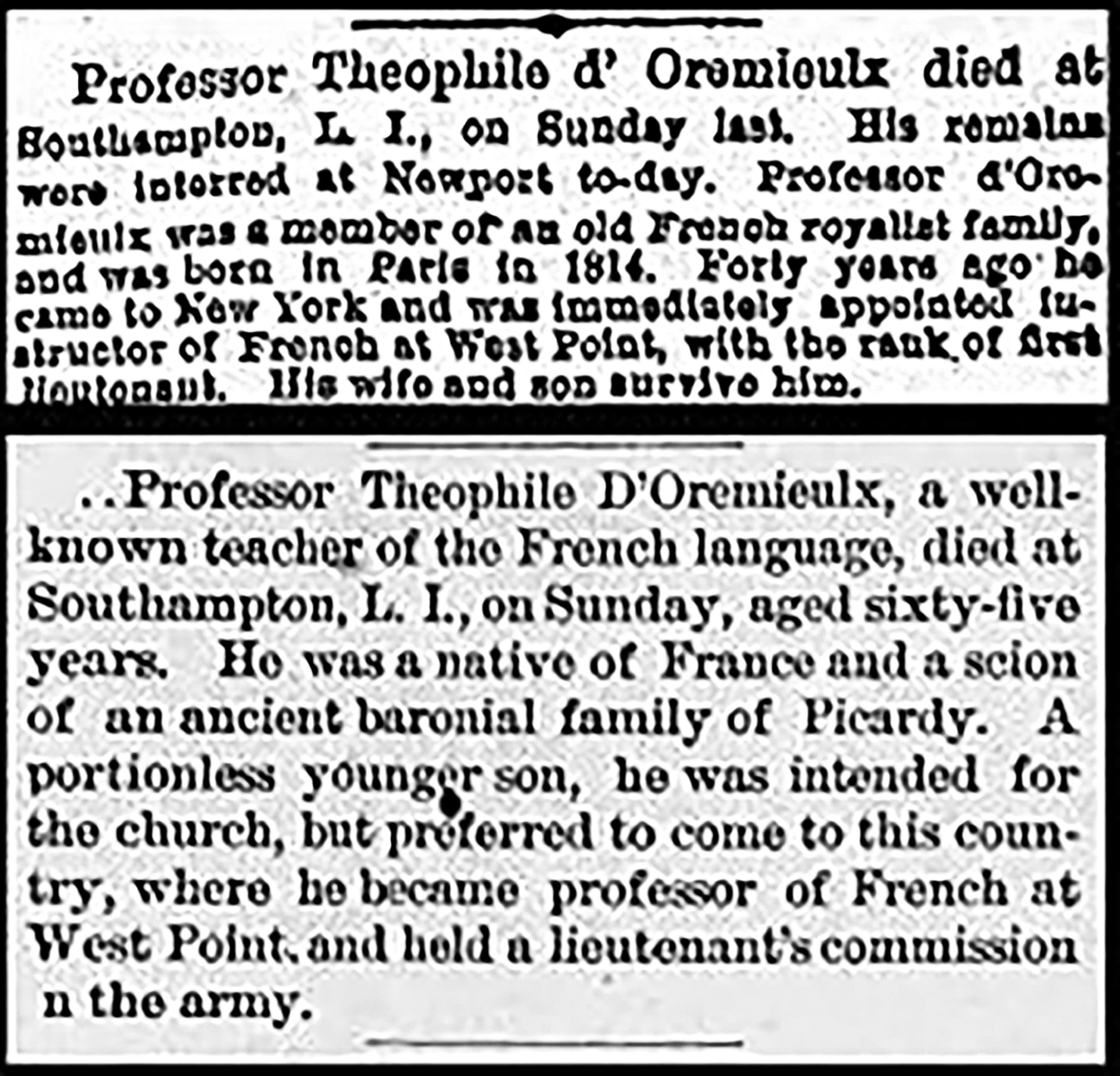
The Obituaries
Obituary notices, 1881.
Professor [Marie] Theophile d’Oremieux died at Southampton, L. I., on Sunday last. His remains were interred at Newport today. Professor d’Oremieux was a member of an old French royalist family and was born in Paris in 1816. Forty years ago he came to New York and was immediately appointed instructor of French at West Point, with the rank of first lieutenant. His wife and son survive him.
Professor Theophile d’Oremieux, a well-known teacher of the French language, died at Southampton, L. I., on Sunday, aged sixty-five years. He was a native of France and a scion of an ancient baronial family of Picardy. A portionless younger son, he was intended for the church, but preferred to come to this country, where he became professor of French at West Point and held a lieutenant’s commission in the army.
A note on his family. The obituaries call the d’Oremieulx line an “old French royalist family.” The man who actually recruited him, Gouverneur Kemble, wrote in 1855 that Théophile was the son of a French general officer “banished from France by the Bourbons” — a detail that points the other way, toward a family out of favor with the restored monarchy. Both descriptions survive here as written; the primary letter is the earlier and better-placed witness.
A Life in Brief
1815/16
Born in Paris Son of a French general officer banished under the Bourbon Restoration.
1838–39
Recruited Gouverneur Kemble, for Secretary of War Poinsett, finds him in New York to teach French at West Point.
1840
Commissioned Made a Second Lieutenant — solely to serve as Assistant Professor of French, on his honor never to claim other rank.
Dec 1850
Declines a captaincy On Major Scott’s death he stands first for promotion and refuses it; his name is withdrawn and passes to Lt. Caldwell.
28 Jun 1853
Marries Laura Wolcott Gibbs Sister of the future Gen. Alfred Gibbs; Col. R. E. Lee hosts the newlyweds at West Point.
31 Jul 1855
Reprieved Secretary of War Jefferson Davis rules he shall not be relieved from the Academy “until further orders.”
c. 1856
Leaves West Point After some sixteen years teaching French to the Corps of Cadets.
1864
Writes to Victor Hugo For the U.S. Sanitary Fair; Hugo sends drawings, including a view of Franklin’s house at Passy.
3 Jul 1881
Dies at Southampton, L.I. Buried at Newport, Rhode Island; his wife and son survive him.
Agnel, H. R. (1850, November 25). [Letter to Capt. H. Brewerton, Superintendent, U.S. Military Academy]. File D-257, 1855, Letters Received by the Adjutant General (Microfilm M567), Record Group 94, National Archives, Washington, DC.
Davis, J. (1855, July 31). [Endorsement on the case of 1st Lt. T. d’Oremieulx]. File D-257, 1855, Letters Received by the Adjutant General (M567), RG 94, National Archives, Washington, DC.
Delafield, R. (1855, May 19). [Letter to Gen. J. G. Totten, Chief Engineer]. File D-257, 1855, Letters Received by the Adjutant General (M567), RG 94, National Archives, Washington, DC.
d’Oremieulx, T. (1850, December 11). [Letter declining promotion, to Adjutant General R. Jones]. File D-257, 1855, Letters Received by the Adjutant General (M567), RG 94, National Archives, Washington, DC.
d’Oremieulx, T. (1855, July 20 & July 24). [Letters to Secretary of War Jefferson Davis]. File D-257, 1855, Letters Received by the Adjutant General (M567), RG 94, National Archives, Washington, DC.
Jones, R. (1850, December 20). [Letter to Secretary of War C. M. Conrad, with Conrad’s approval]. File D-257, 1855, Letters Received by the Adjutant General (M567), RG 94, National Archives, Washington, DC.
Kemble, G. (1855, July 18). [Letter to Secretary of War Jefferson Davis]. File D-257, 1855, Letters Received by the Adjutant General (M567), RG 94, National Archives, Washington, DC.
Morris, J. (1850, December 2). [Letter to Adjutant General R. Jones, Head Quarters 1st Infantry, Fort Duncan, Texas]. File D-257, 1855, Letters Received by the Adjutant General (M567), RG 94, National Archives, Washington, DC.
Gleanings from American art centers. (1902, October). Brush and Pencil, 11(1).