
CONTINUED FROM Chapter II Part 3
Of the two sons of George Gibbs (II.), the younger, William Channing Gibbs married Mary Kane, of the well-known New York family of that name; his son, Theodore Kane Gibbs, was a major in the Civil War and for many years treasurer of Grace Church, New York. See page 57, on which will be found a record of our Governor Gibbs’s Cousins.
1 See “Notes,” page 184, Chapter XI.
[17]
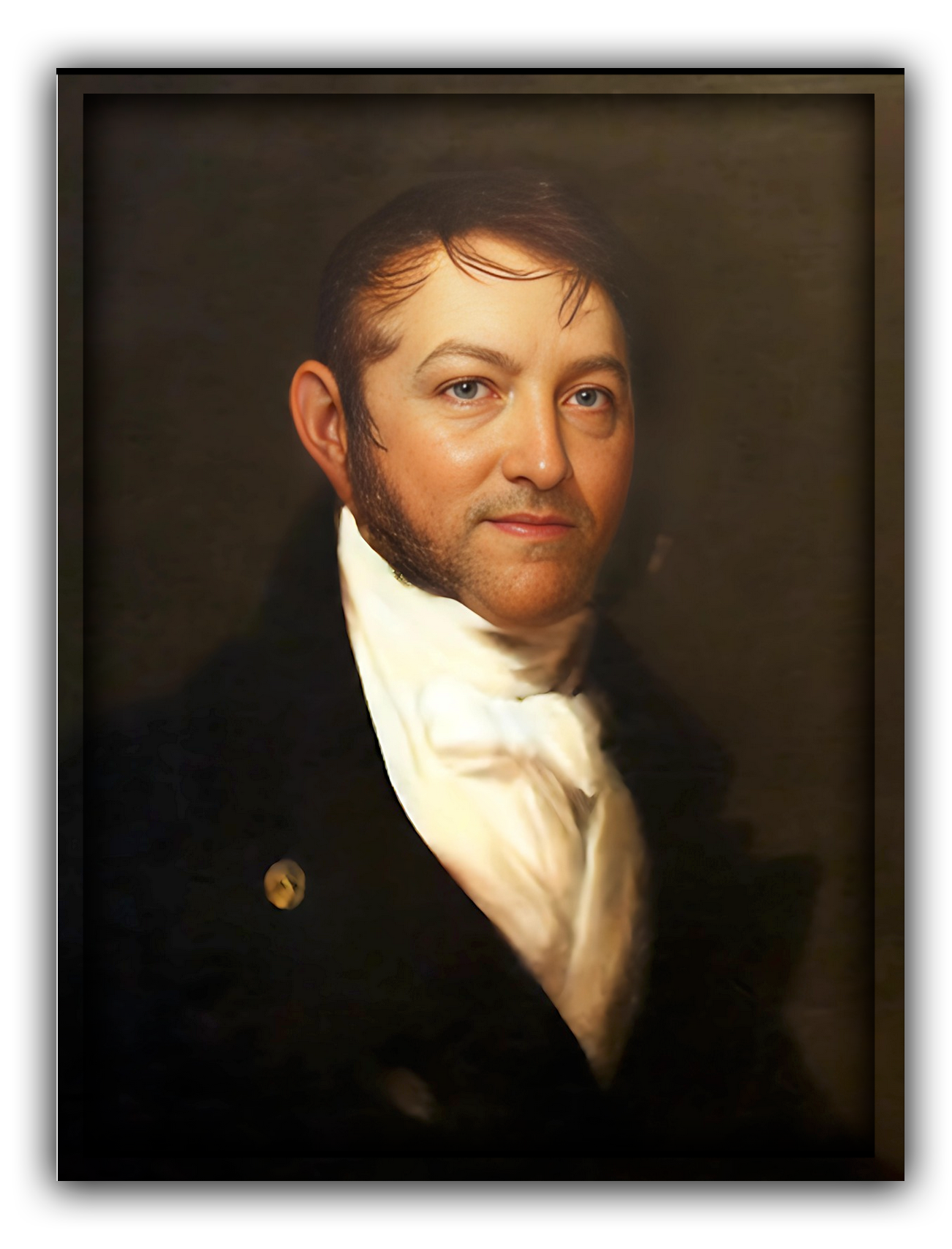
GEORGE GIBBS (III.). Eldest son and fourth child of George (II.) and Mary Channing, was born in Newport, R. I., in 1776. He was educated at Yale College and married Laura Wolcott (born 1794), daughter of Oliver Wolcott, Jr., of Litchfield, Conn., and Elizabeth Stoughton. Laura was but fifteen years of age at the time of her marriage. Extended reference to this remarkable woman will be found beginning on page 21. For an account of the Wolcott connection through my grandmother, see “The Wolcott Family.” George Gibbs in early life was sent to China as supercargo in one of the ships of Gibbs and Channing, as his father intended that his son should succeed him in his business. However, a life of cultivated leisure attracted the young man strongly and upon returning from China he went to Europe, where he spent some years in study. While in France he had the opportunity of meeting many important and interesting people of the Directorate, among whom may be mentioned Mme. Recamier. He returned with a very fine collection of minerals, derived from the purchase of two noted European cabinets. The whole comprised over 10,000 specimens, making it, at the time the largest collection in America. With additions he made later it now amounts to 20,000 specimens. Col. Gibbs, as he was known, deposited his collection at Yale College. Through his friend, Professor Benjamin Silliman, that Institution purchased it, in 1825, for $20,000. Hecontinued throughout his Iifetime to add to the collection and to engage in geological work to develop new mineral localities. Colonel Gibbs was the first to geologize systematically in the White Mountains. In 1816 Dr. Bigelow and his party found and followed the path cut through the thickets by Gibbs some years earlier.
[18]
On his marriage to Laura Wolcott in 1810, he purchased from the Delafield family a large estate, comprising about 40 acres, and a fine Colonial house, named “Sunswick,” on Long Island near what was then called Hallett’s Cove, and is now known as Astoria. The place was about opposite the northern end of Blackwell’s Island (Welfare Island now). It is difficult today to picture this locality as a desirable residence district, but 125 years ago it was in fact a beautiful shore and a favorite spot for the fine country places of New York families, easily reached by the ferry or by sailing boats from the Battery, where the City was then clustered.1. Here Colonel Gibbs devoted himself with great ardor and success to horticulture, and especially to the introduction and testing of new varieties of fruit. Meanwhile he kept up his scientific studies, accumulated a noble library, and exercised an abounding hospitality. For many years he offered prizes at Yale for superior attainment in mineralogy and for services rendered to science by use£ul discoveries and observation, and first suggested to Professor Silliman the publication of the well-known “American Journal of Science.” Two of his sons, as will be seen, inherited his scientific tastes.
[19]
1 See page 161 and photograph of the house, taken many years later. Col. Gibbs’s various activities and interests should be further mentioned.
He was elected Vice-President of the New York Lyceum of Natural History in 1822, and contributed many articles to the American Mineralogical Journal and to the American Journal of Science. He received the degree of M.A. from Brown University in 1800, and from Yale in 1808.
He was appointed Aide-de-Camp by the Governor of Rhode Island in 1804. His societies were:
- Member of the Royal Institution (England), 1807
- American Philosophical Society, Philadelphia, 1810
- American Antiquarian Society, 1813
- American Academy of Arts and Sciences, 1813
- American Academy of Fine Arts, 1816
- Mineralogical Society of Dresden, Germany, 1816
- Newport Marine Society, 1819
- Agricultural Society of Florence, Italy, 1821
- Imperial Agricultural Society of Vienna, 1824
- New York Horticultural Society, 1824
- Linnean Society of Paris, 1826
- Massachusetts Horticultural Society, 1830
The Gibbs Family History — Complete Index
- Chapter I: The Gibbs Family in England
- Chapter II: The Gibbs Family of Rhode Island
- Chapter II, Part 2
- Chapter II, Part 3
- Chapter II, Part 4
- Chapter II, Part 5
- Chapter II, Part 6
- Chapter III: The William Channing Gibbs
- Chapter IV: The Channing Family
- Chapter V: The Wolcott Family of Connecticut
- Chapter VI: The Hosmer Family of Connecticut
- Chapter VII: Further Account of Certain Members of the Gibbs Family
- Chapter VIII: Family Portraits
- Chapter IX: Miscellaneous Notes
- Chapter X: Condensed Genealogical Record
- Chapter XI: Early Family Data
Reproduced verbatim from the 1933 volume, including the author’s spelling and punctuation. Editor’s notes in bracketed boxes mark points where the book’s statements conflict with the documentary record. Corrections will be noted rather than made silently.
Views: 47
Explore the evidence
View this article’s connected sources and media →
About this page
This article was brought over from AlfredGibbs.com. Its preserved text, media and citations remain available for comparison.