
Alfred Gibbs entered the United States Military Academy on April 19, 1842, on a conditional at-large appointment from President John Tyler — the end of a three-year campaign by his widowed mother, his brother, an uncle, four congressmen, a senator, and Winfield Scott, told in full on the Cadet File page. He graduated with the Class of 1846. What follows is the Academy as it actually stood during those four years: not the generic institution of Wikipedia summary, but the specific buildings, superintendents, and course of study recorded in Capt. Edward C. Boynton’s History of West Point (1863) — written by the Academy’s own adjutant less than two decades after Gibbs left it.
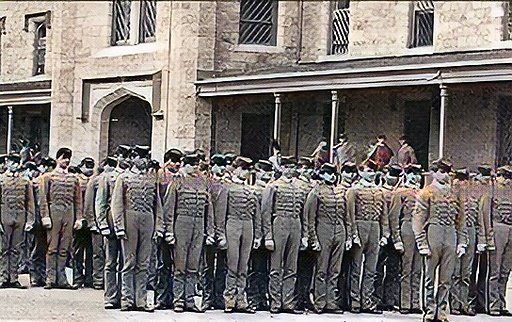
The Academy He Entered, 1842
Gibbs served under two superintendents. Maj. Richard Delafield, Corps of Engineers, took command on September 1, 1838, and held it through almost all of Gibbs’ time as a cadet — surveying and fixing the Academy’s boundaries, building the Library and Artillery Laboratory, and, in 1839, bringing a sergeant and five dragoons up from Carlisle Barracks to found the riding instruction. Delafield was relieved on August 15, 1845 — the start of Gibbs’ final year — by Capt. Henry Brewerton, also of the Engineers, who was Superintendent when Gibbs graduated in June 1846.
The way cadets reached West Point in Gibbs’ era was itself a settled controversy by 1842. Since 1817, appointments were made overwhelmingly on the recommendation of each candidate’s congressman, one cadet per district, precisely so that no single official could be accused of favoring the wealthy or well-connected. Boynton, defending the system in 1863, cites the Academy’s own records that fewer than one in eighteen cadets admitted over the previous twenty-two years could have afforded more than a common school education without it. Gibbs’ own path ran outside this normal channel entirely — he lost his first congressional warrant to political retaliation in 1839 and only reached West Point three years later on a Presidential at-large appointment, a story documented in full on the Cadet File page linked above.
The Four-Year Course, an Eight-Year Obligation
The course of study Gibbs followed was four years, and it carried an obligation longer than the classroom: Section 28 of the Act of July 5, 1838 bound every cadet admitted thereafter to eight years of service, unless sooner discharged, whether or not the government chose to commission him afterward. In practice, Boynton notes, no graduate had ever been left without a commission. (The Academy would not extend the course itself to five years until 1854, eight years after Gibbs left.)
Where He Lived: The Old North and South Barracks
Gibbs did not live in the barracks most often photographed at West Point today. During his four years the Corps of Cadets was quartered in one of two older stone buildings, both already decades old when he arrived:
- The South Barracks — stone, stuccoed, a central block 128 by 25 by 35 feet flanked by two wings, fifty rooms in all. Completed in 1815; demolished in the summer of 1849.
- The North Barracks — four stories, 104 by 56 by 45 feet, set at a right angle to the South Barracks and less than 100 feet from its corner, with forty rooms. Completed in 1817; demolished in July 1851.
Construction on a replacement — the “New Barracks,” later called the Central Barracks — only began in 1845, Gibbs’ final year, and its first wing was not occupied by cadets until August 1848; the whole building was not finished until 1851. Gibbs graduated in June 1846 without ever living in it. That building — the one shown in the photograph on this page, and in the Getty Museum’s 1868 photographs by George Kendall Warren — belongs to the cadets who came after him, not to his own class.
The Academic Hall, Rebuilt After Fire
The Academy’s original classroom building, a two-story stone Academic Hall completed in 1815, burned to the ground on February 19, 1838 — four years before Gibbs arrived — destroying the Adjutant’s own historical records of the post along with it. A new Academic Hall was already under construction under Superintendent De Russy at the time of the fire, and it was this rebuilt building, not the one that burned, where Gibbs actually studied.
Riding, and the Rifles Commission
The riding and cavalry instruction Delafield founded in 1839 was still new and growing during Gibbs’ cadet years — the dedicated Riding Hall would not be completed until 1855, nine years after he graduated. Even so, Gibbs left the Academy in June 1846 and immediately applied to trade his infantry posting for the Regiment of Rifles, a request granted the next day (reproduced in full on this War Department letter). He would go on to command the First New York Dragoons.
Explore Further on This Site
- The Cadet File: How Alfred Gibbs Got to West Point — the complete 1838–1842 NARA application file.
- The West Point Record of Alfred Gibbs, his class standing and demerits for all four years, 1843 to 1846, contributed by Deborah Anthony Dodge.
- Class List of 1846 — his graduating class, roster and searchable database.
- Two Roads to McClellan: The Gibbs Brothers and the Class of 1846
- Letters home during the cadet years (1845), from the Alfred Gibbs Correspondence.
- His commission into the Regiment of Rifles, June 1846.
Sources
Boynton, E. C. (1863). History of West Point, and Its Military Importance During the American Revolution, and the Origin and Progress of the United States Military Academy. London: Greenhill. Internet Archive. archive.org/details/historyofwestpoi00inboyn
Warren, G. K. (1868). [Old Central Barracks, West Point] [Albumen silver print]. The J. Paul Getty Museum, Los Angeles. getty.edu/art/collection/objects/179051
Views: 123
Explore the evidence
View this article’s connected sources and media →
About this page
This article was brought over from AlfredGibbs.com. Its preserved text, media and citations remain available for comparison.