
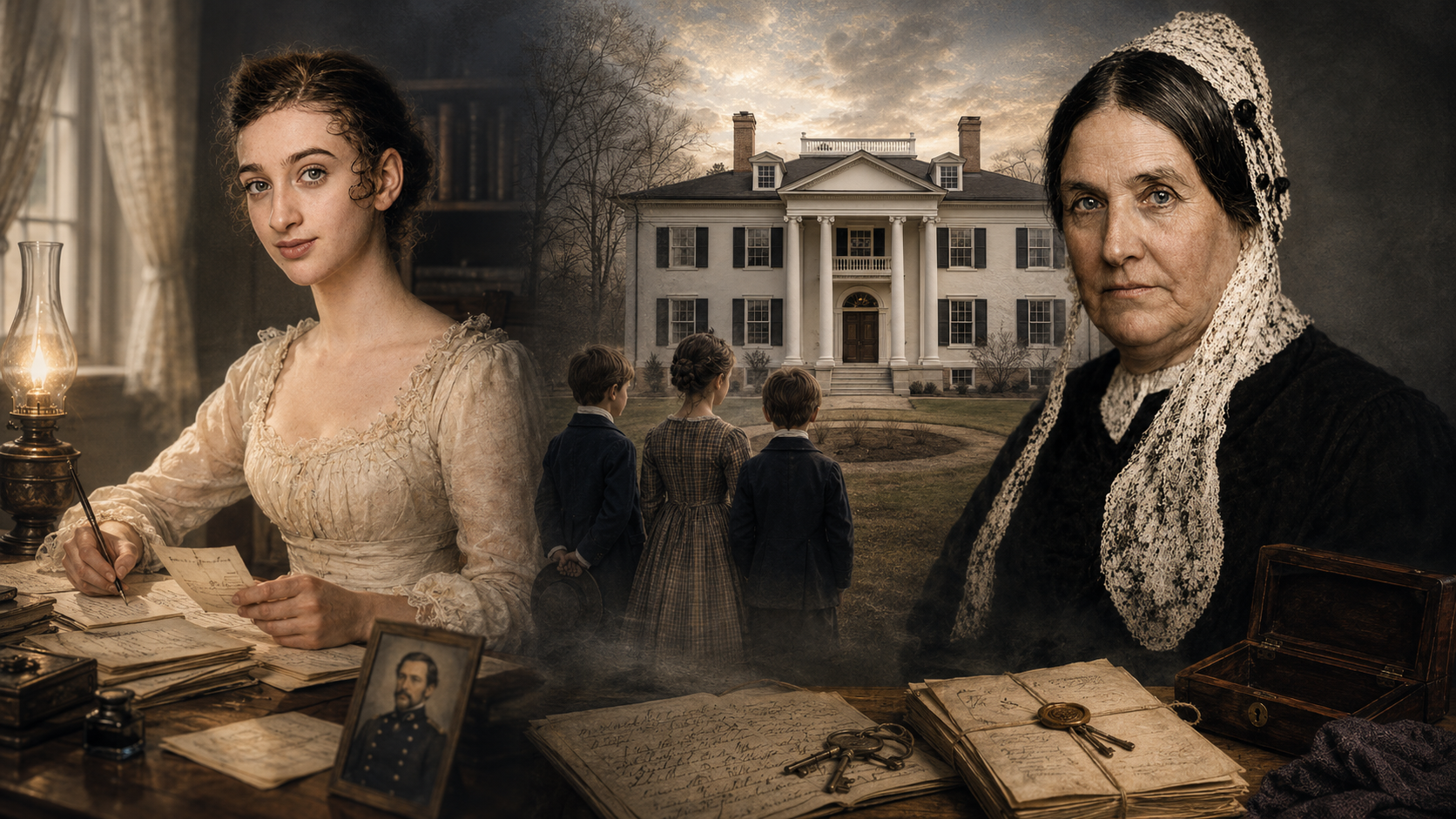
This website is named for a general. But read the family’s papers end to end, the deeds and school bills and ledgers as well as the letters, and every road runs back to one person: his mother. In 1833 Colonel George Gibbs of Sunswick, the celebrated mineralogist, died and left behind a widow, a house full of children, an estate carrying heavy debts, and no plan. What happened next has never been told as one story, because the evidence for it lay scattered across two archives: the Gibbs Family Papers preserved at the Wisconsin Historical Society, and a War Department file in the National Archives. This page puts the documents in one place, in order, each reproduced beside its complete transcription. They show a woman who audited her own agents, out negotiated her buyers, paid down her husband’s debts to the dollar, built him a monument, moved her family for the sake of the children’s schooling, and then fought the United States government for four years, and won. Nothing here is embellished. Every claim sits next to its proof.
What the Documents Show
- She ran the estate herself. As executrix she negotiated prices, held parcels back from sale, took installment bonds at seven per cent, and had her agent’s year end account audited (“examined-right”).
- She executed the rescue plan to the letter. Advised in November 1833 to sell land “to an amount sufficient to pay the Mortgage,” she sold roughly $19,400 of Hallett’s Cove land to Barnabas Bates in August and September 1834, and the ledger shows the proceeds going straight to principal on the estate’s bonds that same September.
- She gave away the one thing she could not be paid for. In those same weeks she made Yale a gift of the great meteoric iron, “the finest meteoric fragment which any museum or individual possesses,” to stand as her husband’s monument beside the Trumbull Gallery.
- The family was still at Sunswick on November 14, 1834, when Silliman addressed her there; the move to Winthrop Place (261 Greene Street) in Manhattan came after, for the sake of the children’s education.
- She then fought Washington for four years, 1838 to 1842, as the applicant of record for Alfred’s West Point warrant, and carried the case in person until the President conferred the appointment at large.
The People in These Papers
I · The Life BeforeA House Full of Children
Begin before the storm. Laura Wolcott was born in 1794 into the first family of Federalist Connecticut; her father, Oliver Wolcott Jr., had succeeded Alexander Hamilton at the Treasury, and her grandfather had signed the Declaration of Independence. Her mother died when she was a child, and a contemporary who knew her well wrote that she took her place “in her early teens at the head of her father’s table,” raised on public questions rather than nursery prattle. In 1810, at fifteen years of age, she married Colonel George Gibbs of Newport, a man who had spent a fortune assembling the finest mineral collection in America; on the marriage he purchased from the Delafield family a forty acre estate called Sunswick, at Hallett’s Cove on Long Island opposite the growing city of New York, and their household filled with children. The letter below is the world as it was: her father, old and lonely in Litchfield, sending cheeses and flannel, asking after grape cuttings, and thanking her for a portrait sketch of his newest grandson, an eight month old named Alfred.

A Grandfather’s Letter: “The Drawing of Alfred”
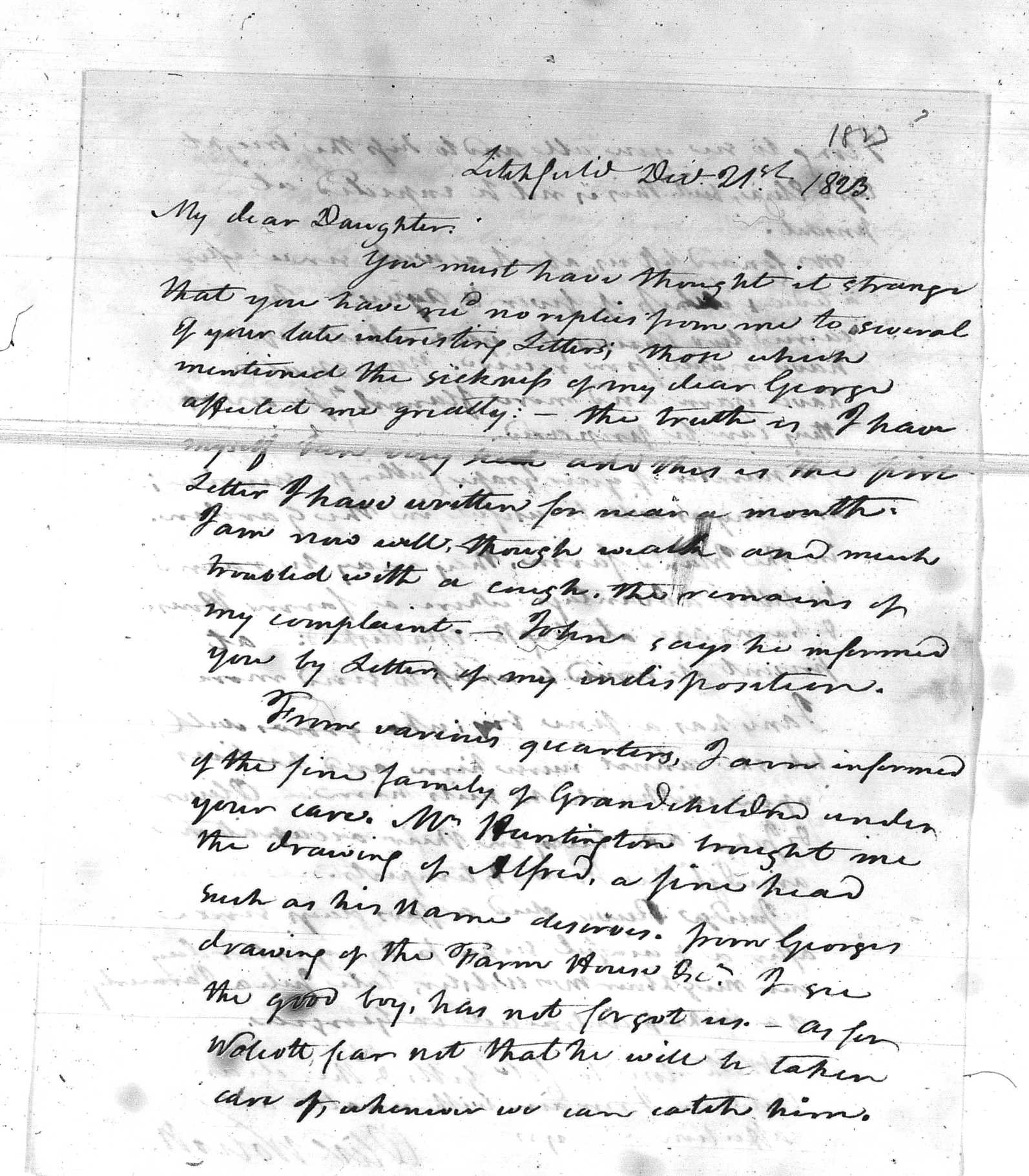
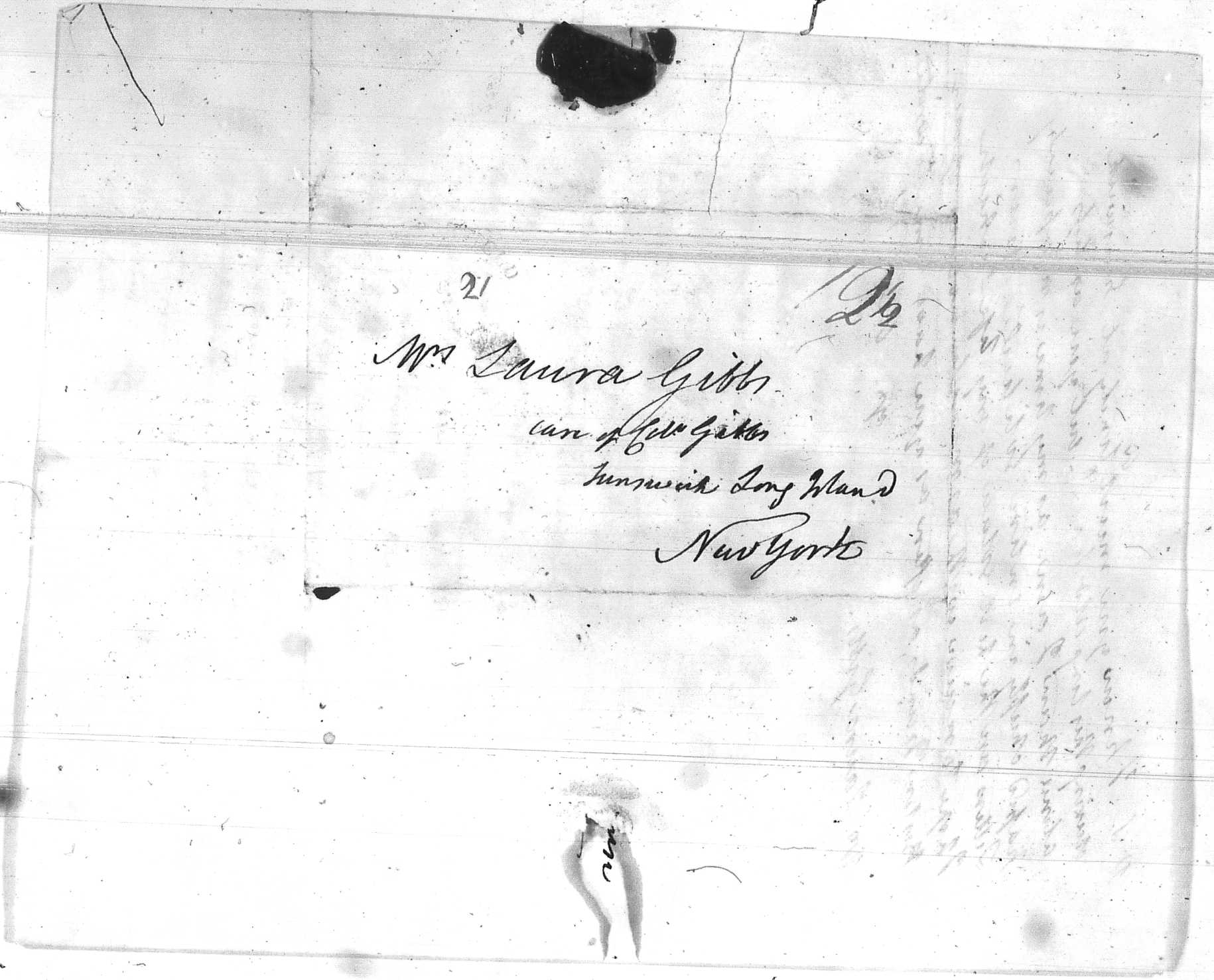
Litchfield Decr. 21st 1823.
My dear Daughter:
You must have thought it strange that you have recd. no replies from me to several of your late interesting Letters; those which mentioned the sickness of my dear George affected me greatly: the truth is I have myself been very [ill] and this is the first Letter I have written for near a month. I am now well, though weak and much troubled with a cough, the remains of my complaint. John says he informed you by Letter, of my indisposition.
From various quarters, I am informed of the fine family of Grandchildren under your care. Mr. Huntington brought me the drawing of Alfred, a fine head such as his Name deserves. From George’s drawing of the Farm House &c. I see the good boy, has not forgot us. As for Wolcott fear not that he will be taken care of, whenever we can catch him.
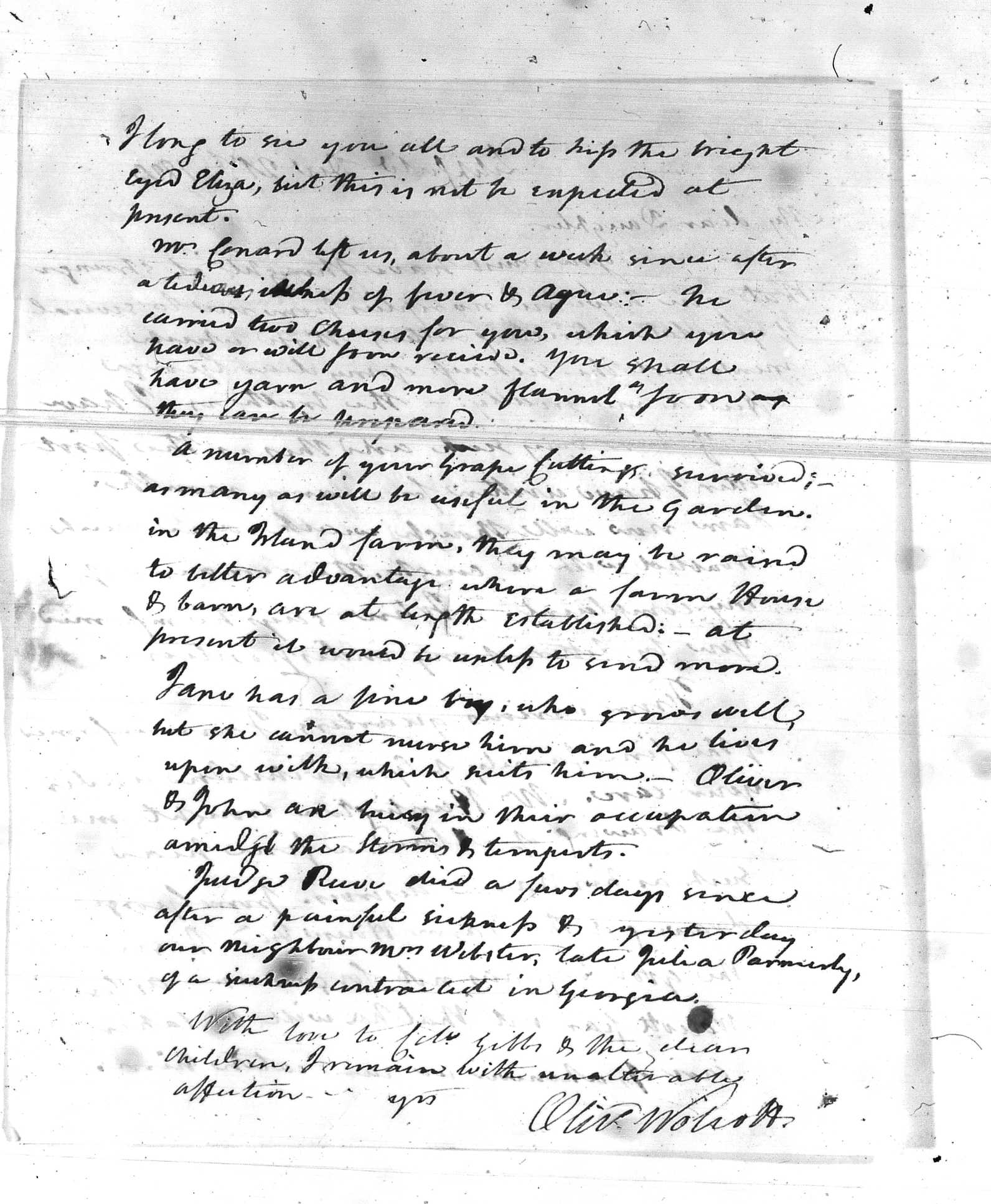
I long to see you all and to kiss the bright eyed Eliza, but this is not to be expected at present.
Mr. Conard [?] left us, about a week since after a tedious sickness of fever & Ague. He carried two Cheeses for you, which you have or will soon receive. You shall have yarn and more flannel as soon as they can be prepared.
A number of your Grape Cuttings survived; as many as will be useful in the Garden, in the Island farm. They may be raised to better advantage where a farm House & barn, are at length established: at present it would be useless to send more.
Jane has a fine boy, who grows well, but she cannot nurse him and he lives upon milk, which suits him. Oliver & John are busy in their occupation amidst the storms & tempests.
Judge Reeve died a few days since after a painful sickness & yesterday our Neighbour Mrs. Webster, late Julia Parmerly, of a sickness contracted in Georgia.
With love to Col. Gibbs & the dear Children, I remain with unalterable affection, yrs.
Oliv. Wolcott.
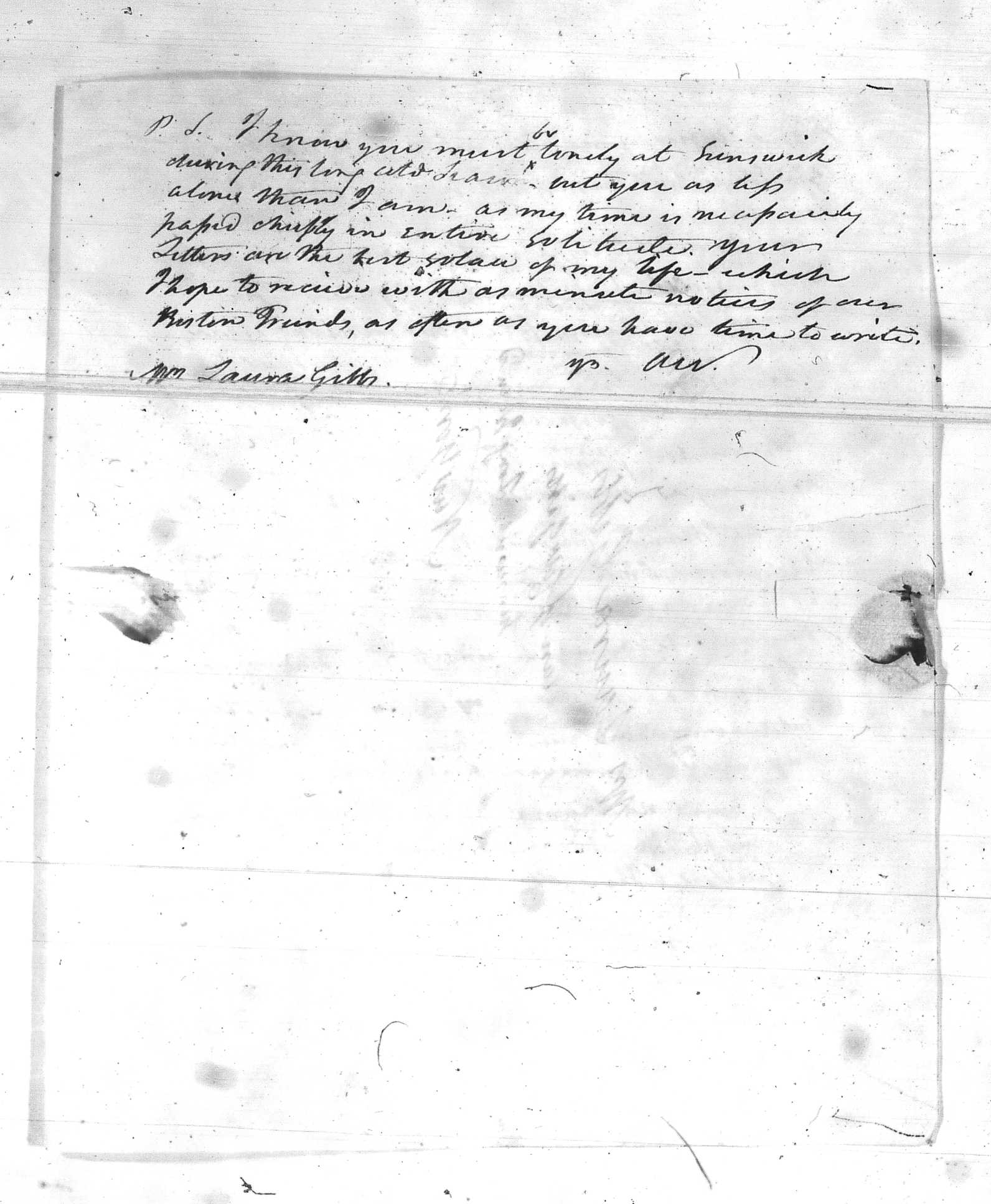
P.S. I know you must be lonely at Sunswick during this long cold Season, but you are as less alone than I am, as my time is necessarily passed chiefly in entire solitude. Your Letters are the best solace of my life, which I hope to receive with as minute notices of our Boston Friends, as often as you have time to write. yrs. O.W.
Mrs. Laura Gibbs.
[Address leaf:] Mrs. Laura Gibbs, care of Colo. Gibbs, Sunswick, Long Island, New York.
II · 1833The Blow
On August 6, 1833, Colonel George Gibbs died, and the world of the grandfather’s letter ended. Laura was thirty nine; her six living children ranged from George at eighteen down to little Francis at two. Under the law of the day a married woman could own almost nothing; a widowed executrix suddenly owned everything, the debts included. What Laura inherited was not a fortune but a problem: a working farm encumbered by mortgage bonds to the banking house of Prime, schoolboys whose tuition was due, and an estate whose income would not cover its interest. The two documents below, written eleven days apart in November 1833, are the sound of her taking stock. In the first she is candid: a $260 school bill is “of an unexpected amount I am myself not prepared to pay.” In the second, the family’s Boston trustee answers the question she had put to him and gives her the unsentimental arithmetic of her situation.
The First Ledger of Widowhood: A School Bill She Cannot Pay
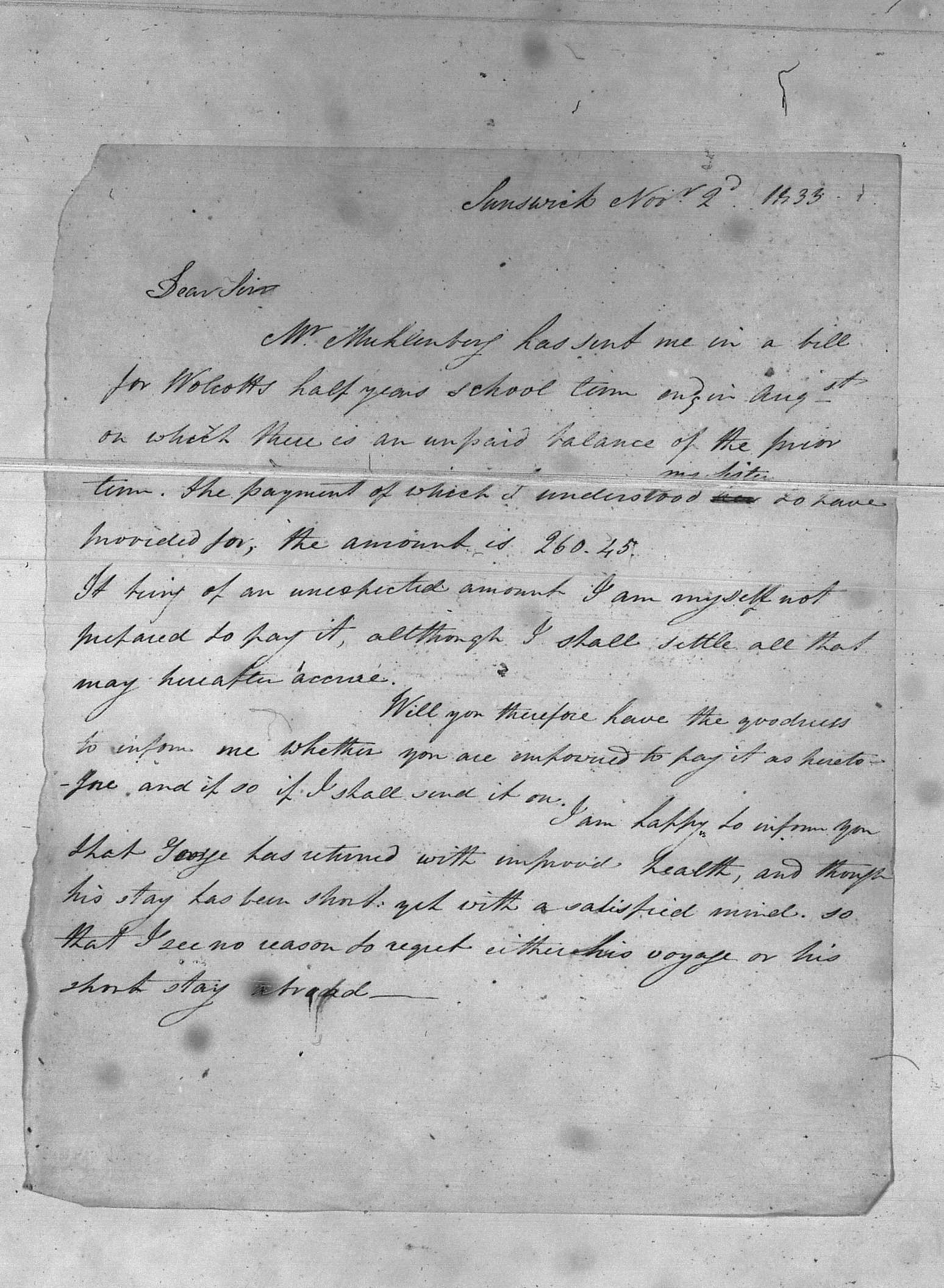
Sunswick Novr 2d 1833
Dear Sir,
Mr Muhlenberg has sent me in a bill for Wolcott’s half year’s school term ending in Augst, on which there is an unpaid balance of the prior term, the payment of which I understood my sister to have provided for; the amount is 260.45.
It being of an unexpected amount I am myself not prepared to pay it, allthough I shall settle all that may hereafter accrue.
Will you therefore have the goodness to inform me whether you are empowered to pay it as heretofore, and if so if I shall send it on.
I am happy to inform you that George has returned with improved health, and though his stay has been short, yet with a satisfied mind, so that I see no reason to regret either his voyage or his short stay abroad.
The Trustee’s Arithmetic: “Your Best Course Will Be to Sell”
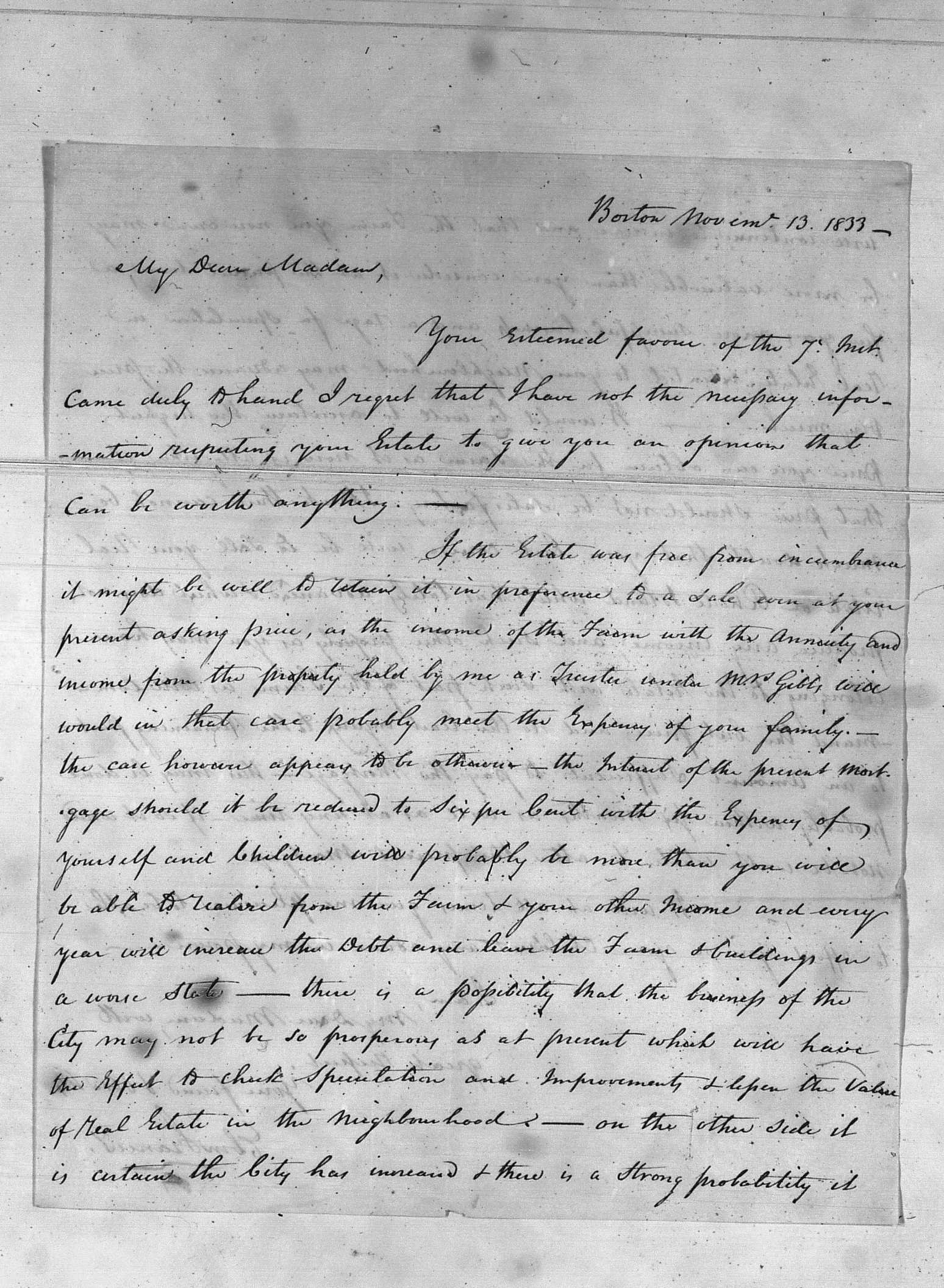
Boston Novemr 13. 1833
My Dear Madam,
Your esteemed favour of the 7th inst. came duly to hand. I regret that I have not the necessary information respecting your Estate to give you an opinion that can be worth anything.
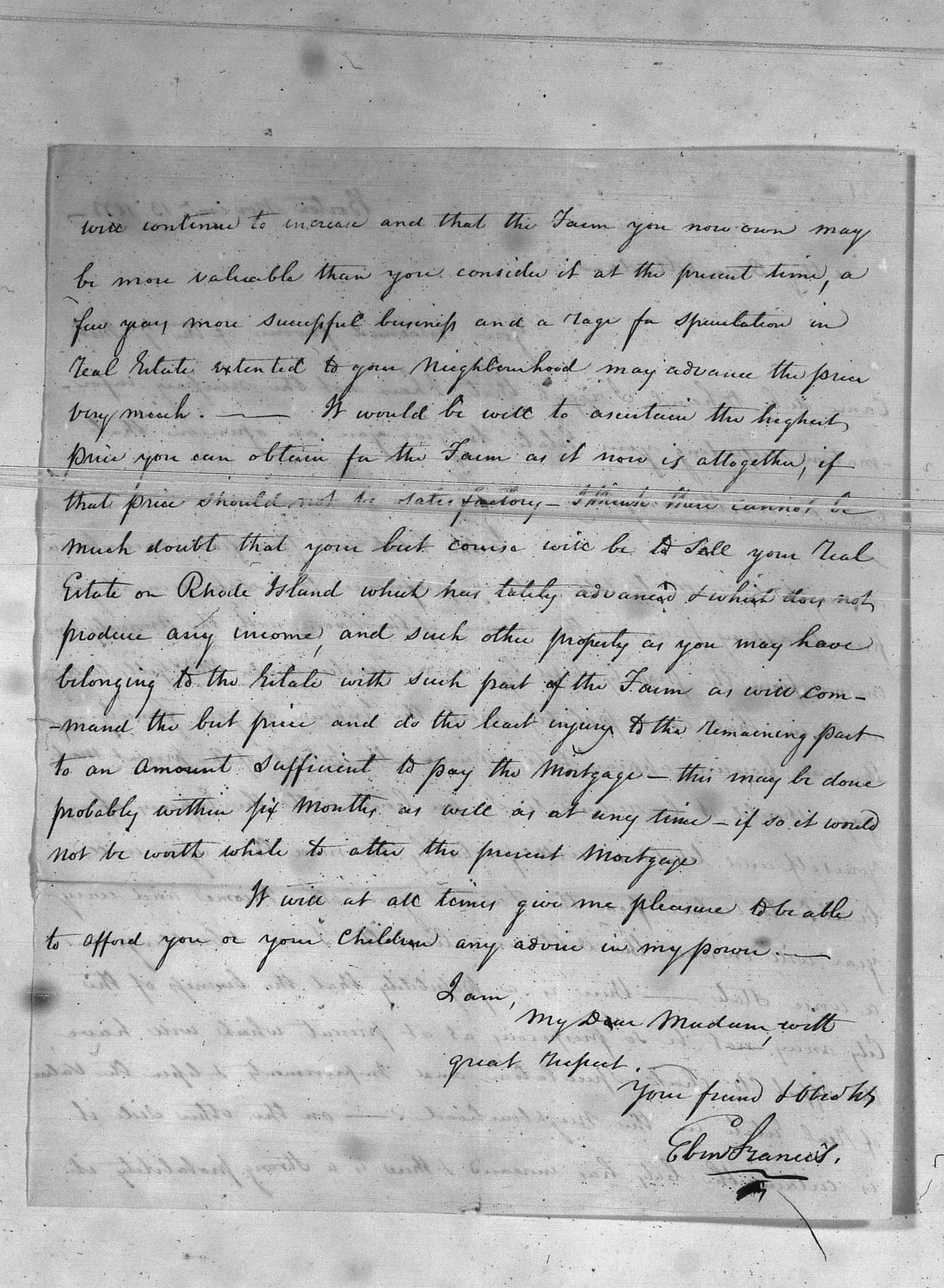
If the Estate was free from incumbrance it might be well to retain it in preference to a Sale even at your present asking price, as the income of the Farm with the Annuity and income from the property held by me as Trustee under Mrs Gibbs’ will would in that case probably meet the Expences of your family. The case however appears to be otherwise. The Interest of the present Mortgage, should it be reduced to Six per Cent, with the Expences of yourself and Children, will probably be more than you will be able to realize from the Farm and your other Income, and every year will increase the Debt and leave the Farm and buildings in a worse State. There is a possibility that the business of the City may not be so prosperous as at present, which will have the Effect to check Speculation and Improvements and lessen the Value of Real Estate in the Neighbourhood. On the other side it is certain the City has increased, and there is a Strong probability it will continue to increase, and that the Farm you now own may be more valuable than you consider it at the present time; a few years more successful business, and a rage for Speculation in Real Estate extended to your Neighbourhood, may advance the price very much.
It would be well to ascertain the highest price you can obtain for the Farm as it now is altogether; if that price should not be satisfactory, there cannot be much doubt that your best course will be to Sell your Real Estate on Rhode Island, which has lately advanced and which does not produce any income, and such other property as you may have belonging to the Estate, with such part of the Farm as will command the best price and do the least injury to the remaining part, to an amount sufficient to pay the Mortgage. This may be done probably within Six Months, as well as at any time. If so it would not be worth while to alter the present Mortgage.
It will at all times give me pleasure to be able to afford you or your Children any advice in my power.
I am, My Dear Madam, with great Respect, Your friend and Obt Servt,
Ebenr Francis.
III · 1834The Executrix
What follows is the part of the story that has never been visible before now: 1834, the year the widow became the family’s chief executive. She negotiated. She refused a low price on a Newport lot because she had found, in her late husband’s own letter book, the figure he had set. She sold the Hallett’s Cove land in two carefully structured installment purchases. She banked the payments, audited her agent, and sent the proceeds where the plan said they must go: against the principal of the estate’s debts. The paper survives at every step, down to the $3.50 it cost to carry her husband’s will to the surrogate at Jamaica.
The Negotiator: “To Sell It at 600 May Be at a Sacrifice”
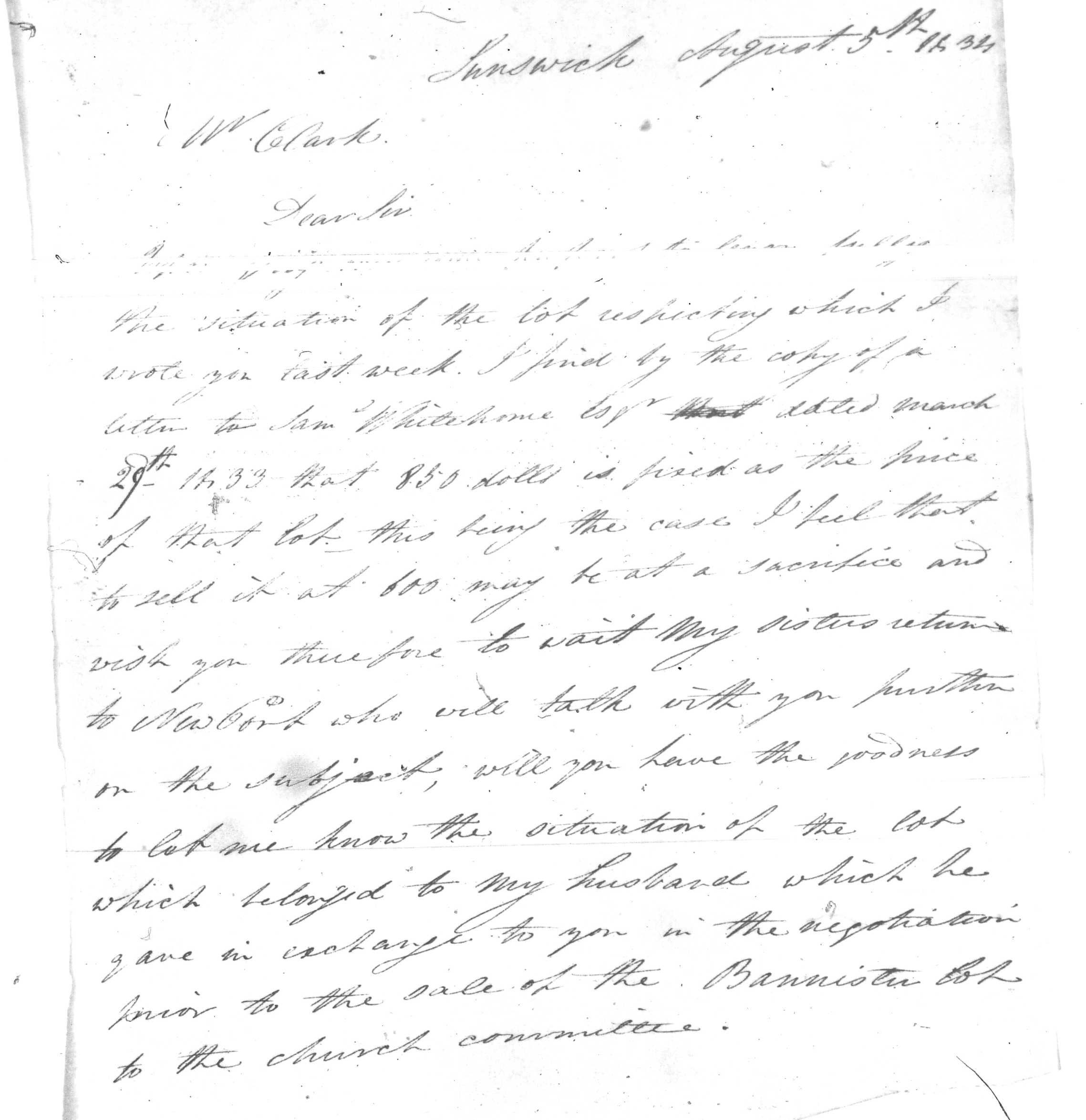
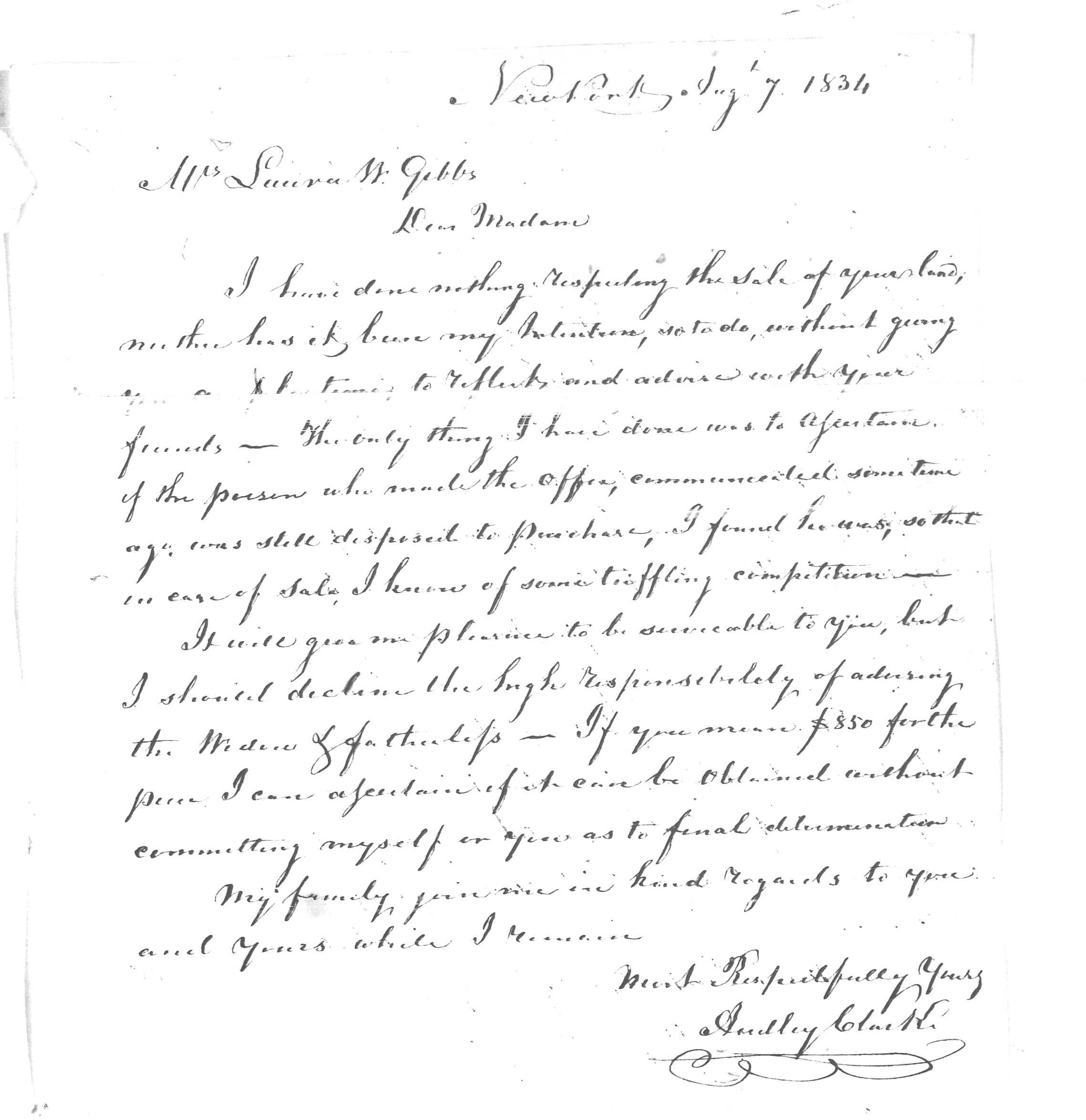
Laura W. Gibbs to Mr. Clark, Sunswick, August 5, 1834:
Sunswick August 5th 1834.
Mr. Clark.
Dear Sir,
[One line partly illegible] … to know fully the situation of the lot respecting which I wrote you last week. I find by the copy of a letter to Saml. Whitehorne Esqr. dated March 29th 1833 that 850 dolls. is fixed as the price of that lot. This being the case I feel that to sell it at 600 may be at a sacrifice and wish you therefore to wait My sister’s return to Newport who will talk with you further on the subject. Will you have the goodness to let me know the situation of the lot which belonged to My husband which he gave in exchange to you in the negotiation prior to the sale of the Bannister lot to the church committee.
[The closing and signature are not on the scanned page.]
Audley Clarke’s reply, August 7, 1834:
New[port or York?] Augt. 7. 1834
Mrs Laura W. Gibbs
Dear Madam
I have done nothing respecting the Sale of your land, neither has it been my intention, so to do, without giving you ample time to reflect, and advise with your friends. The only thing I have done was to ascertain if the person who made the offer, communicated some time ago, was still disposed to purchase. I found he was; so that in case of Sale, I know of some trifling competition.
It will give me pleasure to be serviceable to you, but I should decline the high responsibility of advising the Widow & fatherless. If you mean $850 for the price I can ascertain if it can be obtained without committing myself or you as to final determination.
My family join me in kind regards to you and yours, while I remain
Most Respectfully Yours
Audley Clark[e].
The Sale: Two Bonds of Barnabas Bates for the Land at Hallett’s Cove
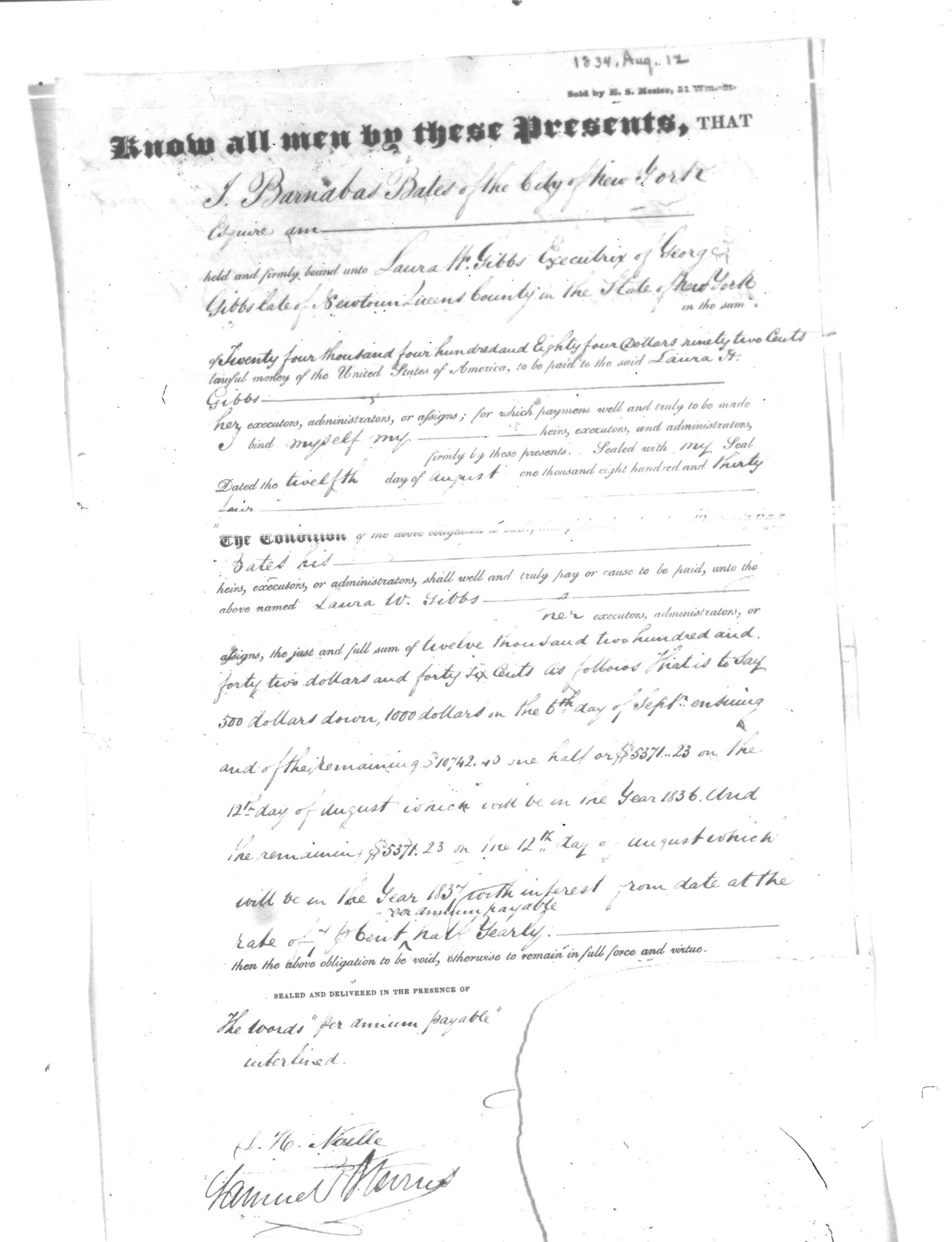
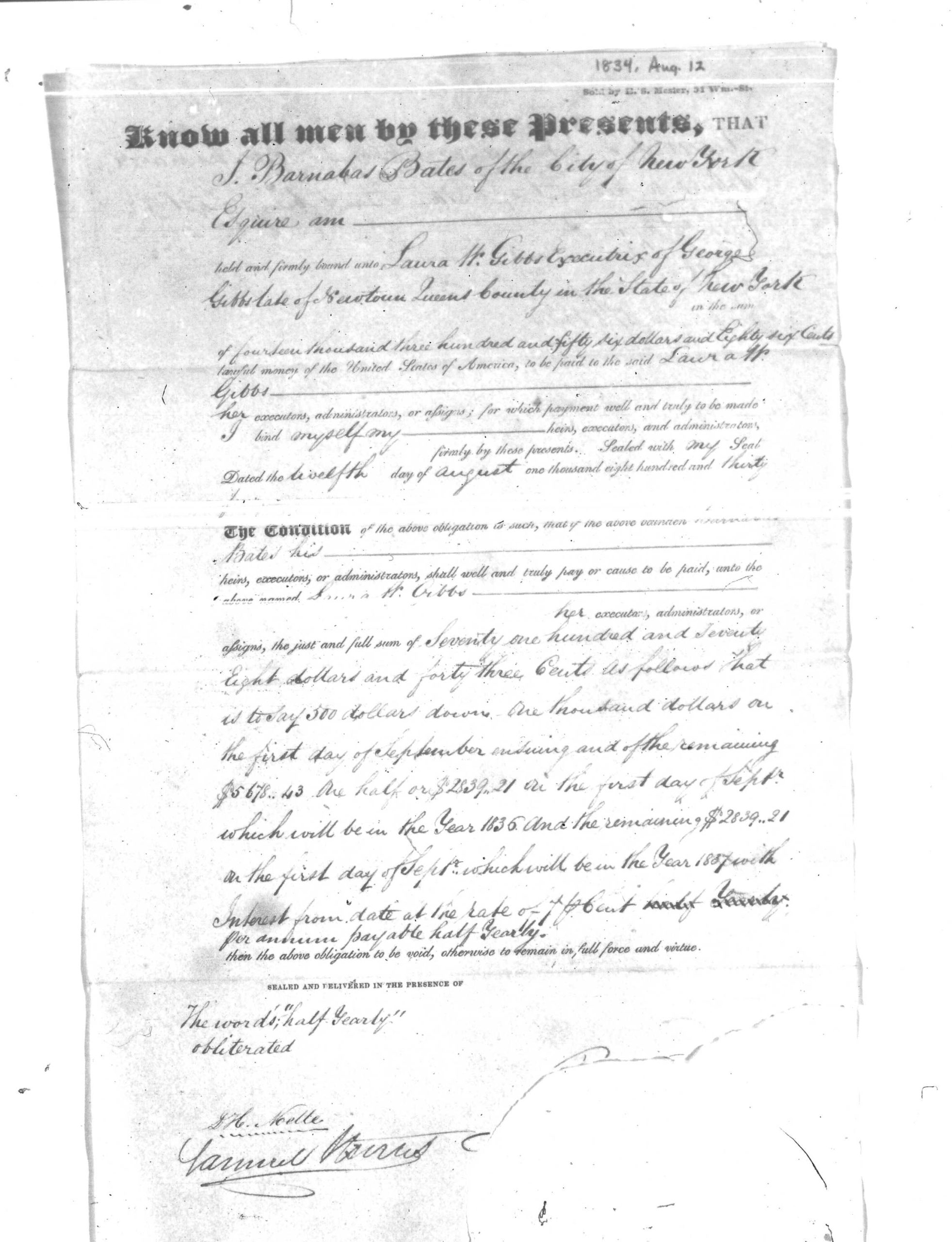
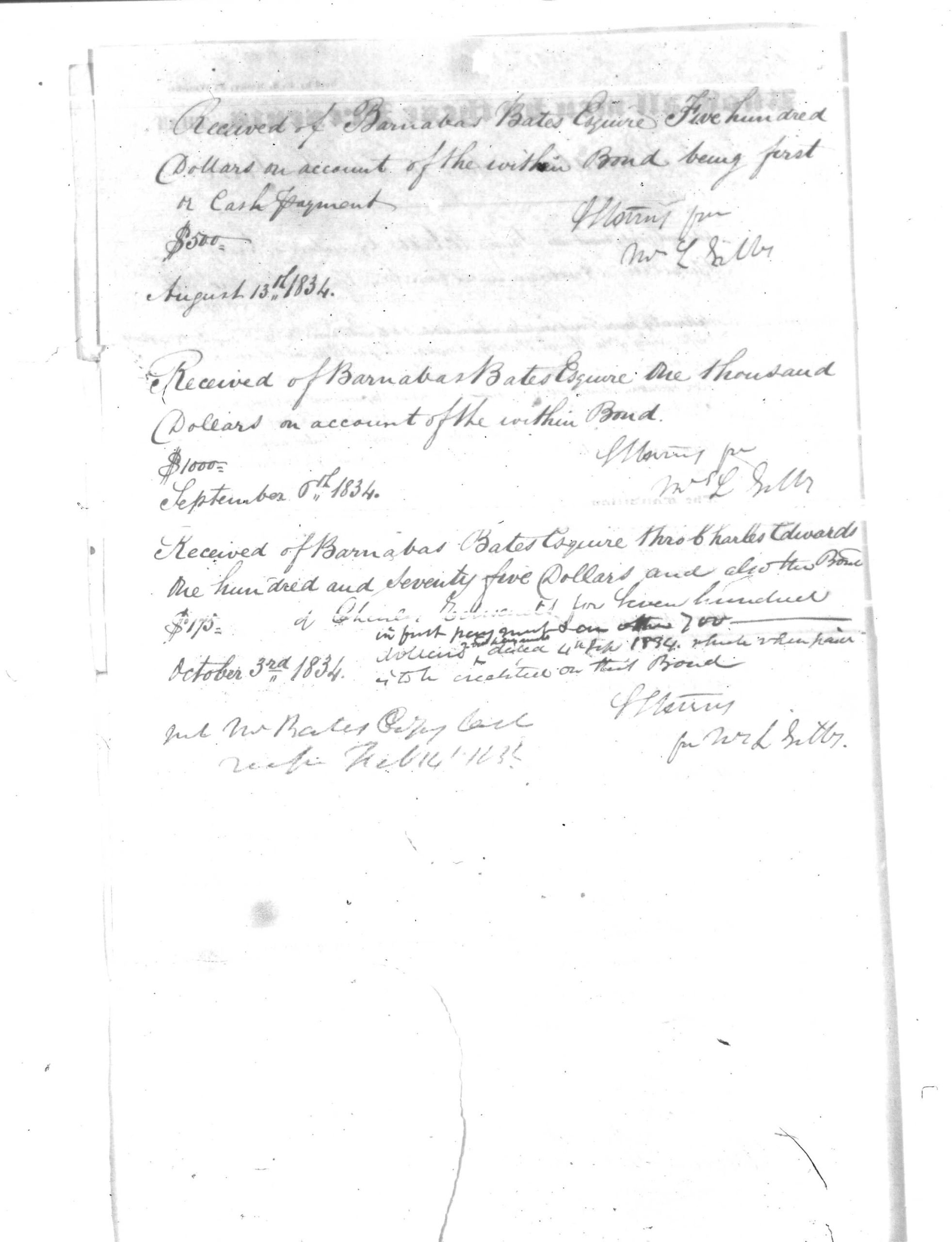
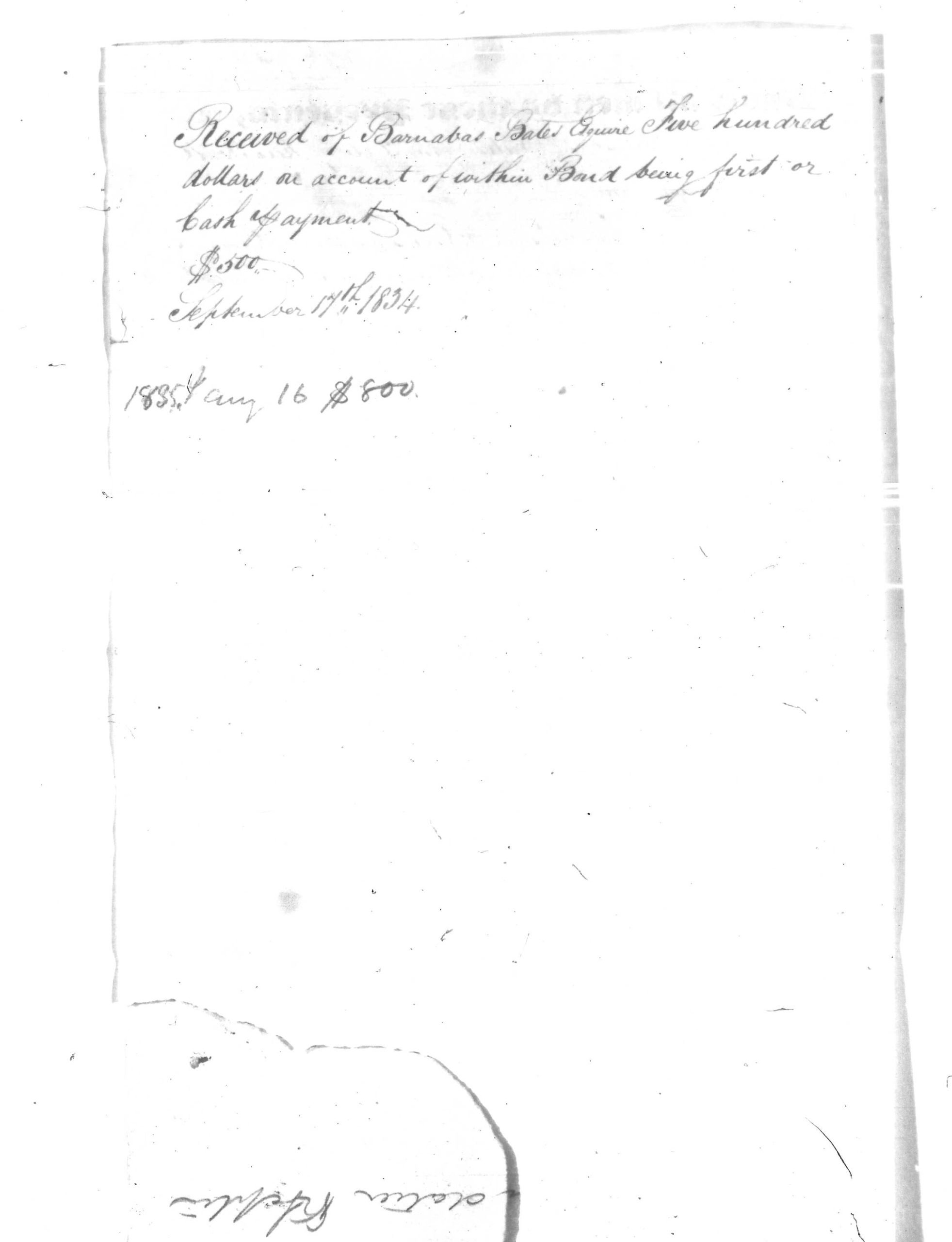
First bond, August 12, 1834 (scan 901):
[Docketed:] 1834, Aug. 12. [Printed form, sold by E. S. Mesier, 31 Wm.-St.]
Know all men by these Presents, that I, Barnabas Bates of the City of New York Esquire am held and firmly bound unto Laura W. Gibbs Executrix of George Gibbs late of Newtown Queens county in the State of New York in the sum of Twenty four thousand four hundred and Eighty four Dollars ninety two Cents lawful money of the United States of America, to be paid to the said Laura W. Gibbs her executors, administrators, or assigns; for which payment well and truly to be made I bind myself my heirs, executors, and administrators, firmly by these presents. Sealed with my Seal. Dated the twelfth day of August one thousand eight hundred and thirty four.
The Condition of the above obligation is such, that if the above bounden Barnabas Bates his heirs, executors, or administrators, shall well and truly pay or cause to be paid, unto the above named Laura W. Gibbs her executors, administrators, or assigns, the just and full sum of Twelve thousand two hundred and forty two dollars and forty six Cents as follows That is to say 500 dollars down, 1000 dollars on the 6th day of Septr. ensuing and of the remaining $10,742.46 one half or $5,371.23 on the 12th day of August which will be in the Year 1836. And the remaining $5,371.23 on the 12th day of August which will be in the Year 1837, with interest from date at the rate of 7 per Cent per annum payable half Yearly, then the above obligation to be void, otherwise to remain in full force and virtue.
Sealed and delivered in the presence of [the words “per annum payable” interlined]
J. H. Nevill [?]
Samuel Stevens [?]
Receipts endorsed on the first bond (scan 902):
Received of Barnabas Bates Esquire Five hundred Dollars on account of the within Bond being first or Cash Payment. $500. August 13th 1834. S. Stevens [?] for Mrs L. Gibbs.
Received of Barnabas Bates Esquire One thousand Dollars on account of the within Bond. $1000. September 6th 1834. S. Stevens [?] for Mrs L. Gibbs.
Received of Barnabas Bates Esquire thro’ Charles Edwards One hundred and Seventy five Dollars, and also the Bond of Charles Edwards for Seven hundred dollars [interlined: in first payment & endorsements, dated 4th Feby 1834, which when paid is to be credited on this Bond]. $175. October 3rd 1834. S. Stevens [?] for Mrs L. Gibbs. [A further pencil memorandum, partly legible, notes a payment received in 1835.]
Second bond (scan 904; the wrapper carries a pencil note, “Should have been dated 8 Septr 1834”):
Know all men by these Presents, that I, Barnabas Bates of the City of New York Esquire am held and firmly bound unto Laura W. Gibbs Executrix of George Gibbs late of Newtown Queens county in the State of New York in the sum of fourteen thousand three hundred and fifty six dollars and Eighty six Cents lawful money of the United States of America, to be paid to the said Laura W. Gibbs her executors, administrators, or assigns; for which payment well and truly to be made I bind myself my heirs, executors, and administrators, firmly by these presents. Sealed with my Seal. Dated the twelfth day of [August] one thousand eight hundred and thirty four.
The Condition of the above obligation is such, that if the above bounden Barnabas Bates his heirs, executors, or administrators, shall well and truly pay or cause to be paid, unto the above named Laura W. Gibbs her executors, administrators, or assigns, the just and full sum of Seventy one hundred and Seventy Eight dollars and forty three Cents as follows That is to say 500 dollars down, One thousand dollars on the first day of September ensuing and of the remaining $5,678.43 One half or $2,839.21 on the first day of Septr. which will be in the Year 1836 And the remaining $2,839.21 on the first day of Septr. which will be in the Year 1837 with Interest from date at the rate of 7 per Cent per annum payable half Yearly, then the above obligation to be void, otherwise to remain in full force and virtue.
Sealed and delivered in the presence of [the words “half Yearly” obliterated]
J. H. Nevill [?]
Samuel Stevens [?]
Receipt endorsed on the second bond (scan 906):
Received of Barnabas Bates Esquire Five hundred dollars on account of within Bond being first or Cash payment. $500. September 17th 1834. [Pencil:] 1835 Aug 16 $800.
The Estate Ledger: A Year of Widowhood in Double Entry
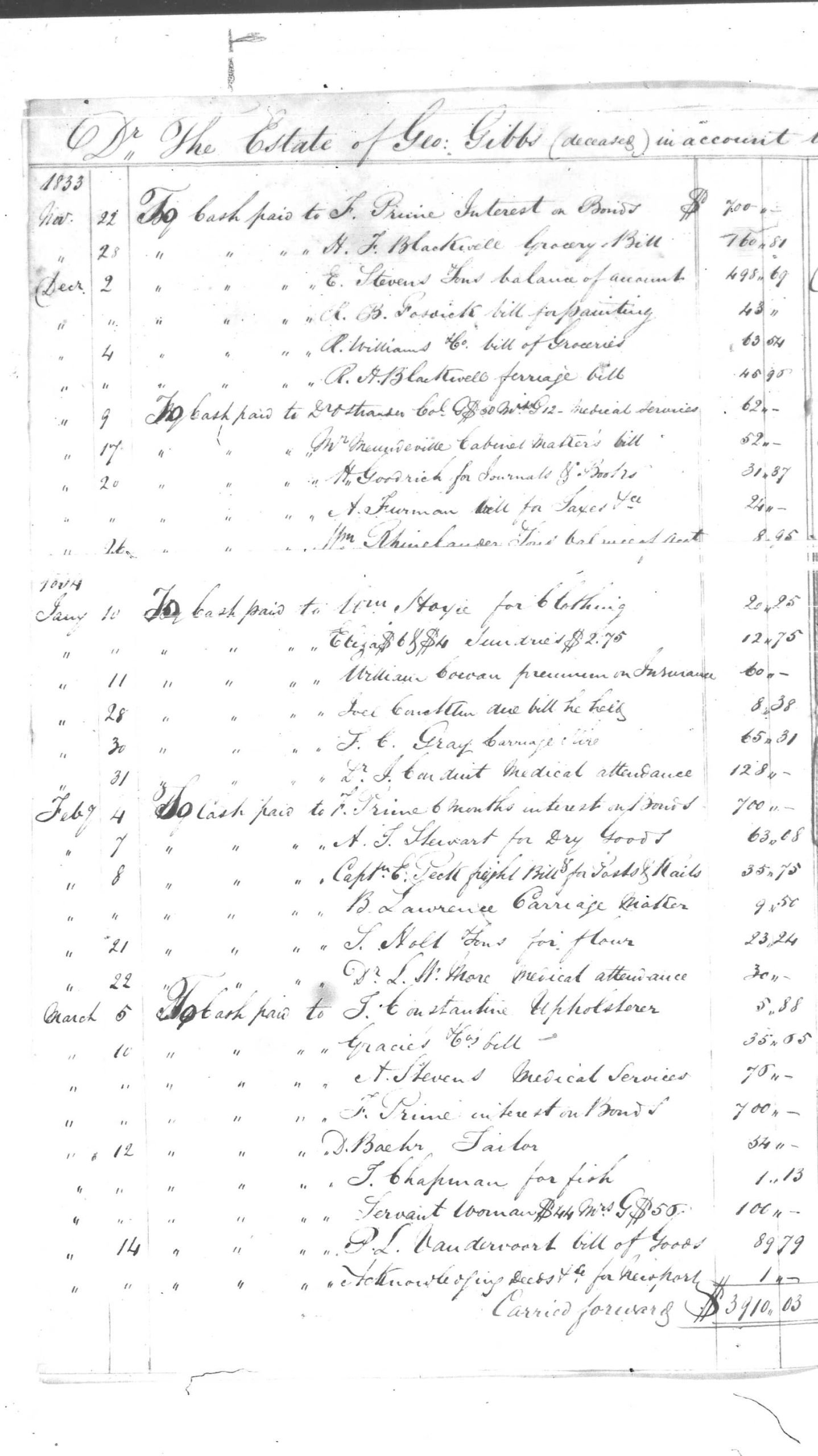
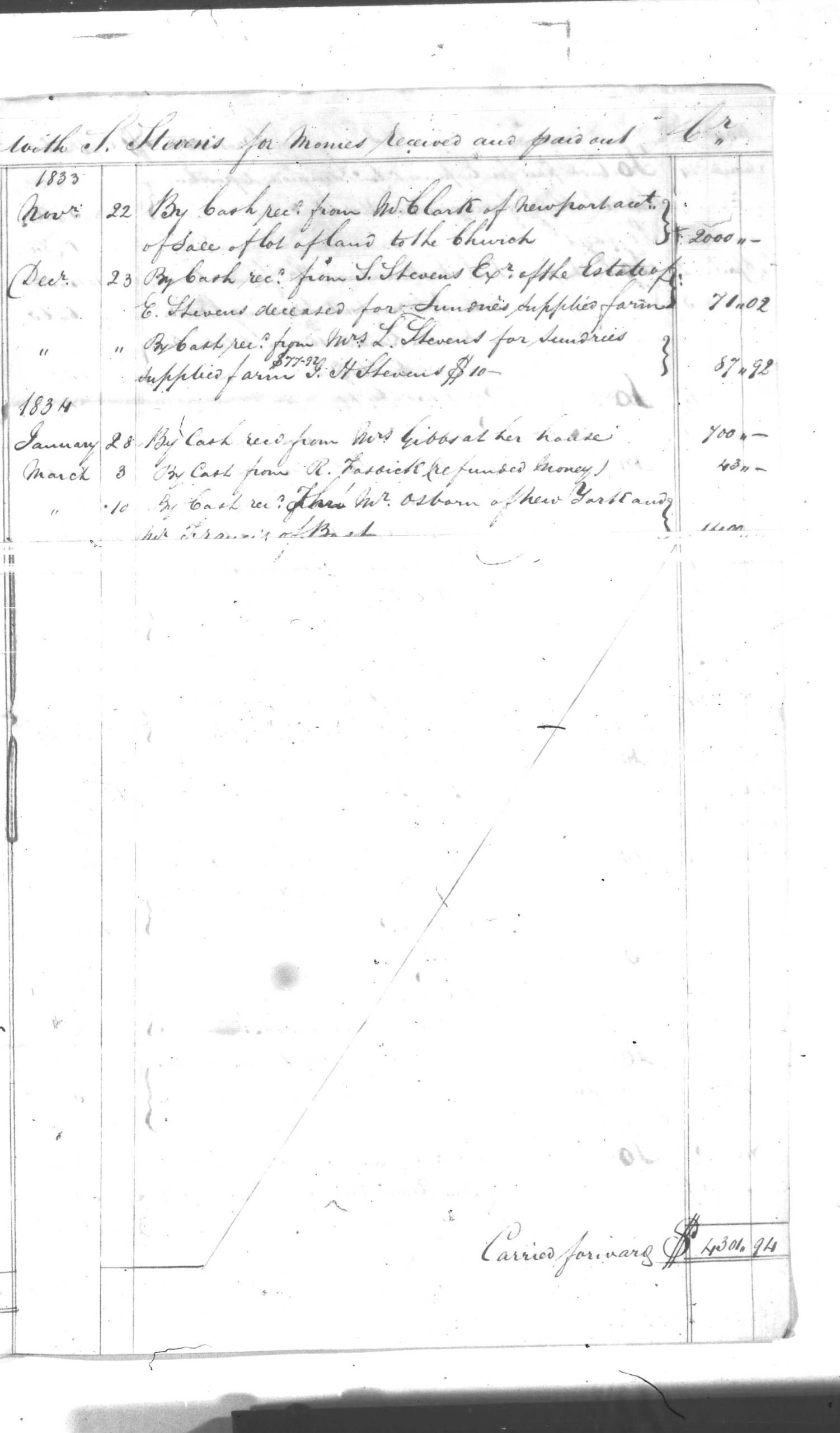
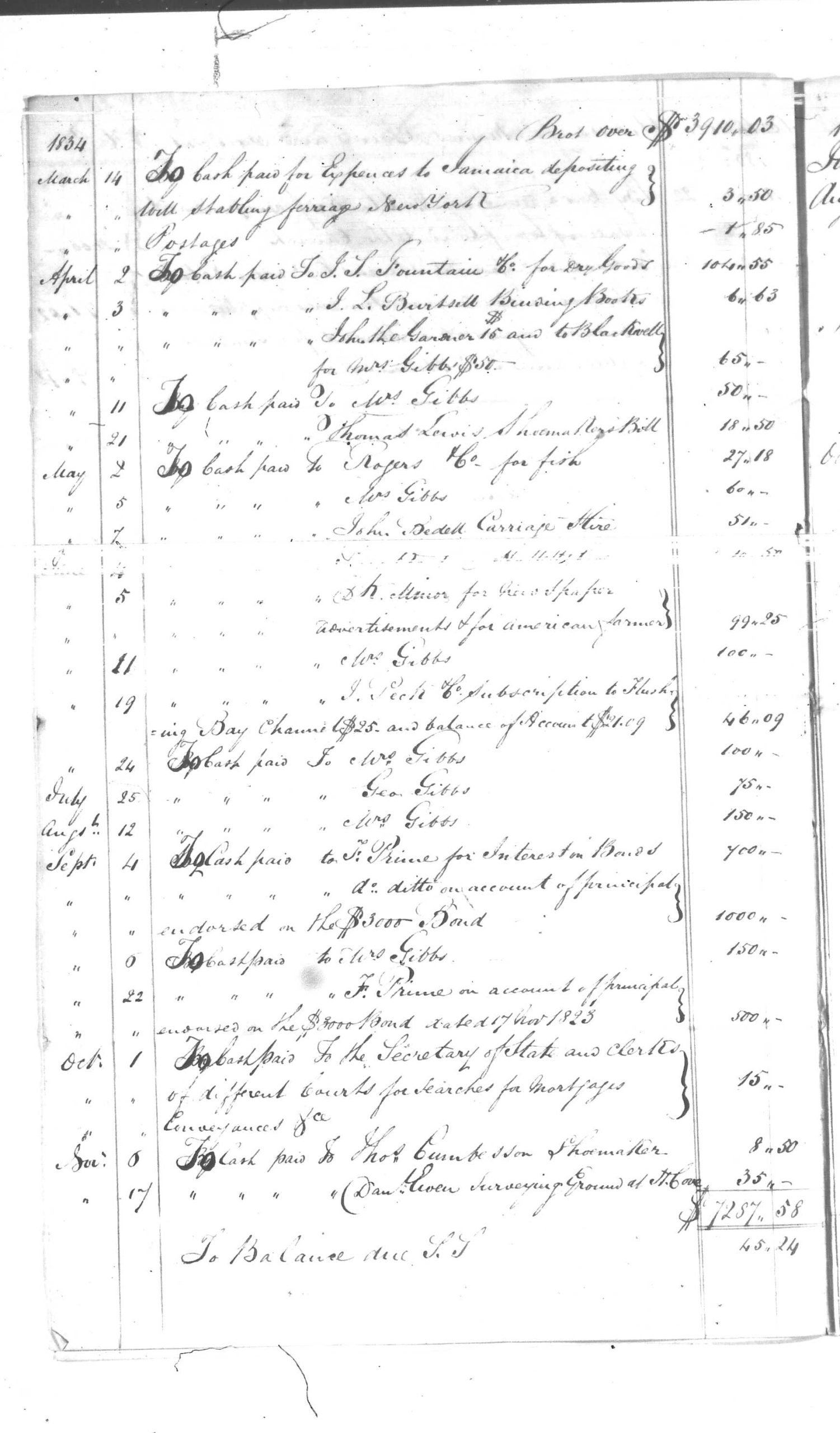
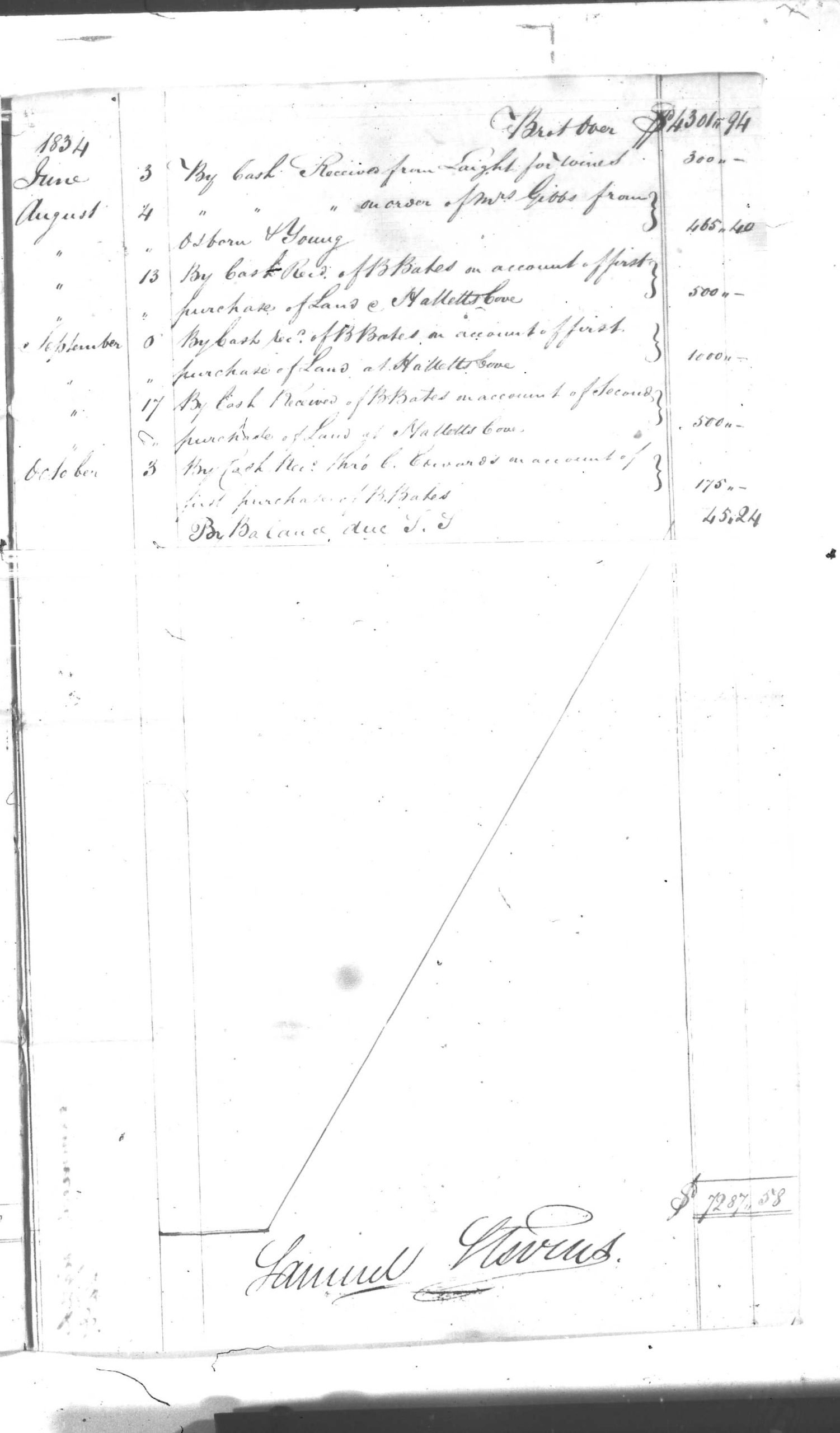
Debit side, first page (scan 919a). Figures difficult at scan resolution are flagged [?]; the totals are the clerk’s own.
Dr. The Estate of Geo: Gibbs (deceased) in account …
1833. Novr. 22. To Cash paid to F. Prime, Interest on Bonds … 700.-
” 28. ” H. F. Blackwell, Grocery Bill … 760.81 [?]
Decr. 2. ” E. Stevens & Sons, balance of account … 498.69
” ” ” R. B. Fosdick, bill for painting … 43.-
” 4. ” R. Williams & Co., bill of Groceries … 65.64 [?]
” ” ” R. & H. Blackwell, ferriage bill … 45.95 [?]
” 9. To Cash paid to Dr. Strahan [?] & Co. $50, Mrs. G. $12, medical services … 62.-
” 17. ” Mr. Mandeville [?], cabinet maker’s [?] bill … 62.-
” 20. ” A. Goodrich, for Journals & Books … 31.37
” ” ” A. Furman, bill for Taxes &c … 24.- [?]
” 26 [?]. ” Wm. Rhinelander, [balance of account?] … 8.95
1834. Jany. 10. To Cash paid to Wm. Hoxie, for Clothing … 20.25
” ” ” Eliza $[10?], Sundries $2.75 … 12.75
” 11. ” William Cowan, premium on Insurance … 60.-
” 28. ” Joel Conklin [?], due bill he held … 8.38
” 30. ” F. C. Gray [?], Carriage Hire … 65.31
” 31. ” Dr. J. Conduit, Medical attendance … 128.-
Feby. 4. To Cash paid to F. Prime, 6 months interest on Bonds … 700.-
” 7. ” A. T. Stewart, for Dry Goods … 63.08
” 8. ” Capt. E. Peck, freight Bills for Posts & Rails … 35.75
” ” ” B. Lawrence, Carriage Maker … 9.50
” 21. ” S. Holt & Sons, for flour … 23.24
” 22. ” Dr. L. W. More, Medical attendance … 30.-
March 5. To Cash paid to J. Constantine, Upholsterer … 5.88
” 10. ” Gracie & Co.’s bill … 35.65
” ” ” A. Stevens, Medical Services … 76.-
” ” ” F. Prime, interest on Bonds … 700.-
” 12. ” D. Baehr, Tailor … 54.-
” ” ” J. Chapman, for fish … 1.13
” ” ” Servant Woman $44 [?], Mrs. G. $50 [?] … 100.-
” 14. ” P. L. Vandervoort, bill of Goods … 89.79
” ” ” Acknowledging deeds &c. for Newport … 1.-
Carried forward … $3,910.03
Credit side, first page (scan 919b):
… with S. Stevens for Monies received and paid out. Cr.
1833. Novr. 22. By Cash recd. from Mr Clark of Newport acct. of Sale of lot of land to the Church … $2,000.-
Decr. 23. By Cash recd. from S. Stevens Exr. of the Estate of E. Stevens deceased for Sundries supplied farm … 71.02
” ”. By Cash recd. from Mrs L. Stevens for sundries supplied farm $77.92, [F.?] H. Stevens $10 … 87.92
1834. January 28. By Cash recd from Mrs Gibbs at her house … 700.-
March 3. By Cash from R. Fosdick (refunded money) … 43.-
” 10. By Cash recd. thro’ Mr. Osborn of New York and Mr Francis of Bost[on] … [1,400?]
Carried forward … $4,306.94
Debit side, second page (scan 920a):
1834. Brot over … $3,910.03
March 14. To Cash paid for Expences to Jamaica depositing Will, stabling, ferriage New York … 3.50
” ”. Postages … 1.85
April 2. To Cash paid to J. S. Fountain & Co. for dry Goods … 104.55
” 3. ” J. L. Burtsell, binding Books … 6.63
” ”. ” John the Gardener $15 and to Blackwell for Mrs Gibbs $50 … 65.-
” 11. To Cash paid to Mrs Gibbs … 50.-
” 21. ” Thomas Lewis, Shoemaker’s Bill … 18.50
May 2. To Cash paid to Rogers & Co. for fish … 27.18
” 5. ” Mrs Gibbs … 60.-
” 7. ” John Bedell, Carriage Hire … 51.-
[June] 4 [?]. [entry faded at the fold, largely illegible] … [?]
” 5. ” S. K. Minor for [?] advertisements & for American Farmer … 99.25
” 11. ” Mrs Gibbs … 100.-
” 19. ” J. Peck & Co., subscription to Flushing Bay Channel $25 and balance of Account $21.09 … 46.09
” 24. To Cash paid to Mrs Gibbs … 100.-
July 25. ” Geo. Gibbs … 75.-
Augt. 12. ” Mrs Gibbs … 150.-
Septr. 4. To Cash paid to F. Prime for Interest [on] Bonds … 700.-
” ”. ” do. ditto on account of principal, endorsed on the $3000 Bond … 1,000.-
” 6. To Cash paid to Mrs Gibbs … 150.-
” 22. ” F. Prime on account of principal endorsed on the $8000 Bond dated 17 Nov 1823 … 500.-
Oct. 1. To Cash paid to the Secretary of State and Clerks of different Courts for Searches for Mortgages, Conveyances &c … 15.-
Nov. 6. To Cash paid to Thos. Cumbes[son?], Shoemaker … 8.50
” 17. ” Dan. Given, Surveying Ground at H[allett’s] Cove … 35.-
… $7,287.58
To Balance due S. S. … 45.24
Credit side, second page (scan 920b), signed:
1834. Brot over … $4,306.94
June 3. By Cash Received from Laight for wines [?] … 300.-
August 4. ” ” on order of Mrs Gibbs from Osborn & Young … 465.40
” 13. By Cash Recd. of B. Bates on account of first purchase of Land at Halletts Cove … 500.-
September 6 [?]. By Cash recd. of B. Bates on account of first purchase of Land at Halletts Cove … 1,000.-
” 17. By Cash Received of B. Bates on account of second purchase of Land at Halletts Cove … 500.-
October 3. By Cash Recd. thro’ C. Edwards on account of first purchase of B. Bates … 175.-
By Balance due S. S. … 45.24
… $7,287.58
Samuel Stevens.
[Docket wrapper, scans 921-922:] S. Stevens’s account with Mrs L. W. Gibbs. [Pencil:] examined-right.
IV · November 1834The Monument
Here is the measure of the woman. In the very weeks the Bates installments were arriving, and every dollar had an assignment, Laura Gibbs took the most valuable single object her husband had owned, the celebrated mass of meteoric iron that crowned his collection, and gave it away. Not sold: given, to Yale, on the understanding that it would stand within the Gibbs Cabinet as her husband’s monument. The two letters below from Benjamin Silliman, the great Yale scientist who had been her husband’s friend and the cabinet’s keeper, document the gift from first negotiation to thanks, and contain, in their eulogy of the Colonel, the finest portrait of Alfred’s father that survives.
Silliman Writes: A Monument of Iron
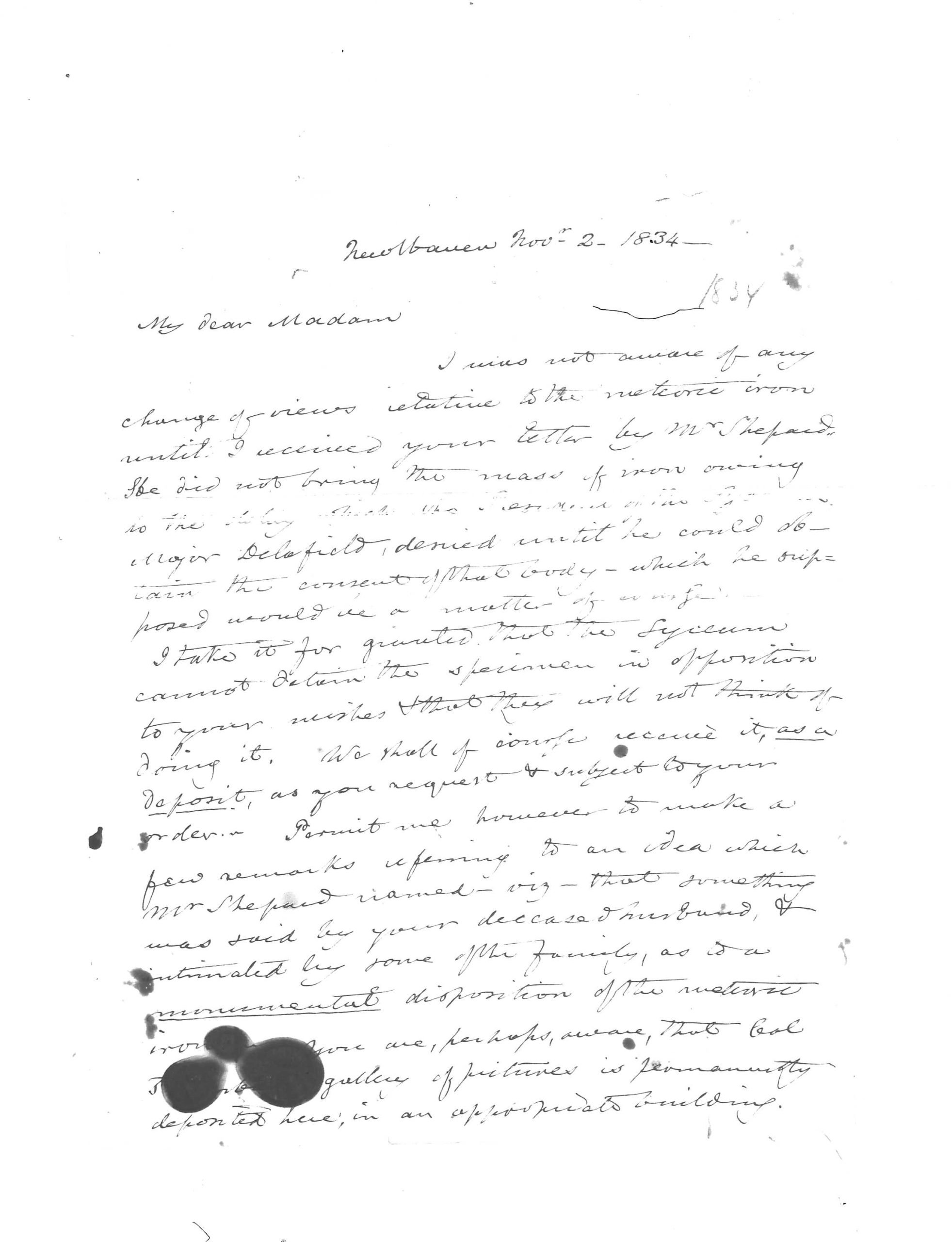
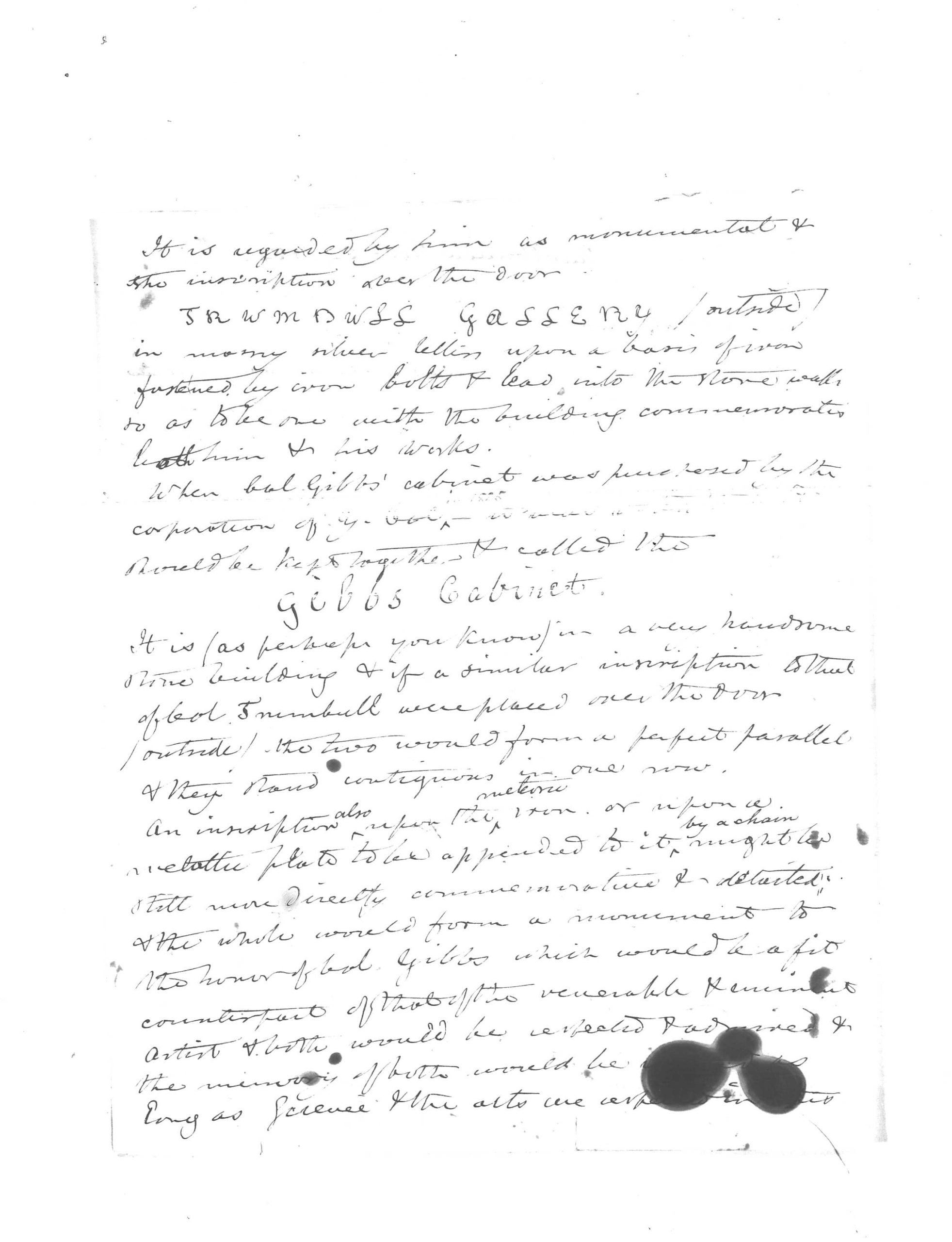
New Haven Novr. 2. 1834.
My dear Madam
I was not aware of any change of views relative to the meteoric iron until I received your letter by Mr Shepard. He did not bring the mass of iron owing to the delay which the President of the Ly[ceum], Major Delafield, [interposed; he] denied [it] until he could obtain the consent of that body, which he supposed would be a matter of course.
I take it for granted that the Lyceum cannot detain the specimen in opposition to your wishes & that they will not think of doing it. We shall of course receive it, as a deposit, as you request & subject to your order. Permit me however to make a few remarks referring to an idea which Mr Shepard named, viz, that something was said by your deceased husband, & intimated by some of the family, as to a monumental disposition of the meteoric iron. You are, perhaps, aware, that Col [Trumbull’s] gallery of pictures is permanently deposited here, in an appropriate building. It is regarded by him as monumental & the inscription over the door
TRUMBULL GALLERY (outside)
in massy silver letters upon a basis of iron fastened by iron bolts & lead into the stone walls so as to be one with the building commemorates both him & his works.
When Col Gibbs’ cabinet was purchased by the corporation of Y. Col. it was [understood] it would be kept together & called the
Gibbs Cabinet.
It is (as perhaps you know) in a new handsome stone building & if a similar inscription to that of Col Trumbull were placed over the door (outside) the two would form a perfect parallel & they stand contiguous in one row.
An inscription also upon the meteoric iron, or upon a metallic plate to be appended to it by a chain, might be still more directly commemorative & detailed, & the whole would form a monument to the honor of Col. Gibbs which would be a fit counterpart of that of the venerable & eminent artist & both would be respected & admired & the memories of both would be [cherished as] long as Science & the arts are [respected in this] country.
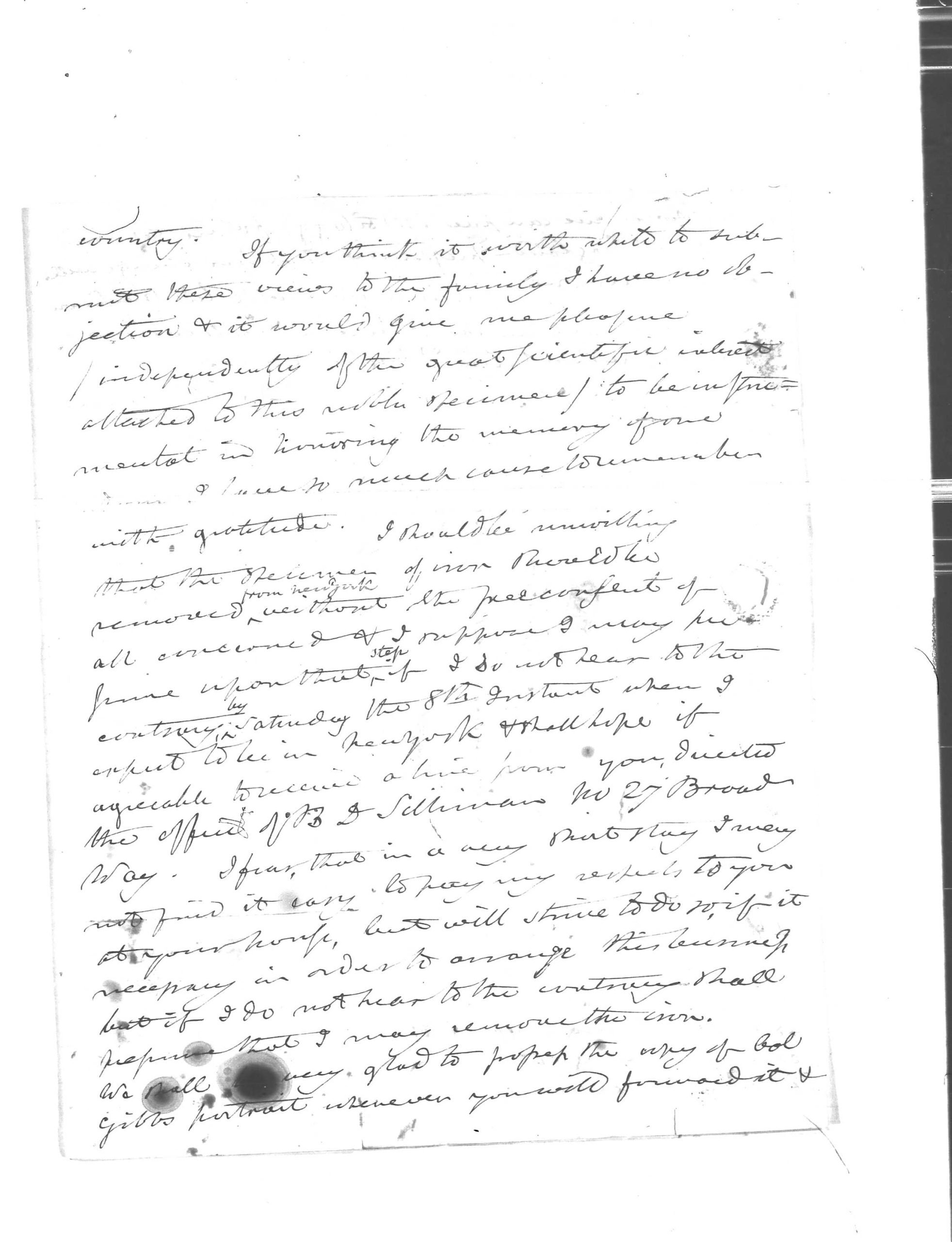
If you think it worth while to submit these views to the family I have no objection & it would give me pleasure (independently of the great scientific interest attached to this noble specimen) to be instrumental in honoring the memory of one whom I have so much cause to remember with gratitude.
I should be unwilling that the specimen of iron should be removed [from New York] without the free consent of all concerned & I suppose I may presume upon that [step] if I do not hear to the contrary by Saturday the 8th Instant when I expect to be in New York & shall hope if agreeable to receive a line from you, directed to the office of B. D. Silliman No 27 Broadway. I fear, that in a very short stay I may not find it easy to pay my respects to you at your house, but will strive to do so, if it [be] necessary in order to arrange this business, but if I do not hear to the contrary shall presume that I may remove the iron. We shall [be] very glad to possess the copy of Col Gibbs’ portrait whenever you will forward it &
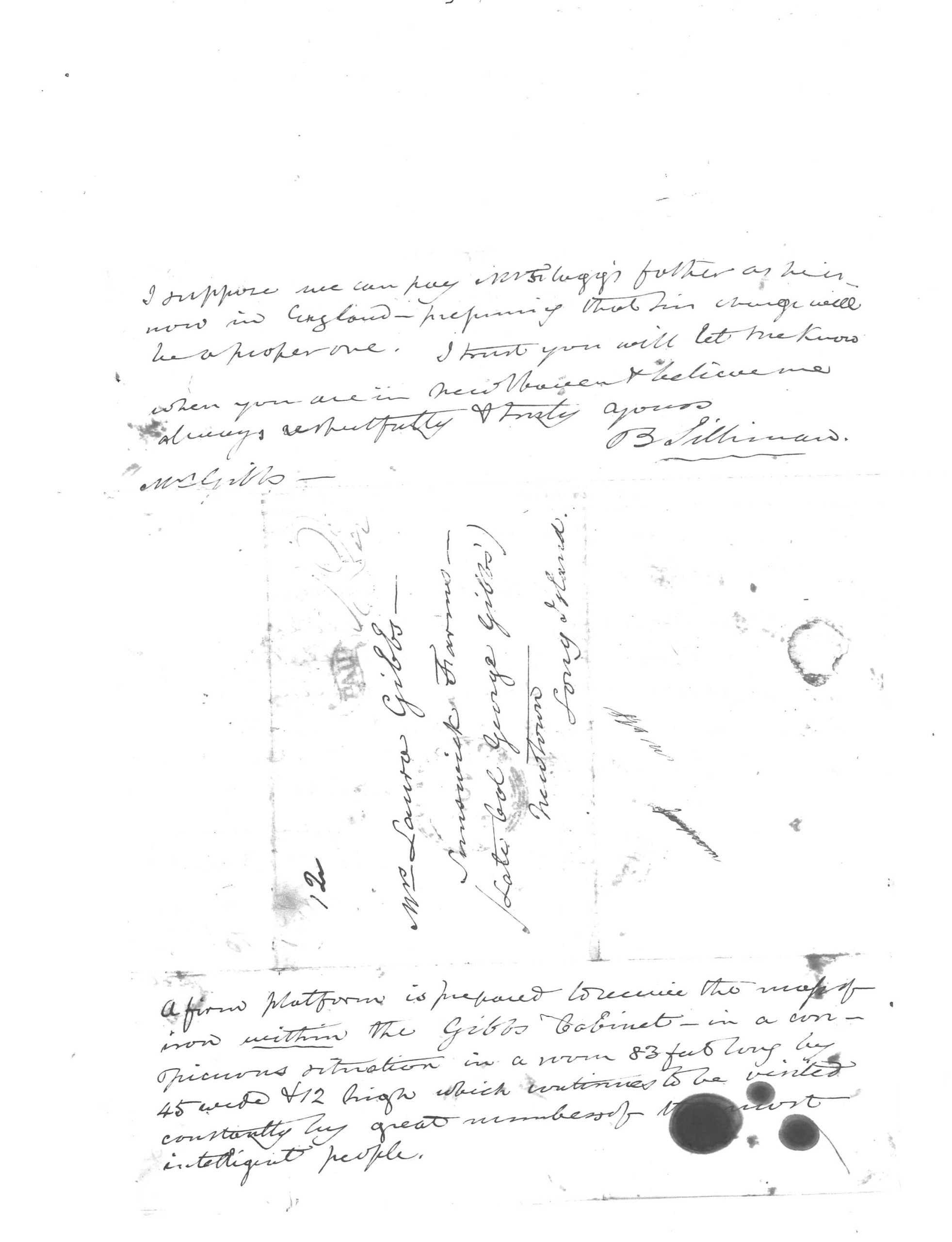
I suppose we can pay Mr [-]’s father as he is now in England, presuming that his charge will be a proper one. I trust you will let me know when you are in New Haven & believe me always respectfully & truly yours
B Silliman.
Mrs Gibbs.
[Address leaf:] Mrs Laura Gibbs, Sunswick Farms (Late Col George Gibbs’), Newtown, Long Island.
[Postscript on the address leaf:] A firm platform is prepared to receive the mass of iron within the Gibbs Cabinet, in a conspicuous situation in a room 83 feet long by 45 wide & 12 high which continues to be visited constantly by great numbers of the most intelligent people.
“This Noble Present”: The Gift Completed
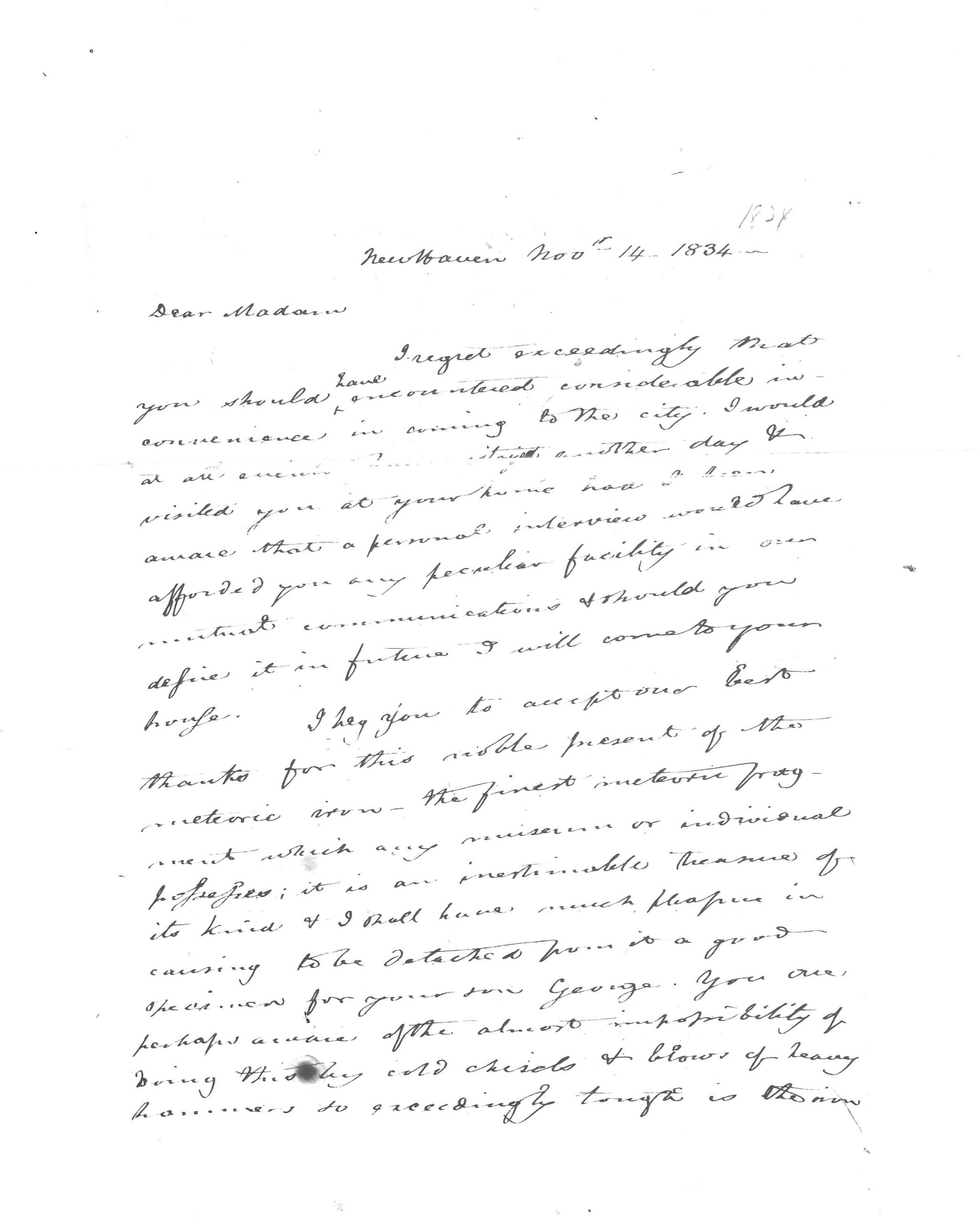
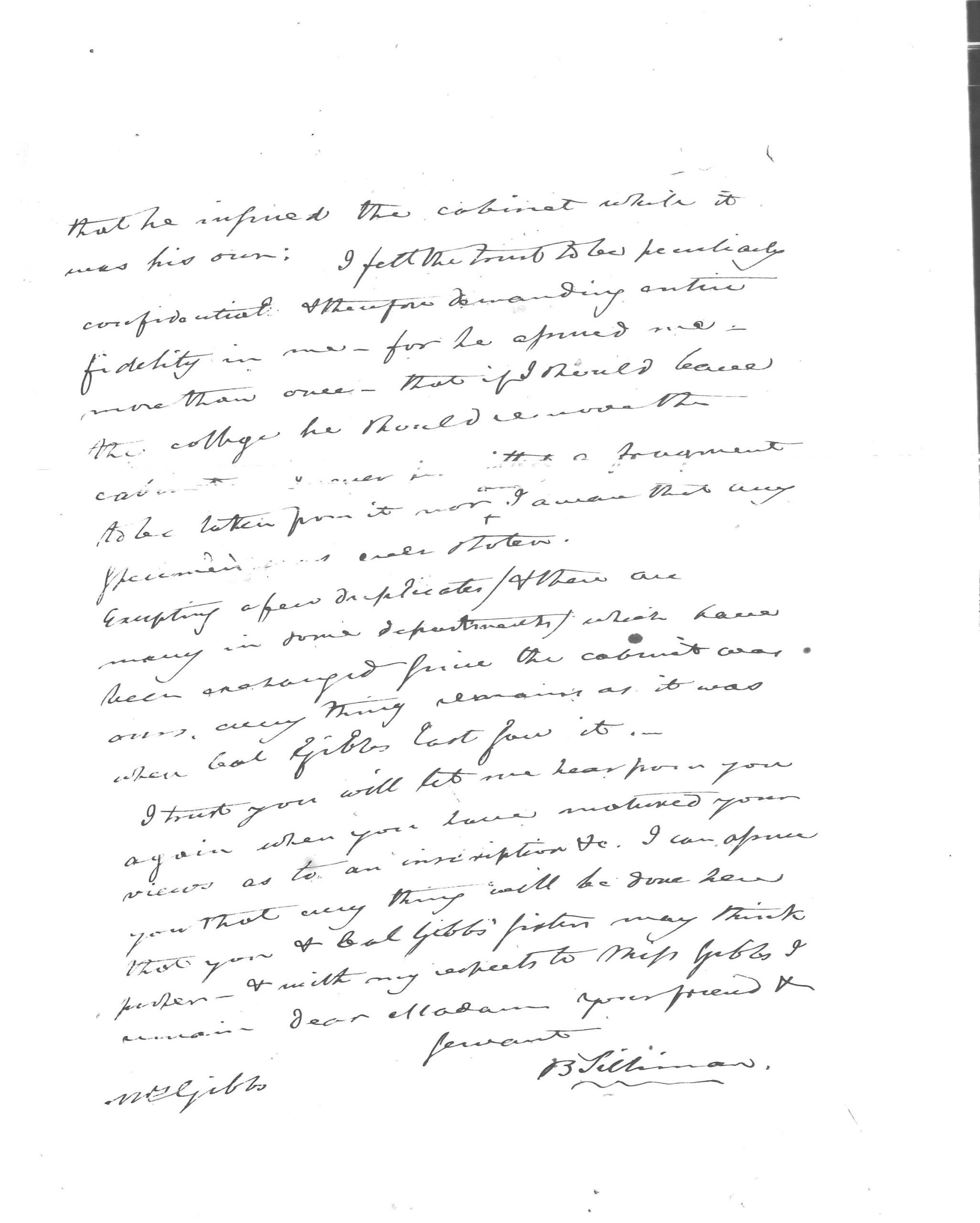
New Haven Novr. 14. 1834.
Dear Madam
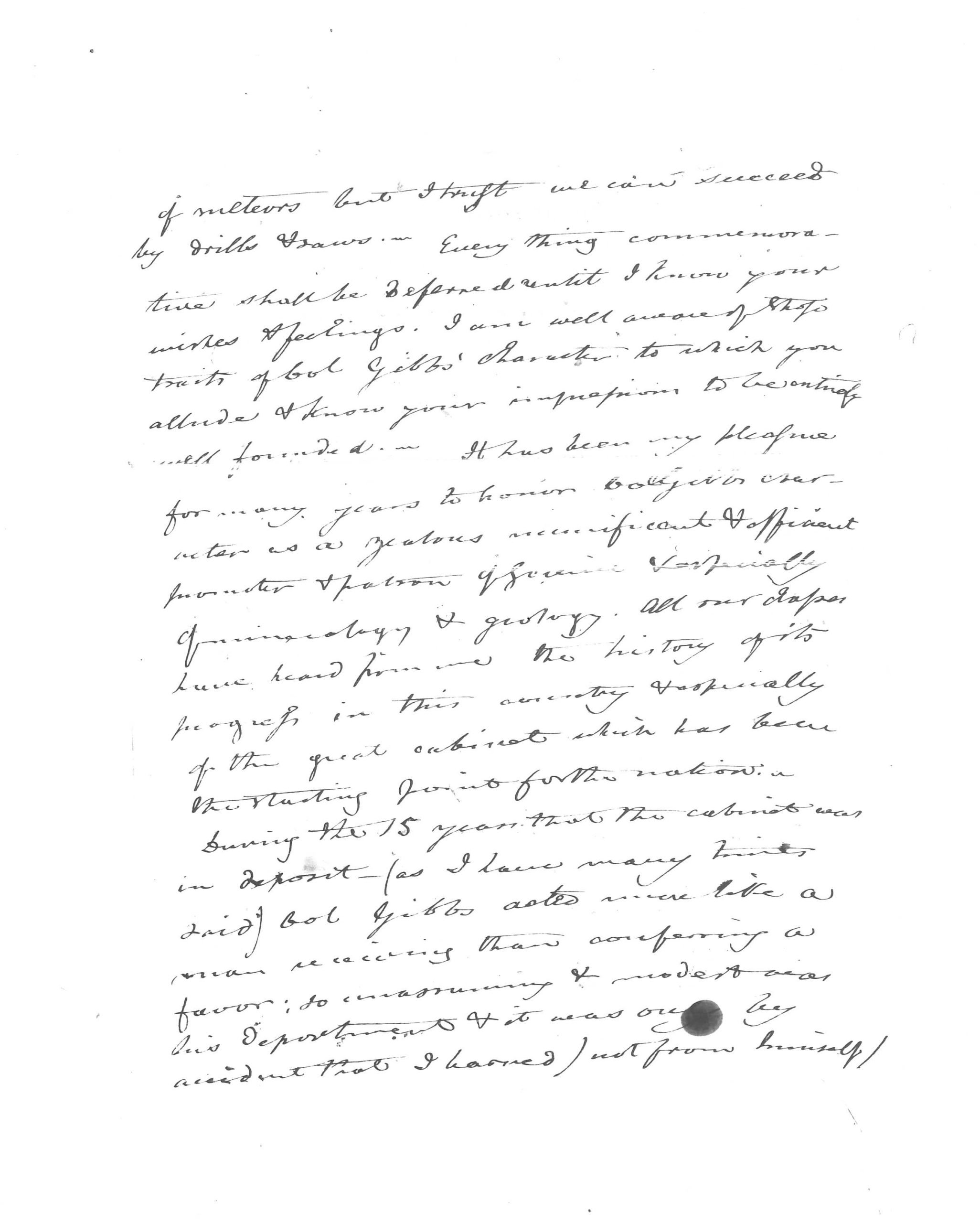
I regret exceedingly that you should have encountered considerable inconvenience in coming to the city. I would at all events [have remained] another day & visited you at your home had I been aware that a personal interview would have afforded you any peculiar facility in our mutual communications & should you desire it in future I will come to your house. I beg you to accept our best thanks for this noble present of the meteoric iron. The finest meteoric fragment which any museum or individual possesses; it is an inestimable treasure of its kind & I shall have much pleasure in causing to be detached from it a good specimen for your son George. You are perhaps aware of the almost impossibility of doing this by cold chisels & blows of heavy hammers, so exceedingly tough is the iron of meteors, but I trust we can succeed by drills & saws.
Every thing commemorative shall be deferred until I know your wishes & feelings. I am well aware of those traits of Col Gibbs’ character to which you allude & know your impression to be entirely well founded. It has been my pleasure for many years to honor Col Gibbs’ character as a zealous, munificent & efficient promoter & patron of science & especially of mineralogy & geology. All our classes have heard from me the history of its progress in this country & especially of the great cabinet which has been the starting point for the nation. During the 15 years that the cabinet was in deposit (as I have many times said) Col Gibbs acted more like a man receiving than conferring a favor; so unassuming & modest was his deportment & it was only by accident that I learned (not from himself) that he insured the cabinet while it was his own. I felt the trust to be peculiarly confidential & therefore demanding entire fidelity in me, for he assured me, more than once, that if I should leave the college he should remove the cabinet[. He] never [permitted] a fragment to be taken from it nor am I aware that any specimen was ever stolen.
Excepting a few duplicates (& there are many in some departments) which have been exchanged since the cabinet was ours, every thing remains as it was when Col Gibbs last saw it.
I trust you will let me hear from you again when you have matured your views as to an inscription &c. I can assure you that every thing will be done here that you & Col Gibbs’ sister may think proper, & with my respects to Miss Gibbs I remain, Dear Madam, your friend & servant
B Silliman.
Mrs Gibbs
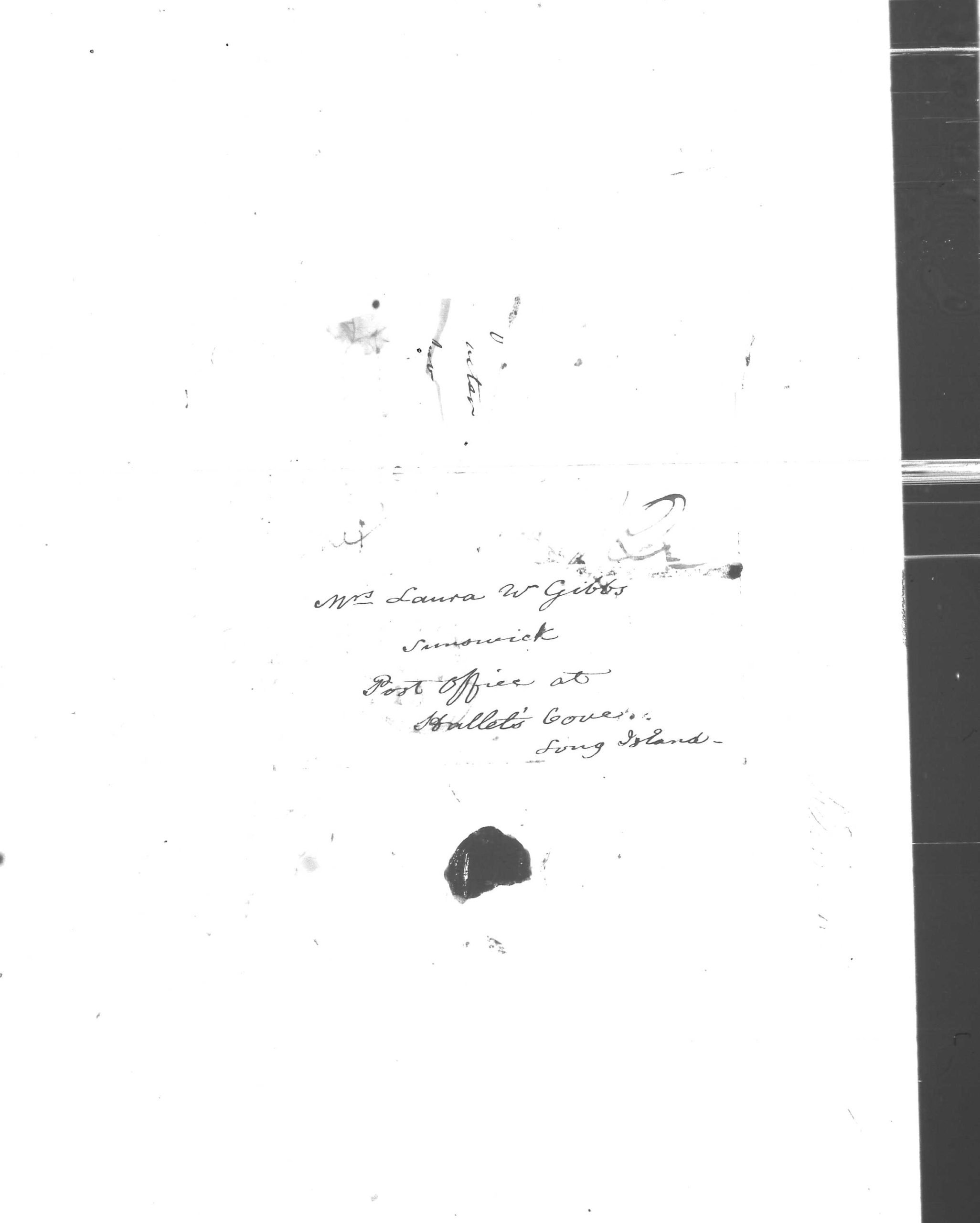
[Address leaf, docketed in pencil “Silliman”:] Mrs Laura W Gibbs, Sunswick, Post Office at Hallet’s Cove, Long Island.
V · 1834-1835The Move
The Silliman address leaves fix the family at Sunswick through November 14, 1834; the surveyor’s bill in the estate account shows the ground at Hallett’s Cove still being staked out three days later. Sometime after that, the household crossed the river for good. The paper end of the sale – the north fields conveyed for $20,276.70 and the three Prime bonds cancelled – is exhibited in full as The Sunswick Sale Completed, 1835. Laura settled her family at Winthrop Place, 261 Greene Street, just off Washington Square in the new Fifteenth Ward, and the reason remembered in every family account is the one already visible in the school bill of 1833: the education of her children. George finished at Harvard and entered the law. Wolcott went the way of his father’s science and became one of America’s leading chemists. Alfred was schooled for the army. The full story of the house and its site today is told in The Sale of Sunswick and the Move to New York and on the Sunswick location page.
❦VI · 1838-1842The War for Alfred
If 1834 shows what she could do with an estate, 1838 to 1842 shows what she could do with a government. And she knew the odds going in: by the family Record, the Colonel himself had wanted a West Point education for their eldest son George around 1832 and found it “impossible to secure” an appointment, “political favor then, as now, being indispensable to success.” Where her husband had given up and sent George to Europe instead, Laura applied for a cadetship for her younger sons, was betrayed by her own congressman in an act of political spite, and refused to accept it. She left a sick bed and went to Washington in person. She confronted the Secretary of War in his own house and quoted him, word for word, back to his successor in writing. She recruited Winfield Scott, twice. When the appointment finally came, at large, from the President of the United States, the file jacket in the National Archives credited the whole campaign in three words: “By his Mother.” The full nineteen document file is presented in The Cadet File: How Alfred Gibbs Got to West Point; the three documents below are the ones that are hers.
The Mother States Her Case
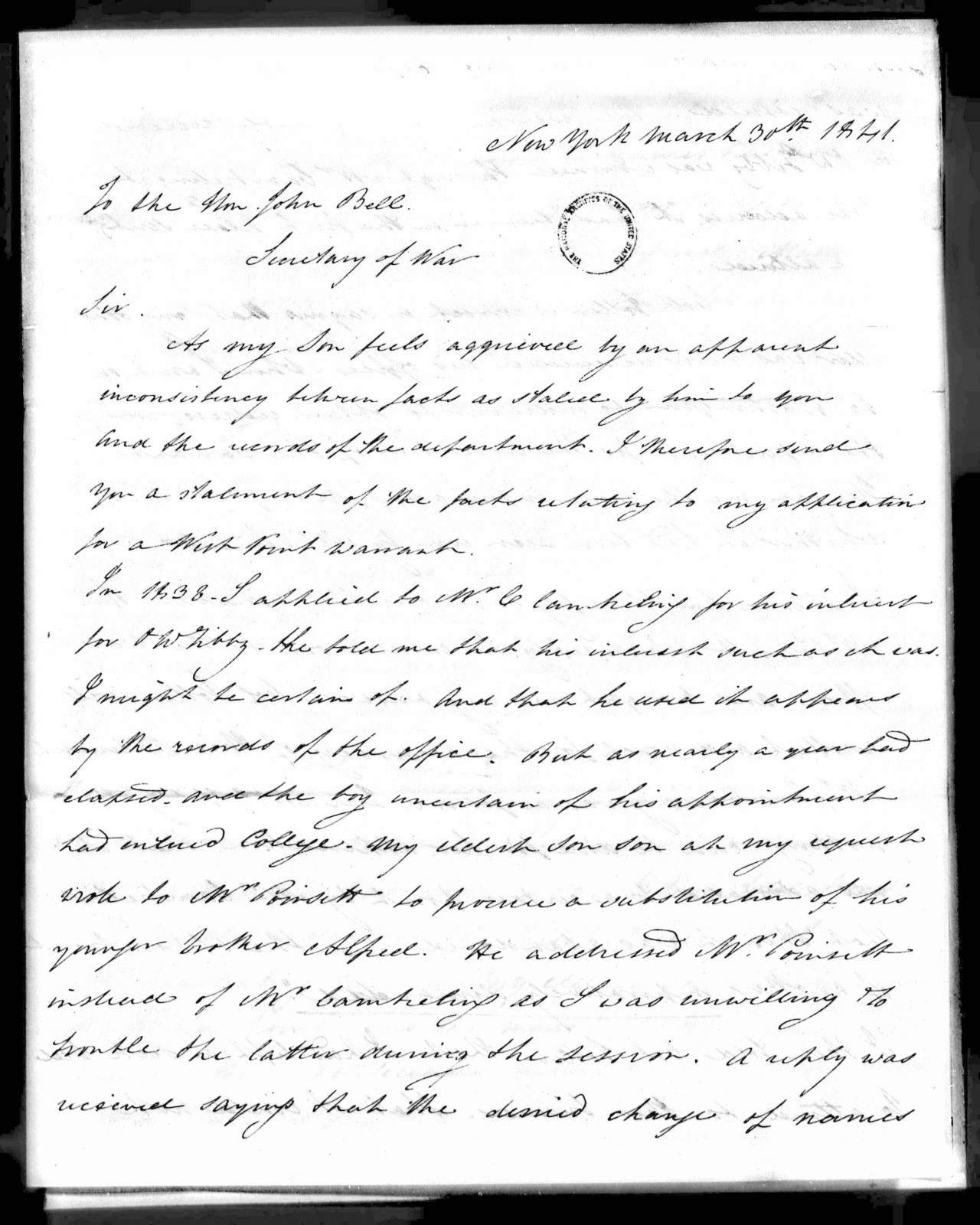
New York March 30th 1841.
To the Hon. John Bell.
Secretary of War
Sir.
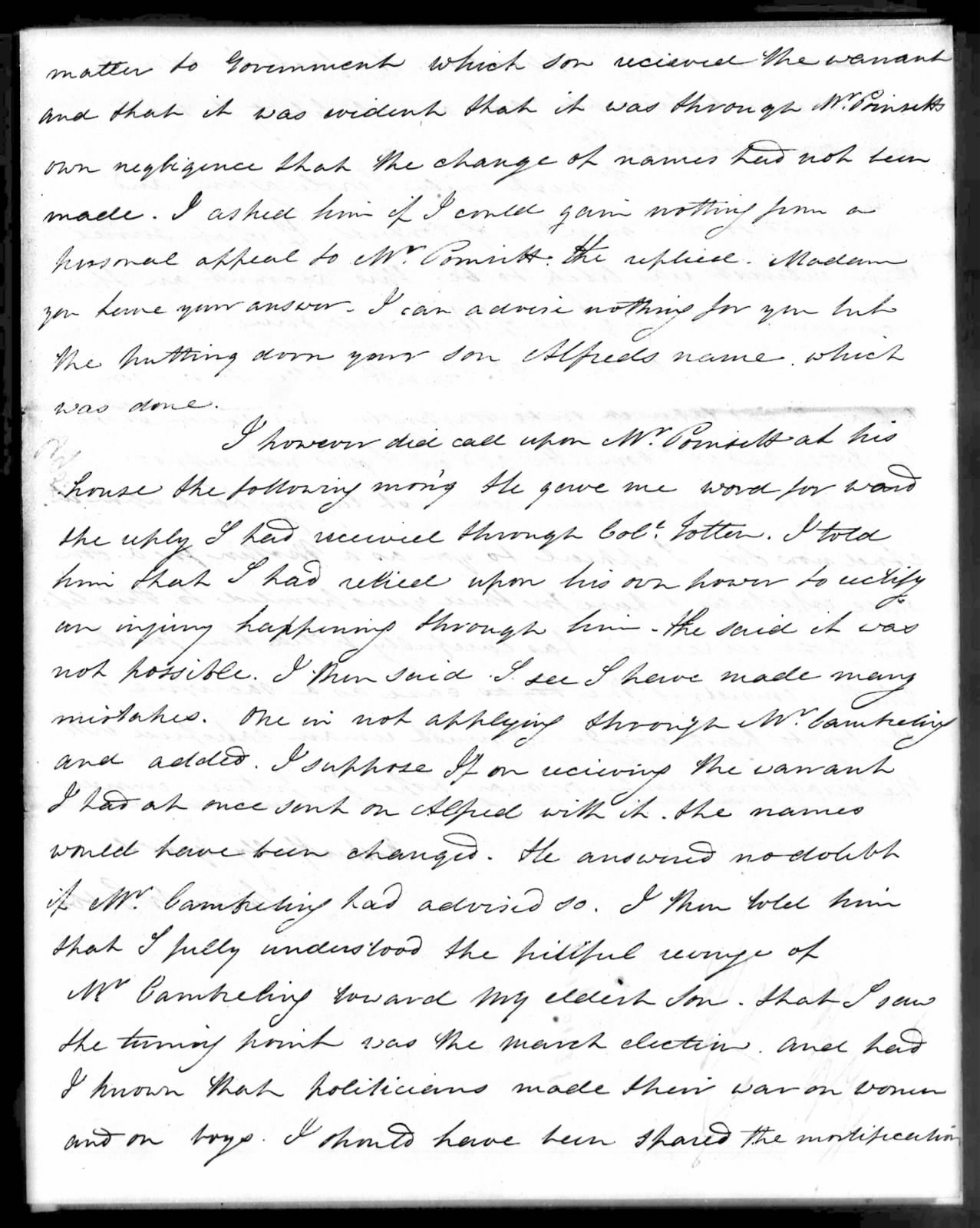
As my Son feels aggrieved by an apparent inconsistency between facts as stated by him to you and the records of the department. I therefore send you a statement of the facts relating to my application for a West Point warrant.
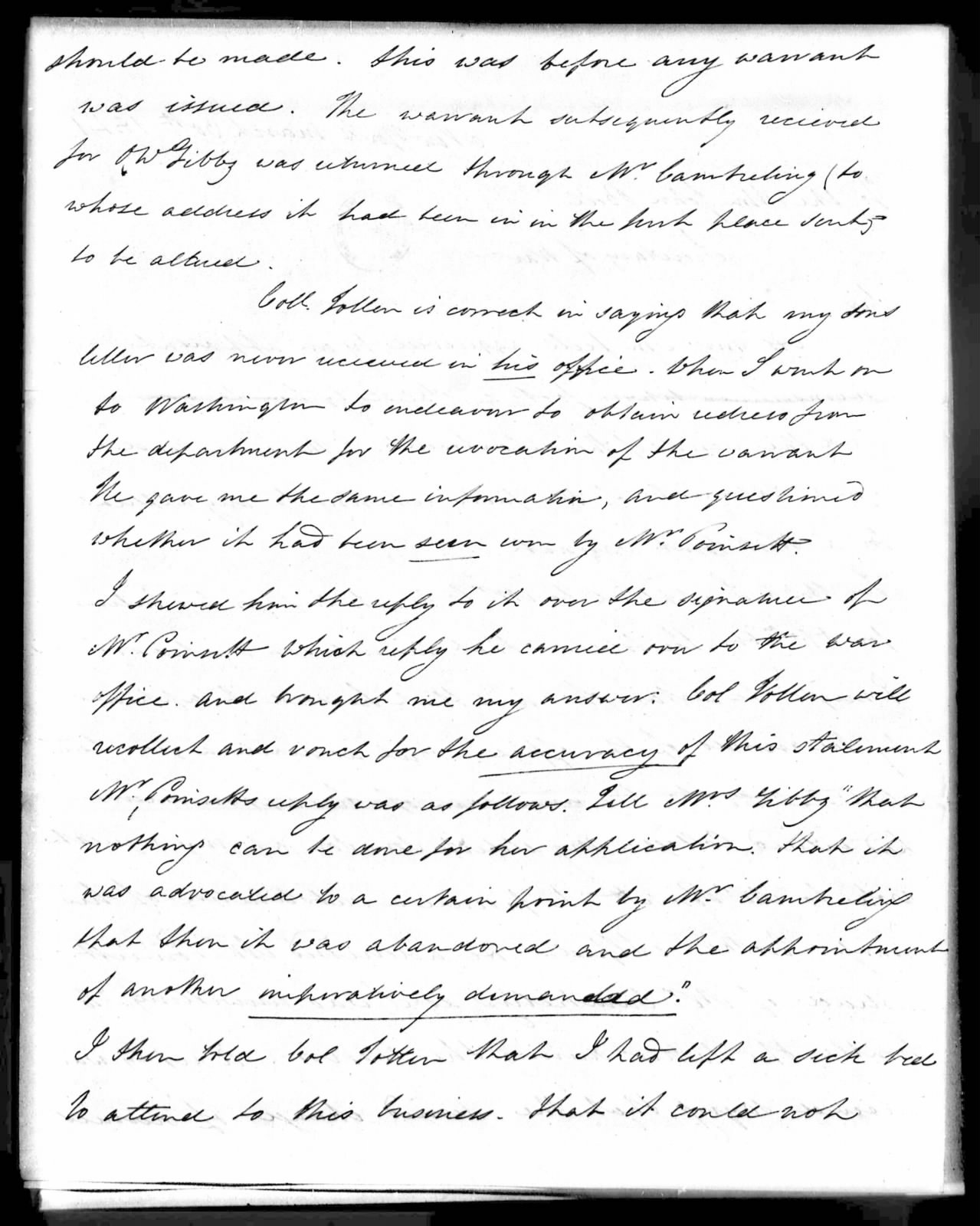
In 1838. I applied to Mr. C Cambreling for his interest for O W Gibbs. He told me that his interest such as it was, I might be certain of. And that he used it appears by the records of the office. But as nearly a year had elapsed, and the boy uncertain of his appointment had entered College. My eldest son at my request wrote to Mr Poinsett to procure a substitution of his younger brother Alfred. He addressed Mr. Poinsett instead of Mr Cambreling as I was unwilling to trouble the latter during the session. A reply was received saying that the desired change of names should be made. This was before any warrant was issued. The warrant subsequently received for O W Gibbs was returned through Mr. Cambreling (to whose address it had been in the first place sent) to be altered.
Coll. Totten is correct in saying that my sons letter was never received in his office. When I went on to Washington to endeavour to obtain redress from the department for the revocation of the warrant He gave me the same information, and questioned whether it had been seen even by Mr Poinsett.
I shewed him the reply to it over the signature of Mr Poinsett which reply he carried over to the war office. and brought me my answer. Col Totten will recollect and vouch for the accuracy of this statement. Mr Poinsetts reply was as follows. Tell Mrs Gibbs “that nothing can be done for her application. That it was advocated to a certain point by Mr. Cambreling that then it was abandoned and the appointment of another imperatively demanded.”
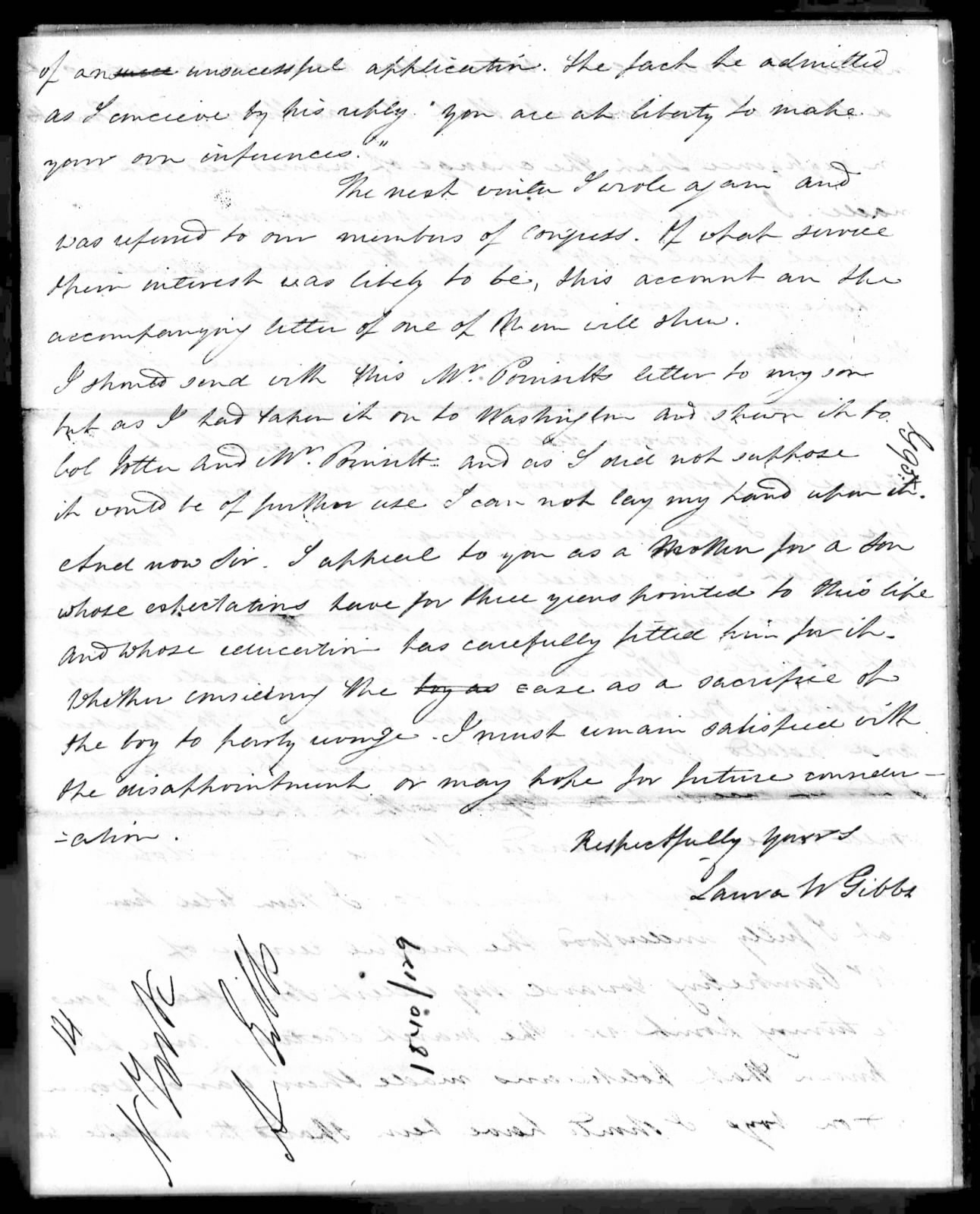
I then told Col Totten that I had left a sick bed to attend to this business. That it could not matter to Government which son received the warrant and that it was evident that it was through Mr Poinsetts own negligence that the change of names had not been made. I asked him if I could gain nothing from a personal appeal to Mr Poinsett. He replied. Madam you have your answer. I can advise nothing for you but the putting down your son Alfreds name. which was done.
I however did call upon Mr Poinsett at his house the following morn’g He gave me word for word the reply I had received through Colo. Totten. I told him that I had relied upon his own honor to rectify an injury happening through him. He said it was not possible. I then said I see I have made many mistakes. One in not applying through Mr Cambreling and added. I suppose If on receiving the warrant I had at once sent on Alfred with it. the names would have been changed. He answered no doubt if Mr Cambreling had advised so. I then told him that I fully understood the pitiful revenge of Mr Cambreling toward my eldest Son. that I saw the turning point was the march election. and had I known that politicians made their war on women and on boys. I should have been spared the mortification of an unsuccessful application. The fact he admitted as I conceive by his reply “you are at liberty to make your own inferences.”
The next winter I wrote again and was refered to our members of congress. Of what service their interest was likely to be, this account and the accompanying letter of one of them will shew.
I should send with this Mr. Poinsetts letter to my son but as I had taken it on to Washington and shewn it to Col Totten And Mr. Poinsett. and as I did not suppose it would be of further use I can not lay my hand upon it.
And now Sir. I appeal to you as a Mother for a Son whose expectations have for three years pointed to this life and whose education has carefully fitted him for it. Whether considering the case as a sacrifice of the boy to party revenge. I must remain satisfied with the disappointment or may hope for future consideration.
Respectfully yours
Laura W Gibbs
“Once More”: A Deadline for the General
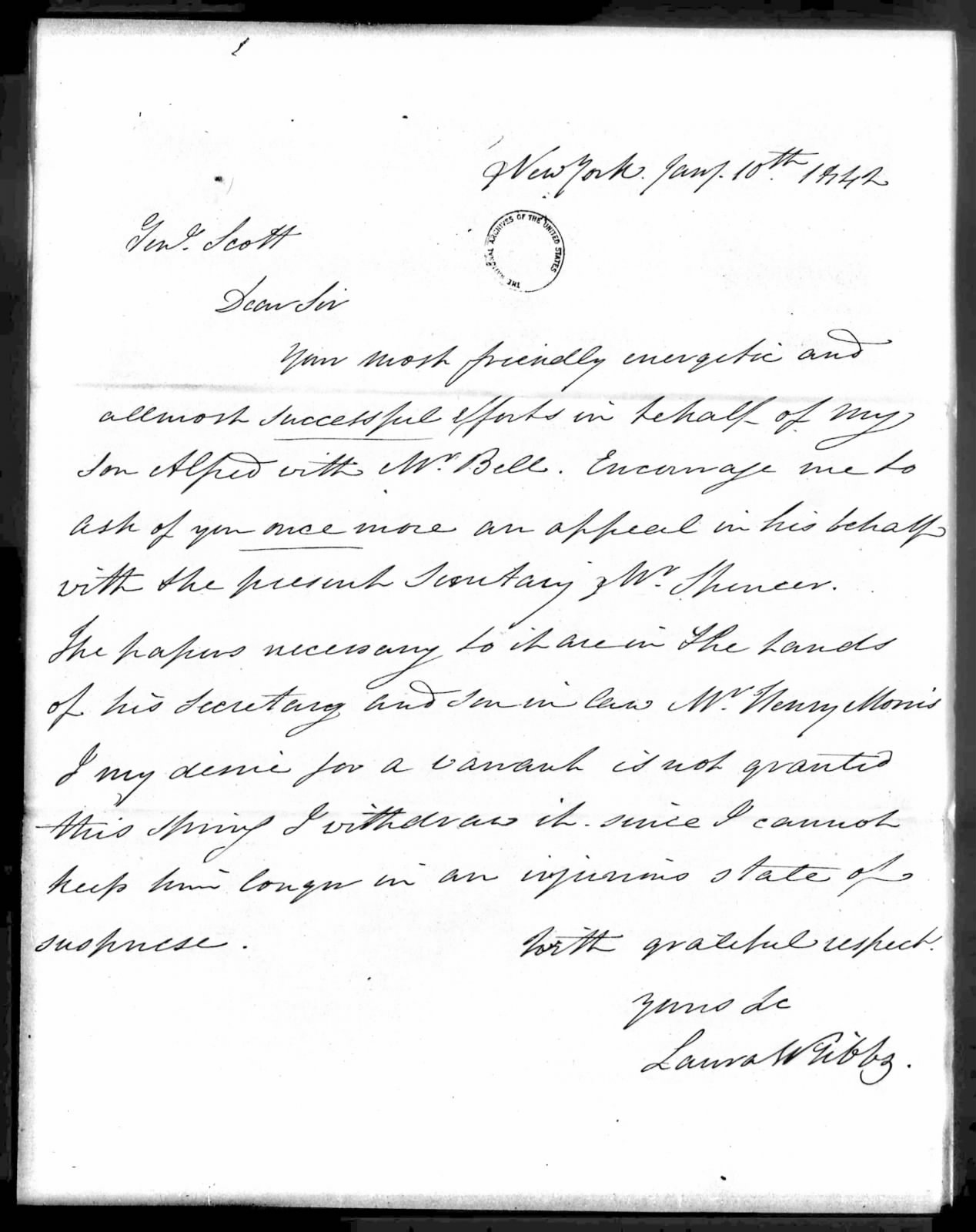
New York. Jany. 10th 1842
Genl. Scott
Dear Sir
Your most friendly energetic and allmost successful efforts in behalf of my Son Alfred with Mr. Bell. Encourage me to ask of you once more an appeal in his behalf with the present Secretary Mr. Spencer.
The papers necessary to it are in the hands of his Secretary and Son in law Mr Henry Morris
If my desire for a warrant is not granted this spring I withdraw it. since I cannot keep him longer in an injurious state of suspense.
With grateful respect
yours &c
Laura W Gibbs.
Two Signatures, One Page
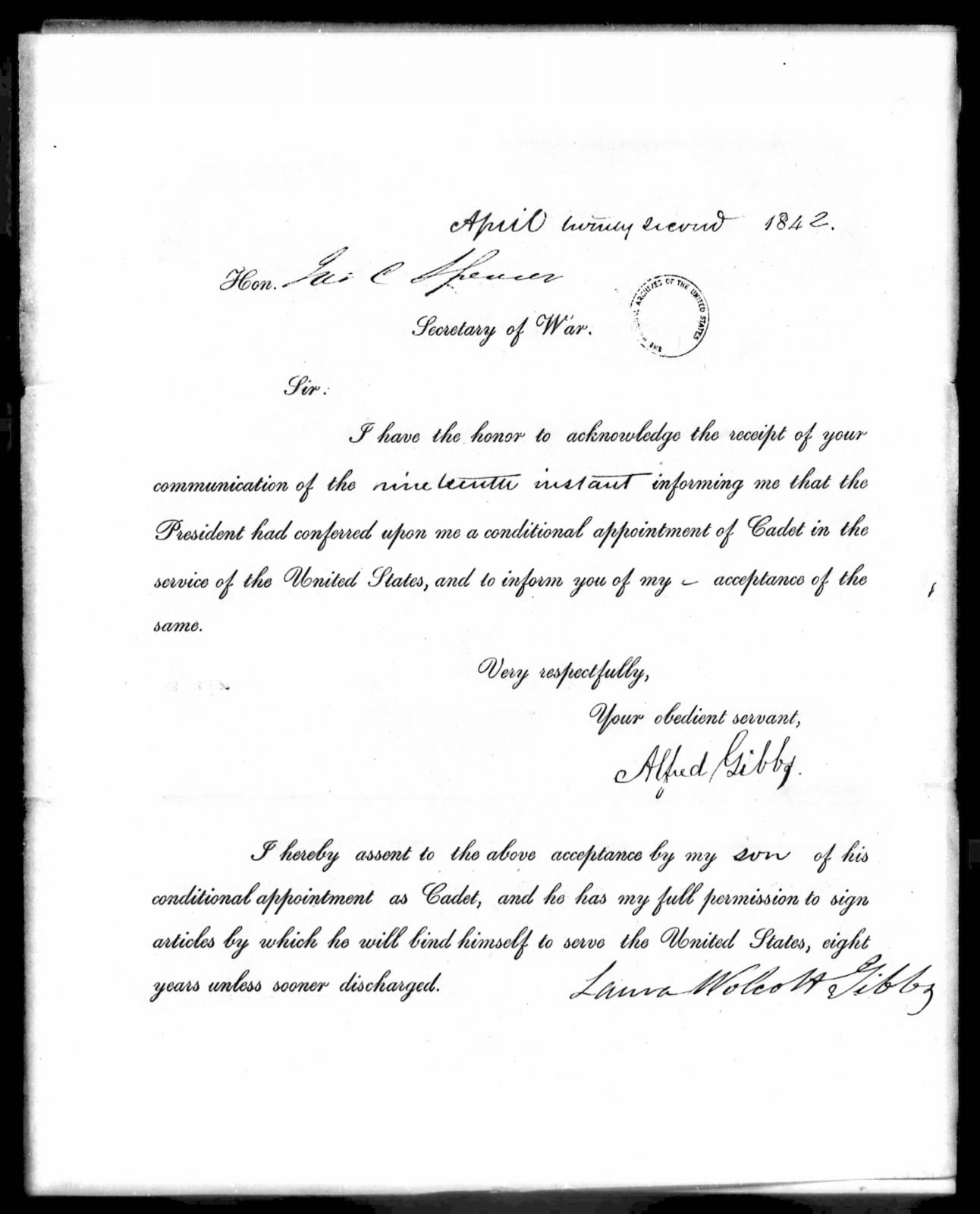
April twenty second 1842.
Hon. Jn. C Spencer
Secretary of War.
Sir:
I have the honor to acknowledge the receipt of your communication of the nineteenth instant informing me that the President had conferred upon me a conditional appointment of Cadet in the service of the United States, and to inform you of my acceptance of the same.
Very respectfully,
Your obedient servant,
Alfred Gibbs.
I hereby assent to the above acceptance by my son of his conditional appointment as Cadet, and he has my full permission to sign articles by which he will bind himself to serve the United States, eight years unless sooner discharged.
Laura Wolcott Gibbs
Epilogue · 1835-1870Greene Street
She lived at Greene Street for the rest of her life, thirty five more years, and the family Record written by her grandson preserves what those years looked like. She was “a strong abolitionist and used to hide negro slaves in her cellar at 261 Greene Street”; when slave hunters chalked a cross on a suspected house, “Mrs. Gibbs, when she found such a mark, would go down at night and remove it.” She was the custodian of her father’s papers, and it was from her hands that her son George received the Wolcott archive from which he wrote his Memoirs of the Administrations of Washington and Adams (1846). She was an artist: her watercolor of Alexander Hamilton, signed “L. W. Gibbs, pinxit,” was engraved and became one of the most widely reproduced portraits of Hamilton ever made. In the Civil War, wrote Bellows, “she had the passionate patriotism of a young soldier,” rebuking unpatriotic talk on her errands to the butcher and the grocer; her daughter Laura helped found the Women’s Central Relief Association and, later, the first training school for nurses in America. She lived to see George publish as an ethnologist, Wolcott rise to eminence as a chemist, and Alfred, the baby of the 1823 drawing, win a general’s star for Cedar Creek in 1864, a promotion his brother George campaigned for exactly as their mother had campaigned in 1841, with letters from the most powerful men who owed the family regard. Alfred died in service at Fort Leavenworth in December 1868. His mother outlived him by two years.
When Laura died in 1870, the Reverend Henry W. Bellows, the great Unitarian minister of New York, wrote of her: “One of the last links binding the present with the early and heroic period of our national history has parted… You felt that she was a piece of the original granite on which the nation was built.” The death notices, true to their century, identified her by her father and her husband. The documents on this page identify her by her works.
The Notices
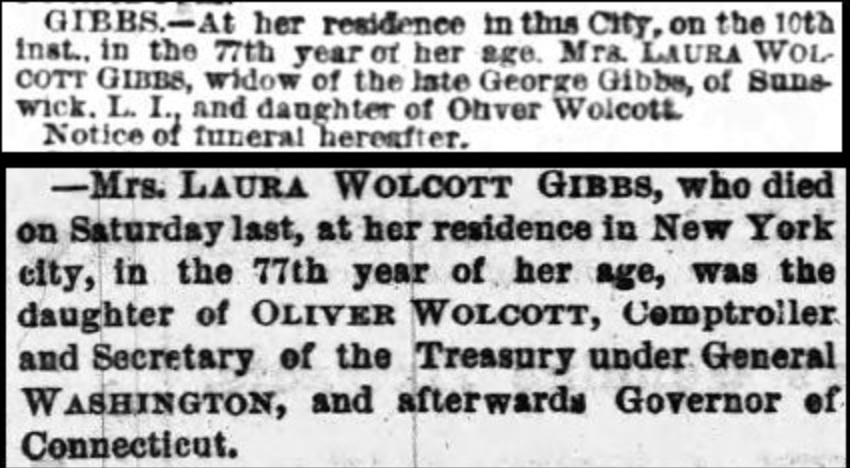
GIBBS. At her residence in this City, on the 10th inst., in the 77th year of her age, Mrs. LAURA WOLCOTT GIBBS, widow of the late George Gibbs, of Sunswick, L. I., and daughter of Oliver Wolcott. Notice of funeral hereafter.
Mrs. LAURA WOLCOTT GIBBS, who died on Saturday last, at her residence in New York city, in the 77th year of her age, was the daughter of OLIVER WOLCOTT, Comptroller and Secretary of the Treasury under General WASHINGTON, and afterwards Governor of Connecticut.
Method
Every document displayed on this page is reproduced from a scan of the original manuscript and accompanied by a complete transcription; original spelling and punctuation are preserved, editorial matter appears in square brackets, and readings that resist confident deciphering are flagged with [?] rather than guessed. The Gibbs Family Papers scans are from the family’s research copy of the Wisconsin Historical Society collection (Reel 1, catalogued July 2026); the West Point documents are from National Archives Microfilm Publication M688, accessed via Fold3. All images are hosted on alfredgibbs.com and open full size in a new tab.
Sources
Gibbs Family Papers, 1762-1935. Wisconsin Historical Society, Madison, Wis. Digitized research copy, Reel 1: scans 518-521 (Oliver Wolcott Jr. to Laura Gibbs, December 21, 1823); 885 (household letter from Sunswick, November 2, 1833); 886-887 (Ebenezer Francis to Laura W. Gibbs, November 13, 1833); 897-900 (Laura W. Gibbs and Audley Clarke correspondence, August 1834); 901-908 (bonds of Barnabas Bates with receipts and dockets, August-September 1834); 909-918 (Benjamin Silliman to Laura Gibbs, November 2 and 14, 1834); 919-922 (estate of George Gibbs in account with Samuel Stevens, 1833-1834).
Cadet application file of Alfred Gibbs, 1840, file 129. U.S. Military Academy Cadet Application Papers, 1805-1866 (National Archives Microfilm Publication M688, roll 126); Records of the Adjutant General’s Office, Record Group 94; National Archives, Washington, D.C. Accessed via Fold3, July 10, 2026.
Gibbs, George [V]. The Gibbs Family of Rhode Island and Some Related Families (family Record). Chapter II, as serialized with the family’s scans and notes on AlfredGibbs.com (https://alfredgibbs.com/chapter-ii-the-gibbs-family-of-rhode-island/ and continuation pages). Source for the Colonel’s dates, the 1810 marriage and Delafield purchase of Sunswick, the seven children, the George IV West Point attempt, the abolitionist cellar account, the Hamilton watercolor, and the full text of the Bellows eulogy.
Bellows, H. W. (1870). Memorial remarks on Laura Wolcott Gibbs. Reprinted in the family Record, Chapter II; also quoted in Laura (Wolcott) Gibbs (Mother), AlfredGibbs.com, https://alfredgibbs.com/laura-wolcott-gibbs-mother/
Death notices of Laura Wolcott Gibbs (1870). Newspaper clippings preserved in the family’s papers; reproduced on this site.
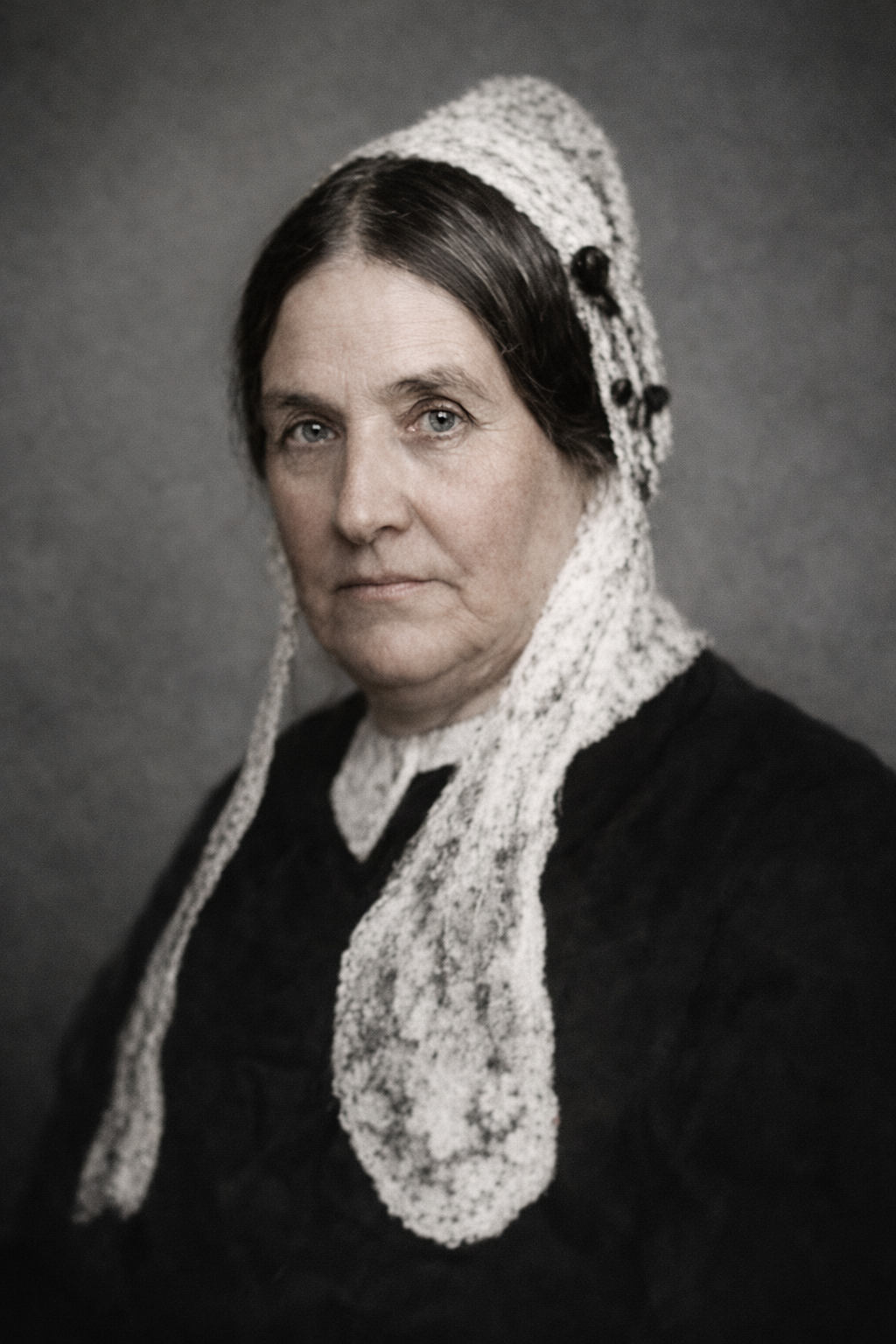
Stuart, G. (1810). Laura Wolcott (Mrs. George Gibbs) [Portrait]. Remastered by Garland H. Green Jr. for AlfredGibbs.com.
Related on this site
The Cadet File: How Alfred Gibbs Got to West Point · The Alfred Gibbs Letters (the General’s own hand) · The Sale of Sunswick and the Move to New York · Laura (Wolcott) Gibbs (Mother) · Sunswick (Location With Maps) · The Making of a General: The 1864 Campaign
Accuracy review: transcriptions checked against the scans, July 10, 2026. Two identifications are deliberately left open on this page: whether the buyer Barnabas Bates is the postal reformer of that name, and the precise date of the family’s removal to Greene Street. Corrections are made openly; this page will be updated, never silently, if better readings are established.
Views: 33
Explore the evidence
View this article’s connected sources and media →
About this page
This article was brought over from AlfredGibbs.com. Its preserved text, media and citations remain available for comparison.