
Imagine Alfred Gibbs born in 1840 instead of 1823. Give him George Custer’s youth and George Custer’s luck. Let him rise at twenty-four, unmarried and unmarked, ride at the head of a volunteer brigade with a scarlet necktie and a hometown newspaper, and live long enough to write his memoirs. That man would be a household name. He would have statues. The man who actually wore the uniform, who did the same fighting and earned the same brevets, is a footnote. This page is about the difference, and it is not a difference of merit. It is a difference of timing, of temperament, and of the machinery that decides who a nation chooses to remember. Every claim below points to a document you can open and read for yourself.
I · THE PROFESSIONALHe fought his way in
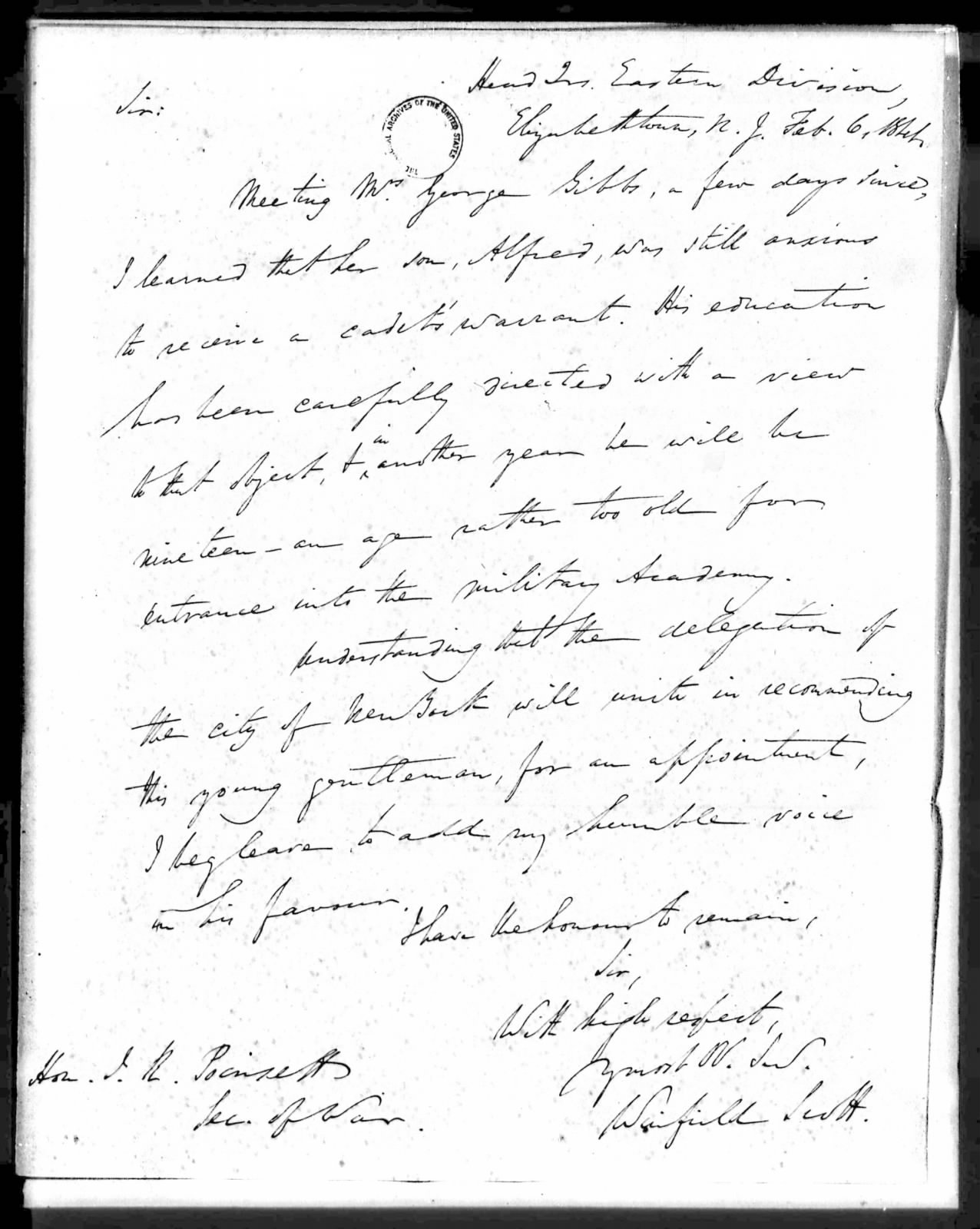
Begin with what he was: not a man who fell into anything. Getting Alfred Gibbs into West Point took a four-year family campaign and, in the end, a warrant signed by a President. His first nomination was traded away in a political betrayal by Congressman Churchill Cambreleng; Winfield Scott recommended the boy twice; only an at-large presidential appointment from John Tyler in 1842 finally put him in the Academy. The full forty-one-page National Archives file is reproduced on this site, document by document. Hold that in mind, because everything that follows flows from it. This was a Regular Army professional who worked for his place in the army. He did not chase fame. He chased competence.
He graduated in 1846 into the Regiment of Mounted Riflemen and went straight to a war.
II · MEXICO, 1847The boy hero who came twenty years too early
Here is the cruel arithmetic at the heart of the story. Custer was a brigadier general and a press sensation at twenty-four. At twenty-four, Alfred Gibbs was being shot at Cerro Gordo.
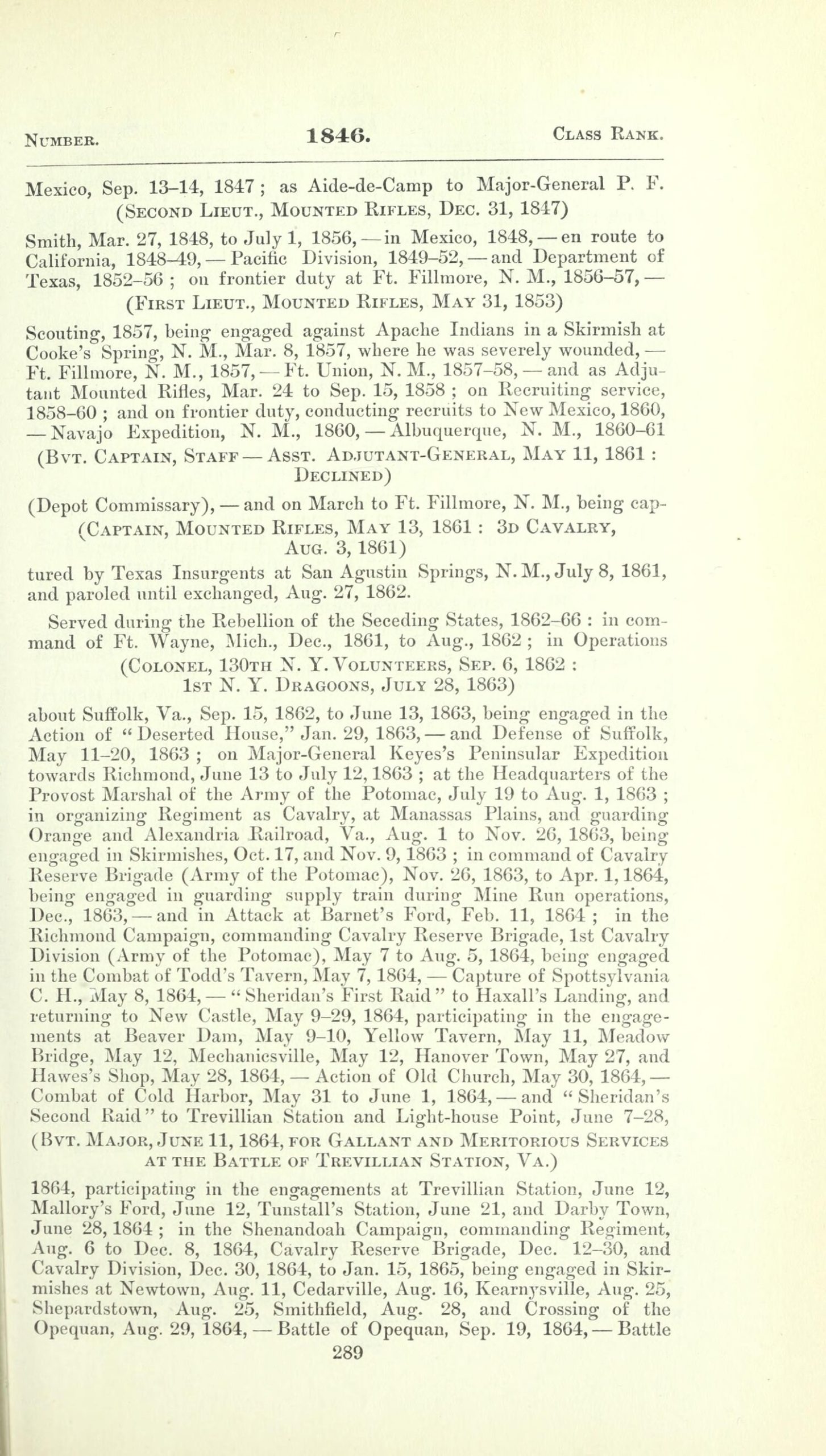
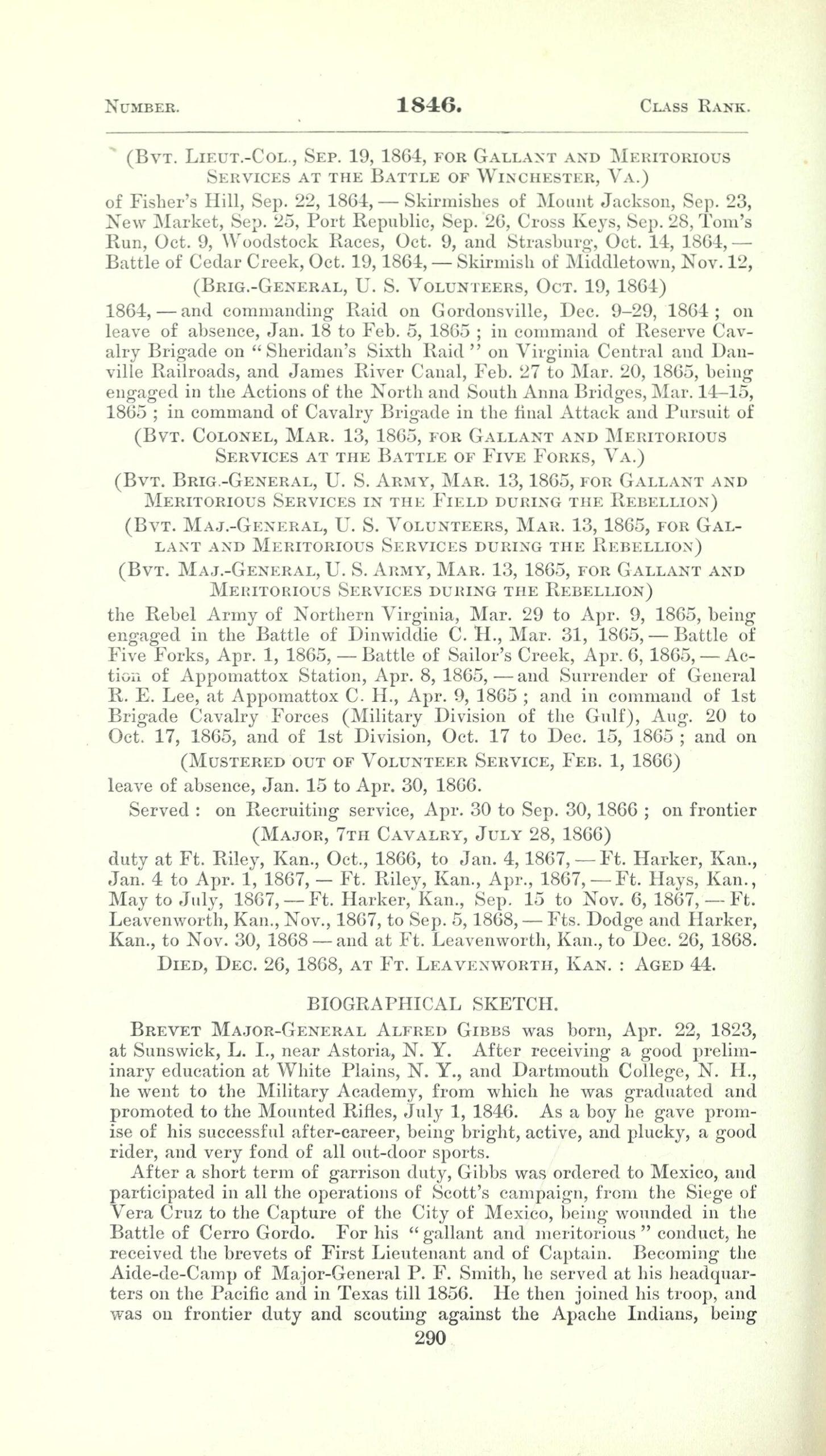
His own service record, printed in Cullum’s Register, lists it plainly: Vera Cruz, Cerro Gordo, “where he was wounded,” Contreras, Churubusco, Chapultepec, the City of Mexico, and the brevets of first lieutenant and captain “for gallant and meritorious conduct.” Gibbs had already lived the boy-hero chapter. He had the youth, the wounds, and the valor. He simply had them in 1847, in a war the public of the 1860s had filed away. His glory arrived twenty years before the spotlight did.
And even then, he would not stand in it. Gibbs wrote one of the best eyewitness accounts of Contreras and Churubusco and published it in the Daily National Intelligencer in October 1847, unsigned. A serving officer’s letter had to be anonymous, true, but the habit is telling: given the chance to put his name on his own bravery, he took it off.
III · THE ANTI-CUSTERThe man who published without his name
The habit was not an accident. In 1854, from a fishing camp in Texas, Lieutenant Gibbs wrote a witty sporting letter for the front page of the Spirit of the Times, America’s great sporting weekly. He signed it not Alfred Gibbs but “Wry-Full,” a Mounted Rifleman’s pun. His war correspondence, unsigned. His sporting byline, a pseudonym. This was a man who wrote well, and made sure no reader would ever know it was him.
Set that beside his rival. George Armstrong Custer was among the most photographed men in America, a study in deliberate self-invention: the golden ringlets, the velveteen jacket, the red tie his whole division adopted, the reporters he cultivated. Custer manufactured a legend on purpose. Gibbs did the opposite on purpose. It should surprise no one that a man who took his name off his own courage was not handed a nation’s memory. Fame is not an accident that befalls the deserving. It is built, and Gibbs refused to build his.
IV · THE EVIDENCE OF HIS MENThe valor he would not claim, his men claimed for him
Because he would not blow his own horn, others had to. At the Deserted House, near Suffolk, Virginia, in January 1863, Gibbs commanded the infantry under Brigadier General Michael Corcoran, in Bowen’s words “that pompous Irishman, Corcoran, who haughtily resented any suggestion from an officer whom he ranked.” Gibbs saw Corcoran was placing the line wrong, said so, and was put under arrest for it. He risked his career to be right. Then the line broke:
Who that was there can ever forget that scene when the brave Colonel Gibbs, under arrest, swordless and horseless, seized the colors and bore them, like the hero he was, in front of the regiment throughout the whole of that charge… from that hour his kingdom in the regiment was established, and every man in his command was now willing to die for him.The 1880 history of Wyoming County, as quoted by James R. Bowen in his Regimental History of the First New York Dragoons (1900), pp. 62-63. The full text is hosted on this site.
A year and a half later, Gibbs’s own brigade commander wrote him into the Official Records. Of the great charge at Third Winchester on September 19, 1864, Colonel Thomas Devin reported:
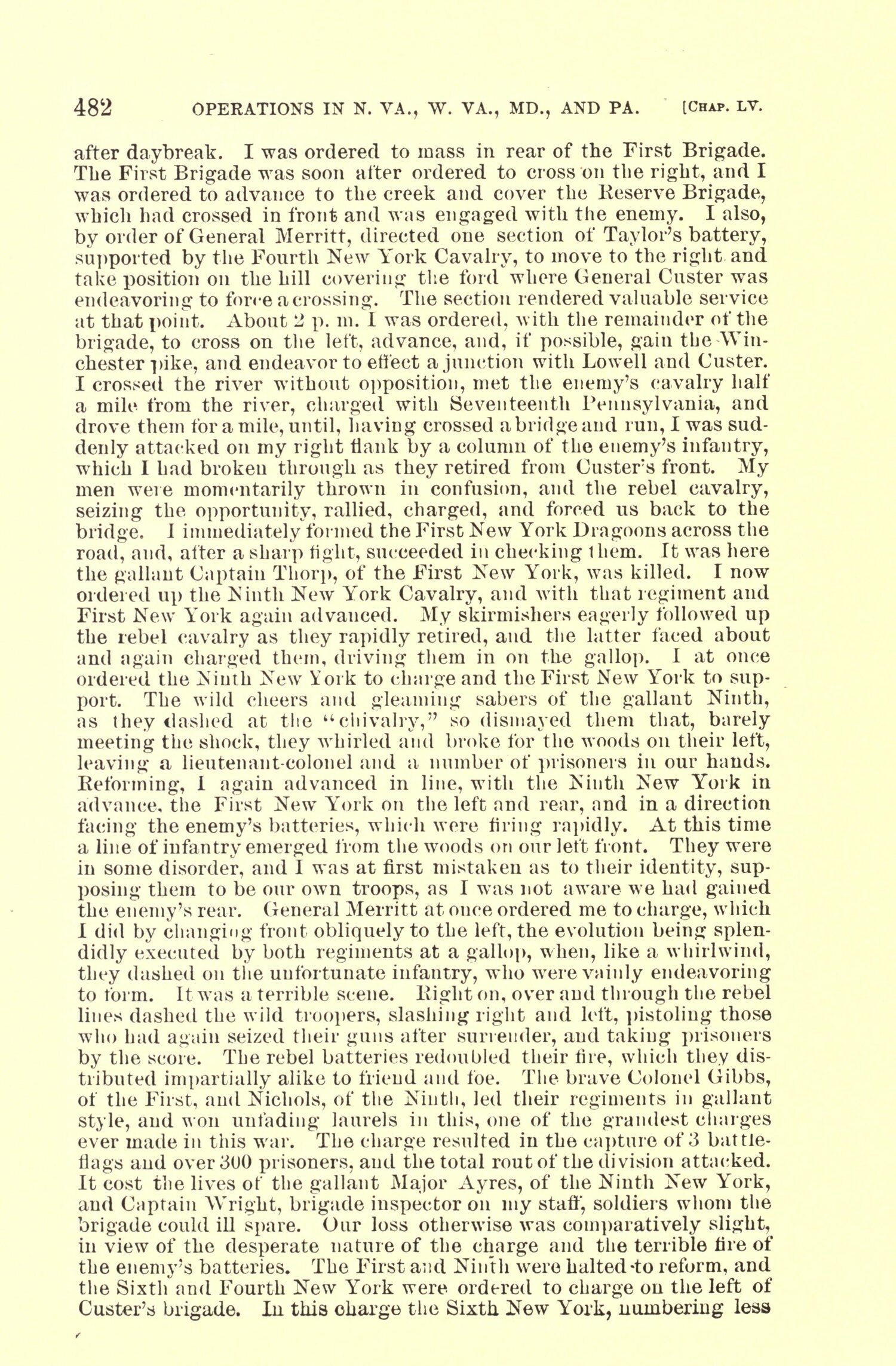
The brave Colonel Gibbs, of the First, and Nichols, of the Ninth, led their regiments in gallant style, and won unfading laurels in this, one of the grandest charges ever made in this war.Col. Thomas C. Devin, report of the Second Brigade, First Cavalry Division, of operations at the Opequon (Third Winchester), Sept. 19, 1864. The War of the Rebellion: Official Records of the Union and Confederate Armies, Series I, Vol. XLIII, Part 1, p. 482. The page is reproduced at right and hosted on this site.
The valor is not in doubt. It is in the record, in other men’s handwriting, because Gibbs would not put it in his own.
V · A BODY USED UPBeat to pieces by three wars
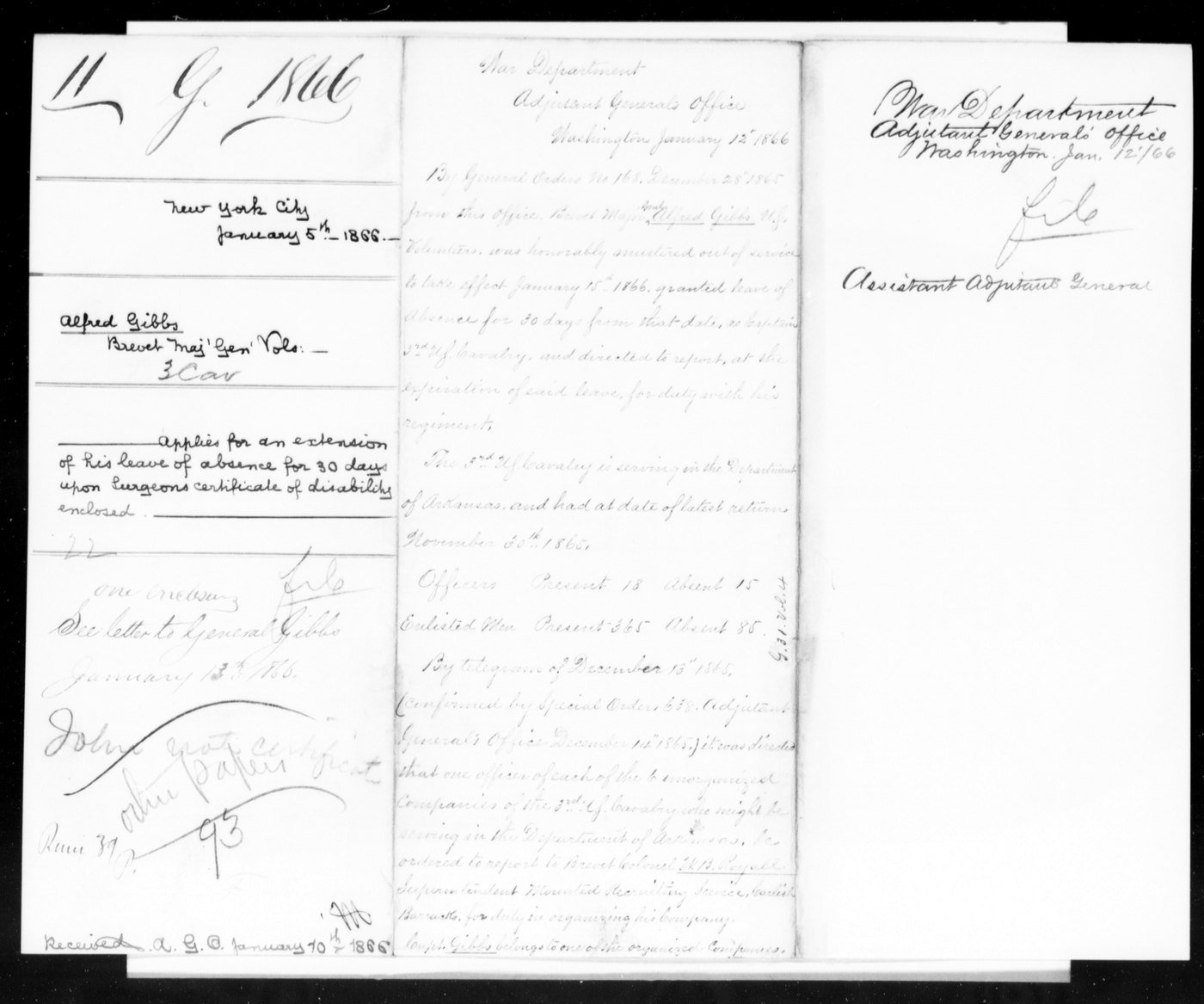
The Boy Generals were fresh. Gibbs was worn out. By 1864 his body had been paying for the army’s wars for eighteen years: the wound at Cerro Gordo in 1847; an Apache lance at Cooke’s Spring, New Mexico, in the 1850s, a scar he carried for life; a year as a paroled prisoner after the Fort Fillmore surrender in 1861; and at Trevilian Station in June 1864 he commanded through eight hours of fighting until he was felled by sunstroke and carried from the field.
Then it caught up with him. This War Department letter, dated January 1866, has Bvt. Maj. Gen. Gibbs applying for a leave extension while convalescing from typhoid and amaurosis, a progressive failure of the eyesight. On December 26, 1868, he died at Fort Leavenworth, on duty as a major in the 7th Cavalry, at the age of forty-five. A man that used up does not campaign for his own remembrance. He does not live to write the memoir that would have done it for him.
Update, October 31, 2026: Two corrections. The account of Gibbs seizing the colors at the Deserted House is quoted by Bowen from the 1880 history of Wyoming County, not written by Bowen himself; the attribution has been corrected. And Gibbs, born April 22, 1823, died at forty-five, not forty-four.
VI · THE BOY GENERALSYoung, single, and unencumbered
Compare the men who eclipsed him. Wesley Merritt was born in 1836 and did not marry until 1871. George Custer was born in 1839 and married in 1864 with no children. In the war years they were young, single, and free to be reckless, and recklessness photographs well.
Gibbs was none of those things. Born in 1823, he was past forty during the great cavalry campaigns. He was married to Peggy Blair. He had sons: Alfred Wolcott Gibbs, born at Fort Fillmore in 1856, and John Blair Gibbs. This is not to say Gibbs held back for their sake; the record says he never did. It is to say that the men history chose were unencumbered boys, and the man it forgot was a middle-aged professional with a family and a used-up body. The counterfactual writes itself: had Gibbs been the boy and Custer the graybeard, the statues would face the other way.
He was not erased for lack of merit. He was erased for being too old, too dutiful, too married, and too soon dead.
VII · THE MACHINERYWhat actually decides who is remembered
Fame in the Civil War cavalry ran on three engines, and Gibbs was cut off from all three.
Patronage. Merritt and Custer were Philip Sheridan’s promoted favorites, and Sheridan pushed their names in his reports and after the war. Gibbs was not in that circle. The proof is quiet but damning: when Charles Russell Lowell was killed at Cedar Creek and Gibbs took up the Reserve Brigade and readied a charge, Sheridan personally checked him. [Source added November 4, 2026: Sheridan tells this himself in his Personal Memoirs (1888), Vol. 2, on Cedar Creek: “as I rode to the front Colonel Gibbs, who succeeded Lowell, made ready for another mounted charge, but I checked him from pressing the enemy’s right.” Sheridan wrote from memory twenty-four years later. The Official Records name Lieutenant Colonel Casper Crowninshield, not Gibbs, as the officer who took Lowell’s brigade; see Gibbs in the Shenandoah Valley, August 1864.] And when the brevet citations were written, look at his own service record at right: they cite Winchester and Five Forks by name. Cedar Creek is not there. He did the work at Cedar Creek; the credit went elsewhere.
The press. Gibbs led the Regulars, who had no home-state newspaper, no governor, no veterans’ association. He knew exactly why the Regulars still lost the ink, and said so: “this unfairness comes from the fact that the regulars have with them a professional New York correspondent, who gives them credit for all the fighting of the brigade” (Bowen, p. 193). No hometown, no constituency, no myth.
An advocate. His brigadier’s star came only in the war’s last winter, and only after his brother George mounted a lobbying campaign, enlisting Winfield Scott, Francis Lieber, William Evarts, Edwards Pierrepont, and the New York Chamber of Commerce to write the Secretary of War. One of those letters states the whole problem in a line: he had been “passed by because there was no one to present his case.”
And then the clock ran out. Gibbs died in 1868, before the great engine of Civil War memory even started, the memoirs and the reunions and the monuments of the 1870s through 1900s. He died eight years before the Little Bighorn turned his own regiment’s Custer into an immortal. A dramatic death makes a legend; a quiet one at a frontier post erases a man.
VIII · THE IRONY WE WILL NOT OVERSELLMcClellan
It is tempting to blame McClellan. Gibbs was George B. McClellan’s West Point classmate, and it was McClellan who recommended him for his colonelcy in 1862. When McClellan fell, and then ran against Lincoln in 1864, being a “McClellan man” could ruin an officer, as it ruined Fitz John Porter and stalled William Franklin. It is a clean story, and we will not tell it, because the evidence will not carry it. That liability fell on senior political partisans, not on Regular brigade commanders, and McClellan’s own cavalry Regulars, Merritt and Custer among them, were promoted faster than anyone after he was gone. No document ties Gibbs’s slow star to McClellan. The honest reading is only an irony: the classmate who rose to command the whole army, and then fell, could not lift Gibbs, and could not sink him either. What sank him was simpler, and it is all in the documents above.
THE VERDICTPoint to the evidence
Read back through this page and notice what it is not: it is not an appeal for sympathy, and it is not one man’s opinion. It is a stack of documents, each one on this site, and a chain of conclusions drawn from them. The service record. The unsigned dispatch. The pseudonymous byline. The colonel’s report and the brigade commander’s. The colors seized under arrest. The sunstroke and the failing eyes. The missing Cedar Creek citation. The lobbying letter that says, in plain words, that no one was there to present his case.
Put them together and the conclusion is not sentiment but arithmetic. Alfred Gibbs was a Regular Army professional who fought his way into the army, spent his youth being wounded in the nation’s earlier wars, refused every chance to advertise himself, was outrun by younger and unmarried men with patrons and reporters, and died before the machinery of memory could reach him. He did not fall into fame. He stood away from it. And a man who will not seek fame should not be expected to find it.
That is the general history forgot to make. The documents are here. Disprove them if you can.
References
Bowen, J. R. (1900). Regimental history of the First New York Dragoons. [Full text hosted at alfredgibbs.com].
Cullum, G. W. (1891). Biographical register of the officers and graduates of the U.S. Military Academy (3rd ed., Vol. II, No. 1313, pp. 288-291). Houghton Mifflin.
Devin, T. C. (1864). Report of operations, Second Brigade, First Cavalry Division. In The war of the rebellion: Official records of the Union and Confederate armies (Series I, Vol. XLIII, Part 1, p. 482). Government Printing Office.
Gibbs, A. (1847, October 13). Battles of Contreras and Churubusco [Unsigned letter]. Daily National Intelligencer, p. 2.
Gibbs, A. [“Wry-Full”]. (1854, August 19). Fishing in Texas. Spirit of the Times, XXIV(27), p. 313.
Gibbs, A. (1864). Report of the Reserve Brigade, Shenandoah operations. In Official records (Series I, Vol. XLIII, Part 1, pp. 487-490). Government Printing Office.
Sheridan, P. H. (1888). Personal memoirs of P. H. Sheridan, General, United States Army (Vol. 2). Charles L. Webster & Co. https://www.gutenberg.org/ebooks/4362 [Added November 4, 2026.]
United States Adjutant General’s Office. (1842). Cadet appointment file of Alfred Gibbs, M688 [reproduced at alfredgibbs.com/how-alfred-gibbs-got-to-west-point/].
United States Adjutant General’s Office. (1866, January). Gibbs leave-of-absence correspondence (convalescing typhoid and amaurosis) [Letters Received, reproduced at alfredgibbs.com].
Views: 35
Explore the evidence
View this article’s connected sources and media →
About this page
This article was brought over from AlfredGibbs.com. Its preserved text, media and citations remain available for comparison.