
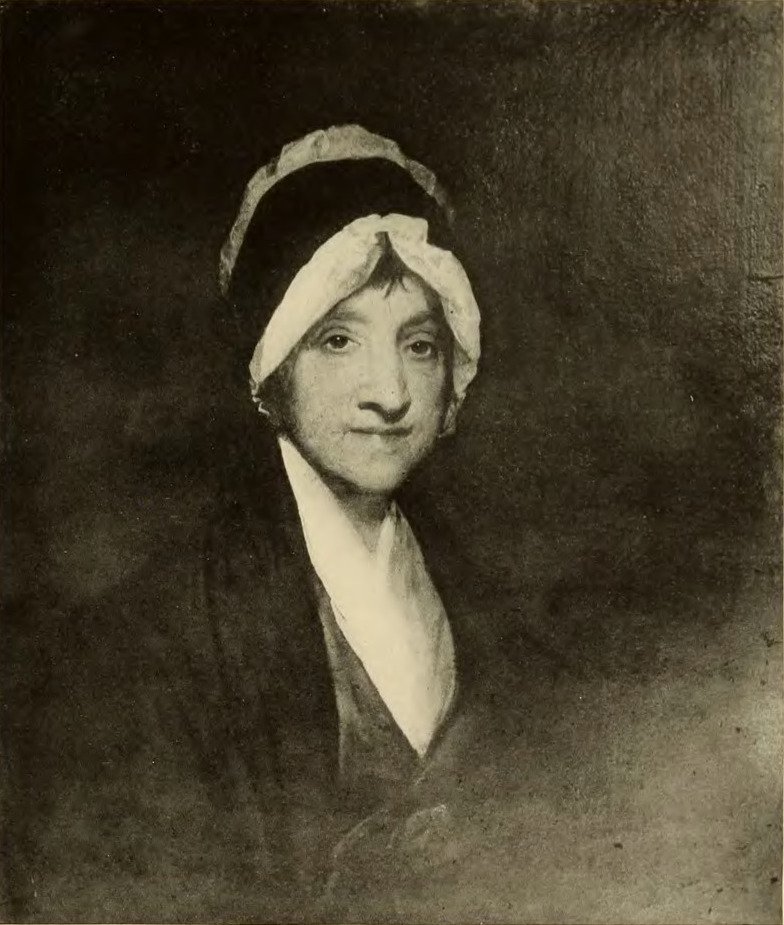
George Gibbs (I.) and his wife, and one or two children are buried in the old town burial-ground in Newport. Two upright slate stones mark the graves. The inscriptions are:
IN MEMORY OF MR. GEORGE GIBBS, WHO DIED AUGUST 6, I755,
IN THE 60TH YEAR OF HIS AGE.
IN MEMORY OF Mrs. RUTH GIBBS,
THE wrong FORM. GEORGE GIBBS, WHO DEPARTED THIS LIFE JUNE 4, 1784, IN THE 76TH YEAR OF HER AGE.
The stones and inscriptions were put in order many years later by their granddaughter, Miss Sarah Gibbs. The inscriptions on two small stones which mark children’s graves are illegible.
GEORGE GIBBS (II.), born 1735, was the son of George Gibbs and Ruth Hart. He may be regarded as the founder of the family and was an eminent citizen of Rhode Island. At his death in 1803 he left a fortune estimated at £700,000, a very large sum for those days. He followed the trade of his father and was originally a flour merchant, but this occupation was gradually merged into that of a shipping merchant in trade with the West Indies. In this business he was at one time a partner of Captain Joseph Anthony, a well-known merchant of Philadelphia. Anthony, who had been originally captain of a sailing vessel was, it is interesting to note, a nephew of Gilbert Stuart, who painted his portrait.
[11]
Anthony’s portrait, a very fine example of Stuart’s art, has been handed down in the Gibbs family and was left by my Uncle Wolcott Gibbs, in his will, to the Philadelphia Academy of Fine Arts, where it is now hung.
Before the War of the Revolution Gibbs’s shipping business appears to have been mainly with the West Indies, as before stated, and perhaps was not very extensive; during the war all commercial shipping business at Newport seems to have come to a standstill, while the British occupied the town. When they left, however ( in 1779), Gibbs returned and actively resumed business, forming in 1792 a partnership with his brother-in-law, Walter Channing of Newport,1 and he so extended his business and conducted it with an enterprise so intelligent that at the height of his activity no less than seventy-five sailing vessels belonging to his firm sailed from Newport for all parts of the world. His trade was chiefly with China, the West Indies, St. Petersburg, and the Mediterranean. In the chief parts of Europe and Asia, then so much more remote than at present, his name was known and respected, and in America no merchant stood higher and carried on a more extensive and venturesome business than he. Added to the dangers of the sea, in those days of small sailing vessels, were the risks of war and piracy. A character, well-known at the time, was “Gibbs the Pirate.” He was, in fact, a mate on one of George Gibbs’s vessels who assumed the name of Gibbs, organized a mutiny, turned pirate and committed numerous depredations. Our war for independence with England, the wars following on the French Revolution, and the aggressions of the Barbary pirates, all levied a toll on Gibbs’s fleet and all added to the difficulties of his career. One of his ships had been absent and unheard of for more than three years, and insurance upon her had been paid, when she sailed into Newport harbor with a good cargo and a strange tale of adventure.
1 See Chapter XI, page 175.
[ 12 ]
The Gibbs Family History — Complete Index
- Chapter I: The Gibbs Family in England
- Chapter II: The Gibbs Family of Rhode Island
- Chapter II, Part 2
- Chapter II, Part 3
- Chapter II, Part 4
- Chapter II, Part 5
- Chapter II, Part 6
- Chapter III: The William Channing Gibbs
- Chapter IV: The Channing Family
- Chapter V: The Wolcott Family of Connecticut
- Chapter VI: The Hosmer Family of Connecticut
- Chapter VII: Further Account of Certain Members of the Gibbs Family
- Chapter VIII: Family Portraits
- Chapter IX: Miscellaneous Notes
- Chapter X: Condensed Genealogical Record
- Chapter XI: Early Family Data
Reproduced verbatim from the 1933 volume, including the author’s spelling and punctuation. Editor’s notes in bracketed boxes mark points where the book’s statements conflict with the documentary record. Corrections will be noted rather than made silently.
Views: 65
Explore the evidence
View this article’s connected sources and media →
About this page
This article was brought over from AlfredGibbs.com. Its preserved text, media and citations remain available for comparison.