
EARLY records of the name in England, and the conditions leading to the emigration of members of the family to America, and their settlement here may be briefly reviewed.
The ancient family of Gibbs, also spelled Gibb, Gibbs and Gibbes, is supposed to have been derived from the Norman personal name “Gislebertus” or “Gilbert.” The ancestors of the family are said to have come into England, in William the Conqueror’s time (11th Century), from Brittany or Normandy. The members of the family, afterwards separating, settled in the counties of Devon, Kent, Warwick and Somerset; also in Ireland. Several of the Gentry families of this name, those of County Somerset, County Herts and County Cork, Ireland, are descended from two brothers Gibbs or Gibbes in the time of Richard II, one of whom settled at Henington, County Warwick, and the other at Fenton, County Devon.Jenkin Gibbes, in the time of Henry VII, a scion of the House of Fenton, whose descendants were of Elmerstone, County Kent, possessed an ancient roll deducing the family from Normandy, where they were resident long before the conquest of England. The Norman origin of the family seems fairly well authenticated, and is referred to in some detail in a Report of Columbus Smith, Esq., made in 1848 for the “Gibbs Association of Vermont,” of a search made in England for a property reported to belong to the Gibbs in America. He quotes Betham in his “Baronetage” and Sir William Pole in his collection of documents on the history of Devonshire as definitely fixing such origin.
In England many distinguished men have descended from the family, which is a prominent one there at the present day, both under the name and by titles and through intermarriages.
We are, however, especially interested in determining the beginnings and descent of the family in America. All came originally from English emigrants. The earliest arrived here in the 7th Century, prior to 1660. The successful colonization of Virginia dated from 1607; colonies along the New England coast were established in 1620, the date of the arrival of the “Mayflower.” Certain colonists of the name of Gibbs, but not our branch apparently, arrived in New England as early as 1628; others arrived in the South about the same time. No successful attempt seems possible to fix the exact date of arrival of my particular ancestor and it is not intended here to trace the growth and distribution of those of the family name now in America; at the present time it is not an uncommon one in many states, notably in Massachusetts, Vermont, Maine, the Carolinas and throughout the Middle States and on the Pacific Coast. “The Gibbs Family Association” published a bulletin more or less regularly giving information of interest regarding the family branches in the various States.
[ 2 ]
It is probable that Gibbs came to America at differ ent times during the 17th and 18th Centuries – and have continued to arrive up to the present time. Also, that they came from different parts of the British Islands, and were only distantly related there. Hence, the relationship between persons of the name in America is even more distant and cannot be traced. Many of the Gibbs here claim the same Coat of Arms as our branch, but this claim in itself is, of course, not sufficient to establish common ancestry.
The late Professor Josiah Willard Gibbs of Yale College published in 1879 a “Memoir of the Gibbs Family of Warwickshire, England, and the U.S.A. ” in which he gives much interesting information regarding his family. He deduces that in the time of Richard II two brothers, John and Thomas Gibbs, lived in England – the former in Devonshire and the latter in Warwickshire. He believed he was descended from Thomas and that the Gibbs of South Carolina are descended from the Devonshire stock (John Gibbs) from whom our branch seems also to have sprung. Prof. Gibbs remarks that “the close resemblance of the arms borne by the various families of Gibbs and Gibbes, in England, indicates identity of origin.” Although wanting in positive proof, we may reasonably assert that the arms were originally a field argent charged with three pole or battle axes, sable, but without a crest, a device which was not generally adopted until after the reign of Edward III, anno 1377. The motto “Tenax propositi” appears closely associated with the name, but this is a matter of taste; mottoes are regarded only as appendages, not parts of heraldic insignia.
No claim should be made for the noble origin of our family in England; but we can trace descent on all sides from respectable people who emigrated and founded a stock in the new country from which, in successive generations, many able and distinguished men appeared. In fact, practically all of the :first American immigrants were people of the lower classes – farmers and the like; some were holders of landed property in a small way; nearly all emigrated to escape religious persecution, or to better their lot. Those coming later may have had other motives, one of which, doubtless, was the incentive of the reported great opportunities in the new country. There was also a sprinkling of venturesome spirits among the emigrants and not a few disreputable members of society. By 1640 probably over 65,000 English people had left their homes for the New World. In the North they spread from Massachusetts to Rhode Island and into Connecticut; my ancestors on the Gibbs, the Wolcott and the Hosmer sides selected either Rhode Island or Connecticut.
1 As described in “Burke”: Arms: Azure. Three poleaxes in pale, argent, garnished, or. Crest: An arm embowed in armor, garnished or, holding in the gauntlet a po\eaxe, argent.
It is interesting to note that in my direct lines of descent for many generations no names appear from continental European families, even up to the present; in other words, we are of pure New England descent.
Dr. Wolcott Gibbs published in 1894 a “Family Record of James and Sarah Gibbs of Bristol, Mass.” It gives the result of his careful investigation of our family origin, and states that the Gibbs ancestors were “probably originally from Bristol, England.” My uncle was not prone to make deductions from data of the truth of which he was not absolutely certain; so he gave practically no detailed information as to the family in England and did not give the date of the arrival of the
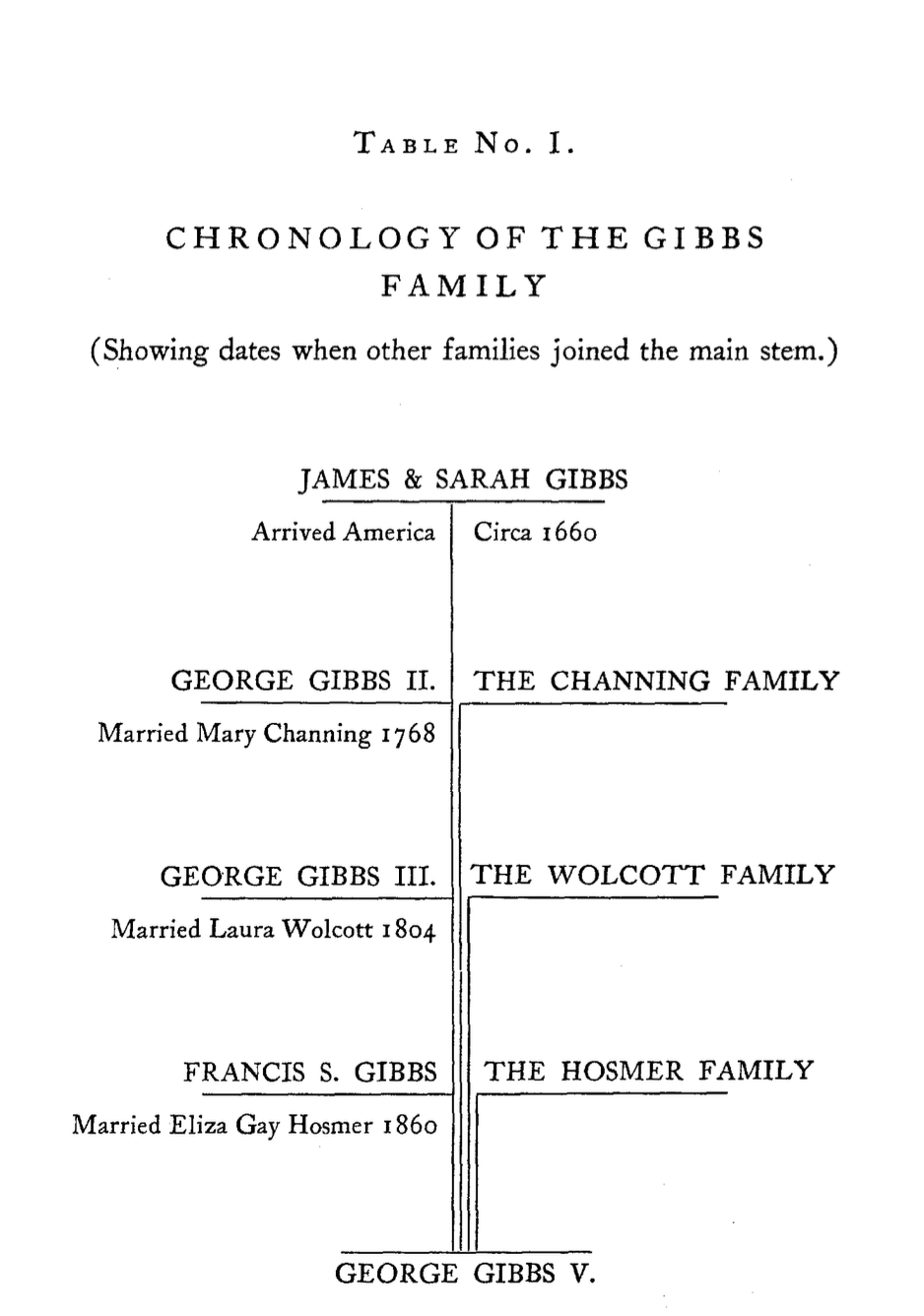
:first immigrant into America. He was convinced, how ever, that our :first American ancestor was James Gibbs, who came from England and settled in Rhode Island about I 660. I shall start my chronological Record of our family with the assumption that this is a fact.
[ 5 ]
The Gibbs Family History — Complete Index
- Chapter I: The Gibbs Family in England
- Chapter II: The Gibbs Family of Rhode Island
- Chapter II, Part 2
- Chapter II, Part 3
- Chapter II, Part 4
- Chapter II, Part 5
- Chapter II, Part 6
- Chapter III: The William Channing Gibbs
- Chapter IV: The Channing Family
- Chapter V: The Wolcott Family of Connecticut
- Chapter VI: The Hosmer Family of Connecticut
- Chapter VII: Further Account of Certain Members of the Gibbs Family
- Chapter VIII: Family Portraits
- Chapter IX: Miscellaneous Notes
- Chapter X: Condensed Genealogical Record
- Chapter XI: Early Family Data
Reproduced verbatim from the 1933 volume, including the author’s spelling and punctuation. Editor’s notes in bracketed boxes mark points where the book’s statements conflict with the documentary record. Corrections will be noted rather than made silently.
Views: 654
Explore the evidence
View this article’s connected sources and media →
About this page
This article was brought over from AlfredGibbs.com. Its preserved text, media and citations remain available for comparison.