
Wisconsin manuscript
Mr. Shipman (Hartford) -> Society of Descendants of Henry Wolcott · n.d. (enclosure)
TYPESCRIPT SPEECH p.1: the speaker's great grandfather looked on "Governor Wolcott - your Oliver Wolcott, Jr. - as a renegade Federalist," prophesying when Wolcott was nominated for Governor in 1817 by the Republicans "that they had caught a Tartar"; the Tartar held office ten years and was "one of the ablest men of his time and of all the Wolcotts as well"
Wisconsin Historical Society, Gibbs Family Papers, U.S. Mss Y, Micro 1117
Reel 3, frames 517, 518, 519, 520, 521, 522, 523, 524, 525, 526
Reel 3, frame 524
Read beside the scan
AI first transcription from the evidence pack; not independently verified. Compare with the scan.
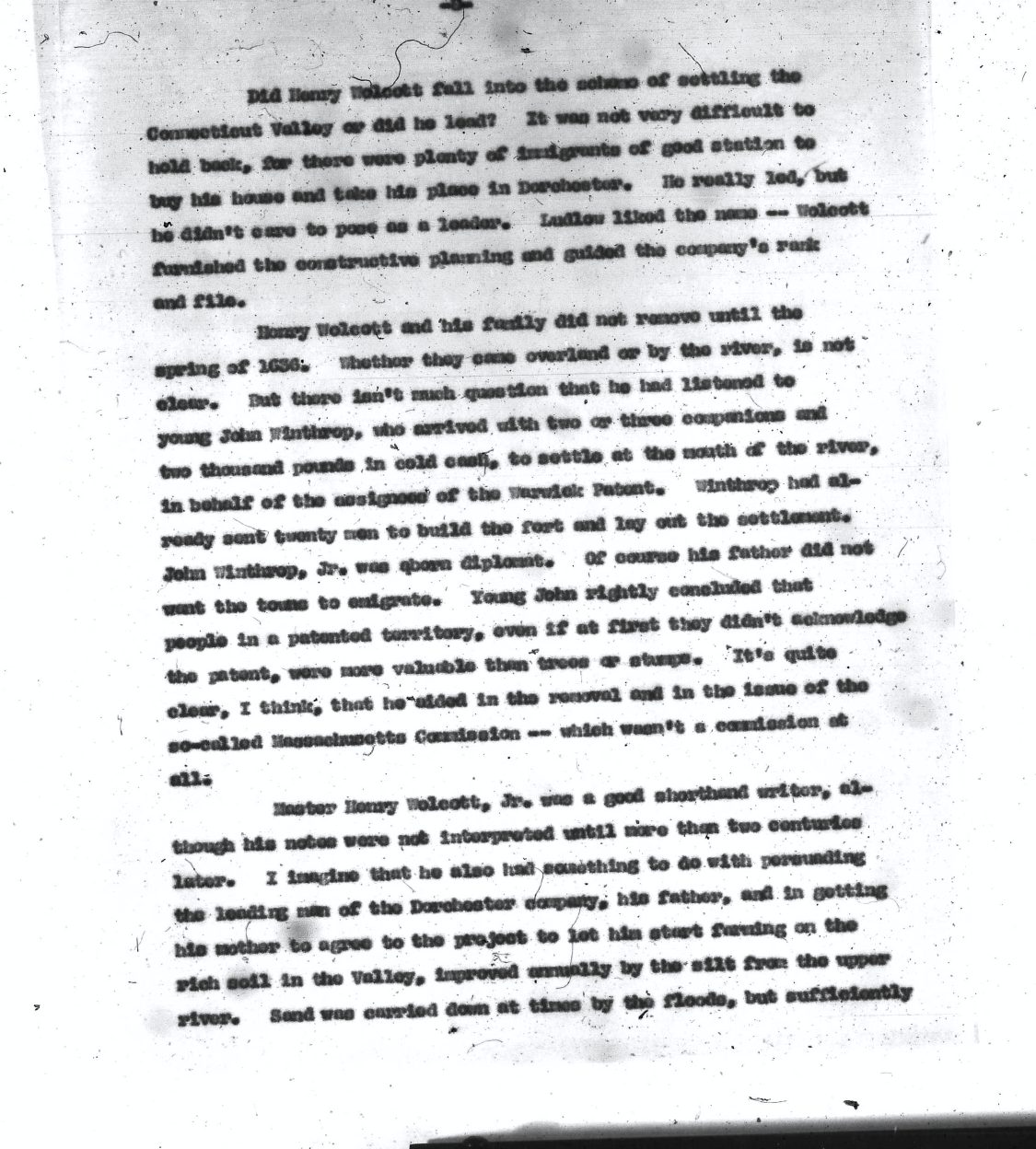
Did Henry Wolcott fall into the scheme of settling the
Connecticut Valley or did he lead? It was not very difficult to
hold back, for there were plenty of immigrants of good station to
buy his house and take his place in Dorchester. He really led, but
he didn't care to pose as a leader. Ludlow liked the name[?] -- Wolcott
furnished the constructive planning and guided the company's rank
and file.
Henry Wolcott and his family did not remove until the
spring of 1636[?]. Whether they came overland or by the river, is not
clear. But there isn't much question that he had listened to
young John Winthrop, who arrived with two or three companions and
two thousand pounds in cold cash, to settle at the mouth of the river,
in behalf of the assignees of the Warwick Patent. Winthrop had al-
ready sent twenty men to build the fort and lay out the settlement.
John Winthrop, Jr. was a born[?] diplomat. Of course his father did not
want the towns to emigrate. Young John rightly concluded that
people in a patented territory, even if at first they didn't acknowledge
the patent, were more valuable than trees or stumps. It's quite
clear, I think, that he aided in the removal and in the issue of the
so-called Massachusetts Commission -- which wasn't a commission at
all.
Master Henry Wolcott, Jr. was a good shorthand writer, al-
though his notes were not interpreted until more than two centuries
later. I imagine that he also had something to do with persuading
the leading man of the Dorchester company, his father, and in getting
his mother to agree to the project to let him start farming on the
rich soil in the Valley, improved annually by the silt from the upper
river. Sand was carried down at times by the floods, but sufficiently
Citation and provenance
Mr. Shipman. (n.d.). [Letter to Society of Descendants of Henry Wolcott]. Gibbs Family Papers, 1763-1918 (U.S. Mss Y, Micro 1117, Reel 3, frames 517-526). Wisconsin Historical Society Archives, Madison, WI, United States.
Citation details need editorial review.
Historical sources retain their individual rights and credits. A scan’s presence here does not establish unrestricted reuse.
People identified in the source catalog
These are catalog labels. Individual identities and relationships have not all been reviewed.
Where the book uses this document
No quotation has yet been assigned directly to this catalog record. Its individual frames may have separate connections.