
Wisconsin manuscript
Mr. Shipman (Hartford) -> Society of Descendants of Henry Wolcott · n.d. (enclosure)
TYPESCRIPT SPEECH p.1: the speaker's great grandfather looked on "Governor Wolcott - your Oliver Wolcott, Jr. - as a renegade Federalist," prophesying when Wolcott was nominated for Governor in 1817 by the Republicans "that they had caught a Tartar"; the Tartar held office ten years and was "one of the ablest men of his time and of all the Wolcotts as well"
Wisconsin Historical Society, Gibbs Family Papers, U.S. Mss Y, Micro 1117
Reel 3, frames 517, 518, 519, 520, 521, 522, 523, 524, 525, 526
Reel 3, frame 519
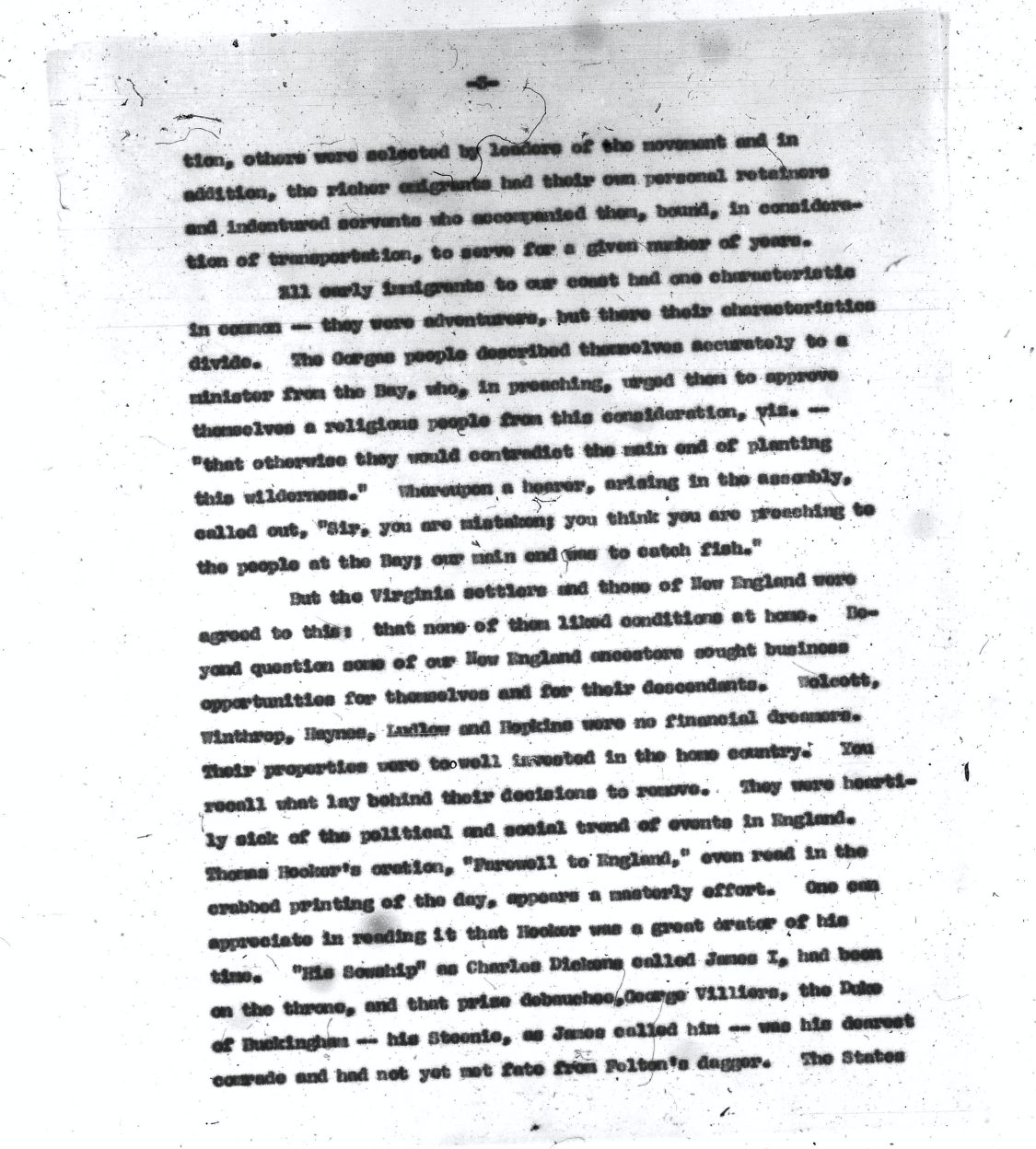
Read beside the scan
AI first transcription from the evidence pack; not independently verified. Compare with the scan.
tion, others were selected by leaders of the movement and in
addition, the richer emigrants had their own personal retainers
and indentured servants who accompanied them, bound, in considera-
tion of transportation, to serve for a given number of years.
All early immigrants to our coast had one characteristic
in common — they were adventurers, but there their characteristics
divide. The Gorges people described themselves accurately to a
minister from the Bay, who, in preaching, urged them to approve
themselves a religious people from this consideration, viz. —
"that otherwise they would contradict the main end of planting
this wilderness." Whereupon a hearer, arising in the assembly,
called out, "Sir, you are mistaken; you think you are preaching to
the people at the Bay; our main end was to catch fish."
But the Virginia settlers and those of New England were
agreed to this: that none of them liked conditions at home. Be-
yond question some of our New England ancestors sought business
opportunities for themselves and for their descendants. Wolcott[?],
Winthrop, Haynes, Ludlow and Hopkins were no financial dreamers.
Their properties were to[inserted: o] well invested in the home country. You
recall what lay behind their decisions to remove. They were hearti-
ly sick of the political and social trend of events in England.
Thomas Hooker's oration, "Farewell to England," even read in the
crabbed printing of the day, appears a masterly effort. One can
appreciate in reading it that Hooker was a great orator of his
time. "His Sowship" as Charles Dickens called James I, had been
on the throne, and that prime debauchee,George Villiers, the Duke
of Buckingham — his Steenie, as James called him — was his dearest
comrade and had not yet met fate from Felton's dagger. The States
Citation and provenance
Mr. Shipman. (n.d.). [Letter to Society of Descendants of Henry Wolcott]. Gibbs Family Papers, 1763-1918 (U.S. Mss Y, Micro 1117, Reel 3, frames 517-526). Wisconsin Historical Society Archives, Madison, WI, United States.
Citation details need editorial review.
Historical sources retain their individual rights and credits. A scan’s presence here does not establish unrestricted reuse.
People identified in the source catalog
These are catalog labels. Individual identities and relationships have not all been reviewed.
Where the book uses this document
No quotation has yet been assigned directly to this catalog record. Its individual frames may have separate connections.