
Wisconsin manuscript
Mr. Shipman (Hartford) -> Society of Descendants of Henry Wolcott · n.d. (enclosure)
TYPESCRIPT SPEECH p.1: the speaker's great grandfather looked on "Governor Wolcott - your Oliver Wolcott, Jr. - as a renegade Federalist," prophesying when Wolcott was nominated for Governor in 1817 by the Republicans "that they had caught a Tartar"; the Tartar held office ten years and was "one of the ablest men of his time and of all the Wolcotts as well"
Wisconsin Historical Society, Gibbs Family Papers, U.S. Mss Y, Micro 1117
Reel 3, frames 517, 518, 519, 520, 521, 522, 523, 524, 525, 526
Reel 3, frame 522
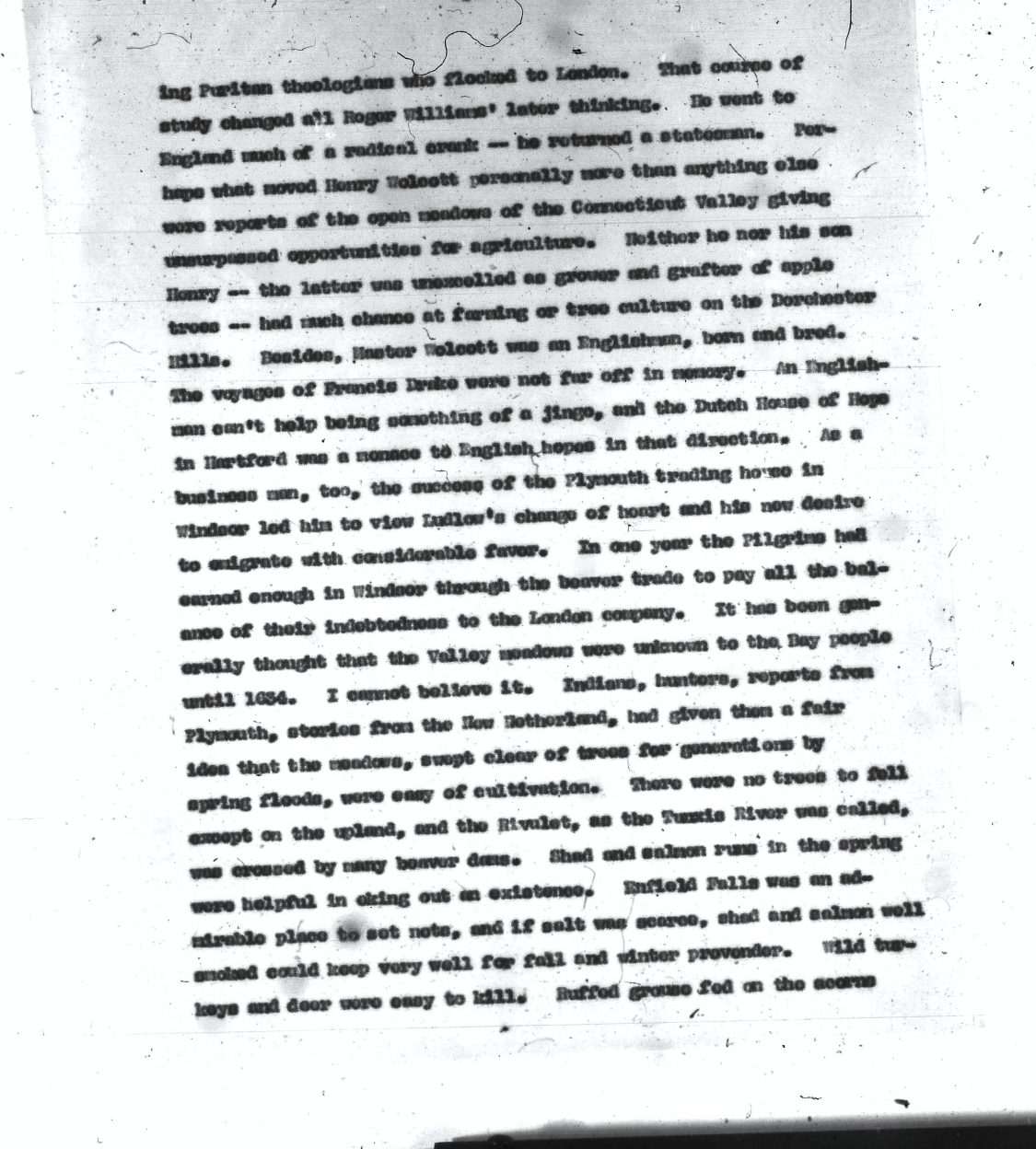
Read beside the scan
AI first transcription from the evidence pack; not independently verified. Compare with the scan.
study changed all Roger Williams' later thinking. He went to
England much of a radical crank -- he returned a statesman. Per-
haps what moved Henry Wolcott personally more than anything else
were reports of the open meadows of the Connecticut Valley giving
unsurpassed opportunities for agriculture. Neither he nor his son
Henry -- the latter was unexcelled as grower and grafter of apple
trees -- had much chance at farming or tree culture on the Dorchester
Hills. Besides, Master Wolcott was an Englishman, born and bred.
The voyages of Francis Drake were not far off in memory. An English-
man can't help being something of a jingo, and the Dutch House of Hope
in Hartford was a menace to English hopes in that direction. As a
business man, too, the success of the Plymouth trading house in
Windsor led him to view Ludlow's change of heart and his new desire
to emigrate with considerable favor. In one year the Pilgrims had
earned enough in Windsor through the beaver trade to pay all the bal-
ance of their indebtedness to the London company. It has been gen-
erally thought that the Valley meadows were unknown to the Bay people
until 1634[?]. I cannot believe it. Indians, hunters, reports from
Plymouth, stories from the New Netherland, had given them a fair
idea that the meadows, swept clear of trees for generations by
spring floods, were easy of cultivation. There were no trees to fell
except on the upland, and the Rivulet, as the Tunxis[?] River was called,
was crossed by many beaver dams. Shad and salmon runs in the spring
were helpful in eking out an existence. Enfield Falls was an ad-
mirable place to set nets, and if salt was scarce, shad and salmon well
smoked could keep very well for fall and winter provender. Wild tur-
keys and deer were easy to kill. Ruffed grouse fed on the acorns
Citation and provenance
Mr. Shipman. (n.d.). [Letter to Society of Descendants of Henry Wolcott]. Gibbs Family Papers, 1763-1918 (U.S. Mss Y, Micro 1117, Reel 3, frames 517-526). Wisconsin Historical Society Archives, Madison, WI, United States.
Citation details need editorial review.
Historical sources retain their individual rights and credits. A scan’s presence here does not establish unrestricted reuse.
People identified in the source catalog
These are catalog labels. Individual identities and relationships have not all been reviewed.
Where the book uses this document
No quotation has yet been assigned directly to this catalog record. Its individual frames may have separate connections.