The book is finished.GIBBS: The Forgotten Warrior of the First New York Dragoons, by Garland H. Green Jr. How to order is coming soon; you can reserve a copy now. Reserve a copy →
You came from “In one house where was 2 wounded men, 1 was a Rebel, 1 was Union.”. Keep that passage in view as you compare this record. Return to the quotation.
Green family letter
Levi D. Green to Dear Brother, December 31, 1862
Original letters held by the extended Green family; transcripts given to Garland H. Green Jr.; one letter is a photocopy held by the National Archives
Green family letters (transcripts of the originals, which are in family hands)
Garland H. Green Jr.’s research
About this Letter
Levi Davis Green wrote this letter on the last night of 1862, and he had no way of knowing he was writing on the eve of a different country. Within hours, on the morning of January 1, 1863, President Lincoln would sign the Emancipation Proclamation, and the war Levi had joined to hold the Union together would become a war to end slavery. He does not mention it. No one in the winter camp at Suffolk that night could have known how the next morning would be remembered. He writes instead about a persimmon seed and a postage stamp he cannot find, and that is exactly the gift of the letter. It catches an ordinary man in the last ordinary hour before the meaning of the war changed under his feet.
The winter around him was a bitter one. Eighteen days earlier, on December 13, the Army of the Potomac had been cut to pieces against the stone wall at Fredericksburg, seventy miles to the north, the worst Union defeat of the war to that point. Levi’s own regiment, the 130th New York Infantry, had been spared that slaughter. It held the Union works at Suffolk, Virginia, under its new colonel, Alfred Gibbs, watching the Confederate forces gathered across the Blackwater River and riding out again and again to probe them. The “trip to Blackwater” Levi describes, the double-quick march, the wounded men lying along the road, the captured Rebel captain in his butternut brown, was one of those expeditions. One month later, on January 30, 1863, the regiment would fight its first real battle a few miles down that same road, at Deserted House.
Levi was twenty-one years old and five months a soldier. His younger brother Marvin served at his side in Company E, and Levi remembers, almost too late, to add at the very bottom that “Marvin is well.” He is writing home to his brother John, in Allegany County, New York, who had not yet gone to the war. He cannot even hold his own pen this night; his bunkmate W. E. Smith writes the letter for him. None of them could see what was coming. Eighteen months from this New Year’s Eve, Levi would be captured on a cavalry raid south of Petersburg and sent to the prison stockade at Camp Lawton, Georgia, where he would die of starvation and disease before the war ended. John would enlist in the 93rd New York and fall wounded in the Wilderness. Only Marvin, the brother named last and almost forgotten, would come home.
That is why an ordinary letter matters. It is a voice from a single evening that the men living it could not step outside of, and we can. His muster record, the account of his capture and death, and the grave that was finally found are gathered on Levi’s own page. The pages below are the family typescript prepared by Marjorie Kuski; the transcription that follows keeps Levi’s spelling and punctuation exactly as he set them down.
Preserved from Garland’s full research page. This introduction is the author’s explanation, distinct from the letter below.
Watch & listen
Explore the video accompanying this letter, then continue into the complete transcript and Garland’s research below.
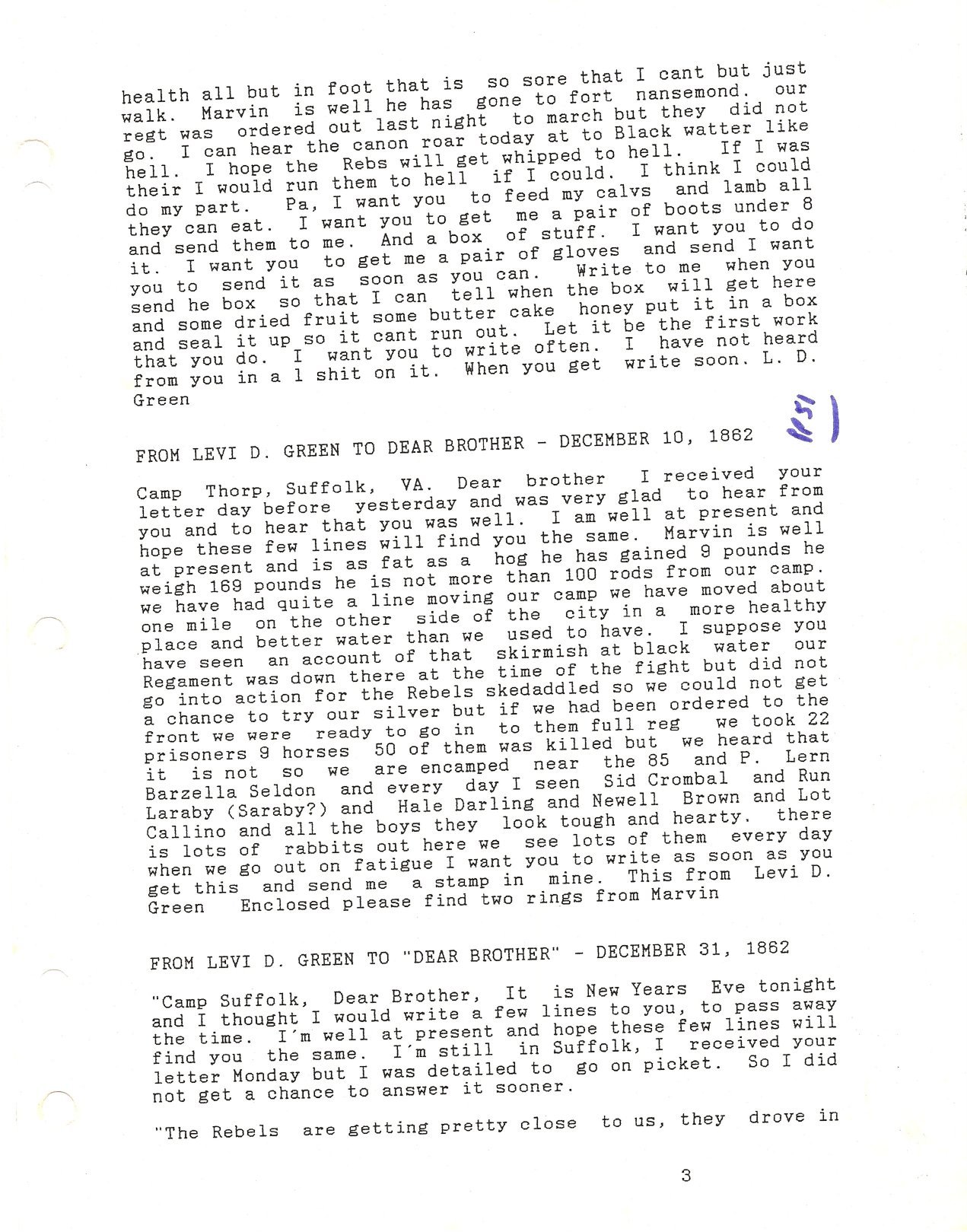
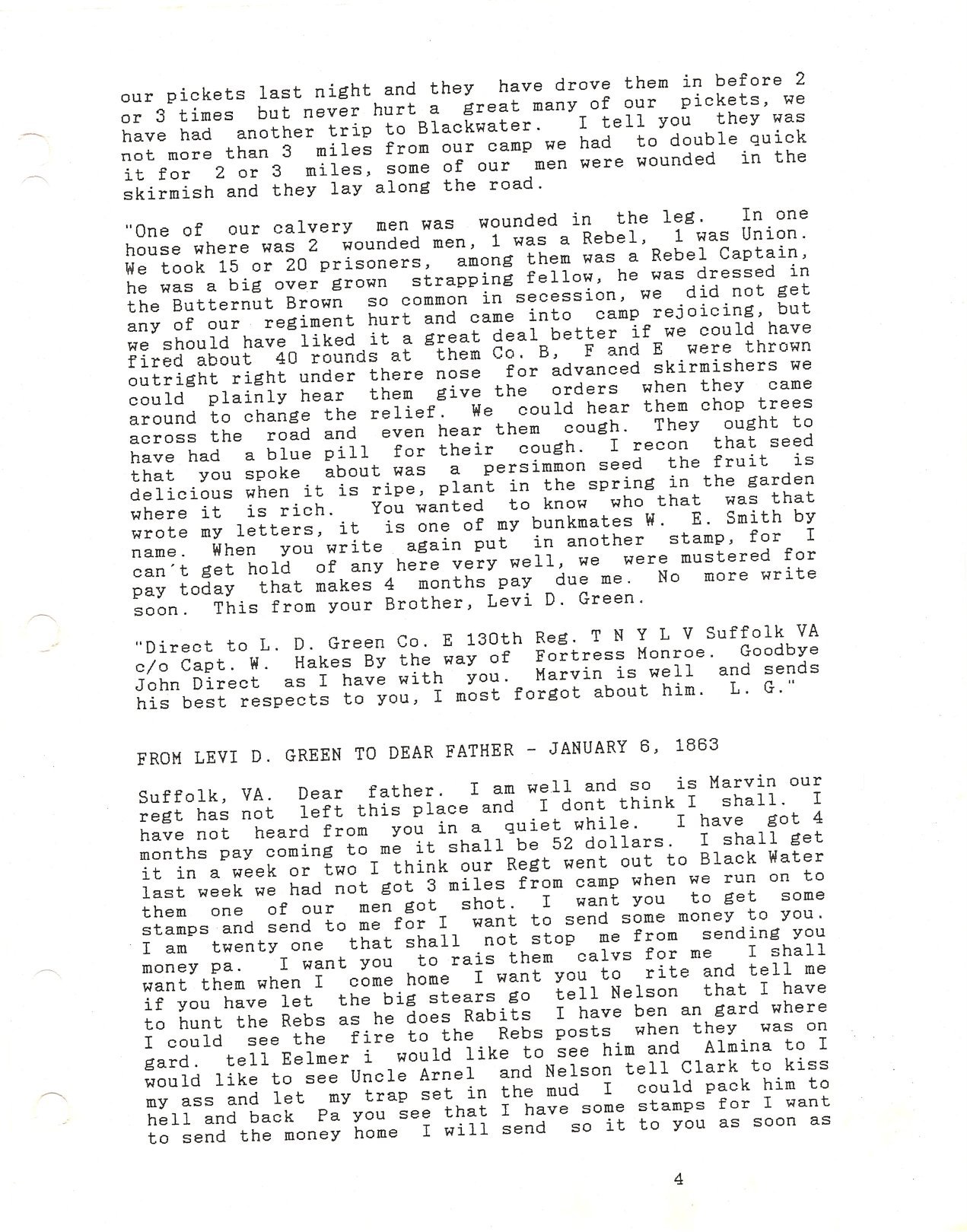
Family typescript pages. These are images of the preserved transcription, not scans of the handwritten originals.
Typescript page 3 (click to enlarge).. Open the image for a larger view.Typescript page 4 (click to enlarge).. Open the image for a larger view.
Full letter transcription
Transcribed verbatim from Marjorie Kuski’s family typescript (pages shown above), preserving Levi’s original spelling and punctuation.
Camp Suffolk, Virginia · December 31, 1862
Dear Brother,
It is New Years Eve tonight and I thought I would write a few lines to you, to pass away the time. I’m well at present and hope these few lines will find you the same. I’m still in Suffolk, I received your letter Monday but I was detailed to go on picket. So I did not get a chance to answer it sooner.
The Rebels are getting pretty close to us, they drove in our pickets last night and they have drove them in before 2 or 3 times but never hurt a great many of our pickets, we have had another trip to Blackwater. I tell you they was not more than 3 miles from our camp we had to double quick it for 2 or 3 miles, some of our men were wounded in the skirmish and they lay along the road.
One of our calvery men was wounded in the leg. In one house where was 2 wounded men, 1 was a Rebel, 1 was Union. We took 15 or 20 prisoners, among them was a Rebel Captain, he was a big over grown strapping fellow, he was dressed in the Butternut Brown so common in secession, we did not get any of our regiment hurt and came into camp rejoicing, but we should have liked it a great deal better if we could have fired about 40 rounds at them Co. B, F and E were thrown outright right under there nose for advanced skirmishers we could plainly hear them give the orders when they came around to change the relief. We could hear them chop trees across the road and even hear them cough. They ought to have had a blue pill for their cough. I recon that seed that you spoke about was a persimmon seed the fruit is delicious when it is ripe, plant in the spring in the garden where it is rich. You wanted to know who that was that wrote my letters, it is one of my bunkmates W. E. Smith by name. When you write again put in another stamp, for I can’t get hold of any here very well, we were mustered for pay today that makes 4 months pay due me. No more write soon.
This from your Brother, Levi D. Green.
Direct to L. D. Green Co. E 130th Reg. T N Y L V Suffolk VA c/o Capt. W. Hakes By the way of Fortress Monroe. Goodbye John Direct as I have with you. Marvin is well and sends his best respects to you, I most forgot about him. L. G.
Researcher’s Notes
The blue pill
What Levi calls the “blue pill” was almost certainly blue mass, a mercury preparation used in the period to treat everything from diarrhea and constipation to syphilis. The mercury was worked together with sugar, licorice, and chalk and rolled into small tablets, and it was in constant use in both armies. We now know the mercury in it was poisonous and could cause serious neurological and kidney damage, so his joke that the coughing Confederate pickets “ought to have had a blue pill” was grimmer than he knew.
The Blackwater
The Blackwater River runs about 105 miles through the inner coastal plain of southeastern Virginia, from its source near Petersburg to its meeting with the Nottoway, where the two rivers form the Chowan and, close by, the line between Virginia and North Carolina. It is a true blackwater river: clear but tannin-stained and slightly acidic, draining a basin of marshes and bald-cypress and tupelo swamp. Through the winter and spring of 1862 to 1863 the 130th New York crossed toward it again and again in the reconnaissances and skirmishing that made up the Union defense of Suffolk. Those actions are told in full here.
The hand that held the pen: W. E. Smith
Levi says the letter was written for him by his bunkmate, “W. E. Smith by name.” He was William E. Smith, an eighteen-year-old from Wellsville, New York, who enlisted on August 4, 1862 and mustered into Company E as a private on August 16, 1862, the same company as Levi and Marvin. By the regimental roster he was made corporal on September 1, 1863, sergeant on February 9, 1865, and mustered out with the company on June 30, 1865 at Cloud’s Mills, Virginia, before going home to Wellsville. Unlike the Green brothers, he came through the war (Bowen, 1900, regimental roster).
Kuski typescript, page 4
Kuski typescript, page 4. Select the image to inspect the full scan.
Read beside the scan
Scan of the Marjorie Kuski typescript of the Green family letters. The quotation's words were found on this page.
No transcription has yet been connected. The quotation itself is not a substitute for the document’s transcription.
Citation and provenance
Green, L. D. (1862, December 31). [Letter addressed "Dear Brother, December 31"]. Green family letters (typescript of the originals, held by the extended Green family; transcripts given to Garland H. Green Jr.).
Historical sources retain their individual rights and credits. A scan’s presence here does not establish unrestricted reuse.
Catalog quotation assignments for this letter
These are the catalog’s assignments. A warning below identifies wording found in another preserved letter; the assignment itself is not silently rewritten.