
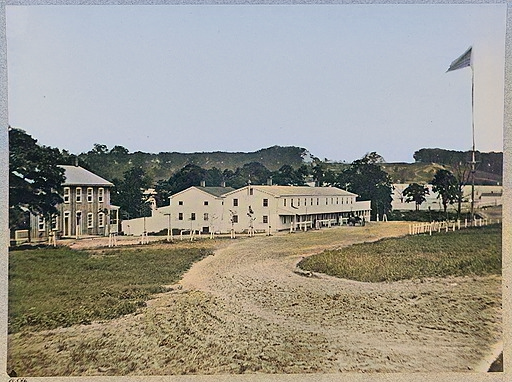
The book is finished. GIBBS: The Forgotten Warrior of the First New York Dragoons, by Garland H. Green Jr. How to order is coming soon; you can reserve a copy now. Reserve a copy →
Alfred GibbsThe research archive
Menu

From your reading · 24-061

Follow these words to their source

You are exploring The picket line, Suffolk in The Blackwater. Compare the words used in the book with the source and the context around them.

In one house where was 2 wounded men, 1 was a Rebel, 1 was Union.

Source inferred, check against scan

See how the book uses these words

Levi had just come off picket. "The Rebels are getting pretty close to us, they drove in our pickets last night." There had been another trip toward the Blackwater, this one short and fast. The enemy "was not more than
3 miles from our camp we had to double quick it for 2 or 3 miles, some of our men were wounded in the skirmish and they lay along the road." He had seen something he wanted his brot

Book context excerpt, up to 400 characters. This is not the full chapter.

Garland H. Green Jr.’s research

About this Letter

Levi Davis Green wrote this letter on the last night of 1862, and he had no way of knowing he was writing on the eve of a different country. Within hours, on the morning of January 1, 1863, President Lincoln would sign the Emancipation Proclamation, and the war Levi had joined to hold the Union together would become a war to end slavery. He does not mention it. No one in the winter camp at Suffolk that night could have known how the next morning would be remembered. He writes instead about a persimmon seed and a postage stamp he cannot find, and that is exactly the gift of the letter. It catches an ordinary man in the last ordinary hour before the meaning of the war changed under his feet.

The winter around him was a bitter one. Eighteen days earlier, on December 13, the Army of the Potomac had been cut to pieces against the stone wall at Fredericksburg, seventy miles to the north, the worst Union defeat of the war to that point. Levi’s own regiment, the 130th New York Infantry, had been spared that slaughter. It held the Union works at Suffolk, Virginia, under its new colonel, Alfred Gibbs, watching the Confederate forces gathered across the Blackwater River and riding out again and again to probe them. The “trip to Blackwater” Levi describes, the double-quick march, the wounded men lying along the road, the captured Rebel captain in his butternut brown, was one of those expeditions. One month later, on January 30, 1863, the regiment would fight its first real battle a few miles down that same road, at Deserted House.

Levi was twenty-one years old and five months a soldier. His younger brother Marvin served at his side in Company E, and Levi remembers, almost too late, to add at the very bottom that “Marvin is well.” He is writing home to his brother John, in Allegany County, New York, who had not yet gone to the war. He cannot even hold his own pen this night; his bunkmate W. E. Smith writes the letter for him. None of them could see what was coming. Eighteen months from this New Year’s Eve, Levi would be captured on a cavalry raid south of Petersburg and sent to the prison stockade at Camp Lawton, Georgia, where he would die of starvation and disease before the war ended. John would enlist in the 93rd New York and fall wounded in the Wilderness. Only Marvin, the brother named last and almost forgotten, would come home.

That is why an ordinary letter matters. It is a voice from a single evening that the men living it could not step outside of, and we can. His muster record, the account of his capture and death, and the grave that was finally found are gathered on Levi’s own page. The pages below are the family typescript prepared by Marjorie Kuski; the transcription that follows keeps Levi’s spelling and punctuation exactly as he set them down.

Preserved from Garland’s full research page. This introduction is the author’s explanation, distinct from the letter below.

The connected source

Levi D. Green to Dear Brother, December 31, 1862

Green family letter · Green family letters (transcripts of the originals, which are in family hands)

placed by its position on the page that transcribes it (check against the scan). A text match or page placement does not establish that the scan has been reviewed.

Questions to bring to the source

Who wrote this, and who was meant to read it? Is the writer describing an event they witnessed, reporting news from someone else, or remembering it later? Read the surrounding lines and compare dates, names and uncertain words.

Begin with the source page
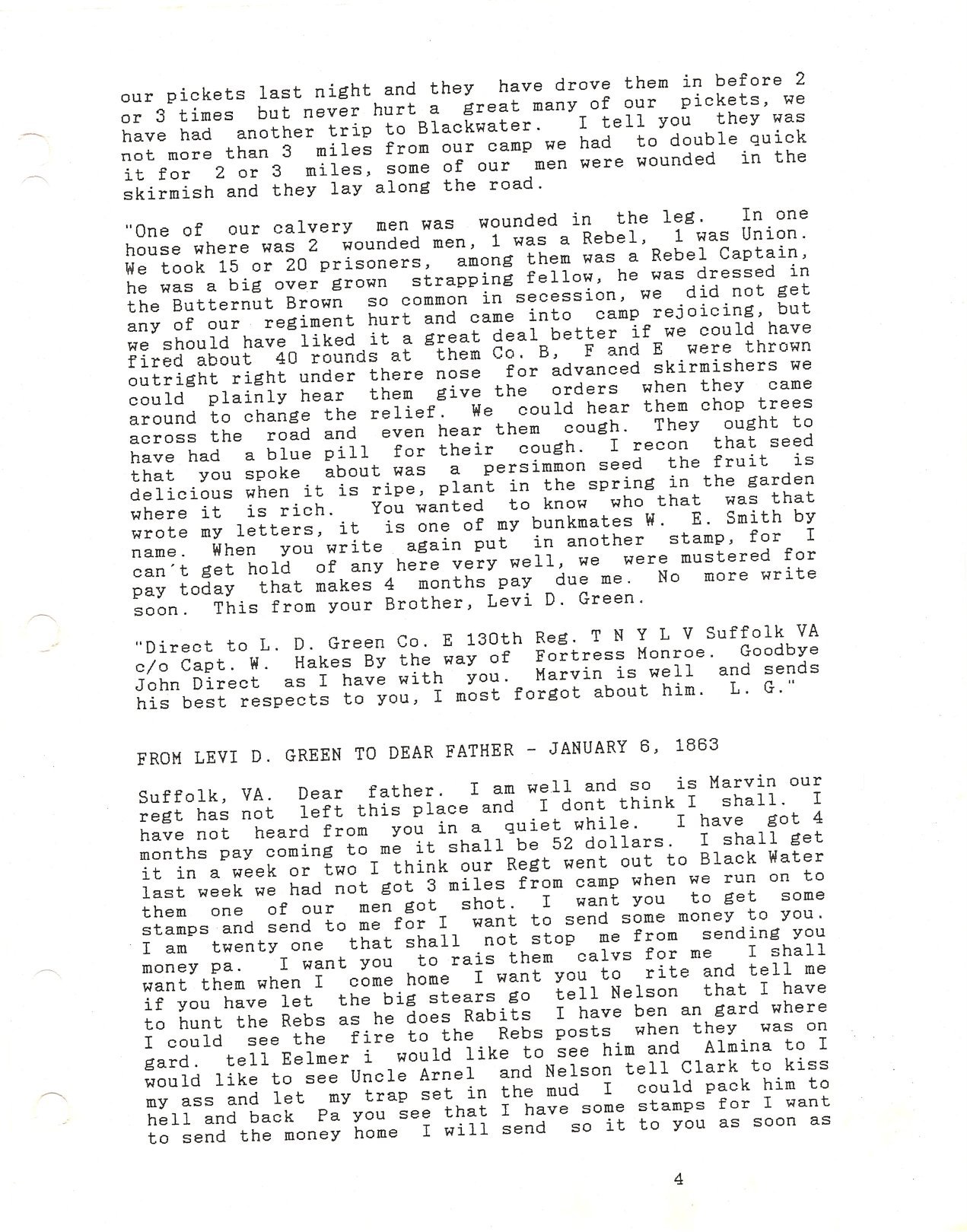
Kuski typescript, page 4

Read beside the scan

Scan of the Marjorie Kuski typescript of the Green family letters. The quotation's words were found on this page.

A transcription has not yet been connected to this scan.

Read the complete page and citation →

Open the document and its pages →

Read the research account used for this passage

The book catalog explicitly points to these preserved site pages. Read the account and follow its reproduced documents and citations. A research account is an intermediary, not automatically the original evidence.

Continue your learning journey

Explore the sources behind The Blackwater →

Follow the people in this chapter →

Return to The Blackwater and its quotation ledger →

he was a big over grown strapping fellow, he was dressed in the Butternut Brown so common in secessi… →

We could hear them chop trees across the road and even hear them cough. They ought to have had a blu… →

This entry as JSON · Explore outside this chapter

Your quotation stays open
Your book journey · The Blackwater · The picket line, Suffolk · Quotation 24-061Explore the evidence

Read the account and its original sources while keeping this quotation open.

Explore outside this journey ↗