
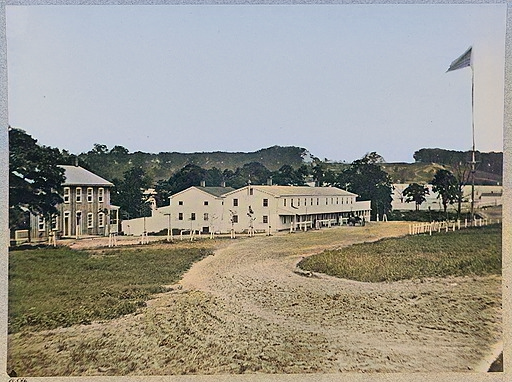
The book is finished. GIBBS: The Forgotten Warrior of the First New York Dragoons, by Garland H. Green Jr. How to order is coming soon; you can reserve a copy now. Reserve a copy →
Alfred GibbsThe research archive
Menu

From your reading · 34-042

Follow these words to their source

You are exploring Petersburg and Cloud's Mills in Appomattox. Compare the words used in the book with the source and the context around them.

did not go with Sheridan.

Source inferred, check against scan

See how the book uses these words

Marvin Green was not at Appomattox. On the eleventh of May he wrote from Winchester, where his battery still was. "Fiting is plaid out now," he told his parents. His battery, he said, "did not go with Sheridan." He was waiting to be sent home, "in 6 weeks and maby not untill my time is out," and he had to stop writing in the middle: "Excuse me for this time for the mule is ready."

Book context excerpt, up to 400 characters. This is not the full chapter.

Garland H. Green Jr.’s research

About this Letter

Levi Green wrote this letter from Suffolk on January 6, 1863, five days after the country he was fighting for changed its purpose. On New Year’s Day, while Levi sat in winter camp, President Lincoln had signed the Emancipation Proclamation, and the war to hold the Union together became a war to end slavery. Levi does not mention it, and there is no sign he yet knew what it would mean. His mind is on his pay and his father’s farm.

The war around him had settled into a hard, watchful routine. His regiment, the 130th New York, still held the Union works at Suffolk, Virginia, under Colonel Alfred Gibbs, and rode out every few weeks toward the Confederate positions across the Blackwater River. The march Levi mentions, when the regiment “had not got 3 miles from camp when we run on to them” and one man was shot, was one of those probes. In three weeks the regiment would fight its first pitched battle a few miles down that same road, at the Deserted House.

But this is a farmer’s son writing to his father, not a soldier writing of war. He has fifty-two dollars in back pay coming, four months of it, and his whole thought is to send it home. He asks his father to raise the calves for him, “I shall want them when I come home.” He wants to know whether the big steers have been sold. He is twenty-one, he says so, and says it will not stop him sending money to his pa. He is also young and unvarnished, and the letter carries a coarse joke about a neighbor that his family kept anyway. That is the gift of a letter never meant for our eyes. It is exactly as he was.

He would not come home, and the calves would grow old without him. Eighteen months after he wrote this, Levi was captured south of Petersburg and died in the prison stockade at Camp Lawton, Georgia. His brother Marvin, “well” here as in every letter, was the one who came back. Levi’s service record and the finding of his grave are gathered on Levi’s own page. The pages below are the family typescript prepared by Marjorie Kuski; the transcription keeps his spelling exactly as he set it down.

Preserved from Garland’s full research page. This introduction is the author’s explanation, distinct from the letter below.

The connected source

Levi D. Green to Dear Father, January 6, 1863

Green family letter · Green family letters (transcripts of the originals, which are in family hands)

placed by its position on the page that transcribes it (check against the scan). A text match or page placement does not establish that the scan has been reviewed.

Questions to bring to the source

Who wrote this, and who was meant to read it? Is the writer describing an event they witnessed, reporting news from someone else, or remembering it later? Read the surrounding lines and compare dates, names and uncertain words.

Begin with the source page
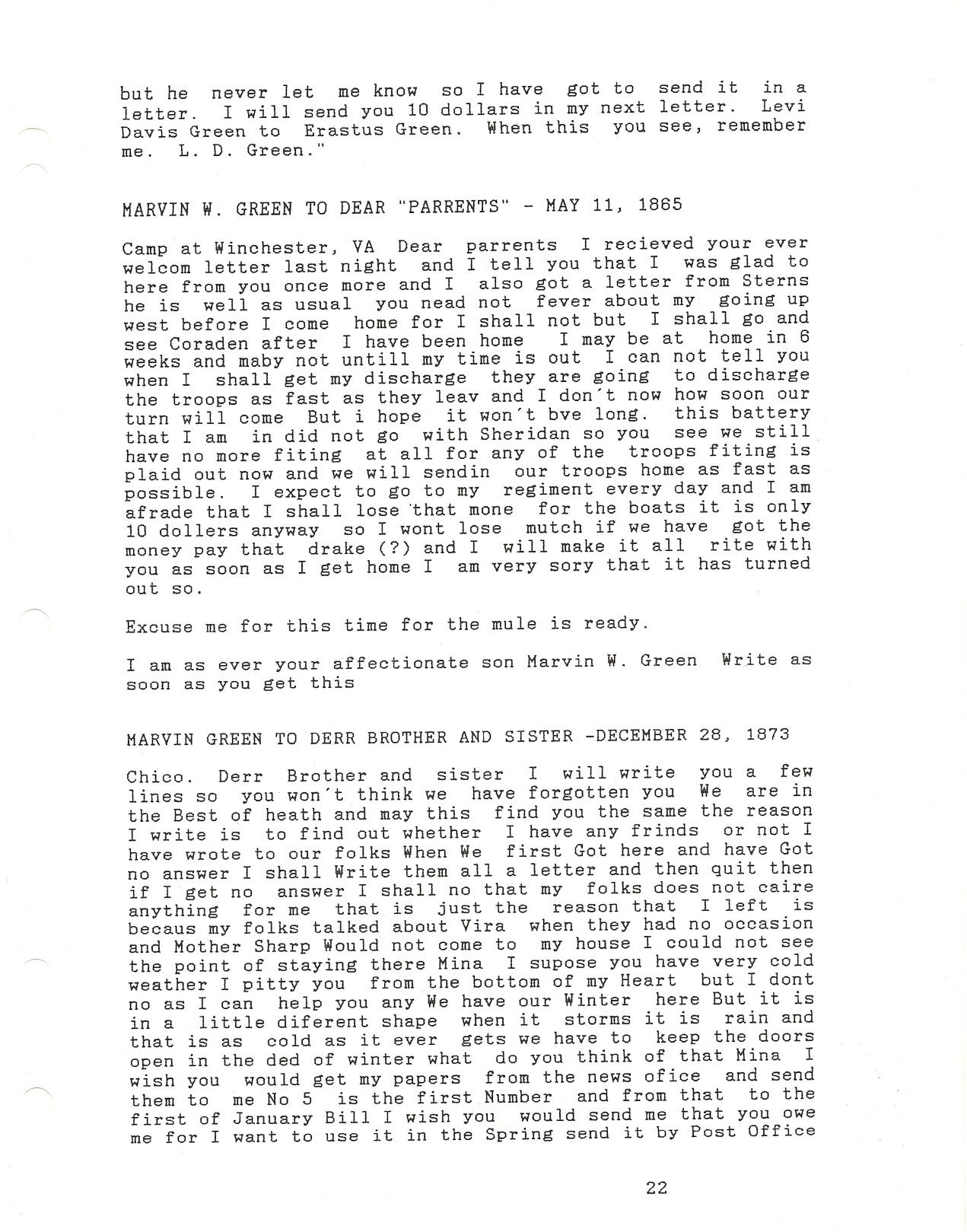
Kuski typescript, page 22

Read beside the scan

Scan of the Marjorie Kuski typescript of the Green family letters. The quotation's words were found on this page.

A transcription has not yet been connected to this scan.

Read the complete page and citation →

Open the document and its pages →

Read the research account used for this passage

The book catalog explicitly points to these preserved site pages. Read the account and follow its reproduced documents and citations. A research account is an intermediary, not automatically the original evidence.

The person behind the name

People named in this passage

Follow the lives and existing research connected to names in these words or their book context. These person connections do not establish the source of the quotation.
Continue your learning journey

Explore the sources behind Appomattox →

Follow the people in this chapter →

Return to Appomattox and its quotation ledger →

in 6 weeks and maby not untill my time is out, →

Excuse me for this time for the mule is ready. →

This entry as JSON · Explore outside this chapter

Your quotation stays open
Your book journey · Appomattox · Petersburg and Cloud's Mills · Quotation 34-042Explore the evidence

Read the account and its original sources while keeping this quotation open.

Explore outside this journey ↗