The book is finished.GIBBS: The Forgotten Warrior of the First New York Dragoons, by Garland H. Green Jr. How to order is coming soon; you can reserve a copy now. Reserve a copy →
You are exploring The pursuit in Swordless and Horseless. Compare the words used in the book with the source and the context around them.
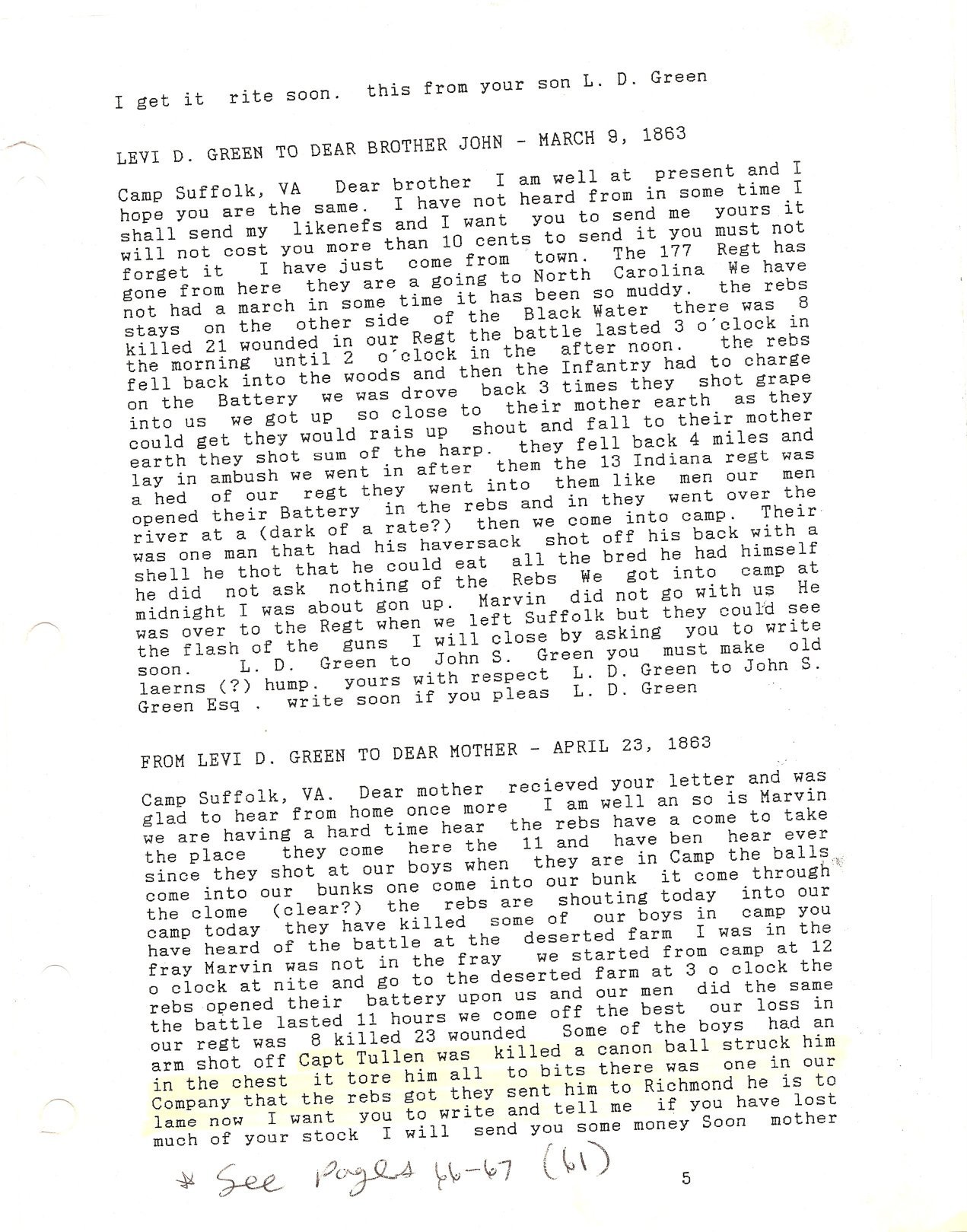
they went into them like men,
Source inferred, check against scan
See how the book uses these words
The column went on at noon toward Carrsville. At Pecosin Creek the 13th Indiana caught Pryor's rear guard, and Spear's cavalry chased it two miles past Carrsville and found nothing. Bowen wrote that Pryor got away
only by crossing the Blackwater and burning the bridge. Pryor wrote that he left the field "leisurely, marching 3 miles in so many hours." Levi watched the Indiana men go in ahead of his
Book context excerpt, up to 400 characters. This is not the full chapter.
Garland H. Green Jr.’s research
About this Letter
Levi Green wrote this letter from Suffolk on January 6, 1863, five days after the country he was fighting for changed its purpose. On New Year’s Day, while Levi sat in winter camp, President Lincoln had signed the Emancipation Proclamation, and the war to hold the Union together became a war to end slavery. Levi does not mention it, and there is no sign he yet knew what it would mean. His mind is on his pay and his father’s farm.
The war around him had settled into a hard, watchful routine. His regiment, the 130th New York, still held the Union works at Suffolk, Virginia, under Colonel Alfred Gibbs, and rode out every few weeks toward the Confederate positions across the Blackwater River. The march Levi mentions, when the regiment “had not got 3 miles from camp when we run on to them” and one man was shot, was one of those probes. In three weeks the regiment would fight its first pitched battle a few miles down that same road, at the Deserted House.
But this is a farmer’s son writing to his father, not a soldier writing of war. He has fifty-two dollars in back pay coming, four months of it, and his whole thought is to send it home. He asks his father to raise the calves for him, “I shall want them when I come home.” He wants to know whether the big steers have been sold. He is twenty-one, he says so, and says it will not stop him sending money to his pa. He is also young and unvarnished, and the letter carries a coarse joke about a neighbor that his family kept anyway. That is the gift of a letter never meant for our eyes. It is exactly as he was.
He would not come home, and the calves would grow old without him. Eighteen months after he wrote this, Levi was captured south of Petersburg and died in the prison stockade at Camp Lawton, Georgia. His brother Marvin, “well” here as in every letter, was the one who came back. Levi’s service record and the finding of his grave are gathered on Levi’s own page. The pages below are the family typescript prepared by Marjorie Kuski; the transcription keeps his spelling exactly as he set it down.
Preserved from Garland’s full research page. This introduction is the author’s explanation, distinct from the letter below.
The connected source
Levi D. Green to Dear Father, January 6, 1863
Green family letter · Green family letters (transcripts of the originals, which are in family hands)
placed by its position on the page that transcribes it (check against the scan). A text match or page placement does not establish that the scan has been reviewed.
Questions to bring to the source
Who wrote this, and who was meant to read it? Is the writer describing an event they witnessed, reporting news from someone else, or remembering it later? Read the surrounding lines and compare dates, names and uncertain words.
Begin with the source page
Kuski typescript, page 5
Read beside the scan
Scan of the Marjorie Kuski typescript of the Green family letters. The quotation's words were found on this page.
A transcription has not yet been connected to this scan.
The book catalog explicitly points to these preserved site pages. Read the account and follow its reproduced documents and citations. A research account is an intermediary, not automatically the original evidence.
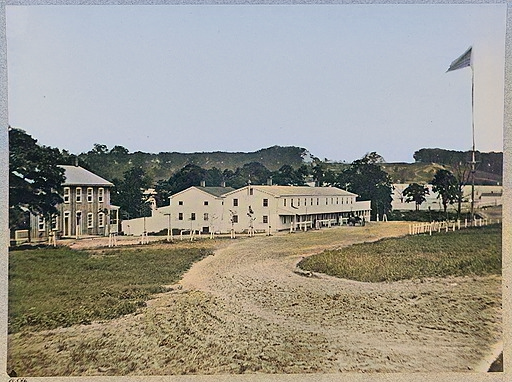
Camp Barry Washington DC · Research-page preview; original-image and enhancement credits remain on that page.