
The book is finished. GIBBS: The Forgotten Warrior of the First New York Dragoons, by Garland H. Green Jr. How to order is coming soon; you can reserve a copy now. Reserve a copy →
Alfred GibbsThe research archive
Menu

The evidence behind your reading · I Knew They Wouldn't

Read the records behind this chapter

Follow a letter, report, recollection or family record beyond the passage in the book. Each source below shows where the chapter uses it and what to examine. Open it here, compare its pages, and return without losing your chapter.

Begin with a question: What could soldiers know in the middle of a campaign?

Go beyond the book · I Knew They Wouldn't

You are reading Beaver Dam Station to Haxall's Landing · May 9 to 25, 1864. The guided starting point below explores Fredericksburg. Evidence for this particular section has not yet been separately assembled; chapter references remain available below.

Read the campaign before its outcome was known

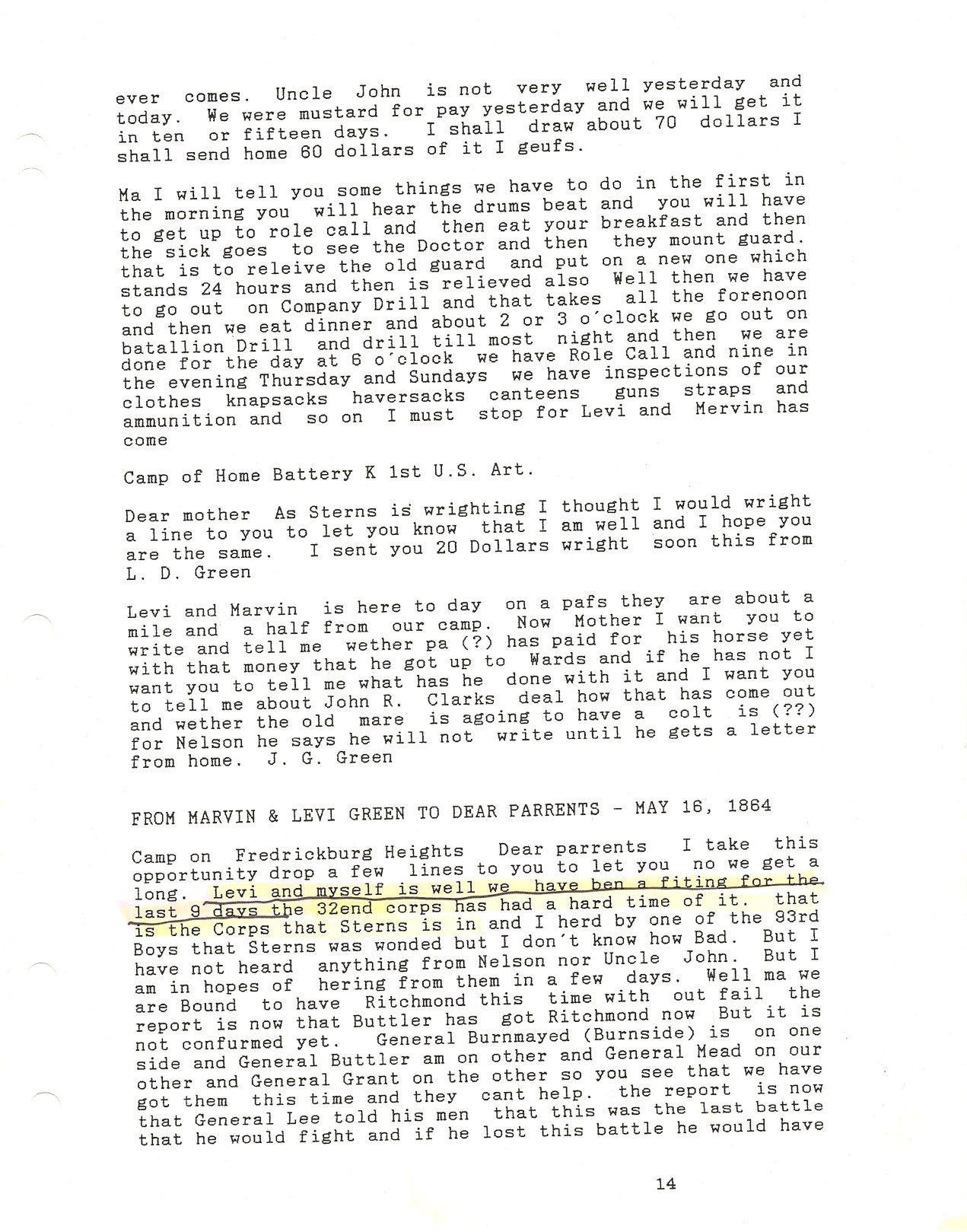
In May 1864, Levi and Marvin wrote home from the Fredericksburg heights after days of fighting. Their letter preserves confidence, rumors, and worry about their brother.

New to these records? A little context.

A transcription records the words of a letter. A typescript is a typed copy, which may survive even when the handwritten original is not on display. The linked account identifies the version it preserves; later explanatory paragraphs are not part of the letter.

What could soldiers know in the middle of a campaign?
Green Family Letters, Marjorie Kuski typescript, page 14
Green Family Letters, Marjorie Kuski typescript, page 14 · From the linked account. Its original credits and image status are preserved there.

Read the source exhibit & its explanation

Marvin and Levi’s joint letter, May 16, 1864

The joint letter reports that they are well and describes recent fighting, while relaying uncertain news about John Sterns Green. It makes the limits of wartime information visible.

What to examine: Find the statements about their own condition, the rumor concerning John, and predictions about Richmond. Sort direct experience, hearsay, and expectation.

Keep this distinction in mind: A hopeful prediction is evidence of belief at the time, not of the campaign’s actual outcome. Read the later context without erasing that uncertainty.

Keep your question in view as you explore. The reading tray retains I Knew They Wouldn't → Beaver Dam Station to Haxall's Landing. Close it to return to this point, or deliberately choose to explore outside the chapter.

12 entries · Page 2 of 2

From the chapter bibliographyFollow the referenceBibliographic illustration, not an original scan.

Reference from your chapter

Green, M. W. (1864, July 7). [Letter to his parents]. Green family letters, typescript by Marjorie Kuski. As transcribed by Green (2026), page 7643.

Preserved from the working manuscript’s reference list. The supplied citation includes details still requiring review.

FROM M. W. GREEN TO DEAR PARENTS – JULY 7, 1864 →

From the chapter bibliographyFollow the referenceBibliographic illustration, not an original scan.

Reference from your chapter

Gibbs, A. (1866, April 11). [Statement of military services]. Records of the Adjutant General’s Office, Record Group 94, file G92 CB 1869 (naId 70516353), G116-G119. National Archives. As transcribed by Green (2026), page 31740.

Preserved from the working manuscript’s reference list. The supplied citation includes details still requiring review.

Gibbs File Doc 45: Alfred Gibbs's statement of military service, with endorsements by Gen →

From the chapter bibliographyFollow the referenceBibliographic illustration, not an original scan.

Reference from your chapter

Gibbs, A. (1866, March 20). [Letter to Maj. Gen. L. Thomas, Adjutant General, enclosing a list of officers of the Cavalry Reserve Brigade recommended for brevet]. Records of the Adjutant General’s Office, Record Group 94, file G92 CB 1869 (naId 70516353), G110-G115. National Archives. As transcribed by Green (2026), page 31735.

Preserved from the working manuscript’s reference list. The supplied citation includes details still requiring review.

Gibbs File Doc 44: Alfred Gibbs to Adjutant General L. Thomas, forwarding a list of his o →

From the chapter bibliographyFollow the referenceBibliographic illustration, not an original scan.

Reference from your chapter

Abbott, A. O. (1865). Prison life in the South: At Richmond, Macon, Savannah, Charleston, Columbia, Charlotte, Raleigh, Goldsborough, and Andersonville, during the years 1864 and 1865. Harper & Brothers. https://archive.org/details/prisonlifeinsout00abbo

Preserved from the working manuscript’s reference list. Publication details have not received a new independent citation audit.

Open the cited reference →

From the chapter bibliographyFollow the referenceBibliographic illustration, not an original scan.

Reference from your chapter

U.S. Bureau of Pensions. (1865-1903). Approved pension application file for Sarah J. Benedict, widow of George D. Benedict, Company G, 1st New York Dragoons (Certificate No. WC 53,251). Record Group 15, National Archives (National Archives Identifier 115942209). As transcribed by Green (2026), page 35974.

Preserved from the working manuscript’s reference list. Publication details have not received a new independent citation audit.

Private George D. Benedict →

← Continue your chapter journey · Follow the people in this chapter →

Your chapter stays open
Your book journey · I Knew They Wouldn't · Beaver Dam Station to Haxall's LandingExplore the evidence

Compare the original with its transcription and citation.

Explore outside this journey ↗

This chapter’s source collection as JSON