
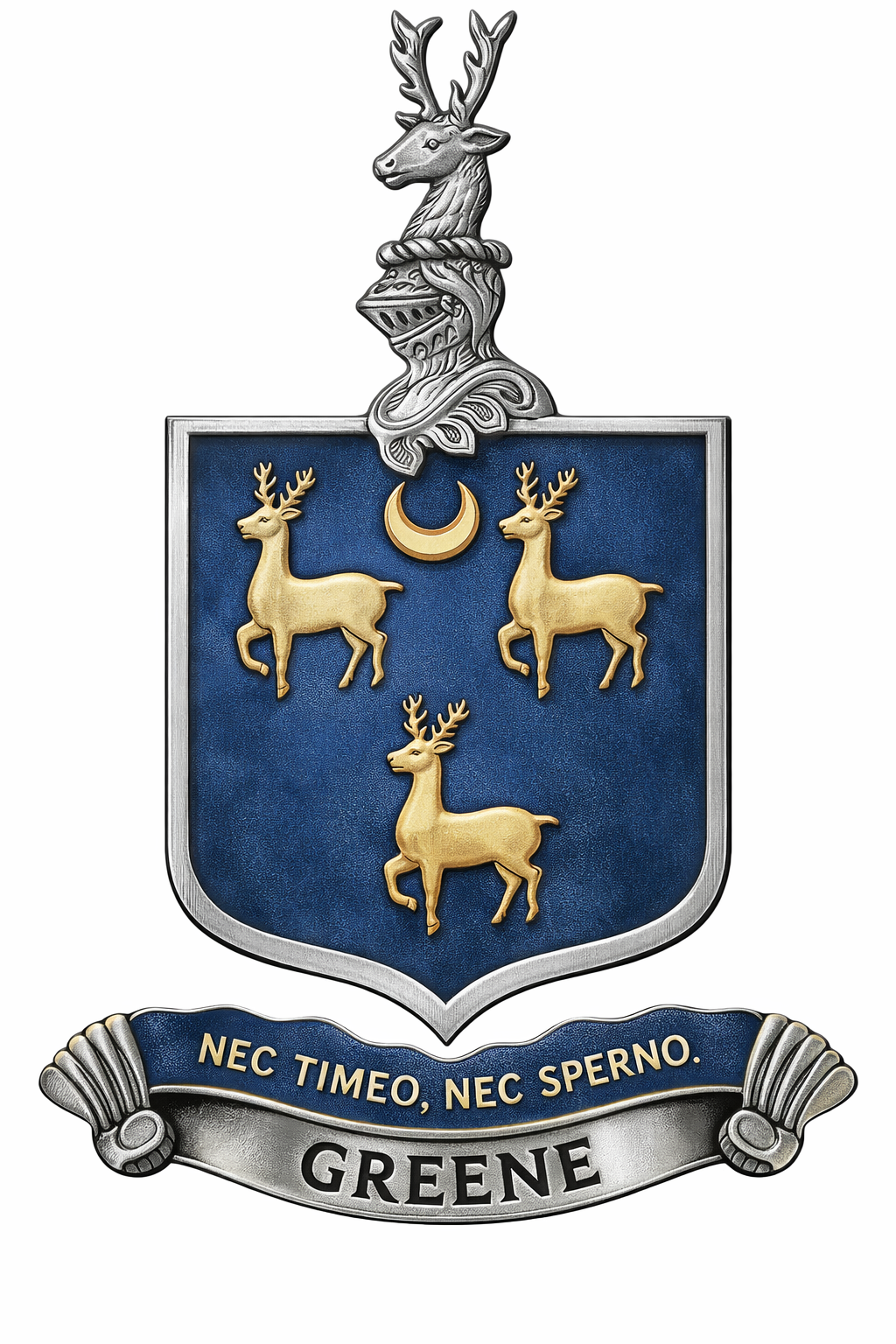
Greene family crest
Audio withdrawn, 23 September 2026. The recording “John Greene of Quidnessett: Lineage and Legacy” formerly played here was made on the identification of his wife as “Joan Beggarly,” which is disproved (see “His wife, Joan” below), so it has been withdrawn.

Table of Contents

A Greene Family Page · The AlfredGibbs.com Archive

Introduction

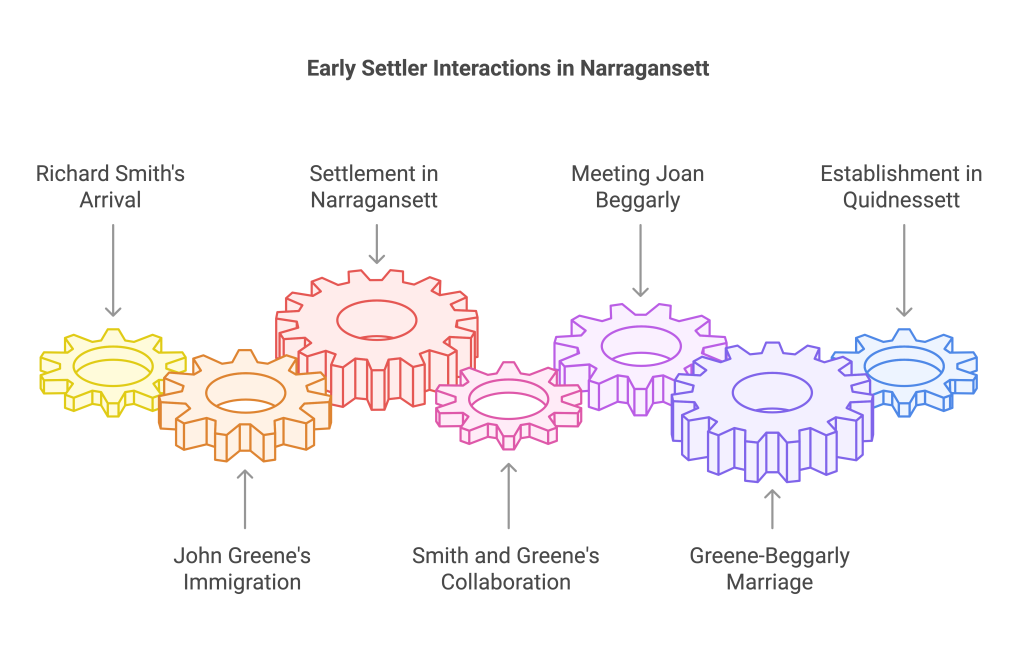
John Greene of Quidnessett (1606–1695) immigrated to the New World in 1635 aboard the ship named Matthew. By approximately 1639, he settled in the Narragansett country, an area dominated by the presence of Richard Smith, the first European settler in the region. Smith had established a trading post at Cocumscussoc (modern-day Wickford, North Kingstown) on the western side of Narragansett Bay, making him a central figure in the early development of the area.

RESEARCHER’S NOTE: John Greene and the Matthew [AKA Mathew]

John Greene, born 1606 in England, immigrated to the New World in 1635, likely aboard the Matthew. Historical records suggest that this ship, under the command of Richard Goodladd, departed London on May 2, 1635, bound for St. Christopher (modern-day St. Kitts) in the West Indies. The Matthew carried a diverse group of passengers, including a “Greene Jo,” aged 29, whose name and age match John Greene’s profile at the time. While the exact connection remains circumstantial, Greene’s presence aboard this ship aligns with his documented journey to the New World. After a brief period in the West Indies, Greene continued to New England, eventually establishing himself in the Narragansett country. View the Manifest of the Matthew 1635

RESEARCHER’S NOTE – MULTIPLE MATHEWS:

The occurrences of both “Mathew of London” and “Matthew of London” were identified in the document, confirming that both spellings were used historically. The document records “Mathew of London” as the primary spelling when referencing the ship captained by Richard Goodladd [read more about Doodladd HERE], such as for the voyage from London to St. Christopher’s on May 21, 1635
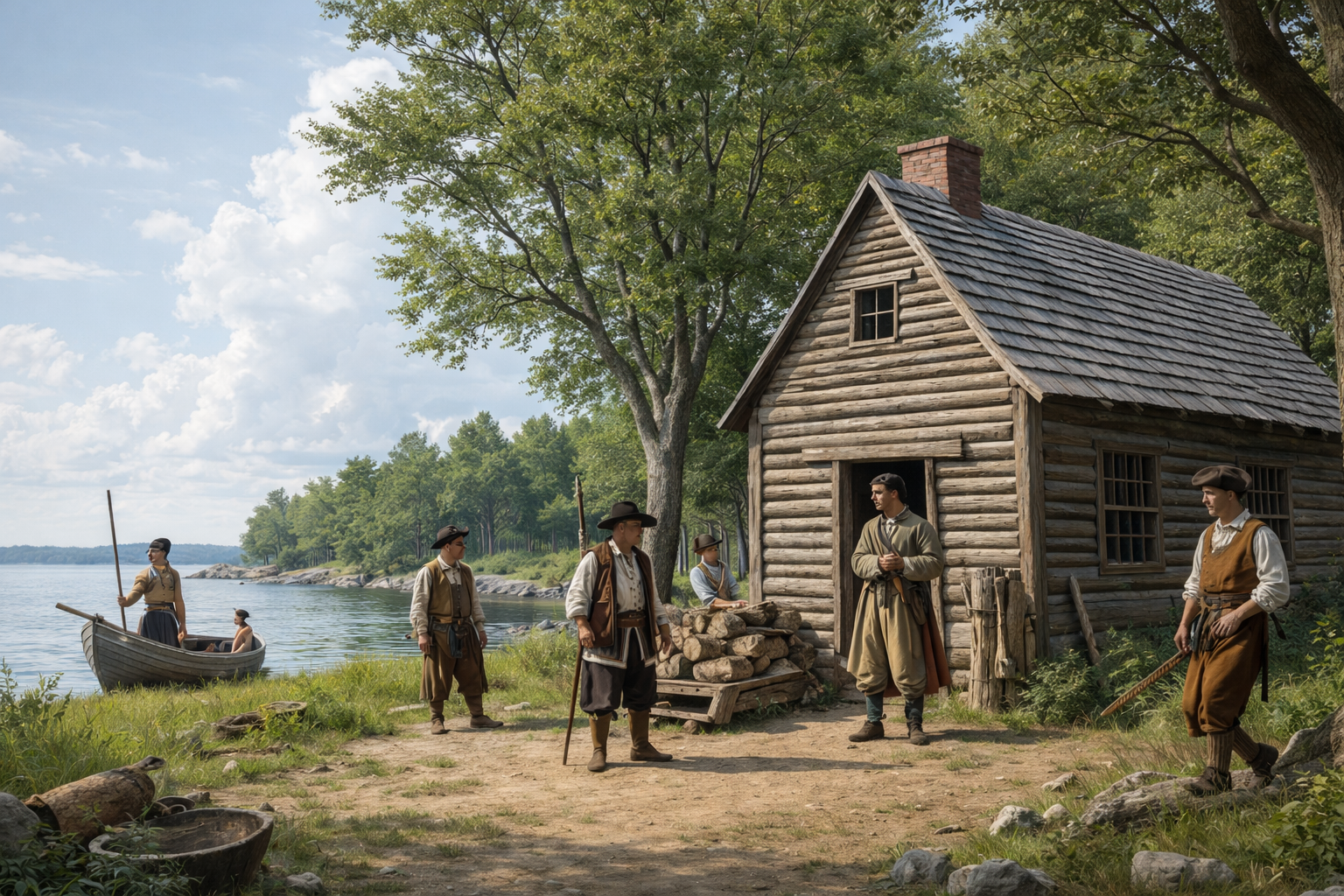
John Greene  and Richard Smith: The First European Settlers

Richard Smith (c. 1596–1666) was not merely one of the early settlers but the first European to establish a permanent presence in the Narragansett country. Around 1637 (or slightly later, per some accounts), he built the first English house and trading post among the Narragansett Native Americans at Cocumscussoc. His trading post became a hub for commerce and interaction, laying the foundation for what would eventually become the village of Wickford. Smith’s settlement was a critical point along the Pequot Path (later the Post Road), connecting New York and Boston.

Smith’s unique position as the first European in the area brought him into close relationships with both the Native Americans and the few settlers who would follow, including John Greene of Quidnessett.

John Greene’s Arrival and Connection to Smith

When John Greene arrived in the Narragansett region, he initially lived and worked with Richard Smith at Cocumscussoc. Smith provided Greene with a base of operations and mentorship as they collaborated on trade with the Narragansett people. Greene later testified that he had lived with Smith for “forty years and more” and described their efforts to establish a foothold in the area when there were no other English settlers within 20 miles.

RESEARCHER’S NOTE: The Relationship Between John Greene and Richard Smith

John Greene of Quidnessett and Richard Smith shared a significant partnership that shaped the early settlement of the Narragansett region. Richard Smith, the first European settler in the area, established Cocumscussoc (later known as Smith’s Castle) in the 1630s, serving as a vital trading post and hub of interaction with the Narragansett people. Smith’s efforts laid the groundwork for subsequent settlers like John Greene, who arrived in 1635.

Upon his arrival in the Narragansett country, Greene lived with Smith for several years. Greene’s testimony that he had lived with Smith for “forty years and more” underscores the closeness of their relationship. Smith likely provided mentorship and resources to Greene, helping him establish himself in the region. Their collaboration in trade and settlement activities created opportunities for Greene to build his own homestead in the nearby Quidnessett area by 1639.

The records do not say how or when Greene met his wife, Joan. (Correction, 23 September 2026: this paragraph formerly said that Smith introduced him to “Joan Beggarly” about 1642. See “His wife, Joan” below.)

While Greene’s early years were closely tied to Smith’s resources and influence, he transitioned to an independent landowner and community leader in Quidnessett. Together, Smith and Greene embodied the cooperative spirit of early colonial life, with Smith providing the economic and social foundation and Greene contributing to the region’s growth and governance. Their partnership was pivotal in shaping the early history of the Narragansett region, laying the groundwork for future generations.

His wife, Joan

John Greene’s wife was named Joan. She is known from one set of records. On 24 March 1681/2 he deeded land at Quidnessett to his sons James and Daniel, each to pay thirty shillings a year “as long as the father or mother should live,” and the deed to James names “Joane Greene, his wife.” She was alive then. Her maiden name, birth, marriage date and death are not recorded, and no record calls her Beggarly. The deeds are shown and transcribed on Joan, wife of John Greene of Quidnessett: the Narragansett record.

Frederic L. Greene said the same in 1894: “His wife, in 1682, at the time of the transfer of land to his sons, was named Joan, but nothing further is known about her.” (Descendants of Joseph Greene of Westerly, reproduced on this site as Descendants of Joseph Greene of Westerly, R.I.)

Correction, 23 September 2026: Joan was not Mrs. Beggarly. This page formerly said that Greene met “Joan Beggarly,” a young widow from Massachusetts, through Richard Smith and married her about 1642, and an addendum told her story. That woman was Alice Daniell, called Mrs. Beggarly, and she was the second wife of John Greene the surgeon of Warwick, not of John Greene of Quidnessett.

The proof is in the Providence town records. On 27 January 1682/3 the surgeon’s son wrote to the town about a lot “Layd out to my motherinlawe before my father Mr John Greene ser maried her who was at that time called Mrs Alse Daniell” (Early Records of the Town of Providence, XVII, p. 9). The deed of that lot was made by “John Greene of Warwick Senr” and confirmed in 1659 by his widow, Philip (Early Records, I, p. 105).

The story that Mrs. Beggarly married John of Quidnessett was first printed by La Mance in 1904, with no source. Both Providence records are reproduced and transcribed on Alice Daniell, called Mrs. Beggarly: second wife of John Greene the Surgeon.
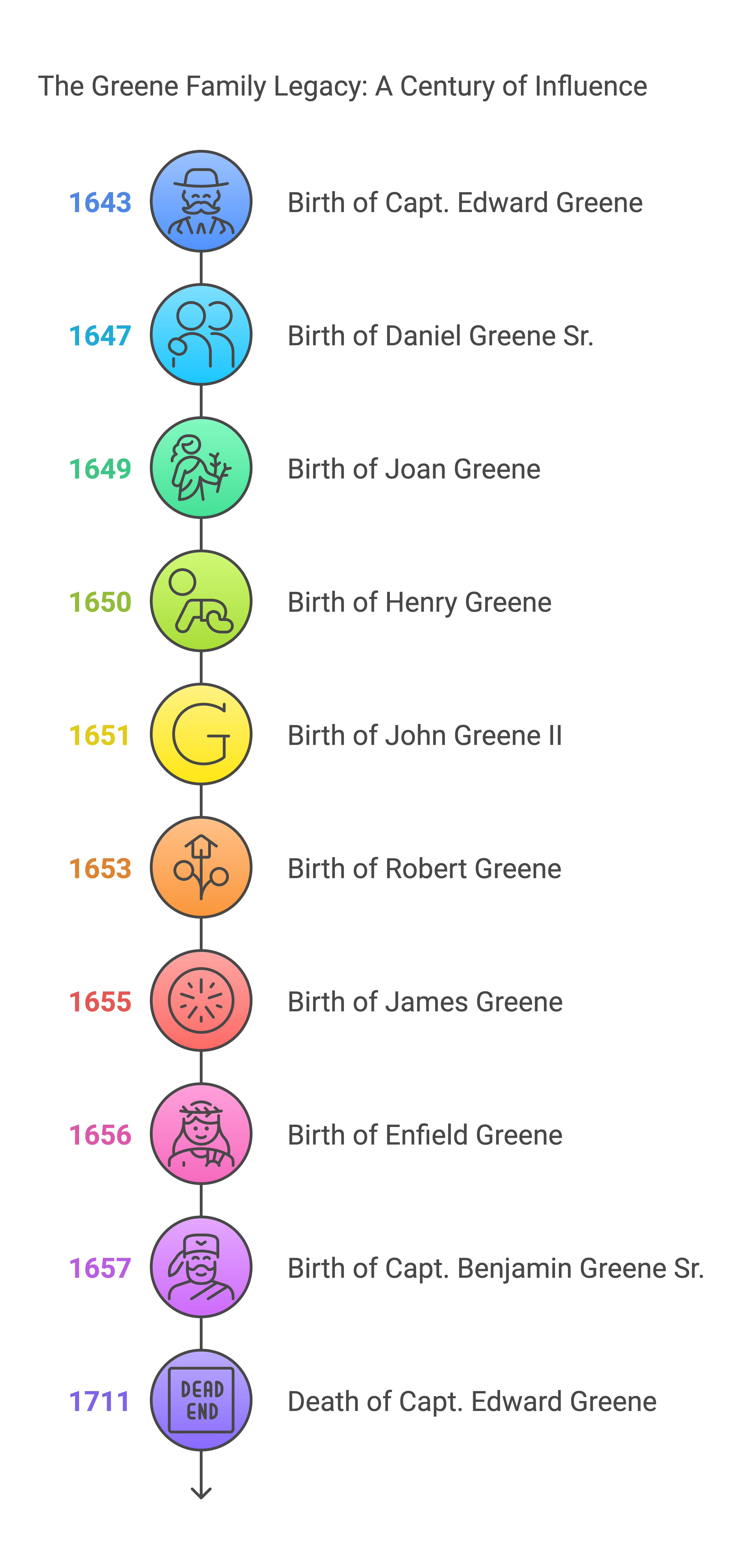
 

Building a Family and Legacy

After their marriage, John and Joan Greene established their home in Quidnessett, where they raised a large family, including:

The Greene family grew to prominence in Rhode Island, with several sons achieving freeman status in 1671, granting them legal and political rights within the colony.

Land Disputes and Leadership

The Narragansett country was claimed by Rhode Island and Connecticut at once, and the land John Greene held at Quidnessett rested on the Atherton purchase of 1659, which Rhode Island refused to recognise. He was a party to that quarrel, never a negotiator of it. On 3 July 1663 he signed with the other Wickford men to be under Connecticut; in May 1664 Rhode Island took him from his house under a warrant, and at Newport he petitioned for pardon and was kept as a freeman; in May 1671, at the court held at Aquidnesset, he was confirmed in his land and took the engagement; on 1 January 1671/2 he and five partners bought the Devil’s Foot tract from the sachem; in July 1679 he swore the affidavit that Richard Smith used to defend his title, and on 29 July 1679 he signed the petition of the inhabitants of Narragansett with his sons Daniel and James.

The John Greene who negotiated the dispute was another man, Major John Greene of Warwick, the surgeon’s son, agent for Rhode Island in England and later Deputy Governor. The records, with every document shown, are on John Greene and Richard Smith: Their Roles in the Narragansett Land Disputes and in the section “The arrest of 1664” on John Greene of Quidnessett.

Correction, 22 September 2026: this section formerly said that John Greene “played an active role in resolving” the land disputes and signed a petition to the Crown in 1676. No record supports either statement; the petition he signed is dated 29 July 1679. The paragraph was rewritten from the records on that date.

Later Years and Final Resting Place

After Joan’s death, on a date not recorded, John Greene moved to live with his son John in Coventry, Rhode Island. He passed away in 1695 at the age of 89 and was buried in the “Old Field Lot,” now believed to be part of Maple Root Cemetery. While his grave remains unmarked, his contributions to Rhode Island’s history endure through his descendants and the land he helped to settle.

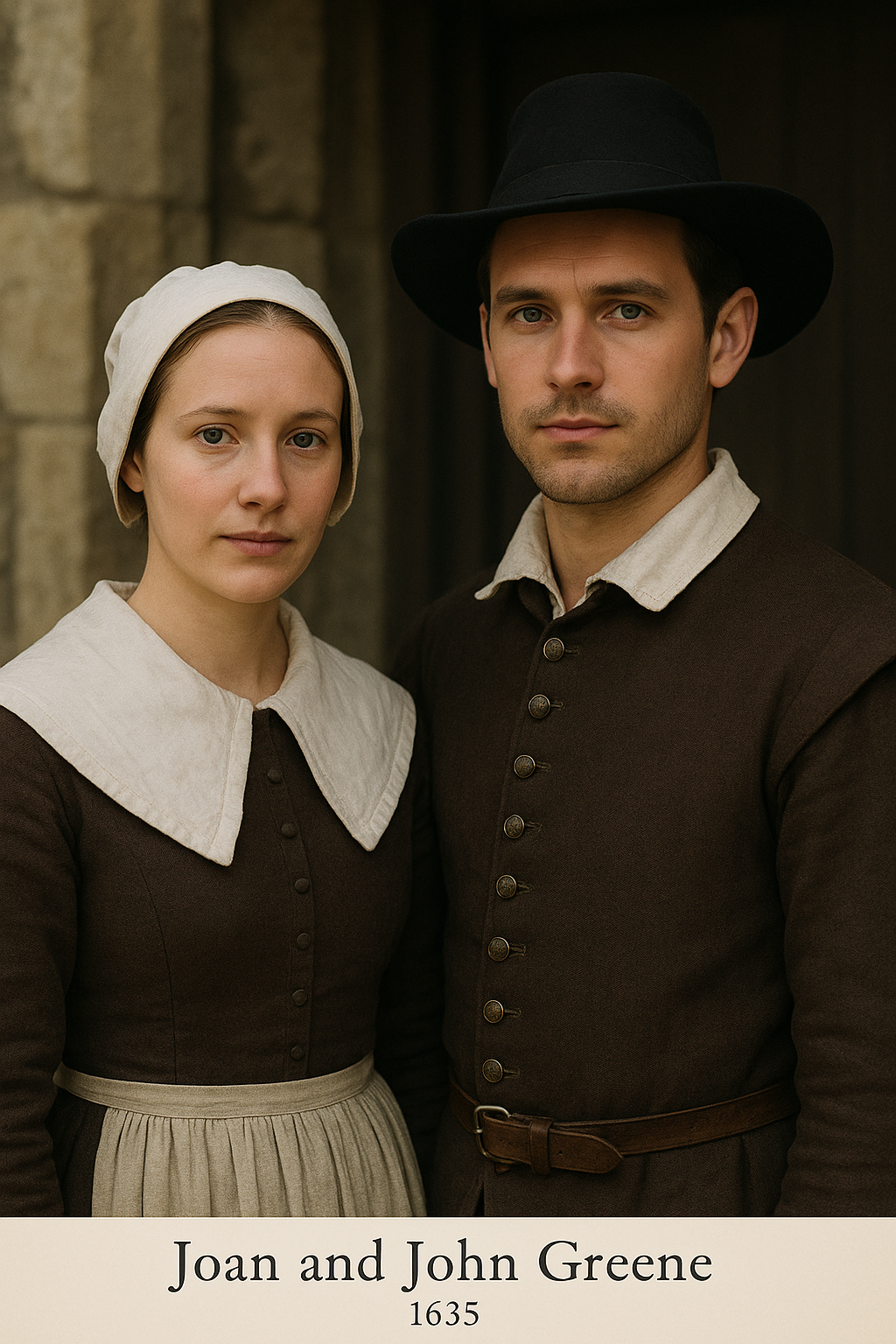
There are no paintings of John and Joan; however, this is a digitally mastered likeness of what these two may have looked like in period clothing.

Update, 23 September 2026: the Salem places formerly described here, the cottage on Skelton’s lot and the farm at Skelton’s Neck, belong to Alice Daniell, not to Joan. They are on Alice Daniell, called Mrs. Beggarly. Joan’s own record, the deeds of 1682 and what surrounds them, is on Joan, wife of John Greene of Quidnessett: the Narragansett record.

Films withdrawn, 23 September 2026. The two films formerly listed here were made on the Beggarly identification, which is disproved, and have been withdrawn.

The addendum on “Joan Ann Beggerly,” withdrawn 23 September 2026

An addendum here told the life of Mrs. Beggarly: her arrival in Massachusetts Bay in 1630, the divorce hearing of June 1636, Winthrop’s note of December 1638 that “one Greene” had married her, and Benedict Arnold’s report in January 1643/4 that “Mr. Green’s wife is dead.” Every one of those records belongs to Alice Daniell and John Greene the surgeon, not to Joan and John Greene of Quidnessett. The Salem map that stood here belongs to her too. All of it is transcribed, with page images, on Alice Daniell, called Mrs. Beggarly: second wife of John Greene the Surgeon.

References:

Find A Grave. (n.d.). Joan Beggarly Greene (1610–1644) [Memorial ID 35999358]. Retrieved January 25, 2025, from https://www.findagrave.com/memorial/35999358/joan_beggarly_greene (This memorial was then titled “Joan Beggarly Greene”; by 23 September 2026 it had been renamed “Mary Tibbett Greene.” It is kept here only as the source of the dates 1610 and 1644, which this page no longer uses. The one record of John Greene’s wife, his deed of March 1681/2, names her Joane.)

RESEARCHER’S NOTE:

A word to readers and correspondents:
This page is one of more than a dozen on this site built from transcriptions, records, maps and citations, so please look through them before deciding that something here is undocumented. Readers have written to challenge parts of this family history, and the records have since shown that this page was wrong about Mrs. Beggarly: she was not the wife of John Greene of Quidnessett, and the page was corrected in September 2026. Corrections backed by records are always welcome, and I will keep making them. The rest of the story is on these pages:

Gibbs, A. (n.d.). John Greene of Quidnessett 1606–1695. General Alfred Gibbs. Retrieved May 12, 2025, from https://alfredgibbs.com/john-greene-of-quidnessett/Alfred Gibbs

Gibbs, A. (n.d.). The Story of John Greene of Quidnessett and Joan Ann Beggarly. General Alfred Gibbs. Retrieved May 12, 2025, from https://alfredgibbs.com/the-story-of-john-greene-of-quidnessett-and-his-wife-joan/Alfred Gibbs

Gibbs, A. (n.d.). From Gillingham to Quidnessett: The Greene Family’s Journey and Legacy in the New World. General Alfred Gibbs. Retrieved May 12, 2025, from https://alfredgibbs.com/from-gillingham-to-quidnessett-the-greene-familys-journey-and-legacy-in-the-new-world/

Gibbs, A. (n.d.). Site Map. General Alfred Gibbs. Retrieved May 12, 2025, from https://alfredgibbs.com/site-index-2/Alfred Gibbs

Green, G. H., Jr. (n.d.). Joseph Greene of R.I. AlfredGibbs.com. Retrieved July 18, 2025, from https://alfredgibbs.com/descendants-of-joseph-greene-of-westerly-r-i/

Greene, F. L. (1894). Descendants of Joseph Greene, of Westerly, R.I.: Also, other branches of the Greenes of Quidnesset, or Kingston, R.I., and other lines of Greenes in America. Joel Munsell’s Sons. https://archive.org/details/descendantsofjos00gree


RESEARCHER’S NOTE: Updated Information 01/01/2026

A dedicated research page for John Greene and Joan Ann Beggarly is currently available via the link below. Please note that while this data is being shared for your convenience, it has not yet undergone a full factual verification. I will integrate these records into this primary page once a thorough review is complete.

John Greene

Updated 21 September 2026, corrected 23 September 2026: the surviving records of Mrs. Beggarly, including the 1636 divorce hearing, her own letter to Governor Winthrop signed Alice Daniell, Winthrop’s 1638 note on her marriage to “one Greene,” and Benedict Arnold’s report of a death in January 1643/4, are transcribed and cited on Alice Daniell, called Mrs. Beggarly. They show that she married John Greene the surgeon, not John Greene of Quidnessett.

Views: 652

Explore the evidence

View this article’s connected sources and media →

About this page

This article was brought over from AlfredGibbs.com. Its preserved text, media and citations remain available for comparison.